



Abstract
Research in organizational theory takes as a key premise the notion that organizations are “actors.” Organizational actorhood, or agency, depends, in part, on how external audiences perceive organizations. In other words, organizational agency requires that external audiences take organizations to be agents. Yet little empirical research has attempted to measure these attributions: when do audiences assume that organizations are agents and how have these attributions changed over time? In this article, I suggest that scholars can triangulate across computational methods—including named entity recognition, dependency parsing, topic models, and dictionary methods—to analyze attributions of agency in text, discourse that I term “agent talk.” I demonstrate the utility of this approach by analyzing how business organizations were discussed as agents during a key period of organizational development, the turn of the twentieth century. Analyzing articles from two of the leading national newspapers, the Wall Street Journal and New York Times, I examine agent talk in everyday business discourse. I find that agent talk generally increased over the early twentieth century, as organizations were depicted as active subjects in text and personified as speakers. Moreover, I find that this discourse was concentrated in social and legal semantic contexts: in particular, contexts relating to labor, regulation, and railroads. Finally, I show the uneven growth of this rhetoric over time, as organizations across different semantic arenas were personified as speakers. Overall, these results show how measures of discourse can provide a window into how and when audiences endow organizations with actorhood.
Introduction
In The Asymmetric Society, James Coleman argued that a defining feature of the modern American economy was the growing prominence of “corporate actors” over natural persons (Coleman 1982). The idea of organizations as unified, purposeful actors is not only a mainstay of organizational and institutional theory (King, Felin, and Whetten 2010; Meyer and Jepperson 2000; Selznick 1948; Steele and King 2011) but also reflects how lay individuals cognize (Plitt, Savjani, and Eagleman 2014) and relate to organizational actors—personifying them as unified entities with agency and intentionality (King 2015:163–64).
While the notion of corporations as unified, intentional actors—that is, entities capable of “behaving in a purposeful, intentional manner” (King et al. 2010)—is now commonplace, this understanding would have likely struck nineteenth century Americans as peculiar. By the late nineteenth century, the language of the popular press, as well as business and legal scholarship, still often treated business organizations like corporations as acting through their shareholders or directors—“the company carried on their concerns through the agency of their directors” (Myers v Perigald 1851, emphasis added)—language that foregrounded business organizations as aggregates of individuals, not actors in their own right (Ireland, Grigg-Spall, and Kelly 1987:151; Schane 1987:599).
The institutionalization of business organizations as actors reflects a more general social phenomenon whereby entities of all sorts—organizations (Czarniawska 1997; Meyer and Bromley 2014), religious institutions (Guhin 2020), markets (Carrard 2009; Kharchenkova 2018), states (Balmas 2018; McGraw and Dolan 2007), and even objects (Kear 2017; Vertesi 2015)—become personified as agents. For instance, Guhin (2020:9) finds that religious educators often personify institutions like prayer or objects like the Bible as agents that “speak” to, “act” on, and make “demands” of their students—a rhetorical practice wherein educators substitute their own agency for that of the personified institution. Similarly, Kharchenkova (2018) discusses how in China, market actors “personify” the art market as an “organism” pursuing its own trajectory, a discursive description that legitimates their own passivity in the face of market changes, since the personified market seemingly evolves on its own.
Understanding the cultural process by which an organization, institution, or object is categorized as an actor requires attention to how these entities are treated in discourse: when they are treated as subjects, what qualities are ascribed to them, what actions they are associated with, as well as the contexts in which these attributions are made. Thus far, sociologists engaged in analyzing cultural understandings of actors in discourse have generally taken one of two approaches. First, in the tradition of John Mohr, sociologists have dug deeply into the semantic networks of text, parsing sentences in order to characterize social actors based on their pattern of relations to other actors (e.g., Franzosi, Fazio, and Vicari 2012; Mohr 1994; Mohr and Duquenne 1997; Mohr and Lee 2000). Second, sociologists have recently begun using automated computational methods on large datasets that draw on co-occurrence structures to study conceptualizations of categories of actors, typically over large swaths of time (e.g., Boutyline, Arseniev-Koehler, and Cornell 2022; Stoltz and Taylor 2021).
In this article, I suggest that we can draw on elements of both approaches to study a prior question: when do certain kinds of entities become cast as actors in discourse in the first place? I suggest that rather than analyze actors, these methods can also be used to analyze the discourse of agency—in particular, a process of “agent talk” in which collective institutions, organizations, or non-human entities are rhetorically personified as agents. By combining the close semantic analysis afforded by Natural Language Processing (NLP) techniques like dependency parsing with analyses of longer-term historical shifts and narrative contexts, we can obtain an empirical measure of where and when such entities are considered to be agents by external audiences. This article thus presents an approach that demonstrates how a novel combination of computational methods can aid in measuring understandings of agency.
I demonstrate the utility of this approach through an analysis of the development of organizational actorhood during the turn of the twentieth century, a period encompassing the American second industrial revolution. To examine the historical development of business organizations as actors, I draw on a text analysis of how business was discussed in two of the leading sources of national financial and business news between 1890 and 1934, the New York Times and Wall Street Journal. I leverage grammatical parsing, named entity recognition, dictionary analysis, and topic modelling across a set of about 436,000 business-related articles to identify when organizations were discussed as actors. This approach, which triangulates among distinct natural language processing tools, allows me to ascertain how “agent talk” was being deployed, as well as analyze whether and how such discourse changed over time.
This article offers both methodological and substantive contributions. Methodologically, I show how automated computational tools like dependency parsing can be combined with tools like topic modeling and dictionary analysis to provide a measure of understandings of agency—attributions which are essential to theories of organizational actorhood and which are core to relational approaches to agency in sociology, but which are rarely measured empirically. While the approach developed here focuses on the perceived agency of business organizations, it can be expanded to other social arenas to examine when other collective or non-human entities are treated as actors in discourse. In addition, I demonstrate the validity of automated tools like named entity recognition and dependency parsing on nineteenth and early twentieth century business texts, as well as identify some limitations.
Substantively, my findings provide empirical evidence for prevailing institutional theories of organizational actorhood and extend existing findings on its emergence. First, institutional theory has generally depicted the rise of organizational actorhood as a broad, generalized phenomenon of the post-World War II era (Meyer 2010; Meyer and Bromley 2014; Meyer and Jepperson 2000). I show the antecedents of this rise and demonstrate that during the first part of the 20th century, the press had already begun to increasingly depict organizations as agents. Second, institutional theory has stressed that organizational actorhood develops as a response to interactions with external others—wherein audiences hold organizations accountable for their actions and elicit organizational commitments (Czarniawska 1997; King 2015; King et al. 2010; Selznick 1948). Here, I find evidence that agent talk was particularly concentrated in social and legal semantic contexts: articles discussing labor disputes, regulation, and railroads, as well as in organizational speech about courts and expectations for future stock performance. Through examining how agent talk is deployed in these settings, I provide evidence that supports these theories. That is, external audiences appear more likely to attribute actorhood in the context of disputes and negotiations with organizational members, the state, and the law. Overall, my results show how and when external audiences attribute agency, demonstrating the growth of this discourse at the turn of the century.
The Discourse of Agent Talk
Actors and Agency in Text
Sociologists interested in the formal analysis of culture have long recognized that the meaning attached to actors can be gleaned from the patterned way that they appear in discourse. In his now classic study, Mohr (1994) sought to understand the meaning that Progressive Era relief organizations attributed to various categories of actors—for instance, soldiers and mothers—by examining patterns of associations in how these social identities were treated in text. Specifically, Mohr performed string searches to identify categories of individuals and the set of services provided to them by social welfare organizations. Arguing that similarities in structural position were indicative of similarities in moral meaning, Mohr's analysis developed a generative technique for examining how different kinds of actors occupy distinct roles (Mohr and Duequenne 1997) and status identities (Mohr and Lee 2000; Mohr and Neely 2009).
Similarly, Franzosi (1989, 1990) introduced computer-assisted semantic grammar analysis to allow sociologists to formally examine relations of actors in text. Semantic grammar analysis assisted coders in parsing sentences in their textual data to identify semantic triplets composed of actors (subjects), actions (verbs), and their objects. Franzosi demonstrated that patterns of triplets could distinguish historical episodes (Franzosi 1989, 1990) and aid in the analysis of events (Franzosi 1998). Importantly, Franzosi and his colleagues also linked the study of semantic structure to broader and longstanding sociological questions about agency (Franzosi et al. 2012). As Franzosi argued, “both semantic grammars and network models are fundamentally concerned with actors and their actions, with agents and agency” (1998: 81). Since agency is ultimately “about what the person actually does (action)” (Franzosi et al. 2012:4), semantic structures could be used to center the actor and their set of actions in the analysis. While trailblazing, this method, which depended on hand-coding, was ultimately limited in the amount of text it could analyze and thus in its capacity to identify broader patterns of historical change.
Recently, innovations in computational analysis have automated the analysis of textual data, vastly expanding the potential for the historical analysis of discourse. Thus far, sociologists have largely approached automated textual analysis through methods that rely on the co-occurrence of words within a corpus, like topic models or word embeddings (DiMaggio, Nag, and Blei 2013; Kozlowski, Taddy, and Evans 2019; Rule, Cointet, and Bearman 2015; Stoltz and Taylor 2019, 2021). As applied to the study of actors, these methods analyze meaning through the co-occurrence of categories of actors, like gender categories or immigrant categories (Boutyline et al. 2022; Stoltz and Taylor 2021), and other words, concepts, or cultural associations that appear in the text (Stoltz and Taylor 2019).
Yet, as Franzosi noted, the study of agency requires attention to what actors do, which, in turn, requires linking entities to their actions and to the semantic structure in which action takes place. The use of automated tools for semantic or dependency parsing remains relatively rare in sociology, though recently scholars are demonstrating the method's applicability to a range of sociological questions (Goldenstein and Poschmann 2019; Mohr et al. 2013; Stuhler 2021). In this paper, I argue that we can use these tools, in combination with others, to revisit the question Franzosi and colleagues raised about the measure of agency in text: that is, how semantic parsing tools can provide a measure of attributions of agency, a concept often at the center of theoretical debates but seldom explicitly measured (Franzosi et al. 2012:4).
In particular, these tools can be useful when studying attributions of agency in the context of collective and non-human entities in text—grammatical subjects where attributions of agency are more complex and less readily attributed than with human subjects. 1 In what follows, I draw from organizational and institutional literature on actorhood to first discuss what organizational agency entails, why the construal of organizational agency is important, and how the discourse of agency in text offers a useful measure of such construals.
Organizational Actors and Measuring Agent Talk
A vast literature in institutional theory and organizational sociology discusses organizations as agents—unified social actors “in their own right” (Bromley and Sharkey 2017; Coleman 1982; King et al. 2010; Meyer and Bromley 2014; Meyer and Jepperson 2000; Whetten and Mackey 2002). That is, although organizations are collectives composed of various individuals with competing goals and interests, organizations act as unified, purposive, and directed. Organizations enter contracts, they own property, and they are held accountable for their actions, both in law (Ciepley 2013; Coleman 1982) and by the public at large (King et al. 2010; McDonnell, King, and Soule 2015). Beyond their legal status as actors, organizations form coherent and enduring identities (Glynn and Watkiss 2012; Whetten 2006; Whetten and Mackey 2002), they make decisions (Steele and King 2011), they come to stand for social values (Corley et al. 2006; Golden-Biddle and Rao 1997; Selznick 1953), and they present themselves to audiences as actors with duties and responsibilities (Bromley and Sharkey 2017). That business organizations act as unified social actors is so foundational to the working of the modern economy that this development has been called “perhaps the most important social fact of modern times” (King 2015:150).
Given the ubiquity of organizational actors in social life, a fuller understanding of organizational actorhood must consider how organizations are understood as actors. In organizational theory, construals of actorhood are a key part of the development of organizational agency, since what it means for an organization to be an agent is, in part, that others take an organization to be an agent. As King and colleagues put it, actorhood for organizations is an “ongoing enactment” that “derives from the expectations of others…audiences who monitor and hold them accountable for their actions” (King, Felin, and Whetten 2010: 292; see also Meyer 2010; Meyer and Bromley 2014; Pfeffer and Salancik 2003). Organizational actorhood is theorized to develop in response to the demands of external environments, including increasing regulatory requirements (Schneiberg and Bartley 2008) as well as social movement pressures (Soule 2009; Vogel 1978). In other words, unlike with human beings whose agency is typically assumed, organizations’ status as actors is a social accomplishment that reflects, in part, others taking them to be agents.
Yet despite the importance of external attributions of agency, we still have “very little understanding of how…external audiences construe organizations as actors in society” (Halgin, Glynn, and Rockwell 2018). The meaning of organizational agency—how institutions and organizations are “narrated and experienced as agentic” by individuals—is often “assumed” rather than empirically investigated (Guhin 2020:8). As Franzosi and colleagues note (Franzosi et al. 2012:4), theories of agency often outstrip measures of agency, including measures of individuals’ understandings of agency. In the case of perceptions of organizational agency, this is likely due, in part, to the fact that the agency of a collective entity forms a part of actors’ “background” understanding of business (Abend 2014). That is, individuals do not hold well-defined opinions on organizational agency that readily lend themselves to empirical analysis; rather, notions of agency underlie the more easily assessed and articulated attitudes they hold towards business in general (Abend 2014:52–54).
Here, the pioneering work of Mohr (1994), Franzosi (1989; 1990), Carley (1994) and other analysts of the formal structure of text offers a solution. As Carley (1994) notes, text provides a window into the author's mental model of the world. For instance, in her study of the textual representation of robots, she showed how descriptions of robots in science fiction could be used to identify assumptions about robots’ capacity for sentiment, consciousness, and interaction. Similarly, with respect to organizational agency, attention to “actors and their actions” (Franzosi et al. 2012:3) can reveal underlying assumptions about organizations’ capacities for action: what kinds of actions they are capable of taking and therefore what kinds of actors they are understood to be. Building on this work, I propose we can measure perceptions of organizational agency, and changes in such perceptions over time, by drawing on automated tools for textual analysis to connect organizational actors to their actions. In particular, I suggest that three types of actions are particularly useful for measuring agency.
Active subjects. First, and most straightforwardly, the description of organizations as taking action denotes a basic form of actorhood. As Coleman argued, action is the foundation of organizational agency: What makes an entity a corporate actor—and there are a variety of different kinds—is action. One can also use other kinds of indicators—whether there are resources that are seen as belonging to the corporate actor, for instance. But the essential point is that if there is a coherent, goal-directed action, there must be an actor (Coleman 1982: 33).
Attributing actions to organizations is relatively uncontroversial (King et al. 2010: 292), and our contemporary language regularly reflects this in headlines such as “Facebook acts to protect brands” (Kuchler and Garrahan 2017) or “Tesla invests in bitcoin”(Telford 2021). While commonplace, these everyday locutions denote the organization as the primary author of the action, rather than, for instance, the CEO or shareholders. Indeed, Coleman (1982: 10−12) demonstrated the rise in the proportion of references to organizational actions on the front page of the New York Times and the concomitant decline in references to the actions of natural persons over the course of the long twentieth century. Straightforward organizational action, then, provides a thin, baseline measure of actorhood.
Intentions. At the same time, organizational agency also implies something deeper than simple action. For organizational theorists, intentionality implies a thicker attribution of actorhood, distinguishing agency from mere behavior. As King and colleagues argue, what underlies actorhood is the “intentionality assumption”–that organizational “actors have some form of intentionality that underlies decision-making and behavior” (2010:292). By attributing intentionality to organizations, individuals hold organizations themselves responsible for the action in question, independently, at least in part, from the individuals who make up the organization. As King and colleagues put it, “Without this sense of internal direction and self-reflection, organizational action could not be attributed to any source other than the individuals constituting the organization or the environment in which the organization is embedded” (2010:292; see also Steele and King 2011).
The notion that agency rests on the intentionality assumption has its roots in psychology, where the capacity for mental states—thinking, judging, decision-making—points to a theory of mind (Deci and Ryan 1985; Leslie, Knobe, and Cohen 2006; Young et al. 2007). For example, Emirbayer and Mische (1998) note that agency has historically been linked with intentionality and choice. For collective entities, the capacity for “group intentionality” is the crux of philosophic debate about group agency, since intentionality and deliberation are taken as “the defining feature of agency” (Gold and Sugden 2007:123; List and Pettit 2011). As a result, the study of attributions of agency in the context of collective groups (like countries, teams, or families) or non-human objects focuses on whether and when these entities are attributed intentions, minds, and decision-making (Bloom and Veres 1999; Waytz and Young 2012). Thus, intentional action that denotes mental states, deliberation, and reasoning are particularly significant attributions of actorhood.
Speech. If attributions of intentionality measure assumptions of agency, then attributions of speech measure an important performance of agency. In the case of human beings, communication is one of the central mechanisms through which agency is performed (Emirbayer and Mishe 1998: 973).
Similarly, the ability to communicate decisions, to make promises, and to announce future actions is a core feature of why the firm as a collective organization exists in the first place (Freeland and Zuckerman 2018). That is, a tenet of organizational theory is that for organizations to have reliable identities over time, they need the capacity to speak in a unified voice and external audiences need to be able to hold them to account for such speech. As Freeland and Zuckerman (2018: 165) note, a unified voice is the essence of organization since organizations cannot coordinate if “anyone can speak publicly” on their behalf. Instead, the firm's own name must be associated with the commitment, since it is the organization itself (and not the individuals making up the organization) that is the responsible party (King et al. 2010: 293).
The importance of speech for attributions of agency in the case of nonhuman entities has been noted in other social arenas. As Guhin (2020:10–13) argues, individuals personify religious institutions as speakers (in particular, “asking”, “demanding”, or “saying”) to endow these institutions with authority. More generally, scholars note that because communication is an essential aspect of human behavior, attributing communication to nonhuman objects, animals, or technologies is a key signal of anthropomorphism (Harrison and Hall 2010; Richert et al. 2018).
Table 1 summarizes these components of “agent talk.” Importantly, these measures of attributions of actions, intentionality, and speech are not meant to provide an exhaustive inventory of the discourse that denotes agency; in other contexts, other discursive attributions (like assigning names to robots or personality traits to pets) may also be important (Darling 2015; Epley et al. 2008). Here, I focus on subjects, intentionality, and speech because these have been central to organizational theories of actorhood and to discussions of agency in the context of collective and nonhuman entities more generally.
Components of “Agent Talk”.

Organizational Actorhood at the Turn of the 20TH Century
In this paper, I focus on analyzing agent talk through the years between 1890 and 1934. This period, widely recognized as a turning point in the history of American capitalism (Chandler 1990; Dobbin 1994; Roy 1997), is one in which popular construals of business and corporations were rapidly evolving. Over the course of a few decades, Americans were first introduced to, and gradually reconciled with, large, national corporations (Lamoreaux 1985). 2
Focusing on this period also allows me to address two common, yet seldomly empirically investigated, theories about organizational agency. First, institutional theory raises questions about when we expect to see the rise of organizational agency, particularly among American businesses. While a great deal of literature has studied the proliferation of the American corporation, as it shifted from a legal form often used as an extension of state power (Handlin and Handlin 1969; Kaufman 2008) to the dominant mode of organizing private capital (Dobbin 1994; Perrow 2002; Roy 1997), little research has examined whether or how popular conceptions of organizational agency likewise shifted. Meyer’s (2010) foundational work on business organizations as actors has cast the rise of organizational actorhood as a part of a global and generalized postwar shift that took off in the second half of the twentieth century (also see Bromley and Sharkey 2017:3). Here, organizational actorhood is theorized to have expanded in response to the global postwar environment, which was characterized by widespread cultural rationalization, scientism, and, eventually, neoliberalism (Meyer 2010; Meyer and Bromley 2014:369). 3 Yet, to date, there has been no empirical examination of popular construals of organizational actorhood during the initial rise of large corporations. This period was not only characterized by the growth of large organizations, but concepts of organizational personhood were also acquiring more significance in legal and business circles (Knight 2022). Whether or not the public likewise attributed increasing agency to organizations during this period remains an open question.
Second, there is a question about under what conditions attributions of actorhood by external audiences are particularly common. Institutional theory argues that organizational actorhood arises when external audiences take the organization to be capable of actorhood. This view reflects sociological work in which the individual actor emerges through interaction with, and in the context of apprehension from, social others (Goffman 1959; Czarniawska 1997). For classical organizational theorists, organizational agency, too, develops in interaction with social others. For Coleman, this agency emerges in relationship to the law (Coleman 1982). For Selznick, organizations develop their actorhood through interactions with contending social groups, who try to elicit organizational commitments and hold them to account (King 2015; Selznick 1948, 1953). 4 Similarly, for Czarniawska (1997: 46), organizations are anthropomorphized when audiences need to form expectations of organizations and hold them accountable “both as citizens and as consumers and producers.” Across all these views, interaction—both within the organization and between the organization and external social groups—is theorized to drive agency. Yet little empirical work has sought to examine whether external audiences are, in fact, more likely to perceive organizational agency in these contexts where social interaction is at stake. Identifying when audiences personify organizations is therefore key to understanding the development of organizational agency.
Data
To address these questions and analyze attributions of agency by external audiences, I focus on discussions of businesses in the popular press. News media was a crucial site of debate about the new corporate form, and historians have frequently drawn on text and newspapers to analyze public opinion about business during this time (e.g., Galambos 1968, 1975). To examine how the public construed business agency, I assemble a corpus of business-related news articles published between 1890−1934. I select articles from two New York-based newspapers: the New York Times (1890−1934) and Wall Street Journal (1905−1934). 5 Because New York was the financial and business hub of the United States during this period (Beckert 2003), these papers are particularly critical to understanding developing conceptions of organizational actorhood.
I collected the text using the Proquest database for historical newspapers (http://www.proquest.com). To examine business discourse, I first selected all articles that included any reference to a business keyword. 6 As is common with historical text data, these documents contain a number of optical character recognition (OCR) related errors that have the potential to create problems for downstream natural language processing (NLP) tasks. Such errors include common spelling mistakes due to reading historic typeface, the inclusion of line-break hyphens, as well as the inclusion of stray characters like periods due to blemishes in the original text. Research has shown that such OCR errors can lead to mistakes in named entity recognition and dependency parsing, particularly when dependency relations are separated by many tokens, as in the case of the subject-verb relations I examine here (Smith and Cordell 2018; Strien et al. 2020). To a lesser extent, such errors may also impact the stability of topic modelling results (Mutuvi et al. 2018; Walker, Ringger, and Seppi 2013). Research suggests that the downstream effect of such errors can be limited by setting thresholds for text quality (Strien et al. 2020). Therefore, in addition to basic preprocessing to limit such errors (including dehyphenating words split across lines), I select only text that passes a threshold of OCR quality of about 90%, a high bar for inclusion in line with recommendations for limiting OCR-related NLP errors (Strein et al. 2020). 7 While this threshold decreases the number of articles I can examine, it has the benefit of mitigating downstream errors. Overall, my final text corpus includes 337,546 articles from the New York Times and 98,109 articles from the Wall Street Journal (see Figure 1). 8

Newspaper sample, by year. Note—N: 337,546 (NYT); 98,109 (WJS).
Methods
Analyzing agent talk requires four distinct steps: (1) identification of the entities that may be treated as actors in text; (2) identification of the actions linked to these entities, and thus, the identification of actors; (3) categorization of actions to identify thick agentic attributions (in this case, intentionality and speech); and finally, (4) identifying the semantic contexts in which agent talk occurs. Each of these four steps requires a distinct suite of natural language processing tools, including parsing as well as co-occurrence methods. 9 Table 2 below briefly outlines these steps and the workflow involved.
Workflow of Measuring Agent Talk in Text.

Identifying Entities
Measuring agent talk requires first identifying textual references to the entities in question—whether persons, organizations, institutions, objects, or otherwise. These include both references to common, generic entities (e.g., “corporation”, “company” “business”, “concern”), as well as references to specific, named entities (e.g., “Standard Oil”, “U.S. Steel”).
To identify references to generic organizations, I assembled a dictionary of common organizational nouns. To identify specific organizations, I turn to named entity recognition (NER), which identifies named organizations by automatically labeling classes of entities (for instance, organizations, persons, locations, or time). Here, I used the Standard Named Entity Recognizer (Finkel, Grenager, and Manning 2005).
While sociological research is increasingly making use of named entity recognition (e.g., Mohr, Wagner-Pacifici and Breiger 2013; Goldenstein and Poschmann 2019) it is critical to validate such tasks on new corpora. This is particularly necessary when using historic text, where classification algorithms are applied to time periods outside the scope of the training data on which they were developed. In my case, for instance, the out-of-the-box Stanford Named Entity Recognizer did not recognize many prominent corporations of the period. 10 By training my own custom classifier, and by using company “gazettes” (lists of company names) covering the years 1890 to 1930 (Goetzmann, Ibbotson, and Peng 2001; Roy 1997), I was able to significantly increase the accuracy of the classifier for identifying business organizations (see Online Supplement A for details). After this, I manually cleaned results by dropping frequently appearing, non-business organizations (see Online Supplement B for details). 11
Identifying Action
The goal of measuring agent talk is to identify when entities in discourse are treated as actors. As discussed above, sociological semantic analyses of actors, typically persons (e.g., Franzosi et al. 2012; Mohr 1994), can assume the entities under analysis are agents—in which case, empirical questions center on the meaning attributed to these actors or the relations between them. By contrast, the concern here is when entities are attributed actorhood; when is a business or organization depicted as the author of action in discourse.
Here, it is essential to link entities to their actions, as it makes a difference, for instance, whether references to a corporation in text refer to it as the object of an action (“the corporation was bought”) or the author of an action (“the corporation bought”). In this case, what matters is not the co-occurrence of corporations and discussions of intentionality and speech, but rather that intentionality and speech are attributed to the organization itself.
For this, parsing methods are essential, as these models map out the grammatical structure of sentences, allowing the analyst to link entities directly to their actions. Here, I rely on dependency parsing, which depicts syntactic structure in terms of the grammatical relation that obtains between word-pairs. Relations are directed, such that a dependent word will modify a head word. For instance, the sentence “The greedy monopoly threatens only those who may be deluded in betting on its success” can be parsed as indicated in Figure 2 below. Here, the key relation of interest is between the subject of the sentence and the action, as indicated by the nominal subject (“nsubj”) dependency relation. In this sentence, the subject of the sentence is “monopoly,” and the verb is “threatens.” 12
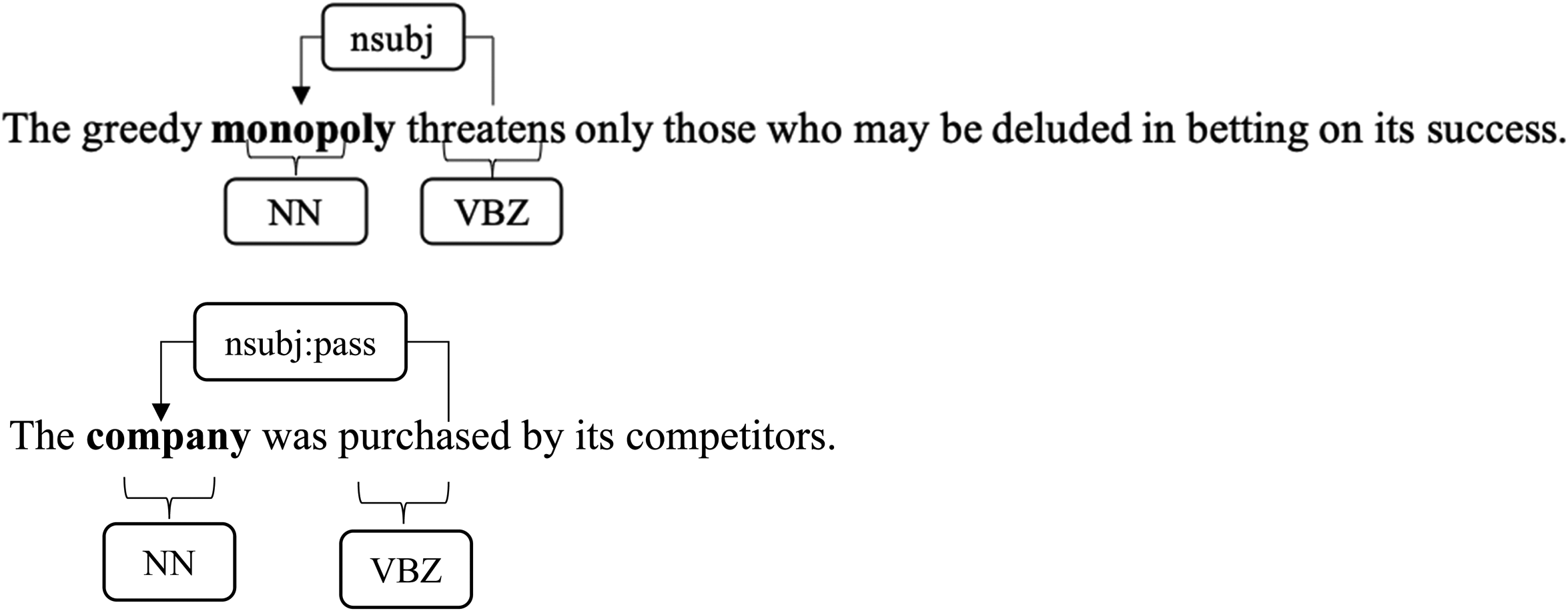
Example of key dependency relations.
Verb relations can be identified by taking all relations of the nominal subject form (“nsubj”) where the governor is a verb and the dependent is the entity in question—here, either a named corporation or a common business noun. 13 For instance, a dependency relationship (“railroad” – nsubj – “employs”) maps the verb “employs” to the entity “railroad.” I extract all cases where the organization is the active subject in a sentence (“nsubj”); for the purposes of comparison, I also extract those cases where the organization is the syntactic subject of a passive clause (“nsubj:pass”). 14
As discussed above, it is important to validate dependency parsing results on historical texts. The Stanford Tagger (as well as many other off-the-shelf taggers) is trained on the Penn Treebank, a corpus composed of 1989 Wall Street Journal news texts that have been both manually and automatedly annotated for linguistic features. While taggers generally reach about 97% accuracy on contemporary texts, performance can drop, sometimes quite dramatically, for historical texts, particularly those with OCR-related errors (Schneider, Marianne, and Rahel 2016). These errors can be highest for the identification of subject-verb relations, which are typically separated by many tokens (Smith and Cordell 2018; Strien et al. 2020). In this case, I identified a precision score of 90% on subject-verb relations, my outcome of interest. 15 I further manually cleaned commonly occurring errors in my sample (see Online Supplement B for details). 16
Measuring Intentionality and Speech
Identifying actors as the syntactic subjects of action in discourse fulfills a broad notion of actorhood. Yet, as discussed above, agency generally (Emirbayer and Mische 1998) and organizational agency (King 2015), in particular, often refers to precise types of actions: those that are purposeful, directed, and intentional. Measuring agent talk therefore requires attending to the particular kinds of actions that cast the entity as agentic.
Verb dictionaries offer a way to classify syntactic categories into broad, semantic classes. For my purposes, I rely upon the Harvard General Inquirer database (Stone et al. 1962), although other popular verb dictionaries (i.e., Verbnet) also provide useful semantic categories. The Harvard inquirer is a commonly used psycho-sociological dictionary that allows users to map text onto word category assignments. Because I am interested in intentionality and speech, I used categories associated with “cognitive orientation” (thinking, knowing, perceiving, evaluating, solving) and categories associated with “communicating” to measure each type of agentic action, respectively.
A limitation of this approach is that dictionary methods do not take into account semantic context. Words can have multiple senses, such that a particular verb like “claim” might refer to an assertion (e.g., “the company claimed no wrongdoing”) or a monetary demand (e.g., “the company claimed a 50 percent share of the market”). Because dictionary methods do not allow the analyst to disambiguate among particular verb uses, I validate and iteratively refine these dictionaries (Vasi and King 2012), removing from the dictionary those verbs where the most common semantic use does not fit the appropriate category (see Online Supplement B for details).
Identifying the Semantic Contexts of Agent Talk
Finally, addressing the question of when agent talk occurs requires assessing the semantic contexts in which this discourse is used. If institutional theory suggests actorhood is particularly salient in contexts of social interactions, how can such contexts be identified? For Mohr and colleagues (2013:686), understanding the meaning of an action requires putting the actions into the semantic “scenes” in which they occur. Across semantic contexts, one not only expects actors to engage in different sorts of actions but also that these actions may take on different meanings. For instance, corporate actions in the context of interacting with stakeholders (like organizational members, or governments) may be more likely to elicit thick attributions of actorhood than semantic scenes that refer to everyday business performance.
Co-occurrence methods provide a tool that directly allows for the measure of semantic contexts: topic models. Topic modelling uses unsupervised machine learning to identify latent topics based on word co-occurrence (Blei and Lafferty 2007). Here, I rely on structural topic models (STM) (Roberts et al. 2014). While typical LDA models assume that all documents share a global prior in their likelihood of belonging to a particular topic, structural topic models improve topic identification by defining documents’ prior distribution as based on documents’ metadata (features such as when or by whom the document was written).
To estimate the semantic contexts of business discourse, I follow DiMaggio et al. (2013:582) and approach topics as providing a “lens” for making sense of a corpus. Here, the selection of the number of topics depends on the analyst's substantive focus—“just as different lenses may be more appropriate for long-distance or middle-range vision”, a smaller or greater number of topics can help the researcher analyze her data at different levels of specificity. In this case, since my approach is exploratory, I choose a broad-based focus. Using fewer, more inclusive topics allows me to draw general conclusions more easily, while limiting errors associated with running multiple regressions across a larger number of more specific topics.
Both agentic language and semantic scenes are estimated from the same textual data. To try to ensure that semantic scenes are not based on either organizational entities or agentic language, I remove the named entity identified by the NER tagger and the associated organizational action from the text. To preprocess the article text, I remove numbers, stop-words, and low-frequency words. I also identify bigrams and trigrams and stem the text. 17
To estimate the topic models, I use the year the article was written and the newspaper as covariates. I evaluate model quality based on qualitative validation (Grimmer and Stewart 2013); I also examine various models’ coherence and exclusivity scores (Roberts et al. 2014). I ultimately selected a 12-topic solution. I include a more detailed discussion of my procedures and a comparison of various topic solutions in the Online Supplement, Part B2. In addition, I assess the robustness of my conclusions by replicating my main analyses across different topic solutions (n = 5, 10, 15), which generate substantively similar results (Online Supplement, Part B3).
In the final step, semantic contexts are associated with instances of agent talk. Regression analysis can predict which semantic contexts are more likely to give rise to different types of agent talk. Semantic contexts are associated with articles, operationalized by the topic prevalence, that is, the document-topic proportion estimated by the structural topic model (Roberts et al. 2014). 18 Agent talk is measured at the article level, using a binary indicator of 0 or 1 for whether an article includes attributions of intentionality or speech, respectively.
To estimate the relationship between semantic context and agent talk, I include several controls that account for other stylistic differences among articles. Because studies have shown that the personification of business organizations is associated with stronger positive and negative feelings (Puzakova, Kwak, and Rocereto 2013; Rai and Diermeier 2015), I control for positive or negative article sentiment. 19 Because longer articles and articles with more references are more likely to have personification, I include controls for the article length (number of words), and the count of organization-verb relations in the article. Because writing style varies across types of news article, I include controls for four types of article: (1) News and Information, (2) Features, Front Page, Cover Stories and Reviews, (3) Editorials, and (4) Letters to the Editors. Similarly, I include dummies for the day of the week articles appeared in the newspaper, since weekend and in particular Sunday papers tended to have longer features. All models include newspaper dummies and year fixed effects. Table 3 below presents summary statistics for these controls.
Descriptives of Variables.

Note— N: 435,655 (WSJ: 98,109, NYT: 337,546).
Results
Organizations as Agents in Text
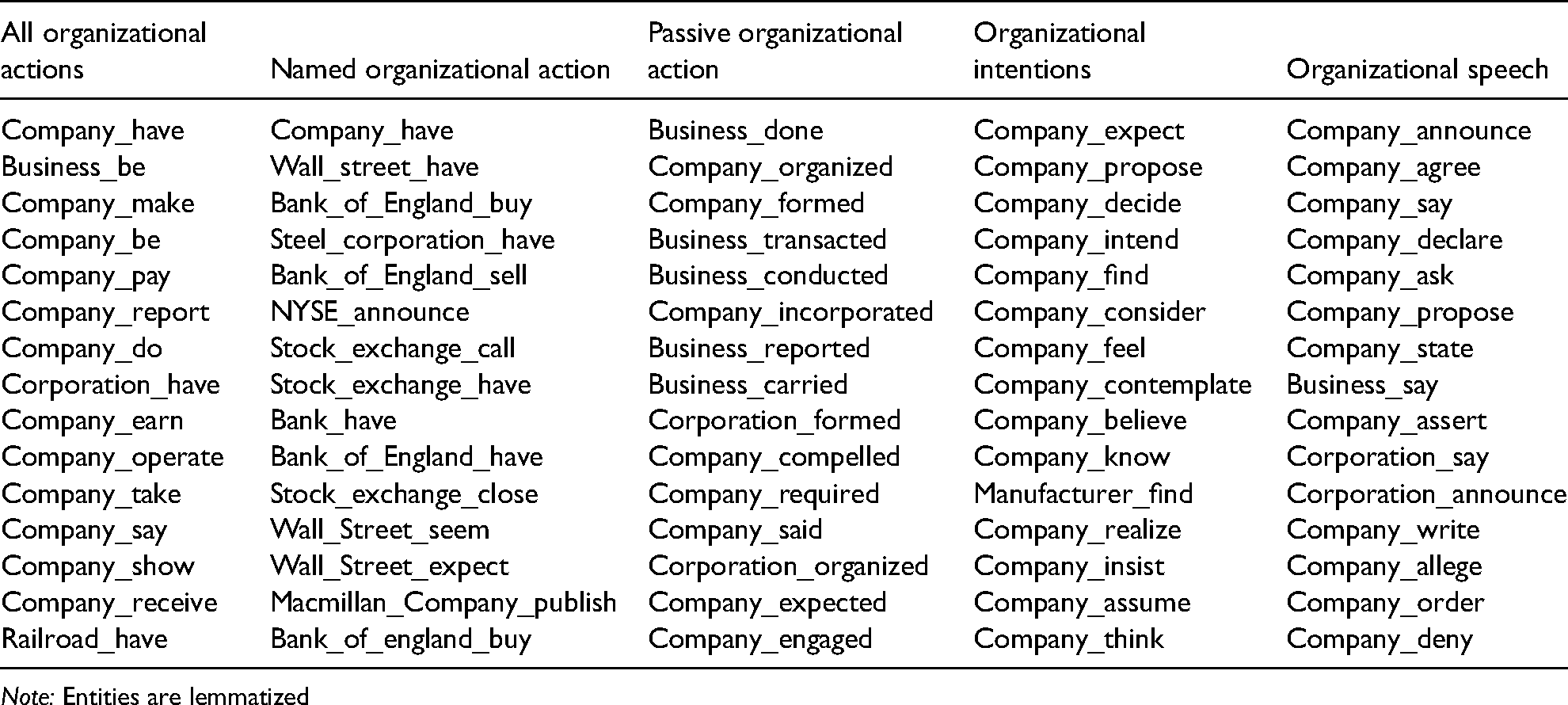
How are organizations discussed as agents in text? In order to examine agent talk in media discourse, I begin by analyzing descriptive data on the common organizational actions that populated late nineteenth and early twentieth century business news. Table 4 presents the most common organizational actions across categories of types of actions: (1) all organizational actions; (2) actions by specific, named entities; (3) actions where the organization appears as the passive subject; (4) intentional actions; and (5) organizational speech.
Organizational Agency as Characterized by Most Frequent Actions.
Note: Entities are lemmatized
Beginning with the most basic form of organizational agency—action—the first two columns of Table 4 present common actions among all organizations and among named entities. These actions most often refer to possession (“company has”), “to be” verbs (“company is”), as well as typical organizational behavior (“earning”, “paying”, “selling”).
Comparing these actions to instances where the organization is the passive subject—column 3 of Table 4—illustrates how agent talk presents the organization itself as the primary actor. For instance, organizations are commonly depicted as passive subjects when writers refer to companies “being owned” or “being organized.” Here, it is the individual shareholders, owners, or organizational members who are the primary actors, while the company is the object.
For example: “Oil companies are not being organized as frequently… and the people who used to invest their savings in oil company stocks of almost any sort are now more informed…” (McQuaid 1927). Here, oil companies are described in ways that highlight them as the economic vehicles for the actions of shareholders. Similarly, passive action casts the Stock Exchange, not as an actor, but as an institution directed by individual members: “business conducted as the Stock Exchange…has been conducted by its members” (New York Times 1913). In these instances, discourse points to the fact that it is some other agent that is organizing, operating, or conducting the organization or institution.
By contrast, even mundane organizational actions—like companies paying, operating, or earning—depict the organization itself as the primary actor. For example: “in the South and elsewhere where the company operates somewhat similar, wage reductions were put in effect some time ago” (Wall Street Journal 1921). Here, it is the company's own identity, rather than that of its owners, members, or the environment, that is responsible for the similarity in wage policies across different environments.
Overall, these everyday organizational actions depict a “thin” kind of agency. However, as discussed above, organizational agency often implies a thicker notion of actorhood: not just any action but action which evinces the organization's own “sense of internal direction” (King 2010: 292). In particular, intentional action portrays an organization as a strategic, rational entity, one with preferences and decision-making capacities (King et al. 2010).
The fourth column of Table 4 shows the common ways that writers attribute intentionality to organizations, describing organizations as “deciding”, “knowing”, “believing”, “realizing”, or “thinking.” Table 5 provides contextualized examples of this discourse, illustrating how this rhetoric fulfills what King terms the “intentionality assumption,” where writers treat organizations as if they are capable of “deliberation, self-reflection, and goal-directed action” (King et al. 2010: 292). For instance, sentences such as “the companies know very well…and do not hesitate to spend huge sums on lawyers…for the sake of obtaining influence” or “the railroads can ignore the orders of the commission” depict companies and railroads as engaged in strategic and deliberate interactions. These sentences attribute motivations and strategic plans to companies. Rather than mere metaphor, this language imbues the organization with goals and interests that are its own, instead of those of its owners, managers, or members.
Examples of Organizational Intentionality and Speech.

In addition to intentionality, organizational speech is theorized as particularly relevant to agency because it allows the organization, in interaction with others, to make commitments to internal and external audiences. Such commitments are essential for the development of reliable, predictable organizational identities (Selznick 1957; King et al. 2010: 295). Table 5 provides examples that illustrate how this discourse operates. When writers for the New York Times and Wall Street Journal assign organizations speech—companies “announcing”, “proposing”, “promising” or “denying”—writers identify organizational commitments from which readers can draw predictions. For instance, writing that “the corporation has promised to hold itself responsible” identifies the arrangement between the corporation and the state as one with “inevitable” results. Similarly, describing the railroads as unlikely to “agree” to wage advances warns readers about likely railroad behavior in the face of legislation. Even ordinary stock announcements—“the corporation announced the declaration of the regular extra dividend”—serve to associate the organization's own name with a future commitment.
Altogether, these results show that agent talk in text provides a measure of how external audiences—in this case, the news media—refer to organizations as actors. By engaging in agent talk, the New York Times and Wall Street Journal depict organizations as entities in interaction with social others.
When Organizations are Agents: Semantic Contexts
If agent talk provides a measure of how external audiences attribute actorhood to organizations, then when are external audiences most likely to make those attributions? In other words, what contexts generate agent talk? To estimate semantic contexts, I use structural topic models, focusing on a relatively limited number of topics to analyze broad themes in business discourse. Figure 3 presents a summary of the twelve topic STM solution, including the set of tokens that were both prevalent and exclusive to that topic (“FREX” words) (Bischof and Airoldi 2012; Roberts et al. 2014), their prevalence, as well as manually assigned topic labels. I used both FREX words as well as a qualitative reading of the top associated set of documents to summarize each topic's key themes.
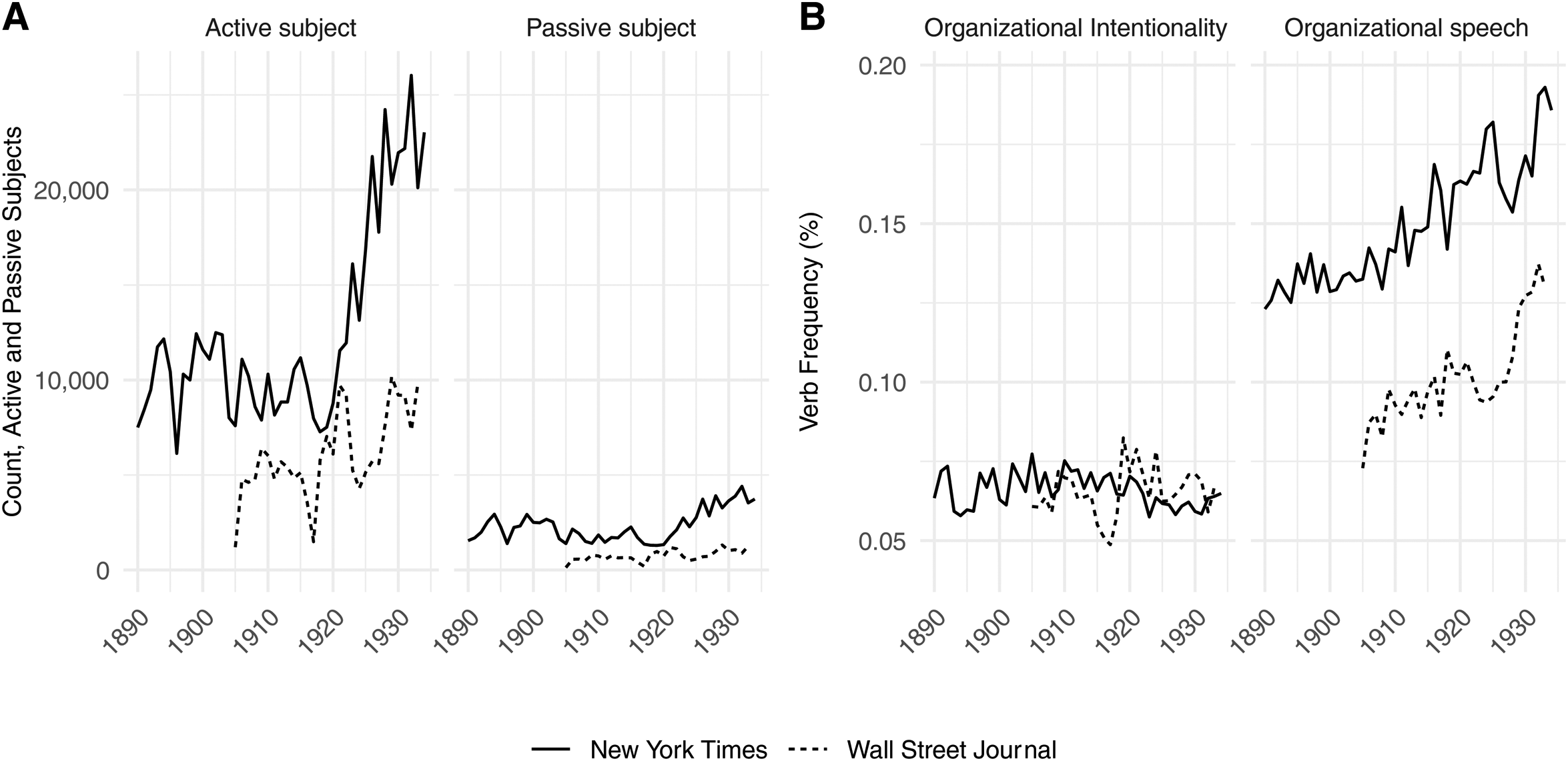
Agent talk over time, by publication.
Note: Panel A presents counts of the number of instances where an organization is the active subject and counts of the number of instances where an organization is the passive subject, over time. Among subject-verb relations where the organization is the active subject, Panel B presents the percentage of articles in which the organization is depicted as having intentionality and speech, respectively. The shaded area indicates
While the topics cover a mixture of themes, they can be grouped into broad categories. The most common discuss organizations in economic contexts (indicated in dark grey), including industry and business-related articles. These are: banking, covering a set of themes related to banking, lending, and currency; business outlook, including information and predictions about future general market conditions; oil and gas; railroads; and stocks, referring to financial news, including stock market updates, shareholder dividends, and future expectations about prices. Next, a set of topics (indicated in light grey) refers, broadly, to social, legal, and political contexts: labor, covering stories associated with union disputes and labor regulation 20 ; courts, both federal and local litigation and legal disputes; regulation, referring to articles generally about federal regulation, including antitrust, interstate trade, consumer regulation, as well as taxes; and politics, covering national and state political parties. Finally, there are a set of topics (in white) that refer to largely non-business organizations: business opinion, which refers to articles (many of which are editorials or letters to the editor) about “business” or “business men” in a general sense; local organizations, which refers to local, social organizations, including the arts (theater companies, opera companies) as well as social events; and international news, which covers foreign diplomacy and military organizations, as well as international trade.
To examine when organizations are most likely to be discussed as agents, I estimate a set of logistic regression models predicting three sets of dependent variables: (1) any instance of agent talk (either intentionality or speech verbs), (2) any use of intentionality verbs, or (3) any use of speech verbs. My main independent variable of interest is semantic context, operationalized as topic prevalence. Because topics are correlated (topic prevalence among all topics must sum to 1) and cannot all be included in one model, I run each model separately, iteratively comparing articles discussing a given topic to the remainder of the corpus. All models include year fixed effects, newspaper fixed effects, and the full suite of article-related controls (see online supplement Tables D1- D6 for full results).
Figure 4 reports results from these models, arrayed by coefficient size. There are three contexts which are most likely to generate agent talk (including both organizational intentionality and organizational speech): labor, regulation, and railroads. In addition, organizational speech (but not intentionality) is more likely to be attributed in contexts referring to stock markets, courts, and politics. Finally, organizational intentionality is more likely to be used in contexts of international news, business opinion, and business outlook, although these latter contexts are not, on the whole, more likely to use agentic language.
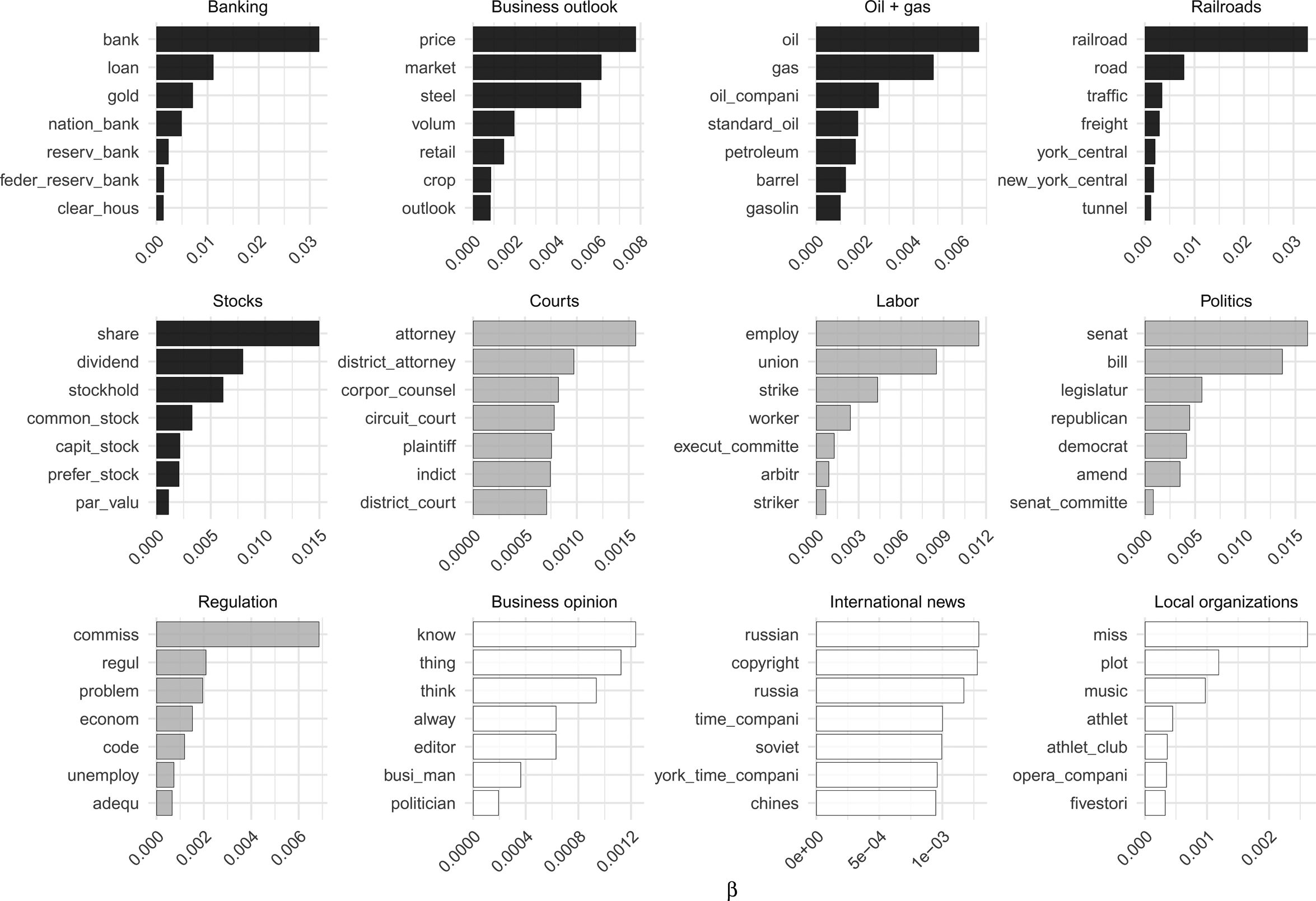
Frequent and exclusive words by semantic context. Note: Figure shows top frex (frequent and exclusive) words associated with each topic. Frex words are weighted 50 percent for frequency and 50 percent for exclusivity.
Overall, for three out of the four topics relating to social, legal, and political contexts—labor, regulation, and courts—agent talk is significantly more common than in other semantic contexts. Among politics articles, organizations are more likely to be attributed speech, but not intentionality. By contrast, in three out of the five economic topics—banking, oil + gas, and business outlook—agent talk is less likely (the exceptions are stocks and railroads). Similarly, agent talk is less likely among two out of three non-business contexts—business opinion and local organizations. The large, negative coefficients for local organizations, in particular, suggests that non-business organizations are less likely to be discussed as agents than business organizations, regardless of semantic context. In sum, business organizations discussed in social, legal, and political contexts appear particularly likely to be discussed as actors.
To interpret the magnitude of these differences, I calculate the predicted probability of an article engaging in agent talk by semantic context. 21 Beginning with organizational intentionality, articles discussed in the context of labor are more than twice as likely to include organizational intentionality, compared with other articles (12 percent of labor articles have intentionality, compared to 5.6 percent of non-labor articles). For regulation and railroads, this increase is about 200 percent and 80 percent respectively (17 percent of regulation articles and 10 percent of railroad articles have intentionality, compared to 5.6 percent for other articles).
For organizational speech, labor articles are nearly three times as likely to include organizational speech (34 percent of labor articles have speech, compared with about 12 percent of non-labor articles). For regulation and railroads, this increase is about 100 percent and 75 percent respectively (23 percent of regulation articles and 21 percent of railroad articles, compared with about 12 percent otherwise). For articles that discuss stocks and courts, writers are about twice as likely to use organizational speech (25 percent of stock-related articles and 24 percent of court-related articles, compared with about 12 percent otherwise). In sum, across these contexts, agent talk is not only statistically significantly higher, but also substantively much more common than in other types of articles. 22
To better understand how agent talk operates in these semantic arenas, we can turn to the text. Table 6 presents examples of organizational intentionality and speech in those contexts where agent talk is most prominent—labor, regulation, and railroads. 23
Examples of Intentionality and Speech by Semantic Context.
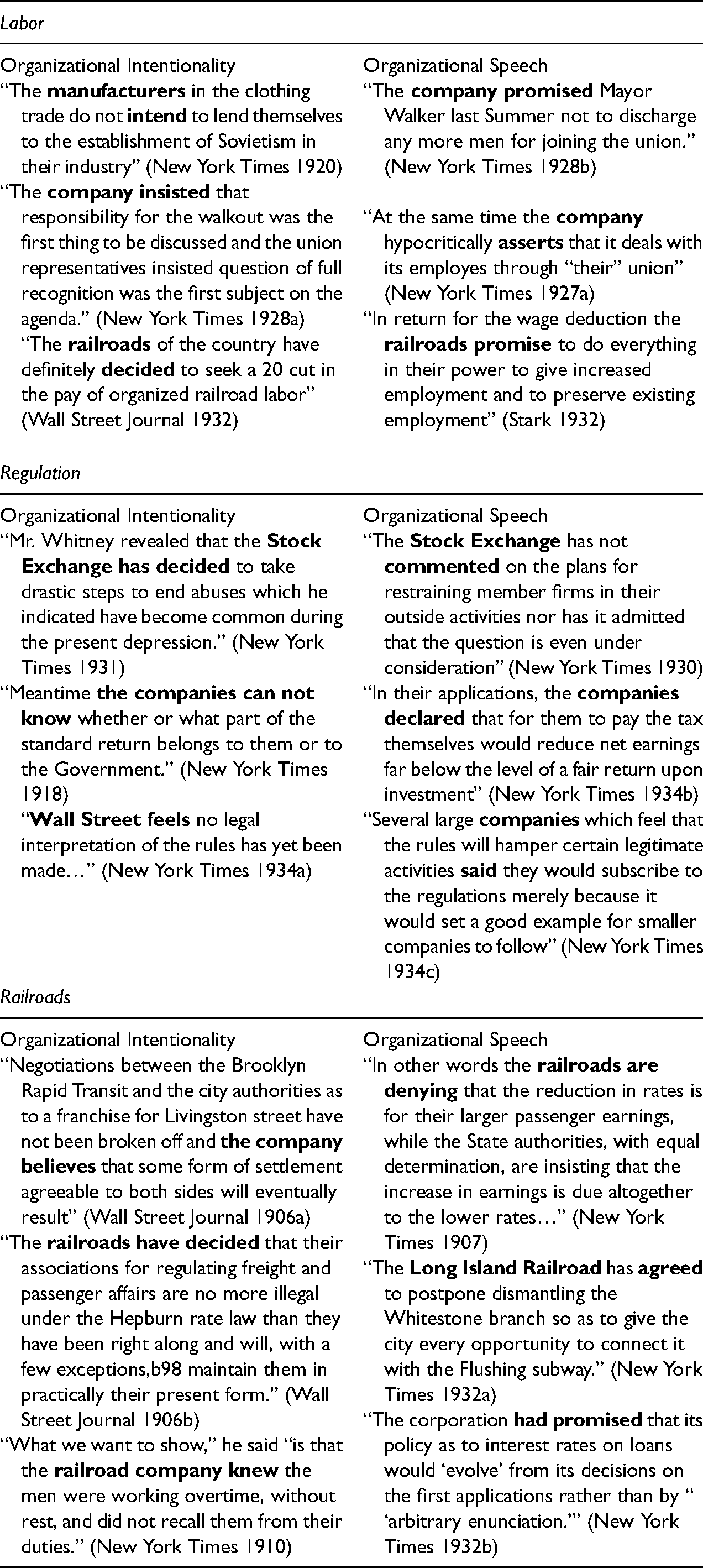
Beginning with labor, examples from the text provide an indication of why social, legal, and political contexts may be particularly likely to generate agent talk. That is, in these contexts writers often use agent talk to describe organizations that are interacting with social and political others. In the context of labor, agent talk is used to describe organizations interacting with unions, where intentionality and speech render the organization's actions intelligible and predictable to external audiences. For example, writers use intentionality discourse when describing organizations in labor disputes; this language imputes to organizations viewpoints and goals. Sentences like “the railroads… have definitely decided to seek a 20% cut in the pay of organized railroad labor” or “the manufacturers in the clothing trade do not intend to lend themselves to the establishment of Sovietism” serve to separate the organization from its members, casting it as an entity with its own, independent interests, which it then addresses to labor. Similarly, when writers refer to organizational speech, they describe organizational commitments to social others. For example, companies make “promises” to workers and political figures or companies “assert” their intentions for dealing with unions. Here, conflict and interaction between companies—articulated as separate entities from their members—and unions appears to foster increased agent talk.
In regulatory contexts, agent talk also describes organizations in interaction, mostly with federal and state organizations. Here, writers use intentionality language to depict organizations amid negotiations with states as entities with internal states, viewpoints, or goals. For example, organizations are described as entities with “feelings” about a new law or as trying to puzzle through responses to new government regulations. Similarly, the rhetoric of organizational speech is often used when describing organizational interactions with government. For instance, companies “declare” their stances on taxes or “say” they will or will not follow state rules.
Finally, articles about railroads are more likely to refer to organizational intentionality and speech. It is important to note that during the period under analysis, railroads were considered “public carriers”—that is, businesses that existed for public purposes and which therefore had special duties to the public (Novak 2017). Many of the articles about railroads that rely on agent talk indeed discuss railroads in interaction with social others, including the public, the government, and unions. For example, railroads are oftentimes imbued with agency when discussed as interacting with the state: railroads are described as having “beliefs” about a deal with the city, as “deciding” their response to regulation or as “denying” accusations from state authorities. In particular, the sentence—“what we want to show…is that the railroad company knew the men were working overtime”—illustrates the importance of organizational intentionality to legal regulation.
Two additional contexts, courts and stocks, generate significant and high levels of agent talk, though this is limited to organizational speech. As above, organizational speech in these arenas is typically used to depict expectations and predictions about future organizational behavior. For instance, in the legal arena of courts, speech endows companies with their own positions: “The company then asked Justice Cohalan in the Supreme Court to restrain the city from enforcing the amendment until the test of its constitutionality was settled…” (New York Times 1915).
“The company asserts that the tax is unjust and illegal and should be vacated” (New York Times 1895).
In the realm of stocks, organizational speech often refers to quotidian stock announcements. These announcements cast the organization as making a commitment to external others: “The International Nickel Co. has declared an extra cash dividend of 25 on the common stock out of surplus earnings payable July 15 to stock of record of June 6.” (Wall Street Journal 1910).
“Among these provisions the company agrees to maintain at all times net tangible assets equal to at least 200 per cent.” (New York Times 1927b).
Overall, these results show that external audiences are significantly more likely to engage in agent talk in a specific set of semantic contexts: particularly those dealing with social and legal topics (labor, regulation and courts), as well as railroads and stocks. Combining this statistical association with qualitative investigation of the text provides supporting evidence for existing theories of how organizational agency develops. When discussing organizations in the context of interaction with social others—both internal members and external groups—audiences are more likely to personify organizations as capable of intentionality and speech. These linguistic attributions serve to render organizational action intelligible, depicting organizations as entities about which readers can form expectations and make predictions.
Agent Talk Over Time
Thus far, results indicate that organizations discussed in social, political and legal contexts (labor, regulation, and courts), as well as in the context of railroads and stocks, are particularly likely to be attributed actorhood. Here, I investigate how this tendency has changed over time.
Figure 5 present estimates, by year, of how often business organizations are discussed as active and passive subjects, attributed intentionality, and attributed speech. Panel A presents counts of how often business organizations are discussed as active subjects versus passive subjects across the New York Times and Wall Street Journal. Among both newspapers, organizations are most likely to be discussed as active subjects, a tendency which increases over time, particularly in the New York Times.
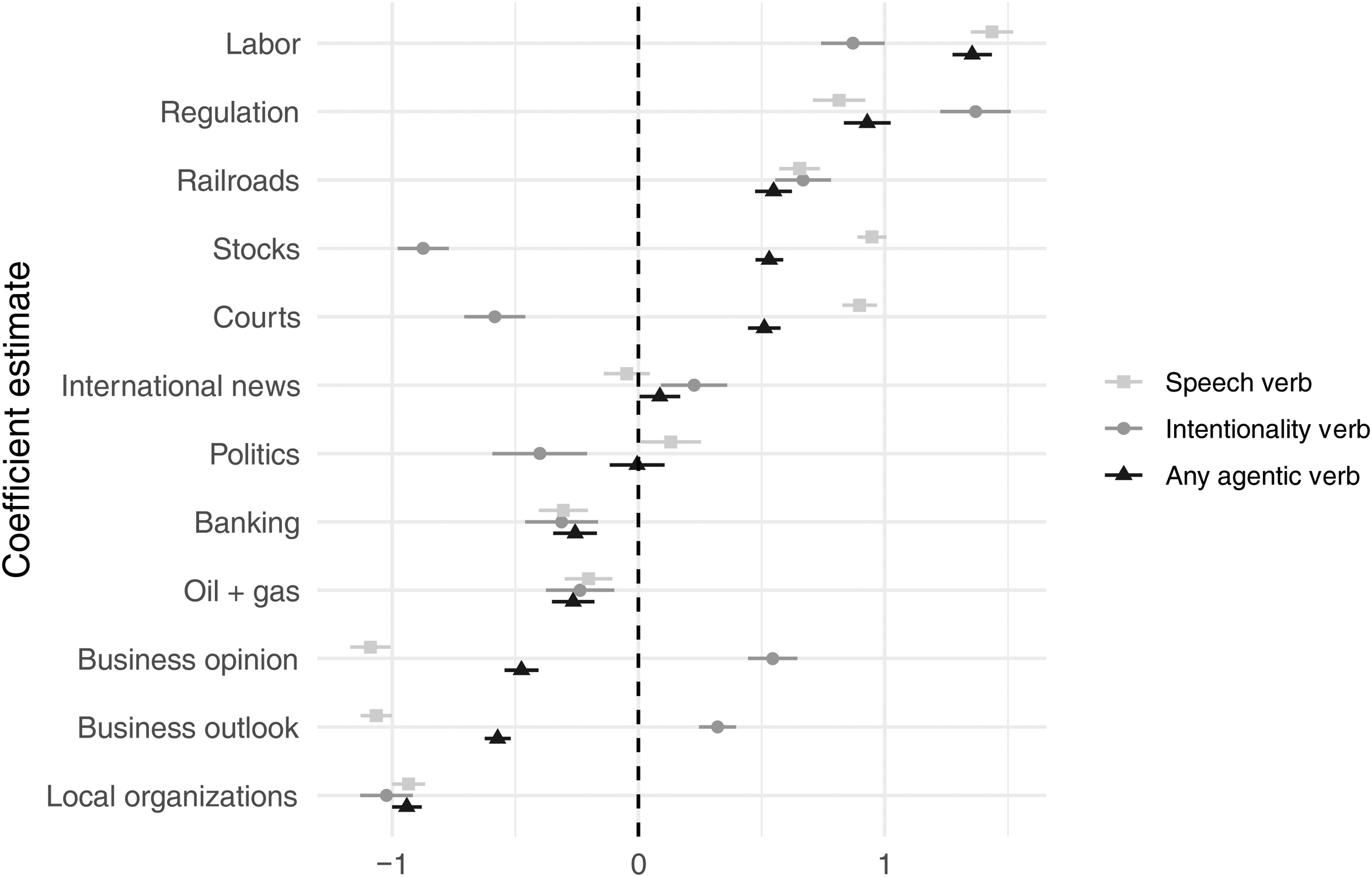
Coefficients from semantic context on agent talk. Note: Figure shows logit coefficients predicting agentic discourse by semantic context with 95% confident intervals. N = 435,655. Full model results are available in Tables D1-D6 of the Online Supplement.
Panel B presents the percentage of the articles where the organization is discussed as an active subject and that action is either an organizational intention or speech verb. Here, we see that it is much more common for organizations to be attributed speech than intentionality, and instances of organizational speech increase over the course of the dataset. In the New York Times, while about 12 percent of articles in 1890 refer to businesses as speakers, this grows over the course of the data by 60 percent, to about 19 percent articles by 1934. The Wall Street Journal engages in generally less discussion of organizational speech, though this form of agent talk doubles over the course of the period from about 7 percent of articles in 1905 to about 14 percent around 1933. By contrast, with respect to attributions of intentionality, only about 5−7 percent of articles include a reference to organizational intentionality, a rate which remains relatively constant over the course of the data. Overall, these descriptive patterns show that business organizations were increasingly portrayed as engaged in speech. By contrast, attributions of intentionality, which are central to theories of organizational agency, are generally rare and did not increase over time.
Was the increase in organizational speech a widespread phenomenon or did it remain siloed in certain semantic contexts? To examine whether trends in agent talk vary by semantic context, I re-estimate the series of models depicted in Figure 4 predicting organizational speech. This time, in each model I add an interaction between the focal topic and a linear year trend, which allows me to estimate topic-specific trends in agentic discourse. I focus on speech since intentionality does not increase over the course of the data. As before, I include the full suite of controls and year fixed effects. To aid in interpretation of the results, I present in Figure 6 below the predicted probabilities that an article discussing a particular topic (having a topic prevalence of “1” in that topic) will use agentic language. Full model results are available in the online supplement, Table D7.

Trends in agentic discourse, by semantic context. Note: N = 435,655. Figure presents predicted probabilties from a series of logistic regression models estimating whether an article will contain organizational speech, along with 95 percent confidence intervals. Each model includes a focal semantic context interacted with a linear year trend; all models include year fixed effects and the full suite of article controls. Full model results are available in Table D7 of the Online Supplement.
Results show that increases in organizational speech occurred most rapidly in those semantic contexts where it is originally highest—in particular, in those contexts dealing with labor and railroads. In addition, across stocks, courts, and regulation, we see positive trends in organizational speech (though this is trend is not significantly greater than among the remainder of the corpus). In addition, we see significant increases across two economic contexts, oil + gas and business outlook, that have initially low levels of agent talk but which grow over time. Among remaining topics, there is either no increase or evidence of a decrease compared with other topics.
Overall, these results suggest that there was a gradual, albeit uneven, increase of the language of organizational agency over time. Organizations were increasingly personified as speakers in a specific set of social and legal contexts (labor, courts, and regulation), as well as railroads and stocks. Yet, over time, we also see evidence of increases in this rhetoric in other, business-related economic semantic domains. These results indicate the importance of social and legal semantic contexts to generating rhetoric of organizational personification, and suggest that, at least in the early twentieth century, agent talk was a linguistic trope particularly propelled by discussions of labor.
Conclusion
This article builds upon the pioneering semantic analyses conducted by Mohr, Frazosi, Carley, and others (e.g., Basov, Breiger, and Hellsten 2020; Carley 1994; Franzosi 1990, 1998; Mohr 1994; Mohr et al. 2013; Mohr and Duquenne 1997) that show how semantic analysis can provide a window into the meaning individuals attribute to categories of actors. By linking actors directly to their actions and to narrative contexts, we can better grasp the portrayal of agency in text (Franzosi et al. 2012). Recently, sociologists interested in studying the changing cultural meanings associated with categories of actors have drawn upon automated, computational tools to analyze discourse across larger amounts of text and over longer historical periods than what was previously possible. Yet, for the most part, these methods have drawn upon co-occurrence in documents or paragraphs, rather than the close, semantic parsing of sentences that, in the tradition of Mohr, connects subjects directly to their actions and that can differentiate between passive and active subjects (but see Goldenstein and Poschmann 2019; Stuhler 2021).
Here, I demonstrate how dependency parsing—alongside a suite of natural language processing tools—can be used to study attributions of agency in text, discourse I refer to as “agent talk.” Drawing on organizational theories of actorhood, I discuss how the rhetoric of organizations as active subjects in text, as well as attributions of intentionality and speech, are core to understanding organizations as agents since these descriptions depict the organization itself, rather than its members, as the author of unified, intentional action. Applying these measures to descriptions of business actors at the turn of the twentieth century, I find a general increase in “agent talk.” At the same time, the increase of this rhetoric is uneven across semantic domains; agent talk was propelled, and remained highest, in social and legal contexts, including in contexts related to labor, regulation, and railroads.
That these particular contexts were the ones most likely to generate agent talk both resonates with existing sociological literature on the development of the American corporation, as well as opens avenues for future research. For instance, as Dobbin (1994, 2004) has shown, railroads were crucial to the conceptual development of American market categories: notions of efficiency, and the conceptual realms of the public and private, were shaped through interaction between early American railroads and states. My results here suggest that railroads may also have been a crucial site in developing notions of organizational actorhood. In the realm of regulation, scholars of nineteenth century American corporate history have shown the government's gradual shift from trying to shape corporations through chartering to instead attempting to deal with corporations as actors in their own right. That is, as Crane (2017:110 emphasis in original) describes it, there was a shift towards “regulating conduct by ‘corporate persons’…rather than creating … corporations themselves.” My results suggest external audiences, apprehending government's attempts to regulate such corporate conduct, were likewise increasingly likely to see organizations as actors with their own separate set of interests and goals. Finally, that labor discussions and disputes were most likely to generate agent talk resonates with a period in which labor and capital constituted two growing and distinct interest groups in society, with labor unions operating as business’s key counterweight in eliciting organizational commitments. Further historical analysis is needed to unpack why these disputes were particularly likely to prompt attributions of organizational agency.
Overall, these findings show the potential for computational tools like dependency parsing to aid in the development of measures for understanding agency, a phenomenon whose theoretical subtlety resists straightforward empirical observation. Questions about changes in elusive concepts like agency, and the relationship between actors and their actions, can be partially addressed through the large-scale analysis of discourse (Franzosi et al. 2012). Dependency parsing offers a way to link actors with their actions, identifying subtle linguistic changes that are beyond the capacity of even the most thorough manual or computer-assisted coders to detect. At the same time, I show how dependency parsing can be combined with co-occurrence tools like topic models that allow users to identify semantic contexts. Rather than having to choose between semantic parsing or co-occurrence approaches, analysts engaged in studying complex problems like changing attributions of organizational agency can assemble their various strengths, “bricoleur style” (Mohr et al. 2013:696).
Though this article is focused on the context of organizational agency, the measure of agent talk presented here has wider general applicability. The capacity to make decisions and to engage in communication is widely understood to be crucial for agency more generally (Emirbayer and Mische 1998). Moreover, the attribution of agency to other kinds of collectives or objects is a widespread social phenomenon: institutions like governments or states (McGraw and Dolan 2007), social collectives like “the people” (Morgan 1989), or objects like technological artifacts (Vertesi 2015) are regularly personified as agents. By providing a measure to empirically investigate the background assumptions audiences hold towards these entities, we can better understand the evolution of this discourse over time.
While this article establishes general trends in organizational agent talk, it has a number of limitations that warrant further analysis. First, I focused only on two newspapers, both of which were based in New York and had generally positive dispositions towards business. This is therefore not a full accounting of American assumptions about business agency during the early twentieth century. Further research should investigate whether understandings of organizational agency followed similar trends in other parts of the country, regions with less access to or control over large manufacturing corporations, or agrarian states with anti-corporate, populist politics.
Second, I rely on dictionary-based methods to identify agent talk. This method necessarily introduces error since some multivalent verbs can be used either to imply intentionality or speech, or used in more regular business contexts (e.g., “the company claimed it had no liability” or “the company claimed a 50 percent share of the market”). I attempted to limit such errors by refining my dictionaries to drop particularly multivalent terms, but future research might use novel neural models of metaphor detection (e.g., Shutova 2010; Gao et al. 2018) to identify personification in the semantic contexts in which it is deployed.
Finally, my results show that historical researchers must be careful when applying off-the-shelf tools to historical data. In particular, OCR quality issues rendered even relatively well-preserved articles from the New York Times and Wall Street Journal prone to down-stream errors in NLP tasks. Moreover, off-the-shelf named entity recognition algorithms were limited in their identification of many of the business organizations of the early twentieth century. As more digital archives come online, further research is needed to understand the limitations of off-the-shelf NLP tools for historical research.
Despite these limitations, this article offers a snapshot of the changing understanding of business corporations by America's most prominent papers during a period of rapid American industrialization. Ultimately, my results show early growth in the sort of discourse that we now take for granted. If, in our experience, business organizations are in fact readily accepted as agents that act on, with, and for us (King 2015:164), then these understandings should be seen as historical products of the particular contexts that were especially likely to elicit them. By focusing on understandings of organizational agency at the turn of the century, this article contributes further evidence of the deep entanglement between organizational actorhood on the one hand, and social interaction on the other.
Supplemental Material
sj-pdf-1-smr-10.1177_00491241221122528 - Supplemental material for When Corporations Are People: Agent Talk and the Development of Organizational Actorhood, 1890–1934 *
Supplemental material, sj-pdf-1-smr-10.1177_00491241221122528 for When Corporations Are People: Agent Talk and the Development of Organizational Actorhood, 1890–1934 * by Carly Knight in Sociological Methods & Research
Footnotes
Authors' Note

Declaration of Conflicting Interests
The author(s) declared no potential conflicts of interest with respect to the research, authorship, and/or publication of this article.
Funding
The author(s) received no financial support for the research, authorship, and/or publication of this article
Supplemental Material
Supplemental material for this article is available online.
Notes
References
Supplementary Material
Please find the following supplemental material available below.
For Open Access articles published under a Creative Commons License, all supplemental material carries the same license as the article it is associated with.
For non-Open Access articles published, all supplemental material carries a non-exclusive license, and permission requests for re-use of supplemental material or any part of supplemental material shall be sent directly to the copyright owner as specified in the copyright notice associated with the article.
