




Abstract

Case report
A three-day-old preterm male infant was admitted in our neonatal intensive care unit following delivery at home by a trained birth attendant. The baby cried immediately at birth. The mother was 28 years old with a history of two previous spontaneous abortions at 2.5 and 3 months of gestation and no living children. In the current pregnancy, she had developed a high-grade fever with a diffuse rash and joint pains during the second month of gestation, for which she did not take any medication. On examination, the neonate was 33–34 weeks of gestation and had a birth weight of 1.45 kg. The heart rate was 170/min, respiratory rate 70/min, axillary temperature 36℃ and capillary refill time 3 s. The mean arterial pressure was normal. There was a grade IV pansystolic murmur heard in the left infraclavicular and parasternal area. The baby was kept under a warmer and supervised intravenous fluid resuscitation was started along with continuous positive airway pressure support. He was icteric and had a palpable hepatosplenomegaly (liver 4 cm and spleen 2 cm below the costal margins). There were multiple raised violaceous macules (blueberry muffin spots), ranging in size from 0.5 × 0.5 cm to 1.5 × 2 cm over the face, scalp, chest and abdomen (Figure 1). There were lenticular opacities in both eyes. Feeble neonatal reflexes were noted.
Blueberry muffin spots over the face, scalp and chest.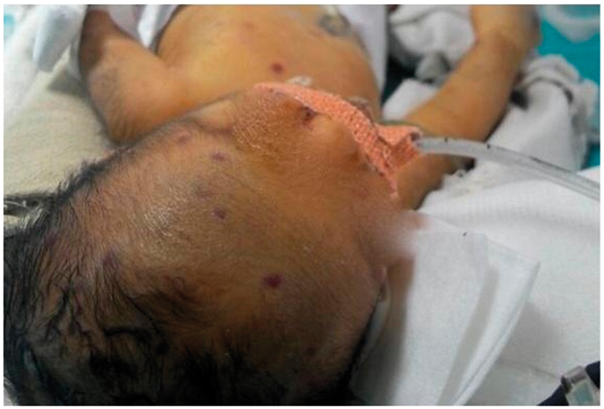
At 4 h of admission, in view of his worsening respiratory distress, the baby was mechanically ventilated. Thereupon, he developed gross gastro-intestinal and pulmonary bleeding, as well as multiple episodes of multifocal seizures along with a bulging anterior fontanelle and sluggishly reacting pupils. At this stage, he required vasopressor support in view of a falling mean arterial pressure.
Investigations revealed anaemia (Hb 82 g/L), leucopenia (3700/µL) and thrombocytopenia (20,000/µL). Random blood sugar was 5 mmol/L. Liver function tests revealed a total serum bilirubin of 274 µmol/L with direct fraction of 171 µmol/L and very raised transaminases (aspartate transaminase [AST] =8090 IU/L, alanine transaminase [ALT] = 4600 IU/L). The serum albumin was low at 18 mg/L. The coagulation profile was deranged with a prothrombin time of 46 s and international normalised ratio (INR) of 4.0 and activated partial thromboplastin time (aPTT) of > 120 s. This coagulopathy failed to respond to an injection of vitamin K with both PT and aPTT becoming non-coagulable the following day with a further elevation of liver enzymes (AST = 9600 IU/L and ALT = 5200 IU/L).
Cranial ultrasound revealed a grade III intraventricular haemorrhage and abdominal ultrasound revealed a hepatospenomegaly with a coarse liver echotexture. Blood culture and fungal culture were sterile. A chest radiograph revealed interstitial pneumonitis. The echocardiogram demonstrated the presence of a patent ductus arteriosus (1.4 mm) with left to right shunting. Skin biopsy of the lesions was deferred due to the presence of coagulopathy. The TORCH titre, using a highly sensitive Mini Vidas ELISA of both the baby and mother, were highly positive for Rubella IgM (40 IU/mL) and IgG (70 IU/mL). Polymerase chain reaction testing for rubella virus was also positive. The rubella IgM and IgG serology of the mother were 36 IU/mL and 180 IU/mL, respectively. Toxoplasma, cytomegalovirus and herpes simplex IgM were negative. VDRL for syphilis was likewise negative in both the mother and the neonate. HIV serology was also negative in the mother.
Despite supportive treatment with packed red cells and platelet concentrate along with fresh frozen plasma, as well as intravenous pantoprazole, total parenteral nutrition and empirical antibiotics, the infant continued to deteriorate and developed multi-organ dysfunction, and died four days later. A postmortem liver biopsy was suggestive of diffuse hepatocyte necrosis.
Discussion
This infant was born prematurely and was small for gestational age, indicating the growth restraining effect of his congenital intrauterine infection.
The cutaneous manifestations of congenital rubella syndrome (CRS) include purpura, maculopapular rash and, less frequently, blueberry muffin lesions. These denote extramedullary dermal haematopoeisis. They have been reported in only 5% of CRS cases and are associated with severe disease. 1
Haematological disorders are infrequently associated with CRS. The most common seen is thrombocytopenia, reported in 20% cases. However, very severe thrombocytopenia as seen in our case is rare. 2
Hepatosplenomegaly is observed in 10–20% of cases of CRS. Hepatitis associated with severe derangement of liver enzymes leading to fulminant hepatic failure has not been previously reported. 1 This catastrophe is defined as the presence of biochemical evidence of acute hepatic injury and an INR > 1.5 with encephalopathy or INR > 2 without encephalopathy. 3 The common causes of neonatal hepatic failure include perinatal infections (most commonly herpes simplex), hypoxic ischaemic insult, neonatal haemochromatosis and inborn errors of metabolism.4,5
Despite being a vaccine preventable infection, CRS continues to account for severe neonatal morbidity. This case report highlights a rare and fulminant complication of rubella infection in the early neonatal period. A neonate suffering from maternally acquired rubella infection needs to be monitored for liver function. Deterioration of liver function warrants prompt initiation of supportive therapy with a close watch on coagulation profile. The use of prothromplex, though hugely expensive, may be beneficial. The aftermath of rubella acquired during pregnancy is often devastating for an infant. In order to minimise the burden of CRS, a high vaccination coverage among the unimmunised women of child-bearing age is mandatory.
Footnotes
Declaration of conflicting interests
The author(s) declared no potential conflicts of interest with respect to the research, authorship, and/or publication of this article.
Funding
The author(s) received no financial support for the research, authorship, and/or publication of this article.