



Abstract
Kawasaki disease (KD), also known as mucocutaneous lymph node syndrome and infantile polyarteritis nodosa, is known to present in multiple ways. Although inflammatory changes in several systems have been reported in KD, there are few documented child patients presenting with parotitis. We report such a case in a five-year-old.
Keywords
Case report
A five-year-old girl presented with a five-day history of fever, earache, left side parotid swelling and a three-day history of vomiting and generalised rash. She had been treated with amoxycillin clavulanate for suspected serous otitis media. Physical examination at admission revealed bilateral cervical lymphadenopathy ≤1.5 cm, tonsillary enlargement, an erythematous rash on the body and a painful erythematous, warm, and non-fluctuant left parotid. Her lips were dry and also erythematous. No strawberry tongue or mouth ulcers were noticed. Laboratory investigations at admission showed a white blood cell count of 19,300/mm3 with 86% neutrophils, a platelet count of 305/mm3, an erythrocyte sedimentation rate of 58 mm/h, a C-reactive protein level of 10.1 mg/dL (normal range <0.5), a serum amylase of 1728 U/L (normal range = 28–100 U/L), lipase 151 U/L (normal range < 60 U/L), alanine aminotransferase 218 U/L (normal range = 18–63 U/L), aspartate aminotransferase 92 U/L (normal range = 10–32 U/L) and an albumin level just at the lower level of normal. Serologic tests for adenoviruses, mumps, enteroviruses, cytomegalovirus and Epstein–Barr virus were negative. Soft-tissue neck ultrasonography revealed multiple lymph nodes and a heterogeneous parenchyma of parotid gland. On the seventh day of her illness, she developed bilateral non-exudative conjunctivitis with erythematous oedema of palms and soles; on the ninth day with persistent fever, desquamation was observed on her body. Laboratory tests were unchanged apart from a significant drop in amylase levels to 214 U/L. KD was suspected owing to the child’s continuing fever, cervical lymphadenopathy, conjunctivitis, polymorphous rash and desquamation. An echocardiography was performed and this demonstrated diffuse dilation of the left main coronary artery measuring 3.73 mm (Figure 1). Treatment with intravenous immunoglobulin (IVIG) at a dose of 2 g/kg and oral aspirin 75 mg/kg/day was commenced. Her fever subsided 48 h later. Laboratory parameters returned to normal six days later. Aspirin doses were decreased to anti-aggregant levels. A check echocardiogram then showed only mild ectasia of the left coronary artery. Informed consent was obtained from the patient’s parents.
Echocardiography revealing diffuse dilation of the left main coronary artery. Demographic data, clinical/laboratory features and treatment of child patients with KD associated with parotitis in the literature. Seyedabadi et al. Douvoyiannis et al. Do et al. Yokoyama et al. U, unknown; IVIG, intravenous immunoglobulin.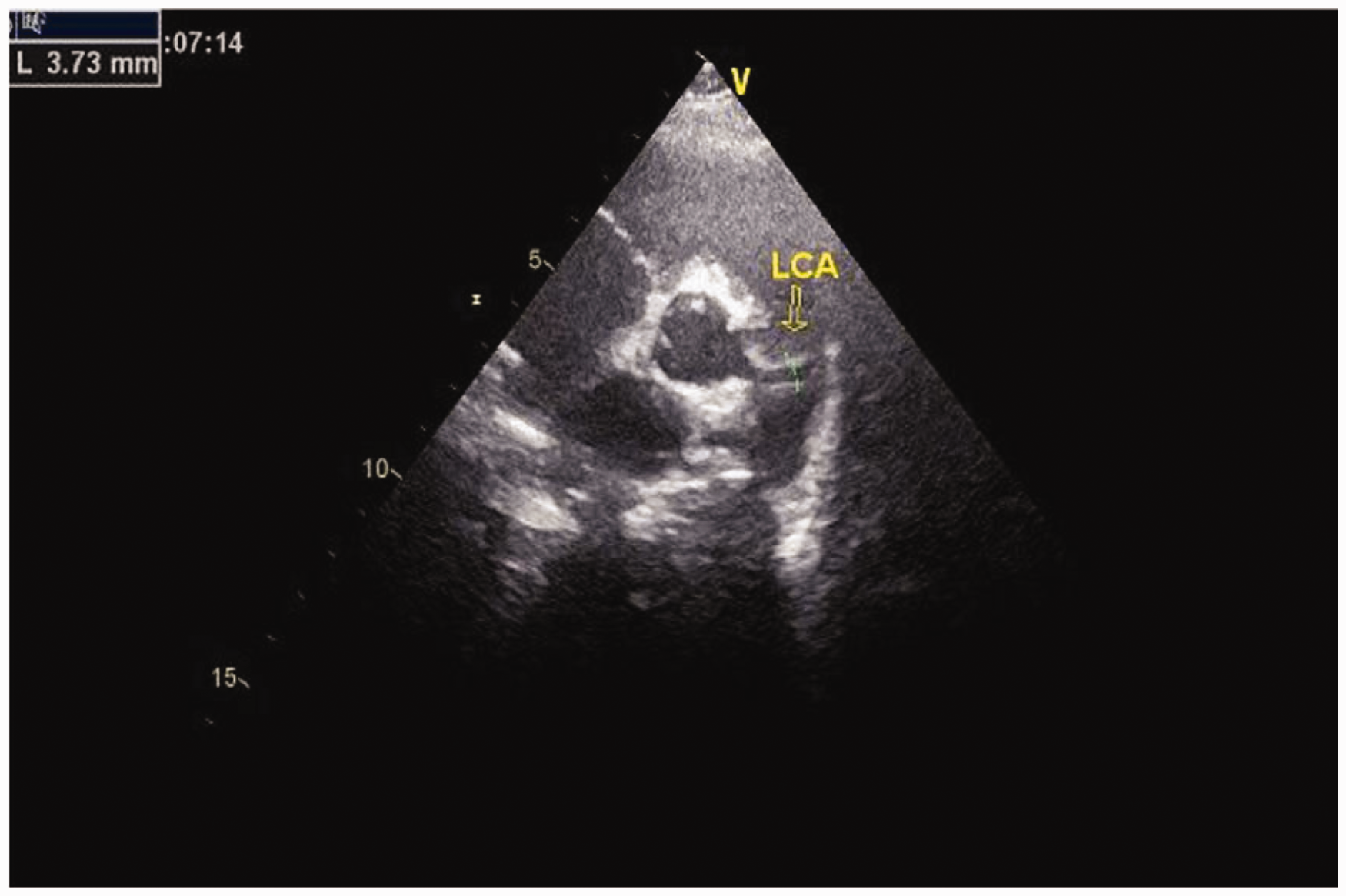

Discussion
KD is a systemic vasculitis affecting small and medium-sized vessels and is most often seen in children aged 6 months–5 years. Its aetiology is still unknown but clinical, laboratory and epidemiological features suggest that one or more transmissible agents could be the triggering factor for the inflammatory response. 1 Typical KD criteria include fever necessarily lasting >5 days, cervical adenopathy, non-purulent bilateral conjunctivitis, oral mucosal ulceration, hand and foot oedema, and a polymorphic skin. Four of five clinical criteria are required for a definite diagnosis.
The fact that no viral agents were identified by serologic tests and fever persisted with significant features of the disease made us suspect that the parotitis was an uncommon initial presentation of KD. This has only been described in four children in the literature to date (Table 1).2–5 Involvement of the parotitis in KD might not be due to viral or bacterial infection, but rather be due to KD itself.
Footnotes
Declaration of conflicting interests
The author(s) declared no potential conflicts of interest with respect to the research, authorship, and publication of this article.
Funding
The author(s) received no financial support for the research, authorship, and/or publication of this article.