




Abstract
Neurological complications related to anti-rabies vaccine are uncommon. The involvement of the optic nerve is extremely rare. It has been occasionally reported after Semple’s vaccine administration due to the presence of highly antigenic sheep brain tissue in the vaccine. To our knowledge, this is the first case report of optic neuritis after chick embryo-derived anti-rabies vaccine.
Keywords
Case report
A 15-year-old boy presented with visual loss in both eyes for the previous seven days. He had an unprovoked dog bite to his right foot three weeks before and had received four doses of chick embryo-derived anti-rabies vaccine, given intramuscularly, every alternate day. Three days after the last vaccine dose, he developed sequential painless loss of vision involving the right eye, followed, after one day, to the left eye. This progressed to absence of perception of light over the next 2–3 days. He had concomitant complaints of poor colour vision and contrast perception. There was no history of eye redness, lacrimation or photophobia.
Fundal examination revealed bilateral disc oedema. The remainder of his neurological examination was unrevealing. Magnetic resonance imaging (MRI) of the brain revealed bilateral tortuous optic nerves, which were hyperintense on T2/FLAIR sequences (Figure 1a) and showed enhancement on contrast administration (Figure 1b). Cerebrospinal fluid (CSF) examination and all routine biochemistry were normal. Reverse transcriptase-polymerase chain reaction (RT-PCR) carried out for rabies virus from the CSF sample was also negative.
(a) Magnetic resonance imaging (MRI) axial FLAIR images of the brain revealed bilateral hyperintense, tortuous optic nerves. (b) MRI brain axial (T1+C) showing enhancement of bilateral optic nerves.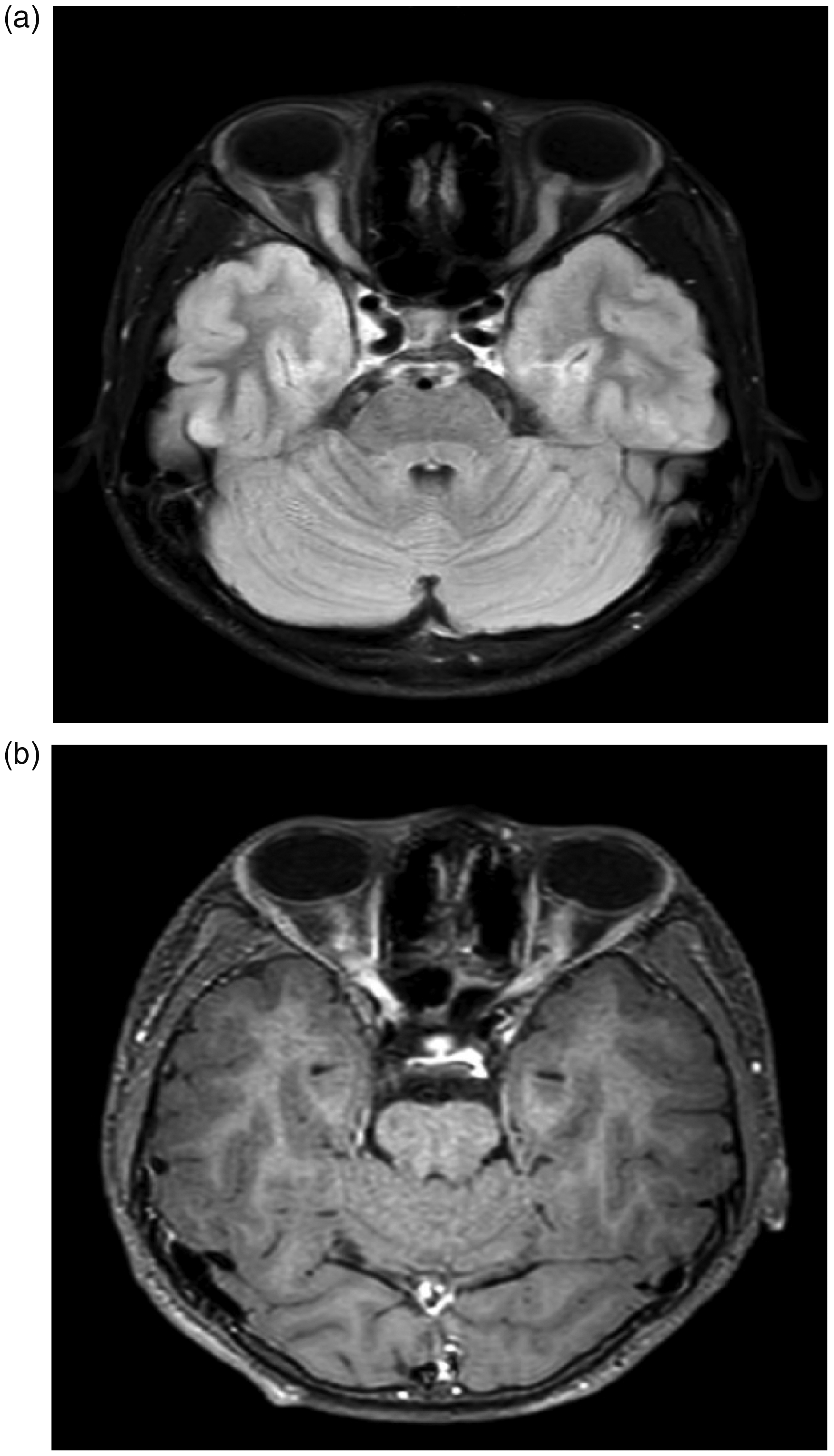
He was treated with intravenous methylprednisolone (IVMP, 1 gm/day) for five days. During this treatment, his vision improved to 6/60 over the next five days and then, at two weeks, to 6/6 with complete resolution of bilateral disc oedema. No oral steroids were administered after IVMP.
Discussion
Neurological complications are rare after anti-rabies vaccination. 1 The main ones reported are encephalitis and myelitis, alone or in combination (ADEM). Reported cranial neuropathies affected are facial, oculomotor, vagus and glossopharyngeal nerves. 7 Optic nerve involvement is extremely rare and generally forms a part of ADEM,2–6,8 only a few cases of isolated Optic neuritis ON having been reported after Semple’s vaccine. 1 The antigenicity of this vaccine is thought to be responsible, through an immune complex-mediated reaction and blood–brain barrier damage, leading to inflammation and demyelination. 9 Spontaneous complete recovery usually occurs. However, incomplete visual recovery may result because of permanent macular damage. 10
In our case, anti-rabies vaccine derived from chicken embryo cells is usually not associated with any neuroparalytic complications, though one case each, of neuro-retinitis 11 and Guillain-Barre syndrome, 12 have been reported. The manufacturer’s information also does not mention the risk of neurological complications. Our patient received his vaccine doses on alternate days (the correct regimen being vaccinations on days 0, 3, 7 and 14). This accelerated dosing regimen may have contributed to enhanced vaccine antigenicity, leading to an immune-mediated complication causing ON.
Our patient had bilateral ON but regained normal visual acuity in both eyes after treatment with IVMP.
Since neuroparalytic complications are thought to result from a reaction between brain tissue and chick embryo tissue, it seems prudent that recombinant vaccines be prepared and used as a permanent solution to this problem. Vaccination, however, remains advisable despite these potential neurological complications in view of their rarity.
Footnotes
Declaration of conflicting interests
The author(s) declared no potential conflicts of interest with respect to the research, authorship, and/or publication of this article.
Funding
The author(s) received no financial support for the research, authorship, and/or publication of this article.