




Abstract
Although human toxocariasis can lead to serious complications including neurological, ocular and visceral complications, there is a lack of comprehensive epidemiological information about the seroprevalence of Toxocara species in humans. In the present study, we analysed and reviewed the overall seroprevalence of human toxocariasis in Iran. The data collection was systematically undertaken on published articles using the PubMed, Google Scholar, ScienceDirect and Scopus databases. A total of 27 studies from the past two decades reporting seroprevalence of human toxocariasis met our eligibility criteria. The pooled proportion of Toxocara infection was estimated as 6.58% (95% confidence interval = 3.98–9.77). A wide variation between different studies was observed (Q statistic = 799.37, df = 26, P < 0.0001, and I2 = 96.7%). The seroprevalence rate of toxocariasis in the Iranian population is relatively high; contamination of the environment by eggs from the host as well as from household dogs and cats should be blamed.
Introduction
Toxocariasis, a neglected tropical parasitic zoonosis, is caused by the roundworm species Toxocara canis and T. cati. The nematode is frequently found in the small intestine of Canidae; however, humans can act as accidental hosts. 1 The major routes of transmission to humans are ingestion of raw vegetables, which contain embryonated eggs, close contact with infected dogs and cats, particularly in pet owners, as well as consumption of contaminated raw meat with Toxocara larvae. Clinical manifestations depend on the aberrant migration of second-stage larvae that result in the invasion of a wide range of organs including visceral larva migrants (VLM), ocular larva migrants, and neurologic and covert toxocariasis. 2 Significant and serious symptoms include hepatomegaly, splenomegaly, abdominal pain, hypereosinophilia, asthma, allergy, uveitis, optic papillitis, bronchitis, urticaria, behavioural disorders, vomiting, neurological, neurophysiological and occult infection.3,4
Human toxocariasis is diagnosed after considering epidemiological, serology, clinical, histopathological and laboratory findings including eosinophilia and IgE levels, imaging and serological tests. 5 Seroprevalence studies indicate that toxocariasis is cosmopolitan and can be considered one of the most common helminthic infection in humans. Human toxocariasis is increasing in prevalence according to reports from Asia, Oceania, Europe, Africa and the Americas. 6 It is higher in tropical and low- and middle-income countries, and is generally associated with low socioeconomic status. Toxocariasis, both in humans and in animals, is considered an endemic and intrinsic disease in Iran, where Toxocara spp. is one of the most frequent (18.8%) parasites of dogs. 7 Human toxocariasis is mainly attributed to T. canis rather than T. cati. High-risk groups for toxocariasis are children, dog owners, veterinarians and farmers, all of whom are more exposed to the eggs of Toxocara species. Among them, children usually have a higher tendency to inadvertently ingest Toxocara ova. 8 Nonetheless, toxocariasis requires more attention from public health services and research systems owing to the importance of clinical symptoms and its disease prevalence. Therefore, the major purpose of our systematic review was to elucidate and analyse the seroprevalence rate of toxocariasis in the Iranian population between 2000 and 2018 and to note the need for improving prevention and control measurements.
Methods
We included studies in English conducted on the seroprevalence of human toxocariasis in Iran from 2000 to 2018. Case reports, studies about animal toxocariasis and those using molecular methods were excluded.
The following databases were searched: PubMed; Google Scholar; ScienceDirect; and Scopus. Keywords used in combination or alone were: toxocariasis; T. canis; T. cati; seroprevalence; antibody; IgG; human; Iran; and eosinophilia. References of the articles were checked to avoid omitting any article.
A data extraction sheet was used to collect the following data from the literature: the first author; year of publication; province; residential areas (urban/rural); sample size; prevalence rate; gender for the origin of samples; age; diagnostic methods of samples; cut-off value; contact history with dog and cat; and eosinophilia.
The pooled proportions of human toxocariasis seroprevalence with a 95% confidence interval (CI) were calculated for each study. A forest plot was used to visualise heterogeneity among the included studies. Heterogeneity was expected in advance and statistical analyses including I2 and Cochrane's Q test (with a significance level of P < 0.1) were used to quantify variations. The meta-analysis was performed using StatsDirectStatistal Analysis software.
Results
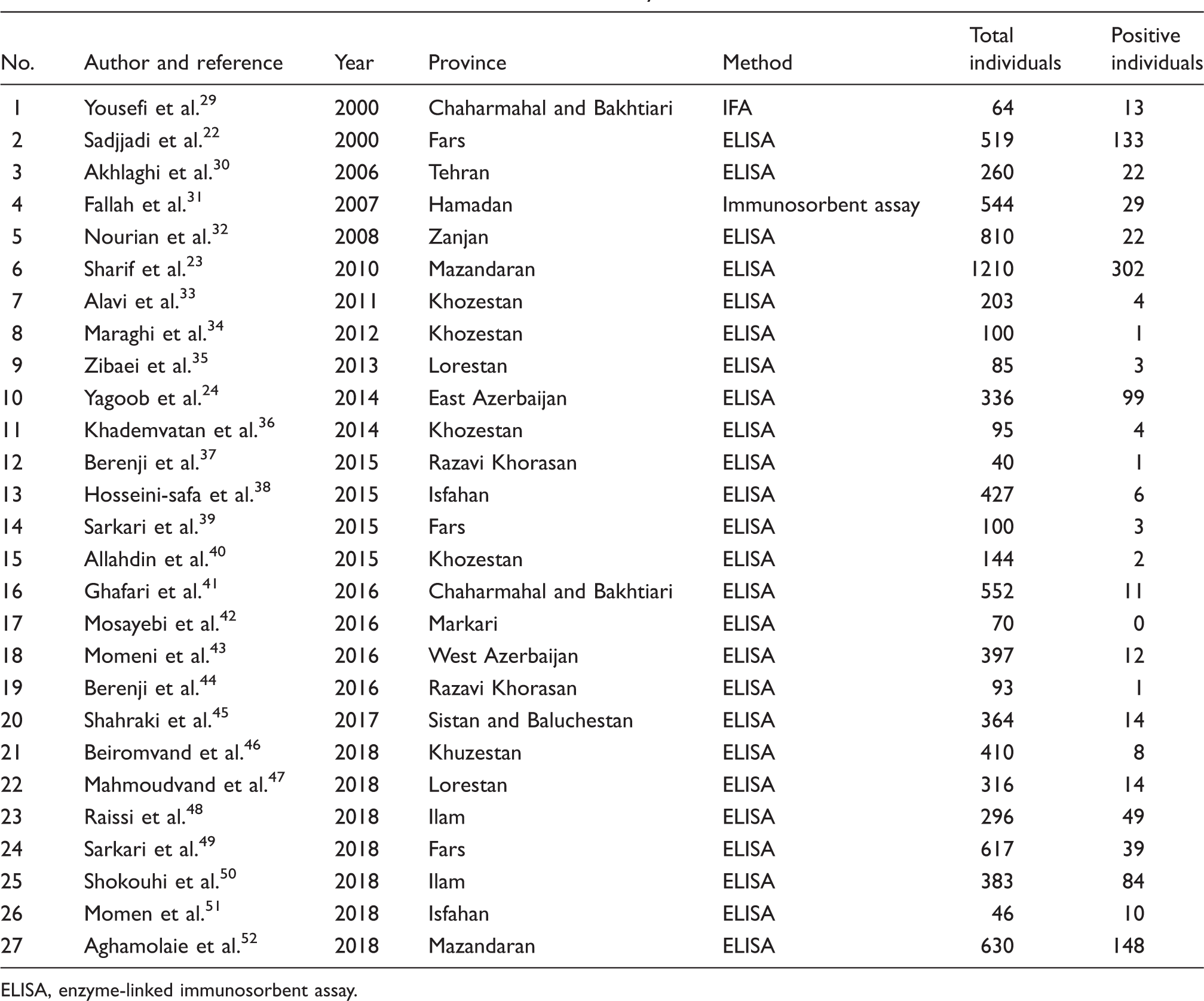
In the first phase of database search (using PubMed, Google Scholar, ScienceDirect and Scopus), 1763 records were identified. In the next step, 52 duplicate papers were removed and 1543 records were excluded based on their title and abstract. Full texts of the remaining 168 articles were assessed for eligibility criteria based on their sample size, being reviewed articles or case series reports, animal studies and sufficient data numbers. A total of 27 studies met the eligibility criteria in our meta-analysis. We accumulated 9490 individuals evaluated for toxocariasis using serological diagnostic methods in different areas of Iran, of whom 821 were positive (Table 1). Enzyme-linked immunosorbent assay (ELISA; 25 studies) was the most common serological employed method for diagnosis of anti-Toxocara IgG antibody in humans. The pooled proportion of toxocariasis among the studied Iranian people from 2000 to 2018, considering the model of random effects, was estimated as 6.58% (95% CI = 3.98–9.77). Figure 1 shows a forest plot of our systematic review. A wide variation in the seroprevalence estimates of different studies was observed (Q statistic = 799.37, df = 26, P < 0.0001 and I2 = 96.7%).
Forest plot of the current systematic review. Publications of human toxocaraisis included in the current systematic review. ELISA, enzyme-linked immunosorbent assay.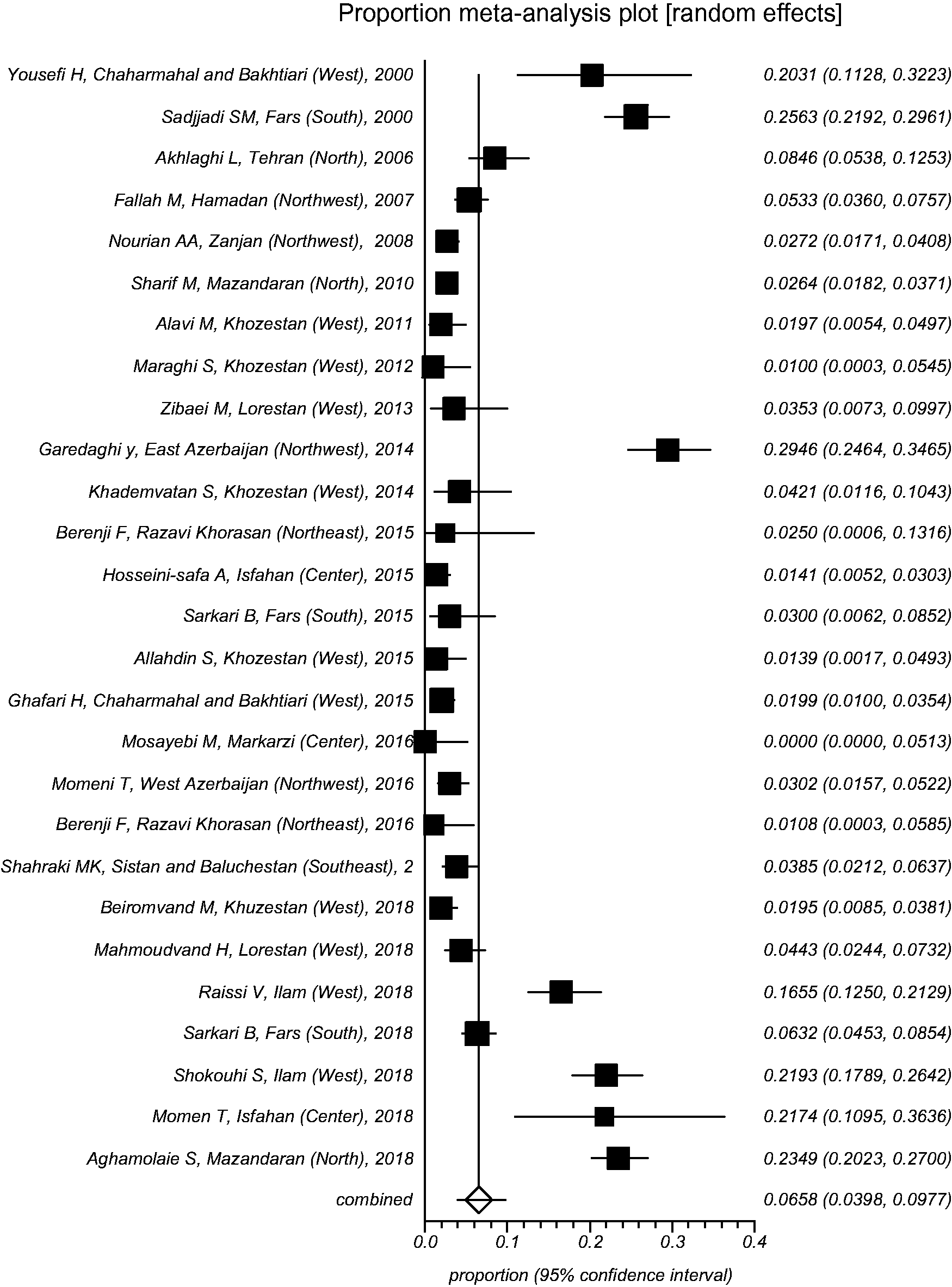
The prevalence of human toxocariasis infection in various regions of Iran was in the range of 0%–29.4%, the distribution in different areas of Iran is shown in Figure 2. The age range of the individuals was 1 month–80 years; however, 70% of studies were conducted in children aged ≤15 years.
The average seroprevalence of human toxocariasis in different provinces of Iran.
Discussion
Human toxocariasis is considered one of the most prevalent neglected tropical zoonotic helminthic infections owing to the man–soil–dog cycle in rural and urban areas in both low- and high-income countries. 9 A similar systematic review reported that the overall prevalence of Toxocara spp. contaminating soil samples from Iran is 16%. 10 Different rates of human toxocariasis have been reported from areas in the world, including Spain (1%), Brazil (3.6%), Turkey (15.7%), Iraq (20.6%) and Argentina (37.9%–39%).11–15
Diagnosis of Toxocara infection is usually determined via ELISA using excretory-secretory antigens of Toxocara spp. Among different serological diagnostic assays, ELISA was utilised in the majority of toxocariasis studies in humans to determine sera for anti-Toxocara antibodies. owing to its high and reliable sensitivity, specificity and availability.16–18 However, a single seropositivity could have limited pathological importance and probably reflects a past Toxocara infection rather than a recent one. Besides, seropositivity does not provide evidence for either active systemic toxocariasis or for CNS toxocariasis. 6 In addition, in the most carefully analysed studies, the seroprevalence rate of Toxocara infection was higher among case groups compared to control ones.
It has been demonstrated that Toxocara ova have high resistance to various environmental conditions and embryonation of the eggs can regularly take place throughout warm seasons. Moreover, appropriate humidity and oxygen, the type of soil, pH and vegetation density are other major factors that affect not only the development of second-stage larvae (L2) within eggs, but also the durability and longevity of Toxocara ova.19–21 According to the published data, East Azerbaijan, Mazandaran and Fars provinces showed the highest rates of seroprevalence.22–24,52 These provinces have the most favourable climatic conditions for the survival of the Toxocara egg and the life cycle of the parasite, having a higher humidity and temperature. 25
In addition, in East Azerbaijan and Fars provinces where high incidences were found, toxocariasis was found in 78.8% and 52.78% of stray cats, respectively.26,27 Further, toxocariasis was, at 27%, the most prevalent helminthic infection in examined domestic dogs in Mazandaran province. 28
Although our data were limited to only 15 of the 31 provinces in Iran, we doubt whether the prevalence in unstudied areas differs greatly. Nonetheless, further studies are highly recommended to complete the mapping of the country.
Most studies were carried out on children. This represents the most frequently infected group and therefore not representative of the whole population. 28
Nevertheless, the high seroprevalence of human toxocariasis in our study must alert the authorities to the importance of widespread anti-helminthic treatment of dogs and cats, the most important final hosts, in prevalent areas. Assistance to animal owners and the enforcement of appropriate legislation is required.
Footnotes
Declaration of conflicting interests
The author(s) declared no potential conflicts of interest with respect to the research, authorship, and/or publication of this article.
Funding
The author(s) disclosed receipt of the following financial support for the research, authorship, and/or publication of this article: Financial support from the Centre for Health Related Social and Behavioural Sciences Research, Shahroud University of Medical Sciences, Shahroud, Iran (grant no. 9920).
