



Abstract
Parameatal urethral cyst (PUC) is a comparatively unusual pathology in children. Since its first report, approximately 100 cases have been reported in the literature, mostly in the Japanese population. We report such a case in a 9-year old boy who presented with urine stream distortion, successfully managed by complete excision of the cyst, with total removal of the epithelium, which is the treatment of choice to prevent recurrence.
Introduction
The pathogenesis of these cysts is uncertain. Although asymptomatic, they can present with urine stream disturbances and dysuria. The first English report was by Thompson and Lantin in 1956, 1 although previous reports exist from Japan
Case report
A 9-year old boy presented with a painless, cystic swelling on the glans penis. The swelling was first noticed at circa eight years of age. The swelling had since then slowly enlarged to become more prominent. There was associated dysuria and urine stream distortion over the past three months. Clinical examination revealed a spherical cystic mass 1 cm in diameter ventro-lateral to the external urethral meatus on the right side (Figure 1). The cyst was noted to be impinging on the urethral wall. Surgical excision of the cyst was undertaken ensuring complete removal of the lining epithelium. The epithelial defect was closed using an absorbable suture. The postoperative period was uneventful with normalization of the urine stream. Histological examination revealed that the cyst was lined with transitional epithelium and there was no evidence of infection or inflammation (Figure 2). Six months of follow up showed no recurrence and the patient was asymptomatic with a good calibre forward urinary stream.

Parameatal urethral cyst.
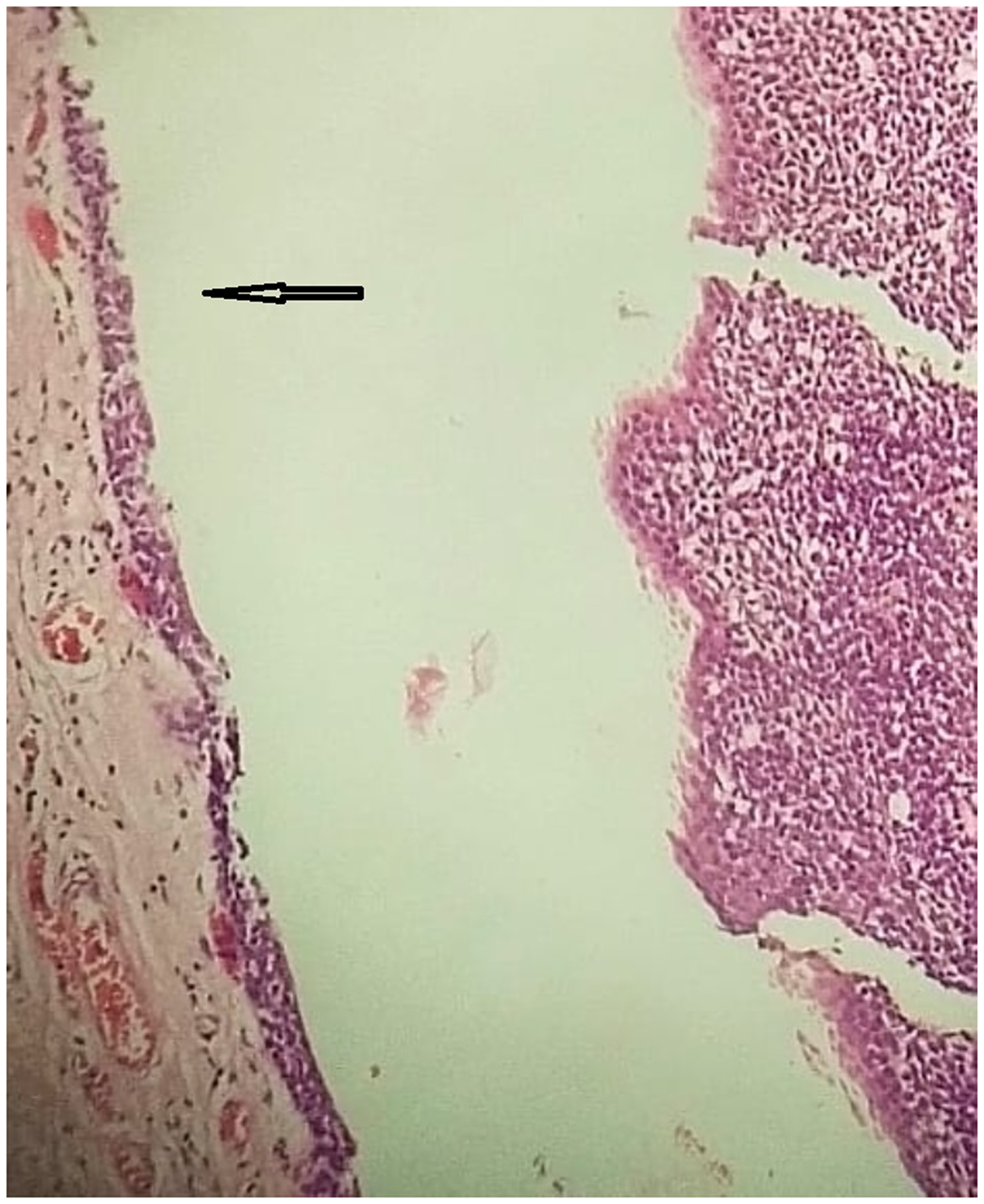
Histopathology of the parameatal urethral cyst showing transitional epithelial lining (arrow).
Discussion
Parameatal urethral cysts (PUCs) are usually <1cm in diameter, located either ventral or lateral to the meatus, impinging the urethral lumen. These cysts are usually asymptomatic and may be present at birth or develop during childhood, with dysuria or urine stream distortion, or simply with cosmetic concerns. PUCs are not associated with other genital abnormalities. 2 The differential diagnosis is of a fibroepithelial polyp, juvenile xanthogranuloma, or other cystic lesions such as an epidermoid cyst, or pilosebaceous cyst 3
Thompson and Lantin proposed a persistence of cystic spaces in the process of preputial delamination. 4 Other theories are an anomalous fusion of the urethra or obstruction of paraurethral ducts secondary to inflammation. 3 Histologically PUCs have been classified into three types: urethral (lined by stratified columnar, cuboidal or transitional epithelium), epidermal (lined by squamous epithelium) and mixed cysts. 5
Reports of spontaneous rupture have been described, but this is very rare and mainly observed in neonates. 6 Reports exist of recurrence after spontaneous rupture, needle aspiration or marsupialization. 7 Therefore, complete surgical excision is the treatment of choice.
A long term follow-up described 29 children who underwent surgery with no recurrence. 8 A waiting period of six months is recommended if found in a neonate, as spontaneous resolution is known. 6
Conclusion
A parameatal urethral cyst is an unusual but benign clinical condition of uncertain aetiology. It may present with dysuria and stream abnormalities. Complete surgical excision produces good cosmesis without recurrence.
Footnotes
Authors’ contributions
VM—planning, conduct, reporting, conception, and design. SG— planning, conduct, reporting, conception, and design. PD—acquisition of data. RN and LG—analysis, and interpretation of data. The pictures were collected by VM and PD. All authors contributed to the drafting of the manuscript. LG and SG helped in the final editing of the revised manuscript. All authors approved the submission of the article
Declaration of conflicting interests
The author(s) declared no potential conflicts of interest with respect to the research, authorship, and/or publication of this article.
Funding
The author(s) received no financial support for the research, authorship and/or publication of this article.
