



Abstract
Maternal and congenital syphilis are a major public health problem worldwide. The World Health Organization and Centre for Disease Control both recommend routine screening of pregnant females for syphilis. Despite guidelines in place, maternal syphilis often remains undiagnosed and untreated and there is currently a surge in cases of congenital syphilis. We present a case of a 3-month-old male illustrating a delayed diagnosis of congenital syphilis despite characteristic skin lesions, hepatosplenomegaly, haemolytic anaemia, failure to thrive and history of untreated syphilis in the mother. This case highlights the need to strengthen existing guidelines for intensive screening and early treatment for maternal syphilis. It also underscores the importance of increased awareness amongst paediatricians and dermatologists regarding overlapping clinical features of congenital syphilis.
Case report
A 3-month old male infant born at term by normal vaginal delivery with a birth weight of 2 kg presented with rapid breathing and cough for 4 days. He had abdominal distension since birth and was not growing well, for which ailment he was taken to different paediatricians, but no conclusive diagnosis was made. The child also had skin lesions for one month for which he had been advised some ointments by a dermatologist.
On examination, he was tachypnoeic with a respiratory rate of 64 breaths/min, febrile (at 38.5°C), hypoxic (saturation 89% on room air), with severe pallor. There were multiple desquamating maculopapular skin lesions and blisters over limbs, back and abdomen (Figs 1 and 2). Intercostal recession and bilateral wheezing were noted. The abdomen was distended with visible dilated veins, a palpable hepatomegaly (3 cm below the right subcostal margin) and splenomegaly (palpable 4 cm below the left subcostal margin) but without ascites. He was of low weight (3.2 kg), short length (51 cm) and small head circumference (36 cm) all below the 3rd centile.

Blisters over hand and arm.
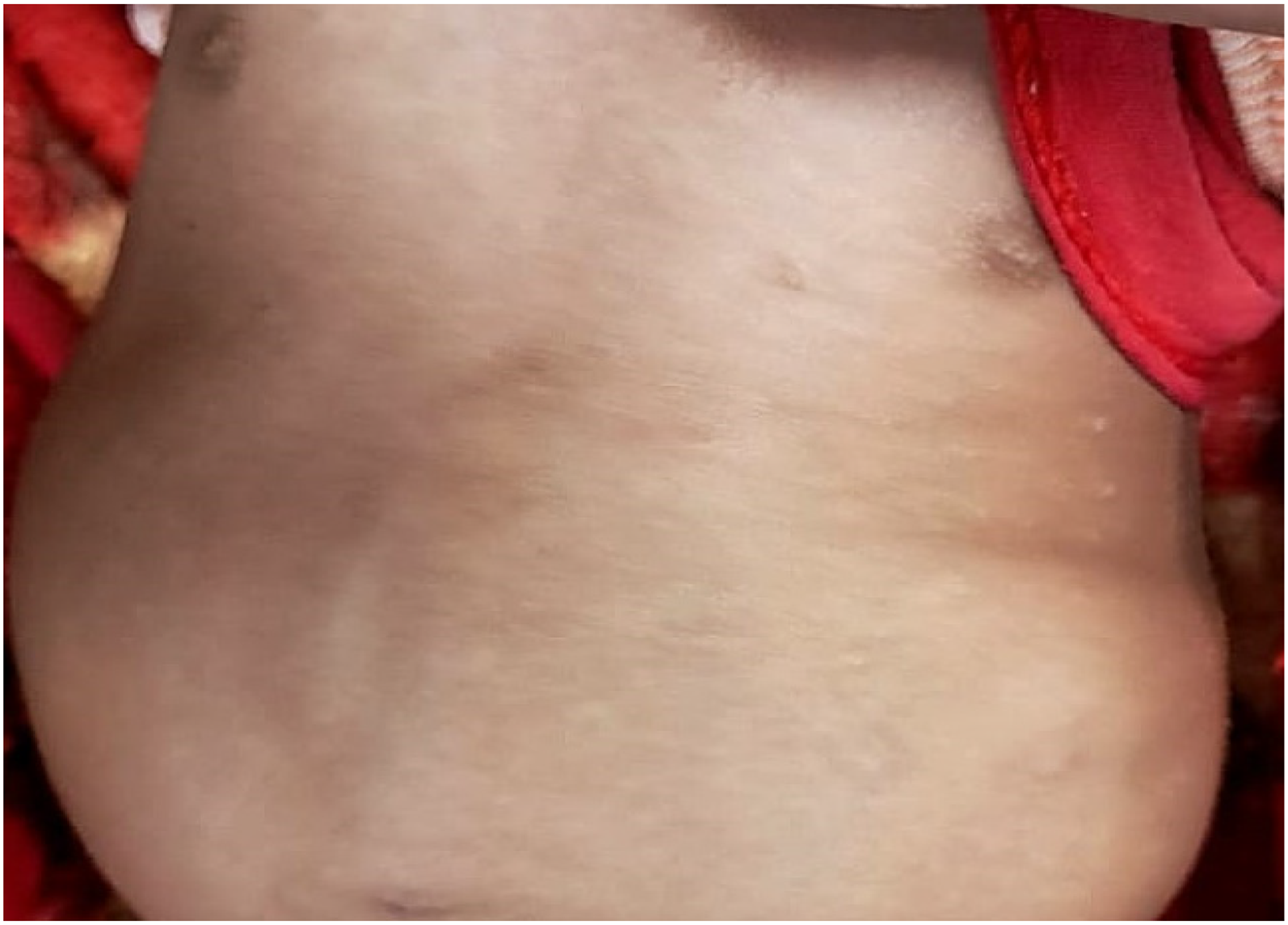
Maculopapular lesions over the abdomen.
Investigations showed a severe anaemia (Hb 58 g/l), thrombocytopenia (platelet count 70 × 109/L) and leucocytosis (27.9 × 10⁹/L). A peripheral smear was suggestive of haemolysis, but liver and kidney function tests were normal. Dengue, malaria, scrub typhus tests were negative.
Oxygen was administered, nebulization with levo-salbutamol and empirical intravenous antibiotic therapy were started. The child received one unit of red cells, but after three days there was no improvement in his general condition.
Further enquiry with the mother revealed a history of genital lesions with a diagnosis of being VDRL positive at eight months gestation, but for which no treatment had been issued. The child's Treponema Pallidum Haemagglutination test (TPHA) came out positive, and rapid plasma reagin (RPR) was 1:128. CSF analysis was normal and negative for RPR. The mother's RPR was 1:16. There were no skeletal changes. Crystalline penicillin was given to the child for 14 days, and he gradually improved, gained weight and could be discharged, at which time his vision and hearing in the right ear were normal but there was mild hearing loss on the left. Repeat RPR was 1:16. On follow-up at eleven months, the child was thriving and the RPR test was non-reactive.
Discussion
Transplacental transmission of Treponema pallidum from an infected pregnant female to the foetus or intrapartum contact with genital lesions may lead to congenital syphilis. 1 Though more common in resource-poor countries, a recent surge in congenital syphilis in richer Western countries has also been noted. 2 Stillbirth, prematurity, intrauterine growth retardation, non-immune hydrops and neonatal infections are some of the severe consequences of untreated maternal syphilis. 3 Foetal infection is likely in 70% of untreated maternal infection. 4 Notably, appropriate treatment of maternal syphilis reduces the incidence of congenital syphilis by 97%. 5
The diagnosis of congenital syphilis may be missed owing to an overlap of clinical features with other common infections. Untreated infants may develop long term disabilities such as hearing and visual impairment, developmental delay and bony deformities. Treponemal (TPHA) and non-treponemal tests (VDRL and RPR) confirm the diagnosis. 3 Crystalline penicillin for 10–14 days is the drug of choice for symptomatic infants, although 10–20% resistance is now being seen. 6
Simple antenatal screening and treatment of maternal syphilis is however both simple and effective. A high index of suspicion in infants presenting with unexplained hepatosplenomegaly, failure to thrive, haemolytic anaemia, thrombocytopenia and characteristic skin lesions is expected to elicit a relevant antenatal history from the mother.
Footnotes
Author's contribution
All the authors were responsible for drafting of the text, sourcing and editing of clinical images, investigation results, critical revision for important intellectual content and final approval of the manuscript.
Ethical consideration
This article does not contain any studies with human participants or animals performed by any of the authors. Written consent for publication was obtained from the family.
Funding
The authors received no financial support for the research, authorship, and/or publication of this article.
