



Abstract
Amoebic liver abscess (ALA) remains a major health burden in tropical regions. Our observational study evaluated the association between serum lipid profiles and disease severity in 118 patients with ALA. Patients were classified into uncomplicated and complicated ALA groups. Serum high-density lipoprotein cholesterol (HDL-C) levels were significantly lower in ALA patients compared to controls and further reduced in complicated cases. HDL-C emerged as an independent predictor of complicated ALA and demonstrated better predictive value than conventional inflammatory markers such as total leucocyte count and C-reactive protein. Lower HDL-C levels were also linked to an increased need for percutaneous catheter drainage and longer hospital stay. Post-treatment assessments showed significant improvement in HDL-C levels. These findings suggest that HDL-C is a valuable, low-cost biomarker for assessing ALA severity and guiding clinical decisions, especially in resource-limited settings.
Introduction
Amoebic liver abscess (ALA), caused by the intestinal protozoan Entamoeba histolytica (EH), continues to pose a significant public health challenge in tropical regions. Lipids are known to play a key role in the pathogenesis of parasitic infections. In EH, cholesterol is essential for growth and virulence expression.1,2 Animal studies have shown higher susceptibility to ALA in cholesterol-fed models compared to standard diets. 3 Notably, EH lacks the machinery for de novo lipid synthesis and must scavenge lipids from the host.
In humans, cholesterol is primarily synthesized in the liver and circulates between the liver and intestines via the enterohepatic pathway, both key sites affected in invasive amoebiasis. Animal studies have shown increased hepatic cholesterol and triglyceride levels in EH infection, despite systemic hypocholesterolaemia. 4 Limited clinical studies have similarly reported altered lipid profiles, particularly low serum cholesterol, in ALA patients.5,6 Among lipoproteins, high-density lipoprotein cholesterol (HDL-C) has notable anti-inflammatory, antioxidant, and endotoxin-neutralizing properties; reduced HDL-C levels have been linked to greater severity and worse outcomes in sepsis.7,8 However, the role of lipid markers in assessing ALA severity or predicting complications remains unexplored.
Patients and methods
Our analytical observational study was conducted at a tertiary-care institute between June 2023 and April 2025. The protocol was approved by the Institutional Research Board and Ethics Committee (AIIMS/Pat/IEC/2024/19), and all investigations adhered to the principles of the Declaration of Helsinki.
Consecutive patients with liver abscess admitted were screened. Included were patients aged between 14 and 75 years diagnosed with ALA. Excluded were non-ALA, current use of statins or other hypolipidaemic agents, underlying chronic liver disease, pregnant females or those with a history of oral contraceptive use, and refusal to provide informed consent. For the comparison of lipid indices, we randomly selected 32 age- and gender-matched control subjects who attended the gastroenterology outpatient department with complaints of mild functional dyspepsia or non-erosive reflux disease.
ALA was diagnosed based on clinical presentation, radiological imaging, and positive amoebic serology. Diagnostic confirmation was further supported by characteristic ‘anchovy sauce’ pus and the presence of caecal ulcers on colonoscopy when available. 9 ALA was classified as complicated when there was evidence of rupture, thrombosis of adjacent vessels, or secondary bacterial infection. In the absence of these, it was labelled as uncomplicated ALA. High-risk features in uncomplicated ALA included large abscess size (>10 cm in the right lobe or >5 cm in the left lobe), caudate lobe involvement, thin rim (<1 cm) of surrounding hepatic parenchyma, and interrupted or ragged abscess margins on computed tomography (CT), characteristic of Type I ALA. 10 Rupture was diagnosed using ultrasonography by a breach in the abscess wall with extrahepatic fluid collection. Intraperitoneal rupture was classified as either localized or diffuse based on the distribution of fluid. Post-procedural secondary bacterial infection was defined by the emergence of purulent, foul-smelling drain output with bacterial growth in pus cultures.
At the time of admission, detailed demographic, clinical, and medical histories were recorded. Data collected included alcohol use, co-morbid conditions, and recent medication history. Baseline laboratory investigations included complete blood count, liver and kidney function tests, blood sugar, and coagulation profile. Enzyme-linked immunosorbent assay was used to detect EH antibody in patient serum. Serum lipid profile, including total cholesterol, triglyceride, low-density lipoprotein cholesterol (LDL-C), and HDL-C, was assessed on fasting blood specimen using the enzymatic colorimetric methods (Ortho Vitros, Beckman Coulter AU5800 series). Inflammatory markers assessed included C-reactive protein (CRP), measured using immuno-turbidimetry method, and procalcitonin (PCT), assessed via chemiluminescent Immunoassay. Abdominal ultrasonography was performed for initial evaluation and characterization of liver abscesses. In cases with diagnostic uncertainty or suspected complications, a contrast-enhanced CT scan was utilized.
All patients received intravenous metronidazole at a dosage of 15 mg/kg tds daily during hospitalization. Complicated ALA and uncomplicated ALA patients requiring percutaneous catheter drainage (PCD) cases also received broad-spectrum antibiotics such as third-generation cephalosporins or carbapenems. PCD was performed using a 12-Fr pigtail catheter under real-time ultrasound guidance by an experienced interventional radiologist. Upfront PCD was considered for all patients with complicated ALA. For uncomplicated ALA, upfront PCD was done only if high-risk features were present. In the remaining patients with uncomplicated ALA, PCD was considered only after 72 h of failed medical therapy, defined as lack of improvement in pain, persistent or worsening fever, and no decrease or an increase in total leucocyte count (TLC).
Continuous variables were expressed as mean ± SD or median (range), based on distribution. Categorical variables were presented as counts and percentages. Group comparisons used appropriate parametric or non-parametric tests, with chi-square or Fisher's exact test for categorical data. Binary logistic regression identified independent predictors of ALA severity. Pearson's correlation assessed relationships between continuous variables. ROC curve analysis evaluated the predictive performance of HDL-C and inflammatory markers (TLC, CRP), with AUC used to determine diagnostic accuracy. Analyses were performed using SPSS version 23.0 (SPSS Inc., Chicago, IL), with p < 0.05 considered statistically significant.
Results
A total of 136 patients with liver abscess were evaluated during the study period. After excluding 18 patients (14 with pyogenic or cholangiolar abscess, 2 with underlying chronic liver disease, and 2 on hypolipidemic medication), a final cohort of 118 patients with ALA was included in the analysis.
Of the 118 ALA patients enrolled, 108 (91.5%) were male, with a mean age of 46 ± 15.2 years. A history of significant alcohol consumption was reported in 84% of patients, while 6% were diabetic. Most patients had either a single abscess (42.4%) or two abscesses (37.3%). Abscess size ranged widely from 2.5 to 15.8 cm, with 54.2% having medium-sized abscesses (5–10 cm). Colonoscopy findings revealed caecal ulcers in 61.2% (60/98) who underwent the procedure. Haematological parameters revealed a median Hb level of 10.5 g/ L and a median leucocyte count of 16.1 × 10⁹/L. Liver function tests showed variable values (Table 1). Lipid profile analysis revealed a high prevalence of hypolipidaemia among ALA patients, as evidenced by a median total cholesterol level of 2.3 mmol/L, HDL-C of 0.31 mmol/L, LDL-C of 1.4 mmol/L, and triglycerides of 1.15 mmol/L. Notably, a reduction in HDL-C levels (<1.03 mmol/L) was observed in 97.5% (n = 116) of ALA patients. In contrast, reductions below normal limits of triglycerides, total cholesterol, and LDL-C were noted in 4.2%, 10.2%, and 41.5% of ALA patients, respectively.
Baseline characteristics of ALA patients, including comparison of parameters between complicated and uncomplicated cases.

aDifference between com plicated and uncomplicated ALA. Abbreviations: ALA: amoebic liver abscess; TLC: total leukocyte count; AST: aspartate aminotransferase; ALT: alanine aminotransferase; S.: serum; HDL: high-density lipoprotein; LDL: low-density lipoprotein; CRP: C-reactive protein; PCD: percutaneous catheter drainage.
Of 118 patients, 44 (37.3%) had complicated ALA, including abscess rupture (31), vascular thrombosis (8), and secondary infection (4). Age and gender were comparable between groups, but complicated cases had more large abscesses (>10 cm: 52.3% v. 27.1%). They also showed higher TLC, ALT, creatinine, CRP, and PCT, with lower platelets and albumin. Lipid profiles revealed significantly lower HDL-C (0.19 v. 0.40 mmol/L, p < 0.001), total cholesterol (1.94 v. 2.46 mmol/L, p = 0.002), and LDL-C (1.05 v. 1.53 mmol/L, p = 0.033), while triglycerides did not differ (p = 0.774) (Table 1).
HDL-C was the most reduced lipid marker in ALA patients, with levels dropping by up to 70%. Median HDL-C was much lower in ALA patients than controls [0.31 (0.026–1.19) vs. 1.14(0.88–1.45) mmol/L, p < 0.001; Fig. 1A]. Furthermore, HDL-C levels showed a strong inverse association with ALA severity.
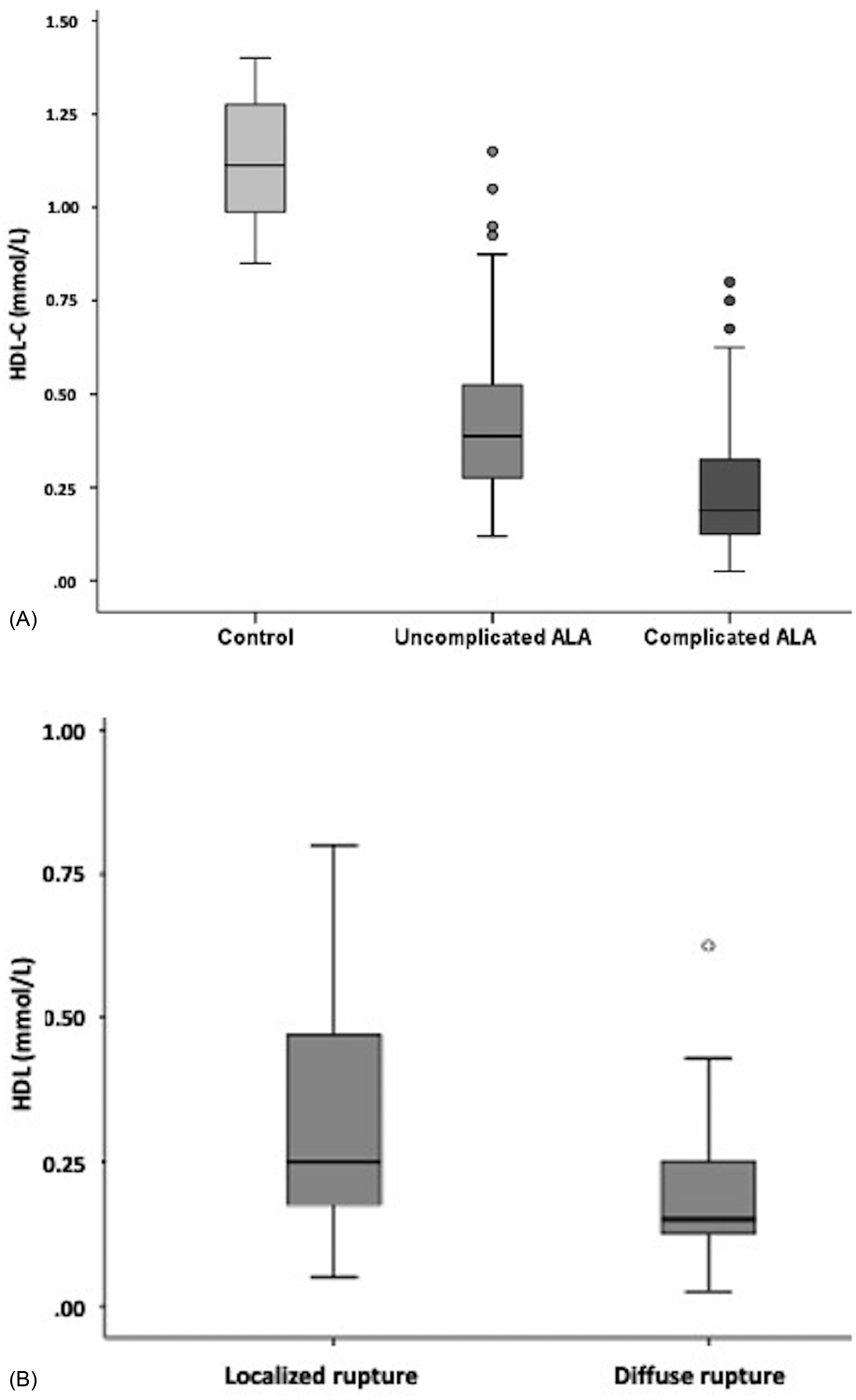
Box plots showing comparison of serum high-density lipoprotein cholesterol (HDL-C) levels among various groups of amoebic liver abscess (ALA) patients. HDL-C levels were significantly lower in both uncomplicated and complicated ALA groups compared to controls (p < 0.001), with the lowest levels observed in the complicated ALA group. Among patients with ruptured ALA, those with diffuse rupture had lower HDL-C levels than those with localized rupture; however, the difference (p = 0.05) just fell short of statistical significant (1B).
Patients with complicated ALA had significantly lower HDL-C than those with uncomplicated disease (0.19 v. 0.40 mmol/L); (p < 0.001). Similarly, HDL-C was lower in ruptured compared to non-ruptured ALA (0.21 v. 0.36 mmol/L); (p = 0.005). Among ruptured cases, diffuse rupture was associated with further reduced levels, though the difference was marginally non-significant (0.18 v. 0.39 mmol/L), (p = 0.051; Fig. 1B). Multivariate analysis identified HDL-C as an independent predictor of complicated ALA (OR 0.93; 95% CI: 0.87–0.99; p = 0.035). The OR of 0.93 indicates that for every 1 mg/dL decrease in HDL-C, the odds of having complicated ALA increase by 7%. The ROC analysis demonstrated moderate discriminative ability for complicated ALA, with an AUC of 0.772 (95% CI: 0.68–0.86).
High-density lipoprotein cholesterol correlation with inflammatory markers
HDL-C showed a modest to weak but statistically significant negative correlation with TLC (r = –0.583, p < 0.001), CRP (r = –0.625, p < 0.001), and PCT (r = –0.314, p = 0.004) (Fig. 2A–C). Furthermore, HDL-C demonstrated highest (0.772) area under ROC value for complicated ALA, compared to TLC (0.712) and CRP (0.687) (Fig. 3). Although alcohol consumption is also known to influence HDL-C levels, no significant difference in median HDL-C was observed between alcoholic [0.31 (0.026–1.9) mmol/L] and non-alcoholic [0.31 (0.052–1.09) mmol/L ] ALA patients.

Scatter plot illustrating a negative correlation of HDL-C (high-density lipoprotein cholesterol) levels with total leukocyte counts (2A), C-reactive protein (CRP, 2B), and procalcitonin (2C) in amoebic liver abscess patients.

Depicts receiver operating characteristic (ROC) curves for serum HDL-C, C-reactive protein (CRP), and total leukocyte count (TLC) in predicting complicated amoebic liver abscess. HDL-C: high-density lipoprotein cholesterol.
Association of high-density lipoprotein cholesterol with requirement of abscess drainage
Overall, the median HDL-C level was significantly lower in patients requiring PCD compared to those managed conservatively [0.26 (0.026–1.19) mmol/L v. 0.51 (0.16–1.088) mmol/L, p < 0.001]. Even among uncomplicated ALA patients, the median HDL-C was significantly lower among patients requiring drainage than those who did not [0.31(0.21–1.19) mmol/L v. 0.51 (0.16–1.088) mmol/L, p = 0.009]. No significant difference in the levels of total cholesterol (p = 0.461), LDL-C (p = 0.887), and triglyceride (p = 0.382) was noted between patients requiring PCD or not. On ROC analysis, HDL-C has an acceptable area under curve of 0.71 (0.59–0.84) in predicting the requirement for PCD (p = 0.002).
Improvement in high-density lipoprotein cholesterol after successful treatment
The median duration of hospitalization was 10 (5–43) days in patients with complicated ALA, 9 (4–17) days in uncomplicated ALA requiring PCD, and 5 (4–10) days in those with uncomplicated ALA managed without drainage. Serum HDL-C levels showed a weak but significant inverse correlation with hospitalization duration (r = –0.382, p < 0.001). Among 49 patients with follow-up data, HDL-C levels significantly increased post-treatment, rising from a median of 0.31 at admission to 0.52 mmol/L at discharge (p < 0.001), with a greater increase seen in complicated cases (0.30 vs. 0.16 mmol/L) (Fig. 4A &B). Total cholesterol also increased significantly (p = 0.008), while LDL-C and triglycerides showed no significant change (p = 0.623 and p = 0.862, respectively).

Bar graph showing dynamic changes in the levels of serum HDL-C from admission to discharge of amoebic liver abscess (ALA) patients overall (4A), and when stratified between complicated and uncomplicated groups (4B). HDL-C: high-density lipoprotein cholesterol.
Discussion
Our study underlines the clinical relevance of serum lipid alterations in patients with ALA, highlights a clear association between low HDL-C levels and the severity of ALA. Low HDL-C levels were independently associated with complicated ALA and predicted the need for drainage in cases of uncomplicated ALA. Furthermore, HDL-C levels rose during clinical recovery, suggesting that these changes are not merely incidental biochemical alterations but appear to be integral to the pathophysiology and clinical trajectory of the disease. These findings support the role of HDL-C as a potential biomarker of disease severity of ALA, with important implications for risk stratification and management.
A severity gradient of ALA was reflected in the degree of HDL-C depletion. Patients with complicated ALA had significantly lower HDL-C levels than those with uncomplicated disease, and those with ruptured abscesses had lower HDL-C than non-ruptured cases. Among ruptured cases, those with diffuse rupture showed a trend toward even lower HDL-C than those with localized rupture. Although HDL-C levels showed an inverse correlation with inflammatory markers, ROC curve analysis demonstrated area under curve of HDL-C over TLC and CRP in identifying complicated ALA, highlighting its clinical utility for risk stratification.
Therapeutic dilemma continues to exist with regard to drainage of uncomplicated ALA. 11 While upfront drainage is indicated in presence of high-risk signs, for the remaining patients, such decision is usually taken after a non-response to 3–5 days of medial therapy, which often results in prolonged hospital stay. In our study median duration of hospital stay in uncomplicated ALA managed with PCD was similar with those of complicated ALA patients (9 v. 10 days), indicating that earlier decision of drainage would have reduced the duration of hospital stay in uncomplicated ALA patients. Furthermore, a low baseline HDL-C in uncomplicated ALA patients reasonably predicted requirement of drainage, highlighting its clinical relevance in procedural planning. Such patients may be considered for upfront drainage in order to achieve early recovery and minimize the recourse utilization.
The pathophysiological basis for the decline in HDL-C levels in ALA patients appears to be multifactorial. HDL-C is a key anti-inflammatory, antioxidant, and immunomodulatory molecule that is known to decrease in various infectious and inflammatory states.7,8 However, the magnitude of reduction observed in ALA patients is notably profound. This suggests a pathogen-specific interaction wherein EH might preferentially utilize host HDL particles. In our study, HDL-C was found to have significant negative association with markers of systemic inflammation (TLC, CRP, and PCT). Therefore, we believe that the co-existing systemic inflammation and parasitic burden may have a synergistic role in the decline of HDL-C in ALA patients. Interestingly, although alcohol is known to affect HDL-C levels, we did not observe any significant difference in HDL-C between patients with or without a history of alcohol use.
Our findings are consistent with earlier small studies reporting low serum cholesterol in ALA,5,6 but this is the first specifically to highlight HDL-C as an independent marker of disease severity, complication risk, and treatment needs. While encouraging, the study has limitations: it was single-centre, retrospective in design (despite prospective data collection) and lacked baseline lipid data, which may confound results. Nonetheless, HDL-C's utility as a biomarker is strengthened by its low cost, routine availability, and clinical relevance.
In conclusion, HDL-C levels are significantly reduced in ALA and correlate with severity, inflammation, need for intervention, and hospital stay. Incorporating HDL-C into routine assessment may aid in risk stratification and improve patient management.
Footnotes
Acknowledgements
We acknowledge the support and cooperation of all the study participants
Author contributions
RK, JRS, and RS contributed to conceptualization, methodology, data curation, writing; TM and SK contributed to data curation and writing; RNP and UA contributed to data curation, reviewing and editing.
Competing interests
Authors declares that they have no competing interest with regard to this article
Declaration of conflicting interests
The authors declared no potential conflicts of interest with respect to the research, authorship, and/or publication of this article.
Funding
The authors received no financial support for the research, authorship, and/or publication of this article.
