



Abstract
Pit viper envenoming commonly causes venom-induced consumption coagulopathy with hypofibrinogenaemia. However, isolated thrombocytopenia without fibrinogen depletion is less recognised and may alter transfusion strategy. We report a confirmed Ovophis tonkinensis bite from northern Vietnam presenting with severe isolated thrombocytopenia and local necrosis. The case highlights the importance of serial platelet monitoring, awareness of fibrinogen availability and appropriate timing of antivenom and platelet support in resource-limited tropical settings.
Case presentation
A 43-year old previously healthy man was bitten by a yellow snake on the instep of the right foot. At his home, he was subjected to blood extraction and application of a tourniquet (a first-aid practice that is common, but contra-indicated and may exacerbate oedema and tissue necrosis). He received tetanus antitoxin serum prior to transfer to our Poison Control Centre at Bach Mai Hospital.
On arrival (13 h after the bite), he was conscious (GCS 15) with stable vital signs: temperature 36.6 °C, heart rate 88 beats/min, blood pressure 125/78 mmHg, respiratory rate 18 breaths/min, SpO₂ 98% on room air, with no neurological deficit.
There were two puncture marks on the dorsum of the right foot, extensive clear blisterings with subcutaneous haemorrhage, progressive swelling and focal necrosis of the right leg, with severe pain (visual analogue scale 9/10). The foot, ankle, calf and thigh were swollen (Table 1).
Serial measurements of limb circumference during hospitalisation.

The culprit dead snake had been brought to the hospital and was identified as Ovophis tonkinensis (Fig. 1), proven subsequently by the Vietnam Academy of Science and Technology centre.

Ovophis tonkinensis snake brought by the patient after being killed. (A) Dorsal view of the snake. (B) Ventral view showing body pattern and morphology.
Laboratory monitoring was performed at specific time intervals, and key haematologic parameters were recorded (Table 2).
Serial haematologic parameters during follow-up.
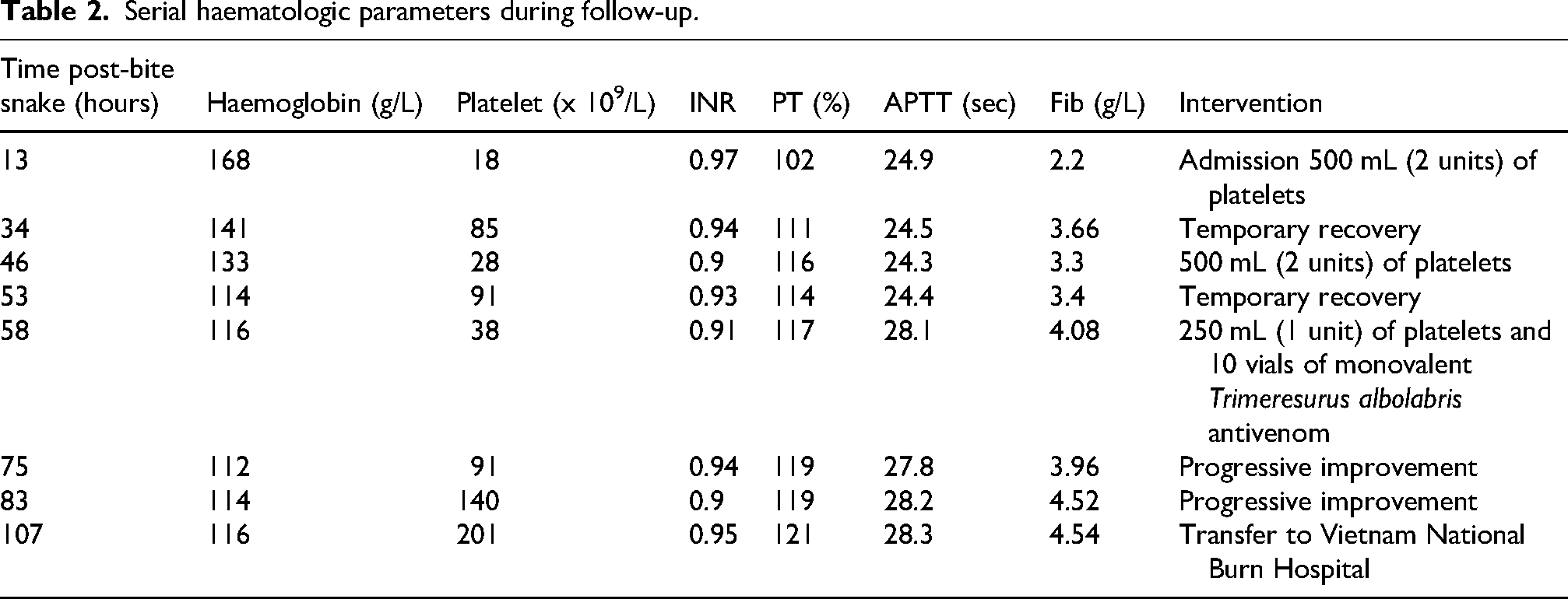
During follow-up, fibrinogen levels remained within the normal range. Platelet counts initially decreased further and then gradually increased following platelet transfusion and subsequent administration of monovalent antivenom.
Analgesia with 5 mg morphine single dose, and subsequent codeine-paracetamol was given as well as ciprofloxacin 400 mg IV bd and clindamycin 600 mg IV tds for five days, then by oral route. Local debridement of necrotic tissue was performed at the bedside prior to transfer to the National Burn Hospital. Platelets were transfused 19, 47 and 62 h post injury.
Antivenom (10 vials Trimeresurus albolabris monovalent) was administered 66 h after the bite, the delay being due to logistics and initial uncertainty of species identification.
Our patient's platelet count decreased, increased and then returned to normal.
The progression of local tissue injury evolved over time, as shown in Figure 2.

Progression of local tissue injury following snakebite. (A) At presentation (13 hours after the bite), showing initial swelling and erythema. (B) At 63 hours after the bite, demonstrating worsening edema, blistering, and skin discoloration. (C) At 87 hours after the bite, showing extensive necrosis and tissue damage.
During the hospital course, there was no clinical evidence of major systemic bleeding. Minor serous oozing at the wound site was controlled with local dressings.
Discussion
This case demonstrates severe isolated thrombocytopenia following confirmed Ovophis tonkinensis envenoming, without hypofibrinogenaemia or prolongation of PT/aPTT. 3 This differs from classical venom-induced consumption coagulopathy (VICC), in which fibrinogen depletion is a central feature. 1 The absence of hypofibrinogenaemia despite severe thrombocytopenia suggests a platelet-predominant toxic effect rather than classical VICC.
Distinguishing isolated thrombocytopenia from VICC is clinically important. In VICC, early antivenom is essential to neutralise circulating procoagulant toxins and limit fibrinogen consumption. 1 In contrast, when fibrinogen and clotting times remain normal, bleeding risk may primarily reflect low platelet count rather than systemic consumptive coagulopathy.
Fibrinogen assays are not universally available in many tropical settings. Where testing is accessible, normal fibrinogen levels support a diagnosis of platelet-predominant toxicity rather than VICC and may help avoid unnecessary plasma or cryoprecipitate transfusion. 4 Serial platelet counts and clinical assessment therefore remain critical.
Standard transfusion thresholds provide practical guidance. Prophylactic platelet transfusion is generally considered when counts fall below 10 × 109/L even without active bleeding; below 20–30 × 109/L if minor bleeding or procedures are anticipated; below 50 × 109/L for major bleeding; and below 100 × 109/L in life-threatening haemorrhage or critical surgery. 5 In this case, transfusion was guided by severe thrombocytopenia and bleeding risk rather than laboratory evidence of consumptive coagulopathy.
Pit viper venoms vary in haemotoxic effects, and species-level identification may help anticipate clinical patterns. 2 Although para-specific antivenom was used, platelet recovery followed administration, suggesting at least partial neutralisation of circulating toxins.
This case reinforces three practical lessons for clinicians managing snakebite in resource-limited tropical hospitals:
- Monitor platelets serially, even when PT/aPTT are normal. - Assess fibrinogen where available to distinguish VICC from isolated thrombocytopenia. - Use platelet transfusion according to standard thresholds and bleeding risk, while arranging timely antivenom when possible.
Conclusion
Ovophis tonkinensis envenoming may present with severe isolated thrombocytopenia without hypofibrinogenaemia. Recognition of this pattern is important to guide transfusion decisions and antivenom use in tropical clinical practice.
Footnotes
Acknowledgments
The authors thank the medical staff of the Poison Control Center for their care of the patient and their support in data collection.

Consent for publication
Written informed consent was obtained from the patient for publication of this case report and any accompanying images. A copy of the written consent is available for review by the Editor-in-Chief of this journal.
Authors contributions
Nguyen Dang Duc conceived the study, collected data and drafted the manuscript. Lam Nguyen Hong Anh and Lam Nguyen Hong Khanh contributed to literature review and manuscript editing. Nguyen Dang Bach critically revised the manuscript for important intellectual content. All authors read and approved the final version of the manuscript.
Funding
The authors received no financial support for the research, authorship, and/or publication of this article.
Declaration of conflicting interests
The authors declared no potential conflicts of interest with respect to the research, authorship, and/or publication of this article.
Availability of data and materials
All data supporting this case report are included in the article.