



Abstract
Atrial fibrillation (AF) is a recognised but potentially reversible manifestation of hyperthyroidism and may occasionally precede classic thyrotoxic symptoms. We report two cases in which AF was the initial presentation of hyperthyroidism with distinct aetiology and clinical severity. The first had rapid AF from Graves’ disease, and the second had new-onset AF due to a solitary toxic adenoma. These cases emphasise the importance of routine thyroid evaluation in patients presenting with new-onset AF.
Introduction
Atrial fibrillation (AF) represents one of the most clinically significant extracardiac causes of secondary dysrhythmia, and thyroid dysfunction remains an important reversible contributor in this context. Even a mild excess of circulating thyroid hormone can alter atrial conduction properties and autonomic balance, thereby increasing susceptibility to supraventricular tachyarrhythmias. 1 Beyond its electrophysiological influence, hyperthyroidism has been associated with increased cardiovascular morbidity and adverse outcomes if left untreated. 2 Importantly, AF may serve as the first clinical clue to underlying thyrotoxicosis, particularly in patients without prior cardiac disease, making routine thyroid function testing essential in new-onset cases. The heterogeneity of hyperthyroid states, ranging from diffuse autoimmune stimulation to focal autonomous nodules, adds further complexity to presentation and management.
Case report 1
A 45-year old male, suffering from vitiligo for seven years, presented with abdominal discomfort for one week. His irregularly irregular heart rate was 160 beats/minute, and his blood pressure 140/90 mmHg, with an elevated jugular venous pressure. He also had fine crepitations in both lower chest zones, suggestive of pulmonary oedema. A goitre was evident. His abdomen was distended, with shifting dullness suggestive of ascites.
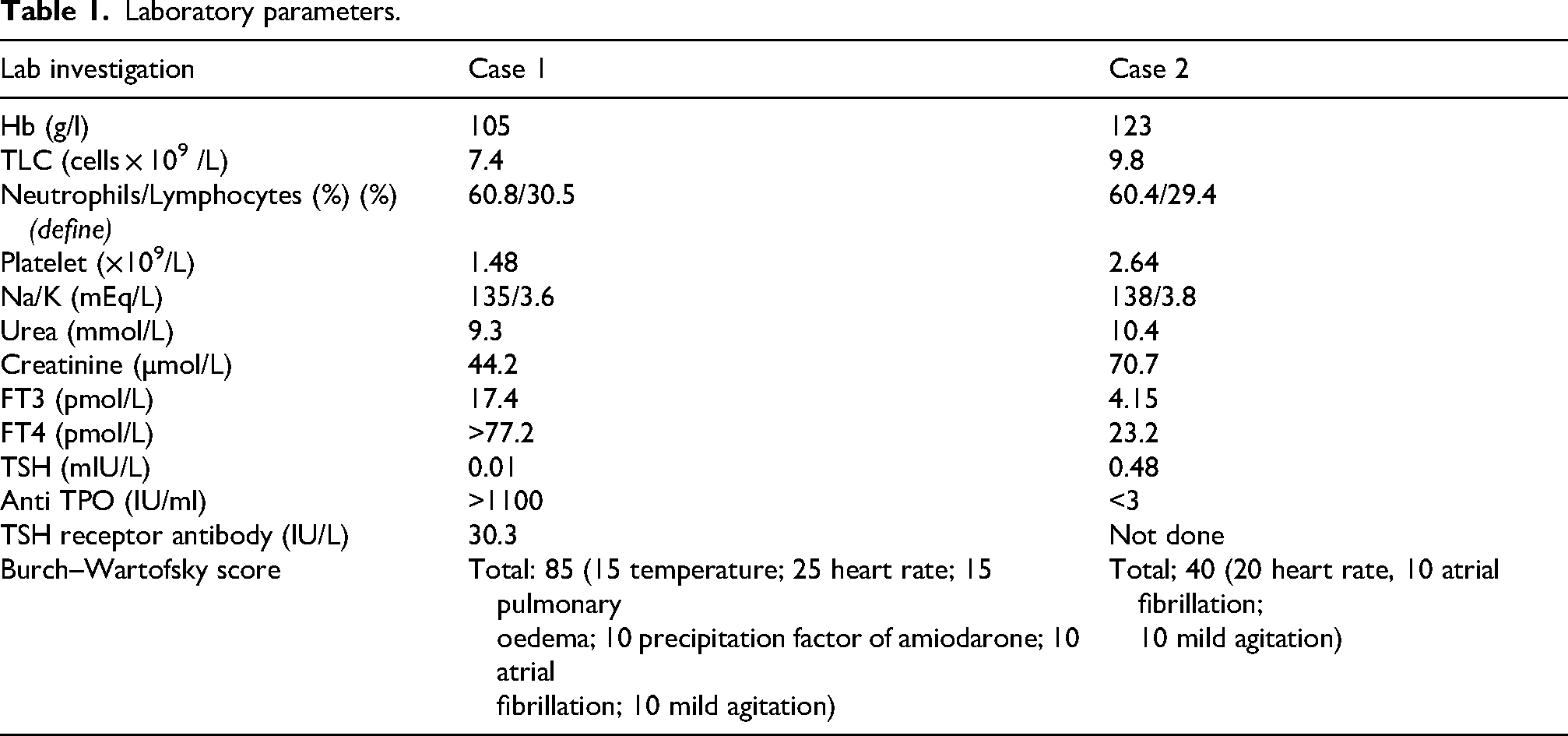
Anaemia was found, with pyrexia of 38.7°C. The thyroid profile suggested thyrotoxicosis (Table 1), and he was positive for thyroid-stimulating hormone (TSH) receptor antibody. The Burch–Wartofsky point score was 85, suggestive of thyroid storm.
Laboratory parameters.
Treatment with a loading dose of 500 mg of propylthiouracil, followed by 300 mg qds, with propranolol 60 mg orally every four hours, as well as a loading dose of intravenous hydrocortisone 300 mg dose followed by 100 mg tds, which was subsequently tapered and stopped. Propylthiouracil was continued as a maintenance dose of 100 mg tds, with propranolol 20 mg tds.
At followed up after one month, he was in an euthyroid state and was advised to undergo radioiodine ablation as definitive therapy.
Case report 2
A 59-year old female presented with irregular palpitations for one month. Her heart rate was irregularly irregular at 130 beats/min, and her blood pressure 130/90 mmHg. There was a left thyroid swelling noted, confirmed on ultrasound to be a solitary nodule of the left thyroid lobe.
The thyroid profile confirmed thyrotoxicosis (Table 1). The Burch–Wartofsky point score was 20, suggestive of an impending thyroid storm. Treatment with methimazole and metoprolol was initiated. Two months later, she was symptom-free, and her rhythm had reverted to normal. Definitive surgical excision was advised, but refused, so medical management of methimazole and metoprolol was continued.
Discussion
Atrial fibrillation is a well-recognised cardiovascular complication of hyperthyroidism, occurring in approximately 10–25% of patients with overt thyrotoxicosis, with prevalence increasing with age and severity.1,2 Atrial fibrillation may, however, also be an initial presentation, occasionally preceding classical systemic features in upto 1.7% of the patients with hyperthyroidism. Thyroid hormones exert profound electrophysiological effects on the myocardium. Tri-iodothyronine (T3) increases β-adrenergic receptor density and enhances sympathetic sensitivity, leading to increased automaticity and triggered activity. In addition, thyroid hormone shortens atrial action potential duration and refractory period, thereby promoting re-entry circuits that predispose to AF. 1 Chronic thyrotoxicosis may further induce structural remodelling, including atrial dilation and fibrosis, contributing to arrhythmogenic substrate formation. 2
In the first case, AF occurred with a thyroid storm, characterised by severe systemic decompensation with cardiovascular complications, particularly rapid AF, heart failure and shock, responsible for high mortality if untreated. Effective management requires prompt inhibition of thyroid hormone synthesis, blockade of peripheral T4-to-T3 conversion and aggressive β-adrenergic control.3,4
The second case illustrates AF resulting from a solitary toxic nodule, which may lead to localised, TSH-independent hormone production. Although the clinical course is often more indolent, sustained thyrotoxicosis, even without storm, can induce sufficient electrical remodelling to precipitate AF.2,5
From a clinical standpoint, these cases underline several important principles. First, in resource-constrained settings, targeted thyroid function testing may be prioritised in younger patients with new-onset AF, particularly in the absence of structural heart disease, in cases resistant to rate control, or when clinical features suggestive of thyroid dysfunction, such as weight loss, tremors, palpitations or goitre are present. Serum TSH is considered the preferred initial screening test because of its high sensitivity for thyroid dysfunction. However, if TSH is suppressed, further evaluation with free thyroxine (FT4) and, when necessary, triiodothyronine (FT3) is essential to confirm overt hyperthyroidism or T3 thyrotoxicosis. Second, restoration of an euthyroid state remains the cornerstone of management, as spontaneous reversion to sinus rhythm occurs in a substantial proportion of patients once thyroid levels normalise. 5 Third, electrical cardioversion is generally deferred until euthyroidism is achieved unless haemodynamic instability mandates urgent intervention.6,7 Finally, the thromboembolic risk must be assessed using established scoring systems, although hyperthyroidism itself may contribute to a prothrombotic milieu.2,6
Footnotes
Acknowledgements
The authors would like to acknowledge the Department of General Medicine and department of Cardiology, SMVMCH, for their constant support.

Consent
Relevant consent has been obtained from the patient in writing and documented.
Funding
The authors received no financial support for the research, authorship, and/or publication of this article.
Declaration of conflicting interests
The authors declared no potential conflicts of interest with respect to the research, authorship, and/or publication of this article.