



Abstract
In 2013, the Indian state of Punjab contracted with a corporation to operate a new police phone helpline. The corporation call centre not only electronically logged complaints, but also monitored, directed and reported police responses to them. We can see in this arrangement two parallel tensions.The first tension is between two different forms of human and technological mediation: the paper-based records of police and the voice and electronic database records of the call centre. This parallels a tension between two constructions of a political subject in bureaucratic practices: (a) the first requires that a person be represented by an authoritative official of the state and is codified in police law, and (b) the second, enacted in customer service practices, requires that a person represent him or herself, that is, with minimal agential involvement of another person.
I
Introduction
On 26 May 2014, the following exchange was recorded between Gurpreet, a woman caller, and a 181 Punjab Police Helpline call taker. 1
181 call taker
Sat Sri Akal. Punjab Police helpline.
Gurpreet2
Yes, Madam … I made an official [181 Helpline] complaint on the 24th.
181 call taker
Yes, you have already registered a complaint on this issue….
Gurpreet
Yes, I received a phone call from Khanna [police station]. I mentioned that my previous complaint was to Samrala [Women’s Cell]. Khanna police said that they can send the case back to the Women’s Cell. I said that I don’t want my inquiry to be done through the women’s cell because they really deceived me …. The women’s cell did not inquire anything but, instead, falsely blamed me ….
181 call taker
Your [181 Helpline] complaint number is 252784…. This complaint has already been sent to higher authorities and it is being investigated.
Gurpreet
Did it go to the higher authorities? There was a [police] man [at the station] named Manvir Singh who told me to go meet the DIG [Deputy Inspector General]. He told me that only the higher officials could take care of the complaint and I should have the lower officials terminate their inquiry. I said, ‘What does that mean?’ … He told me to bring a new application and appear again in front of the SSP [Senior Superintendent of Police]. I said I don’t want to do that again and again because I have already appeared before him and have turned in a complaint …. The Khanna police said that I should come again and prepare another to bring. Then I said, ‘Is this all I have left to do—keep coming back and present the case again and again?’
181 call taker
Gurpreet, your [181] complaint has already been sent and it is being looked into right now. Please wait and it will be taken care of. You registered your complaint on the 24th. Don’t worry … you are telling me that the Khanna police are telling you to bring a complaint to their SSP, right? Whenever we get a response, you will get a call from our 181 number. You won’t have to go anywhere …. Don’t worry, you will definitely get justice. Is that fine, Madam?
Gurpreet
Thank you, Madam.
181 call taker
Thank you for your time on the 181 number.
In the exchange above, Gurpreet, a woman living outside the small city of Samrala, was calling back to ask about her case. A few days before, she had gone in person to the Women’s Cell of the local police station, a division of police staffed by and serving women, where they ‘falsely blamed’ her and did nothing. After going to a different police station in Khanna nearby, she was told to prepare another complaint and take it to the Senior Superintendent of Police (SSP), who commands the whole district. Refusing this runaround, Gurpreet called into the new 181 Punjab Police Helpline call centre and was surprised to find things were moving along. Her complaint had quickly been put into the hands of ‘higher authorities’ and was already under investigation. And there was no need for her to go anywhere. The 181 call taker politely informed her, ‘Whenever we get a response, you will get a call from our 181 number. You won’t have to go anywhere …. Don’t worry, you will definitely get justice.’
The 181 Punjab Police Helpline was inaugurated the year before, on 22 August 2013, by the then Deputy Chief Minister of the Indian state of Punjab. Instead of being run by the police, the call centre—operations, management and staffing—had been outsourced to a private corporation, Ziqitza Healthcare Ltd., which specialised in ambulance services. Although the arrangement was referred to as a helpline, it is better seen as an organisation that took complaints and monitored police activities through the early stages of an investigation. The helpline was intended to solve the most commonplace problems of traditional bureaucracies: access and inaction. However, it also came to challenge the norm governing the way that citizens are allowed to represent themselves in relation to the police and other bureaucracies in India. The corporate-police arrangement raises a range of fascinating issues regarding gender, police operations, software and databases, popular understandings of police and the overall effect of the arrangement on the criminal justice system in Punjab. 3
However, in this article, I focus on how this socio-technical arrangement enacts citizens within police procedures. Specifically, I show how the integration of corporate call centre customer service practices into the Indian police procedures creates a tension between two different forms of human and technological mediation: paper-based police records and call centre electronic voice and text database records. This tension is generated as communications records are translated back and forth between their electronic and paper forms, each medium linked to different purposes and claims to primacy. This tension between these media arrangements is at the same time a tension between two constructions of a political subject. The first, codified in police law, requires that a person be represented by an authoritative official of the state. The second, enacted in customer service practices, requires that a person represent him or herself, that is, with the minimal agential involvement of another person.
Questions of self-representation often focus on speaking and writing, the acts most closely associated in European political traditions with expressions of the human will. As James Slotta (2017; 2022) observes, liberal democratic accounts of self-representation—from 16th-century English Parliamentary procedures to John Stuart Mill to Gayatri Spivak—have centred on the individual act of speaking. Francis Cody (2009) extends this insight to writing in his perceptive analysis of the attempt by lower-caste, partly literate village women in Tamil Nadu to present a petition to the district collector. Autographic writing is an index of the ‘capacity for self-representation’ (Cody 2009: 352) and forms of communication required for state recognition often ‘rest on the notion that written self-representation constitutes an act of political agency’ (ibid.: 350). The focus of Cody’s account is the significance of the women’s unsteady signatures, and what they had hoped to accomplish through the presentation of the petition to the collector himself. However, Cody also points us beyond this failed attempt (the collector ducked out for lunch and never came back) to what might happen to the petition itself: no one in the village was ‘sure that the government would take firm action ensuring justice’ (ibid.: 372).
A fully finalised act of self-representation is one that is heard or read and responded to. Expressions such as ‘giving voice’, ‘listening to the voiceless’, ‘allowing them to speak’ and ‘learning to hear’, Slotta observes, ‘are a familiar part of a contemporary politics of voice’ (2017: 328). 4 As familiar as these expressions are, I think we have yet to adequately explore the institutional forms that listening takes and how these proceduralised, multi-participant forms of listening call forth responses. 5 This article analyses how complaint calls were transformed into written bureaucratic self-representations and, even, orders through novel 181 centre procedures and technologies that compelled bureaucratic actors to listen and respond.
The 181 Helpline was originally designed for women, in the face of the intense public outcry over sexual violence and the security of women that followed the Nirbhaya rape and murder case in Delhi. 6 It was also part of a variety of government reforms using customer service as a way of improving efficiency and ensuring the dignity of Indian citizens (Clarke and Newman 2007). 7 The 181 Helpline addressed two problems facing women who needed the police: accessing police personnel and persuading them to act on their complaints. 8 In different ways, these are both matters of self-representation. The mobility of women beyond their homes and nearby areas is often limited, particularly in impoverished rural regions, as many women lack the means of transport necessary to reach a police station. Apart from these obstacles, many women feel apprehensive about going to police stations, which are morally fraught—even dangerous—places, particularly if they are unaccompanied by a male relative who can provide them protection. ‘One of the most significant features of the helpline is that it removes the need for physical contact with the police in most of the situations’, said Dinkar Gupta, the senior police official who led the effort to establish the helpline. 9 So we first encounter the issue of self-representation in the most basic socio-spatial organisation of police work.
Women who muster the courage to visit a police station may still face dismissal from officers who challenge their integrity and the veracity of their claims, as in Gurpreet’s case above. Sometimes the police, usually male, deny women the agency to act on their own behalf and insist that they be represented by a husband or another male relative, who may be related to the perpetrator if he is not the perpetrator himself. 10 Beyond these obstacles, women—like many other sorts of persons—find it difficult to get the police to respond. State organisations are so closely associated with documentation that it is often forgotten that functionaries, for any number of reasons, can refuse to generate documents. In India, one of the major problems with the police is that officers often refuse to register complaints and do not produce a ‘First Information Report’ (FIR), the document that sets the process of criminal investigation ‘in motion’, as it is usually put. When police do write down a complaint prior to the FIR, they are supposed to record this encounter in a daily diary, but they often refuse even this thin form of documentation so that people cannot use these records to highlight the inaction of police.
I have more to say about complaints and FIRs. Let me preview my account by saying that the 181 Helpline procedures were designed to solve these problems by allowing women to contact police from their homes and to compel the police to initiate proceedings on the basis of every woman’s complaint within specified time limits (Baxi 2014; Satyogi 2019). As a matter of policy, it was then expanded to include other vulnerable populations, including children, elderly and non-resident Indians. Over time, it came to be used broadly by every sort of resident of Punjab. Staffed mostly by women, the call centre was intensively gendered by design, a responsive feminine institution over against the unresponsive masculine police, similar to what Aradhana Sharma analysed as feminised NGOs over against the masculinised state (2006: 68).
To show how this new customer service system and traditional police procedures differently construct political subjects, I need to sketch how the 181 system worked, in particular how call centre case records were generated in the first place and how they were injected into the prevailing system of police documentation and command.
II
From 181 Calls to Police Commands
How were 181 transformed into police commands? The call centre’s concentration on the perspectives of callers began in the banal process of making records of their complaints.
The core call centre staff, made up primarily of young women, were the call takers, with around 10 on duty during the day. In early Ziqitza documents, they were designated as ‘call counsellors’, emphasising their orientation to listening and offering advice. Through a series of exchanges with the caller, a call taker would gradually assemble a case on her screen, hopscotching around the screen between checkboxes, dropdown menus for things such as ‘police station’ and type of victim (‘women’, ‘children’, ‘NRI’, ‘others’). It is important to note that the call takers were not permitted to refuse to make a record in the database. In fact, call takers were not even permitted to hang up on callers—that is, to initiate an end to the phone call themselves—though they had a lot of interactional techniques for getting callers to do this. Every phone call—even a wrong number or hang-up call—was recorded and archived in the electronic database.
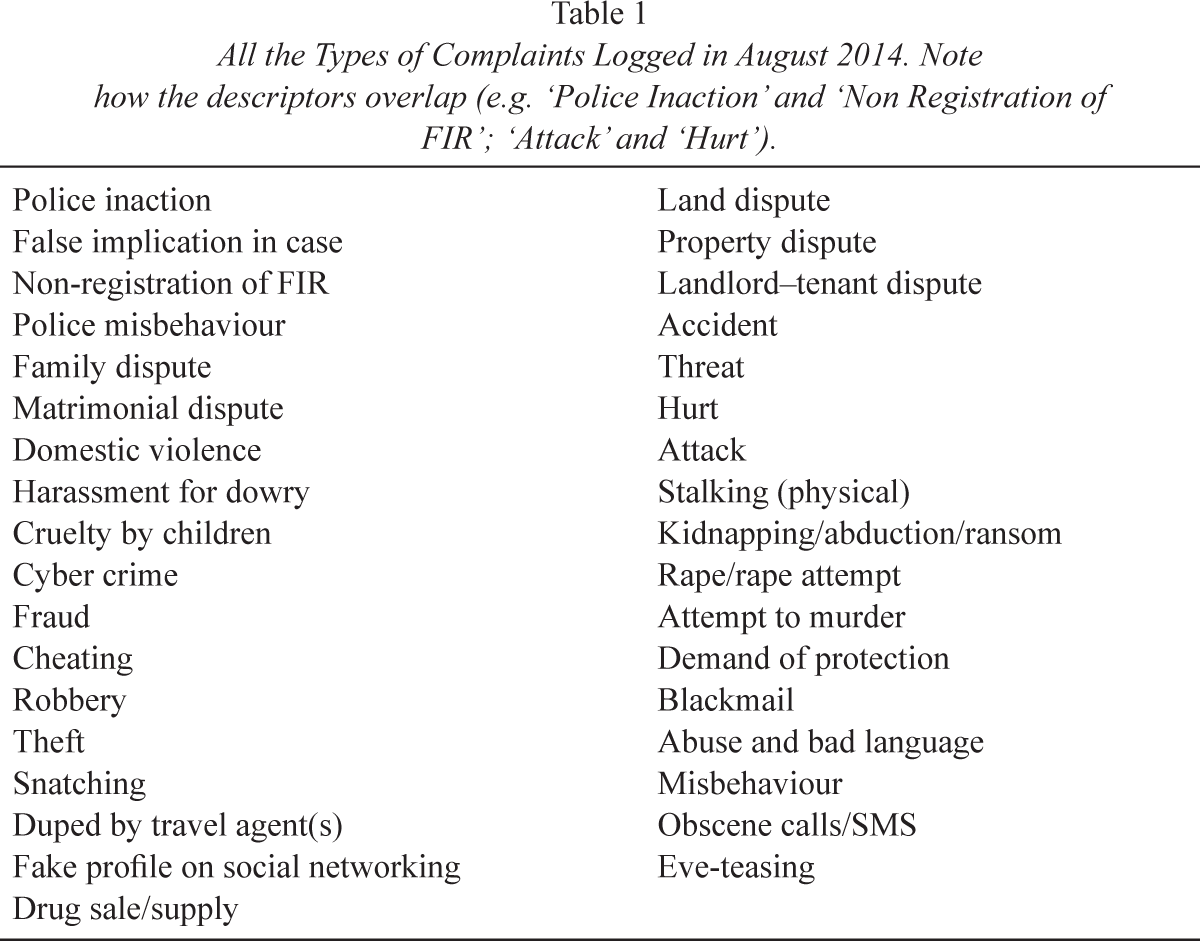
Callers were never asked for their ID card or Aadhaar numbers and the database contained no field to record them. Reflecting their characterisation as callers rather than simply legal persons, they were identified by the conjunction of their names and the ID of their communication channel, that is, the phone number they called from, which was automatically captured by the software. Call takers selected the type of complaint from a dropdown menu. The responsive listening effort of the 181 Helpline was manifest in its use of this most banal of formatting interface technologies. When 181 first began operations, the complaint types were close to legally specified crimes, modelled on what one police officer explained to me was the police practice of trying to determine if actions categorisable as a particular crime had occurred by asking ‘direct information questions’ that elicit short answers. But the call takers and case coordinators did not passively accept the complaint types given to them by the police and software developers. When they encountered situations that did not fit the existing categories of events, they asked the software managers to add new complaint types to the system. Over the first two years, the list expanded to more than 70 types, transforming a legally based, bureaucratic categorical scheme into a menu of narrative descriptors used to characterise the caller’s situation as closely as possible (Table 1). We can contrast this with the way police engaged with women complainants in Delhi in Pooja Satyogi’s account (2019): police reworked the facts and stories of complaints to make them fit legal criteria for crimes, to increase the likelihood of successful prosecution (see also Das 2004). In contrast, 181 was not focused on successful prosecution and was limited not by the fixity of law but only by the routine process of changing dropdown menu lists, administered by the software company. The 181 staff was attuned to representing callers’ accounts in bureaucratic terms that captured callers’ own perspectives.
All the Types of Complaints Logged in August 2014. Note how the descriptors overlap (e.g. ‘Police Inaction’ and ‘Non Registration of FIR’; ‘Attack’ and ‘Hurt’).
There were also crucial epistemic and sociopolitical differences between the situations in which call takers and police constructed complaints. Beatrice Jauregui (2014) analyses the complex process through which a police officer in Uttar Pradesh negotiated complainants’ accounts. With responsibility to a particular area, the officer usually knew (or quickly learned about) all parties to the dispute, some of whom—like wealthy landowners and politicians—might have a direct impact on the officer’s career and income. Complaints might have been ultimately voiced (animated) by complainants, but they reflected a variety of interests, many of which were not theirs but those of the officer or the accused party. If the police officer in Jauregui’s account was listening to a lot of people connected with a dispute, the 181 call taker was only listening to the caller. The contrast between the multi-actor constituencies of police and the duty of the call taker only to the caller was sometimes performed through a 181 complaint itself. For example, in August 2013, a complaint from a man claiming to be harassed by a neighbourhood girl included the statement that ‘he alleges that Police listens to only the girl side and they are not even registering his complaint’. A second, related contrast between the police and 181 is that 181 call takers never had a personal motive in shaping complaints one way or the other. Unlike the police, they answered calls from around a state with a population of around 28 million people and never knew any of the callers or the persons named as offenders.
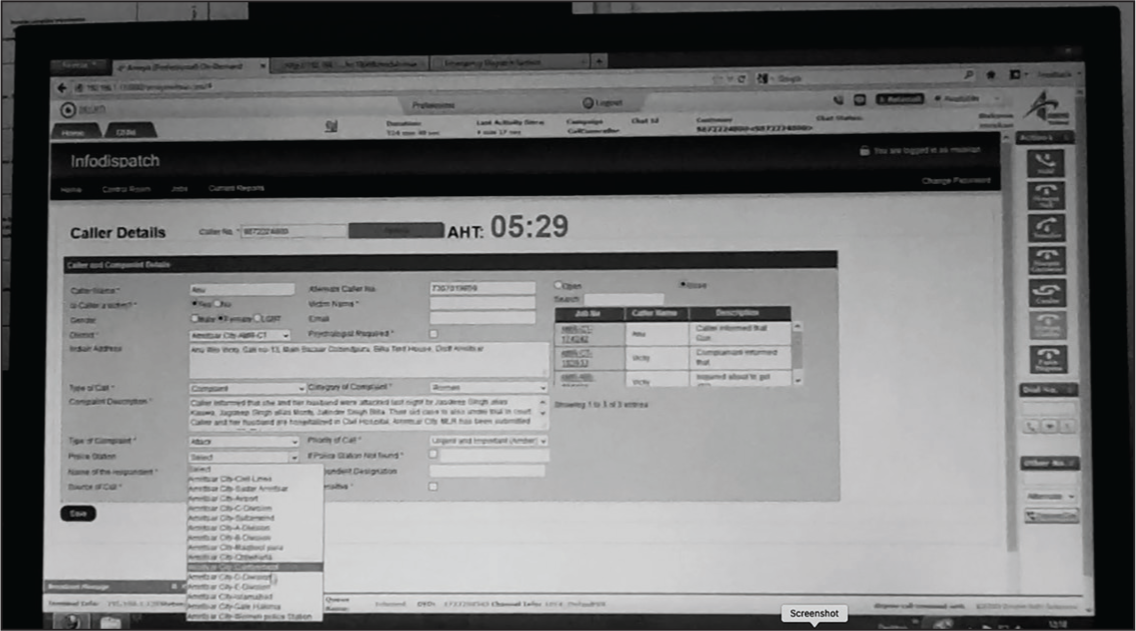
The software interface of the 181 Helpline also had text boxes for various fields such as ‘caller name’, ‘victim name’ and, most critically, ‘complaint description’, a concise (30–180 words) account of the incident and the people involved (Figure 1). Sometimes, these descriptions echoed the caller’s language and sentiments, including quotations or other less-direct forms of reported speech.
11
But more typical are these two from August 2014, which translate the callers’ claims into objective, third-person accounts:
The caller informed that she met with an accident. She went to the police station to lodge complaint at Phase-8 Mohali and talked with SHO [NAME] but SHO misbehaved with her. Kindly investigate the matter. ‘[NAME] says his daughter went to Gyan hospital for checkup to dr. [NAME]. he misbehaved with his daughter….they went to police station for his complaint sherpur (sangrur) thana.. [NAME]-sho-30/1/2013..no registration of fir kindly solve the matter.’
Note the politely directive conclusions to these complaints: ‘kindly solve the matter’–the use of the imperative forms of verbs, and the ‘kindly’ placed at the start of the sentence, a pragmatic word-order form used by superiors with subordinates. It is also common to find ‘please’ at the start of these imperatives, another index of a superior-to-subordinate utterance (Hull 2012: 143), for example, ‘please do the needful’ or ‘please look in this matter and provide needful information’. The lower-ranking police at the station house level explicitly interpreted their communications from 181 case coordinates as directives, for example:
Case Coordinator:
Yes, is this Vikram?
Police Officer:
Yes, what is your order?
Case Coordinator:
This is Ravinder speaking.
Police Officer:
Yes, Madam. What’s your order?
After finishing writing the complaint, the call takers would read back the complaint to the caller and ask if it was correct (‘Is that what happened?’). After completing the record, the call taker would save it, which ‘registered’ the complaint and gave it a case number consisting of a three-letter or five-letter geographical code and a unique six-digit number such as ‘AMR-RR-301976’, where ‘AMR-RR’ stood for Amritsar rural district. The six-digit number was similar to a flight confirmation number and served as a reference for future interactions with the 181 Helpline or directly with the police. The record produced by the helpline thus functioned as a kind of preliminary FIR; it was a document that initiated the process to produce an FIR, the document to initiate a formal police inquiry. 181 complaint records were pre-document that compelled more documents.
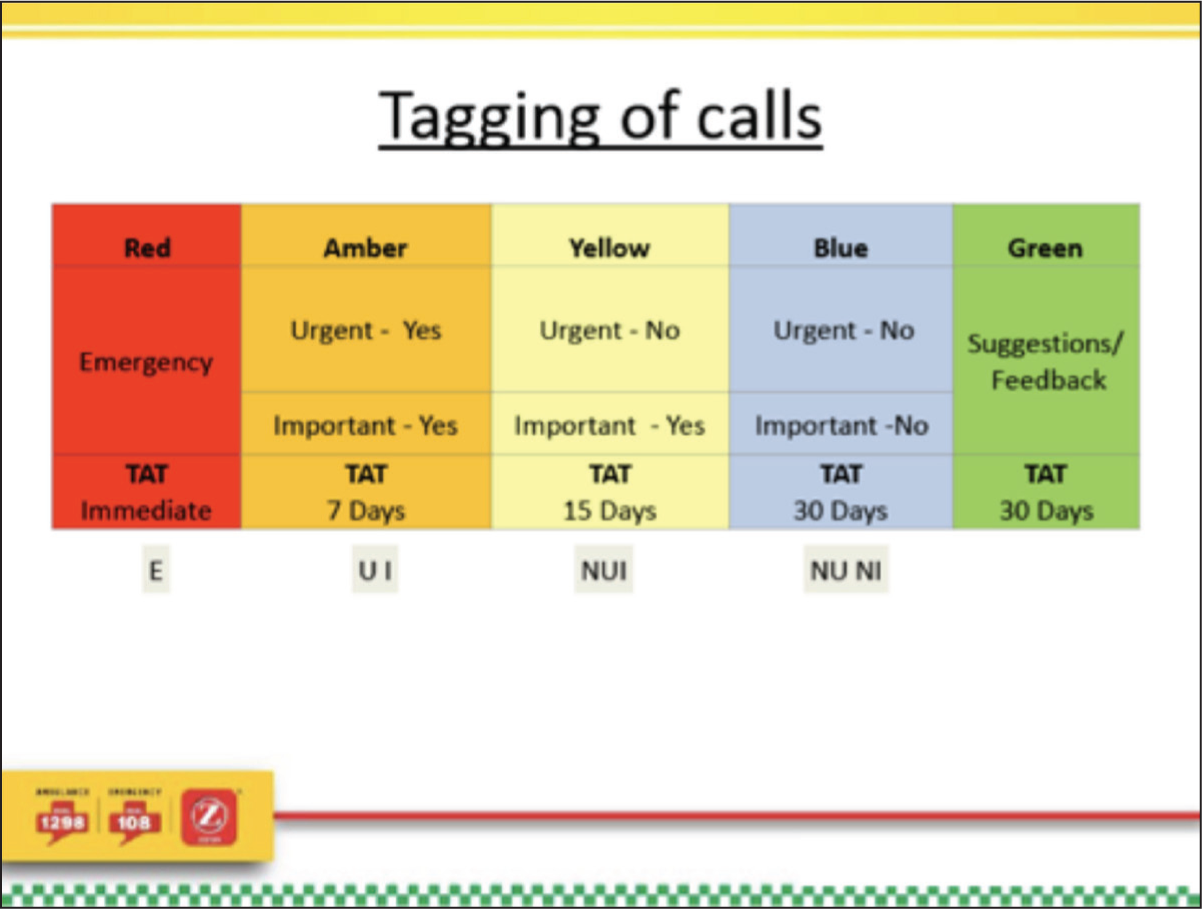
After being registered, the case would appear on the tracking page of the screen of a nearby ‘case coordinator’, who would ‘tag’ it with a colour code based on urgency (the temporal frame the case needs to be dealt within) and importance (the seriousness of the issue). Each code had a corresponding ‘turnaround time’ (TAT): ‘immediate’ for red (emergencies), seven days for amber, 15 days for yellow and 30 days for blue. Although the TAT is a customer service concept, it can be compared to recent laws in India that mandate government services, like a car registration or a Right to Information application (Sharma 2013; Webb 2010), be processed within a statutorily specified time frame. By implementing ‘time-bound’ responses through private corporate procedures and records, the Punjab Police could structure organisational practices without legally requiring timely action, which would give citizens the right to complain (Figure 2).
The case coordinator would then send the record via email and SMS (Short Message Service) to the station house officer of the caller’s area and the SSP. A key feature of the 181 system was that the records were emailed and texted to the superiors at the Punjab State Police headquarters in Chandigarh. Each recipient was required to be entered separately, and the records were sent out rapidly, including to one of the most senior police officials in the state. As the number of complaints logged every month rose to nearly 4,000 by 2018, close supervision at the centre became impossible. However, in the initial years, Gupta—and, later, his staff—made it a practice to occasionally check and contact a subordinate about a case. Similarly, a senior police officer in charge of a district told me he had made a regular practice of randomly calling complainants to inquire about police conduct. Such practices made the cell phones of senior officers akin to Bentham’s watchtower: subordinates were uncertain whether someone was monitoring their actions but were compelled to act as if they were being watched.
These quickly travelling electronic communications created a paper wake of official police authority behind them. Although call centre staff gently directed police action—‘kindly investigate the matter’—official police authority still ran through paper. The SSP’s office printed out the call centre email messages, and he or another senior district officer signed them and ‘marked’ them as an order to the station house officer. Crucially, the policy on 181 complaints set by police headquarters was that senior district officers could never refuse any 181 complaints: they were required to simply authorise every one and order their subordinates to address them. This was an important feature of the system that I will return to.
The compulsory status of what began as a caller complaint is evidenced by the irritation and frustration lower-ranking police officers, those responsible for dealing with complaints, expressed about the 181 cases, especially their TAT. According to some Station House Officers (SHOs), the 181 Helpline produced an increase in the number and triviality of complaints since it was much easier to initiate a complaint through the helpline than to visit a police station. Santana Khanikar (2018: 39) observes that normally residents treat the Delhi police as mai baap (mother father) and request them to perform all sorts of tasks regardless of whether the tasks are law-and-order related. However, the officers estimated that the number of complaints had increased four to five times than before 181, with only one in four of them being what they considered legitimate police matters. People began calling the helpline even for trivial matters like a drunk person causing a disturbance, which they would have previously handled themselves or ignored. As a station house officer told me in frustration, ‘Nowadays, everyone goes to the police for everything’.
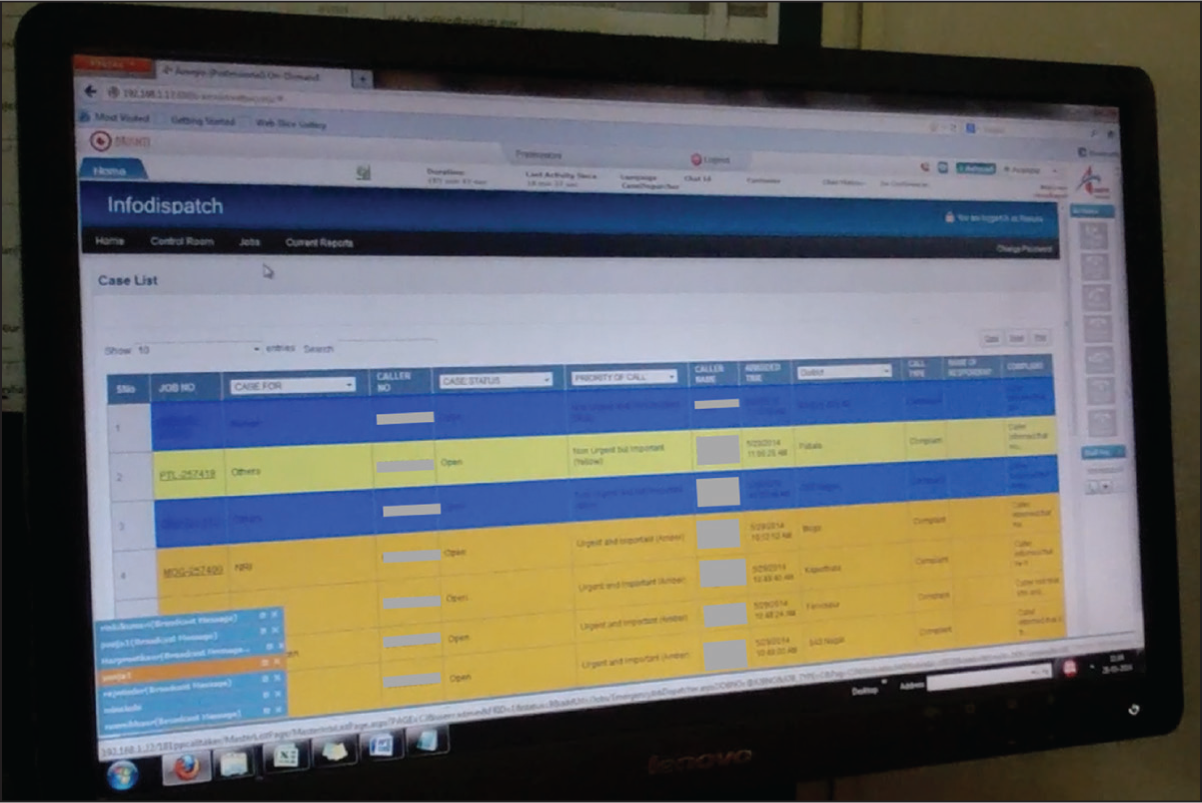
The compulsion 181 cases put on the police is evidenced also in their resentment at losing the discretion that lies at the heart of what we might call the policeman’s business model, that is, pursuing the cases from which they can expect some personal benefit. Although the 181 cases were routed through their SSP, 181 case coordinators remained in control of the TAT (Figure 3). The 181 InfoDispatch software distributed different capacities to call centre staff and district-level police: centre employees could see the full record and could change it as they needed to; district police could only see the complaint and its status, and they could not change anything in the record. Central police officials did have full authority to access all the information in the database, but they did not have InfoDispatch interfaces and depended on the Ziqitza to extract data and send it to them. Sometimes, SHOs new to the system contacted the call centre to get a TAT tag changed to give them more time to deal with a complaint. However, 181 staff would almost always refuse such requests, unless the police could convincingly explain why the initial complaint mischaracterised a situation.
District SSPs emphasised meeting the TATs rather than changing them. Once or twice a month, many district police heads sent their subordinates lists of cases past their TAT. Subordinates felt pressure to clear overdue cases, even if they suspected the letters were just meant to demonstrate to headquarters their commitment to 181. Here is a translation of a letter from a Ludhiana Rural SSP to the SHO of Jagraon on 2 June 2016:
You are being notified with this letter that the following 181 Helpline complaints, which you have had on file for a long time, are under an ongoing investigation. [These complaints] have already passed the due date, causing them to be categorised under the overdue list. We have already had a meeting on May 28th, 2016 instructing you to resolve the reports and to have them sent to my office and even after this, another file, number 689-97 Helpline, was issued to you on May 31st, 2016 instructing you to resolve these reports on high priority and to have them sent to my office by June 2nd, 2016 under any circumstances. But you have not sent any reports to my office. This proves that you lack interest in your work and do not obey orders given by your Senior Officers. Because of this, this letter is being sent to you to give you strict orders to resolve the following overdue complaints and their corresponding reports, and to send them to my office under any circumstances by June 6th, 2016 and to determine the persons responsible for causing the delay in the resolution of these reports. If the directions are not met, we will not hesitate to take action. Please ensure the orders are followed as stated (emphasis added).
12
The call centre’s operations were intended to compel the police to generate a written record, known as an Action Taken Report (ATR), within the specified TAT (Figure 3). The FIR is a legal document prescribed under the Indian Code of Criminal Procedure, 1973. Unlike the FIR, the ATR is a genre of document that originates in global customer service practices; its format is defined not by law but rather by the procedures of the 181 Helpline and the Ziqitza software (Berry 2011; Lessig 1999; Manovich 2013). Although a customer service document, the ATR was partly absorbed into the conventions of bureaucratic police documents. The ATRs were produced on paper—handwritten or typed in Punjabi or English, depending on the district—and signed by hand by the senior-most police officer of a district or an immediate subordinate. Then, the ATRs were scanned and the file, in image or portable document format, was emailed to the centre.
The unusual relation between the call centre and the police was manifest in the awkward forms of address used on ATRs. Some ATRs were addressed to the ‘Manager, 181 Punjab Police Helpline’, which constructed the 181 office manager as a stand-in for the senior police who monitor the takings of reports (Figure 4). But many other ATRs were distinctive among Indian bureaucratic documents in that they had no addressee, reflecting the strange circumstance that scanned images of documents were emailed for posting to a database rather than a particular officer. Any one of the case coordinators could see when an ATR email had come in and post it to the proper complaint record (see the lower left corner of Figure 5).
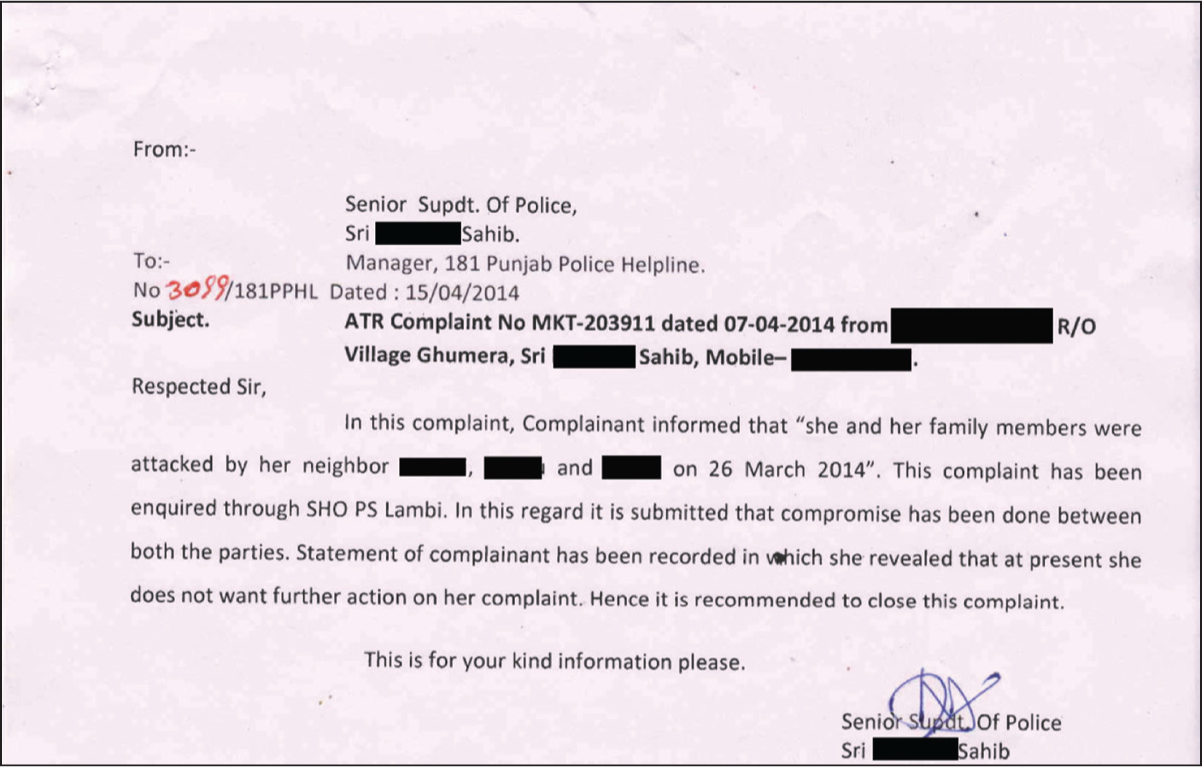
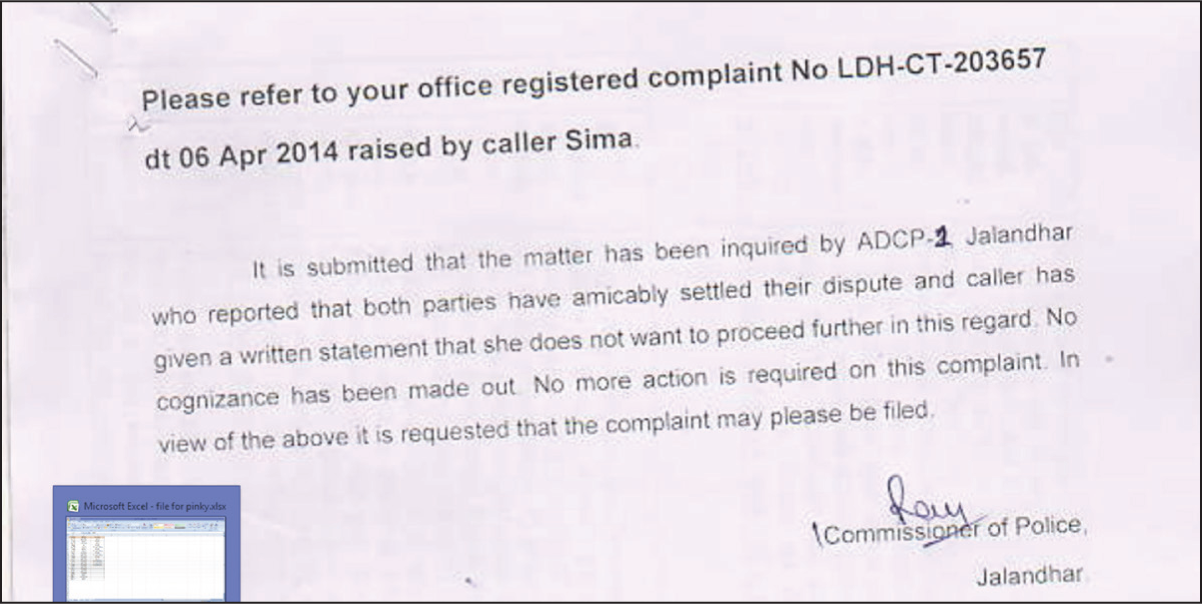
The language of the ATRs also expressed the ambiguous, even confusing, relationship of senior police officers with the faceless call centre monitoring system (Figure 5). Often, the ATRs concluded with the subordinate-to-superior phrase ‘it is submitted’. The ATRs commonly asked for the case to be closed with the subordinate-to-superior formulation, ‘it is requested that the complaint may please be filed’, but with the placement of the ‘please’ at the beginning of the phrase pragmatically indicating a superior-to-subordinate request. However, some police officers addressed the call centre more clearly as a subordinate, reflecting their view of the call centre as just a battery of pestering women clerks with computers and phones. Some ATRs, for example, asked for cases to be closed with the superior-to-subordinate phrase, ‘it is recommended to close this complaint’.
Policemen would write ATRs to liberate themselves from call centre surveillance by claiming that they had taken the legally required or appropriate action in response to the complaint and that the complaint should be ‘filed’ or ‘closed’. In some cases, ATRs simply stated that an FIR had been registered. Other ATRs included lengthy explanations stating that the complainant was lying or that the offence was not ‘cognisable’, meaning that it was not an offence for which an FIR could be registered. The majority of ATRs stated that the disputing parties had reached a compromise, and the complainant had withdrawn the complaint, which was a common outcome of police mediation (Basu 2015; Baxi 2014; Jauregui 2016: 76–81). Thus, the ATR became a persuasive genre written by police officers to 181 case coordinators.
Case coordinators considered themselves representatives of callers and when ATRs were not filed on time, the case coordinators would threaten to ‘escalate’ the case. This term is derived from the world of customer service, where it refers to ‘a scenario in which a customer is not pleased with an employee interaction and wants someone at a higher level within the company to resolve the complaint’. 13 In the 181 context, ‘escalate’ meant moving up the police hierarchy and bringing the problem to the attention of an officer’s superior. While functionally similar to petitioning, the act of escalating a case within the 181 system differed conceptually due to the emphasis on the caller’s agency in the escalation rather than the addressee’s. A petition typically centres around the addressee’s ability to fulfil a request or address an issue and thus underscores the authority of the person being appealed to (Cody 2009; Hull 2012: 86–111; van Voss 2001). The escalation, in contrast, focuses on the caller’s intensification of demands.
The possibility of escalation provided a powerful incentive for the police to submit ATRs that would falsely claim that the complainant had withdrawn their complaint. In August 2013, one woman followed up on her first call to 181 to register an additional, very common complaint: ‘Caller told Police Officer forcefully signed on compromise from her.’ In the early months of the call centre operations, this occurred fairly commonly. But the frequency waned as the police became more familiar with the final step of the call centre’s role in the case. After the police sent an ATR, a case coordinator would call the original caller and try to determine if he or she was ‘satisfied’.
This 181 system led to important operational changes (Hull 2022). But my focus here is on the tension between customer service and police-legal constructions of the role of citizens in police procedure. This tension is especially evident at two points in the handling of a case: the registration of a complaint; and the aforementioned documentation of a caller’s ‘satisfaction’.
III
Corporate Official Records: 181 Complaints and FIRs
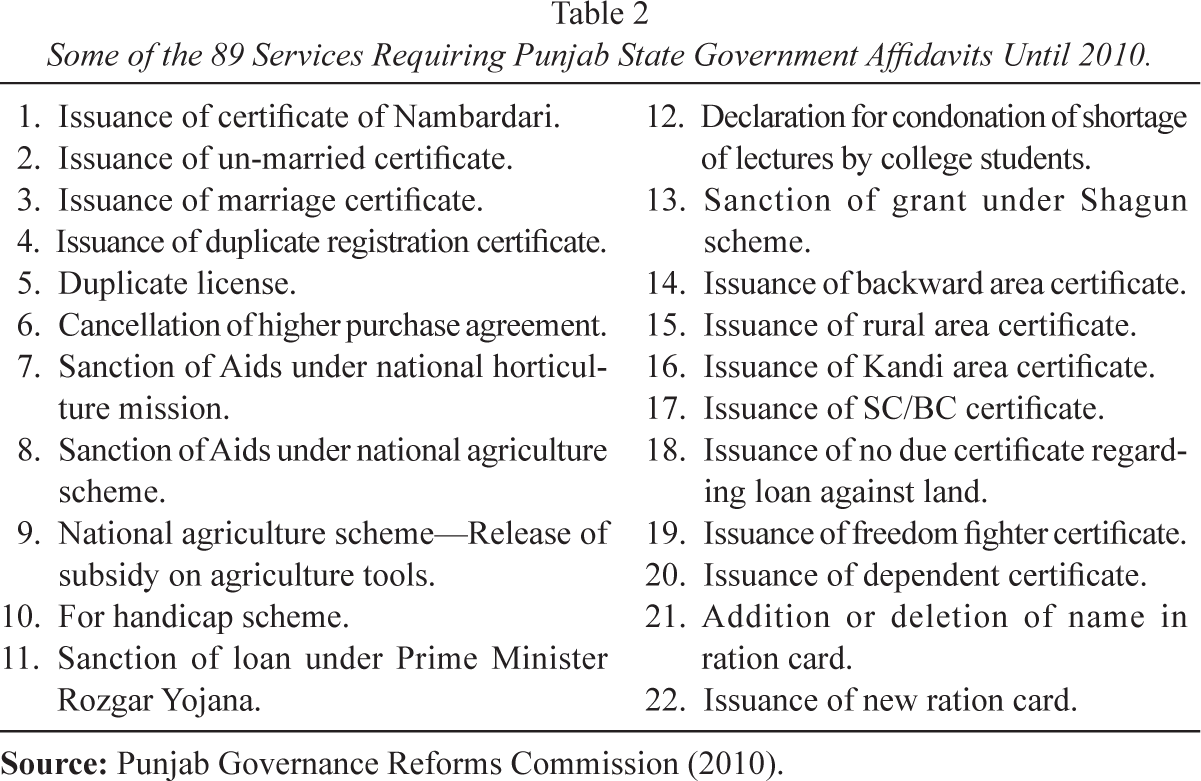
Although Indian citizens gained the right to vote in the Constitution of India, their right to self-representation has remained circumscribed in the bureaucratic realm. This is clear in the practices of affidavits and attestation, sometimes called the ‘Affidavit Raj’. In her early history of these contemporary practices, Bhavani Raman (2012: 138) describes the way that colonial bureaucracy in the early 19th century came to rest on protocols of attestation and the signatures of Company officials came to ‘form the basis of credible claims’. In 2010, the Punjab state government passed measures to reduce affidavit and attestation requirements, but until that point, affidavits were required for virtually every kind of engagement with government: applications for a new power connection, residence certificate, school admission and so forth (Table 2). In this system, government rules required virtually every affidavit submitted to the government to be attested by a magistrate or, for less important documents, a public notary. What is important to note here is that affidavits and attestations merely affirm the facts provided by applicants. Beyond verifying the identity of the applicant from identification documents, the attesting person, such as a district magistrate or gazetted officer, usually has no capacity to verify these facts. Attestations appear to provide little curb on fraud (Ghosh 2019; Srivastava 2012) and, furthermore, no new opportunities for criminal prosecution. Persons who provide false information to government authorities on forms and in letters can be prosecuted under a number of provisions of the Indian Penal Code (IPC), including the following sections:
Section 177. Furnishing false information Whoever, being legally bound to furnish information on any subject to any public servant, as such, furnishes, as true, information on the subject which he knows or has reason to believe to be false. Section 197. Issuing or signing false certificate Whoever issues or signs any certificate required by law to be given or signed, or relating to any fact of which such certificate is by law admissible in evidence, knowing or believing that such certificate is false in any material point. Section 199. False statement made in declaration which is by law receivable as evidence.
Some of the 89 Services Requiring Punjab State Government Affidavits Until 2010.
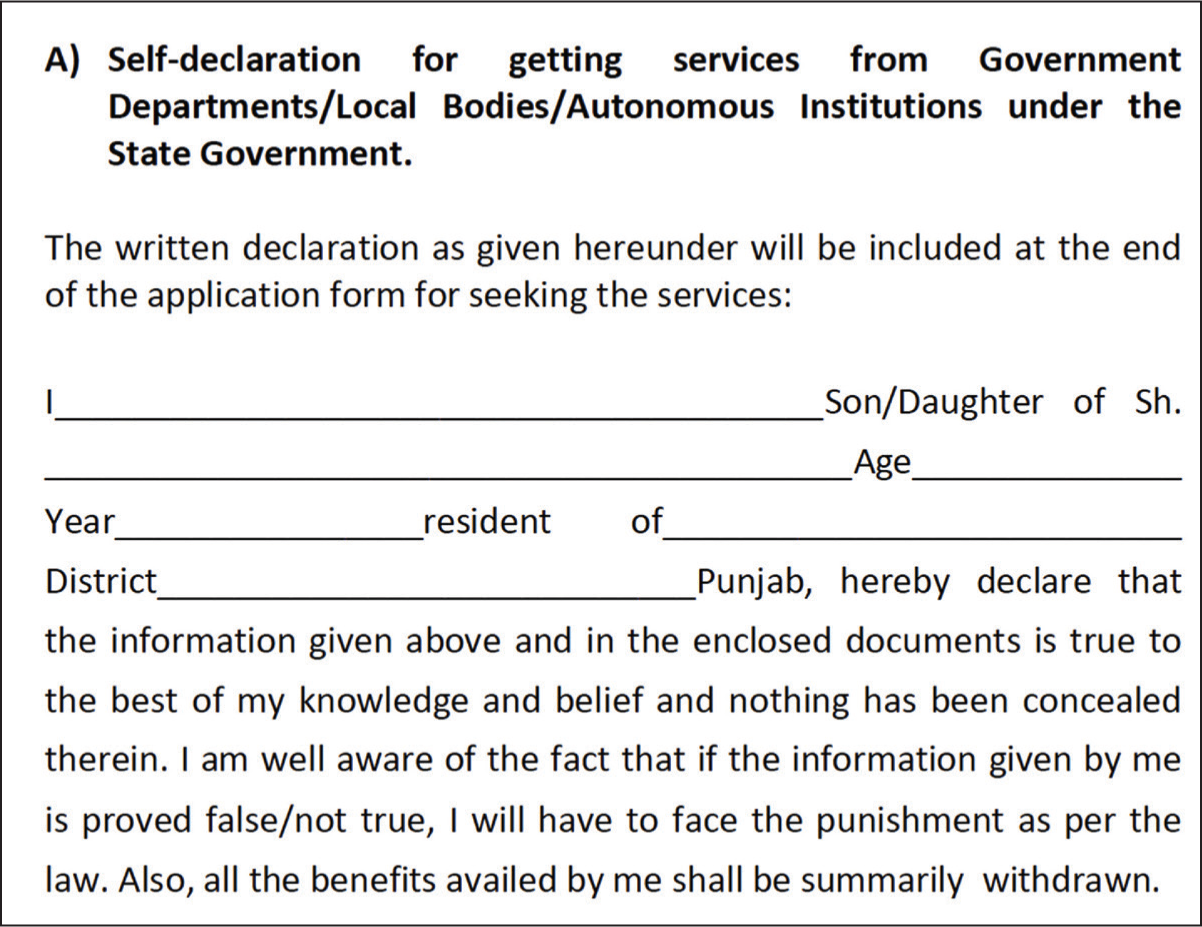
If attestation does not prevent fraud or provide significant grounds for criminal prosecution, what then is attestation doing? The Punjab Governance Reforms Commission argued that it is a way to cast all citizens as cheats and frauds. There is something to this political function. Raman (2012) shows that attestation practices are a legacy of the colonial government’s distrust of its Indian subjects. That said, we should not overlook how practices like affidavits and attestation work in a ‘vital’ idiom of patronage (Piliavsky 2014) as much as impersonal bureaucracy (Carswell and De Neve 2020). The village women Cody (2009) describes long to present their petition to the collector to operate in both these registers. Jauregui (2014) describes a police officer simultaneously playing the patron and client to different parties in the act of registering an FIR. The patronage function of attestations is among the reasons that the liberal reformers of the Punjab Governance Reforms Commission attacked them so vigorously. However, the patronage of brokers and bureaucrats depends on the fundamental function of attestations: They ensure that the claims of individuals do not enter the official, written, paper record without the explicit, written approval of a government officer. In many cases, attestations and affidavits were not required by statute; demanding them was simply a bureaucratic custom. The requirement that one’s declaration must be authorised by an official third party such as a magistrate undermines not so much the basic right of a citizen to speak but to be listened to. If a document had not been attested, no one had to listen and respond to it. In 2010, the Punjab Governance Reforms Commission recommended eliminating attestation requirements where they were not codified in statute. In their place, the Commission recommended what it called, ‘self- declarations’ (Figure 6). By calling this document a ‘self-declaration’, the Commission emphasised the ability of citizens to speak for themselves. Self-representation in this case depended not only on new capacities to speak but also on new procedures for authorised listening and response. With self-declaration, citizens could get the bureaucracy to listen without first getting a government officer to listen. Members of the Punjab Government Reforms Commission and senior police officers had also been in informal dialogues about police reforms. The 181 Helpline can be seen as being of a piece with reforms across the Punjab government. 181 complaints worked like self-declarations.
Sample Self-declaration. Punjab Governance Reforms Commission. 2013. Annexure III, Reforming Public Service Delivery Systems in India: Rationalisation of Affidavits.
To understand the effects of 181 complaints, we need to understand normal, paper-based complaints given in person at a police station, what police refer to as ‘complaints’, ‘statements’ or ‘bayan’. A bayan is a written report that a person takes to a police station or, more often, a police officer makes. A bayan is different from an FIR in a number of respects. The information is more thoroughly documented in FIRs, and narratives are often reformatted so that actions can be characterised in terms of crimes under the IPC; FIRs are signed by the individual attesting to the facts (not necessarily the aggrieved party); their making often involves negotiation with police among all parties concerned; and they are codified in the Code of Criminal Procedure. Bayans are not signed by the person making them, even though their very name (meaning statement, deposition, or account) frames them as the utterance of a particular person. As Krithika Ashok observed (personal communication), FIRs, as their name suggests, are documents presenting information conceptualised as facts independent of the persons who attest to those facts, displacing complainants from the process.
However, perhaps the most significant difference is that unlike FIRs, whose broad contents are recorded in another registry book, bayans are often not copied for the complainant and registered. The police sometimes record some details in the General Diary or Daily Diary, but this register with serial entries organised by date is devoted not to complaints but to all important transactions or events taking place in a police station. When complaints are recorded, the complainant can be given a serial number for the entry; but, they are entered among a huge number of other entries, including the arrival and departure of police staff, duties performed, transferring of charge between officers, etc. Unlike the 181 system that continually surfaces old open complaints, diary complaint entries quickly recede into less and less frequently consulted pages. The registers can only be examined in the station itself. In practice, therefore, complaints exist simply as isolated pieces of paper in the hands of the police officers who produce them. Callers to the 181 Helpline frequently complained that they received no complaint number or copy of what the policeman had written. One enthusiastic discoverer of 181 in its early weeks emailed to complain that he had gone to a station, but ‘No one was ready to listen and complaint was not registered and my complaint with attached evidences was kept like a rough piece of paper on the table for so many days’. Another 181 caller claimed she ‘was made to sign the statement without reading the same and again no copy was issued to her’.
In short, even if they are entered in the general diary, bayans are only weakly anchored in a relatively inaccessible component of the official documentary order, and they do not entail investigation. Bayans are considered an internal document and play no official role in police procedure. One sub-inspector laughingly made this point to me as we sat in a coffee shop in Chandigarh, telling me that right then he had a couple dozen complaints from two postings ago scattered on the floor of his car. Sub-inspectors told me they often wrote out a detailed bayan to make it appear to the complainant that they intended to take real action, when they did not. Unlike bayans, 181 complaints were not only completed by call centre staff rather than police, the InfoDispatch software differentially structured reading and altering access to complaints. Call centre staff had complete access to all the information in the database and could change it, though the changes were logged and attributed to individual staff members. In contrast, the junior police were not able to read some information the centre gathered, and they were denied access ‘privileges’ to alter any information in the database.
In terms of police procedure, a 181 complaint resembled a bayan but, with its official recording, it was more like an FIR. Every call of every kind was recorded and kept as an audio file; every complaint, of course, was also logged and easily retrieved, as well as kept permanently. And unlike a bayan that might end up on the floor of a car, a complaint transformed into official order as it moved in paper form through the SSP office. But the most significant resemblance between 181 complaints and FIRs was function. Like FIRs, 181 complaints set the process of criminal justice in motion (Commonwealth Human Rights Initiative 2015). The 181 complaint record was designed to compel the production of an FIR where appropriate. The solution to the problem of police refusal to document was to establish a prior documentation process run by Ziqitza.
The FIR is a document genre that is seen to be defined in the Indian Code of Criminal Procedure, the law covering the administration of substantive criminal law in India. 14 The key features of the contemporary FIR were specified in Section 12 of the original 1861 version of the Code: The mediation by an officer, written media (which meant on paper), signature of the complainant, anchoring in the documentary order by reference to a register.
Every complaint proffered to an officer in charge of Police station shall be reduced into writing, and shall be signed, sealed, or marked by the person making it; and the substance of thereof shall be entered in a book to be kept by such officer in the form prescribed by the Local Government.
Sec. 112, Code of Criminal Procedure, 1861 (italics in original)
The tension between 181 complaints and the law governing so-called FIRs was brought to my attention first by a Deputy Superintendent of Police (DSP), a junior officer of the elite Indian Police Service in the SSP office of Jalandhar. The DSP had been expecting me and knew I wanted to talk with him about 181. He sat me on a couch in a sitting area in his office next to his desk as he dealt with a woman who had come for help with the conflict of her divorce and man with a land dispute.
When he finally turned to me, he said he had read some of my work on Pakistan and knew what I needed to know about 181. He was spot on—an ideal anthropological interlocutor. In subsequent conversation, the officer positioned himself as a reformer profoundly dispirited by what he saw as the corruption of the Punjab Police. But he told me immediately he did not like 181. He opened his copy of the current Code of Criminal Procedure to a page he had marked before I arrived. He implicitly confirmed the quasi-official status of 181 records by looking at them in terms of the requirements for an FIR. The 181 Helpline, he told me, violated the documentary requirements set forth in the Code of Criminal Procedure, in particular, Section 154, the provision of the 1973 version of the law which lays out the law governing the documentation and registration of complaints commonly called FIRs:
Every information relating to the commission of a cognisable offence, if given orally to an officer in charge of a police station, shall be reduced to writing by him or under his direction, and be read over to the informant; and every such information, whether given in writing or reduced to writing as aforesaid, shall be signed by the person giving it, and the substance thereof shall be entered in a book to be kept by such officer in such form as the State Government may prescribe in this behalf. Sec. 154(1).
First, the DSP emphasised that oral complaints had to be ‘reduced to writing’ and told me it was not clear that the records that 181 was generating are ‘writing’. He was sceptical that entries in an electronic database could count as writing. Here we see the degree to which the bureaucratic concept of writing is fused with the medium of paper. Second, he noted, callers provided no verifiable identification of themselves, and their recorded oral assent to the complaint description read back to them by call takers was no substitute for the signature required of an FIR.
The DSP was also concerned about whether it was actually a crime to lie to a 181 call taker. First, call takers are not ‘public servants’, so lying to them is not a crime under statutes like IPC Section 177 Furnishing false information. Second, he observed, a caller cannot be held accountable for a false complaint because the 181 staff framed the actual complaint, noting the problem of assigning responsibility for any reported speech (Irvine 1996). Indeed, police often reported that when callers were confronted with allegations that they lied to 181, they would often say that 181 had gotten the complaint wrong.
15
The police often expressed doubts about the veracity of complaints, and their ability to hold complainants accountable for false information. However, the 181 staff are unequivocally tasked with refusing judgement regarding the truth of a caller’s claims, as we can see in this exchange between a male 181 case coordinator and a female police dispatcher:
Case Coordinator
In the Chardi Pati area, in Shutrana village there has been a misuse of the loudspeaker….
Police Officer
Sir, sometimes people make false complaints.
Case Coordinator
Sorry?
Police Officer
Is it possible that this is a false complaint?
Case Coordinator
They inform, whether it is about a murder or a loudspeaker, or …
Police Officer
Okay then, they did not mention the address or name …
Case Coordinator
Sorry?
Police Officer
They …
Case Coordinator
They just inform us.
Police Officer
They …
Case Coordinator
No Madam, there are no details.
Police Officer
Sir, sometimes there are people from the opposite community that don’t like this thing. Then, they make such allegations or sometimes make false complaints.
Case Coordinator
I agree, Madam. But we all always, inform them that if they are trying to trick the police, then according to the rules and regulations there will be action taken accordingly. Okay, Madam?
Police Officer
Yes.
Case Coordinator
We always make sure to tell this statement to all the complainers.
Police Officer
Okay, then it’s fine.
However, for the DSP, the biggest problem was that Ziqitza call takers were not police officers with the legal authority to accept a complaint. Section 154 Criminal Code of Procedure seems to leave open the possibility that a person could write their own FIR by including the conditional, ‘If given orally….’ However, in practice, only officers produce FIRs.
It is important to note that years of court rulings have determined that the role of the police officer should not be to affirm the accuracy of the complainant’s claims but simply to authorise them as having been made, to represent the complainant to the criminal justice system. Ziqitza call takers could be seen to play a similar role—talking to the caller, constructing a complaint record and passing it on the police. But this, the officer argued, was precisely the problem. Since Ziqitza employees had no status as officials in the criminal justice system, the 181 system was allowing callers to bypass or even usurp the authority of the police and to represent themselves, illegitimately injecting their unauthorised complaints directly into police procedure. The 181 complaints compelled police to take actions: as we saw above, 181 complaints are not only part of the official record, but they flow into the chain of command communications from the highest level of the district police. For the DSP, they had all the force of a proper police order and none of its authority. In contrast to FIRs that centre facts (information), 181 complaints, like bayans, ‘make the complainant and complaint central to police process’ (Krithika Ashok, personal communication). The 181 system enables complainants to set police procedures in motion without the discretionary exercise of police authority or, to put it another way, 181 forces the police to listen and respond to complainants in something approaching their own words. If petitions are self-representations to the bureaucracy, 181 complaints become self-representations within it.
IV
Satisfaction and Self-representation
The second tension between police procedure and 181 customer service was the contention over the procedural finality of oral expressions documented by police on paper and by 181 in electronic audio files and text records. As Ursula Rao points out, although classical media theory predicts that in the age of electronic records, ‘handwritten record turns into an authentic witness’ (2017: 127), electronic records make all kinds of unexpected counterclaims. This came out in the documentation of satisfaction. As already noted, after receiving the ATR, a case coordinator would call back the original caller to determine whether he or she was ‘satisfied’ or ‘not satisfied’ with the actions documented in the ATR. The software configured satisfaction in three degrees: ‘satisfied’, ‘partially satisfied’ and ‘not satisfied’. But for reasons no one could explain, case coordinators construed responses in a binary and never checked the ‘partially satisfied’ box.
As the voluminous literature on consumer surveys suggests, determining the satisfaction of an individual with respect to something is considered a complex task. It is akin to the problems of determining an ‘opinion’ (Hull 2010) or religious conversion (Kravel-Tovi 2012), which, like satisfaction, are conceptualised as irreducibly subjective, even interior facts. In customer service practice, satisfaction is conceptualised as a mental state in relation to some expectation. Inquiries about satisfaction often disclose problems with police action but, as one senior policeman told me, they are meant to learn about the ‘feelings of complainants’. If it is hard to get into people’s heads, it is easier to establish procedures to produce satisfaction as an authorised bureaucratic object. Since satisfaction is a psychological fact, the complainant’s own utterances constitute the only evidence for satisfaction available through and authorised by call centre procedures. Here the scientific consensus on interior states requires the self-representation of callers. Thus, case coordinators would call back many times to reach the original complainant. They would not accept the testimony of anyone else (not the complaint’s husband, wife, son, father, mother, sister or children) since that person could not provide genuine evidence of the complainant’s mental state and might wilfully or unintentionally provide a false account. No one could substitute for the caller. And if the person answered to the name of the original caller at the original phone number, no caller was asked to have someone else vouch for their identity, in contrast to the typical bureaucratic requirement that a person’s self-representations be attested.
The call centre staff were trained to be sensitive to the emotional aspects and social nuances of phone conversations. However, the assessment of satisfaction as a bureaucratic goal placed overwhelming emphasis on the propositional content of a complainant’s words, rather than the ‘tone’ or other factors that could provide evidence for subjective inferences about satisfaction. This focus on the literal content of speech reflected the uneasy institutionalisation of satisfaction. The emphasis on the propositional content of utterances, what they ‘literally’ said, reflected the awkwardness of situating satisfaction within a legal setting.
In satisfaction interviews, as already noted, case coordinators would let the complainant know what the ATR said and ask if it was accurate. If the ATR itself claimed that the complainant was satisfied, then the case coordinators would usually approach the question of satisfaction by a direct query, ‘Is it true, are you satisfied or not?’ using one or another English or Hindi/Punjabi word for satisfied (santusht), agreed (sehmat) or even happy (khush). If the ATR did not claim the complainant was satisfied, the case coordinator would initiate a more open conversation about the police action. They would ask about the manner of police: ‘How was the behaviour?’ (vyavahaar); ‘Was his behaviour right [sahi] with you?’; ‘They didn’t say anything wrong?’ (galat bat/gal); ‘There was nothing inappropriate?’; ‘Are they being completely helpful?’ They would also ask what official actions the police took, including those required by police procedure (recording a statement, giving them documents, taking information, photos and anything else so forth needed for an investigation). Lastly, would they ask if the police committed any offence, such as threatening them, demanding a bribe or beating them.
One senior police official I talked with was very sceptical about all the reports of satisfaction, asking pointedly, ‘If there is so much satisfaction in 181, why is there so much anti-police feeling?’. Indeed, many declarations of satisfaction by complainants were likely made out of fear of retribution from the police. Given the level of distrust and fear of the police, we could even find it surprising that as many as 35 per cent of the complainants in some districts were willing to express their dissatisfaction.
Just as police officers complained about people calling the helpline for ‘everything’, complainants often reported not being satisfied for reasons that had little to do with police wrongdoing. Police explained to me that it is not possible to get ‘100 per cent satisfied’, ‘because they want police to do things they cannot do’: they want a ‘good postman’ or ‘stagnant water’ taken care of. One police officer told me that ‘people had feeling that anything can be done through 181, since it has to please me.’ Other complainants demand that the police deal with a civil matter, such as a property dispute, that can be dealt with only through the courts. However, complainants also criticised police actions and directly disputed the claims of police ATRs. Callers reported to case coordinators that police were impolite, did not provide required documents, did not return stolen property they recovered, demanded bribes, stole from complainants and even beat them up.
For the police, one challenge was that a complainant’s satisfaction was not stable over time. There were two broad reasons for this: the unravelling of compromises and the demand for police action. Records show that complainants often reported not being satisfied because someone was not keeping to the terms of a compromise brokered by the police. As a junior police official told me, ‘the fights start up after compromises, some people are not satisfied with the bargain’. But the most common reason for ‘dissatisfaction’ was that complainants would not limit their expectations to dignity and adherence to legal procedure. They demanded actions that the police would not or could not take, at least not immediately, such as the arrest of an accused person. Such grievances were so common that case coordinators keep the following phrases in a text window to quickly copy-and-paste into records: ‘But according to the complainant no action has been taken by police’; and ‘but police has not initiated any action against the accused.’ This entry in the record from 2016 is typical: ‘Caller is Disagree with ATR, due to police has not initiated any action in her case…. Hence case is closed…. and is Tagged as Totally Dis-Satisfied’. As case coordinators sometimes more forthrightly documented, the ‘complainant wants justice’. Case coordinators also kept that phrase in their cut-and-paste text box. Complainants reports of satisfaction frequently changed as they moved from hopefulness about police action to the experience of its delay or refusal.
As the police gained experience with 181, they more frequently oriented their practices to the bureaucratic documentation of satisfaction in order to limit the case coordinators’ quasi-judicial authority. In an effort to buttress their ATRs, enterprising policemen would sometimes ask 181 callers to sign affidavits that they were ‘satisfied’. The head police officer of a rural district told me that he had made it policy in his district to ask complainants to sign statements that they are ‘satisfied according to the law’ (kanun ke anusar). Other police did not bother complainants with actual statements and simply got them to sign at the bottom of a blank piece of paper on which police themselves would later fabricate and inscribe a wholehearted expression of satisfaction—which they would attest themselves.
In police procedures and court proceedings such written, signed and attested declarations, however legally novel, would be dispositive in cases when complainants subsequently declared themselves ‘not satisfied’. In conversations with case coordinators, when informed that some complainant was not satisfied, police often mildly protested that the complainant had signed a statement that they were satisfied. However, in 181 practices these written and signed statements and ATRs did not stand up against the oral expressions of satisfaction or dissatisfaction, even ones that changed from call to call. The police, oriented to the law and written media, privileged speech. The call centre, focused on the experience of complainants and oral channels, privileged listening. In legal proceedings, prior written declarations weigh heavily against later statements that contradict them. In contrast, case coordinators sanctioned the oral word of the complainant regarding satisfaction over any prior written declarations. They were listened to anew. The police were made to answer for subsequent oral self-representations of callers as mediated by the records of the call centre.
V
Conclusion
Despite our well-founded concern that citizenship is debased in its consumer citizenship form, the documentation procedures and technologies and the emphasis of customer service on performance and satisfaction required the police to listen to the self-representations of citizens and act on them in unprecedented ways. The 181-police socio-technical arrangement translated the complaints of callers into the orders of superior officers. As complaints moved out from the call centre, they became the ambiguous public–private (official–corporate) documents of this public–private partnership. It is important to note that 181 procedures were limited to the early stages of investigation. Nonetheless, they clearly increased the responsiveness to the sorts of people and their concerns that police often ignored before.
In the police–corporation socio-technical arrangement, we see an integration and tension between on the one hand, an older governmental bureaucratic model that vests power in the written word of officials, and on the other, a newer corporate bureaucratic customer service model that vests power in the oral word of the customer. These socio-technical arrangements also reflect and model different kinds of political subjects. While the first demands that an individual’s utterances be represented by someone else, the second conjures the autonomous individual whose own utterances represent themselves. In the 181 arrangement, speech, of course, is essential. It is a ‘call centre’ after all. But the key innovation of the system was on the side of listening and response. The aspiration for a properly democratic, self-representing political subject is enacted less through a new means of enabling individuals to speak, than through institutional arrangements to compel listening and response.
Footnotes
Acknowledgements
This paper was presented as the Second Annual Contributions to Indian Sociology: Institute of Economic Growth–SAGE Distinguished Lecture. I am grateful to Professor Rita Brara and the editorial board of the Contributions for the honour of the invitation to give this lecture. I owe special appreciation to Professor Deepak Mehta for his insightful comments on the lecture. I would like to thank my interlocutors in Punjab, who generously gave me their insights into the workings of the police and the 181 Helpline: the staff of the 181 Helpline, especially the call takers and case coordinators; Rajesh Chakrabarti, Dinkar Gupta, Arun Saini, Vivek Soni and police officers and staff of Barnala, Jalandhar, Ludhiana City and Ludhiana Rural. Valuable insights came from my fellow members of the Technosemiotics Workshop, especially Miyako Inoue, Paul Manning and Eitan Wilf. I am grateful for the insightful comments on versions of this material from Amita Baviskar, Jatin Dua, Beatrice Jauregui, Ursula Rao and James Slotta. Special thanks to Krithika Ashok, Michael Lempert and Krisztina Fehérváry. For Punjabi language translation, I am grateful to Pinderjeet Kaur Gill. Earlier versions of this paper benefited greatly from engagements with audiences at the University of Copenhagen and the Society of Linguistic Anthropology. Finally, I am grateful to the staff at Contributions and Sage for their terrific editorial and production work.
Notes
Declaration of Conflicting Interests
The author declared no potential conflicts of interest with respect to the research, authorship and/or publication of this article.
Funding
The author received financial support for this research from the American Institute of Indian Studies and the University of Michigan.