




Abstract
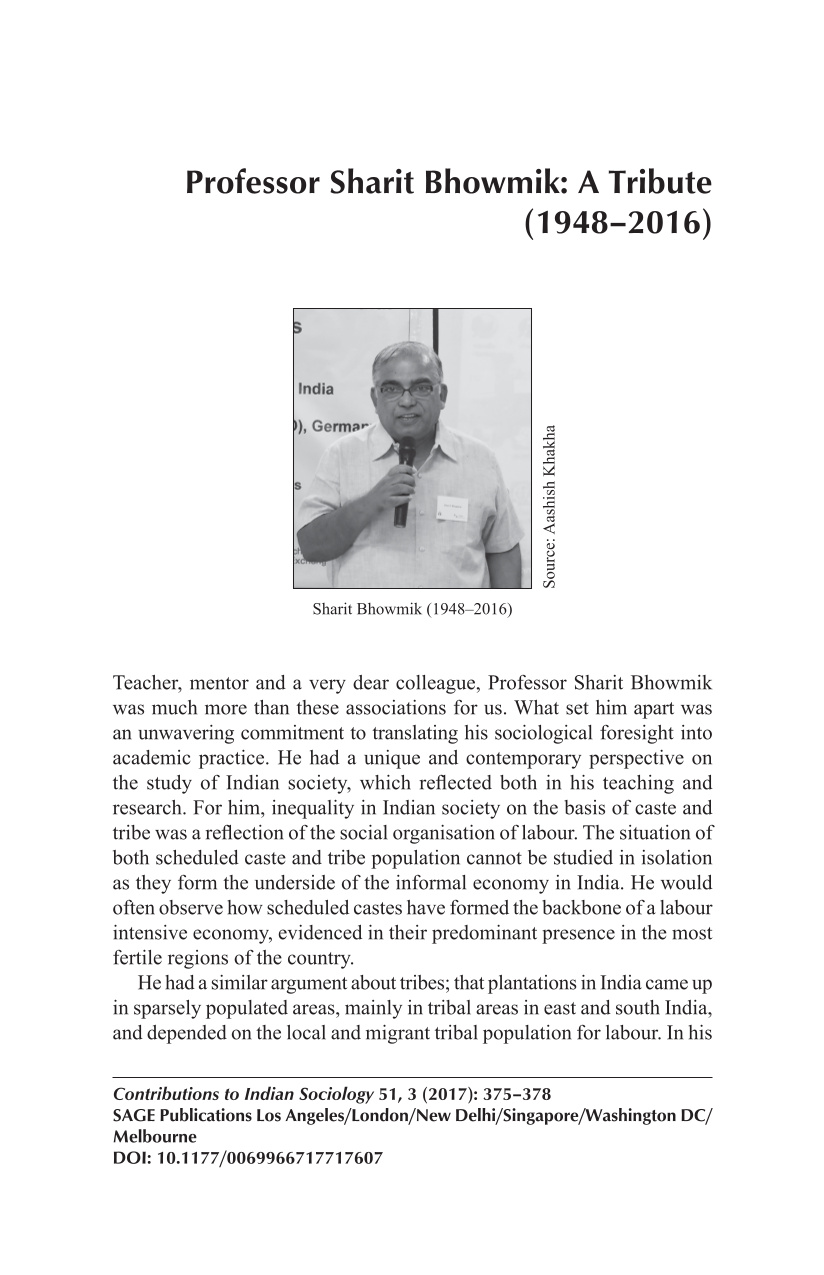
Sharit Bhowmik (1948–2016)
Source: Aashish Khakha

Teacher, mentor and a very dear colleague, Professor Sharit Bhowmik was much more than these associations for us. What set him apart was an unwavering commitment to translating his sociological foresight into academic practice. He had a unique and contemporary perspective on the study of Indian society, which reflected both in his teaching and research. For him, inequality in Indian society on the basis of caste and tribe was a reflection of the social organisation of labour. The situation of both scheduled caste and tribe population cannot be studied in isolation as they form the underside of the informal economy in India. He would often observe how scheduled castes have formed the backbone of a labour intensive economy, evidenced in their predominant presence in the most fertile regions of the country.
He had a similar argument about tribes; that plantations in India came up in sparsely populated areas, mainly in tribal areas in east and south India, and depended on the local and migrant tribal population for labour. In his study on plantations in West Bengal and Assam, which has a substantive population of tribal migrants from Chotanagpur, he highlighted how four characteristics of coercion, migrant labour, isolation and political support sustained the plantation economy. He drew attention to the general silence within academic and administrative discussions over the wider social and political system that sustained the oppressive conditions within plantations. Implicit therein was not just a critique of the economism that dominated the study of labour but also of the dominant sociological understanding of the categories of caste and tribe in India.
Not surprisingly then, his work reflects a lifelong commitment to espousing better conditions of work for people employed in the various sectors of the informal economy. He single-mindedly worked on issues related to labour and labour rights and towards unionisation of workers in the informal sector. He worked closely with workers in plantations, both in east and south India, in their effort to unionise as also to set up workers’ cooperatives. Since his first publication titled Class Formation in the Plantation System, in 1981, he has consistently written on the conditions of plantation workers across India. Besides drawing public attention to this issue, Professor Bhowmik along with his friend and colleague Virginius Xaxa also wrote a very accessible manual on the rights of tea plantation workers, which was published by Friedrich-Ebert-Stiftung. The manual represents one of his many attempts to make his research and writing relevant to the subjects of research.
Professor Bhowmik’s contribution to the fields of industrial sociology, labour studies and the sociology of organisations represent his deft manoeuvres across the terrains of research, writing and activism. Even as he navigated the theoretical debates around the social organisation of industry in India, he alerted readers to the complex and dynamic economic, social and political landscape in India. This sensitivity, both to a historical perspective as well as to the acceptance of dynamism, charts out the field of industrial sociology in India, very differently from the dominant Western tropes of industrialisation and industrial society in the third world.
His book Industry, Labour and Society is among his many forceful, yet quiet contributions to the disciplines of sociology and social anthropology in India. It speaks volumes for his ability to make his research and teaching accessible to a wider group of students and teachers. We hope that in the years to come, this will feature in many syllabi on industrial sociology, development studies and labour studies. Not only is it a lucid and succinct articulation of the sociology of industrial life while drawing on the dominant categories of family, kin ties and the village—germane to sociological research and writing in India—but it also marks a departure, as Professor Bhowmik does not remain confined either to a sociology of work or a sociology of organisations, or even the conflict perspective in industrial relations. Rather, he shows how the organisation of industry in India is a complex combination of the continuance of certain traditional structures of relations, the adoption of scientific management principles and bureaucratic organisation of industrial work, the relations of conflict between labour and management, and the significance of collective bargaining and the trade union movement and the growth of an informal sector.
In recent years, he was convinced that old techniques of table-thumping and sloganeering cannot address the manifold effects of globalisation and liberalisation. Soon after he joined the Tata Institute of Social Sciences, Mumbai. In 2006, at the behest of and in partnership with the Global Labour University, Germany, Professor Bhowmik introduced an innovative masters programme in Globalisation and Labour, meant primarily for trade unionists (also open to regular students) from across the world, exposing them to the theoretical and comparative frameworks to comprehend the challenges facing labour in the context of globalisation. His interest in the programme was twofold: familiarising trade unionists with new strategies of countering the ill-effects of globalisation; and drawing attention to the burgeoning informal economy in India and the absence of unionisation therein. Internship in unions forms an essential part of this programme. The main intention was to expose them to the different work conditions and encourage interactions between unionists.
Besides this, he introduced the concepts of decent work, social security and unionisation within the informal sector as important and necessary components in the papers he taught, both within and outside the Institute. His classroom lectures reverberated with examples of his work with plantation workers, street vendors and hawkers—the challenges they face in everyday life, their efforts to unionise and their gumption that inspired him to contribute to their struggle.
However, he was concerned that trade unions were, barring a few exceptions, largely ignoring women workers. This led him to establish an NGO in 2008 called Labour Education and Research Network (LEARN) in Mumbai (http://learn-india.org/). The organisation initially focused on organising women rag pickers in Dharavi, but has now affiliated with unions from across three districts of Mumbai, Nashik and Solapur in Maharashtra. It represents a range of women workers, which include home-based workers, domestic workers, street vendors, micro-factory workers, garment workers and rag pickers. Associated with various movements and in collaboration with other partner organisations, LEARN has been taking up various issues such as housing, government grants for education of children and provisions for better facilities. Regular health camps and community-level activities for children have facilitated a greater sense of association and partnership with the organisation. Even as other members of LEARN feel a deep sense of void with his passing, they also express quiet determination to carry on his legacy, his vision and the connections he so meticulously nurtured between research, training and activism.
All those who share some memories of Professor Sharit Bhowmik speak unanimously of his generosity of spirit, his ability to draw anyone he knew into a large network of many connections and the artful, yet seamless way in which he merged sociological research, writing and activism in the domains of work, labour and industrial sociology in India. In a context where the public university strives for legitimacy and the social sciences struggle to articulate their relevance in the changing socio-economic landscape, Professor Bhowmik’s work and his practice of sociology serve as outstanding examples of what it means to be a public intellectual and how social science research can be meaningful in contemporary times.