




Abstract
Upon the restoration of the Society of Jesus in Portugal in 1858, the Jesuits founded two important colleges that made significant efforts in the promotion of hands-on experimental teaching of the natural sciences. At the Colégio de Campolide (Lisbon, 1858–1910) and the Colégio de São Fiel (Louriçal do Campo, 1863–1910) the Jesuits created modern chemistry and physics laboratories, organized significant botanical, zoological and geological collections, promoted scientific expeditions with their students to observe eclipses and to collect novel species of animals and plants, and engaged in original research work in physics, botany, and zoology. The successful implementation of modern scientific practices gained these colleges public recognition as the most prominent secondary institutions in nineteenth-century Portugal, and this made a major contribution to countering the widespread and commonly accepted anti-Jesuit accusations of obscurantism and scientific backwardness.
Keywords
Introduction
After being awarded the Nobel Prize in Medicine or Physiology in 1949, the Portuguese physician António Egas Moniz (1874–1955) published his long-awaited memoirs. When describing his childhood, Moniz praised the education he had received at the Colégio de São Fiel, a Jesuit college established in a sleepy provincial town. He recalled that the Jesuits had offered him a regular education in the humanities and, most importantly, an excellent scientific education. Contrasting with what was by then the usual practice in public state schools, the teaching of the natural sciences at Jesuit colleges at the turn of the nineteenth century “was based on experiments whenever possible.” 1 Because he believed that the experimental approach to the teaching of sciences had been particularly significant for his scientific career, his memoirs revived the dispute about Jesuit education. His book reached a very wide readership, eager to know more about the life of the celebrated physician, and contributed to an awakening of a general awareness of the significance of the Jesuit colleges at the turn of the nineteenth century. The Jesuit colleges were recalled by some former students as the most prominent boarding schools of the day, but then they were perceived by a wider audience as leading institutions, particularly with regard to the teaching and practice of science.
Forty years earlier, the renowned naturalist Theodore Dru Alison Cockerell (1866–1948) had already emphasized the importance of the Portuguese Jesuit colleges and their collections with respect to the progress of botany and zoology. In a meaningful demonstration of his solidarity, he published, in the journal Science, a plea in favor of the exiled Jesuits, who had been deprived of their scientific collections after the republican revolution in 1910. 2 At this point, a few questions arise: Why was an Anglo-American zoologist so concerned with the fate of the distant Portuguese naturalists? Why did a celebrated journal such as Science voice his concerns about the seizing of the Jesuits’ botanical and zoological collections and the closing of two seemingly insignificant boarding schools? In what way did the memoirs of Moniz reflect the importance given to science and scientific education by the Jesuits at the turn of the nineteenth century? In this paper, I will try to answer these questions by arguing that the teaching and practice of science acquired a somewhat unusual prominence in these colleges, not only in the Portuguese context but also in the broader history of science and education in Catholic schools during this period. This commitment to science and education will be interpreted not only as a way of carrying over a popular and effective centennial tradition, but also as a response to the adverse anticlerical political and cultural Portuguese milieu.
Jesuit science and education in Portugal (1858–1910)
The Jesuits’ contributions to science have been an important topic of enquiry for historians of science and education over the past twenty years. 3 By focusing on their educational and scientific endeavors in the sixteenth, seventeenth and eighteenth centuries these works have largely contributed to challenge the Merton thesis and the traditional Whiggish narrative of the scientific revolution. Officially obliged to teach Aristotelian scholastic philosophy in their colleges, the Jesuits were often portrayed as conservative clerics who strongly resisted the adoption of new philosophical models and scientific theories in early-modern Europe. 4 In the past few years, it has become clear that this portrait was much too naïve, in particular because it characterized the Society of Jesus as a rigid and uniform religious order while, at the same time, overlooking the significant individual and collective scientific and educational endeavors of the Jesuits in Europe, East Asia and South America. With regard to the Portuguese empire, historians of science have been particularly interested in the teaching and practice of mathematics, mechanics, cartography, engineering, astronomy and nautical sciences, in Portugal, Brazil and East Asia; that is, in the so-called Assistentia Lusitaniae, the largest and most scattered administrative territory under Jesuit jurisdiction until the suppression of the order in 1773. 5
Between 1540 and 1759, the Jesuits of Assistentia Lusitaniae were committed in particular to the missions overseas and to pre-university instruction, being responsible for the education of about twenty thousand students in continental Portugal alone. 6 After the expulsion of the Jesuits, the Marquis of Pombal (1699–1782) undertook a series of reforms with the objective of implanting a state educational system. Despite the unquestionable modernity of the curricula, there was a massive decrease in the number of students and a manifest debasing of quality. During the Pombaline anti-Jesuit campaign, hundreds of printed and manuscript works portraying the Jesuits as morally relaxed, ambitious and deceitful circulated all over Europe. However, one of the most pervasive accusations put forward was that of educational backwardness and illiteracy, which was developed especially by Pombal after the 1759 expulsion. 7 In addition to quite clearly inspiring Jesuit historiography, the widely-accepted anti-Jesuit accusations were also particularly decisive in shaping the history of the Jesuits in modern Portugal. 8
The Society of Jesus was effectively restored in Portugal by Carlos Rademaker, S. J. (1828–85) in 1858. Despite the large time gap between the 1759 expulsion and the 1858 restoration, the argument that presented Jesuits as the main culprits for the Portuguese scientific and educational backwardness was still felt in full force in the nineteenth century. The need to counter the influential and widely accepted eighteenth-century accusations clearly shaped the initiatives and apostolates of the new Society of Jesus. Upon their return, the Jesuits founded a novitiate and several residencies and colleges. However, their reputation as educators and scientists relied in particular on two boarding schools: the Colégio de Maria Santíssima Imaculada, founded in Lisbon in 1858 and more commonly known as Colégio de Campolide; and the Colégio de São Fiel, established in 1863 in Louriçal do Campo, a small village in the interior of Portugal. 9
Both colleges offered a primary and a secondary education course to pupils between seven and sixteen years old. 10 However, the socio-economic origins of the students were somewhat different. The Colégio de Campolide, founded in the country’s capital, was attended mainly by children of prominent politicians and highborn aristocrats, being the preferred boarding school for both republican and monarchist parliamentarians, Freemasons and Catholics alike, particularly because it was seen as an important way of integrating the circuits of power. In contrast, the Colégio de São Fiel was attended by lower rank aristocracy, a countryside bourgeoisie and by orphans and poor children from Louriçal do Campo and its outskirts. Despite the undeniable importance of geography, there was another aspect that, to some extent, explains the socio-economic differences between these two colleges. While Campolide was founded by Rademaker with the funds from his father’s inheritance, São Fiel was not founded by the Portuguese Jesuits. Established in 1852 by the Franciscan friar Agostinho da Anunciação (1802–74) for the education of orphans, São Fiel was, until 1862, directed by the Daughters of Charity of Saint Vincent of Paul. After the expulsion of this female religious order, Friar Anunciação and Isabel Maria de Bragança (1801–76), a renowned benefactor of the college and the regent of Portugal (r. 1826–28), travelled to Rome where they obtained official permission for handing over the college to the Portuguese Jesuits. When they assumed direction of São Fiel, in 1863, the Jesuits respected the founder’s determination to provide an education for local orphans and poor children. With the increasing demand for this Jesuit college, they began to accept new students connected with the local elites. While the expenses of the orphans were guaranteed by a trust fund created and preserved by Anunciação, the new students paid a monthly tuition fee. There was yet another distinction regarding the paying students: the wealthiest pupils paid a higher fee to attend the college. This naturally implied that the socio-economic origins of the student body were more inclusive in São Fiel than in Campolide. Because the monthly fee to attend Campolide was twice the fee to attend São Fiel, some students also came from Lisbon to Louriçal Campo. 11
Despite targeting quite different sectors of the society, both colleges pursued a somewhat similar dedication to science that greatly exceeded the incorporation of scientific subjects in their curricula, as Moniz’s memoirs testify. At both colleges the Jesuits created modern chemistry and physics laboratories, organized substantial botanical, zoological and geological collections, promoted scientific field trips with their students to observe eclipses and to collect novel specimens of animals and plants, and engaged in original research work in physics, botany and zoology. As well as promoting hands-on experimental teaching of the natural sciences, Portuguese Jesuits made significant efforts in recreating the daily practices of modern scientific institutions, with the objective of providing both teachers and students with “abundant means to further perfect themselves, accompany the progress of sciences and contribute to its development with personal works.” 12
The establishment of hands-on experimental teaching of the natural sciences owed its success to a number of factors – the quality of the natural history collections, the modernity of the physics instruments, and the Jesuits’ teaching skills – but it also depended on a number of financial, political and sociological aspects. Between 1858 and 1910 the colleges underwent a significant number of improvements, which included the construction of larger rooms, dormitories and recreational areas, the creation and modernization of the sanitation and water systems, and the foundation of laboratories and natural history museums. 13 The establishment and constant improvements of the chemistry and physics laboratories, the enlargement of the zoological and botanical collections, and the development of a continuous policy of acquisition of scientific books and instruments were crucial for the success of the experimental teaching of the natural sciences.
From the nineteenth century, and unlike what was the mandatory practice in the old Society of Jesus, most students paid a monthly tuition fee. 14 Despite their importance to the annual budget of the colleges, the tuition fees and occasional donations only partially explain the heavy investments made. It is worth remembering that the Jesuits took vows of chastity, obedience and poverty; and the vow of poverty was particularly important for the finances of the colleges, because it prevented the Jesuits from being paid a salary. Because wages are amongst the highest costs of any educational institution, and this budget line was absent from their accounts, the colleges of Campolide and São Fiel managed to be self-sustainable and were often profitable. 15 The official requirement to fully invest their profits, combined with the desire to promote the teaching and practice of science, thus gave rise to investments that included the creation of laboratories and natural history museums, the purchase of scientific books and instruments and even the acquisition of full libraries and collections. In the school year of 1891–92, for instance, the natural history museum of Campolide was enriched with the acquisition of a complete museum which had been organized by the renowned Italian naturalist Domenico Vandelli (1735–1816) for the Marquis of Angeja (1716–88), one of the most notorious Portuguese eighteenth-century aristocrat collectors. 16
By the turn of the century, the willingness of the Portuguese Jesuits to project their public image as modern scientists and pedagogues, combined with the tacit acceptance of their return by the royal family and the highest ranks of the nobility, the steady increase of admissions in their colleges, and the appropriate financial conditions, appeared to be una mirabil congiuntura for Jesuit science and education in nineteenth-century Portugal (see Figure 1).
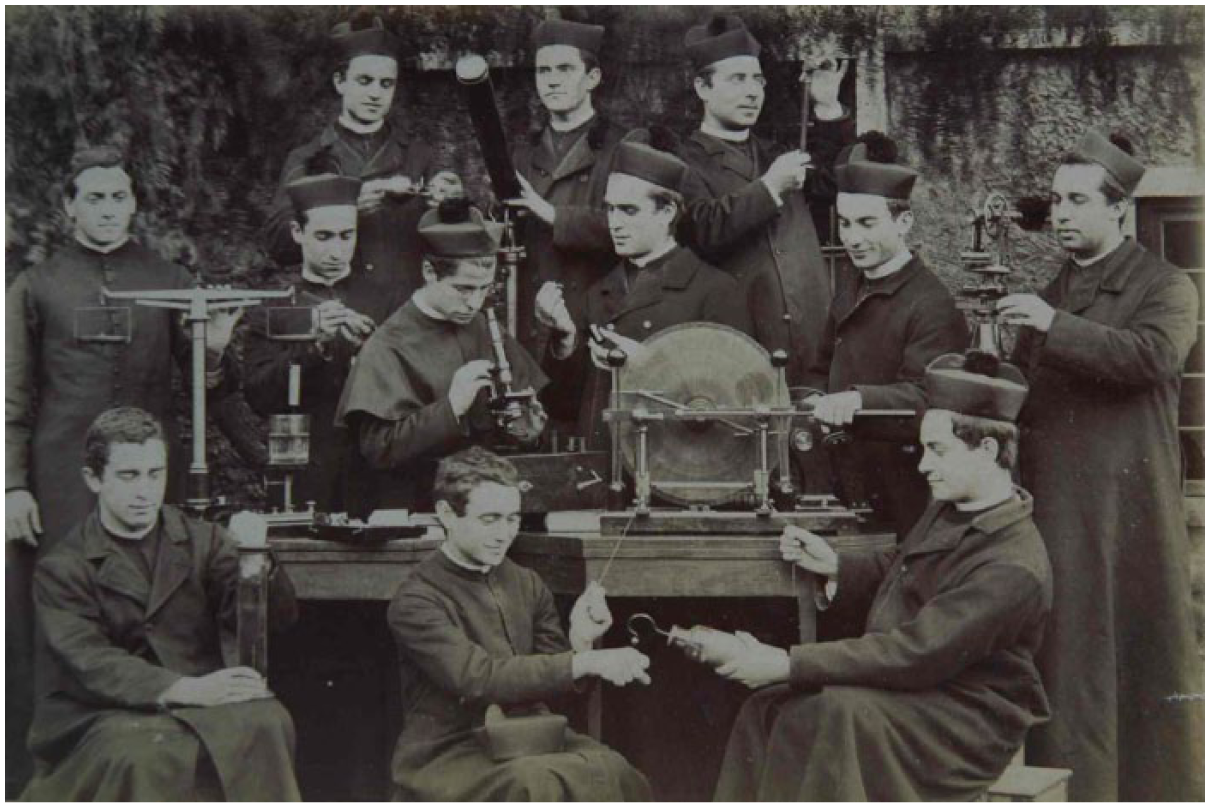
Philosophy students at the Colégio de São Francisco (Setúbal), 1892–1893. Credits: Archive of Brotéria, Lisbon.
Laboratories, cabinets, museums and observatories
Following the creation of a natural history museum and a physics cabinet at the Colégio de Campolide, in the school year of 1871–72, the Jesuits established a natural history museum and a physics cabinet at the Colégio de São Fiel (ca. 1876–8) and, finally, a physics cabinet at the Colégio de São Francisco (1886), a college founded exclusively for Jesuit scholastics studying philosophy (see Figure 2). In 1908, António de Oliveira Pinto, S.J. (1868–1933), one of the most prominent Jesuit teachers of mathematics and natural sciences during this period, took a further step towards the institutionalization of the teaching and practice of science in Campolide by merging the natural history museum, the physics cabinet, the chemistry laboratory, the scientific library and the laboratory of natural sciences into a unique institute: the Instituto de Sciencias Naturaes. The foundation of this institute embodied, in a certain sense, the desire to recreate the daily practices of modern scientific institutions, because its members were expected to contribute directly to its improvement, either by collecting and labelling animals, plants, and minerals, or by doing original research work in physics and chemistry. The Instituto also relied on some student ‘assistants’ who were expected to maintain the collections and the library and contribute to the classification of novel specimens. In addition, all former and current students were asked to collect “zoological, botanical and mineralogical specimens particularly from the colonies,” and were thus expected to play an important role in the development of the natural history collections. 17

António de Oliveira Pinto S.J. (1868–1933) at the physics cabinet of the Colégio de São Francisco, 1892–1893. Credits: Archive of Brotéria, Lisbon.
By 1908, the collections from the newly founded institute comprised an ethnological collection, which included the renowned Egyptian mummy from Angeja’s natural history museum, and important numismatic, heraldic, mineralogical, geological, zoological and botanical collections. For Oliveira Pinto, the cryptogams, especially the mosses and fungi, and the myxomycetes (slime molds), were amongst the finest scientific collections of Campolide. He was particularly proud of the latter which he pompously considered to be “surely the most comprehensive collection in Europe after the one from the British Museum.” 18 This collection, which comprised rare and novel species of myxomycetes, had been organized by Camilo Torrend, S.J. (1875–1961) and included 283 specimens, representing 199 different species. 19 According to Gulielma Lister (1860–1949), the renowned botanist from the British Museum, “the numerous gatherings made by Dr. C. Torrend in Portugal,” included in the descriptive catalogue of myxomycetes in the Herbarium of the British Museum, were “the first examples of this group recorded from that country.” 20
In 1909, the most celebrated acquisition for the zoological section of the museum was a large (stuffed) lion from the Jesuit missionary province of Mozambique. Being almost seven feet (some 2.1 metres) long, it was the largest specimen exhibited in a Portuguese museum. As for the botanical section, the fungi collection was substantially enriched with fifteen hundred new specimens. In that year, the Jesuit botanists also classified and described more than one hundred species for the Herbarium of the University of Coimbra, by request of Júlio Henriques (1838–1928), one of the most eminent contemporary Portuguese botanists. The comprehensive contributions of both teachers and students were crucial with regard to the enlargement of the botanical collections. As in previous years, the Jesuit naturalists organized field trips to collect new specimens of animals and plants. In the school year of 1909–10 they organized a number of small journeys with their students in Lisbon and its outskirts (Lumiar, Queluz, Belas, Alfeite, Vale do Rosal, Sintra) and a longer excursion to Serra de Monchique, the highest mountain range in the Algarve region. 21
As was the case with their brethren of Campolide, the Jesuits of São Fiel were enthusiastic collectors. 22 Furthermore, they became internationally renowned for the foundation of the Brotéria (1902–2002), the first Jesuit journal dedicated exclusively to science. Unlike other well-known Jesuit learned periodicals (La Civiltà Cattolica, Études, The Month, Razón y Fé, Studies, etc.), Brotéria was not an apologeticmagazine with a scientific section but a strictly scientific journal. Rather than promoting intellectual debates on the compatibility of science and religion, it sought to publish the works of Portuguese and foreign botanists and zoologists and contribute to the circulation, identification, description and classification of novel species of animals and plants. During its hundred-year existence, Brotéria described in its pages more than two thousand new species of animals and plants collected in Portugal, Spain, Germany, Angola, Mozambique, Timor, Brazil and Argentina. Initially devoted to plant and animal taxonomy, Brotéria gradually expanded its scope to the modern subjects of plant physiology, plant breeding, biochemistry and molecular genetics. The strictly scientific purpose behind its foundation, the unusual longevity for a scientific periodical, the extensive taxonomical work it published, the international readership, and the role played in the foundation and development of new research fields have all come to characterize Brotéria as one of the most significant scientific journals published in twentieth-century Portugal. 23
The astronomical and geophysical sciences, in a broad sense, represented a major area of research in the restored Society of Jesus. 24 Following the tradition of establishing observatories in their colleges, the Jesuits built a circular tower in Campolide for astronomical observations in 1886 and a meteorological observatory in São Fiel in 1902. 25 The cabinets of physics of Campolide and São Fiel, were amongst the most obvious examples of the successful intertwining of theory and practice in Portuguese pre-university institutions. These cabinets comprised three distinctive sections (optics, mechanics and hydrostatics, and electricity) and were equipped with modern instruments that “experimentally illustrated” the most important treatises dealing with physics. 26
The promotion of experimental teaching of the natural sciences, although common in other European countries since the beginning of the nineteenth century, was quite unusual in the Portuguese context. From 1836 to 1895 the Portuguese government promulgated nine curricular reforms, with the aim of modernizing secondary education. 27 Although the reforms encouraged experimental teaching of the natural sciences and postulated the creation of a botanical garden, a physics cabinet, a chemistry laboratory and a natural history museum in all public schools, their implementation was somewhat challenging, mostly because of financial constraints. 28 During this period the discrepancies between private and public schools were clear, and there was an obvious primacy of the private colleges. To put matters in perspective, one need only to be reminded that between 1868 and 1895 only 21 percent of students enrolled in public schools, while the vast majority of students (79 percent) opted for home-schooling and private colleges. 29 Following the reform introduced by Jaime Moniz (1837–1917) in 1895, the number of enrolments in public schools increased and the teaching of the natural sciences was gradually implemented in a few public schools. As with the Jesuit colleges, the Lisbon Military College distinguished itself in the context of scientific education. Founded in 1806 and devoted to the secondary education of the sons of the military from the court, and to those wishing to pursue a “career of arms,” the Lisbon Military College had a prominent status in nineteenth-century Portugal. The collections of the natural history museum, established in 1860, were greatly improved during the following decades by purchases, transfers and donations made by the Lisbon Polytechnic School, and the University of Coimbra and former alumni, most notably King Carlos (r. 1889–1908). 30
There are also some Jesuit colleges comparable to Campolide and São Fiel, namely St. Francis Xavier College, in Liverpool (England), and Colegio Maximo, in Tortosa (Spain). Founded in 1842, St. Francis Xavier College was “the largest Catholic secondary day-school in Britain.” 31 In 1875, Superior General Pieter Beckx (in office 1853–87) encouraged the reform of the curriculum of the Liverpool college and urged the Jesuits to give more time to the teaching of modern languages, arithmetic and chemistry. According to Maurice Whitehead, the creation of a course of chemistry at St. Francis represented “a significant break with traditional practice.” 32 In the following years, the college witnessed the inauguration of a chemistry laboratory (1877) and a physics cabinet (1890), the creation of a “night chemistry class for young men” (1877) and the organization of an independent series of popular scientific lectures (1876–9), mostly delivered by John Gerard, S.J. (1840–1912). 33 At Colegio Maximo, the Spanish Jesuits founded an astronomical observatory (1905), a biology laboratory (1906) and a chemistry laboratory (1908), which were subsequently transferred to Barcelona (1916). Because Colegio Maximo comprised the faculties of philosophy and theology, the creation of these facilities was expected to give the Jesuit scholastics a “solid basis on natural sciences as a part of the philosophical studies.” 34
The scientific academies
Shaping a public image of science
Following the pedagogical guidelines of Ratio studiorum and what had been a mostly normal practice in their colleges in the past, Portuguese Jesuits promoted the creation of academies in São Fiel and Campolide. 35 Attended by promising students, the academies promoted the teaching and discussion of modern scientific topics during their regular sessions. Once or twice a year, usually before Christmas and summer holidays, they fostered the organization of solemn sessions, and all students and their families were invited. In Campolide and São Fiel, the students were the protagonists, being responsible not only for carrying out the experiments but also for describing and explaining their underlying scientific principles. These sessions were quite theatrical and included screen projections and spectacular experiments with high-frequency electrical discharges, cathode and X- rays, magnetism, wireless telegraphy and liquid crystals. 36 The sessions were often presided over by renowned individuals, from the political, clerical and public spheres, and the minister of public education and the royal princes were among the most illustrious chairmen of the solemn sessions held in Lisbon in the years that preceded the republican revolution. Because these festive events, initiated in the 1870s, publicly displayed the Jesuits’ modernity to a broad audience, sessions played a significant role in the Jesuits’ struggle to recover their educational and scientific credibility.
One of the most significant sessions held at Campolide took place on 16 March 1905, and it was presided over by, and dedicated to, Luís Filipe (1887–1908) and Manuel de Bragança (1889–1932). 37 At this session the royal princes became honorary members of the scientific academy of Campolide and witnessed the presentation and experimental demonstration of three different theses. By putting together experiments involving high-frequency electrical discharges, liquid carbon dioxide and nitrogen, and wireless telegraphy, the Jesuits tried to impress their audience and, especially, the royal princes with their theatrical modernity. Interestingly, this theatricality was already made clear on the beautifully conceived program, which included engravings of the instruments that were to be used during the solemn session (see Figure 3). With these public sessions, Portuguese Jesuits joined the European practice of organizing scientific spectacles while evoking, in a way, their scientific and educational history and the success of the Jesuit polymath Athanasius Kircher (1602–80). 38
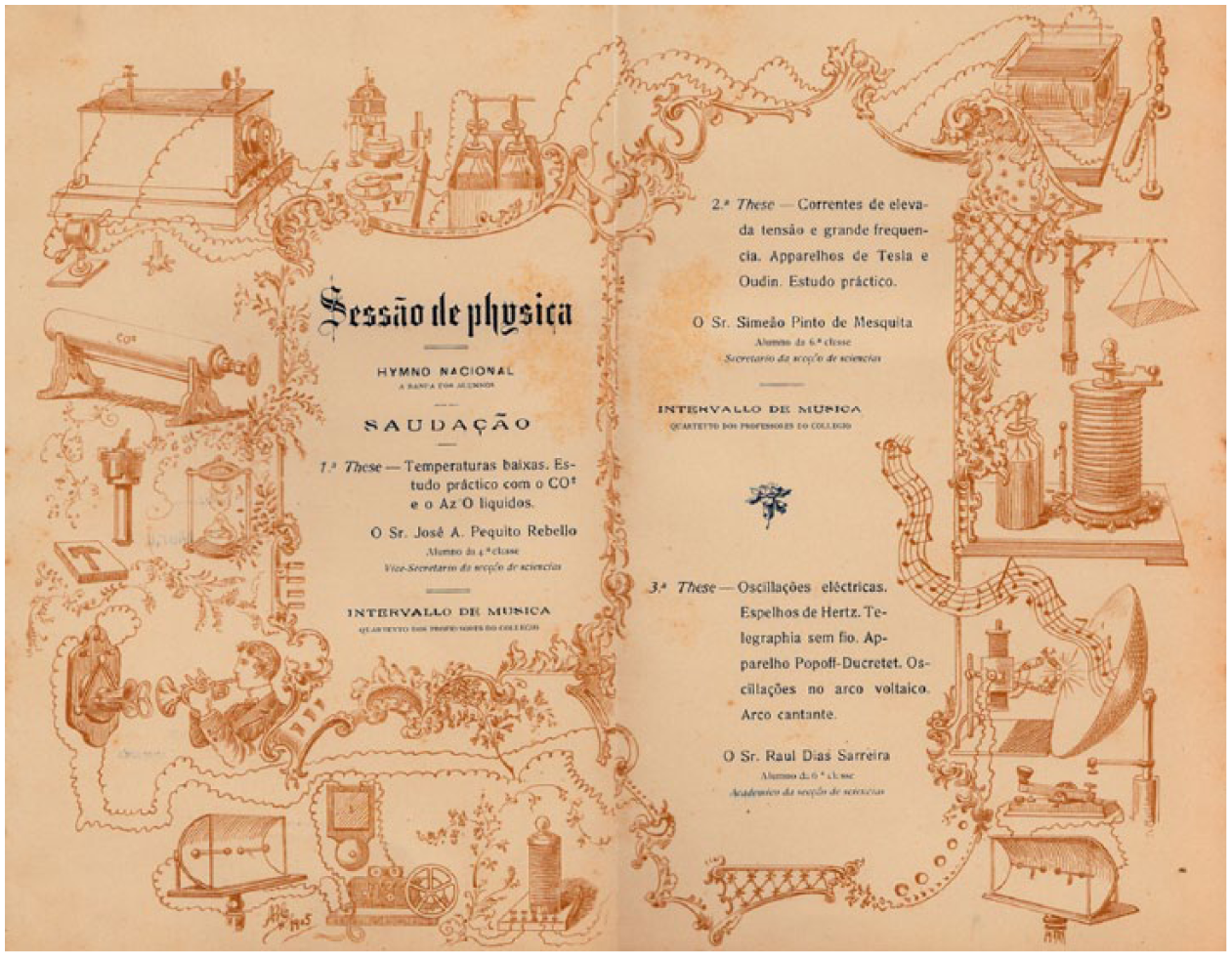
Program of the solemn session held at the Colégio de Campolide on 16 March 1905. Credits: Archive of the Portuguese Province of the Society of Jesus, Lisbon.
The subsequent session of the scientific academy of Campolide was presided over by Abel Pereira de Andrade (1866–1958), Minister of Education. The session took place on 27 May 1906, and it was dedicated to the study of crystals. 39 The first act of the perfectly choreographed session concerned the explanation of “crystal systems”, “elementary notions on the polarization of light”, and birefringence, and it was planned as an “introduction to what will be exposed on the second [part].” 40 During the second act the audience was invited to watch sixteen-year-old João Maria Berquó d’Aguiar (1889–1954) re-enact the “very recent” experiments on the birefringence of some liquids, performed by Otto Lehmann (1855–1922) between 1904 and 1906. By recreating these experiments with liquid crystals in the presence of the Minister of Education. Portuguese Jesuits were making a clearly persuasive rhetorical claim regarding their modernity.
For the execution of experiments with liquid crystals in 1906, the Jesuits had purchased an instrument that had been “expressly conceived for the Colégio de Campolide” by Zeiss, the international manufacturer. Purchasing new scientific instruments for research and public demonstrations was one of the most distinctive features of the Jesuits’ academies in the Portuguese educational context. In the solemn session of 1907, for instance, the acquisition of “the recent pump of dr. Gaede” and X-ray equipment was crucial for planning new demonstrations (see Figure 4). 41 The Gaede pump created a vacuum in just four minutes, thus simplifying the experiments with high-frequency electrical discharges, while the X-ray apparatus was used to radiograph a cat in a box. By purchasing modern, and occasionally tailor-made, instruments that allowed them to perform innovative demonstrations, the Jesuits continually entranced their audiences with unique scientific spectacles, while revealing themselves as modern pedagogues.

Program of the solemn session held at the Colégio de Campolide on 23 May 1907. Credits: Personal Archive of Francisco Malta Romeiras, Lisbon.
The scientific academies of Campolide and São Fiel hosted sessions dedicated to other subjects, such as astronomy (São Fiel, December 1905), volcanology (São Fiel, May 1907), animal cytology and histology (Campolide, March 1908), and seismology (São Fiel, March 1909), but the majority of the solemn sessions were dedicated to physics. It is probable that this was not entirely unplanned, because experimental physics delivered the best and well-proven combination of science and spectacle. By successfully offering modern and well-choreographed theatrical performances, the Jesuits were finally regaining some of their educational prestige and influence with the highest ranks of nobility and bourgeoisie, the royal family and the ministry of education, and the acceptance of their presence in Portugal was becoming more than just tacit.
The solar eclipses of 1900 and 1905
As well as organizing public sessions, the students and teachers of the scientific academies engaged in other periodic activities, such as journeys to collect new specimens of animals and plants and field trips to observe eclipses. The Jesuits started observing eclipses in the 1890s at the Colégio de São Francisco, in Setúbal, and in 1900 they organized their first expedition to observe this popular astronomical event. On 28 May 1900, some naturalists of São Fiel were in Benespera and Capinha, two small parishes not far from the college premises, to observe the total solar eclipse. 42 During the days before the eclipse, several professional astronomers had already reached Portugal and Spain to observe this phenomenon, which was only completely visible in some regions of the Iberian Peninsula. By the turn of the century, these expeditions were undertaken quite frequently because they provided a perfect opportunity for the spectrophotometric analysis of the atmosphere and for observation of the solar corona. In addition to the professional expeditions, there were also a number of amateur expeditions, such as the one from São Fiel. Frederico Oom (1864–1930), the head of the Astronomical Observatory of Lisbon, encouraged these amateur observations in which he was personally involved, not only by creating a public awareness of their relevance but also, and most importantly, by establishing a network of correspondence with both amateur and professional astronomers. 43
After the publication of the Eclipse do Sol de 28 de Maio de 1900, a booklet containing a summary of their observations, the Jesuits continued to correspond with Oom, and his suggestions were also relevant regarding a particular situation: the establishment of a meteorological observatory in São Fiel. In November 1901, two months prior to its official debut, Carlos Zimmermann, S.J. (1871–1950) asked Oom to confirm the list of scientific instruments already available at São Fiel. 44 Because Zimmermann wished to establish a reliable observatory, capable of integrating the national network of meteorological stations, Oom’s suggestions were extremely valuable and contributed to the inclusion of São Fiel’s data in the annual reports of the national meteorological observatory from 1902 onwards.
On 30 August 1905 the Jesuits of São Fiel and Campolide organized a collective expedition to observe a total solar eclipse in Spain; and on 8 December 1905, the eponymous feast of the Colégio de Campolide, they published a new booklet containing the results of their observations. 45 Dedicated to the royal princes, this popular work did not set out to communicate new astronomic discoveries but, rather, to summarize their observations and “enrich the archive of empirical knowledge, always significant when considering a phenomenon so restricted in time and space.” 46 The amateur astronomers had observed the eclipse from three different cities: Tortosa, Palencia and Burgos. The committee lead by Oliveira Pinto had travelled from Campolide to Tortosa, and that from São Fiel, guided by Joaquim da Silva Tavares, S.J. (1866–1931) and Valério Cordeiro, S.J. (1866–1931), to Palencia. The group heading to Burgos included one naturalist from each college and two students from the scientific academy of Campolide: José Pequito Rebelo (1892–1983) and Simeão Pinto de Mesquita (1889–1989). As a meeting point for astronomers coming from all over Europe, Burgos was the most suitable location for the Jesuit committee to interact with amateur and professional astronomers. Comfortably installed in a Jesuit college, Pinto de Mesquita and Pequito Rebelo were responsible for photographing and illustrating the eclipse, and the drawing of thirteen-year-old Pequito Rebelo, later included in the booklet, was highly praised by Frederico Oom and some foreign astronomers staying in Burgos at that time for its accuracy. 47
António Oliveira Pinto and the radioactivity of Portuguese mineral waters
The Jesuits’ teaching and research skills and their willingness to keep up with modern scientific practices were crucial for the success of their colleges. However, during this period some of their opponents accused them of being unprepared, especially because they did not meet the standard criteria for being high school teachers. After an official visit to São Fiel in 1880, Joaquim de Sousa Refóios (1853–1905) concluded that the school was directed by Jesuits and accused them of distressing the population of Louriçal do Campo and its outskirts. Sousa Refóios recognized that most families sent their children to São Fiel because of the excellence of its scientific and humanistic education, but he added that they did so “hoping that, when leaving the college, it would be easy to remove the vestiges of Jesuit education.” 48 Thirty years later, Pedro Ferrão voiced the usual accusations against the Jesuits of São Fiel. He repeated the common allegations of ambition, deceitfulness and secrecy and claimed they were inept teachers. 49 From 1880 to 1910, the Jesuits’ opponents often mentioned that the absence of state-certified training should prevent them from teaching. The most detailed reply came from António Mendes Lages, S.J. (1838–1908), who claimed that the ability to teach and the profound knowledge of the subjects taught were more important than an official diploma. The Jesuit added that because state training was not legally enforced the assessment of teaching skills should be left to the rectors of every educational institution. 50
In the restored Society of Jesus, the Jesuits professed their first vows after a two-year novitiate. Following a three-year philosophy course, which also included mathematics and natural philosophy, each scholastic would become either a missionary or a teacher for a number of years. This period of their training was somewhat variable, and it could last for several years before enrollment in theology studies. Because the Society of Jesus did not offer a course of theology in Portugal, the Jesuits were always sent abroad to study, for three to five years. After a process that lasted a minimum of ten years, they were finally ordained priests, and their future tasks were then determined by the Provincial Superior. Typically, those who during their training had distinguished themselves as skillful teachers returned to the colleges. Given this prolonged formation, it is clear that the scientific training, conducted only at the philosophy course, was insufficient to explain the success of the teaching of the natural sciences at Campolide and São Fiel. To understand this issue fully, let us consider the life and work of António Oliveira Pinto, one of the most prominent Jesuit teachers of mathematics and natural sciences during this period.
Oliveira Pinto was born in Covilhã, in the interior of Portugal, in 1868, and he became a novice after turning fourteen years old. After the novitiate, he taught mathematics in São Francisco (1892–3) and physics, chemistry and natural history in São Francisco (1891–2) and São Fiel (1893–5). From 1895 to 1897 he studied theology in Õna, being ordained priest in Vals-Près-Le-Puy (Haute-Loire) in the following year. From 1901 to 1910 he taught mathematics, physics, chemistry and natural history at Campolide, where he was also responsible for the Instituto de Sciencias Naturaes. A member of several national and international societies, he earned a prestigious place in the history of physics in Portugal for performing some of the first experiments with telegraphy (1902) and the first recorded experiments with radioactivity (1910), both at Campolide. 51
Pinto’s interest in radioactivity dated back to the First International Congress of Radiology and Electricity, held in Liège in 1905. 52 Five years later, he attended the Second International Congress of Radiology and Electricity (Brussels, 1910) and presented the results of his experiments on the radioactivity of Portuguese mineral waters. 53 Despite their interest in radioactivity, the lack of an appropriate experimental training and the difficulties encountered in acquiring radioactive sources prevented the physicists from the University of Coimbra from working with radioactivity until 1915. 54 Although he lacked a formal university scientific education, Oliveira Pinto became acquainted with radioactivity in 1905, and in 1910 Pierre and Marie Curie welcomed him to their laboratory. He worked there for a short period of time and became familiar with the most recent methods and instruments. Oliveira Pinto had the necessary expertise and access to the coveted radioactive source, in this case a solution of radium bromide, to carry out his experiments. The radium bromide solution, essential for the calibration of the electroscopes, was supplied by Ellen Gleditsch (1879–1968). 55
The republican expulsion
Fifty years after a reticent return, the implicit acceptance of their presence by the royal family and the ministry of education, the success of their colleges and the national and international projection of their taxonomical works seemed to represent una mirabil congiuntura for the Portuguese Jesuits. However, their situation was somewhat fragile, due especially to the centrality of anti-Jesuitism in the more general nineteenth-century anticlericalism. 56 Influential writers, poets and politicians frequently insisted that there was a clear conflict between liberty, progress and science on the one hand, and clericalism on the other. Essentially, they stated constantly in their works and public speeches that “who believes [in God] does not think, and who thinks does not believe.” 57
In nineteenth-century Portugal the accusations of obscurantism and educational backwardness were particularly frequent. Following Pombal’s line of reasoning, the Jesuits were accused of kidnapping children and of enrolling them in a “dark seminary” which transformed them into “stupid night-birds.” 58 Manuel Borges Grainha (1862–1925), probably the most active and vociferous anti-Jesuit critic in late nineteenth-century Portugal, repeatedly complained about the lack of quality of Jesuit schools and the backwardness of their teaching. For Grainha, the undeclared objective of the Jesuits had always been controlling the nobility and the bourgeoisie through education, and the people by instilling the fear of God. 59
The contradictions of many of the accusations became obvious when the fact that several anti-Jesuit politicians had chosen the colleges of the Society of Jesus for the education of their children was made public. The duplicity of their position regarding Jesuit education was explicitly condemned by the parliamentarian Tomás Ribeiro (1831–1901), who accused Portuguese politicians of living a life of “constant lies” because they did the opposite of what they publicly stood up for. 60 Political events accelerated rapidly after the assassinations of King Carlos and Prince Luís Filipe de Bragança on 1 February 1908. Republicans associated the decline of the monarchy with the alleged obscurantism of the Jesuits and made their expulsion a priority. Banning the Jesuits was not only compulsory for the sake of scientific and educational progress but also a legally enforced action. For the republican party, the Jesuits’ presence was illegal because it infringed on two laws that were still in force: the Pombaline decree of expulsion (1759) and the liberal decree that banned male religious orders (1834). The demand for the Jesuits’ expulsion was frequently mentioned in speeches in parliament. Afonso Costa (1871–1937), for instance, presented a bill to ban the Jesuits and close their colleges in 1908 and in 1909, but the bill was only promulgated on 8 October 1910; that is, three days after the republican revolution, and thus it became Costa’s first decree as minister of justice of the new republic. 61
On the morning of 5 October 1910, at the height of the republican revolution, the bombardment of the Colégio de Campolide and subsequent imprisonment of the Jesuits put an abrupt end to the apparent mirabil congiuntura (see Figure 5). 62 Following the bombardment, a considerable amount of the scientific instruments, books and collections was either destroyed or stolen during an assault that involved military personnel and a rebellious crowd. What was not lost on that day was afterwards confiscated by the new republic. 63 Most of the scientific instruments, books and collections from São Fiel escaped unharmed and were subsequently sent to the University of Coimbra and to the nearest local public school, which, despite all the legislative efforts, still lacked a natural history museum and a physics cabinet. The expulsion of the Jesuits and the confiscation of their collections created a commotion both nationally and internationally. 64 In a meaningful demonstration of the scientific credibility they had acquired, Cockerell published a plea in favor of the exiled naturalists in Science. 65 However, the protests were mostly ignored and the few collections that were partially retrieved pertained to four foreign Jesuits and were recovered only after diplomatic interventions. 66
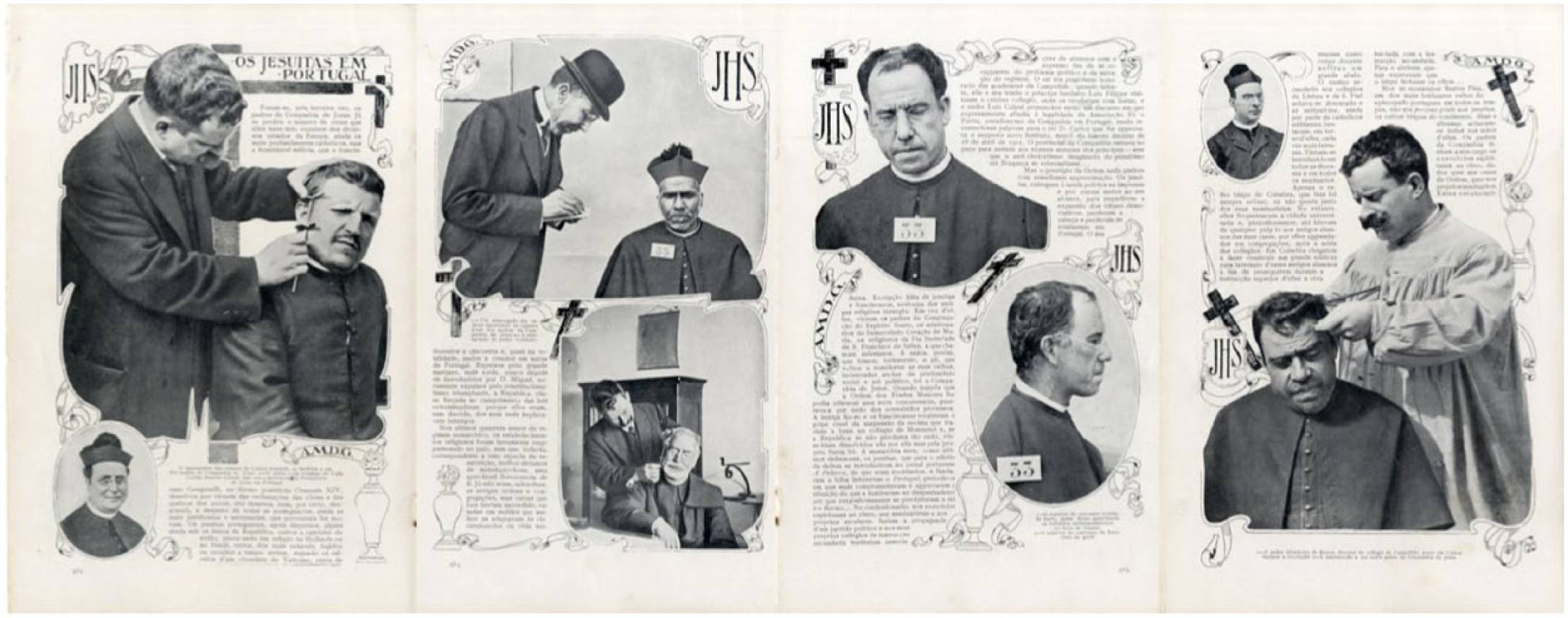
“Os jesuítas em Portugal”. Adapted from Illustração Portugueza (1910) Volume 246, pp. 582–588. Courtesy of Hemeroteca Municipal de Lisboa.
The expulsion of the Jesuits, the closure of their colleges and the unwillingness of the new government to retrieve their scientific collections, instruments and books can be broadly interpreted as a predictable consequence of a struggle for cultural hegemony between the Jesuits, as intellectual representatives of the old monarchist regime, and the republicans, who sought to broadcast their own values and principles through the establishment of a new educational order. 67 In a period when various political and religious groups were struggling for educational hegemony throughout Europe, the expulsion of the Jesuits and all religious orders was considered by the Portuguese republicans as a necessary first step for achieving social and political stability in the newly formed regime.
Conclusion
When the Society of Jesus was restored in 1858, Portuguese Jesuits were very much aware of the longevity and popularity of the eighteenth-century accusations of obscurantism. While ultimately aspiring to the “greater glory of God” – the celebrated Ignatian motto – they established observatories, laboratories and museums in their colleges and founded a scientific journal that played a significant role in the development of zoology, botany, plant breeding, biochemistry and molecular genetics in Portugal. By putting the teaching and practice of science at the top of their list of educational priorities and by projecting their public image as modern scientists and pedagogues, they gradually regained their credibility with the royal family, the highest ranks of nobility and bourgeoisie and the scientific community. In addition, the restoration of their credibility represented a fundamental step in the approval of new apostolic missions by the crown, namely the foundation of colleges and missions in China, India, Mozambique and Timor. 68
The Campolide and São Fiel colleges played a major role in the restoration of the Society of Jesus and in the diffusion of Ignatian spirituality, through the restoration of the Sodalities of the Blessed Virgin Mary and through the organization of Spiritual Exercises and other silent retreats. With the objective of providing an education grounded on the “alliance between Religion and Science,” these colleges took a further step towards the formal scientific training of a new elite, which included not only future scientists but also military officers, priests, bishops, politicians and celebrated artists. 69 As with the reform of the scientific curriculum of St. Francis Xavier’s College in Liverpool, it is possible that the Jesuit Curia in Rome urged the Portuguese Jesuits to dedicate themselves to the teaching of scientific courses in their colleges. However, the extant sources suggest that the selection of the courses was decided locally. It is worth remembering that because scientific education was only conducted at the philosophy course, the engagement of Jesuits in the teaching and practice of natural sciences reflected their active involvement in amateur practices in physics, astronomy, zoology and botany.
The promotion of amateur expeditions to observe eclipses and to collect new specimens of animals and plants, the systematic collection of meteorological data, the attendance at international conferences and the engagement in original research work all suggest that Jesuits’ informal training, and their participation in national and international scientific networks proved to be more relevant for their training as modern scientists and pedagogues than any official diploma or examination. By teaching subjects directly related to their own scientific practices they exemplified a proficient intertwining of the teaching and practice of science in their colleges. Furthermore, the direct involvement of students in duties of diverse complexity and the desire to recreate the modern practices of scientific institutions were probably the most distinctive features of these colleges, not only in the Portuguese context but also in the wider Jesuit educational framework.
Exiled to Spain, Belgium and Brazil, the Portuguese Jesuits established new colleges and missions and continued to publish their taxonomy works in Brotéria, which was subsequently awarded a gold medal in two international exhibitions in Brazil (Baía, 1913 and Rio de Janeiro, 1922). 70 From 1928 onwards, the Jesuits’ contributions to science were publicly acknowledged by the scientific community and the Portuguese government, and the editors of Brotéria were granted honorary doctorates and bestowed the highest state honours. 71 In the 1960s the teaching and practice of science remained at the top of the Jesuits’ educational priorities because science was still considered “the most important ministry of the Society [of Jesus]” and “scientific prestige conferred a greater authority to all apostolic activities.” 72 This dedication to science must also be understood in a broader religious context, because “finding God in all things” has been at the very core of Ignatian spirituality since the foundation of the Jesuits in the sixteenth century. As the Portuguese naturalists elegantly expressed it in the foreword of the opening issue of Brotéria, their research on the natural sciences was extremely rewarding because their works led them to unveil “the greatness of God” both “on the immensity of the world and on the myriad of tiny animals and plants” uncovered by the microscope. 73
Footnotes
Acknowledgements
This article expands some of the views expressed in my doctoral thesis. I would like to thank Henrique Leitão for supervising this work, for carefully reviewing earlier versions of the manuscript, and for his helpful suggestions concerning the distinctiveness of Jesuit science and education in modern Portugal. I would also like to thank the two anonymous reviewers. Their comments and suggestions were particularly helpful in presenting the argument of this paper more clearly.
Declaration of Conflicting Interests
The author(s) declared no potential conflicts of interest with respect to the research, authorship, and/or publication of this article.
Funding
The author(s) disclosed receipt of the following financial support for the research, authorship, and/or publication of this article: This work was carried out during my doctorate in history and philosophy of science and was funded by Fundação para a Ciência e Tecnologia (SFRH/BD/61883/2009).
1.
António Egas Moniz, A nossa casa (Lisbon: Paulino Ferreira Filhos Lda, 1950), p. 254.
2.
Theodore Dru Alison Cockerell, “The Exiled Naturalists of Portugal,” Science 34 (1911): 714–15.
3.
The literature on Jesuit science is quite extensive. However, the historiography is somewhat uneven and most historians pay more attention to the early modern period than to the scientific history of the Society of Jesus after its restoration in 1814. For the history of Jesuit science from 1540 to 1773 see in particular: John O’Malley, Gauvin Alexander Bailey, Steven J. Harris and T. Frank Kennedy (eds.), The Jesuits II: Cultures, Sciences and the Arts, 1540–1773 (Toronto: Toronto University Press, 2006); Marcus Hellyer, Catholic Physics: Jesuit Natural Philosophy in Early Modern Germany (Notre Dame, IN: University of Notre Dame Press, 2005); Mordechai Feingold (ed.), Jesuit Science and the Republic of Letters (Cambridge, MA: MIT Press, 2003); Mordechai Feingold (ed.), The New Science and Jesuit Science: Seventeenth-Century Perspectives (Dordrecht: Kluwer Academic, 2003); John O’Malley, Gauvin Alexander Bailey, Steven J. Harris and Kennedy T. Frank (eds.), The Jesuits: Cultures, Sciences and the Arts, 1540–1773 (Toronto: Toronto University Press, 1999) and Ugo Baldini, Legem impone subactis: Studi su filosofia e scienza dei Gesuiti in Italia, 1540–1632 (Rome: Bulzoni, 1992). For a global synthesis of the scientific history of the Society of Jesus from its foundation to the twentieth century see Agustín Udías, Jesuit Contribution to Science: A History (Dordrecht: Springer, 2015).
4.
Analysing the historiographical consequences of the traditional narrative of the scientific revolution is not the aim of this article. For an overview, see Steven J. Harris, “Transposing the Merton Thesis: Apostolic Spirituality and the Establishment of the Jesuit Scientific Tradition,” Science in Context 3 (1989): 29–65 and Sheila J. Rabin, “Early Modern Jesuit Science: A Historiographical Essay,” Journal of Jesuit Studies 1 (2014): 88–104. For modern narratives of the so-called scientific revolution see: Katharine Park and Lorraine Daston (eds.), The Cambridge History of Science. Volume 3: Early Modern Science (Cambridge: Cambridge University Press, 2006); Steven Shapin, The Scientific Revolution (Chicago: Chicago University Press, 1996) and David C. Lindberg and Robert S. Westman, Reappraisals of the Scientific Revolution (Cambridge: Cambridge University Press, 1990).
5.
Assistentia Lusitaniae comprised seven provinces: Portugal, Brazil, Maranhão, Goa, Malabar, Japan and China. The scientific and educational activities of the Jesuits in Assistentia Lusitaniae have been extensively studied during the last two decades by historians such as Ugo Baldini, Henrique Leitão, Noël Golvers, Ines G. Županov, Florence C. Hsia, Alfredo Dinis, António Costa Canas, Luís Carolino, Carlos Ziller Camenietzki, Bernardo Mota, Luís Tirapicos, Samuel Gessner, Catherine Jami, Luís Saraiva, André Ferrand de Almeida, Rui Magone, and José Miguel Pinto dos Santos.
6.
In 1759, the Jesuits directed the University of Évora and thirty-seven colleges scattered through the Portuguese empire (sixteen in Portugal, twelve in Brazil, three in Azores and India, and one each in Madeira, Angola and Macao). For a recent article on the expulsion of the Jesuits from Portugal see Emanuele Colombo and Niccolò Guasti, “The Expulsion and Suppression in Portugal and Spain: An Overview,” in Jeffrey D. Burson and Jonathan Wright (eds.), The Jesuit Suppression in Global Context: Causes, Events, and Consequences (Cambridge: Cambridge University Press, 2015), pp. 117–38.
7.
For a more detailed analysis see: Francisco Malta Romeiras and Henrique Leitão, “The Role of Science in the History of Portuguese Anti-Jesuitism,” Journal of Jesuit Studies 2 (2015): 77–99, 86–90.
8.
On Jesuit historiography in modern Portugal see: Francisco Malta Romeiras, “Jesuit Historiography in Modern Portugal,” in Robert Maryks (ed.), Jesuit Historiography Online (Leiden: Brill, 2016). doi: 10.1163/2468-7723_jho_COM_192570.
9.
On the history of the Colégio de Fiel and the Colégio de Campolide see: Francisco Malta Romeiras, Ciência, prestígio e devoção: Os jesuítas e a ciência em Portugal (séculos XIX e XX) (Cascais: Lucerna, 2015), pp. 47–84.
10.
Regarding the requirements to enroll at the Jesuit colleges, the prospect of Campolide specified that new students should be between seven and twelve years old. The extant sources regarding São Fiel do not mention the age requirements for a new student to enroll. However, when the Jesuits took over the direction of São Fiel in 1863, the rector adopted the school rules and regulations followed at Campolide. The rules and regulations of Campolide can be found here: Colégio de Campolide, Prospecto (Lisbon: Typographia Universal, 1886), pp. 1–2.
11.
On the tuitions of Campolide and São Fiel see: Romeiras, Ciência, prestígio e devoção, p. 81 (note 9).
12.
António de Oliveira Pinto, “O Instituto de Sciencias Naturaes do Collegio de Campolide,” O Nosso Collegio 5 (1908–1909): 99–113, 100–1.
13.
These improvements were especially relevant because they made possible a steady growth of the student body. While in the mid 1860s, the Colégio de Campolide only housed about forty students, by 1910 it housed nearly three hundred alumni. With regard to São Fiel, the data also corroborate this hypothesis, because this college housed eighty students in the 1860s, and more than three hundred and sixty students in 1910: Romeiras, Ciência, prestígio e devoção, pp. 54–8 (note 9).
14.
In 1880, students of the Colégio de Campolide paid a monthly tuition of 15,000 réis (currently, in 2017, that would roughly correspond to 314 €). At São Fiel, there were three different groups of students. The orphans attended the college free of charge, the poorest students paid 6,500 réis, whereas the other students paid 8,000 réis (those tuition fees would correspond nowadays roughly to 136 € and 167 €, respectively). In 1880 there were one hundred and thirty-eight students at São Fiel: fourteen orphans, sixty-eight unprivileged children, and fifty-six full-paying alumni: Manuel Borges Grainha, História do Colégio de Campolide da Companhia de Jesus (Coimbra: Imprensa da Universidade de Coimbra, 1913), p. XLIV; Joaquim de Sousa Refóios, O Collegio de São Fiel no Louriçal do Campo e o de Nossa Senhora da Conceição na Covilhã: Apontamentos sobre o jesuitismo no districto de Castello-Branco (Coimbra: Imprensa da Universidade de Coimbra, 1883), p. 17.
15.
Regarding the impossibility of being paid a salary and on the self-sustainability of the colleges see Monumenta Ignatiana. Sancti Ignatii de Loyola Constitutiones Societatis Iesu, 3 vols (Rome: Monumenta Historica Societatis Iesu, 1934–8) and Carl Moell (ed.), The Constitutions of the Society of Jesus and Their Complementary Norms: A Complete English Translation of the Official Latin Texts (Saint Louis, Institute of Jesuit Sources, 1996), especially parts IV, V and VI, which deal with the formation of the Jesuits after the novitiate and with the meaning of their vows. The financial statements for Campolide and São Fiel can be found at the Arquivo Nacional da Torre do Tombo, in Lisbon. For more details on the finances of Campolide and São Fiel see Romeiras, Ciência, prestígio e devoção, pp. 67–8 and 79–80 (note 9).
16.
With two excellent sections of mineralogy and zoology, Angeja’s museum was one of the most celebrated natural history museums in eighteenth-century Portugal. It became especially renowned for its Egyptian mummy, unique in Portuguese museums. After the republican revolution the provisional government confiscated the mummy and transferred it to he National Museum of Archaeology. Regarding the history and purchase of this natural history museum please see: Maria de Fátima Meneses, “Museus e ensino: Uma análise histórica sobre os museus pedagógicos e escolares em Portugal (1836–1933)” (Unpublished MSc dissertation, Universidade Nova de Lisboa, 2003), pp. 194–7; José Leite de Vasconcelos, “Viagem de Pérez Bayer em Portugal, em 1782,” O Archeologo Portugues 24 (1920): 108–76, and Grainha, História do Colégio de Campolide, p. 105 (note 14).
17.
Pinto, “O Instituto de Sciencias Naturaes,” pp. 100–2 (note 12).
18.
Ibid., p. 99.
19.
Camilo Torrend, “Les Myxomycètes. Étude des Espèces connues jusqu’ici,” Brotéria-Botânica 6 (1907): 5–64; Camilo Torrend, “Les Myxomycètes. Étude des Espèces connues jusqu’ici,” Brotéria-Botânica 7 (1908): 5–177.
20.
Arthur Lister and Gulielma Lister, A Monograph of the Mycetozoa: A Descriptive Catalogue of the Species in the Herbarium of the British Museum, 2nd ed. (London: Printed by order of the Trustees of the British Museum, 1911), p. 3.
21.
Pinto, “O Instituto de Sciencias Naturaes do Collegio de Campolide,” 143–9 (note 12).
22.
To grasp the dimension of their botanical collections, one must recall that in 1910 their herbarium contained more than five thousand different species. The herbarium included 93 species of Portuguese lichens, 627 species of mosses pertaining both to Portuguese and non-Portuguese floras, 521 species of Portuguese fungi, 3000 diatoms, 855 species and 106 subspecies of Portuguese spermatophytes and 47 species of foreign spermatophytes: Joaquim da Silva Tavares, “O Herbário do Colégio de S. Fiel,” Brotéria-Botânica 21 (1924): 82–7.
23.
The history of Brotéria (1902–2002) largely exceeds the aim of this article. For a detailed account of the centennial history of this Jesuit journal see: Francisco Malta Romeiras and Henrique Leitão, “One Century of Science: The Jesuit Journal Brotéria (1902–2002),” in Robert Maryks (ed.), Exploring Jesuit Distinctiveness: Interdisciplinary Perspectives on Ways of Proceeding within the Society of Jesus (Leiden: Brill, 2016), pp. 235–58.
24.
In 1910, the Jesuits directed twenty-four observatories worldwide: Agustín Udías, Searching the Heavens and the Earth: The History of Jesuit Observatories (Dordrecht: Kluwer Academic Publishers, 2003), pp. 2–4.
25.
Carlos Zimmermann, “Observatorio Meteorologico do Collegio de São Fiel,” Brotéria 1 (1902):185–88 and Grainha, História do Colégio de Campolide, p. 96 (note 14).
26.
Pinto, “O Instituto de Sciencias Naturaes,” p. 100 (note 12). For a detailed account on the evolution of the usage of these instruments in the nineteenth and early twentieth centuries, see Paolo Brenni, “The Evolution of Teaching Instruments and Their Use Between 1800 and 1930,” Science and Education 21 (2012): 191–226.
27.
Regarding the successive attempts to implement an experimental teaching of science in public schools see: Inês Gomes, “Os Gabinetes de História Natural dos antigos liceus: Um estudo exploratório a partir dos textos legislativos,” in Carlos Fiolhais, Carlota Simões and Décio Martins (eds.), Actas do Congresso Luso–Brasileiro de História das Ciências (Coimbra: Imprensa da Universidade de Coimbra, 2011), pp. 1185–1202.
28.
For a complete and modern analysis of the Portuguese public education system between 1836 and 1975 see: Jorge Ramos do Ó, Ensino liceal (1836–1975) (Lisbon: Ministério da Educação, 2009).
29.
Maria Cândida Proença, “A reforma de Jaime Moniz. Antecedentes e destino histórico” (Unpublished doctoral thesis presented to the New University of Lisbon, 1993), p. 113.
30.
Inês Gomes, “The Natural History Collection at the Lisbon Military College: Tracing the History of a Teaching Collection,” Journal of the History of Collections 29 (2017), doi: 10.1093/jhc/fw036.
31.
Maurice Whitehead, “The Jesuit Contribution to Science and Technical Education in Late-Nineteenth-Century Liverpool,” Annals of Science 43 (1986): 353–68, 356.
32.
Ibid., p. 357.
33.
Ibid., p. 358, 363.
34.
Josep Battló and David Altadill, “The Ebre Observatory: Its Path to Ionospheric Research,” Advances in Space Research 39 (2007): 941–6, 941.
35.
The first scientific academy founded in Jesuit colleges was the academy of mathematics of the Collegio Romano. Regarding this important institution, see: Ugo Baldini, “The Academy of Mathematics of the Collegio Romano from 1553 to 1612,” in Mordechai Feingold (ed.) Jesuit Science and the Republic of Letters (Cambridge, MA: MIT Press, 2003), pp. 47–98. On the different versions of Ratio studiorum see: Ladislaus Lukács (ed.), Monumenta Paedagogica Societatis Iesu. V: Ratio atque Institutio Studiorum Societatis Iesu (1586, 1591, 1599) (Rome: Institutum Historicum Societatis Iesu, 1986).
36.
Regarding the solemn sessions of the scientific academies held at Campolide and São Fiel until 1910 see: Romeiras, Ciência, prestígio e devoção, pp. 91–106 (note 9).
37.
After the assassination of his elder brother and father, in 1908, Manuel (r. 1908–10) became the last king of Portugal.
38.
On the history of public scientific demonstrations and their importance for the popularization of science see: Agustí Nieto-Galan, Los públicos de la ciencia. Expertos y profanos a través de la historia (Madrid: Fundacíon Jorge Juan, Marcial Pons Historia, 2011), pp. 81–121; Bernadette Bensaude-Vincent and Anne Rasmussen (eds.), Science and the Spectacle in the European Enlightenment (Aldershot: Ashgate, 2008) and Aileen Fyfe and Bernard Lightman (eds.), Science in the Marketplace. Nineteenth-Century Sites and Experiences (Chicago: Chicago University Press, 2007). On Kircher and the Roman College Museum see: Paula Findlen, “Scientific Spectacle in Baroque Rome: Athanasius Kircher and the Roman College Museum,” in Mordechai Feingold (ed.), Jesuit Science and the Republic of Letters (Cambridge, MA: MIT Press, 2003), pp. 225–48.
39.
Colégio de Campolide, Á sua Celeste Padroeira (Lisbon: n.p., 1906); Colégio de Campolide, “Sessão Solemne de Physica,” O Nosso Collegio 3 (1906–1907): 17–20.
40.
Ibid., pp. 17–18.
41.
Colégio de Campolide, “Sessão anual de Sciências da Academia Campolidense,” O Nosso Collegio 4 (1907–1908): 29–31. This vacuum pump was the first instrument conceived by the physicist Wolfgang Gaede (1878–1945). It was presented in 1906 at a conference in Merano, Italy. During the following years, Gaede would continuously improve his vacuum pump. On Gaede see: M. Dunkel, “Wolfgang Gaede: An Appreciation of His Life on the Occasion of the 50th Anniversary of the Invention of the Diffusion Pump,” Vacuum 13 (1963): 501–3.
42.
Colégio de São Fiel, Eclipse do Sol de 28 de Maio de 1900. Observações dos Professores do Collegio de São Fiel (Lisbon: La Bécarre, 1900).
43.
Luís Miguel Carolino and Ana Simões, “The Eclipse, the Astronomer and His Audience: Frederico Oom and the Total Solar Eclipse of 28 May 1900 in Portugal,” Annals of Science 69 (2011): 215–38.
44.
Carlos Zimmermann to Frederico Oom, 12 November 1901. Archive of the Astronomical Observatory, Lisbon, Ms. C469.
45.
Luís Gonzaga Cabral, O eclipse total do Sol no dia 30 de Agosto de 1905: Observações feitas pelas comissões das Academias Scientificas dos Collegios de S. Fiel e Campolide (Lisbon: La Bécarre, 1905). On this Jesuit expedition see also: Joaquim da Silva Tavares, “Eclipse total do sol em 30 de Agosto de 1905,” Brotéria 5 (1906): 254–60.
46.
Cabral, O eclipse total do Sol, p. 8 (note 45).
47.
Ibid., p. 41.
48.
Refóios, O Collegio de São Fiel, p. XII (note 14).
49.
Pedro Ferrão, A educação jesuitica. O Collegio de S. Fiel. Subsidios para a historia contemporanea dos jesuítas (Lisbon: Guimarães & Ca, 1910), pp. 81–3.
50.
António Mendes Lages, O Sr. Marianno de Carvalho e o Collegio de S. Fiel (Lisbon: Typographia da Cruz do Operário, 1888), p. 23.
51.
Francisco Malta Romeiras and Henrique Leitão, “Jesuítas e ciência em Portugal. I. António Oliveira Pinto S.J. e as primeiras experiências com radioactividade em Portugal,” Brotéria 174 (2012): 9–20; José Vaz de Carvalho, “António da Costa e Oliveira Pinto,” in Diccionario Histórico de la Compañía de Jesús, 4 vols. (Madrid, Rome: Universidade Pontificia Comillas, Institutum Historicum Societatis Iesu, 2001), vol. IV, p. 3141.
52.
António de Oliveira Pinto, “Primeiro Congresso Internacional de Radiologia e Ionização,” Brotéria 5 (1906): 129–34.
53.
António de Oliveira Pinto, Primeira contribuição para o estudo da radioactividade das aguas mineraes de Portugal (Porto: Typographia Occidental, 1910); António de Oliveira Pinto, “Première contribution a l’étude de la radioactivité des eaux minérales du Portugal,” in II Congrès International de Radiologie et d’Electricité (Brussels: Imprimerie Médicale et Scientifique L. Severeyns, 1911), pp. 3–8.
54.
António José Leonardo, Décio Martins and Carlos Fiolhais, “A Física na Universidade de Coimbra de 1900 a 1960,” Gazeta de Física 34 (2011): 9–15.
55.
Romeiras and Leitão, “António Oliveira Pinto,” pp. 15–16 (note 51).
56.
Regarding the history of nineteenth-century anticlericalism see: Luís Machado de Abreu, Ensaios anticlericais (Lisbon: Roma Editora, 2004). On the history of Portuguese anti-Jesuitism see: António Araújo, Jesuítas e antijesuítas no Portugal republicano (Lisbon: Roma Editora, 2004).
57.
Manuel Joaquim de Carvalho Júnior, Nem Deus, nem Diabo. Solução da philosophia positiva (Lisbon: Typographia Elzeviriana, 1884), p. 7.
58.
Abílio Guerra Junqueiro, A velhice do padre eterno (Porto: Livraria Minerva, 1885), pp. 65–9.
59.
His magnum opus was História do Colégio de Campolide da Companhia de Jesus. Presented as a scientific history of the Colégio de Campolide, this book included the transcription of the annuae litterae found at the college by the republican revolution in 1910 and their vernacular translation. It also included a long and detailed preface, with more than seventy pages, where Borges Grainha accused the Jesuits of being illiterate and manipulative clerics obsessed with power.
60.
Câmara dos Pares do Reino, “Sessão de 15 de Junho de 1891,” p. 2.
61.
Câmara dos Senhores Deputados, “Sessão de 27 de Julho de 1908,” pp. 4–5; Câmara dos Senhores Deputados, “Sessão de 28 de Julho de 1909,” p. 7.
62.
Luís Gonzaga de Azevedo, Proscritos, 2 vols. (Valladolid: Florencio de Lara, 1911), vol. 1, pp. 32–9.
63.
Ibid., vol. 1, p. 176.
64.
Public denunciations came from the most famous Portuguese chemist, António Ferreira da Silva (1852–1923), founder and president of the Portuguese Chemistry Society (Sociedade Portuguesa de Química), and from Luís de Castro (1868–1928) and José Veríssimo de Almeida (1834–1915), both professors at the Agronomical Institute (Instituto Superior de Agronomia). Unlike the Catholic and monarchists Ferreira da Silva and Luís de Castro, Veríssimo de Almeida was a staunch republican and a freemason.
65.
Cockerell, “The Exiled Naturalists of Portugal,” pp. 714–15 (note 2).
66.
On the republican revolution and the expropriation of the Jesuit collections see: Francisco Malta Romeiras, “Constituição e percurso das colecções científicas dos jesuítas exilados pela 1ª República: o caso do P. Carlos Zimmermann S.J.,” Archivum Historicum Societatis Iesu 168 (2015): 287–327.
67.
Gramscian concepts such as hegemony, counter hegemony and intellectuals have been reconsidered by historians of science in the past few years: Agustí Nieto-Galan “Antonio Gramsci Revisited: Historians of Science, Intellectuals, and the Struggle for Hegemony,” History of Science 49 (4) (2011): pp. 453–78. For a recent book using this historiographical framework see: Oliver Hochadel, Agustí Nieto-Galan (eds), Barcelona: An Urban History of Science and Modernity, 1888–1929 (London: Routledge, 2016). On the struggle between different religious groups for cultural and educational hegemony in the nineteenth and twentieth centuries see also: Barry J. Hake, Tom Steele, and Alessando Tiana-Ferrer (eds.) Masters, Missionaries and Militants: Studies of Social Movements and Popular Adult Education 1890–1939 (Leeds: Leeds Studies in Continuing Education, 1996); Barry J. Hake and Tom Steele (eds.), Intellectuals, Activists and Reformers: Studies of Cultural, Social and Educational Reform Movements in Europe, 1890–1930 (Leeds: Leeds Studies in Continuing Education, 1998); John Rudolph, Scientists in the Classroom: The Cold War Reconstruction of American Science Education (New York: Palgrave, 2002).
68.
Before the republican expulsion, the Portuguese province was constituted by three hundred and sixty members, and the Jesuits were responsible for the education of more than eight hundred students in continental Portugal and more than three thousand students overseas: Francisco Rodrigues, A formação intellectual do jesuíta: Leis e factos (Porto: Livraria Magalhães e Moniz, 1917), p. 596.
69.
Prospecto do Colégio de Campolide, p. 1. For an overview of the most prominent alumni of Campolide and São Fiel see: Romeiras, Ciência, prestígio e devoção, pp. 48–51 (note 9).
70.
Romeiras, Ciência, prestígio e devoção, pp. 155–6 (note 9). The most important colleges founded during the exile were the Instituto Nun’Alvres and the Colégio Antônio Vieira (São Salvador da Baía, 1911). Proclaimed heir of Campolide, Instituto Nun’Alvres was constantly moved. Established in Dieleghem (1912–14), on the outskirts of Brussels, it was consecutively transferred to Los Placeres (1914–16) and La Guardia (1916–32), both in Spain, and finally to Santo-Tirso (1932–), in Portugal, where it still functions today. On the history of the Instituto Nun’Alvres see: José Carvalhais, 80 anos na educação (1912–1992): Instituto Nun’Alvres (Caldas da Saúde: Instituto Nun’Alvres, 1992). On the history of the Colégio António Vieira see: Waldir Freitas Oliveira and Edilece Souza Couto, Colégio Antônio Vieira (1911–2011). Vidas e histórias de uma missão jesuíta (Salvador da Baía: EDUFBA, 2011).
71.
Joaquim da Silva Tavares, founder and editor of Brotéria from 1902 to 1931, Afonso Luisier, S.J. (1872–1957), editor of Brotéria between 1932 and 1957, and Luís Archer, S.J. (1926–2011), director of Brotéria from 1962 until 2002, were elected members of the Academia das Ciências de Lisboa, the most respected national scientific academy. Luisier and Archer were also granted honorary doctorates and were bestowed with the Military Order of Saint James of the Sword, the highest state honour conferred on artists, scientists and writers in Portugal: Francisco Malta Romeiras, “The Emergence of Molecular Genetics in Portugal: The Enterprise of Luís Archer S.J.,” Archivum Historicum Societatis Iesu 164 (2013): 501–12 and Romeiras, Ciência, prestígio e devoção; 155–7, 236–8 (note 9).
72.
Lúcio Craveiro da Silva to Luís Archer, 12 April 1961. Archive of the Portuguese Province of the Society of Jesus, Lisbon [uncatalogued letter].
73.
“Duas palavras de introdução,” Brotéria, 1 (1902): v. On the relation between the Jesuits’ scientific practices and their spirituality see also: Rivka Feldhay, “Knowledge and Salvation in Jesuit Culture,” 1 (1987): 195–213; Timothy Toohig, “Physics Research, a Search for God,” Studies in the Spirituality of Jesuits, 21 (2) (1999): 1–26.