




Abstract
In late nineteenth- and early twentieth-century Germany, the integration of product-evaluating certificates and reports (Gutachten) into advertisements triggered repeated condemnations of “advertisement-Gutachten” (Reklamegutachten), and scientists and science administrators introduced various restrictions to prevent the appearance of such documents. At the same time, the provision of Gutachten to private individuals and firms seemed crucial to the success of many private and public laboratories. Some chemical and other professionals, moreover, argued that the authoring and use of Reklamegutachten could represent a “scientific” and, therefore, ethical practice. By examining the contested history of the advertisement-Gutachten, this article reveals how a previously tolerated knowledge service lost its legitimacy in a particular place and period of time, and highlights the challenges of eliminating this practice or restoring its legitimacy afterward. The article also explores how professional scientists’ approaches to maintaining a reputation for integrity in the face of commercial and competitive pressures related to the better-known efforts of professionals in other fields, particularly the medical. I emphasize that, in determining whether a Gutachten qualified as scientific, the nature and transparency of the underlying research process was only one of the criteria that were considered, and often not the most significant yardstick. At the same time, however, ideas about the personal and professional/institutional integrity of providers of Gutachten were inextricably connected with assessments of the honesty and objectivity of their research.
Keywords
When Carl Remigius Fresenius’s son Wilhelm turned to the final part of his paper for the 1904 meeting of the German Association of Independent Public Chemists (Verband selbständiger öffentlicher Chemiker Deutschlands) he knew that he had to choose his words carefully. Wilhelm Fresenius was about to address the legitimacy of a practice that, during the previous years and decades, had come to be associated with blatant fraud and seemed to epitomize the apparent lack of integrity of scientific and medical professionals. The practice in question had been condemned in professional ethics codes and “honor courts” (Ehrengerichte) and had become the target of regulatory restrictions governing scientific laboratories and institutes as well. To a significant extent, the professional association of analytical and food chemists that Fresenius was addressing had even been established to counter the harm that this practice was believed to have done to its members.
Although the focus of Fresenius’s talk was on the position of chemists as scientific expert witnesses, his concluding remarks did not deal with how, in Germany and elsewhere, the seemingly contradictory courtroom testimony of such experts had triggered mockery and charges of commercial corruption. 1 His final comments also did not speak to related complaints faced by some academic scientists who had combined their teaching and research work with an involvement in commercialization activities. 2 Instead, Fresenius shared his opinion on an issue that preoccupied late nineteenth- and early twentieth-century scientific and other professionals in and beyond the German Empire, but has been largely overlooked or ignored by historians of science: the exploitation of expert-authored certificates and reports for advertising purposes. 3
While Fresenius was well aware of abuses associated with this practice, he cautiously argued that chemical experts should not be blamed if they resisted the temptation to “say more than could be justified” on the basis of their scientific analyses and knowledge and did not use the “unpleasant, presumptuous, exaggerated, noisy” language commonly found in advertisements. 4 Fresenius’s emphasis on objectivity and the avoidance of language that was seen as overly commercial and, therefore, dishonorable, was part of broader efforts to differentiate between “scientific” (wissenschaftlich) and “unscientific” (unwissenschaftlich) forms of advertising. Some doctors and chemists, as an example, argued that the only expert certificates or reports that could legitimately be offered to private individuals and firms were those that seemed publishable in scientific journals. By the time of Fresenius’s talk, however, there was also a growing awareness of the difficulties involved in preventing the writing and publication of documents that did not meet this standard. Moreover, the very word that many German chemists, doctors, and science administrators had come to use to designate such certificates and reports was strongly pejorative and almost oxymoronic, therefore complicating any effort to present their preparation as a legitimate scientific practice.
In the years around 1900, the documents in question were commonly referred to as “advertisement-Gutachten” (Reklamegutachten), a term whose precise connotations are almost impossible to convey in English. 5 As a noun and a verb, the notion of “Gutachten” was (and still is) used to designate a whole variety of action-enabling knowledge products and services, ranging from legal expert opinions and medical assessments of patients claiming social security benefits to verifications of the authenticity of historical works of art. The type of Gutachten at the center of this article represented a pivotal mechanism of knowledge transfer between industry and academia in imperial and Weimar Germany. In it, scientific and other experts examined and described the qualities of products and processes with which firms or other private parties had supplied them. 6 As how-to books and articles for providers of Gutachten emphasized, they were supposed to do this “with the greatest objectivity” 7 ; after all, the legitimacy and effectiveness of their Gutachten depended on the cultivation of an aura of impartial and dispassionate expertise. 8 Ads such as Figure 1, however, did not exactly give the impression that the ‘authorities’ whose Gutachten were quoted – or misquoted or even completely fabricated – had been entirely disinterested and objective.
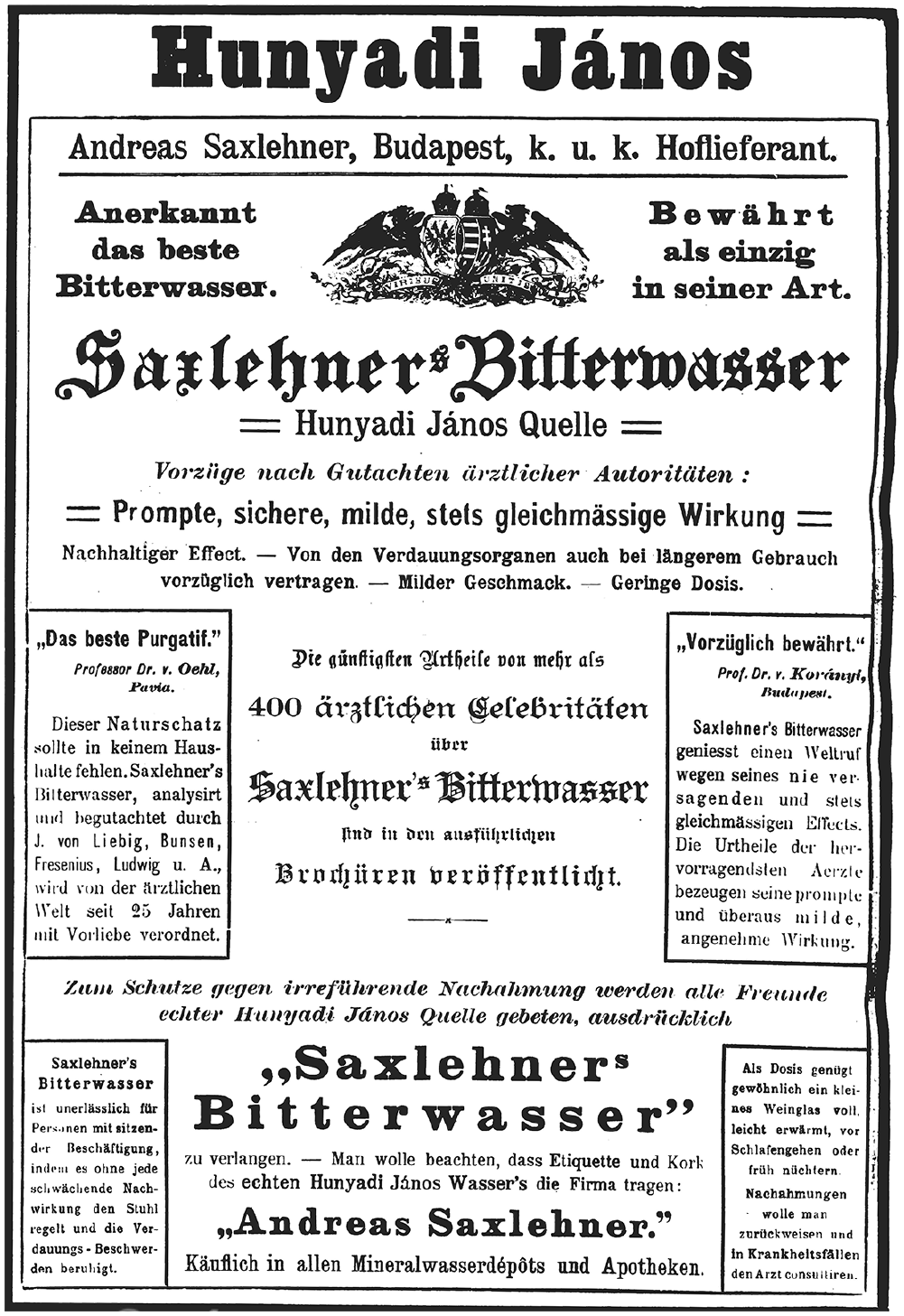
Advertisement for Saxlehner bitter water, claiming that this water had been certified by Fresenius (presumably Wilhelm’s better-known father Carl Remigius Fresenius), Liebig, and Bunsen, and positively evaluated by “more than 400 medical celebrities.”
By examining the contested history of the advertisement-Gutachten in the German Kaiserreich, this article aims to make two broader contributions to research on the history of scientific fraud and integrity. First, the analysis of controversies and concerns related to such Gutachten can add to our understanding of why previously tolerated science-related practices lost their legitimacy in particular places and periods of time, and of whether it was at all possible to eliminate these practices or to restore their legitimacy afterward. As Margaret W. Rossiter showed in her analysis of fertilizers fraud in the mid nineteenth-century United States, it was not uncommon for chemists to analyze and ‘certify’ product samples on a fee basis for advertising purposes. Yet, as Rossiter noted, the emphasis of German-trained agricultural chemist Samuel W. Johnson “on being disinterested and incorruptible was unusual among [US] chemists of the time. Although it was fashionable to denounce quackery, there was not yet an ethical code among scientists or even a clear-cut idea of what constituted quackery.” 9 In Germany, too, the exploitation of scientific knowledge and authority for advertising reasons can be traced back to at least the mid nineteenth-century, when newspapers’ ad sections featured many self-styled ‘professors’ and the name of Johnson’s teacher Justus von Liebig started being used to promote a rapidly growing range of food products. 10 But it was only from the late nineteenth-century onward that advertisement-Gutachten and other forms of science-related product promotion raised sufficient concern to turn advertising restrictions into a priority for scientific and medical professionals, as well as for science administrators. The relevance of these restrictions is not limited to the history of advertising; as this article suggests, their nature, scope, and impact can also cast valuable light on how understandings of “scientific and moral integrity” (wissenschaftliche und moralische Integrität) were affected by public–private boundaries and institution-building efforts reflecting the late nineteenth- and early twentieth-century emphasis on professionalism. 11 Moreover, such broader conversations about integrity in science are relevant to this special issue’s goal of historicizing the current keyword of “research integrity,” a concept that was not invented until after the period covered here.
Second, studying advertisement-Gutachten and advertising restrictions can serve to explore how professional scientists’ approaches to maintaining a reputation for integrity in the face of commercial and competitive pressures related to the better-known efforts of professionals in other fields, particularly the medical. 12 Unlike historians of science, historians of medicine and the health industries have paid a substantial amount of attention to advertising strategies and conventions during and after the so-called second industrial revolution. Most relevant, in his study of innovation in the German synthetic pharmaceuticals industry, Wolfgang Wimmer discussed how large chemical-pharmaceutical companies such as Bayer and Hoechst partly abandoned seemingly unscientific forms of print advertising to gain the goodwill of the medical profession. 13 Other historians have shown that smaller health firms, too, developed new science-oriented advertising and marketing strategies from the late nineteenth-century onward, including the reprinting and circulating of articles and clinical reports from medical journals. 14 Irrespective of their size, and much like their self-described “ethical” counterparts in the United States, these firms could hardly ignore the values and sensitivities of doctors on whose support they depended to sell their drugs or medicinal foods. 15 This, however, did not mean that unscientific advertising campaigns of the kind pioneered by the patent medicine industry just disappeared. As a matter of fact, even some of the same firms that targeted professional experts on the basis of technical information presented in a seemingly objective way, similar to how it might appear in a scientific journal, simultaneously accented often exaggerated claims and credentials in campaigns directed to broader audiences. 16 Moreover, time and again, the efforts of doctors’ societies to protect the medical profession’s honorability and reputation for integrity did not suffice to prevent medical ‘authorities’ and ‘celebrities’ from endorsing the products that were being promoted in the latter way (Figure 1). 17
While some of the most high-profile controversies about advertisement-Gutachten mainly concerned doctors, the spread and discreditation of such Gutachten involved a much broader range of actors, both inside and outside the world of science. One group of experts who developed a specific interest in curbing, if not preventing, the appearance of advertisement-Gutachten were the analytical and food chemists whom Wilhelm Fresenius was addressing in 1904. To uncover a rich history of advertising and advertising restrictions in science, this article concentrates on members of this professional society, the Verband selbständiger öffentlicher Chemiker Deutschlands (VsöCD), as well as on the doctors, scientists, science administrators, and government officials who affected, or were affected by, the VsöCD’s approach to enhancing its reputation for integrity. I first suggest that, to fully appreciate the VsöCD’s concerns and strategies regarding Reklamegutachten, it is necessary to consider how such Gutachten had become associated with fraud in the 1870s and 1880s, and how doctors and chemists had responded to perceived abuses. Afterward, this article discusses how the VsöCD’s leadership and its competitors at public analytical laboratories built on these precedents in the years around 1900, when Reklamegutachten was popularized as a derogatory term. Like the medical and other professionals who were introducing or reaffirming advertising restrictions in the late nineteenth and early twentieth centuries, the VsöCD’s members took pains to safeguard their honorability and perceived objectivity and disinterestedness. They did not, however, fully refrain from providing Gutachten to private individuals and firms. Some of them indeed agreed with Fresenius that, under certain conditions, the authoring and use of Reklamegutachten could represent a scientific (wissenschaftlich) and, by implication, ethical practice.
The fraudulent roots of the “advertisement-Gutachten”
By the time of Fresenius’s talk, several analytical and food chemists continued to associate advertisement-Gutachten with deceitful practices that predated the founding of the German Empire in 1871 and had persisted throughout the 1870s and early 1880s. In these years, a relatively small number of self-styled chemists and apothecaries had been systematically exploiting a demand for promotional statements that they categorized as either “attestations” (Atteste) or Gutachten. 18 Three of the most unscrupulous providers had been Theobald Werner, Ludwig Hess, and Johannes Müller. Werner became so notorious that, almost two decades after his death in 1886, the mere mention of his name continued to evoke memories of blatant fraud and deception. 19 Hess and Müller were also well known in their own times; like Werner, however, they have been largely forgotten since the end of the Wilhelmine era. 20
At least up to 1880, when a widely noted article in Die Gartenlaube revealed that Werner readily certified nostrums that contained potentially deadly amounts of poison, many observers seem to have been amused by the web of lies that Werner had built to earn a more or less stable income as a provider of Gutachten. In his certificates and his correspondence with real or prospective clients, Werner claimed to be a PhD-holding chemist who headed a government-accredited polytechnic institute and laboratory in Breslau (today’s Wrocław), thus associating himself with the prestige and reputation for integrity of the German civil service. 21 As critics pointed out, however, this supposedly not-for-profit institute was actually a private business enterprise, and Werner’s educational background and credentials were mostly made up, too. 22 For instance, to increase his authority as an analysist of foodstuffs and beverages, Werner occasionally presented himself as a former student of Justus von Liebig – a claim that Liebig reportedly denied. 23 Moreover, despite the broad range of products covered in Werner’s Gutachten, his certificates frequently included exactly the same laudatory claims. More specifically, irrespective of whether he was attesting food supplements, patent medicines, or mechanical technologies such as ceramics or brewing materials, Werner constantly repeated that he had subjected a sample to “both a qualitative and a quantitative chemical analysis” and could therefore conclusively confirm that the product possessed the favorable features that its manufacturers ascribed to it (Figure 2). As some observers suspected, it is entirely plausible that Werner did not even possess the laboratory facilities and equipment necessary to conduct the chemical tests described in his certificates and simply fabricated his results!
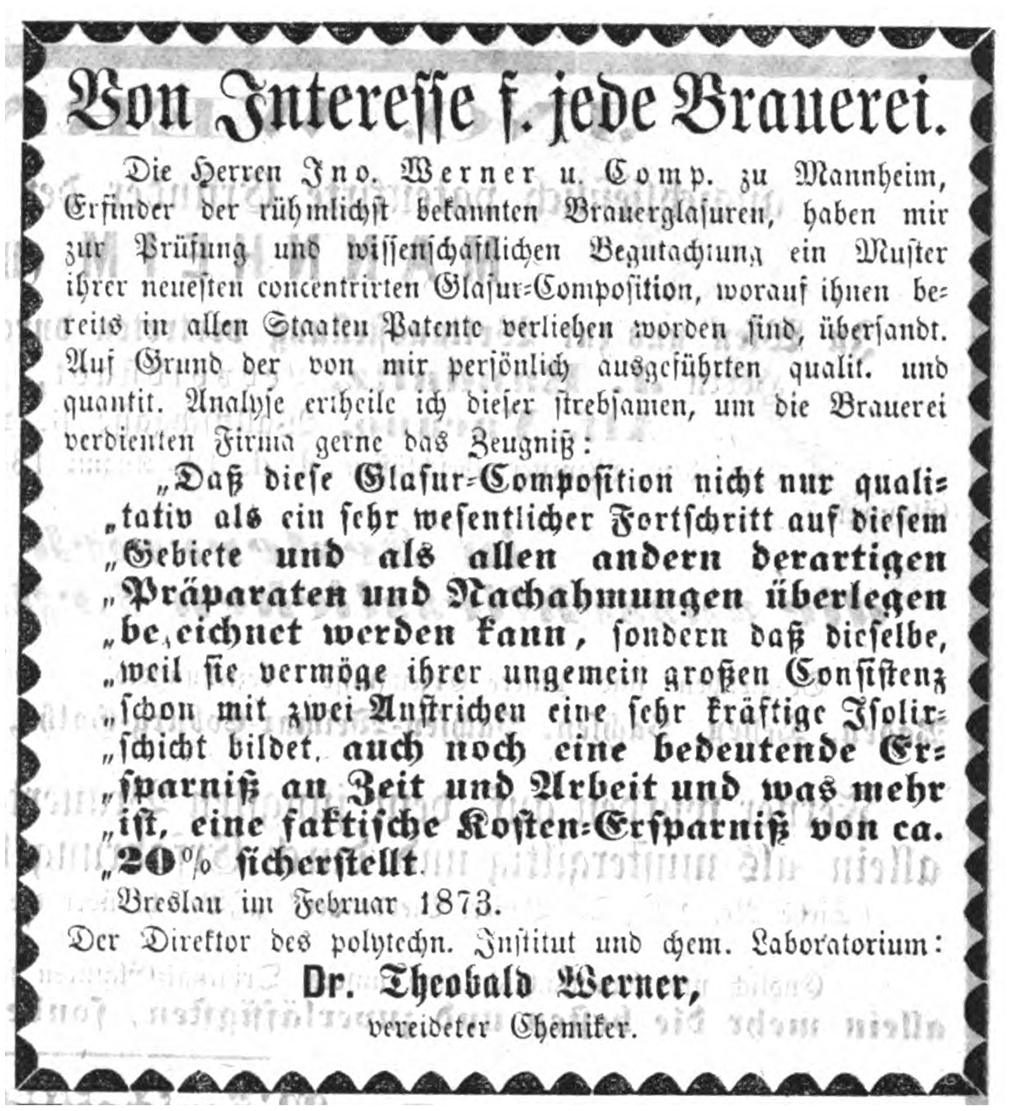
Example of a Gutachten in which Werner claimed to derive his favorable conclusions from qualitative as well as quantitative analyses. Figure courtesy of Bayerische Staatsbibliothek (bsb10943047_00123).
While there are several instances where Werner’s analyses were treated as credible scientific information, journal editors generally were quick to identify him as a chemical “quack” or “swindler” and to express amazement about his brazenness. Accordingly, already by the early 1870s, concerns about Werner’s lack of personal integrity undermined the trustworthiness of documents featuring his name. 24 At the same time, however, several commentators did not hide their taking pleasure in how Werner shamelessly exploited the credulity of his clients and/or the audiences these clients were targeting, including various non-German ones (Figure 3). In 1879, as an example, the Chemiker-Zeitung fully published a promotional letter that Werner had sent to a prospective customer “for the general amusement” of its readers. 25 Such a tone of enjoyment seemed less appropriate in the following year, when the Leipzig apothecary R. H. Paulcke tricked Werner into certifying a “nose ointment” that included half a gram of arsenic poison. 26 Nonetheless, even after 1880, chemists primarily looked to the state and the judiciary to stop the obviously deceitful enterprise of Werner, whom they, notwithstanding Werner’s self-characterizations, did not consider to be an actual member of their profession. Significantly, this goal of ending Werner’s business was not accomplished until 1886, approximately two decades after Werner’s first ‘scientific Gutachten’ had appeared. 27
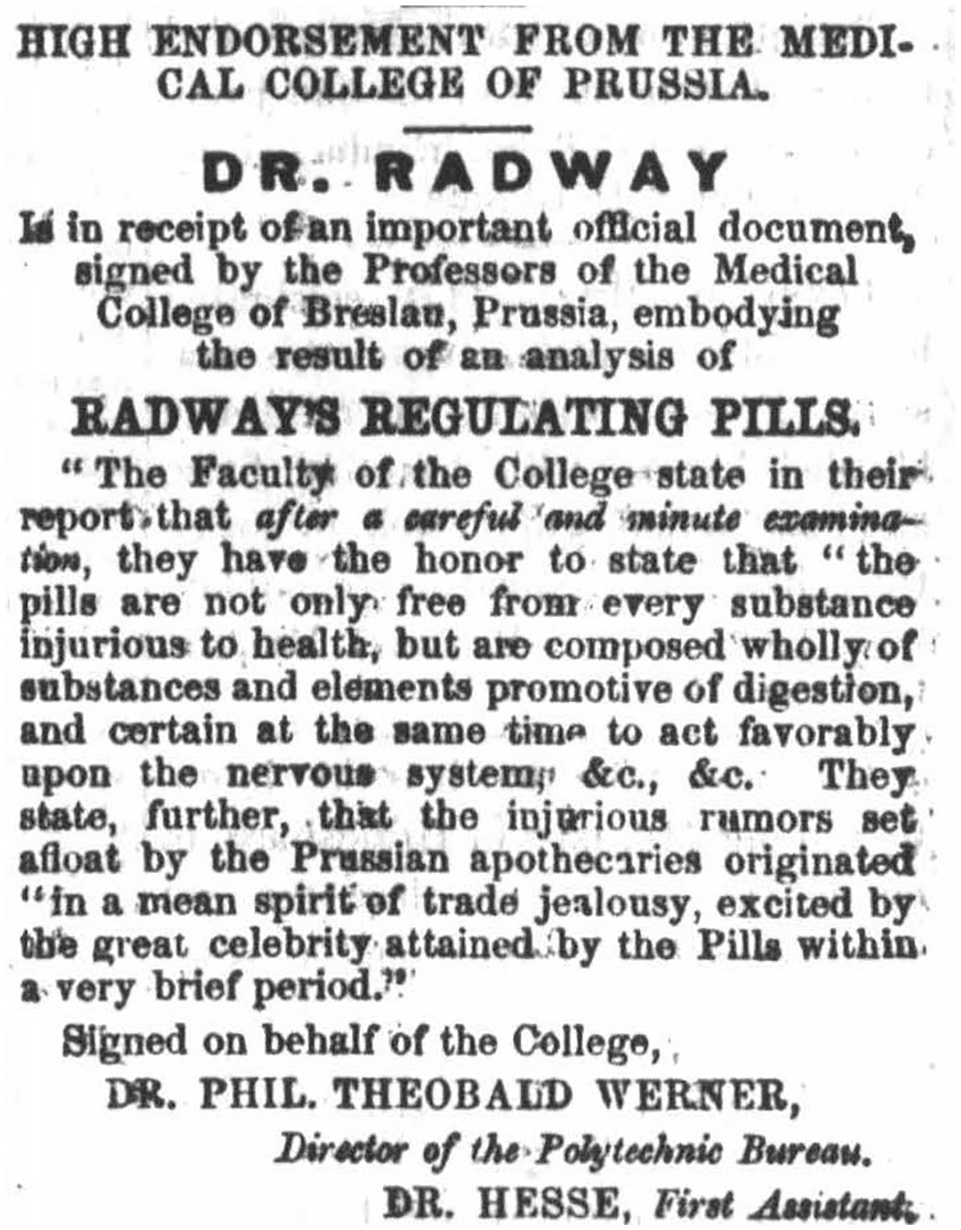
Werner’s fabrications about the nonexistent “Medical College of Prussia (Breslau)” were widely advertised in the United States and reportedly caused “a general joyousness” in Berlin and Breslau; see Hermann Richter, Das Geheimmittel-Unwesen (Leipzig: Otto Wigand, 1875), p.152.
How, then, did fraudsters such as Werner contribute to broader concerns about the integration of Gutachten into advertisements and the integrity of scientific professionals? Werner, Hess, and Müller certainly cannot be blamed for undermining the legitimacy of “mass” advertising: in mid to late nineteenth-century Germany, large-scale advertising campaigns that targeted broader audiences had never been considered respectable in the first place, not least because they often promoted nostrums. Moreover, irrespective of whether any Gutachten were used, quantitative increases in print advertising and the introduction of qualitatively new advertising strategies and techniques would continue to arouse strong resistance into the Weimar era. 28 Tellingly, advertising professionals’ promotion of the term “Werbung” as an alternative for “Reklame” in the 1910s and 1920s was partly motivated by the persistence of the latter word’s negative connotations. 29
For scientific and other experts it was, however, troubling that it became possible to conceive of such a thing as the “advertisement-analysis” (Reklame-Analyse) and the advertisement-Gutachten – that is, of supposedly objective and disinterested knowledge services that served the clear purpose of promoting commercial products. More specifically, it seemed worrying that Gutachten authored by the likes of Werner could be almost impossible to differentiate from Gutachten attributed to unquestionably credentialed medical and scientific professionals. This had been evident from before the foundation of the Kaiserreich and continued to be detectable in the years afterward, when, as a case in point, a Bavarian brewing journal kept republishing an advertisement featuring beer chemist Carl Lintner, one of Werner’s many critics (Figure 4). The visibility of this problem, however, seemed to have increased by the late 1870s, when a junior member of the Department of Chemistry and Metallurgy at the Technische Hochschule Berlin-Charlottenburg felt pressured to resign over his certifying the medicinal powers of a malt chocolate. 30 By 1883, according to food chemist Paul Lohmann, the practice of using supposedly scientific Gutachten for advertising purposes had even become “universally adopted.” At a hygiene exhibition in Berlin, Lohmann observed that “with a few laudable exceptions, all of the exhibited [food] products feature at least one and mostly several chemical analyses as the basis for ‘Gutachten’ that are always solely praising.” Lohmann, who was naturally reminded of Werner, opined that manufacturers could not be blamed for requesting such Gutachten. Instead, he held all-too-willing scientific experts responsible for embarrassing “science and especially the scientific Gutachten,” whose effectiveness depended on the perceived objectivity and disinterestedness of its authors. 31 A certificate by one of these experts, C. Bischoff from Berlin, also prompted an early criticism of “Reklamegutachten.” 32
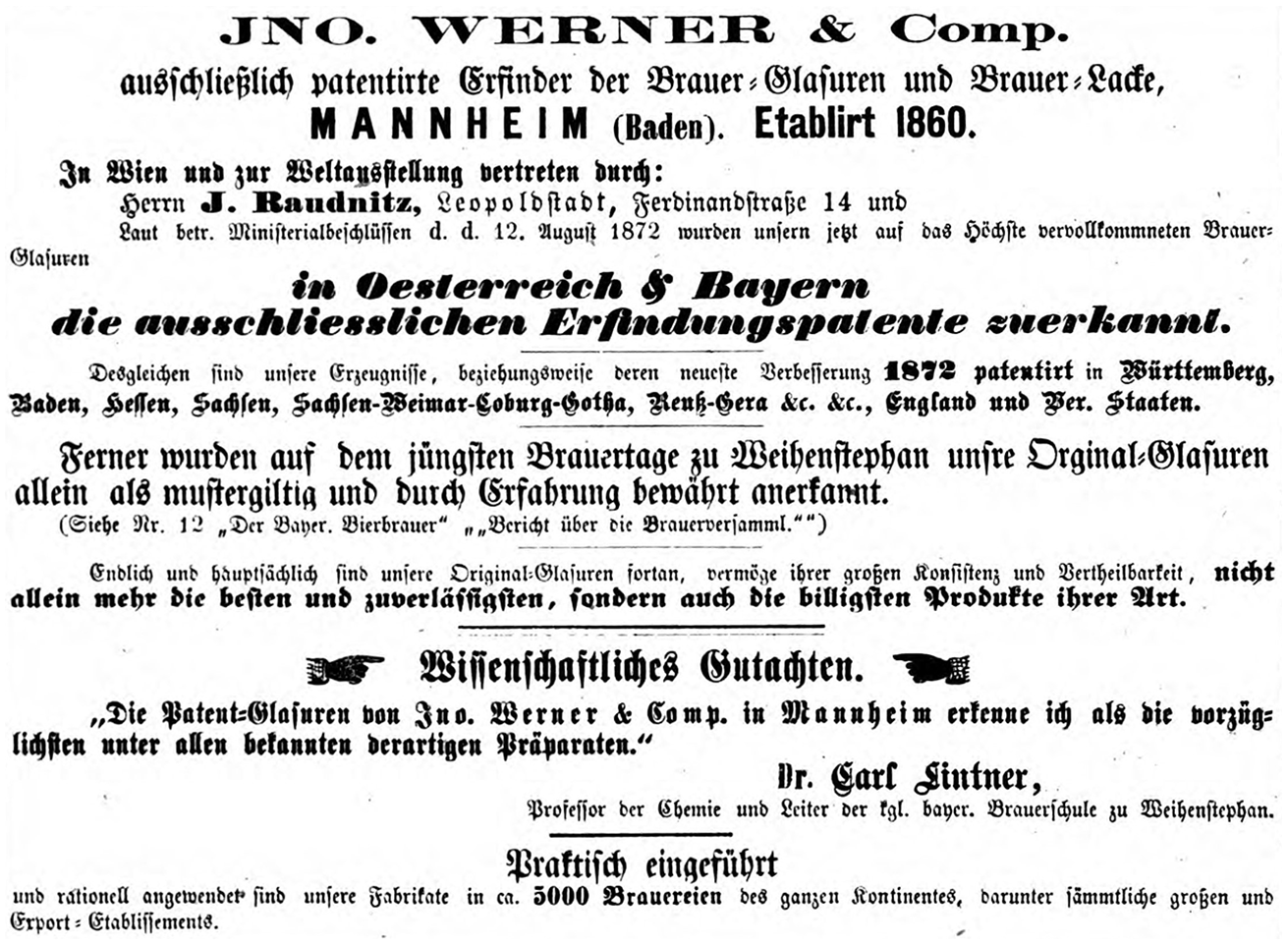
Advertisement of Jno. Werner & Comp., a firm that had also worked with Theobald Werner. Early versions of the ad dated Carl Lintner’s “scientific Gutachten” to January 1869. From March 1873 onward, however, Jno. Werner & Comp. no longer mentioned that Lintner had authored it so long ago. Figure courtesy of Bayerische Staatsbibliothek (bsb10943047_00537).
Three years before Lohmann made these observations, another food analysist, Fritz Elsner, had expressed his belief that “nothing has damaged the reputation of the chemist more, and continues to damage it, than the publication of erroneous analyses of patent medicines (Geheimmittel).” Accordingly, Elsner, the author of a popular food chemistry textbook, encouraged his readers to never accept requests to certify nostrums. At the same time, however, he acknowledged that obtaining “an explicit recognition of particularly good qualities of something” was one of the main reasons why private individuals or firms contacted food chemists. 33 In the following years and decades, these chemists and their employers would develop a range of approaches for dealing with such requests. Before examining these, it is, however, important to briefly consider how doctors’ societies tried to prevent the appearance of advertisement-Gutachten, for analytical and food chemists were keeping a close eye on medical professionals when initiating their own advertising restrictions.
The Virchow controversy and the medical advertisement-Gutachten
One particularly visible controversy that highlighted the necessity of being “as careful as possible” when authoring Gutachten involved Rudolf Virchow, the renowned pathology professor and liberal politician, whose name had been used to promote a laxative. 34 Virchow’s statement that the aloe-based Swiss Pills (Schweizerpillen) sold by apothecary Richard Brandt “had a rapid effect [on his own health] and did not cause any inconvenient side effects” appeared in numerous newspapers and journals as part of a promotional campaign that was exceptionally large by the standards of German-speaking Europe (Figure 5). 35 By itself, the fact that Virchow and various other medicine professors prominently featured in this campaign is not a sufficient reason to understand why it created so much uproar among doctors in and beyond Germany in 1883. In similar instances in the past, editors and readers of professional journals had preferred not to draw attention to advertisements featuring respected scientists or doctors who seemed to have fallen victim to the marketers of patent medicines, in order to protect these individuals’ reputations. 36 In contrast, the house journal of the German Association of Doctors’ Societies published a critical article on “Medicine Professors and Swiss Pills” in its May 1883 issue. This piece included a reprint of a newspaper insert of Brandt and his associates, thus further increasing its visibility and, consequently, causing more embarrassment to Virchow. The article also expressed frustration that it seemed pointless to fight the patent medicine industry as long as renowned physicians did not prevent firms in this sector from listing their names and credentials in support of their claims. In addition, the head of the Central Committee of the Berlin Doctors’ Society mailed a copy of this text to Virchow, “in case it had escaped your attention.” Undaunted by Virchow’s status as one of the country’s most distinguished physicians, he also asked Virchow to let him know whether he was the actual author of the above-quoted statement, adding that it had made a “most embarrassing impression” on doctors in the German capital. In response, Virchow took the remarkable step of ceasing his connections with this society, on the ground that he could not stand its “petty and intrusive guild spirit.” 37 This decision prompted a divisive and acrimonious debate on the appropriateness of the association’s action among doctors and medical journal editors in and beyond Germany.

Academic praise for notorious laxative pills in a supplement to the Zeitschrift des allgemeinen Oesterreichischen Apotheker-Vereines 21 (1883). The same professors also featured in advertisements in German journals.
Part of this discussion was about whether or not the Schweizerpillen were a “secret remedy” (Geheimmittel) – a designation that Virchow disputed but others defended in light of the pills’ changing and/or incompletely disclosed composition and the ways in which they were marketed. Together with their promotion as a miracle cure, this uncertainty about the pills’ ingredients, including the amount of aloe in them, also seemed to invalidate Virchow’s claim that they were harmless. Accordingly, one critic concluded that Virchow’s statement was worse than the “excessive praise for mineral water, bathing resorts etc.” recurrently provided by chemists and doctors in Germany and various other countries. 38
Analytical and food chemists, too, were anxious to avoid being associated with the “quackery” attributed to the patent medicine industry. However, another question addressed during the Virchow controversy would become at least as relevant to them: Could doctors and scientists reasonably be expected to anticipate that their statements and writings might be abused for advertising purposes? As Virchow explained in the Berliner klinische Wochenschrift, apothecary Richard Brandt had sent him a packet of Swiss Pills with the request to test them. Virchow had initially ignored this demand, but, after having received a reminder, tried the pills on himself and thanked Brandt in a private letter. Brandt quoted this and other such letters in his advertisements, without the approval of Virchow or several other medicine professors. 39 In light of this information, international medical journals such as The Lancet and The Medical Age opined that the German medical societies had overreached and that Virchow “should not have been subjected to molestation.” 40 There were also German journals and doctors who agreed with this view, including the editor of the Berliner klinische Wochenschrift. But others argued that Virchow had been overly naïve, particularly since the Swiss Pills had already gained notoriety in the years before 1883 because of their uncertain composition and allegedly unlimited healing powers.
It also mattered that German doctors had repeatedly reaffirmed their beliefs as to the dishonorableness of advertising. As recently as on the ninth German Doctors’ Day in Kassel in 1881, the membership of the German Association of Doctors’ Societies had adopted a resolution emphasizing that: it does not seem compatible with the honorableness of the medical profession that private and government-employed doctors, yes even university authorities and teachers, without prior scientific examination write certificates of products and supplements such as legume, stomach water, liquors, China water, etc., as well as of bitter water, carbonated beverages and the like.
41
Doctors were not the only professionals who were quick to distance themselves from lowly regarded and aggressively marketed products: one German lawyer even challenged another legal professional to a duel for this reason. 42 But how could the use of Gutachten to promote patent medicines, foodstuffs, and other widely advertised items be prevented? After the turn of the twentieth century, German doctors would have a limited amount of success in blacklisting the most notorious Gutachter in collaboration with the chemical-pharmaceutical industry and in capping the amounts of money that more reputable providers were allowed to request as honorarium. 43 By this time, organized doctors had also developed a greater awareness of the complexity of these issues, including the factors determining whether or not the author of a Gutachten could legally prohibit its publication and reproduction. 44 In contrast, in the years up to 1896, when the VsöCD was established, they had still been convinced that the problem of advertisement-Gutachten could largely be solved by upholding high ethical and honor standards in their profession, a goal that was supposed to be facilitated by the creation of state-sanctioned medical chambers and honor courts. Founding members of the VsöCD evaluated these institution-building efforts more positively than Virchow, who preferred less state involvement in the organization of the medical profession and more informal and gentlemanly approaches to ethical self-policing. The liberally minded physician-politician became one of the most prominent critics of the Prussian honor court and its authorization to issue monetary fines. Given his own experiences with the Swiss Pills, however, Virchow may have been somewhat relieved that, while this and other medical honor courts ended up devoting large portions of their time to perceived advertising violations, they did not acquire jurisdiction over university professors or doctors employed elsewhere in the civil service. 45
Advertisement-Gutachten and the public analytical chemist
Were German chemists able to draw useful lessons from organized doctors’ attempts to prevent the appearance of advertisement-Gutachten? In the large and heterogenous chemical profession, it was primarily the heads of private analytical laboratories, rather than the industrial or state and university employees, who showed an interest in medical societies’ codes of conduct and approaches to disciplining their members. 46 Since the mid-1870s and especially after the passing of a national food law in 1879, a gradually increasing number of these independent private chemists conducted food control analyses at the request of the police and other public agencies, particularly in Saxony and Prussia. 47 Given the nature of this work and the relatively high prestige of the civil service, these chemical analysists insisted on the right to be recognized as “public chemists” (öffentliche Chemiker). However, unlike with doctors’ organizations, it took until the 1890s before these chemists established specialized societies that could serve to protect their professional interests and uphold standards of conduct. 48 In 1895, one of these associations, the Vereinigung öffentlicher analytischer Chemiker Sachsens, carried out what it described as “the first attempt to organize public analytical chemists’ young profession similar to doctors’ and lawyers’ professions.” 49 In the following year, this same goal contributed to the formation of a much larger society, the VsöCD, several members of which could build on their earlier experiences in Saxony. 50
Between the early 1880s and the creation of the VsöCD in 1896, the publication of advertisement-Gutachten had continued to be a major concern for chemists involved in the creation of these societies. For instance, the five editions of Fritz Elsner’s food chemistry textbook that came out between 1882 and 1895 all repeated Elsner’s earlier warning about “advertisement-analyses” and the great harm that they had inflicted on chemists’ reputations. Moreover, Elsner’s observation that private citizens and firms frequently contacted food chemists for promotional reasons remained at least as true by the second half of the 1890s, when the term Reklamegutachten had come to be broadly adopted among Elsner’s professional colleagues and their competitors and critics. 51 Given this context, as well as private analytical chemists’ orientation to medical and legal professionals’ codes of conduct, it may not be surprising that the constitution adopted by the VsöCD included the requirement to safeguard the profession’s “reputation, honor, and dignity” by refraining from “advertisement-like, pushy public praise.” The VsöCD also established its own “honor court” – which differed from the medical courts in that it was not connected with any state-sanctioned chamber – and several of the cases that it handled were at least partly based on the just-quoted provision. In 1900–1 one case even led to the eviction of a member, the highest possible punishment. 52
Still, by 1904, when Wilhelm Fresenius presented his paper “On the Position of the Chemist as Expert and Gutachter,” it had become clear that these initiatives would not suffice to fully preclude the appearance of further ads that risked frustrating the sought-after reputational gains. Shortly after his 1902 election as president of the VsöCD, as a case in point, Arthur Forster from the city of Plauen in Saxony had to admit that his “innocent attestation” of a conservation product was being “shamelessly abused for advertising purposes.” 53 The promotion of meat and other food preservatives was particularly hazardous as high-profile scientific, political, and legal debates had turned the health effects of some of these – notably boric acids – into a topic of national (and international) interest and controversy. 54 It was, therefore, no coincidence that the appearance of chemists’ and doctors’ names and statements in advertisements for preservatives prompted the VsöCD to issue new guidelines regarding the provision of Gutachten. These rules show on the one hand that the VsöCD was not willing to instruct its members to always decline requests for advertisement-Gutachten. On the other hand, they reveal that attempts to positively reappraise the Reklamegutachten still faced major hurdles at this time. More specifically, the guidelines that were announced shortly after Fresenius’s talk reflected both a continued commitment to curbing the publication of such Gutachten and an increased awareness of the challenges complicating this goal. The VsöCD’s members were, for example, instructed to conclude written agreements stipulating that clients were only allowed to literally reproduce the entire Gutachten, instead of selectively quoting the sentences or phrases that were most valuable for advertising purposes. 55 Here again, the key objective was to enhance the honorability and perceived objectivity and disinterestedness of the independent analytical and food chemist and, relatedly, to protect this chemist’s economic interests. This perspective strongly shaped the VsöCD’s conception of integrity in science.
Competing on integrity: Private chemists, public laboratories, and advertisement-Gutachten
The same reasons motivated the VsöCD’s exposure of Reklamegutachten featuring competitors at public laboratories, including Gutachten providers at academic establishments. German education ministries and university administrations offered repeated warnings and advice to such academics, and in some cases reprimands could prompt a resignation. 56 Still, not least because of concerns that broadly conceived restrictions on the delivery of private Gutachten would negatively affect academia–industry knowledge exchanges, chemists and other scientists based at academic institutions generally faced fewer restrictions on the provision of such Gutachten than scientists employed elsewhere in the civil service or members of professional societies such as the VsöCD. For example, even in the years around 1900, when advertisement-Gutachten were widely criticized, the director of the Royal Mechanical-Technical Testing Laboratory at the Technische Hochschule in Berlin-Charlottenburg simply published a statement meant to dissociate his establishment from the many advertisements in which its attestations appeared (Figure 6). Like its successor, the Royal Material Testing Office created in 1904, this Prussian institution had been given the explicit mission of conducting scientific analyses for not just government agencies, but also private individuals and firms. Its statutes stipulated that the resulting certificates were only allowed to indicate the “scientific findings of analyses,” a requirement that may have been partly aimed at preventing the use of language that could have made these documents more valuable for advertising purposes. As the VsöCD emphasized in an 1899 petition to the Prussian parliament, this provision clearly did not suffice to prevent the appearance of Reklamegutachten trying to exploit the laboratory’s academic authority. The VsöCD’s evidently self-serving argument that the mandate of the testing laboratory should therefore be restricted was, however, dismissed. 57

Announcement by Adolf Martens, the director of the Royal Mechanical-Technical Testing Laboratory.
A more existential threat to the VsöCD resulted from the gradual expansion of the number of publicly owned food control laboratories in the decades following the food law of 1879. The VsöCD’s members had benefited from the fact that two of Germany’s largest states, Prussia and Saxony, were relatively slow to dedicate resources to the creation of regional and municipal laboratories staffed by civil servants, and, instead, primarily collaborated with private analytical laboratories to identify food adulterations. 58 The VsöCD actively lobbied for the continuation of this approach, yet critics such as Berlin’s police chief, Ludwig von Windheim, believed that its members were “more or less blatantly serving special industrial and commercial interests.” Moreover, even when private chemists acted in an ethically irreproachable way, von Windheim and many others considered it undesirable to collaborate with them, for they were unlikely to “ever get rid of the reputation of being insufficiently objective.” 59 In developing his case for the establishment of a public food control laboratory to the Prussian government, von Windheim explicitly referred to advertisement-Gutachten by the private chemist with whom his police force had had to collaborate. 60 Von Windheim was, however, also aware that the Gutachten of public laboratories, too, might be exploited for advertising purposes.
In and beyond Prussia, the measures that public food control laboratories implemented to prevent this from happening can be grouped into at least three different categories. First, institutions as diverse as the Imperial Health Office in Berlin and the Bureau of Chemical Analysis of the city of Görlitz simply prohibited their personnel from offering Gutachten to private individuals or firms. 61 While eliminating the risk that such Gutachten might be integrated in advertisements, this relatively drastic approach did come at a price. In particular, besides ruling out a potential source of income that could be used to cover part of these institutions’ expenses, it also limited their options for gaining the goodwill of nearby citizens and communities.
A second group of food control laboratories allowed their employees to provide Gutachten to private parties if these parties formally agreed in writing that they would not use the Gutachten for advertising reasons. This solution had some obvious benefits but was not foolproof, as the legal enforceability of such agreements could not be taken for granted. 62
The third and most commonly adopted approach only prohibited the offering of Gutachten to private individuals and firms in cases where it was suspected that these Gutachten might be used for advertising purposes. The institutions implementing this approach ranged from municipal food control laboratories in Breslau, Essen, and Oldenburg to state-level establishments in Berlin and Leipzig and the chemical laboratory of the Imperial Police Department in Strasburg (Strasbourg).
63
The Bureau of Chemical Analysis in Breslau attracted special scrutiny from the VsöCD. It had been established in 1881 – unusually early in the Prussian context – when Theobald Werner was still active in the same city. The vast majority of its analyses were carried out at the request of the local police, courts, and municipal authorities. The share of investigations for private parties, in contrast, generally remained below five percent of the total number until the mid-1890s. As elsewhere, such analyses mainly concerned samples of basic products such as water and, to a lesser degree, milk and butter. The bureau’s comprehensive annual reports reveal that this comparatively low portion of privately requested analyses was partly due to the institutional policy set up by the establishment’s trustees. In the report for 1894–5, for example, the director of the Untersuchungsamt opined that: the prohibition to deliver Gutachten that could be used for advertising purposes makes it more difficult to increase the amount of private orders, because everyone who has once experienced a rejection on account of this instruction only returns when he is really forced to do so for whatever reason. We therefore retain only a small basis of private clients, who gradually immersed themselves in our principles. But, on the other hand, we avoid the cliffs that cannot always be circumnavigated by private chemists who also serve as experts for the courts and other public authorities [like later VsöCD members, JM].
64
This advantage continued to apply in the following decade: unlike some other public food control laboratories, the Untersuchungsamt appears to have never been criticized for authoring Gutachten that were subsequently exploited for advertising purposes. 65 Instead, it received several honors and signs of recognition, including the rights to train and examine aspiring food chemists and the granting of a professor’s title to its director, Bernhard Fischer. Moreover, although the bureau continued to carefully evaluate requests with an eye to avoiding “any kind of abuse of its official Gutachten,” it was able to increase the private demand for its services to roughly ten percent of its total number of analyses by 1903–4. 66 The VsöCD criticized this work as “undisputable evidence that a municipal bureau conducts remunerated work for private parties to cover its financial expenses” – a practice it was hoping to render illegal. To Fischer and his supporters, in contrast, it suggested that the expanding establishment had succeeded in gaining the trust of not just the public authorities at the local and state level but also Breslau’s inhabitants and firms. 67 The bureau’s history, in sum, captures a tension that many food control laboratories faced in one way or another.
“Scientific” and “unscientific” advertisement-Gutachten
This tension and the trade-offs associated with it also help explain why, despite a variety of restrictive measures, scientists and doctors continued to be featured in, and to produce, advertisement-Gutachten until long after the end of the Kaiserreich. 68 One notable additional challenge resulted from the transnational dimensions and implications of the use of Reklamegutachten. Already in the late 1860s and early 1870s, the international publication of Werner’s ‘scientific Gutachten’, which appeared as far away as in Hawaii, generated nationalist concerns about Germany’s foreign reputation. 69 Such feelings would become particularly significant under the Nazis, when Reich Education Minister Bernhard Rust singled out the provision of Gutachten to non-German firms as a problematic practice that required prior approval and had to be “treated with the strongest reservations.” 70 However, in the Kaiserreich, too, nationalist fears about the status of German science were expressed at the highest levels of decision making. In 1890, as a case in point, Bismarck’s successor Leo von Caprivi described his anxiety around avoiding inflicting “a major disadvantage on ourselves if we would let the German thinker appear to be profit-seeking on a field in which Germany has so far enjoyed an unchallenged reputation of idealistic striving.” 71
Conversely, as the nationally diverse list of medicine professors promoting the Schweizerpillen illustrates (Figure 5), product praise by foreign scientists and doctors also appeared in German publications, and Germany was by no means the only country where the exploitation of scientific authority for advertising purposes raised substantial concerns. 72 As for the United States, which often served as a reference point in German discussions of modern advertising, Margaret Rossiter seemed to imply that the mid nineteenth-century practice of offering promotional certificates for a fee would become easy to suppress once scientists agreed on an ethics code and developed “a clear-cut idea of what constituted quackery.” 73 Several ethics codes introduced in the years before World War I indeed seem to suggest that, by this time, scientific and engineering professionals in the United States had developed a relatively specific sense of which forms of advertising could and could not be tolerated. 74 At the same time, however, Rossiter appears to have underestimated how difficult it was (and still is) to offer conclusive definitions of quackery and other forms of science- and medicine-related dishonesty and deceit, and how rapidly such attempts could become outdated. 75 In the German context, for example, Reklamegutachten were invariably presented as scientific documents, yet the nature and formulation of the statements and claims that were highlighted in advertisements tended to raise immediate doubts about the validity of that characterization. Still, instead of just distancing themselves from such Gutachten, some scientists and science administrators tried to partly restore the legitimacy of this type of product evaluation by differentiating truly scientific from unscientific varieties. In the discussion of Wilhelm Fresenius’s 1904 paper to the VsöCD, as a case in point, food chemist Robert Kayser expressed his belief that Reklamegutachten were legitimate as long as they seemed publishable in a scientific outlet. Kayser’s comment was pertinent, given that various firms had begun using scientific and clinical articles and reports for marketing purposes by the early 1900s – long before this promotional strategy started attracting scrutiny of the type that it has been receiving in recent years. 76 Crucially, such publications were not easily recognizable as marketing documents; sometimes, indeed, they were not even designated as Gutachten to avoid raising suspicions about their scientific merits by associating them with laudatory certificates of the kind discussed in this article. 77 Clearly, one implicit criterion for separating scientific from unscientific advertisement-Gutachten was simply that the former were more difficult to detect!
For related reasons, Reklamegutachten published in scientific and medical journals were believed to be especially effective if their authors’ ties with sponsoring firms remained invisible, a goal that was facilitated considerably by the absence of any requirements to disclose potential conflicts of interests. 78 This absence should not be taken to mean that there were no concerns about such conflicts. Rather, it reflected the fact that, in a period when considerations of honor and reputation were shaping the ethical priorities of scientific and other professionals, scientists and their supervisory authorities were more interested in safeguarding the perceived integrity of science and the civil service than in addressing the often subtle biases associated with patronage relationships and commercial considerations. 79
Conclusion
This article has contributed to the study of scientific fraud and integrity by examining the history of a controversial science-related practice and the arguments and strategies used to suppress, defend, or tolerate it. Through the lenses of the VsöCD and several of its critics and competitors, I have shown that not just doctors but also scientists considered advertisement-Gutachten a major threat to their honorability, their perceived objectivity and disinterestedness, and their related economic interests. At the same time, and, again, much like many medical professionals, German scientists and science administrators had ambivalent attitudes about advertising restrictions targeting Reklamegutachten. On the one hand, such measures were seen as crucial for maintaining the reputation for integrity of the scientific enterprise and the civil service, and such reputational advantages could translate into socioeconomic benefits. Yet, on the other hand, these restrictions could come at a substantial personal and professional/institutional cost in terms of revenue generation as well as service provision or knowledge exchange. The resulting trade-offs, moreover, played out in a competitive environment where the redefinition of public–private boundaries and an emphasis on professionalism further complicated efforts to prevent the appearance of advertisement-Gutachten or to recast the authoring of Gutachten that might be integrated into advertisements as a legitimate scientific practice.
Like other contributions to this special issue, this article also points to the limitations of using the current concept of research integrity as a starting point for thinking about fraud and integrity in science. My analysis has demonstrated that, in determining whether a Gutachten qualified as scientific, the nature and transparency of the underlying research process was only one of the criteria that were considered, and often not the most significant yardstick. To be sure, recent definitions of research integrity also cover aspects that were central to the history of the Reklamegutachten. The statement drafted at the Second World Conference on Research Integrity in Singapore in 2010, for example, proposes public communication responsibilities that are very similar to the warnings and advice offered to the providers of chemical and medical Gutachten in the Kaiserreich. However, research integrity statements that are supposed to be applicable “across all scientific and scholarly disciplines and for all research settings” – sometimes even anywhere in the world – are less suitable for appreciating the complex set of factors that have historically shaped conceptions of fraud and integrity in science. 80 Current notions of research integrity, moreover, regularly seem to overlook that, not just in the late nineteenth and early twentieth centuries but also today, assessments of the honesty and objectivity of (alleged) pieces of research are inextricably connected with perceptions of the integrity of their authors and the professions and institutions to which they belong. There are, in this connection, also additional reasons for paying close attention to the status of individual and groups of scientists and to the specificities of their institutional and professional environments. The competitive dynamics that shaped the history of the advertisement-Gutachten in imperial Germany indeed suggest that, among other contributions to the historiography of fraud and integrity in science, such analyses would give a better sense of who stands to benefit and who stands to lose from the promotion of particular ethical standards and codes.
Footnotes
Acknowledgements
I am most grateful to Lissa Roberts and Cyrus Mody for their perceptive comments on several drafts of this article. I also benefited from the thoughtful criticisms and encouragement of the anonymous reviewers. In addition, I am indebted to the participants of the Uppsala workshop for their stimulating questions and/or helpful clarifications, and would like to thank Wolfgang König, Michael Schneider, Marcus Carrier, and Samantha Muka and her colleagues and students at the Stevens Institute of Technology for the same reason.
Declaration of conflicting interests
The author(s) declared no potential conflicts of interest with respect to the research, authorship, and/or publication of this article.
Funding
The author(s) received no financial support for the research, authorship, and/or publication of this article.
1.
Historians have related these concerns about the integrity of scientific expert witnesses to the adversarial nature of Anglo-American legal systems, which allowed opposing parties to hire their own experts and to cross-examine those engaged by the other side; see, e.g., Tal Golan, Laws of Men and Laws of Nature (Boston, MA: Harvard University Press, 2004). Although the German criminal law system was inquisitorial rather than adversarial, there, too, conflicting expert opinions in lawsuits raised doubts about the integrity of expert witnesses, as Fresenius discussed at the beginning of his paper. See W. Fresenius, “Über die Stellung des Chemikers als Gutachter und Sachverständiger vor Gericht,” Zeitschrift für öffentliche Chemie 10 (1904): 342–54, 342–7.
2.
This article builds on findings from Joris Mercelis, Gabriel Galvez-Behar, and Anna Guagnini (eds.), “Commercializing Science: Nineteenth- and Twentieth-Century Academic Scientists as Consultants, Patentees, and Entrepreneurs,” History and Technology 33 (2017): 4–151. In particular, in the context of this project, I identified the reputational harm resulting from advertising campaigns involving academic scientists as a major concern of the Prussian Education Ministry; see Joris Mercelis, “Commercializing Academic Knowledge and Reputation in the Late Nineteenth and Early Twentieth Centuries,” History and Technology 33 (2017): 23–52.
3.
There is a substantial literature on how (social) scientists, especially psychologists, contributed to and benefited from advertising and marketing developments; see, e.g., Christiane Lamberty, Reklame in Deutschland 1890–1914 (Berlin: Duncker & Humblot, 2000), chapter 7; Michael Pettit, The Science of Deception (Chicago: University of Chicago Press, 2013); Dirk Reinhardt, Von der Reklame zum Marketing (Berlin: Akademie Verlag, 1993), pp.87–99; Walter Friedman, Birth of a Salesman (Boston, MA: Harvard University Press, 2005), chapters 6–7. However, in contrast to historians of medicine and the health industries, who have examined the ethics of medical advertising from multiple perspectives, historians of science and technology have paid very little attention to scientists’ and engineers’ concerns about advertising and the advertising restrictions that they initiated. Relevant studies are referenced later in this article. See also Tatjana Buklijas, “Publicity, Politics and Professoriate in Finn-de-siècle Vienna: The Misconduct of the Embryologist Samuel Leopold Schenk,” History of Science (2020): 458–84.
4.
Fresenius, “Stellung des Chemikers,” p.350 (note 1).
5.
On the nature of the Gutachten and the difficulty of translating this term, see Alexa Geisthövel and Volker Hess, “Handelndes Wissen,” in Geisthövel and Hess (eds.), Medizinisches Gutachten (Göttingen: Wallstein, 2017), pp.9–39, 13–18. For an early reference to “Reklamegutachten,” see “Kayser und Bischoff: Nier’sche Weine,” Jahresbericht über die Leistungen der chemischen Technologie 29 (1883): 869–871, 869. The spellings “Reclamegutachten” and “Reklame-Gutachten” were used as well. Closely related terms such as “Reklame-Analyse” do not seem to have caught on in the same way.
6.
On the significance of this kind of Gutachten to academia–industry knowledge exchange, see Hans-Liudger Dienel, “Professoren als Gutachter für die Kälteindustrie 1870–1930,” Berichte zur Wissenschaftsgeschichte 16 (1993): 165–82, and German education ministries’ defense of them in the context of the Great Depression, when the supplementary income earned by academic Gutachter came under political scrutiny (see, e.g., Landesarchiv Baden-Württemberg Abt. Generallandesarchiv Karlsruhe 235/5010).
7.
C.A. Neufeld, Der Nahrungsmittelchemiker als Sachverständiger (Berlin: Springer, 1907), p.17. Other examples of this kind of literature are Hugo Fleck, Die Chemie im Dienste der öffentlichen Gesundheitspflege (Dresden: Zahn, 1882), pp.21–7; Trillich-Grünwinkel, “Kaufmann und Chemiker,” Zeitschrift für öffentliche Chemie 5 (1899): 63–7, 65–7; Albert Moll, Aerztliche Ethik (Stuttgart: Enke, 1902), chapter 9.
8.
“To avoid any appearance of partiality,” for example, Fresenius strongly encouraged chemical expert witnesses to express their opinions calmly, rather than “with ferocity and passion.” See Fresenius, “Stellung des Chemikers,” p.343 (note 1). For historical perspectives on the performative aspects of expertise, see Joris Vandendriessche, Evert Peeters and Kaat Wils (eds.), Scientists’ Expertise as Performance (London: Pickering & Chatto, 2015).
9.
Margaret Rossiter, The Emergence of Agricultural Science (New Haven: Yale University Press, 1975), p.150. More recently, Paul Lucier has addressed similar questions in his work on geological consultants; see especially his Scientists and Swindlers (Baltimore: JHU Press, 2008).
10.
On frauds in newspaper advertising, see, e.g., Ronald Fullerton, “A Prophet of Modern Advertising,” Journal of Advertising 27 (1998): 51–66, 55–7. On Liebig, see Rima Apple, “‘Advertised by our Loving Friends’: The Infant Formula Industry and the Creation of New Pharmaceutical Markets, 1870–1910,” Journal of the History of Medicine and Allied Sciences 41 (1986): 3–23; William Brock, Justus von Liebig (Cambridge: Cambridge University Press, 1997), pp.224–33; Mark Finlay, “Quackery and Cookery,” Bulletin of the History of Medicine 66 (1992): 404–18; and Uwe Spiekermann, Künstliche Kost (Göttingen: Vandenhoeck & Ruprecht, 2018), pp.91–2, 100, 130–8, 163.
11.
Quote from Arthur Forster, “Der selbständige öffentliche Chemiker,” Zeitschrift für öffentliche Chemie 9 (1903): 348–55, 355.
12.
Professionals who introduced advertising restrictions in the late nineteenth or early twentieth centuries included lawyers, accountants, and engineers. See, e.g., John Attanasio, “Lawyer Advertising in England and the United States,” The American Journal of Comparative Law 32 (1984): 493–541, 495–510; Thomas Wood and Anne Sylvestre, “The History of Advertising by Accountants,” Accounting Historians Journal 12 (1985): 59–72; and “Code of Ethics,” Transaction of the American Institute of Chemical Engineers 5 (1912): 255–8. On professional disinterestedness, see Thomas Haskell, “Professionalism versus Capitalism,” in Thomas L. Haskell (ed.), The Authority of Experts (Bloomington: Indiana University Press, 1984), pp.180–225.
13.
Wolfgang Wimmer, ‘Wir haben fast immer etwas Neues’ (Berlin: Duncker & Humblot, 1994), pp.333–5. Similarly, distinctions between “scientific” and “unscientific” forms of advertising contributed to the rise of the medical trade catalog in Britain; see Claire Jones, The Medical Trade Catalogue in Britain, 1870–1914 (London: Routledge, 2015).
14.
These firms typically did this in response to pressures from medical professionals, or even on the initiative of doctors with whom they collaborated; see Christian Bonah, “‘The Strophanthin Question’,” History and Technology 29 (2013): 135–52; Axel Hüntelmann, “A Different Mode of Marketing?,” History and Technology 29 (2013): 116–34; Caitlin Murdock, “Selling Scientific Authority,” German History 35 (2017): 21–42, 27, 35–40; and Spiekermann, Künstliche Kost, p.171 (note 10). On the relation of these strategies to more recent forms of science-oriented marketing, see Jean-Paul Gaudillière and Ulrike Thoms (eds.), The Development of Scientific Marketing in the Twentieth Century (London: Pickering & Chatto, 2015).
15.
On the United States, see Joseph Gabriel and Bennett Holman, “Clinical Trials and the Origins of Pharmaceutical Fraud: Parke, Davis & Company, Virtue Epistemology, and the History of the Fundamental Antagonism,” History of Science 58 (2020): 533–58.
16.
E.g., Spiekermann, Künstliche Kost, pp.99–103, 106 (note 10); Wolfgang Wimmer, “Die Pharmazeutische Industrie als ‘ernsthafte’ Industrie,” Medizin, Gesellschaft und Geschichte 11 (1992): 75–88.
17.
On the preponderance of considerations of honor to late nineteenth- and early twentieth-century medical ethics, see Andreas-Holger Maehle, Doctors, Honour, and the Law (Basingstoke: Palgrave Macmillan, 2009); Barbara Rabi, Ärztliche Ethik – Eine Frage der Ehre? (Frankfurt: Peter Lang, 2002); Robert A. Nye, “Medicine and Science as Masculine ‘Fields of Honor’,” Osiris 12 (1997): 60–79.
18.
Some authors considered “Gutachten” to be a more comprehensive and demanding form of certification than “Atteste”; see, e.g., F. Roloff, Thierärztliche Gutachten, Berichte und Protokolle (Berlin: Hirschwald, 1890), pp.3–4. Other commentators, however, used these terms interchangeably in cases such as those discussed in this article.
19.
E.g., H. Norrenberg, “Zur Beurteilung des Citronensaftes,” Pharmazeutische Zentralhalle 46 (1905): 160–1. Several of these individuals had actually been trained as apothecaries, but were unable to obtain a pharmacy concession; see Elmar Ernst, Das ‘industrielle’ Geheimmittel und seine Werbung (Würzburg: Jal-Verlag, 1975), pp.167–9; Anon., “Die Helfershelfer des Geheimmittelschwindels,” Die Gartenlaube 28 (1880): 177–9, 178; and, for an illustration of the difficulty of obtaining such a concession in the 1860s, Michael Kamp and Florian Neumann, Fresenius (Munich: August Dreesbach, 2014), pp.12–4. I have found no evidence supporting Ernst’s claim that Theobald Werner was also in this position.
20.
The main exception is Ernst, Das ‘industrielle’ Geheimmittel, pp.167–72 (note 19).
21.
On this reputation for integrity, see, e.g., Frank Bösch, “Krupps ‘Kornwalzer,’” Historische Zeitschrift 281 (2005): 337–79, 341–2; Jürgen Kocka, “Capitalism and Bureaucracy in German Industrialization before 1914,” The Economic History Review 34 (1981): 453–68, 455–6. In the Wilhelmine era it was challenged by a series of high-profile scandals, analyzed most recently in Anna Rothfuss, Korruption im Kaiserreich (Göttingen: Vandenhoeck & Ruprecht, 2019).
22.
E.g., Carl Lintner, “Beiträge zur Kenntnis des Werthes gewisser chemischer Analysen,” Der Bayerische Bierbrauer 5 (1871): 176–9. See also Ernst, Das ‘industrielle’ Geheimmittel, p.169 (note 19).
23.
Gebrüder Fähndrich, “Nicht zu übersehen!,” Allgemeine Hopfen-Zeitung (12 May 1870); Lintner, “Beiträge,” p.178 (note 22).
24.
Examples of publications treating Werner as a credible source are Livius Fürst, Die künstliche Ernährung des Kindes im ersten Lebensjahre (Leipzig: Weber, 1870), p.33; Eduard Windakiewicz, “Analysen von galizischem Alaunschlefer und Bauxit,” Oesterreichische Zeitschrift für Berg- und Hüttenwesen 23 (1875): 217. Journals that were quick to identify Werner as a fraudster included Industrie-Blätter and Chemisch-technisches Repertorium.
25.
“Tagesgeschichte,” Chemiker-Zeitung 3 (1879): 96–100, 97–8.
26.
R.H. Paulcke, “Noch einmal in der Falle,” Die Gartenlaube 28 (1880): 355–7; Redaction, “Die internationale Ausstellung,” Sprechsaal 13 (1880): 261–2.
27.
[Redaktion], “Brief und Fragekasten,” Tonindustrie-Zeitung und Keramische Rundschau 10 (1886): 180–1, 181.
28.
See, e.g., Reinhardt, Reklame, pp.434–44 (note 3); Pamela E. Swett, Selling under the Swastika (Stanford: Stanford University Press, 2013), chapter 1.
29.
Lamberty, Reklame in Deutschland, p.20 (note 3). See also Hartmutt Berghoff, “Von der ‘Reklame’ zur Verbrauchslenkung,” in Hartmut Berghoff (ed.), Konsumpolitik (Göttingen: Vandenhoeck & Ruprecht, 1999), pp.77–112, 79.
30.
Mercelis, “Commercializing Academic Knowledge,” p.35 (note 2).
31.
Paul Lohmann, “Von der Hygiene-Ausstellung. Die Nahrungsmittel. II,” Pharmazeutische Zentralhalle für Deutschland 24 (1883): 390–3.
32.
Bischoff’s analysis of a wine sample from Oswald Nier was criticized by both Lohmann and later VsöCD president Robert Kayser; see Paul Lohmann, “Eine Wein-Analyse,” Industrie-Blätter 20 (1883): 281–3, and Uwe Spiekermann, “Ein Franzose in Berlin – Oswald Nier, der ‘Ungegypste’ Weingroßhändler” 12 July 2018,  (accessed June 12, 2019).
33.
Fritz Elsner, Die Praxis des Nahrungsmittel-Chemikers (Leipzig: Voss, 1880), pp.6, 9.
34.
Lohmann, “Von der Hygiene-Ausstellung,” pp.392–3 (note 31).
35.
On Brandt and the businesspeople behind him, see Ernst, Das ‘industrielle’ Geheimmittel, pp.95–104 (note 19).
36.
E.g., Apoth. M. in E., “Offene Korrespondenz,” Pharmazeutische Zentralhalle für Deutschland 17 (1876): 199–200, 199.
37.
See “Professoren der Medicin und ‘Schweizerpillen’” and Geschäftsausschuss des deutschen Aerztevereinsbundes, “Erklärung” in Aerztliches Vereinsblatt für Deutschland 12 (1883): 126 and 173–9; Rudolf Virchow, “Ein Schreiben Rudolf Virchow’s,” Berliner klinische Wochenschrift 20 (1883): 403.
38.
Paul Börner, “Die Brandt’schen Schweizer Pillen,” Deutsche Medizinische Wochenschrift 9 (1883): 391–3, 393. On chemists’ and doctors’ promotion of bathing resorts, see also Murdock, “Selling Scientific Authority” (note 14) and Ignacio Suay-Matallana, “Between Chemistry, Medicine and Leisure,” Annals of Science 73 (2016): 289–302.
39.
Virchow, “Ein Schreiben Rudolf Virchow’s” (note 37). See also Ernst, Das ‘industrielle’ Geheimmittel, p.166 (note 19).
40.
“Professor Virchow and Secret Remedies,” The Lancet (30 June 1883): 1135.
41.
Geschäftsausschuss des deutschen Aerztevereinsbundes, “Erklärung,” 175–6 (note 27) [emphasis mine].
42.
Ute Frevert, Men of Honour (Cambridge, MA: Polity Press, 1995), pp.128–9.
43.
Wimmer, ‘Immer etwas Neues,’ pp.335–9 (note 13).
44.
E.g., Wilhelm His, Jr., “Über Ertheilung ärztlicher Gutachten über neuerfundene Heilmittel,” pp.30–6; Th. Kayser, “Juristisches Referat über das Verhandlungsthema,” pp.45–50 (both in Verhandlungen der Gesellschaft deutscher Naturforscher und Ärzte. 72. Versammlung [1901, vol. 2]).
45.
See, e.g., Virchow, “Nr. 94: Selbständige Organisation des Ärztestandes,” in Rudolf Virchow Sämtliche Werke, vol. 36, Christian Andree (ed.) (Berlin: Blackwell, 2001), and “Nr. 108: Ärztliche Ehrengerichtsbarkeit,” in Rudolf Virchow Sämtliche Werke, vol. 37, Christian Andree (ed.) (Berlin: Blackwell, 2003); Forster, “Selbständige öffentliche Chemiker,” p.355 (note 11); Jochen Binder, Zwischen Standesrecht und Marktwirtschaft (Frankfurt: Peter Lang, 2000), p.113; and Maehle, Doctors, Honour, and the Law (note 17).
46.
Studies of the “professionalization” of German chemists in the late nineteenth and early twentieth centuries have tended to focus on other segments of the profession. See, e.g., Jeffrey Johnson, “Academic, Proletarian, . . . Professional?,” in Geoffrey Cocks and Konrad Jarausch (eds.), German Professions (New York: Oxford University Press, 1990), pp.123–42.
47.
Vera Hierholzer, Nahrung nach Norm (Göttingen: Vandenhoeck & Ruprecht, 2010), p.109.
48.
On the emergence of food chemistry as a scientific (sub)discipline, see, e.g., Jutta Grüne, Anfänge staatlicher Lebensmittelüberwachung in Deutschland (Stuttgart: Franz Steiner, 1994).
49.
[Redaktion], “Jahresversammlung der Vereinigung öffentlicher analytischer Chemiker Sachsens,” Forschungs-Berichte über Lebensmittel und ihre Beziehungen zur Hygiene, über forense Chemie und Pharmakognosie 2 (1895): 397.
50.
Vera Hierholzer has highlighted important connections between the VsöCD and the Freie Vereinigung bayerischer Vertreter der angewandten Chemie; see her Nahrung nach Norm, pp.168–78 (note 47). To understand the VsöCD’s position on advertisement-Gutachten, however, its ties with the Saxon organization appear to have been more directly pertinent; see, e.g., Arthur Forster, “Dreissig Jahre Vereinigung öffentlicher analytischer Chemiker Sachsens,” Zeitschrift für öffentliche Chemie 26 (1920): 133–6, 134.
51.
E.g., Trillich-Grünwinkel, “Kaufmann und Chemiker,” p.65 (note 7). Elsner was active in both the Vereinigung öffentlicher analytischer Chemiker Sachsens and the VsöCD.
52.
See “Verfassung des Verband selbständiger öffentlicher Chemiker Deutschlands,” Zeitschrift für öffentliche Chemie 3 (1897): 21–4, 22, and the yearly summaries of the court’s activities in the same journal.
53.
Arthur Forster, “Über ein neues Konservierungsmittel,” Zeitschrift für öffentliche Chemie 9 (1903): 29–30.
54.
E.g., Geheimes Staatsarchiv Preußischer Kulturbesitz, Berlin, I. HA Rep. 76, VIII B Nr. 3322–6.
55.
Arthur Forster, “Zur Standesordnung,” Zeitschrift für öffentliche Chemie 10 (1904): 335–6.
56.
For examples, see Mercelis, “Commercializing Academic Knowledge” (note 2) and the complaints against chemists Karl Brückner and Albert Gronover in Generallandesarchiv Karlsruhe 235/30666. See also note 6.
57.
Geheimes Staatsarchiv Preußischer Kulturbesitz, Berlin I. HA Rep. 151, IC Nr. 7024 and Nr. 7025.
58.
This approach is frequently contrasted with Bavaria’s; see, e.g., Hierholzer, Nahrung nach Norm, pp.97–107 (note 47).
59.
Geheimes Staatsarchiv Preußischer Kulturbesitz, Berlin I. HA Rep. 76, VIII B Nr. 3350, Bl. 114–5. Leading food chemists in the civil service expressed similar criticisms; see, e.g., Grüne, Anfänge staatlicher Lebensmittelüberwachung (note 48).
60.
This chemist was C. Bischoff, whose Gutachten had been criticized since at least the early 1880s.
61.
On the Imperial Health Office, see Axel Hüntelmann, “Die Gutachten-Maschine,” in Geisthövel and Hess (eds.), Medizinisches Gutachten, pp.224–45, 239–41. On the bureau in Görlitz, see Geheimes Staatsarchiv Preußischer Kulturbesitz, Berlin I. HA Rep. 76, VIII B Nr. 3369.
62.
For examples of this approach, see J. König and A. Jukenack, Die Anstalten zur technischen Untersuchung von Nahrungs- und Genussmitteln sowie Gebrauchsgegenständen (Berlin: Springer, 1907) and Zeitschrift für öffentliche Chemie.
63.
See Geheimes Staatsarchiv Preußischer Kulturbesitz, Berlin I. HA Rep. 76, VIII B Nr. 3369–70, and reference in note 62.
64.
Bernhard Fischer, “Jahresbericht 1894–1895,” Breslauer Statistik 16 (1896): IV. 189–251, IV. 190.
65.
E.g., the Grossherzoglich-chemischen Prüfungs- und Auskunftsstation für die Gewerbe in Darmstadt, see Bernhard Fischer, “Jahresbericht 1896–1897,” Breslauer Statistik 17 (1898): III. 243–306, III. 302 (see also III. 270).
66.
Bernhard Fischer, “Jahresbericht 1897–1898,” Breslauer Statistik 19 (1902): 231–98, 235.
67.
Kayser, “zur Abwehr,” Zeitschrift für öffentliche Chemie 4 (1898): 333–59, 354–5; G. Fendler, “Bernhard Fischer,” Berichte der Deutschen Pharmaceutischen Gesellschaft 15 (1905): 365–9, 367.
68.
Studies of medical advertising have suggested that the use of Gutachten for promotional purposes represented “a problem . . . that was never solved”; see Wimmer, ‘Immer etwas Neues,’ p.337 (note 13). See also Binder, Zwischen Standesrecht und Marktwirtschaft, pp.109–14 (note 45); and Ursula Lill, Die pharmazeutisch-industrielle Werbung in der ersten Hälfte des 20. Jahrhunderts (Stuttgart: DAV, 1990).
69.
Lintner, “Beiträge,” p.179 (note 22).
70.
See Rust’s statement of 20 August 1936 in Generallandesarchiv Karlsruhe 235/5010.
71.
As quoted in (and translated by) Christoph Gradmann, “Money and Microbes,” History and Philosophy of the Life Sciences 22 (2000): 59–79, 65. Von Caprivi specifically referred to research on infectious diseases, but the concern that he expressed also applied to many other fields.
72.
In Belgium, for example, state agricultural chemists also had to be careful in offering analyses to private individuals and firms; see Lyvia Diser, Wetenschap op de proef (Leuven: Leuven University Press, 2016), p.92.
73.
Rossiter, Agricultural Science, p.150 (note 9). On “American capitalism” as a reference point, see, e.g., Lamberty, Reklame in Deutschland, pp.443–56 (note 3).
74.
See, e.g., the advertising-related provisions in the 1912 code of the American Institute of Chemical Engineers and, to a lesser extent, the 1914 code of the American Society of Civil Engineers.
75.
On the difficulty of defining “quackery,” see Roy Porter, Health for Sale (Manchester: Manchester University Press, 1989), chapter 1. In imperial Germany, similar problems applied to attempts to define “Geheimmittel.”
76.
See note 14 and, for examples of this recent scrutiny, Cristin Kearns, Laura Schmidt, and Stanton Glantz, “Sugar Industry and Coronary Heart Disease Research,” JAMA Internal Medicine 176 (2016): 1680–5; Sergio Sismondo, “Medical Publishing and the Drug Industry,” Learned Publishing 25 (2012): 7–15. In early twentieth-century Germany, doctors seem to have been more critical of this strategy than chemists, yet they had only very limited success in opposing it. See Wimmer, ‘Immer etwas Neues,’ pp.336–7 (note 13).
77.
Lill, Pharmazeutisch-industrielle Werbung, p.288 (note 68).
78.
On this absence, see Mercelis, “Commercializing Academic Knowledge” (note 2) and, for a U.S. perspective, Nicolas Rasmussen, “The Drug Industry and Clinical Research in Interwar America,” Bulletin of the History of Medicine 79 (2005): 50–80, 76–8.
79.
On biases associated with industrial sponsorship, see, e.g., David Resnik and Kevin Elliott, “Taking Financial Relationships into Account when Assessing Research,” Accountability in Research 20 (2013): 184–205.
80.
World Conferences on Research Integrity, “Singapore Statement on Research Integrity,” 2010, https://wcrif.org/guidance/singapore-statement (December 2019); Allea, “The European Code of Conduct for Research Integrity,” 2017, (December 2019).