



Abstract
The terms that Galileo’s contemporaries used for lenses (cristallo/i, lente/i, and vetro/i) have often been treated, and even translated, interchangeably. In this article, we argue that Galileo used references to crystals as lenses to embed epistemological and cosmological arguments in the material object of the telescope. Across Galileo’s correspondence and letters, the term crystal had many uses and meanings. As a substance, crystal was a form of raw material, but crystal was also a substance that was central to scholastic cosmology and an explanatory device on which scholastics relied to explain first the appearance of the new star of 1604 and then Galileo’s new telescopic discoveries. When Galileo began using the word crystals as a synonym for lenses, he endowed the material of his instrument with cosmological arguments. Galileo’s choice of language was deliberate and polemical, serving as a joke at the expense of scholastics and as a linguistic marker of social proximity to Galileo and his intellectual agenda, especially among the members of the Academy of the Lincei. Rhetorically and linguistically, Galileo chose to refer to his lenses as crystals both because of the material from which they were made and because in so doing he signaled the epistemological work that the lenses would perform. Ultimately, the crystal lenses in Galileo’s telescope and writings shattered the crystalline spheres, replacing explanatory metaphors with a polemical emphasis on the material and empirical realities of objects.
Keywords
Introduction
Galileo’s work with instruments has long been a central highlight in narratives of the history of science. 1 In particular, the telescope’s relationship with cultural imagination is a subject that has been a source of creative and inspiring scholarship by a range of art historians, historians, and literary scholars. 2 However, specialists from these fields far too seldom have the opportunity to come together around primary materials to combine analytical approaches that deepen our understanding of how Galileo expressed his use and development of the telescope. The primary materials themselves are often catalogued, housed, or digitized by diverse archives that prevent integrated (digital) analysis of all related texts, regardless of post-hoc genre labels, format, or author.
This article offers a model for a holistic, digitally assisted study of lexemes in Galileo’s corpus of writing and the texts in his personal library as a way to engage with questions of knowledge production in the history of science and the other fields engaged with research at the intersection of multiple academic disciplines. Our prototype digital project, GaLiLeO: Galileo’s Library and Letters Online, brings together the full text of 3,278 letters written directly to or by Galileo, seven of Galileo’s vernacular book-length publications, and a growing collection of the vernacular sixteenth- and seventeenth-century book-length texts that he was known to have owned (currently seventy-five), along with prefatory letters from the Italian and Latin books that have not been fully transcribed (currently 125). 3 Importantly, the correspondence also benefits from an editorial apparatus created by a collection of scholars that offers a high-level overview of recurring themes in the correspondence, including places, hand citations, individuals mentioned, gifts, locations, general keywords, and most importantly for this article: instruments. 4 The editorial tags offer a filter created by specialist scholars, which allow us to focus on humanistically defined categories that reveal the specific instances of language that can then be explored and contextualized within Galileo’s library. In this article we focus on the categorical tag “instruments” as a starting point that bridges the literary and the material. Doing so alerts us to the distinctive uses of terms like vetro (glass) and cristallo (crystal) to describe the materiality of the lenti (lenses) of the telescope in Italian, which has previously passed unnoticed in Galilean scholarship. Indeed, the three terms Galileo’s contemporaries used for lenses (cristallo/i, lente/i, and vetro/i) are used seemingly interchangeably, to the point that translators frequently do not distinguish between them. The texts in the library and the letters from correspondents offer a broader context in which to interpret these expressions as part of an overall trend, an anomaly, or an intentional pattern of use. We find that, alongside his many other rhetorical and philosophical tools, Galileo used the vernacular cristallo specifically to shatter inherited ideas with tangible things, adopting a language that was as attentive to materiality as it was to inherited metaphor.
Our approach supplements previous work on Galileo’s corpus in two ways. First, through connections with the library, we expand the comparative linguistic backdrop beyond Galileo’s known associates emphasized in the National Edition of Galileo’s works by direct comparison with the broader cultural environment in which he and they crafted arguments. 5 Second, the editorial tags provide a level of abstraction beyond the valuable lemmas and forms offered by the Galileo Museum’s Galileo//Thek@ and allow for integration with materials as-yet unincorporated in that platform. 6 While more an experiment in the benefits of expansive digital editing and curation, rather than an innovation in digital humanities methodologies, our findings document the potential research directions offered by an integrated digital repository of correspondence, contemporary printed volumes, and editorial intervention by specialists. Such a method reveals the contexts and influences of linguistic choices in a cultural moment that lauded virtuosity of expression.
Our intervention in this article is to reread Galileo’s writings and those of his colleagues with particular attention to the language that they used to describe the lenses of the telescope: cristallo/i, lente/i, and vetro/i. We use methods of historical and literary analysis to test the apparent relationship between the tensions of res (things) and verba (words) outlined by Brian Vickers and Maria Luisa Altieri Biagi; the articulation of the function and value of the telescope; the predilection of Galileo and his companions for long-running inside jokes; and Florentine commentaries on Dante’s Comedy, a text with which Galileo and his correspondents were actively familiar. 7 In that sense, we add a new chapter to the story of Galileo’s telescope, which has been told many times and with many emphases. We also build on the comparative and historical work of Eileen Reeves, who documented the role of lens-and-mirror instruments in shaping courtly and practical discussions of telescopic objects prior to Galileo’s fashioning of the concave–convex lens pairing of his cannocchiale. 8 Of course, other words for lenses also existed, and Reeves has documented the ways in which the term traguardo (a narrow opening) became elided with a glass lens after the invention of the Dutch telescope. 9 Yet, the meanings embedded in our selected lexical group (cristallo/i, lente/i, and vetro/i) can be further unpacked to reveal the relationships between artisanal labor, the study of vision, and metaphysical arguments about the cosmos.
Within the lexical group, crystal is a particularly interesting term to study in Galileo’s corpus since it is a word that he used with apparently greater frequency than his closest correspondents. 10 As we will argue, Galileo’s repeated engagement with a term that his confederates and opponents used relatively infrequently in their direct engagement with him overemphasized the physical and metaphysical qualities of the material in order to advance epistemological claims rooted in a tradition broader than that of optics alone. Of the fifty-two letters to or from Galileo that use the word crystal or one of its variants, Galileo wrote fourteen (27%). For comparison, in general only 13% of the letters in Favaro’s national edition are written by Galileo (435 out of 3,278). Patterns of Galileo’s use for vetro/i (13%) and lente/i (12%) follow this proportionality. The remaining thirty-eight letters that talk about crystal are written by a total of twenty different people, most of whom had close relationships to Galileo. Notably, in the seventy-five Italian books in his library that are currently part of our project, variants of crystal are overwhelmingly dominant in natural philosophical texts, particularly those written by Florentine Lodovico delle Colombe (see Table 1). 11 Poetic, dramatic, and historical books do not engage substantially with crystal, with the exception of Dante’s Comedy and the two poems that Galileo most often discussed: Ludovico Ariosto’s Orlando furioso and Torquato Tasso’s Gerusalemme liberata.
Texts owned or written by Galileo that use christal* or cristal*, organized by number of times the word appears in the text.
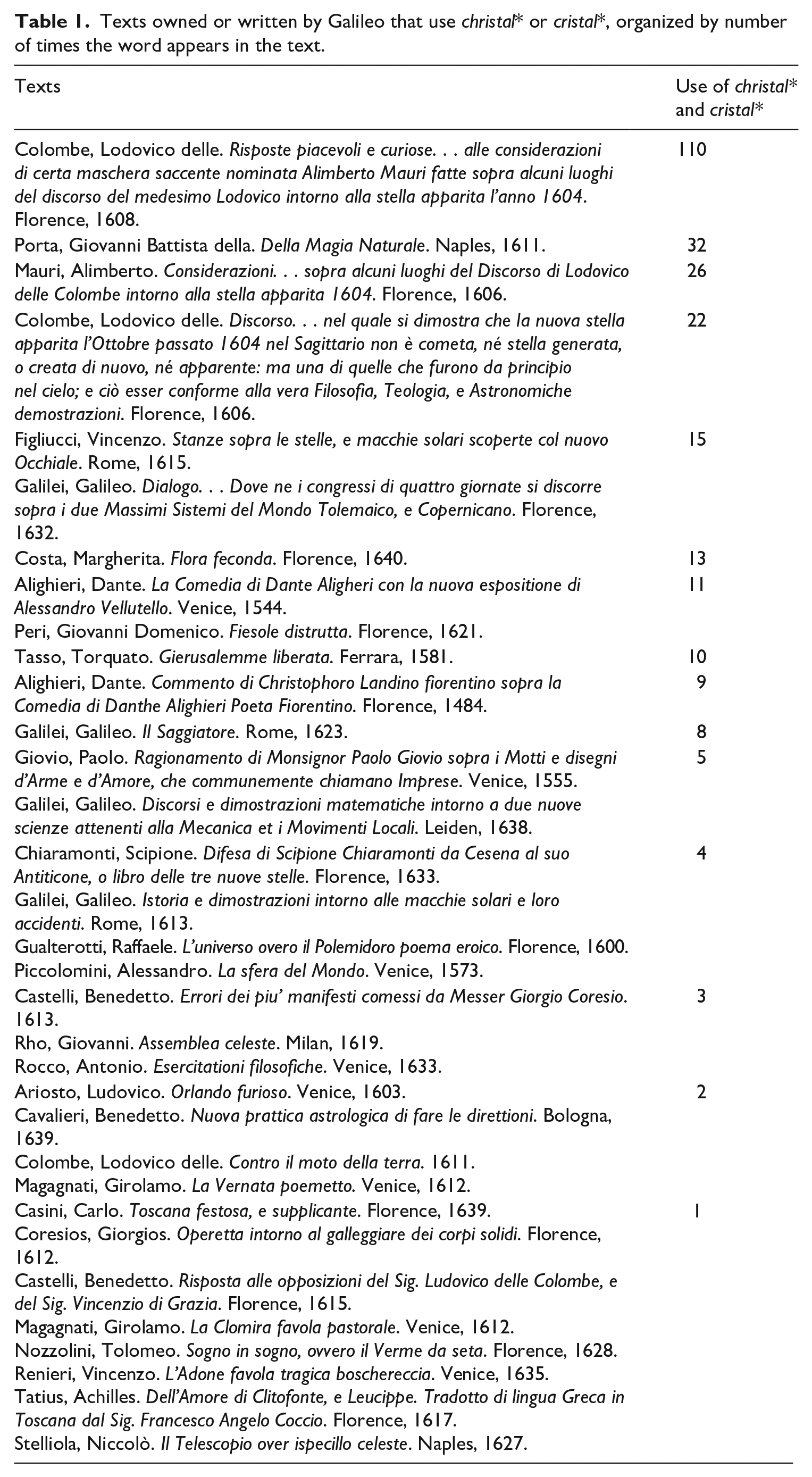
We have long known Galileo to have been a talented rhetorician, but attention to his language about the materials for enhancing vision reveals that his rhetoric about telescopic discoveries and the nature of the cosmos became part of a joke that allowed him to turn the very instrument of these discoveries into an anti-Aristotelian argument aimed at a group of close colleagues and disciples. The narrative arc of this story begins with Galileo’s use of the term cristallo in his early telescopic experiments, situates the roots to his polemical use of the term in conflicts with Ludovico delle Colombe, and then follows how Galileo redeployed his linguistic and rhetorical technique in the Dialogue. We conclude with a reflection on how Galileo narrativized the role of crystal in his own life, as seen from his house arrest following his trial by the Roman Inquisition. Contrary to William Ashworth’s suggestion that Galileo “did not engage in metaphorical warfare at all,” we show instead, through this study of language, materials, and instruments, that Galileo’s rhetorical deployment of crystal was a repeated salvo in his lifelong attacks on cosmological metaphor. 12
Crystals and connoisseurship
Both the editorial tags and keyword searching situate the beginning of this epistemological-rhetorical debate at the moment of the arrival of the Dutch telescope in Italy, and subsequent reconsiderations of glass mirrors as telescopic devices. The earliest mention of crystal in Galileo’s archival corpus appears in a missive from Enea Piccolomini, a secretary at the Florentine court of Cosimo II de’ Medici, to Galileo on September 19, 1609. In the letter, Piccolomini noted that he was sending Galileo “the crystals as requested,” and nudged Galileo to finish his telescope quickly. 13 Over the course of that fall, Galileo had been working to improve the magnification of his telescope and to make observations. While there is not extensive discussion in Galileo’s papers of the merits of crystal versus glass in creating lenses, his friend and colleague Paolo Sarpi discussed the matter several times in both theoretical and practical terms. 14 Galileo’s undated shopping list on the back of a letter from 1610 indicates that a trip to Venice to buy groceries was also a chance for him to outfit his workshop with materials for making telescopes, including the purchase of tubes, ground German glasses (vetri), pieces of mirror, and the task “to grind rock crystal [spianar cristallo di montagna].” 15 Galileo was no more in the know than others about the optical potential available in different materials. Giovanni Bartoli, a Medici diplomat in Venice, had written to the Tuscan Secretary of State, Belisario Vinta, that Venice was awash in variations on the telescope, including versions made with ordinary glass, “Murano crystal,” or even rock crystal (cristallo di montagna). 16 The telescope was exciting diplomatic news, and the materials used to make it were part of this trade in secrets, which connected Galileo to the glassmaking expertise in both Florence and Venice. 17 Indeed, the Venetian glass industry by this time had gained fame for production of crystal glass in Murano that mimicked the clarity of rock crystal. 18
In 1610, a series of letters between Cardinal Francesco Maria del Monte and Galileo discusses the use of rock crystal (quartz) and draws further attention to the Roman communities of Jesuits and clerics involved in making lenses. Cardinal del Monte was a close ally and associate of the Medici, and had been in touch with Galileo since the late 1580s. Although no letters from Galileo to del Monte survive, many of del Monte’s letters to Galileo are extant and document their lively conversations about mathematics, art, optics, and family. 19 Galileo had been loath to send one of his telescopes to the Jesuits at the Collegio Romano, led by Giovanni Paolo Lembo and Odo Van Maelcote, who had been busy building telescopes even before the publication of the Sidereus nuncius. 20 Instead, he corresponded openly and enthusiastically with Cardinal del Monte, sending him a telescope through Bardino Gherardi in April 1610. 21 Del Monte eagerly accepted the gift of the telescope and set to work doing several experiments. He was delighted to learn that Galileo was working to improve the instrument’s function and showed off his own knowledge of optics, suggesting several possible options for improving its magnification: extending the tube, making the lenses concave, and “exchanging glass for rock crystal.” 22
As a consummate patron and lover of the arts, perhaps most famous for his patronage of Caravaggio, del Monte’s enthusiasm is a signal of the value of artisanal materials at court. In addition to painting and sculpture, he was also deeply involved in glass arts in both Florence and Rome and in stone and gem work. 23 Del Monte exchanged letters with Federico Borromeo and Ferdinando de’ Medici about finely worked crystal glasses, vases, and pieces of rock crystal in their collections. 24 Between 1599 and 1604, del Monte had commissioned Giovanni Maggi’s four-volume illustrated manuscript depicting different designs for drinking glasses. 25 His suggestion that Galileo use rock crystal rather than glass was a well-informed position based on highly developed connoisseurship. While glass cristallo from Venice was valued for its underlying artisanal skill for evoking quartz, clear rock crystal was nonetheless more expensive and of better quality. 26
Del Monte’s suggestions and his further advice would also have drawn on what he read in the books in his library. At his death, his Roman residence at Palazzo Madama possessed a library of more than 800 volumes and many manuscripts. 27 In addition to his knowledge of art and its techniques, Del Monte was well informed about contemporary debates in philosophy. 28 del Monte would certainly have read the works of the Neapolitan natural philosopher and future member of the Academy of the Lincei, Giovanni Battista della Porta, who wrote at length about lenses and their effects in his books Natural Magic and De refractione optices parte libri novem. In Natural Magic, over the course of Book 17, della Porta discussed the many uses of lenticular crystal, including distances and magnification, the combinations of lenses to make distant objects appear close, and a discussion of how the magnifying effects of crystal are greater than those of glass (quantified in Table 1). 29 Galileo’s Venetian shopping list of materials for the telescope lenses included a number of items and methods described in Natural Magic as well as the courtly concerns about materiality of which della Porta and del Monte were so acutely aware. 30 In della Porta’s De refractione, he devoted a whole book to crystal pillars and spheres, showing through a combination of prose and diagrams the ways that light moves through crystal. 31 In this mathematical account, crystal stands in as a material for observing the effects of light in the purest glass, while in Natural Magic della Porta wrote about the manufacture of optical materials, using glass and crystal to refer to different substances.
Della Porta’s texts were building on a larger humanist conversation about crystals taking place in courts across Europe. Della Porta’s accounts drew on Pliny the Elder’s descriptions in the Natural Histories, which highlighted crystal’s use in luxury objects while at the same time detailing the many ways in which it might be imperfect. 32 The Tuscan physician Andrea Cesalpino, whom Del Monte had helped attain the prestigious position of personal physician to Clement VIII, was also engaged in this reassessment of the substance of crystal. 33 In 1596, Cesalpino published his De metallicis libri tres (Three Books on Metals), in which he discussed the structure and nature of crystals, often comparing accounts in Aristotle and Pliny to the mining techniques in the hills outside Pisa. 34 At the court of Rudolf II in Prague, Johannes Kepler and Anselmus Boëthius de Boodt were thinking carefully about the chemical, astrological, and mineralogical aspects of celestial bodies. 35 Courts across Europe were sites of connoisseurship where glasswork, metallurgy, and discussions of the properties and qualities of crystal lay at the heart of natural philosophical discussion. 36
Throughout June and into July 1610, Cardinal del Monte showed off his Galilean telescope, facilitating others’ interactions with the instrument and prompting additional requests from Roman elites who wanted one of their own.
37
On June 4, del Monte responded enthusiastically to another letter from Galileo, gushing that he was most pleased by what Galileo had written about the telescope: I was especially happy to learn that you are thinking about using rock crystal [cristallo di rocca] . . . and if there is anything I can do to assist you, I would do so with pleasure. In Rome [there are artisans who] work rock crystal with admirable skill and ease, and if I can be of use to you in this respect, I would do so willingly.
38
Del Monte’s offer to connect Galileo with Rome’s artisans working with glass and gems is an intriguing reminder of the ways that Rome’s cardinals and ecclesiastics served as important patrons of artistic and scientific endeavors. Indeed, they were also essential as nodes facilitating the interactions between artisans and natural philosophers. 39 When Galileo came to Rome in the spring of 1611, he hurried to Cardinal del Monte’s house on the very day of his arrival, presenting a letter from the Grand Duke, which may have been a political and social introduction, but was clearly not a personal one for these two longtime correspondents and friends. 40 We might wonder if one of Galileo’s many trips around Rome in 1611 included meetings with the very artisans to whom del Monte had so enticingly alluded.
The scholastic roots of crystalline polemics
Galileo had arrived in Rome in May 1611 to promote his telescope and its discoveries and to try to win the support of the Jesuits. 41 Despite Jesuit interest in the telescope and its discoveries, the great mathematician Christopher Clavius remained skeptical. As Galileo’s friend Lodovico Cigoli had noted at the beginning of October 1610, the only thing that would convince Clavius of the truth of the Medicean stars was “a telescope capable of creating them and then of showing them.” 42 Cigoli’s cynicism equaled the depth of Clavius’s skepticism. Given the imperfect quality of both the glass and foil backings of earlier telescopic devices that employed mirrors, such as Thomas Digges’s instrument in 1576, ghost images were a pressing concern for observers. 43
That May, Galileo wrote a long letter to his friend the Roman cleric Piero Dini to address concerns about his telescope, how it functioned, and the truth of the findings it presented. 44 One of Galileo’s arguments in this letter centers on the light of the moons of Jupiter and why they seemed to disappear at times only to reappear later. Galileo explained that if the light reached viewers, then they are able to see it through the telescope, even if it was intermittent. The telescope itself did not create phenomena but merely revealed them. If some light got lost or disappeared, then, in Galileo’s words, “all of the crystals in Murano [quanti cristalli ha Murano] would not be enough to make it visible.” 45 In this explanation, Galileo elides any difference between the colorless glass called cristallo and ground rock crystals. In so doing, he combined two signals of value: Murano artisans as the most skilled craftsmen, and crystal as the highest quality raw ingredient that also required the most skill to work. 46 Neither glass bobbles nor a lens would create light. He also elides the lensing effect of crystal with the telescope by switching use of the terms throughout the letter. Galileo’s rhetoric – that if the light does not reach earth, then not even the best materials could reveal it – invested his instrument with quality and also argued that well-wrought lenses of either type of cristallo did not introduce effects beyond observable reality. Indeed, Galileo argued that his crystals revealed the observed light to be planets orbiting around Jupiter, which in turn meant that “there is not only one center with respect to the revolutions of the stars.” 47 By equating crystals and lenses and using them as proof of the veracity of his discoveries, Galileo cut to the heart of debates about his telescopic observations. His merging of the two materials into a single term recognized the place of metaphor in his detractors’ philosophies and the deceptiveness of terminology used across poetry and astronomy. Even as Galileo worked to resolve terminological ambiguity in later decades, he continued to embrace the multiple meanings of cristallo, marking the continued use of the term as either a surprising oversight or part of a longer-term strategy for rewriting the contrary discourses of crystal that he faced.
At the same time that Galileo wrote to Dini to defend his discoveries, there were many other explanations of his telescopic observations circulating. On April 19, 1611, prior to Galileo’s visit, Cardinal Bellarmine requested an official opinion from the Jesuits at the Collegio Romano on a number of Galileo’s discoveries, including the multitude of the fixed stars, the shape of Saturn, the phases of Venus, the surface of the moon, and the moons of Jupiter. 48 The Jesuit Fathers responded within the week. 49 However, among them there was some dispute about the nature of the surface of the moon. Was it actually irregular (thereby violating the Aristotelian understanding that celestial objects were perfect and uniform) or did it just appear rough? And if the texture was indeed only an appearance, how was that appearance formed? Christopher Clavius concluded that most likely the surface of the moon was not actually rough, but that the matter of the moon was not equally dense throughout and this gave the appearance of texture, as people regularly observed in macchie ordinarie (usual spots on the lunar surface), which could be seen without the aid of an instrument like the telescope. 50 Here Clavius’s spots echoed Pliny’s description of flawed crystal. 51 However, other Jesuit mathematicians disagreed with Clavius. Presumably led by Giovanni Paolo Lembo, who was convinced of Galileo’s discoveries, these dissenting scholars thought that the moon’s surface was indeed rough, but they conceded that they were not certain beyond doubt. 52
Having read a copy of the Jesuit response, Lodovico delle Colombe, Galileo’s longtime enemy, wrote to Clavius in May 1611 to propose a similar explanation for the appearance of the moon’s surface.
53
Colombe argued that the mountainous appearance of the moon’s surface was, as Clavius argued, due to differing densities within the moon, thus giving the appearance of texture, though the surface remained smooth. However, where Clavius pointed to the clouds as physical proof of how this kind of phenomenon might occur, Colombe’s physical referent was an imperfect crystal ball. He explained: But because our sight is deceived at this distance, we cannot see the parts that are less dense since the sun does not reflect its rays there, and because of this the body [of the moon] appears unequal and not smooth or spherical because our sight does not reach these parts. The same thing happens with a large crystal ball [una gran palla di cristallo] within which there are a variety of figures made of white enamel [smalto bianco], and when it is held at a distance from our eyes it does not appear to be round and you cannot see the clear parts of the crystal, just as you cannot see the rain when looking at the sky.
54
While Pliny discussed imperfections in crystal, Colombe turned to smalt as part of a distinctive literary tradition in order to undermine the optical value of Galileo’s crystals.
Colombe’s explanation for comprehending the surface of the moon is central to the ways that Galileo turned the lenses of his telescope into a natural philosophical joke and an attack on scholastic cosmology by referring to them as crystals. But why presume a blemished crystal ball for this argument? The joke reveals itself in several episodes, each following the courtly pattern for this genre, what JoAnn Cavallo has described as a way for authors to “give vent to their animosity” while following rules of decorum. 55 Although this line of joking (or insulting) falls outside the scope of lusus naturae and lusus scientiae that Paula Findlen has articulated in early modern scientific discourse, our findings align with her overall evaluation of this mechanism as a way to signal virtuosity and invite participation in a crowd that understands the hidden message. 56 Importantly for this episode, with the exception of Antonio Neri’s yet-to-be-published Arte vetraria (1612) and della Porta’s Natural Magic (first edition 1558), references to smalt among books in Galileo’s library are found only in poetic texts. We must turn to parallel literary and natural philosophical traditions to make sense of Colombe’s critique and to understand how and why Galileo would weaponize the term “crystals” in his future writings.
Crystal had important natural philosophical significance in the Aristotelian and Ptolemaic cosmos that was called into question in the sixteenth and seventeenth centuries. Through this prevailing cosmological model, each of the celestial objects was ensconced in an orb of crystalline material, aether, which was part of the unchanging celestial realm revolving in continuous motion in regular, circular motion (Figure 1). Planets and stars could be observed, but not their pure enclosures. Unlike the lunar or sublunar smalt in Colombe’s explanation, these objects were considered perfect and unchanging as well, incomparable to artifacts made by human artisanal processes.
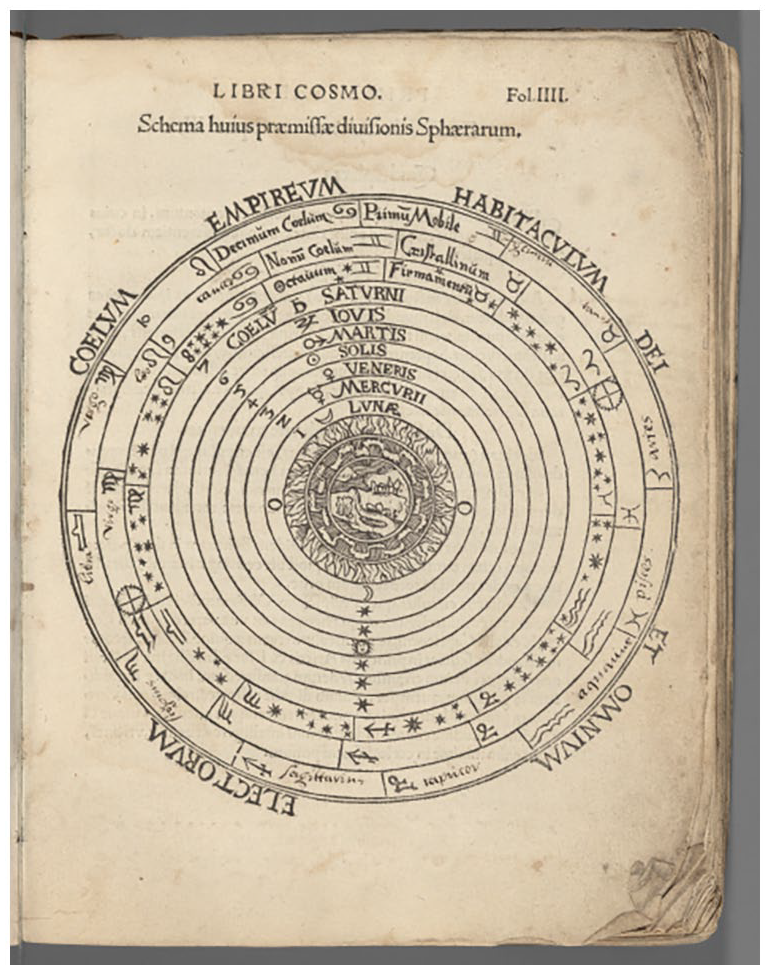
An image from Peter Apian’s Cosmographicus liber (1533) showing the embedded spheres. Note the eighth orb of the firmament, the ninth crystalline orb, and the Primum Mobile as the tenth.
For Christian readers, the term crystalline sphere also had theological significance. During the creation as recounted in Genesis 1.6 the firmament divided the waters from the waters. This higher realm of waters was at varying times characterized as solid or fluid. Water in solid form was ice, which was a crystal, and even those theologians and natural philosophers who understood the crystalline orb to be fluid still attributed to it the ideal characteristics of crystal: luminosity, transparency, and uniformity, regardless of whether that realm was considered to be hard. 57 The nature and number of these orbs was a subject of debate. Christopher Clavius identified the crystalline sphere as including the ninth, tenth, and eleventh orbs, while, for example, Peter Apian identified the crystalline orb as the ninth, followed only by the tenth orb of the Primum Mobile (Figure 1). 58 Crystalline spheres thus had multiple meanings and connotations in the complicated cosmological and theological space of the Aristotelian–Ptolemaic model. 59

Mauri’s two figures that take at face value Colombe’s conjectures about the size of stars (AB), our distance from the stars (we are at M), and the observed behavior of the comet (DE in the top figure) in order to demonstrate that they imply forty-four years of visibility of the comet (trajectory HL).
The lensing effects of crystals
Galileo’s engagement with the effects of crystalline orbs had begun before his discoveries with the telescope. In 1604, a new star (now known as Kepler’s Supernova) appeared in the sky that was brighter than any of the planets and even visible to the naked eye during the daytime. The supernova of 1604 was not as bright as Tycho’s new star of 1572, but its appearance only a few decades later made it a significant subject of debate. Galileo reported his take on the new star in three public lectures that November in Padua, and then pseudonymously in the rustic Dialogue of Cecco di Ronchiti, written in Paduan dialect and published in 1605. 60 In 1606, the avowed Aristotelian Colombe took to the presses to proclaim his explanation of the appearance of the new star, which he claimed was not new at all. 61 He argued that there are stars that are too dim to be seen by the naked eye, but that occasionally the crystalline sphere aligned in ways that had a lensing effect, thus magnifying and amplifying the dark star such that it could be seen on earth. This line of reasoning allowed Colombe to maintain the immutability of the heavens while also accounting for the fact that the new star did not show parallax. 62
A few months later, a pseudonymous treatise by “Alimberto Mauri” took aim at Colombe’s crystalline arguments. 63 If indeed the crystalline sphere (shown as H-C-L in Figure 2) had a lensing effect, “they would need to be perfect spectacles [occhiali] to make visible in the Primum Mobile stars that are not found there.” 64 “Mauri” goes on to posit that if those spectacles (vostri occhiali) had enabled us to see that star, we wouldn’t have then lost sight of it, and having this same nuisance on our nose, we would still now be enjoying the sight of so bright a star as a reward.” 65 Next, “Mauri” calculates the amount of time the new star should have been visible based on the distance to the crystalline sphere of the Primum Mobile, concluding that it should be visible for forty-four years. 66
From Colombe’s astronomical argument, “Mauri” then confronts a physical problem. It is clear, states “Mauri,” that a coin in a crystal glass filled with water is magnified when viewed from the side, but this magnification comes from the effect of the crystal, not the density of the material within it as Colombe claimed. 67 The phrasing draws attention to the medium through which we look, that is, the medium that separates the eye from the object. As Ofer Gal and Raz Chen-Morris have compellingly demonstrated, the distinction between magnification of the crystal and distortion by the water (or the eye) will have ramifications for the reliability of observations in Galileo’s later work. 68 “Mauri’s” attacks on Colombe hinge on the possible effects of perfect crystalline lenses and the disappearance and reappearance of celestial phenomena – the same arguments that Galileo would use in 1611 and beyond in defense of his telescopic discoveries.
“Mauri’s” attack broke apart Colombe’s analogy and insisted on the physical properties of materials that could be observed. Colombe responded to this style of critique in his 1608 Risposte piacevoli by describing in further detail his account of the lensing properties of the crystalline spheres, opting to emphasize their deceptive properties. First Colombe dwells on the tricks of mirrors and lenses and the ways that they can distort vision.
69
Then he moves on to describe how a crystal ball can perform these same kinds of distortions through analogy with other observed effects: You yourself would know how to do it, if that round and large crystal [cristallo] about which you were saying before that you inserted it with the usual art in a sphere, which outside appeared smooth but uneven inside, or if you were to reserve others, differently arranged. Is it not true that some painters by means of certain ridges, placed so that they are not apparent, make visible in the plane of a single frame to anyone who regards it from different positions, now a celestial sphere, now a monkey, now Death, now a beautiful Venus; and they make appear all of these things at the same time to different men situated differently to view it? Therefore, one ought to have no doubt, oh Alimberto, that the celestial density cannot cause such an appearance, like the very true and totally proper example of the mirrors demonstrates.
70
In this less-than-pointed response, Colombe conflates a variety of artisanal optical illusions, describing painterly tricks of embellishing curved slats in such a way as to show different images to viewers standing at different vantage points (Figure 3). 71 These tricks of the eye are the artifice of humans and the materials that show the image. Colombe juxtaposes this manufactured effect to the natural perfection of celestial objects and the presumed an-optic properties of the air or other medium that separates the viewer from the object viewed. Colombe works to keep the cristallo of the sphere distinct from terrestrial influence. However, Galileo’s lexical choices in subsequent texts insist on the elision of any difference between the two for epistemological, cosmological, and combative purposes.
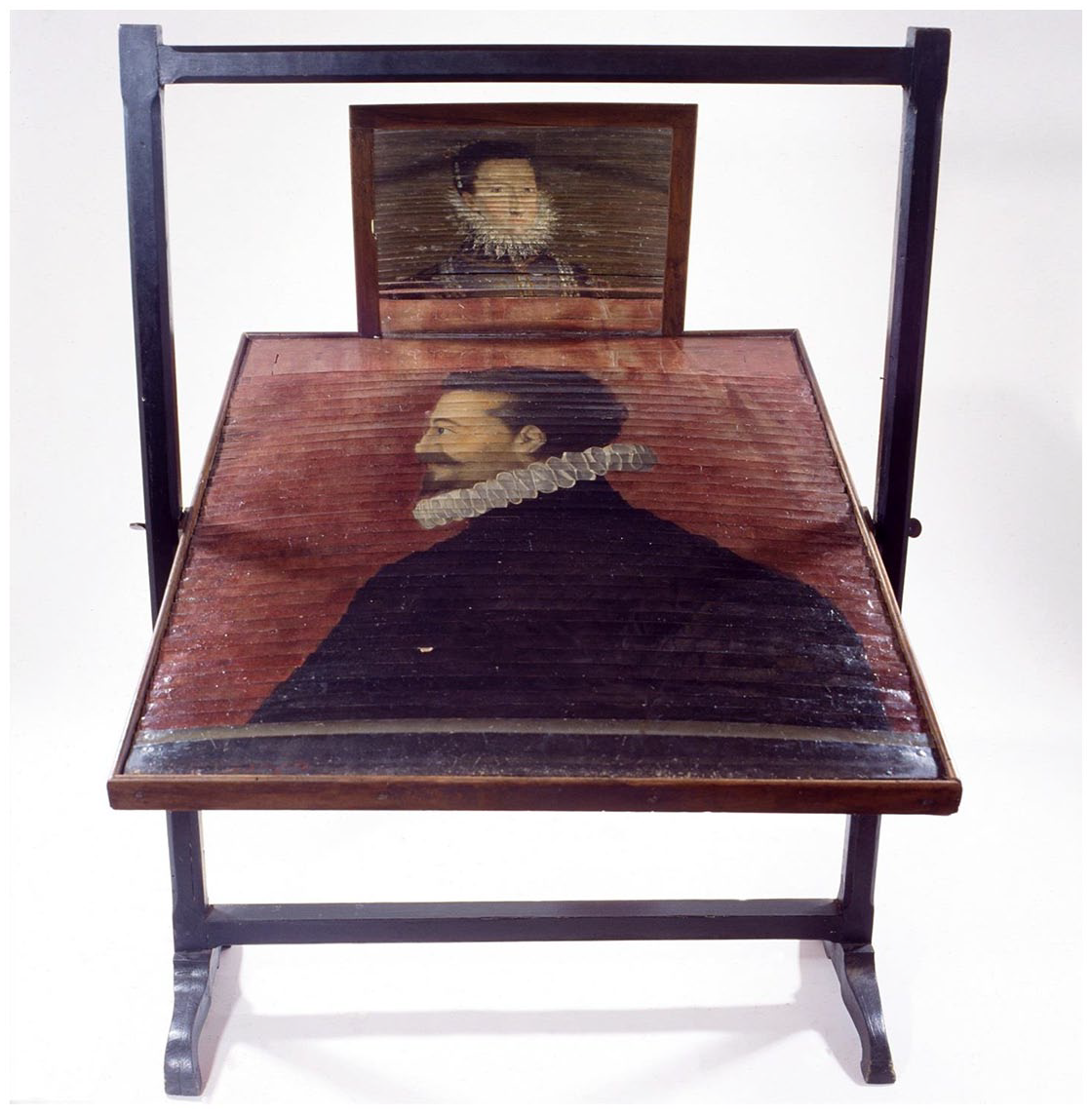
An optical toy from 1593 that shows Charles III, Duke of Lorraine from one viewpoint and Grand Duchess Christina of Lorraine, the wife of Ferdinand I de’ Medici, from another angle. Colombe describes a more complex version of this kind of illusion.
When Colombe referred to the crystal ball with white smalt in his 1611 explanation of the surface of the moon, he was surely referencing these debates with “Mauri,” whom he presumed to be Galileo. In subsequent exchanges Galileo did allow himself to be understood as Alimberto Mauri by self-consciously drawing once again on these same examples and this time capitalizing on the double meaning of crystals as lenses of supreme natural quality and artisanal design. On July 16, 1611, Galileo penned a letter to Gallanzone Gallanzoni, the secretary to the French Cardinal François de Joyeuse. Three weeks prior, on June 26, Gallanzoni had forwarded to Galileo the letter that Colombe had written to Clavius in response to Bellarmine’s April request for the Jesuits to evaluate Galileo’s discoveries. 72 Galileo announced in the letter-treatise’s opening lines that it was a direct response to Colombe. He leaped immediately into disputation with his longtime rival, announcing that Colombe’s response was an attempt to “accommodate the works of nature to their entrenched opinions.” 73 Galileo remarked that he had already definitively dispelled this idea with a letter to the Augsburg banker and future academician Mark Welser, in February of that year, intimating that opinions in Rome were not only wrong but were not even up to date on the latest discussions. 74
Galileo’s letter to Gallanzoni is a rhetorical expansion on both the letter to Welser and also on the polemic of the pseudonymous Alimberto Mauri. Galileo’s rebuttal began with a forceful statement about his observations of the moon – that it was made of “surfaces full of innumerable cavities and prominences, so pronounced that they tower over the ground as mountains” – and a strong assertion that these characteristics were not philosophical or literary descriptions but firm visual evidence. 75 Galileo then attacked Colombe for his suggestion that the moon was not the body that they had long observed with their eyes. Instead, and in addition to the observable, physical reality, Galileo characterized Colombe’s argument as relying on the moon being contained within a “certain very transparent surrounding, made of crystal or diamond and totally imperceptible to our senses,” which filled all the observed cavities and levels the mountains. 76 It’s a nice thought, Galileo concluded, but the explanation suffered from being completely indemonstrable. Additionally, Galileo continued, arriving at the letter’s sarcastic rhetorical summit, if we accept this, what is to keep one from saying that this crystal itself has many mountains that we cannot see? 77 Introducing this “newly imagined crystal [layer]” made no sense if the celestial substance was all supposed to be the same. 78
Next, Galileo turned to the incoherence of Colombe’s example of the white smalt. He advised that “the crystalline globe of this example can be located not only in the air but also in oil, in wine, in fire, and in other translucent substances encountered and understood through experience.” The crystalline sphere becomes tangible material via this rhetorical move. If one were to take the crystal ball with white smalt and immerse it in a container full of similar crystal that eliminated the differences between the two substances, then one is ultimately left with “lumpy smalt, enclosed in an even greater mass of crystal.” The only conclusion we can draw from this example, in Galileo’s reasoning, was that “the lunar body is opaque and mountainous but located in the sky.” 79 These sections of the letter that attack Colombe directly are significant expansions beyond the original letter that Galileo wrote to Welser. They dwell in particular on the materiality of the examples that Colombe invoked and echo the pointed criticisms of Alimberto Mauri about distinguishing terrestrial from celestial materials in the dispute over the new star.
Galileo also poked fun at Colombe’s scholastic reasoning and carefully alluded to his own work on floating bodies and the effects of immersing substances within other substances, a research trajectory that continued to engage Colombe. Through these experiments, Galileo emphasized once again that the cosmos cannot be explained as Colombe had done, drawing on physical substances as metaphors. Instead, one should draw on tests of observable phenomena, understanding the explanatory power of how physical materials interacted. Galileo’s attack on Colombe applied his epistemological process to Colombe’s own example – taking the crystal ball that Colombe was imagining and treating it physically rather than metaphorically.
Material and literary smalt
In addition to the rich natural philosophical and Marian imagery presented by the crystal comparison, there are literal and physical dimensions of Colombe’s reasoning. 80 Several crystal balls survive from seventeenth-century collections (see Figure 4). 81 These were objects that natural philosophers investigated, turning them over in their hands and probing them for knowledge of their physical and optical properties, as della Porta described in his books. However, Colombe’s mention of the effects of white enamel, or smalt, is a peculiar addition to a conversation about a crystal ball. Smalt is a pigment made of ground glass particles and then melted to make a single substance. In his Natural Magic, following a section on how to make counterfeit gems by “staining” crystals, della Porta had given instructions for how to manufacture smalt. 82 He suggested combining “two ounces of Lead ashes, four of Tinne; and make it into a body, with double the quantity of glass: roll it into round balls” before placing it in a fire overnight. 83 In the pages that follow, della Porta referred to the glass used to make these embellished objects. Della Porta’s description of the process indicates that Colombe may have been talking about a pure crystal ball (Figure 4), but he was likely holding and reasoning with a glass ball that contained imperfections made by pieces of white enamel fused into the center. Our distance from the material practices of glassmaking obscures what contemporary readers would surely have understood about Colombe’s description of white enamel: a crystal ball with smalt once again emphasized the artifice of Galileo’s instrument, drawing further attention to tricks of the instrument rather than the physical properties of the object of study. Smalt and crystal sit at the intersections of both human artifice and nature, as well as observation and tradition.
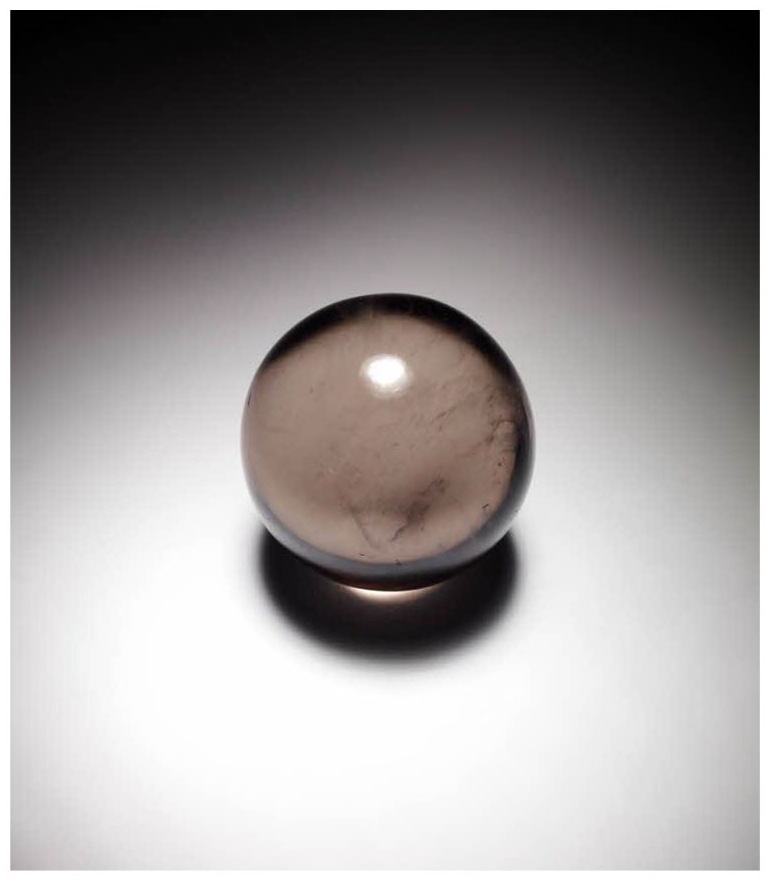
A seventeenth-century crystal ball held at the British Museum, formerly owned by John Dee.
The Florentine Colombe’s reference to smalt in the context of crystalline spheres also contained important literary valences that resonate throughout his lifetime of debate with Galileo. Chief among these was the opposition of smalt to crystal, a literary and allegorical structure maintained in Dante Alighieri’s Comedy, itself a fusion of scholastic philosophy and theology with astronomy and mathematics.
84
Galileo owned and annotated a copy of Cristoforo Landino’s commentary on the Divine Comedy (among others), and Colombe would certainly have been familiar with the Florentine commentator’s natural philosophical explanation of Dante’s imagery given his deep roots in the literary culture of the city.
85
In Landino’s commentary on Dante’s Comedia, smalt is interchangeable with the heaven of earthly delights and the pagan heaven of the Elysian fields – both imperfect pinnacles of sublunar realms. In Purgatory VIII.112–14, Currado Malaspina’s shade wishes Dante the fortitude necessary to reach the summit of the mountain, described in these material terms: So may the lantern that leads you on high discover in your will the wax one needs – enough for reaching the enameled peak [infino al sommo smalto].
86
A more literal translation of the final line of the terzina would be “as is required at the highest smalt.”
Landino, the fifteenth-century humanist, interpreted this passage, focusing on its cosmological nature in a stark departure from previous commentary traditions.
87
Of Dante’s need for energy to reach the highest smalt, Landino explains: . . .enough for reaching the first cause [prima causa], which being immobile moves all things. And he calls smalt the first heaven. Or perhaps it is better to say up until the peak of this mountain where there lies the paradise of delights, decorated with plants and flowers, just as smalts are. And Dante used a similar word in the first canticle when he mentioned the field of excellent men which makes this very similar to the Elysian fields.
88
With this explanation of smalt, Landino connects the Christian God, the Aristotelian prime mover, and the Greek resting place for the souls of the gods and heroes, but maintains a clear distinction between the changeable earth and perfect celestial spheres. Alimberto Mauri’s persistent engagement with the properties of crystal, as experienced on earth, attempted to break through this allegorical, philosophical, and theological opposition of the two materials. This rhetorical strategy reveals awareness of Colombe’s alignment with, if not reliance on, the poetic and scholastic traditions and “Mauri’s” deep familiarity with this subtext. For Landino, smalt was the “first sky,” the most distant and crystalline orb that was also something adorned (ornate) with decoration and embedded within a scholastic cosmos, a poetic and theological vision that Colombe tried to use to explain physical properties of crystals and which Galileo repudiated mercilessly throughout his writings.
Scholars have long remained split about whether Alimberto Mauri was indeed Galileo. 89 The smalt discussion places the debate over the new star of 1604 as the direct precursor to Galileo’s discussion of the surface of the moon. Galileo’s attacks on Colombe’s metaphorical use of crystal applies the same logics and reasoning that “Mauri” had deployed. In the coming years, Galileo would drive this point home by using the word crystal to mean lenses in discussions with many of his closest intellectual allies. By naming his lenses crystals, not glass pieces or even lenti, Galileo epistemologically displaced the “crystalline spectacles” that Mauri had chided in Colombe’s reasoning, which so “enriched the way of seeing the stars that could not be seen and never would be” with the unaided eyes alone. 90 Whether or not Galileo was indeed Mauri, his rhetorical and lexical choices only strengthen the association between the Considerations and his later works. He was clearly willing to pick up the criticism of Colombe where Mauri left off and to assume the conflation of identities that it implied.
Networks of crystals
Based on lexical choices in Galileo’s correspondence, there appears to have been a restricted group of compatriots who were in on what would become a multilayered humanistic joke about crystals as lenses. Attention to Galileo’s choice of language with particular interlocutors highlights the rhetorical networks that surrounded the telescope. 91 Through the genre of semi-public letters, Galileo capitalized in particular on the social value of this rhetorical and epistemological argument. In Antonio Favaro’s National Edition of Galileo’s works, both the May 1611 letter to Dini and the July 1611 letter to Gallanzoni are categorized as “letters.” However, they share more in common with manuscript publications than personal correspondence. 92 These texts were intended for audiences beyond their titular addressees, and the surviving Roman correspondence from this period shows the pathways by which these letters moved through Galileo’s Roman network. 93 Galileo’s opening statement that he thought people following these conversations in Rome would already have heard a version of his response to Welser may not have been literal, but it indicates the degree to which these letters were circulating as treatises in and of themselves. Communities of readers accessed these texts at the level of natural philosophical treatises and also as social documents meant to bolster the credibility of the scientific claims by situating themselves as part of an intellectual network. 94 Discussions of lenses as crystals became key to how Galileo signaled social and intellectual proximity during these exchanges.
Galileo had already begun voicing some of these social indications in his letters on sunspots. He had shown the sunspots to friends during his visit to Rome in May 1611, and he began to systematically study the phenomena over the next eighteen months. Galileo published his findings as a series of polemical letters. 95 The opening pages of Galileo’s letter to the Austrian patrician and senator Mark Welser in May 1612 notes, “I have no doubt that they [the sun spots] are real and not simply appearances or illusions of the eye or of the lenses [cristalli].” 96 While Galileo does not further engage with this metaphor or example, this use of crystals to mean lenses is not a one-off. In June 1612, Galileo wrote to Medici Secretary of State Belisario Vinta to let him know that he had had the crystals as requested for four months – these crystals, of course, were lenses for a telescope. 97 This word was gaining traction in fall 1612, when Polish Duke Kristof Zbaraz requested lenses (cristalli) and the esteemed Latin scholar Martino Sandelli thanked Galileo effusively for the incredible efficacy of his expertly worked lenses (cristalli). 98
Crystal in this period was both a substance and a crafted instrument. Prince Federico Cesi and Galileo were among the many natural philosophers reading about crystal, working with lenses, and hypothesizing about the nature of the cosmos, and they corresponded about the many resonances of crystal as a material. In January 1613, Cesi wrote to Galileo about a visit from the bishop of Bamburg, Johann Gottfried von Aschhausen, who had taken a break from the witch hunts he was conducting in his own diocese to visit Rome. 99 Cesi reported that the Prince-Bishop was a great patron of learning and wanted to know about Galileo’s celestial discoveries. Cesi informed him that, alas, they did not have high quality lenses in Rome, but that he would check with Galileo and see if he had some that he could give to the bishop in order to “acquire a good friend in Germany.” 100 The bishop especially wanted a telescope of his own. Galileo, who was at the time at the Salviati Villa in Le Selve, just outside of Florence, responded that he unfortunately did not have “crystals adequate for a telescope worthy of the bishop,” but that he would try to find a mediocre pair when he returned to the city, warning that there was a real difficulty obtaining pure crystal. 101 This exchange sheds light on the multiplicity of meanings of the term crystal and also highlights the ways that the telescope as a technology was a form of social currency for Galileo. 102
Even as other investigations overtook Galileo’s time, the social value of crystals persisted. For the first six months of 1613, Galileo’s correspondence with the Lincei was preoccupied primarily with printing and distributing the letters on sunspots and trading samples of another kind of crystal, glowing pieces of Bologna Stone, also known as baryte (pietre lucifere). By summer 1613, Galileo was once again working on lenses, overseeing their distribution, and using the word crystal to mean lenses within this select group of correspondents. Fabio Colonna – a naturalist, botanist, and fellow Lincean – wrote to Galileo from Naples in August to report that he had been observing the sunspots and the moon even though “in Naples no one knows how to make telescopes perfect enough to successfully observe the new stars [Jupiter’s moons]” due to many defects “both in the lenses [cristalli] and in the work.” 103 Colonna’s remark clearly acknowledges that telescopes required high quality materials in addition to artisanal skill. Galileo’s response, now lost, pleased Colonna, who was thrilled that Galileo would be sending him lenses (cristalli) “not only to observe with, but also as forms.” 104 Colonna had begun making lenses of his own and using them for observations, though he was unsure whether the globes he was seeing on either side of Saturn were real or a defect of the lenses (difetto delli cristalli). 105 When Galileo finally sent the lenses to Colonna in November 1613, he did so by way of Prince Cesi. 106 In December, Colonna wrote thanking Galileo for the “lenses for the telescope [cristali per il telescopio]” and describing the differences between those he had made himself and those that Galileo had sent him. 107 Another Lincean, Vincenzo Mirabella, wrote from Syracuse in Sicily to request two lenses (due cristalli), since he was unable to make them himself. 108 Galileo’s fellow members of the Academy of the Lincei – Cesi, Colonna, and Mirabella – are all clear in these exchanges that they are not seeking and receiving the unworked raw material of rock crystal. Instead, what turned glass lenses into crystals for these fellow academicians was the way that Galileo altered and worked the material, transforming the substance cristallo into a scientific instrument. Cesi and Colonna’s use of the term crystal to describe Galileo’s lenses is an acknowledgement of the artisanal work as well as the raw material of these instruments that echoes Galileo’s first elision of the term in the 1611 letter to Dini.
Meanwhile, the social currency of glass involved a widening audience. In 1612 a new book hit the presses, linking Medici patronage of the glass arts with their patronage of Galileo. The cleric and alchemist Antonio Neri’s L’arte vetraria distinta in libri sette included many recipes for crystal glass. 109 Neri’s book described the glassmaking process in ways that exposed some of its secrets while also abstaining from providing sufficient detail to recreate the work without an extensive preexisting experiential knowledge of glassmaking practices. 110 At a time when many natural philosophers were especially attentive to the material characteristics of glass, Neri’s book provided them with a rich language for describing types of glass and making comparisons between them. Galileo owned a copy of this book, and he procured another at the request of Federico Cesi, sending it to the Prince of the Lincei in Rome in the winter of 1614. 111 Notably, Neri’s sixth book is on smalt, which he praises for its delightful ornamentation, not optical properties, “since it can be seen that metals adorned with smalt of many colors make a lovely and noble sight enticing in many ways the eyes of the beholder.” 112 Cesi responded a few weeks later that he found Neri’s book to be “rich in experiments and beautiful artifices,” and encouraged Galileo to send lenses (cristalli) when possible, acknowledging that there was no immediate rush given the winter rains in Rome. 113
When the Roman skies cleared in March, Cesi received his lenses “adjusted by you [Galileo] for the celestial telescope” (christalli, accomodati da lei per telescopio celeste), attached them to the tube, focused them for his own sight, and observed Galileo’s marvelous discoveries. 114 As Galileo’s Lincean circle – Cesi, Colonna, and Mirabella – read Neri’s book, they became ever more conversant in the materials and work of lens-making, but they continued to describe the lenses themselves as crystals. This double meaning was the point exactly for Galileo’s close intellectual allies. Brian Vickers has summarized the persistent tension between names (res) and things (verba) in Galileo’s philosophy: “to attach a name does not mean we have understood the phenomenon, and may just disguise our ignorance of it.” 115 We suggest that the obvious materiality of crystal has led scholars to overlook and misunderstand the social and intellectual stakes of Galileo’s word choice. Crystal was a material, but it was a material that had deep roots in Galileo’s anti-Aristotelian polemic. The Lincean community that referred to lenses as crystals were in on the jokes at the expense of the Jesuits and committed to furthering Galileo’s intellectual and rhetorical project more broadly.
Based on our survey of the fifty-two letters written by or to Galileo that use the term crystal, its adoption to mean lenses was a social cue reserved for the Linceans in this period. At the same time, Galileo used different language in correspondence with other friends about lenses. For example, in several letters from this period, Galileo discussed lenses with his friend Giovan Francesco Sagredo, who knew a lot about lenses and the materials that went into them. In his correspondence, Sagredo exclusively used the term glass/vetri or mirrors/specchi to mean lenses, and limited his discussion of crystal to explanations of different materials like rock crystal or quartz. 116 Mark Welser also corresponded with Galileo about lenses, discussing the kinds that might be manufactured in Bavaria and Bohemia. He, too, exclusively described lenses as “pieces of glass [vetri].” 117 Although the Linceans maintained their own distinct research agendas, they signaled in their choice of language about lenses that they were united behind Galileo’s mission to link materiality to direct experimentation and observation rather than to metaphor.
Crystal in the Dialogue on the Two Chief World Systems
While Galileo’s surviving correspondence from the 1620s largely drops the use of the term crystals to mean lenses, Galileo revisited his crystalline controversies in print, where these references continued to coexist alongside the other term, glass/vetro. For example, in The Assayer (1623), Galileo mentions cristallo for its transparency, as well as the “cristalli del telescopio,” but also uses the terms lenti and vetro. 118 Colombe is not the target of Galileo’s criticism in the text, and while it is a Lincean work, its embedded cultural capital is inspired by and accrues strength from its inspiration, Jesuit Orazio Grassi’s Astronomical and Philosophical Balance (1619), written under the pseudonym Lothario Sarsi. Shortly thereafter, Galileo began working with renewed devotion on what would become his Dialogue on the Two Chief World Systems (1632). As Andrea Carugo documented, the Dialogue represented the revisiting and repurposing of numerous debates with opponents’ ideas that had accumulated throughout Galileo’s career. 119 In this textual mosaic Galileo would once again revisit his polemic with Colombe and revive his use of the term crystal to mean lenses. In the Dialogue, with the exception of a singular use of lenti by the interlocutor Salviati, the characters use only the term crystal to refer to the lenses of the telescope, reserving glass for other experiments and experiences in their four days of discussion. Not every use of cristallo in the Dialogue is related to lenses, but the connotation of the term is still overwhelmingly in the field of optics. 120
Throughout the Dialogue, Simplicio in particular ventriloquizes many of the positions of Galileo’s most memorable nay-sayers. For instance, on the third day, Simplicio admits that he has not been interested in reading Galileo’s books – the letters on sunspots and The Assayer – but is now curious to hear more, acknowledging: “I have considered as fallacies and deceptions of the lenses [cristalli] those things which other people have admired as stupendous achievements.” 121 We hear the early skepticism of Clavius and the persistent refusals of Colombe in this statement. The starting point for all of these statements about crystals qua lenses is that Aristotelian philosophers explained away Galileo’s discoveries as being caused by the substance of the crystalline sphere and its effects, as Simplicio did in the first day of the Dialogue. However, as Galileo’s own language about his lenses developed, he embedded this argument within the telescope itself. Throughout the second and third days of the Dialogue Galileo puts the crystalline joke in the mouth of Simplicio – in order to maintain the Aristotelian position, Simplicio must dismiss the crystals, this time of the telescope. 122 Indeed, the character Salviati repeats more than once the familiar refrain about having to confront those who do not believe what they see in these crystals. 123
The Dialogue’s third interlocutor, Sagredo, draws us to an oblique reference to the earlier conflicts with Colombe and Aristotelian philosophers in general on the first day of the Dialogue. As discussions of potential similarities between the earth and celestial objects such as the moon build to a crescendo, Sagredo concludes a critique with an uncharacteristically harsh attack on anyone who categorizes something inalterable and perfect as noble, while condemning generative and mutable things to be low and imperfect: “Such men really deserve to encounter a Medusa’s head which would transmute them into statues of jasper or diamond, and thus make them more perfect than they are.” 124 Galileo elsewhere uses jasper, a type of stone common in Tuscany, as an example of incorruptible material similar to marble. This is his second use of the conceit of being frozen by the gorgon Medusa’s gaze, the first having appeared in a similar discussion of generation and corruption in the Third Letter on Sunspots. 125 Importantly, Medusa has already been decapitated in Sagredo’s reference, implying that some new Perseus is wielding her head as a weapon to immobilize opponents. In a nod to readers who have seen these arguments before, Salviati dryly adds that such a transformation could at least stop these petrified figures in gemstones from “discussing in reverse [discorrere al rovescio],” undoing any gains by continuing to return to a settled argument.
In the context of Galileo’s library and letters, references to Medusa are rare. She appears in Ovid’s Metamorphoses, in Alessandro Piccolomini’s description of the constellation of Perseus, in the poetic text of Tasso’s Jerusalem Delivered, and in the Italian translation of Achilles Tatius’s Adventures of Leucippe and Clitophon. 126 In the scientific arguments of the Dialogue, the reference to Medusa is a signal to readers that Simplicio embodied the positions of Christoph Scheiner, Galileo’s opponent in the debates on sunspots. However, it also contains a hidden reference to Simplicio’s roots in Colombe’s treatises, for readers with sharp Florentine poetic knowledge. Once again, in light of the conflicts with Colombe, Landino’s commentary provides the key to understanding the full impact of this unusual inclusion of a gorgon and alchemical transmutation in a discussion of the moon. 127
In this passage in the Dialogue Galileo expanded on his first reference to Medusa in the letter on sunspots by connecting it directly to a discussion of the shape and material of the moon, the substance of the earlier debate with Colombe. The segue benefits from the full poetic context of the Comedy and its commentary tradition. In Inferno IX.52–4, Dante avoids the city of Dis in the circle of the furious, where shades tear their skin and beat their chests. Even from a distance, he can’t help but overhear their screams, which begin with an invocation to Medusa and her capacity to change men into Colombe’s argumentative stone of choice: “Let Medusa come and that way we will turn him to smalt.” 128 Landino reminds us in the commentary that the instrument that allowed Perseus to vanquish Medusa was the shield of Minerva: “which, because it was crystalline he could see Medusa with it and not be seen by her.” 129 Sagredo’s curse on those who misapply ontologies is thus a hidden reminder of the power of a crystalline shield to break the chain of misplaced attention. The lens-and-mirror combination is now only poetic, having been fully displaced by Galileo’s telescope. Sagredo deploys the alchemical term of transmutation to further connect the Florentine environment for producing glass crystal to the lenses that disproved the crystalline spheres. Dante himself provides the ammunition for the rhetorical salvo: that devotees of such misplaced beliefs will be changed into nothing better than the lumpy smalt with which Colombe had hoped to win the earlier debates.
In subsequent passages of the first day of his Dialogue, Galileo took pains to reproduce Colombe’s arguments about the moon’s surface in the voice of Simplicio and to mock those ideas repeatedly through the characters of both Sagredo and Salviati. In this section of the Dialogue, Simplicio repeats Colombe’s favorite explanation of the appearance versus substance of the moon’s surface to explain the telescopic discoveries: The appearances you speak of, the mountains, rocks, ridges, valleys, etc., are all illusions. I have heard it strongly maintained in public debates against these innovators that such appearances belong merely to the unevenly dark and light parts of which the moon is composed inside and out. We see the same thing occur in crystal [cristallo], amber, and many perfectly polished precious stones, where, from the opacity of some parts and the transparency of others, various concavities and prominences appear to be present.
130
Galileo responds several pages later through the character of Salviati, using a reformulation of his argument in the letter to Gallanzoni, in which crystal is immersed in more crystal. Sagredo responds with a joke aimed specifically at Colombe: A little while ago when Simplicio, in accordance with the opinion of a certain Peripatetic friend of his, attributed the apparent irregularities of the moon to its parts being unevenly opaque and transparent, creating illusions similar to those seen in crystals and gems of various kinds, something occurred to me that would be much better adapted to the showing of such effects, and I believe that his philosopher would give anything for it. This is mother-of-pearl, which is worked into various shapes; even when brought to an extreme polish, it appears to the eye so pitted and raised in various places that even touching it can hardly make us believe in its smoothness.
131
Sagredo’s joke operates on several levels. At the surface, he is simply referring to the high value of madreperla due to its rarity. Indeed, the material is often listed with gems and precious metals in descriptions of palace ornaments, princely jewelry, and exquisite craftsmanship to convey the elevated status of its owner.
However, Sagredo’s statement also hides a critique of the theory of uneven lunar transparency. Long-standing tradition held that mother-of-pearl represented the marriage of heaven and earth. 132 This substance was understood as the genetrix of pearls: simultaneously rough and uneven on the outer shell and captivatingly luminescent on the protected inside – mimicking the smooth surface of the pearl through their same material. 133 As Sagredo states, the shells can be “worked” and “reduced” to different shapes, implying the sanding, grinding, and carving for use in the decorative arts. Only after this artisanal intervention does the material stop tricking the eye as to its true nature. Moreover, the appearance of madreperla could also be fabricated as nacre within the luster arts of the period, as Garzoni highlights in the Piazza universale. 134 This material was often used for inlaid designs on furniture, an artistic form that Galileo frequently used to critique his opponents’ rhetoric and the style of Torquato Tasso.
Maurice Finocchiaro glosses this passage by drawing readers’ attention to the distinction between using intellect or reason in opposition to artificial instruments. 135 But Sagredo’s joke goes deeper – the mother-of-pearl comment harkens yet again to the epistemological distinctions between Galileo and Colombe. The variegated, enticing surface of mother-of-pearl, Sagredo jokes, couldn’t convince viewers that it was smooth even if they turned it over in their hands, like a crystal ball. The sight of the substance renders Simplicio unable to convince himself of the material properties before him in his hands, just as the crystal ball for Colombe was epistemologically distinct from the crystal of the celestial spheres. Salviati praises Sagredo’s comparison, alluding dismissively to the fact that other gems, and here we might think of crystal or smalt, could be made to produce these same illusions that trick the mind into not believing the reality of the physical world before them. 136 The effects of gems that Sagredo and Salviati reference are the enticing and misleading nature of metaphor as a replacement for empirical proof.
Mother-of-pearl might seem another strange comparison, on the level of Colombe’s smalt, but the critique of metaphor as epistemology persists throughout the Dialogue, after turning on images of precious stones and crystals. Simplicio’s impasse aligns with an overall tension that Gal and Chen-Morris have identified in the understanding of vision in the Baroque period: “only the artificial mediation of an optical lens provides reliable knowledge.” 137 The cristalli of the telescope can penetrate the murky space between the eye and the object of study, unchanged by the passions, inherited traditions, or other conditions of the observation. 138 Much like the crystal within crystal that Galileo used to refute Colombe’s smalt, Sagredo’s mother-of-pearl joke would only have been clear to readers aware of the text’s construction from pieces of argumentation that spanned the early decades of Galileo’s debates about celestial bodies.
Conclusion
During the years following the publication and prohibition of the Dialogue, Galileo and his correspondents continued to discuss lenses using the particular term “crystals.” In this period, once again, we see a clear community forming around Galileo based on the use of this term. The expanded community included family, like Geri Bocchineri, Galileo’s son Vincenzo’s brother-in-law, who worked in the Medici administration. 139 It also included Galileo’s tireless go-between in Northern Europe, Elia Diodati, who consistently talked about lenses using the word crystals as he forwarded Galileo’s letters and packages across the continent. 140 So too, Galileo’s close friends and disciples – Fulgenzio Micanzio, Antonio Santini, and Raffaello Magiotti – all drew on Galileo’s peculiar vocabulary for discussing the lenses that he was manufacturing during this period. 141 What stands out about this group of correspondents is the fact that they were all closely connected to each other, not just to Galileo. These are the relationships that facilitated Galileo’s intellectual enterprises in the years following the trial. We already know that Galileo used particular, coded language to communicate with his closest circles during the period surrounding his inquisition trial. 142 The use of the term crystals was no code, but it was yet another instance of the ways that language reinforced Galileo’s community.
Galileo’s close contacts received letters and composed letters about lenses in this period, adopting Galileo’s own terminology. In his correspondence with Fulgenzio Micanzio, Galileo mentions that he is sending lenses (cristalli) to Matthias Bernegger. 143 The shipment of the lenses to Bernegger was managed by Diodati, who was also charged with forwarding a package with lenses (cristalli) to Pierre Gassendi in France. 144 Bernegger, the ever-attentive translator of Galileo’s Dialogue into Latin, responded by thanking Galileo for the packages “of lenses for telescopes [crystallorum telescopii],” mimicking Galileo’s own word choice in his Latin response. 145 The consistent use of the word crystals to mean lenses was a device initiated by Galileo and then repeated and adopted by his interlocutors, who also facilitated the transmission of these objects during this period.
In April 1636, King Ladislao IV of Poland sent a missive to Galileo requesting “two or three pairs of lenses [vetri]” to replace those that had been sent as a diplomatic gift more than twenty years earlier and then lost in Muscovy. 146 Galileo responded that summer, enclosing “three pairs of crystals” and ranting angrily, though not spontaneously – the letter is preserved in autograph minuscule – against his mistreatment at the hands of the Roman Inquisition. 147 The letter pauses amid these complaints to rhetorically ask, “Ah, but where does this passion leave me? I return to the crystals.” Galileo’s letter does return to the crystals, detailing which lenses corresponded with particular lengths of telescopes. However, this rhetorical question is also an insight into Galileo’s own autobiography. As Galileo described his situation in that letter to Ladislao, he was serving his house arrest for having espoused a doctrine that the Church (in Galileo’s words) found to be “more scandalous, more hated, and more pernicious to Christianity than all that is contained in the books of Calvin, Luther, and all the heresiarchs combined.” During this house arrest Galileo had indeed returned to grinding lenses. 148 Once again, Galileo’s language is both material and metaphorical. He was manufacturing and distributing lenses to patrons and colleagues across Europe, but these lenses that he called crystals also embedded within them a refutation of the Church’s condemnation of his natural philosophy. Galileo’s crystals had provided the evidence to shatter the crystalline spheres, and in passionate defiance of the Church, Galileo “returned to the crystals” during his house arrest.
Scholars have long appreciated the ways that Galileo’s life was carried out simultaneously at levels that were literal, symbolic, linguistic, and literary. Mario Biagioli traced Galileo’s rise and fall as a courtier and clarified the ways that his scientific instruments engaged discourses of credit. 149 Caterina Mongiat Farina has argued compellingly that, while instruments and theory were part of the battle over the understanding of the cosmos, much of the war rested on metaphysics and language. 150 To paraphrase Mongiat Farina, star-ifying the earth or earth-ifying the stars fundamentally succeeded through linguistic choices. Samuel Edgerton has suggested that Galileo’s interpretations of mountains on the moon were informed by his knowledge of perspective in the visual arts. 151 This article suggests that more hidden narratives exist in Galileo’s corpus, which further erode the scholarly boundaries between the history of science, art history, and literary studies.
Across Galileo’s correspondence and letters, the term crystal had many uses and meanings. As a substance, crystal was a form of raw material. Crystal was also central to scholastic cosmology and an explanatory device on which scholastics, especially Colombe, relied to explain first the appearance of the new star of 1604 and then Galileo’s new telescopic discoveries. When Galileo began using the word crystals as a synonym for lenses, he embedded his cosmological arguments in the material of his instrument. Galileo’s choice of language was deliberate – crystal united earthly and celestial materials, mirroring how Galileo’s understanding of the movement on earth and in the cosmos too was linked. The evidence for a Copernican cosmos was manifested in Galileo’s discoveries made with the telescope. The use of the word crystal to mean lens also served as a joke at the expense of scholastics and as a linguistic marker of social proximity to Galileo and his intellectual agenda, especially among the members of the Academy of the Lincei. Rhetorically and linguistically, Galileo chose to refer to his lenses as crystals both because of the material of which they were made and because in so doing he signaled the epistemological work that the lenses performed. Ultimately, the crystal lenses in Galileo’s telescope and writings shattered the crystalline spheres, replacing explanatory metaphors with a polemical emphasis on the material and empirical realities of objects.
Footnotes
Acknowledgements
The authors would like to thank Paula Findlen, Eileen Reeves, and the two anonymous reviewers for their careful and probing comments on previous versions of this essay. We would also like to thank Kenneth Gouwens for a helpful discussion of metaphors and Jonathan Regier for sharing a pre-publication copy of his essay on Kepler and crystals.
Declaration of Conflicting Interests
The authors declared no potential conflicts of interest with respect to the research, authorship, and/or publication of this article.
Funding
The authors received no financial support for the research, authorship, and/or publication of this article.
1.
The literature on this topic is vast. For several of the important, English-language works, see Massimo Bucciantini, Michele Camerota, and Franco Giudice, Galileo’s Telescope: A European Story, trans. into English by Catherine Bolton (Cambridge, MA: Harvard University Press, 2015); Albert Van Helden, Sven Dupré, Rob van Gent, and Huib Zuidervaart (eds.), The Origins of the Telescope (Amsterdam: KNAW Press, 2010); John Heilbron, Galileo (Oxford: Oxford University Press, 2010); Giorgio Strano (ed.), Galileo’s Telescope: The Instrument that Changed the World (Florence: Giunti, 2008); Eileen Reeves, Galileo’s Glassworks: The Telescope and the Mirror (Cambridge, MA: Harvard University Press, 2008); Mario Biagioli, Galileo’s Instruments of Credit: Telescopes, Images, Secrecy (Chicago: University of Chicago Press, 2006); Stillman Drake, Galileo at Work: His Scientific Biography (Chicago: University of Chicago Press, 1978); Albert Van Helden, The Invention of the Telescope (Philadelphia: The American Philosophical Society, 1977).
2.
The interdisciplinary scholarship spans many perspectives. For primarily recent examples, see Sanam Nader-Esfahani, “The Critical Occhiale: Lenses, Readers, and Critics in the Polemic regarding Marino’s L’Adone,” Renaissance Studies 35.20 (2021): 170–87; Rachel Trubowitz, “The Fall and Galileo’s Law of Falling Bodies: Geometrization vs. Observing and Describing Things in Paradise Lost,” in Catherine Gimelli Martin (ed.), Milton and the New Scientific Age: Poetry, Science, Fiction (New York; London: Routledge, 2019), pp.79–107; Marco Maggi, “Un curioso Galilei e Cervantes,” Rivista di letterature moderne e comparate 70 (2017): 349–63; Amy Knight Powell, “Squaring the Circle: The Telescopic View in Early Modern Landscapes,” Art History 39.2 (2016): 282–301; Genevieve Warwick, “The Story of the Man Who Whitened His Face: Bernini, Galileo and the Science of Relief,” Seventeenth Century 29.1 (2014): 1–29; Frédérique Aït-Touati, Fictions of the Cosmos: Science and Literature in the Seventeenth Century, trans. Susan Emanuel (Chicago: University of Chicago Press, 2011); Eileen Reeves, Painting the Heavens (Princeton: Princeton University Press, 1997); Erwin Panofsky, Galileo, Critic of the Arts (The Hague: Martinus Nijhoff, 1954).
3.
The prototype was shared at the small conference “Designing GaLiLeO: Galileo’s Library and Letters Online,” Harvard University, September 7, 2018. For information on Galileo’s library, see the database maintained by the Museo Galileo, “Bibliografia Galileiana,” < >; Crystal Hall, “Galileo’s Library Reconsidered,” Galilaeana 12 (2015): 25–78; Antonio Favaro, “La libreria di Galileo Galilei: descritta e illustrate,” Bullettino di bibliografia e storia delle scienze matematiche e fisiche 19 (1886): 219–93; Antonio Favaro, “Appendice prima alla libreria di Galileo Galilei,” Bullettino di bibliografia e storia delle scienze matematiche e fisiche 20 (1887): 372–6; and Antonio Favaro, “Appendice seconda alla libreria di Galileo Galilei,” Scampoli galileiani 11.12 (1895–6): 44–50, reprint in Antonio Favaro, Scampoli galileiani, Lucia Rossetti and Maria Luisa Soppelsa (eds.) (Trieste: LINT, 1992): 368–74.
4.
This database of tags was compiled by Hannah Marcus, Daniele Macuglia, Paolo Savoia, Mackenzie Cooley, Rachel Midura, Brian Brege, Demetrius Loufas, Chris Bacich, Padraic Rohan, Julia Roever, Charlotte Thun-Hohenstein, and Paula Findlen as part of the Galileo Correspondence Project and is being prepared for digital publication.
5.
On the National Edition, see Giuseppe Castagnetti and Michele Camerota, “Antonio Favaro and the Edizione Nazionale of Galileo’s Works,” Science in Context 14.s1 (2001): 357–61, and Massimo Bucciantini and Michele Camerota, “Il progetto di aggiornamento dell’edizione nazionale delle Opere di Galileo,” in Le opere di Galileo Galilei edizione nazionale, Appendice, v. II (Florence: Giunti Editore, 2015), pp.8–9.
7.
Brian Vickers, “Epideictic Rhetoric in Galileo’s Dialogo,” Annali dell’Istituto del Museo di Storia della Scienza di Firenze 8 (1983): 95–103; Altieri Biagi, Maria Luisa, Galileo e la terminologia tecnico-scientifica (Florence: Olschki, 1965).
8.
Reeves, Galileo’s Glassworks (note 1).
9.
Ibid., pp.111–12.
10.
Please note that this statement analyzes usage only within Galileo’s corpus, which includes letters directly to and from Galileo. Crystal is a complicated word orthographically, with numerous spellings and adjectival variations. Our database of tags standardizes and groups terms regardless of spelling, though alternative approaches exist through lemmatized searches in Galileo//Thek@.
12.
William B. Ashworth, “Light of Reason, Light of Nature. Catholic and Protestant Metaphors of Scientific Knowledge,” Science in Context 3.1 (1989): 89–107, 105.
13.
Antonio Favaro (ed.), Edizione Nazionale delle Opere di Galileo Galilei (Florence: Giunti, 1890–1909), X, p.259, cited hereafter as OG. All translations are by the authors unless otherwise indicated. For this exchange see also Drake, Galileo at Work, 142–4 (note 1).
14.
For Sarpi’s comments, see Paolo Sarpi, Pensieri naturali, metafisici e matematici, Luisa Cozzi and Libero Sosio (eds.) (Milan: R. Ricciardi, 1996), pp.190, 272, 339. On this comparison not existing in Galileo’s papers, see Bucciantini et al., Galileo’s Telescope, p.57 (note 1). On Sarpi, see Reeves, Galileo’s Glassworks, p.83 (note 1).
15.
OG, X, p.270 n. 1. Discussed recently in Giorgio Strano, “Galileo’s Shopping List: An Overlooked Document about Early Telescope Making,” in Morrison-Low et al. (eds.), From Earth-Bound to Satellite: Telescopes, Skills and Networks (Leiden: Brill, 2012), pp.1–19, and Bucciantini et al., Galileo’s Telescope, pp.59–61 (note 1).
16.
OG, X, p.259.
17.
Eileen Reeves, Evening News. Optics, Astronomy, and Journalism in Early Modern Europe (Philadelphia: University of Pennsylvania Press, 2014), pp.20–6; 29–56. On crafting high quality lenses in fifteenth-century Florence, see Vincent Ilardi, “Eyeglasses and Concave Lenses in Fifteenth-Century Florence and Milan: New Documents,” Renaissance Quarterly 29.3 (1976): 341–60.
18.
For a general overview of luxury glassmaking in Venice, including the clear, colorless cristallo made in Murano, see W. Patrick McCray, Glassmaking in Renaissance Venice: The Fragile Craft (Aldershot: Ashgate, 1999), and for the social and economic world of early modern Venetian glassmaking, see Francesca Trivellato, Fondamenta dei vetrai: lavoro, tecnologia e mercato a Venezia tra Sei e Settecento, Saggi. Storia e scienze sociali (Roma: Donzelli, 2000).
19.
There are five surviving letters from del Monte to Galileo in 1610. Each includes clear indications that they are responses to other letters from Galileo. Galluzzi reminds us of the complicated nature of communications between Rome and the Veneto during the interdict, in Paolo Galluzzi, The Lynx and the Telescope: The Parallel Worlds of Federico Cesi and Galileo (Leiden: Brill, 2017), pp.15–17. After Galileo repatriated to Tuscany in 1611 he “broke his long silence” with Clavius and wrote to him directly, OG, X, pp.431–2.
20.
Galluzzi, The Lynx and the Telescope, p.14 (note 19).
21.
OG, X, p.343.
22.
Ibid., p.344.
23.
Zygmunt Wazbinski, Il Cardinale Francesco Maria del Monte, 1549–1626 (Florence: Leo S. Olschki Editore, 1994), Vol. 2, pp.458–65, 498–511.
24.
Ibid., Vol. 2, pp.455, 469, 473, 501.
25.
These were published in facsimile; see Giovanni Maggi and Paola Barocchi, Bichierografia (Florence: S.P.E.S., 1977).
26.
See McCray, Glassmaking, pp.87–92 (note 18).
27.
Wazbinski, Cardinale del Monte, Vol. 2, p.409 (note 23).
28.
Ibid., Vol. 2, pp.421–3. Del Monte was involved in a debate about the philosophy of Tommaso Campanella and its relationship to that of Telesio in a letter to Ferdinando de’ Medici in 1592. The timing of this exchange comes one year before the Congregation of the Index began discussing the prohibition of Campanella’s works. Ugo Baldini and Leen Spruit, Catholic Church and Modern Science (Rome: Libraria Editrice Vaticana, 2009), Vol. 1, tome. 2, p.975.
29.
Giovanni Battista della Porta, Magiae naturalis libri XX (Naples: 1589), 259–80.
30.
For polished German glass, for example, see ibid., p.279.
31.
Giovanni Battista della Porta, “2. De pillae crystallinae refraction,” in De Refractione optices parte libri nouem (Naples, 1593), pp.35–64.
32.
Pliny, Natural History, volume X: books 36–7, trans. D. E. Eichholz, Loeb Classical Library 419 (Cambridge, MA: Harvard University Press, 1962), pp.180–5.
33.
Wazbinski, Cardinale del Monte Vol. 2, p.433 (note 23).
34.
Andrea Cesalpino, De metallicis libri tres (Rome, 1596), pp.96–100. Augusto De Ferrari, “CESALPINO, Andrea,” Dizionario Biografico degli Italiani, Vol. 24 (1980). <> (accessed 10 September 2021). On Galileo’s relationship to Cesalpino, see J. L. Heilbron, Galileo (Oxford: Oxford University Press, 2010), pp.114, 140.
35.
Jonathan Regier, “Stars, Crystals, and Courts: Johannes Kepler and Anselmus Boëthius de Boodt,” in Patrick J. Boner (ed.), Kepler’s New Star (1604): Context and Controversy (Leiden: Brill, 2021), pp. 107–28.
36.
For an exploration of this intersection based in material evidence, see the numerous examples in Wolfram Koeppe (ed.), the catalog of the recent Making Marvels: Science and Splendor at the Courts of Europe (New York, NY: Metropolitan Museum of Art, 2019).
37.
See, for example, OG, X, pp.383, 388, 407–11.
38.
Ibid., p.367. “E particolarmente mi e piacciuto intendere quello ch’ella va pensando di fare del cristallo di rocca, perciochè spero che mediante la dottrina et ingegno di VS si possano trovare altre cose mirabili, si come ella ne ha trovate fin hora: et s’ella me ne fara partecipe, io le ne restarò con molta obligatione. In Roma si lavorano i cristalli di rocca con arte e facilita mirabile: pero se in questo particolare io posso fare servitio alcuno a VS, lo faro molto volentieri.”
39.
On his patronage at the intersection of art and science in seventeenth-century Rome, see Sabina Brevaglieri, Natural desiderio di sapere: Roma barocca fra vecchi e nuovi mondi (Rome: Viella, 2019).
40.
On April 2, 1611, del Monte wrote to the Grand Duke Cosimo II that he would help Galileo both to honor the wishes of the Grand Duke and “because he is my old friend and I greatly esteem his impressive valor: “sì perch’è mio amico Vecchio e stimo molto l’eminenza del suo valore. . ..” OG, XI, p.81. On Galileo’s trip to Rome and arrival, see William R. Shea and Mariano Artigas, Galileo in Rome: The Rise and Fall of a Troublesome Genius (Oxford: Oxford University Press, 2003), pp.30–1.
41.
Shea and Artigas, Galileo in Rome (note 40).
42.
OG, X, p.442. As quoted in Galluzzi, The Lynx and the Telescope, p.12 (note 19).
43.
See Reeves, Galileo’s Glassworks, pp.141–2 (note 1).
44.
OG, XI, pp.105–16.
45.
Ibid., p.115: “non basteriano quanti cristalli ha Murano a renderle visibili.”
46.
Tommaso Garzoni acknowledges the difficulties of working with rock crystal in Discorso LXIV of Paolo Cherchi and Beatrice Collina (eds.), Piazza universal di tutte le professioni del mondo (Turin: Einaudi, 1996), p.872.
47.
OG, XI, p.116. “non un solo è il centrol al quale hanno rispetto tutte le rivoluzioni delle stelle.”
48.
For Bellarmine’s request, see OG, XI, pp.87–8.
49.
This response to Bellarmine’s request is dated April 24, 1611, and was signed by Clavius, Christoph Grienberger, Odo Van Maelcote, and Giovanni Paolo Lembo; see OG, XI, pp.92–3.
50.
R. Ariew, “Galileo’s Lunar Observations in the Context of Medieval Lunar Theory,” Studies in History and Philosophy of Science 15 (1984): 222–3.
51.
Pliny, Natural History, 184 (note 32). Pliny’s term is “maculosa nube.”
52.
OG, XI, p.93. On this episode, see also Isabelle Pantin, “Galilée, la lune et les Jésuites: À propos du ‘Nuncius Sidereus Collegii Romani’ et du ‘Problème de Mantoue,’” Galilaeana: Journal of Galilean Studies 2 (2005): 19–42.
53.
OG, XI, p.118. It is worth noting that this letter does not survive in autograph and Favaro reproduced it from the Florentine edition of Galileo’s Opere (Gio. Gaetano Tartini e Santi Franchi, 1718), noting that the contemporary editors likely changed the text. It also appears as letter 333 in the recent edition of Clavius’s Corrispondenza, Ugo Baldini and Pier Daniele Napolitani (eds.) (Pisa: Dipartimento di matematica, 1992).
54.
OG, XI, p.118: “ma perché il senso viene in tanta distanza ingannato, non si vedendo quelle parti rare, perchè il sole non vi reflette con i suoi raggi, di qui è che quel corpo pare ineguale, e non polito e sferico, perchè non si termina la vista in quelle parti; siccome farebbe una gran palla di cristallo, dentro la quale fossero molte varietà di figure fatte di smalto bianco, ed esposta in alto lontana dai nostri occhi, che non parrerebbe tonda, non si vedendo le parti pure di quel cristallo, siccome non si vede la pioggia guardando verso il cielo.”
55.
JoAnn Cavallo, “Joking Matters: Politics and Dissimulation in Castiglione’s Book of the Courtier.” Renaissance Quarterly 53.2 (2000): 402–24.
56.
Paula Findlen, “Jokes of Nature and Jokes of Knowledge: The Playfulness of Scientific Discourse in Early Modern Europe,” Renaissance Quarterly 43 (1990): 292–331.
57.
See Edward Grant, Planets, Stars, and Orbs: The Medieval Cosmos, 1200–1687 (Cambridge [England]; New York: Cambridge University Press, 1994), pp.320–3, and Edward Grant, “Celestial Orbs in the Latin Middle Ages,” Isis 78.2 (1987): 151–73.
58.
Christoph Clavius, Christophori Clavii Bambergensis e Societate Iesu Opera Mathematica V Tomis distributa. . . (Mainz: sumptibus Antonii Hierat excudebat Reinhardus Eltz, 1611), Vol. 3, p.24.
59.
Erkinger Schwarzenberg, “Cristallo,” in Marco Beretta and Giovanni di Pasquale (eds.), Vitrum. Il vetro fra arte e scienza nel mondo romano (Florence: Giunti, 2004), pp.61–9.
60.
Galileo Galilei, Galileo against the Philosophers in His Dialogue of Cecco Di Ronchitti (1605) and Considerations of Alimberto Mauri (1606): In English Translations, trans. into English by Stillman Drake (Los Angeles: Zeitlin and Verbrugge, 1976), p.4.
61.
Lodovico delle Colombe, Discorso di Lodouico delle Colombe nel quale si dimostra, che la nuoua stella apparita l’ottobre passato 1604. nel Sagittario non è cometa, ne stella generata, ò creata di nuouo, ne apparente (Florence, 1606).
62.
Stillman Drake, Galileo at Work: His Scientific Biography (Chicago: University of Chicago Press, 1978), p.118.
63.
Reeves, Painting the Heavens, pp. 96–9 (note 2).
64.
Alimberto Mauri, Considerazioni d’Alimberto Mauri sopra alcuni luoghi del Discorso di Lodovico delle Colombe intorno alla stella apparita 1604 (Florence, 1606), p.21v.
65.
Ibid., p.22r.
66.
Ibid., p.23r.
67.
Ibid., p.26r.
68.
See Ofer Gal and Raz Chen-Morris, Baroque Science (Chicago: University of Chicago Press, 2013), pp.53–78, 79–97.
69.
Lodovico delle Colombe, Risposte piacevoli e curiose di Lodovico delle Colombe alle Considerazioni di certa Maschera saccente nominata Alimberto Mauri, fatte sopra alcuni luoghi del discorso del medesimo Lodovico dintorno alla stella apparita l’anno 1604 (Florence, 1608), pp.118v–119r.
70.
Ibid., p.119v. “Voi medesimo il sapreste fare, se quel cristallo rotondo, e grosso, di cui diceuate dianzi inseriste con l’arte solita in vna spera, che di fuora piana apparisse, ma dentro quella inegualita, o altre, diuersamente disposte serbasse. Non è egli vero, che alcuni pittori per uia di certe pieghe situate in guisa, che non appaiono, fanno ueder nel pian d’un quadro stesso, à chi per diuerse positure il riguarda, hora una sfera celeste, hora vna Scimia, hora vna Morte, hora vna bellissima Venere; e tutte queste cose a diuersi huomini nel medesimo tempo diuersamente posti a guardare apparir fanno? Niuna dubitanza, per tanto dee hauersi, ò Alimberto, che la densita celeste non possa cagionar cotale apparenza, come l’esemplo, verissimo, e proprio totalmente, degli specchi ne dimostra.”
71.
On the metaphor of the universe as a painting, see Reeves, Painting the Heavens, p.100 (note 2).
72.
The letter with which Gallanzoni forwarded delle Colombe’s response can be found in OG, XI, pp.131–2.
73.
Ibid., p.141, “accommodare le opera della natura alle loro inveterate opinioni.”
74.
Ibid., pp.38–41. This letter came in response to Welser’s of January 7, 1611, OG, XI, pp.13–14.
75.
Ibid., p.142, “egli è di superficie piena di innumerabili cavità et eminenze, tanto rilevate che di gran lunga superano le terrene montuosità.”
76.
Ibid., p.142, “vi è intorno un certo ambiente trasparentissimo, a guise di cristallo o diamante, totalmente impercettibile da i sense nostri. . ..”
77.
This passage is discussed briefly in Shea and Artigas, Galileo in Rome, p.45 (note 40).
78.
OG, XI, p.144, “questo nuovamente imaginato cristallo.”
79.
Ibid., p.145, “il corpo lunare è opaco e montuoso, ma locato nel cielo.”
80.
On the Marian imagery in these explanations of the moon (as cloud or crystal ball), see Reeves, Painting the Heavens, pp.144–8 (note 2).
81.
82.
Della Porta, Magiae naturalis libri XX, pp.121–3 (note 29).
83.
Giambattista della Porta, Natural magick (London: 1658), p.185.
84.
In Simon Gilson’s analysis, Landino’s Proemio “ranks as one of the most highly wrought eulogies of the poet’s universality as a natural philosopher” (Simon A. Gilson, “Science in and between Dante and His Commentators: The Case of Cristoforo Landino’s ‘Comento sopra la Comedia di Danthe Alighieri’,” Annali d’italianistica 23 [2005]: 31–54, 36).
85.
Antonio Favaro, “La libreria di Galileo Galilei descritta ed illustrata,” Bullettino di bibliografia e di storia delle scienze matematiche e fisiche 19 (1886): 219–93, 277. On Delle Colombe and Florence, see Maria Muccillo, “Delle Colombe, Lodovico,” Dizionario Biografico degli Italiani 38 (1990): <> (accessed 10 September 2021).
86.
87.
Gilson, “Science in and between Dante” (note 84), 37.
88.
Cristoforo Landino, Comento sopra la comedia, Paolo Procaccioli (ed.) (Roma: Salerno, 2001), Purgatorio, p.1175 ll. 6–12: “insino alla prima causa, la quale stante inmota muove tutte le chose. Et chiama smalto el primo cielo. O forse meglo insino al sommo di questo monte, dove è el paradiso delle delitie, ornato d’herbe et di fiori, chome sono gli smalti. Et simil vocabolo usò nella prima cantica, quando fè mentione del prato de gl’huomini excellenti, el qual fa quasi simile a’ campi elysii.”
89.
The major schools of thought on this follow Stillman Drake (yes, it was Galileo) and Maurice Finocchiaro (no, it was not). See, for example, Drake’s introduction to Galileo against the Philosophers, pp.62–71 (note 60), and Maurice Finocchiaro, “Review of Stillman Drake, Galileo against the Philosophers in His Dialogue of Cecco di Ronchitti (1605) and Considerations of Alimberto Mauri (1606),” ISIS 68.4 (1977): 645–6.
90.
Mauri, Considerazioni, p.26r (note 64): “poichè gli avete co’ vostri christallini occhiali arricchiti del modo di vedere stelli, le quali non si ritronano [sic], ne ritrovaron giammai.”
91.
We might add this to the networks identified by Sven Dupre in “Introduction: Writing the History of the Telescope: Makers, Markets and Mapping,” in Morrison-Low et al. (eds.), From Earth-Bound to Satellite: Telescopes, Skills and Networks (Leiden: Brill, 2012), pp.xxiv–xxv.
92.
On this phenomenon in relation to Galileo’s work, see Nick Wilding, “Manuscripts in Motion: The Diffusion of Galilean Copernicanism,” Italian Studies 66.2 (2011): 221–33. For letters and social and scientific networks, see Paula Findlen and Suzanne Sutherland, The Renaissance of Letters: Knowledge and Community in Italy, 1300–1650 (Abingdon, Oxon; New York, NY: Routledge, 2020); Nancy G. Siraisi, Communities of Learned Experience: Epistolary Medicine in the Renaissance, Singleton Center Books in Premodern Europe (Baltimore: Johns Hopkins University Press, 2012).
93.
On Galileo’s Roman network, see Paula Findlen and Hannah Marcus, “The Breakdown of Galileo’s Roman Network: Crisis and Community, c. 1633,” Social Studies of Science 47.3 (2017): 326–52.
94.
Steven Shapin, A Social History of Truth: Civility and Science in Seventeenth-Century England (Chicago: University of Chicago Press, 1994).
95.
Galileo Galilei and Christoph Scheiner, On Sunspots, trans. into English and introduced by Eileen Reeves and Albert van Helden (Chicago: University of Chicago Press, 2010).
96.
OG, V, p.95, “che esse siano cose reali, e non semplici apparenze o illusioni dell’occhio o de i cristalli, non ha dubbio alcuno.”
97.
OG, XI, p.316.
98.
Ibid., pp.400 and 421, respectively.
99.
William Bradford Smith, Reformation and the German Territorial State: Upper Franconia, 1300–1630 (Rochester, NY: University of Rochester Press, 2008), pp.170–1.
100.
OG, XI, p.464, “massime nella Germania, e n’acquistarebbe un buon amico.”
101.
Ibid., p.469, “Dispiacemi di non haver cristalli che vagliano per un telescopio degno di tanto Signore.” On Galileo between Le Selve and the Medici court, see Biagioli, Galileo, Courtier: The Practice of Science in the Culture of Absolutism (Chicago: University of Chicago Press, 1994), pp.160–2.
102.
Biagioli, Galileo’s Instruments of Credit, pp.77–134 (note 1).
103.
OG, XI, p.547, “se ben in Napoli non ci è chi sappia far telescopii perfetti, di modo che non giongemo a veder le nove stelli. . . sì nelli cristalli come nel lavoro.”
104.
Ibid., p.567, “poichè non solo me serviranno li suoi cristalli per l’uso di vedere, ma anco per norma.”
105.
Ibid., p.568.
106.
Ibid., pp.598–9.
107.
Ibid., pp.601–2.
108.
OG, XII, p.96.
109.
Antonio Neri, L’arte vetraria distinta in libri sette del R. P. Antonio Neri fiorentino (Firenze: Nella stamperia de’ Giunti, 1612).
110.
On L’Arte vetraria, see Marco Beretta, “Glassmaking Goes Public: The Cultural Background to Antonio Neri’s L’Arte Vetraria (1612),” Technology and Culture 58.4 (2017): 1046–70.
111.
Favaro, “Libreria di Galileo,” 290 (note 3). The letter in which Cesi requests the book is OG, XII, p.12.
112.
Neri, L’arte vetraria, p.83 (note 109), “poiche si vede che i metalli ornati di Smalto di più colori fanno una vaga, & nobil vista allettando oltre a modo li occhi de i riguardanti.”
113.
OG, XII, p.15.
114.
Ibid., p.40.
115.
See Vickers, “Epideictic rhetoric” (note 7).
116.
From 1613, see OG, XI, pp.448, 458. For Sagredo’s discussions of materials with Galileo in 1618 see OG, XI, pp.521–2, 536, 553, 563, 570; XII, pp.418, 427, 429, 446.
117.
For example, OG, XI, pp.516–17.
118.
OG, VI, p.362.
119.
Adriano Carugo, “Gli avversari di Galileo ed il loro contributo alla genesi e immediata fortuna del Dialogo sopra i due massimi sistemi del mondo: saggio di biografia delle idee,” in Carlo Maccagni (ed.), Saggi su Galileo Galilei (Florence: Barbera, 1972), pp.128–207.
120.
At the beginning of the second day of the Dialogue, Sagredo and Salviati again share a laugh at Simplicio’s expense, this time mocking “a doctor lecturing in a famous Academy” who heard about the telescope and immediately attributed it to Aristotle (Galileo Galilei, Dialogue Concerning the Two Chief World Systems, trans. Stillman Drake [New York: The Modern Library, 2001], p.127). Running to his bookshelf, this gentleman read an Aristotelian text as an emblem book, interpreting a passage about seeing stars in the daytime in the bottom of a dark well. The well, of course, is the tube of the telescope, the gross vapors “from whence the invention of the glass lenses [cristalli] is taken,” and then the sight is strengthened by passing through another darker, denser medium. The sting of the humor derives from the juxtaposition of the Aristotelian term, crystal, which had been used by Simplicio to argue against the telescope, and now claims priority for the same crystals as lenses that are unravelling Aristotelian thought. See Reeves’s discussion of the well, clenched fists, and the cerbottana (blowgun) in Galileo’s Glassworks, pp.84–6 (note 1).
121.
Galilei, Dialogue, p.390 (note 120).
122.
Here too, see Findlen, “Jokes of Nature and Jokes of Knowledge” (note 56).
123.
Galilei, Dialogue, p.305 (note 120). “This author would deny all these things as visual deceptions due to the lenses (cristalli) of the telescope.” In further discussion of the sunspots, Salviati explains again that the Peripatetics will “pretend that all these appearances are vain illusions of the lenses [cristalli], and will free themselves with little trouble from thinking any more about it” (p.410).
124.
Ibid., pp.67–8. Modern critic Andrea Cannas sees in Sagredo’s wish that the defenders of the perfection of celestial bodies see a “testa di Medusa,” when seen in its full mythological and narrative context, a concentrated message about the new science: “dall’esaurimento per cristallizzazione del vecchio impianto peripatetico, dovuto alla paralisi del pensiero, trae nuova linfa la moderna scienza galileiana.”Andrea Cannas, “Galilei il Linceo brandisce una testa di Medusa: un mito non accidentale nel Dialogo sopra i due massimi sistemi,” in S. Fabrizio-Costa, P. Grossi and L. Sannia Nowé (eds.), . . .che solo amore e luce ha per confine per Claudio Sensi (1951–2011) (Bern: P. Lang, 2012), pp.105–18, p.111. Dolora A. Wojceihowski offers a feminist reading of the passage in “A Gendered Cosmos: Galileo, Mother Earth, and the ‘Sink of Uncleanliness’,” in Laura Benedetti, Julia L. Hairston, and Silvia M. Ross (eds.), Gendered Contexts: New Perspectives in Italian Cultural Studies (New York: Peter Lang, 1996), pp.93–107.
125.
Galilei and Scheiner, On Sunspots, p.294 (note 95). Italo Calvino saw in both references the tensions between mobility and immobility: see Why Read the Classics?, trans. Martin McLaughlin (New York: Vintage Books, 1999), p.88.
126.
Alessandro Piccolomini, De le stelle fisse (Venice, 1579), pp.15v, 18v, 33r; Torquato Tasso, Gerusalemme liberata (Ferrara, 1581), 29.4; Achilles Tatius, Dell’Amore di Clitofonte, e Leucippe, trans. Francesco Angelo Coccio (Florence: Giunti, 1617), p.35. Galileo owned a manuscript of Ovid. For a survey of the textual tradition related to Medusa see Marjorie Garber and Nancy Vickers (eds.), The Medusa Reader (New York and London: Routledge, 2003).
127.
The commentary on these verses also aligns thematically with the Dialogue’s concerns about misconstrued value systems: “Muta Medusa gl’huomini in saxi perchè la troppa et disordinata cupidità de’ falsi beni cie gli fa parere sì begli che in quegli diventiamo stupefacti, et ad ogni altra chosa ciamo ciechi, et sordi, et quasi insensati” (Landino, Comento (note 88), Inferno, p. 553). Authors’ translation of Landino: “Medusa changes men into stones because the disordered and excess cupidity of false goods makes them seem so beautiful that we become stupefied by them, and we are blind, and deaf, and nearly senseless to any other thing.” Aside from reiterating what Sagredo and Salviati have identified as a wrong definition of good, the descriptive terms of the errant believers (stupefied, blind, deaf, and senseless) repeat throughout the Dialogue in other moments of criticism.
128.
Landino, Inferno, p.552, IX.v. 52 (note 88). Authors’ translation of Landino’s version of Dante’s text: “Vengha Medusa et sì ‘l faren di smalto.”
129.
Ibid., p.553, IX.vv. 52–4 (note 88). Authors’ translation of Landino: “el quale perchè era cristallino potea per quello vedere Medusa e non essere veduto da lei.”
130.
Galilei, Dialogue, p.80 (note 120).
131.
Ibid., p.98 (note 120).
132.
Beate Fricke, “Matter and Meaning of Mother-of-Pearl: The Origin of Allegory in the Spheres of Things,” Gesta 51.1 (2012): 35–53, 44. On the origins of the term baroque in pearls, see Molly A. Warsh, “Unruly Objects: Baroque Fantasies and Early Modern Realities,” in Paula Findlen (ed.), Early Modern Things: Objects and Their Histories, 1500–1800, 2nd ed. (London: Routledge, 2021), pp. 255–72.
133.
Bernardo Cesi, Mineralogia (Leiden: Prost, 1636), p.591.
134.
Garzoni, Piazza universale, Discorso CV, p.1203.
135.
Maurice Finocchiaro, The Routledge Guidebook to Galileo’s Dialogue (London: Routledge, 2014), pp.273–4.
136.
Galilei, Dialogue, p.99 (note 120).
137.
Gal and Chen-Morris, Baroque Science, p. 58 (note 68).
138.
Ibid., p.95.
139.
OG, XV, pp.180, 198.
140.
OG, XVI, pp.117, 474, 490; XVII, pp.129, 136.
141.
OG, XVI, pp.445, 483; XVII, pp.50, 220; XVIII, p.356.
142.
Hannah Marcus and Paula Findlen, “Deciphering Galileo: Communication and Secrecy before and after the Trial,” Renaissance Quarterly 72 (2019): 953–95.
143.
OG, XVI, p.483.
144.
Ibid., pp.117, 490.
145.
OG, XVII, p.22, “onustae munere crystallorum telescopii.”
146.
OG, XVI, p.420, “due o tre para di vetri delle sue prospettive.” See also Artur Wolyński, “Relazioni di Galileo colla Polonia esposte secondo i documenti per la maggior parte non pubblicati,” Archivio storico italiano 3.17 (1872): 30–4.
147.
OG, XVI, p.458, “3 coppie di cristalli.”
148.
Ibid., pp 458–9, “una dottrina più scandalosa, più detestanda e più perniziosa per la Cristianità, di quanto si contiene ne i libri di Calvino, di Lutero e di tutti gl’eresiarchi insieme. . .. Ma dove mi trasporta la passione? Torno a i cristalli. . ..”
149.
Biagioli, Galileo’s Instruments of Credit (note 1). Biagioli, Galileo, Courtier (note 101).
150.
See Caterina Mongiat Farina, “Galileo, la Luna e le sue rughe: retorica e tempo dei massimi sistemi,” Rinascimento 47 (2007): 389–410. On metaphor and conceptual blending as a methodology for intellectual history, see Kenneth Gouwens, “Erasmus, ‘Apes of Cicero,’ and Conceptual Blending,” Journal of the History of Ideas 71.4 (2010): 523–45.
151.
Samuel Edgerton, “Galileo, Florentine ‘Disegno’ and the ‘Strange Spottednesse’ of the Moon,” Art Journal 44.3 (1984): 225–32.