




Abstract
This investigation is part of the authors’ larger research project on so-called minor declarative complementizers in the history of English, that is, connectives recruited mostly in the adverbial domain that are occasionally used in complementation. The present study sheds light on the complementizer use of the three originally comparative links as if, as though, and like in Present-Day English complement structures. In the theoretical part of the article, the authors argue for the complement analysis of certain clauses depending on as if, as though, and like (e.g., It seemed as if the strange little man had never been there). The empirical part of the study analyzes data drawn from the Brown family of corpora (LOB, Brown, FLOB, and Frown), the Diachronic Corpus of Present-day Spoken English (DCPSE), and the Toronto English Archive (TEA), which are representative of both written and spoken language at different time periods (1960s, 1990s, and early 2000s) and in different varieties of English (British English, American English, and Canadian English). Taking the corpus data as a starting point, and with the aim of revealing what ongoing change is observable in the contemporary language, the authors attend to the following issues: (a) the predicates and construction types associated with these minor links, (b) the factors determining the variation between the three comparative complementizers, and (c) the variation between as if, as though, and like and the default declarative complementizer that.
The variation between the two major links introducing finite declarative complement clauses, that and zero, has received considerable attention in the literature on complementation, both for Present-Day English (PDE) and for earlier stages of the language (see, among others, Elsness 1982, 1984; Warner 1982; Fanego 1990; Rissanen 1991; Finegan & Biber 1995; López-Couso 1996b; Tagliamonte & Smith 2005; Kaltenböck 2006; Kearns 2007; Torres Cacoullos & Walker 2008). However, connectives normally associated with other types of subordinate clauses but that are occasionally used in complementation structures (e.g., as if) have so far not received systematic investigation. The research reported in this article is part of a larger project that aims to study the origin, development, and current use of these minor declarative complementizers (López-Couso 2007; López-Couso & Méndez-Naya 1998, 2001, forthcoming). In particular, the present article is concerned with the complementizer use in PDE of the three originally comparative subordinators as if, as though, and like in sequences of the type It seems as if/as though/like it’s going to rain or He looks as if he were older.
The article has a theoretical and a data-based component. In the theoretical part we first address the use of as if, as though, and like in adverbial subordination (e.g., He talks as if he had a potato in his mouth) and then provide a number of criteria that favor the complement analysis for the subclause in structures such as It looks as if it’s going to rain, in which the clause introduced by as if conveys a semantic argument of a propositional attitude predicate. In the empirical part, which is based on data from a range of written and spoken corpora representative of different varieties of contemporary English, we examine (a) the predicates and construction-types associated with as if, as though, and like in complementation; (b) the variation between these three minor links, paying attention to different types of structural, textual, and dialectal factors that may determine their choice; and (c) the variation between these connectives originating in the comparative domain and the default declarative complementizer that. This corpus analysis aims to reveal what ongoing change is observable in the contemporary language. Finally, the article closes with a summary of our main findings.
The data for the present study have been drawn from the Brown family of corpora (LOB, Brown, FLOB, and Frown; Hofland et al. 1999), the Diachronic Corpus of Present-day Spoken English (DCPSE; Aarts & Wallis 2006), and the Toronto English Archive (TEA; Tagliamonte 2003–6, 2006).
As If, As Though, and Like in Adverbial and Complementation Constructions
In PDE the subordinators as if, as though, and like are normally associated with adverbial clauses of Comparison, 1 as in examples (1)–(3) (see Quirk et al. 1985:1110-1111; Biber et al. 1999:844; Huddleston & Pullum 2002:1151-1154, 1158). In addition, like can also introduce adverbial clauses of Similarity, as in (4). 2
(1) He talks as if he has a potato in his mouth. (from Quirk et al. 1985:1110)
(2) The bird was careening from side to side as though there were waves. (OED s.v. careen v.)
(3) They look at me like I’m dirt. (OED s.v. like a., adv. [conj.] and n.2 B.6.e)
(4) His successors can build their modest, unpretentious monuments, like the British have been doing for years. (OED s.v. like a., adv. [conj.] and n.2 B.6.a)
In Kortmann’s (1997) typological study of adverbial subordinators in European languages, Comparison and Similarity are identified as two of the thirty-two interclausal relations into which the adverbial semantic space can be divided. More specifically, they belong to the group of Modal relations, which also includes Manner, Comment/Accord, Instrument/Means, and Proportion, that is, those relations associated with the “tightly interconnected network of manner relations in the widest sense” (Kortmann 1997:84). 3
The semantic affinity between Comparison and Similarity, and between these two relations and other members of the Modal domain, is evident. Example (1) above illustrates how the proposition in adverbial clauses of this kind answers ‘how’ questions (‘how does he talk?’). Moreover, Comparison involves Similarity, the similarity relation expressed by the adverbial clause being typically hypothetical (Kortmann 1997:195): he talks as if he has a potato in his mouth, but does not have one. The close connection between Comparison and Similarity would explain why some subordinators, as is the case of like (and as), can signal both semantic relations.
Comparison and Similarity qualify as cognitively complex relations that stand at the extended core of adverbial relations (Kortmann 1997:144, 158). In Kortmann’s (1997:159) view, the cognitive complexity of the conceptual space of Comparison may go a long way toward explaining why only a few languages make use of monomorphemic subordinators for this semantic domain. English mostly uses “complex subordinators combining an element of Similarity (as) with an element indicating hypotheticality (if, though), yielding as if and as though” (Kortmann 1997:318), although monomorphemic connectives (such as like) are also found.
In addition to the basic adverbial use of as if, as though, and like just described, these subordinators can occasionally be found in complementation structures introducing finite declarative clauses, such as those in (5)–(7). Structures of this kind are the concern of the present investigation.
(5) . . . and as time passed it seemed as if the strange little man had never been there (Brown PL23)
(6) It seemed as though she were always auditioning. (Brown F09)
(7) ‘cause some people seem like they’re older . . . (TEA sneville)
Although at first glance the as if, as though, and like clauses in these examples may have the appearance of adverbial clauses of Comparison, similar to those in (1)–(3) above, they nevertheless fulfill a number of structural and semantic criteria that show that the complement analysis for the clauses at issue is preferable.
The most relevant of these criteria is the fact that, in contrast to the adverbial clauses in (1)–(4) above, the italicized clauses in (5)–(7) convey the argument of a semantic predicate (seem). The occurrence of these clauses therefore requires the presence of a predicate of a specific class “that licenses them” (Huddleston & Pullum 2002:219). When occurring with the appropriate predicates, the as if, as though, and like clauses are obligatory constituents in clause structure and cannot be omitted without affecting the grammaticality of the sequence, as shown in (5a). They thus show a higher degree of integration into the matrix than adverbial clauses, which can easily be left out, as illustrated in example (2a).
(5a) *and as time passed it seemed.
(2a) The bird was careening from side to side.
The analysis of as if/as though/like clauses as complements thus heavily hinges on the occurrence of a particular licensing predicate and on whether the argument structure of this complement-taking predicate is already saturated or not. If the argument structure of the predicate is satisfied by another element in the clause, then the adverbial reading is triggered (also see Bender & Flickinger 1999:13). This is what happens in example (8a), where the predicate look co-occurs with both an Adjective Phrase in predicative complement function, shrivel’d and old, and a comparative clause introduced by as though. Notice, however, that if shrivel’d and old is omitted, as in (8b), the argument structure of the predicate look would be completed by the as though clause, which would no longer qualify as an adverbial clause in the resulting sequence, but rather as a complement according to the criterion of obligatoriness.
(8a) Pregnant women addicted to this spirit often gave birth to weak, sickly children who looked “shrivel’d and old as though they had numbered many years.” (FLOB G16)
(8b) Pregnant women addicted to this spirit often gave birth to weak, sickly children who looked as though they had numbered many years.
Further support for the complement analysis of the clauses at issue comes from the fact that they can be replaced by unambiguous declarative complement clauses, either finite or non-finite. Thus, for example, the that clause in (5b) can substitute for the as if clause in our earlier instance (5), “without any perceptible change of meaning” (Huddleston & Pullum 2002:962; also see Quirk et al. 1985:1175 note a, 1184 note b). Similarly, the infinitival construction in (7a) is an alternative for the as if clause in example (7). In other words, the clauses in (5)–(7) are semantically equivalent to declarative complements.
(5b) and as time passed it seemed that the strange little man had never been there.
(7a) ’cause some people seem to be older.
Additional evidence in this connection is found in examples like (9), where the as if clause, complement to the predicate look, is resumed by a that clause after the insertion of intervening material.
(9) “I tell you I can’t believe it. It’s—it’s not right. It looks as though you’ve, well, that you’ve forgotten Dad.” (FLOB N25)
Coordination with prototypical complements, either phrasal or clausal, may also be taken as indicative of the complement status of the clauses under analysis. Examples (10) and (11) show two clausal complements linked by means of coordination, an as if clause and a that clause in the former, and a like clause and a that clause in the latter.
(10) Now, driving the horse and sulky borrowed from Mynheer Schuyler, he felt as if every bone was topped by burning oil and that every muscle was ready to dissolve into jelly and leave his big body helpless and unable to move. (Brown K14)
(11) Do you feel like your neighbors care about you or that you have any sense of community that way? (TEA dbarrett)
In examples (12) and (13), coordination is established between an Adjective Phrase (nervous and grave, respectively) and an as if clause, both of them in predicative complement function. Struck through words in example (12) appear that way in the corpus.
(12) I think you’re doing fine. You’re not . . . seeming nervous or as if you need encouragement to me. Do you think you need encouragement? (DCPSE: DI-A16)
(13) Even Perry looked grave and as if he were to blame, stricken with compunction, possibly for the first time in a century. (FLOB K10)
Another possible criterion for distinguishing between adverbial clauses and complement clauses introduced by the subordinator as if is mobility, as proposed by McCawley (1988:143) and Bender and Flickinger (1999). Thus, whereas the adverbial as if clause in example (14) can be placed in sentence-initial position, the fronting of the as if clause in our earlier example (5) yields an ungrammatical construction, as shown in (5c). Notice that the preverbal position of the subclause is here ruled out because the clause is a complement of the verb seem and complements of seem can only occur in extraposition. This is one more respect in which the as if clause in (5) clearly aligns with that complements, as shown in example (5d).
(14) As if he suddenly felt her studying him, he turned and looked down at her. (Frown SP10)
(5c) *As if the strange little man had never been there seemed.
(5d) *That the strange little man had never been there seemed.
Finally, a further criterion for complementhood has been proposed by McCawley (1988:143), namely pronominalization. Note that the as if clause in (5) would pronominalize as (5e), in exactly the same way as its that clause counterpart in (5b).
(5e) It seemed so.
The complementizer use of as if, as though, and like just discussed has received very little attention in reference grammars of PDE and in the literature on complementation, with Bender and Flickinger (1999) and Rooryck (2000) as notable exceptions. This neglect may be attributed, at least in part, to the strong association of these links with adverbial subordination. Passing mention to as if and as though in complement structures can nevertheless be found in Quirk et al. (1985:1175 note a), McCawley (1988:143), Dirven (1989:134), Huddleston and Pullum (2002:962, 1151-1152), Dancygier and Sweetser (2005:229-230), and Taylor and Pang (2008:130). The use of like in complementation is also recognized in Huddleston and Pullum (2002:608n1, 1158) 4 and in Quirk et al. (1985:1175 note a), where it is mentioned that after verbs such as seem, appear, look, sound, feel, smell, and taste, in addition to as if and as though clauses, “one also frequently hears clauses introduced by like, but these are often regarded as nonstandard: It seems like the weather is improving.”
Of the two uses of as if, as though, and like discussed in the present section, the adverbial use is not only the basic one, but also the earliest to be recorded in the historical data. The combinations as if and as though date back to the thirteenth century (see Visser 1963–73:923-924, López-Couso & Méndez-Naya, forthcoming). The conjunctional use of like is first found in the fifteenth century in clauses of Similarity (Middle English Dictionary s.v. līk(e conj.), and the comparative meaning ‘as if’ is an Early Modern English development (see OED s.v. like a., adv. [conj.] and n. 2 , B.6.e). Despite its long history, though, the conjunction like remained infrequent until the Late Modern English period. It was only in the nineteenth century that it started to be noticed and rebuked by prescriptive grammarians, a stigmatization that continues to the present day. 5 Quirk et al. (1985:1110; also 558, 662, 998, 1033) and Kortmann (1997:371n159) characterize conjunctive like as typical of informal style and as especially common in American English. Huddleston and Pullum (2002:1158) also refer to the “quite strong tradition of prescriptive opposition”: it is alleged that like requires a Noun Phrase complement and cannot take a finite clause. Nevertheless, it is also stated in this grammar, published some twenty years later than Quirk et al.’s, that speakers who avoid the use of like as a conjunction are “very much in the minority,” both in British and especially in American English. In the former variety, this use of like is mostly restricted to informal style; in American English, though closely associated with informality, like is trickling into more formal registers.
The complementizer use of the comparative links under analysis develops later than their use in adverbial subordination: as though is first found in the Late Middle English period, while we have been able to trace the first instances of complementizer as if to Early Modern English (López-Couso & Méndez-Naya, forthcoming; also see Bender & Flickinger 1999:12 for as if). The complementizer use of like emerges much later: the earliest examples given in the OED entry for like (s.v. like a. adv. [conj.] and n2, B.6.e) are found in Faulkner’s writings and are dated 1940. Mark Davies’s Corpus of Historical American English (COHA), however, yields examples of the complementizer like from the first half of the nineteenth century onward.
Corpora
As mentioned in the introduction, our aim in this article is to examine the behavior of as if, as though, and like as declarative complementizers in PDE, paying special attention to the distinction between the spoken and the written media, different text types, and different national varieties. For this purpose we have selected the following corpora:
The Brown family: LOB, FLOB, Brown, Frown, one million words each, illustrating written British and American English of the 1960s and 1990s and containing texts representing different degrees of formality. 6
The DCPSE, which samples spoken English used by British adults in the 1960s (400,000 words from the London-Lund corpus) and 1990s (400,000 words from the ICE-GB).
The TEA, which records 1,800,000 words of informal conversations with people born and raised in the city of Toronto (Ontario, Canada) in the early 2000s (Tagliamonte 2003–6, 2006).
Table 1 summarizes the main features of the selected corpora.
The Corpora
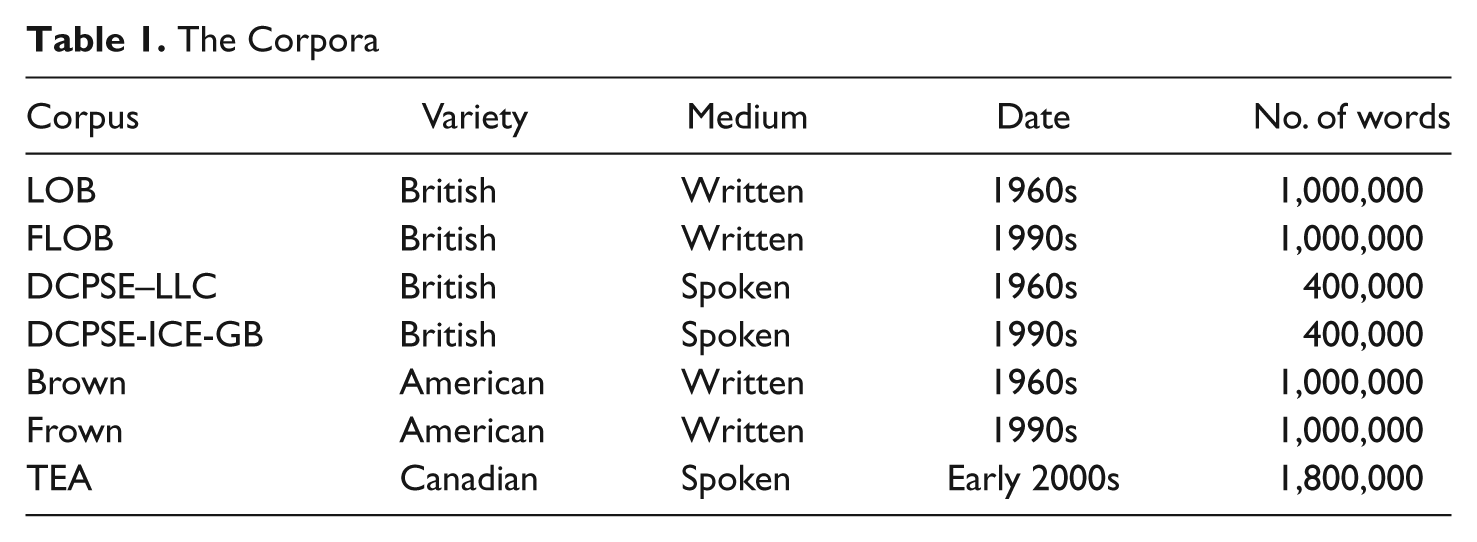
In our analysis of the corpus material, we have considered only finite clauses introduced by the three comparative subordinators. 7 For as if and as though, we have included in the count all their occurrences in the seven corpora, both in their comparative use and in their complementizer function. For like, we have analyzed all the examples in the DCPSE in which like was tagged as a conjunction. By contrast, and for practical purposes, in the remaining corpora we have considered only those instances in which the subclause depends on one of the following predicates as trigger words: appear, feel, look, seem, and sound. 8
Due to the sampling method employed for the examples of like, the data for this connective are not included in Table 2, which shows the distribution of as if and as though in the corpora in their double function as adverbial subordinators and complementizers.
As If and As Though as Comparative Links and as Complementizers in the Corpora
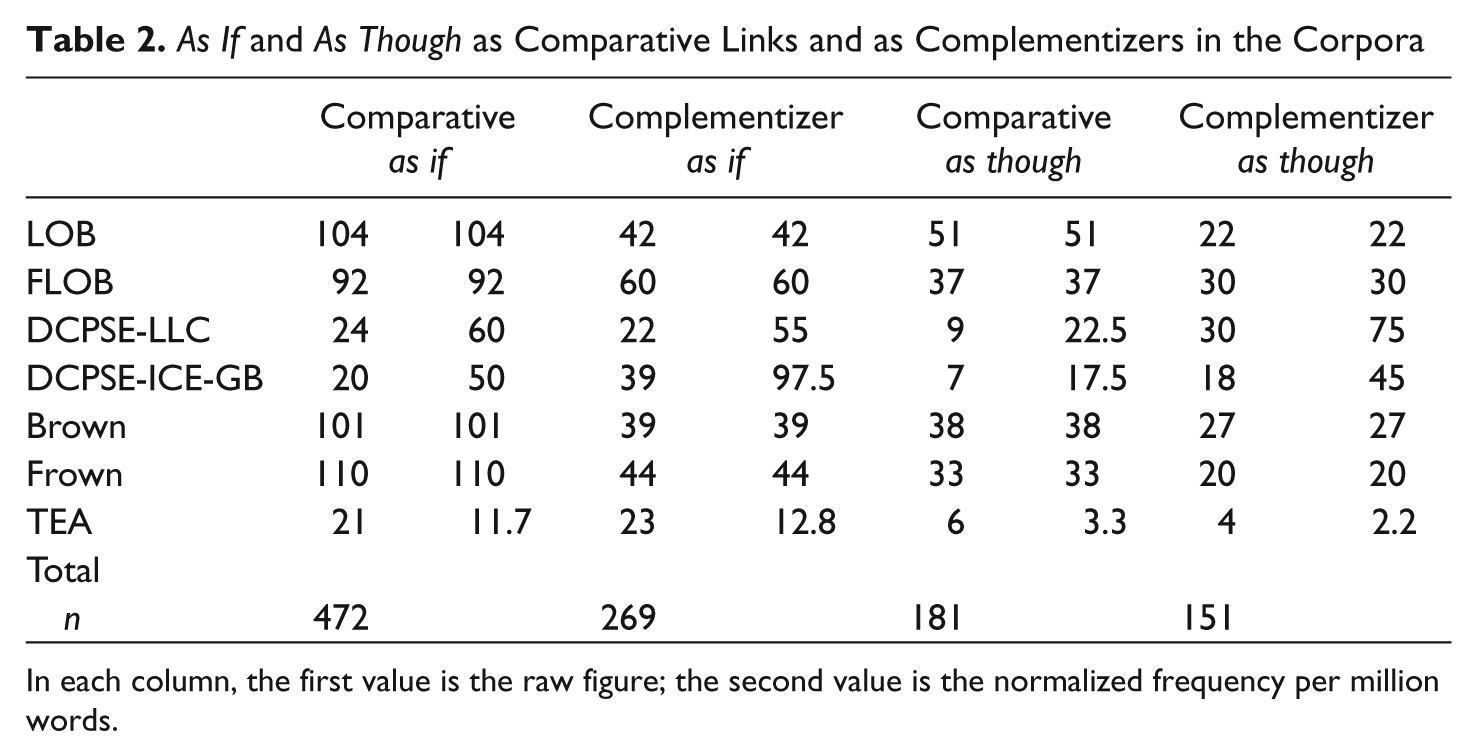
In each column, the first value is the raw figure; the second value is the normalized frequency per million words.
As the data in Table 2 show, both as if and as though are attested in all the corpora in both of their uses, though their frequency of occurrence in the Canadian English material is very low; notice in particular the almost negligible figures we have obtained for as though in this variety. This can be accounted for by the prevalence of the conjunction like in the Canadian data, which is shown below. Overall, in our material as if is more common than as though in both functions (except in the DCPSE-LLC where the complementizer as though is somewhat more common than the complementizer as if). The figures in Table 2 also indicate that instances where as if and as though introduce clauses that could be interpreted as complements rather than as adjuncts represent a secondary or subsidiary reading in the written corpora. It is worth noting, however, that in the British spoken material the proportions are clearly reversed, the complementizer function being found in the majority of cases.
Syntactic Patterns and Licensing Predicates
In what follows, the different syntactic functions in which clauses introduced by the comparative complementizers as if, as though, and like occur in the corpus material are discussed individually in order of decreasing frequency. 9 Due to the extraction method used for the like examples, the figures provided correspond only to as if and as though.
Subject Function
In our material, comparative complementizers most commonly occur in clauses realizing the function of the subject of the sentence, 10 with a total of 271 examples. Within this function three patterns can be distinguished: (a) (It) seems + comparative complementizer + subject clause (147 exx.), (b) It is + comparative complementizer + subject clause (105 exx.), and (c) absent matrix (19 exx.).
The list of complement-taking predicates (CTPs) occurring in the pattern (It) seems + comparative complementizer + subject clause in the corpora with the complementizers as if and as though includes appear (1 ex.), feel (7 exx.; see OED s.v. feel v. III.16), look (68 exx.)/not look (5 exx.), seem (40 exx.)/not seem (1 ex.), and sound (25 exx.). 11 Illustrative examples of this pattern are given in (15) and (16).
(15) It looks as if the three of you will have a very cosy evening. (FLOB P29)
(16) It sounded as though she might ever again be alone with Mark. (LOB P06)
The complementizer like is also commonly attested in similar instances, as shown in (17).
(17) It seems like some people in Paris want to hear more from me than those fellers over at the conference house do. (Brown K27)
Particularly interesting in this pattern are instances with no anticipatory it, as in (18)–(20). Taking the three complementizers together, examples of this kind are recorded mostly, but not exclusively, in the spoken material: out of 41 examples of this type in the corpora (as if 6 exx., as though 2 exx., like 33 exx.), only 13 occur in the written sources. And it must be noted that these 13 examples from the Brown family of corpora are found without exception in fiction, mostly in fictional dialogues or monologues, as in example (20). The two predicates most commonly occurring in structures without it are look (19 exx.) and sound (16 exx.).
(18) Looks as if it might well have been doesn’t it? (DCPSE: DI-B19)
(19) Sounds as though he must be. (DCPSE: DL-B18)
(20) “Seems like we’re never going to see eye to eye, Lieutenant. Didn’t they tell you what I wanted the p& a& system for?” (Brown L12)
The fact that in all such instances the verb is inflected for the present tense, and that the most common link is like (in 33 out of 41 exx.) could be taken as an indication that the combinations looks like and sounds like are close to fossilization, maybe on their way to becoming evidential markers of some kind, as happened with the construction methinks in Earlier English (López-Couso 1996a; Palander-Collin 1998; Wischer 2000). Evidence for this development is found in the occurrence of such combinations in parenthetical use, as in (21), from Mark Davies’s Corpus of Contemporary American English (COCA).
(21) Going to be a big one, looks like. (COCA, 2009 Bk: Reliable Wife)
Quite frequently, subject clauses introduced by as if or as though depend on a matrix containing the verb be (89 exx.)/not be (16 exx.), rather than a verb of seeming. Examples (22) and (23) illustrate the pattern It is + comparative complementizer + clause. The “it is as if-construction,” as it has been labeled, has been studied by Declerck (1992:222-223), who attributes to it a very specific discourse function, the expression of “what the speaker infers to be a possible interpretation of a given situation” (Declerck 1992:223).
(22) It was as if he’d bewitched them. (LOB K09)
(23) It was as though the biwa had been eaten up by the wind. (Brown P25)
Similar instances are also found with like, as in (24).
(24) And it was like you know she wasn’t eighty-three years old. (DCPSE: DI-B74)
In addition to the two patterns discussed so far, the corpora yield examples in which the complement clause occurs on its own but can be understood as depending on an elided matrix of the kind it is/seems/appears/looks, etc. A total of 19 examples of this kind are attested in our material, as illustrated in (25) and (26).
(25) Everybody these days has to be something. Conservative, Socialist, Communist, as though you must belong to some party to have any opinion worth calling an opinion. (LOB N11)
(26) But almost as if she had some sort of message to give me or <,> (DCPSE: DI-B12)
In 15 of them, the clause has the illocutionary force of an exclamation, as in (27) and (28). These exclamatory clauses are discussed in Huddleston and Pullum (2002:1152) and also in Dancygier and Sweetser (2005:229), who refer to this structure as the “monoclausal use of as if,” where the clause typically expresses surprise, rejection, or regret. 12 A similar instance with like is (29), from Dancygier and Sweetser (2005:230 ex. 79).
(27) As if she would ever forget the importance of what they’d just promised! (Frown P11)
(28) As though that mattered now! (FLOB K25)
(29) Like I care!
Predicative Function
The second most frequent group of examples in the corpus (107 exx.) corresponds to a structure of the type She seems as if/as though/like + complement clause in what appears to be a case of raising out of a finite clause. In the literature this has been labeled “pseudo-raising” (Rooryck 2000:55-56) and “copy-raising” (Asudeh & Toivonen 2005, 2006). The range of CTPs found in this pattern is similar to that mentioned above in connection with subject clauses: appear (1 ex.), be (2 exx.), look (79 exx.)/not look (4 exx.), seem (7 exx.)/not seem (1 ex.), sound (11 exx.)/not sound (2 exx.). As shown in examples (30) and (31), the function of the clause is that of subjective predicative complement, and the subject of the matrix clause is a referential Noun Phrase, not the dummy subject it. Moreover, these Noun Phrase subjects are always definite and restricted to the second and third persons (Rooryck 2000:57). In most cases (93 exx. vs. 14 exx.) the subject of the matrix and that of the subclause are coreferential, as in (30), though this is not invariably so, as in example (31), where coreferentiality is established with a Noun Phrase other than the subject. 13
(30) The landlord, a plump and harassed man named Barry, looked as if he had spent too much time enjoying his own product (FLOB A33)
(31) Plus flawless skin, smooth brow and cheeks, lips that looked as if you could get a shock from them. (Brown N17)
The complementizer like also occurs in this pattern (77 exx.), mostly with the predicates look (52 exx.) and not look (3 exx.), and most commonly in TEA (59 exx.). Illustrations are given in (32) and (33) below. Only five instances of like are found in the British English corpora: one in LOB (in fictional dialogues, Cat. N) and four in the spoken corpora. In the American English material, most like examples occur in imaginative prose (a few in press and belles lettres), which contrasts with occurrences of as if and as though in this pattern, which are recorded in all kinds of registers.
(32) He sounds like he’s earned the right to play the blues. (Frown C04)
(33) He- he looks like he has the-whatever-we-call-it. (TEA nlui)
Object Function
A third possible function for as if, as though, and like complement clauses is that of object, as shown in (34). We have recorded 41 examples of this kind, mostly in the written material (30 exx.). The only CTPs occurring in these structures are feel (39 exx.; see OED s.v. feel v. II.6c., 9b, 9d, 15b), find (1 ex.; see OED s.v. find v. I.6.b), and take (1 ex.; see OED s.v. take v. VII.47.c).
(34) She felt as though her heart had been cut into pieces. (FLOB P 14)
Like also occurs very frequently in this pattern (155 exx.), predominantly in the spoken corpora, and mainly in the Canadian material (145 exx. in TEA + 2 exx. in DCPSE), as in (35) below. In the written corpora like in this pattern is mostly confined to the less formal imaginative prose.
(35) I told her that I’d had to take these tablets and that’s why I felt like I wasn’t thinking properly. (DCPSE: DI-A13)
Noun Complementation
The corpus also yields an example of nominal complementation, where the subclause introduced by as though complements the noun look. This is given as (36).
(36) But there was a look about her mouth as though she were tasting lemons. (Brown K 23)
Table 3 summarizes the information on syntactic functions and licensing predicates provided in the preceding paragraphs.
Syntactic Patterns and Licensing Predicates

Semantic Predicates and Epistemicity
As the foregoing discussion shows, as if, as though, and like clauses in the most common functions in our material (i.e., subject and predicative complement) co-occur, without exception, with copular or linking verbs: either the copular verb par excellence be or verbs of seeming (including sensory verbs; see Quirk et al. 1985:1171-1174; Biber et al. 1999:436; Taylor & Pang 2008:131). Interestingly, the idea of equation characteristic of copular structures entails similarity, which could go a long way toward explaining why adverbial links of comparison fit well in complement structures of this kind. 14
From a semantic point of view, all the predicates selecting as if, as though, and like complements in our data belong to the group of Propositional Attitude Predicates (PAPs) in Noonan’s (1985) taxonomy of CTPs. As such, they convey “an attitude regarding the truth of the proposition expressed as their complement” (Noonan 1985:113). More specifically, the predicates we have identified in the corpora could be characterized as expressing medium modality on a scale of strength of speaker commitment (Huddleston & Pullum 2002:175-177). Obviously, the copula be in examples (22)–(24) above cannot be ascribed to any of Noonan’s semantic classes. It should be noted, however, that in such cases it is the it is as if construction as a whole that conveys the speaker’s inferences (Declerck 1992:223). In other words, such cases involve epistemic modality, which by definition “qualifies the speaker’s commitment to the truth of the modalised proposition” (Huddleston & Pullum 2002:52). It seems therefore that the use of the comparative complementizers in the structures at issue harmonizes either with the epistemic nature of the CTP in the matrix (Huddleston & Pullum 2002:1152) or with the epistemic function of the whole construction. Put differently, comparative complementizers can be said to lessen the speaker’s endorsement of the embedded proposition, and complement clauses introduced by them are seen as inferences gained from evidence.
The close association of as if/as though/like complements with a particular type of CTP is in line with the constraints we have also observed in our work on other minor complementizers at different stages in the history of English. For example, the complementizer but normally occurs with predicates of negative import, especially those denoting doubt (López-Couso & Méndez-Naya 1998); the complementizer lest is confined to clauses dependent on predicates of fearing (López-Couso 2007); and the finite declarative complementizers if and though typically occur with commentative predicates (Noonan 1985:117), that is, those denoting an emotion or an evaluation on the part of the speaker (López-Couso & Méndez-Naya 2001).
Complementizer Variation
Variation between Comparative Complementizers
We now move on to the analysis of the variation between the three comparative complementizers, paying attention to the textual and dialectal factors that may determine their choice. Table 4 gives the figures for the three links in the British, American, and Canadian English corpora, with the predicates appear, feel, look, seem, and sound as trigger words.
Distribution of As If, As Though, and Like with the Predicates Appear, Feel, Look, Seem, and Sound in the Corpora
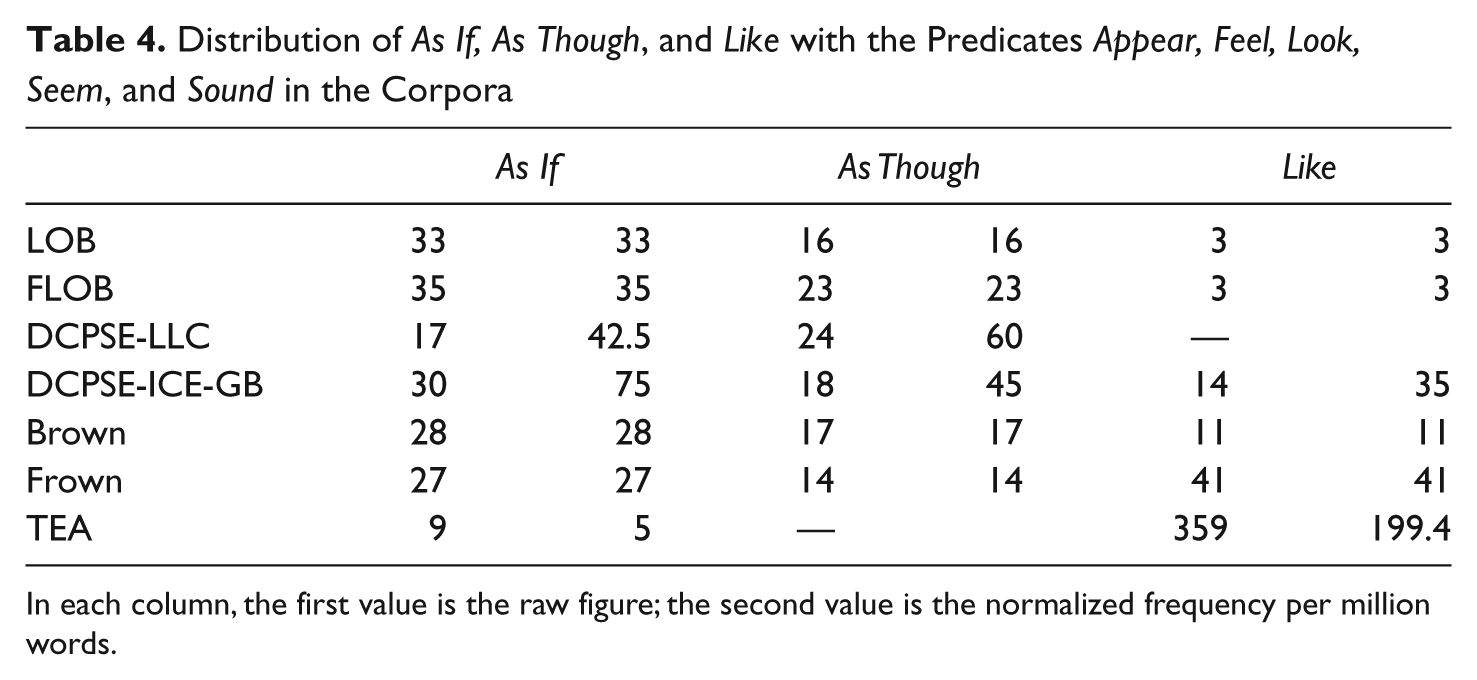
In each column, the first value is the raw figure; the second value is the normalized frequency per million words.
Table 4 provides a number of interesting insights into the variation of the three comparative complementizers. As already suggested by the data in Table 2, the figures in Table 4 further support the idea that the minor declarative complementizers as if, as though, and like are more closely associated with the spoken language than with the written medium. The normalized frequencies for the three links in the spoken British material (DCPSE) are much higher than those in the contemporary written corpora LOB and FLOB. Of the three complementizers, as if is the preferred choice in most of the corpora we have analyzed. The only exceptions correspond to spoken British English from the 1960s (DCPSE-LLC), where as though is the most common link, and to written American English from the 1990s (Frown) and Canadian English, which both show a clear predominance of the complementizer like. Notice that, in the latter variety, the complementizer as though is not recorded in our data and that the proportion of as if is negligible. In turn, in the British English written corpora the complementizer like is almost nonexistent. Moreover, it is not recorded in the spoken material from the 1960s, although it becomes quite popular in speech in the 1990s.
A look at the distribution of the three complementizers in the different text types of the British and American written corpora reveals a clear preference of these links to occur in imaginative prose (67.1 percent), particularly in fictional dialogue, rather than in informative prose (32.9 percent). This corroborates the close association of these minor complementizers with the spoken language mentioned earlier. Nevertheless, the data from the Brown family of corpora suggest the existence of a cline of formality for the three comparative complementizers in written Present-Day British and American English, with as if at the most formal end and like at the informal end of the continuum (see Figure 1). For example, in the LOB corpus instances of like are restricted to fictional dialogue (three examples in Cat. N, Adventure and Western Fiction), as though occurs predominantly in imaginative prose (13 examples as opposed to three instances in informative prose), and the examples of as if are evenly distributed between informative and imaginative prose (17 examples in each group).

Cline of formality of comparative complementizers in written British and American English
It must also be noted that the already mentioned increase of like in American written English from the 1990s as represented in Frown is attested not only in imaginative prose but also in informative texts. This finding suggests that, in Present-Day American English, the complementizer like has expanded beyond the domain of informality and has lost its original stigmatized character, as noted by Huddleston and Pullum (2002:1158).
Comparative Complementizers versus That
In addition to the competition among as if, as though, and like discussed in the previous section, the variation between the comparative complementizers and the major complementizers that and zero is also worth investigating. For our present purposes, only that has been considered, due to the impossibility of automatic retrieval of examples with the zero complementizer. Table 5 gives the figures for the variation between that and the comparative complementizers with the predicates appear, feel, look, seem, and sound as trigger words in the British and American English corpora.
Variation between the Comparative Complementizers and That with the Predicates Appear, Feel, Look, Seem, and Sound as Trigger Words in the British and American English Corpora
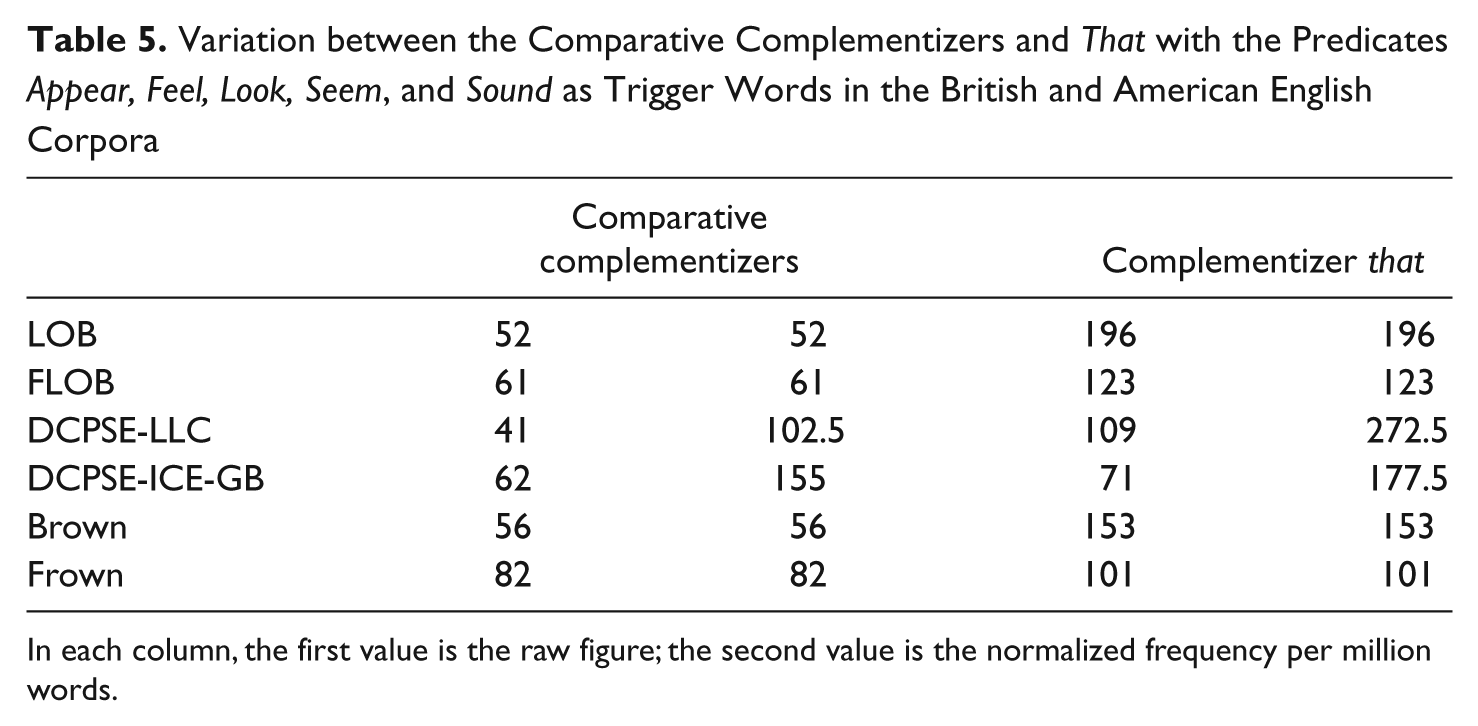
In each column, the first value is the raw figure; the second value is the normalized frequency per million words.
The most immediate insight to be gained from the data in Table 5 is the clear predominance of the default complementizer that in all corpora. A closer look at the data indicates that the variation of as if, as though, and like with the major complementizer that seems to be structurally restricted, since it is available only for those patterns in which the clause functions as subject or object. For the predicative function, by contrast, the variation is established with infinitival clauses instead.
Most significantly, besides being structurally restricted, the variation between the comparative complementizers and that also turns out to be lexically constrained. Table 6 gives the breakdown of the data in Table 5 according to individual predicates.
Comparative Complementizers vs. Complementizer That with the Predicates Appear, Feel, Look, Seem, and Sound as Trigger Words in the British and American English Corpora
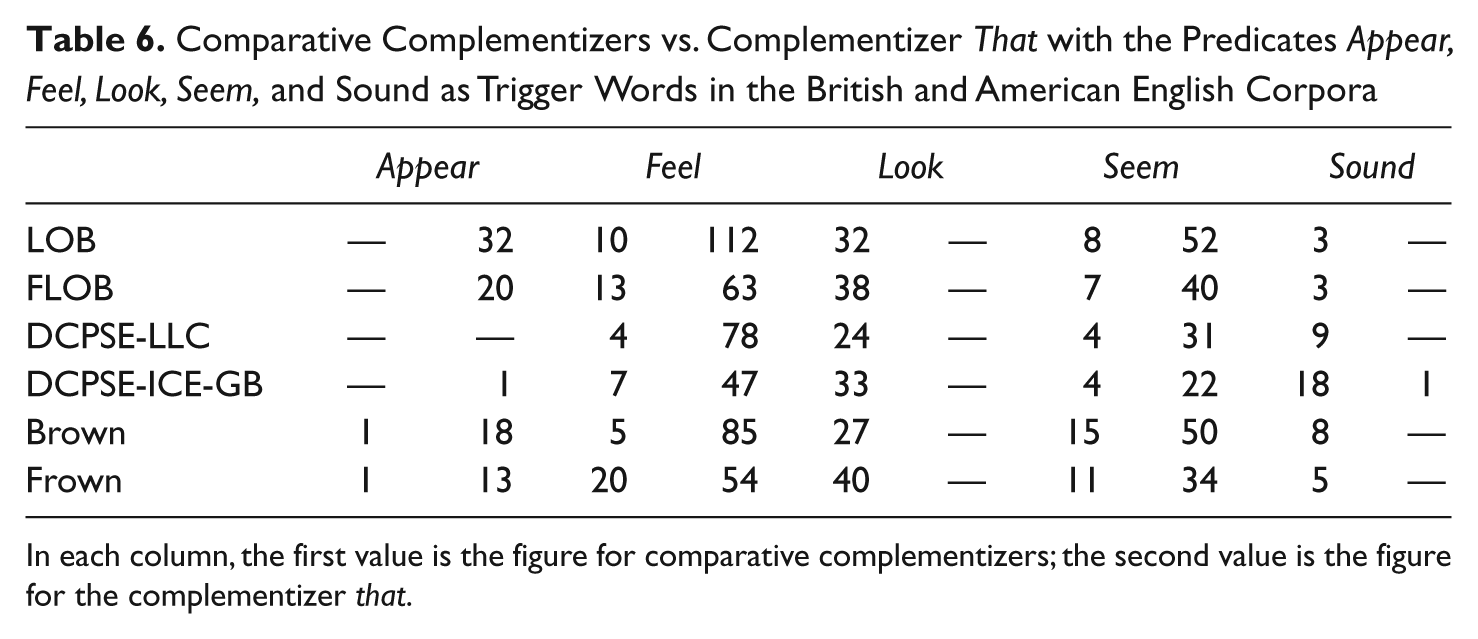
In each column, the first value is the figure for comparative complementizers; the second value is the figure for the complementizer that.
The data in Table 6 demonstrate that the selection of either the comparative complementizers under analysis or the major complementizer that is clearly lexically determined. The predicates look and sound categorically select the minor links as if, as though, and like. The only example of the complementizer that with one of these predicates in the corpora is (37). Example (9), repeated here as (38), also shows that, but it involves a reformulation. Here that resumes the link as though after the insertion of intervening material.
(37) It sounds that you’re wanting to take care of yourself physically as well (DCPSE: DI-A 11)
(38) = (9) “I tell you I can’t believe it. It’s—it’s not right. It looks as though you’ve, well, that you’ve forgotten Dad.” (FLOB N25)
Our data for look and sound are therefore in line with the information provided by Huddleston and Pullum (2002:962n8), who report that that clauses are only “very occasionally found” with these two predicates. 15 The existence of predicates that exclude that and (virtually) obligatorily select comparative complementizers would indicate that as if, as though, and like can be considered complementizers in their own right (Rooryck 2000:56).
The opposite tendency is witnessed for the predicate appear, which almost categorically selects the complementizer that. The only two corpus instances with a comparative link are given as (39) and (40).
(39) You had to have convictions to lie down in the road in all those clothes and appear as though you might wish to turn yourself out of your own home. (Brown P08)
(40) When he noticed that he was being watched, Milt Saunders sank his head between his shoulders so that it appeared momentarily as if he had no neck. (Frown P26)
By contrast, the predicate seem shows true variation: though the major complementizer that clearly prevails in all corpora (229 exx.; 82.4 percent), as if, as though, and like complement clauses also occur (49 exx.; 17.6 percent). In our opinion, complementizer selection with seem may reflect the degree of the speaker’s endorsement of the embedded proposition, which is higher in the case of that. This is suggested by the existence of an interesting difference between the two types of complementizers as regards the expression of an experiencer Noun Phrase in the sentence. In the case of seem + that, 36.7 percent of examples show an overt experiencer, mostly a first person one (70.5 percent of the cases where the experiencer is expressed). An illustration is given in (41), where it seems to me that indicates the speaker’s belief and his or her commitment to the truth of the proposition in the subclause, and could thus be considered a (less face-threatening) alternative to I think or I believe. In the case of seem + comparative complementizers the proportion of examples with an overt experiencer with seem drops to just 13.1 percent, eight examples in all, only three of which feature a first person experiencer. Example (42) illustrates seem as though with a third person experiencer.
(41) In Rowe’s opinion this response is a failure, but it seems to me that he has overlooked some considerations which show his assessment to be unwarrentedly pessimistic. (Frown D11)
(42) It seemed to the frightened judge as though his son would actually shoot the craft in under the outer end of the wharf. (LOB N03)
Although the low number of examples does not warrant definite conclusions, this finding seems to point to a crucial difference between that and comparative complementizers both in terms of the evidential types in which they occur (belief vs. inference) and as regards the degree of speaker commitment (higher vs. lower) that they convey (see Cornillie 2007:36, 41 for parallel Spanish examples).
The last predicate whose behavior we have analyzed is feel. Here the situation is somewhat more complex than with the other CTPs, since a distinction needs to be made between the two syntactic patterns available with this predicate. In the structure it feels + subject clause (nine examples, as in (43) below) only comparative complementizers are available. By contrast, in clauses in object function, as in (44), that clearly predominates in all corpora (89.9 percent).
(43) When they sat down, it felt as if they were on display, which Robin didn’t seem to mind. (Frown K13)
(44) So I felt that these voices were sort of growing in my imagination (DCPSE: DI-E04)
Concluding Remarks
In this article we have shown that, in addition to their primary use as adverbial subordinators of Comparison and Similarity, as if, as though, and like also serve as complementizers in PDE, as counterparts of the major links that and zero. In their complementizer function, these minor links are particularly common in copular structures. Notice that the idea of equation entails similarity, so that original adverbial links of Comparison and Similarity, such as as if, as though, and like, fit the bill.
The variation between the comparative complementizers and the major link that is both structurally restricted (it is available only when the clause realizes the subject or the object function) and lexically determined. As is the case with other minor complementizers, as if, as though, and like are constrained to occur with a specific type of CTP. In our data as if, as though, and like complements prototypically depend on PAPs encoding a medium degree of commitment toward the truth of the embedded proposition (appear, look, seem, etc.). The selection of comparative complementizers is compatible with the idea of a hypothesis evoked by the matrix predicate; in other words, it harmonizes with the nature of the CTP in the matrix. However, the fact that some of our predicates favor that (e.g., appear), while others categorically select comparative links (e.g., feel with subject clauses or look), may indicate the existence of differences between the predicates at issue regarding the strength of the modality they convey.
The analysis of the corpus material here indicates that the minor declarative complementizers as if, as though, and like are more closely associated with the spoken language than with the written medium, where they are typically found in informal text types, particularly in fictional dialogue. Of the three comparative links, as if is the preferred choice in four of the corpora analyzed (LOB, FLOB, Brown, DCPSE-ICE-GB). The DCPSE-LLC material shows a predominance of as though, while in written American English from the 1990s (Brown) and, especially, spoken Canadian English (TEA) like is far more common. Like also shows a marked increase in spoken British English from the 1990s (DCPSE-ICE-GB). Moreover, the distribution of the three links across text types suggests the existence of a cline of formality, with the complementizer as if at the most formal end of the continuum and like at the informal end. However, evidence from Frown indicates that in Present-Day American English the complementizer like is starting to expand beyond the domain of informality.
Further corpus research is certainly needed on topics such as the Verb Phrase in the subclause (e.g., the occurrence of modally marked forms and of the interpretive progressive) and the presence of other epistemic markers (such as modal adverbs) in the construction. This may help us to discover whether the choice of different comparative links correlates with varying degrees of the speaker’s commitment toward the truth of the embedded proposition.
Footnotes
Acknowledgements
We are grateful to Sali A. Tagliamonte for granting us access to the Toronto English Archive material.
The author(s) declared no potential conflicts of interest with respect to the research, authorship, and/or publication of this article.
For generous financial support we are grateful to the European Regional Development Fund and the following institutions: Spanish Ministry for Science and Innovation (Grants HUM2007-60706 and FFI2011-26693-C02-01) and Autonomous Government of Galicia (Grants INCITE-08PXIB204016PR and CN2011/011).