



Abstract
The English have-perfect can be traced to Old English [habban ‘have’ + noun + perfect participle]. A comparative look at the development of the have-perfect in Romance suggests a way to reassess the Old English corpus, which in turn reveals that the string [habban + noun + perfect participle] had three distinct structures and values aside from the periphrastic perfect. The author shows that the likeliest source of the have-perfect is a periphrasis denoting the achievement of a result or a persisting resultant state. This implies that the relationship between possessive and auxiliary habban is less direct than previously claimed.
The English have-perfect is known to be a reflex of a pre–Old English (OE) periphrasis that involves a form of the verb habban, a noun phrase in the accusative case, and a perfect participle in the accusative case (henceforth <habban + noun. (1) Ic hæbbe boc gewritene > I have written a book
There is no attested stage of OE that predates the have-perfect. In the oldest texts we find a periphrasis with habban and a perfect participle exhibiting the following properties: ability to appear without the noun.
The OE have-perfect developed alongside an older periphrastic perfect, the be-perfect: <wesan/beon + perfect participle. (2) Ic eom gecumen > I am come, replaced by PDE I have come
The changes shown in (1) and (2) have attracted notice since at least the nineteenth century, and development (1) has often been described as a straightforward instance of grammaticalization. Most accounts assume that the source construction <habban + noun. (3) Ic hæbbe [boc gewritene] I.NOM have.PS.1S book.ACC.S written.F.ACC.S ‘I have a book written.’
There is a considerable gap between the meaning and structure of (3) and that of the corresponding have-perfect (PDE I have written a book), which linguists have dealt with in various ways. Many have argued that habban ‘have’ bleaches gradually, losing its possessive meaning. According to such accounts, as habban weakens, the perfect participle becomes the salient part of the periphrasis, and the whole construction comes to predicate something about writing, rather than holding or possessing. Whitney (1875:91) offers an early statement of this view:
Present possession often implies past action: habeo cultellum inventum . . . ‘I possess my knife (recovered after loss).’ . . . On this absurdly narrow basis is built up the whole immense structure of the “perfect”-tense expression: the phrase shifts its center of gravity from the expressed condition to the implied antecedent act; and I have found the knife, ich habe das Messer gefunden, j’ai trouvé le couteau, become indicators of a peculiar variety of past action contemplated as completed.
But others regard the leap from (3) to a have-perfect as improbable, and describe the emergence of the have-perfect as a three- or multistage development (cf. Visser 1973). These accounts insert an intermediate stage between (3) and the corresponding perfect:
(4) Ic hæbbe boc gewritene I.NOM have.PS.1S book.ACC.S written.F.ACC.S ‘I hold/possess a written book.’
No one advocating a three-stage or multistage approach for English has made the syntactic structure or meaning of (4) very precise. Instead, three-stage analyses have tended to rely on glosses like the one given above. However, as I will show, there are multiple types of <habban + noun.
Another approach, more frequently seen in the literature on the Romance have-perfect (cf. Ernout & Thomas 1953; Rohlfs 1969; Pulgram 1978; Lapesa 1980; La Fauci 1988; Loporcaro 1995), is to omit the stage represented by (3) altogether, and begin with something like (4). La Fauci (1988) has proposed a reasonable structure for the analog of (4) in Latin, which we will consider below. For now, I will note that taking (4) as a starting point may obviate the problem of getting from (3) to (4), but it says nothing about the possible connection between lexical habban ‘hold, possess’ and habban functioning as an auxiliary verb.
This brief overview of previous accounts of the development of the English have-perfect reveals that the development described in (1) could be better understood in at least two ways. First, we could be more precise about the structure(s) and meaning(s) of <habban + noun.
As I will show, comparative evidence from Latin/Romance and internal evidence from English strongly suggest that the English have-perfect did not arise from the structure seen in (3). The likeliest source of the perfect is a construction I call the “attained state” type of <habban + noun. (5) ac ælmihtig god se milda . . . hine þa na lengc ahwænedne but almighty god the merciful . . . him. ACC then no longer troubled.M.ACC.S habban nolde have.INF not-wished ‘But almighty God the merciful. . . no longer wished to keep him afflicted’
The attained state type was one of three types of <habban + noun.
How did habban happen to participate in the attained state type of <habban + noun.
Nonperfect Instances of Have and a Perfect Participle
Alongside the well-known periphrastic have-perfects in the Germanic and Romance languages, there are a number of other periphrases constructed with have and a perfect participle. These have the form <have + noun. (6) Mary has a shirt made in China. (Adnominal) (7) Mary has her opponent cornered. (Attained State) (8) Mary had a rock thrown at her. (Affectee) (9) Mary had the papers graded by an assistant. (Causative)
Before we weigh the historical evidence from OE and Romance, it is useful to work out a preliminary sketch of the syntactic and semantic properties associated with these different types of <have + noun.
Adnominal Type of <have + noun.acc + perfect participle>
The Adnominal type, seen in (3) and (6), is a collocation of lexical have and a noun phrase containing a participle functioning as an attributive adjective. Like the have in the other types of <have + noun. (10) *Mary’s a shirt made in China. (11) Does Mary have a shirt made in China?
In this type of <have + noun.
(12) #Mary has it made in China.
Attained state Type of <have + noun.acc + perfect participle>
The attained state type, seen in (5) and (7), is an aspectual periphrasis that describes one of two stages of a complex situation. In the first stage, the syntactic subject of have is an instigative agent who achieves a result; this result usually consists of getting the object (the noun.
The have in the attained state type is not an auxiliary verb, so, again, in PDE reduced forms of have are unacceptable and do-support is required in the relevant contexts:
(13) *Mary’s her opponent cornered. (14) Does Mary have her opponent cornered?
Though this have is not an auxiliary, it does not signify ‘possess’ or ‘hold,’ either. The attained state type of <have + noun. (15) Mary will have the letter mailed by noon.
At the time of sending, the letter is not in the possession of the subject Mary.
Because the noun. (16) Mary has him cornered.
The action described by the attained state type begins punctually and continues as a state, so this type is incompatible with the progressive, and compatible with time expressions like for a minute/day/year (which pick out the state phase) and right away or instantly (which pick out the punctual beginning). 4
To be eligible for the attained state type, the perfect participle must meet a semantic requirement: it must describe an event that leaves a lasting effect on its object or subject. Consider the following examples.
(17) Mary had the guitar {restrung/*played} before we got back. (18) Mary had the sonata {memorized/*played} in a few minutes.
In (17), restrung is permissible while played is not because the former describes a change in the state of the guitar while the latter does not. In terms of thematic roles, guitar is an (affected) theme of restring, but an (unaffected) instrument of play. In (18), the sonata is not changed by either memorize or play, but the first of these verbs describes a change in the condition of the subject Mary while the second does not. In other words, we can conceive of Mary entering into a new state as a result of memorizing the sonata, but it is more difficult to conceive of her entering a new state as a result of playing it.
There is also an aspectual requirement on the perfect participle: the action described by the perfect participle must begin or end punctually. Consider the following examples:
(19) *Mary has poetry liked. (unbounded state) (20) *Mary has poetry read. (unbounded activity) (21) Mary has the error spotted. (punctual event) (22) Mary has the water boiled. (punctual beginning) (23) Mary has the guitar restrung. (punctual ending)
Note also that the meaning of (21)–(23) varies according to the perfect participle employed. For instance, Mary has the error spotted describes an event with lasting effects on the subject, while Mary has the water boiled describes an event with lasting effects on the object. 5
Affectee Type of <have + noun.acc + perfect participle>
The affectee type, seen in (8), seems to function as means of promoting to subject an argument that would otherwise have low syntactic and thematic prominence. The subject of the affectee type figures syntactically as a nonterm in a clause describing a situation brought about by someone or something else. Thematically, the subject can have one of a number of “secondary” roles—beneficiary, sufferer, recipient, experiencer, source, possessor, person for whom the statement holds true—but never agent, cause, patient, or theme. I call the available cluster of secondary thematic roles “affectee” roles.
Like the have in the adnominal and attained state type, the have in the affectee type is not an auxiliary. Once more, we see the impossibility of reducing have and the need for do-support:
(24) *Mary’d a rock thrown at her. (25) Did Mary have a rock thrown at her?
And like the have in the attained state type, the have in the affectee type does not necessarily signify ‘possess’ or ‘hold,’ either. For instance, in (25), the subject Mary does not possess or hold the rock.
Another similarity with the attained state type is the possibility of pronominalization: the noun. (26) She had it thrown at her.
Unlike the attained state type, the affectee type allows perfect participles with an agent expressed in a by-phrase:
(27) She had her wallet stolen by a pickpocket.
The felicitousness of the affectee type with a particular participle and set of complements depends very much on the availability of alternative constructions. As mentioned above, the affectee type functions as a means to promote to subject an argument with low thematic and syntactic prominence. In affectee-type sentences like Mary had her appendix removed, Mary had something wonderful happen to her, Mary had a rock thrown at her, the final subject originates in deeply embedded locations—the genitive possessor in a noun phrase or the object of a preposition. Sentences like #Mary had herself reported to the police, #Mary had herself fingerprinted by the police, #Mary had herself mentioned in a song seem to make poor affectee type sentences because their final subjects originate in a syntactically and thematically prominent position: They are all patient or theme objects. When speakers want to make a final subject out of an initial patient or theme object, the simplest means is the passive voice—Mary was reported to the police, and so on. The felicitousness of passives like Mary was reported to the police may explain why affectee constructions like #Mary had herself reported to the police are awkward, and why we naturally interpret these would-be affectee sentences as causatives.
Finally, because the subject of the affectee type is someone who experiences something or takes emotional interest in a situation, this subject must be an animate sentient being, as the following contrasts show:
(28) Mary’s coat was buttoned ~ Mary had her coat buttoned. (29) A rock was thrown at Mary ~ Mary had a rock thrown at her. (30) The leg of the table is broken ~ ?The table has its leg broken. (31) An arrow was shot at the target ~ ?The target had an arrow shot at it.
Having completed this sketch of the nonperfect types of <have + noun.
Why Look at the Romance Have-Perfect?
Linguists have long been aware that the periphrastic perfects of the Germanic and Romance families are strikingly similar. Synchronically, these language families exhibit the same forms (have/be + perfect participle) and a comparable range of temporal-aspectual values. Diachronically, the Germanic and Romance periphrastic perfects seem to have followed a similar trajectory. To cite two uncontroversial diachronic similarities: (a) some Germanic and Romance languages have lost the be-perfect altogether; (b) in some Germanic and Romance languages the periphrastic perfect has taken over the functions of the “simple past,” that is, the reflex of the Proto-Germanic preterite or Latin synthetic perfectum. 6 These similar outcomes suggest that a study of the Romance periphrastic perfect might elucidate a study of the Germanic periphrastic perfect, and vice versa.
As far as the genesis of the periphrastic perfect goes, we can only compare the developments in Germanic and Romance up to a point because the available data do not allow us to weigh the same kind of evidence. In the earliest attested stages of literary Latin (second century
We can deduce that Proto-Germanic had no periphrastic have-perfect because Gothic (attested third century
One hypothesis that should be mentioned, but probably rejected, is that the genesis of the Germanic have-perfects was due to Latin influence.
7
Have-perfects are very rare in the languages of the world but common in Western Europe, a distribution that would suggest borrowing or mutual influence rather than several homologous innovations (Drinka 2001:106-107). However, Benveniste (1966) rejects the possibility of Latin influence on Germanic because it would require an overly long period of bilingualism involving speakers of Latin and each of several Germanic languages. He suggests instead that the perfect/passive periphrasis <be + *-to/-no participle.
Traugott (1972) maintains that while the Latin have-perfect may not have influenced the creation of the Germanic have-perfect, it may have reinforced the burgeoning Germanic construction. Mitchell (1985:292), on the other hand, asserts that the OE have-perfect is “clearly native” and “owes nothing” to Latin. In the end, the matter of possible Latin influence may be a difficult one to settle empirically, but in the absence of positive evidence showing Latin influence on Germanic there is no reason to suppose that the Germanic have-perfects were not autochthonous.
The Rise of the Romance Have-Perfect
Prior to the existence of the Romance periphastic have-perfect, the Latin source string <habere + noun. (32) longa nomina contortiplicata habemus long. (33) liberos parentibus sublectos habebis? children. (34) hominem servom suos domitos habere man. (35) habent exsuctas ab sole animorum virtutes have.
I have included two instances of the attained state type to show its two characteristic stages: in (33), the subject achieves a result, while in (34) the result persists under the subject’s control. Corpus evidence shows that two of the types shown above, the adnominal and attained state types, coexisted from the earliest literary Latin, while the affectee type is attested only from the classical period. The Romance have-perfect was a postclassical development.
Only one of these three types of <habere + noun.
Using the framework of Relational Grammar, La Fauci (1988:62-63) represents the change from a nonperfect periphrasis <habere + noun. (36)
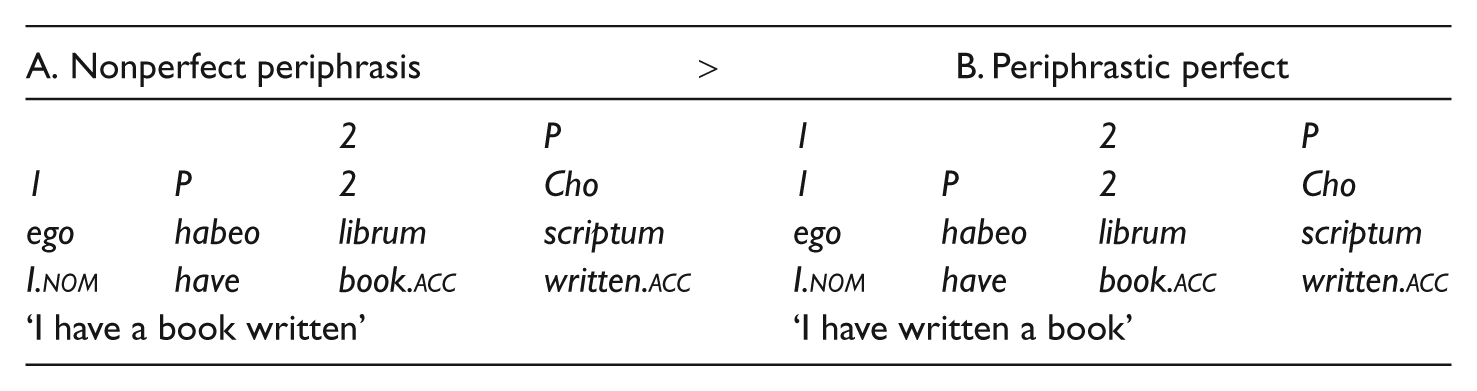
The development shown above involves a twofold change in valence. If we regard the bleaching of habeo as the catalyst, then we would say that habeo, the second predicate (the lower “P” in this framework), loses its capacity to initialize a “1” (i.e., to initialize a subject distinct from that of the participle). Consequently, the subject ego (the “1”) must be interpreted as having been initialized by the first predicate, scriptum ‘written’ (the upper “P”). Speakers of Latin accordingly revise the valence of scriptum so that it can initialize a subject just like scribo ‘I write,’ a verb in the active voice. In the resulting reanalysis (B), habeo inherits its subject (its “1”) from scriptum; it is an auxiliary. This is a perfectly coherent account, but note that we can also turn the sequence on its head: that is, under some condition the participle gains the ability to initialize a subject, and consequently habeo loses this ability.
Meyer-Lübke (1906), Vincent (1982), and Pinkster (1987) have suggested contexts that would be conducive to the reanalysis shown in (36), namely, uses of <habere + noun.
The reanalysis of the attained state type into a have-perfect had a number of reverberations, many of which are directly relevant to our discussion of the status of the have-perfect in OE. First, before the reanalysis, the attained state type appears with its three elements—have, noun.
Three Types of <habban + noun.acc + perfect participle.acc > in OE
Corpus evidence shows that the earliest OE had three types of <habban + noun.
In what follows, I include some examples that are translations from Latin because the Latin originals can help us to disambiguate between types of <habban + noun.
The following seem to be clear examples of the adnominal type, that is, instances in which the English reflex of the PIE *-no/-to participle functions adjectivally and appears in the same noun phrase as the noun. (37) hafa þe wunden gold|| þæt ær agen have. was our folk ‘Keep thou the twisted gold that was our people’s’ (38) hwæðer he . . . þa stafas mid him awritene hæfde whether he. . . the letters. ‘Whether he had with him the letters in written form’
Example (37) is an imperative with wunden ‘twisted’ appearing as a modifier of the gold to be kept, while in example (38), the sequence mid him . . . hæfde ‘had with him’ indicates physical bearing of the letters (i.e., runes). The adnominal type is rare in OE; Mitchell (1985:292) notes that instances of <habban + noun.
There are many potential examples of the attained state type, a large number of which are ambiguous between the attained state type and a resultative have-perfect with an inflected *-to/-no participle. Consider the following sentence:
(39) hie habbaþ me to hearran gecorene they have. ‘they have me chosen for (their) Lord’
This example is certainly not of the adnominal type, since the noun.
The existence of such ambiguities does not weaken the claim that there was an attained state type and that the have-perfect derives from it. Instead, they are evidence for the kind of ‘layering’ that characterizes the emergence of new grammatical forms (cf. Heine, Claudi, & Hünnemeyer 1991:20). When the new have-perfect emerged, the attained state type did not disappear, but rather persisted alongside the newly minted periphrasis. Eventually the two constructions became distinguishable by word order (i.e., they have me chosen vs. they have chosen me), but this appears to have been a later development (cf. Mitchell 1985:282-289).
Despite these obstacles to finding instances of the attained state type that are clearly distinct from resultative have-perfects, there do seem to be a few in the OE corpus. For example ((40) from Visser 1973:2189; (5) repeated here as (42)),
(40) gyt ge habbaþ eowre heortan geblende. yet ye. (41) gief we ðonne habbað sua micle sorge & sua micle if we. we both. ‘if we take as much trouble and care about our neighbors as ourselves, then we have both feet very well shod’ (42) ac ælmihtig god se milda . . . hine þa na lengc ahwænedne but almighty god the merciful . . . him. have. ‘But almighty God the merciful. . . no longer wished to keep him afflicted’
Example (40) translates Latin adhuc caecatum habetis cor vestrum ‘you still have your heart blinded.’ In the OE translation, as in the Latin original, there is an adverb meaning ‘yet, still,’ which describes the persistence of the blinded condition of the heart. From context, we can see that the subject is the agent who maintains the blinding, so an affectee reading is not possible. Moreover, since the subject maintains a degree of control over the resultant state of blindness, this looks to be an example of the attained state type, not the perfect. Note that (40) does not make sense as an adnominal since there is an important difference of control between you have [blind hearts] and you have your hearts blinded.
Sentence (41) is a translation of Latin Si ergo ut nostram, sic curam proximi gerimus, utrumque pedem per calceamentum munimus ‘Therefore if we bear the concern of a fellow man as our own, we safeguard both feet with footwear.’ This passage is part of a longer analogy between shoeing one’s feet and caring for others. If we care just for ourselves, the analogy goes, that is like having just one foot shod, but if we also concern ourselves with others, then that is like having the other foot shod as well. In any case, the equivalence between ‘we have both feet very well shod’ and ‘we safeguard both feet with footwear’ works best if the former is given an attained state type reading: the subject we maintains an active control over the state of shoeing through good behavior. As in (40), the subject must be agentive.
In example (42), the phrase þa na lengc ‘no longer’ forces an attained state reading. In this passage God keeps the emperor Theodosius in a state of affliction by allowing heresies to be perpetrated around him. Finally, God takes mercy on Theodosius and wishes to interrupt the state resulting from hine ahwænan ‘troubling him.’ Again, we see an agentive subject who maintains active control over a resultant state.
All three of these examples show the second stage of action of the attained state type (i.e., the persisting resultant state) rather than the first stage (the achievement of a result). I believe that OE examples of the attained state type showing the first stage of action are probably indistinguishable from resultative have-perfects with inflected participles. Again, I do not see this as counterevidence against the claim that the have-perfect derives from the attained state type. Indeed, we should expect to see significant overlap between the two constructions in the early history of the have-perfect.
As in Latin, OE examples of the affectee type are relatively rare. The following are examples of this type ((43) from Visser 1973:564):
(43) þa hie to ðæm gemære comon. . . þa hæfdon hie then they. their passage. ‘when they came to that border they had their passage closed’ (44) Hafað wuldres bearn his seolfes seld Has. heaven-surrounded. ‘The son of glory has his throne surrounded by the heavens’
In (43)–(44), the agent associated with the past participle is someone other than the subject of habban. In (43), for instance, the traveling group is an affectee that experiences the situation described by hiera clusan belocene ‘their passage [was] closed.’
Was the OE Have-Perfect a Genuine Perfect?
Mitchell (1985:238) observes that in OE the simple tenses (present and past) carry out more functions than their counterparts in modern English. Periphrastic forms, like the progressive <beon + present participle> and the perfect <habban + perfect participle>, exist “only in embryo.” Thus some traditional OE grammars include these periphrases in the verb paradigm (e.g., March 1873), while most do not (e.g., Sweet 1882; Wright 1914). More recently, linguistic studies of the have-perfect have remarked on the difficulty of interpreting the exact status and temporal values of the emerging periphrasis in OE (Mitchell 1985; Brinton 1988; Elsness 1997; Wischer 2002).
I agree that the OE evidence is inconclusive, but I believe that part of the confusion can be resolved by keeping in mind that, in addition to the have-perfect, there were three types of <habban + noun.
As far as determining the history of the have-perfect goes, the principal reason that the OE data are inconclusive is not the difficulty of assigning meanings to unclassifiable cases of <habban + noun.
Is there any English-internal evidence that would allow us to reconstruct the chronological development of <habban + noun.
Syntactic Tests
How can we decide whether OE <habban + perfect participle> was a genuine perfect? The answer to this question depends to some extent on our analysis of the genesis of the have-perfect, because it asks us to decide: (a) if <habban + perfect participle> can be considered distinct from its historical source according to some syntactic and semantic criteria, and (b) if <habban + perfect participle> has true perfect time reference.
First, let us consider the question of whether <habban + perfect participle> can be considered a distinct construction according to some syntactic and semantic criteria. In accounts where the have-perfect is thought to come from the adnominal type of <habban + noun.
OE examples of <habban + perfect participle> without the noun. (45) æfterðæmðe hie gesyngod habbað after-that they sinned have. (46) þa he hæfde on þæm emnete gefaren oþ then he had. he com to Ticenan he came to Ticena ‘He had gone on the plain until he came to Ticena’ (47) me . . . leanode . . . syððan mergen com ond we to me repaid after morning came and we at symble geseten hæfdon banquet sat had. ‘he [the Scyldings’-friend] repaid me when morning came and we had sat down at the banquet-board’ (48) hie. . . forð onettan oð hie gegan hæfdon they. . . forth hastened until they. to the. ‘they hastened forth until they had gone to [i.e., come to] the rampart-gate’
It is notable that <habban + perfect participle> can be formed with intransitive verbs in the earliest OE texts, since this is considered to be a late development in Latin/Romance. Some intransitive verbs like the ones in (45)–(48) also participate in the be-perfect <wesan/beon + perfect participle.
The following are examples of <habban + perfect participle> formed on transitive verbs that can take an object in the accusative case. In these examples they appear without the object expressed ((50) is from Visser 1973:285):
(49) hæfde Higelaces hilde gefrunen had.3 ‘he had heard of the warring of Hygelac’ (50) ðu hæfst alogen þam Halgan Gaste you have. (51) ða geeton hæfdon hig wunedon ðær. when eaten had. ‘when they had eaten, they remained there’ (52) þa he hæfde gedruncen þa cwæð he . . . when he.
The last two examples translate Latin cum comedissent, manserunt ibi ‘when they had eaten, they remained there’ and Latin quo hausto, dixit . . . ‘with it [the wine] finished, he said . . . .’ None of these examples can be interpreted as instances of the adnominal, attained state, or affectee types. The absence of the noun.
There are many examples of <habban + perfect participle> in which the participle does not show agreement with the noun. Examples with an inflected participle become less common with the passing of time. . . . But they are not predominant in any OE text, either prose or verse. . . . According to Harrison (1887) . . . 18 out of 114 participles are inflected in the Cura Pastoralis, 30 out of 230 in the Chronicle . . . 8 out of 70 in Napier’s Wulfstan, and 2 out of 39 in Beowulf. . . . (Mitchell 1985:284)
In the Romance languages, the loss of agreement in the perfect participle was an extended development that has still not been completed in some of the modern languages. In other words, there are modern Romance have-perfects that to this day show participle agreement under specific conditions. When we look at OE data, we may regard nonagreement of the participle as evidence that we are dealing with a have-perfect—because the adnominal, attained state, and affectee types syntactically require agreement—but as we have already seen, agreement of the participle does not help us to distinguish the have-perfect from one of the nonperfect types of <habban + noun.
Time Reference Tests
Applying syntactic criteria, we can see that there is an OE have-perfect distinct from its historical source—one type of <habban + noun.
Generally speaking, a true perfect denotes a previous situation with continuing relevance at a time specified by the tense of the auxiliary have. Previous work on perfects (Comrie 1976:56-61; Dahl 1985:133-138; Brinton 1988:10-11) has classified true perfects into as many as four types according to their meanings. These four types all exist in PDE and are as follows: (a) resultative, denoting a current state that results from past situation, as in She has arrived; (b) continuative, denoting a situation that began earlier and persists into the current moment, as in I have known him since college; (c) experiential, denoting situations that have held at least once before the present moment, as in She has been to England; and (d) perfect of recent past, denoting a situation that by its very recentness is felt to be currently relevant, as in He has just coughed. Not all languages that have a distinct true perfect express all four of the above meanings with this verbal category. For example, Castilian Spanish has a true perfect but tends to express continuative situations—those that began earlier and persist until the current moment—with the present tense.
When considering time reference, I think we can assert that OE <habban + perfect participle> is a genuine perfect if it can express any of the four true perfect meanings—resultative, continuative, experiential, or recent past. In other words, OE <habban + perfect participle> can be a true perfect without being coextensive in meaning with the PDE have-perfect, and without having the same distribution relative to the preterite as the PDE have-perfect. Thus, if we encounter instances of the OE preterite that we would translate with the PDE have-perfect, this does not entail (as some accounts suggest) that OE <habban + perfect participle> was not yet a true perfect; it merely entails that the distribution between the perfect and the preterite was not the same in OE as it is in PDE. It is useful to bear in mind the trajectory of the Romance have-perfect, which began as a resultative and encroached on several of the domains of the synthetic preterite.
We also need to bear in mind that <habban + perfect participle> can function both as a true perfect (past with current relevance) and as a relative past (past-in-the-past, or “double past”) when habban is not in the present.
10
This double function can be verified with corpus evidence, and I believe it can be explained by considering the entailments that correspond to different tenses of the auxiliary. Consider this present perfect and two pluperfects in PDE:
(53) Is John here? Yes, I think all of the guests have arrived. (54) John was certainly there at eight o’clock. All the guests had arrived by then. (55) We learned that John had arrived by car.
The present perfect in (53), the guests have arrived, describes a current state of affairs, namely, that all of the guests are here. This sentence is normally interpreted to mean that this resultant state has not yet been interrupted (i.e., the guests have not left yet—that is what makes this present perfect an appropriate answer to Is John here?). In (54), the pluperfect functions as a past-tense version of the present perfect in (53), which has current relevance. This pluperfect expresses that the resultant state was persisting during some time in the past and had not yet been interrupted. By contrast, the pluperfect in (55) is a past-in-the-past, and is noncommittal about whether the resultant state of arrived by car has been interrupted at the time of the verb learned. At the time that the action described by learned takes place, John may have already departed.
These examples suggest that the condition of continuing relevance can be strictly observed only when the auxiliary verb have is in the present tense since this is the only tense that logically entails that the state or habit described by <have + perfect participle> persists without interruption. The past-tense state or habit described by a pluperfect may be continuing in the past, in which case the pluperfect functions like a true perfect in the past, but it may also be interrupted, in which case the pluperfect functions like a relative past tense (of course, other material in the sentence will often force one or the other of these interpretations). Mutatis mutandis, the same can be said for the future perfect as for the pluperfect.
In the OE corpus, we do find examples of <habban + perfect participle> with true perfect meaning. The vast majority of these true perfects are resultative. Sentence (50), for example, is most naturally interpreted with resultative meaning: ðu hæfst alogen ‘you have lied [so now you must suffer the consequences]’; the sentence describes the persistent state that follows the event of lying (an accomplishment or achievement in aspectual terms). Note, however, that some of the examples above with the auxiliary habban in the past tense need not be interpreted as resultative perfects; they can be interpreted as relative past tenses. For example, sentences (51)–(52) use <habban + perfect participle> to translate Latin cum comedissent ‘when they had eaten’ and Latin quo hausto ‘with it [the wine] finished.’ In these translations, <habban + perfect participle> seems to be expressing nothing more than relative pastness.
Did the OE have-perfect have any values other than resultative perfect and relative past? Wischer (2007) provides interesting evidence for a continuative have-perfect and Lee (2002) argues that the OE have-perfect could express both continuative and experiential values. An apparent example of a continuative perfect (from Wischer 2007:11) is,
(56) Ic lufige god. . . þone þe min mægþhad fægre and wel gehealdon hæfð. I Iove god him who my virginity lovely and well kept has.PS.3S ‘I love God . . . who has kept my virginity lively and well’
The continuative and experiential values of the have-perfect seem to have been later developments that grew out of an original resultative meaning. There does not appear to have been a perfect of recent past during the OE period.
Where Do the Three Types of <habban + noun.acc + perfect participle> Come From?
Most scholars working on the history of the have-perfect in OE have assumed that, at the outset, <habban + noun.
Possession and Pertaining
I contend that it is unnecessary, and indeed unreasonable, to assume a restricted meaning of ‘possess’ or ‘hold’ for habban at the time when the OE have-perfect emerged. Consider the range of meanings associated with PDE have in these sentences:
(57) I have a book in my hand (physical association, ‘holding’) (58) I have a car (possessing property) (59) I have brown eyes (comprising component parts) (60) I have a sister (kinship) (61) I have a headache (experiencing a bodily condition) (62) I had a great time (experiencing an event) (63) I had a swim (performing an action) (64) I have an idea (producing an object of thought)
What “core” meaning of have can account for (57)–(64), which show just part of the versatility of PDE have? The lexicographers of the OED (s.v. have) rightly demur when they present this verb: “have . . . tends to uses in which it becomes a mere element of predication, scarcely capable of explanation apart from the context.” It is a consequence of the elasticity of have that we pay special attention to the few instances in which have yields more readily to explanation, when have means ‘hold’ or ‘possess.’ These are felt to be the full or emblematic senses of have, though sentences like (62)–(64) clearly diverge from these senses and are by no means unusual.
I do not assume that English have has always been so elastic. As reconstructed, PIE had no verb meaning ‘have,’ and possession relations were marked by means of case. English have and OE habban are reflexes of the PIE root *kap- ‘grasp’ (Watkins 2000). Latin habere and its Romance reflexes derive from the PIE root *ghabh- (also *ghebh-) ‘give or receive’ (thus despite the semantic and phonological similarity between Latin habere and OE habban, the two are not historically related; Latin habere is cognate with OE giefan, PDE give, while OE habban is cognate with Latin capere ‘take, seize’). The verbs meaning ‘have’ in OE and Latin are both reconstructed with full lexical meanings in PIE, and notably neither of these meanings is ‘hold’ or ‘possess.’
Yet OE habban, Latin habere and their reflexes undeniably mean ‘hold’ or ‘possess’ in some contexts. How do these meanings emerge from the earlier senses associated with *kap- ‘grasp’ and *ghabh- ‘give or receive’? Heine (1997) looks at possession constructions in a range of languages and observes that the linguistic expression of predicative possession tends to be conceptually and historically related to different types of propositional structures, which may be described by eight “event schemas” involving an agent (X), patient (Y), and some situation. These schemas are displayed in Table 1.
Heine’s (1997:83-108) Schemas for Predicative Possession.
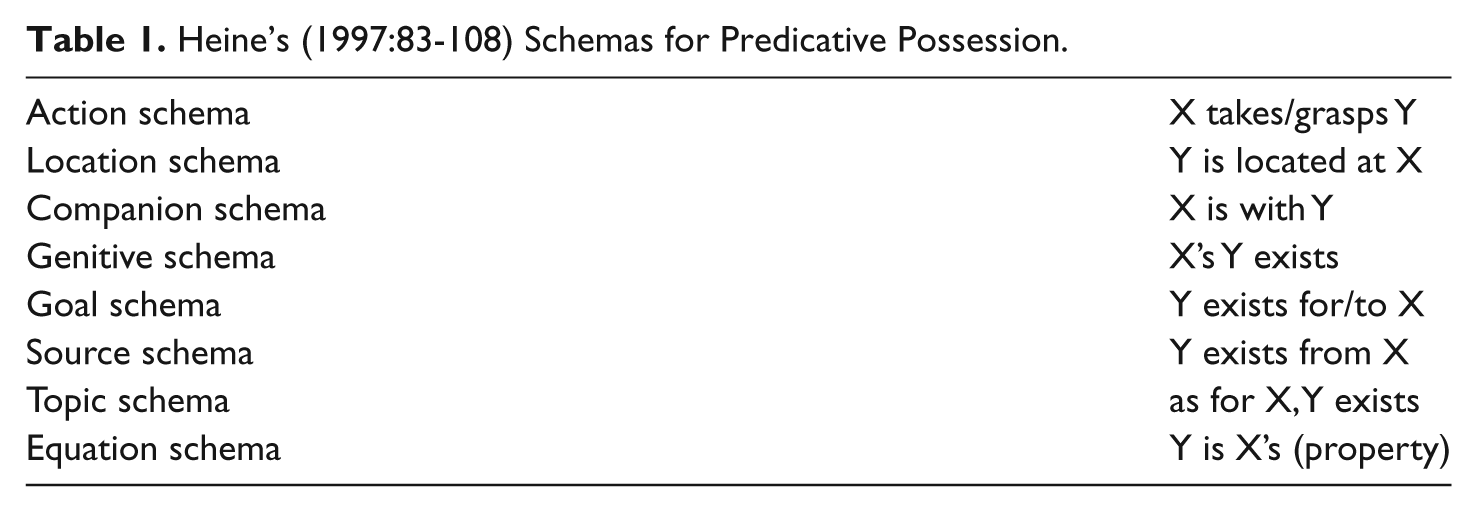
OE habban < PIE *kap- ‘grasp’ seems to be a straightforward instance of the action schema. Grasping or taking is an ingressive event that precedes a state of holding/possessing/having. Through a semantic-aspectual shift, the root *kap-, which once designated the ingressive event, came to designate the state that follows. The case of Latin habere < PIE *ghabh- ‘give or receive’ is more complex. The two reconstructed meanings, ‘give’ and ‘receive,’ are both associated with a transfer of possession, but imply opposite points of view. I am inclined to think that in this case we simply do not know the “original” signification of the reconstructed PIE root *ghabh-, though we believe it had to do with transfer of possession. As one anonymous reviewer points out, the kind of confused usage seen in PDE borrow/lend and rent/let may have been instrumental in the development of PIE *ghabh-.
It is worthwhile to investigate the development not only of the meanings ‘possess’ and ‘hold,’ but also of all the meanings of have that are, per the OED (s.v. have), “scarcely capable of explanation apart from the context.” How can we begin to explain the meaning of OE habban in such collocations as sorge habban ‘have sorrow, grieve,’ geþeaht habban ‘take council,’ and weg habban ‘make a journey’ (cf. Akimoto & Brinton 1999:42-44)? How do we account for the fact that in the earliest OE, habban can mean not only ‘hold’ and ‘possess’ but also ‘keep at one’s disposal,’ ‘have as kin,’ ‘bear,’ ‘contain,’ ‘comprise as a subordinate part,’ ‘have as an attribute or quality,’ ‘get, come into possession of,’ ‘experience, enjoy or suffer,’ ‘consider, regard as,’ ‘assert,’ and more (OED s.v. have)?
The OE action schema with habban is not unique in its ability to express such varied notions as holding, kinship and experience. Heine (1997) observes that languages regularly use one or more of their possession schemas to express such dissimilar ideas as ‘Mary has a pen in her hand,’ ‘Mary has a father’ and ‘Mary has trouble with her homework.’ Can we define the core characteristic(s) of predicative possession that would explain this variety? Heine entertains a number of alternatives—such as control, influence, proximity, or interest—to account for these varied uses, and concludes that no characteristic is entirely satisfactory.
But even in the absence of a concise formula for predicative possession, we can generally describe what possession is. The relation of possession is subjectively created in speakers’ minds, and is constrained by culturally transmitted knowledge about the world. It is an abstract, asymmetrical relation: speakers conceive of a “minor” member as connected to a “major” member in the form of an appendage, accessory, dependent, attribute, adjunct, duty, concern, experience, product, and so on. Being the “major” or “minor” member in a possession relation is not inherent in the physical world, though it may correlate to some material fact, such as relative position or size. Possession is essentially a stative relation, though it may be imagined to have a punctual beginning (the moment of taking, receiving, being affected, etc.).
The above description, broad as it is, still does not account for all of the uses of predicative possession schemas. Cross-linguistically these schemas appear not only with a simple possessum (e.g., Mary has a father) but also with a situation that pertains to or befalls the “possessor” (e.g., Mary had a rock thrown at her). In many cases we are no longer looking just at possession, but at a wider class of relations, which we might call “relations of pertaining.” How can we characterize these relations of pertaining? They link an entity (i.e., an argument, like father) or a situation (an argument plus a predicate, like rock thrown) to another entity. Relations of pertaining are subjectively created and abstract, just as the more specific subclass of possession is. Like possession, they are also asymmetrical: something belongs to or befalls the “major” member of the relation, but not vice versa. While possession is essentially stative, relations of pertaining may be stative or eventive, depending on the aspectual properties of the “minor” member. For example, the English sentence Mary had a rock thrown at her expresses that a subject is affected by a dynamic event because rock thrown denotes a dynamic event.
How the Adnominal, Attained State, and Affectee Types Develop
The adnominal type of <habban + noun.
There are historical developments in Romance that show how the attained state and affectee types with habban might have arisen. In Latin, there is a neat alternation between the goal schema (with esse ‘be’ + a dative argument) and the action schema (with habeo ‘have’); both appear as possession constructions, and both can co-occur with a perfect participle, as in,
(65) nunc (id) certum est mihi Now it. ‘I now have it resolved’ literally ‘Now it is resolved for me’ (66) dicam de istis graecis suo loco, Marce say.
Example (65) is a periphrastic passive perfect with a dative of interest. The dative case in Latin, in addition to marking indirect objects and possessors, can mark the person interested in a situation and even the agent of the action. In passive perfect constructions, the agent (if expressed) regularly appears in the dative case (Woodcock 1959:159-162).
Example (66)—an example of the attained state type in Latin—mimics (65), except that the action schema (habeo ‘I have’) is used in place of the goal schema (est ‘it is’ + noun.
Now consider two further developments that have affected Portuguese. In medieval Portuguese, ter (< Latin tenere ‘hold’) replaced aver (< Latin habere ‘have’) as the unmarked verb of possession in “action” constructions. In modern Portuguese, the action schema with ter is the least marked way to express possession predicatively. The verb ter also participates in the attained state and affectee types of <have + noun. (67) tenho o problema resolvido have. ‘I have the problem solved’
More recently, Portuguese has innovated a new way to predicate possession, estar com, which is an instance of Heine’s (1997) “companion schema”—X is with Y. For example,
(68) estou com um problema am. ‘I have a problem’
The estar com construction can predicate not only possession, as in (68), but also that a situation befalls someone:
(69) já estou com o problema resolvido already am. ‘I already have the problem solved’
Sentences like (69) have the same meaning as the attained state type of <have + noun.
These developments in Latin and Portuguese suggest that in the history of a language, innovative possession schemas can take on the broad range of functions carried out by existing possession schemas. In the history of English, as in Latin, the action schema was an innovation, since PIE is not reconstructed with a verb meaning ‘possess.’ We have seen that in Latin, a productive goal schema was used to predicate possession, and that this goal schema also co-occurred with perfect participles. The action schema with habere ‘have’ seems to have assumed many of the functions previously carried out by the goal schema. For centuries the two coexisted, and eventually one type of <habere + perfect participle> developed into a perfect. In OE, there is a goal schema, too—a possessor could be marked with a dative—but there is nothing comparable to the robust “dative of agent” of Latin. Thus, it is difficult, in OE, to see a clear parallel between the goal schema and the action schema in contexts where perfect participles appear. Nevertheless, it seems likely that the attained state and affectee types of <habban + noun.
We now consider a plausible sequence for the development of the attained state and affectee types, and ultimately the have-perfect.
A Chronological Sequence of the Development of the Have-Perfect
The following is a six-stage sequence describing what I believe were the principal steps in the formation of the have-perfect. The sequence spans PIE and OE, but I have put all of the forms in OE for consistency and convenience; some of the forms will therefore be anachronistic in the discussion that follows.
Boc (ge)writen ‘written book, book having been written’
Boc (ge)writen is ‘a book is written; a book has been written’
Boc (ge)writen is me ‘a book is written to/for me; a book is written and I am affected’
Ic hæbbe boc gewritene ‘a book is written and I am affected’
Ic hæbbe boc gewritene ‘I have a book written’ (attained state type)
Ic hæbbe boc gewritene ‘I have written a book’
In the earliest stage, stage (i), a noun may combine syntactically with a *-to/-no adjective. When attached to verbal stems, the suffixes *-to and *-no formed adjectives expressing “the accomplishment of the notion of the base” (Watkins 2000:93). These suffixes could also be combined with nominal stems to form adjectives with the sense of ‘pertaining to,’ ‘having the nature of,’ ‘possessed of,’ for example, wullen ‘woolen,’ eorþen ‘earthen,’ gylden ‘golden,’ hringede ‘ringed,’ hocede ‘hooked.’
Scholars of PIE have traditionally regarded *-to/-no adjectives as separate from the verbal system in the proto-language because they take nominal morphology and lack both voice and temporal reference (though they tend to suggest anteriority). As Drinka (2007) argues, however, these adjectives display verbal “potentialities”—like anteriority and passivity—and therefore certain periphrastic constructions with *-to/-no adjectives may be much older than once believed. It is noteworthy that *-to/-no adjectives have been incorporated into the verbal systems of Germanic, Italic, Celtic, Baltic, Slavic, and Indo-Iranian in the form of periphrastic passives, resultatives, and perfects.
A noun combining with a *-to/-no adjective would normally be interpreted as the object of the underlying verb, e.g., wunden gold ‘twisted gold’ in (37). Like other adjectives, a *-to/-no adjective originally inflected for number, gender, and case only. These *-to/-no forms became verbal once they clearly took on passive and anterior meanings. For Sihler (1995:622), the development of the perfect value is an implicature-turned-entailment: *-to/-no adjectives were originally stative but suggested an accomplishment by virtue of the changed state of the object (e.g., wunden ‘twisted, having been twisted’); they first implied, then later entailed, the event preceding the changed state.
Stage (ii) is ushered in by the creation of a periphrasis with the form <beon/wesan + perfect participle>. The *-to/-no adjective has become a participle, and the periphrasis as a whole has an identifiable voice and temporal reference. In OE, we see a two-way split in this periphrasis: for transitive verbs, <beon/wesan + perfect participle> is normally a passive construction in the present (cf. Mitchell 1985:315-319), while for intransitives, <beon/wesan + perfect participle> is an active construction in the past. As the participial function of the *-to/-no adjective developed, a further split occurred, this one structural: in Germanic the *-no adjectives became the preferred form for the participles of strong verbs, for example, OE wunden, while the *-to adjectives became the preferred form for weak verbs, for example, OE geblende (Drinka 2007:146). Other Indo-European languages show different distributions; in Latin, for example, the *-to suffix became extremely productive as the maker of the perfect passive participle, while *-no remained purely adjectival.
In stage (iii), which would have followed immediately on the heels of stage (ii), a dative of interest is added to the periphrasis. Across the Indo-European languages, the dative case marks human participants who receive (eventive value) or possess (stative value) something through a situation (Quiles & López-Menchero 2009:289). ‘Receive’ is a broad notion that can include experiencing and undergoing, and so sentences like Boc (ge)writen is me have a range of possible interpretations in the neighborhood of ‘a book is written to/for me; a book is written and I am affected.’
To reach stage (iv), speakers proceed by analogy. The OE goal schema (is me ‘is to-me’) is felt to be similar enough to the action schema (Ic hæbbe) that one can replace the other in this context. Though the two are similar in meaning, the sentence Boc (ge)writen is me differs in information structure from Ic hæbbe boc gewritene, and so the pair probably function as pragmatic alternatives (this is what happened for centuries in Latin). The former highlights the object, while the latter highlights the affected subject.
Once the sentence Ic hæbbe boc gewritene ‘The book is written and I am affected’ is available, speakers may begin to distinguish between kinds of affectedness in the highlighted subject. If the subject of hæbbe is assigned a thematic role like beneficiary, sufferer, recipient, and so on, then the whole construction has the value of the affectee type. If, on the other hand, the subject of hæbbe is a kind of experiencer for whom the experience is one of actively completing the action (we might call this “attainer”) then the construction has the value of the attained state type. The creation of these two distinct types is stage (v).
Stage (vi) results from the reanalysis of the attained state type into a resultative perfect, a development already discussed at length above. OE is first attested after reaching stage (vi), though it shows some evidence of the previous stages.
Conclusion
In both English and Romance, the periphrastic perfect happened to emerge from the periphrasis with have, and not from the parallel one with be and a dative of interest. But I maintain that there is nothing special about have per se, and that the periphrastic perfect could just as easily have come from a reanalysis of something like stage (iii) above. Indeed, there are languages in which the periphrastic perfect or past tense results from the reanalysis of a goal schema with an associated passive or perfect participle: Benveniste (1966) shows that in Ancient Egyptian, the perfect of transitive verbs has such a source, and Hetzron (1969) shows the same for the past tense in Syriac. Benveniste (1966) and Cardona (1970) show that still other schemas for predicative possession have been exploited to create perfects and past tenses in Armenian and Persian, respectively.
I concur with Benveniste (1966) that the *-to/-no participle is the key to the have-perfect in both Germanic and Romance. Indeed, it seems remarkable that the *-to and *-no suffixes already express both something of anteriority (when combined with verbal stems) and something of pertaining/possession (when combined with nominal stems) in PIE. Perhaps they are grammaticalized vestiges of earlier constructions that might reveal something further about the origins of the periphrastic have- and be-perfects.
At the beginning of this article, I noted that the copious literature on the have-perfect has left two issues unclear: the structure(s) and meaning(s) of <habban + noun.
Because the attained state type does not involve habban with a sense of ‘possess’ or ‘hold,’ the connection with possession turns out to be indirect. Moreover, given the range of functions normally carried out by predicate possession schemas, it seems quite unlikely that the meaning of habban ever narrowed to just ‘possess’ and ‘hold’ during its long history. OE habban, an instantiation of Heine’s action schema, expressed not only possession, but more generally relations of pertaining, befalling, belonging, and so on, which link an entity (i.e., an argument) or a situation (an argument plus a predicate) to another entity. I maintain that it was precisely because habban could express these broad relations of pertaining that the attained state and affectee types were possible. Thus, the have-perfect did not emerge as a result of bleaching a narrowly possessive habban, but rather as a result of a more modest change: the reanalysis of one kind of resultative construction into another.
Footnotes
Declaration of Conflicting Interests
The author(s) declared no potential conflicts of interest with respect to the research, authorship, and/or publication of this article.
Funding
The author(s) declared the receipt of the following financial support for the research, authorship, and/or publication of this article: The research presented here was begun under the auspices of an NSF graduate research fellowship, and was completed with an institutional grant from The Evergreen State College.