




Abstract
This article argues that historical linguistic change is mediated by register differences at a highly specific level. As a result, seemingly minor differences in register can correspond to meaningful and systematic differences in the patterns of linguistic change. Two specific case studies of twentieth-century historical change are presented. The first explores variation among sub-registers of news reportage, comparing the patterns of change in magazine articles from Time magazine to those found in newspaper articles from the New York Times. This case study shows that the differing readerships and purposes of magazines versus newspapers result in different historical-linguistic patterns of use. The second case study then explores variation among sub-registers of academic research writing. This study shows how differences associated with academic discipline (science vs. social science vs. humanities) correspond to systematically different trends in historical change. Even more surprising, this study shows that science articles published in journals aimed at multidisciplinary audiences differ from articles published in journals targeted toward specialized audiences. In the conclusion, we briefly consider the theoretical issue of whether these case studies illustrate historical change within a register or change to new registers. However, the primary goal of the article is methodological, to argue for more attention to register differences in corpus-based historical research.
Keywords
The Role of Register in Historical Research
Over the past decade, numerous studies of linguistic variation and change in English have been carried out using corpus-based analyses. In most cases, the corpora used for such studies have been constructed reflecting two major design considerations: size and coverage of registers. General purpose corpora, like the Brown Corpus, the British National Corpus, and the Corpus of Contemporary American English, differ in size, but they are all similar in their inclusion of a range of registers.
The coverage of registers is typically given even more weight in the design of historical corpora (see http://www.helsinki.fi/varieng/CoRD/corpora/index.html). For example, the Brown family of corpora are constructed to have the exact same coverage of written registers (e.g., press reportage, press editorials, skills and hobbies, popular lore, learned, general fiction, adventure, and western fiction) across samples from different years in the twentieth century (1931, 1961, 1991). Similarly, the ARCHER corpus is constructed to represent a range of written and speech-based corpora (e.g., medical prose, science prose, newspaper reportage, fiction, personal letters, diaries, drama) in fifty-year historical periods from 1650 to 1990. The much larger Corpus of Historical American English (COHA) is structured around four major register categories (fiction, magazines, newspapers, and nonfiction books) with a continuous sample across years from 1810 to 2009 (Davies 2010–).
Many other historical corpora are designed to represent a particular register, such as the Corpus of English Dialogues (1560–1760), the Corpus of Early English Medical Writing (1375–1800), and the Corpus of English Religious Prose (1500–1699). These corpora give special attention to register, categorizing texts for specific “sub-registers.”1 So, for example, the texts in the Corpus of Early Modern English Medical Writing (EMEMT) are categorized for sub-registers such as scientific journals, general treatises or textbooks, surgical and anatomical treatises, recipe collections, and health guides (Taavitsainen & Pahta 2010). An alternative approach was used for the construction of the TIME Magazine Corpus, which focuses on a single register/genre but includes nearly a 100 percent sample of texts from the magazine for the period 1923–2006 (Davies 2007).
Not surprisingly, the researchers who have given the most attention to register differences in corpus construction are also the researchers who have systematically considered those differences in their linguistic analyses. So, for example, Culpeper and Kytö (2010) compare the registers of trial proceedings, witness depositions, play texts, and dialogue in prose fiction as part of their more general analysis of historical change in “spoken” English dialogues. Similarly, the chapters in Taavitsainen and Pahta (2010, 2011) document the linguistic characteristics of specific sub-registers like surgical treatises versus recipe collections in their description of historical change in English medical writing.
In many other cases, though, researchers have been interested in general historical change in English, attempting to chart developments for the language as a whole. These researchers have disregarded register differences even when they are encoded in the corpora used for analysis. In such analyses, the inclusion of multiple registers in a corpus is considered to be a necessary requirement to achieve representation of the language in general, with the assumption that a corpus with this design enables analysis of overall historical developments in English.
A recent exchange of articles between Geoffrey Leech and Neil Millar is informative in this regard. Leech (2003), based on analysis of the Brown family of corpora (1961 and 1991), concludes that modal verbs are declining in English. Millar (2009), based on analysis of the much larger TIME Corpus, argues that Leech is wrong and that at least some modals are increasing in use in English. Leech (2011), based on analysis of COHA, argues that Millar is wrong and that the modal verbs really are declining in English.
The interesting consideration for our purposes here is that both Leech and Millar want to make generalizations about language change for English as a whole. They both assume that their corpora represent English, providing the basis for general conclusions about historical change in the language. Thus, Leech (2003) argues that the Brown family of corpora are “balanced” and have matched designs (equivalent samples for the same register categories) across historical periods, and thus they can be used to track general historical change in English. Millar (2009) criticizes the 2003 study, noting that the Brown family of corpora are relatively small and sampled from only two years (1961 and 1991); in contrast, the TIME Corpus is much larger, and sampled continuously across years from 1923 to 2006. Millar finds an increasing use of modal verbs in the TIME Corpus and concludes that this provides a more accurate picture of the overall trend for English. Finally, Leech (2011) counters that Millar’s study is based on only a single register—Time magazine—and therefore the increasing use documented for that corpus does not represent the actual (declining) trend for the language as a whole. Leech addresses the possible importance of register differences, noting that Millar’s analysis has limited generalizability because it represents change in only a single specific register (Leech 2011:549-550). But he does not otherwise consider register differences, arguing instead that balanced multiregister corpora can be used to represent overall change in the language as a whole.
Our point here is not to disagree with Leech’s claim that modals are decreasing in use. In fact, Biber (2004:118) shows this same trend for both written and speech-based registers in the ARCHER corpus. Rather, our main goal here is to challenge the assumption that historical change should be documented for the language as a whole. We argue instead that register is crucially important as a mediating factor for historical developments, that change should be studied relative to particular registers, rather than attempting a kind of average for English.
We support this claim through consideration of historical change within the register domains of news reportage and academic prose, focusing mostly on the increasing use of “literate” linguistic features associated with structural compression. Several previous studies have focused on the opposite trend: the increasing use of colloquial linguistic forms in English written registers over the past two centuries. That is, written registers have shown an increasing use of lexical and grammatical features associated with conversation, such as first person pronouns, contractions, and semimodals (e.g., be going to, have to). This trend, which has accelerated in the twentieth century, has been referred to as the “drift” of written registers toward more “oral” styles (Biber & Finegan 1989), “informalization” (Fairclough 1992), and “colloquialization” (Hundt & Mair 1999; Mair 2006; Leech et al. 2009).
Earlier investigations of these patterns suggested that they represent a general historical trend for written English as a whole. However, subsequent investigations have shown that there are important differences among written registers, in that some written registers have not participated in this historical drift. For example, Biber and Finegan (1997/2001) show that written registers like fictional novels and personal letters have been strongly influenced by the shift to more colloquial linguistic styles, but written academic registers have not participated in these changes. Hundt and Mair (1999) also note this difference, distinguishing between “agile” written registers (e.g., newspaper prose) that are receptive to these changes, and “uptight” written registers (e.g., academic prose) that resist such changes.
More recent studies show that the patterns of historical change are actually more complicated. In particular, it is not accurate to describe academic prose as conservative and resistant to change. In fact, academic research writing has been the locus of other historical linguistic changes that are at least as noteworthy. Rather than increasing in the use of “colloquial” linguistic features, academic prose has changed historically to become more “compressed,” relying on noun phrase structures rather than clauses, and relying heavily on phrasal (rather than clausal) modification (see, e.g., Halliday & Martin 1993/1996; Mair 2006; Biber & Clark 2002; Biber 2009; Biber & Conrad 2009; Leech et al. 2009; Biber & Gray 2010, 2011).
Following Hundt and Mair (1999), we regard news writing and academic prose as especially interesting registers with respect to the historical trends of colloquialization and compression. News writing is interesting because it has been influenced by both historical trends, becoming both more colloquial and more compressed (Biber & Gray 2012; see further details below). Academic prose is interesting because the historical changes toward grammatical compression are more pronounced in this register than probably any other register in English (see Biber & Gray 2010, 2011). For both registers, these have been rapid historical developments, occurring especially over the past one hundred years.
These findings support the claim that register differences are crucially important for understanding grammatical change. In the present article, we argue that such differences are even more important than we had previously recognized—that even specific sub-registers differ in pervasive and systematic ways in their historical development.
The Dilemma for Corpus Construction: Size versus Careful Text Selection
One methodological challenge for tracking grammatical change is the limited availability of historical corpora that are both large and sampled carefully with detailed register information. For example, the ARCHER corpus (see, e.g., Biber, Finegan & Atkinson 1994; Biber & Finegan 1997/2001) was designed to carefully represent different register categories (e.g., drama, personal letters, diaries, newspaper reportage, medical research writing). However, ARCHER is limited with respect to size: the corpus is structured in terms of fifty-year periods, and each register is represented by only ten text samples per historical period. The corpus has been expanded considerably in recent years (see Yáñez-Bouza 2011), but it is still mostly designed for the analysis of long-term grammatical change across registers, rather than detailed lexical descriptions of real-time change. The Brown family of corpora has been designed with similar priorities: careful attention to the selection of individual texts representing particular registers, but relatively small size (one million words and five hundred text samples in each corpus; see Leech et al. 2009).
In contrast, more recently constructed corpora like COHA (Davies 2010–) and American Google Books (Davies 2011–) are extremely large (COHA comprises 400 million words; American Google Books comprises 155 billion words). Such corpora permit analysis of historical change on a scale not imaginable with earlier corpus designs, allowing for a nearly continuous tracking of change across time, and the analysis of historical patterns for individual words as well as grammatical features (see Davies in press-a, in press-b). However, it is not feasible to verify the specific register classification of individual texts in a corpus of this size, making these corpora somewhat less suitable for detailed investigations of registers and register variation. For example, while these large corpora specify general register categories for these texts (e.g., newspaper articles or academic writing), less attention is provided concerning the specific sub-registers of texts within these relatively broad categories.
The challenge for corpus-based historical analyses is to balance both considerations. But in the past, the difficulty in obtaining suitable historical corpora for detailed analyses has sometimes resulted in historical comparisons that are not well controlled for register. Our primary goal in the present article is to show how this practice can lead to inaccurate conclusions; in fact, even minor register differences can sometimes confound historical comparisons.
The problem can be illustrated with an unpublished historical study that we carried out several years ago. The goal of that study was to track historical change in written news reportage, with a particular focus on the patterns of change in the twentieth century. We began our investigation with the newspaper sub-corpus from ARCHER, which included ten news reportage text samples from British English newspapers published in the first half of each century and twenty text samples published in the second half of each century (ten British English and ten American English). In previous studies, the news sub-corpus from ARCHER had been used to track major grammatical developments in news reportage over the past three centuries (see, e.g., Biber & Clark 2002; Biber 2003), but we concluded that this sampling was not adequate to provide the basis for detailed investigations of change in the twentieth century. For this reason, we supplemented the twentieth-century sub-corpus from ARCHER with a relatively large sample of twentieth-century news reportage articles from Time magazine. The combined corpus included two hundred articles published in five specific years: 1925, 1945, 1965, 1985, and 2005 (i.e., one thousand articles total). We checked these articles by hand to include only news reportage texts (i.e., excluding editorials, essays, etc.). Our expectation was that we could combine the newspaper texts from ARCHER with the news reports from Time to provide a more detailed account of historical change in the twentieth-century news reportage (while also using the eighteenth- and nineteenth-century samples from ARCHER to see the longer-term trends in newspaper reportage).
Figure 1 shows the kinds of findings resulting from this analysis, tracking the use of that complement clauses controlled by verbs (as in 1) and finite adverbial clauses (as in 2):
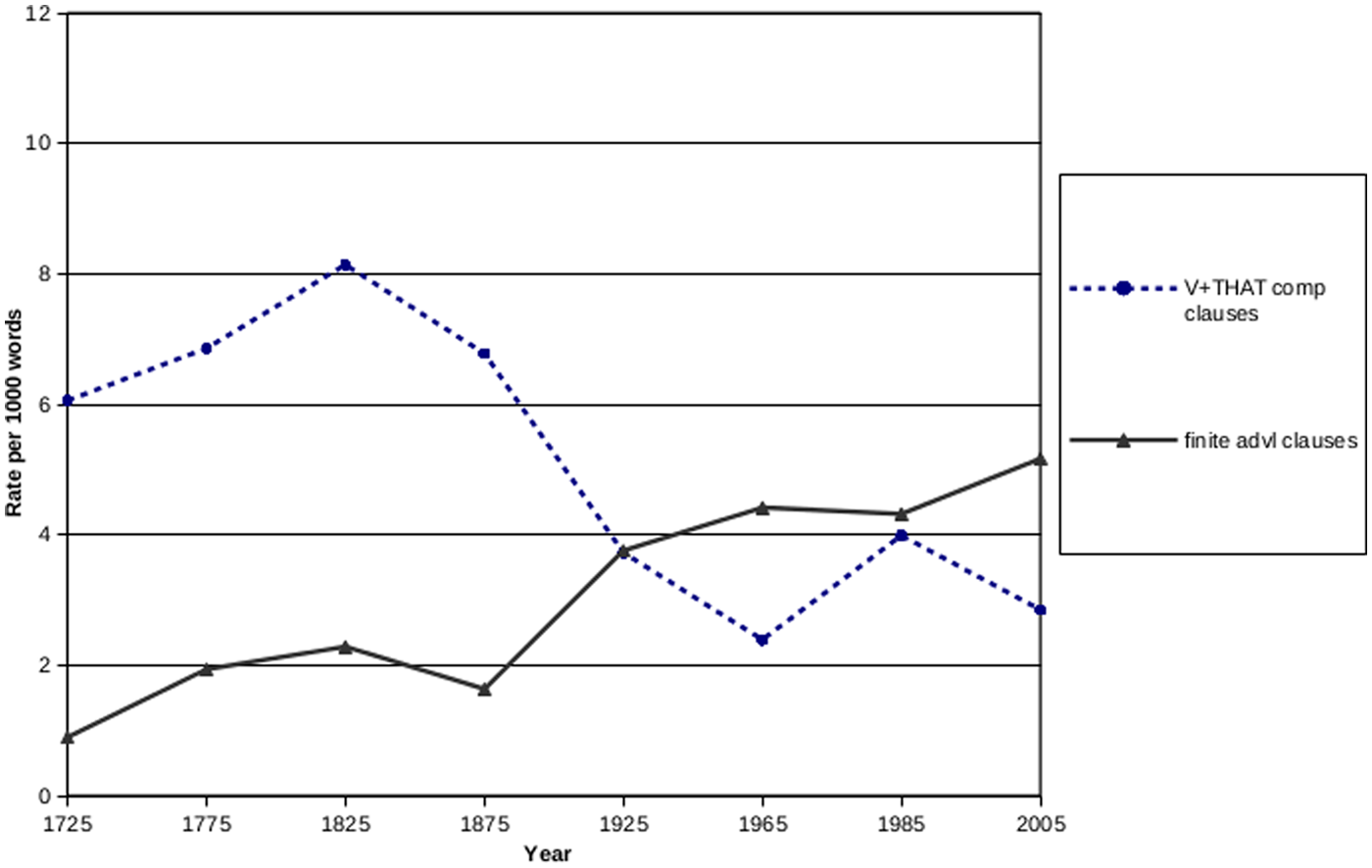
Finite dependent clauses in written news reportage (ARCHER and TIME combined).
(1) Admiral Alexeieff
(2) such an occupation would be very advantageous to Russia
The most notable changes shown in Figure 1 occurred between 1875 and 1925, with a fairly dramatic decrease in that-clauses and a relatively large increase in adverbial clauses.
However, it turns out that this apparent historical change is confounded by the sub-register difference between news reports in newspapers versus news reports in Time magazine. Figure 2 displays the same data for that-clauses as Figure 1, except the ARCHER newspaper texts are plotted separately from the Time magazine articles. Figure 2 shows that there is a large difference even in 1985 between the relatively frequent use of that-clauses in newspaper articles versus the considerably less frequent use of this feature in Time magazine. The apparent historical decrease in the use of this feature that was seen in Figure 1 is actually due to the addition of the Time magazine sample, rather than representing an actual historical change in newspaper writing. That is, when the data for ARCHER and Time are considered separately for 1985 in Figure 2, it appears that the use of that-clause constructions has remained relatively constant over time. Similarly, Figure 3 shows that there has been a small and gradual increase in the use of finite adverbial clauses in both newspaper articles and Time magazine articles. However, the apparent large increase in use between 1875 and 1925 shown in Figure 1 actually reflects the addition of the Time magazine sample (which exhibits consistently higher frequencies of adverbial clauses than ARCHER newspapers), rather than a genuine historical change in news reportage generally.

Finite that complement clauses in ARCHER (newspapers) versus Time magazine.

Finite adverbial clauses in ARCHER (newspapers) versus Time magazine.
We later stumbled across a similar discrepancy in our analyses of academic writing. Similar to our investigations of historical change in newspaper writing, we initiated our historical studies of academic writing with the ARCHER corpus, and then supplemented that with additional texts. When the ARCHER corpus was constructed, the sampling for scientific academic writing was considered to be one of the least problematic registers because there is a continuous record of publication for the Philosophical Transactions of the Royal Society of London (PT) from 1665 to the present day (see Atkinson 1999). Thus, ARCHER relies solely on PT articles to represent science writing. In some more recent studies, we supplemented the ARCHER corpus with a larger sample of twentieth-century scientific research articles from specialist journals (see, e.g., Biber & Gray 2010). Although it was not the intended goal of our investigation, we began to notice consistent differences in the linguistic styles of specialist science research articles (i.e., articles published in journals aimed at highly specific and specialized disciplines and/or subdisciplines) versus the articles published in PT.
Although we both specialize in the study of register variation, we were quite surprised by these findings. In the case of news, we had carefully selected news reportage articles from Time magazine, and our expectation was that those texts represented the same register as news reportage articles from newspapers. However, the research findings displayed in Figures 2 and 3 strongly suggest that this expectation was wrong—that instead, minor differences in audience, purpose, and perhaps editorial policy have resulted in systematic differences in the use of linguistic features. Similarly, we had simply assumed that academic science writing in PT was the same register as academic science writing in specialist research journals. And here again, those assumptions were challenged by our empirical linguistic comparisons (likewise associated with differences in audience and purpose).
The present study explores such differences in more detail, investigating the extent to which historical change is mediated by specific sub-register patterns. We base our analyses on relatively large corpora of sub-registers within news reportage and within academic prose (described in detail below). Our goal was to construct strong tests of the hypothesis that sub-register plays a fundamentally important role for understanding historical grammatical change, by comparing sub-registers that are minimally different in their situational characteristics. As the following sections show, this hypothesis is clearly supported by the linguistic development of a range of grammatical features over the past two centuries.
Historical Development in News Reportage
Corpus and Method
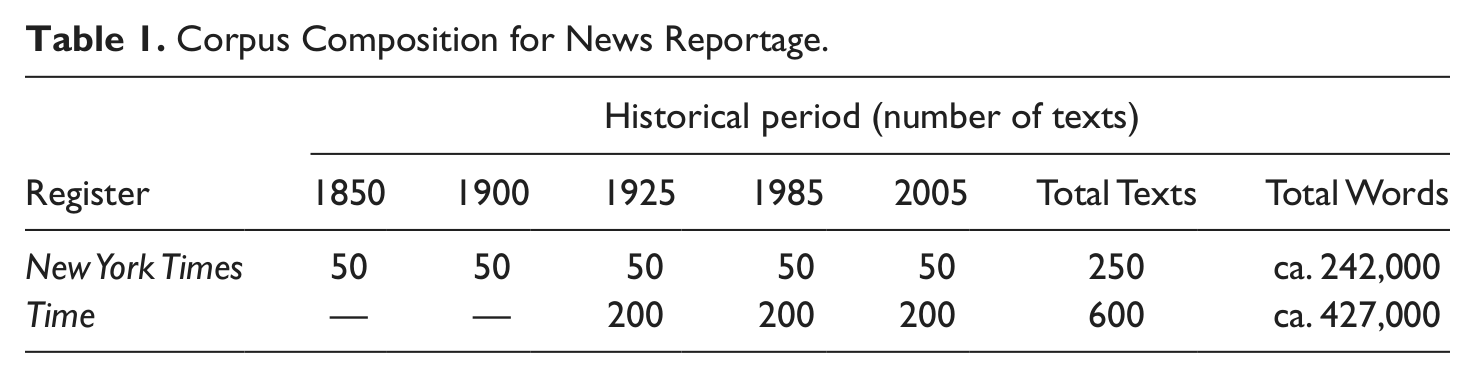
To analyze historical change in news reportage, we constructed a corpus representing two sub-registers: newspaper articles and news magazine articles (see Table 1). Newspaper articles are taken from the New York Times (NYT). Five periods are included in this sub-corpus: 1850, 1900, 1925, 1985, and 2005. Magazine articles that report on current news are taken from Time magazine, which was first published in 1923. Thus, our Time sub-corpus includes articles from three historical periods over the past eighty years—1925, 1985, and 2005—allowing for direct comparison with NYT in those periods. 2
Corpus Composition for News Reportage.
We followed the same analytical methods for both the case study of news reportage as well as the subsequent case study of academic writing. First, all texts were “tagged” using the Biber automatic grammatical tagger (see Biber 1988; Biber et al. 1999). Additional computer programs were written to calculate rates of occurrence for linguistic features associated with colloquialization and compression (see below). Then rates of occurrence were calculated for each text in the corpus by “norming” the raw counts for each linguistic feature to a standard rate per one thousand words (see Biber, Conrad, & Reppen 1998:263-264). Both case studies employ a “Type B” design, in which each text is treated as an observation (see Biber & Jones 2008:1298-1300; Biber 2012). This design allowed us to compute mean rates of occurrence and standard deviations of linguistic features for each register in each historical period and to also use standard inferential statistics (ANOVA) to test for significant differences among those mean scores.
Twentieth-Century Patterns of Change in News Reportage
In the present section, we consider four linguistic features that have been undergoing rapid change in use over the course of the twentieth century: direct and indirect quoted language, passive voice verbs, noun + of-phrase, and noun–noun sequences. The analyses presented below show that there are systematic differences between news sub-registers in the development of these features. In most cases, news reports in NYT are more innovative than news reports in Time. That is, NYT shifts to an innovative use of these linguistic features earlier than Time, and in most cases, NYT persists in using these features to a greater extent in later historical periods.
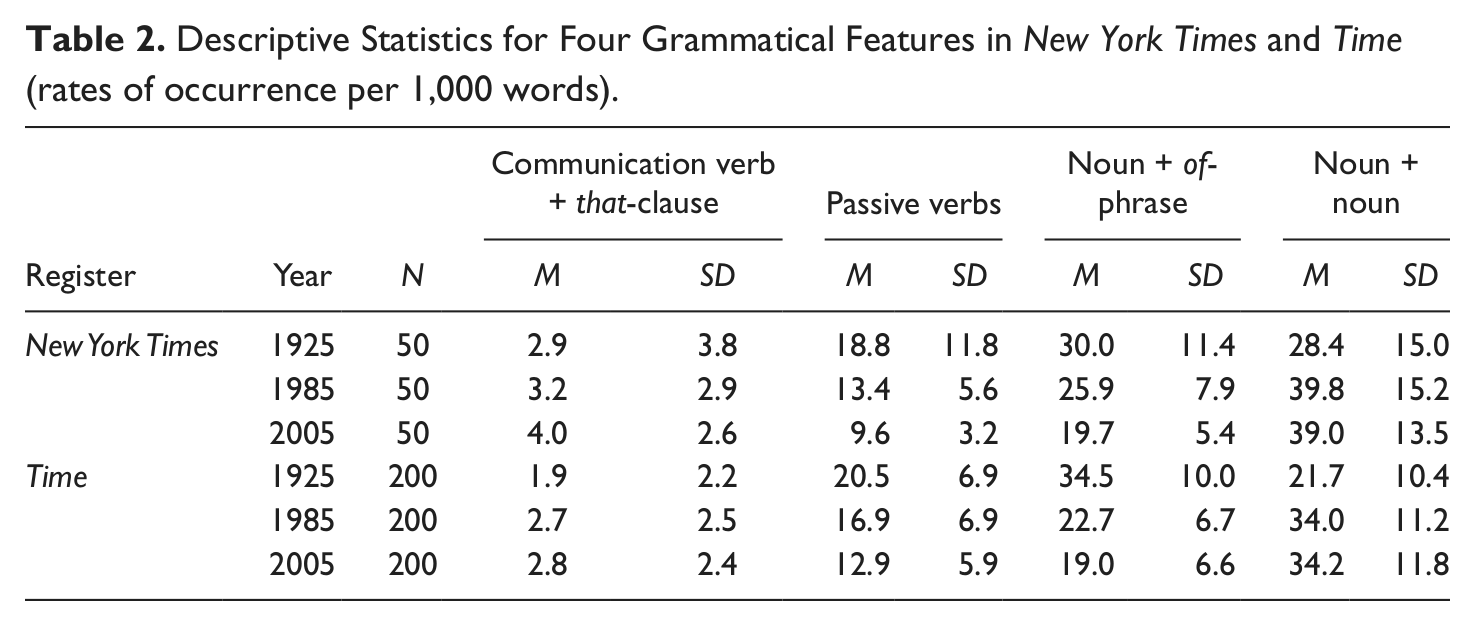
Table 2 gives descriptive statistics (mean and standard deviation) for each feature in each register and time period. Table 3 provides the results from a factorial ANOVA, testing the statistical significance of the differences in mean scores between sub-registers and across time periods.
Descriptive Statistics for Four Grammatical Features in New York Times and Time (rates of occurrence per 1,000 words).
Summary of the ANOVA Factorial Models for News Reportage Sub-registers.

Speech (and written communication) is reported through the use of two structural devices: direct quotes and indirect reports with that-clauses controlled by communication verbs (e.g., said that . . .). As Figure 4 shows, both structures have increased in use over the course of the twentieth century. The increase for that-clauses has been gradual, but in general, NYT has been more innovative than Time (in any given year, NYT uses that-clauses to a greater extent than Time). In contrast, Time magazine in its earliest years was more innovative in its use of direct quotes. NYT followed the lead in this case, matching the style of Time by the 1980s, and then employing direct quotes to a greater extent than Time by 2005.

Direct and indirect quoted speech in New York Times versus Time.
Text Sample 1 illustrates the frequent use of both indirect reported language and direct quotes in present-day NYT reportage:
Text Sample 1
Eight former executives of the accounting firm KPMG and one outside lawyer have been indicted on charges stemming from their role in designing and selling questionable tax shelters. Yet so far, no court has One tax shelter promoter has asked a federal judge in San Francisco to tackle that very question: the legality of the shelters. And federal prosecutors in Manhattan appear to be worried that the judge might do that. Lawyers for the government have twice . . . The defendants in New York are awaiting the government’s response—due next week in the federal court in San Francisco—to the summary judgment motion filed in the civil case brought by the shelter promoter Lawyers for the government “The court cannot decide the narrow legal issue presented in the delicately crafted motion for summary judgment, until the parties can take discovery about, and present a fully developed record on, the factual dispute,” government lawyers wrote last month. Lawyers for Presidio responded: “The government makes no argument that ruling on ripe legal issues will ‘interfere’ with a parallel case. It seems that the only possible ‘interference’ to the government is that the ruling might go against the government’s position.” . . . The indictment charges the nine men with conspiracy to defraud the government, and prosecutors have
These linguistic features are used to support and personalize the narrative line of a news story, associating particular perspectives and personal reactions with the people and institutions who expressed them. This style of reportage has increased over the course of the twentieth century, with NYT at present using both features to a greater extent than Time.
Accompanying the increased use of direct and indirect quotes, we find a decreased use of stereotypically “literate” features. Two of these features are especially noteworthy: passive voice verbs and the of-genitive (see also Leech et al. 2009:148-153, 224-225). The analysis of our news reportage corpus confirms the decrease in use of passive voice verbs and of-genitives documented by Leech et al. (2009). Figures 5 and 6 display the use of the passive voice and noun + of-phrases, respectively, in Time and NYT from 1850 to 2005. These two figures illustrate the frequent use of both features in the last half of the nineteenth century and beginning of the twentieth century. Thus, almost any article from 1850 NYT reportage illustrates the dense use of both passive voice verbs (
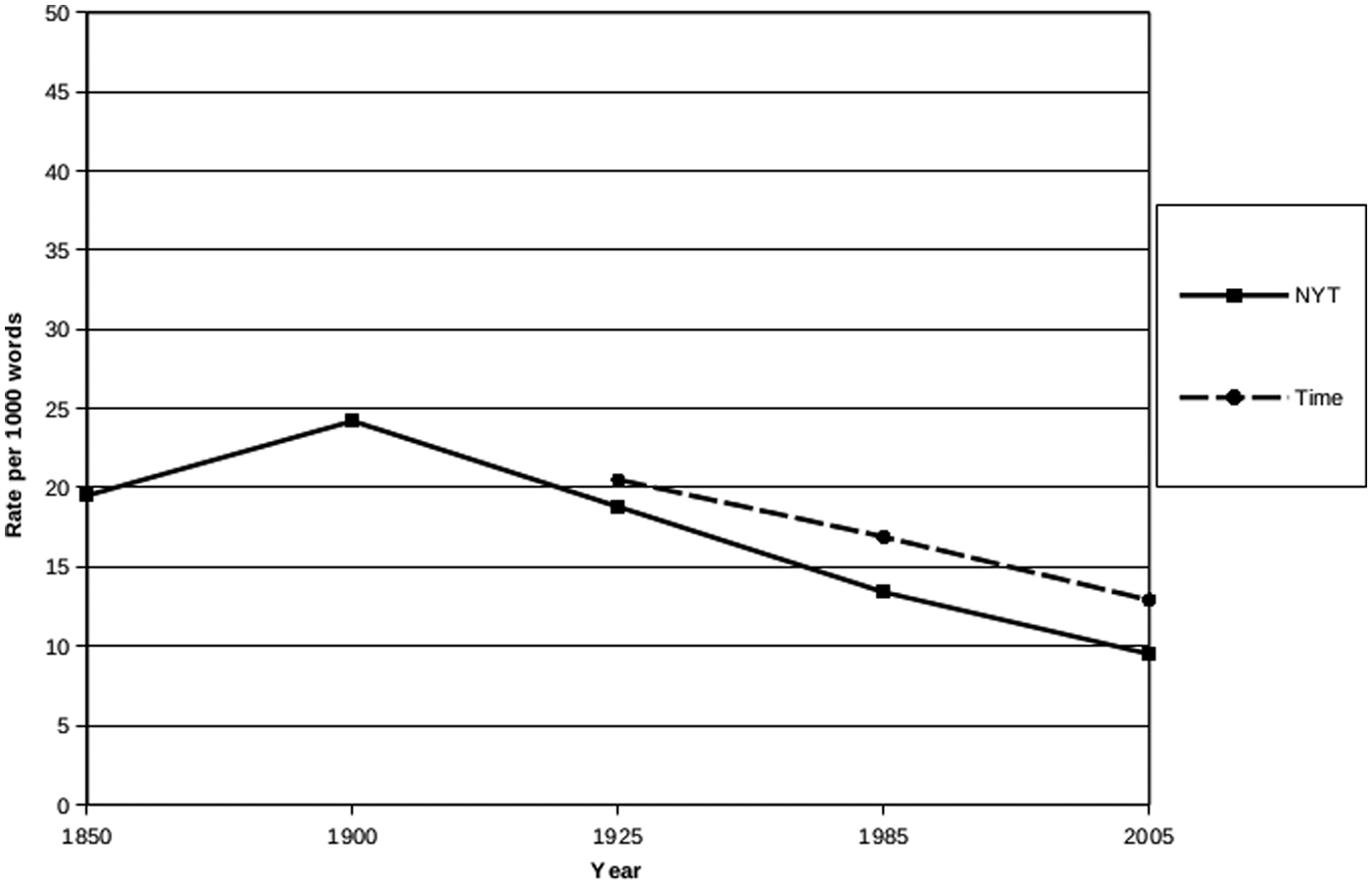
Historical use of passive voice in New York Times versus Time

Historical use of noun + of-phrase in New York Times versus Time.
Text Sample 2
At four o’clock Monday morning, the arrest OF representatives OF the people
In contrast, the longer Text Sample 1 above (from NYT 2005) shows only one example of a finite passive voice verb (have been indicted) and only two instances of the of-genitive (executives of the accounting firm, legality of the shelters).
Figure 5 shows that passives were still increasing from 1850 to 1900, but that they then declined strongly in use over the twentieth century. The decline is found in both NYT and Time, but NYT takes the lead. Thus, in any given year, NYT uses fewer passive verbs than Time. Similarly, Figure 6 shows a strong and consistent decline in use for of-genitive constructions over the entire period of 1850 to 2005. In this case, NYT is more innovative than Time in the earliest period that allows a comparison (1925), but Time quickly adopts this change, so that the two registers are nearly identical in their infrequent use of of-genitive constructions by 2005.
The statistical tests reported in Table 3 confirm these two different patterns. Differences in the mean scores for passive verbs are statistically significant across historical periods and between the two sub-registers. The interaction effect is not significant, indicating that the difference between the two sub-registers remains relatively constant across historical periods. In contrast, the mean scores for of-genitives are significantly different only between the two sub-registers, but the interaction effect is also significant, indicating that there is significant change over time, but the difference between the two sub-registers also changes over time (i.e., there is not a significant difference between sub-registers in the most recent period).
The three grammatical changes discussed to this point can be related to the colloquialization of news reportage during the twentieth century, resulting in an increased use of conversational features (direct and indirect quoted language) and a decreased use of stereotypically literate features (passive verbs and of-genitives). We have shown that sub-register distinctions are important for understanding these developments. In the use of direct quotes, Time magazine was innovative in its earliest periods, but otherwise NYT has generally taken the lead historically. Thus, although the trend toward greater colloquial styles (and decreased “literate” styles) has influenced both registers, Time has generally lagged behind NYT in the implementation of these changes.
However, we noted in the introduction that news reportage has also been influenced by a complementary historical trend in the twentieth century: the development of more “compressed” linguistic styles. Perhaps the most noteworthy grammatical change of this type is the dramatic increase in the use of nouns modifying a head noun, as in sequences like government action, business community, school board, health insurance, and security measures. The dense use of this device can be observed in the 2005 NYT Text Sample 1 above, including examples such as tax shelters, summary judgment motion, bond-linked issue premium structure, and tax shelter promoter (this is not a comprehensive list of all noun + noun sequences in Text Sample 1).
Figure 7 shows the dramatic increase in the use of noun–noun sequences over the past 150 years. Noun–noun sequences were relatively rare in mid-nineteenth-century newspaper reportage, but they increased sharply in use at the end of that century, and that strong increase continued throughout most of the twentieth century. Table 3 shows that those differences are statistically significant for both historical period and for sub-register. Figure 7 indicates, however, that this historical development appears to have reached a saturation point at the end of the twentieth century, so that there has been little change in use over the past thirty years.
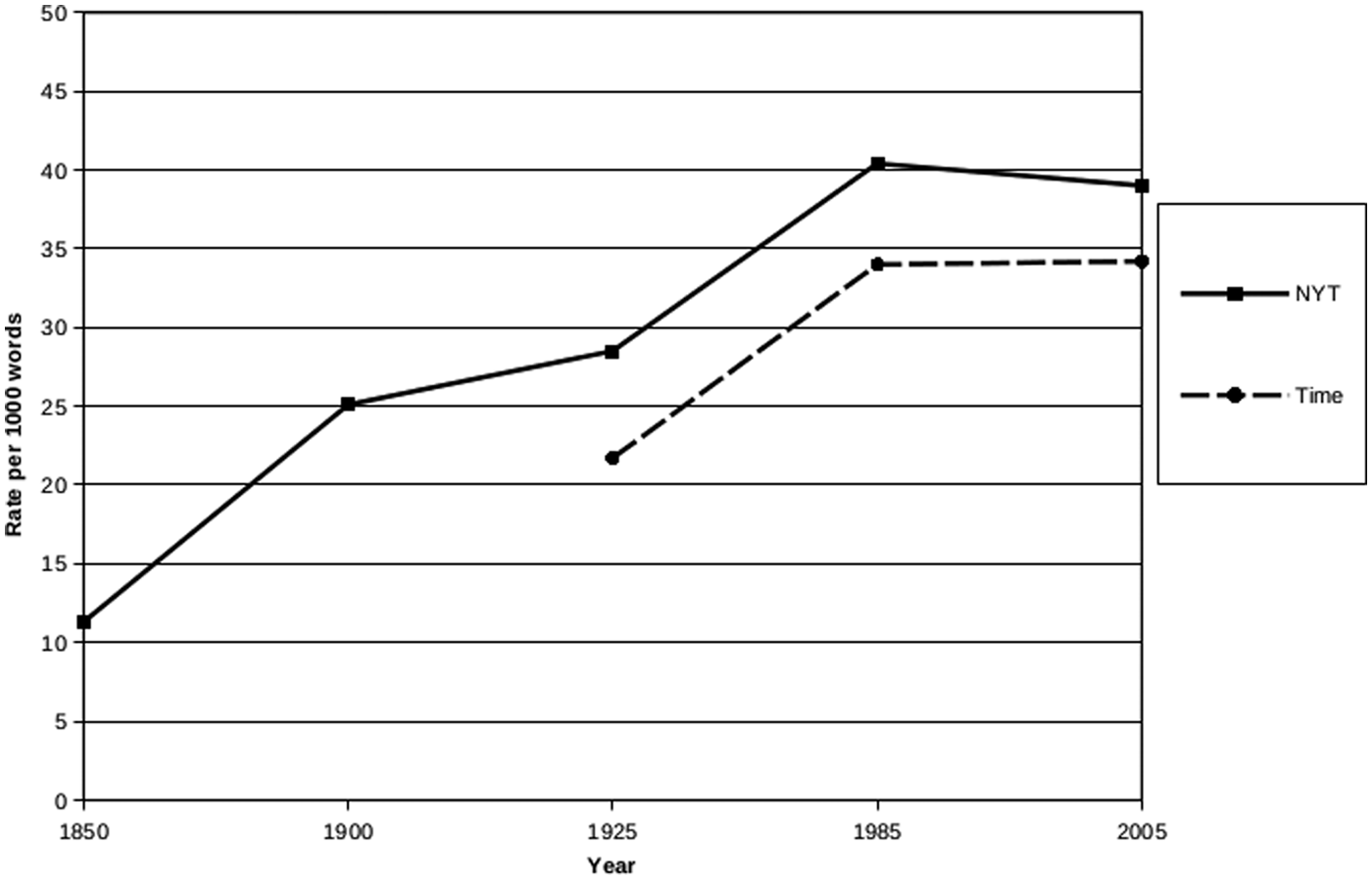
Historical use of noun + noun in New York Times versus Time.
The interesting pattern for our purposes here is that once again, NYT has adopted these changes to a greater extent than Time magazine. That is, in any given year, NYT makes greater use of noun–noun sequences than Time. In summary, the analyses that we have presented here have shown that with respect to several major grammatical features, NYT leads Time in the implementation of historical developments. The following section shows that patterns of change in academic writing are likewise mediated by seemingly minor differences in sub-register.
Historical Development in Academic Research Writing
Corpus
The case study on academic research writing compares multiple sub-registers, and as a result, the academic corpus is more complicated than the news reportage corpus. As a baseline for our study, we include two sub-corpora of academic texts from the nineteenth century: science research articles and humanities books (history). However, the main focus of the analysis is on four sub-corpora of disciplinary research writing from the past fifty years, with samples from 1965, 1985, and 2005: specialist science research articles, specialist social science research articles, multidisciplinary science research articles, and history research articles (and books). A fuller description of the six sub-corpora is provided in Table 4.
Corpus Composition for Academic Research Writing.

The nineteenth century was a period of transition in which academic sub-disciplines and specializations were beginning to form. However, the major disciplinary distinction of the time was between humanities academic writing (e.g., in philosophy, history, and literary discussions) and science/medical prose. Thus, to provide a baseline for our analyses of sub-registers in the twentieth century, we collected two sub-corpora from nineteenth-century academic writing: one for science/medical writing and one for humanities (history) writing. We sampled science articles from three periods: 1850, 1875, and 1900. These sub-corpora came from the science/medical research articles in ARCHER, astronomy research articles from the Corpus of English Texts on Astronomy (CETA; see Crespo García & Moskowich-Spiegel Fandiño 2010), PT, and the journal Science (for 1875 and 1900).
The twentieth century witnessed incredible disciplinary diversification within the general domain of science research, including the development of disciplines in the social sciences. Most science articles from the nineteenth century still presented the results of observational research in general disciplines, such as biology, chemistry, and astronomy; these articles were read by relatively wide audiences of scientists (and often educated lay readers) from multiple disciplines. In contrast, research articles in the twentieth century usually report the results of experimental studies, written by specialists in narrow sub-disciplines, to be read by a small group of specialists from the same sub-disciplines. This diversification and subsequent shift in content, readership, and purposes have led us to question whether the development of sub-registers within academic science writing is associated with systematic differences in historical linguistic development. Thus, the twentieth-century science sub-corpora are designed to allow us to test this hypothesis.
The primary focus of the present study is register diversification in the late twentieth century (using the nineteenth-century sub-corpora as a baseline for comparison). Over the course of the twentieth century, numerous academic sub-disciplines emerged out of the more general disciplines that existed in earlier centuries, including the “social science” disciplines and highly specialized disciplines within “science.” While it would be possible to analyze the patterns of variation among specific sub-disciplines (see, e.g., Gray 2011), we include only a two-way distinction here: science versus social science. For science, we collected research articles from specialist journals in biology (Journal of Cell Biology, Biometrics, Journal of Animal Ecology), medicine (American Journal of Medicine), and physiology (Journal of Physiology). For social science, we collected research articles from specialist journals in education (American Educational Research Journal, Journal of Educational Measurement) and psychology (American Journal of Psychology, Developmental Psychology).
Interestingly, some of the science research journals that were influential in the nineteenth century have continued to publish research articles up to the present day. We include sub-corpora for two of these journals: PT and the journal Science, for the periods 1985 and 2005.
Our initial inclination was to track the history of science writing in English by restricting the analysis to these influential research journals that have had a long continuous history. After all, PT has been published since 1665, and Science since 1880. In many ways, these journals have remained relatively constant in purpose and readership, intended as outlets for the most important science research findings from across the full range of scientific disciplines, and written for an audience from that same breadth of disciplines. By analyzing the same research journals, we (and other researchers who have previously used these journals as the basis for diachronic studies) should be able to isolate the influence of historical time.
However, that approach would only partially capture the historical evolution of science writing. In the nineteenth century, most science writing was published in multidisciplinary venues and read by a wide multidisciplinary audience. Thus, journals like PT and Science provide a fairly good representation of the universe of science writing from that period. In contrast, articles of that type represent only a very small proportion of all science writing at present. Instead, most science writing today is published in highly specialized journals associated with specific sub-disciplines, and read mostly by specialists from those same sub-disciplines. Thus, we consider multidisciplinary science writing (PT and Science) as a separate sub-register from specialist science and social science research journals.
Finally, we also include a sample of academic research writing in history (representing humanities research): research articles in history (from the Journal of Contemporary History and the Journal of the History of Ideas), published in 1965, 1985, and 2005 (supplemented by a sample of books from 2005). Humanities serves as an interesting comparison point to science and social science writing because it has been much less influenced by the trend toward experimental designs and quantitative methods.
Our central goal here was to investigate the extent to which these relatively subtle sub-register differences are influential as determinants of linguistic change. Thus, we compare the four major sub-registers described above: specialist science research articles, multidisciplinary science research articles, specialist social-science research articles, and humanities research writing (history).
Twentieth-Century Patterns of Change in Academic Research Writing
As we note earlier, academic research writing is an especially interesting register in English, because the historical developments resulting in increased grammatical compression are more pronounced in this register than in most other registers of English (see Biber & Gray 2010, 2011). These have been rapid historical developments, occurring mostly in the twentieth century. The research question that we explore in the present section is the extent to which these developments have applied generally to all sub-registers of academic writing.
The most obvious characteristic of modern academic writing is its heavy reliance on nouns. Thus, as early as 1960, Wells documented the “nominal style” of academic writing, in contrast to the “verbal style” of other varieties. Figure 8 shows that the density of common nouns has been increasing steadily in academic writing over the past 150 years. Interestingly, Figure 8 also shows that the nominal style noted by Wells in 1960 represents a density of use that is considerably less extreme than in present-day academic research writing.
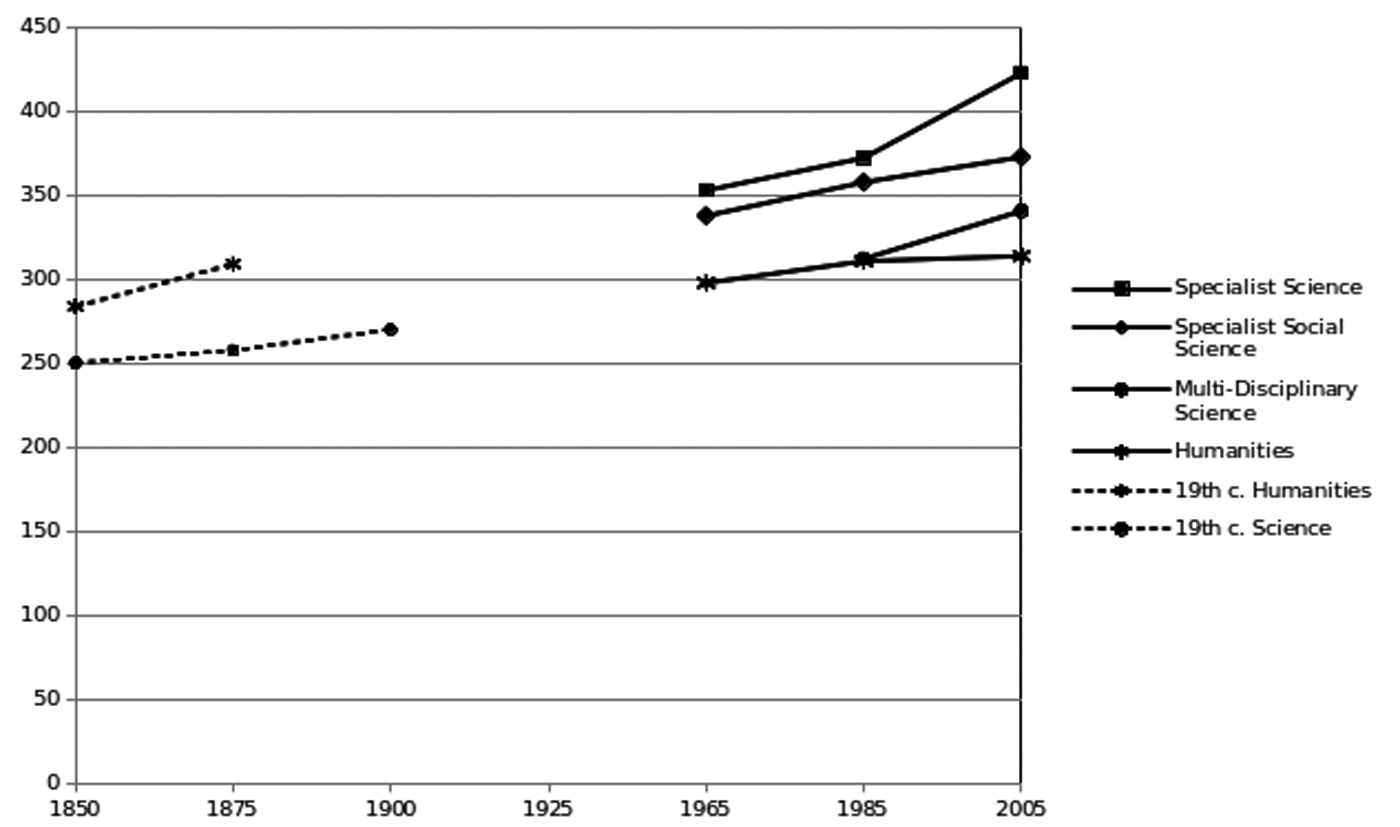
Nouns in academic registers.
Table 5 presents the actual mean scores and standard deviations for the academic sub-registers in the recent historical periods (1965, 1985, 2005). Taken together, Table 5 and Figure 8 show that the increase in nouns has not occurred uniformly in all sub-registers. For example, history research writing has changed little over this period: it had a relatively dense use of nouns in the nineteenth century, and it has maintained roughly that same density of nouns up to the present time. In contrast, the use of nouns has increased dramatically in science research writing, and it appears that the increase is still in progress.
Descriptive Statistics for Five Grammatical Features in Academic Sub-registers from Three Recent (1965, 1985, 2005) Historical Periods (rates of occurrence per 1,000 words).
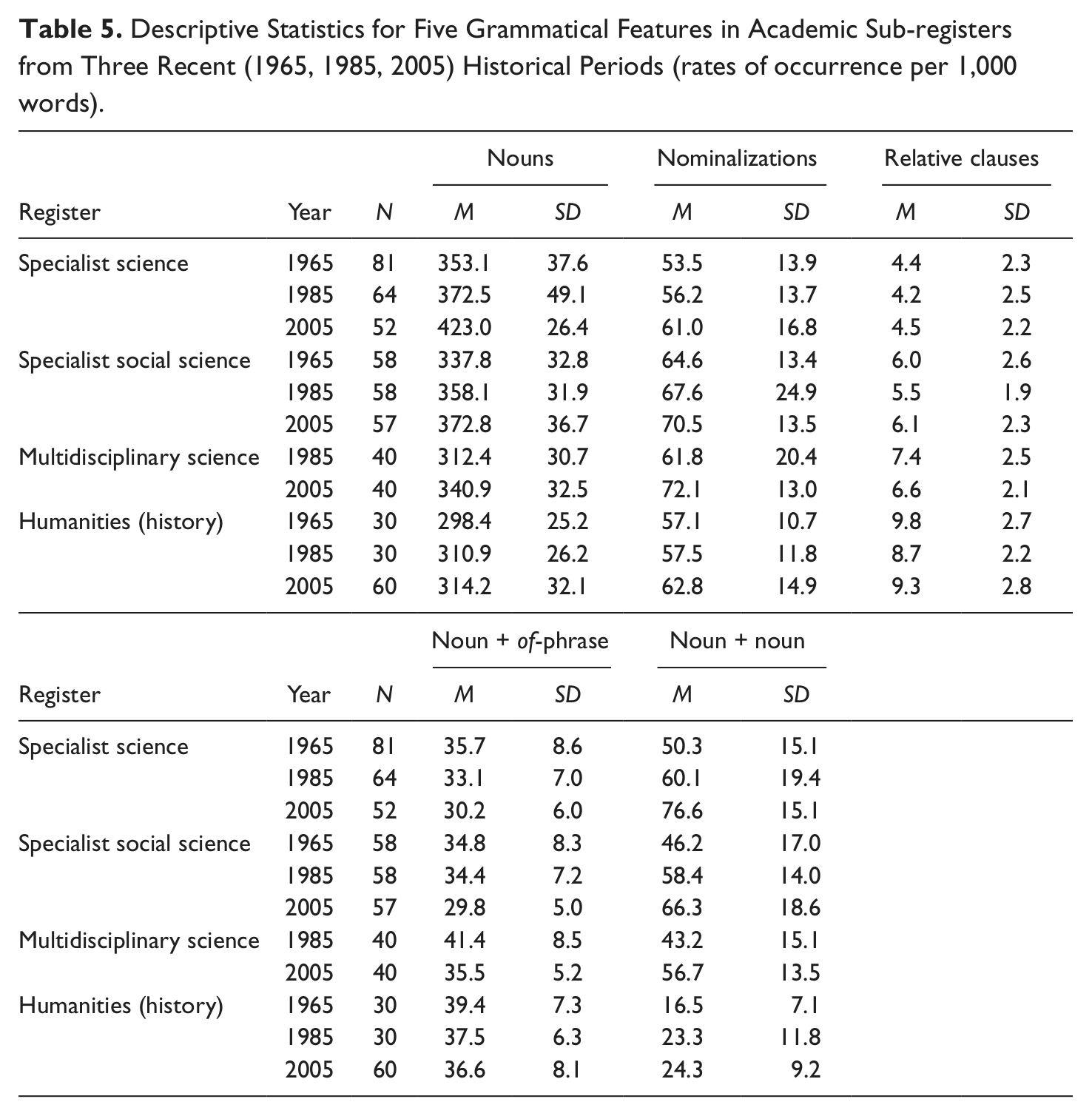
The trend is by far most pronounced in specialist science articles, where nouns have increased by over 10 percent in just the past 20 years. Specialist social science articles follow the same increasing trend as the specialist science articles, but to a less extreme extent. Finally, the trend toward increased use of nouns has also affected multidisciplinary science articles, but it is considerably less pronounced than in either of the specialist sub-corpora.
Table 6 presents the results of a factorial ANOVA, testing the statistical significance of the mean differences across the three recent historical periods and across the four academic sub-registers. Both main effects show significant differences. In addition, there is a significant interaction effect here, reflecting the fact that humanities research writing has changed little in the use of nouns, while nouns have increased dramatically in use in the science sub-registers.
Summary of the ANOVA Factorial Models for Four Academic Sub-registers (specialist science, specialist social science, multidisciplinary science, humanities) in Three Recent Historical Periods (1965, 1985, 2005).

There are numerous other grammatical features that can be associated with the “nominal style” of modern academic writing. Most of these have increased in use over the course of the twentieth century, although the specific patterns of sub-register development are sometimes surprising. Perhaps the most studied of these characteristics is nominalizations, which have been described as the most important manifestation of the “grammatical metaphor” that is prevalent in modern science writing (see, e.g., Halliday 1988/2004; Banks 2008). Figure 9 shows that the use of nominalizations has increased in all types of academic writing in our study, including history research writing as well as all sub-registers of science research writing. 3 Surprisingly, though, the pattern of sub-register diversification is the opposite to that found for common nouns: nominalizations have increased the most in specialist social science articles and in multidisciplinary science articles, while the increase is considerably less pronounced in specialist science articles. Table 6 shows that these mean differences are statistically significant for both historical period and sub-register.
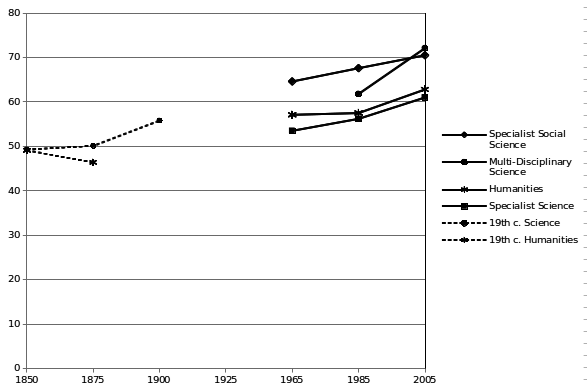
Nominalizations in academic registers.
Previous research has shown that the increased noun phrase complexity of the twentieth century is of a particular type, associated with a preference for phrasal as opposed to clausal elaboration (see, e.g., Biber & Gray 2010, 2011; Biber, Gray & Poonpon 2011). In fact, it turns out that some features of clausal elaboration have actually decreased in use. The most notable of these is finite relative clauses, which have declined in use over the course of the twentieth century. However, as Figure 10 shows, there are distinct patterns of change among sub-registers: the decrease in use is by far strongest in specialist science articles, where relative clauses have declined by 50 percent from 1900 to 1965. Specialist social-science articles also show a strong decline in use, while the multidisciplinary science articles show a lesser decline in use. And in contrast to all science sub-registers, history research writing has remained essentially unchanged over the past century in its heavy reliance on relative clauses for nominal elaboration. The ANOVA results reported in Table 6 are based on historical change for the three recent historical periods—1965, 1985, and 2005. Thus, the results for relative clauses show a significant difference for sub-register, but no significant difference for historical period. That is, the large historical decrease in the use of relative clauses in science writing occurred in the early twentieth century, while these registers have remained relatively unchanged in the use of relative clauses over the past fifty years.
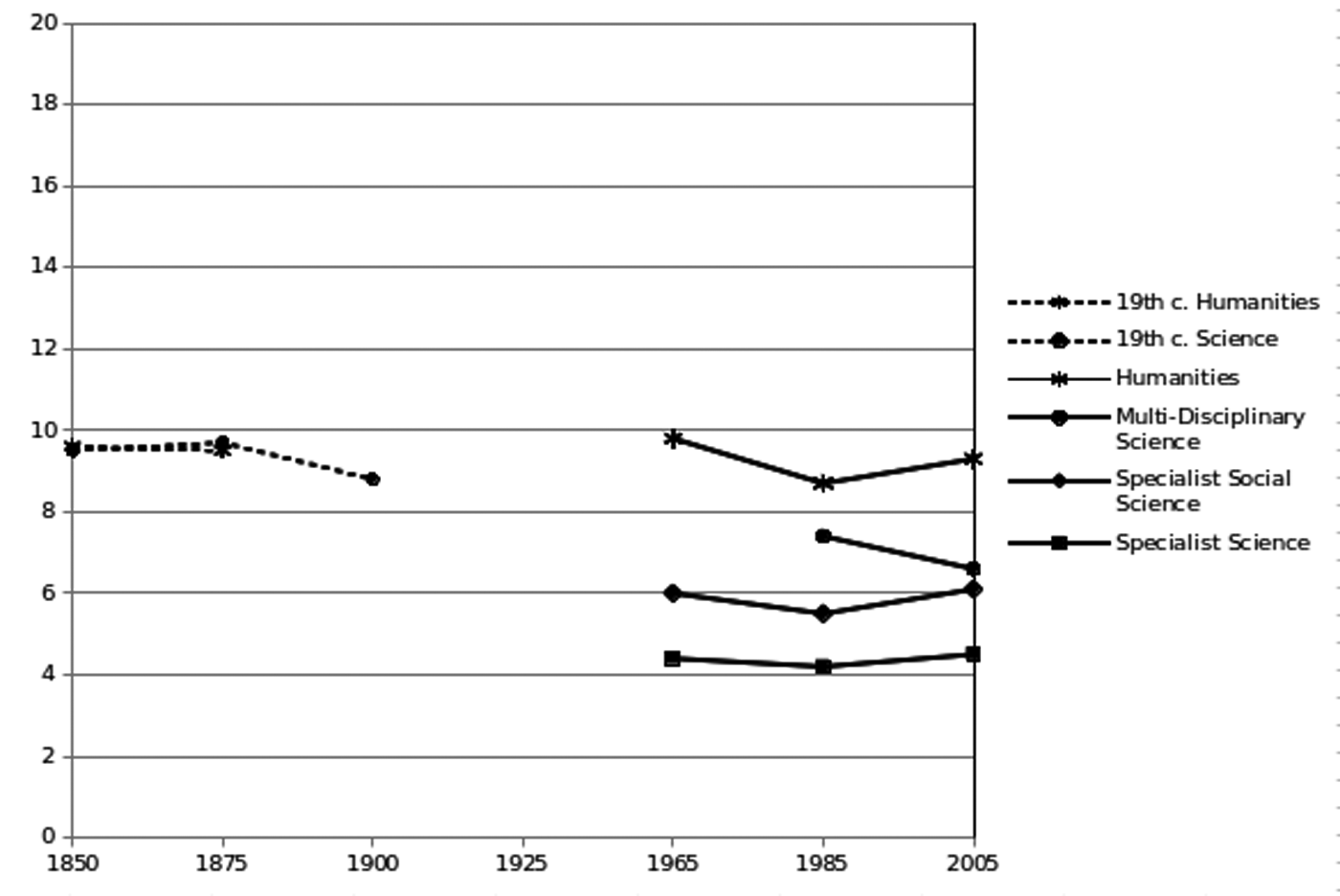
Finite relative clauses in academic registers.
Interestingly, postnominal of-phrases have followed a similar historical path (Figure 11): strong declines in specialist science and social-science articles, a lesser decline in multidisciplinary science articles, and essentially no change in history research writing. Those trends are in marked contrast to historical change in the use of other postnominal prepositional phrases (headed by, e.g., in, on, with), which have increased dramatically in use over the past century (e.g., Biber & Gray 2010, 2011).
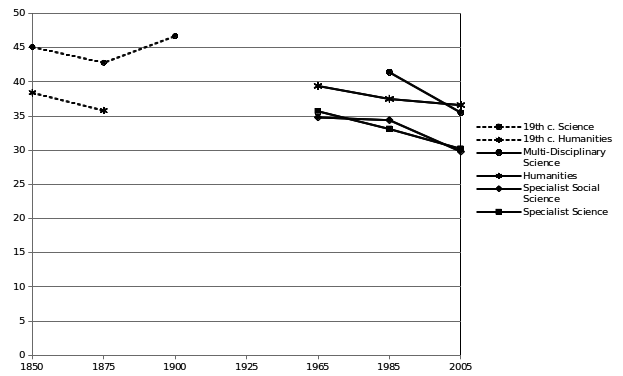
Noun + of-phrase in academic registers.
As noted above, these findings are in agreement with our earlier research studies, which show a general twentieth-century shift in academic writing away from clausal styles of elaboration and toward phrasal, “compressed” styles. The most important grammatical device used to modify noun phrases in this compressed style is a noun used as a premodifier of a head noun (e.g., patient history, case study). As Figure 12 shows, premodifying nouns were only moderately common in the nineteenth century, but they have increased in use by as much as 400 percent in the twentieth century. This increase has been strongest in the specialist science sub-register, and also very strong in the specialist social-science register. Multidisciplinary science writing is progressing in the same direction, but it lags behind the specialist sub-registers in the extent to which this device is employed. In contrast, history research writing has increased only slightly in the use of this feature. These developments are significant across historical period and across sub-registers (see Table 6). In addition, there is a significant interaction effect for this feature, reflecting the fact that humanities writing has changed little, in contrast to the dramatic changes over time observed for science writing.
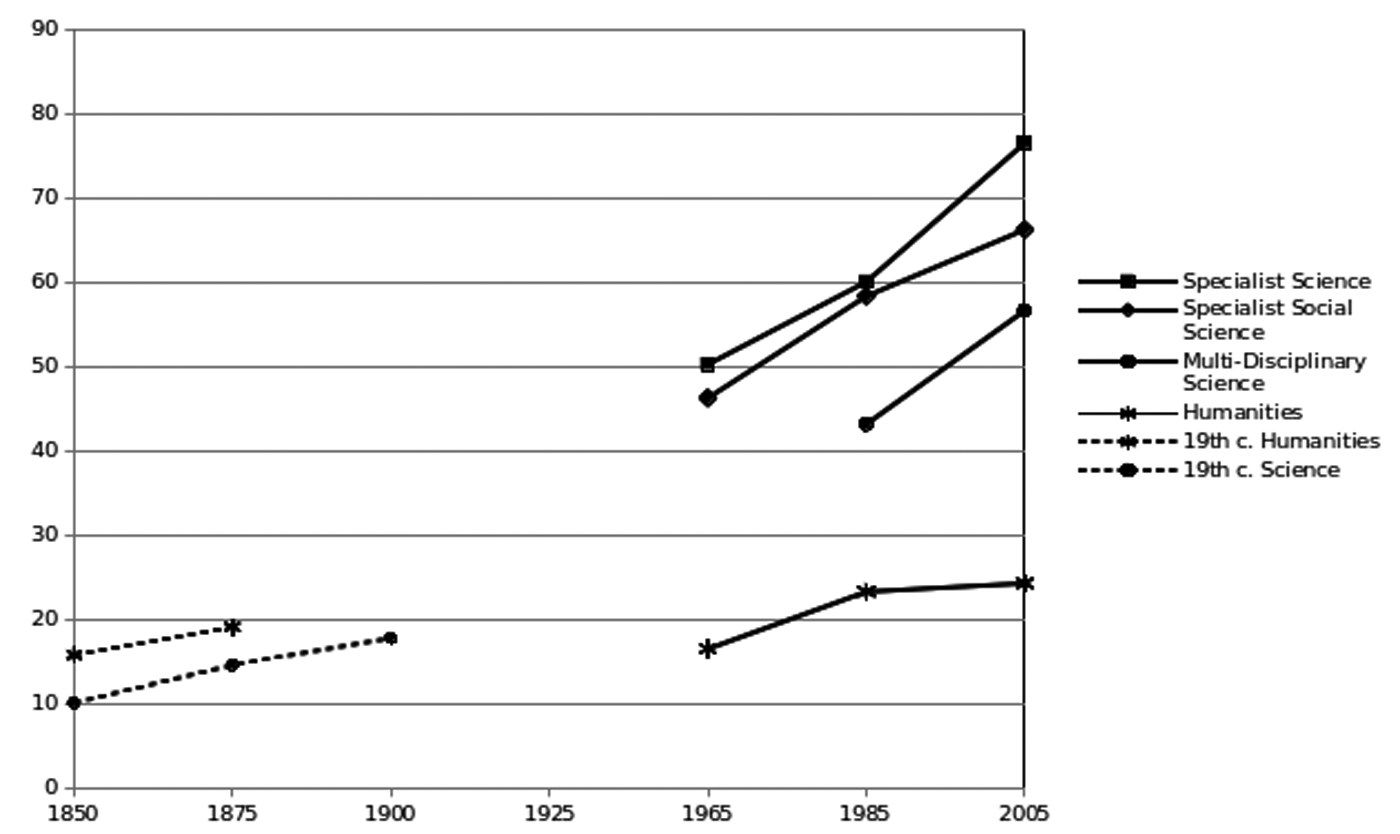
Nouns as nominal premodifiers in academic registers.
The following text samples illustrate these grammatical developments. Sample 3 is from multidisciplinary science writing in the mid-nineteenth century, illustrating the types of clausal elaboration that were common in earlier centuries (including finite adverbial clauses, complement clauses, and relative clauses). Finite relative clauses are underlined in this sample, and genitive-of is shown in ITALIC CAPS. There are several nominalizations (division, operation, tenacity, explanation, alterations, comparison), but no instances of noun–noun sequences in this text excerpt.
Text Sample 3
That division OF these nerves produces some serious lesion is proved by the death OF the animal,
Present-day multidisciplinary science writing can sometimes be similar in discourse style to nineteenth-century articles. Thus, Text Sample 4 illustrates a modern PT text with extensive clausal elaboration (finite relative clauses are
Text Sample 4
From Darwin derives not only the explicit assumption OF animal-human continuity, but also the implicit assumption that behaviour patterns,
The more typical style of recent multidisciplinary science writing is to employ much less clausal elaboration, coupled with a dense use of phrasal modifiers, as in Text Sample 5:
Text Sample 5
Tide gauge measurements suggest that global average sea-levels rose by between 1 and 2 mmyr-1 during the twentieth century (Church et al. 2001). Between 1993 and 2000, satellite altimetry indicated that the rate OF rise was approximately 2.5 mmyr-1 (Cabanes et al. 2001),
This style is similar to that found in recent specialist science writing, except that specialist science writing exhibits an even more extreme reliance on phrasal modification of nouns, coupled with even less use of dependent clauses. For example,
Text Sample 6
Population growth rate is a particularly powerful index for evaluating harvest effects because it measures the ability OF a population to increase when subjected to any specified level OF exploitation. . . . Selectivity OF the harvest on Putauhinu Island translates into large differences in harvest rates among weight classes. . . . The population effects OF removing an individual depends on quality (i.e. future contributions to reproduction) and on the contribution OF its stage to demography. The effect of quality differences among chick classes in our model is small because chicks move among classes during the nanao and rama (Table 1). The contribution OF chick survival to population growth is small, and regardless of initial weight all chicks become identical pre-breeders at the end OF the first year (Fig. 1). . . . There is evidence for such links between characteristics OF young individuals and life history traits OF adults in many taxa. . . .
One interesting characteristic of the noun–noun sequences found in modern academic writing is that they are typically not technical terms. Of course, we can find counterexamples which fit the stereotype of jargon-heavy scientific academese, as in,
(3) The Peutz-Jegher syndrome tumor-suppressor gene encodes a protein-threonine kinase.
However, the more common pattern is to modify a nontechnical head noun with another nontechnical premodifying noun. Specialist background knowledge is required to understand the meaning relationship between the two nouns, but the nouns themselves typically have transparent, everyday meanings. Many of these could be paraphrased with an of-genitive as nominal postmodifier:
(4) sea level level OF the sea
water level level OF the water
life history history OF a life
life history traits traits OF a history OF a life
Other examples could be paraphrased with other prepositional phrases as nominal postmodifier:
(5) quality differences differences in quality
century-scale rise a rise on the scale of a century
population effects the effects on the population
Even in these paraphrased examples, specialist knowledge is required to understand the meaning relationship between the head noun and the prepositional phrase. However, other examples are much more difficult to paraphrase; for example,
(6) tide gauge measurements measurements made by a gauge that calculates the level of the tide
long-term trend a trend that lasts for the long term
time-average sea-levels the level of the sea averaged across different time periods
storm surge a surge in the sea level, associated with a storm
surge events events that involve a surge in the sea level, associated with a storm
harvest rates differences in the magnitude of a harvest
harvest effects the extent to which the magnitude of a harvest varies
chick survival the extent to which chicks survive
In sum, the individual nouns employed in noun–noun sequences are often not technical, but the meaning relationships underlying those sequences are technical and require specialist background knowledge for understanding. As a result, this grammatical device is most strongly preferred in specialist science writing, with a less dense use in science writing for multidisciplinary audiences.
Summary and Conclusion
Our goals in the present article have been both methodological and historical/descriptive. Methodologically, we hope to have demonstrated the importance of not only registers but also of sub-registers for studies of historical language use, arguing that register distinctions at all levels are important for the study of linguistic variation (see also Biber 2012). We undertook two strong tests of this claim: comparing two sub-registers of written news reportage and comparing four sub-registers of academic research writing. Both case studies show that even at a very specific level of register differentiation, there are systematic differences in the patterns of historical development. These differences are all statistically significant, and in most cases they are also statistically strong. Historical analyses that disregard these differences would confound the description of linguistic change with patterns that in fact reflect register differences. We believe that these case studies convincingly demonstrate that register differences matter, for both synchronic and diachronic descriptions of language use—and that they are important at a more specific level of analysis than has typically been suspected.
From a descriptive perspective, we have documented some surprising patterns of register variation and change. First, we have shown how American newspaper reportage in NYT has been consistently more innovative in historical changes than written news reports in Time magazine. It is conceivable that these linguistic differences are simply the result of different editorial policies, with Time magazine being more conservative and resistant to change than NYT. If this turns out to be the primary factor, it is noteworthy that the same policies have been maintained in both publications for approximately eighty years, and that those policies have applied to the use of both colloquial features as well as compression features. Interestingly, the grammatical patterns reported here are at odds with the findings of previous research, which has described Time magazine as especially innovative in its creation of new vocabulary (see Firebaugh 1940; Yates 1981).
Other possible factors include differences in the intended audiences of the two publications and differences in the typical communicative purposes of their news articles. For example, news reportage articles in NYT have generally included more personal narratives than Time articles. These differences are becoming less noticeable in recent periods, as it is also becoming more difficult to clearly identify news reports as distinct from other newspaper/magazine registers. However, it is likely that the historical linguistic differences documented in the present study reflect a range of influences, rather than any single factor.
With regard to academic research writing, we have shown how science (and social science) writing has been much more innovative than research writing in the humanities. However, our analyses further identify systematic differences at more specific levels, with science research writing being more innovative than writing in the social sciences, and specialist research articles being more innovative than articles written for a multidisciplinary audience. These linguistic changes have been of a particular type, marked by an overall decline in dependent clauses together with a strong increase in the use of phrasal modifiers. These grammatical shifts can be linked to the “information explosion” and the need to express more information in fewer words. At the same time, these grammatical developments result in prose that is less explicit in the expression of the meaning relationships among constituents. These two factors working together help to explain why these historical changes have been restricted mostly to informational writing, and why they have been most extreme in the sub-registers intended for specialist readerships.
In sum, the present study has shown how twentieth-century grammatical changes in news reportage and academic writing are mediated by specific sub-registers. In future research, we hope to explore in more detail the specific lexico-grammatical correlates of these changes, as well as their underlying social/situational motivating factors.
Footnotes
Declaration of Conflicting Interests
The author(s) declared no potential conflicts of interest with respect to the research, authorship, and/or publication of this article.
Funding
The author(s) received no financial support for the research, authorship, and/or publication of this article.