



Abstract
Using data from the 400-million-word Corpus of Historical American English (COHA) and the 450-million-word Corpus of Contemporary American English (COCA), this study investigates both diachronically and synchronically the use of the -free compound and its counterparts, the free of/from phrases. A close examination of the frequency, distribution, and structural and semantic functions of the constructions yields the following key findings. First, frequency-wise, free of has exhibited a steady slow growth, and free from has declined dramatically; in contrast -free has increased enormously, although its archaic use in the senses of ‘free to’ and ‘free with’ disappeared by the 1940s. Second, the -free compound boasts a high potential productivity index. Third, while both the compound and the phrasal constructions may be used as predicative and postnominal adjectives, objective complements, and adverbials, only the -free compound is used as a prenominal (attributive) adjective. Fourth, whereas the -free compound is used almost exclusively nonreferentially, the free of/from constructions are used significantly more referentially. Fifth, even in the contexts where the constructions may all be used, often only one is allowed or preferred due to certain internal structural and semantic factors. Finally, condensation of information along with changes in language and life styles appears to have driven the increased use of the compound over its phrasal counterparts, although the phrase free of charge has resisted the change: its high frequency likely has blocked its *charge-free compound counterpart.
Introduction
Several English words (e.g., free, like, and type) may be used as combining elements to form adjectival compounds, such as cost-free, child-like, and data-type. When they are so used, these elements retain the meanings they have as separate words (Plag 2003:73; Moon 2011:487; Bauer, Lieber & Plag 2013:441). Furthermore, the compounds they help form coexist with a near-alternative phrasal construction in many contexts. For example, the -free compound can be reworded as free of or free from (noun), e.g., pain-free
It is important to note that there are a few other constructions that may be considered near-synonymous with the free-based constructions, such as the -less compound and the without X/no X phrases. We choose not to include them in this study for the following reasons. First, in the case of the -less compound, studies (Slotkin 1990; Górska 1994) have shown that, although it is interchangeable with -free in some cases, it differs from -free in that it is often used to express the meaning of ‘being without something that is not intentionally removed and/or something that is actually desired’ (e.g., an arm/spine-less man). By contrast, -free typically indicates the meaning of ‘being without something that is intentionally removed for its undesirability’ (e.g., fat/cholesterol-free). This difference also applies to without X/no X versus -free/free of/from because, only the without X/no X constructions are used, like -less, to express the meaning of without something desirable, e.g., a man without/with no arms/compassion/love. Second, a quick query of Davies’s (2008–) Corpus of Contemporary American English (COCA) shows that the most frequent tokens (nouns) of the -less and without X/no X constructions differ markedly from those of the -free and free of/from constructions. Third, including these additional constructions would require space beyond that of a normal paper.
It is also necessary to note that this study is corpus-driven and form-based; i.e., the study examines all of the tokens of the three forms in the corpora chosen for this study, regardless of whether the forms are always used with the same meaning.
Background and Research Questions
Studies on the adjectival compounds in question and compounds in general have focused on four issues: (1) the classification of the elements used in forming such adjectival compounds; (2) the productivity of such elements; (3) the formal features of compounds; and, most importantly, (4) the semantic functions and usage patterns of such adjectival compounds. Given these focal areas and the main purposes of the study, we aim to answer the following research questions.
What are the general historical usage patterns (e.g., frequency and distribution) of the -free compound and the free of/from phrase constructions over the past two centuries?
How productive is the -free compound?
Does the -free compound conform to the general formal features of such compounds (e.g., does it take only nouns and noun phrases as its left base)?
What structural and semantic functions do the compound and phrase constructions each perform? What functional and usage differences are there between the two? What motivates the choice of one construction type over the other in contexts where both are functional?
Our background discussion focuses on issues related to these questions.
Form Classification
Scholars’ views on the classification of the compound-forming elements in question have varied substantially but can be grouped into three positions: (1) free morpheme, (2) suffix, and (3) semi-suffix (between a free morpheme and a suffix). Huddleston and Pullum (2002:1711), Plag (2003:73), and Bauer, Lieber and Plag (2013:441) are among those who consider these elements free morphemes, a position motivated by the fact that these compound elements are used with the same form and meaning as free morphemes. Using error-free as an example, Plag (2003:73) explains this position clearly: “error-free can be paraphrased by free of error(s), which means that free in error-free and free in free of error(s) are most probably the same lexical item, and not two different ones (a suffix and a free form).”
In contrast, Górska (1994:413), Adams (2003:31), and Hamawand (2007:74) classify these forms as derivational suffixes because, as Hamawand (2007:74) argues, “they meet the two requirements of derivation. First, they change the word class of the combined result in the same way as an affix does. Second, they add a specialized meaning to the combined result in the same way as an affix does.” However, Hamawand (2007:74) recognizes that these forms can stand alone, so he calls them “free suffixes.”
Marchand (1969:356) takes a third, middle-ground position by using the term “semi-suffix” to refer to these forms because, in his view, these forms “stand midway between full words and suffixes.” Despite the variations in classification, scholars actually all seem to agree on the free-standing nature of these elements. For this reason, we agree with the first position that each of these elements is a free morpheme or “compound element,” a term used by Bauer, Lieber and Plag (2013:441).
Productivity
Because these compound elements work like affixes in forming new words, their productivity is determined in the same way as that of affixes. Scholars typically look at three things when determining morphological productivity: the number of types, the number of tokens, and the number of hapaxes produced by a given affix (for a detailed discussion on this issue, see Plag 1999:22-35; Plag 2003:51-59; Baayen 2009). A type is an individual word formed by an affix or compound element; thus, e.g., duty-free and drug-free are each a type of -free. The total number of types tells us how many different words the affix has generated. A token is an occurrence of any type formed by the affix. The total number of tokens shows how frequently all of the types formed by the suffix are used. A hapax (abbreviated from hapax legomenon) is a type that occurs only once in a corpus. For example, cigar-like and sofa-like are hapaxes because each occurs only once in COCA. The total number of hapaxes provides valuable information about how the affix can generate new types, for a common measure of the productivity of an affix developed by Baayen and Lieber (1991) is the quotient or ratio of the number of hapaxes formed with a given affix and the total number of tokens of words formed with that affix. Because of its focus on the number of hapaxes, this type of productivity is called “potential productivity” (Baayen 2009:902). There are two other types of productivity: “realized” and “expanding” (Baayen 2009:901-902). Realized productivity is calculated by dividing the number of types generated by a given compound-element by the total number of tokens of the corpus used in the analysis. Expanding productivity is calculated by dividing the number of the hapaxes generated by a given affix by the total number of hapaxes in the corpus. Given that existing studies that covered the use of -free (Slotkin 1990; Górska 1994; Adams 2003) have noted a large increase in the use of the compound, it will be of interest to examine the different measures of its productivity in this study.
Formal Features of Compounds
There are many formal features related to compounds; we address only those of importance to this study. In terms of the formation of the -free compound, its left-member is typically a noun (e.g., debt-free), although a couple of tokens of other parts of speech have been found in creative use of language: one verb (fester-free ‘unagitated’) and one adjective (glib-free ‘serious’) have been found in the Buffy the Vampire Slayer TV show (Adams 2003:176, 183). However, the acceptability of these two -free compounds may be questionable. It will be important to examine whether such use can be identified in our study.
Compounds also have some internal structural features. One is that they are “uninterruptable units,” allowing no insertion of “an affix or another word” (e.g., no *shorty-change or *short slow change for shortchange; Bauer, Lieber & Plag 2013:432). By the same token, plurals are generally not used within compounds (e.g., *booksmark or *injuries-prone), although they are sometimes used in Noun+Noun compounds, e.g., admissions officer and arms embargo (Bauer, Lieber & Plag 2013:443, 506). It will be interesting to examine whether these rules hold in the use of the -free compound.
Semantic Functions
We begin with the functions of compounding or word formation in general before we discuss the functions and usage patterns of the -free compound found in previous studies. The most important function of word formation (including compounding) relevant to this study is noted in Bauer’s (1988:102) observation that while naming (or “labeling,” a synonymous term used by Kastovsky 1986:594 and Plag 2003:59) is the function of compounds and derived words, description is the function of syntactic phrases. This naming versus description distinction between compounds and phrases can easily be seen in examples such as a greenhouse versus a green house and a redcoat versus a red coat. Greenhouse is the name for buildings designed for growing plants, whereas a green house refers to a house with a green color; similarly, redcoat is the name for any British soldier (especially during the American Revolution), while a red coat means simply a coat that is red. Of course, spelling is not a reliable means of differentiating compounds from phrases in English because English compounds are not always spelled with the combining bases joined together; we may need to resort to other means, such as stress patterns. Compared with English, differentiating compounds from phrases is much simpler in most other European languages, such as German and Spanish, where adjectives in phrases inflect in gender and number with their modified nouns but adjectives in compounds do not.
It is important to note that recent studies on German adjective+noun (A+N) compounds versus A+N phrases (Schlücker & Hüning 2009; Schlücker & Plag 2011) have found that the semantic-functional distinction between compounds being used for naming and phrases being used for description is not always true. Schlücker and Hüning’s (2009:228) analysis shows that not all A+N compounds are noncompositional with a special meaning (the hallmark structural and semantic features of compounds) and, equally importantly, some (lexicalized) A-N phrases are actually noncompositional with a special meaning, leading them to the conclusion that “the functional split between compounds and phrases describes [only] a tendency rather than a rule.” Schlücker and Plag’s (2011:1550) empirical study, which asked subjects to produce new concepts from a given adjective and a noun, produced a similar finding: like compounds, A+N phrases are also used for naming in German, although compounds are used much more in this function. According to Plag (2003:59-60), besides labeling, word formation also performs the functions of “syntactic recategorization” and expressing “an attitude,” as can be seen in (1) and (2), taken from Plag (2003).
(1) Yes, George is extremely slow. But it is not his slowness that I find most irritating.
(2) Come here, sweetie, let me kiss you.
In sentence (1), the noun slowness is an instance of syntactic recategorization by which the clause that he is slow turned into a noun phrase his slowness. Syntactic recategorization may perform several subfunctions, such as condensing information and creating stylistic variation (from informal speech style to formal written style). The word sweetie derived from sweet in sentence (2) is an example of word creation for expressing an attitude, or affection in this case.
In short, the above discussion about the functional differences between the A+N compounds and A+N phrases has important implications for our study as it behooves us to examine closely whether similar or other functional differences exist between the -free compound and the free of/from phrases.
Now, we turn to the semantic functions and usage patterns of the -free compound specifically. Previous research on the topic consists of two studies that compared the use of this compound with that of the -less compound (Slotkin 1990; Górska 1994), and brief discussions of the issue in Adams (2003), Plag (2003), and Hamawand (2007). Slotkin’s (1990) study uses three sets of data: (1) dictionaries; (2) television advertisements, magazines, and other published material; and (3) a large questionnaire survey. The study shows that the -free compound “has increased its connotative sense to include the positive element of deliberate choice and/or action,” i.e., deliberate removal of what is usually deemed undesirable (Slotkin 1990:47).
Like Slotkin’s (1990) study and also Hamawand’s (2007:77-78) brief cognitive and corpus-based analysis of -free in his book on adjective formation, Górska’s (1994) analysis of the two adjectival compounds (-free and -less), using data compiled mainly from Time magazine, also finds that -free in contemporary English is used to mean ‘without’ or ‘unaffected by’ something that is either always undesirable (e.g., pain-free) or undesirable in a given situation (e.g., oil-free, as oil is not always undesirable).
While these studies have produced important information on the use of the -free compound in comparison with the -less compound, none of them offered a diachronic data-driven examination of the use of the -free compound, and none of the studies compared the -free compound with its phrasal counterparts free of/from, hence motivating the present study.
Corpora, Query Methods, and Data Analysis Procedures
The corpora used in this study are Davies’s (2010) 400-million-word Corpus of Historical American English (COHA) and (2008–) 450-million-word COCA. These two corpora are chosen because of their (1) large size and (2) systematic data selection (twenty million words per decade for COHA from 1810 to 2009 and twenty million words per year for COCA from 1990 onward with four million words for each of its five register-specific subcorpora per year). Also, while COHA, spanning over 200 years, can provide valuable information for a diachronic analysis about the historical usage patterns of the -free compound and the free of/from phrases, COCA, with its large amount of data from the past twenty years across five registers, can allow a valid and reliable synchronic analysis of the contemporary usage patterns of these constructions.
In terms of the corpus queries, we first searched for the frequency of -free and free of/from in COHA and COCA respectively. Concerning -free, we queried using the <*free> and <[n*] free> search strings. The <*free> string returned all of the hyphenated and closed-form (e.g., taxfree) tokens. The <[n*] free> string returned all of the open-form tokens (tax free). However, both strings (especially the latter) also returned irrelevant tokens (e.g., names like Murfree and Mickey Free, incomplete parts of phrases like country free in set my country free, and the negative adjective unfree formed by the prefix un-). So we manually checked the results carefully to exclude all the irrelevant tokens. For free of/from, we queried using the <free of> and <free from> strings. Then we copied and pasted all the concordance lines into Excel spreadsheets for analysis to determine their structural and semantic functions, including whether each was a prenominal, predicative, or postnominal, and what it meant, i.e., whether it was used in the sense of ‘without or unaffected by something undesirable’ or in some other sense. In the process, we also excluded additional irrelevant or false items, such as record-free in “I’d put a Jazz Messengers record-Free for All” (where free is actually part of the free for all phrase where the hyphen before free should have been a dash), and multiword phrases like buy-one-get-one-free/get-out-of-jail-free.
For the -free compound tokens, we also checked whether the left elements were exclusively nouns, and whether they contained any complements, modifiers, and/or plural forms. We also identified all the types and hapaxes of the compound. Furthermore, for both the compound and the phrasal constructions, we classified the nouns in them into two major groups: (1) nonspecific or nonreferential bare nouns (e.g., worry free and free of/from worries) and (2) specific or referential nouns, which include three subgroups: (a) those determined by the articles (e.g., free of the old laws), (b) those modified by a possessive pronoun (e.g., free of his control), and (c) proper nouns (e.g., free of Saddam Hussein). Although the -free compound is believed to be used only nonreferentially because the noun (the left member) in such a compound is typically “a common noun [. . .] intended non-referentially” (Bauer, Lieber & Plag 2013:464), we did check all the compound tokens to see if any were used referentially. These analyses and the coding of the tokens were generally straightforward, but time consuming. We completed the structural classification of the tokens with the assistance of five graduate students trained for the task. We double-checked their classification results and found them to be 88 percent accurate. We corrected the tokens they had misclassified. The semantic classification was done by the two authors individually, but whenever we ran into items we were not sure about, we discussed them together until we arrived at a consensus.
For statistical analysis, we conducted a hierarchical configural frequency analysis (HCFA) of all of the relevant sets of data to determine whether there were significant differences among the semantic and usage patterns of the three constructions. The analysis was done by using Gries’s (2004) HCFA for R program. We will explain the HCFA test and its use in our discussion of the results below.
Results and Discussion
Diachronic Analysis: Historical Changes
For the diachronic analysis, we used COHA. To understand the historical usage patterns of the three constructions, we first tabulated both their total and nonreferential use frequencies decade-by-decade over the past two centuries (reported in Table 1 and illustrated in Figure 1). We include the nonreferential frequencies because while the -free compound is used almost exclusively nonreferentially (4,348 out of 4,354 with only six referential uses, such as O. J. [Simpson]-free and Monica [Lewinsky]-free, an issue we will address below), such is not the case with the two phrasal constructions. It will be meaningful to compare the nonreferential use of the compound with such use of the two phrasal constructions in addition to a total frequency comparison.
Total and Nonreferential Frequencies of -Free and Free of/from across Two Centuries in COHA.
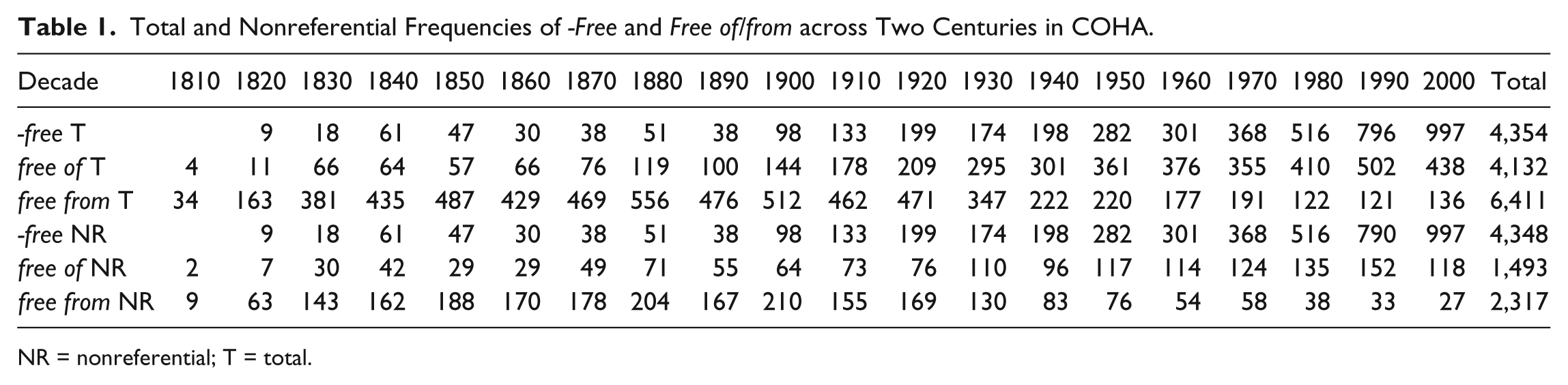
NR = nonreferential; T = total.
It is clear from both Table 1 and Figure 1 that, over the 200 years, the -free compound exhibits a noticeable continuing increase with a spike in the most recent decades. For example, from the 1930s to 2000s, its use increases more than six times from 174 to 997 tokens in both total and nonreferential use. In contrast, free of and free from show very different historical usage patterns. Free of shows a steady but small increase except for the most recent decade. For instance, for the same 1930-to-2000 period, the use of free of increases moderately (from 295 to 438) in the total use but remains essentially unchanged in nonreferential use (from 110 to 118). As for free from, it has decreased drastically since the late 1800s. For the same 1930-to-2000 period, its use decreases from 347 to 136 in total use and from 130 to 27 in nonreferential use, with the latter showing a decrease of 4.8 times. The nonincrease of free of and the sharp decrease of free from in the nonreferential use is of particular importance in the comparison of the use of the two phrases and the -free compound because the latter is used almost exclusively nonreferentially; in other words, it is much more meaningful to compare them in the nonreferential use. Of course, even in the total use frequency, the compound also shows an enormous increase while the two phrases do not (in fact, free from recorded a tremendous decrease). In short, the findings here suggest that historically the free of/from phrases were used much more often, but in contemporary American English, the -free compound has become the much more preferred construction. We will explore the contributing factors for this change below in the section “Motivations for Construction Selection and for the Increased Use of the -Free Compound.”
While we will discuss in the following sections the general structural and semantic usage patterns of the three constructions and their differences using data from COCA, we deem it appropriate to discuss in this diachronic analysis section a few historical changes in their semantic usages we have found in COHA. Our analysis indicates that while the -free compound has been used almost exclusively in the sense of ‘without or unaffected by’ something undesirable, there are a few items, such as fancy-free, heart-free, soul-free, thought-free, and tongue-free, which showed a different meaning. A close examination of their use in COHA, along with a consultation of the OED and Merriam-Webster, reveals, however, that the different meanings of these constructions are mainly archaic, idiomatic usages.

Comparison of total and nonreferential frequencies of -free and free of/from across two centuries in COHA.
Fancy-free can mean either ‘free from the power of love, amorous attachment or engagement’ [i.e., free from love or marriage, often occurring as footloose and fancy-free] or ‘free to imagine or fancy’; similarly, heart-free may mean either ‘free from love [i.e., not in love]’ or ‘having or characteristic of a heart that is free’ (Merriam-Webster; OED s.vv. fancy-free, heart-free ). Soul-free is not listed in either dictionary, but the COHA examples (shown below) indicate two meanings: ‘ free in his/her soul’ and ‘being single.’ Tongue-free means ‘loquacious’ (OED s.v. tongue-free), but one token (example 3 below) means ‘free to speak.’ Concerning thought-free, although the OED lists only one meaning ‘Having or showing no thought’ (that is, without thought) and Merriam-Webster does not even list it, we found one token, in example (4), used in 1854 by Henry David Thoreau in the meaning of ‘free to think.’ The following COHA examples illustrate the aforementioned meanings of these -free compounds. 1
(3) Are you foot-free, tongue-free, soul-free? [. . .] [the people in your city] all were acting not themselves. [. . .] Perhaps I judge wrongfully. (COHA/FIC 1845)
(4) If a man is thought-free, fancy-free, imagination-free, that which is not never for a long time appearing to be to him, unwise rulers or reformers cannot fatally interrupt him. (COHA/FIC 1854)
(5) [. . .] but had I been still heart-free I never could have married her. (COHA/FIC 1864)
(6) [. . .] a footloose and fancy-free bachelor strolled to the Traube and ordered a Wienerschnitzel and a GosserBier. (COHA/FIC 1943)
(7) In front of the saloon a number of men made a good-natured, tongue-free crowd [. . .] (COHA/FIC 1920)
It is clear that, in examples (3) and (4), the -free compounds, except for soul-free (which means ‘ free in terms of one’s soul’), all, including fancy-free, mean ‘having the freedom or right to (walk, speak, think, or imagine).’ In contrast, heart-free in (5) and fancy-free in (6) both mean ‘being single.’ Tongue-free in (7) clearly means ‘loquacious.’
However, all such uses of the compound occur before the 1950s, with all of those used in the sense of ‘having the freedom to’ found before the 1900s. To make sure that such uses are not found in contemporary English, we checked COCA and found no such uses in this contemporary corpus. All of the combined thirty-three tokens of fancy-free in COHA/COCA since the 1900s mean ‘being single’ with twenty-four (73 percent) appearing as part of the foot-loose and fancy-free idiom, i.e., there is no token of fancy-free used in the sense ‘free to fancy.’ In the case of heart-free, there is not a single token since 1938 in COHA and none in COCA. Concerning imagination-free, there is actually no other token besides the one from Thoreau’s 1854 book Walden in example (4). Regarding thought-free, there is only one other token besides the one by Thoreau in (4) (although this very Thoreau quote was cited by a 1992 article in Perspectives on Political Science in COCA). However, this other thought-free in COCA shown in example (8) is used in the contemporary sense of ‘without’ instead of ‘free to think.’
(8) Library shelves groan with shallow celebrity manifestos and thought-free entertainments. (COCA/NEWS Washington Post, 04/24/2000)
Clearly, this thought-free is the author’s indictment of today’s popular books and magazines for lack of thought. Concerning soul-free, there are only two tokens after 1920 with one meaning ‘without spirit’ and one meaning ‘being single,’ in (9) and (10) respectively.
(9) Deep inside a brown brick building soul-free enough to be an awning factory, there’s a cavernous recording studio [. . .] (COCA/MAG 2000)
(10) Back before I was footloose and soul-free. (COCA/MAG 2005)
In example (9), the author is using soul-free to describe the boring, nondescript appearance of the building and contrast it with the vibrant music being produced inside it. There is one ambiguous token of tongue-free (one of the only three total tokens in the two corpora and the only one after 1920).
(11) Thank God, I’m tongue-free, not tongue-tied. (COCA/NEWS 1990).
Tongue-free here may mean ‘I am able to speak because I have the freedom to’ or ‘because I have the ability to,’ but the meaning is more likely the latter, considering the added phrase “not tongue-tied.”
In short, our data analysis shows no use of -free in the sense of ‘having the freedom or right to’ in contemporary American English. Based on this fact and the fact that neither the OED nor Merriam-Webster lists this sense for this compound, it can be concluded that the use of the compound in the sense of ‘having the freedom or right to’ represented by Thoreau’s 1854 example is an archaic usage.
Besides, we also found an archaic use of the free of phrase in the sense of ‘free with’ in the expression free of speech in COHA. There is a total of eight tokens, all used before 1905 with four before 1839, and all used in the sense of ‘free with,’ not in the ‘free to speak’ sense nor the ‘without or free of/from’ sense, as can be seen in (12)–(14).
(12) Zella. Zella. You are too free of speech [. . .] (COHA/FIC 1831)
(13) As she is free of speech it requires some courage to face her. (COHA/MAC 1887)
(14) Anne Boleyn had grown up to womanhood fond of adventure, defiant of convention, free of speech and manner, and loose in thought. (COHA/MAG 1905)
In all three examples, free of speech is used to suggest that the girls in question were very frank and free with their speech. According to the OED (s.v. free), free of is an archaic usage interchangeable with free with: ‘free with (
Productivity of the -Free Compound
As mentioned in the background section, there are three established productivity measures for an affix or a compound element: “realized” (its type count/N tokens in the corpus), “potential” (its hapax count/N tokens), and “expanding” (its hapax count/N hapaxes in the corpus). We have computed the first two indices for -free in COHA and COCA. The results are reported in Table 2, along with the total numbers of tokens, types, and hapaxes. No “expanding” productivity is calculated because we have no means of knowing how many hapaxes in total are in each corpus.
Number of Tokens, Types, and Hapaxes in COHA and COCA.

Based on the results of the realized and potential productivity measures, -free boasts a much higher potential productivity than realized productivity in both COHA (0.098) and COCA (0.072). This suggests that the compound will continue to be very productive. The result also adds statistical support for Slotkin’s (1990) observation that -free has become a highly productive compound.
Usage Patterns and Differences in Structural Functions
For the structural function analysis and the semantic function analysis that follows, we use data from COCA because it is contemporary and it allows cross-register (synchronic) examination. Our analysis of all the tokens in terms of their structural functions reveals that, besides being used as prenominal (for -free only), postnominal, and predicative adjectivals, the compound and the phrase constructions are also used as adverbials and objective complements. Below are examples of these structural functions: (15) prenominal, (16) and (17) postnominal, (18) and (19) predicative, (20) and (21) adverbials, and (22) and (23) objective complement.
(15) This is a drug-free zone. (COCA/SPOK 2007)
(16) Melissa Fulcher, now cancer-free [. . .], is appealing the judge’s decision. (COCA/SPOK 2002).
(17) The moral end is clear: a world free of the threat of nuclear weapons. (COCA/MAG 2010)
(18) Today she is cancer-free [. . .] (COCA/MAG 2011)
(19) When they (cancer cells) all die out, patients will be free from cancer. (COCA/SPOK 1995)
(20) Tiger [Woods] is practicing pain-free [. . .] (COCA/NEWS 2009)
(21) More than 80% of the [terminally ill cancer] patients can [. . .] die relatively free of pain. (COCA/ACAD 2007)
(22) We try to make it as pain-free as possible. (COCA/News 2007)
(23) [. . .] a strong back also will keep you healthier and free of pain. (COCA/MAG 2002)
Table 3 reports the frequencies of the structural functions of the three constructions in COCA, along with the result of an HCFA test we conducted. An HCFA is a much more informative test than the chi-square test because, in addition to yielding the results that a chi-square produces, it also shows which cell frequencies in a contingency table are significantly higher or significantly lower than expected. The HCFA test (detailed results of this and all of the following HCFA tests are given in the appendix) shows a significant difference between the -free compound and the two phrasal constructions. As shown in Table 3, the -free compound functions mainly as an attributive adjective, for it is the only Type (a frequency significantly higher than expected) in this function. Because of its overwhelmingly dominant use in this function, the compound is an Antitype (a frequency significantly lower than expected) in every other structural position. In contrast, the free of/from phrases are never used attributively. Therefore, they are each a strong Antitype in the attributive position but a Type in every other position.
Comparison of Structural Functions of the Constructions in COCA.

A cell number followed by T denotes a Type; a cell number followed by A denotes an Antitype.
It is clear that -free is used very infrequently in the postnominal adjectival and objective complement positions. It is imperative to note as well that the fact that the three constructions may all appear in most of the structural positions does not mean they are always interchangeable in these positions. In some cases, internal structural and semantic factors would allow only one or promote one construction type over the others. In some other cases, the free of/from phrases are used with a meaning different from the ‘without’ sense. The internal structural factors will be discussed here while the semantic factors will be addressed below in the “Usage Patterns and Differences in Semantic Functions” and “Motivations for Construction Selection” sections.
Concerning whether the left member in the -free compound is indeed composed exclusively of nouns, our analysis essentially confirmed it. This finding suggests that the two exceptional cases (one adjective and one verb) shown in Adams’s (2003) study are indeed limited only to unique creative uses of language. Regarding whether plural nouns are allowed in the -free compound, we found 349 tokens of plural nouns, a result that supports previous research findings that plural nouns can appear in compounds (cf., Bauer, Lieber & Plag 2013:443, 506). It is interesting to note that while some of these plural noun compounds, such as benefits-free and conditions-free, have no singular noun counterparts, many do, but with the singular form having a higher frequency. For example, there are seven emissions-free tokens compared with thirteen emission-free ones, and eight nuclear-weapons-free compared with twenty-nine nuclear-weapon-free ones. This suggests that the singular form is still much more preferred in compounds.
We identified 376 tokens of -free used with a phrase. Except for a few four- or five-word phrases such as capital-gains-tax-free and weapons of mass destruction-free, most of them were three-word compounds, such as by-product-free, nuclear-weapon(s)-free, side-effect-free, and state-tax-free. A close examination of the results shows that when a -free compound becomes four or more words long, speakers prefer the phrasal construction, but this is not the case with three-word ones. For example, for the five-word weapons of mass destruction-free compound, there was only one token, but there were five tokens of its phrasal counterpart free of weapons of mass destruction. In contrast, the three-word nuclear-weapon(s)-free compound had thirty-seven tokens, much more than the combined twenty-four tokens of its phrasal counterparts free of/from nuclear weapons. This is an example of how internal structure influences our choice between the compound and the phrasal constructions.
Usage Patterns and Differences in Semantic Functions
The first semantic function issue is how often each construction is used referentially. The results from COCA (shown in Table 4, together with the results of an HCFA test) corroborate those from COHA reported above: while -free is used almost exclusively nonreferentially as the only Type in such use, free of and free from are used significantly more referentially with both as a Type in this use.
Comparison of the Nonreferential and Referential Use of the Constructions in COCA.

A cell number followed by T denotes a Type; a cell number followed by A denotes an Antitype.
There is a total of only eleven referential uses of -free. 2 Of the eleven tokens, five were O. J.-free used in 1994/1995 news reports and TV programs (CNN, San Francisco Chronicle, and Washington Post) that declared their programs to be “O. J.-free zones,” i.e., free of discussion about the O. J. Simpson case; one Buffy-free found in a 1998 Entertainment Weekly report discussing the possibility of a Buffy Vampire Slayer show without the character Buffy; three tokens of Monica-free used by TV/radio programs (ABC and NPR) in 1998 after the Bill Clinton trial in Congress over his affair with Monica Lewinsky to indicate that their programs were finally Monica-free; one “Saddam-free Iraq” (NPR 2002), referring to an Iraq without the rule of Saddam Hussein; and one Tebow-free used by one speaker on the ABC’s “This Week” program (2012) to emphasize that his talk did not touch on Tim Tebow, a somewhat controversial National Football League (NFL) quarterback. It is important to note that all these referential uses of -free occurred after 1994. Although small in number, such recent referential use of -free provides further evidence about its increased functions.
The second important semantic usage issue is related to the aforementioned compound-for-naming versus phrase-for-description difference proposed by Bauer (1988) and echoed by Plag (2003:59), who uses the term “labeling.” Because -free is an adjectival rather than a nominal compound like greenhouse, the compound itself cannot function as a name. However, while it does not perform the naming function per se, -free serves the function of categorizing (similar in nature to labeling or naming) when used as a prenominal/attributive modifier, a role it performs most frequently. As noted before, only the -free compound can be used as an attributive modifier and, equally importantly, this compound is used mainly in this prenominal function, for 72 percent of its total tokens (9,905 out of the 13,770) are used in this function (see Table 3). Studies (Quirk et al. 1985:1242-1243; Sadler & Arnold 1994:192-193; Radden & Dirven 2007:149) have shown that prenominal adjectives typically designate permanent and characteristic features (hence performing a categorizing function) while predicative adjectives express temporary and occasional properties (hence performing mainly a descriptive function), as can be seen by contrasting the prenominal -free compounds in examples (24) and (25) with the predicative free of phrases in examples (26) and (27).
(24) Since the mat provides a protective housing for an artwork on paper, it is important to choose a 100% rag mat that has been treated with an alkaline shield that absorbs atmospheric acidity. These acid-free or museum-quality mats can be found in most art-supply stores. (COCA/MAG 1999)
(25) I’ve seen that wind energy is an important part of what’s powering Colorado, especially in Arvada. This pollution-free energy keeps our economy going and thousands of jobs in wind production and manufacturing right here in our state. (COCA/NEWS 2012)
(26) [. . .] bluebells (Mertensia ciliata) didn’t flower until the ground was free of snow. (COCA/ACAD 2004)
(27) Lavery is usually out on the Potomac River six days a week, as long as the water is free of ice. (COCA/MAG 2004)
In examples (24) and (25), the authors first mentioned and/or described the thing in question (“mat” and “energy” respectively) and then categorized or labeled it with a prenominal -free compound (acid-free mat and pollution-free energy). In other words, acid-free here designates a permanent category of mat distinguished from non-acid-free mats; similarly, the compound pollution-free defines a permanent category of energy differentiated from the type of energy that produces pollution. Obviously, the free of/from phrases, which can only occur postnominally and predicatively, do not seem to be able to function this way. At least, their use in such a discourse context (i.e., after a previous mention) will look awkward: These mats that are free of acid can be found and This energy that is free of pollution keeps. In this sense, the -free compound, while performing the function of labeling, also serves the function of condensation of information via syntactic recategorization from a phrase (e.g., “mat that has been treated with an alkaline shield that absorbs atmospheric acidity”) to a compound (“acid-free mat”), an important function of compounding mentioned by Plag (2003).
In contrast with the -free compounds in examples (24) and (25), the free of phrases in examples (26) and (27) serve the function of describing temporary properties. In other words, the authors of the two sentences were using the free of phrase to describe the temporary properties or conditions that are necessary for something to occur (i.e., the ground to be free of snow for bluebells to flower in 26, and the Potomac River to be free of ice for Lavery to be out on the river in 27). The -free compound would not work well or would not normally be used in such a predicative descriptive function, as is evidenced by our finding reported above that the -free compound is used mostly attributively while the two phrasal constructions are used significantly more predicatively. This finding highlights the functional difference discussed here between the two types of constructions.
One more function of word formation/compounding identified by Plag (2003:60) is its use to express an attitude or stance. O. J.-free and Monica-free are excellent examples of this function, as both were clearly used by the TV program anchors to express a boredom or disgust over the excessive coverage of the O. J. Simpson case and the Clinton–Monica Lewinsky scandal. The same may be said of the aforementioned Buffy-free and Tebow-free examples. Similarly, a negative attitude is clearly shown in the “blush-and-sweat-free accusations” compound (COCA/FIC 2006) used to condemn shameless frivolous accusations. Of course, the compound is not only used to express negative attitudes, but it is employed to show a positive attitude toward something, especially in the discussion of contemporary life topics and fashion, such as a “cling-free and comfy jersey” (COCA/MAG 2010), a new mower with a “tools-free mode change” function (COCA/MAG 2008), and new fuel cubes that can be used with “touch-free handling” (COCA/MAG 2006). The use of the compound for expressing a positive attitude can also be found in the discussion of politics, as shown by the term Republican-free found in the statement “The Democrats came together to enjoy a Republican-free zone” (COCA/SPOK 2000) where the verb enjoy clearly shows the Democrats’ appreciation of a space limited to themselves, i.e., without Republicans.
The best example of the -free compound as a choice for expressing an attitude in COCA is perhaps found in the use of child-free in (28) by a woman in defending why she and her husband chose not to have children: a choice that in itself showed her attitude on the issue.
(28) My husband and I are child-free by choice. We have endured unwanted questions and comments from family, friends, and strangers who feel it’s only natural to become parents [. . .] (COCA/MAG: Redbook, August 2008)
By choosing the word child-free, the speaker indicated clearly that, to her and her husband, having no children was something positive, a freedom they chose to have. However, for those who asked the couple “unwanted questions” and made “unwanted comments,” childless would seem a better word for the couple’s situation due to their negative attitude on the issue. Car-free, computer-free, and electricity-free (all nonhapax tokens in COCA) are just some other examples used both as a choice of life style and a choice for expressing a stance.
Now we turn to the most important semantic issue: the meanings of the -free compound and the free of/from phrasal constructions. Our analysis indicates that the compound is used almost exclusively and the two phrases are used mainly in the sense of ‘without’ or ‘unaffected by’ something that is either always undesirable or undesirable in given situations. This finding about the meaning of the compound supports previous research results (Slotkin 1990; Górska 1994; Hamawand 2007). However, it is important to note that our findings also suggest that Górska (1994:424) overstated her case when she claimed that adjectives like rainless and waterless are acceptable but their alternatives rain-free and water-free “are unacceptable” because, she argues, “we are not able to control seasons or deserts so that they would, or would not have rain or water.” We actually found twelve tokens of rain-free and eleven tokens of water-free in COCA, including (29)–(32).
(29) In 2004 Wimbledon enjoyed all of three rain-free days [. . .] (COCA/MAG 2009)
(30) Other than that [a light drizzle], our sail was rain-free. (COCA/NEWS 1992)
(31) Additionally, the water-free, composting restrooms on the top of the mountain are scheduled for completion this season. (COCANEWS 2010)
(32) You must spin-dry the greens to a water-free state. (COCA/MAG 1991)
It is particularly important to note that in the two water-free examples, the condition was not only desirable but also created by humans. These are good examples of the use of -free with a noun denoting something that is generally desirable but undesirable from the speaker’s perspective in a given situation. The importance of a speaker’s construal (perspective) in this use of the compound is perhaps best evidenced by the aforementioned woman’s proud declaration that she and her husband were child-free by choice.
Another point about the meaning of the compound relates to carefree, which actually has two different meanings due to the two different senses of the word care (attention/maintenance versus worry): while a care-free toy or machine is one needing no care, a carefree life or person is one unaffected by care or worry. Of course, carefree also has the meaning of ‘irresponsible,’ a meaning listed by Merriam-Webster. However, our data analysis indicates that carefree is used mostly in the ‘worry-free’ sense.
One more meaning issue with the free of/from phrases is that, when used as adverbials referentially, the two phrases, while they may mean ‘without’ (as shown in 33 and 34), may also mean being ‘freed or released from something’ as a result of an action (as in 35 and 36).
(33) He preferred to live free of the burdens of room and board. (COCA/MAG 2006)
(34) As a result today I live free from the fear of persecution and threats to my life that I faced on a daily basis in Iraq. (COCA/SPOK 2007)
(35) He pulled himself free of the quilt and sat up trembling slightly. (COCA/NEWS 2005)
(36) She tasted dust and jerked her legs free from the car. (COCA/MAG 2001)
It is important to note that the -free compound is not an option in either type of these two referential adverbial uses of the phrases. The referential use of the ‘without’ sense cannot be substituted by the compound because the latter cannot be formed with a long referential noun phrase headed by the definite article the. Additionally, the different meaning of the ‘freed/released from’ use makes it even more un-substitutable by the compound. However, despite the difference, this ‘freed from’ use of free of/from is still related to the ‘without’ sense of the -free compound in that both often imply an intentional removal or freeing of something from another thing, e.g., “jerked her legs free from the car” in (36) means ‘had her legs freed from the car,’ and the “Saddam-free Iraq” compound example mentioned earlier indicates ‘an Iraq freed from the rule of Saddam’ (i.e., an Iraq without Saddam after his removal).
Table 5 reports the frequencies of the adverbial uses of the two phrases in each of the two meanings. As shown in the table, although both phrases in the adverbial function are used substantially more in the ‘without/unaffected by’ sense than in the ‘freed/loosened’ sense, the result of an HCFA test indicates that free from is, however, an Antitype (significantly less than expected) in this sense because it is used much less frequently than free of is for this meaning. Conversely, its use in the ‘freed/loosened from’ sense (though lowest in raw number) is actually a Type again due to its divergence from the statistical distribution seen with free of.
Comparison of Meaning Distributions of Free of and Free from as Adverbials.

A cell number followed by T denotes a Type; a cell number followed by A denotes an Antitype.
Motivations for Construction Selection and for the Increased Use of the -Free Compound
It is clear from the above discussion that the contexts in which the -free compound and the free of/from phrasal constructions may be used interchangeably are quite limited. Moreover, even in the limited contexts in which the compound and the phrasal constructions may be used interchangeably, only one construction type is actually used or preferred with certain lexical items. For example, while there were eight tokens of free of danger and forty-eight tokens of free from danger in COCA and COHA, there was no token of danger-free. In contrast, whereas there was only one token of free of children and no token of free from children, there were fifty-four tokens of the child-free compound with fourteen used predicatively. These two examples suggest that, in addition to the aforementioned internal structural factors (e.g., when the noun involved is singular, the compound construction is preferred), the choice between the compound and the two phrasal constructions in a context where both are allowed may be lexically conditioned. The choice in these situations can also be very well explained by the “analogical” model proposed by Schlücker and Plag (2011). According to this model, speakers’ selections are based on the “family bias” related to the words in the compound, e.g., with the words child/children, it has an extremely strong -free compound bias, much stronger than that for the word danger.
Despite the fact that the contexts in which the compound and the phrasal constructions are interchangeable are very limited, there has been a significant increase in the use of the -free compound not seen in the use of its counterpart phrasal constructions especially when used nonreferentially, as has been reported above in the “Diachronic Analysis: Historical Changes” section. Besides the reason that only -free can appear prenominally (a factor that clearly restricts the use of the two phrasal constructions), what are the other factors that have driven the increased use of the -free compound? Our close analysis of the tokens of the -free compound indicates the following likely reasons: (1) condensation of information via syntactic recategorization, (2) an increased use of a compressed language style in contemporary English, and (3) the influence of changes in contemporary life styles. It is important to note that the first is the main reason and the second one (compressed language style) is tied to the first.
As recent corpus studies (e.g., Biber & Gray 2011; Leech et al. 2009) have shown, in the last century, condensation of information (labeled “compressed style” by Biber and Gray 2011 and “densification” by Leech et al. 2009) has become an increasingly popular language style in contemporary English, especially in writing. Biber and Gray’s (2011:229-230) study of the grammatical changes in the use of the noun phrase in informational writing first summarizes the main findings of Biber and colleagues’ previous studies about the increased use of “compressed” style in academic writing through devices such as nominalization, nouns as nominal modifiers, and prepositional phrases as nominal postmodifiers. Then, through a close functional analysis, they show that these noun structures have become more productive and their functions significantly broadened. Biber and Gray (2011:234) also mention, among other factors encouraging a compressed writing style, “information explosion” in the contemporary world as an “associated need for economy of expression as there is more information to be communicated [. . .].” Leech et al.’s (2009) study of the general changes in contemporary English identifies “densification (compacting meaning into smaller number of words)” as one significant change evidenced by the increased use of “Noun+Noun and s-genitive constructions” and “processes of word formation” including acronymy and nominalization. The latter devices help pack more information in fewer words or less form, as exemplified by the very term “densification”: “[t]hree necessary elements of meaning ‘dense’ + ‘[dens]-ify’ + ‘[densif]-cation’ were condensed into one abstract noun meaning ‘the process of causing [something] to become dense’” (Leech et al. 2011:250). Leech et al. (2011:234) indicate that newspaper and magazine writing “had a major role in promoting this [densification] trend.” In other words, the written media have helped make densification a popular style.
The significantly increased use of -free corroborates these research findings. The densification effect of the compound in comparison with the two phrasal constructions has clearly made it a preferred or more fashionable choice, which has then been further popularized by the media as suggested by Leech et al. This point is supported by our examination of the distributions of the -free compound and the two phrasal constructions across the subcorpora or registers in COCA (reported in Table 6 along with the results of an HCFA test). As can be seen from the results in the table, -free is the only Type in the two media registers (magazines and newspapers). In fact, its combined frequency in these two subcorpora (6,724 + 2,992 = 9,716) accounts for 71 percent of its total frequency (13,770). The overwhelmingly high frequency of -free in the two media subcorpora has not only made the free of/from phrases each an Antitype in these two registers but also made -free an Antitype in the Fiction and Academic registers in COCA.
Cross-Register Distribution of -free in COCA.
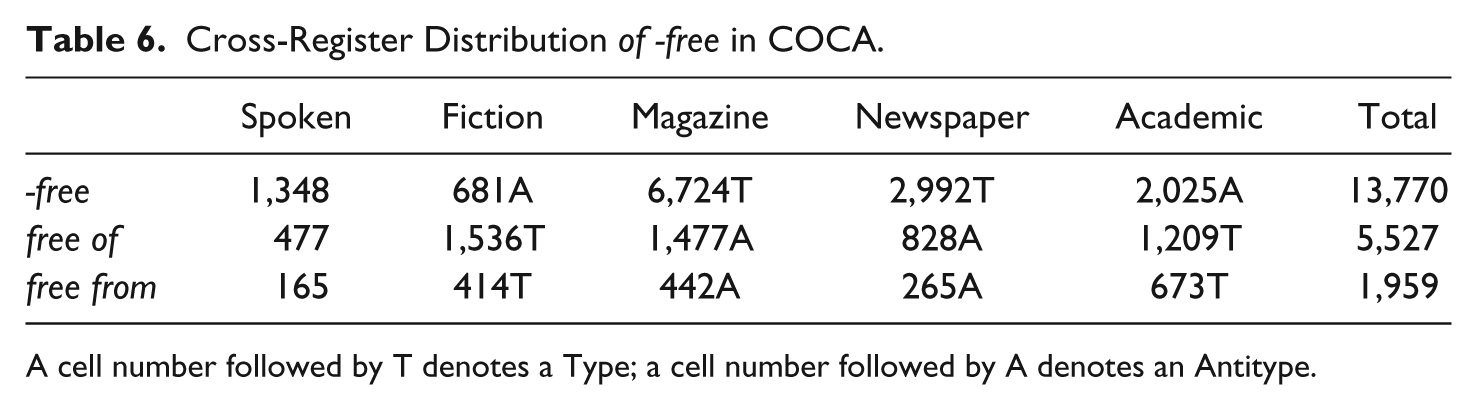
A cell number followed by T denotes a Type; a cell number followed by A denotes an Antitype.
The connection between changes in lifestyle and the increased use of -free lies in the fact reviewed earlier that compounds are preferred over phrases for naming and the fact that changes in lifestyle often lead to the invention and use of new labels for new concepts. While -free only categorizes (rather than names) these new concepts, it is clearly the preferred choice over the two phrases in this function, nonetheless. In fact, previous research (Plag 2003:60) has already noted that the increased use of compounds may be influenced by fashions. Our analysis of the use of -free in COCA provides further evidence: the compound has been used increasingly more in connection with topics (many involving new concepts) that have become more and more important in contemporary society, such as healthy food and diet (e.g., fat-free or sugar-free food), environment and community safety (e.g., drug-free or smoke-free schools), and changing lifestyles (e.g., car-free or child-free living).
As evidence for this point, it may be noted that of the top twenty most frequent -free items in COCA (listed in Table 7), over half (eleven) are health- and environment-related. In contrast, only six for free of and one for free from are related to health and environment. Even more importantly, there is a tremendous difference in the frequency of the -free and the free of/from items on these topics. For example, while there are 1,058 tokens of fat-free, there are only three tokens of free of fat. Similarly, there are 471 tokens of drug-free but only seventeen tokens of free of drugs. These findings clearly indicate that in discussing these contemporary life topics, speakers/writers prefer the -free compound over the free of/from phrasal constructions.
Top Twenty Items of the Constructions in COCA.

Italicized items are health-/environment-related.
However, it seems that some established, highly frequent usages of free of/from may resist change, for our analysis shows that, whereas most of the frequently used free of/from phrases have a -free compound counterpart whose use has increased greatly (e.g., free of/from care, debt, pain > care-, debt-, pain-free), the free of charge phrase does not have one: *charge-free. How do we explain this? There are three likely related reasons. First, free of charge is the most frequent nonreferential use of the free of construction in both COHA and COCA (with a combined frequency of 1,008), accounting for 27 percent of all the nonreferential tokens of free of (3,670 tokens), and it had already gained its salience back in the early 1900s. This long established high frequency could have blocked its alternative charge-free because, research has shown, “[t]he higher the frequency of a given word, the more likely it was that the word blocked a rival form” (Plag 2003:65). Second, from a cognitive linguistic perspective, the high salience of a linguistic item (determined by its frequency ratio versus the total frequency of all related items) is a key factor in influencing a speaker/writer’s lexical choices, i.e., the more salient an item is, the more likely it is to be selected from a set of synonyms (Grondelaers & Geeraerts 2003:75; Liu 2013:96). Similarly, based on the “entrenchment” theory in cognitive linguistics (Croft & Cruse 2004:308), the extremely high frequency of free of charge has likely made it entrenched in the English speakers’ language system as a construction itself. It is important to note that the blocking of *charge-free by free of charge does not mean charge-free is ungrammatical, for, as Booij (2009:229) states, “[b]locking is the effect of competition between synonymous lexical units. It is not a formal principle that qualifies constructs as ungrammatical.”
Conclusion
This diachronic and synchronic study has explored the use of the -free compound and the free of/from phrasal constructions in COHA and COCA. It has yielded several important findings. First, frequency-wise, free of has exhibited a steady slow growth; free from has declined dramatically; in contrast -free has increased enormously, although its archaic use in the senses of ‘free to’ and ‘free with’ disappeared by the 1940s. Second, the -free compound boasts a high potential productivity index, i.e., the high ability to generate new words or hapaxes in a corpus. Third, while the compound and the phrasal constructions may both appear in several different structural positions, only the -free compound is used attributively. Fourth, whereas the -free compound is used almost exclusively nonreferentially, the free of/from constructions are significantly more referential. Fifth, even in the contexts where both construction types may be used, often only one type is allowed or preferred due to internal structural and semantic factors. These findings provide some support for the theory that true synonyms do not exist (cf. Cruse 1986:270). Finally, besides the fact that only the -free compound can appear prenominally, the main motivation driving the increased use of the -free compound over its phrasal counterparts appears to be its information-condensation function via syntactic recategorization, along with the adoption of a compressed language style and changes in lifestyle that have led to new labels and concepts, for which the -free compound is the preferred categorizing device. However, despite the general increase in the use of the -free compound over the phrasal constructions, one free of/from item, free of charge, has resisted this change pattern: its enormously high frequency has likely blocked its compound counterpart *charge-free, offering further evidence for the blocking theory in morphology.
In short, by showing that structural, semantic, stylistic (specifically the compressed style in contemporary English), frequency, and social factors may all influence the choice between the -free compound and the free of/from phrases, we have provided support for many existing theories and also shed new light on the use of the two types of constructions. Of course, it will be important to see more studies on other related lexical-syntactic (phrasal) pairs or sets to further test the findings of this study.
Footnotes
Appendix
Declaration of Conflicting Interests
The author(s) declared no potential conflicts of interest with respect to the research, authorship, and/or publication of this article.
Funding
The author(s) disclosed receipt of the following financial support for the research, authorship, and/or publication of this article: Our research was partially supported by grant 13cyy001 from the China National Project of Philosophy and Social Sciences.