




Abstract
This paper examines the development of and stuff, a general extender (GE), in Canadian English in longitudinal perspective. Previous research (Cheshire 2007; Tagliamonte & Denis 2010; Pichler & Levey 2011) finds suggestive evidence that and stuff and other GEs have undergone grammaticalization over their development. However, when viewed in apparent time, there is little evidence of ongoing grammaticalization; rather only vestiges of apparent previous grammaticalization remain. This paper takes up Pichler and Levey’s (2011) call for an appropriate real-time benchmark of comparison to enable a more thorough understanding of the historical development of these features. A collection of oral histories recorded in the 1970s and 1980s with elderly residents of three communities in southern Ontario, Canada, is used as a proxy for comparison to Tagliamonte and Denis’s (2010) analysis of the Toronto English Archive. By tracking the development of and stuff over more than a century of apparent time, this paper finds three changes in progress: (1) a lexical replacement such that and stuff becomes the majority variant in the variable system; (2) a morphological clipping process such that longer GEs such as and stuff like that lose the comparative element like that; and (3) the semantic bleaching of the set-marking meaning of and stuff. While this last change is a necessary part of grammaticalization, in the absence of phonetic reduction, decategorialization, and pragmatic shift, it is not sufficient evidence according to grammaticalization theory (e.g., Heine 2003; Traugott 2003; Diewald 2010).
1. Introduction
The literature on English general extenders (GEs), a set of pragmatic markers that function to evoke set membership, as in (1)-(2), converges in finding that the GE and stuff (like that) has risen in frequency in dialects of English around the globe. This rise in frequency has typically been discussed with respect to grammaticalization (e.g., Overstreet 1999 on American Englishes; Cheshire 2007 on British Englishes; Tagliamonte & Denis 2010 on Canadian Englishes).
(1) I bought some eggs and stuff from up at Atwood. (EON/M/1912) 1
(2) We used to have church socials and things like that. (NIA/F/1912)
While the change in frequency of and stuff (like that) is readily observable in corpora of sociolinguistic interviews as an apparent-time increase in the proportion of the form relative to all other GEs, the appeal to grammaticalization is more controversial. According to grammaticalization theorists (e.g., Lehmann 1982/1995; Heine 2003; Traugott 2003; Diewald 2010), a defining hallmark of the process is a series of correlated phonetic, morphosyntactic, and semantic-pragmatic changes affecting the linguistic form undergoing grammaticalization. Heine (2003) defines these as “phonetic reduction” or the loss of phonetic substance, “decategorialization” or the loss of morphosyntactic properties, “semantic bleaching” or the loss of the lexical/propositional meaning, and extension or the use of a linguistic form in new contexts and/or with new pragmatic functions (also called “pragmatic shift”). Given that these changes are correlated, it would be quite unusual for only subsets of these changes to occur during the grammaticalization of the same linguistic form. For example, evidence of phonetic reduction or decategorialization in the absence of semantic change and pragmatic shift does not provide evidence for grammaticalization, as defined. In other words, these changes may be “causally independent” (Eythórsson 2008:2). And yet, not all studies of the apparent grammaticalization of GEs have observed all (or even the same) mechanisms to be active. Furthermore, those studies that consider the dimension of time have found little or no indication that the mechanisms of grammaticalization are undergoing change in progress (Tagliamonte & Denis 2010; Pichler & Levey 2011). Some varieties exhibit vestiges of (one or more of) the mechanisms, which potentially indicate that grammaticalization was operational at some point in the past. However, thus far, ongoing grammaticalization has not been observed. This leads to a third issue: those studies that do consider the dimension of time have appealed to the apparent-time construct in which the age of speakers is a proxy for time (Bailey et al. 1991). As Pichler and Levey (2011:462) put it: “[I]t remains to be determined whether the synchronic stable patterns of GE variability [. . .] are in fact the product of grammaticalization processes that may have been operative at an earlier stage of the language, predating the time-span in our corpus.” Accordingly, these authors plead for an “appropriate real-time benchmark” to unravel the unknown history of these changes. In this paper, I investigate just such a real-time benchmark of earlier Canadian English data from oral histories, in comparison with the contemporary Canadian English data reported on by Tagliamonte and Denis (2010). This allows for longitudinal investigation of GEs and and stuff (like that) in particular. While synchronic (apparent-time) data have provided inconclusive evidence for grammaticalization in progress, the data investigated in this paper provide a view on the GEs system over more than a century, which, as it turns out, covers nearly the full time span of the rise of and stuff (like that). When viewed from this longitudinal perspective, there is no evidence that the mechanisms of grammaticalization act in unison, as a single process (i.e., grammaticalization), during the development of and stuff (like that) in Canadian English. Rather, three independent changes have taken place. First, there is a process of lexical replacement of and stuff (like that) as observed by Tagliamonte and Denis (2010). Second, putative phonetic reduction of GEs from long forms (and stuff like that) to short forms (and stuff) that has been frequently reported in the literature as a diagnostic of phonetic reduction cum grammaticalization (e.g., Erman 1995; Overstreet 1999; Aijmer 2002; Cheshire 2007) is the result of an independent change in progress. Lastly, to the extent to which any semantic-pragmatic change affecting GEs can be identified, it is independent of other mechanisms of grammaticalization and, thus, independent of a theorized, uniform process of grammaticalization (cf. Lehmann 1982/1995; Heine 2003; Traugott 2003; Diewald 2010).
The paper is organized as follows. I begin with a general review of the GEs literature and introduce the data examined in this paper. Next, I present an overview of the inventory and distribution of GEs in earlier Canadian English and across the twentieth century. I then consider Cheshire’s (2007) diagnostics of grammaticalization of GEs in longitudinal perspective. I appeal to real-time comparison across the longue durée (cf. D’Arcy 2012, 2015). Finally, I conclude that the development of and stuff (like that) in Canadian English is not a story about grammaticalization, but rather an instance of independent changes acting on a multifaceted variable system.
2. General Extenders: Structure, Function(s), and Socio-Pragmatic Meaning
General extenders are a set of pragmatic markers that occur clause- or phrase-finally and typically function with respect to set-marking. Cheshire (2007:157) observes that “what is assumed to have been their original meaning” is “indicating that the clause element to which [GEs] are attached should be seen as an exemplar of a more general set.” For example, the GE in (1) refers to a set that includes eggs and also perhaps butter, flour, and other agricultural foodstuffs.
GEs have additionally been structurally defined (e.g., Dines 1980; Tagliamonte & Denis 2010). Tagliamonte and Denis (2010:337) provide a template for prototypical GEs composed of four components: connectors, quantifiers, generics, and comparatives. These four components combine in various ways, exemplified in (3)-(5).
(3) Connector+Quantifier+Generic+Comparative: or+some+thing+like that
We’d kick the ball around in the summer time or play baseball or something like that. (EON/M/1905)
(4) Connector+Generic: and+stuff
They’d be starting it all in spring, seedlings and vegetables in March. Sowing seeds and stuff. (NIA/M/1902)
(5) Connector+Generic+Comparative: and+things+like that
They loaded an ambulance with generators, lights and things like that […] (BLV/M/1914)
There is also a subset of non-prototypical GEs, as in (6)-(8), that do not conform to the template but nevertheless perform a set-marking function.
(6) Then of course in the summertime there’d be extra help for harvest and so on like that but mostly during the war it was women and children. (NIA/M/1907)
(7) And of course in the wintertime, I guess it was getting out, building forts and having a snowball fight or throwing some snowballs at somebody driving by or whatever. (EON/F/1919)
(8) I generally played on all the teams that went out of high school. Uh the basketball, baseball, hockey, et cetera. (BLV/F/1898)
While GEs have been conceptualized in the sociolinguistic literature as a variable system, at least two types of GEs should be kept separate as they function differently and thus constitute different envelopes of variation. “Adjunctive” GEs are those with an and connector and which entail ‘there is more’ (e.g., 4). These contrast with “disjunctive” GEs, those with or, which entail ‘there are alternatives’ (e.g., 3). In a variationist perspective, and stuff and or something do not constitute “two or more ways of saying the same thing” (Labov 1972:323) in the same way that and stuff and and things like that do. That said, the variationist literature is not consistent in separating these two kinds of GEs. The variationist literature also frequently groups together prototypical GEs based on common elements, typically the quantifier and generic combination: and stuff, and stuff like that, and and that stuff are all stuff GEs, something around there, or something, and or something of that sort are all something GEs (e.g., Cheshire 2007).
Both the frequency and distribution of GEs have been observed to be conditioned by social factors. A high frequency of use of GEs in general has been associated with working-class speech (Dines 1980; Dubois 1992) and young people (Dubois 1992; Stubbe & Holmes 1995; Cheshire 2007; Tagliamonte & Denis 2010; Denis 2011). Individual forms have also been associated with different social and stylistic contexts. For example, Cheshire (2007:165) observes the highest use of and that among working-class youths while middle-class speakers prefer and stuff and and things.
The pragmatics literature has focused on the multifunctionality of GEs (Youssef 1993; Overstreet 1999, 2014; Aijmer 2002, 2013). There is general consensus that the core function is set-marking. Non-set-marking functions that have been ascribed to GEs include marking politeness, establishing common ground, creating social solidarity, foregrounding information, shifting topic or speaker, turn-taking, hedging, and approximation. Generally, these non-core functions can be grouped into interactional (i.e., dealing with the organization of discourse) and interpersonal (i.e., dealing with the interlocutors’ propositional attitudes).
Overstreet and Yule (1997:250) focus on the role GEs play in the interpersonal domain as markers of social solidarity. Because the core function of GEs is ad hoc set-marking and this type of category implication requires common ground among interlocutors, GEs can function as conventionalized markers of shared knowledge and social closeness. In other words, using a GE rather than an explicit example or list indicates to a listener that she believes that the listener has enough shared knowledge with the speaker to reconstruct the intended set. Hence, GEs mark an implicature of social closeness between interlocutors. I will return to this observation when discussing the grammaticalization mechanisms of semantic bleaching and pragmatic shift.
3. Grammaticalization Theory and the Grammaticalization of General Extenders
GEs are frequently discussed with respect to grammaticalization and grammaticalization theory. While “grammaticalization” is empirically definable, it is difficult to narrowly define a cohesive “grammaticalization theory” as different researchers posit various (and only sometimes) intersecting mechanisms of grammaticalization. That said, most researchers agree on the following: (a) grammaticalization is a change from lexical to grammatical (=functional) and from grammatical to more grammatical, and (b) grammaticalization takes place via interconnected phonetic reduction, loss of morphological wordhood, a loss of propositional meaning, and concomitant strengthening of non-propositional meanings.
The first point is an empirical observation about the result of certain kinds of diachronic processes (cf. Joseph 2004:61): what was once lexical can come to serve grammatical (or functional) purposes. The second point encompasses a theoretical prediction: changes of the type described in (a) are predicted to undergo a specific type of development. What I call “grammaticalization theory” includes both (a) and (b) in a definition of “grammaticalization” (e.g., Lehmann 1982/1995; Heine 2003; Traugott 2003; Diewald 2010). It is precisely this conception of grammaticalization that will be tested in this paper. 2
To extend grammaticalization theory to the development of pragmatic markers, the only necessary adjustment to make to the core notion of grammaticalization is to expand what is meant by “more grammatical” to include the expansion of pragmatic function (Thompson & Mulac 1991; Traugott 1995; Brinton 1996, 2008). If a form expands from having a strictly lexical meaning to expressing a discourse-pragmatic function it can be said to be grammaticalizing (Brinton 2008:52). Brinton (2008:52-53) (among others) argues that the development of pragmatic markers is also subject to the interrelated mechanisms of grammaticalization. Pragmatic markers arise through the decategorialization of “more major to more minor word class membership” (Brinton 1996:273) (i.e., from nouns and/or verbs to particles), undergo semantic bleaching and pragmatic expansion as they change from having propositional meanings to serving interactional and/or interpersonal functions, and, often undergo phonetic reduction (e.g., you know what I mean > y’know; isn’t it > innit; I don’t know > I dunno).
Indeed, many researchers have discussed GEs (either implicitly or explicitly) with respect to grammaticalization. Aijmer (2002) observes that, in the London-Lund Corpus of Spoken (British) English, the higher frequency of short GEs could be due to phonetic reduction (Aijmer 2002:222) and their observed multifunctionality can be thought of as a result of semantic-pragmatic change (Aijmer 2002:217). Likewise, Overstreet and Yule (1997) note that those GEs that function more interpersonally (i.e., those that have pragmatically shifted) are more often shorter (suggesting phonetic reduction), unambiguously attach to nominals less often (suggesting decategorialization), and tend to lack the set-marking function (suggesting semantic bleaching). The variationist sociolinguistic literature has focused on quantitatively testing the hypothesis that GEs are grammaticalizing.
Cheshire (2007) develops diagnostics to test each of Heine’s (2003:579) mechanisms of grammaticalization on a synchronic set of sociolinguistic interviews with adolescents. Following Aijmer (2002:227), Erman (1995:145), and Overstreet and Yule (1997), Cheshire (2007:167) hypothesizes that a shortening of the lexical length of GEs indicates phonetic reduction. 3 Cheshire (2007:168) observes that longer forms (e.g., and stuff like that, and that kind of thing) are less frequent in her data of British adolescents than shorter forms without comparative elements (e.g., and stuff, and things).
To test decategorialization, Cheshire (2007) operationalizes Dines’s (1980) and Aijmer’s (2002) mapping of morphosemantic features to particular quantifier-generic combinations. Dines (1980) and Aijmer (2002) assume that the generic element of each GE ought to depend on the morphosemantic features of its referent. The generic form stuff should co-occur with a mass noun referent, such as milk, while things, being a plural (count) noun itself, should co-occur with plural (count) noun referents, such as puzzles. However, as Cheshire (2007) and others before her observe, this is not always the case. In fact, GEs frequently appear in coordination with non-nominal constituents. Cheshire (2007) hypothesizes that the more frequently a GE co-occurs with an unexpected referent, the more it has decategorialized. Indeed, Cheshire’s (2007) comparison of long and short GEs suggests that short forms (i.e., the more phonetically reduced forms) are more decategorialized than long forms (i.e., the less phonetically reduced forms). Taken together, these observations point to the possible grammaticalization of certain GEs. To determine the extent of semantic bleaching, Cheshire (2007) examines the extent to which the core set-marking function has been lost. Tokens in which no set-marking function is inferable are argued to be more advanced. Cheshire (2007) observes that the set-marking function is categorical with all long GEs (e.g., and things like that) but often not inferable with short GE forms (e.g., and things). That the variants at the forefront of phonetic reduction and decategorialization are also those in which the core meaning could not be inferred further supports the hypothesis that GEs are grammaticalizing. Lastly, Cheshire (2007) operationalizes collocation with other discourse-pragmatic markers (DPMs) to determine the extent to which GEs have pragmatically shifted. She argues that if a GE co-occurs with another DPM within the same utterance, then the GE is less grammaticalized than one that does not. In the former case, the GE serves a more propositional role, while the co-occurring DPM is providing the interactional and/or interpersonal function. In the latter case, the GE itself is assumed to be more likely functioning in the interactional/interpersonal domains. Cheshire (2007) finds that the GE variants most advanced in terms of phonetic reduction, decategorialization, and semantic change are also those most advanced in terms of pragmatic shift.
Cheshire’s (2007) evidence for grammaticalization of GEs appears strong. However, her focus is on a single generation and it is unclear to what extent, if any, the set of changes associated with grammaticalization are occurring through time. To explore this question, Tagliamonte and Denis (2010) apply the same diagnostics using apparent-time evidence. They report that stuff GEs increased at the expense of thing GEs across the twentieth century. If the development of stuff GEs is best thought of as grammaticalization, then over the course of this change in frequency, we should expect evidence of ongoing grammaticalization. 4 However, although there are some indicators consistent with previous (perhaps arrested) grammaticalization, Tagliamonte and Denis (2010) argue that grammaticalization did not happen during the apparent-time span of the data (1916-1992). Thus, as Pichler and Levey (2011) request, what we need is a real-time comparison.
4. Earlier Ontario English Collection
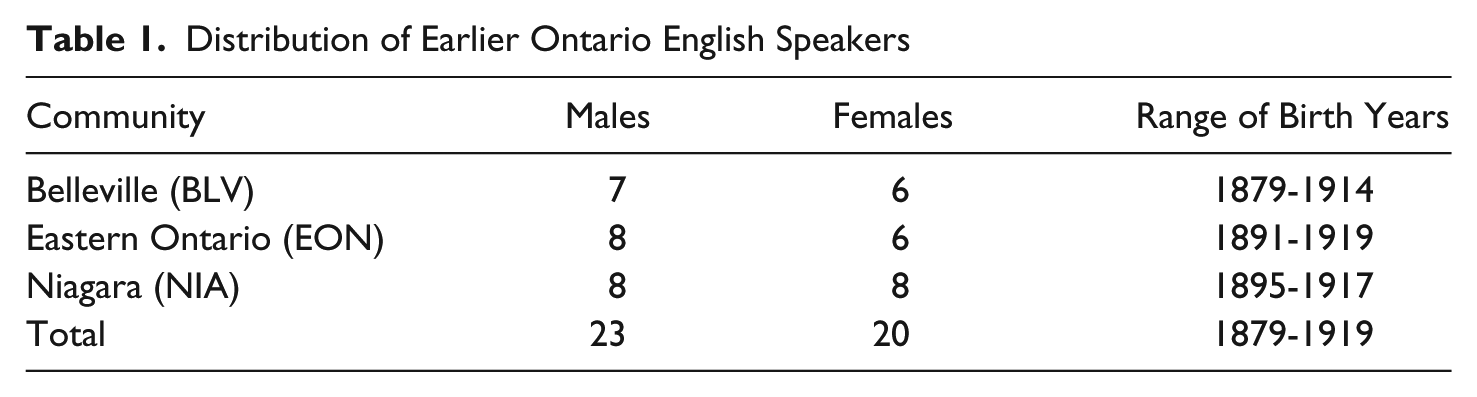
In an effort to reach further back in time and illuminate the development of GEs (in particular stuff GEs), this paper makes use of two Canadian English oral history collections. These collections serve as a real-time benchmark with more recent sociolinguistic interview data. Together, I refer to these data as “Earlier Ontario English” (or EOE). First is the Belleville 1975 Oral History collection (Hastings County Historical Society 1975; Tagliamonte 2007-2010). Interviews with prominent residents of Belleville and the surrounding Hastings County area were recorded in an effort to record first-hand narratives about the history of the region. The Farm Work and Farm Life Since 1890 oral history project was collected in the mid-1980s in an effort to document the lifestyle and working conditions of early twentieth-century farmers (Archive of Ontario 1987). Interviews were conducted with elderly Ontarians who were born and raised on farms in five regions of Ontario. For present purposes, only two of the five communities are considered: Niagara and Eastern Ontario. For all three communities I consider here, the first Europeans settlers were United Empire Loyalists—Americans by birth who fled the United States before, during, and after the American Revolution (Fryer 1980:307; French 2006:54). The Loyalists are considered the founding population of English-speaking Canada west of Quebec. In keeping with Zelinsky’s (1992) “Doctrine of First Effective Settlement” and Mufwene’s (1995) “Founder’s Effect,” this first settler population exerted “many subtle and largely unintentional dictates on those who succeed them” including their language (Chambers 2004:xii). Thus, the Belleville, Eastern Ontario, and Niagara Region speech communities represent not only a lineage that can be directly traced back to the general Canadian English’s founding speech community, but also a link in the chain of transmission of this variety, two or three generations deeper into the past than the Toronto English Archive (see below) represents with speakers born between 1879 and 1919. Table 1 presents the distribution of speakers in this collection of Earlier Ontario English by community, sex, and year of birth.
Distribution of Earlier Ontario English Speakers
The EOE will be compared directly to the state of affairs in the Toronto English Archive (TEA) (Tagliamonte 2006; Tagliamonte & Denis 2010). The TEA is a two-million-word corpus of more than two hundred sociolinguistic interviews with native speakers of Toronto English recorded between 2003 and 2005. Speakers were born between 1916 and 1992. All together, the data considered in this paper provides a view on GEs in Canadian English that spans more than a century. 5
In the next section, I present the overall distribution of GE variants in EOE in comparison to Tagliamonte and Denis’s (2010) results for Toronto.
5. Overall Distribution and Changes in Frequency
Across the apparent-time span of TEA, stuff GEs rose in frequency proportional to all others (Tagliamonte & Denis 2010). However, the nature of the variable system prior to this must be established to fully understand the development of stuff GEs in Canadian English. Figure 1 plots the relative frequency of adjunctive GE types (and+that, everything, so on, stuff, thing, and all others) as a proportion of the total number of adjunctive GEs. 6 Speakers are binned by their year of birth in decade long intervals from 1890 to 1990. The 1890s bin also includes speakers born between 1879 and 1889 due to a low number of speakers born prior to 1890.
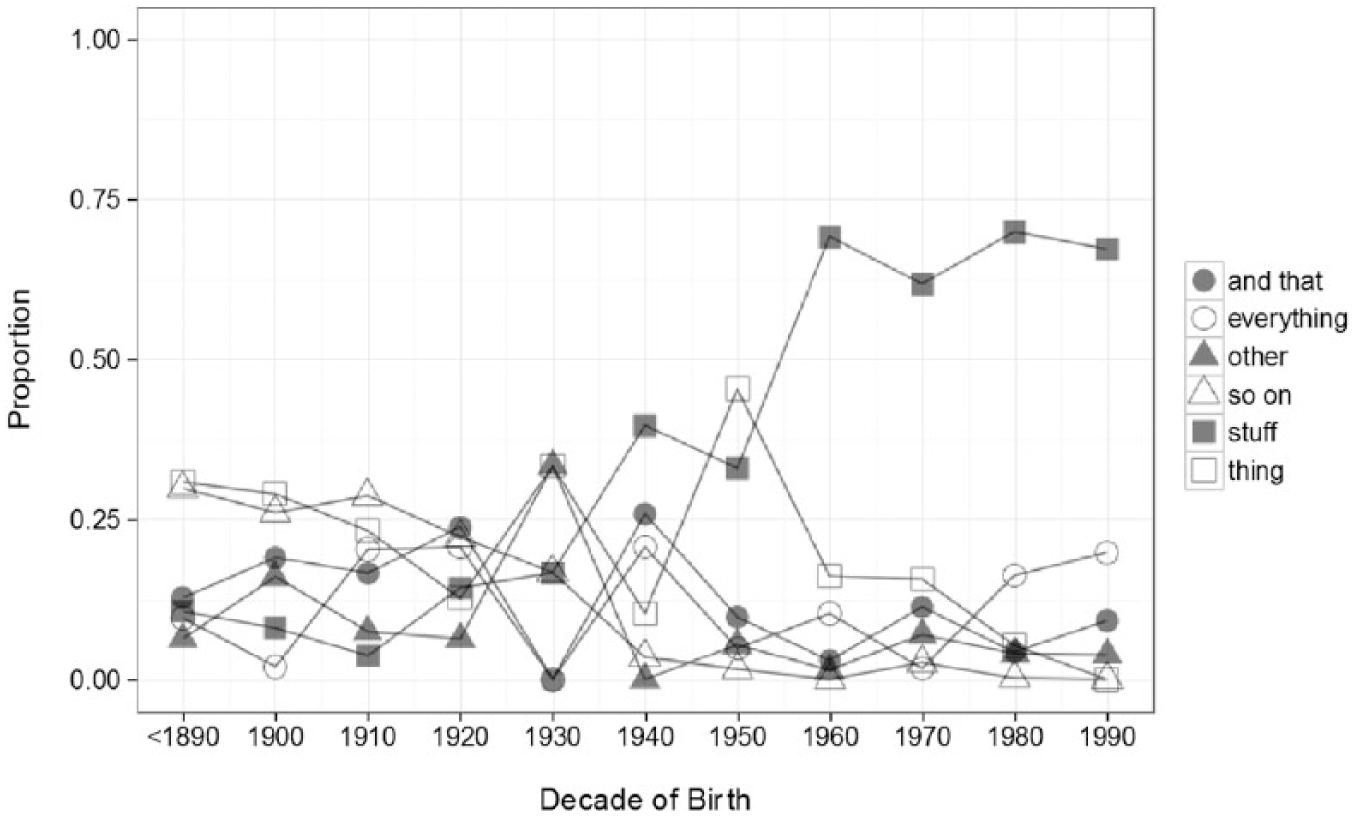
Proportion of Main Variants of Adjunctive General Extenders over 100+ Years of Apparent Time in Ontario English. N = 1535
The variable system of the oldest speakers consists of multiple variants with proportions hovering between 0.15 and 0.30. Thing GEs (open-box point) and so on GEs (open-triangle point) lead, though we begin to see a decrease of both forms by the 1920s. Among these older speakers, stuff GEs (square point) rank much lower. However, after the perturbations among the 1930s speakers, where token numbers are generally low, stuff GEs begin to take over the system. This expanded picture across one hundred years of apparent-time indicates that there is a more complex story than that told by Tagliamonte and Denis (2010:358), who suggest that stuff GEs were replacing their next major competitor thing GEs. Rather, the rise of stuff GEs resulted in a massive reduction of variation. Where the oldest speakers exhibit robust variation of variants, the youngest speakers have a variable system that is dominated by a single variant.
The timespan considered here ranges back to a period when stuff GEs were truly peripheral. Indeed, while the earliest attestation in the OED dates to 1670 (see sense 8a), these early examples suggest a sense of irrelevance (not generalness) to the set, which is consistent with the sense of stuff as ‘rubbish’ around this time period. Furthermore, Tagliamonte and Denis (2010:364) find no examples of stuff GEs in A Corpus of English Dialogues (1560-1760) (Kytö & Culpeper 2006). The earliest Canadian attestation I could find dates to 1836, given in (9). In this example, no sense of irrelevance seems to be implied.
(9) But his notebook was safe under lock and key, and the pigs in New York, and the chap the rats eat in jail, and the rough man from Kentucky, and the entire raft of galls emprisoned in one night, and the spittin’ boxes and all that stuff, warn’t trusted to memory, it was noted down, and printed.
(Haliburton 1836:83)
Thus, the combined data here illuminates nearly the entire developmental trajectory. This is critical because if grammaticalization (presently arrested or otherwise) were involved in this development, evidence should be apparent herein.
6. Testing the Diagnostics of Grammaticalization Longitudinally
I now turn to the core question and test the hypothesis that during the rise in frequency of stuff GEs from an incipient stage the form underwent grammaticalization. Each diagnostic of grammaticalization is replicated with the EOE data in comparison to TEA following Cheshire (2007) and Tagliamonte and Denis (2010). I then probe each mechanism and provide an updated analysis of the trajectory of each potential change.
6.1. Phonetic Reduction
Cheshire (2007) follows a number of researchers who have suggested that a decrease in the syntagmatic length of a GE (e.g., short and stuff versus long and stuff like that) is diagnostic of phonetic reduction. In other words, phonetic reduction is predicted to erode away whole components of Tagliamonte and Denis’s (2010) GE template over time. Tagliamonte and Denis (2010:351-352) test this mechanism for the prototypical GEs. For every speaker in the data, the frequency per 10,000 words of short and long versions of each GE type was calculated. To determine the extent of phonetic reduction, the normalized frequency of long forms was subtracted from the normalized frequency of short forms. By binning speakers into three age groups, Tagliamonte and Denis (2010) argue that apparent time phonetic reduction can be identified if an increase in the mean of differences for each group is observed across apparent time.
Table 2 presents the results for stuff GEs from Tagliamonte and Denis (2010: Table 6) together with the results from EOE. The table presents the mean normalized frequency of length by age group. Results of a paired sample, two-tailed t-test, testing the significance of the difference of the means of long and short forms for each speaker in each group are reported below the means.
Test of Phonetic Reduction in Real Time, Forms per 10,000 Words, Paired-Sample t-Tests
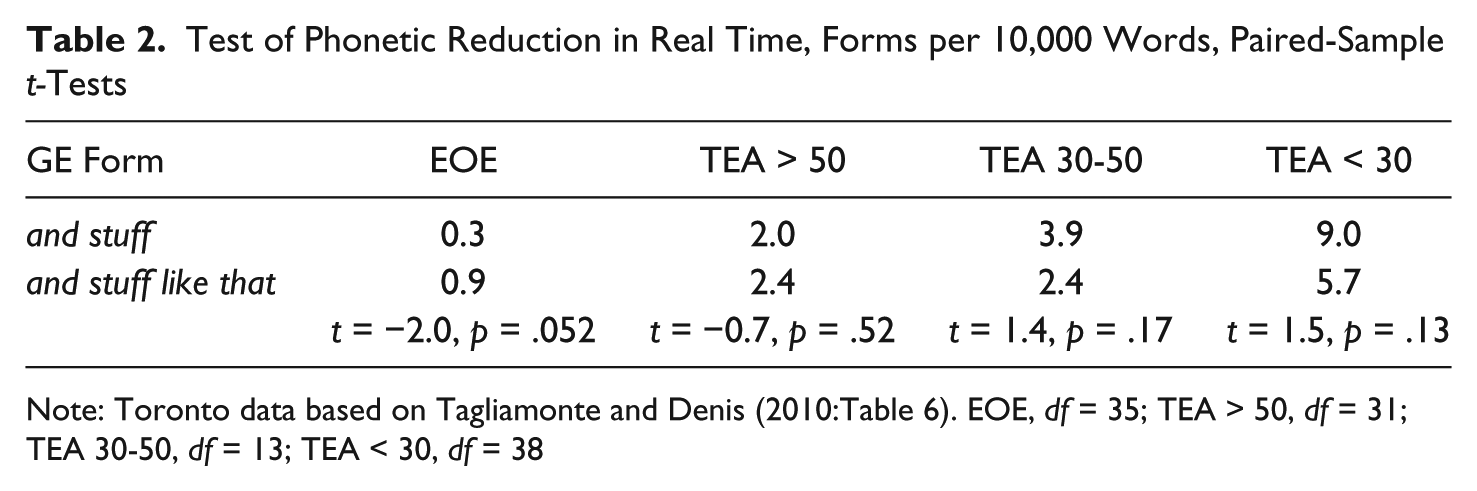
Note: Toronto data based on Tagliamonte and Denis (2010:Table 6). EOE, df = 35; TEA > 50, df = 31; TEA 30-50, df = 13; TEA < 30, df = 38
While the difference between long and short forms of stuff in TEA increases across apparent time, Tagliamonte and Denis (2010:351) find no significant difference in the means. However, in EOE, the difference, such that there are more long forms than short forms, nears significance (p = .052). Together, this could be interpreted as empirical support for phonetic reduction as part of the grammaticalization of stuff GEs in real-time. However, is this phonetic reduction cum grammaticalization or could something else explain this change?
Because grammaticalization independently affects different linguistic forms, phonetic reduction cum grammaticalization is expected to affect different grammaticalizing GE types; phonetic reduction of stuff GEs should operate independently of thing GEs (and something and everything GEs, etc.). An alternative possibility is that the change in length of stuff GEs observed in Table 2 is the result of some other kind of change. Note that some changes that appear on the surface to be proceeding independently are the result of a single underlying change involving variation between two competing variants in a synchronic grammar. These are the kinds of changes that traditionally involve competing grammars, differing minimally with respect to some abstract rule/parameter settings (Kroch 1989, 1994; Santorini 1992; Pintzuk 1999; Newmeyer 2014). Changes that are the result of a single underlying process are hypothesized to proceed at a constant rate in all affected contexts (precisely because each context is a reflex of a single underlying process). 7 Thus, if the apparent phonetic reduction observed with stuff GEs is also found to occur with other GEs and, critically, if the change proceeds at a constant rate with each type, the change is plausibly the result of some other change, independent of grammaticalization. The rates of change of different forms undergoing phonetic reduction cum grammaticalization are not predicted to be the same.
In an attempt to tease apart phonetic reduction cum grammaticalization from some independent change, Figure 2 bins speakers into decade-long age groups as in Figure 1. For each age group a data point is plotted for the five GE types that robustly exhibit long and short forms: stuff, thing, something, everything, and so on. The position of the data point along the y-axis represents the frequency of long forms as a proportion of the total number of each GE type in each age group. For example, for speakers born in the first decade of the twentieth century, approximately 50 percent of all everything GEs were long forms and 50 percent were short.

Proportion of Long Stuff, Thing, Something, Everything, and So On GEs (versus Short Forms) Across Apparent Time. N = 2044
The overall trend is a decrease in the frequency of long forms across all types. Comparing the oldest speakers to the youngest speakers, the GE types stuff, something, and everything have all dramatically reduced the frequency of long forms. The GE and so on like that completely fell out of favor in the early half of the twentieth century. For speakers born after 1930, only the long thing GEs remain consistently above the 50 percent mark.
So far, the evidence does not disentangle the two possible causes of this decline. In order to put phonetic reduction cum grammaticalization to the test, we need a benchmark against which to compare. A possible independent change is that the comparative element like that has increasingly become susceptible to elision (cf. Tagliamonte 2012:276). In this scenario, the presence of long and short GEs represents variation between the comparative like that and a null comparative (cf., e.g., Tagliamonte & Smith 2005 on complementizer deletion). If this is the case, this morphological clipping should affect all GEs equally (and thus at the same rate), since it is independent of any particular type. Some types may favor or disfavor comparative deletion to different extents, but, crucially, the rate of change should be the same.
Following Kroch (1989), this hypothesis can be tested using a logistic regression model. The dependent variable of the model is the realization of the comparative (like that or ∅).
8
The model tests the main effects of
The results of this model are presented in Table 3.
10
There are three points to observe. First, the main effect for
Mixed-Effects Logistic Regression Testing the Fixed Effects of
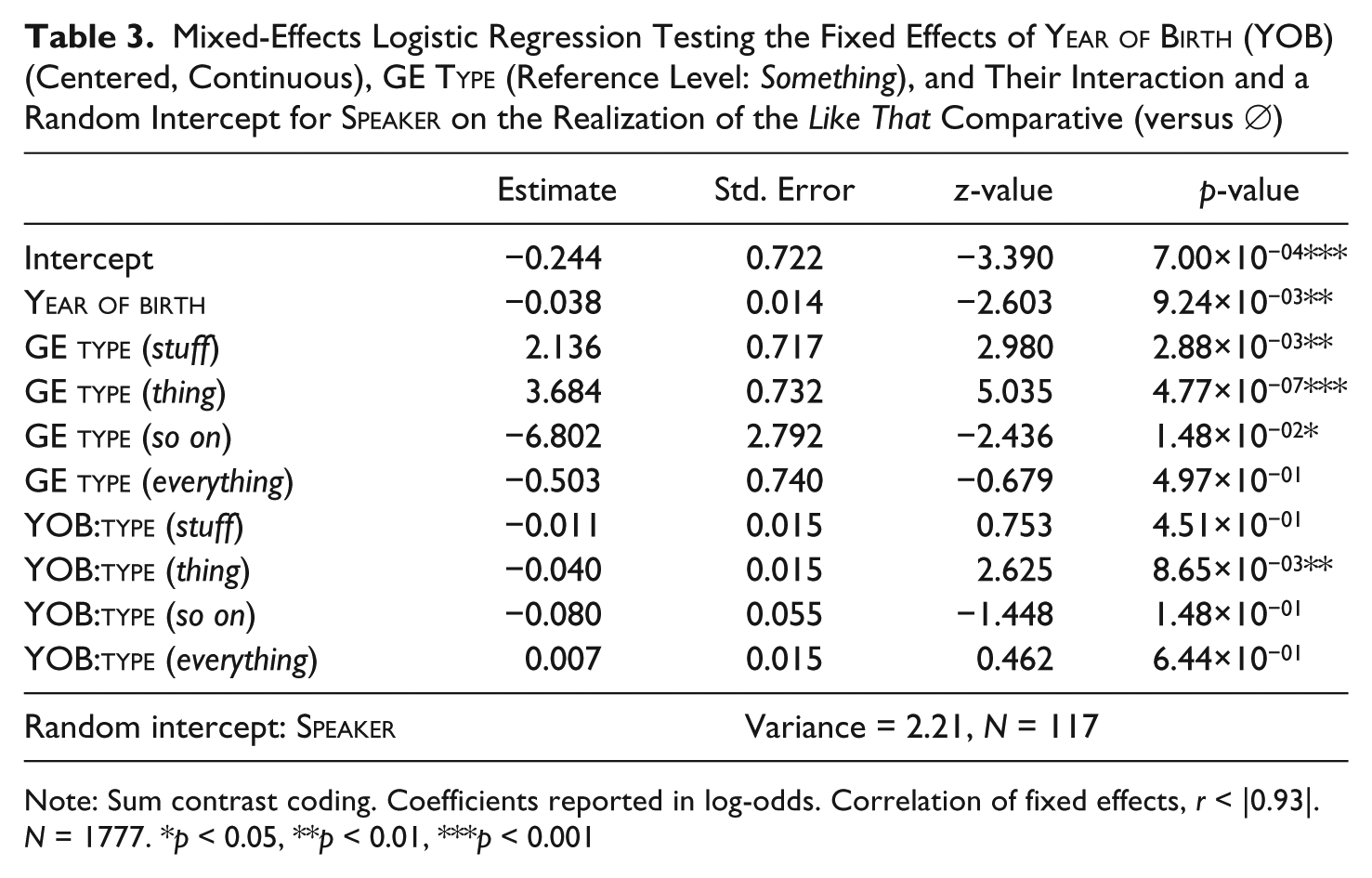
Note: Sum contrast coding. Coefficients reported in log-odds. Correlation of fixed effects, r < |0.93|. N = 1777.
*p < 0.05, **p < 0.01, ***p < 0.001
What remains then is a mixed story. On the one hand, we have possible evidence that supports the idea that individual GE types are phonetically reducing; different GEs erode at different rates. On the other hand, only one GE stands out. The rates of change of all other GE types—including, critically, stuff—are statistically indistinguishable, which would be purely coincidence if each were undergoing phonetic reduction cum grammaticalization (cf. Fruehwald, Gress-Wright & Wallenberg 2013). Perhaps the trajectory of phonetic change for things is different from all other forms because of its obsolescence. For now we move on to the other diagnostics of grammaticalization tested by Cheshire (2007) and Tagliamonte and Denis (2010) and return to a discussion of the mechanism of phonetic reduction in the context of a broader perspective on grammaticalization.
6.2. Decategorialization
Next I consider decategorialization or “the loss of morphosyntactic properties characteristic of the source form [. . .]” (Heine & Kuteva 2005:579). Cheshire’s (2007:168) approach begins with the hypothesis that “[i]n a [GE] that has not grammaticalised, we might expect the head noun in the construction to always have the same syntactic and semantic properties as a preceding noun to which it relates anaphorically.” Hypothetically, and stuff should co-occur with non-count nouns because the lexical noun stuff is a non-count noun itself; mutatis mutandis, and things should co-occur with plural nouns, or something with singular nouns, etc. However, the literature has always observed that GEs do not strictly follow this feature matching requirement (e.g., Dines 1980). Not only do GEs co-occur with unexpected nominal referents, GEs frequently co-occur with phrases larger than nominals. GEs that co-occur with unexpected referents have been argued to be more grammaticalized than GEs that co-occur with their expected referents.
The EOE data contain examples of stuff GEs that co-occur with a variety of referents (indicated by bracketing) as in (10)-(13).
(10) Stroud’s would have toys and [kitchenware and all that stuff ] at that time. (BLV/F/1903)
(11) One Christmas I was tired of [Santa Claus pictures and all that stuff ]. (BLV/F/1898)
(12) I still have [. . .] the old agreements dating back to what the hired man had to to sign. To provide so much wood and [provide so much milk and all this kind of stuff ]. (EON/M/1912)
(13) I was one out of a group of five hundred junior farmers that went to the Royal Winter Fair from Ontario. [. . .] We spent a week as the guests of the Ontario Government and [we stayed at the Royal York hotel and all this kind of stuff ]. (EON/M/1912)
In each case, the GE unambiguously modifies referents of different syntactic categories. In (10), and all that stuff attaches to kitchenware, a non-count noun. In (11), it co-occurs with Santa Claus pictures, a plural (count) noun. In (12), and all this kind of stuff caps off the end of a list of conjoined predicates. Lastly, in (13), the same GE caps off a list of whole clauses. The same representation of referents for other GE types is also apparent in EOE (as Tagliamonte & Denis 2010 have previously shown in TEA).
Following Cheshire (2007) and Tagliamonte and Denis (2010), I coded each GE in EOE for the syntactic category of its referent. For sixty-seven tokens, the referent of a GE was ambiguous and therefore excluded. A further sixteen tokens were excluded because they were unclear for other reasons (e.g., background noise, overlapping speech, etc.). Each unambiguous token was further coded for whether that type of referent was expected or not, given the generic (stuff, things, etc.). Following Cheshire (2007), a distinction was made between unexpected nominal referents and unexpected non-nominal referents (hypothetically these are more decategorialized). By examining the distribution of referents over apparent-time, decategorialization can be tracked. Tagliamonte and Denis (2010:352-354) examine the distribution of referents of short stuff GEs, long stuff GEs, short thing GEs, and long thing GEs in the same three age groups as in Table 2. The trend in TEA is stability but this finding is limited by the lack of real-time evidence. Stability in the synchronic data does not preclude the possibility that decategorialization took place earlier. Given this possibility, I replicate Tagliamonte and Denis’s (2010) approach, adding an expanded temporal perspective from EOE in Figure 3. 11 Figure 3 displays the proportion of tokens across the same four apparent-time age groups as used in Table 2 for each of the three referent categories (expected, other nominal, other phrase). Each of the four facets of the chart is divided by GE type (stuff versus thing, for comparison) and length.
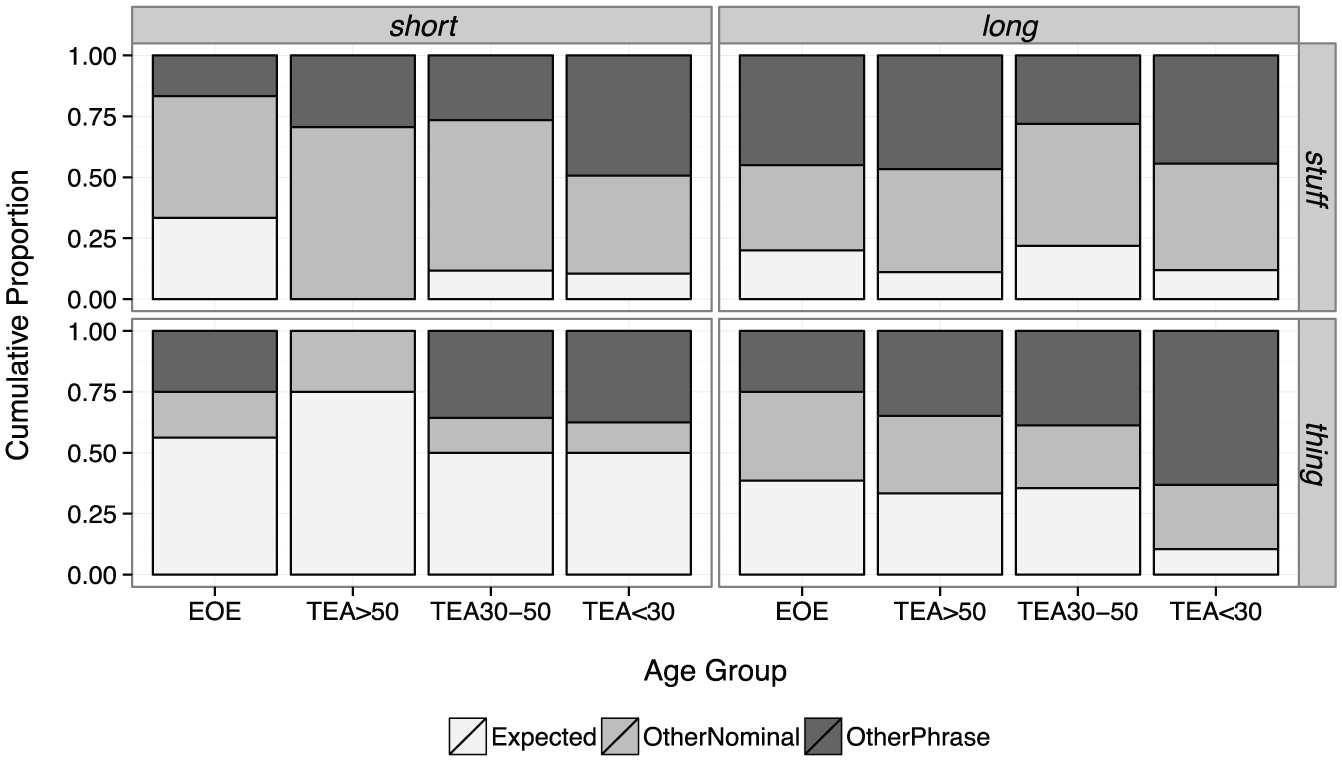
Stacked Bar Charts Showing the Fluctuating Distribution of GE Referents Over Real and Apparent Time
Just as Tagliamonte and Denis (2010:354) observe, the trend is one of stability. The majority of early onset tokens of short stuff in EOE co-occur with unexpected referents. This trend continues into the twentieth century. Although there is some indication that these oldest speakers had more of a preference for expected referents than the younger speakers, there are only six tokens of short stuff in EOE. The distribution of referents across apparent time for long stuff GEs in the upper right facet is stable. Tagliamonte and Denis (2010:354) suggested that short thing GEs were the only GEs where there was “a marked difference between the speakers older than fifty and the younger age groups” in TEA. However, we now see in the bottom left facet that this difference is not the result of decategorialization in progress, but rather the TEA>50 group seems to be a quantitative anomaly—the EOE group and the two younger age groups in TEA exhibit essentially the same distribution of referents. Lastly, while the oldest three groups have near-identical distributions of referents for long things, the youngest speakers have a lower rate of expected referents and this seems to be at the expense of a higher number of non-nominal referents. That said, with the expanded view from EOE, the conclusion reached by Tagliamonte and Denis (2010) for TEA holds. By and large there is stability.
To further confirm the lack of decategorialization in progress in this data, we can consider not the distribution of referents within a GE type, but the proportion of a GE type within the contexts of different referents (i.e., following the Principle of Accountability; Labov 1972). Since stuff GEs are well-established as the majority variant among the youngest speakers regardless of referent, if stuff GEs decategorialized over time, we expect to see this expansion to different contexts at different times and potentially at different rates of change in different contexts. However, if the rise of stuff GEs occurred at a constant rate across referents (or especially if we see no evidence of expansion over time), it is plausible that decategorialization never occurred. That is, stuff co-occurs with all referents today not because of a process of decategorialization but because it has since its earliest usage occurred in all these contexts and has generally and independently increased in frequency.
We can test this diagnostic of decategorialization with a logistic regression model. Table 4 presents the results of a mixed-effects logistic regression that models the main effects of
Mixed-Effects Logistic Regression Testing the Fixed Effects of
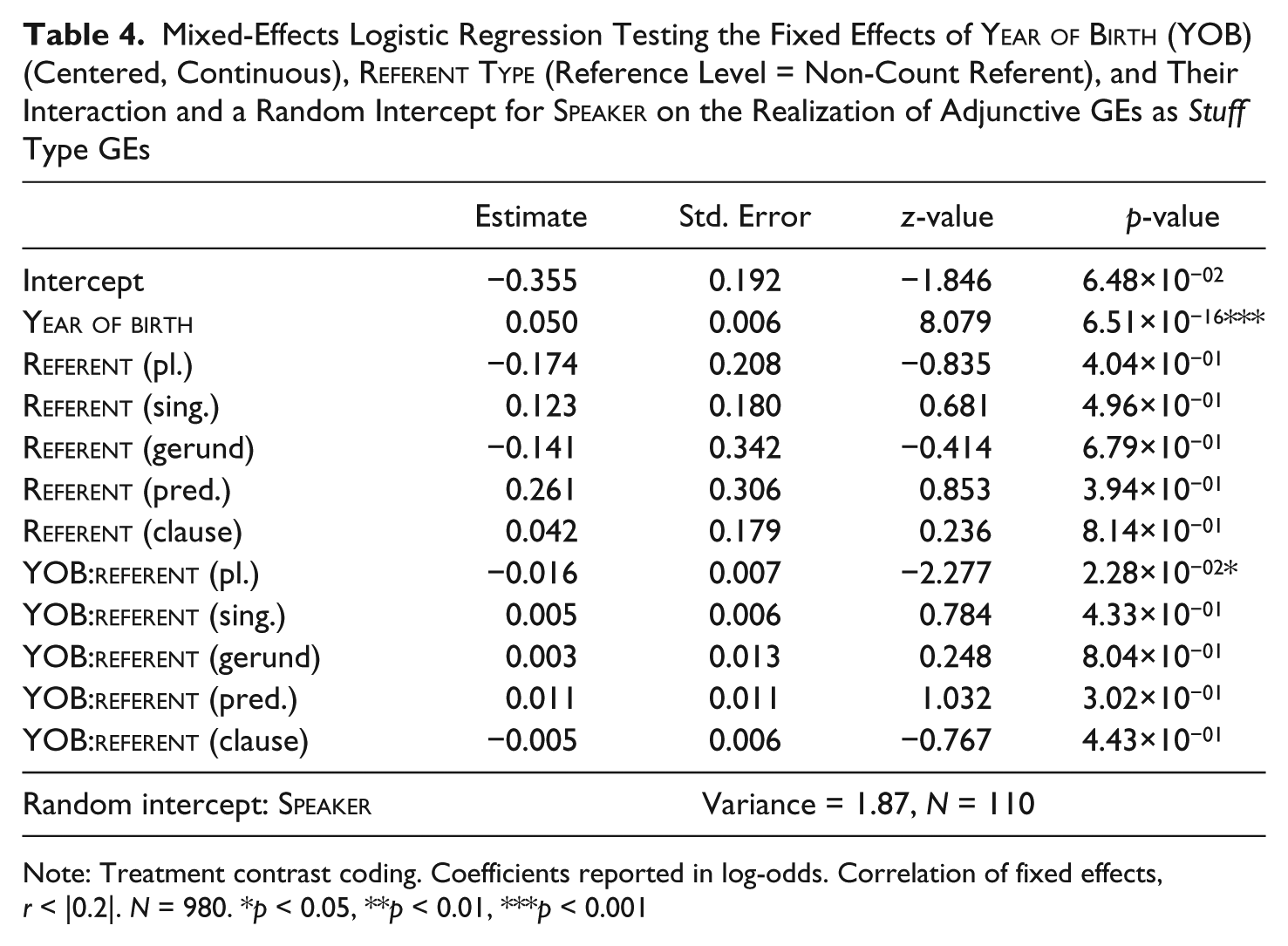
Note: Treatment contrast coding. Coefficients reported in log-odds. Correlation of fixed effects,r < |0.2|. N = 980. *p < 0.05, **p < 0.01, ***p < 0.001
The model shows a significant main effect of
6.3. Semantic Bleaching
Semantic bleaching is at the core of grammaticalization for many grammaticalization theorists. Heine (2003:583) argues that bleaching “precedes and is immediately responsible for” the other three mechanisms of change. Thus, for grammaticalization to be in progress with respect to the development of GEs, at a minimum, we should observe evidence of semantic bleaching. Insofar as the literature has argued that speakers are able to use GEs without implicating a set, we may find just such evidence (Erman 1995; Overstreet & Yule 1997:253; Overstreet 1999:43; Aijmer 2002:227; Cheshire 2007:175).
For many utterances containing a GE, a set or category is straightforwardly evoked, albeit perhaps not the set the speaker intended (see Channell 1994). In many (if not most) cases, the set/category is ad hoc and non-lexicalized (Overstreet 1999:43; Cheshire 2007:175). In (14), things like that might be evoking the set of “things kids who grew up on a farm did for fun.”
(14) I remember jumping off the beams into the straw, things like that. Burying each other in the wheat when I’d have kids come to play. (NIA/F/1912)
Although, for the analyst, determining the set evoked often requires some wordiness, it is typically still straightforward to express the concept (O’Keeffe 2004:17-18).
However, it has been observed that GEs can lack the set-marking function (Erman 1995; Overstreet & Yule 1997:253; Overstreet 1999:43; Aijmer 2002:227; Cheshire 2007:175). 12 In (15), it is difficult to imagine the possible set that the speaker might be evoking; there is no entailment of “there is more.”
(15) [The neighbor’s trees] kind of hang over the entire yard, so all the leaves fall on our side and stuff, so. (TEA/M/1984)
As Cheshire (2007:175) notes, in some cases there is evidence from the surrounding discourse that the addressee did not interpret the GE as functioning to extend a set or even that the speaker did not intend for the GE to do so. This is exemplified in Cheshire’s (2007:176) excerpt 22 (repeated here in 16), a conversation about horses and horseback riding.
(16) yeah but because it’s in the riding school if he’s got lessons and things you can’t ride him but he doesn’t usually have that many lessons
Although the speaker uses and things, the subsequent discourse suggests that she did not intend to extend the set which includes lessons. The speaker does not want to give the impression that the horse has a busy schedule and thus her riding time is cut short, so she mitigates her statement to let the hearer know that there are not too many lessons and, therefore, there are not too many situations in which she cannot ride her horse. Crucially, the mitigated statement is only one about lessons, and not one about the whole set of things in which lessons is an exemplary member.
To determine the extent of semantic bleaching, Tagliamonte and Denis (2010:355) (following Cheshire 2007:176) code each GE for whether or not a set can be inferred. This includes only tokens where no general set could be determined and where there was some indication from the surrounding discourse that the speaker and/or hearer did not interpret the GE as set-extending (Cheshire 2007:176). I follow this method here coding all stuff and thing GEs. 13 The results are presented in Table 5, along with the results from TEA.
Test of Semantic Bleaching in Real Time; Frequency of Non-Set Extending GEs by Age Group, GE Type, and Length. Toronto data from Tagliamonte and Denis (2010:Table 7)

Tagliamonte and Denis (2010:356) observe that “semantic bleaching is modest at best” in Toronto. Indeed, the rates of non-set-extending GEs in TEA are much lower than Cheshire (2007) reports (between 18 and 32 percent). For the two oldest generations in Toronto there are only 10 and 8 tokens respectively in which no set could be determined. Although the raw frequency of non-set-extending GEs is higher in the youngest age group, the proportion does not rise, indicating no ongoing bleaching.
That said, the data from EOE add nuance to the story. Not a single token in the three EOE communities lacked a set-marking function. Putting the data from EOE and TEA together, we can interpret the results in Table 5 as an indication of early semantic bleaching of GEs taking place in twentieth-century Canadian English. I revisit the implications of these results below.
6.4. Pragmatic Shift
The last mechanism of grammaticalization, which operates hand-in-hand with semantic bleaching, is pragmatic shift. The argument from grammaticalization theory is that grammaticalizing forms shift from expressing propositional functions to interactional or interpersonal functions. Assuming that set-marking is the propositional meaning of a GE, then semantically bleached GEs are likely not vacuous, but rather have come to serve other (interactional/interpersonal) functions.
Cheshire (2007:178-183) observes that GEs operate across a range of discourse functions including information management, turn-taking, and with respect to the interpersonal relationships between interlocutors. Although the variationist approach to examining such a situation would be to code every token for the pragmatic function exhibited, Cheshire (2007:183-184) points out a number of pitfalls with this approach. Chiefly, it is difficult for the analyst to ground an interpretation of each token objectively. A systematic analysis of exemplary GEs in context, for example, Aijmer (2002) and Cheshire (2007), can reveal the range of different functions that GEs can serve, but this is not the same as identifying how any given token is functioning. That is, not all tokens are clearly categorizable on the basis of objective criteria. The coding problem is multiplied by the fact that GEs tend to be simultaneously multifunctional. Any given token may function propositionally, interactionally, and/or interpersonally. Thus, it is ill-advised to attempt to pinpoint a main function for every token (Cheshire 2007:183).
For these reasons, Cheshire (2007:185) devises an alternative diagnostic for pragmatic shift, operationalizing the presence/absence of co-occurring discourse-pragmatic markers (DPMs) within the same utterance. Following Aijmer’s (2002:2) observation that co-occurring DPMs help “addressees to deal with the ambiguity of pragmatic particles,” the working assumption is that GEs that express non-propositional functions (i.e., more pragmatically shifted) will less frequently co-occur with other (interactional/interpersonal) DPMs (such as like, you know, I mean) than GEs which have not shifted (Cheshire 2007:185). 14 The examples in (17)-(18) demonstrate this: the function of you know in both utterances overlaps with the interpersonal function of the adjunctive GEs (i.e., marking shared knowledge). If the GE were to have occurred alone, it would carry the full interpersonal functional load.
(17) We always had either goose or turkey and- and uh everything that goes with it
(18) It was all uh just general agricultural gen–
Cheshire (2007:185) finds that the GE types that were found to be most advanced with respect to phonetic reduction, decategorialization, and semantic bleaching tended to co-occur with discourse markers less often than forms that were less advanced with respect to the diagnostics of those mechanisms. However, Tagliamonte and Denis (2010:357) found that with respect to this diagnostic there was no evidence for pragmatic shift in Toronto in apparent time.
Table 6 presents the percentage of tokens of both long and short forms of thing and stuff GEs that co-occurred with another DPM within the same utterance for the EOE, and for TEA. Following Cheshire (2007:185), turn initial DPMs (such as oh and well) were excluded as they function differently from GEs. The table also includes the total number of tokens of each GE type for each age group (in parentheses) and a column for the total number of different types of DPMs that co-occur with each GE type. For example, there were one hundred tokens of long thing GEs, of which 25 percent occurred with one of eleven different DPMs.
Percentage of Co-Occurring Discourse Markers (N) and Type Frequency

There are two crucial observations to make from Table 6. First, as observed by Tagliamonte and Denis (2010:186), the frequency of GEs that co-occur with DPMs generally increases across time. This is true regardless of GE type and length. Though there is some fluctuation with the middle-age speakers in Toronto, the youngest speakers have a higher frequency of co-occurring GEs than the oldest two groups of speakers. The second observation is that there is no systematic correlation with the length of a GE. In some cases, shorter GEs have more co-occurring DPMs (e.g., for TEA > 50 things) but in others, longer GEs have more (e.g., for TEA > 50 stuff ).
Together, these observations suggest that there is no evidence for pragmatic shift. If pragmatic shift was underway throughout the twentieth century, we would expect a decrease in the rate of co-occurring DPMs over time. Furthermore, since the shorter variants of GEs are argued to be on the forefront of grammaticalization (Overstreet 1999; Aijmer 2002; Cheshire 2007), shorter variants are hypothesized to co-occur with DPMs less frequently than longer forms. That there is no evidence for this hypothesis is unsurprising considering the argument above that shorter GEs are not shorter due to phonetic reduction cum grammaticalization.
A problem with this diagnostic is that the increase over apparent time may be caused by something else. Co-occurrence of GEs with other DPMs will necessarily be correlated with the frequency with which individuals use DPMs generally. Thus, the increase (or non-decrease) of co-occurring DPMs across apparent time may be independent of pragmatic shift (or non-pragmatic shift) of GEs. Figure 4 collapses across all GE types and considers the proportion of GEs that co-occur with other DPMs over apparent time. Four scatterplot smoothing curves (one for each age group) are plotted (see Baayen 2008:34-35; Tagliamonte & Denis 2014).

Trajectory of the Proportion of GEs that Co-Occur with Other Discourse Markers Over Apparent Time
There is no linear trend, but rather an age-based pattern: younger speakers have more co-occurring DPMs. This is likely a result of a higher rate of use of DPMs generally among younger people, as has been observed above for GEs specifically (Tagliamonte & Denis 2010:Figure 2). If this is the case, then it is difficult to tease apart the possibly age-graded overall frequency of DPMs from any effect that pragmatic shift might have (i.e., more DPMs with non-bleached GEs and fewer with bleached GEs) without knowing the apparent-time trajectory of the use of DPMs generally.
Pichler and Levey (2011) forego the use of this diagnostic entirely, opting rather to use a coding taxonomy for semantic-pragmatic change. The taxonomy includes four stages of change. GEs at Stage 0 are strictly set-marking (contingent on intersubjectivity) and no interpersonal or interactional functions are apparent. Tokens at the next stage are multifunctional, serving both a set-marking function and interpersonal and/or interactional functions. At Stage 2, GEs are semantically bleached of the set-marking function, serving only interpersonal and/or interactional functions. Lastly, GEs at Stage 3 serve as punctors: DPMs that have been classified as “nervous tics, fillers, or signs of hesitation” (Vincent & Sankoff 1992:205).
Although Pichler and Levey (2011) use multiple coders to cross-check the categorization of individual tokens, this method remains vulnerable to subjectivity. In particular, the distinctions between Stages 0 and 1 and between Stages 2 and 3 are fuzzy. Because set-marking is contingent on intersubjectivity between interlocutors and linguistic features that function as markers of intersubjectivity inherently function interpersonally, any GEs at Stage 0 must also be functioning interpersonally. Thus, there is no meaningful distinction between Stages 0 and 1. This idea is implicit in discussions of the meaning and function of GEs; at the core of a GE is both a propositional and interpersonal function and these are inherently linked (Overstreet & Yule 1997:250; Aijmer 2002:240; Overstreet & Yule 2002:787; Pichler & Levey 2011:450). Likewise, GEs at Stage 3, which function as punctors, seem to necessarily function interactionally (and are thus categorizable as Stage 2) (see Vincent & Sankoff 1992:208-209). Thus, as an empirical metric this taxonomy may suffer from subjective categorization on part of the analyst.
6.5. A Theoretical Trajectory of Semantic-Pragmatic Change of GEs
Given the caveats just discussed regarding Pichler and Levey’s (2011:452) method, a simpler model of semantic-pragmatic change is more desirable. To the extent that GEs are undergoing such change, the trajectory is something like:

That is, GEs at an earlier stage inherently function both propositionally and interpersonally (and possibly interactionally). Over time, the propositional function of set-extension has been lost: this is apparent in the few tokens in TEA where no set-marking function could be determined. Thus, the formula is consistent with Heine’s (2003:591-592) “bleaching model” of grammaticalization, which holds that semantic developments “entail a loss in semantic content of the item concerned” (Heine 2003:591). For example, when demonstratives develop into definite articles, they lose their deictic meaning yet retain their definiteness (Heine 2003:591). For GEs, those that are more advanced with respect to semantic-pragmatic change are those tokens for which the set-extension (i.e., propositional) function has been lost, yet the interpersonal function has been retained.
If we consider GEs to have always had an interpersonal function, as argued for here, we can now explain the pattern in Figure 4. Assuming the probable age-grading with the youngest generation, there was no change to the frequency of co-occurring (interpersonal) DPMs (at least in the direction expected), precisely because the interpersonal element of GEs was always present. This is consistent with Waltereit’s (2006:75) observation that pragmatic markers tend to develop from linguistic elements that “already have some properties typical for discourse markers.”
Heine (2003:591) claims that cases of semantic bleaching like this are the “sine qua non for grammaticalization to happen.” However, does the evidence presented here support an account consistent with grammaticalization theory as defined in section 3?
7. The Development of And Stuff as Multiple, Independent Changes
The story of the development of and stuff is not a story about grammaticalization (at least in accordance with grammaticalization theory). Rather, the changes documented here are attributable to independent changes. Recall what would be necessary to identify a change as grammaticalization according to grammaticalization theory. It is critical to grammaticalization, as a theory of language change, that the component mechanisms are interrelated. The five quotes in (i)-(v) present a sampling of views on the correlation of a series of changes that together make up grammaticalization (my italics).
“ A number of semantic, syntactic and phonological processes interact in the grammaticalization of morphemes and of whole constructions.” (Lehmann 1982/1995:v)
The four mechanisms of grammaticalization “and the way they are interrelated” account for the process of grammaticalization “irrespective of how one wishes to define a ‘distinct process.’” (Heine 2003:583)
“[T]he four mechanisms are not independent of one another; rather desemanticization precedes and is immediately responsible for decategorialization and erosion.” (Heine 2003:583)
“[E]arly grammaticalization can therefore be seen as a complex set of correlated changes: i. structural decategorialization; ii. shift from membership in a relatively open set to membership in a relatively closed one [. . .] in the context of a specific construction; iii. bonding (erasure of boundaries) within a construction; iv semantic and pragmatic shift from more to less referential meanings via invited inferencing [and] phonological attrition [. . .].” (Traugott 2003:643-644)
“The distinctive and unique feature of grammaticalization is generally seen in its particular combination and serialization of several processes.” (Diewald 2010:20)
Thus, to identify grammaticalization, one must demonstrate that each mechanism, however conceived, is active, or more specifically in Heine’s (2003) view, that semantic bleaching has diachronically triggered the other mechanisms. Any case in which the activity of one or more mechanisms cannot be demonstrated must not be a case of grammaticalization.
The task of the grammaticalization theorist is made difficult by the fact that, as Diewald (2010:35) observes, “[t]here is growing agreement that none of [these] sub-processes is restricted to grammaticalization.” We may find changes in progress which resemble one or the other mechanisms of grammaticalization but, when they operate independently of the other mechanisms, they cannot be considered grammaticalization (see Joseph 2000, 2004; Campbell 2000; and Newmeyer 2000 for a general discussion on the independence of grammaticalization). However, if analysts can demonstrate that each mechanism is active in the course of some change, and that these are not otherwise independent, then this is a case of grammaticalization. Joseph (2000:178) uses similar logic to argue against a grammaticalization theory account of the development of the weak nominative pronominal paradigm in Modern Greek (a purported “straightforward case of ordinary, garden-variety ‘grammaticalization’ via phonological reduction”). By showing that the development of these forms could have taken place via analogical change independent of grammaticalization, Joseph (2000:178) argues that “no sort of ‘grammaticalization’ as a process in and of itself is needed.”
With this in mind, Table 7 summarizes the findings for each mechanism of grammaticalization with respect to stuff GEs in Ontario English across the twentieth century.
Summary of the Mechanisms of Grammaticalization on Stuff Type GEs in Ontario English
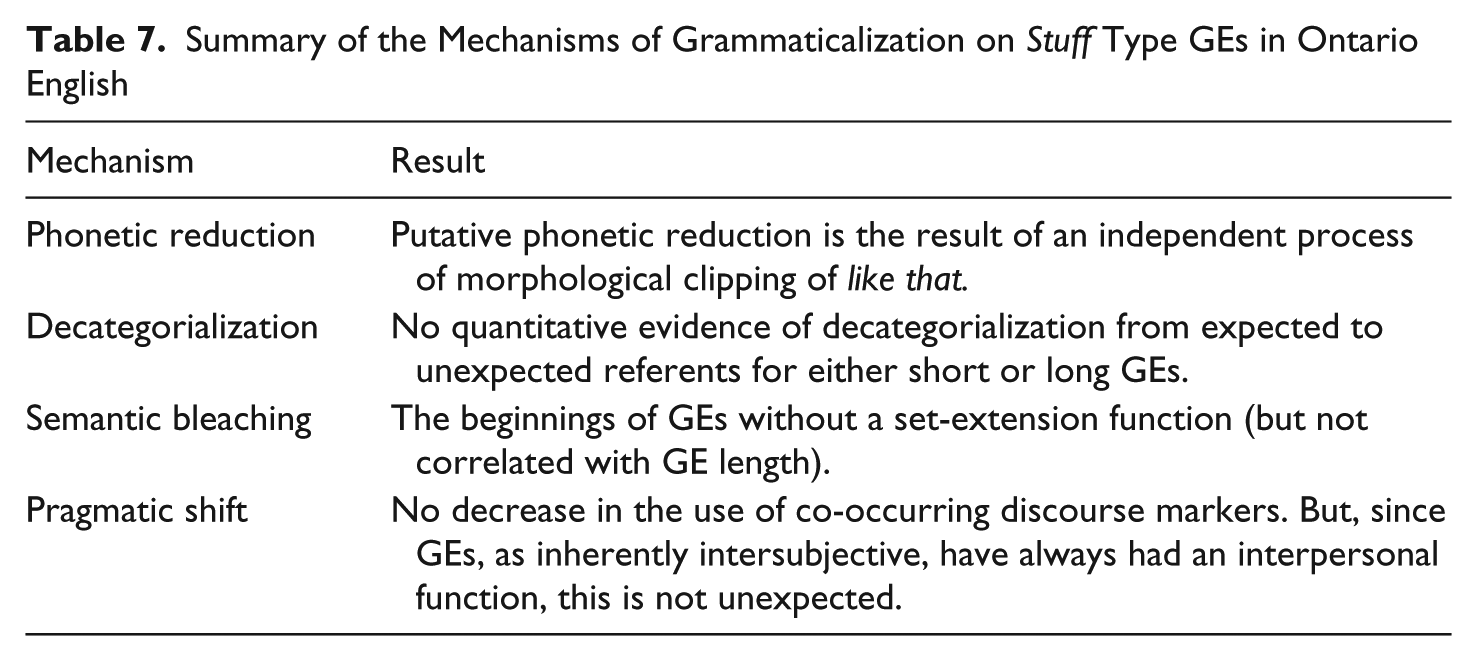
What many researchers have argued is that the phonetic reduction of GEs is an independent change (morphological clipping) that is not related to a gradual erosion of phonological material, associated with grammaticalization. Stuff GEs have been reported to co-occur with unexpected referents from their onset and, thus, there is no evidence of decategorialization. There is some evidence for semantic bleaching of GEs in the early twentieth century in my data. None of the tokens in the real-time benchmark data could be conceived of as lacking a set-marking function, but there are tokens in the more recent data from TEA where no set-marking function is observed. Lastly, the evidence for pragmatic shift from co-occurring DPMs runs counter to the prediction. The youngest speakers use more, not fewer, DPMs with stuff and the three older speaker groups exhibit stability. However, because I have argued that the interpersonal function is always present (even in non-bleached tokens), this is not surprising.
Rather than grammaticalization, the development of stuff GEs has undergone three independent changes. First, they have risen in frequency and become the majority variant in the variable system, a result of lexical replacement (confirming Tagliamonte & Denis 2010). At the same time, an independent process of deletion of the comparative element like that has taken place. Lastly, a semantic-pragmatic change is underway: the bleaching of the propositional meaning of GEs leaves just the interpersonal meaning, itself present in the implicata (i.e., meaning which is implied) of non-bleached GEs.
In summary, the only mechanism of grammaticalization for which there is diachronic evidence in these data is semantic bleaching. Since grammaticalization theory defines grammaticalization as the confluence of mechanisms, grammaticalization theory cannot be the explanation for the development of stuff GEs in Canadian English. Instead, I suggest that GEs constitute a complex variable system that has undergone a number of independent changes across the last one hundred and twenty years.
Footnotes
Acknowledgements
I am greatly indebted to those who have provided feedback and guidance on this research and this paper including Sali Tagliamonte, Alexandra D’Arcy, Elizabeth Cowper, Jack Chambers, Jenny Cheshire, Naomi Nagy, Aaron Dinkin, Stephen Levey, Heike Pichler, Frederick Newmeyer, and Alexandra Motut. Many thanks also to JENGL editors Peter Grund and Matthew Gordon, and two anonymous JENGL reviewers for their insights.
Declaration of Conflicting Interests
The author declared no potential conflicts of interest with respect to the research, authorship, and/or publication of this article.
Funding
The author disclosed receipt of the following financial support for the research, authorship, and/or publication of this article: This work was financially supported by a SSHRC Joseph-Armand Bombardier Canada Graduate Scholarship (#767-2009-2325) and a SSHRC Postdoctoral Fellowship (#756-2015-0557). Permission to use and publish examples from the Farm Work and Farm Life in Ontario Since 1890 (RG 16-200) was granted by the Archive of Ontario. Permission to use and publish examples from the Belleville Oral History Project and the Toronto English Archive was granted by Sali A. Tagliamonte (University of Toronto). Those corpora were compiled as part of SSHRC grants #410-070-048 and #410-2003-0005 (PI: Sali A. Tagliamonte).