



Abstract
Using the theoretical constructs of “image schema” and “conceptual metaphor,” this study examines the use and historical development of on track and off track as a pair of metaphorical idioms in American English. Specifically, this article is concerned with usage patterns and semantic changes of the expressions over the past two centuries in three American English corpora. We study the semantic features of the subject nouns as the “trajectors” and the diverse verbs used with the on/off track metaphors in order to uncover the main cognitive mechanisms underlying the use of the two idioms. The results of the study delineate how the development of the metaphorical idiom pair was largely motivated by PATH/FORCE conceptual metaphors based on image schemas and licensed by the Event-Structure Complex Metaphor; this demonstrates the important role of image schemas and conceptual metaphor in language use and development. The results also reveal that, in using metaphors based on image schemas, speakers/writers may activate very specific embodied images, and that context influences the use of the metaphorical idiom pair. Our results also support findings from previous corpus-linguistic theory-guided corpus studies of lexical/syntactical constructions, confirming again the vitality of this research.
1. Introduction
1.1. Background
According to the OED (s.v. track), on track is a contemporary American English expression with the following definition: “on track (U.S.), on course; achieving or doing what is required.” Similarly, the Merriam-Webster Dictionary (s.v. track) defines the meaning of the phrase as “achieving or doing what is necessary or expected.” The OED provides the following two examples to illustrate the meaning and use of on track, given in (1) and (2).
(1) We’re looking for a professional who can keep us on track by making contributions that improve efficiency. (OED, s.v. track)
(2) Three weeks ago, Mondale won the Illinois primary and said his comeback was on track. (OED, s.v. track)
This metaphorical expression, along with its derived antonym off track (which has not yet made it into the OED or Merriam-Webster), has witnessed a tremendous increase in use since the 1970s, as will be shown in this study. Because of their significant increase, it will be of interest and importance to learn approximately when this idiom pair first emerged and how their meanings and usage patterns have developed so as to shed light on the motivating factor(s) for such lexical usage changes. Hence, the present study aims to examine the uses of the pair both diachronically and synchronically by employing a corpus-based approach guided by cognitive linguistic theory, a relatively new approach in the study of lexical/syntactical constructions (e.g., Stefanowitsch & Gries 2003; Gries, Hampe & Schönefeld 2005; Hilpert 2008, 2013; Gries 2015). However, so far, only a few studies (e.g., Tissari 2010; Trim 2010) appear to have used the approach to diachronically examine figurative lexical usage changes motivated by image schemas and conceptual metaphor, which is the focus of the present study.
More specifically, this study will use the theoretical constructs of PATH/FORCE image schemas and conceptual metaphors in guiding its data analysis and discussion of results. This is influenced by the overall semantic change of track: the original meaning of track ‘the mark, or series of marks, left by the passage of anything; a trail [. . .]’ and its subsequently derived figurative meanings of ‘a course of action or conduct [. . .] ‘way’, ‘path’’ from the 1700s and onward (OED, s.v. track) are all tied to “paths” and “motion.” In adopting this approach, we hope to extend corpus linguistic work guided by cognitive linguistic theory to the study of the diachronic changes of a specific figurative language usage in the framework of image schemas and conceptual metaphor to gain better understandings of such changes. To provide some theoretical foundation and context for this study, the remainder of the introduction will briefly overview the concepts of image schema and conceptual metaphor as well as the existing research that uses a cognitive theory-guided corpus approach.
1.2. Image Schema
The concept of “image schema” was first introduced by Johnson (1987) and Lakoff (1987) in their respective seminal books on embodied conceptualization/meaning and later expanded on by many other scholars, such as Talmy (1983) and Turner (1991). As a relatively new and developing concept, image schema does not have a consensus definition; in fact, its definition has remained an issue of considerable debate (see Clausner & Croft 1999; Grady 2005; Hampe 2005; Mandler & Cánovas 2014). 1 A thorough discussion of its definition is thus beyond the scope of this article. However, for the purpose of this study, Johnson’s (1987:29) original definition would seem sufficient: image schemas (e.g., CONTAINER, FORCE, and PATH/SOURCE-PATH-GOAL) are schematic images developed from perceptual and embodied experience; they function as dynamic recurring structures “for organizing our experience and comprehension.” They structure not only our bodily experience but also our non-bodily, abstract experience and our thinking by means of conceptual metaphor, i.e., by understanding things of one domain, often an abstract one (e.g., life), in terms of those in another, usually a concrete one (e.g., CONTAINER), as shown in the statement “he has had a full/empty life.” Image schemas are thus embodied prelinguistic structures that enable us to organize and conceptualize our experience, allowing meanings to emerge from our embodied experience (Johnson 1987, 2005, 2007; Croft & Cruse 2004).
An important characteristic of image schemas is that they are flexible or dynamic, i.e., an image schema or, to be more specific, the details of an image schema may vary across different experiential contexts encountered by different or even the same individuals (Johnson 1987, 2005, 2007; Hampe 2005). This understanding of image schemas being fully grounded in our individual-specific embodied experiences has since led to important new understandings about image schemas. For example, according to Johnson (2005:28), the study of image schemas as repeated structuring patterns of meaning cannot be restricted to structural analysis and should include a consideration of qualities of the events being experienced because the experience and understanding of life “is very much an affair of felt qualities of situations. The human experience of meaning concerns both structure and quality.”
In a similar vein, Gibbs (2005:132) argues for a dynamic view of image schemas as emergent mental representations closely connected to our embodied experience rather than “mental representations abstracted away from experience.” However, while the appreciation of an image schema may vary based on individual experiences, it does not mean a person needs to have had all the embodied experiences directly to understand the image schema.
It is also important to note that an image schema often contains a few key components. The PATH and FORCE image schemas, which provide the key metaphorical mappings for the on/off track metaphorical idiom pair, are cases in point. The PATH image schema typically consists of a source/starting point, a path/trajectory, and a destination/goal, but it could also include a series of intermediate points/stops and even backward movements. FORCE image schemas may include a source, target, direction, path, and intensity of the force as well as the sequence of the causation resulting from the force. More importantly, FORCE image schemas may also involve different types of force, which may be considered sub-type image schemas, such as COMPULSION, COUNTERFORCE, DIVERSION, and ENABLEMENT (Johnson 1987:42-48). In short, as recurring mental structures, image schemas help structure both our bodily and abstract experience and our thinking by means of conceptual metaphor, i.e., they provide the schematic basis for conceptual metaphors, to which we now turn.
1.3. Conceptual Metaphor
In traditional linguistic theories, “metaphor” was defined as “a novel or poetic linguistic expression,” i.e., it was viewed as a figure of speech not found in everyday language and seen as solely “a matter of language, not thought” (Lakoff 1993:203). By contrast, in the contemporary cognitive linguistic theory, metaphor is a mode of thought that provides “a cross domain mapping in the conceptual system” (Lakoff 1993:203), allowing us, as already noted above, to understand one conceptual domain in terms of another, often one based on our embodied experience (hence the term “conceptual metaphor”), as illustrated in (3).
(3) President Hu Jintao’s Washington visit in January will give China and the US a chance to
In (3), the “target domain” of “relationship” is understood in terms of the “source domain” of “vehicle” via the RELATIONSHIP IS A JOURNEY conceptual metaphor or mapping. With examples of metaphors like this one being ubiquitous in everyday language, metaphor is “part of the ordinary system of thought and language” (Lakoff 1993:203). 2
Also important to understand is that the conceptual mapping of a metaphor typically consists of a set of ontological correspondences between its target and source domains. For example, the LOVE IS A JOURNEY mapping entails the following correspondences (Lakoff 1993:207):
i) The lovers correspond to travelers.
ii) The love relationship corresponds to the vehicle.
iii) The lovers’ common goals correspond to their common destinations on the journey.
iv) Difficulties in the relationship correspond to impediments to travel.
Another important point to note is that conceptual metaphors/mappings are often interrelated in a hierarchical order (Lakoff 1993; Lakoff & Johnson 1999). Individual conceptual metaphors derived from our embodied experience are called “primary metaphors” (Grady 1997; Lakoff & Johnson 1999), such as AFFECTION IS WARMTH. Often, in our thought and language, more than one primary metaphor may be activated together to form a “complex metaphor,” such as A PURPOSEFUL LIFE IS A JOURNEY, which consists of primary metaphors, such as PURPOSES ARE DESTINATIONS and ACTIONS ARE MOTIONS, and entails a complex metaphorical mapping that includes, among other things, A PERSON LIVING A LIFE IS A TRAVELER and LIFE GOALS ARE DESTINATIONS (Lakoff & Johnson 1999:61).
One important extended complex metaphor worth mentioning for the purpose of this study is what is known as the “Event Structure Complex Metaphor” (Lakoff: 1993:240), which involves many motion and force-based primary metaphors and, as such, provides a key foundation upon which the on/off track idiom pair operates. Based on Lakoff’s (1993) analysis, the Event-Structure Complex Metaphor boasts a long list of primary conceptual metaphors or mappings, including CAUSES ARE FORCES and PURPOSES ARE DESTINATIONS (Lakoff 1993:220). These primary metaphors, most of which are MOTION/FORCE-based, enable us to understand the “various aspects of events [. . .] metaphorically in terms of such physical concepts as location, force, and motion” (Kövecses 2002:135), as can be seen in (4) from COCA.
(4) In 1878, southern Democrats pushed legislation through Congress limiting the ability of the federal government to marshal troops on U.S. soil. (COCA, MAG, 2008)
In (4), southern Democrats were presented as “force,” legislation as a “moving object,” pushed as “forced motion,” and Congress as “location.”
Furthermore, as noted above, conceptual metaphors/mappings often form a hierarchical structure. According to Lakoff (1993), three of the aforementioned metaphors (the Event-Structure Complex Metaphor, LIFE IS A JOURNEY, and LOVE IS A JOURNEY) form such a hierarchy, with the Event-Structure Complex Metaphor at the top level followed by the LIFE IS A JOURNEY metaphor, and then by the LOVE IS A JOURNEY metaphor. An important nature of such a hierarchy is that a lower-level metaphor in the hierarchy inherits the mapping structures of the one above it. Or put another way, a higher-level metaphor licenses the ones below it. Hence, the Event-Structure Complex Metaphor licenses, through its broad conceptual mappings, all the conceptual metaphors below it.
Three concepts are important in this context: “trajectory” (also known as “figure”),“landmark” (also known as “ground”), and “path.” A trajector is an object that is moving or undergoing change in relation to a landmark (another object or a location) and the line along which the trajector moves is considered its path, as illustrated in (5).
(5) The bill sailed through the Senate by unanimous consent. (COCA, MAG, 2013)
In (5), the “bill” is the moving trajector, through indicates the path, and “the Senate” is the landmark. Concerning the on/off track idiom pair, any noun said to be “on/off track” is the trajector while track is the ground, and the line the trajector travels along is the path.
Kövecses (2015:49) has recently argued that context plays a very important role in metaphor use because “in many cases metaphorical concepts do not arise from prestored mappings in the conventional conceptual system [. . .], but result from the priming effect of contextual factors in real situations of discourse on the human mind to establish metaphors.” In other words, through cognitive operations, humans “produce a particular conceptual system informed by and based on embodiment. But conceptual systems emerge as a result of contextual factors as well” (Kövecses 2015:49). Thus, like embodiment, context greatly influences the metaphors we use. Kövecses (2015) shows how various types of context, such as discourse (linguistic), cultural, and situational contexts, may determine our metaphor use, as in (6) (from Kövecses 2015:54).
(6) The Americanization of Japanese car industry shifts into higher gear.
In (6), the topic of “the Americanization of Japanese car industry” has clearly motivated the car driving metaphor “shifted into higher gear” (Kövecses 2015:54).
1.4. Previous Research
There are three lines of existing research that are relevant to the present study. First, there has been an increasing number of corpus-based studies guided by cognitive linguistic theory that examine lexical/syntactical usages as “constructions” and their diachronic changes (e.g., Stefanowitsch & Gries 2003; Hilpert 2013; Traugott & Trousdale 2013; Gries 2015). In cognitive linguistics, the basic unit in language is a symbolic unit or “construction,” i.e., a pairing of form and meaning that may vary greatly in size ranging from a single morpheme to a complete utterance (Langacker 1987). Gries and associates (Stefanowitsch & Gries 2003; Gries, Hampe & Schönefeld 2005; Gries 2015) have developed and employed a series of association measure statistics, known as “collostructional analysis,” to effectively identify constructions and their usage patterns in corpus data, looking at the collocational strengths, frequencies, and distributional patterns of the target lexical/syntactical items. The method has been used by others in “the synchronic analysis of constructions and alternations [. . .] and language change” (Gries 2015:508-509).
Diachronic trends in constructions have received increasing attention in the past decade (e.g., Hilpert 2013; Traugott & Trousdale 2013). Hilpert (2013) uses rigorous quantitative procedures, including those from Gries and associates mentioned above, to accurately identify in historical corpora the specific changes in a set of English constructions (e.g., the first/second person possessive determiners), the exact time these changes occurred, and the factors influencing these changes. Traugott and Trousdale (2013), on the other hand, uses case studies of constructionalization and constructional changes (e.g., the case of a lot of evolving from a partitive phrase to a quantifier construction) to clearly demonstrate (i) the difference between constructionalization (the creation of a new construction) and constructional changes (the gradual changes in the form and meaning of a construction), and (ii) the fact that constructionalization is often preceded and sometimes also followed by gradual constructional changes. These studies differ, however, from the present study in that they did not use image schemas and conceptual metaphor as their theoretical framework.
The second line of related research investigates the development of meanings and metaphorical mappings of individual words or a set of related words (Fabiszak & Hebda 2010; Tissari 2010; Trim 2010). Trim (2010) traces the evolution of English metaphors related to the emotional word love in literary works, revealing a “diachronic conceptual networking” in the development of love-related metaphors from Latin to Middle English (Trim 2010:223). Along similar lines, Fabiszak and Hebda (2010:261) examine the word pride in Old and Middle English corpora, showing how “the scenario for pride in medieval times differed from the contemporary one” and “the metonymic sources of metaphorical mappings” involved. Also using historical corpora, Tissari (2010) explores a set of emotional words, such as love, hate, hope, and fear, and presents some interesting findings, including that “English words for emotions are associated with direction and movement” (Tissari 2010:320). While these studies have addressed the underlying conceptual metaphors in lexical items and their development, they focus exclusively on individual words (further limited to emotional words) rather than constructions or other types of words, as in our study.
The third line of related research involves studies on the use and function of image schemas in language (e.g., Oakley 2005; Falck 2010) and in other media of communication, such as action comics, animation films, and gestures (e.g., Cienki 2005; Potsch & Williams 2012; Forceville 2017). However, there does not appear to have been any study that examined the role of both image schemas and the conceptual metaphors based on them in the development and use of an idiom pair.
2. Methodology
2.1. Corpora
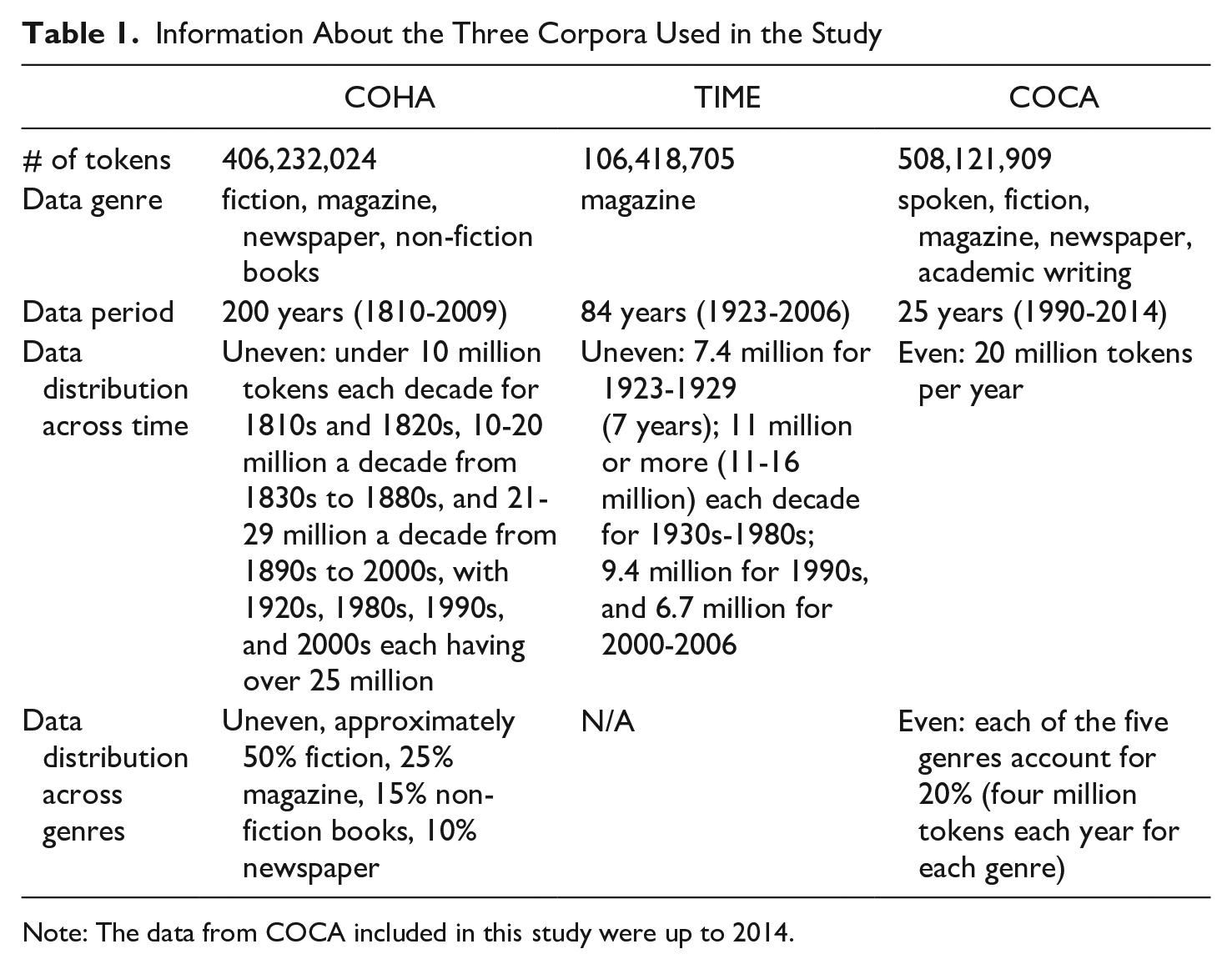
The following three corpora were used in this study: Corpus of Historical American English (COHA), the TIME Magazine Corpus (TIME), and Corpus of Contemporary American English (COCA). Detailed information about the three corpora is included in Table 1.
Information About the Three Corpora Used in the Study
Note: The data from COCA included in this study were up to 2014.
COHA and TIME were included for examining the historical evolution of on track and off track while COCA was used mainly for examining the contemporary use of the two expressions. Our reason for using the TIME corpus, in addition to COHA, was that it would provide more historical data and hence make our findings more reliable. In fact, as will be shown below, the inclusion of the TIME corpus turned out to be a very sound and important decision for the purpose of this study.
2.2. Corpus Query, Coding, and Analysis
We first queried all the tokens of the two phrases in each of the three corpora by using the search strings <on track> and <off track> respectively. We downloaded the concordance lines of the returned tokens and transported them into Excel. We first read all of the concordance lines of both phrases that occurred before the 1970s in COHA and TIME (a total of only fifty-one) and some tokens that occurred after the 1970s to gain a preliminary general understanding of the usage and meaning patterns of the idiom pair so we would know how to best code and analyze the data. Our preliminary reading indicated that besides the contemporary metaphorical meaning of ‘being on course and progressing as expected or desired,’ on track was also used with two additional senses: (i) a literal sense of ‘being physically on railway, racing, or running tracks,’ as shown in (7) and (8), and (ii) a figurative sense of ‘being in pursuit of or closing in on someone or something,’ as shown in (9); this figurative meaning was used before the contemporary one and should hence be considered the first figurative meaning.
(7) [. . .] the eight-thirty train for the southwest would leave in five minutes on track three [. . .] (COHA, NEWS, 1921)
(8) There are many contested matches on track and field, and on the water. (COHA, FIC, 1922).
(9) [. . .] beneath Brandt’s careless demeanor was concealed the relentless pertinacity of a bloodhound on track of its victim. (COHA, FIC, 1892) 3
With this knowledge gained from the preliminary reading, we trained three graduate research assistants in applied linguistics to code the data. They coded all the concordance lines from the three corpora (each graduate assistant did approximately one third of the tokens). Specifically, they coded each of their assigned concordance lines regarding the following issues: (i) the meaning of the token (i.e., whether it was used literally or figuratively; if figuratively, which of the two figurative senses it was used in), and (ii) if the token is used in the figurative sense, what is the noun (i.e., the trajector) in the token and whether it refers to a person/persons, an abstract concept (e.g., life, relationship), an entity (e.g., a city, company), an activity/event (e.g., a meeting, talk), or a concrete thing (e.g., an airplane, product). The trajector of an on/off track token may be either the subject or object in the sentence in which it appears as can be seen in (10) and (11).
(10) [. . .]
(11) Ruth Feldman had taken on local fundraising to get
The three coders also determined whether back was used (i.e., in back on track) and identified the verb used in each token. In the cases where the information of a concordance line was inadequate for coding, the coders also read the expanded context of the token in the corpus it appeared in.
The rationales for coding the aforementioned types of information were as follows. The identification of the meanings of all the on/off track tokens was crucial for understanding the semantic/usage patterns and development of the idiom pair. The coding of the trajector nouns and their types was necessary for the understanding of not only the range of target domains used in the idiom pair but also the breadth of conceptual metaphors licensed by the motion/path/force branches of the Event-Structure Complex Metaphor. This is because by identifying the trajector of each on/off track token, we would know what the target domain was. Regarding the identification of whether back was used and what verbs were used, such information (especially the information about the verbs used) would enable us to understand the FORCE image schemas that form the basis of the specific metaphorical uses of the idiom pair.
The coding results were double-checked by the authors, who also coded the data. A Cohen’s kappa interrater reliability test between the graduate students’ and the authors’ coding yielded a value of 0.894 for the coding of the meanings of the tokens and 0.873 for the coding of the noun types. Both kappa values were considered very strong according to Cohen’s (1960) original and McHugh’s (2012) recent standards for interpreting kappa values. No interrater reliability was calculated for the identification of whether back was used and what verb was used in each token because the determination of these two types of information involved no subjective judgment or ambiguity. One reason for our high interrater reliability in coding the meanings and the types of nouns was that the coding of these two types of information was rather straightforward in general. Only a small number of the items turned out to be challenging. Specifically, for the coding of the meanings of the tokens, the items on which the students’ coding differed from ours were mainly those (fifty-five of them) that included physical motion by humans or objects (e.g., airplanes, ships, and storms) with no clearly defined visible physical track or path involved, as shown in (12) and (13).
(12) But it [Hurricane Emily] is staying on track right now. (COCA, SPOK, 2005)
(13) It’s not difficult [for hikers] to stay on track in the narrow valley. (COCA, MAG, 2005)
The unique nature of these tokens appeared to have made the coding of their meanings challenging. Whereas some of these tokens were coded as literal thanks to the physical motion involved in them, others were coded as figurative perhaps because the coder saw no visible physical tracks involved. After some thoughtful consideration, we decided in our final coding to label these tokens as semi-figurative to differentiate them, on the one hand, from the literal ones where railway/racing/running tracks were referenced and, on the other hand, from the figurative uses where no physical motion and track were involved.
Finally, in data analysis, we calculated the frequencies of the different meanings, noun types, and verbs identified and conducted chi-square tests on some of the frequency results whenever appropriate to determine whether significant differences existed between the various meanings and types of nouns used across time and/or registers.
3. Results and Discussion
This section is organized into five subsections: overall historical trend in the frequency of on/off track in 3.1; overall historical semantic development in 3.2; emergence of the contemporary meaning of on/off track and its various uses in 3.3; broad target domains and metaphorical mappings of on/off track, focusing on noun types, in 3.4; and varied PATH/FORCE image schema-based experiences, focusing on verbs, in 3.5.
3.1. Overall Historical Trend in Frequency
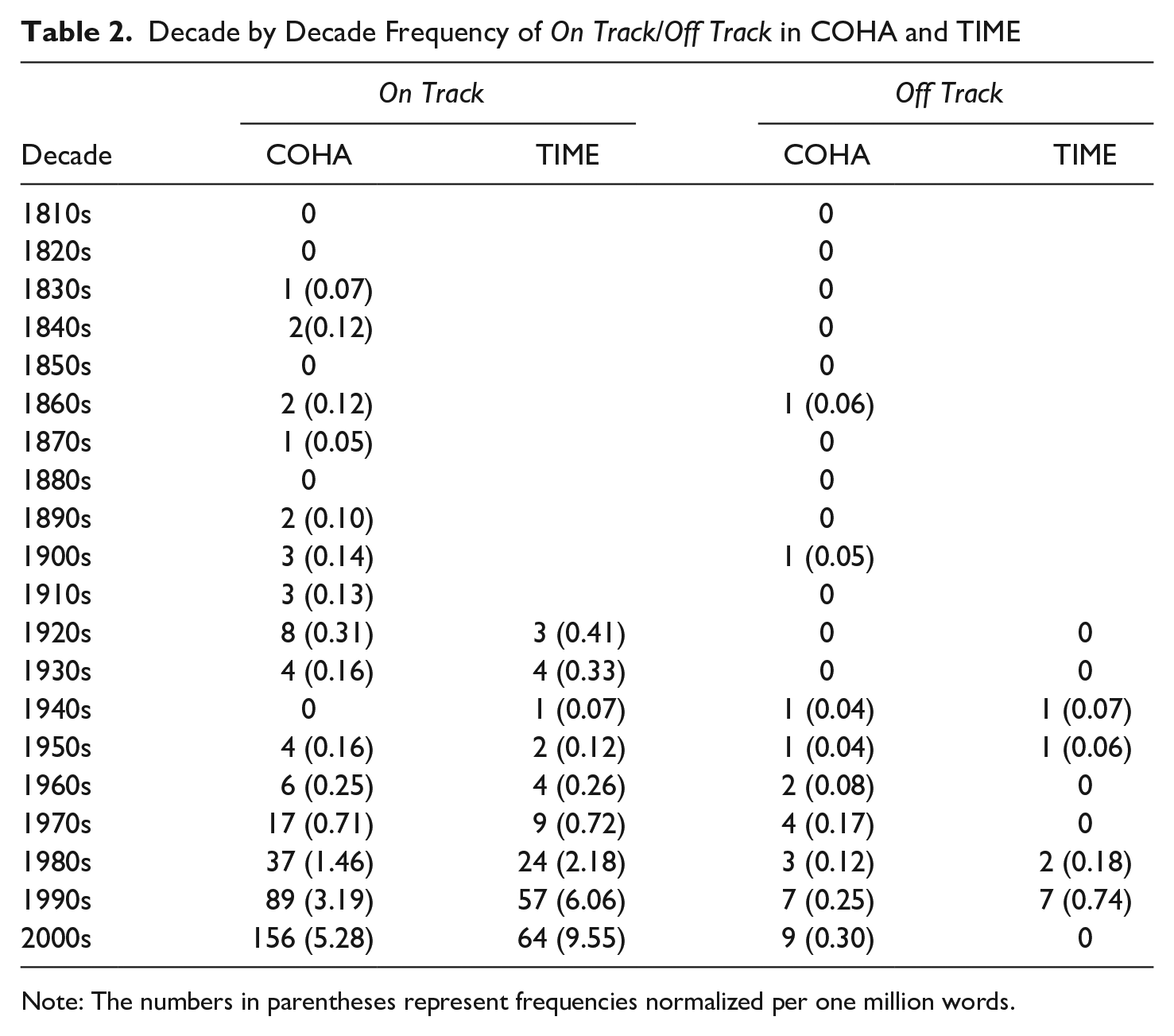
Both the raw and normalized frequencies of on track and off track in COHA and TIME are reported in Table 2. The reason for including the normalized frequency is that, as noted in 2.1, the number of word tokens per decade varied substantially between some decades. Because the frequencies in many of the decades were below five with some being zero, no chi-square tests were applied to the results. However, it can be clearly seen from the results that from the 1950s to the 2000s, the use of on track increased drastically in both historical corpora in terms of the normalized frequency: 33 times in COHA (5.8 in the 2000s divided by 0.16 in the 1950s) and 80 times in TIME (9.55 in the 2000s divided by 0.12 in the 1950s). The much larger increase in TIME, as will be shown below, likely resulted from the much higher use of the expression in magazines and newspapers than in fiction (which accounted for a large portion of the data in COHA). The frequency of off track has also increased noticeably since the1970s, but not to the extent of that of on track. In fact, as noted above, even in the decades since the 1970s the frequencies of off track were still quite small (all in the single digits).
Decade by Decade Frequency of On Track/Off Track in COHA and TIME
Note: The numbers in parentheses represent frequencies normalized per one million words.
The frequency results from COCA are shown in Table 3 (only raw frequencies are reported for COCA because the data in COCA are evenly distributed across time). The table reveals a steady increase in the use of on track with its frequency almost doubling from 346 in COCA’s first five-year period (1990-1994) to 671 in the 2010-2014 period. A similar pattern is found with back on track, while no steady increase is shown in the use of off track. A one-way chi-square test of each idiom’s frequencies across the five time periods showed a significant difference: χ2(4) = 126.24, p < .0001 for on track and χ2(4) = 11.59, p < .021 for off track. Likely reasons for this lack of a clear increased use of off track include: (i) it is possible that both figurative and literal off track activities, which encode unusual and undesirable events, generally occur far less often than on track phenomena, and (ii) speakers/writers might have a low desire to reference off track events, which are negative in nature.
Frequency of On Track and Off Track in COCA (1990-2014)

Note: The numbers in parentheses are those used with back, as in back on track.
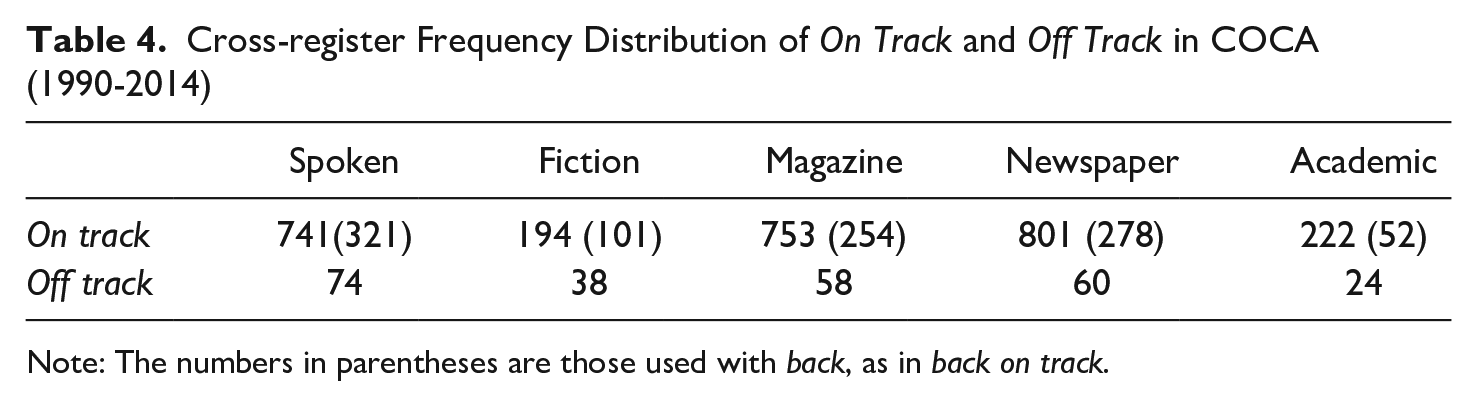
For the COCA data, we also considered possible register variation. The results are reported in Table 4. A one-way chi-square test of each idiom’s frequencies across the five registers shows a significant difference: χ2(4) = 691.09, p < .0001 for on track and χ2(4) = 30.65, p < .0001 for off track. The results suggest that the two metaphorical idiomatic phrases are used significantly more in the spoken, magazine, and newspaper registers.
Cross-register Frequency Distribution of On Track and Off Track in COCA (1990-2014)
Note: The numbers in parentheses are those used with back, as in back on track.
3.2. Overall Historical Semantic Development
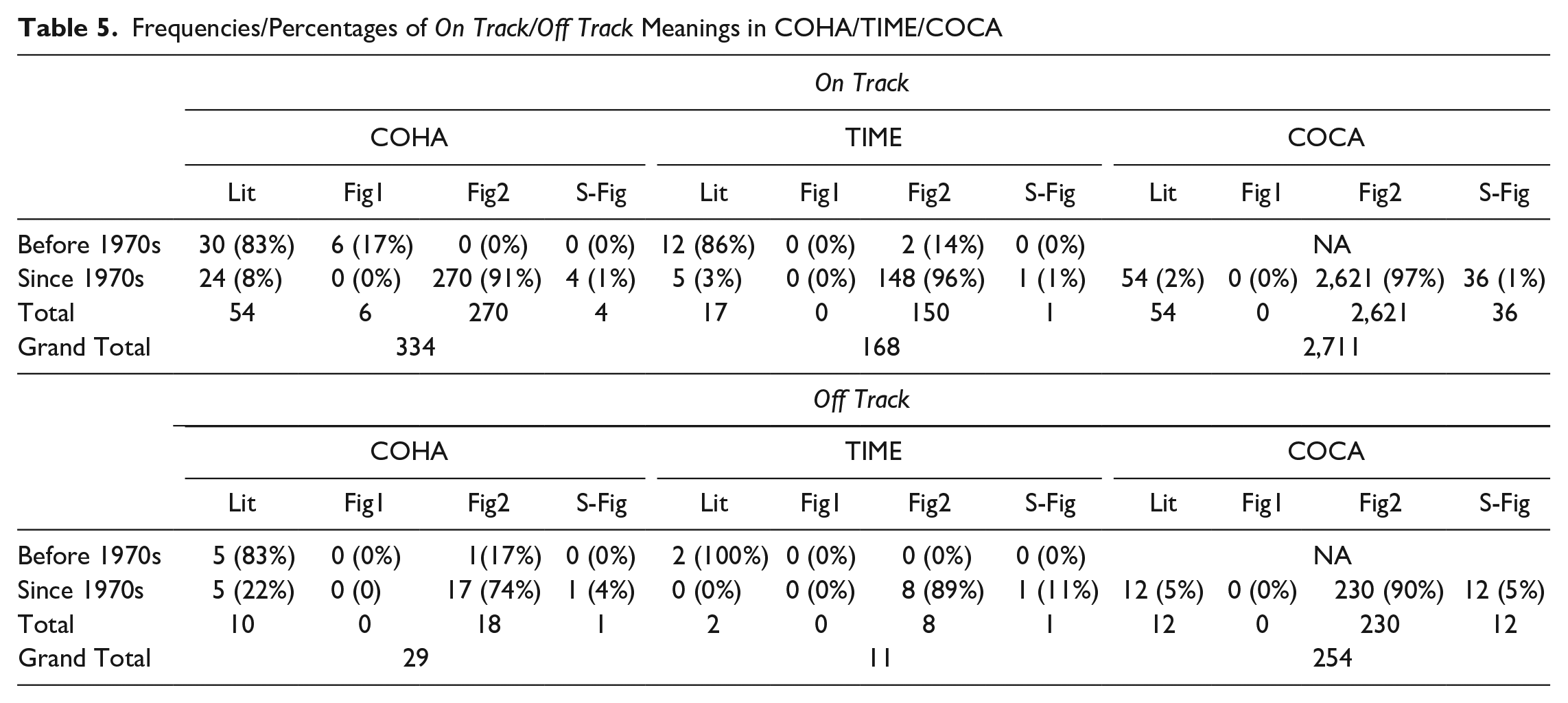
In Table 5 and Figures 1 and 2, we report the raw frequencies and the percentages of the literal, figurative 1 and 2, and semi-figurative uses of the two constructions in each of the three corpora. Because the 1970s was the time that began to witness a tremendous increase of the use of the two constructions, we divided the frequency results from COHA and TIME into two major periods: (i) before the 1970s (i.e., 1800-1969 for COHA and 1923-1969 for TIME), and (ii) since the 1970s. No such division was made concerning COCA’s data because COCA does not include any data before 1990. Examples (14)-(20) illustrate the use of the four different senses of on track and off track (note: there was no figurative 1 use of off track).
(14) [. . .] his [a racing horse] demeanor is docile in stable or on track. (TIME, 1924; this example illustrates a literal use of on track where track refers to ‘horse racing track.’)
(15) Box Cars Blown Off Track. (COHA, NEWS [a headline], 1947; this example illustrates a literal use of off track where freight cars were reported to have been blown off a rail track by a tornado.)
(16) [. . .] having laid [led] them on track of the fugitives, he hurried back to the performance of his interrupted duty. (COHA, FIC, 1847; this example illustrates a figurative 1 use of on track where on track of fugitives meant ‘in pursuit of fugitives.’)
(17) Reagan finally seemed to be on track with a sensible and well-rounded foreign policy initiative (COHA, MAG, 1982; this example illustrates a figurative 2 use of on track where being “on track” meant ‘making desired progress.’)
(18) Many Americans seem to believe that the country is off track. (COHA, NEWS, 1991; this example illustrates a figurative 2 use of off track where being “off track” meant not ‘making desired progress.’)
(19) [. . .] you [a backpacker] know you were still on track and mark that on your map. (COCA, MAG, 1997; this example illustrates a semi-literal use of on track where a backpacker was in physical motion toward his/her intended goal, but there was no physical track.)
(20) The Eastbay 49 was not easily pushed off track. (COCA, MAG, 1999; this example illustrates a semi-figurative use of off track where the said sailing yacht was in physical motion toward its intended goal, but there was no physical track.)
Frequencies/Percentages of On Track/Off Track Meanings in COHA/TIME/COCA
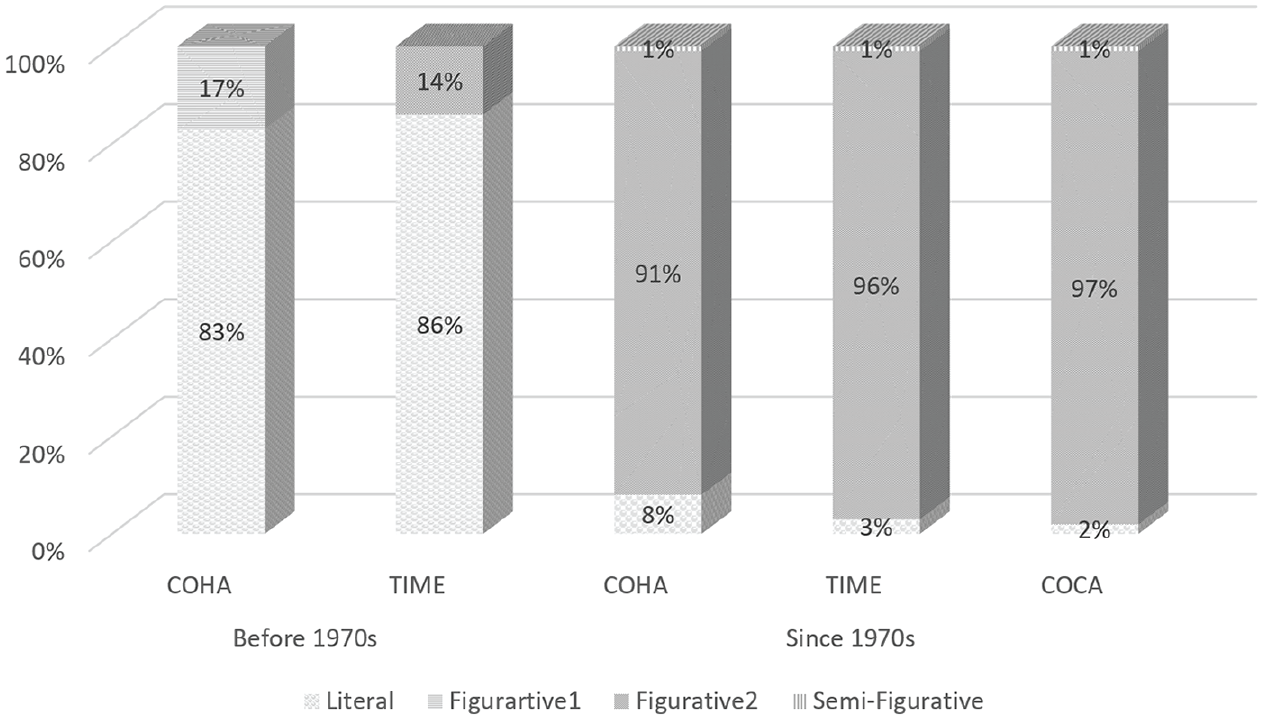
Percentages of On Track Meanings Before and Since the 1970s in COHA/TIME/COCA
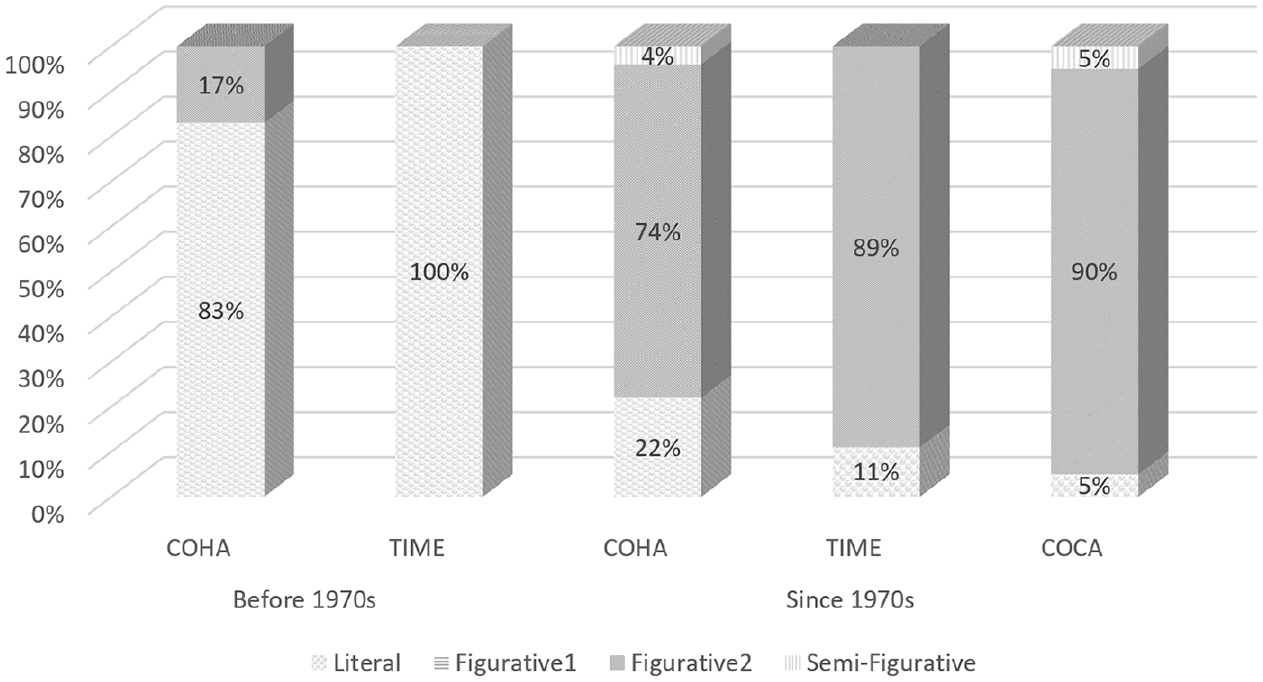
Percentages of Off Track Meanings Before and Since the 1970s in COHA/TIME/COCA
As shown in Table 5 and illustrated by Figures 1 and 2, before the 1970s, on track and off track were used mainly in the literal sense in both COHA (83 percent in literal sense for both on track and off track) and TIME (86 percent for on track and 100 percent for off track). In sharp contrast, the pair’s semantic usage patterns have exhibited a complete reversal since the 1970s, with both being used almost exclusively in the contemporary figurative sense (figurative 2) in the three corpora: for on track, 91 percent in COHA, 96 percent in TIME, and 97 percent in COCA; for off track, 74 percent in COHA, 89 percent in TIME, and 90 percent in COCA. In other words, the raw frequency and percentages for the literal, figurative, and semi-figurative senses across the two periods are very different in the corpora. Because of the tremendous frequency differences and the fact that some of the frequencies (e.g., those of the first figurative sense and semi-figurative sense) were smaller than five and were even zero in some cases, no inferential statistical analysis was necessary or even appropriate to run in order to see the significant changes in the semantic use of the idiom pair across time.
Finally, of the metaphorical tokens of on track that appeared after the 1970s, we also identified the number and percentage of those in collocation with back, i.e., in the form of back on track in each of the three corpora: 109 (40 percent) of the 272 tokens in COHA, 58 (39 percent) of the 149 tokens in TIME, and 911 (34 percent) of the 2653 tokens in COCA. The results suggest that back on track accounted for a large portion (ranging from 34 percent to 40 percent) of the metaphorical on track tokens. We will discuss the importance and implications of this finding for the development of the on track metaphor in 3.3.
3.3. Emergence of the Contemporary Meaning of On/Off Track
To obtain a more in-depth understanding of the semantic evolution of on track, we identified the first token of the contemporary metaphorical use of on track, off track, and back on track in both COHA and TIME. It turned out that the first such use of on track occurred in TIME in 1951 (see 21), twenty years earlier than the first token found in COHA (1971). This first token in TIME, given in (21) appeared in a report about the peace talks that General Matthew B. Ridgway (commander of the US and UN forces in Korea during the Korean War) and his staff were starting with the North Koreans.
(21) General Ridgway himself jeeped over to try to talk to the newsmen. He explained that they could not go to Kaesong until
According to the report, General Ridgway clearly believed he had to wait until the peace talks were making meaningful progress before he could participate. From this use of on track where the target domain (peace talks) was compared to the source domain of a moving object on a track or path towards a destination (reaching a peace deal), we can see that the speakers/writers who started the new metaphorical use of on track must have felt the similarity between an object (e.g., a car or train) moving on track towards a physical destination and an abstract thing, including an activity/event, progressing on a path towards a goal. In other words, this new use of on track and off track must have been motivated by the PURPOSEFUL ACTIVITY/EVENT IS MOTION TOWARDS A DESTINATION conceptual metaphor and other related conceptual metaphors licensed by the Event-Structure Complex Metaphor. We will provide more direct evidence for this point below when we explore in depth the various uses of on/off track. It is also important to note that, according to Kövecses’s (2015) theory about the role of context in metaphor use, the verb jeeped in the first sentence in (21) might have provided the discourse/linguistic context that motivated the use of the on track metaphor.
The first token of on track used in the new metaphorical sense in COHA occurred in a report in the Christian Monitor in 1971 regarding the US’s objection to a European conference involving the Russians, cited in (22).
(22) In any event, with the
In (22), on track was used to mean that the discussions of the issues related to Berlin (then a divided city) were progressing as desired for both the East and the West; hence the Russians believe the US should not object to a European conference including the Russians and the East European block.
The first token of back on track in the corpora occurred in 1973, twenty-two years after the first token of the contemporary metaphor on track. It was used in a newspaper article discussing how China wanted the diplomatic ties with India to return to normal after the 1962 war between the two countries, cited in (23).
(23) There were signs even before the Indo-Pakistani war that they
It is worth noting that the target domain of on track in (23) is not an activity, but a relationship (diplomatic ties). This use has thus broadened the PATH/MOTION conceptual metaphor from A PURPOSEFUL ACTIVITY IS MOTION TOWARDS A DESTINATION to A (GOOD/NORMAL) RELATIONSHIP IS MOTION TOWARDS A DESTINATION. Of course, as we will show in 3.4, many other concepts have since been included.
Like back on track, off track also emerged in the corpora in the 1970s (i.e., also more than twenty years after the appearance of the first contemporary metaphorical token of on track). 4 It was found in a 1977 magazine article on the challenges faced by child acting stars, including the challenge of sex exploitation, as shown in (24).
(24) Will they [child acting stars] also be so foolproof that no amount of sex exploitation can
In (24), humans (along with their careers) were the target domain compared to MOTIONS ON A PATH TOWARDS A DESTINATION. In other words, we see continued expansion of the target domains used with on/off track.
That the first use of both back on track and off track in the corpora occurred twenty years after the first appearance of the new metaphorical use of on track may cause some curiosity, but this fact is understandable and logical upon close examination. Quite conceivably, it might have taken some time before some speaker(s) realized, based on their embodied track-related experience (such as running on a track, driving on a highway, and taking a train), that humans and concepts being viewed metaphorically on track could also get off track by will, mistake, or some outside force and that, after having gone off track, they could then also get back on track by their own effort or with the help of some outside forces. Obviously, the use of the metaphors of getting/being forced off track and getting/being put back on track involves various FORCE image schemas on top of the PATH image schema involved, an issue that we will also explore below.
Our close analysis also revealed that an expanded expression of on track in the form of on track to +
(25) I was on track to become a senior executive at 63. (TIME, 1987)
This specific statement was actually the first token of this new usage in both COHA and TIME. It marked the first use of this PATH image schema/MOTION metaphor-based idiom where the GOAL/DESTINATION was explicitly named; when used without the added to+
Normalized Frequency of On Track To in COHA and TIME
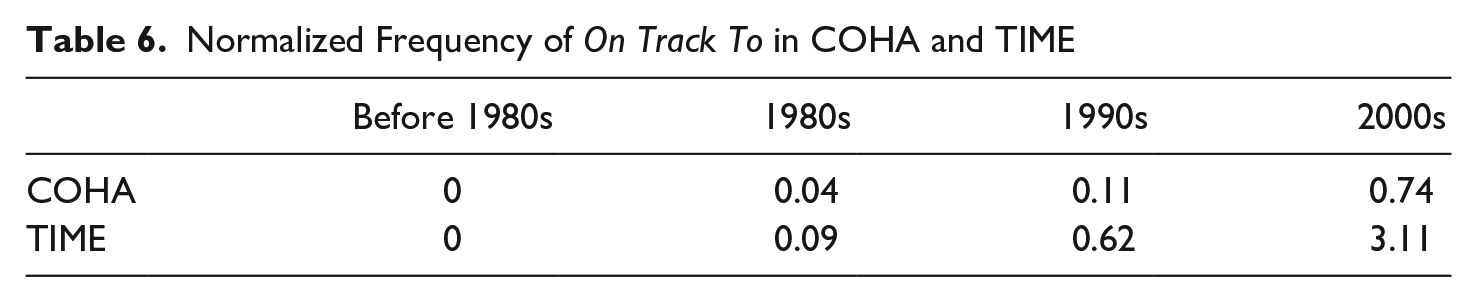
The significant increase is also found in COCA (reported in Table 7). A one-way chi-square test of the COCA frequency distributions showed a significant difference or increase: χ2(4) = 201.36, p < .0001.
Frequency of On Track To in COCA

In short, the above results would seem to suggest a developmental trajectory of on track > off track/back on track and then on track to although the actual trajectory may not be as linear as suggested here. Thus, the historical semantic usage development of on track and off track dating back to their literal use could so far be summarized as a four-phase evolutionary process diagrammed in Figure 3 where the semantic senses and uses shown in white are those that have continued along with the added new senses shown in black. However, as reported above, the figurative 1 sense has ceased since the 1920s and the frequency of the literal use has become minuscule in contemporary American English.

Historical Semantic Development of On/Off Track
One may wonder why it took twenty years for the significant increase of the contemporary metaphorical use of on/off track to take place in the 1970s after the first token of such use of on track occurred in 1951. Any explanation must remain speculative at this point. Barring the possibility that earlier uses were simply not captured by the corpora used in this study, we see two possible reasons. The first was the rapid building of interstate highways from the late 1950s to the 1960s after President Eisenhower signed the Interstate Highway Act in 1956, which resulted in the construction of 24,500 miles of interstate highways across the US (Fuller 2019) and which, in turn, made driving on such highways a common activity for Americans. The rapid increase of highway driving would likely have significantly strengthened CAR as a source domain as evidenced partly by some of the verbs used with the idiom pair (e.g., steer and veer; see section 3.5), i.e., verbs that are often used for describing the operations of automobiles. Stadium car racing where tracks are marked might have helped license car driving as a source domain of on/off track. The second likely reason for the large increase of the idiom pair is the fast-growing accessibility and influence of mass media (especially broadcasting media) from 1950 to 1970. As reported in Blanchard (1998:85, 644), from 1950 to 1970, the number of radio stations grew from 2144 to 4288 (doubled exactly), the number of households with radio sets increased from 40,700 to 62,000 (50 percent growth), and the percentage of households with television jumped from about 8 percent to close to 95 percent. Furthermore, the 1960s witnessed the emergence of not only large news networks but also many new popular broadcasting programs, such as news magazines (e.g., 60 Minutes) as well as the first live broadcast of presidential candidates’ debates and Apollo 11’s landing on the Moon, among many other historical events (Blanchard 1998:648). Some research has shown that mass media played a very important role in the anti-war and civil rights movements in the 1960s and the early 1970s (Blanchard 1998:370-373). The impact of mass media on the use of the idiom pair may be indirectly supported by our finding reported in 3.1 that the idiom pair has been used predominantly in media, i.e., in COCA’s sub-corpora of magazine, newspaper, and spoken (which is composed entirely of broadcasting language).
3.4. Broad Target Domains/Metaphorical Mappings: Trajector Nouns
There were in total 3358 noun/pronoun tokens with 951 different noun/pronoun types serving as the target domains or trajectors of the figurative and semi-figurative uses of on track/off track. They were grouped into five semantic categories based on the coding scheme described in 2.2. Table 8 reports the frequencies of the five categories along with the most common items in each category.
Categories of Nouns Used as Trajectors (Target Domains) and Their Frequencies
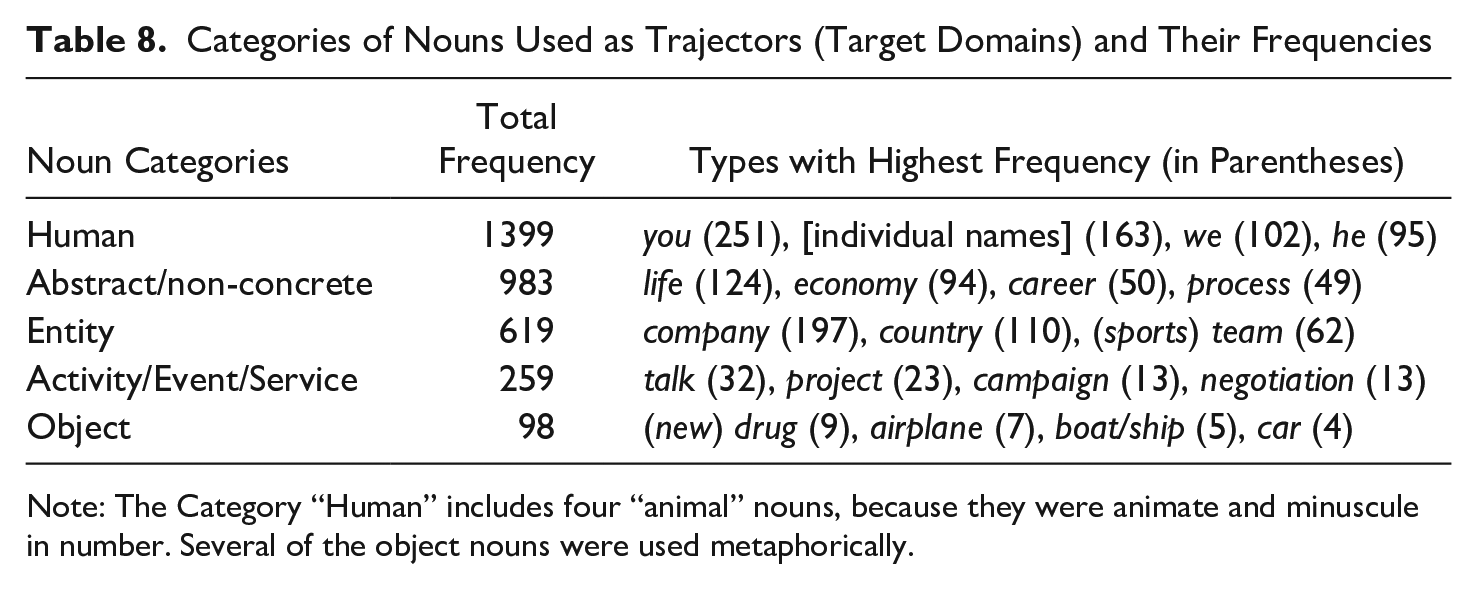
Note: The Category “Human” includes four “animal” nouns, because they were animate and minuscule in number. Several of the object nouns were used metaphorically.
As shown in Table 8, Human nouns/pronouns were the most frequent followed in order by Abstract, Entity, Activity/Event, and Object nouns. The results indicate that a very wide variety of nouns have been used as the target domains of the on/off track metaphors licensed by the broad mappings of MOTION/PATH/FORCE branch of the Event-Structure Complex Metaphor. Clearly, the target domains of the idiom pair have expanded from literal activities/events, such as talks and negotiations (which appeared in the first uses of the contemporary figurative meaning of on track) to many different abstract concepts (e.g., career/life/relationship), human beings, entities (e.g., company/country/teams), and concrete things (especially products such as new drugs and cars). In other words, with the increased use of on/off track, more and more different things have been included in (or understood in terms of) the MOTION/PATH/FORCE-based metaphors of on/off track.
It is notable that, in some of the tokens, the trajector noun was train, which was not the target domain per se as can be seen in (26) and (27).
(26) [. . .] unless the Egyptians and Israelis have managed to get
(27) He [Ken Lay] was named CEO [of the Enron investment company] last
February but resigned abruptly for what he said were personal reasons six months later in August, before
In the examples, train was used to flesh out the source domain (train track) while an adjectival (diplomatic in 26 and Enron in 27) was employed to express the target domain (“diplomatic relationship” in 26 and “the Enron company” in 27). In other words, the modifying adjective has technically turned train into the target domain. This
When train was used to flesh out the source domain, the target domain was not explicitly expressed by an adjective (i.e., not via the
(28) Rather than educate the public about the issues, the torrent of advertising and paid mailings served to turn off the voters to the point where turnout was at a historic low in 1998. This letter is a challenge to our elected officials to turn this
(29) The Reformers, many of them, say they don’t want to completely throw out the mullahs. They like their religion. They want to go slow and steady.
Example (28) is an excerpt from a letter to a newspaper, arguing the need to stop special interest groups from doing unlimited commercial political advertising. Though not explicitly stated, the discourse context indicates clearly that this runaway train refers to the unlimited political advertising and mailing by “Big Money and special interests.” Hence, the real target domain was this unlimited advertising and mailing practice by special interest groups referred to as a runaway train. In (29), on the other hand, the author discusses how the reformers in Iran believe that the reform should not proceed too fast by comparing the reform to a train. However, they do not call it a reform train, i.e., they do not explicitly name “reform” as the target domain. Yet, the implied target domain is very clear in the discourse. Again, the word train here metaphorically merged the target and source domains.
Furthermore, the use of train in the on/off track idiom pair as shown in the examples above indicates clearly that the speakers/writers of such uses were tying the PATH image schema-based metaphor to their embodied experiences. For instance, in labeling out-of-control political advertising as a runaway train, the writer obviously connected the political advertising target domain to the perceptual experience of a runaway train that was in danger of racing off the right tracks. Similarly, in stating that the reform in Iran should be a slow train, the writer was activating the embodied experience of feeling much safer in taking a slowly moving train than taking a fast running train. Likewise, by saying “the Enron train totally came off track,” the speaker must be relating to a felt shocking perceptual experience of a real train totally running off track. Finally, the frequent use of train in the idiom pair may have been motivated by two other facts. One is that one of the literal meanings of track is a railway track. Second, a railway track presents arguably the best visual image of the PATH image schema because it looks long and straight, usually much longer and straighter than a country road, a street, or even a highway.
3.5. PATH/FORCE Image Schema-Based Experiences: Focus on Verbs
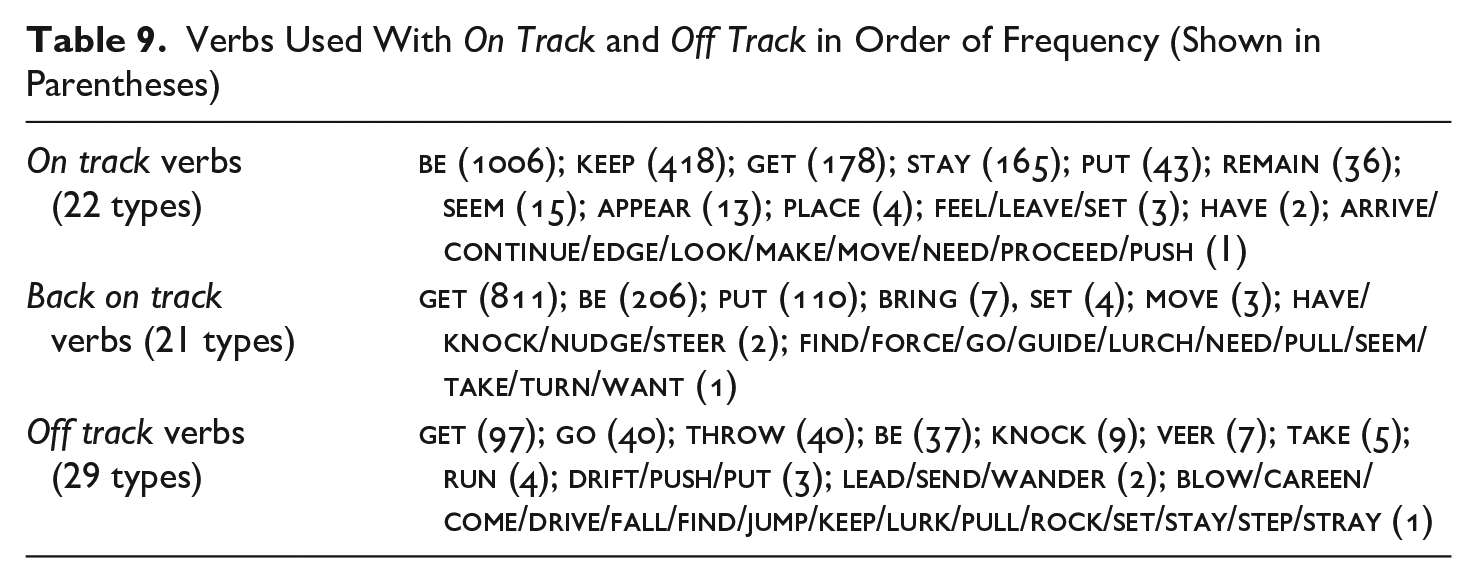
A total of 1898 verb tokens were found in all the contemporary figurative uses of on track (not including tokens of back on track, which will be reported below) in the three corpora (170 in COHA, 92 in TIME, 1636 in COCA). These tokens involved twenty-two different verbs or verb types. For back on track, a total of 1160 verb tokens were involved (109 in COHA, 47 in TIME, 1004 in COCA), including twenty-one different verbs. For off tack, a total of 269 verb tokens were used (19 in COHA, 8 in TIME, and 242 in COCA), involving twenty-nine different verbs. The frequencies of the verbs are reported in Table 9. (Some examples of the verbs used in context are provided after Table 10.)
Verbs Used With On Track and Off Track in Order of Frequency (Shown in Parentheses)
Some FORCE Image Schemas Represented by the Verbs Used
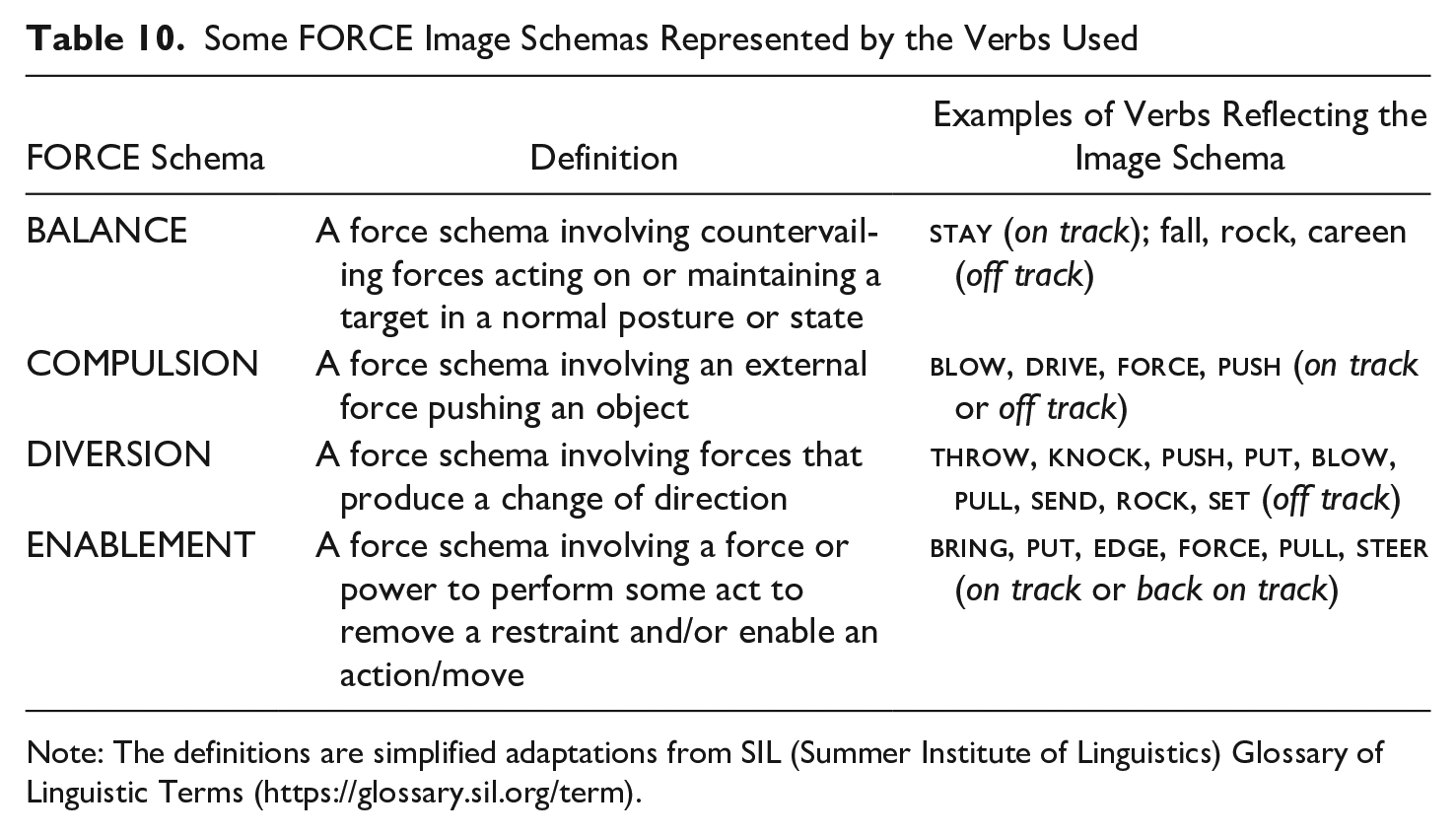
Note: The definitions are simplified adaptations from SIL (Summer Institute of Linguistics) Glossary of Linguistic Terms (https://glossary.sil.org/term).
While some of the verbs were used highly frequently, many occurred only once or a few times. Furthermore, the most frequently used verbs varied across the three expressions, with
The many different verbs used with the idiom pair help reveal the various manners in which a person or thing may be put on or off track by one’s own will or other forces. In turn, the different verbs also evoke a diverse range of FORCE image schemas, some examples of which are shown in Table 10 along with their definitions and some specific verbs that help illustrate them. As shown in the table, some of the verbs can evoke or represent more than one FORCE image schema and are hence listed more than once.
Most importantly, the use of many of the listed verbs, especially those that had a very low frequency (i.e., those with only one or two occurrences), appears to reflect an effort of the given speaker/writer to project onto the listener/reader a vicarious embodied experience tied to the PATH/FORCE image schema-based metaphors being used. Examples (30)-(35) illustrate a range of uses.
(30) Just the one word
(31) This agreement [. . .] reflects [. . .] their determination that the peaceful settlement will not be
(32) All you need are some reminders [. . .] to
(33) “[. . .] the public sees the nation as headed in the wrong direction. We’ve [we = US]
(34) What he couldn’t say is how a life that, on paper at least, seemed to have all the right ingredients
(35) But his [sports] career has been
In (30), the verb nudge projected a gentle DIVERSION (simultaneously ENABLE-MENT) force that made Weems return to the topic of the ongoing conversation. In contrast, a strong, sudden, and/or almost violent force was involved in (31)-(35) where the verbs
Such uses of diverse verbs of strong force and motion provide evidence for Gibbs’s (2005) and Johnson’s (2005) claims that image schemas are not structures devoid of embodied experience, but structures directly connected to our concrete embodied experience. As cited earlier, Johnson (2005:28) used motions-along-a-path examples to argue that image schemas are dynamic based on varied felt experiences: “There is a quality of rapid acceleration that differs markedly from gradual starting up. There is a particular quality of motion of the pulses one feels in a movement that consists of repeatedly starting and stopping a particular movement [. . .].” The diverse verbs used with the idiom pair and the uses of back on track and off track in addition to on track clearly reveal the varied felt experiences of the speakers/writers about the diverse types of motions of getting on and off track and forced stops and changes of directions. For example, in stating “just the one word
This gentle force of nudging acted on a trajector in motion obviously differs greatly from the strong forces enacted on a moving trajector as expressed by thrown/knock/veered/careened in (31)-(35). For instance, in (31), the speaker (Warren Christopher, President Bill Clinton’s first Secretary of State) was talking about how Israel and Palestine during their peace negotiations at the time (early 1990s) were determined not to let a peace settlement be thrown off track by violence from extremists. Obviously, violence involves strong destructive forces and Christopher (along with the rest of the world) had seen the devastation caused by the extremists’ violent forces. Christopher’s wording of “
In short, these findings highlight Gibbs’s (2005:120) point that in using image schema-based metaphors, “people create image-schematic construal of events alluded to in each expression.” As illustrated by the corpus examples examined above, choosing wordings such as “A person was
4. Conclusion
Using the theoretical constructs of image schema and conceptual metaphor from contemporary cognitive linguistics as a guide, this study has examined the use and development of the on/off track idiom pair in American English. Our results offer support for existing research findings/theories in two ways: (i) regarding the importance of image schemas and conceptual metaphor in language use, and (ii) in relation to previous cognitive-linguistic theory-guided corpus studies on the use of constructions. The results of our study show the broadened range of target domains and diverse descriptive verbs used with on/off track and thus provide strong support for the important role that image schemas and conceptual metaphor play in our understanding of meaning and about the conceptual and metaphorical nature of everyday language (Lakoff 1993; Johnson 1987, 2007). Our findings also underscore how image schemas are structures not devoid of concrete embodied experience but connected directly to specific embodied experiences, as suggested by Gibbs (2005) and Johnson (2005).
Like Hilpert (2013), this study is able to identify, with precision, when and what changes occurred in the use of the idiom pair diachronically, presenting new evidence for the vitality of this line of research on constructional changes. Second and more specifically, this study has confirmed a couple of key necessary procedures in this type of research: the need to decide what collocational or contextual information to examine and how to code the chosen information. As Stefanowitsch and Gries (2003:215) mentioned in their pioneering work on collostructions, for the study of the “X [is] waiting to happen” construction, they decided to focus on the “head noun” used in this construction and they needed to conduct “item by item inspection [of the identified head nouns] and manual coding [. . .].” Also, as mentioned earlier, to uncover the historical development of the first/second person determiners (i.e., mine/thine vs. my/thy), Hilpert (2013) chose to examine four contextual variables, including the first sound and the stress patterns of the words that the determiners modified. In a similar vein, our study focused on the nouns serving as the target domain/trajector of on/off track as well as on the verbs used, and coded the nouns by meaning and type, item by item, manually. In short, in this line of research, despite great advancements that have been made in automatic data search, extraction, and analysis, some human analysis and coding are still necessary. Also, what contextual information to focus on in data analysis often varies across studies depending on the specific features of the construction(s) being examined.
To our knowledge, this study is the first to examine the development of a figurative construction by using the framework of image schemas and conceptual metaphor. As noted earlier, existing research on the development of figurative language appears to have been limited to individual emotional words focusing on the role of conceptual metaphor without discussing image schemas (e.g., Fabiszak & Hebda 2010; Trim 2010). This study has thus broadened the scope of previous research both in the types of constructions examined and the cognitive linguistic constructs or theories applied. It will be of interest and importance to see the use of similar cognitive theory-based corpus analysis applied to studies on the use and development of other figurative language constructions. Of course, as already shown, when applying the method to other studies, it will be important and necessary to make adjustments regarding what linguistic factors and aspects of the researched language construction to examine. While the nouns and verbs used in the on/off track idiom were the foci in this study, other linguistic factors may need to be examined when studying a construction with a different structure and/or parts of speech. Finally, because this study examined the use of only one related metaphorical idiom pair, it will be necessary for future studies to corroborate the findings reported here by investigating the development and use of other constructions and structures in English or other languages.
Footnotes
Acknowledgements
We would like to thank the editors and the three anonymous reviewers for their valuable constructive comments, which we believe have helped significantly enhance the quality of the study. We would also like to thank the graduate assistants of the first author for their help in the coding of the corpus data.
Declaration of Conflicting Interests
The author(s) declared no potential conflicts of interest with respect to the research, authorship, and/or publication of this article.
Funding
The author(s) received no financial support for the research, authorship, and/or publication of this article.
