



Abstract
This paper offers a principled framework for the analysis of sources associated with modal verbs that express root necessity. First, the notion of “source” (who or what lies at the origin of the necessity) is described and illustrated, and a comprehensive taxonomy of sources is put forward that can be used for empirical analysis. Special attention is paid to “subject-oriented” sources, which have mainly been discussed in the realm of modal possibility (ability) but which are relevant to modal necessity as well. The framework is then applied to a sample of sentences with
1. Introduction
This paper addresses the concept of “source” of modal necessity (see Depraetere & Verhulst 2008; Depraetere & Reed 2011): it puts forward a principled framework for the analysis of sources of root (or non-epistemic) modality, which is then applied to a sample of examples of
The concept of a source of the (root) necessity refers to who or what makes it necessary for someone to do something or that makes it necessary for a situation to actualize. For instance, in (1), it is clearly the speaker, Ruth’s mother, who tells her daughter what to do and who imposes her will. In (2), it is likewise the speaker who does not want to become involved in the addressee’s plans and who explicitly requests him not to include her in his plan of action. In (3), on the other hand, it is specific circumstances (possibly disagreement among the ruling party members or a situation in which the parties are evenly balanced) that make it necessary for the Government to depend upon minority parties when specific proposals are being put to the vote. (1) ‘Ruth, you must do as I tell you. Do as I tell you.’ Her mother’s voice, angry, at its wits’ end. (BNC, W_fiction_prose) (2) You seem to be seeking to destroy yourself in some way, but you must not include me in your plan of action. (Verstraete 2001:1507) (3) When the parties are evenly balanced in the Commons or when the Government has to depend for support upon minority parties, the Prime Minister may well let it be understood that he will not resign or call an election on an adverse vote in the Commons except on an explicit issue of confidence. (BNC, W_non_ac_ polit_law_edu)
While the role of what is called here “source” of the modality has been treated in discussions of root necessity, previous analyses of
The paper is structured as follows: in section 2, I position the topic of source of the necessity within previous research concerned with the factors that drive the speaker’s choice of a specific modal verb of necessity from the wide range of available verbs (e.g.,
2. Background
In research on the semantics of modal verbs that express root necessity, various factors have been argued to determine their contexts of use. Analyses of this kind often involve a comparison of pairs of verbs like
In this paper, I examine in detail the factor that has been addressed by some literature (e.g., Lyons 1977; Verstraete 2001) under the heading of the subjective versus objective nature of the modal meaning. Verstraete (2001) offers an overview of the (various) meanings that subjectivity/objectivity cover in research on modality (and more in general, within cognitive linguistics). His view is that subjectivity should be defined in terms of modal performativity, meaning that the speaker takes a specific position of “commitment with respect to the propositional content of the utterance” (Verstraete 2001:1517). He uses, amongst others, interrogative contexts as a diagnostic test to assess the subjective/objective nature of the modal. He argues that “subjective modals are oriented towards the interlocutor under the influence of interrogation, whereas objective modals remain unaffected” (Verstraete 2001:1521). For instance, when the declaratives in (4) and (6) are turned into interrogatives, the necessity is oriented towards the addressee in the case of subjective necessity (5), but not in the case of objective necessity (7). (4) What we want is for the right honourable gentleman to use the full weight of his office. We are getting tired of a cosmetic approach an oversanguine approach. There is a crisis and he must act now. (Verstraete 2001:1521) (5) Must the minister act now? (Verstraete 2001:1521) (6) Brake shoes must always be renewed in sets of four. (Verstraete 2001:1521) (7) Must brake shoes always be renewed in sets of four? (Verstraete 2001:1521)
Whereas “Do you want the minister to act now?” captures the meaning of (4) (the modality is subjective), “Do you want break shoes always to be renewed in sets of four?” does not (the modality is objective).
Even though Kratzer’s (1981, 2010) terminology is different, she also differentiates different kinds of so-called conversational backgrounds in her formal model: they constitute modal basis and serve to define different types of modality. For instance, phrases like given the regulations, in view of what the law provides, and in view of what is commanded capture a deontic modal base; in view of my goals and in view of the circumstances respectively capture a teleological and a circumstantial modal base. Bouletic conversational backgrounds have to do with preferences and wishes. While there are restrictions on the kinds of conversational backgrounds that can be used to interpret modals, they mainly define the modal meaning that is at stake.
In this paper, I take up Verstraete’s (2001) distinction; in doing so, I address, in more detail, what he calls “objective modality” by making use of the concept of source of modal necessity. I also offer a detailed discussion of subject-oriented source, and I show how the different modal sources can be operationalized in empirical data analysis. A more explicit taxonomy enables a finer-grained analysis of the root necessity meaning involved; indeed, on the basis of the empirical study reported on in section 4, I show what conclusions can be drawn about the semantic profile of
3. Sources of the Necessity: An Overview
3.1. Source: A Basic Taxonomy
In this section, I clarify and analyze the semantico-pragmatic feature of source; the different types of source are illustrated with examples of
Depraetere and Verhulst (2008:3) examine root necessity as expressed by
Any necessity (be it expressed by have to or must) is linked up with a source: if there is reference to a necessity, it must originate somewhere, i.e., some entity must be at its origin. This hypothesis is obviously motivated by our knowledge of the world and is as such not concerned with the linguistic expression of sources.
The typology of sources in their paper is based on a qualitative and quantitative corpus study. The major distinction made is that between discourse-internal (subjective) and discourse-external (objective) sources. A discourse-external source may be of three types: the modal source may be a regulation (or a rule), circumstantial, or conditional. (i) Discourse-internal (speaker/hearer) (ii) Discourse-external (a) Rules and regulations (b) Circumstantial (c) Conditional
In what follows, I show that an additional category, that of subject-internal source, needs to be added to arrive at a taxonomy that covers the full range of potential sources of necessity. Subject-internal modality has been primarily associated with root possibility: it is the defining feature of ability. In Jennifer can sing well, the ability of singing is attributed to the skills of the referent of the grammatical subject, which therefore constitutes the source of the possibility. However, this feature also occurs in discussions of modal necessity, in particular in discussions about
3.2. Discourse-internal Source
In examples with a discourse-internal source, it is either the speaker (in declarative sentences) or the hearer (in interrogatives) who is the origin of the necessity, as illustrated in (8)-(11). The concept is present in early corpus-based descriptions of modal verbs and in reference grammars under the heading of subjective modality (e.g., Coates 1983; Huddleston & Pullum 2002).
2
(8) B: He described to me in general the detail his business e.g. where he operated from how many people he had and who the directors were. A: Yeah but you knew all that didn’t you B: No I didn’t at that time because it was twelve thirteen fourteen months later It could’ve all changed I didn’t know his turnover because the accounts I had were originally nineteen eighty-five were not up to nineteen eighty-eight A: And uhm so you wanted to see some accounts then (unclear words) first thing you need to do is give us an up to date set of accounts. (ICE-GB: S1B-065, legal cross-examinations, Queen’s bench London) (9) At the moment there are no savings identified and (10) (11) […] it isn’t particularly clear whether in fact this is part of er some idea that the government has that the people shouldn’t register and
The sentence with need to in (8) is directive: the speaker tells the addressee to do something; he is in a position of authority and orders the addressee to hand in accounts. In (9), (10), and (11) as well (which are not directive in the sense that the speaker is giving an order to the addressee), the speaker is the source of the necessity, and it could potentially be argued that the subjective nature is enhanced by markers such as “I think” and “It seems to me.” It is important to add that, even though the speaker’s wish to bring about a situation may be based on specific information that is publicly available and even though she may well be in a position to motivate it on the basis of specific circumstances, in each of the examples, the situation is clearly represented as necessary because the speaker believes it must happen. For instance, in (9), the speaker is expressing her view, taking into account decisions made at previous meetings of the Environment Committee, but this is all the same her personal opinion that she voices when she says that it is necessary for a specific situation to actualize.
In interrogative clauses, it is the addressee who constitutes the discourse-internal source. In example (12), “Do I need to take both packets?” can be paraphrased as “Do you think it is necessary for me to take both packets?” (example 5 is similar). (12) (SP: PS0E8) There’s your cartridges. (SP: PS0E9) Do I need to take both packets? (SP: PS0E8) I wouldn’t think so, I can’t think you’ll get through ten cartridges myself, that seems rather excessive. (BNC, KCD S_conv)
Here again, one might want to argue that there are two sources at stake in this example, in the sense that the hearer is being asked whether there is a (circumstantial) need. In the operationalization of source in this paper, examples of this type are classified as discourse-internal, also taking into account Verstraete’s (2001) observations (see section 2). The paraphrase is clearly “do you believe it is necessary?” In other words, the hearer is the primary source of the necessity. She can potentially pick one from a range of reasons why something is (not) necessary, specific circumstances being one of them, but the hearer is clearly called upon as the primary decision maker.
Given the fact that the term “subjective” covers quite diverse notions in linguistics in general, the label “discourse-internal” is used in this paper to avoid terminological confusion. This label also nicely captures the fact that it can be the speaker or the addressee who is the source of the necessity, depending on the sentence type in which the modal verb is used.
3.3. Subject-internal Source
As pointed out in section 3.1, the basic taxonomy needs to be supplemented with a source which more commonly features in accounts of root possibility, more specifically in discussions of “dynamic” modality (e.g., Palmer 1990; Huddleston & Pullum 2002). Volition (e.g., 13) and ability (e.g., 14) are typical examples of dynamic modality in taxonomies of modal meaning; it is modality “concerned with properties and dispositions of persons, etc., referred to in the clause, especially by the subject NP” (Huddleston & Pullum 2002:178). The term “subject-internal” source is used to capture the kind of modal source in cases like these. In (13) and (14), the modal source is located within the referent of the grammatical subject, who appears as the agent in control of the situation referred to. (13) I hope that the House will support the motion. That would help to show the universal determination of all parties in the House to achieve an answer that will provide a proper future for British agriculture and enable me at least to be able to tell my companions in the negotiations that there are things that matter so much to us that we will sit there until we achieve them, even if it means that we will sit there for many more months to come. (BNC, HHX_W_Hansard) (14) And though I can swim pretty well, the swirl of the tide was fierce, and looked dangerous; and besides, I had no desire to swim. (BNC, CKF_W_fict_prose)
In the case of modal verbs of necessity as well, there may be cases in which the referent of the (grammatical) subject (be it first person, second person, or third person) feels that it is necessary to bring about a certain situation. Examples like these (such as 15 and 16), in which the subject referent intentionally wants to do something (witness I want to tell you, I would much prefer to tell you in 15), are therefore classified as having subject-internal sources. (15) […] I miss Paris and I miss you! We never spoke much, though that doesn’t really matter as words are often inappropriate when in the presence of feeling. Having said that there are one or two things I want to tell you, and for the moment the only way I can express them is through this letter. I would much prefer to tell you one-to-one. Anyway, prepare yourself. You are special, because you are you. You are lovable, and I … You are unique, and talented too. Are you. You probably didn’t expect me to say such things Francoise, but I needed to say them.
I could say more, a part of me wants to, but there’s no need for me to embroider or elaborate on my words, that would ruin the genuineness of my feelings. I will change the subject now and tell you something different. (ICE-GB W1B-008) (16) You feel though you’ve got to come out, you need to get out! You know, he and he’s at that point now … Mm where he needs to get out. Which is fair enough. (BNC, KP1_S_conv)
In (16), there is reference to a person who is at the point of leaving a hospital; the paraphrase of the sentence with
Subject-internal necessity has received a lot of attention in discussions about
For Nokkonen (2006), the basic feature of subject-internal necessity is that it is weak (in force) and objective. In other words, it is not the modal source as such that is the only criterion for assigning a sentence to this category on her approach. For instance, examples (17) and (18) are said to belong to the “internal group” because they are objective and weak. (17) A no, wait a minute B yeah A no, I mean, you’d get to c well, you need to get to Putney, Hammersmith A then you met Ham, you you hit Hammersmith, and you’ve got to get on from there, that’s all right. (Adapted from Nokkonen 2006: 45) (18) I need to know I need to so keep me informed, if you really feel that things are that bad that you need to do it, [Yeah.] [then] consult me, okay. (Adapted fromNokkonen 2006: 45)
Nokkonen (2006, 2010) starts from Van der Auwera and Plungian’s notion (1998) of “participant-internal necessity,” which refers to “necessity internal to a participant engaged in the state of affairs” (1998:80); they give the necessity example seen in (19) to illustrate this type of modal meaning. (19) Boris needs to sleep ten hours every night for him to function properly. (Van der Auwera and Plungian, 1998:80)
In Van der Auwera and Plungian’s (1998) paper, participant-internal necessity is the necessity counterpart of participant-internal possibility, which is used to characterize typical “ability” examples (e.g., Boris can get by with sleeping five hours a night). The examples from Nokkonen (2006, 2010) show that Van der Auwera and Plungian’s (1998) original concept is applied to a far wider range of cases than intended by Van der Auwera and Plungian (1998). The instances in (20) and (21) are further examples of this category, which Nokkonen alternatively calls “internal compulsion” (Nokkonen 2006) and “participant internal need to” (Nokkonen 2010). (20) I need to go now. (Nokkonen 2006:37) (21) Ann: I’ve wiped this I’ll have washed the whole floor. Sally: <laugh> Ann: I won’t need to do it tonight. I’ll get some knitting done. Seeing as I haven’t any ironing to do. (Nokkonen 2010:48)
The examples do not appear to be entirely identical in nature when considered from the point of view of source as it has been defined here. With regard to (20), Nokkonen (2006:37) points out that the subject referent feels a compulsion which originates within herself: “such compulsions, even if the subject is first person I, are objective, since the speaker has no conscious control over them” (I discuss this observation in more detail in 3.4.2). However, without further context, it seems that example (20) could also be a case in which conscious volition is involved or one in which the necessity to leave is motivated by a circumstantial source that lies outside the subject. It is difficult to identify a compulsion or irresistible urge without access to the wider context. 3 Likewise, in (21), it is the circumstance of the floor having been cleaned that does not require any further action. In other words, these examples show that subject-internal has become a category that is far broader in scope than Van der Auwera and Plungian’s (1998) participant-internal modality on which it is based.
Declerck (1991:386) is another author who brings up subject-internal necessity in his discussion of (22) She needs to take pills every day. (Her state of health makes it necessary for her to take pills every day.)
She has to take pills every day. (She is obliged to.) (23) You need to have a bath. (For your own sake that I’m saying this: you look untidy.) You must have a bath. (I want you to.) (24) He needs to talk to others about his work. (because of his character) (25) Children need to learn to respect the property of others. (because it is an essential aspect of their education)
While the absence of a wider context makes it harder to interpret the examples, they could be described as follows in terms of modal source of necessity as defined in this paper: in (22), the health condition of the subject referent requires her to take pills; this example illustrates what I call a circumstantial necessity (section 3.4.2). In (23), the paraphrase in brackets pinpoints two facts: (a) the subject referent is the beneficiary (who benefits from bringing about the necessary situation is a different criterion that is not addressed in this paper); (b) the speaker believes that it is necessary for the addressee to have a bath. In other words, the source is discourse-internal. In (24), the subject referent seems to be subjected to an “irresistible urge.” This example illustrates what I call a (circumstantial) subject-driven source (section 3.4.2). Example (25) illustrates “rules and regulations,” as customs or good practice also belong to the realm of binding forces (section 3.4.1).
Declerck (1991:382) uses the phrasing “inner compulsion” and “irresistible inward urge” when commenting on examples with accented must, like those in (26), and observes that here, must is almost interchangeable with will, expressing “obstinate insistence.” (26) I simply MUST have that necklace. I will not go home without it.
As the subject referent is the agent in control of the situation (and potentially very eager to bring it about) rather than the patient subjected to an inner compulsion (“subject-driven”), my view is that this example is the only one in (22) to (26) that illustrates a subject-internal source.
Westney (1995) and Collins (2009) also associate (27) The prosecutors, Marcia Clark and Christopher Darden from the district attorney’s office, described the defendant as a violent wife-beater who needed to control Nicole Simpson in every way.
Westney (1995:137) writes: “This refers to an internally motivated need and suggests that need (to) is in fact vague as the source of motivation it signals. […] There is some similarity between the use of need (to) for internally motivated need seen here and the use of have to (and to some extent, must) illustrated in (4.145)-(4.147).”I cite here his examples (145)-(147), as (28)-(30), for illustration.
(28) When we ate cherries, we didn’t just try and suck them in by the stalk, oh no, we had to go one better. (Westney 1995:135) (29) So he said, right well, you’d better ring me then so I said, OK, well, I’ll ring you tonight some time, so I told the others about it and we all had to have hysterics again. (Westney 1995:135) (30) The rain was bad enough, but then it had to snow. (Westney 1995:136)
In (28) and (29), the subject’s behavior is said to be presented as “motivated by some inner, irresistible compulsion” (Westney 1995:136), which is illustrated in Quirk, Greenbaum, Leech, and Svartik's (1985:226) example in (30) too. It will be clear that the “vagueness” that Westney (1995) refers to in his comment on the example in (27) relates to the trigger of the (irresistible) internal urge, and does not in itself question the presence of an irresistible compulsion.
Collins (2009:73) offers a view similar to Westney’s (1995). He argues that in sentences with a first person subject, like I need to get ready, need to suggests “compulsion arising from within the speaker. It is from this sense of internal compulsion that the deontic meaning of need to derives. Statements pertaining to an addressee’s needs come—via indirect illocutionary force—to serve the role of recommendation or exhortations.”
4
Even though Collins (2009) first associates internal compulsion with the referent of the speaker (rather than with the subject referent), he also mentions sentences (with a second person subject) in which the needs relate to the subject referent. He agrees with Smith (2003: 260) (see Nokkonen 2006:37) that
This overview shows that subject-internal source is not understood in the same way by the authors cited here, and it follows that the views on the nature of
3.4. Discourse-external Sources: Rules and Regulations, Circumstantial Sources, and Conditional Sources
3.4.1. Regulations or Rules
The category of regulations or rules (as in 31 and 32) is relatively straightforward: in many cases, the necessity for a specific situation to be brought about resides in an existing rule or a regulation. (31) I have your name on a list of people who need to do a 4 day First Aid course because you take students on field trips. (ICE-GB, W1B-018) (32) For an article in an anthology, for instance, you need to keep details of the journal in which it originally appeared. (BNC, HXH W_ac_humanities_arts)
In (31), there is reference to a regulation that requires people who take students on field trips to follow a first aid course. In (32), the style guide of anthologies requires journals to be mentioned in a specific form. Examples (33) and (34) are further illustrations of this category. (33) If, for example, you asked someone not to smoke in your presence (the right to ask others to respond to your needs and wants) you need to respect their right to have different needs and wants and, much more difficult, their right to say no. (BNC, B2F, W_commerce) (34) right now let’s see what we need to do (pause) it says (reading) we need to melt (unclear) the margarine. (BNC, KBW S_conv)
Rules and regulations also encompass, for instance, assumptions about what is considered morally appropriate behavior (33) and cooking instructions (34).
3.4.2. Circumstantial Sources
Examples that refer to a specific (temporary or habitual) situation which necessitates the actualization of a situation are classified here as having a circumstantial source. In (35), for instance, the situation requires large quantities of photocopies to be made; in (36), it is the specific situation of traveling which urges the backpacker to split the weight of the tent she’s carrying. In (37), it the nature of words, potentially all words, that necessitates the use of quotes in a specific way. (35) Any photocopying that needs to be done in great bulk, erm get quotes, and let the company pay for it rather than you paying for it and then pay you back. (BNC, F8U S_meeting) (36) Wetter climates favour tents that go up fly first so that the inner and your gear can be protected as quickly as possible. Pitching inner and fly together can be a time saver, but obviously the inner must be detached from the fly if you need to split the weight for backpacking. (BNC, CHJ W_ pop_lore) (37) Philosophically, it could be argued that most or all words present analogous difficulties, and need to be put in scare quotes (“the ‘topic’ of this ‘essay’ is the ‘issue’ of the ‘author’s’ ‘intentions’”, etc.). (BNC, HXH W_ac_humanities_arts)
I have also included, as a circumstantial source, examples in which the subject referent appears as a patient subjected to an inner urge beyond her control. In this case, the modality may be said to be subject-driven in the sense that the subject referent is under the compulsion to do something and therefore, the modal source can be considered as a kind of circumstantial source. Example (38) is a case in point: the speaker’s body signals a need to go to the toilet, a need which is beyond her control. (38) Oh, I need to go to the toilet, hold on. (BNC, KDN_S_conv)
Example (39), in which want to and need to are contrasted, illustrates the difference between a subject-driven (circumstantial) versus subject-internal source. (39) What does the circle mean in this play? What does it represent? What is the “Keeper” looking after? Who is the “Keeper”? What does the newspaper represent? Who, or what, is B, the thief? And why does the thief want or need to take the “keys”? Providing the teacher retains an open mind, an extraordinary drama can evolve from this. (BNC, HYA W_ac_ polit_law_edu)
Here, need to expresses circumstantial necessity: the thief is required to do something, either as a result of an irresistible character trait (which is called here subject-driven necessity, a subtype of circumstantial necessity) or possibly because there is a specific situation, not specified in this example, which required him to do so. Subject-internal necessity originating in the subject referent’s conscious volition is expressed by want to in this example. 5
3.4.3. Conditional Sources
In the case of a conditional source, the actualization of a situation is represented as necessary in order for another situation to actualize. The desired situation may be literally mentioned in the context, in the form of a subclause of purpose or result or the protasis of a conditional clause. Examples are given in (40)-(42). (40) In order for strategic planning and decision making to be effective, a different set of values needs to be held by senior officials. (BNC, GVN W_commerce) (41) Witness the image of the watch: it remained easy to think of the system as having a grand purpose built into it. To explain a watch we need to realize both how its springs and wheels (or, nowadays, microchips) work and that its purpose is to tell the time. (BNC, EDD W_ac_polit_law_edu) (42) It is the kind of approach the council needs to take
All of the examples can be paraphrased as “X is necessary in order for Y to actualize” or “X needs to actualize in order for Y to actualize.” In (40), it is necessary for senior officers to hold a specific set of values (X) in order for strategic planning to be effective (Y); in (41), having insight into how the springs and wheels of a watch work (X) is represented as a skill that is required in order to explain how a watch works (Y). Finally, in (42), it is necessary for the council to take a specific approach (X) in order to avoid apartheid against disabled people (Y). In other words, what sets these examples apart from circumstantial examples is that there is a relationship of posteriority between the situation that needs to actualize (at time t) and the required result to be produced (at time t+1). Another observation is that, in the majority of conditional examples, the situations that are presented in the if-clause or in the subclause of purpose are perceived as positive. 6
The aim may also be clear from the surrounding linguistic context, as seen in (43). Here, need to is said to have a conditional source because the sentence can be paraphrased as “You need to have certain skills in order to be an effective coach.” (43) An effective coach is interested in people, recognizing their importance and potential. You need to know the desires, interests and capacities of your subordinates and above all to avoid doing their thinking for them. (BNC, AYJ W_commerce)
Example (44) is interesting as it potentially involves two sources. (44) In order to qualify for a full pension, you need to have paid into it for over forty years. (BNC, FX5 S_brdcast_discussn)
There is reference in (44) to existing pension regulations and there is also a subclause of purpose (X = you need to pay for forty years, Y = you qualify for a full pension). Examples like this are categorized as conditional: even though the sentence is part of the set of rules concerning pensions, it is not the rule as such that imposes the actualization of a situation. Rather, having paid into a pension is presented as being necessary in order to qualify for a full pension. Again, we observe the temporal relationship of posteriority between the proposition in the main clause and that in the subclause of purpose.
3.4.4. Interim Conclusion
Discourse-external sources have been spelled out in terms of three categories. If “circumstances” is defined broadly, it might be argued that rules and regulations and conditional sources are also circumstantial. However, here, “circumstantial” is understood in more narrow way, as (a) circumstances that are not rules and (b) circumstances that are not posterior situations whose actualization is explicitly presented as an aim.
The observations made here are explored in more detail in the data analysis in section 4. I show that there is a contradiction between the claims that have been made in the literature about the distinctly subject-internal nature of
4. Modal Source and Need to
With the notion of source and its relevance to the semantico-pragmatic profile of modal verbs established, I show how this notion can be exploited in data-analysis, making use of a sample of
4.1. Material and Method
Frequency of
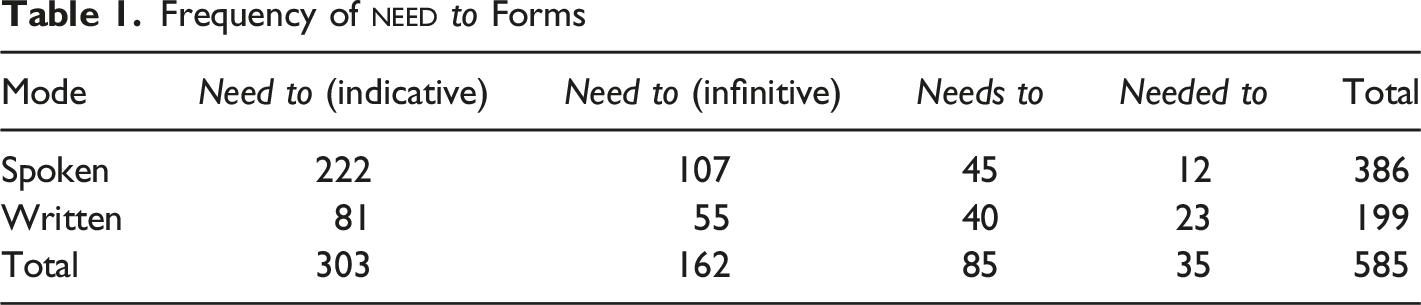
This data set was coded in terms of the source of the modality for each example. The annotation of a semantico-pragmatic feature like modal source is challenging. However, collaborative work on modal source for over ten years (Depraetere & Verhulst 2008; Depraetere & Reed 2011; Depraetere et al., 2021; Verhulst et al., 2013) has enabled me to fine-tune the parameter and to make it fully operational for data analysis. It was therefore always possible to identify the source and classify the examples in the data set presented here. In this kind of analysis, it is important to consider the wider linguistic context as well as the general discourse context. I analyzed the data set three times, with intervals of several months between the different rounds of analysis.
I looked for two kinds of significant patterns: two chi-squared tests were run in R, one for the overall distribution (that is, to check if the observed distribution of sources significantly diverges from an even distribution), and one to see whether there are significant differences in the distribution of sources between the spoken and the written modes. 10
4.2. Results
Overall Distribution of Sources

Distribution of Sources Across Modes
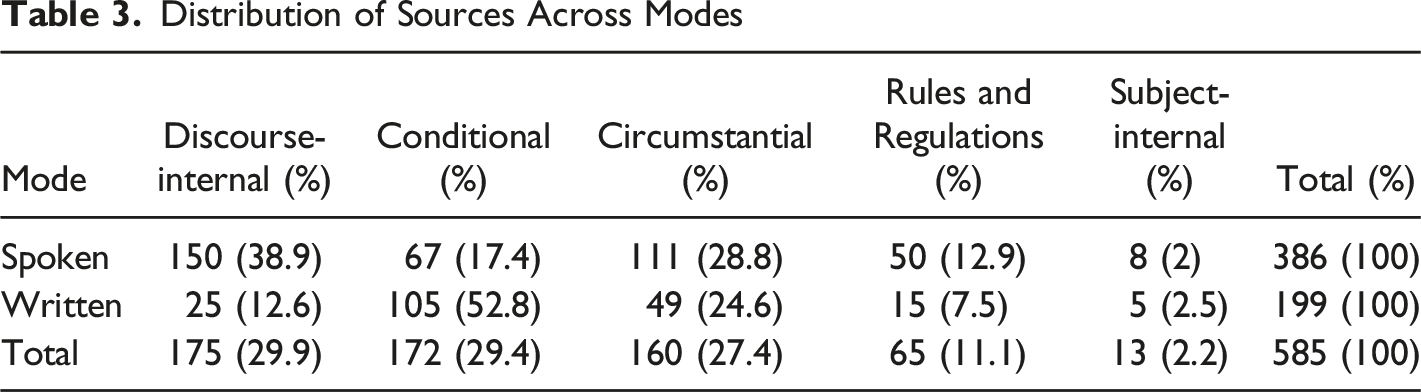
With respect to distribution of sources across the spoken and the written modes, the distribution is statistically significant (χ2 = 90.74, df = 4, p-value < 2.2e-1). Residuals make it possible to pinpoint where the significant differences in distribution lie; it is possible to represent the relative contribution of each cell to the overall chi-squared value in an extended association plot on the basis of residuals. The extended association plot in Figure 1 visualizes, on the basis of residuals that exceed +2/-2, which of the cells in Table 3 significantly contribute to the significant result of the χ2, that is, which sources are significantly associated with one or the other mode. The dark grey tiles show significant associations: those that extend above the line represent a significant positive association (attraction) with a mode, while those below the line represent a significant negative association (repulsion) with a mode. The light grey tiles represent non-significant associations. Significant Patterns in the Distribution of Sources Across Spoken/Written Modes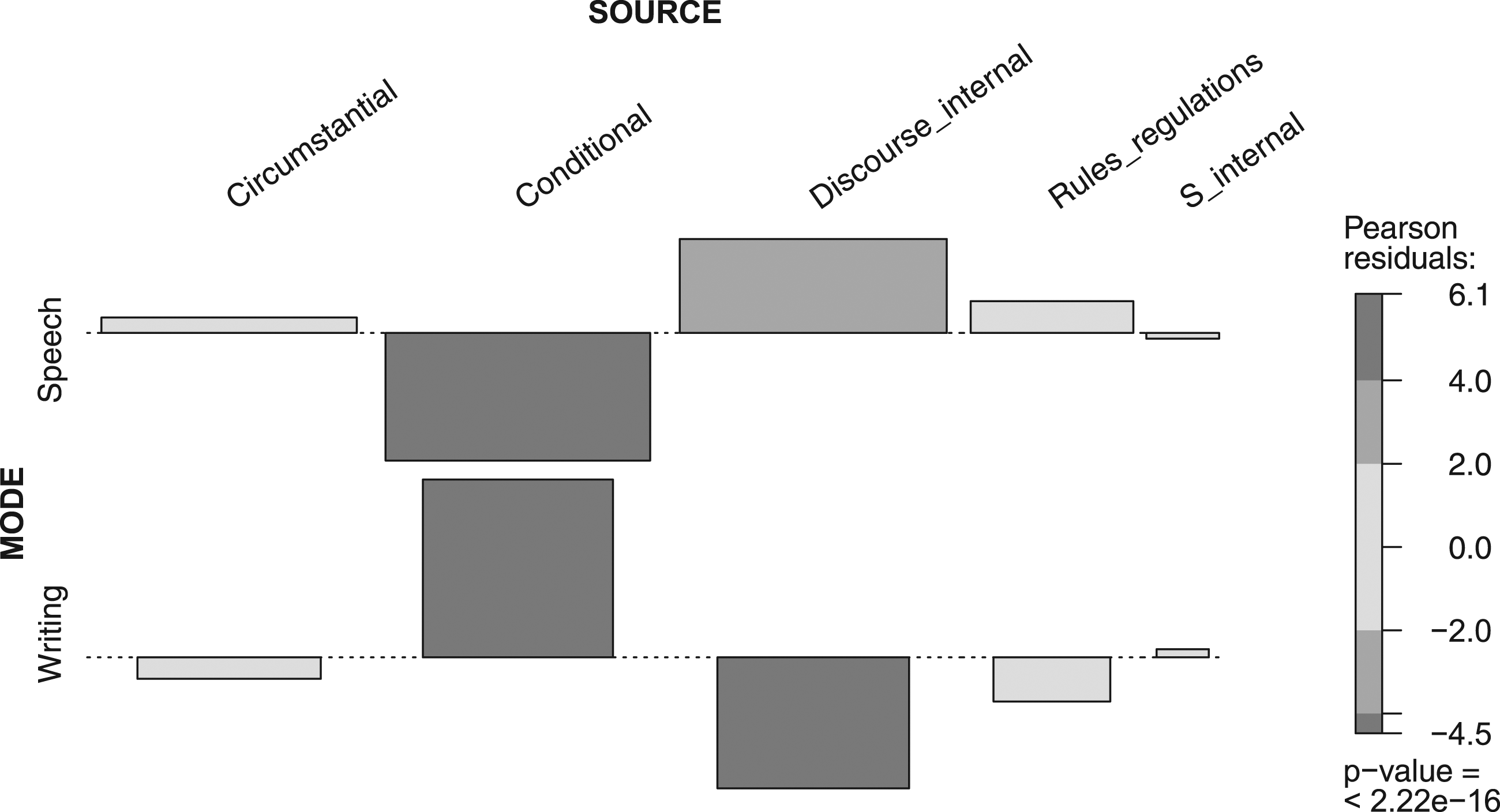
The following significant patterns stand out: conditional sources typically occur in the written mode and typically not in the spoken mode; discourse-internal sources typically occur in the spoken mode and typically not in the written mode.
4.3. Modal Source and Need to: Discussion
4.3.1. Discourse-internal Source (Speaker/Hearer)
N (45) (SP:PS3JJ) All I’d say on five chairman is chairman is that this issue of infrastructure particularly sewerage, sewerage, foul water and water supply is a major issue in York and the location of the new settlement I think needs to be very closely assessed in terms of er of five. I think it’s a very important criteria that we need to look at. (SP:PS3JK) I agree it’s important, what I have no feel for, is whether it is something which helps to make a decision as to where the new settlement might go. What I think I’m looking for is some evidence that the severity of the infrastructure problems to which you refer actually varies from one district to another. (BNC, HVH S_ pub_debate) (46) (SP:PS6G8) Are we having (unclear) we have to vote here? Anything else needs to be (unclear). Anything you need to raise with us? (SP:PS6G8) No, I don’t think so. I mean the main thing is these new leaflets really (SP:KRYPSUNK) mhm. (SP:PS6G8) getting them produced, checked (SP:KRYPSUNK) You’re happy about that? (SP:PS6G8) Yes. (BNC, KRY S_meeting)
This generalization is in line with Larreya and Rivière’s (2019:128) description: they argue that (47) Sophie, you need to respect other people’s privacy. (D. Brown, The Da Vinci Code) (Larreya & Rivière 2019:128)
Figure 1 shows that
In his analysis of obligation modals, Smith (2003) discusses what he calls “private obligation,” which seems relevant to the discussion of discourse-internal sources. He quotes the examples given in (48)-(51) from Sweetser (1990:53-54). (48) You have to stay home because I say so. (Smith 2003: 244) (49) ? You need to stay home because I say so. (Smith 2003: 244) (50) I need to stay home tonight to study for the test. (Smith 2003: 245) (51) I have to stay home tonight to study for the test. (Smith 2003: 245)
While one may want to argue about whether or not the example in (49) is truly questionable, Smith (2003:244) writes that (49) is not felicitous because
4.3.2. Conditional Source
In (52) and (53), N (52) Kirov was a rat caught in a trap of his own making, and time was running out. He needed to summon all the devious cunning with which nature had endowed him if he were to escape. (BNC, CDA_W_fict_prose) (53) But SQL server alone will not address all the needs of enterprise-wide client server. It needs to evolve in several ways to meet these needs. (BNC, HEP_S_Speech_unscripted)
Both examples represent the actualization of a particular situation (the main clause situation) as necessary and sufficient for the actualization of another situation, which is referred to in the if-clause (52) or the subclause of purpose (53). In other words, the desired situations are the driving forces behind the necessities, whose actualization require the main clause situation to come about: Kirov being smart is necessary in order to escape (52), and the SQL server evolving is necessary in order to the meet the needs (53). Example (53) occurs in the context of a seminar about the implementation of IT architecture: there is reference to a more extensive use of facilities which will require a change in the architecture.
Conditional sources have received relatively little attention in the literature (e.g., Depraetere & Verhulst 2010:8-11; Furmaniak 2020), but grammars, such as Declerck (1991:386) and Dekeyser et al. (1999), occasionally point out that (54) He needs to earn more money if he is to buy a car. (Declerck 1991:386)
My analysis provides support for this claim. N
So while examples with a conditional source have not received much attention in discussions of root necessity
4.3.3. Circumstantial Source
Another significant pattern is the use of
Examples (55) and (56) illustrate circumstantial modal sources. (55) Then I was able to help when young Mrs Thwaites at High Birk Hatt, our nearest neigbours, suffered terribly from toothache and needed to go to the nearest dentist, who was in Barnard Castle. (BNC, W_biography) (56) You get much above about fifty people and you perhaps do need a some technical assistance with the power. So the power needs to be just slightly slightly raised okay. (BNC, JSA_S_unclassified)
In (55), it is the circumstance of having toothache which makes it necessary for Mrs. Thwaites to see a dentist. The sentence in (56) features in a discussion about the power of voice: if there is a certain number of people present, the power of the voice needs to be adjusted. In other words, specific circumstances make it necessary to raise the power of the voice.
4.3.4. Rules and Regulations
N (57) So you have built an item of farm equipment that helps you do your job better, then let us know. It doesn’t have to be newly built, though we are limiting entries to machines built in the past five years. Nor does it need to be big or expensive looking. What we are looking for is evidence of imagination, lateral thinking and the FBLdesigner’s ability to solve technical problems. (BNC, ACR_W_ pop_lore) (58) The trials revealed a number of essential conditions that need to be met by all employers, assessment centres and candidates participating in the occupational competence assessment. Employers need to be committed to providing candidates with access to and use of workplace evidence; opportunities for additional experience; testimonies of their performance; counselling and support; and, ideally, a development programme for achieving the required competencies. (BNC: GXF W_non_ac)
In (57), the entries submitted to a contest need to meet certain requirements; “the items of farm equipment being big or expensive looking” is not one of them. In (58), it is the requirements to participate in the assessment that constitute the source of the necessity.
No observations have been made in previous analyses of
4.3.5. Subject-Internal Source
There are thirteen examples of (59) She pours withering scorn upon such ‘painted poupes’ as Joan Collins and Liz Taylor for the hours they devote to their images, as well as the men they choose as partners, but one look at the deep lines of bitterness etched into the faces of those women who renounce loving relationships in favour of cats, gardens or anything else tells me all I need to know. (BNC, G2V_W_ pop_lore)
The data confirm Müller’s (2008) findings based on corpus data from the ARCHER corpus and the Oxford English Dictionary from 1800 to the present. She shows that examples that express participant-internal necessity are rare (Müller (2008) uses Van der Auwera and Plungian’s (1998) concept (see section 3.3), which is called a subject-internal source in this paper). Only 2 out of the 428 sentences she analyzed illustrate this use, compared to the equally low number of 13 out of 585 examples (2.2 percent) in the data set analyzed here.
This type of example may well be similar to the “performative” use of must discussed by Coates (1983), and illustrated in (60).
(60) “You must play this ten times over, Miss Jarova would say” (Coates 1983:33, 38).
While examples like this, and subject-oriented uses of
5. Conclusion
The aim of the paper was to offer a more comprehensive and more explicit taxonomy of modal sources of root necessity. I have shown that the detailed investigation of the modal sources associated with a modal verb can shed new light on its semantico-pragmatic profile,
More generally, the method presented in this paper can be useful to arrive at a deeper understanding of the factors that drive the choice of modal verbs of root necessity. Further multi-factorial analyses that include semantic factors (such as the type of verb phrase), formal features (such as the type of subject), lexical features (co-text), and a larger range of verbs will be useful to complement this investigation and to determine the relative role source plays in the selection of a specific modal necessity verb.
Footnotes
Acknowledgements
I am grateful to Benoît Leclercq and Samantha Laporte for useful discussion of various topics addressed in the paper, and to the reviewers and editors for their critical observations and constructive suggestions.
Declaration of Conflicting Interests
The author(s) declared no potential conflicts of interest with respect to the research, authorship, and/or publication of this article.
Funding
The author(s) disclosed receipt of the following financial support for the research, authorship, and/or publication of this article: This work was supported by the ANR (Agence Nationale de Recherche) (ANR-16-CE93-0009).
