




Abstract
The relation between attachment styles and emotion regulation is well documented, and emotion dysregulation is considered characteristic of individuals with insecure attachment styles. Although gender differences in emotion regulation have often been reported, it is not clear whether the association between attachment styles and aspects of emotion dysregulation may vary across gender. A sample of 229 newlywed couples completed the Experiences in Close Relationship–Revised scale and the Difficulties in Emotion Regulation Scale. First, we confirmed previous evidence on the association between attachment insecurities and emotion dysregulation. Indeed, attachment anxiety and avoidance were both related to emotional nonacceptance and lack of emotional clarity. Moreover, attachment anxiety was associated with difficulties in impulse control and limited access to effective emotion regulation strategies, whereas attachment avoidance was uniquely related to lack of emotional awareness. Finally, gender was found to moderate the association that both attachment anxiety and attachment avoidance had with difficulties in pursuing desired goals when experiencing negative emotions. Specifically, among women (but not men), attachment anxiety was associated with greater difficulties in engaging in goal-directed behavior when distressed. Conversely, the association between attachment avoidance and difficulties in pursuing desired goals when distressed was positive for men and negative for women.
Bowlby (1988) suggested that early relationships with primary caregivers result in the development of attachment styles, including information about the self and the others, as well as about their emotional bounds. The attachment theory posits that these attachment styles play a key role in the way people interpret and understand their relationships throughout the lifespan.
From this point of view, in the last decade, attachment theory has been used as a conceptual framework for the study of the influence of early attachment experiences on emotion regulation, with particular regard to couple relationships and marital functioning (Creasey & Ladd, 2004; Mikulincer, Shaver, & Pereg, 2003). Indeed, several studies have shown an association between attachment styles and the way people evaluate their relationship (Feeney, 2008; Hazan & Shaver, 1987). Furthermore, emotion regulation and attachment styles interact in predicting conflict management behavior in intimate relationships (Creasey & Ladd, 2004). Finally, the ability to regulate emotional reactions to negatively charged experiences in the context of marital relationships is often considered a crucial competence for developing and maintaining adequate relationship functioning (Velotti et al., 2015).
Several studies have reported that emotional functioning in intimate relationships was associated with individual differences in attachment styles. In particular, attachment styles were related to variations in the emotional reactions to signals of distress or pleasure perceived in partners’ behavior (Mikulincer & Shaver, 2005). Therefore, attachment-related differences in emotion regulation may significantly influence relationship interactions (Mikulincer et al., 2003) and particularly conflict resolution between partners (Ben-Naim, Hirschberger, Ein-Dor, & Mikulincer, 2013). In fact, when dealing with stressful situations within the couple, each partner may experience different levels of anxiety and may rely on different abilities to regulate their negative emotions. Notably, this variability could, at least in part, be captured examining individual differences in attachment styles.
Interestingly, adult romantic relationships may represent the possibility for individuals to revisit past attachment experiences, developing a current attachment representation, which is specific to their romantic partners (Crowell & Treboux, 2001). Recent studies have demonstrated that specific attachment models (i.e., those related to the current partner) interacted with generalized attachment models (i.e., those related to the primary caregiver) in predicting couple adjustment and conflict strategies (Castellano, Velotti, Crowell, & Zavattini, 2014; Velotti, Castellano, & Zavattini, 2011).
During the development and through their relationship with attachment figures, children build their own emotion regulation abilities (Mikulincer & Shaver, 2008). Nonetheless, significant events during adulthood, such as a stable intimate relationship, could confirm or disconfirm original expectations based on general attachment representations, in turn leading to a modification of emotion regulation strategies (Feeney, 2008). As a whole, the studies outlined above seem to indicate that attachment dimensions and emotion regulation abilities are important to understand couple relationships. Furthermore, a more complete understanding could be reached by focusing on both partners, rather than studying couple functioning at the individual level. For instance, romantic (i.e., current) attachment insecurity has been linked to maladaptive emotion regulation (Goodall, 2015). However, since several studies suggested that different levels of emotional experience within romantic functioning are affected by gender (Clark, Fitness, & Brissette, 2001), it is still not clear whether gender differences may affect attachment styles and difficulties in emotion regulation strategies in couple relationships.
Gender differences in emotion regulation
We refer here to emotion regulation as a multidimensional construct involving the awareness, understanding, and acceptance of emotions; the ability to access adaptive strategies for modulating the intensity and/or duration of emotional responses; the willingness to experience emotional distress as part of pursuing desired goals; and the ability to control behavior when experiencing emotional distress (Gratz & Roemer, 2004). The relative absence of any or all of these skills is referred to as emotion dysregulation.
It has often been reported that emotional functioning in close relationships is based on gender stereotypes (Hess et al., 2000). For instance, women are often described as those who provide emotional support to others, seek emotional support from others, and use high person-centered comforting messages in the effort to relieve stress (Debrot, Cook, Perrez, & Horn, 2012). Women are also usually considered more emotionally responsive and able to express more intensely a range of broad emotions (van Middendorp et al., 2005). On the other hand, men are deemed more inclined to express specific emotions such as anger, while they are associated with a greater tendency to suppress negative emotions (e.g., sadness; Flynn, Hollenstein, & Mackey, 2010). Moreover, women usually report greater emotional awareness than men (Barrett, Lane, Sechrest, & Schwartz, 2000). Other scholars have shown that wives benefit more than their husbands from the expression of negative emotions and that emotional expression was considered a sign of intimacy that women find more desirable than men in couple relationships (Monin, Martire, Schulz, & Clark, 2009). Also, it has been reported that women tend to use a greater variety of emotion regulation strategies (Garnefski, Teerds, Kraaij, Legerstee, & van den Kommer, 2004), express their emotions more often (Mendes, Reis, Seery, & Blascovich, 2003), and experience their emotions more intensely (Williams & Barry, 2003).
However, the extant literature on this topic frequently reports inconsistent results, failing to describe coherent gender differences in terms of emotion regulation within romantic relationships (Velotti, Casselman, Garofalo, & McKenzie, 2015; Velotti, Zavattini, & Garofalo, 2013). For example, a study conducted by Debrot et al. (2012), aimed at investigating interpersonal emotion regulation processes within romantic relationships, highlighted only small and somewhat inconsistent gender differences between partners. Similarly, van Middendorp et al. (2005) did not find any gender difference regarding the difficulty in experiencing and describing emotions, as well as in emotional control. Such inconsistency could be clarified by introducing a third variable. Indeed, it is possible that men and women do not differ in their emotion regulation abilities in absolute terms, but that this difference is relative to their attachment style. However, to the best of our knowledge, no studies have investigated whether attachment styles could better explain gender differences in emotion regulation.
Finally, emotion regulation is considered to play a key role in determining healthy functioning in both women and men, as in their couple functioning. However, only few studies have looked at gender differences in emotion regulation within couples considering both partners (Garofalo, Velotti, & Zavattini, 2015; Nolen-Hoeksema & Aldao, 2011).
In an effort to address this gap, this study examined how gender differences in emotion regulation could be understood considering underlying attachment styles. In other words, we sought to investigate whether the relationship between attachment styles and emotion regulation, rather than emotion regulation only, was affected by gender differences. Accordingly, we examined in a large sample of heterosexual couples whether women showed a greater ability to regulate their emotions as compared to men. Yet, given the controversial findings mentioned above, no specific predictions were made concerning distinct dimensions of emotion dysregulation. Furthermore, we expected that no differences in attachment styles would emerge across gender. Finally, it was expected that higher scores on each insecure dimension (i.e., avoidance and anxiety) were related to higher degrees of emotion dysregulation. However, given the expected gender differences in emotion regulation, we hypothesized that gender would moderate the relationship between attachment dimensions and emotion regulation facets.
Method
This study is part of an ongoing longitudinal research focused on the first years of marriage (see also Velotti et al., 2015). Information relevant to this study is presented below.
Participants
The following criteria were used to select participants: all participants had to be in the first 6 months of a heterosexual marriage; participants did not have children and were not expecting a child at the beginning of the study; none of the participants had been previously married; all participants had to be Italian and they were not planning to leave the country. These criteria were chosen in order to avoid that the impact of stressful events (e.g., parenthood and divorce; Brown & Robinson, 2012) that could alter the assessment of the variables of interest. The sample consisted of 229 newlywed couples (N = 458). They had been married for an average of 4.2 months, and their mean age was 31.29 years (standard deviation [SD] = 3.63) for females and 32.97 years (SD = 3.55) for males. Spouses had been dating for an average of 5.4 years (SD = 3.31) before they were married. Regarding educational level, 41.2% of husbands and 56.7% of the wives had university education. Less than 10% of the first-time marriage applicants who were approached declined to participate in the research.
Instruments
Difficulties in Emotion Regulations Scale
The Difficulties in Emotion Regulations Scale (DERS; Gratz & Roemer, 2004) is a 36-item self-report scale developed to assess difficulties in six domains of emotion regulation. Participants were asked to indicate how often each item applied to them using a 5-point Likert-type scale, ranging from 1 (almost never) to 5 (almost always). Higher scores reported on each DERS’ scale indicate greater emotion dysregulation in the following areas: Nonacceptance of emotional responses (Nonacceptance, for example, “When I’m upset, I become embarrassed for feeling that way”); Difficulty engaging in goal-oriented behavior when experiencing negative emotions (Goals, for example, “When I’m upset, I can still get things done”); Difficulties with impulse control when experiencing negative emotions (Impulse, for example, “When I’m upset, I feel out of control”); Lack of attention for, and awareness of, personal emotions (Awareness, for example, “I pay attention to how I feel”); Limited access to emotion regulation strategies (Strategies, for example, “ When I’m upset, it takes me a long time to feel better”); and Difficulties in identifying and labeling one’s emotions (Clarity, for example,“ I know exactly how I am feeling”). Both the original (Gratz & Roemer, 2004) and the Italian (Giromini, Velotti, de Campora, Bonalume, & Zavattini, 2012) versions of the DERS showed good internal consistency and construct validity. In this study, Cronbach’s alphas were .92 for the DERS total score and equal to or greater than .67 for each subscale (the only scale with an alpha lower than .70 was Awareness, in line with previous studies with the Italian version of the DERS; for example, Velotti & Garofalo, 2015).
Experiences in Close Relationships—Revised
The Experiences in Close Relationships–Revised (ECR-R; Fraley, Waller, & Brennan, 2000) is a 36-item self-report questionnaire which provides a dimensional evaluation of current attachment style between romantic partners. Participants are asked to indicate their feelings regarding their couple relationship according to a 7-point Likert-type scale ranging from 1 (strongly disagree) to 7 (strongly agree). The questionnaire produces scores on two subscales, resembling the two main dimensions of romantic attachment styles: (1) Anxiety, that is, intense worry about one’s romantic relationship, strong involvement in the relationship, along with fear of abandonment and frequent seeking of the partner’s attention and care (e.g., “I often worry that my partner doesn’t really love me”); Avoidance, which involves difficulties in establishing a deep intimate connection to the partner and a tendency to feel discomfort with intimacy (e.g., “I find it difficult to allow myself to depend on my partner”). Low scores on both dimensions are indicative of relatively secure attachment.
In this study, we used the dimensional evaluation, as recommended by the ECR-R authors (Fraley et al., 2000), so that the differences among individuals could be more easily observed, compared to a categorical evaluation. Several studies have examined the validity and reliability of this measure and supporting its adequate psychometric properties (Sibley, Fischer, & Liu, 2005). Picardi, Bitetti, Pasquini, and Puddu (2000) translated and validated the Italian version of the ECR-R, which confirmed its sound psychometric properties. In this study, internal consistency was good for both the avoidance and the anxiety subscale (α = .88 and .90, respectively).
Procedure
In order to maximize the sample size, couples were recruited from premarital courses (N = 426; 93%) or when they applied for marital license in the District Office (N = 32; 7%) in different cities in Central Italy, and then screened to determine whether both partners met the eligibility criteria described above. Following the initial screening process, letters were sent to couples meeting the above criteria, inviting them to participate in a 2-year longitudinal study on marriage. Partners interested in participating were given their own individual questionnaire pack after providing written informed consent. The completion of the survey took between 45 and 60 min, and the respondents were instructed not to discuss their answers with their partners. All measures were completed either in a room where the premarital courses took place or at participants’ home. In both cases, a trained clinical psychologist was present during the administration of the questionnaires.
Ethical considerations
The research received formal approval from the Research Ethics Committee at Sapienza University of Rome (Italy). The study complied with American Psychological Association (APA) ethical standards in the treatment of human research participants and conformed to the provisions of the Declaration of Helsinki in 1995 (as revised in Edinburgh 2000).
Data analysis
A linear mixed model analysis was used to estimate the level of difficulty an individual experienced with regard to emotion regulation and attachment dimensions within their marriage, as well as their interaction. This technique is well suited for the analysis of multi-actor data structures, as it takes into account the dependency of the observation and estimate variance at different levels.
Results
Descriptive analyses for the DERS and the ECR-R
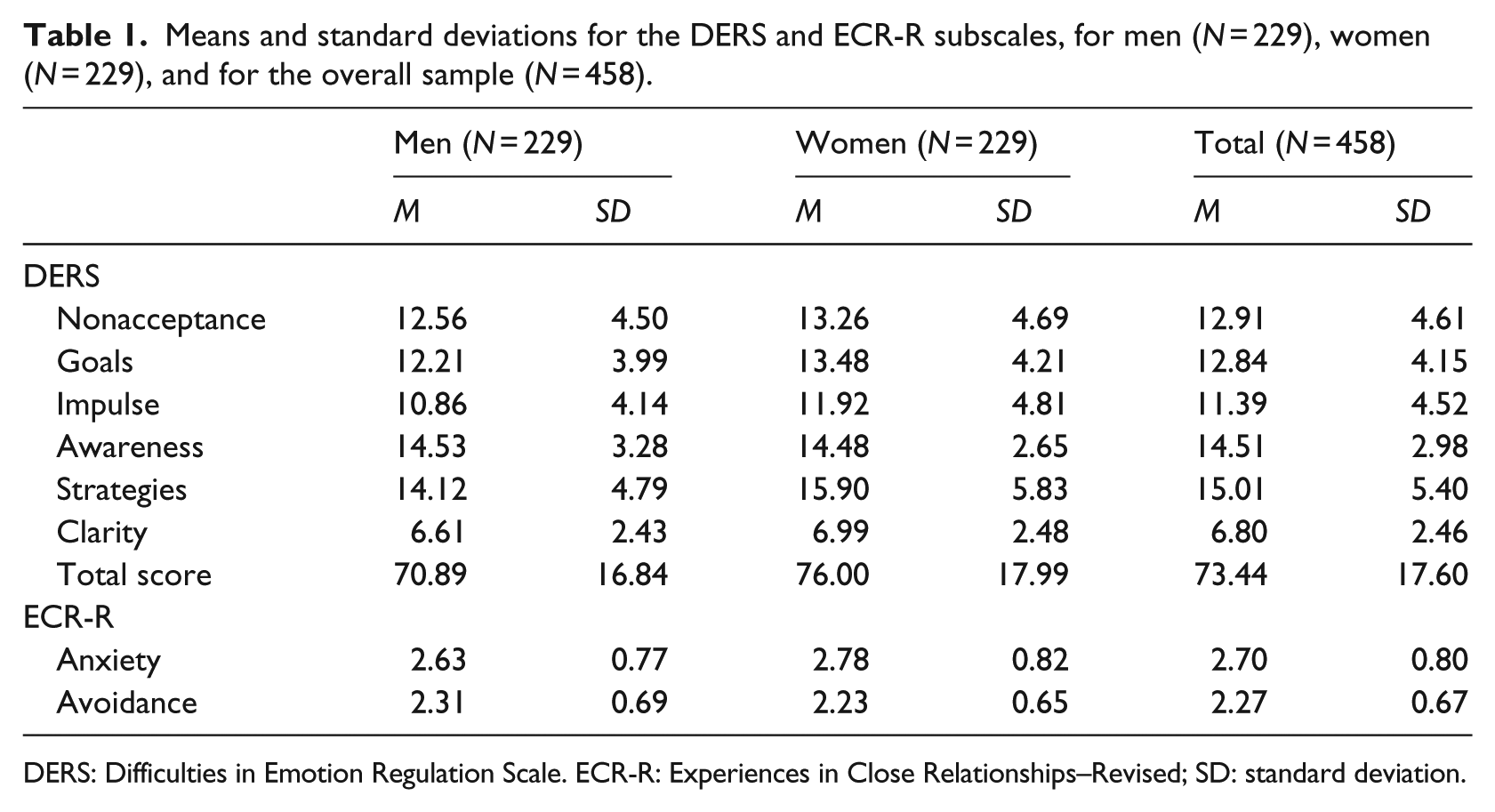
Table 1 presents the means and standard deviations for difficulties in emotion regulation and attachment dimensions.
Means and standard deviations for the DERS and ECR-R subscales, for men (N = 229), women (N = 229), and for the overall sample (N = 458).
DERS: Difficulties in Emotion Regulation Scale. ECR-R: Experiences in Close Relationships–Revised; SD: standard deviation.
In line with the mean scores found in the nonclinical sample used by Gratz and Roemer (2004), scores in our sample were distributed in the lower-middle range of difficulties in emotion regulation. Data analysis revealed significant variation across gender. Specifically, women reported higher scores on the following DERS subscales: Goals (F = 11.05; p < .001), Strategies (F = 12.75; p < .001), as well as on the DERS total score (F = 9.85; p < .01). Conversely, no gender differences were found regarding attachment dimensions.
Regarding attachment styles, participants reported a central distribution on the dimensional continuum, placing this sample in the range of attachment security. Our sample reported relatively lower levels of anxiety and avoidance than those found in the validation sample from Fraley et al.’s (2000) study.
Associations among DERS and ECR-R scales and gender effect
Both attachment anxiety and attachment avoidance positively predicted overall emotion dysregulation (i.e., DERS total score). In detail, results showed that anxiety and avoidance were positively associated with scores on several DERS dimensions. First, Nonacceptance was positively related to anxiety (Est. = 1.87; t = 8.05; p < .001) and avoidance (Est. = 0.52; t = 1.90; p < .001). Moreover, only anxiety had a positive relation with the Impulse subscale of the DERS (Est. = 1.54; t = 2.07; p < .001), whereas avoidance did not emerge as significant predictor (Est. = 0.04; t = 0.181; p > .05). As for Awareness, only avoidance showed a significant positive effect (Est. = 0.77; t = 3.92; p < .001), while anxiety was not significantly related to this subscale of the DERS (Est. = 0.132; t = 0.710; p > .05). For the Strategies subscale, only anxiety had a significant positive effect (Est. = 2.36; t = 8.03; p < .001), with avoidance being not significantly associated with this dimension of the DERS (Est. = 0.189; t = 0.512; p > .05). Then, both anxiety (Est. = 0.92; t = 5.13; p < .001) and avoidance (Est. = 1.08; t = 7.11; p < .001) were significantly and positively related to scores on the Clarity subscale. Finally, in the prediction of Goals scores, the effect of anxiety (Est. = 0.55; t = 1.61; p < .001) and avoidance scores (Est. = 0.86; t = 2.25; p < .001) interacted with gender, as follows. Regarding the anxiety × gender interaction (Est. = 1.29; t = 2.76; p < .001), greater levels of anxiety corresponded to higher scores on the Goals subscale only among females. As for the avoidance × gender interaction (Est. = -1.64; t = -2.97; p < .001), the opposite pattern emerged: avoidance scores were related to higher Goals scores only for males, whereas females with higher avoidance scores showed lower scores on Goals (see Figure 1 for a graphical depiction of this moderation effect). 1
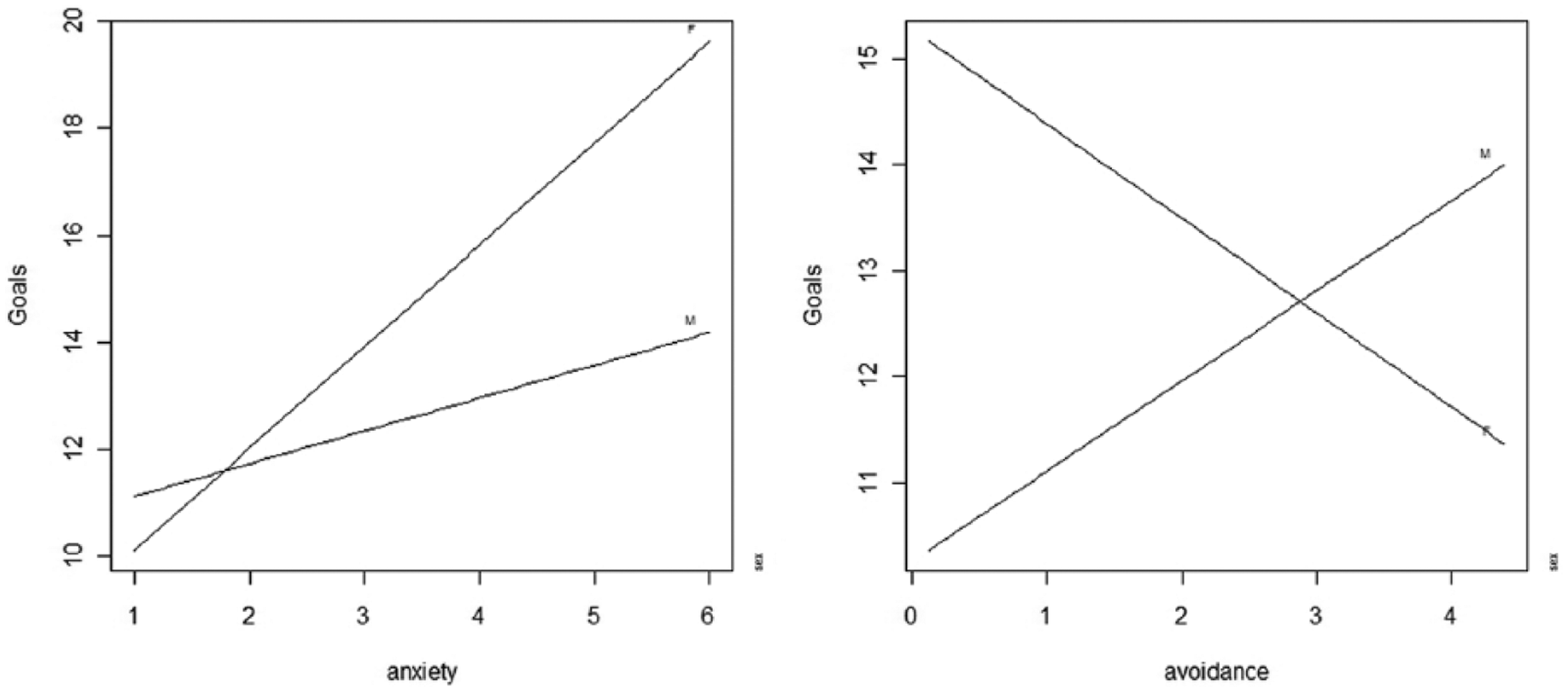
Moderating effect of gender in the association between both attachment anxiety and avoidance with DERS Goals dimension. Specifically, higher scores on attachment anxiety were related to more difficulties on the DERS Goals dimension among women, but not men. Conversely, among men, the higher the score of attachment avoidance, the greater the difficulties reported on the DERS Goals dimension, whereas the opposite was true for women (i.e., a negative association between attachment avoidance and Goals emerged).
Discussion
Consistent with prior studies (Bakermans-Kranenburg & van IJzendoorn, 2009), and in line with the expectations, our findings confirmed that gender differences did not characterize attachment styles such as anxiety and avoidance. However, this study adds to the literature by examining gender differences in the associations between attachment insecurities and emotion regulation difficulties.
Regarding difficulties in emotion regulation, our results seem to suggest possible gender differences. In fact, women reported greater difficulties in the regulation of negative emotions than men. Specifically, women had greater overall difficulties in emotion regulation (i.e., higher scores on the DERS total score), as well as in concentrating on tasks at hand when experiencing negative emotions and in accessing effective emotion regulation strategies (i.e., higher scores on the Goals and Strategies subscales, respectively). It is worth noting that, in the validation study of the DERS, Gratz and Roemer (2004) reported a different pattern of gender differences in their sample, with men having higher scores on the Awareness subscale than women. However, the authors of the Italian adaptation of the DERS (Giromini et al., 2012) did not find any gender difference, suggesting that variability in emotion dysregulation may not depend directly on gender, but rather gender differences may stem from variability in a third intervening variable (here, attachment style).
Thus, in this study, we examined whether, rather than playing a direct effect on emotion dysregulation dimensions, gender could play a moderating role in the association between attachment styles and emotion dysregulation. First, our findings corroborated previous evidence on the relation between attachment insecurities and emotion dysregulation. In particular, both attachment anxiety and attachment avoidance were related to difficulties in emotional acceptance, as well as to lack of emotional clarity and overall emotion dysregulation. However, only attachment anxiety significantly predicted negative urgency (i.e., difficulties in refraining from impulsive behavior when distressed) and limited access to effective emotion regulation strategies. On the other hand, attachment avoidance was uniquely related to lack of awareness for emotions. As a whole, these findings seem to suggest that attachment insecurity in general (i.e., either in the form of anxiety or in the form of avoidance) is related to nonacceptance of emotional responses and lack of emotional clarity. These two dimensions of emotion dysregulation partially reflect a mentalizing deficit (Velotti & Garofalo, 2015) often associated with attachment insecurity (Allen & Fonagy, 2006). Consistent with this framework, an insecure attachment style could undermine the ability to think of and reflect on one’s own emotions, in turn compromising emotion regulation efforts. Nonetheless, this mentalizing deficit could be associated with selected difficulties in emotion regulation, as a function of attachment. Indeed, people with an anxious attachment style seemed characterized by a lack of confidence in abilities to engage an effective emotion regulation strategy and an associated difficulty with impulse control. In contrast, individuals with an avoidant attachment style may not present these deficits in emotion regulation while showing a lack of emotional awareness. Interestingly, the Awareness scale of the DERS actually captures the individual tendency to attend to and acknowledge upsetting emotions. Hence, this pattern of emotion dysregulation is consistent with the conceptualization of avoidant individuals as dismissing attachment-related issues and detaching from emotional experiences (Mikulincer & Shaver, 2008).
Finally, and perhaps more importantly, the relation between attachment styles and the difficulty in engaging in goal-oriented behaviors when experiencing negative emotions was moderated by gender. Indeed, attachment anxiety was related to this dimension of emotion dysregulation only among women. This may indicate that women with an anxious attachment style are less willing to experience negative emotions as part of pursuing an individual goal, while this ability (also referred to as distress tolerance, or persistence) could remain intact in men with the same attachment style. Conversely, the unwillingness to tolerate negative emotions while engaging in goal-directed behavior was related to attachment avoidance among males only. Taken together, this moderation effect suggests that a mentalizing deficit—or a limited ability to reflect upon mental states—could undermine the individuals’ capacity to rely on their emotional states as a source of information to guide their behavior, in a different way among men and women. Indeed, anxious (with respect to attachment) women and avoidant men, but not anxious men and avoidant women, could manifest this difficulty in controlling and directing behavior toward a personal goal when upset. In other terms, the ability to behave in accordance with desired goals could be selectively impaired in anxious women and avoidant men. Of note, women with an avoidant attachment style showed a greater willingness to tolerate negative emotions while engaging in goal-directed behavior than women low in attachment avoidance. However, it should be noted that women in our sample reported levels of attachment avoidance in the range of (relative) attachment security. Therefore, this finding seems to suggest that, to a certain extent, attachment avoidance could be somehow functional among women, whereas it is linked to difficulties in regulating emotions among men. Likewise, our findings suggest that relatively higher levels of attachment anxiety could be more detrimental for women than for men. The relevance of this particular dimension of emotion dysregulation (i.e., in the ability to behave in accordance with desired goals when experiencing negative emotions) in couple relationships is supported by the fact that a willingness to express (and experience) negative emotions was associated with positive relationship outcomes, such as elicitation of mutual support and enhancing intimacy in romantic relationships (Graham, Huang, Clark, & Helgeson, 2008). Accordingly, an attachment-informed approach to treat a difficulty in this aspect of emotion dysregulation could be of great help in couple therapy (Kazdin, 2015; Kirby & Baucom, 2007). The different pattern of findings for men and women may result from different gender role norms for goals achievement. Women are typically expected to take a less active role, which may produce more tension in anxious women who experience heightened distress and more intense emotions with an associated need to express their fears (Davis, Shaver, & Vernon, 2003). Men, on the other hand, are expected to act in accordance with their desired goals even when they are experiencing negative emotions; therefore, meeting this expectancy could be difficult for avoidant men who prefer to disengage themselves.
Although our study has a number of strengths (e.g., the recruitment of a large sample of couples and a sophisticated data analytic approach to examine relations in a paired sample), a number of limitations warrant mention. First, the cross-sectional data analytic approach presented here prevents us from understanding causal relationships between attachment styles and emotion dysregulation dimensions. Our hypothesis, in line with the mainstream theoretical models (e.g., Mikulincer & Shaver, 2008), was that an insecure attachment style could undermine the individuals’ ability to regulate emotions, but this cannot be confirmed using the present data. For example, it is unclear whether the high levels of emotional unawareness reported by individuals with an avoidant attachment style were due to their attachment style or whether the direction of causation was inverted, such that lack of emotional awareness may have led to the development of an avoidant attachment style. In other words, it is possible that emotion regulation patterns may serve as a means for modeling one’s attachment orientation within romantic relationships: this possibility should be explored in future research. Moreover, it is even possible that a mutual relationship may characterize these constructs or that a third variable—such as attachment representations with respect to parental figures—may have influenced the development of both emotion regulation and romantic attachment style. Further research is needed to obtain a better understanding of the causal link between emotion regulation and romantic attachment.
Second, this study relied on self-report measures of attachment styles and emotion dysregulation, which may raise concerns about self-presentation biases, lack of insight, and about the effects of shared-method variance on the observed correlations. Future research using different assessment methods of these constructs are needed to validate our conclusions.
Third, this study involved newlywed heterosexual young adults, which may limit the generalizability of the findings. For instance, replications are needed in different national contexts, where same-sex marriages are legal, in order to also compare gay and lesbian couples. Furthermore, it is possible that the associations between romantic attachment styles and emotion dysregulation vary across developmental periods and marital stages. As a result of this uncertainty, future research may benefit from the inclusion of younger and/or older individuals as well as individuals not yet married or married for a longer time.
Conclusion
As a whole, these results seem to suggest that different dimensions of emotion dysregulation may stem from different attachment dimension and that this relation differs across gender. These findings are related to interesting clinical implications. Indeed, when dealing with couples suffering from difficulties in emotion regulation, an appropriate treatment should be tailored based on the attachment style of each partner. In particular, if it is well known that targeting dysfunctional aspects of attachment anxiety or avoidance is an integral part of marital therapy (Castellano, Velotti, & Zavattini, 2014; Kazdin, 2015), treatment approaches priorities may differ when treating men or women with attachment insecurities. Notwithstanding these distinctions, specific aspects of attachment insecurity were related to selected difficulties in emotion regulation, as described above, supporting the relevance of attachment-based approaches for the treatment of individuals and couples with emotion dysregulation problems.
Footnotes
Acknowledgements
We are especially grateful to the couples who contributed to this project as participants.
Funding
The author(s) received no financial support for the research, authorship, and/or publication of this article.