




Abstract
This article describes a study with two major objectives: first, to investigate whether prospective memory functioning is dissociated from retrospective memory functioning and, second, to examine whether field-independent cognitive style will differ significantly from field-dependent cognitive style in prospective and retrospective memory functioning. A total of 76 undergraduate students of the University of Nigeria, Nsukka (41 men, 35 women; mean age: 19.66 years; standard deviation = 2.02) completed the Group Embedded Figures Test and the Prospective and Retrospective Memory Questionnaire. Omnibus statistic showed that prospective and retrospective memory was not dissociated (p < .001) and the field-dependent versus field-independent cognitive styles differed significantly on prospective (p < .001) and retrospective memory (p < .001). The results were viewed as tentative; the study maintains that future studies are required to provide converging evidence. Authors concluded with some suggestions for further research.
Keywords
The field of human memory covers many different kinds of skills and abilities (Westerman & Payne, 2005). People sometimes remember what they must do. At other times, they remember what they have done. The former is termed prospective and the latter retrospective memory. Thus, one basic distinction that guides much of research in human memory today is between prospective and retrospective memory (Kliegel & Martin, 2003; Kvavilashvili, Kornbrot, Mash, Cockburn, & Milne, 2009; Maylor & Logie, 2010). Prospective memory refers to the ability to remember to do previously planned actions in future. It has important implications for everyday functioning. As Crawford, Smith, Maylor, Della Sala, and Logie (2003) point out, remembering to do things at the appropriate time or in response to an appropriate cue is as important in everyday life as is remembering information from the past. For instance, failing to remember to take medication or attend a medical appointment could potentially have very serious consequences. Several potentially different prospective memories have been identified. Kvavilashvili (1996) described three distinct types of prospective memory based on the difference between events, times, and activities. Einstein and McDaniel (1990) drew a distinction between time- and event-based intentions only, whereas Harris (1984) differentiated between appointment-keeping intentions (time-based) and intentions to do one thing before or after another (activity-based). The potential differences and similarities between the remembering of activity-, event-, and time-based intentions have not been studied systematically (Kvavilashvili, 1996). Retrospective memory, on the other hand, refers to the ability to remember information from the past. It covers memory such as semantic, episodic, autobiographical, declarative, explicit, and implicit memories, depending upon the specific characteristics of the information to be remembered.
One major interest in the study of human memory is to understand whether prospective memory performance is uncorrelated with or dissociated from performance on retrospective memory task. Although a few correlations have been reported between prospective memory and some aspects of retrospective memory such as verbal memory (Cherry et al., 2001) and working memory (Cherry & LeCompte, 1999), the matter is still not conclusive. There are studies (e.g., Ferbinteanu & Shapiro, 2003; Kliegel, McDaniel, & Einstein, 2000; Maylor, Smith, Della Sala, & Logie, 2002; West & Krompinger, 2005) where impaired prospective memory caused definite impact on retrospective memory, suggesting that the two kinds of memory are not entirely independent. Interestingly too, there have been studies (e.g., Burgess & Shallice, 1997; Groot, Wilson, Evans, & Watson, 2002; Kvavilashvili, 1987) where patients with impaired prospective memory had an intact retrospective memory, suggesting that to some extent the two components of memory involve separate processes. Studies which argue that prospective and retrospective memories are independent from each other tend to explain their findings based on the assumption that seems to divide memory into stages. For example, McDaniel, Glisky, Rubin, Guynn, and Routhieaux (1999) explain the lack of relationship in performance between prospective and retrospective memory to mean that the two kinds of memory are localized in different parts of the brain. They argue that while successful prospective memory depends on posterior parietal and medial temporal lobes, the retrospective memory is mostly dependent upon the frontal systems and on the executive functions.
This study argues against the memory system approach; instead, it maintains that the processing approach, such as the transfer-appropriate processing (TAP) framework (Morris, Bransford, & Franks, 1977), is more parsimonious to understand dissociations in human memory. The TAP framework, because it posits that differences in any two kinds of memory codes are the result of different levels of analysis, provides the theoretical basis for understanding functional dissociation. Unlike the memory systems approach or any of its variants, TAP focuses on the processes underlying memory. It argues that dissociation reflects impairment on only a certain type of process distinguished between conceptual and perceptual processes. Proponents of the TAP framework (e.g., Jacoby, 1983; Roediger & McDermott, 1993) argue that a task engages conceptual processes when performance involves the analysis of stimulus meaning and perceptual processes when performance involves the analysis of stimulus form. The TAP framework predicts that dissociations are likely to occur between prospective and retrospective memory if one memory is perceptual and the other conceptual. If, however, the two kinds of memory utilize the same level of analysis, dissociation would not occur between them. The TAP framework enjoys great success, accounting for functional dissociations between prospective and retrospective memory tests. The results observed from Li, Dong, and Gong’s (2008) two experiments, which investigated the difference in TAP effect of prospective memory among individuals with different cognitive styles when attention was focused or divided, are consistent with the TAP framework.
This study examines the effect of cognitive style on self-reported prospective and retrospective memory slips in everyday life. Cognitive style is a stable and persistent personality dimension that influences attitudes, values, and social interactions. Peterson and Deary (2006) define cognitive style as stable attitude preferences or habitual strategies that determine individuals’ mode of perceiving, remembering, thinking, and problem solving. Similarly, Riding and Rayner (1998) maintain that cognitive style is an individual’s consistent approach to organizing and processing information during learning that can facilitate, improve, and/or inhibit optimal performance of a task. A number of cognitive styles have been identified and studied over the years, such as the field dependence–independence (Witkin, Moore, Goodenough, & Cox, 1977), visualizer–verbalizer (Riding & Cheema, 1991), intuition–analytic (Allinson & Hayes, 1996), and the adaptation–innovation (Kirton, 2003) dimensions. However, the field-dependent versus field-independent cognitive style is one of the most widely known styles (Amazue, 2006; Mullany, 2001). The two styles have stable and predictable attributes (Warpner, 1986). The field independence is an analytical style that relates to internal frames of reference, while the field dependence is a social style that correlates to external frames of reference. Zhang and Sternberg (2006) argue that the field-independent style is revealed by an active discovery approach to learning, an individual orientation, analytical interests, and a task emphasis. The field-dependent style, on the other hand, may be evidenced by a chain-like reasoning process, a with-people orientation, social interests, and a social emphasis.
Research has identified a number of major connections between field-independent and field-dependent cognitive styles on memory and learning. Several studies (Giovanna, Piera, Francesca, & Marina, 2012; Graff, 2003; Li et al., 2008) suggest that field-independent and field-dependent cognitive styles constitute an important aspect of individual differences among students regarding the way they acquire and process information. There is, from several sources, consensus that field-independent individuals are likely to learn more effectively under conditions of intrinsic motivation, such as during self-study. They are, however, not significantly influenced by social reinforcement. In contrast, the field-dependent individuals are more autonomous in the development of interpersonal skills. Studies (e.g., Sternberg & Zhang, 2001; Zhang & Sternberg, 2006) have shown that students who learn about their own styles frequently become better learners, achieve higher grades, and are more motivated and have more positive attitudes about their studies. Other studies (Graeme & Richard, 2007; Lopez-Ruperez, Palacios, & Sanchez, 1991; Tinajero & Paramo, 1997) argue that learners with different cognitive styles pay closer attention to different aspects of information. That is, they encode, store, and recall information differently, and also think and comprehend in different ways. Tinajero and Paramo (1997) investigated the relationship between cognitive style and student achievement in several subject domains, including English, mathematics, and Spanish. The researchers found that cognitive style was a significant source of variation in overall performance of students: field-independent subjects outperformed their field-dependent counterparts. Similarly, Handal and Herrington (2004) found field-independent subjects more efficient in comprehending hypermedia instructions compared to the field-dependent subjects. These studies seem to suggest that field-independent cognitive style is more successful at learning higher order tasks. It uses an active reasoning pattern that includes cognitive structuring skill. The field-dependent cognitive style, on the other hand, “takes it as it is” (Fritz, 1992, p. 4) and seems to be passive in the learning context.
The Prospective and Retrospective Memory Questionnaire (PRMQ) has been used with participants in a number of European countries (Crawford, Henry, Ward, & Blake, 2006; Crawford et al., 2003; Gonzalez-Ramirez & Mendoza-Gonzalez, 2011). By testing participants on the PRMQ outside the usual European culture, this study sought to determine whether the findings from Europe would be replicated in Nigerian (African) participants. This study has two objectives. The first hypothesis states that there would be no dissociation between prospective and retrospective memory items on the PRMQ. The TAP framework predicts that dissociation would occur between any two kinds of memory (e.g., prospective and retrospective), if one memory is perceptual and the other conceptual. Since the items on the PRMQ seem to employ the same level of analysis, the researchers proposed that scores on both the prospective and retrospective memory items would be homogeneous and undifferentiating. The second hypothesis states that there would be statistically significant difference between field-independent and field-dependent individuals on the PRMQ. Each cognitive style (field-independent versus field-dependent) possesses its own strengths and weaknesses. However, because the field-independent individuals tend to notice details and seem to have greater analytical and differentiating ability compared to the field-dependent people (Amazue, 2006; Giovanna, et al., 2012; Li et al., 2008), the study proposes that the field-independent participants would report fewer memory slips than the field-dependent ones.
Method
Participants
The participants comprised 76 undergraduate students of the University of Nigeria, Nsukka (41 men, 35 women). The students were attending the General Experimental Psychology class, and they participated in partial fulfillment of the course requirements. The students’ ages ranged from 18 to 22 years, with a mean age of 19.66 years (standard deviation [SD] = 2.02 years). The participants were predominantly right-handed individuals (95%).
Instrument
Two instruments were used in this study. They are the Group Embedded Figures Test (GEFT) and the PRMQ. The GEFT (Witkin, Oltman, Raskin, & Karp, 1971) was the first instrument that participants were asked to complete. The test is a perceptual test that is frequently used to characterize individuals into field-independent and field-dependent cognitive styles (Warpner, 1986; Witkin, 1978; Witkin, Goodenough, & Oltman, 1979; Witkin et al., 1971). The GEFT requires individuals to locate a simple figure when the figure is embedded within complex patterns. The test consists of 25 items organized into three sections. The first section has seven items and is used for practice. The other two sections, containing nine items each, were scored. Scores on the GEFT reflect abilities in perceptual disembedding, and the higher a participant’s score, the greater the field independence. Each item correctly located within the complex pattern is scored 1. Scores range from 0 to 18, and the median score is the threshold for categorization between field-independent and field-dependent individuals. Low scores reflect difficulty in finding the simple figure. Higher scores reflect skill at locating simple figures. The GEFT has satisfactory validity (a correlation of .82 between the two major sub-sections) and reliability (.89 on test–retest over a 3-year period) (Witkin et al., 1971). In Nigeria, the GEFT has a reliability index (Cronbach’s alpha) of .69 (Nwonyi, 2014). Amazue (2006) reported a test–retest reliability coefficient of .67 over a period of 4 weeks and a construct validity coefficient of .76.
The second instrument is the PRMQ (Smith, Della Sala, Logie, & Maylor, 2000), which is a self-report measure of prospective and retrospective memory slips in everyday life. The PRMQ consists of a set of questions about minor memory mistakes that people make from time to time. It is made up of 16 items on the whole; 8 of the items asked questions about prospective memory, while the other 8 items asked questions about retrospective memory. The PRMQ required respondents to say how often each of the things happened to them on a 5-point scale: Very often, Quite often, Sometimes, Rarely, and Never. Some sample items are as follows: “Do you decide to do something in a few minutes’ time and then forget to do it?” (Prospective item) and “Do you fail to recognize a place you have visited before?” (Retrospective item). Ratings were assigned numerical values of 5 (Very often) to 1 (Never), resulting in minimum and maximum possible total scores of 16 and 80, respectively. Cronbach’s alphas (internal consistency) of the total scale and the prospective and retrospective scales were .89, .84, and .80, respectively (Smith et al., 2000). The pilot study to standardize the instrument in Nigerian sample shows that the PRMQ is a valid and reliable measure of the two kinds of memory. Nwonyi (2014) reported content validity coefficients of .72 and .80 and Cronbach’s alpha reliability coefficients of .69 and .77 for prospective and retrospective memory, respectively.
Procedure
Participants responded to the GEFT and the PRMQ in a quiet classroom. Prior to the start of the study, participants were told that the tests were not for examination and that participation is anonymous. All 76 participants completed the two instruments in English. They completed the GEFT first. The test consisted of three sections, one for practice and two others for actual scoring. The researchers gave verbal explanations regarding Section 1 of the test and demonstrated how a figure could be traced over the lines of a complex figure. Before turning over to the timed sections (i.e., Sections 2 and 3) of the test, the researchers reminded the participants about the instructions for completing the test. Participants were allowed 30 min to complete Sections 2 and 3 without assistance. When the test duration elapsed, participants were instructed to turn the GEFT face-down and to get ready for the second test. Prior to the completion of the PRMQ, the researchers informed the participants that the items on the test were stated in the form of questions about minor memory mistakes that everyone makes from time to time. They were to indicate how often or infrequently they make the mistakes. At the end of the instructions, participants were asked to complete the questionnaire. No restriction on time was imposed. The last participant, however, completed the PRMQ before the expiration of 5 min.
Ethical considerations
Ethical approval for this research was granted by the University of Nigeria, Nsukka.
Data analysis
Pearson product-moment correlation coefficient (Pearson r) and the multivariate analysis of variance (MANOVA) were the two statistical tools used to test the hypotheses stated in the study.
Results
Data obtained for the two kinds of memory were correlated using the Pearson correlation coefficient to determine whether prospective and retrospective memory items were related. Findings show that the prospective and retrospective memory items were moderately correlated with each other (r = .63, p < .001). This result tends to support the first hypothesis that no dissociation exists between prospective and retrospective memory items. It is often more efficient to analyze studies with more than one dependent variable with a statistic that can handle two or more dependent variables simultaneously. Thus, an omnibus statistic (MANOVA) was conducted to test how well or poorly field-independent and field-dependent individuals remember things in prospective and retrospective memory. The descriptive statistics shown in Table 1 indicate that field-independent oriented individuals reported higher mean score on the prospective memory items on the PRMQ than the field-dependent individuals. Similarly, the field-independent oriented individuals also reported higher mean score on retrospective memory items on the PRMQ than the field-dependent participants. Given that skewness (−.68) and kurtosis (−1.58) values of the two cognitive styles were each less than ±2, the obtained result is accepted with greater confidence.
Descriptive statistics of the two levels of cognitive styles on prospective and retrospective memory slips.
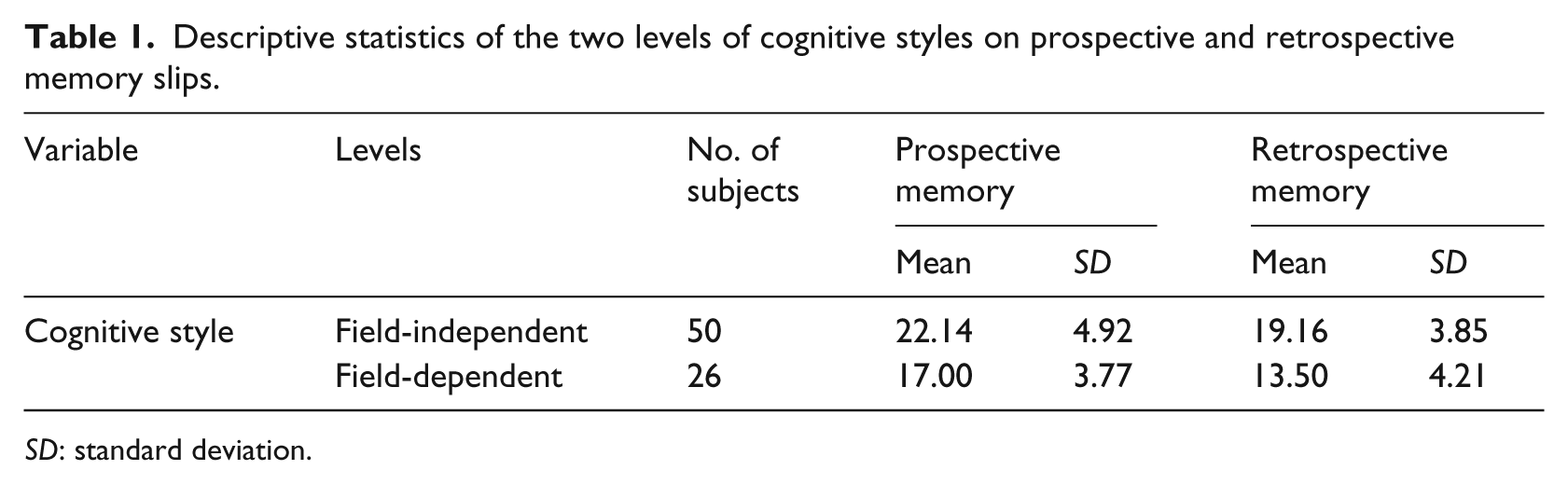
SD: standard deviation.
A one-way independent-subject MANOVA was conducted to assess the statistical significance of the descriptive statistics described above. Given the fact that Box’s M test has a p-value that is greater than .05 (p = .39), the assumptions of multivariate normality and that of the variance–covariance matrices were not violated. The test of significance on the mean scores obtained by the field-independent versus field-dependent oriented individuals on the PRMQ showed that the differences in the mean scores were statistically significant for prospective memory items, F(1, 74) = 22.15, p < .001, effect size (ES) = .26, as well as for retrospective memory items, F(1, 74) = 40.54, p < .001, ES = .36 (Table 2). The ES values of .24 and .36 for prospective and retrospective memory items, respectively, belonged to the ES Cohen (1992) classified in the range of small effect. Although these ESs may be small, they are not trivial; Kirk (2005) maintains that even small ESs are large enough to be useful. Although the difference in the means of field-independent and field-dependent oriented individuals on the PRMQ was statistically significant, the direction of significance was not what was predicted in the second hypothesis.
MANOVA summary table showing the test of significance for cognitive style on Prospective and Retrospective Memory Questionnaire (PRMQ).
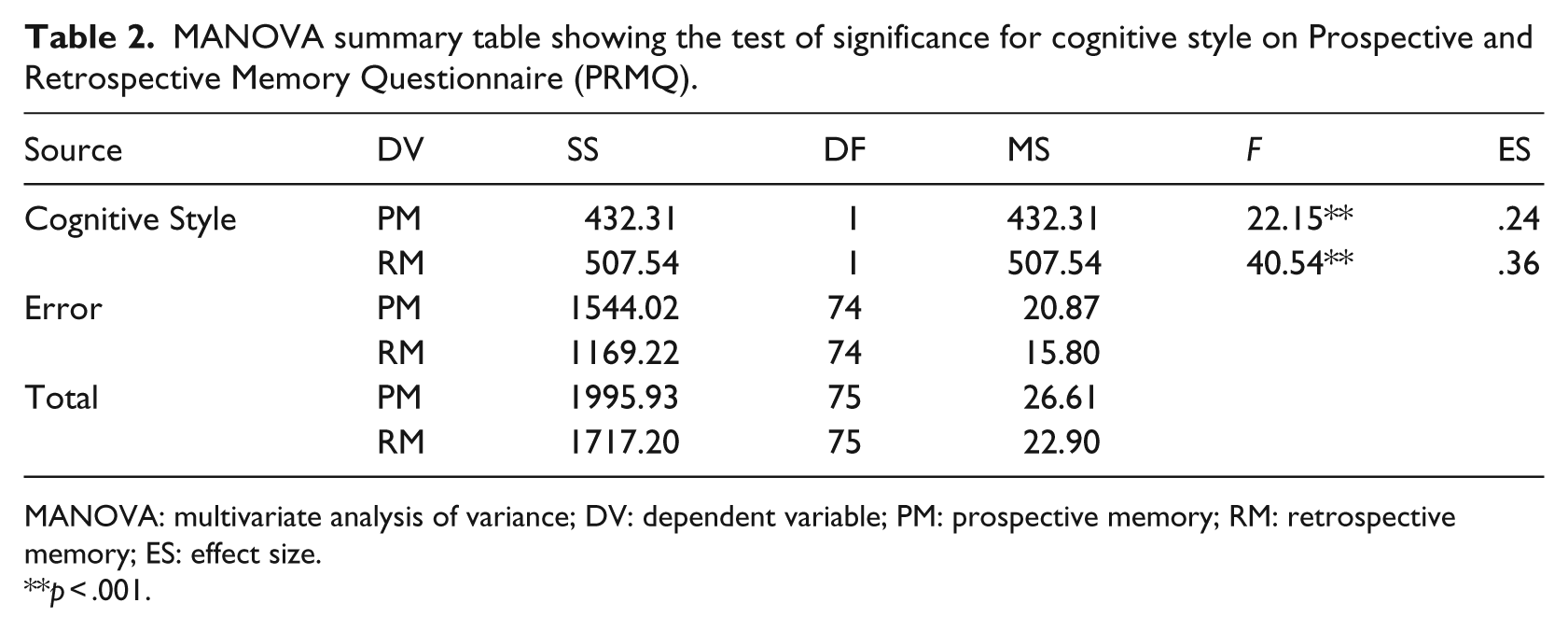
MANOVA: multivariate analysis of variance; DV: dependent variable; PM: prospective memory; RM: retrospective memory; ES: effect size.
p < .001.
Discussion
This study examined the degree to which field-dependent versus field-independent cognitive styles influence prospective and retrospective memory slips. The first objective of the study investigated whether prospective and retrospective memory items on the PRMQ are dissociated from or uncorrelated with each other. Scores obtained on the prospective and retrospective memory items were correlated, and results showed that the two kinds of memory were moderately related. The similarity in scores between prospective and retrospective memory seems to indicate that the two kinds of memory may not be dissociated after all. This finding tends to support the first hypothesis. It seems to have replicated previous researches conducted with European participants (e.g., Ferbinteanu & Shapiro, 2003; Kliegel et al., 2000; Maylor et al., 2002; West & Krompinger, 2005), which found no dissociation between prospective and retrospective memory. The similarity in scores of participants on the two kinds of memory can more easily be understood with a memory process approach such as the TAP framework than with a memory systems approach. The basic tenet of the TAP framework is that memory performance for prospective and retrospective memory items should be dissociated only when the processes guiding the two kinds of memory are unrelated (e.g., involving perceptual and conceptual materials). However, if the tasks are governed by a similar process, TAP predicts that prospective and retrospective memory would be affected similarly. Therefore, one plausible explanation why dissociation was not found between prospective and retrospective memory items on the PRMQ is that the items on the scale were of similar conceptual status. Such an explanation seems more parsimonious than that the absence or presence of dissociation between the two kinds of memory implies that the two tasks are localized in the same or different parts of the brain.
This study also hypothesized that there would be statistically significant differences between field-independent and field-dependent individuals on the PRMQ. Results of data analyses showed that the differences between the means of the field-independent and field-dependent cognitive styles are statistically significant. Interestingly, however, field-independent students reported significantly more memory slips than the field-dependent students on the PRMQ. This outcome is somewhat unexpected. Most other studies (e.g., Amazue, 2006; Giovanna et al., 2012; Graeme & Richard, 2007; Li et al., 2008) seem to suggest that the field-independent cognitive style is a more superior learning style and that they probably should recall and/or retain information better than the field-dependent cognitive style. Although this is mostly the case in higher order tasks, such conclusion needs to be taken with caution to avoid overextended generalizations. The field-independent and field-dependent cognitive styles have stable and predictable attributes (Warpner, 1986), and the difference between the two cognitive styles is most evident in new problem-solving situations where experience is lacking and structure is not organized (Witkin & Goodenough, 1981). Thus, the unexpected finding in this study is probably due to the fact that the PRMQ is probably not complex enough to elicit active cognitive structuring skills that often make field-independent oriented individuals adopt better cueing strategies than the field-dependent individuals. Again, studies (e.g., Fritz, 1992; Witkin et al., 1977) argue that field-dependent cognitive style, more than the field-independent style, is more likely to have preference for social orientation, desire peer input to organize experience and shape decisions, and want a variety of instructional modalities to derive meaning from an experience (Witkin, Moore, Goodenough and Cox, 1977). Perhaps, the field-dependent cognitive style, because it depends on several sources to interpret situations, may have a more enduring memory trace than field-independent cognitive style.
Cognitive style is a key concept in education. It enhances personal motivation and improves performance. For example, when a student has a cognitive style that is similar to that of his or her teacher, the chances that the student will have a positive learning experience are improved (Pressley & Wharton-McDonald, 1997; Watkins & Hattie, 1981). Despite its popularity, the field independence–dependence model is still fraught with poor understanding. It is generally believed that field-independent people usually perform more accurately on higher order tasks than field-dependent people (Amazue, 2006; Giovanna et al, 2012); however, such conclusions often do not hold in all circumstances (as shown in our study). Perhaps, it is necessary to state at this point that cognitive style is not the same thing as cognitive ability. Cognitive ability describes peak performance which is often considered beneficial and measured with an aptitude or intelligent tests, whereas cognitive style is a personality dimension that describes an individual’s preferred way of processing information (Kirton, 2003). Kirton criticized the GEFT as containing an element of cognitive ability, and so may not measure cognitive style alone. Because accurate measurement lies in the heart of assessing change (Kantowitz, Roediger, & Elmes, 1994), there seems to be a possibility of confounding variable that is often unaccounted for whenever the GEFT is used to characterize cognitive style into field-independent and field-dependent cognitive styles. The unexpected finding of this study might as well be explained by the properties of the GEFT. The study advocates that future studies that would choose to use GEFT in research should strive to control it for the influence of ability.
Another limitation of this study was the use of PRMQ as the sole measure of the two memory constructs. Although self-report instruments have consistently been shown to have high reliability, metamemory (i.e., individual’s beliefs about their own memory ability) does not always correlate highly with their actual memory performance as assessed by objective memory tests and clinical observations (Craik, Anderson, Kerr, & Li, 1995; P. E. Morris, 1984). Thus, authors advocate the use of multiple indicators in future studies, such as objective measures and rating scales, because of potential unreliability of a single indicator and/or the possibility that any observed effects may be due to method variance.
Conclusion
This study investigated the influence of field-dependent versus field-independent cognitive styles on prospective and retrospective memory slips. Two objectives were pursued in the study: to examine whether prospective memory would be dissociated from retrospective memory and to investigate whether field-independent participants will differ significantly from field-dependent participants on prospective and/or retrospective memory. With regard to the first hypothesis, data seem to support that prospective and retrospective memories were not dissociated. The memories were moderately related with each other. The two kinds of memory seem to differ only in the fact that while prospective memory focuses on intended future events, the retrospective memory emphasizes memory for events that have previously occurred. Notwithstanding the seemingly difference between the two kinds of memory, they seem not to be independent of each other: impairment on the prospective memory would probably affect retrospective memory, and vice versa. Also, field-independent participants report significantly more memory slips than field-dependent individuals on the PRMQ. This outcome is unexpected in view of the findings of most other studies in literature. However, the finding should be viewed as tentative pending confirming evidence from further studies.
Footnotes
Funding
The author(s) received no financial support for the research, authorship, and/or publication of this article.