



Abstract
Information is needed regarding the antecedents and outcomes of flourishing, particularly in sports contexts, where the study of this optimal well-being state has remained largely unexplored. This study examined the role of strength use to facilitate flourishing, enhance team embeddedness, and counter withdrawal behaviour of athletes. It further investigated the role of flourishing to retain athletes to their sport and teams and examined the role of team embeddedness in this relationship. A cross-sectional research design was utilised with structural equation modelling to assess model fit and examine postulated relationships. The sample comprised 235 student athletes. The results suggested that team strength use predicts flourishing. It further revealed positive paths to team embeddedness from both individual and team strength use. Flourishing was also positively related to team embeddedness. Lastly, a negative association was found between team embeddedness and withdrawal behaviour among the athletes.
Flourishing – a condition that has been described as optimal human functioning – is directly linked to growth and resilience. It comprises three dimensions, namely, emotional well-being, social well-being, and psychological well-being (Keyes, 2005). Research is required to understand the antecedents of optimal functioning to enhance the flourishing of people (Seligman, 2011). Psychology must establish ways in which flourishing can be promoted and must put forward practical suggestions to create contexts in which this can be achieved (Younkins, 2010). One of the contexts for experiencing flourishing that remains unexplored is sport. According to Penedo and Dahn (2005), involvement in sport leads to higher general and health-related quality of life, and better functional capacity and mood states.
Little is known about the prevalence of flourishing of individuals in the sports community. Malebo, Van Eeden, and Wissing (2007) found that athletes in general experience lower levels of negative affect, somatic symptoms, symptoms of depression, and pessimistic life orientation; and higher levels of positive affect, sense of coherence, and self-efficacy. However, research in the sports domain has not focused on total well-being, known as flourishing. More specifically, two research gaps exist. First, information is needed regarding the antecedents of flourishing in sport contexts, and, second, it is necessary to examine the outcomes of flourishing in sport (Hanin, 2007). In this study, we assess the role of a strength-based approach (SBA) as an antecedent of athlete flourishing. We examine whether flourishing will lead to a decreased likelihood of the athlete withdrawing from a team. Finally, the role of the embeddedness of the athlete in a team to counter such withdrawal behaviour is investigated.
Strength use and flourishing of athletes
The SBA entails that the expansion of talents and virtues of people is as important for their development as the rectification and redressing of their deficits (Linley, Joseph, Harrington, & Wood, 2006). The SBA consists of two dimensions, namely, organisational (or team) strength use (TSU) and individual strength use (ISU) (Stander & Mostert, 2013; van Woerkom, Els, Mostert, Rothmann, & Bakker, 2013).
TSU refers to the contextual enablement of individuals’ strengths by the organisation or team they are embedded into (van Woerkom et al., 2013). It describes the extent to which the culture, policies, and dynamics of a team are favourable to permit such individual to express his/her strengths (Stander & Mostert, 2013). ISU refers to the proactive and inherent capacity of a person to utilise his/her strengths to achieve optimal development (Stander et al., 2014). ISU is a critical component to realise potential as it assists the individual to persevere in the face of trial and cultivates resilience (Frese & Fay, 2001). It forms part of the inherent capitals which are ‘aspects of the self linked to resiliency’ (Hobfoll, Johnson, Ennis, & Jackson, 2003, p. 632). Gordon and Gucciardi (2011) reported an enhanced level of mental toughness facilitated in a team of cricket players by introducing strength-based group coaching. Gould, Dieffenbach, and Moffett (2002) utilised strength-based development workshops to develop skills required for competition.
Research has focused on the effects of isolated strength-based interventions on athlete outcomes (Gould et al., 2002; Wagstaff & Leach, 2015). It will be valuable to examine the effects of an integrated SBA, comprising both TSU and ISU, on the subjective well-being of athletes. Regarding TSU, conservation of resources theory (Hobfoll, 1989) proposes that individuals actively seek resources in their direct environment that assist them to be more efficient and to achieve goals. People will protect, develop, and try to enhance the availability of these resources (Halbesleben, Neveu, Paustian-Underdahl, & Westman, 2014). Therefore, athletes in teams that seek to utilise and promote their character strengths are likely to flourish.
ISU is related to flourishing. The values-in-action (VIA) framework (Park, Peterson, & Seligman, 2004) proposes that every person has unique signature strengths, which, when encouraged and developed, will lead to the optimal expression of potential. Strengths, as put forward by the VIA framework, relates to well-being, as it accentuates what is good and virtuous about an individual (Seligman, 2011). Also, in the PROSPER model (Noble & McGrath, 2015), the use of character strengths is a prerequisite for well-being. Athletes, who have the inherent predisposition to seek, promote, and utilise their character strengths, will be more inclined to flourish and less likely to withdraw from their sport. This is due to the enjoyment, gratification, and fulfilment that is achieved through the platform of sport which, when geared towards the athlete’s strengths, will yield rewarding internal experiences (Petosa & Holtz, 2013).
Strength use, flourishing, team embeddedness, and withdrawal behaviour
Withdrawal behaviour describes an individual’s conscious and deliberate purpose to leave a group, team, or organisation (Tett & Meyer, 1993). It represents a decision on the part of such individual to leave the team he/she is part of when an opportunity arises (Emberland & Rundmo, 2010). When a supportive environment exists, teammates can draw support from each other to realise their goals (Flores, Salguero, & Márquez, 2008). Should athletes experience that teams do not allow them to express their strengths, they will seek to join another team or quit the athletic activity altogether.
The VIA framework proposes that individuals who utilise their unique character strengths will be more resilient and better equipped to be effective in the environments in which they operate (Park et al., 2004; Seligman, 2011). According to the PROSPER model, these individuals will function at the optimum psychological level more frequently and experience the activities they participate in as meaningful and purposeful (Noble & McGrath, 2015). ISU will assist athletes to persevere and prosper in their teams. When an athlete’s well-being is positively affected by sport participation, he or she will experience sport as intrinsically rewarding and will not withdraw from it (Petosa & Holtz, 2013). The social value offered by a team is significant. It offers members the opportunity to interact on a platform which is enjoyable, provides a challenge, and enhances self-esteem. These benefits counter withdrawal behaviour and motivate members of a team to commit their efforts and energy to the team.
Job embeddedness theory (Zhang, Fried, & Griffeth, 2012) argues that there is a wide range of indicators that influence people’s decision to stay with a particular team, that is links, fit, and sacrifice (Mitchell, Holtom, Lee, Sablynski, & Erez, 2001). Links refer to the formal or informal interconnectedness that exists directly between members of a team or between members and the culture, institutions, or outside influences in a team environment (Mitchell et al., 2001). If the perceived links are strong, members of that team are more embedded in that team and are less likely to leave it. Fit describes the sense of compatibility with a team that team members have (Mitchell et al., 2001). Sacrifice describes the extent to which a team member will perceive loss when he or she leaves the team (Mitchell et al., 2001). Loss, in this sense, is a broad term, which can refer to financial loss, and loss of opportunity for social interaction or psychological, pragmatic or social costs that occur if an individual withdraws participation from the team.
A team culture that draws on the virtues of its members will facilitate a team environment that members will experience as rewarding (Stander & Mostert, 2013). The uplifting nature of a TSU culture will create cohesion and affinity between team members (Stenseng, Forest, & Curran, 2015). ISU will enhance embeddedness, as individuals who proactively capitalise on their strengths would feel more inclined to draw on their potentialities and feel part of a team (Noble & McGrath, 2015). The association between flourishing and team embeddedness is also postulated to be positive.
Embeddedness is considered to be a direct counter to withdrawal behaviour. When a team member experiences relatedness in the team, compatibility with its context, and high costs associated with leaving, he/she will be less likely to withdraw from the team (Zhang et al., 2012). A healthy team environment provides the platform for relatedness, growth, and development of its members and as such is a significant contributor to counter intention to leave that team (Stenseng et al., 2015).
Based on the synthesis of the literature outlined above, this article postulates that the dimensions of TSU and ISU will be positively associated with flourishing and team embeddedness, and negatively associated with withdrawal behaviour of athletes. Furthermore, it argues that athlete flourishing will associate positively with team embeddedness and negatively with withdrawal behaviour. In conclusion, this article holds that team embeddedness will be negatively associated with withdrawal behaviour, and moderate the relationship between athlete flourishing and withdrawal behaviour.
Method
A cross-sectional research design was utilised. This study was exploratory and descriptive.
Participants
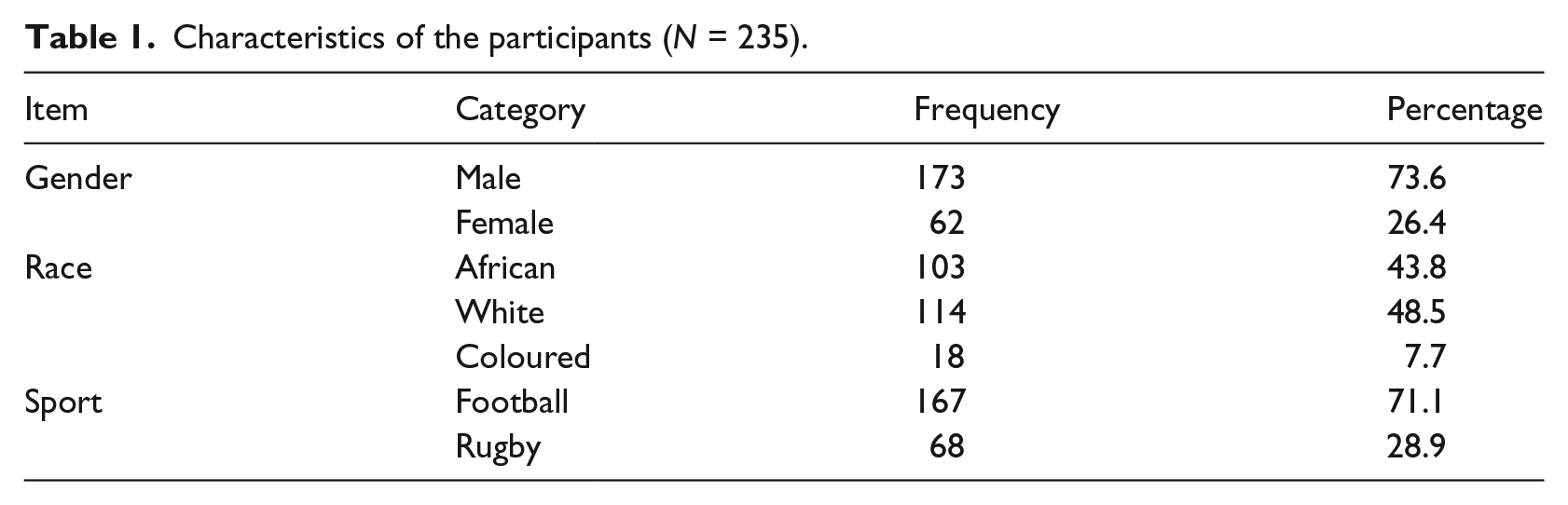
A convenience sample of 235 student athletes participating in South Africa’s two most prominent sports – football and rugby – participated in the study. Participants had to receive a form of compensation for their participation in sport at the time of the research. This was to ensure that serious student athletes were engaged in the research, as opposed to students who merely participate in sport for leisure/recreational purposes. Furthermore, they had to be actively involved in another significant time-consuming activity, such as work or study, alongside their sport participation at the time of the research. Table 1 provides an overview of the characteristics of the participants.
Characteristics of the participants (N = 235).
Instruments
The TSU and ISU dimensions of SBA were assessed with the Strength Use and Deficit Improvement Questionnaire (SUDIQ; van Woerkom et al., 2013). Both dimensions were measured by four items, scored on a 7-point frequency scale ranging from 0 (almost never) to 6 (almost always). An example item for TSU is ‘My sports team allows me to use my talents’. An example item for ISU is ‘In my sport I make the most of my strong points’. The SUDIQ has been proven reliable (Stander, Mostert, & de Beer, 2014). Stander et al. (2014) established internal consistency of .94 (TSU) and .93 (ISU) for the two SBA dimensions.
Flourishing was measured with the Mental Health Continuum–Short Form (MHC-SF; Keyes, 2009). This measure comprises 14 items that represent the three dimensions considered as components of flourishing, namely emotional, social, and psychological well-being. Emotional well-being is assessed by the item that asks the respondent to rate how frequently he/she has felt interested in life. Social well-being is, for example, measured through enquiring how often the respondent felt he or she had something important to contribute to society. Psychological well-being is measured by the example item that explores the frequency that a respondent has felt purpose in his/her life. The instrument is scored on a 6-point frequency scale with responses ranging from never to every day. Internal consistency of the MHC-SF has been established in studies (Keyes, 2009).
Withdrawal behaviour was measured with an adapted version of the Turnover Intention Scale (TIS-6; Bothma & Roodt, 2013). This measure has six items. An example of an item is ‘How often have you considered leaving your sports team?’ Bothma and Roodt (2013) have reported internal consistency of .80 for the TIS-6. The instrument is scored on a 5-point frequency scale from 1 (never) to 5 (always).
Embeddedness in team was measured by the Job Embeddedness Scale (JES; Mitchell et al., 2001), adapted specifically for the sports team context. The short version of this scale, comprising seven items (of which the negatively scored item was discarded), was applied. The scale measures all three dimensions of embeddedness. An example item for links is ‘Many members of my team are dependent on me’. An example item for fit is ‘I fit with my team’s culture’. Sacrifice is, for example, measured by the item ‘I would sacrifice a lot if I left my team’. Responses are scored on a Likert scale, ranging from 1 (strongly disagree) to 6 (strongly agree). Van Dyk, Coetzee, and Takawira (2014) established an internal consistency of .91 for the JES.
Procedure
The project leader administered the instruments at pre-arranged times and in pre-arranged venues. Participants in the study were approached through liaising with the management team of the participating university, by identifying the main sports that this university’s student athletes partake in. Administration of the questionnaires followed shortly after an event of active participation, such as a training session or sports game. The nature, purpose, and details of the research were explained to participants, who were afforded the opportunity to ask questions. An informed consent letter was also attached to the instruments, outlining the entire research process. Participation was voluntary and all responses were kept confidential. Participants were given the opportunity to withdraw at any stage of the study. The project leader collected completed instruments and stored them in a secure storage facility.
Ethical considerations
The research project was formally approved by the ethics committee of the North-West University (NWU-00108-14-S8). An informed consent letter was attached to the instruments, outlining the entire research process. Participation was voluntary and all responses were kept confidential. Participants were given the opportunity to withdraw at any stage of the study. The project leader collected completed instruments and stored them in a secure storage facility.
Data analysis
Mplus 7.31 was used to analyse the data (Muthén & Muthén, 1998–2014). A robust maximum likelihood indicator was used to determine Akaike Information Criterion (AIC) and Bayes Information Criterion (BIC). Indices used for absolute fit were the chi-square value, the standardised root mean square residual (SRMR), and the root mean square error of approximation (RMSEA). Incremental fit indices were determined using Tucker-Lewis Index (TLI) and Comparative Fit Index (CFI). Regarding good model fit, Wang and Wang (2012) recommend values of .90 or higher for both CFI and TLI. Both RMSEA and SRMR values lower than .08 indicate a close fit between the model and the data. Chi-square tests were used to compare the structural models. Reliability of the scales was determined using a formula based on the sum of squares of the standardised loadings and variance of error terms (Raykov, 2009). Effect sizes were used to decide on the practical significance correlations. The cut-off values for practical significance are as follows: small effect (r < .30), medium effect (r > .30), or large effect (r > .50; Cohen, 1988).
Results
Measurement models
Considering the cross-sectional nature of the study, competing measurement and structural models were tested. In terms of the measurement models, four different models were considered using confirmatory factor analysis (CFA). The first measurement model consisted of the following latent variables: (a) flourishing, consisting of three latent variables, namely emotional well-being (measured by means of three observed variables), psychological well-being (measured by means of six observed variables), and social well-being (measured by means of five observed variables); (b) TSU (measured by means of four observed variables); (c) ISU (measured by means of four observed variables; (d) team embeddedness (measured by means of six observed variables); and (e) withdrawal behaviour (measured by means of five observed variables). The other models followed the same template, but with some differences in terms of specification: The second model comprised flourishing as a one-factor construct, but the remaining part of the model was the same as Model 1. Model 3 was congruent with Model 1, except that strength use (team and individual) was modelled as a single latent variable. Finally, Model 4 specified all the observed variables as part of a single latent variable. Table 2 shows the results.
Fit statistics for the hypothesised competing measurement models.

χ2: chi-square statistic; df: degrees of freedom; TLI: Tucker-Lewis Index; CFI: Comparative Fit Index; RMSEA: root mean square error of approximation; SRMR: standardised root mean square residual.
Evident from Table 2, Model 1 showed good fit to the data based on the other indices, namely χ2 = 759.81, df = 482, p < .001, CFI = .93, TLI = .92, RMSEA = .05 (95% confidence interval [CI]: .043, .056), SRMR = .06, AIC = 19,731.98, and BIC = 20,119.45.
Analyses continued in an exploratory mode to improve the fit of the selected model. The standardised residual (SR = 5.79) of Item 2 (‘Many members of my team are dependent on me’) and Item 3 (‘I like the members of my team’) of the JES was higher than 2.58 (Byrne, 2012). Therefore, the model was re-specified without Item 3. The fit statistics for the revised model (Model 5) showed that the fit improved significantly when one item was removed: χ2 = 680.75, df = 451, p < .001, CFI = .94, TLI = .93, RMSEA = .05 (95% CI .043–.056), SRMR = .06, AIC = 19,267.80, and BIC = 19,644.90. Standardised coefficients from items to factors ranged from .57 to .86. The relationship between each observed variable and its respective construct was statistically significant (p < .01), establishing the posited relationships among indicators and constructs (Hair, Black, Babin, & Andersen, 2010).
Descriptive statistics, correlations, and reliabilities
Reliability and correlation coefficients are reported in Table 3.
Descriptive statistics, reliabilities, and correlations of the scales.
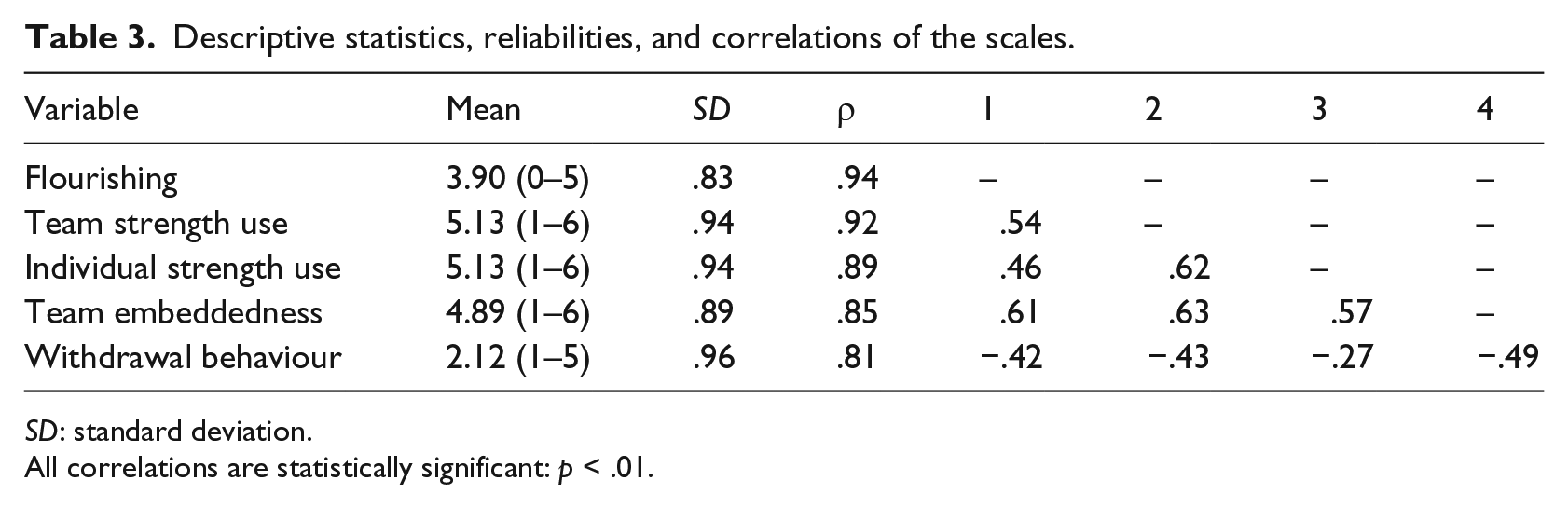
SD: standard deviation.
All correlations are statistically significant: p < .01.
Reliability coefficients of all the scales were acceptable (ρ ⩾ .70). Correlations of medium effect (r ⩾ .30) were found between ISU and flourishing; flourishing and withdrawal behaviour; TSU and withdrawal behaviour; and team embeddedness and withdrawal behaviour. The latter three correlations were all negative. Correlations of large effect (r ⩾ .50) were found between TSU and flourishing; team embeddedness and flourishing; TSU and ISU; TSU and team embeddedness; and ISU and team embeddedness.
Structural models
Structural models were assessed based on the measurement model delineated above. Given the cross-sectional nature of this study, three competing structural models were compared. Model 1 (the direct and indirect effects model) included paths from TSU to flourishing, ISU to flourishing, TSU to withdrawal behaviour, ISU to withdrawal behaviour, flourishing to withdrawal behaviour, and team embeddedness to withdrawal behaviour. Model 2 (the indirect effects model) was similar to Model 1, but the paths from TSU and ISU to team embeddedness and withdrawal behaviour were constrained to zero. Model 3 (the direct effects model) was also similar to Model 1, but the paths from TSU and ISU to flourishing and team embeddedness were constrained to zero. Table 4 displays the fit statistics and standardised regression coefficients for the three competing structural models.
Fit indices and standardised path coefficients of the structural models.
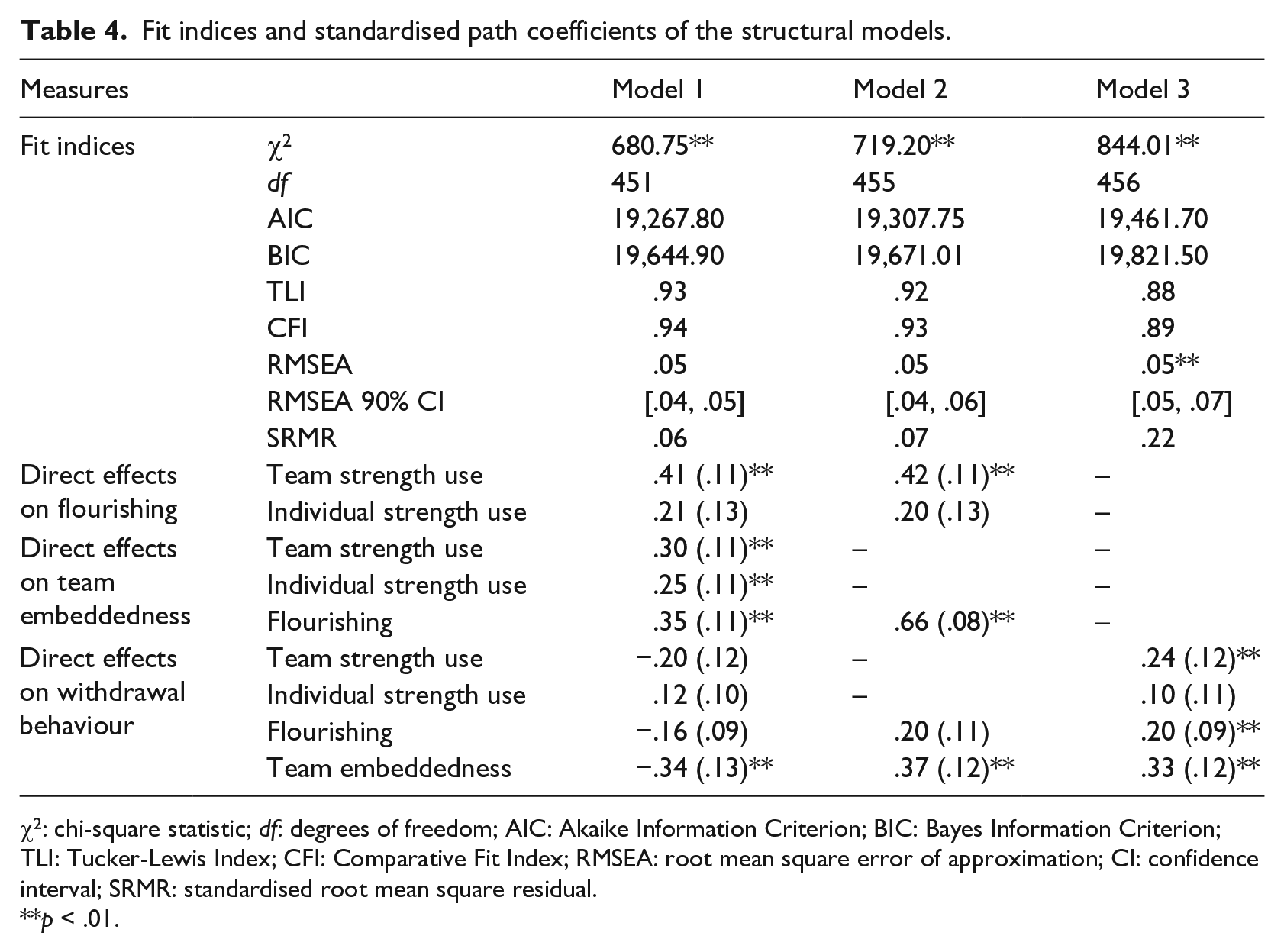
χ2: chi-square statistic; df: degrees of freedom; AIC: Akaike Information Criterion; BIC: Bayes Information Criterion; TLI: Tucker-Lewis Index; CFI: Comparative Fit Index; RMSEA: root mean square error of approximation; CI: confidence interval; SRMR: standardised root mean square residual.
p < .01.
The following changes in chi-square (Δχ2) were found: Models 1 and 2 (Δχ2 = 34.27, Δdf = 4, p < .01); Models 1 and 3 (Δχ2 = 114.40, Δdf = 5, p < .01); and Models 2 and 3 (Δχ2 = 47.02, Δdf = 1, p < .01). The AIC and BIC values of Model 1 were also substantially lower than the values for Models 2 and 3. Model 1, comprising paths from TSU to flourishing, ISU to flourishing, TSU to withdrawal behaviour, ISU to withdrawal behaviour, flourishing to team embeddedness, and team embeddedness to withdrawal behaviour, proved to be the best fit of the compared models and also revealed good fit statistics χ2 = 680.75, df = 451, p < .001, CFI = .94, TLI = .93, RMSEA = .05 (90% CI: .04, .05), and SRMR = .06.
Table 4 describes the structural paths between the variables. Statistically significant paths were established between TSU and flourishing (β = .41, standard error [SE] = .11, p < .01). However, the paths from ISU to flourishing, as well as the paths from team and ISU to withdrawal behaviour were not statistically significant. Furthermore, statistically significant paths were found from TSU (β = .30, SE = .11, p < .01) and ISU (β = .23, SE = .11, p < .05) to team embeddedness. The path from flourishing to team embeddedness was also statistically significant (β = .35, SE = .11, p < .01). However, flourishing did not predict withdrawal behaviour. Team embeddedness had a statistically significant negative association with withdrawal behaviour (β = −.34, SE = .13, p < .01).
The independent variables explained 32% of the total variance in flourishing, 54% of the variance in team embeddedness, and 29% of total variance in withdrawal behaviour. These findings present further evidence for the validity of the structural model (Figure 1).
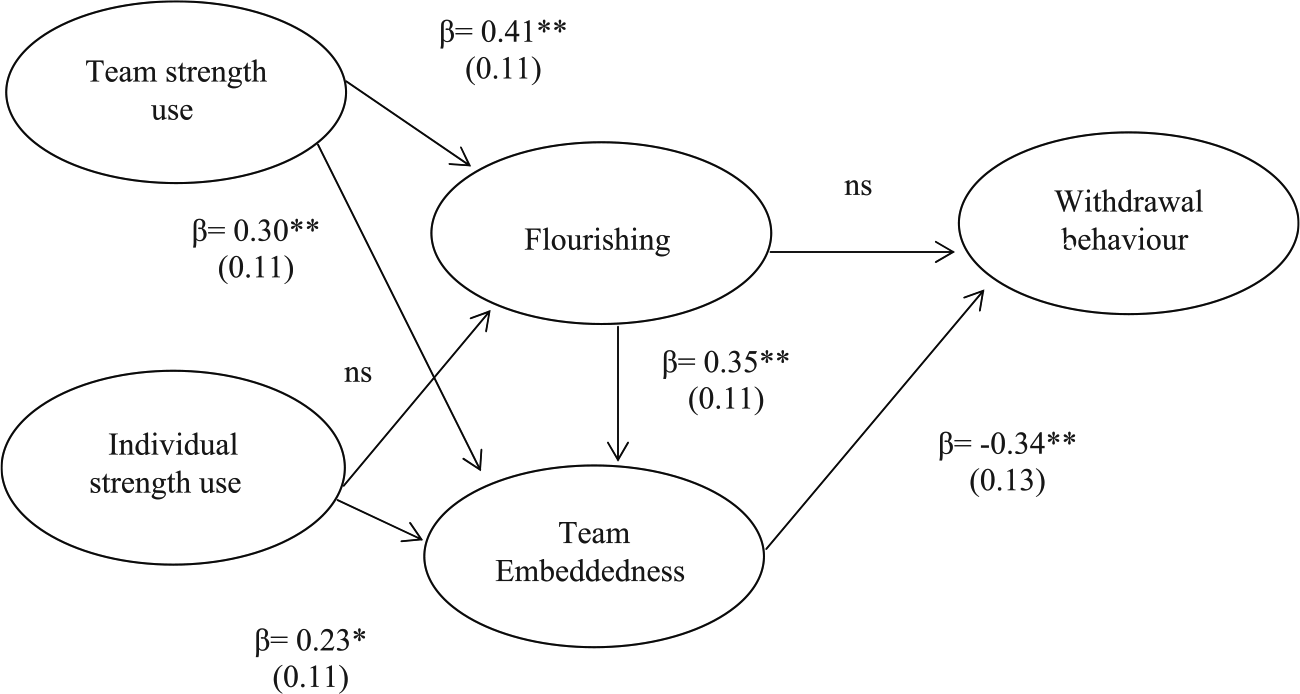
The structural model (standardised solution with standard errors in parentheses).
Team embeddedness as moderator
Next, the interaction effect between flourishing and team embeddedness on intention to leave was computed using factor scores. A syntax developed by Stride (2015) was used to test whether team embeddedness moderated the effects of flourishing on withdrawal behaviour. However, the interaction effect was not statistically significant.
Discussion
The results of this study build on findings of studies done by Penedo and Dahn (2005). The latter studies examined particular optimal human states in sport contexts, towards understanding the antecedents required for emotional, social, and psychological well-being (Keyes, 2005). TSU was evaluated regarding its potential in harnessing flourishing, enhancing team embeddedness, and countering withdrawal behaviour. TSU refers to the culture, procedure, and policies that exist in a sports team that make the utilisation of its individual members’ strengths more possible (Stander & Mostert, 2013). van Woerkom et al. (2013) argue that TSU is characterised by a willingness to enable strengths of team members through the way in which the team operates and how it functions on a daily basis.
The results showed that TSU predicted flourishing, herewith proposing that the TSU developmental approach poses significant well-being-related value. It established that TSU was positively related to team embeddedness. The findings provide support for the results of Stenseng et al. (2014), who argued that a positive culture which promotes the individual team members’ potential will enhance the bond between members. Leaders of sports teams can learn that a culture of active strength accentuation and promotion can service the individual team members. TSU offers an enabling environment for individual team members to display their potential. It provides a supportive team environment, which cultivates greater levels of well-being (Elbe, Strahler, Krustrup, Wikman, & Stelter, 2010). Interventions geared at creating a culture of strength use in sports teams will lead to greater levels of flourishing and embeddedness in teams (Grant & Cavanagh, 2007). Such interventions include workshops to discuss individual strengths and explore the benefit thereof for the team. It includes workshops to understand the strengths of team members and how such strengths can be used to the benefit of the team.
The ISU dimension was positively related to team embeddedness. According to the PROSPER model (Noble & McGrath, 2015), the proactive inclination of individuals to seek and utilise their personal strengths is an important component of the optimal functioning of individuals. Individual interventions, such as coaching or mentoring, through which the athlete is made aware of and encouraged to actively utilise his or her unique character strengths, are proposed as a practical measure to enhance athletes’ experience of embeddedness in their teams.
Flourishing was positively related to team embeddedness in this study. Flourishing individuals function positively in a group context, want to contribute meaningfully to society, and experience their relations with others as fulfilling (Keyes, 2005, 2007). By enhancing the emotional reward associated with sport, such as providing fulfilling training environments and celebrating success (Stenseng, Forest, & Curran, 2015); creating social value for team members, such as supportive team environments (Reinboth & Duda, 2006); promoting psychological well-being through such interventions as enhancing confidence (Biddle & Mutrie, 2008); and flourishing of athletes can be enhanced. If flourishing increases, experiences of embeddedness in a team will also increase.
We aimed at gauging whether the meaning, purpose, and identity sports teams provide to their members (Joesaar, Hein, & Hagger, 2011) could have an influence on their decision not to withdraw from that team. Should the members of a team experience their involvement in that team as a strong fit to their personality, experience links with their team members, and perceive retirement from the team as sacrificing, they are likely not to withdraw (Zhang et al., 2012). Although embeddedness was not proven as a moderator between flourishing and withdrawal behaviour, its negative relationship with withdrawal behaviour provides sufficient validation to coaches, administrators, and managers of sports teams to actively promote the embeddedness dimensions of their teams to retain athletes. Focused team building interventions can facilitate such dimensions and ultimately lead to sustained participation and involvement in sport from athletes.
Conclusion
This study provided a useful platform for the exploration of the antecedents and outcomes of the flourishing of people in sport contexts, highlighting the role a SBA can play in creating flourishing athletes and suggesting the value of flourishing in retaining such athletes. However, the study was not without limitations. First, the cross-sectional nature of the work makes it difficult to claim that the patterns observed in the results will apply over time. Second, the research was conducted among student athletes, who, based on the inclusion criteria, can be considered semi-professional. It may be interesting to see whether the results will be the same for professional sport contexts, where financial implications come into play. The study incorporated a diverse representation of athletes but did not account for possible differences among groups, for example between male and female athletes and their experience of flourishing.
Future research may benefit from adopting a longitudinal design. In this research, male and female participants, as well as participants from various racial and demographic backgrounds, participated. Future studies could, however, benefit from scrutinising possible differences among groups of athletes as relating to their experience of flourishing. This will strengthen the robustness of understanding flourishing in sport contexts. Finally, this study was conducted in the context of team sports. The dynamics of flourishing, which is a subjective experience, may be altered in the case of individual sports. The literature can benefit from future studies in the individual athlete domain.
Footnotes
Funding
The author(s) received no financial support for the research, authorship, and/or publication of this article.