



Abstract
Extant research has shown that incidental haptic sensations can, nonconsciously, influence judgements of objects or people that are non-diagnostic (unrelated) for the actual qualities of the items being judged – including interpersonal judgements. Evidence suggests that this could also be true for intrapersonal judgements. The application of this conception to the use of personality questionnaires lead to the following hypothesis: incidental exposure to a specific haptic experience (firmness or flimsiness of the paper) could, nonconsciously, trigger physically grounded mental frameworks, which, in turn, may effect the intrapersonal judgements of individuals completing a personality questionnaire. A randomized post-test only, one-way experimental design was conducted using a sample of university students (n = 178). The experiment found evidence to support the hypothesis that a physically grounded mental framework, consistent with embodied cognition, could nonconsciously lead participants to form stronger self-judgements on agreeableness and extraversion, when encountering an incidental haptic experience of firmness in a personality questionnaire. The findings of this research may serve to create awareness of the influence of incidental haptic sensations as a confounding variable in questionnaire design. Implications of the findings and future research directions are discussed.
Keywords
A largely unexplored area within the field of behavioural research is the influence of haptic experiences on intrapersonal judgements and subsequent ratings on personality questionnaires. Research has shown that haptic sensations (or sense of touch) can exert a pervasive impact on evaluative processing (Peck & Childers, 2003). Empirical research investigating the effect of tactile experience on social judgement, recorded by means of self-report questionnaires, has shown that haptic experience can nonconsciously 1 influence judgements of objects or people that are non-diagnostic 2 (unrelated) for the actual qualities of the item being judged – including interpersonal judgements (Ackerman, Nocera, & Bargh, 2010). Ackerman and colleagues (2010) referred to such nonconscious encounters with non-diagnostic stimuli as incidental haptic experiences. While they focused predominantly on the influence of incidental haptic experiences on interpersonal judgements, they indicated that touch may also have an effect on an individual’s judgements of themselves (i.e., intrapersonal judgements).
The basic premise underlying the aforementioned study by Ackerman and his colleagues (2010) suggests that language and higher order cognitions are grounded in the physical context (Glenberg & Kaschak, 2002). This is commonly referred to as embodied cognition – which posits that our cognitive structures and mechanisms are grounded in patterns of bodily experience and activity (Gibbs, 2006). Self-report questionnaires often negate the sensory motor or visceral aspects that influence the conceptual thoughts of respondents, mainly due to the fact that responding to a questionnaire is predominantly perceived as a mental activity. However, from an embodied cognition perspective, it becomes possible to conceive that self-report questionnaires, in themselves, can provide haptic cues, which may cue touch-related conceptual processing. This, in turn, may nonconsciously influence participant’s intrapersonal judgements, when completing a personality questionnaire. Following in the footsteps of critically recognized researchers such as Ackerman et al. (2010), the experiment presented in this article sought to determine whether a physically grounded mental framework, consistent with embodied cognition, could nonconsciously lead participants to form self-judgements consistent with these frameworks when encountering an incidental tactile experience (of firm or flimsy paper) when completing a personality questionnaire.
Embodied cognition
Traditional experimental psychology and cognitive science have regarded the mind as an abstract information processor that places little importance on the connections to the surrounding environment (Bilda, Candy, & Edmonds, 2007). Contemporary research into the functioning of the mind, however, has discovered the essential role that the body plays in constructing perceptual and mental processes. This field of research has become known as embodied cognition (Wilson, 2002). Embodied cognition holds that cognitive processes and even intelligence are deeply embedded in the body’s interactions with the environment, as a result of sensory motor activity (Barsalou, 2008; Jostmann, Lakens, & Schubert, 2009; Smith & Gasser, 2005; Wilson, 2002; Woodworth, 1937). Theories of embodied cognition, thus, emphasize that the sensorimotor system is crucial to understanding cognitive processes (Garcia-Marques & Ferreira, 2009) and necessary for successful interaction with the environment (Wilson, 2002). In other words, the mind needs to be understood in the context of its relationship to the body (Barsalou, 2008).
Despite the aforementioned, people are mostly unaware of the embodied nature of their thought processes (Clark, 2008). Accordingly, they typically fail to recognize the aspects of their bodies and the environment that shape their understanding of, and reasoning regarding, particular topics or objects. The embodied cognition perspective has allowed room for the role of the nonconscious in thought. Thus, when cognition is viewed from the embodied cognition perspective, it becomes possible to conceive of cognitive activity (e.g., judgements) as occurring on a nonconscious level from interactions between the brain, body, and environment.
Scaffolding and metaphors in relation to embodied cognition
Existing research suggests that higher mental processes are based on experience of the physical world and developed through scaffolding processes (Ackerman et al., 2010). Scaffolding refers to the process through which people integrate incoming information with their existing knowledge structures (Williams, Huang, & Bargh, 2009), whereby the features of abstract or less understood concepts are mapped onto existing and well-understood concepts. This is done in such a way that the structure of the earlier developed, primary concept is retained in the newly constructed concept. For instance, individuals often use the structure inherent in fundamental aspects of their physical worlds to develop higher-level concepts (Tooby & Cosmides, 1992). An example would be, the evaluation of physically brighter stimuli as positive and darker stimuli as negative (cf. Meier, Robinson, & Clore, 2004). Thus, without involving a person’s explicit intent or awareness, the mind uses perceptual, body-based information as the scaffolding for the development of abstract concepts (Williams et al., 2009), which is consistent with the embodied cognition perspective.
Scaffolding processes can be seen to effect human cognition (Williams et al., 2009) and can be evidenced in language, specifically through the use of metaphors. The metaphor provides a linguistic window through which it is possible to ‘see’ people’s thought processes (Lakoff & Johnson, 1999). This is in line with claims that our normal conceptual system is metaphorically structured; that is, most concepts are partially understood in terms of other concepts (Lakoff & Johnson, 1980). A common example is the use of weight as a metaphor for the importance of abstract issues (Vankeerberghen, 2006). This suggests that the association between weight and importance has developed from a concrete link to a conceptual relationship on an abstract level (Jostmann et al., 2009; Lakoff & Johnson, 1980). As a result of this, feeling a heavy object sensitizes us to weight and may also elicit concepts relevant to metaphorical weight, such as importance. From this perspective, it becomes possible to conceive that the tactile experience of questionnaire paper (i.e., firmness or flimsiness) could trigger physically grounded mental scaffolds that would invoke metaphors, which participants could nonconsciously apply to their judgements of themselves.
Embodied cognition and haptic experiences in relation to intrapersonal judgements
The term haptic, in its broadest sense, relates to the study of touch (Prytherch & McLundie, 2002). According to Ackerman et al. (2010), haptically acquired information ‘exerts a broad influence over cognition, in ways in which we are probably often unaware’ (p. 1713). Empirical research investigating the effect of tactile experience on social judgement, recorded by means of self-report questionnaires, has shown that haptic experience can nonconsciously influence customer product perceptions (Peck, 2010; Peck & Wiggins, 2006), how social situations are judged (Ackerman et al., 2010; Jostmann et al., 2009; Schneider, Rutjiens, Jostmann, & Lakens, 2011) and how we perceive and judge individuals (Ackerman et al., 2010). Ackerman et al. (2010) suggested that self-perceptions will be similarly affected by the phenomenon of incidental haptic sensations: ‘Although we have focused on interpersonal perceptions, we expect that self-perceptions are similarly affected by what we touch, which is consistent with the dual nature of priming effects’ (p. 1714). On an informal level, people tend to judge themselves continuously. However, people may also be asked to judge themselves in a formal way. This may be done by means of a personality questionnaire.
Personality
Neill (2003) defines personality traits as distinguishing qualities or characteristics of a person. Personality traits are characteristics that can be described as ‘enduring tendencies or habitual patterns of behaviour, thought, and emotion’ (Croy et al., 2011, p. 1). Many researchers believe that there are five core personality traits. Evidence of this theory has been growing over the past 50 years, beginning with the research of Fiske (1949) and later expanded upon by other researchers including Norman (1967), Goldberg (1981) and McCrae and Costa (1987). DeYoung (2010) describes these broad traits, namely, extraversion, neuroticism, conscientiousness, agreeableness, and openness to experience. These personality constructs have become known as the ‘Big Five’ personality factors.
Extraversion is described as a construct that contains primary indicators of personalities sensitive to reward and positive affect. Neuroticism is indicative of personalities that are sensitive to environmental threat, punishment, and negative affect (Denissen & Penke, 2008). Conscientiousness encompasses the ability and tendency to exert a top-down control over behaviour and impulses, for the purpose of following rules and pursuing non-immediate goals. Agreeableness, according to DeYoung (2010), reflects the tendency to prefer altruism and cooperation, as opposed to the exploitation of others. Openness to experience is a reflection of the ability and tendency to identify, explore and make use of patterns of abstract and sensory information (DeYoung, 2010).
Personality and incidental haptic experiences
Recent research exploring the relationship between sensory thresholds and personality traits indicates that the environment can have an impact on personality, intrapersonal judgements, emotions, and intrapersonal feelings (cf. Gallace & Spence, 2010). According to Croy et al. (2011), the Big Five taxonomy provides an opportunity to explore the possible influences of personality traits and their relationships with sensory ability. Ackerman and colleagues (2010) also suggested that contemporary interpretations of the classic Big Five personality traits suggest two higher order factors with the (tactile metaphor–relevant) labels ‘stability’ and ‘plasticity’. According to DeYoung, Peterson, and Higgins (2002), the label stability refers to the categories of emotional stability (low neuroticism), agreeableness, and conscientiousness. Stability reflects an individual’s tendency and ability to avoid disruption of goal-directed functioning by impulses (DeYoung, 2010). The label plasticity refers to the categories of extraversion and openness (DeYoung et al., 2002, p. 533). Plasticity reflects an exploratory tendency. This label refers to how an individual is actively engaged with the possibilities of the environment (DeYoung, 2010). Ackerman stated that ‘. . . it would be interesting to consider the influence (if any) of varieties of touch experience on these systems’ activation’ (Ackerman et al., 2010, p. 1714). The proposed link is that the haptic experience of either firm or flimsy paper will trigger mental scaffolds invoking metaphors related to stability or plasticity, respectively, which participants will then apply to self-judgements when completing the personality questionnaire.
The aim of this study was, thus, to conduct an experiment to investigate whether the haptic experience of a self-report questionnaire (firm vs flimsy paper) would have a nonconscious effect on the intrapersonal judgements of individuals completing a personality questionnaire. Based on the background and the proposed problem statement, the following research question was formulated: Do incidental haptic sensations, encountered when participants handle a self-report questionnaire, nonconsciously, impact the participant’s intrapersonal judgements? We hypothesized that participants who encountered a tactile experience of firmness, in the self-report questionnaire, would obtain higher scores on agreeableness, conscientiousness, and lower on neuroticism, while those who encountered a tactile experience of flimsiness would obtain higher scores on extraversion and openness.
Method
Participants
A total of 178 participants from a metropolitan university in Johannesburg were approached to complete the self-report questionnaire for research purposes. In return for their participation, participants were offered 1% course credit. The mean age of the participants was 19.81 years (standard deviation [SD] = 1.92). There were 122 women (68.5%). In terms of ethnicity, the majority of the sample was represented by Black (61.2%) and White (26.4%) participants, with the minority being Asian (1.7%).
Instruments
Data were collected by means of administering The Basic Traits Inventory (BTI; Taylor & De Bruin, 2006). The BTI is a personality inventory that was developed in South Africa and consists of 193 items. It was created to capture the Big Five personality traits. These broad traits form part of the six scales in the BTI, namely, openness to experience (O), conscientiousness (C), extraversion (E), agreeableness (A), neuroticism (N), and social desirability. The first four scales are subdivided into five facets and the fifth, N, has only four facets (Taylor & De Bruin, 2006). The shortened version of the BTI (BTI-Short; Taylor & De Bruin, 2013) was utilized for the purpose of this study. This version comprises 60 items (12 items per trait) that relate to individuals’ common thoughts and behaviours. The items were rated on a on a 5-point scale ranging from strongly disagree (D) to strongly agree (A).
The questionnaire includes social desirability items which are used as a measure to check for test takers’ ‘faking good’, or trying to manipulate results. This questionnaire is suitable for individuals from the age of 16 years with a minimum educational level of Grade 10. Preliminary psychometric analyses revealed that the scale measured a strong general factor for each of the traits of the BTI-Short. One item had to be deleted. The reliabilities of the scores were as follows: extraversion (α = .75), neuroticism (α = .75), conscientiousness (α = .85), openness to experience (α = .82), and agreeableness (α = .82).
Procedure
Each participant was randomly assigned to one of two experimental groups. In Group 1, participants completed a self-report questionnaire that was printed on firm paper (300 g/m2), and, in Group 2, participants completed a self-report questionnaire that was printed on flimsy paper (46 g/m2). In both experiments, the participants remained blind to the true purpose of the study. Thus, participants were not in a position to explicitly explain how handling the questionnaire (either firm or flimsy) had affected their judgement – this was desirable for the purpose of these studies as the intention was to determine the nonconscious influence of the haptic experience of the paper on subsequent participant judgements.
Ethical considerations
This study was guided by the regulations and policies set out by the Health Professions Council of South Africa (HPCSA) for psychological testing. Ethical clearance was received from the Research Ethics Committee of the University of Johannesburg. Participants were informed that they would be participating in a psychologically oriented research study and provided written consent with regard to the use of the information for publication purposes. Participants were guaranteed nominal confidentiality and advised as to their right to withdraw from the research at any stage.
Data analysis
Data were analysed using R statistical software (R Development Core Team, 2013). Descriptive statistics were used to describe the data set (e.g., mean, SD, skewness, and kurtosis). One-directional t-tests for independent groups were conducted on the data to assess the difference between the means of the two groups for each personality trait. The level of statistical significance was set at 95% with p < .05. The effect sizes of Cohen’s d were considered to be small when d = .20, medium when d = .50, and large when d = .80 (Cohen, 1988).
Results
Table 1 summarizes the descriptive statistics of the five traits of the BTI-Short for Group 1 (firm) and Group 2 (flimsy).
Descriptive characteristics of the five traits of the BTI for Group 1 (flimsy) and Group 2 (firm).
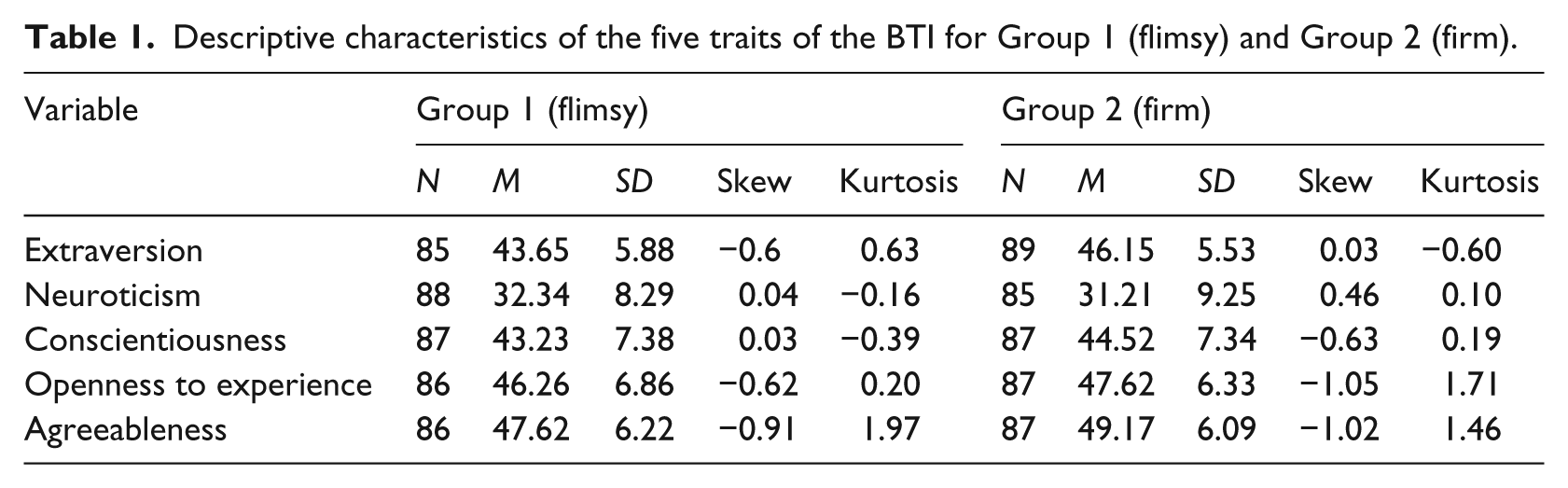
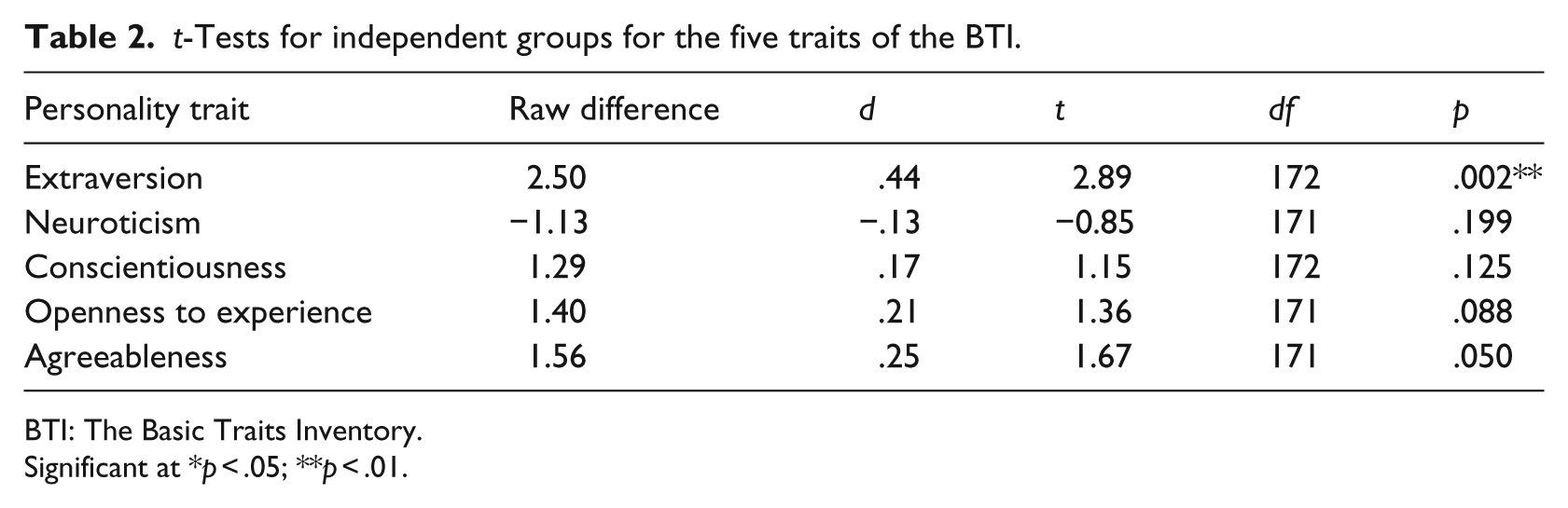
Table 2 contains a summary of the results of five independent t-tests for each of the five traits. Only one comparison yielded a statistically significant result, namely extraversion (p = .002). In terms of substantive significance, extraversion showed a medium effect size (d = .44) difference between the means of Group 2 (‘Flimsy’) (mean [M] = 43.65) and Group 1 (‘Firm’) (M = 46.15).
t-Tests for independent groups for the five traits of the BTI.
BTI: The Basic Traits Inventory.
Significant at *p < .05; **p < .01.
The remaining comparisons showed there was a small effect and statistically non-significant difference between the means for Group 2 (‘Flimsy’) and Group 1 (‘Firm’) for agreeableness (t(171) = 1.67, p = .050, d = .25) and trait openness to experience (t(171) = 1.36, p = .088, d =.2) and a very small and non-significant difference between the group means for the traits neuroticism (t(171) = −0.85, p = .199, d = −.13) and conscientiousness (t(172) = 1.15, p = .125, d = .17).
Discussion
The main objective of the study was to examine the effect of incidental exposure to a specific haptic experience (firmness or flimsiness of the paper) on intrapersonal judgements on a personality questionnaire. Two hypotheses were formulated. First, we hypothesized that there would be a significant difference between the means of Group 1 (‘Firm’) and Group 2 (‘Flimsy’) for neuroticism (with the mean for Group 1 being lower), agreeableness (with the mean for Group 1 being higher), and conscientiousness (with the mean for Group 1 being higher). Second, we hypothesized that there would be a significant difference between the means of Group 1 (‘Firm’) and Group 2 (‘Flimsy’) for extraversion (with the mean for Group 2 being higher) and openness (with the mean for Group 2 being higher).
The first hypothesis was not supported. Although the mean scores for agreeableness and conscientiousness for Group 1 (‘Firm’) were higher than the mean scores for Group 2 (‘Flimsy’) – as hypothesized – these differences were not statistically significant and therefore not meaningful. Similarly, the mean score for neuroticism for Group 1 (‘Firm’) was lower than the mean score for Group 2 (‘Flimsy’), as hypothesized; however, this difference was also not statistically significant and therefore not meaningful. Thus, a physically grounded mental framework, consistent with embodied cognition, had not led participants in Group 1 (‘Firm’) to respond in a more agreeable, conscientious, or less neurotic manner, when encountering an incidental, tactile experience of ‘stability’ when completing a personality questionnaire.
Further investigation of the descriptive statistics also revealed that, for neuroticism, Group 1 had a much higher kurtosis (kurtosis = −0.16) than Group 2 (kurtosis = 0.10). This is an indication that the haptic sensation of the firm paper resulted in more polarized responses for trait neuroticism. In other words, the firm paper resulted in participants judging themselves in a more extreme manner for neuroticism. The result of firm paper eliciting polarized responses could be indicative of the metaphor ‘being firm in understanding’, that is, the firm paper could have elicited touch-related conceptual processing related to the metaphor ‘being firm in understanding’, which, in turn, could have lead participants to form more firm or polarized intrapersonal judgements.
The second hypothesis – a significant difference between the means of Group 1 (‘Firm’) and Group 2 (‘Flimsy’) for extraversion (with the mean for Group 2 being higher than for Group 1) and openness (with the mean for Group 2 being higher than for Group 1) – was also not supported. For both traits, the mean scores for Group 1 (‘Firm’) were higher than the mean scores for Group 2 (‘Flimsy’) – not as hypothesized. Thus, a physically grounded mental framework, consistent with embodied cognition, had not led participants in Group 2 (‘Flimsy’) to respond in a more extroverted or open manner, when encountering an incidental, tactile experience of ‘plasticity’ when completing a personality questionnaire. There was, however, a statistically significant result, indicating a strong positive relationship between the experience of firmness of the paper and extraversion – which was not expected. Results indicated that a physically grounded mental framework, consistent with embodied cognition, had nonconsciously led participants in Group 1 (‘Firm’) to respond in a more extroverted manner, when encountering an incidental, tactile experience of ‘stability’ when completing a personality questionnaire.
There are several possible explanations for the results not meeting the expected pattern. First, the underlying assumptions of the experiment (i.e., the associations between the concepts of stability and plasticity and Big 5 personality traits) are not well-founded and were not developed empirically. Another possible explanation presents itself in the use of a randomized post-test only, one-way design in the experiment. Without a pre-test, it is not possible to exclude the possibility that the experimental groups may have differed on personality traits at baseline. A pre-test would help determine whether the two groups started with equivalent means on the dependent variable. Then, after the administration of the experimental treatment, if there was a reliable difference between those means, the difference on the dependent variable may then be attributed to the experimental treatment (McGuigan, 1993). Also related to the research method, a possible explanation for the unexpected results may be the small sample size used in the experiment, which might have hindered the tests ability to detect small effects.
Taking on a different perspective, an answer can also be found in the work of Gallace and Spence (2010), who suggested that different receptors in the skin are sensitive to the various types of somatosensory information, and our brains naturally and automatically weave them into the unified sense of touch. Thus, the haptic sensation of the flimsy paper used in the study may have been too small in comparison with the other types of somatosensory information taken in by the body when completing the personality questionnaire. The results of the experiment could be an indication that there is a certain threshold of touch needed to elicit embodiment-related conceptual processing.
Conclusion
Prior research has examined the influence of incidental touch. However, little or no research has empirically investigated the influence of incidental haptic sensations on intrapersonal judgements in the use of personality questionnaires. Our experiment indicated that haptic experiences may very well impact reporting (in particular, intrapersonal judgements); however, we have no clear indication as to how this will happen. Thus, a replication of this study, addressing the important limitations identified, is strongly suggested – including the use of a larger sample that is capable of detecting small effects and the use of a more sophisticated statistical technique (e.g., pre-test−post-test experimental group design) to ensure that experimental groups have equivalent means on the dependent variable before the experimental treatment.
While we have provided some initial evidence for our hypothesized account for the influence of incidental tactile experiences, consideration can even be extended to other tactile experiences encountered during questionnaire completion (e.g., the instrument used or bodily position). Alternatively, a gap for further research lies in testing incidental haptic sensations and self-perceptions of other higher cognitive processes such as resilience or emotional intelligence. Finally, the results of this study suggest that metaphorical activation of incidental haptic sensations in judgement formation is a multidimensional and complex phenomenon. Specifically, the results of this study suggest that consideration should be extended to include research on possible thresholds of touch needed to elicit embodiment-related conceptual processing. In conclusion, this research may serve to create awareness of the influence of incidental haptic sensations as a confounding variable in questionnaire design and, in particular, in the assessment of personality. However, further research is necessary to determine how exactly this may happen; expanding to include the potential effect of threshold limits in eliciting embodiment-related conceptual processing.
Footnotes
Acknowledgements
The research assistance of all participants is gratefully acknowledged.
Declaration of conflicting interests
The author(s) declared no potential conflicts of interest with respect to the research, authorship, and/or publication of this article.
Funding
The author(s) received no financial support for the research, authorship, and/or publication of this article.