




Abstract

Recent work on African psychology (Long, 2016; Makhubela, 2016; Nwoye, 2015) has restaged, and at times perhaps worsened, the decades-old confusion about the definition, scope, impetus for, and ultimate aims of an African psychology within South Africa (SA). A clarification – and perhaps more than just a clearing up – is warranted about the stimulus, prevailing and possible meanings, end-goal, and horizons, but also how, in light of the call for the decolonisation of higher education in SA, we – meaning students, teachers, researchers, therapists – might design African psychology university courses, research, professional programmes and therapies, as well as networks. An attempt is made to explicate what appear to be basic misperceptions by responding, after a fashion, to some frequently asked questions about African psychology – as well as other questions that usually remain unasked.
Is African psychology a psychology that studies Africans?
While some academics and practitioners misread and reduce African psychology to a psychology that studies only Africans, a vast literature indicates that African psychology is the study of all forms of behaviours and relationships, including behaviours of and relationships between non-Africans and Africans, as well as humans and animals (e.g., Azibo, 1996; Baldwin, 1986; Clark, McGee, Nobles, & Weems, 1975; Dawes, 1998; Khatib & Nobles, 1978; Long, 2016; Mkhize, 2004; Moll, 2002; Nobles, 2015; Nwoye, 2015; Ratele, 2016). An even more crucial point is that all of psychology done in and for Africa, about Africans, by Africans as well as non-Africans (working on Africa) is African psychology.
To be precise, a number of routes into African psychology exist, and while one way leads towards the idea of African psychology restricted to Africans, others point beyond Africa and Africans. My sense is that the questions posed frame the meaning and horizon of African psychology.
Aware that this is an over-simplification, there are two broad ways to ask about African psychology. One set of questions mainly focusses on actors, subjects, and identities – who is the student, teacher, author, reader, study subject, therapist, or client. It is in this particular case where one might ask the question, ‘is African psychology a psychology that focuses Africans?’ Some researchers, teachers, and therapists may be inclined towards African psychology as focussed on Africans. However, such a question could also limit the potential and future of African psychology as a global enterprise. That is to say, when such identity-related questions are used to frame African psychology, African psychology often appears as an esoteric branch of psychology. It is on the basis of such identitarian questions that African psychology would get to be defined as studies and therapies (of X, whatever X is) on or for (and, sometimes, although slightly different, by) Africans. All the same, while there are researchers, teachers, and therapists who may prefer African psychology thus defined, it is one way to conceive of the work.
Another set of question is more miscellaneous, concerned with standpoints, methods, and applications: what is an appropriate therapy, how to teach, what are the topics of interest, how to approach them, and what interpretations can be derived from the data? From this angle one could ask: how might we undertake research within an African psychological perspective or how do we see therapeutic work? Such questions seem to lead towards a more variegated African psychology, with a definition suggested by the questions being: African psychology refers to ways of situating oneself in the field of psychology in relation to and from Africa. In other words, African psychology is situated knowledge and practice.
Why is there a need for African psychology if it is not necessarily a psychology that studies Africans?
In simple terms, the main stimulus for an African psychology was to get out from under a Euromerican-centric psychology dominated by the rich Western countries, which have been led since the Second World War by the United States of America. In SA, the struggle was against apartheid psychology (Anonymous, 1986; Nicholas & Cooper, 1990; Seedat, Cloete, & Shochet, 1988). The ultimate goals in searching for an African psychology has been to build a relevant, appropriate, socio-politically conscious, transformed, or decolonised discipline and profession. The search for an African psychology was sometimes explicitly labelled as such, but as often was barely traceable under various discourses such as relevance, appropriateness, or transformation (Dawes, 1986; Long, 2013; Vogelman, 1987). Of course, there is no one-to-one correspondence between something like a decolonised psychology and an African psychology, which points to new questions. In the final analysis though, the need for an African psychological register is conceivable as part of a relatively long intellectual history to de-Westernise, contextualise, transform, or decolonise psychology and, more generally, knowledge in former colonies and the Global South (Cooper, 2013; Dawes, 1998; Manganyi, 1973, 2013).
Is the name African psychology not limiting?
The name African psychology has real limitations. These include how, more than a label like US or South African psychology, it generates serious confusion. Perhaps worse, the term African psychology can burnish stereotypes of Africa as a special case. These limitations are not easily hurdled and, when they are, keep returning. To be sure, it is often necessary for those who do psychology on the peripheries of the world, particularly when they have to communicate to and orient those at the centres of the world of psychology like the United States, to retain labels like African, Chinese, or Latin American psychology. As such, African psychology is usually retained for the sake of charting the ‘othered’ terrain that needs to be described and point out to the powerful centre how realities on the peripheries are different from those at the centre.
But there are two very crucial and specific limitations about the label African psychology worth accentuating. First, unless one desires to contort oneself, all psychology regarding Africa and Africans on the continent and the diaspora has to be counted into the body of what is seen as African psychology. This seems a straightforward characterisation – except when it is not.
Second, the problem with the name African psychology arises out of the fact that debates about African psychology references, usually implicitly, other debates about histories of slavery, colonialism, and racism. African psychology partakes in existential, ontological, and political contests such as those on who can be African, whose home is Africa, besides those issues of who can teach about Africa, who is entitled to teach Africans, and who can do psychological repair work among Africans. An implication of all these broad and specific contests and issues is that it is hard for African psychology not to be political, even when it wishes remain neutral (see Biesheuvel, 1987), as these issues and contests derive from the politics in African countries.
The unasked question is why is there a need to use the adjective African psychology instead of simply taking all psychology done in Africa on Africans and non-Africans samples as psychology, period. What some scholars seek to do with the term African is to distinguish between different ways of thinking about Africa, being African, and psychology (Mkhize, 2004; Nwoye, 2015). Out of this quest, again usually implied than explicitly stated, are to be found attempts to differentiate between psychology that identifies with or empathetically centres Africa, and a neutral psychology that approaches Africa as one object among others. As such, while all psychology that is taught, studied, published, and applied in SA, just like in other African countries, is of course African psychology, the effort has been to surface psychology teaching, research, and applications that consciously identify themselves with Africa. The latter is what is sometimes referred to as African-centred/Afrocentric psychology. Wade Nobles (2015) had this to say about this distinction:
We, therefore, should not be just talking about psychology in Africa. To simply bring Western psychology to Africa is to be complicit in the mental brainwashing and psychic terrorism . . . of Africa and the adoption of the very tool and theories that have been used to demean, defame, debilitate, and damage us. In effect to merely advance Western psychology into Africa would be akin to uncritically drinking poison as if it were medicine to heal and revive ourselves (pp. 402–403).
Even when the distinction has been made clear, the questions one poses about Africa, Africans, the West, and the psychology will tend close or open up how we think of an African psychology. Thus, it is necessary to recognise that the term African psychology is contingent, can have multiple meanings, and, in countries like SA, overladen with political history of colonialism and apartheid racism. The term African psychology will therefore have to be always contingently embraced by students, teachers, researchers, and therapists even as psychological work from different countries of Africa remain in need of strengthening, in some countries, like the Gambia and Equatorial Guinea for instance, considerably more so than in others. Strengthening African psychology is a gargantuan task, and in my view would include (a) taking up the challenge to redefine the relation between psychology and Africa; (b) to better, energetically and more sophisticatedly locate Africa in global psychology; and (c) to highlight the situatedness of all psychological knowledge and practice.
What does it mean to say African psychology is situated knowledge and practice?
Situated African knowledge and practice is work that is conscious of its birth, history, context, and point of view. Situatedness signals location, position, orientation, or standpoint. To be situated begins with appreciating one’s biography, sociality, perspective, and interpretations. African psychology in this light is the same thing as situated psychology. But situated psychology is not always African. US psychology is situated psychology, as is British, Chinese, French, Islamic, and Latin American psychology. All psychology is situated. However, the fact is that in a world differentiated by economic, military, racial, and cultural power, on average those who have better access to such power have little need to situate their knowledge and practice.
What is called African psychology is then not a separate body of knowledge but a way to situate one’s work and oneself. But there are different ways people situate themselves in any field on knowledge and practice. As situated practice and knowledge African psychology is not one single thing but a polyvocal and dynamic enterprise. It is made of different voices. It is not static. In that way, African psychology is composed of different orientations. And how one is situated in or orients to the world frames the research questions one ask; presents the world from a certain view and occludes other possibilities; influences the therapeutic goals, success, and failures; and determines what one teaches and leaves out.
How many orientations are found in African psychology?
The number is not definitive, but the fact is that there is more than one orientation towards African psychology. It is proposed that four orientations are distinguishable under the umbrella African psychology (Ratele, 2016). The four orientations that constitute African psychology are as follows: (a) a more western-oriented African psychology; (b) what I call psychological and psychoanalytic African studies; (c) a more culturally, spiritually, metaphysically, philosophically inclined African psychology (cultural African psychology in short); and (d) a more materialist, political, or critical African psychology (critical African psychology in short; Figure 1).
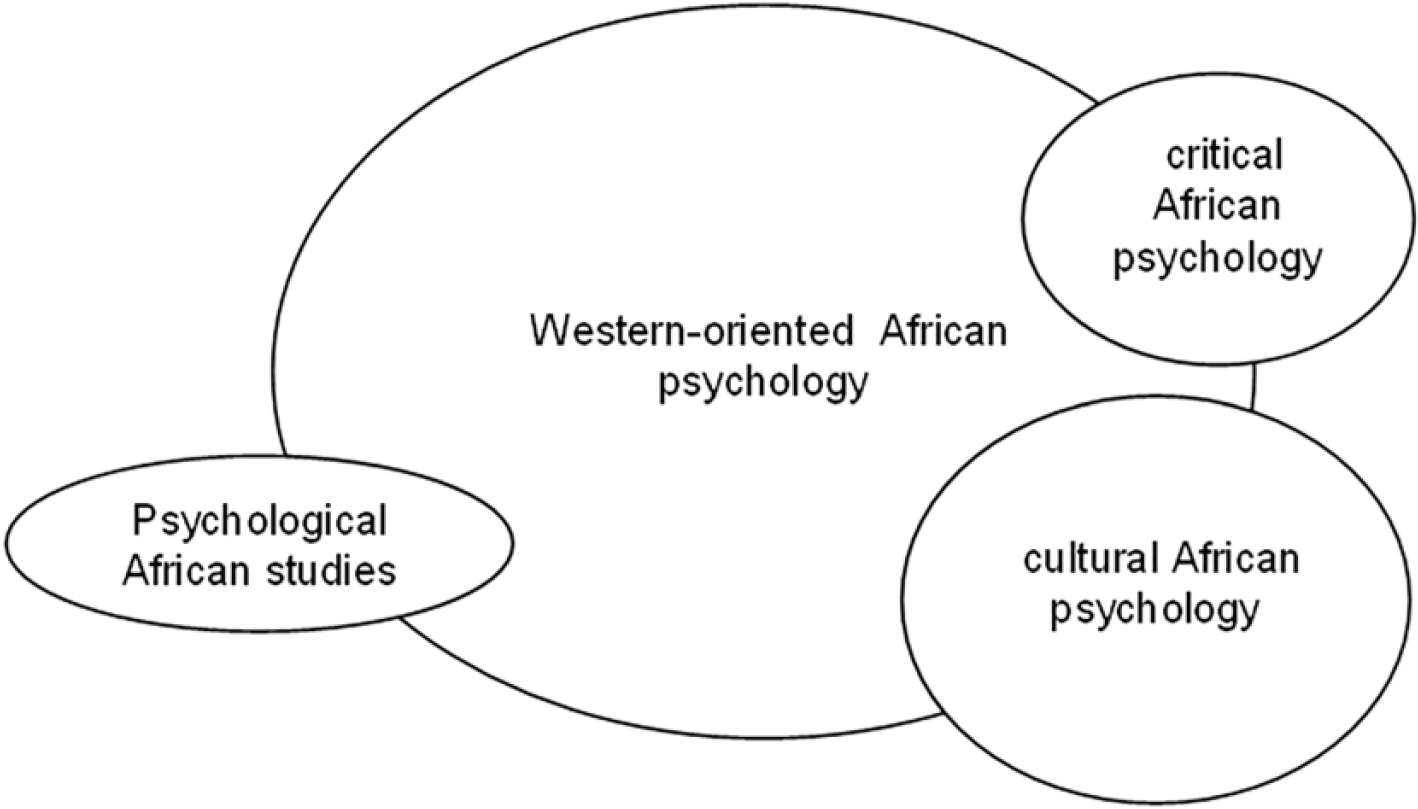
Four orientations in African psychology.
Sometimes these orientations are readily graspable – such as the more western-oriented African psychology (elsewhere referred to as the psychology in Africa orientation [Ratele, 2016]). As the mainstream, western-oriented African psychology is how the majority of psychologists are situated, and the literature is too vast to reference. At other times the orientations are represented by a handful of scholars (Abdi, 1975; Mkhize, 2004; Nsamenang, 1995; Nwoye, 2015).
A western-oriented African psychology considers African psychology as the study of behaviour (in African settings). A western-oriented African psychology stance assumes, implicitly or explicitly, that psychology is a universal science, apolitical, objective, and largely value-neutral. This forms mainstream psychology in SA – the core content and concepts of what is taught in universities, the therapeutic modalities used in consulting rooms and psychiatric hospitals, and the research work that is published in journals and books.
Psychological and psychoanalytic African studies refer to work, sometimes by psychologists, and arguably more often by non-psychologists, that uses psychological tools and concepts to study Africa (Adams & Dzokoto, 2003; Diouf, 2003; Mbembe, 1992; Ratele, 2008). African psychology as part of African studies indicates using psychological and psychoanalytic methods, theories, tools, and insights within African studies. Hence, this orientation is taken to indicate psychologically and psychoanalytically inclined African studies, where African studies refer to those studies whose object is Africa and its societies, including studies in African history, politics, economics, anthropology, philosophy, languages and literature, and religion. Psychological and psychoanalytic African studies are inclined towards interdisciplinarity and transdisciplinarity.
The third orientation of African, the more culturally, spiritually, metaphysically, philosophically inclined African psychology situates the investigator and the investigated, the therapist and the client, the teacher and the student in a cultural world. Culture is placed at the centre of psychology and Africa. The cultural effects of colonialism and apartheid racism are also seen as figuring prominently in the lives of Africans. The object of study is the person in their cultural context and the culture that shapes the person. The problems of the person seeking counselling are seen to emerge from the dynamic between culture and person, and an understanding of the culture is as important as understanding the person. The student who comes to the psychology class is seen as a cultural being, bringing her culture into the lecture room. Cultural African psychology begins with putting people in their cultural context, seeing practices from the people’s cultural point of view.
As a more materialist, political, or critical orientation, African psychology seeks to be attentive to the materiality or structures of daily life, including economic and political and other social structures. These structures are seen as shaping psychology and a critical African psychology perceives itself as oppositionally situated within yet against political, economic, and other social structures. Like the previous two orientations, critically oriented African psychology tends to be interdisciplinary and transdisciplinary, appropriating from critical African thought, critical Western psychologists and critical Western thought more generally. Critical African psychologists prefer to pose questions about the workings of power and knowledge in their societies and within psychology. This orientation is distinguished from cultural African psychology by a suspicious stance not only towards US and Western European psychology, but also suspicion towards all psychology and notions culture.
In heading towards a conclusion, it needs restating that what distinguishes these orientations from each other are the manner two main central ideas – Africa and psychology – are apprehended. But the case is often that how the two ideas are understood and approached remains implicit. The most significant element is, however, that one is always situated, unconsciously or after deliberation. The four African psychologies can therefore be considered as ways actors are positioned in relation to Africa as an object of study, towards psychology’s place in Africa, towards Africa as a place of knowledge making, as well as to their own being, social relations, perspective, and expertise. The crucial point is that orientation, or situatedness – that is, the way clinicians, counsellors, teachers of psychology, and researchers are positioned or position themselves – has an effect on psychotherapy, counselling, teaching, and research.
The four African psychological orientations are not meant to correspond to the established branches or areas such as critical psychology, cultural psychology, cross-cultural psychology, political psychology, economic psychology, or indigenous psychology. They are also not meant to correspond to established sub-disciplines of psychology such as general, cognitive, developmental, personality, community, and social psychology; not to the categories of registration such as clinical, counselling, industrial, educational, research, neuropsychology, and forensic psychology; and not to the divisions of the professional associations of psychologists. Instead, different African psychological orientations are, in my assessment, found within the areas of work, sub-disciplines, within registration categories, and within the divisions of the professional association. In SA, some areas of work, sub-disciplines, registration categories, and divisions more than others, simply because of the sheer numbers involved, will evidence more debates on African psychology.
It is also worth noting that African psychology teachers, researchers, and psychotherapists can and do move across these different orientations; that the boundaries between the four psychologies are permeable; and that it is more likely that individual psychologists will at different points in time orientate themselves in one way or another with regard to African and psychology.
Footnotes
Funding
The author(s) received no financial support for the research, authorship, and/or publication of this article.