



Abstract
The scarcity of mental health resources in low- and middle-income countries requires the identification of effective interventions that can be taken to scale in a cost-efficient manner. Yet the evidence base for treatment of common mental disorders in low- and middle-income countries remains limited. As one of the better resourced countries on the African continent, South Africa could potentially play a leading role in developing an African evidence base for mental health care. This study sought to describe and evaluate the South African evidence base for treating common mental disorders. A systematic review of randomised controlled trials for depression, substance use, and anxiety in the adult South African population from 2000 to mid-2015 was conducted. Eligible studies were assessed for their consistency with recommendations for mental health interventions in low- and middle-income countries and for methodological and reporting rigour. A total of 16 RCTs satisfied the inclusion criteria, of which 8 targeted depression, 6 targeted substance use, and 2 targeted anxiety symptoms. There has been a strong trend towards alignment with prevailing recommendations for delivery of mental health interventions in resource-scarce regions. While there are some promising findings with regard to effectiveness of specific interventions, replication, costing, and dissemination studies are still required and there is still an urgent need for treatment studies for anxiety disorders, which are the most common class of common mental disorder in South Africa. The review also indicates that research design and reporting practices in South African mental health intervention research could be enhanced and recommendations towards this are suggested.
Keywords
While the substantial contribution of mental disorders to the burden of disease in both high-income countries (HICs) and low- and middle-income countries (LMICs) is now well documented (Lopez, Mathers, Ezzati, Jamison, & Murray, 2006; Whiteford et al., 2013), LMICs remain characterised by a particularly vast disparity between the burden of mental disorders and the resources that are available to meet treatment needs (Saxena, Thornicroft, Knapp, & Whiteford, 2007). Increasingly, the identification of effective, culturally acceptable, accessible, and scalable mental health interventions in LMICs has been recognised as a key challenge in global mental health (Eaton et al., 2011; Patel & Thornicroft, 2009). The integration of mental health care into primary health care, the use of brief interventions, and the development of task-shifting models (the delivery of mental health interventions by non-professionals) are recommended approaches to enhancing the accessibility, acceptability, and scalability of mental health care in resource-constrained contexts (Dua et al., 2011; Lancet Global Mental Health Group, 2007; Patel et al., 2013). Within such approaches, providing adequate training to treatment providers and monitoring the fidelity of treatment delivery are important considerations (Murray et al., 2011).
Numerous treatment studies indicate that mental health interventions for severe mental illnesses like schizophrenia can be effectively delivered in LMICs, but the evidence base for the treatment of common mental disorders (CMDs) like depression, anxiety, and substance use disorders in LMICs is still comparatively limited, with the African continent being particularly poorly represented (Patel et al., 2007). Given that Africa has even fewer resources than other regions with regard to mental health professionals, hospital-based mental health services, and community-based mental health care, and hence a higher number of untreated persons living with mental illness (Saxena et al., 2007), the identification of effective and affordable interventions that can be taken to scale is of critical urgency for the continent.
South Africa is the leading economy on the African continent (http://www.bbc.com/news/world-africa-37045276), and although its funding allocation for both mental health services and mental health research is far lower than most HICs, these allocations are nevertheless better than most other African countries (Lund, Kleintjes, Kakuma, & Flisher, 2010). It could therefore be expected that the evidence base for treatment of CMDs would be better developed in South Africa relative to many other African countries and could potentially provide valuable data to guide mental health service delivery on the continent.
Epidemiological data from the Diagnostic and Statistical Manual of Mental Disorders (4th ed.; DSM-IV)-based nationally representative South Africa Stress and Health (SASH) study indicate that the lifetime prevalence of CMDs among South African adults is 30%, with anxiety disorders being most prevalent (15.8%), followed by substance use disorders (13.4%) and then depression (9.8%) (Stein et al., 2008). The lifetime prevalence of CMDs in South Africa is twice that of Nigeria and higher than the majority of other countries in the WHO World Mental Health Survey (Stein et al., 2008). However, among South Africans currently living with a mental disorder (16.5%), only 25% have received treatment in the past year and formal mental health services have been accessed by only 5% (Seedat et al., 2008). Contributors to this substantial treatment gap include a dearth of mental health professionals relative to population needs, particularly in non-urbanised parts of South Africa (Lund et al., 2010), and the slow pace of decentralisation of mental health services away from hospital-based care towards community-based care (Petersen & Lund, 2011). As untreated severe depression and anxiety among South African adults results in lost national earnings of US$3.6 billion, there is a strong economic rationale for investing in treatments for CMDs that will be both effective and accessible for South Africa’s population (Lund, Myer, Stein, Williams, & Flisher, 2013). But to what extent is there a credible local evidence base to guide the allocation of scarce mental health resources?
This study aimed to conduct a systematic review of randomised controlled trials (RCTs) for the psychosocial treatment of depression, substance use, and anxiety among South African adults. While lower levels of evidence have been established for some interventions in the South African context, this review aimed to identify treatments that have already established a threshold of evidence that could warrant their being considered for further dissemination (OCEBM Levels of Evidence Working Group, 2011). Its objectives are to identify which psychotherapeutic treatments for CMDs have been evaluated with an RCT design in South Africa, to evaluate the degree to which the existing RCT evidence base fits with recommended modes of mental health care delivery in LMICs, to assess the methodological rigour and reporting standards of existing RCTs, and to identify strategies for enhancing the evidence base for treating CMDs in South Africa and the African region more broadly.
Method
Study inclusion and exclusion criteria
The following criteria were used to select studies for review:
Only treatment studies that used an RCT design to evaluate interventions for depression, anxiety, or substance use disorders were included in the review. Other research designs such as case studies, pre-post test evaluations with no control group, or controlled studies that did not use randomisation were excluded.
Decisions about whether studies targeted depression, anxiety, or substance use disorders were based on the study aims and reported findings as well as the description of instruments used.
Only studies with adult samples were included.
It is possible that interventions that do not conform to standard evidence-based treatment (EBT) protocols or to traditional notions of psychotherapy may be appropriate and acceptable in the South African context. Therefore, any RCT that aimed to address symptoms of depression, anxiety, or substance use was included in the review, including adaptations of EBTs as well as non-psychotherapy interventions (examples of the latter included craft groups and cash loans). However, studies that evaluated pharmacotherapy treatment only were excluded.
In order to review the most contemporary evidence, the review was restricted to studies published from 2000. Data collection took place in June 2015 and studies published after that date are not included in the review.
Search strategy
A systematic search was performed on the following electronic databases: Academic Search Premier, Africa-Wide Information, CINAHL, e-book Collection (EbscoHOST), Health Source: Nursing/Academic Edition, Humanities International Complete, MasterFILE Premier, MEDLINE, PsycARTICLES, PsychINFO, and SocINDEX. Hand searches of The South African Journal of Psychology and The South African Journal of Psychiatry were also conducted, in addition to manually examining reference lists of all the studies selected for inclusion in the review.
The following key words and phrases were combined in different ways with the truncated term ‘South Afr*’ to form the search terms: ‘trials’, ‘common mental disorders’, ‘random’, ‘control’, ‘study OR review OR evaluation OR research’, ‘depression’, ‘anxiety’, ‘substance abuse’, ‘substance use’, ‘treatment’, ‘intervention’, ‘therapy’, ‘clinical trial’, and ‘programme’. To refine the search, we truncated certain words to capture all possible variations. For example, random* found studies that included randomisation, randomization, random assignment, and randomised/randomized controlled trial in their titles.
The titles and abstracts of all articles identified by this search strategy (n = 9904) were then each reviewed by two different reviewers and rated as being relevant for inclusion or not based on whether they described a psychosocial intervention for depression, anxiety, or substance use that had been carried out with a South African sample. In the few cases where there was a disagreement, this was discussed with a third expert until a consensus was reached. This selection process yielded 45 studies. These studies were then reviewed in further depth to establish whether they included randomisation, a control arm, and an adult sample. There were 16 studies that met all the inclusion criteria. The search and selection strategy is summarised in Figure 1.
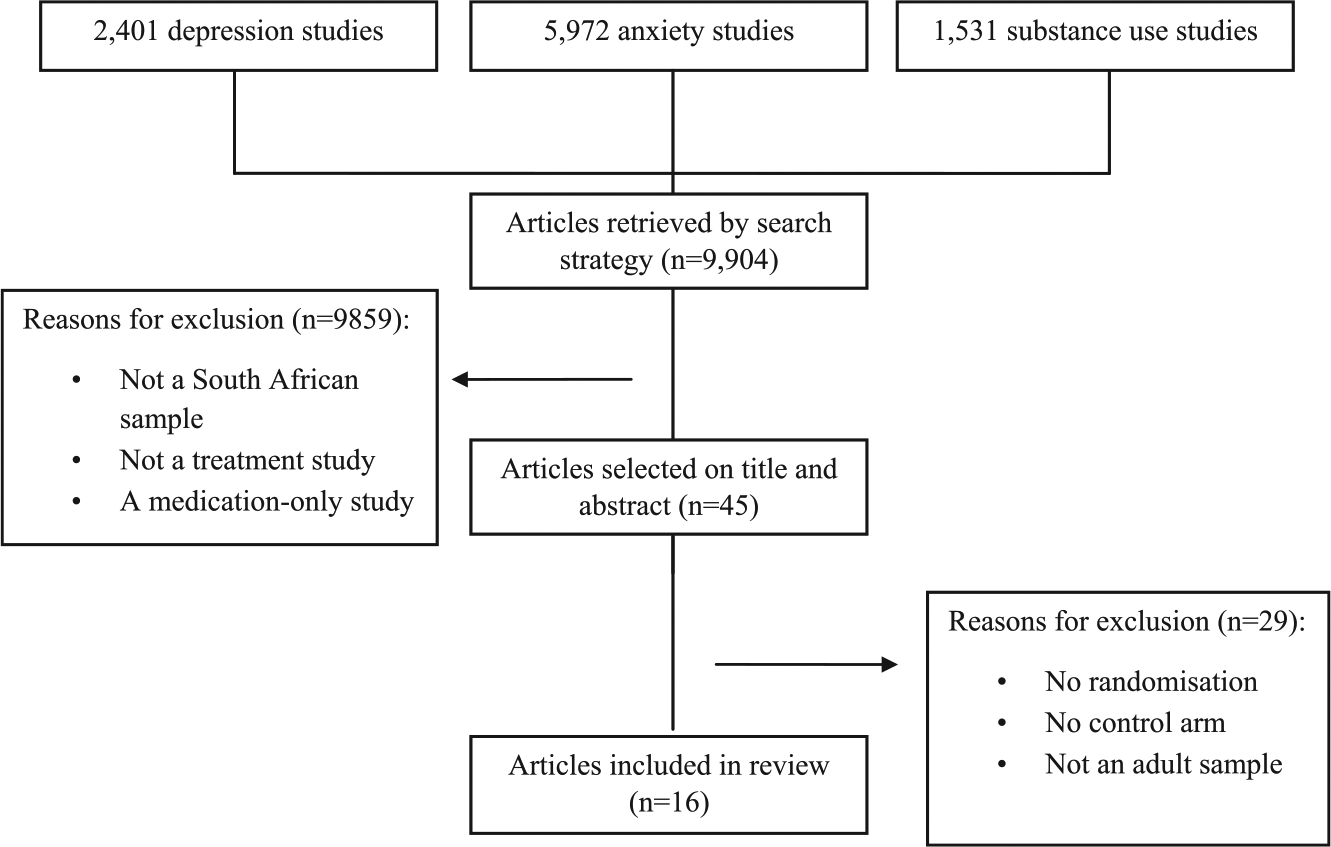
Flowchart of search and selection strategy.
Evaluation of articles
We evaluated each article along two dimensions. First, we considered the degree to which the intervention reflected consistency with prevailing recommendations for mental health interventions in LMICs where issues of accessibility, acceptability, cost-effectiveness, and scalability are paramount. We therefore considered the following: the length of the interventions (number of sessions), the treatment setting (public health clinic, hospital, university, etc.), the treatment personnel that delivered the intervention (clinicians, nurses, lay counsellors, etc.), the extent of training provided to treatment deliverers, and whether procedures for monitoring treatment fidelity were used. Given that South Africa has 11 official languages, and that language is an important aspect of treatment accessibility and acceptability, we also considered whether language of treatment delivery was reported. Second, drawing on items from the Cochrane Risk of Bias Assessment Tool (Higgins et al., 2011) and the qualitative assessment tool for quantitative studies developed by the Effective Public Health Practice Project (EPHPP; Thomas, Ciliska, Dobbins, & Micucci, 2004), we considered the methodological rigour and reporting standards of the studies by examining the following: whether procedures for assessor blinding were reported, whether potential confounding variables were addressed in the article, whether rates of attrition were reported, and whether effect sizes (to evaluate the practical significance of treatment effects) were reported. In studies that had attrition rates above 10%, or did not report attrition rates, we examined whether intent-to-treat (ITT) analysis was used. Each study was categorised by two evaluators on each of these dimensions. Any disagreements were referred to a third expert and resolved through a consensus process (Van Tulder, Furlan, Bombardier, & Bouter, 2003).
Results
Eight depression RCT, seven substance use RCTs, and two anxiety RCTs were yielded by the review. As summarised in Figure 2, the vast majority (n = 12; 71%) have been published since 2011, indicating only a very recent trend towards more rigorous treatment research in South Africa.

South African RCTs for CMDs by year.
Depression
Eight RCT studies assessed depression as the primary outcome (Table 1). Five of these used group-based interventions: group-based interpersonal therapy (IPT), cognitive therapy, rational-emotive behaviour therapy (REBT), craft workshops, and animal-assisted therapy were each evaluated by one study. Individual IPT, hypnotherapeutic ego strengthening (HES), and cash loans were also each evaluated once. The largest sample was in the cash loan study and consisted of 237 participants, while the smallest was in the group animal-assisted therapy study which had 16 participants. The group-based cognitive therapy study and the group-based craft intervention study used treatment-as-usual control groups, including access to antidepressants, the control group in the individual IPT study received citalopram, the control group in the group-based IPT study received HIV medication and standard HIV counselling services, the REBT study used a wait-list control group, and the control groups in the remaining three studies were not reported as being allocated to any treatment or wait-list.
South African RCTs for treatment of depression (2000–mid-2015).

Only coded when attrition was not reported or was greater than 10%.
Apart from the credit study by Fernald, Hamad, Karlan, Ozer, and Zinman (2008) in which the notion of ‘sessions’ does not apply, the remaining depression RCTs examined treatments consisting of between 5 and 15 sessions, so were relatively short-term interventions. Treatment providers and settings varied widely across the depression studies. Three studies based at state health clinics used a task-shifting model to deliver group interventions: psychiatric nurses delivered a cognitive intervention, lay counsellors delivered IPT, and volunteers delivered a crafts intervention. The individual IPT intervention was delivered at a state hospital by a psychiatrist, the REBT intervention was delivered by an experienced REBT therapist but did not report the setting, the animal-assisted therapy was conducted at an old age home by a trained dog and handler, the cash loans intervention was administered by bank managers to individual households, and the HES study was delivered at a private hospital but did not report on who delivered the intervention. Despite the fact that South Africa has 11 official languages, only two studies reported on the language of treatment delivery. Petersen, Hanass Hancock, Bhana, and Govender’s (2014) group IPT treatment study was the only article to report on how fidelity to treatment was monitored.
All the studies used standardised symptom rating scales to assess outcomes. The Beck Depression Inventory (BDI) was the most widely used measure of depression, employed in four out of the eight studies. Other depression measures include the Profile of Mood States (POMS), the Centre for Epidemiologic Studies-Depression Scale (CES-D), the Hamilton Depression Rating Scale (HAMD), the Self-Reporting Questionnaire (SRQ-20), Patient Health Questionnaire (PHQ-9), and Hopkins Symptom Checklist (HSCL-25), and one study included a number of anxiety measures also. Four of the eight studies reported a statistically significant difference in depression between intervention and control groups on at least one depression measure: the study of group-based cognitive therapy delivered by psychiatric nurses, lay-counsellor delivered group-based IPT, volunteer-led group-based craft interventions, and the HES study. The loan study by Fernald et al. (2008) found that credit access was associated with an improvement in male, but not female, depression. The remaining three studies reported a significant decrease in depression scores for the intervention groups but did not report between-group comparisons.
Only Petersen et al. (2014) reported on procedures for assessor blinding. In terms of controlling for confounding variables, four studies used statistical methods to address possible confounds while four studies did not report consideration of this issue. Attrition rates across the studies were generally low at between 0% and 6%; however, a higher rate of 45% was reported by Petersen et al. (2014) for a number of reasons, including lack of transport, employment opportunities on treatment days, and discomfort among males in groups dominated by females. Only the Fernald et al. (2008) study used an ITT analysis. None of the studies reported an effect size.
Of the eight depression RCTs, Petersen et al.’s (2014) task-shifting study of group-based IPT met the most criteria for both consistency with LMIC intervention recommendations and methodological and reporting rigour. However, high attrition rates are a limitation of the study and, as with all the other depression studies, the results await replication. A number of large RCTs evaluating task-shifting models to address depression are currently underway in South Africa, including one evaluating group-based IPT (Lund et al., 2015; Lund et al., 2012).
Substance use
Of the six substance use studies, five focused on alcohol misuse and only one addressed both drug and alcohol misuse (Table 2). The sample sizes were considerably larger than those used in the depression RCTs, ranging from 152 to 1196. The interventions were more uniform than the depression studies: the interventions in all six studies comprised a combination of information, motivation, and behavioural counselling elements, and all were very brief – five studies used a single session while Marais et al. (2011) delivered four brief intervention sessions. In five of the studies, the control groups received an information booklet or leaflet, while the control group in one study received a one hour wellness session. The Alcohol Use Disorders Identification Test (AUDIT) scale was employed by four studies, while Mertens, Ward, Bresick, Broder, and Weisner (2014) also included the Alcohol Smoking and Substance Involvement Screening Test (ASSIST) scale to measure drug misuse; Burnhams, London, Laubscher, Nel, and Parry (2015) developed the Workplace Questionnaire (WQ) which they used to assess alcohol misuse, HIV-alcohol knowledge, and workplace alcohol consumption. Four studies reported a significant effect for the primary outcome related to the delivered intervention, while two studies reported non-significant results which were attributed partly to a strong effect of the educational material provided in the control arm.
South African RCTs for treatment of substance use (2000–mid-2015).

Only coded when attrition was not reported or was greater than 10%.
Community-based settings were the norm in the substance use RCTs: three studies were conducted at primary health care clinics, one at a public hospital, one at a government department, and one at a university. All six RCTs used a task-shifting model employing nurses or lay counsellors, and processes for ensuring fidelity to treatment were reported by all but one study. Three studies delivered treatments in the mother tongue of participants or in a language in which participants were proficient, while the other four did not report on language.
The substance use RCTs generally performed better than the depression studies with regard to methodological rigour and reporting standards. All six studies described procedures for controlling possible confounding variables, four studies used blinding procedures, and three of the four studies with high attrition rates used an ITT analysis. Of the four studies that reported a significant treatment effect, only one reported an effect size.
Anxiety
Despite anxiety disorders being more prevalent in South Africa than depression or substance use, RCTs for anxiety disorders produced the smallest yield. Only two studies used an RCT design with anxiety symptoms as the primary outcome (Table 3): Constant, de Tolly, Harries, and Myer (2014) investigated an intervention that sent 13 timed text messages to 469 women undergoing medical abortion at public health clinics; and Nortje, Posthumus, and Moller (2008) investigated cognitive behavioural group techniques delivered by clinical psychologists over 12 sessions to 44 participants in an unreported setting. Constant et al. (2014) arranged for participants to receive text messages in their first language, while Nortje et al. (2008) did not report on language of treatment delivery. Nortje et al. (2008) used a wait-list control group while Constant et al. (2014) used a treatment-as-usual control.
South African RCTs for treatment of anxiety (2000–mid-2015).

Only coded when attrition was not reported or was greater than 10%.
Standardised anxiety measures were used in both studies. Constant et al. (2014) found a significant between-group difference in anxiety, and Nortje et al. (2008) found that both cognitive therapy with exposure and exposure alone resulted in significantly reduced anxiety compared with the control group. It should be noted that Moller and Steel (2002) and De Klerk et al. (2004), whose results are presented in the depression section above, also measured the impact of their interventions on comorbid anxiety, with the former finding no significant between-group difference and the latter showing a clinically significant change in anxiety.
Both of the RCTs with anxiety as the primary outcome considered confounding variables and statistically controlled for them. Assessor blinding procedures were not reported in either study. Only Constant et al. (2014) reported on attrition and employed an ITT analysis. Nortje et al. (2008) was the only study to report effect sizes, which were small to moderate at follow-up.
Discussion
The objective of this study was to systematically review treatments for CMDs that have been conducted in South Africa using an RCT study design. Our search yielded 16 South African RCTs that have evaluated treatments for CMDs in adults between 2000 and June 2015 – a small number over a 15-year period, when considering that South Africa as an upper-middle income country (World Bank, 2016) has better research funding and research capacity than many other African countries and even some LMICs in other regions. Most South African RCTs have been conducted in the past 5 years, suggesting that mental health researchers in the country have only recently begun to adopt international standards for generating clinical evidence, and this may signal an emerging empirical shift that will be built upon by future research in South Africa and the continent more generally.
Within the RCTs included in the review, there was a strong trend towards an alignment with prevailing recommendations for mental health interventions in LMICs. More than half of the RCTs used a task-shifting model (employing nurses, lay counsellors, or volunteers), most were conducted in community-based settings (such as public health clinics), 44% (n = 7) employed a group therapy format that can treat a greater number of patients at one time, and all evaluated fairly brief interventions ranging from 1 to 15 sessions. This reflects careful attention by the researchers to issues of accessibility, acceptability, and cost-effectiveness, although there is still some way to go in actually demonstrating the cost-effectiveness and scalability of any of the interventions tested thus far.
The depression RCTs investigated a wide variety of treatment approaches with only one RCT to support each and used relatively small samples. Furthermore, while task-shifting approaches were common, most studies failed to report on training, fidelity, and language procedures, which makes it difficult to assess the feasibility and costs of dissemination. Therefore, although there are several positive findings regarding effectiveness of specific depression interventions, there is still a weak evidence base to support their scaling up. The substance use RCTs used large samples and consistently reported on training and fidelity, blinding procedures, attrition, and management of confounds. One treatment protocol (based on the IMB model) was tested in three different settings, but findings were not consistent; the remaining treatment models were each only tested once. While there does seem to be promising support for brief interventions to reduce alcohol use through a task-shifting approach, further replication of specific protocols is needed, and evidence for the treatment of drug abuse remains scarce. Only two RCTs have evaluated treatments specifically targeting anxiety, using very different interventions, and neither has been replicated. As anxiety disorders are the most prevalent class of CMDs in South Africa, this treatment evidence gap clearly requires attention.
There are a number of limitations that cut across many of the RCTs in this review. First, in a country with many official languages, the language in which treatments (and particularly ‘talk therapies’) are delivered is a key consideration affecting acceptability, effectiveness, and dissemination of mental health interventions (Swartz, Kilian, Twesigye, Attah, & Chiliza, 2014). However, 11 of the articles did not report on language issues. This issue should be addressed more carefully in future RCT studies, both in the design of interventions and in publications. Second, only two studies reported on effect sizes, making it difficult to assess the practical significance of the findings and hindering policy decisions about which might be the most effective treatment to invest in (though cost-efficiency also has to be factored in to these decisions). Third, it is important to note that symptom severity scales were the only outcome measures used across all the RCTs, and it is unclear whether those interventions found to be effective would also reduce psychiatric caseness. Finally, the cost-effectiveness and the feasibility of large-scale dissemination of the evaluated interventions included in this review have not yet been established; these data are urgently needed to inform mental health policy development in South Africa and the continent (Jack et al., 2014).
This systematic review has several limitations. It is possible that, despite a comprehensive search strategy, studies meeting the inclusion criteria may have been overlooked. This could have occurred during the initial search for studies within the databases or during the reading of study titles and abstracts that followed. Also, grey literature was not included in this review; therefore, RCTs that have been conducted but not yet published will have been omitted. Finally, this review relied on the content reported in the journal articles published by the researchers. The researchers may have sometimes failed to report on procedures they had in fact carried out.
Conclusion
Reviewing the number, content and quality of published RCTs has enabled a thorough assessment of high-level research conducted on the treatment of CMDs in South Africa. Although the use of RCTs is a very recent development in South Africa, a number of interventions have been found to be effective for treating CMDs in adults, and many of these are consistent with prevailing recommendations for the format and modes of delivery of mental health interventions in resource-scarce regions. However, replication, costing, and dissemination studies are still urgently needed in order to inform mental health policy development. The review has also indicated how research design and reporting practices could be enhanced in the future in treatment studies emerging from South Africa and the continent more broadly: more attention needs to be paid to blinding procedures, descriptions of language of delivery, treatment provider training and monitoring of fidelity to treatment protocols, attrition and the use of ITT analyses, reporting of effect sizes, and inclusion of diagnostic outcome measures. Given the increasing rate of RCTs in South Africa in recent years, we suggest that systematic reviews of this kind should be conducted every 5 years to monitor the growing evidence base and its implications for mental health policy development in the country and the region. It is also important to note that in very recent years, there has been a call for a more transdiagnostic approach to evidence-based psychotherapies, which seeks to train counsellors in the common elements that underlie treatment of a range of mental health problems, rather than in treatment protocols for specific CMDs (Kazdin, 2015). This is particularly relevant to LMICs where training counsellors to deliver interventions for one CMD at a time is a burden on scarce resources. Furthermore, while RCTs remain a cornerstone of evidence-based mental health care, they constitute only one source of evidence. When developing mental health treatments for LMICs, qualitative process evaluations and case studies are critical for understanding why interventions may or may not be effective or acceptable to consumers.
Footnotes
Funding
The author(s) received no financial support for the research, authorship, and/or publication of this article.