



Abstract
The study explored whether the positive links between individuals’ psychosocial career attributes and career adaptability resources empirically represent the characteristics associated with proactive career self-management behaviour. A cross-sectional convenience sample of Black and White (N = 248) working adults participated in the study. The redundancy analysis of the canonical correlation analysis indicated positive links between the career attributes of behavioural adaptability, career directedness, self-esteem, self/other skills, social connectivity, and career purpose, and the four career adaptability resources of career concern, career control, career curiosity, and career confidence. The common synthetic themes that emerged from the positive associations described the characteristics of proactive career self-management behaviour, including (1) self-efficacious adaptive goal-directed behaviour, (2) proactive psychosocial career engagement behaviour, and (3) career resilience. The three dimensions offer considerations for practitioners involved in career development and counselling discussions with employees who need to develop personal agency in their career development and management.
Keywords
The highly competitive and rapidly changing contemporary business environment has given rise to more complex and unpredictable careers for individuals (Akkermans, Schaufeli, Brenninkmeijer, & Blonk, 2013; Rodrigues, Guest, Oliveira, & Alfes, 2015). Employees increasingly need career attributes, competencies, and resources that can help them to engage in proactive career self-management behaviour in navigating a more uncertain career landscape (Akkermans, Brenninkmeijer, Huibers, & Blonk, 2012; Rodrigues et al., 2015). Career self-management theory (Akkermans et al., 2012; Bezuidenhout, 2011; De Vos & Soens, 2008; King, 2004) emphasises the proactive and self-directed manner in which people manage their careers. Proactive career self-management behaviour includes developing insight into one’s own career aspirations, interests, values, and motives and actively engaging in behaviours such as career planning, creating opportunities, and networking. Such behaviour generally denotes personal agency in enacting self-concordance strategies and actions aimed towards realising planned goals that are aligned with personal career motives and aspirations (Akkermans et al., 2012; Unsworth & Mason, 2016). Previous research also shows that self-directed career management behaviour significantly reduces job insecurity, increases individual marketability and employability, and contributes to positive work and career outcomes (Akkermans et al., 2012; Bezuidenhout, 2011; Spurk, Kauffeld, Meinecke, & Ebner, 2016).
The notion of proactive career self-management has received attention from various perspectives such as boundaryless career (DeFillippi & Arthur, 1994), protean career (Anakwe, Hall, & Schor, 2000; Briscoe, Hall, & DeMuth, 2006), career self-management (Akkermans et al., 2012; De Vos, De Clippeleer, & DeWilde, 2009; King, 2004), and human capital (Kuijpers, Meijers, & Gundy, 2011). A common theme running through these perspectives is the reference to key psychosocial career resources that underpin proactive career self-management. These resources include reflective behaviours (i.e., career insight, proactive personality, openness to experience, self-awareness, career planning, reflection on personal motives and capacities), communicative competencies (i.e., networking, interpersonal skills, interactive behaviour, developmental feedback-seeking behaviour), and behavioural competencies (i.e., career-related skills, adaptive behaviour, flexibility, career planning, career actualisation ability, career control, and work exploration).
Employability perspectives on proactive career self-management emphasise attributes and resources that enhance individuals’ self-regulation (the intrinsic motivation and cognitive, emotional, and social ability to flexibly apply different skills and resources to achieve goals). Self-regulation strategies such as goal-setting, effort and planning, proactive behaviour, emotional control, resilience, sociability, and feedback-seeking seem to be common themes highlighted as elements of proactive career self-management behaviour (Bezuidenhout, 2011; Van der Heijde, 2014).
The extant research literature on contemporary career self-management further emphasises the development and enactment of career adaptability resources in coping with the imminent challenge of multiple career transitions in the more unpredictable contemporary employment environment (Savickas & Porfeli, 2012; Spurk et al., 2016; Stoltz, Wolff, Monroe, Farris, & Mazahreh, 2013; Zhou, Guan, Xin, Mak, & Deng, 2016). As a consequence, self-efficacious career adaptability has emerged as an important outcome of self-regulatory proactive career self-management (Savickas & Porfeli, 2012; Spurk et al., 2016). Self-efficacious adaptive career behaviours and resources are seen to function as self-regulatory mechanisms of personal agency or self-directedness that help individuals proactively adjust to and thrive within the contemporary more turbulent work environment (Lent, Ezeofor, Morrison, Penn, & Ireland, 2016). The social cognitive career theory (SCCT) of career self-management (Lent & Brown, 2013) and career adaptability theory (Savickas & Porfeli, 2012) focus on self-efficacious goal-directed adaptive career behaviours such as career exploration, decision-making, job searching, identity management (SCCT), and resources such as career concern, career curiosity, career control, and career confidence (career adaptability theory).
Empirically, research provides evidence of positive associations between psychosocial resources of career adaptability and proactive career self-management attributes such as problem-solving behaviour (De Guzman & Choi, 2013; Rottinghaus, Day, & Borgen, 2005); employability, communication, and team work (De Guzman & Choi, 2013); work engagement (Maggiori, Johnston, Krings, Massoudi, & Rossier, 2013); career satisfaction and optimism (Spurk et al., 2016); locus of control, self-esteem, and social support (Duffy, 2010); and perceived marketability and lower job and career insecurity (Spurk et al., 2016).
Taking theory and the empirical evidence together, it is expected that proactive career self-management behaviour represents career adaptability resources that are positively linked to key psychosocial career attributes. The concept of career adaptability (Savickas & Porfeli, 2012) is a recent construct in contemporary career theory that requires more research in the proactive career self-management context. As individuals need to develop personal agency in navigating a more uncertain career landscape and enact adaptive career behaviours in managing more frequent career transitions, it is in organisations’ and practitioners’ best interest continually to look for ways of enhancing employees’ career self-management behaviours (Akkermans et al., 2012; Rodrigues et al., 2015).
This research was therefore interested in exploring the association between career adaptability resources (Savickas & Porfeli, 2012) and a wide array of new emergent psychosocial career attributes that have been under-researched in the adaptive career self-management context. Developing insight in how career adaptability resources co-occur with under-researched psychosocial career attributes in explaining proactive career self-management will help advance contemporary theory on career self-management behaviour. In addition, the new knowledge gained from the research may help inform individual career development counselling in support of organisational career development practices. Career counselling efforts may potentially draw on the insights gained from the study to facilitate adult workers’ awareness of the career attributes and resources that enable agency in career self-management.
Utilising a multivariate statistical procedure, canonical correlation analysis (CCA), the aim was to explore synthetic common themes that could emerge from studying the associations among the two sets of variables (psychosocial career attributes and career adaptability resources) with the view to potentially identify new dimensions of proactive career self-management behaviour which could extend contemporary career self-management theory. The unique contribution of the study to current debates on career theory lies in connecting in a single study career constructs embedded in two different contemporary perspectives on career self-management with the view to explore commonalities in explaining proactive career self-management behaviour. Such an analysis will help establish new clusters of career behaviour that facilitate personal agency in career development.
Career adaptability resources in relation to psychosocial career attributes
The utilisation of career adaptability resources presumes a psychological readiness to proactively participate in coping with the career-related challenges, adjustments, and transitions prompted by the changes in work and working conditions (Savickas & Porfeli, 2012). Psychological readiness flows from the development and active utilisation of the four adaptability resources (Savickas & Porfeli, 2012) of career concern (anticipating future career developments, developing a career vision), career control (taking responsibility for one’s career and exerting influence in one’s career), career curiosity (crystallising the career identity and role integration, exploring possible selves and career opportunities), and career confidence (self-efficacious problem-solving and goal implementation, anticipation of success in the face of obstacles). The four resources of career adaptability act as self-regulatory strengths or capacities for solving complex and challenging career-related tasks, all of which are highly relevant to proactive self-management behaviour (Spurk et al., 2016; Tolentino et al., 2014).
Although under-researched in the career self-management context, research suggests that positive psychosocial traits generally tend to develop individuals’ career adaptability because they facilitate an adaptive readiness to change and willingness to appropriately negotiate career uncertainties (Tolentino et al., 2014). Adaptive readiness is seen as the self-regulative trait component of proactive career self-management in the sense that this trait helps shape the development and use of the career adaptability resources (Savickas & Porfeli, 2012; Tolentino et al., 2014).
Empirically, preliminary links between the career adaptability resources and proactive personality traits, career optimism, and learning goal orientation have been established (Tolentino et al., 2014). This research was therefore interested in further exploring the link between individuals’ career adaptability resources and psychosocial career attributes that are associated with individuals’ psychological availability to engage in proactive career self-management behaviours.
The psychosocial career attributes of relevance to this study include a wide array of psychosocial career attributes that are integrated in the psychological career resources framework developed by Coetzee (2008, 2014). People draw on these attributes to engage in proactive career self-management behaviour (Bezuidenhout, 2011). Drawing on the psychological availability theory of Kahn (1990) and Kahn and Heaphy (2014), psychosocial career attributes such as career values, career enablers (practical/creative skills and self-management and interpersonal skills), career drivers (career purpose, career directedness, and career venturing), and career harmonisers (self-esteem, behavioural adaptability, emotional literacy, and social connectivity) represent individuals’ repertoire of cognitive, emotional, motivational, and social resources which influence their psychological readiness and confidence to engage in career-related tasks (Shunmugum, 2016). Previous research showed positive links between the psychosocial career attributes and positive career outcomes such as job embeddedness (Ferreira, 2012), organisational and career commitment (Ferreira, 2012; Tladinyane, 2012), work engagement (Tladinyane, 2012), and job and career satisfaction (Coetzee & Schreuder, 2012).
The three intrinsic motivational states (autonomy, competence, and relatedness) described by self-determination theory (Deci & Ryan, 2000) offer a theoretical lens for explaining how the psychosocial career attributes contribute to individuals’ psychological availability for proactive career self-management. In career self-management, the need for autonomy is addressed through enacting career choices driven by one’s career values (need for roles that fulfil the need for autonomy, authority and influence, and continuous growth and development). The need for competence (i.e., feeling competent in mastering one’s environment and creating opportunities for self-expression; Gagne & Deci, 2005) is addressed through the development of enabling skills (i.e., effective practical/creative skills in career planning and self-management and interpersonal skills), goal-directed behaviour (i.e., having a strong career calling or purpose, clear career goals and direction, and willingness to venture out to explore new career opportunities), and a positive self-evaluation of one’s psychological strengths (i.e., positive self-esteem, proactive adjustment of goals and behaviour, and emotional literacy). The need for relatedness (i.e., sense of belonging; Gagne & Deci, 2005) is addressed through having confidence in connecting with others (i.e., social connectivity). Self-determination theory (Deci & Ryan, 2000) posits that a deep desire to fulfil the three needs of autonomy, competence, and relatedness initiates an intrinsic motivation process that centralises on attaining this goal.
Both the psychosocial career attributes and the career adaptability resources are seen to be located at the intersection of person-in-environment (psychological and social) rather than being personality traits that are at the core of the individual (Bezuidenhout, 2011; Spurk et al., 2016). The psychosocial career attributes are seen as important self-regulatory mechanisms that function as important psychological resources in career self-management for attaining autonomy, competence, and relatedness. This aspect of the psychosocial career attributes may allude to a psychological readiness and confidence (psychological availability) in proactively managing career-related tasks. Research shows that high career adaptability also denotes a psychological readiness and willingness to actively utilise the career adaptability resources in solving problems to attain career goals (Savickas & Porfeli, 2012). Based on the research evidence highlighted in this article on the links between each of the two constructs and other career constructs and outcomes, it therefore stands to reason that the psychosocial career attributes may be positively associated with the four career adaptability resources. Taking theory and the empirical evidence together, it is expected that proactive career self-management behaviour represents career adaptability resources that are positively linked to key psychosocial career attributes.
It was hypothesised that positive links between individuals’ psychosocial career attributes and career adaptability resources represent dimensions of the characteristics associated with proactive career self-management behaviour.
Method
Participants
A convenience sample (N = 248) of Black (54%) and White (46%) participants employed in a South African organisation situated in Gauteng participated in the study. The sample was represented by female (63%) and male (37%) employees between the ages of 18 and 49 years (81%). The sample of participants mostly occupied management-level positions (75%).
Instruments
The participants’ repertoire of psychosocial career resources was assessed by means of two measures, namely the Psychological Career Resources Inventory (PCRI) developed by Coetzee (2008) and the Career Adapt-Abilities Scale (CAAS) developed by Savickas and Porfeli (2012). The PCRI measures the psychosocial career attributes that are described in the theoretical framework of Coetzee (2014). The CAAS measures the four career adaptability resources described by Savickas and Porfeli (2012).
PCRI
The PCRI (64 items in total) measures a range of psychological career resources deemed important for career self-management behaviour. Eleven constructs are measured on a 6-point Likert-type scale (1 = strongly disagree; 6 = strongly agree): growth/development career value (three items; e.g., ‘I like to help others grow and develop’), authority/influence career value (three items; e.g., ‘I like to have the power to make important things happen’), practical/creative skills (four items; e.g., ‘I am good at putting my ideas into practical plans and making it work for me’), self/other skills (four items; e.g., ‘I am good at analyzing situations and data to create new solutions’), career purpose (five items; ‘I feel confident I my ability to achieve my career goals’), career directedness (three items; e.g., ‘I am clear about what I would like to become career wise’), career venturing (four items; e.g., ‘I am willing to go out and test new career experiences’), self-esteem (five items; e.g., ‘I feel as worthwhile as anyone else’), behavioural adaptability (six items; e.g., ‘It is easy for me to adapt to new things and situations in my life’), and emotional literacy (five items; e.g., ‘I find it easy to express my feelings and needs clearly and directly’) and social connectivity (five items; e.g., ‘I find it easy to ask others for or accept their help or support’). The internal consistency reliability coefficients for these subscales ranged between .72 and .85 (high). Construct validity and high internal consistency reliability of these subscales are reported by Coetzee (2014) and Shunmugum (2016).
CAAS
The CAAS (24 items in total) measures four career adaptability constructs deemed important in career self-management behaviour on a 5-point Likert-type scale (1 = not strong; 5 = strongest): career concern (6 items; e.g., ‘Thinking about what my future will be like’), career control (6 items; e.g., ‘Taking responsibility for my actions’), career curiosity (6 items; e.g., ‘Becoming curious about new opportunities’), and career confidence (6 items; e.g., ‘Performing tasks efficiently’). The internal consistency reliability coefficients for these subscales ranged between .84 and .90 (high). Construct validity and high internal consistency reliability of these subscales are reported by Savickas and Porfeli (2012) and Shunmugum (2016).
Procedure
Data were collected through an online web survey. The questionnaires were electronically distributed through an email link with a cover letter explaining the rationale of the study and inviting the participants to voluntarily participate in the study. The letter also explained that participation is anonymous and confidential. Participants’ responses were captured on an Excel spreadsheet and converted into an SPSS file for data analysis purposes.
Ethical considerations
Permission for the research was granted by the management of the company. The University of South Africa’s research ethics committee provided ethical clearance for the study. Ethical considerations such as voluntary participation, informed consent, confidentiality, and anonymity were adhered to.
Data analysis
Descriptive statistics, Cronbach’s alpha coefficients, and zero-order correlations were calculated. Concerns about multi-collinearity among the PCRI and CAAS variables were explored using the threshold value of r ⩾.80 as a guideline (Hair, Black, Babin, & Anderson, 2010). CCA was used to calculate a multivariate statistical model for further exploration of the links between the two sets of multiple PCRI and CAAS variables. One canonical variate was formed by the 11 PCRI variables (labelled career attributes) and a second canonical variate was formed by the four CAAS variables (labelled career adaptability). CCA is a useful statistical procedure for exploring what is common among the two sets of canonical variates and which variables contributed the most in explaining the links between the two sets of variables (De Guzman & Choi, 2013; Stoltz et al., 2013). The SAS Institute Inc. (2013) multivariate analysis of variance (MANOVA) procedure was utilised for the CCA. Although the CCA provides various multivariate test criteria for assessing significance, the Wilk’s multivariate criterion lambda (λ) was used because it allows researchers to assess the practical significance (1 − λ = r2-type metric of effect size) of the full canonical model (Sherry & Henson, 2005).
Results
Descriptive analysis and zero-order correlations
Table 1 shows that the zero-order correlations among the PCRI and CAAS were significant and positive and ranged between r ⩾.30 and r ⩽.66 (moderate to large practical effect; p ⩽ .05). Career venturing did not correlate significantly with career control and career confidence.
Descriptive statistics, Cronbach’s alpha coefficients, and zero-order correlations.
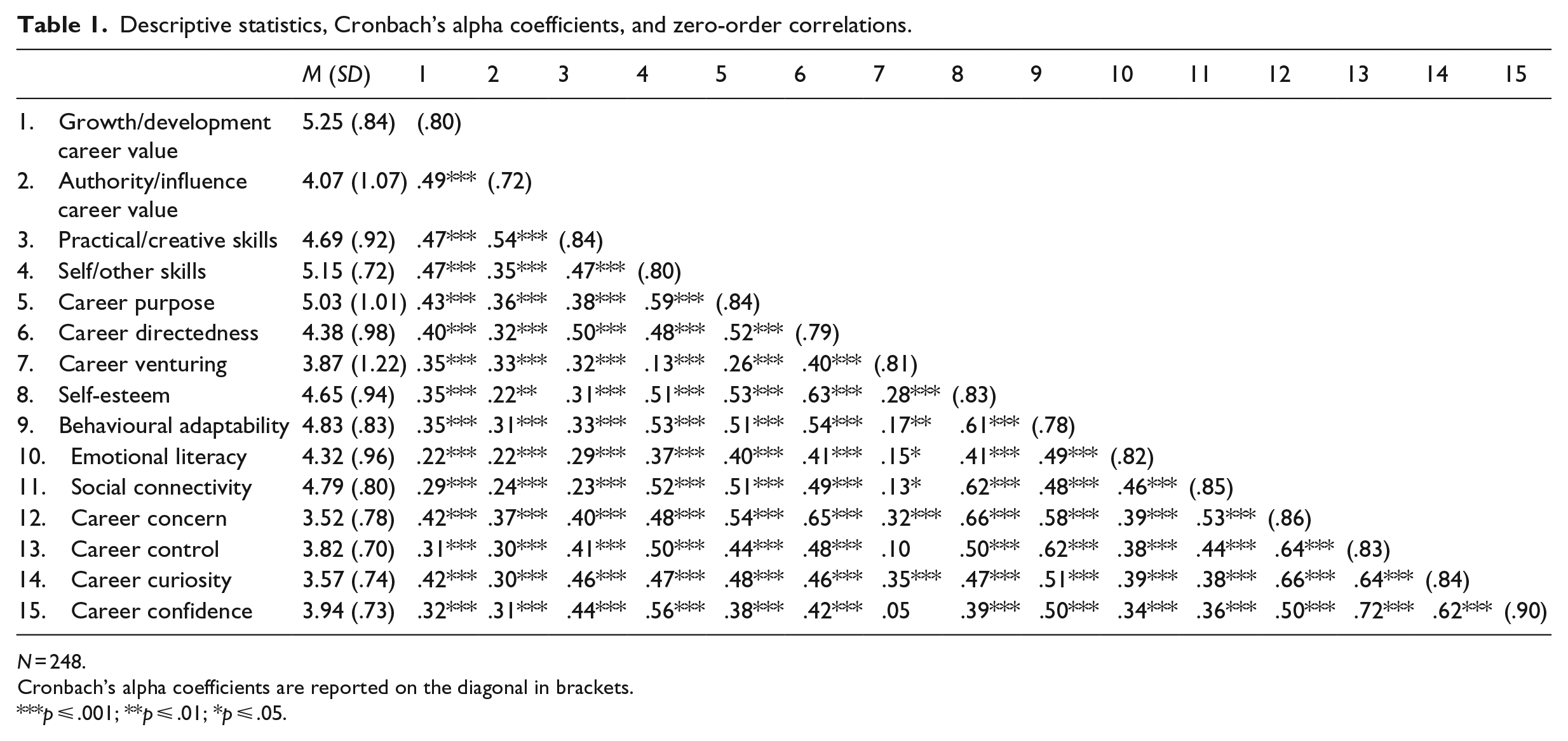
N = 248.
Cronbach’s alpha coefficients are reported on the diagonal in brackets.
p ⩽ .001; **p ⩽ .01; *p ⩽ .05.
CCA: testing multivariate associations among the variables
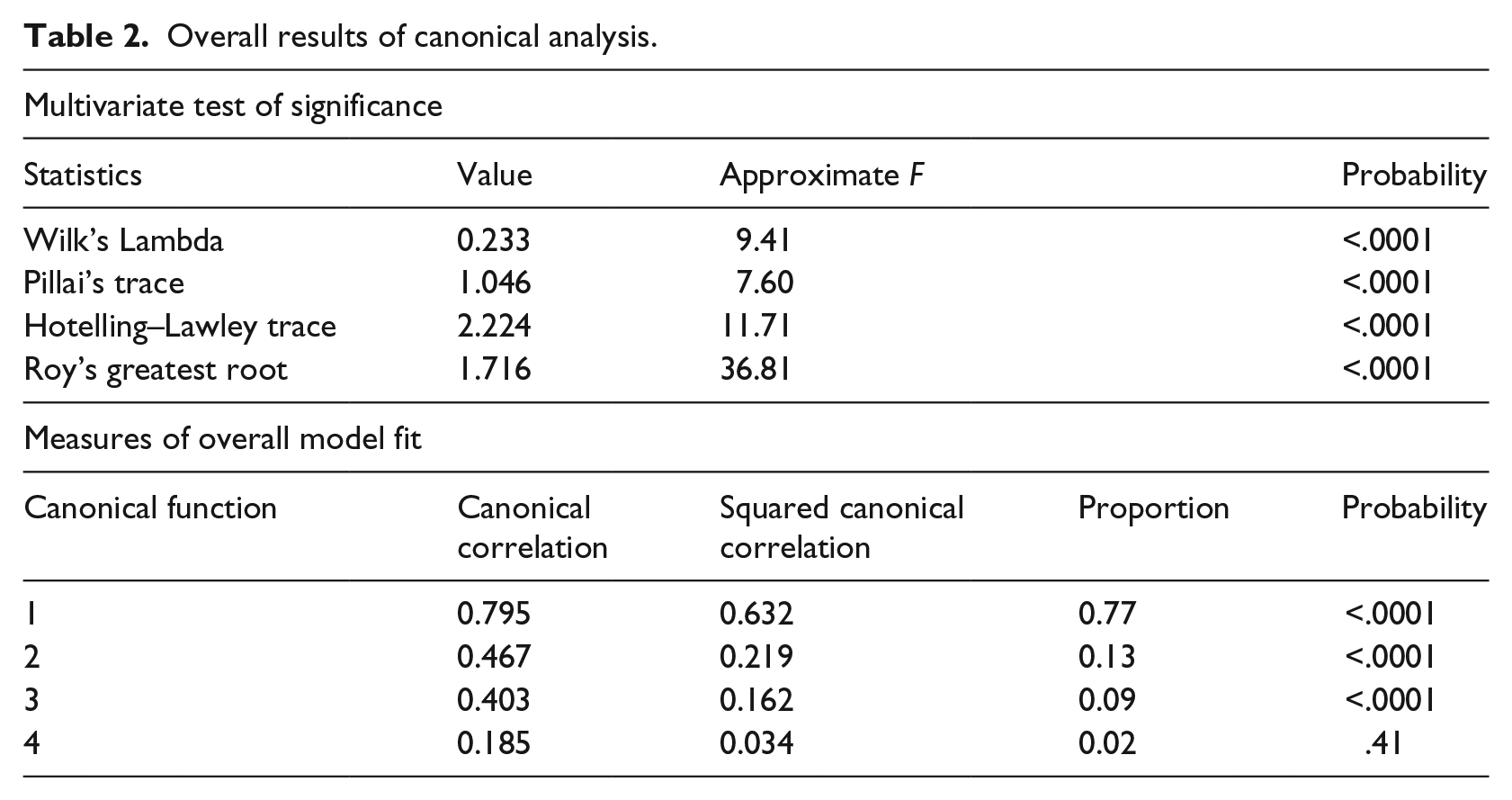
The CCA provided support for the research hypothesis. Table 2 shows that the full canonical model was statistically significant across three functions with a Wilk’s lambda (λ) of .233, F = 9.41, p ⩽.0001. The r2 metric of effect size of 1 − λ (1 − .233) was .77 (large practical effect) which indicates that the full model explained a substantial proportion (about 77%) of the variance shared between the two sets of variables. Table 2 shows that the canonical correlation of the first function was .79 and contributed already 77% of the explained variance relative to the three functions. The first function was therefore regarded as being practically sufficient for interpreting the links between the two sets of variables. The redundancy index (squared canonical correlation = .63; large practical effect) verified this decision.
Overall results of canonical analysis.
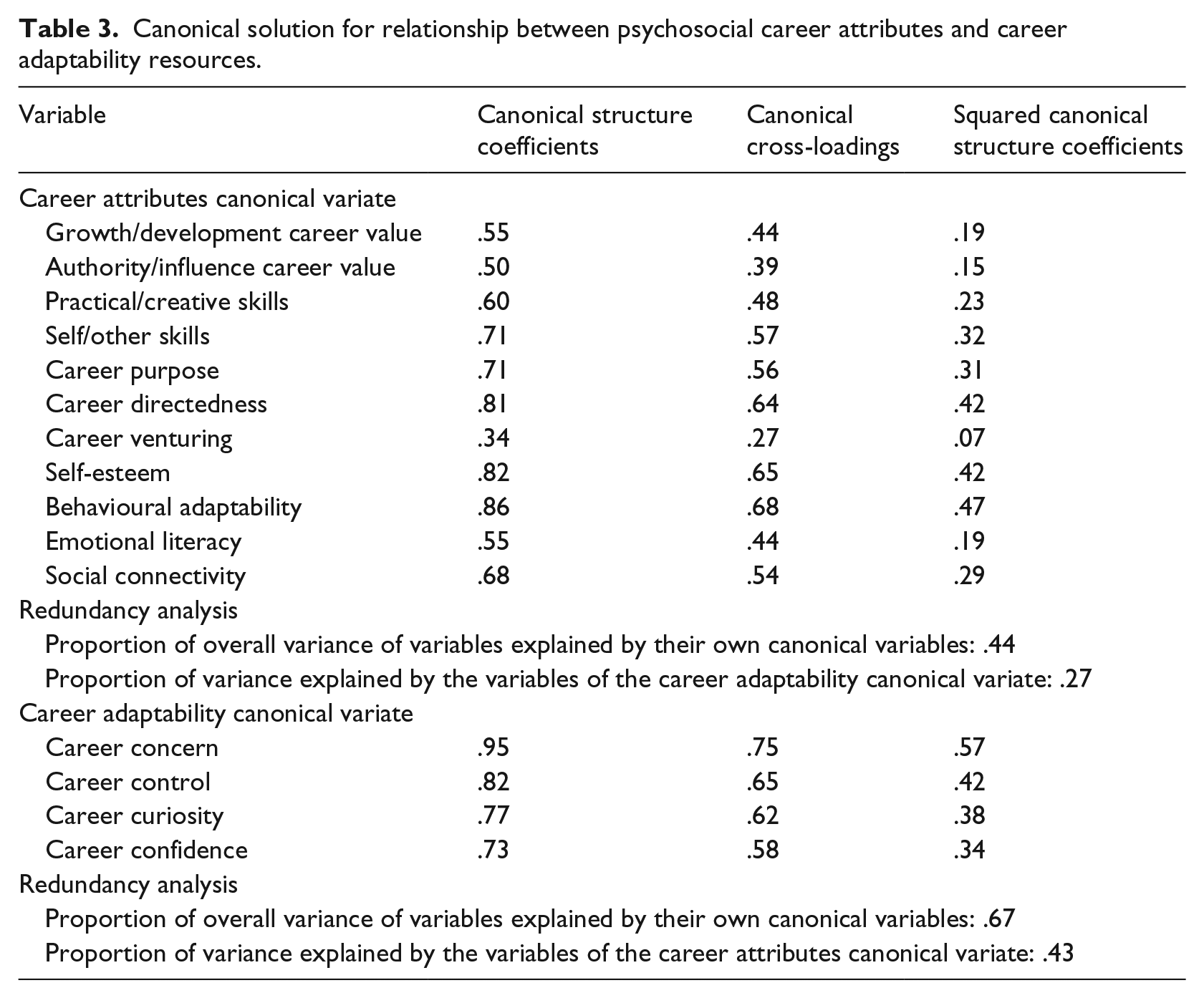
The canonical structure coefficients, canonical cross-loadings, and squared canonical structure coefficients are reported in Table 3. Due to the number of variables, a relative rigorous threshold value (only variables that exceeded an rc greater than .50; large practical effect) was used in the interpretation. The canonical cross-loadings showed that participants scoring high (large practical effect) on behavioural adaptability (rc = .68;
Canonical solution for relationship between psychosocial career attributes and career adaptability resources.
Discussion
The study explored whether the positive links between individuals’ psychosocial career attributes and career adaptability resources empirically represent the characteristics associated with proactive career self-management behaviour. Overall, the results highlighted a number of psychosocial career attributes and career adaptability resources that seem to share similar characteristics relating to proactive career self-management behaviour. The common themes underpinning the positive links between the career attributes (behavioural adaptability, career directedness, self-esteem, self/other skills, social connectivity, and career purpose) and the four career adaptability resources (career concern, career control, career curiosity, and career confidence) describe the characteristics of (1) self-efficacious adaptive goal-directed behaviour, (2) proactive psychosocial career engagement behaviour, and (3) career resilience. Previous research indicates these three characteristics as important elements of proactive career self-management behaviour in that they allow individuals to take ownership of their own career development, adaptation, and goal achievement (Lent et al., 2016; Savickas & Porfeli, 2012). Seen commonly through the lens of self-determination theory (Deci & Ryan, 2000), the career constructs embedded in the three synthetically derived themes also allude to the needs for competence (behavioural adaptability, career directedness, self-esteem, self/other skills, career purpose, career concern, career control, career curiosity, and career confidence) and relatedness (social connectivity). In this regard, the research extends career self-management theory by connecting the two sets of career constructs through the theoretical lens of self-determination theory (Deci & Ryan, 2000). It appears from the findings that the three characteristics of proactive career self-management also emphasise the intrinsic motivation for fulfilling the need for competence and relatedness.
Self-efficacious adaptive goal-directed behaviour
The results of this study suggest that self-efficacious adaptive goal-directed behaviour is a common theme embedded in the positive links between key psychosocial career attributes and career adaptability resources. Psychosocial career attributes included behavioural adaptability (the capacity to initiate and engage proactively and courageously in the career self-management process and deal positively with setbacks), career directedness (clarity about future career directions and goals, finding support and crafting new opportunities), self-esteem (sense of worthiness and effectiveness in comparison to others), and career purpose (having a career calling). The key career adaptability resources highlighted were career concern (future-orientation and preparedness for upcoming career tasks and challenges) and career confidence (self-efficacious engagement in problem solving and goal implementation behaviour). These constructs all emphasise self-efficacious goal-directedness.
The finding corroborates the premise of SCCT model of career self-management (Lent & Brown, 2013) that goals and self-efficacy are core attributes of adaptive career self-management. Goals set the stage for engaging in adaptive career behaviours such as career planning and exploration. Self-efficacy (i.e., the ability to manage specific tasks necessary for career preparation and adjustment across diverse occupational paths) contributes to goals and actions through the confident engagement in career exploration and decisional behaviours (Lent et al., 2016). Self-determination theory (Gagne & Deci, 2005) also views self-efficacious goal-directedness as an element of the intrinsic motivational state of competence.
Proactive psychosocial career engagement behaviour
Apart from behavioural adaptability which denotes conscientiousness in initiating, setting, and implementing goals in the career self-management process (Coetzee, 2014), the findings suggest that self-management and interpersonal skills, social connectivity, and career curiosity also describe proactive psychosocial career engagement behaviour. Career curiosity denotes openness to career engagement with the active exploration of future work roles and opportunities in different environments (Zacher, 2014).
Previous research indicates that apart from goal-directed behaviour, openness and conscientiousness facilitate the development of self-efficacy (a sense of competence) at career planning tasks because of the organisation and persistence tendencies that flow from these traits (Lent et al., 2016). The results further seem to suggest that proactive psychosocial career engagement can also be explained by well-developed self-management and interpersonal skills and social connectivity (establishing mutually satisfying and supporting relations in support of career goals; Coetzee, 2014) attributes. In this regard, the finding corroborates the basic premise of self-determination theory (Gagne & Deci, 2005) that the intrinsic motivational states flowing from a sense of competence and relatedness are important in engaging in proactive psychosocial behaviours.
Individuals’ careers occur in social contexts and therefore necessitate the development of skills in establishing positive interpersonal relations and networks that support the achievement of long-term positive career outcomes (Parker, Khapova, & Arthur, 2013; Ryan & Hopkins, 2013). Previous research also indicates conscientious career planning and exploration, and the establishment of contacts that can help one professionally as important elements of proactive career engagement behaviour (Hirschi & Freund, 2014).
Career resilience
The results of this study also highlight links between behavioural adaptability, self-esteem, career confidence, and career control (self-disciplined ownership and perseverance in career self-management; Savickas & Porfeli, 2012), all of which denote the characteristics of career resilience. Research scholars (e.g., Hirschi, Lee, Porfeli, & Vondracek, 2013) view career resilience as an important characteristic of proactive career self-management behaviour because of its link to self-efficacious goal-setting behaviour that facilitates positive career outcomes and person-environment congruence. Career resilience is generally characterised by a high degree of adaptability, self-confidence, and perseverance even in the face of adverse career circumstances (Bezuidenhout, 2011).
The findings of the study have important implications for career theory. Apart from contributing to self-determination theory, the three common themes identified from the positive links among the career adaptability resources and psychosocial career attributes extend career adaptability theory (Savickas & Porfeli, 2012) by identifying key psychosocial career attributes that explain the psychological readiness for adaptive career behaviour. Adaptive readiness denotes the self-regulative trait component of proactive career self-management that helps shape the development and use of the career adaptability resources (Savickas & Porfeli, 2012; Tolentino et al., 2014).
The findings of the study also have important implications for practice. Employee career development discussions and counselling could benefit from an awareness of the value of developing the career attributes and adaptability resources underpinning the three dimensions of career self-management behaviour. Self-efficacious adaptive goal-directed behaviour, proactive psychosocial career engagement behaviour, and career resilience might be interpreted as key characteristics for enhancing employees’ personal agency in their career development. The three characteristics combine key career adaptability resources and psychosocial career attributes that serve as mechanisms for activating the intrinsic motivation for competence and relatedness in the work context. Career development discussions may focus on developing the three characteristics identified in this study to facilitate proactive career self-management behaviour.
The findings of this study should be interpreted with caution due to a number of research design limitations. First, the cross-sectional research design limits the generalisability of the findings to the participants involved in the study only. Future research should consider replicating the study with additional career measures in various occupational and socio-cultural contexts. Second, due to the exploratory correlational design, no cause–effect relations could be established but merely the magnitude and direction of associations between the variables. Future longitudinal studies could establish such relations through more complex research designs. Third, the measures were self-report and concerns about the possibility of common method bias should be considered in future research projects.
Conclusion
The study highlighted three dimensions of proactive career self-management behaviour as explained by the positive links between career adaptability resources and psychosocial career attributes. The three dimensions of self-efficacious adaptive goal-directed behaviour, proactive psychosocial career engagement behaviour, and career resilience offer considerations for practitioners involved in career development and counselling discussions with employees who need to develop personal agency in their career development and management. We hope that future studies will build on these findings to provide more in-depth understanding of the career attributes and resources that underpin proactive career self-management behaviour.
Footnotes
Acknowledgements
The authors are grateful to the participants who voluntarily participated in the study and Ms C Shunmugum who collected the data.
Declaration of conflicting interests
The authors hereby declare that they have no conflict of interest and that the article has not been submitted elsewhere for either review or publication.
Funding
This research received no specific grant from any funding agency in the public, commercial, or non-profit sectors. No financial support for the research, authorship, and/or publication of this article was received.