




Abstract
A parenting education program delivered to a sample of parents of young children aged 3–12 years who often used negative behavior control strategies to discipline their children was evaluated for effectiveness using a quasi-experimental design. Parents (n = 150) who received parenting education program intervention program for 8 weeks (weekly 2 hr session) were compared with parents (n = 150) who did not go through the program. The program’s effectiveness was evaluated with regard to changes in parental disciplinary behavior through observation of parent–child interactions during home visits. Data were collected across three time periods using home observation checklist. Significant improvements in parenting skills were observed as many parents were seen using verbal praise and other positive strategies in dealing with their children; a feat that was lacking before to intervention. The analysis of covariance revealed a significant treatment effect on parenting behavior F(2, 248) = 23.39, p < .05, with the intervention parents demonstrating greater ability to use positive behavior control strategies than did the comparison parents. The magnitude of the effect size was medium (partial η² = .072). This effect persisted over a 12-week follow-up period. These findings indicated that the parenting education program could be effective in helping parents improve their parenting skills and support the parents in creating a safe and supportive home environment that prevent children’s exposure to physical abuse.
Introduction
Child discipline is considered an integral part of child rearing in all cultures (United Nations Children’s Fund [UNICEF], 2010). It is also considered an important aspect of parenting. It is widely acknowledged that parents serve as the primary socialization agent for children. Central to the process of the socialization of children is the parenting behaviors and discipline responses which children experience within family settings (Halpenny, Nixon, & Watson, 2010). Although the need for child discipline is broadly recognized, there is considerable debate regarding violent physical and psychological disciplinary practices (UNICEF, 2010).
In Nigeria, parental use of physical methods as means of disciplining children is widespread. The traditional child-rearing method in the Nigerian society seems to support the idea of “not sparing the rod on the child” which tends to encourage the beating of children. Although Nigerian parents are known to cherish children, at the same time, they tend to bring up their children with an “iron” hand (harsh discipline). Fatimilehin and Hassan (2016) have noted that physical chastisement is a common component of parenting in Nigeria. Findings from research showed that cultural factors contribute to child abuse (Ajayi, 2013; Fatimilehin and Hassan, 2016; Nduka, Mansor, & Talib, 2012); parents beat their children as a form of discipline, and use cultural beliefs to justify their actions, believing that their children will behave well after being punished. Bassey (2016) while citing Akpan and Oluwabamide (2010) noted that African children, although cherished by their families, are often disciplined using life-threatening physical violence, such as severe beatings, burns, and strangulations, which are inflicted by the adult members of the community. For many children, corporal punishment has become a regular part of their daily experience.
A UNICEF (2014) study conducted in Nigeria found that on average about four in five children aged 2–14 years about 91% of children surveyed had experienced violent discipline at home in the month prior to the survey. Ejikeme (2003) and Nduka, Mansor, and Talib (2012) stated in their studies that Nigerian culture is deeply rooted in sociocultural values, customs, beliefs, and ideas about what constitutes good and bad behavior and noted that parents were culturally empowered to use physical punishments to discipline their children, thereby making them see corporal punishment as legitimate ways of responding to child’s misbehavior. The parents who failed to use harsh punishments in child training were seen as negating the child-rearing processes (Mejiuni cited in Ajayi, 2013). Thus, the use of corporal punishment is deeply rooted in Nigerian society and is passed on through generations (Nduka, Mansor, & Talib, 2012), culminating in what Halpenny, Nixon, and Watson (2010) described as the “cycle of intergenerational transmission of parenting practices.” Through the process of social learning, children see corporal punishment as the norm that they themselves transmit to their own children thus resulting into a vicious cycle (De Zoysa, 2011; Snyder & Bub, 2008). This phenomenon is thought to be a possible reason for parents adopting to use an only method they know—corporal punishment.
Research has consistently demonstrated an association between use of corporal punishment and a range of negative developmental outcomes for children (Smith, 2012). Several studies have linked corporal punishment with physical, social, cognitive, and psychological negative consequences on children’s development (see Gershoff & Gragon-Kaylor, 2016; Tang & Davis-Kean, 2015). Given the widespread use of parental corporal punishment coupled with its harmful effects on children necessitates the need for parenting intervention programs.
The literature on parenting programs indicate that they can be highly effective in changing parenting behaviors. For instance, the majority of evaluations reviewed in the study by Holzer, Higgins, Bromfield, Richardson, and Higgins (2006) reported successful results following participation in a parent education program. Peters and Durrant (2009) reviewed 57 research articles, including 11 meta-analyses evaluating parenting programs. It was reported that most of the evaluations and virtually all of the meta-analyses had positive effects of the interventions on parenting attitudes, beliefs, and their behavior. Some of the parenting programs that have demonstrated effectiveness include The Incredible Years (Webster-Stratton & Reid, 2015); Tripple P-Positive Parenting Program (Sanders, 2012), and Parent–Child Interaction Therapy (Brinkmeyer & Eyberg, 2003), among several others. While there is considerable research for the effectiveness of parenting education programs (PEPs), there is limited evidence from the Nigerian perspective.
Research problem
Many parents are not aware of the harmful effects of corporal punishment and do not realize the damage they cause when they use such disciplinary methods on their children (Deb, 2018) and also have no idea about discipline methods that are non-punitive (Fatimilehin & Hassan, 2016).
Our concern is premised on the need to help parents develop appropriate child management techniques and improve parenting practices. This requires a drastic intervention through the process of education. Based on cognitive dissonance theory (Festinger, 1957), it is possible to change practices by introducing people to new information. Education remains a powerful force that has potential to bring about change in the life of individuals and society (Patil, 2012). Unfortunately, there appears to be a paucity of education programs that can serve local needs. The existing ones are mainly foreign based and do not address parenting problems relevant to this study. This lack of awareness on the part of parents and lack of a strong empirically tested program of intervention that is culturally suited for Nigerian setting inspired the present researchers to develop a program of intervention called PEP on corporal punishment prevention (PEP) designed to enhance parental capacity in managing their children’s behavior.
Several studies cited in Tolani, Brooks-Gunn, and Kagan (2006) suggested that parenting behaviors, or changes in parenting behaviors, are associated with the quality of a child’s development, therefore a PEP can be instrumental in helping parents reduce the use of corporal punishment on children and thereby support their children’s developmental outcomes. Moreover, many experts agree that in order for parents to be effective caregivers for their children, they should possess certain knowledge, skills, attitudes, and interpersonal abilities that promote parenting effectiveness (Shriver & Allen, 2008; Zepeda, Farela, & Morales, 2004). Therefore, the focus of this study is justified on the need to impart knowledge, skills, and tools which will enhance parental abilities and assist parents toward using positive methods of discipline in ways that support their children’s optimal development.
The primary aim of this study was to evaluate the effectiveness of PEP program by determining whether participation in PEP program can impact parental ability to employ positive behavior control strategies in child training. The study was guided by the key question: To what extent would participation in PEP intervention program impact parental ability to employ positive methods of discipline in child training? It was hypothesized that there would be significant difference between parents who received PEP intervention and those who did not receive such intervention on their ability to employ positive methods of discipline in child training, and there would be significant long-term effect of PEP intervention program on parental outcome.
Theoretical and conceptual framework
This study was grounded on social learning theory, a theory formulated by Bandura (1977) to explain the acquisition of social behaviors. The theory suggests that we acquire new behaviors and develop attitudes and views through observation, reinforcement and ensuing imitation of significant models. Parenting interventions based on social learning theory typically involve an interactive, collaborative learning format in which program facilitators teach key behavioral principles and parenting skills to parents/caregivers who then practice the skills that they have learned (Furlong et al., 2010). Social learning theory is suitable for our study because it views behavior and behavior change as the reciprocal interactions between individuals and their environments. We will rely on the principles of the theory to develop parenting capacity by using direct instruction, modeling, role-playing, and homework practices to teach positive parenting skills to parents of young children and to modify key aspects of parenting that damage child development. Research suggests that parenting education can be a mechanism for transformative learning that will result in changed positive parenting practices which in turn improve outcomes for children (Huebner, 2002).
The PEP program is guided by a conceptual framework based on the premise that interventions that promote positive parenting are central to creating safe and supportive environment for children (Sanders & Cann, 2002).
Method
Participants
The study was conducted using a quasi-experimental design. The target population comprised all Nigerian parents of young children aged 3–12 years. Parents of young children were targeted because studies have revealed that corporal punishment is used more frequently on younger children aged 6–12 years than on older children aged 13–18 years (Banda, 2006).
A multi-stage sampling process was employed in selection of study participants. In stage 1, Nigeria was stratified along the three major regions: Northern, Western, and Eastern as reflected in the old regional structure. The headquarters of each region were selected as study locations, namely, Kaduna, Ibadan, and Enugu. In stage 2, one local government area (LGA) was randomly selected within each study location. In stage 3, from each LGA, two communities were selected, one as the intervention and the second as the control. In stage 4, within each community, 13 streets were randomly selected for block-listing from which 120 households were drawn. In stage 5, within each household, parents who have young children aged 3–12 years in their care were identified, targeting only the parent who served as the primary caregiver. Altogether, a total of 709 parents of young children were identified across the six study communities. Finally, we carried out a screening test to identify the parents to be included in the study by selecting only parents who endorsed the use of corporal punishment and reported utilizing such methods to discipline their children. The screening process resulted in the identification of 619 parents, out of which 300 were randomly selected to form the sample for the study.
Instruments
Parenting questionnaire
The parenting questionnaire (PQ) was developed by the researchers after an extensive review of literature. It had two sections: The first part gathered information on the demographic background of the parents. The second part of the questionnaire measured the frequency of parental use of corporal punishment with children. Participants were asked how often during the past 2 weeks they had used different forms of corporal punishment to discipline their children; 2 weeks referent period was chosen to facilitate recall. The section included seven items comprising a range of typical disciplinary practices commonly used by parents. Some of the items constituted psychological punishment (yelling, verbal abuse, and making child feel ashamed), while some were physical punishment (slapping, spanking, hitting with an object, and threatening to beat). The items were completed on a 4 (always) to 1 (never) scale. Scores ranged from 7 to 21 with higher scores indicating frequent use of corporal punishment on children.
The internal consistency reliability based on Cronbach’s alpha was calculated and a value of .87 was obtained.
Fidelity of PEP implementation
In this study, adherence to the PEP program delivery was measured using an observational tool developed by the researchers—PEP delivery observation guide (PEPDOG)—on which trained observers rated the extent to which parent educators adhered to the intervention procedure and implemented the intervention with integrity. The observers observed and rated each component of the program curriculum as well as the delivery procedure for each of the eight sessions which they reported on a three-point scale ranging from 1 (not implemented) to 3 (full implementation). The feedback showed that the facilitators demonstrated 93.6% fidelity in program delivery, showing that the implementation of fidelity was high and was found to be within the acceptable range of 90%–100% specified by Field (2009).
Home observation checklist
Trained observers conducted home visits on the participants’ homes to observe the behavioral patterns in the quality of parent–child relationship. A 16-item checklist of behavior control strategies was developed by the researchers which was used in rating the type and frequency of the observed incidents, seven of the items constituted punitive/violent techniques, two items constituted negative but non-punitive techniques, while seven items constituted non-violent/positive techniques. The observers were required to specify the type of disciplinary methods that parents used on their children and to rate the frequency of occurrence. A coding manual was developed by specifying the definitions for each target behavior. Using the checklist of behaviors, the observers simply checked off the occurrence of each target behavior. All the items demonstrated good reliability with Cronbach’s alpha of .78.
PEP intervention package
The PEP curriculum was designed to provide parents of young children with information about positive discipline strategies that are safer, non-violent, and more effective than corporal punishment. It has as its goal to help parents to develop appropriate child behavior management techniques, improve their parenting skills, and reduce parental reliance on harsh discipline. The program was developed using techniques that were derived through a combination of the principles of adult learning, reinforcement, and social learning theory. The intervention package (curriculum) included topics relating to child development and the harmful effects of corporal punishment as well as topics that addressed positive parenting strategies. The lesson topics were structured into eight session modules of 2 hr weekly session, comprising an orientation/relationship building session, six main content sessions, and a review session/closing ceremony. Each module session was made up of a number of steps.
The validity of the PEP curriculum was ascertained via pilot study. First, a draft copy of the program content was presented to a team of experts in the field of educational psychology who reviewed the content of the program and made some corrections. Then, we piloted the program to check for clarity in both the curriculum and the implementation process. No ambiguity was detected in the content.
Procedure
The process of data collection started with the recruitment and training of fieldworkers (research assistants, observers, data collectors, parent peer educators, and block-listing officers); identification of project sites; contacting and meeting with heads of selected communities to secure permission; and the recruitment of study participants on whom the parenting intervention was implemented.
During each parenting session, the curriculum was delivered in a group setting format interspersed with icebreaking exercises, indigenous folk songs, and games to motivate and sustain participants’ interest. Each session started with a recap of previous session. The teaching method used during each session consisted of direct instruction, group activities, group discussions, role-plays, and home practice activities. This delivery method provided parents with an opportunity to learn, model, practice, and apply the new knowledge aimed at promoting behavior change. Each training session introduced a new strategy on positive parenting strategies. For instance, the PEP program taught parents the strategies for focusing on “dos” instead of “don’ts,” paying attention on good behavior, giving praise and rewards for good behavior, ignoring minor disruptions, fostering positive parent–child interaction, and parents as role models to their children—all of which were aimed at enhancing parenting skills. The full detail of the intervention implementation procedure is contained in the PEP Training Manual.
We employed a 3-tier train-the-trainer model in delivering the PEP intervention, in which we trained research assistants who in turn trained community parents as parent peer educators to deliver the intervention to the participants. This delivery strategy was adopted because research has shown that peer education can be a powerful method of effecting social change (Kabara-Clark, 2014). Parents in the intervention communities (n = 150) received PEP intervention for a period of 8 weeks (weekly 2 hr session) for a total of 16 hr. Parents in the control communities (n = 150) received no intervention but given a placebo treatment during the same period on the topic “Importance of education for national development.” Both the intervention group and the control group followed the same data collection schedule except for the difference specified in the design.
Several steps were taken to minimize attrition. For instance, apart from collaborations with the local community leaders who helped to mobilize community support for the project, as well as the local delivery of the program, we offered several incentives which helped to encourage and motivate participant involvement including providing snacks and meals during parenting classes, using the local community centers as training venues, scheduling the classes during hours that were convenient for program participants, providing child care for the young children who accompanied their parents to the training venues, and using a tracking approach and sending reminders of meeting times, which resulted in high attendance rate.
Data were collected across three time periods—pretest (Time 1), posttest (Time 2), and follow-up (Time 3). The pretest measures were administered before the first parenting class. Posttest measures were administered on the last day of parenting class; 12 weeks after intervention, all participants were re-contacted for a follow-up assessment. While the questionnaire data were collected at the training venues, Home observation data were collected at participants’ homes. Participants were observed in their homes at three time points (pre, post, and follow-up). Each of these observations lasted 35 min. The data collection process lasted 20 weeks from August through December 2016.
Ethical considerations
Ethics approval for the study was granted by the Research Ethics Committee of the National Open University of Nigeria. Parents were informed about the purpose and nature of the research and their right to opt out if they wished to. They gave informed consent to participate in the study. Confidentiality was maintained.
Data analysis
Data collected from the observation were coded into quantitative categories and analyzed with the use of frequencies, means, and the analysis of covariance (ANCOVA) in which pretest scores served as covariates to control the pretesting effect. All statistical analyses used SPSS (version 17). All significance tests were set at .05 alpha level. The effect size measure for ANCOVA results were reported as partial eta squared (partial η²). In line with recommendations, the values were interpreted as small: partial η² = .01, medium: partial η² = .06, or large: partial η² = .13 (Cohen, 1988).
Results
Participants’ demographic characteristics
The participants were primarily women (83%), while male participants accounted for 17% of the sample. The age of participants ranged from 15 to 45 years and above with a mean age of 28.4 years. On educational level, about one-third of the sample (34.7%) had secondary education, 31% had higher education, with 19.7% and 14.7% indicating primary education level and no formal education, respectively. On employment status, many of the participants (53.2%) were on part-time employment, 29.7% were on full-time employment, while 14.4% were self-employed and 2.7% unemployed. In terms of marital status, the vast majority of participants (79.3%) were married, while 13.7% were either divorced, or separated, or widowed, and 6.7% comprised single parents who had never married. All parents had varying number of children ranging in age from 3 to 12 years: 57 parents had one child, 84 parents had two children, 86 of the parents had three children, 55 parents had four children, 11 parents had five children, while 7 parents had six children.
Impact of PEP intervention program
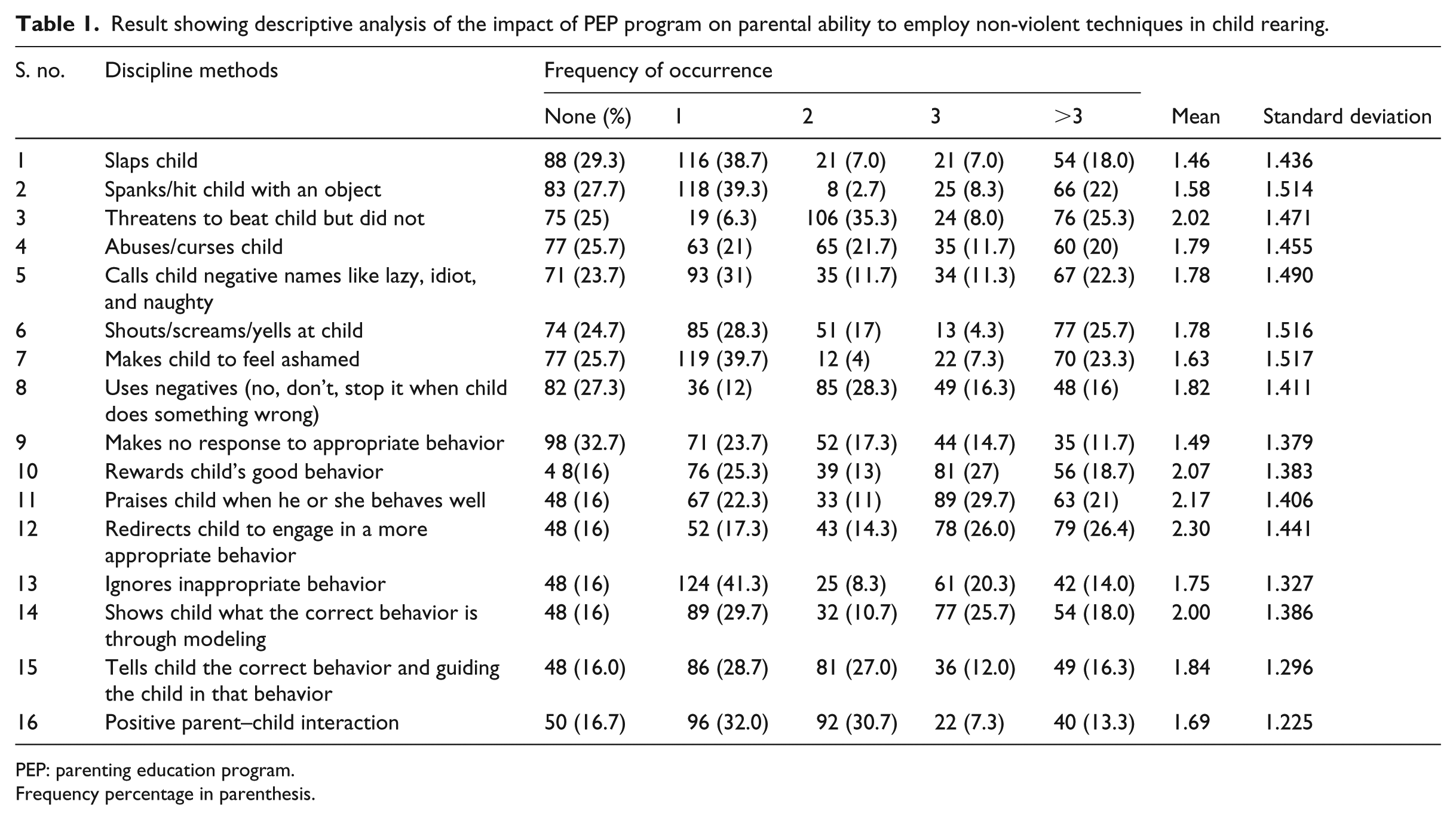
The descriptive data gathered in respect of the research question on the impact of PEP intervention on parental ability to employ positive behavior control strategies were analyzed using frequency scores and the results presented in Table 1.
Result showing descriptive analysis of the impact of PEP program on parental ability to employ non-violent techniques in child rearing.
PEP: parenting education program.
Frequency percentage in parenthesis.
Table 1 showed the 16 disciplinary methods that were examined, with seven of those methods (nos 1–7) constituting punitive/violent techniques, two methods (nos 8–9) constitute negative but non-punitive techniques, while seven of the methods (nos 10–16) constitute non-violent/positive techniques, which were the main concern of this study. From Table 1, it is observed that a majority of parents (84%) have learnt to use more positive forms of behavior management strategies in dealing with their children. They have learnt to use rewards system to reward the child’s good behavior, praising the child when he or she behaved well and also redirected the child to engage in a more appropriate behavior. The most commonly used non-violent techniques include redirecting child to engage in a more appropriate behavior, praising child when he or she behaves well, and rewarding child’s good behavior, showing child what the correct behavior is through modeling. Based on the finding, it can be concluded that to a large extent, the PEP intervention program enhanced parental ability to employ non-violent methods of behavior management in child training.
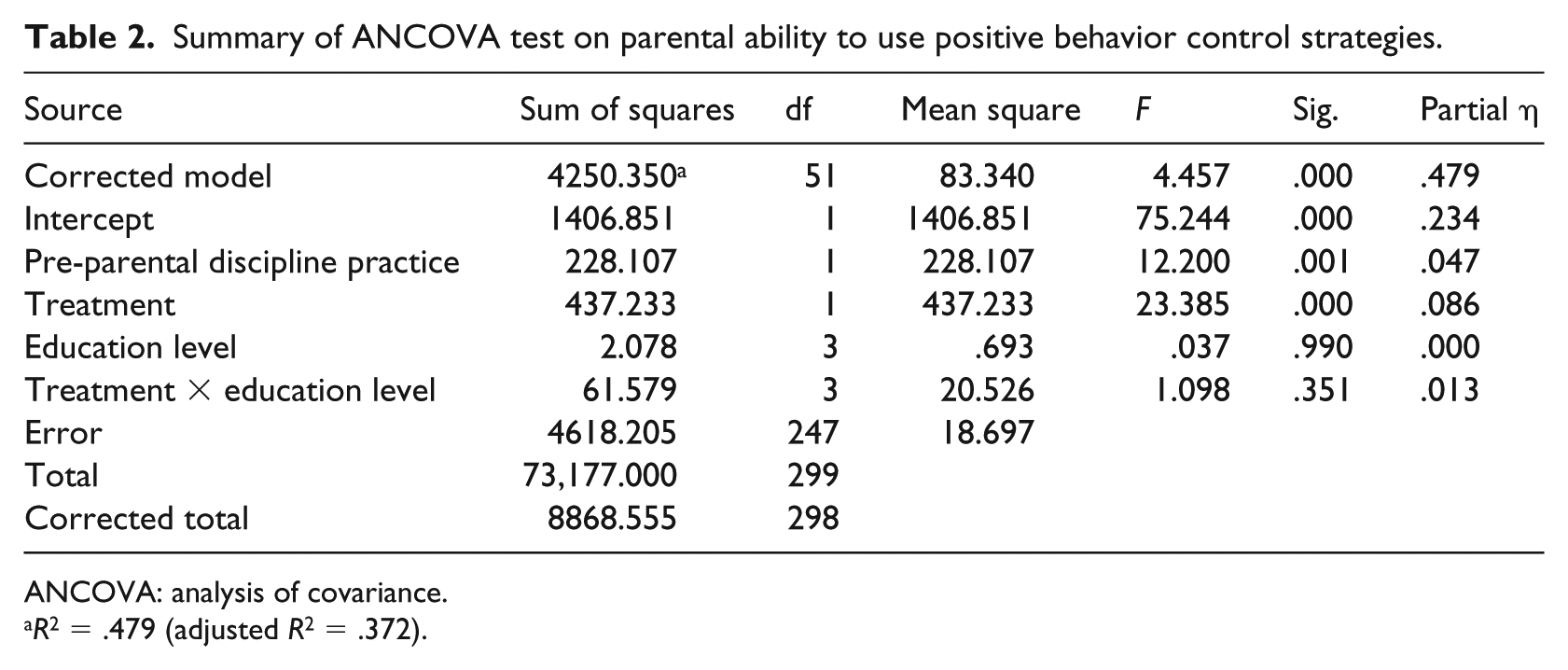
The inferential analysis of the treatment effect is presented in Table 2.
Summary of ANCOVA test on parental ability to use positive behavior control strategies.
ANCOVA: analysis of covariance.
R2 = .479 (adjusted R2 = .372).
Table 2 reveals that after adjusting for the covariance, the effect of treatment on parental outcome was statistically significant, F(2, 248) = 23.39, p < .05. Consequently, the null hypothesis was rejected. Table 2 further showed that the magnitude of the effect size as indicated by the partial eta square
Durability of treatment effect
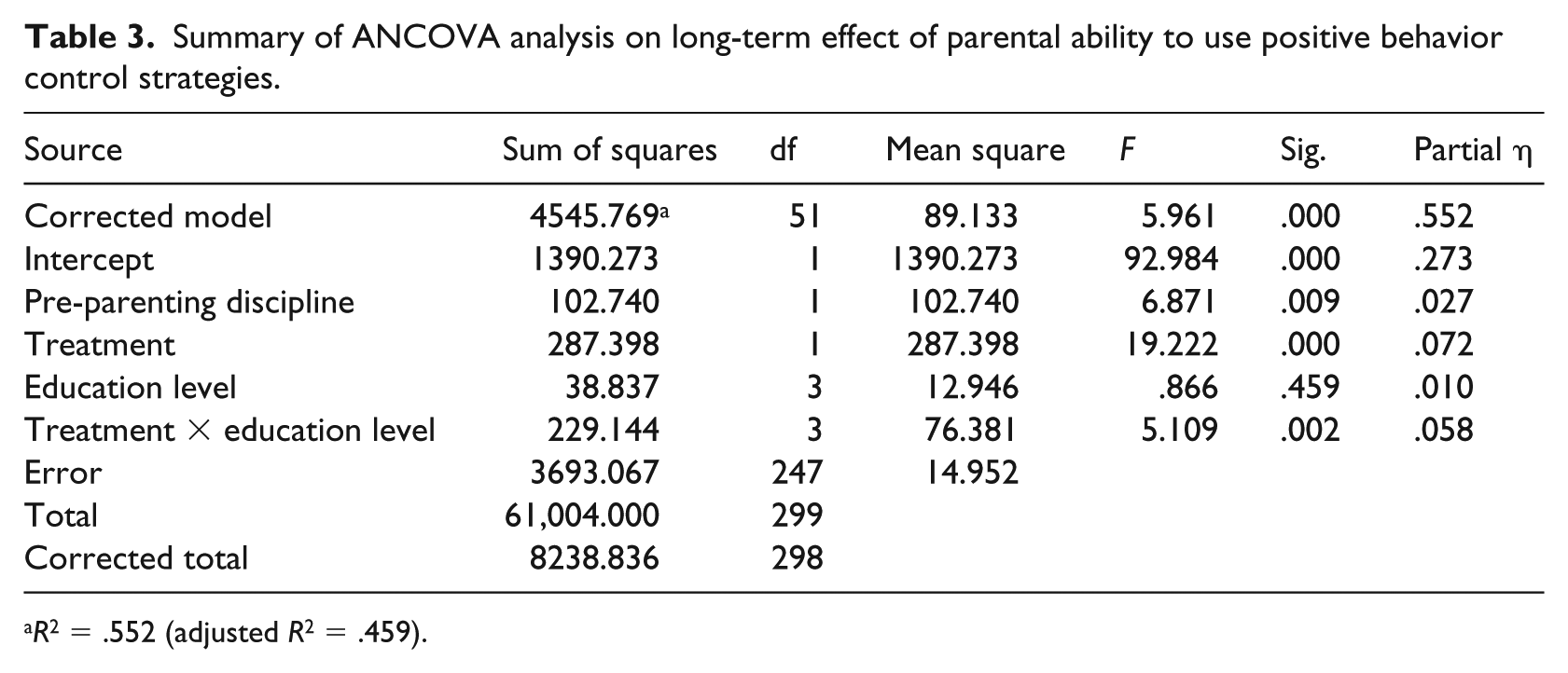
The delayed posttest measure was used in the analysis to determine whether the intervention had a durability effect. The result is presented in Table 3.
Summary of ANCOVA analysis on long-term effect of parental ability to use positive behavior control strategies.
R2 = .552 (adjusted R2 = .459).
Table 3 revealed that the long-term main effect was statistically significant F(1, 247) = 19.22, p < .05. The magnitude of the effect size was .072. The adjusted R2 value of .459 indicates that the independent variables accounted for 45.9% of the variation in the long-term treatment effect. The intervention group has the higher adjusted mean score of
Discussion
Evidence yielded by the study revealed that parents who received PEP intervention demonstrated an increased use of positive techniques in managing their children’s behavior. The parents demonstrated increases in praising the child, redirecting child’s attention, rewarding child’s good behavior, and showing child what the correct behavior is through modeling; a feat that was lacking prior to intervention. The effect of treatment was statistically significant with an effect of medium magnitude. The study extends previous research demonstrating the positive effects of parenting education on parents (see Holzer et al., 2006; Lakes, Vargas, Riggs, Schmidt, & Bair, 2011; Peters & Durrant, 2009; Santini & Williams, 2016). It could be deduced from our findings that PEP intervention can be effective in reducing harsh parenting while demonstrating increases in parental ability to use more positive forms of behavior management in child training.
The study has demonstrated the potential of PEP program by showing that in spite of the strongly held beliefs on the use of the “rod” as a disciplinary measure, which is deeply rooted in Nigerian society and is passed on through generations (Nduka, Mansor, & Talib, 2012), the program has made a difference by impacting positive changes on parents’ behavior. A possible explanation for the observed changes may be as a result of the new knowledge and information about parenting and childrearing covered during the training sessions. According to De Zoysa (2011), such favorable results could be obtained only if certain conditions are fulfilled such as receptivity and readiness of parents to such information and the extent of emotional arousal that the information-giving activity elicits in the parents. These conditions appeared to have been established in this study. For instance, the parents participated actively during the training sessions and showed much interest and enthusiasm to learn, which have been recognized as key determinants in behavior change (Pojoga & Marici, 2015). One could therefore conclude that the content of our intervention program appeared to have such motivational properties that provoked emotional arousal and thus psychological receptivity which instigated the observed change on the part of the participants.
From the findings that emerged, one can infer that PEP intervention program appeared to have a moderately strong effect. According to experts, only a moderate threshold of evidence was required before recommending implementation of these types of programs. Interventions with even a moderate effect could impact a large number of people (Mash & Mash, 2016).
In addition to the effectiveness of PEP program in producing changes in the outcome variable, the utility of PEP program was further demonstrated by its ability to produce long-term changes at 12-week follow-up. One explanation for the enduring effect may be that the issue of concern—parenting and child discipline—is very topical, highly involving, and of personal relevance. Many Nigerian parents cherish their children and are eager to have a better understanding about how to bring up their children well. This may have predisposed the observed effects to be relatively long-lasting even after the 12-week follow-up period. But whether there will be a further stability at a later testing is a question to be examined in future research. However, there exists suggestive evidence that treatment effects can be successfully maintained over time through periodic remodification of behavior (Bandura, 1977).
There are a couple of important implications of the findings to practice that can be drawn from this study. Given the importance of our findings, the PEP program can be a useful resource for supporting parents in creating a safe, supportive, and nurturing home environment that prevent children’s exposure to physical abuse and adversities, toward ensuring sustainable health and well-being of children and families. Hence, the evidence described in this study can be used to inform policy and practice on the need to embrace parenting education in the context of a traditional society like Nigeria which lacks a formal national program that promotes good parenting practices. Given the positive outcomes of this study, policy makers in the education sector can be sensitized to introduce parenting education into the school curriculum of primary and secondary education, so that boys and girls who are aspiring to become future parents will begin early enough to imbibe appropriate child management skills and through this process help to break the vicious cycle of intergenerational transmission of violent discipline practices. Finally, being the first of its kind within our local context, the study may provide practitioners with useful insight on the implementation process and the mechanisms inherent in the intervention that contributed to the positive outcomes obtained.
Despite the contributions of this study, there are some limitations that warrant discussion and point to important directions for further research. First, although the study attempted to use a nationally representative sample that consisted primarily of parents from the three major ethnic groups in Nigeria, which limits the generalization of the findings to parents from the ethnic minorities. Second, child outcomes were not measured which poses a limitation and projects an area in need of further research. The effectiveness of the program in producing behavior changes in children of those parents who participated in the study needs to be examined. Third, we did not have information on the socio-economic background of the parents. Also, we did not assess the children, and therefore, we could not corroborate the observation data from the parents on their disciplinary methods. Having this information would have enhanced the interpretation of the findings. Fourth, due to time constraints, the follow-up assessment was conducted only 12 weeks after completion of the intervention program. It is possible that the length of the follow-up period is too brief for such a high profile level intervention. A longer follow-up could shed further light on the durability of the intervention effects. A final limitation of this study is that the sample comprised predominantly female parents.
Conclusion
This study has demonstrated the potential of PEP program in enhancing the ability of parents to use positive methods of discipline with children. Parents are the most influential people in their children’s lives; therefore, it is the responsibility of parents to protect children from all forms of violent practices. The findings of the study suggest that the PEP program could be an effective tool to engage with parents and enhance their parenting competences. Because corporal punishment is widely accepted and practiced in Nigerian society, the findings of the study provided empirical support for implementation of the PEP program on a wider scale, which would help many more parents become more effective in their parenting in ways that support their children’s optimal development.
Footnotes
Funding
This study was part of a larger research work which was supported by a grant from the TETFund Research Fund—a federal Tertiary Education Trust Fund in Nigeria.