




Abstract
The positive role of religion in reducing prejudice has remained a neglected theme in Psychology of religion, concerning itself mostly with prejudice and fundamentalism. Recently, noting the absence of a positive antithesis to prejudice and fundamentalism, faith development theory presents xenosophia as going beyond mere tolerance to a creative engagement with other religious faiths to develop new insights and broaden one’s own worldview. The current research undertakes a study of Muslim faith contents to get insights into how these beliefs shape construction of self in relation to other faith communities. Conducting inductive thematic analysis of faith development interviews from 12 Muslim participants from three major religious affiliations in Pakistan (equally divided for gender and ages ranging from 31 to 76 years) in an earlier research, the research analyzes a range of xenological patterns from xenophobia to xenosophia with associated potentials for inter-faith dialogue. Focusing on residents of a country with a dense Muslim population, the study carries implications for religious socialization and religious education in a globalized world.
Keywords
Introduction
Faith development theory conceptualizes faith as a universal quality found in all human beings despite differences in their beliefs (Fowler, 1981; Smith, 1963, 1979). “Faith” is here understood as not restricted to religious propositions in the sense of specific traditions; it refers to the ultimate concerns of the life actually lived (Tillich, 1951, 1957) and involves the totality of being (Fowler, 1981). The awareness of multiple perspectives makes one attentive to the ultimate relativity of religious beliefs while imparting a reflection on one’s own particularity in relation to others. Faith is relational (Fowler, 1981). Streib and Keller (2018) note that in faith development paradigm, in the perspective of religious styles, the term religion is to be understood in a broad sense and operationalized in Faith Development Theory (FTD) as comprising one’s perspective-taking, social horizon, morality, loci of authority, forms of world coherence, and understanding of the symbolic or symbolic function. This study thus focuses on the question of religion as shaping of self–other relations.
Faith Development Theory (FTD) proposes that a trajectory toward maturity can be operationalized as growing awareness of different worldviews, whether religious or other, and as movement toward a dialogical style (Fowler et al., 2004; Streib & Keller, 2018). Every individual develops the first identification with one’s immediate social environment, whether theist or atheist. The interpersonal contexts provide the basic matrix of self–other relations. The subjective religious style with self as undifferentiated from significant others starts to respond to resonance from caretakers and to sense that others are different from oneself, while the self–other relations in this style are consequence-oriented: The next religious style in the hierarchy is termed instrumental-reciprocal, do ut des. It is a trade-like way organized around reward and punishment where, for a person believing in God, the good is what God demands and rewards and bad is what God would punish, and characterized by an unquestioned obedience and literal understanding of sacred texts. The mutual religious style manifests as widening of social horizons and perspective-taking as one learns the mutuality of interpersonal relations and social role-taking. Self is embedded in one’s own social relations and expectations, and one does not reflect on one’s own worldviews from an outside perspective. A sense of self independent of others marks the individuative-systemic religious style, which shows a critical distance from beliefs and worldviews and an explicit ideology, though one is more concerned about closures around one’s own system. Others are seen as representing sets of ideas or particular systems, and social inclusions and exclusions are based on ideological compatibility. The dialogical religious style welcomes different perspectives and takes into account the other as a possibility of reviewing one’s own worldview and an associated high tolerance for complexity. Xenosophia as a scheme of dialogical religious style hence transcends tolerance to include “inspiration and creativity” and “exceeding any pre-given ways” of responding to a stranger, demands dialogue, and leads to wisdom (Streib, 2018, pp. 15–16). Xenosophia is measured by the subscale of Religious Schema Scale (Streib et al., 2010) of the same name through items such as “We can learn from each other what ultimate truth each religion contains” and “We need to look beyond the denominational and religious differences to find the ultimate reality.” In faith development interview (FDI), the main measure of faith development theory, xenosophia can be studied in particular based on responses to the last question, that is, “If people disagree about a religious issue, how can such religious conflicts be resolved?” and also self–other relation elsewhere in response to other questions. While the last question of FDI relates in particular to world coherence, the evaluation of the content of single answers leads to understanding of specific xenological patterns and their substantiations in different religious styles.
This study is an investigation into contents 1 of Muslim faith and how they are used in the construction and handling of self–other relations. While the role of religious beliefs as meaning-making systems has been established by earlier research (Hood et al., 2005; Park, 2005), the need to look into Muslim faith in particular follows from increased Muslim populations in the Western societies and earlier studies pointing to “the Great Divide” as they frame “Muslims’ and westerners’” perceptions of each other. To be an adherent of a faith in a multi-cultural and fast-shrinking world means not only carrying specific beliefs; it entails loyalties, social identities, histories, and life experiences—all these shape perceptions of self and others in interpersonal to inter-cultural/religious encounters. This study asks the following questions: How do personally appropriated beliefs influence one’s portrayal of self in relation to followers of other religious orientations? How Muslims in a highly religious cultural context view religious conflict and dissent, and what solutions do they offer? What xenological patterns can be inferred from these self–other constructions and conflict resolution strategies?
Objectives
To analyze how personally appropriated belief/faith contents exert a structuring power on understanding of self in relation to others.
To take a relational view of faith development and analyze the potential of personal beliefs appearing in various religious styles and xenological patterns from xenophobia toward xenosophia.
To further explore xenological patterns, based on religious conflict resolution strategies expressed by participants of different religious styles.
Method
Research design
The research was a qualitative one using inductive thematic analysis. Expanding earlier work based on the structural analysis of faith development (Tarar et al., 2017), this study analyzes culturally embedded themes and meanings and relates religious content to structure of personal faith. Adding an inductive perspective, this study offers rich and detailed exploration of beliefs expressed at various religious styles focusing on self–other constructions. Also, it was intended to explore how these constructions relate to textual, social, and political contexts in the Muslim world. For this, inductive thematic analysis, which examines ways of how participants’ constructions of meaning can be the effect of social and political contexts around them, was used.
Inductive thematic analysis or “thematizing meaning” is a shared skill used across qualitative research for identifying and analyzing patterns in a text (Holloway & Todres, 2003, p. 347). It brings to light the underlying assumptions that shape the semantic content of data and is a widely used qualitative analysis that has many variants depending on the range of ontological and epistemological stances undertaken by the researchers. With the methodological flexibility, thematic analysis can be essentialist or realist method, which reports participants’ experiences, meanings attached to them, and the reality of participants. On the contrary, it can be a constructionist method, which examines ways in which these realities are the effects of a range of discourses operating within society. Thematic analysis can take a contextualist position in between essentialism and constructionism (Braun & Clarke, 2006). This contextualist approach, taken in this study, focuses on individual meaning-making as well as on the ways the broader social contexts—in this case, the Islamic frameworks in texts and traditions—inform this meaning while retaining a focus on the material and other limits of reality. Inductive approach in thematic analysis identifies themes or patterns within data in a “bottom up” way where themes are grounded in data, allowing more theoretical and exploratory freedom and providing an enriched view (Frith & Gleeson, 2004).
Sample
Interviews of an earlier study on faith development profiles (Tarar et al., 2017) using purposive sampling with 12 participants from three groups of Muslims with different schools of thought, namely, Ahle Sunnah, Ahle Hadith and Ahle Tashi, with age ranging between 31 and76 years and equally divided for gender within each group were used as sample for qualitative analysis (see Table 1). The reason for choosing participants from these different groups was to make the sample representative of the dominant religious affiliations in Pakistan. Also, a wide range of age groups was taken as FDT has a developmental approach. Pakistani Muslims are mostly Ahle Sunnah wal jama’ah. This is also generally the largest affiliation among Muslims worldwide and named as people who follow the way and form a large unification/group (Jama’ah). Ahle Hadith, following text-based Islam, restrict themselves to the tradition that is written down and reported by “authentic” sources. Textual influences are present but less intense among Ahle Sunnah where the major school of theology grew out of philosophical speculation inspired by a combination of traditional text (Quran and Hadith) and personal-rational reflection (ijtihad) on these texts. Ahle Hadith consider texts as hadith as directly accessible sources and references than relying on tradition (Mufti, 2012; Wagemakers, 2018). Comparable to the recent Salafi movement or Wahhabism, Ahle Hadith propose a non-emotional religion in their opposition to veneration of prophets and saints, which is observed by Ahle Sunnah and Ahle Tashi. Ahle Tashi—originally Shiate Ali (Ali’s party)—support Imam Ali as the righteous leader and Caliph of the Muslims and oppose other early caliphates in Islam. Ahle Tashi constitute a small but influential portion of Pakistani Muslim population as the majority constitute the direct descendants of Imam Ali and follow the tradition set by Imams (guide) of this lineage (Ashura—the martyrdom of Imam Hussain, the son of Imam Ali, and the most consolidating historical event for Ahle Tashi—respected by Sunni majority as well 2 (Denny, 1994, p. 313)—is a public holiday in Pakistan).
Sample demographics and religious styles of participants (copied from Tarar et al., 2017).

Data collection instrument
Interviews had been conducted using an Urdu version of classical FDI developed in an earlier research project (Tarar et al., 2017). Classical FDI consists of 25 open-ended questions for an in-depth discussion on participants’ life experiences, relationships, religion, values and ethics, and existential frameworks around life and death.
Procedure
The participants were approached by the principal investigator at their residence. Ethical principles of informed consent and confidentiality were taken care of. The participants were assured that they can leave at any moment they feel uncomfortable with any research aspect and that their religious beliefs will be used for research purposes only. Furthermore, they were assured of access to all published material. The interview process went very smoothly and no conflicts were faced.
Analysis
Careful transcription and translation into English by Urdu-English bilingual experts was done. The process involved guidelines for a sound thematic analysis as going repeatedly through the text to identify consistent, distinctive, and coherent themes, keeping in mind that the themes relate to actual text for a balance between extract and analysis. Furthermore, the principles of researcher’s position as active and creative in extracting the themes while noting that the themes are according to the objectives of the research were followed (see Braun & Clarke, 2006). The analysis was then presented to a second researcher who emphasized adding relevant details from Islamic frameworks to aid understanding of the broader cultural contexts involved and to illustrate individual appropriations of Islamic beliefs; however, referring to Islamic texts and beliefs is not to project any absolute picture of Islamic faith or religious faith in general.
The themes were then related to the religious styles reflected in every participant’s profile obtained from using FDI analysis with the traditional scoring method. The styles were assigned with the agreement of four raters. Findings are ordered according to the different religious styles and their implications for self, identity, and relating to an “other” faith. Verbatim quotes from FDIs are used to demonstrate how themes and structure are correlated. In the second part of the analysis, responses to the last question of FDI that indicate participants’ constructions of options of religious conflict resolution were analyzed. Findings show how belief contents inferred from thematic analysis correspond to participants’ views on dealing with possible conflicts with followers of other religious traditions as measured by the last question of FDI.
Findings
Faith, for Pakistani Muslim participants, is grounded in their religion Islam. It is expressed in terms of Islamic paradigms of belief and practice with occasional references to Quran and Hadith. Belief in and relation with Allah consistently appeared as the basis of moral judgment, as an essence of prayer and unity of mystical experience, as a principle of permeating one’s values and commitments, and as a worldview . However, the cognitive, emotional, spiritual, and experiential meaning of religious beliefs varied greatly among the participants, placing them along a relational spectrum from religious intolerance to positive engagements with other faiths. The different notions of this central concepts are displayed in the following section. First, the general understanding of religious beliefs according to a specific style is characterized. Then, associated themes and their analyses citing extracts from participants’ talk are presented.
Instrumental-reciprocal religious style and perceptions of other faith
Beliefs in instrumental-reciprocal style appeared as “enforcement” of Divine Will, as indicated in participants’ talk in sections below. It entailed making others to submit through political and legal implementation of Islamic law. The rewards that this style brings include protecting one’s religious identity in a complex world, a positive self-image as God’s agent of social and political change, and satisfaction of power motivation by subjugating others (see extracts from participants’ talk in sections below). Monotheism literally becomes a default pattern of thought whereby One God-One Law solutions to deal with different others are offered. Social world is understood along the dualistic categories of Muslim and non-Muslim, and different others are dealt through exclusion as reflected in references below. Belief contents in this style were categorized along three major themes, namely, “us versus them,” “ideology enforcement on others,” “oneness seen as sameness,” and “perception of different others as enemies.”
“Us versus them.”
Religious belief was realized as a social and historical identity, which was highly “other-focused” as grounding itself in marginalizing and warding off other threatening identities. This is evident in Qamar’s talk below where pride in own tradition is gained against a perceived essential evil in other religions and an “us versus them” discourse is constructed to understand one’s identity as a Muslim. Monotheistic belief was framed in a numerological and literalistic view of “one God versus many gods” as in Qamar’s (75 years, male, do ut des style) talk (see below) where concrete images from Muslim history and “idol breaking” by Muslim conquerors as heroic deeds were referred to. Hindus were especially mentioned as polytheistic, with Pakistan-India divide as a manifestation of truth separating from falsehood. He makes inferences from his childhood experiences in a pre-partition sub-continent as . . . They worship the cow and we slaughter it. They make the idol and we break it. Mahmud Ghazni
3
is their enemy and our hero. He told them plainly that a Muslim is an idol breaker not an idol buyer. They worship many gods and we submit to One God; they kill women in the name of sattee and we think a widow should be married off.
Abida’s (63 years, female, do ut des faith style) resistance to any model of humanity outside Islam is another instance of how another religious milieu is rejected to preserve one’s own identity: “Yeah but fortunately we have the Quran and Sunnah and do not need Mother Theresa.” Though taking pride in one’s own tradition may not characterize fundamentalism, it is the resistance to and an essentialist opposition of other religious perspectives that mark the above understanding of monotheistic faith as fundamentalist.
Ideology enforcement on others
Oneness of God as One Will and Law to be followed was related to a definition of oneself as an agent to assert this as law in one’s life as well as in all others. Taking one’s own version of reality as absolute, refusal to take into consideration other perspectives on reality and its imposition on others characterizes this style where God’s will meant enactment of Islamic shariah—more particularly one’s own group’s version of it—in all socio-political arenas. In Aqsa’s meanings derived from words which she quotes from the Quran, Alhukmulillah,
4
“the rule/command is for Allah alone,” and it is both personal and collective: “The obedience to the orders of Allah in one’s own life and society beyond is the essence of a true life committed to Allah.” Absolutist perceptions of religious beliefs translated into revolutionary ideas that called for social action, revolution, and change. This is reflected by Aqsa’s “invitation to truth,” to which she actively invites others: “. . . it is in fact the implementation of shariah that would truly make our lives Islamic.” In Abida’s views, “Islam came to correct all other cultures; it is a force that rectifies and corrects and is bound to have its ghaliba-e-din (be powerful) over other religions and cultures . . .” There is no denying that Islamic culture rests upon the idea of a unification of thought and action and regulates people’s collective lives. A radical view asserted medieval Islamic shariah as a non-negotiable law to be enforced on the whole world. Omar expresses his ideal environment as “It is my utmost desire that an Islamic revolution changes the society.” Qamar’s meaning of his religious beliefs connects Oneness of Allah with a human effort to implement this rule as follows: If there is one God then that does not mean that His oneness has nothing to do with our lives. It means that He has given us a complete code of life . . . But we are unlucky to have so many people with western and liberal minds that oppose the implementation of Shariah and call themselves believers in Islam.
Oneness seen as “sameness.”
A literal understanding of monotheism was found to be associated with an understanding where oneness translated into “sameness” and a strong rejection for diversity and xenophobia exhibited as narrow bounds of social awareness and perspective-taking characteristic of do ut des style. In fundamentalist understanding, since God is one, He wants uniform thought and practice—especially appearances. Associated themes were of a “pure,” “free of contamination,” and “original” Islam reinforced by Islamic concepts of avoiding bidah 5 or innovation in religion. Oneness then gets literally translated in extremist discourses as a divinity that perceive any human cultural and religious diversity as danger to Islam. In Abida’s views, “. . . I have come to be more sensitive about how Islam is being changed by many new brands of religion. We are getting away from Quran and sunnah and have formulated many bidahs in the name of religion.” Qamar sees diversity of religious practices as “Whether it is contamination by belief or by practice, it is a contamination leading you to false gods.”
Perception of different others as enemies
The understanding of oneness as a religio-political totality that would not compromise on any system except Shariah instilled an “enemy” in fundamentalist consciousness—anyone holding different beliefs can potentially ruin one’s religion and should be guarded against. The only one true version of religion as God’s will (understood as Shariah or the Islamic law) on all world puts Muslim fundamentalism in clash with other political and social systems. Aqsa’s criticism on society around her goes as follows: “. . .. Today, our whole system is standing on stupid ideas like democracy and we are worshipping the country as an idol.” Omar holds that opposing the West and Western theories should be a common goal of Muslims: “. . . all of us should affiliate with one cause, i.e. the nafaz e shariah (Islamic law) in this country being run on western and secular lines . . .” Categories of “true Muslim” versus “Muslim in name only,” “non-Muslim,” and “kafir” were characteristic of a thinking pattern marked by being harshly judgmental in one’s characterization of other different from self, non-engagement with different other, and including and excluding others at will from one’s monologue. The most profound memory of Hajj (pilgrimage to Kaabah) for Omar is of a board reading “no non-Muslims beyond this point.” He reads it as Allah’s plan “to allow only the clean and pure” in His House.
At do ut des levels, an outwardly directed emphasis in moral judgments made victory over adherents of any other thought a moral goal of Islam. Victory is understood as popular terms of ghalibaa-e-din (the victory of Islam over others—subjugating others to Islamic system) by Abida, nafaz e shariah (the implementation of Islamic law) by Omar, and jihad (Holy War) against non-Islam by Omar and Aqsa. The different other as threatening to one’s truth in these themes can be explained in terms of mentalization—an important clinical concept (Fonagy & Target, 2007) and useful in the understanding of faith development (cf. Keller & Streib, 2013). While mentalization involves looking at oneself from the eyes of others and understanding others’ inner lives, fundamentalist discourses reflect the mode of psychic equivalence whereby one’s own thinking is seen as automatically true. The option that other’s thinking being true would imply that one’s own is wrong leads to the other’s different view experienced as a threat. Oneness of God as an absolutist picture of reality makes fundamentalist thinking a monologue where different others are included, at the most, as hurdles to be overcome in the fight of good and evil.
Religious belief and aspect-specific profile in instrumental-reciprocal style
Adhering to beliefs as a set of absolutist socio-political system influenced aspects of faith such as morality and perspective-taking. Seen from a faith development perspective, a highly normative worldview and the resultant “other as enemy” mark rigid and narrow bounds of social horizon. The aspect-specific profiles indicate a pure, uncompromising faith intolerant of dissenting forms in Omar (see Figure 1) and Abida at style 2 ratings in most aspects of faith, owing to their responses highly closed to any outside faith orientation beyond his own. Aqsa shows fundamentalist style especially in existential areas as moral judgments, locus of authority, world coherence, and symbolic function, although aspect-specific profiles reflect Aqsa and Qamar show potential to move from do ut des to mutual style.
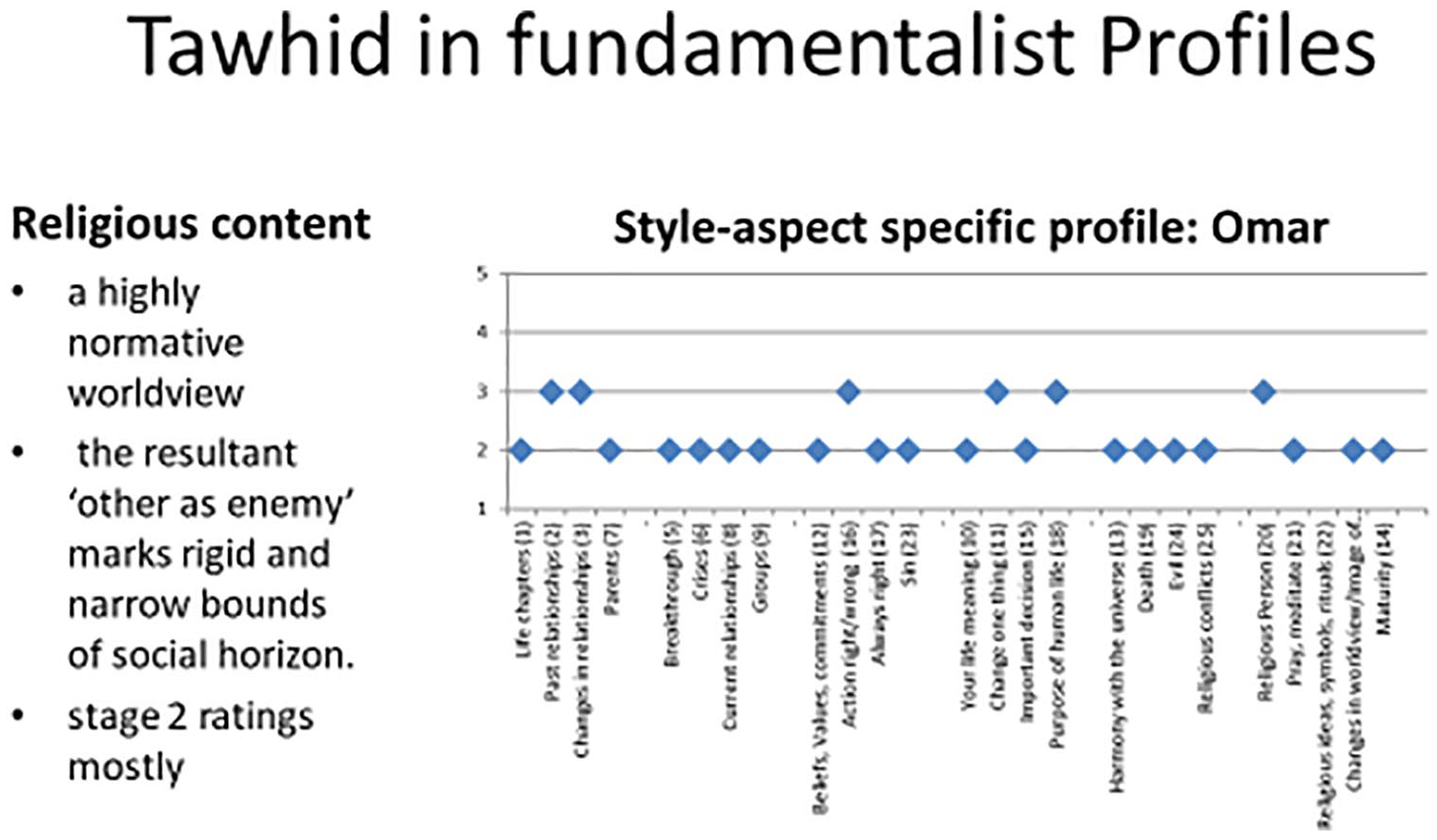
Aspect-specific profile of Omar.
Mutual religious style and perception of other faiths
At mutual religious styles, the interpretations reflected constructions of beliefs where the One Absolute Unseen Reality instilled awareness of differences of approach with others. However, the relatedness with others was through simple relativism as pragmatist ideas of a just and well-functioning social order and moral ideas of living peacefully with others as a virtue. Beliefs reflected in this style were categorized along the major themes of “acceptance of diversity” and “empathy.”
Respecting individualities
At mutual religious styles, monotheistic belief implied God’s Absoluteness and Perfection in contrasting contexts as God being beyond creation and yet manifest in it. Hence, despite all human appropriations of who is Allah, Allah as the Absolute would be above, beyond, and never accessible in total. Fatima shares her image of God: “. . . The picture cannot capture the whole artist. . . . insofar as it has broken away from the source, it is incapable of presenting its creator fully, and remains just a clue.” God as beyond and above creation led to the acceptance of human relativity and differences in their approaches as Allah can only be known indirectly through his Zahoor (manifestation) in creation. The creation and humans as the best of creation are the medium through which God is known. He cannot be known in a void, as Sobia shares human God relationship as follows: “. . .. He says that wherever we turn we shall see the face of God
6
. . .. but what we see around are other human beings with their own frames of references.” The “face” of God is the evident or manifest reality, or the creation. Human beings are to be valued as the varied expressions of God. Reaching out to different “frames of reference” or perspectives is a part and parcel of monotheistic belief at mutual religious styles. The individual frames of reference or perspectives on reality are various ways in which God is known to humanity, which Sobia shares in her observation of others in her interpersonal environment as follows: The purpose of our lives in short is to worship and obey Allah. . . . Life is therefore a plan God has designed differently for each of us as we are different but the purpose of all life is a training and a road leading from oneself to oneself the one purified self which comes closer to its origin which is no other than Allah.
Empathy
It is noteworthy that consistent with Islamic philosophy, the relation with Allah is incomplete without referring to one’s own being and social relations. Mutual religious style reflected an awareness of relationship with Allah to be incomplete without relating to others, as Fatima holds: “Allah says, after associating partners with Him, the greatest sin is to hurt a person”
7
and “It means keeping our faith to ourselves and give others a participation in it by setting good examples in society in which you live.” It means humanity to me. According to Razi, the moral and ethical goal of being a Muslim is not possible without humanity: Morality without humanity is not possible. Our religion forbids us to kill and harm others but all of this is done in the name of religion just because humanity is absent in our conception of right and wrong and good and evil.
Simple forms of logic as mutual co-existence characterize this style of relating to others.
Religious belief and aspect-specific profile in mutual religious style
Other awareness and positive engagement with others are vivid in concept of and faith in God in mutual religious styles, with Sobia (see Figure 2) concerned with interpersonal harmony and Sana expanding out to others while protecting her own ideology to have style 3 ratings on the average. Inquisitiveness about alternative paths and placing value in individualities are evident at mutual religious styles, although it exhibits simple forms of logic in case of Sobia and Sana, while Fatima emphasizing empathy beyond religions and Razi sharing the historical location of one’s own beliefs are capable of making a transition toward individuative-systemic style with almost half scores dispersed above style 3 assignments.
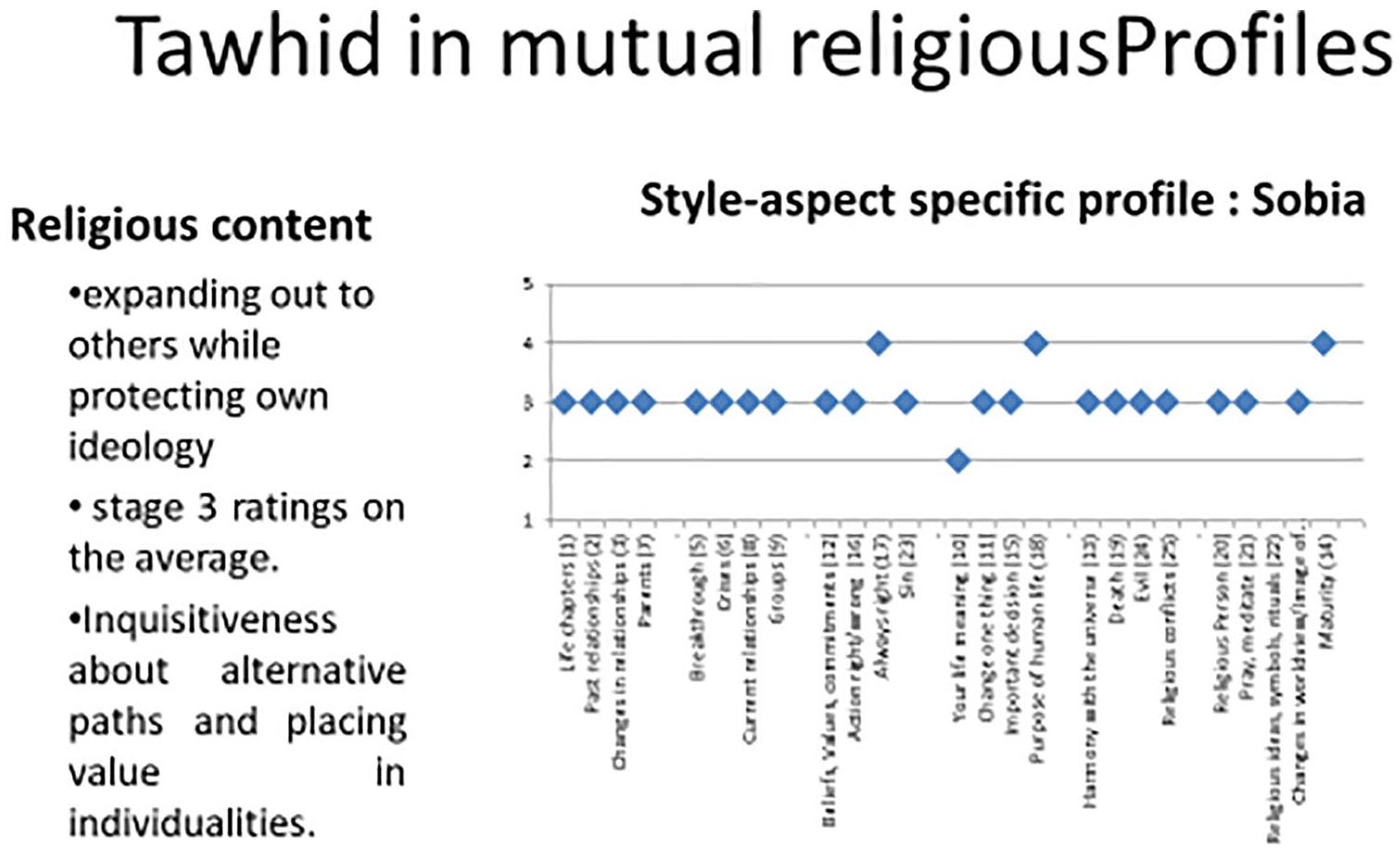
Aspect-specific profile of Sobia.
Individuative-systemic style and perceptions of other faiths
Individuative-systemic style understood religious beliefs in their underlying complexity and variety. There was a progression toward abstraction. While complexity at these levels involved decoding religious symbols into creative and personalized meaning, the simultaneous striving for other perspectives and awareness of one’s own particular position in the larger system was vivid in individuative-systemic style.
Decoding religious symbols
Zara was the only participant with an overall individuative-systemic style. She shows deep attachment with the most sublime symbol of Tawhid—the tawaaf or the circumambulation of Kaabah—and interprets the symbol of the circle with a center in its multiplexity of meaning: The greatest living circle is tawaf e kaabah and it always leaves a deep impact on me. Circle also means to me death and rebirth; I think many times in our lives we get a new life after everything seems to end up . . .
For her, the circle is the reality of self that follows the cycle of nature: I think we are born in age overwhelmed with progress and so we have a progressive and linear sort of vision in life; we can’t understand the logic behind many of God’s actions as we see them. Nature is not like that . . .
It is the revert and regression of the circle that imparts an awareness of a human collectivity returning toward a shared origin and empathetic vision in contrast to a linear, progressive, and competitive one: “Indeed we belong to Allah, and indeed to Him we will return.” 8 Her development in the aspect of symbolic function especially moves beyond mere emotional attachment to decoding the myth and symbol into a system of her own while taking a distance from outward form of beliefs, which places her in individuative-systemic style.
Appreciation of other religions
A circle converging toward a center reflects a reality, with all divergence ultimately linking to the Ultimate One in their own ways. What she hears from other faiths demands inclusion into and ideological compatibility with her own system—characteristic of individuative-systemic levels. All diversity of forms is ultimately some facet of the same truth which permeates all forms from literal to abstract: He is a mystery; He is One but cannot be reduced to one explanation or one fixed nature only; . . . even if you take it as number one . . . what is symbolically true also has literally true examples as well; the number one multiplies and divides to give same numbers; so it is the essence of all numbers without changing their outward form into one.
Religious belief is a meaning-making process where another person’s truth adds to what one “never thought before.” Zara’s meeting with a Buddhist had profound influence on her concepts: I also met a Buddhist with whom I discussed many things for hours. To put short, she said there is no god; all that is there is within. This made me think certain things I had never thought before. Why does our kalima
9
in Islam begin with the same words “there is no god . . .?” It could have said “there is only one God” straight away but it says “there is no god but God.” Are theism and atheism two sides of the same coin?
Religious belief and aspect-specific profile of individuative-systemic style
It is noteworthy that although Zara’s overall style is individuative-systemic (see Figure 3), her faith aspect profile is rather scattered from mutual to dialogical. In her complex understanding of the symbol of transcendence beyond differences in religions, she shows progress moving from seeing her own tradition as one among several perspectives (systemic) to seeing the own tradition through the eyes of “others” (dialogical).
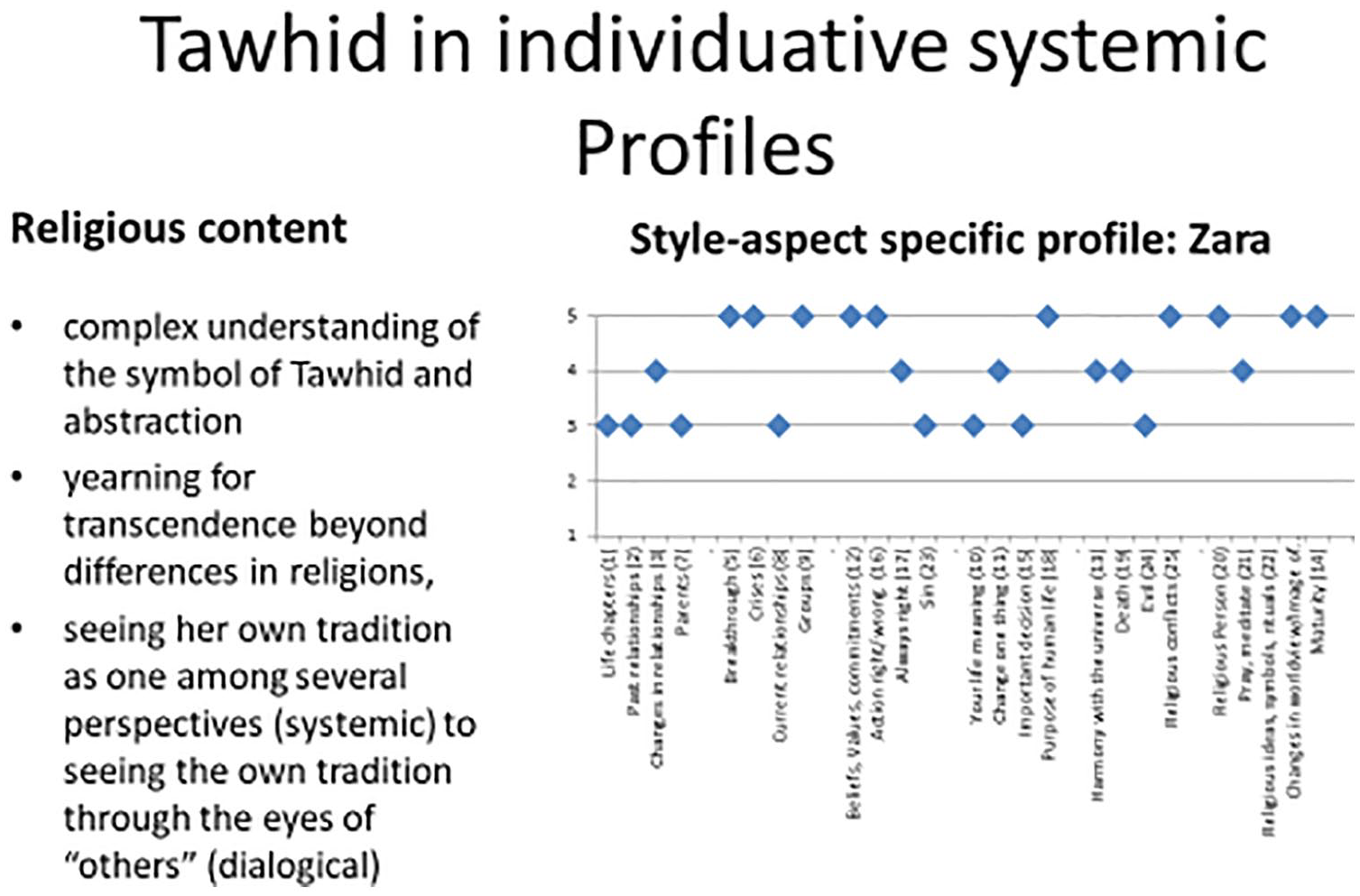
Aspect-specific profile of Zara.
Dialogical styles and perception of other faiths
Dialogical styles were marked by quest, rational debate, mystical frameworks, and conjunction of various perspectives. Religious belief was constructed as a worldview where Oneness of Allah constituted an integration and endorsement of views on reality in life rather than giving in to only one perspective to the exclusion of all others. Beliefs reflected in this style were categorized along the major themes of “quest enriching beliefs,” “integration of opposing perspectives,” “self-reflection,” and “humanity as a single soul”
Quest enriching beliefs
Quest for Unseen Allah is not possible without knowing what relates to Him. Murtaza displays a dialogical style in most aspects of faith: I have learned that thinking about Allah in terms of a pure idea of one is not enough; unless we hold One and Only . . . Knowing Him is like searching a never ending realm. Lord says, “And if all the trees on earth were pens and the ocean (were ink), with seven oceans behind it to add to its (supply), yet would not the words of Allah be exhausted (in the writing): for Allah is Exalted in Power, full of Wisdom.”
10
The false god is one’s own ego; quest is bound to take one beyond oneself. In Murtaza’s view, . . . I think mature faith is a freedom; . . .. The moment you stop seeking knowledge of what was unknown to you, you are finished in your own ego.” Tabrez believes in spiritual, mystical, and experiential quest and holds that God cannot be understood within institutional and orthodox rules only: “. . . The one who tastes, knows; the one who explains, lies. How can you describe the true form of Something in whose presence you are blotted out? And in whose being you still exist? And who lives as a sign for your journey?” Divine love makes me and you and everyone else not in search of some outward deity but the inward experience of spiritual bliss. . . . So I do not believe in institutionalized rules about God (laughs a bit). God is different for everybody including myself. Relationship with Him depends upon how deep you dig into yourself.
Understanding the inner meanings of beliefs than resorting to outward rules only or understanding phenomena in their complexity with a self-awareness of limits to one’s understanding which characterizes dialogical styles is evident here.
Integration of opposing perspectives
Knowing God as both remote and near, and beyond creation and manifest in creation presented polarities which link with broader discourses in Islamic faith as “the middle way”
11
between any opposite extremes emphasized in the Quran. The middle way is thus harmonizing of opposing not only perspectives on reality but also a religious choice where one stands amid all religions witnessing truth. Murtaza, sharing his image of a person of mature faith, shares the Quranic meaning of a middle way among various religious directions possible: . . . Say, “To Allah belongs the east and the west. He guides whom He wills to a straight path. And thus we have made you a community of the middle way that you will be witnesses over the people and the Messenger will be a witness over you.”
12
. . . it is not the direction in itself as both east and west belong to God and righteousness does not belong to anyone as an asset to marginalize others. Rather, as a Muslim one can fairly appreciate the message in the verses on change of Qibla
13
that “For each [religious following] is a direction toward which it faces. So race to [all that is] good. Wherever you may be, Allah will bring you forth [for judgement] all together. Indeed, Allah is over all things competent.”
14
The submission to the Will of Allah, the All-encompassing One is to respect various ways to Allah: So He says, if He willed He would have put all in one religion, but He did not Will so. My religion is submission to His will. I am a Muslim respecting the truth in all religions and do not conceal the truth as ordered by Allah.
15
For Ishaq, divine love is all-encompassing and revealing of truth in all religions: Church fathers have broader human families than being committed to one family. Compassion is a great value that is not understood in its true essence. But then everyone has his own way . . . a moment drowned in Allah’s love gives you deep peace of heart and mind and unravels mysteries in yourself and around you that you come to you about meaning of everything.
For Murtaza, to make a quest for Allah and believe in the integrative philosophy of Tawhid as a middle way does not mean reducing all realities to any one level, but to approach all visions on reality in their own perspective, if one is not to submit to any one of them as a false god. According to Murtaza, “Contradictions do not lie at the same plane. The Quran instructs human beings to travel and see how did God create the first creation and then spread it on earth 16 . . . a believer can’t be a seeker? . . .” Understanding belief at the dialogical level shows a complexity of thinking and the realization of relativity of differing perspectives.
Self-reflection
Dialogical style expresses profound interest and an imagination of people totally different in approach. Mentalization, or seeing oneself from others’ eyes, is evident as Tabrez shares his views on atheists’ discontent with religion as follows: . . . I do not blame the atheists for anything; if they say “la ilah” there is no god, then they are right in a way that it is oneself who is to be known first, not some outward remote far off idea of God which shuts off all your questions. God is not cruel, He is Holy, He is the Most beneficent, meaning allowing of all possible space to humans. I cannot conceive of any god below humanity suppressing their will to know and act. It is simply not possible.
As he notices the first kalima beginning with an atheist note “there is no god,” the atheist perspective allows him to review one’s own image of God. Ishaq shares the Quranic story of Prophet Moses (a prophet of God knowing revealed truth and formal religion) meeting Khizr (a friend of God knowing cosmic secrets) who reveals a totally unknown spiritual way to Moses as an instance of quest for truth. 17 Their meeting point of “where the two seas meet” is highly symbolic of two traditions meeting one another. The totally different other is then a need for self-growth and transcendence in xenosophia.
Humanity as a single soul
The perceptions of Oneness at dialogical levels bind together the reality into a unified whole where the diversity of being leads to a unity and harmony behind it, or the perceptions of simplicity behind apparent complexity in faith development terms. Every human being approaches this unity from a different angle and a particular frame in which (s)he exists. In Tabrez’s view, “Did God ever send a religion of untruth? No, this can never happen . . .” Murtaza’s understanding of Tawhid as a direct order of submission to the will of God entails acceptance of a diverse faith community coming from Nafse wahida 18 (a single soul). Insofar as everything is a manifestation of God, and he came to be known to us through this vast and diverse universe, there are different manifestations and ways to know Him, and as many ways as there are human beings on earth.
Religious belief and aspect-specific profile in dialogical style
Tabrez (Figure 4), Murtaza, and Ishaq have style 5 ratings on the average. Tabrez, showing identification with different others in quest for Allah in terms for a shared meaning; Murtaza, a keen reader of various subjects who distinguishes submission to Allah from stagnant beliefs; and Ishaq, retreating into Sufi practices experiencing Oneness of Being, show dialogical style.
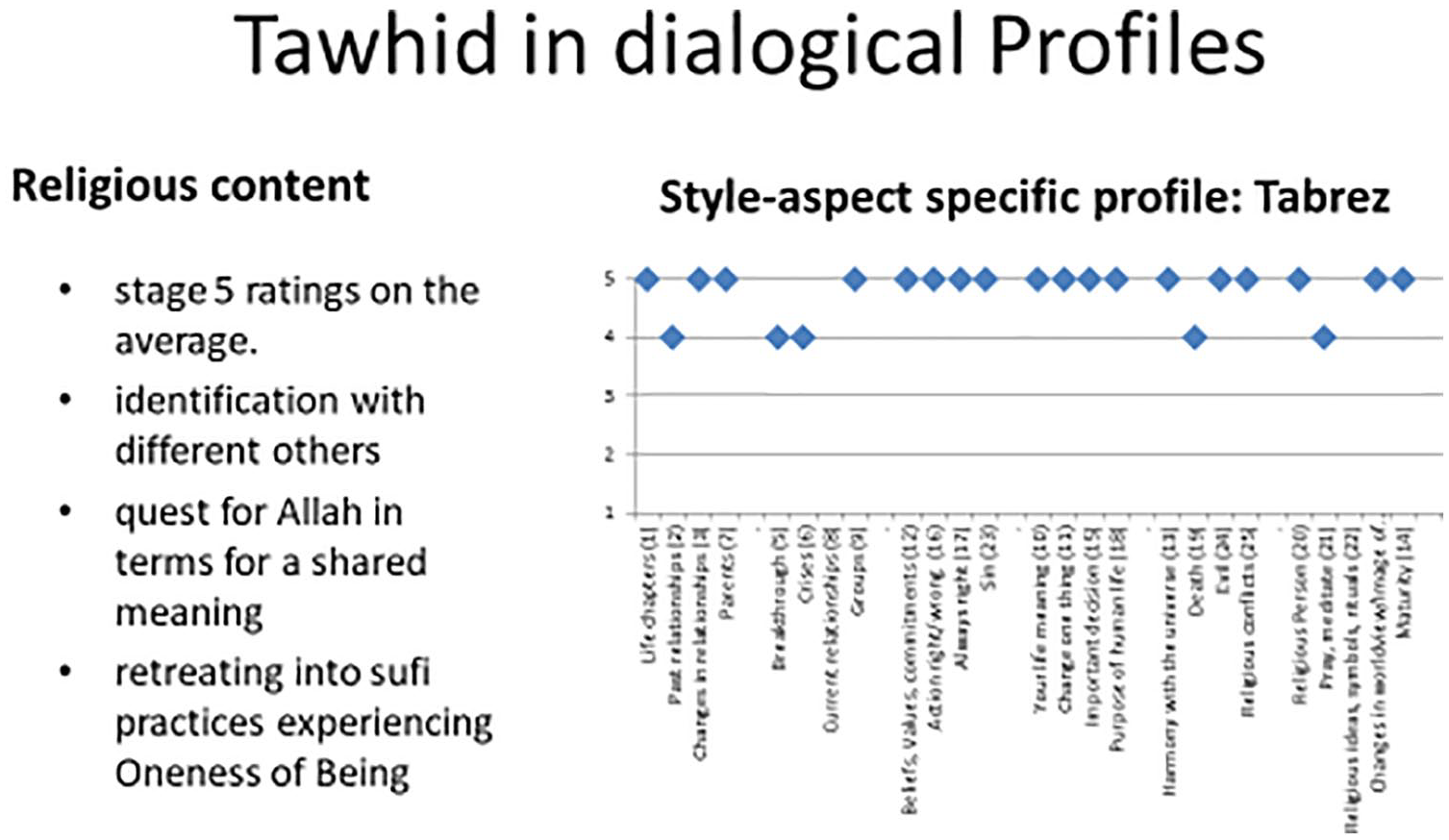
Aspect-specific profile of Tabrez.
Various understandings of religious beliefs analyzed above led to participants’ inclusions and exclusions of what they consider their own faith community and how they relate to different others. While Oneness of Allah and submission to His Will were agreed by all participants, for some, this submission literally meant the implementation of Islamic law and rule in or against a collective entity, whether concrete as country or state, or abstract as any system of thought or perspective. This had the propensity of using enforcement, fighting with opponents, and making sure that others submit as well. For others, the will of God meant the Quranic injunctions that Allah’s will was to make people of diverse faith communities. In other words, meaning-making around religious beliefs marked the degrees of participants’ openness and responsiveness to other religions. The analysis revealed that understandings of religious faith and sacred texts may range—according to the model of religious styles—from xenophobic views, where different others are threatening and dealt by exclusions, to xenosophic outlooks, where different others are actively sought to complete a wholesome view on reality.
The next step was to analyze how self–other constructions revealed by different constructions of Tawhid correspond to xenological patterns.
Inter-religious conflict resolution and xenological patterns
This analysis in particular focused on conflict resolution strategies in answer to the last question of FDI: “If people disagree about a religious issue, how can such religious conflicts be resolved?”
Participants with fundamentalist religious styles saw conflict as a result of going astray from one right religion. They also referred only to conflicts within Islam than talking about any broader human community.
. . . Conflicts will arise when you leave the right source of knowledge with the result that you discover ever new religions [laughs slightly] and try to justify them in one way or the other. (Abida) It happens because we have left authentic sources that tell us what is Islam. All practices that are added later are bidats and are the real reason of conflict amongst Muslims. (Aqsa)
Solutions in fundamentalist styles also reverted to rational and logical version of Islam keeping pace with modern times. The rational side condemns the yearning for human-to-human attachments, calling them as idolatry as Qamar shared: . . .. By thinking and rationally agreeing to what is right. Is it rational to call people Mushkil Kusha (resolver/redeemer)? The only mushkil Kusha is Allah. So when you rationally and logically look into things and are prepared to change, then conflicts can be solved.
The solutions also carried themes of ghaliba-e-din (victory of religion) and Jihad (holy war) against enemies as suggested by Omar: . . .. But still there are people who either are not Muslims or are Muslims in name only. They create trouble by coming in the way of Islam’s spread. So fighting against them is essential. Why should one resolve conflicts with people that do not follow Allah’s path? They are basically wrong and there are only two ways to deal with them. One is to call them peacefully to Islam and if they go against it, the only option left is Jihad.
At less strict terms, conflict resolution was negotiation but with an effort to convert others. Abida, for instance, suggests ghaliba-e-din (the victory of Islam) to be through negotiations: “. . . So much is being done against Islam that we need to open our eyes now and try for ghalibaa-e-din (the victory of Islam).But I also think fighting won’t take us anywhere and let us convince them.”
Participants progressing toward mutual style—as Sana—showed on probing a yearning to reach out to people of other faiths but absorbing other ones into their own worldview. Majority of her responses center around her concerns of adjustment and harmony in her own group, although the non-violent vision of religious struggle makes her cognizant and tolerant of the existence of different others:
The last Imam, who is yet to come, will InshaAllah resolve these conflicts which Muslims especially are having amongst them . . .
Can we have any solution to resolve these conflicts in the status quo?
Not really; as people are stuck with what they believe. But there are people who are guided by Allah; He is the ultimate Guide. I was astonished read Arundhati Roy 19 . . . she had the vision of the Holy Prophet (peace be upon him). At that time, she did not know who is this great person she is meeting. He told her not to leave Maula Ali.
Participants with mutual religious styles expressed tolerance and peace-making with different others. They offered pragmatist solutions as keeping religion to oneself and not interfering with others and bad language against one another to be avoided. Razi’s responses may also be attributed to his religious heritage. Imam Ali had banned religious confrontational stances in public during his reign.
It’s simple . . . Let others practice what they want as you are doing what you like. Well, bad comments against each other by various sects and use of abusive language heats up things . . . They can never reach the same conclusions, so the best idea is to refrain from collisions in public. (Razi)
Both Sobia and Fatima offer simple pluralism and mutual peaceful co-existence (Streib & Keller, 2018, p. 90) of all humanity; Fatima’s responses were marked by keeping religion and religious identity away from her service to humanity as a doctor: By giving them every right to practise their faith and by making sure that their faith does not offend others. (Sobia) I am not an expert into social issues . . . So religion should not come in the way of humanity. I am not concerned about religious sect of my patients. I think if we do not mix up things, it would be better. Charity is for all humanity, not some of them if society wants to be a society and this world really a human world. (Fatima)
The individuative-systemic religious styles showed awareness of dissent and difference being inevitable but inviting of positive dialogue with other faith communities and also perceptions that religious meaning is not restricted to apparent differences in forms. Zara’s talk shows a reflection on beliefs themselves: We can’t resolve these conflicts totally. We can only minimize them; also, a good thing that can be done is to promote inter-faith dialogues where people would be encouraged to connect in a healthy way with all faiths and groups . . . try to understand one another’s perspective in spirit . . . tolerance is the principal I believe people of the whole world should agree on. (Zara)
At the Dialogical styles, in answers to resolving conflicts there was a sense of every individual’s belongingness to various faiths, understanding of others from their own contexts, and re-appraisal of one’s own truth through linking it with alternative perspectives. Ishaq’s view of a basic religious honesty leans on “listening to others.” It is also noteworthy here that “listening” and its intellectual precedence over “talking” are an important aspect of the spiritual tradition to which he belongs: the Holy Quran orders us not to say anything bad about any human being’s god
20
whosoever it is . . . Fighting on religions also leads nowhere. A human being should be understood in his mindset and tools of his thought and spirit wherever he belongs. If you match your piece of truth with that of another person, and if you are honest . . .then you will see that your truth and his truth are standing and sometimes fitting into each other . . . (Ishaq)
Progress toward dialogical styles accompanied long and in-depth analyses incorporating one’s own and others positions: . . . I think when we bow and see others bow and have awareness that others have also their own conception of God . . . it is extreme self righteousness and being stuck somewhere that hinders the resolution of religious conflicts. Islam asks us to gain knowledge whether it comes from the east or west, Muslim, Christian, Hindu or Jew as truth is one . . . (Murtaza)
Compared to fundamentalists’ understanding of religious texts as authoritative, dialogical style shows the awareness of meaning of revelation to be mediated by human mind. The ability to perform reflection on one’s thought and the awareness of one’s own particular tradition as well as the cognizance of historical developments of religion itself were also vivid in dialogical narratives as Murtaza shared: It is important to understand that between revelation and its understanding is the human mind. For example, the Holy Quran asks us to implement justice,
21
but leaves it up to the human mind to do so. And human by their culture, environment and other factors vary in their idea of justice . . . So getting stuck somewhere and thinking only this is ultimate, of course Allah can bring forth quite the reverse.
Tabrez’s solution to conflict is promoting a culture of quest rather than dogma, and for that matter he emphasizes engagement with the totally different tradition as adding to one’s knowledge: If the aim of a person is to find the truth per se and not just take sides of a dogma, then this would also do the good of producing tolerance in the process . . . I am a believer in monotheism; but many gods in Hinduism . . . (tell me).. how many facets of deity are there; . . . Why have we forgotten message of the Quran that when you talk to people of Book talk in a manner that should be best.
22
And orders of finding commonalities . . .
23
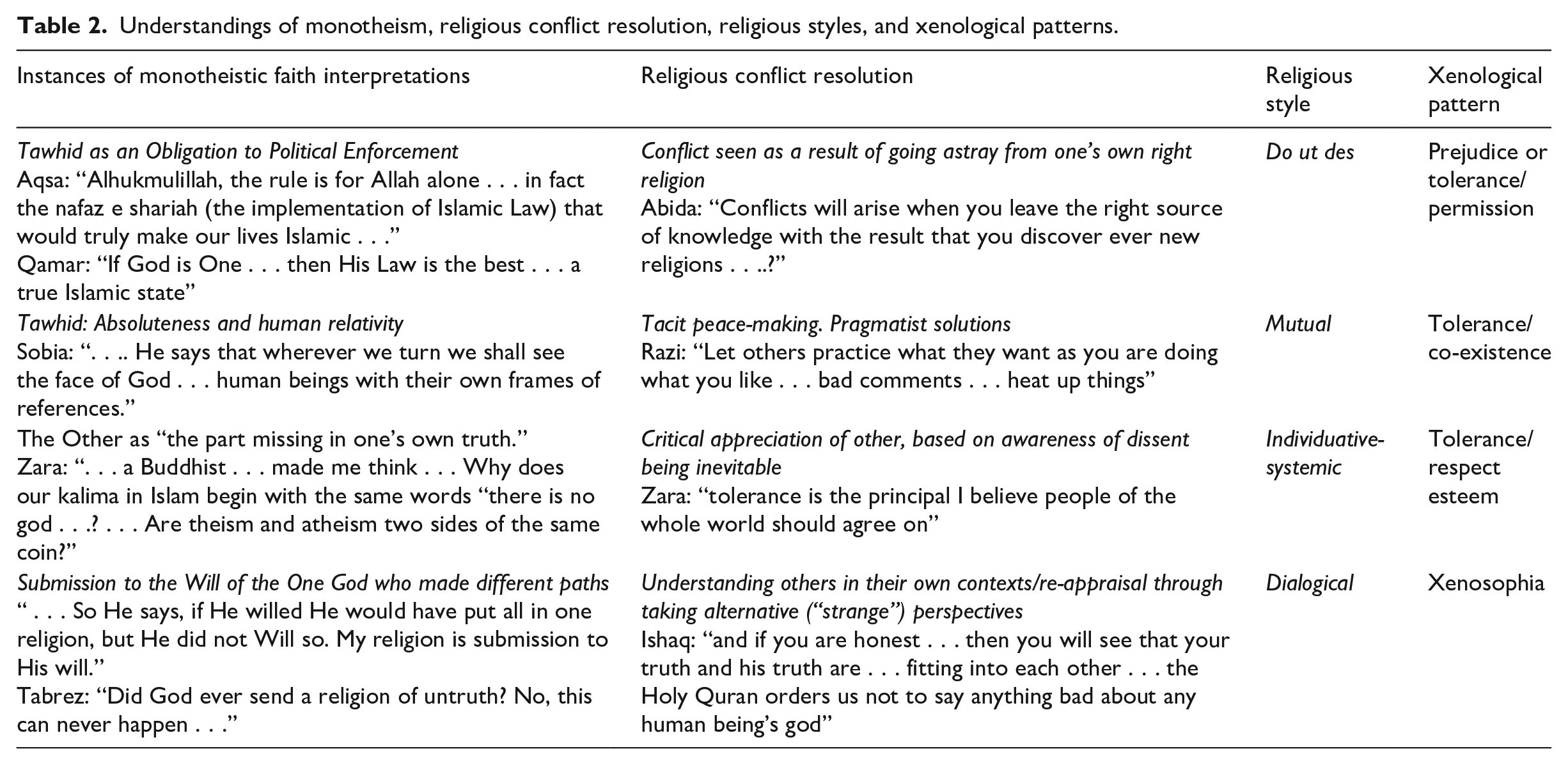
Xenological patterns revealed from conflict resolution strategies indicated the levels of self–other relations from fear, negative labeling, essentialist understanding, to pragmatist solutions, annihilation into one’s own worldviews, curiosity about the other, and xenosophic levels of creatively deciphering other as “the missing part.” Consistent with earlier research (Streib & Keller, 2018), the conflict resolution in various religious styles ranged from prejudiced thinking in fundamentalist style to peaceful co-existence in mutual styles, and further deepened to holding the different other in great esteem in individuative-systemic and finally xenosophic engagement with the other where the other is an essential source of looking back at one’s own perspectives. Table 2 illustrates how self–other constructions of monotheistic faith corresponded to inter-religious conflict resolution offered.
Understandings of monotheism, religious conflict resolution, religious styles, and xenological patterns.
Discussion and conclusion
The analysis focused on how various Islamic belief contents get precipitated in individual subjectivities shaping responses toward alternative perspectives and faith communities beyond one’s own. Thematic analysis revealed religious belief as a worldview with both vertical and horizontal dimensions. It related to a God (vertical transcendence) but also put a person in a particular relation transcending mundane affairs to other human beings (horizontal transcendence). Streib and Hood (2011), for instance, note that horizontal transcendence may be a connectedness with humanity, cosmos, and being than involving god and deity as in vertical transcendence.
Starting with the interpersonal context at earlier styles of faith development, moving beyond the outward and literal was made possible with individual’s inner life accessible to herself or himself and her or his ability to understand and internalize the inner lives of elders as they experienced their faith. Conversely, constructions of monotheistic faith by participants with do ut des style reflected strict religious indoctrination or contexts in which separationist motives against others were actively pursued. This was seen in other-focused identities, the instances of which were seeing oneself as covered amid a shameless world, as a puritan amid Muslims in name only, as a proponent of Islam amid kafirs, and as a Muslim against Hindu. An ambitious piety restricting acknowledgment of one’s own shadow or undesirable part of self, the results is of a religious persona projecting its shadow onto others. This shadowed relationship of self with others marks fundamentalism. It is rooted in religious socialization that does not foster self-growth and the in-built psychic need for individuation. What is focused on as religious experience is the outward religious act bringing rewards characteristic of do ut des style. With expanding social circles, fundamentalist style employs religion as a social identity closure against other collective identities. Instances are dubbing of a political and socio-economic separation of Pakistan from India in exclusively religious terms and identity closures of Islam against the “West.” Inter-culturally, the other-focused identity serves certain functions in a rapidly diffusing world. It creates its own religious enclaves (Streib, 2015) where fundamentalist notions are sustained and highlights more differences than similarities with broader societies to exorcize the fear of diffusion. The faith community hence becomes narrow and closed, and one’s moral responsibility is also limited to the in-groups. The influence of social and political contexts for development of particular religious orientations can be further investigated.
Thematic analysis highlighted perspective-taking/mentalization to contribute toward dialogical styles and xenosophia. An awareness of one’s own and others’ inner mental life is essential to generate the creative power to relate one’s life experiences meaningfully to the archetypal and primordial. Insofar as self develops as a result of continually settling and re-settling social relations (Kegan, 1982), the other from interpersonal to inter-cultural is integral to meaning-making, and the relational competence is enhanced only through mentalization or insight into others. The expansion of domain of being seen in themes as Oneness of Being and the Circle as the human collectivity converging on a shared center is made possible through the awareness of one’s own particularity and the co-construction of meaning gained from differing religious outlooks. The cross-categorical subjectivity (Kegan, 1982) where one relates one’s own and the others’ perspective gives way to further development where one is no longer made up of differing perspectives but constructing a meaning with it. While religious discontent with normative influences and broad-based exposures were some factors contributing to development of individuative-systemic and dialogical styles, the creative capacity to generate one’s individualized meaning of religious content requires a personal initiative or confidence in one’s own agency and generativity. Dialogical styles of faith development therefore are rich with contents that reflect what Kacela (2008) regards as “self-authored faith,” although he does not directly relate it to FDT. Its various expressions at dialogical levels seen in this study are as follows: other religions seen as a broader canvas for exploration of religion in general; the “other” as conveying a sense of human relatedness; knowing the different other as the essential message of the Quran; and other religious traditions carrying an esoteric meaning which had to be understood beyond apparent boundaries. Although Kacela (2008) brings together perspectives on faith and its development as relational including Fowlerian ideas, the styles approach explains the development from embeddedness in one’s own tradition to “leaving home,” being attentive to other perspectives, and reaching a “second naivete” characterized by understanding the conjunctive of one’s own and alternative perspectives. Movement beyond embeddedness in a tradition to second-order reflection upon one’s own beliefs needs more grounding in self as a firm base than religious beliefs. Faith development is made possible by self-growth and expansion of one’s relatedness.
A thorough analysis of the faith contents of 12 participants yielded a wide range of meanings attached to monotheistic nature of Islam. Nevertheless, one cannot be confident that this spectrum would be reflected in the same way in larger samples and in other societies where Muslims assume a minority or a migrant status. This needs a thorough study with a larger sample to explore various constructions of Islam and their implications for faith development. Only one participant was at the individuative-systemic style, so a comparison with others at the same level could not be made. Although Zara provided a rich account of how the symbolic is understood in individuative-systemic styles, further study may inform what other meanings of Oneness are possible. Furthermore, similar studies with highly religious Christians or persons from other traditions need to be conducted to look at how central concepts and the relationship to others’ faiths are constructed in different religious styles.
The research concludes that particular understandings of Muslim monotheistic faith direct self–other relations, ranging from xenophobic understandings to tolerant and xenosophic approaches. This further highlights that conceptualizing fundamentalism purely in terms of “Truth of text and teachings” (Streib et al., 2010) of a tradition does not inform on being fundamentalist or xenosophic. Further qualitative attempt at understanding faith contents in biographical and relational perspectives may reveal how faith contents shape inter-faith orientations and are themselves shaped through life span socialization. The study presents how human self is understood in religious terms. Earlier research has attracted attention toward a dialogue between religious and psychological conceptualizations of human self (Raiya, 2014). Further work linking Islamic and Western perspectives on human self and individuation process and its role in religious development can enlighten both. The study also carries implications for religious education. Insofar as religious styles are not rigid stages and aspect-specific profiles show movement toward mature styles, providing educational and counseling settings which are supportive and encourage safe review of one’s own perspective can make a change. In cross-cultural contexts, the positive role of Islam in peace-making and tolerance can be the contexts where Islam accepts the diversity of religions, is understood as a reminder of earlier religions, and needs what is common with different others.
Footnotes
Authors’ note
The first phase of analysis in this research is a part of PhD dissertation by Amina Hanif Tarar. This research was presented at IAPR Conference, 2019, in Poland by Dr Barbara Keller.
Funding
The author(s) received no financial support for the research, authorship, and/or publication of this article.
