



Abstract
During the COVID-19 pandemic, many religious college students have found comfort in God, while others may have developed anger toward God; however, no studies have systematically compared the multidimensional effects of religiousness on how Muslim and Christian students react to stressors such as COVID-19. This study addressed this gap in the literature by investigating which of the Four Basic Dimensions of Religiousness Scale (4-BDRS: believing, bonding, behaving, and belonging) were significant predictors for both taking comfort in and feeling anger toward God among Muslim (n = 550) and Christian (n = 334) college students in Indonesia, while also controlling for the influence of neuroticism, a known predictor for attitudes toward God. Muslims reported that all dimensions of the 4-BDRS were significant predictors of comfort, with bonding as a negative predictor (β = –.09, p = .04), while Christians reported that belonging (β = .07, p = .34) was the only insignificant predictor. Muslims reported that believing (β = –.22, p ⩽ .001) and behaving (β = –.19, p = .002) were negative predictors of anger, while Christians reported negative effects only for bonding (β = –.17, p = .04); however, bonding did not significantly predict anger when analyzed separately for men and women. Therefore, to decrease their anger toward and increase the comfort they find in God, Muslims must focus on their beliefs and exercise the commandments of Islam. Christians, though, must focus on increasing cognitive, affective, and behavioral aspects of religiousness to find comfort, while having better personal relationships with God could be key in reducing anger toward God.
The COVID-19 pandemic has disrupted nearly all spheres of life. Even behaviors that were considered good and adaptive prior to the pandemic can now create problems. Quick adaptation to new behavior may result in significant distress for many people. Moreover, COVID-19 is a new disease with unknown elements, causing feelings of uncertainty and widespread anxiety. Studies conducted in several countries have already shown that COVID-19 may cause stress, anxiety, and depression (Cortés-Álvarez et al., 2020; Liu et al., 2020; Solomou & Constantinidou, 2020).
During difficult times, many people turn to religion for comfort (Abu-Raiya & Pargament, 2015; Hart & Koenig, 2020). This is especially common in Indonesia, where most people report that religion plays a very important role in their lives (Poushter & Fetterolf, 2019). However, religion can be a double-edged sword, with the potential both to benefit and harm physical and mental health (Abu-Raiya et al., 2016; Park et al., 2018). For instance, feelings of closeness or comfort with God bring benefits, while feelings of anger toward God can deteriorate physical and mental health (Wood et al., 2010).
Studies have also shown that younger people are at greater risk for stress, anxiety, and depression in the context of the pandemic (Rodríguez-Rey et al., 2020; Wang et al., 2020; Zhou et al., 2020). Notably, they are also prone to feelings of anger toward God (Arnett, 2000; Bryant & Astin, 2008). This combination of factors puts younger people at higher risk of having problems with God during COVID-19. Previous studies have also found that religiousness and neuroticism are predictors of positive and negative attitudes toward God, that is, higher neuroticism is associated with negative attitudes toward God, while higher religiousness is associated with positive attitudes toward God (Exline et al., 2011; Wilt et al., 2016).
Neuroticism is defined as the tendency to experience negative emotions such as anxiety, worry, and anger (John & Srivastava, 1999). Although several studies have investigated the effects of religiousness and neuroticism on attitudes toward God, most were conducted in the West and in Christian cultures. While previous research found that the effects of religiosity and personality were related to contextual and situational factors (Saroglou, 2017), there is no known research on the effects of neuroticism and multidimensional religiousness on attitudes toward God in the context of Indonesian culture, where Muslims are the majority and Christians are in the minority. Moreover, there have been no systematic comparisons to test for differences in the multidimensional effects of religiousness between Muslim and Christian students.
To close this gap, this study investigated the interplay between neuroticism and religiousness with regard to feelings of anger toward and comfort in God among Muslim and Christian college students in Indonesia. Previous research has shown that 87% of Indonesians identify as Muslim and 7% identify as Christian (Badan Pusat Statistik Republik Indonesia, 2010). Although both are Abrahamic religions, they are associated with different teachings and traditions. Under the pressures of the pandemic, Muslims and Christians may therefore respond differently to the various dimensions of religiousness known to affect attitudes toward God. The goal of this research was to determine the dimensions of religiousness that significantly predicted both anger toward and feelings of comfort in God, while controlling for the effects of neuroticism among Muslim and Christian college students in Indonesia. The results provide suggestions for informed counseling responses for religious students in the wake of the pandemic.
Attitudes toward God
A positive attitude toward God is referred to as comfort, while a negative attitude is referred to as anger (Wood et al., 2010). Most monotheistic religions portray God in a personal way, meaning that believers may have somewhat similar feelings toward God and human beings. Because Islam and Christianity view God as an attachment figure (Kirkpatrick, 1992; Miner et al., 2014), followers may develop feelings of comfort and anger toward God. Indeed, both Islam and Christianity teach adherents that they can find comfort in God, even though the means of doing so may differ between religions. For example, both Muslims and Christians have rituals, prayers, and moral standards. However, they tend to emphasize different aspects of religiousness. Saroglou et al. (2020) found that Muslims tend to focus on behaving, while Protestants focus on believing, and religious people (mostly Protestants) in the United States focus on bonding. Muslims tend to find comfort through prayer (Abu-Raiya, 2013; Bonab & Koohsar, 2011), while Christians tend to find it through their relationship with God (Beck & Haugen, 2013).
Anger toward God can range from disappointment to more extreme feelings, which may be experienced even by devout believers. In particular, studies conducted in the United States, India, Poland, and Indonesia have revealed that many college students feel anger toward God at some point (Aditya et al., 2020; Exline, Hall, et al., 2017; Exline, Kamble, et al., 2017; Zarzycka, 2016). Compared with people at other stages of life, young adults may have a higher level of anger toward God. During childhood, they received the concepts of God from their parents or religious leaders, but as they matured they started questioning those concepts to decide what was logical (Arnett, 2000; Bryant & Astin, 2008). For example, both Muslims and Christians are taught that God is all-loving and powerful. However, they may experience suffering or difficulties in life that seem to contradict that concept. Especially during the COVID-19 pandemic, when many people lost their loved ones, young adults were likely to experience cognitive dissonance and feelings of anger toward God (Gorsuch & Smith, 1983; Legare et al., 2012), whom they held accountable either directly or indirectly for the pandemic (Pirutinsky et al., 2020).
Christians seem to be more accepting of their feelings of anger toward God. Several Biblical writers, such as Job, Jonah, and David in Psalms, expressed their protest toward God. On the contrary, anger toward God is more problematic for Muslims, who are expected not to develop such emotions, although the feeling of anger toward God has been also found to occur among Muslims. For example, previous research among Palestinian Muslims revealed low levels of anger toward God (Abu-Raiya et al., 2015).
The Four Basic Dimensions of Religiousness Scale
The Four Basic Dimensions of Religiousness Scale (4-BDRS) is divided into the components of believing, bonding, behaving, and belonging; these dimensions are not based on a particular religion and are thus considered universal (Saroglou, 2011). Believing is a cognitive part of religiousness consisting of beliefs about transcendence, while bonding refers to emotional and aesthetic ritual; behaving is related to the moral dimension of action, and belonging denotes an attachment to one’s religious community. Our previous study showed that the 4-BDRS is a valid religiousness scale for use among Muslims and Christian college students in Indonesia, meaning that all four dimensions are present in that context (Aditya et al., 2021). However, there are some differences in terms of the salience of each dimension and how they affect other psychological variables between believers in Islam and Christianity. Two previous studies conducted in Indonesia consistently found Muslims to have a higher level of behaving, while Christians had a higher level of belonging (Aditya et al., 2018, 2020).
Saroglou et al. (2020) found that all dimensions of the 4-BDRS positively correlated with life satisfaction. A previous study among Muslim and Christian college students in Indonesia found similar results; all dimensions of the 4-BDRS were positively associated with life satisfaction. However, the result of regression analysis revealed that believing and belonging significantly predicted life satisfaction for Christians, while only belonging did for Muslims (Aditya et al., 2018). Muslim males tended to have a higher score on all dimensions of the 4-BDRS than did Muslim females. On the contrary, there were no gender differences in any dimensions of the 4-BDRS for Christians (Aditya et al., 2021).
Neuroticism
Neuroticism is a psychological trait connected to negative emotions. People with high neuroticism can easily feel anxious, stressed, and depressed. It can therefore be assumed that these individuals are prone to the negative emotional effects of COVID-19. As they are more likely to experience stress compared with people with lower levels of neuroticism, they tend to have more anger toward God. This is in line with the results of previous studies, which found that neuroticism was one of the strongest predictors of anger toward God, that is, people with higher neuroticism tended to have higher levels of anger toward God (Grubbs et al., 2013; Wood et al., 2010).
Indonesian Muslims
Six religions are endorsed by the Indonesian government: Islam, Christianity (Protestant and Roman Catholic), Buddhism, Hinduism, and Confucianism. This study focused on Muslims and Christians, who together comprise 97% of Indonesians (Badan Pusat Statistik Republik Indonesia, 2010).
Indonesian Islam has been recognized as moderate (Ali, 2007; Hilmy, 2013; Kersten, 2015), which refers to communities that emphasize tolerance, avoid violence, promote rational ways of thinking, and use dialogue as a strategy. Hilmy (2013) stated that Indonesian Islam is characterized by non-violent ideology in religious teaching, adoption of modern ways of life (e.g. science and technology, democracy, human rights), rational thinking, a contextual approach to understanding Islam, and the use of intellectual dialogue for decision making. Two of the largest Muslim organizations in Indonesia, Nahdlatul Ulama (NU) and Muhammadiyah, influence Islamic education, da’wah (mission), and culture. Both belong to the Sunni denomination and follow the essence of Islamic teachings guided by the Qur’an (Rahem, 2017; Razak et al., 2011). Three BDRS elements, believing, bonding, and behaving, are explicitly taught in Islamic Indonesia; they are known as aqidah (believing), ibadah (worship and religious services, which include both bonding and behaving), and akhlak (behaving; Razak et al., 2011). For Muslims, aqidah or believing in God also means believing in all the teachings contained in the Qur’an, including the nature or attributes of Allah, such as loving, caring, protecting, helping, giving, and forgiving, which are also important attributes of attachment figures. This is among the main reasons that Bonab & Koohsar (2011) argued for Allah as an attachment figure for Muslims. Belief in a loving Allah also protects people from getting angry with Allah during difficult situations, because they believe that help and protection come from God. Ibadah or ritual practices are worship that allows people to establish and maintain a close relationship with God (Bonab & Koohsar, 2011; Nasution, 2013). Likewise, good or moral behavior (akhlak) is also seen as a form of worship (Abu-Raiya, 2013; Nasution, 2013). The fourth element, belonging, does not appear to be taught explicitly. However, communal decisions contained in the fatwa (rulings from the religious council) about the lawfulness (halal) of COVID-19 vaccines, for example, are still regarded as being important for the Muslim community. Thus, daily living as a part of religious communities (belonging) seems to be central among Indonesian Muslims.
Abu-Raiya et al. (2015) claimed that Islamic theology and education teach that having negative feelings toward God are not allowed in Islam. They argued that Muslims’ religious struggles in their attitude toward God can be explained theologically. Muslims are taught that God has great compassion and care and always provides safety and protection. At the same time, Muslims are also strongly encouraged to fear God, because those who violate God’s guidelines and provisions can be punished. This situation opens the possibility of religious tension for Muslims, such as ambivalent attitudes or anger toward God, especially for those experiencing difficult situations.
Indonesian Christians
Christian communities in Indonesia are more fragmented, with several different denominations present. Protestants make up around 70% of all Christians in Indonesia, while Catholics around 30%. Beside the Christianity inherited from missionary activities in the European colonialism period, Indonesia is also influenced by the holiness tradition from China and East Asia. Notable Protestant denominations in Indonesia include Reformed/Calvinist, Lutheran, Evangelicals, Methodist, Mennonites, Baptist, and Pentecostal/Charismatics.
Most Calvinist churches stress cognitive understanding (belief) and traditional morality (behaving), while other churches focus on social responsibility (belonging), and the Charismatic church provides a platform for more affective (bonding) expressions (Rodemeier, 2017). Previous studies among Christian college students in Indonesia consistently found that believing, behaving, and bonding were similar and higher than belonging (Aditya et al., 2018, 2019; Saputra et al., 2016), in contrast to the results of studies in different countries; Saroglou et al. (2020) found that Christians tended to score higher on bonding, followed by believing, behaving, and belonging. Indonesia’s results might indicate the influence of the Muslim majority in the country. A previous study on Indonesian Muslim college students found their highest score to be in behaving, followed by believing, bonding, and belonging. Compared with Muslims, Christians had a lower score on behaving but a higher score on belonging (Aditya et al., 2018).
In their relationship with God, Christians tend to treat God as an attachment object (Kirkpatrick, 1992). As with other forms of attachment, attachment with God can induce both positive and negative attitudes. Previous studies found that a positive attitude toward God depended on religiosity and conscientiousness, while anger toward God was correlated with negative religious coping, lower participation in religiousness, higher distress, neuroticism, and entitlement (Wood et al., 2010). A previous study in Indonesia indicated that spirituality (believing and bonding) buffered the effect of anger toward God on life satisfaction while the moral community (behaving and belonging) did not (Aditya et al., 2021). Those results indicated that to be able to handle anger toward God, Christian college students needed to know their God both cognitively and affectively.
The context of COVID-19 pandemic in Indonesia
The first COVID-19 case hit Indonesia on 2 March 2020 (Djalante et al., 2020). Many suspected a higher number of cases and earlier outbreak because of lack of testing at the start of the pandemic. As of 23 November 2020, Indonesia is experiencing the rising slope of the first wave of COVID-19 pandemic, with the total case exceeding 500,000 cases, with over 16,000 deaths.
Many aspects of religious life can be a source of strength, as well as presenting challenges during the COVID-19 pandemic in Indonesia. Although the Indonesian government called for social restriction as early as 15 March 2020; still as of May, more than 40% respondents reported having attended religious establishment or worship in the previous week (Kuipers et al., 2021). Similar to what happened in other countries, the call for restriction of communal prayer may be complicated by political or religious subgroup identity. Since communal expression of religion is restricted, the pandemic may set off a specific tension on the belonging dimension of religiousness during the pandemic in Indonesia.
Hypotheses
Based on measurements taken with the 4-BDRS, this study examined the dimensions of religiousness that predicted comfort and anger toward God for Muslim and Christian college students in Indonesia during COVID-19. Neuroticism was included in the analysis as a control variable because it is commonly used to predict comfort and anger toward God.
For Muslim participants, we expected that all dimensions of the 4-BDRS would positively predict a positive attitude toward God. The first three dimensions (believing, bonding, and behaving) are directly related to God. Higher levels of believing are associated with higher levels of understanding about God, while higher levels of bonding are associated with higher levels of emotional intimacy with God, and higher levels of behaving are associated with higher amounts of religious duty and increased feelings of comfort toward God. Higher levels of behaving give individuals the sense that they are pleasing God. Belonging is not directly related to God but refers to fellowship with other believers; nevertheless, this dimension can also help individuals grow closer to God. Furthermore, only believing, bonding, and behaving are known to have negative effects on anger for Indonesian Muslims. As their levels of believing, bonding, and behaving increase, Indonesian Muslim people understand God’s mercy more deeply and perceive God’s punishment as a consequence of their own failure to follow God’s guidance. Therefore, it is expected that they will be more able to handle their negative emotions toward God.
For Christian participants, we also expected that all dimensions of the 4-BDRS would positively predict a positive attitude toward God. Basic teachings of Christianity stress that God is love and God wants to have a personal relationship with humans. Therefore, as believing, bonding, and behaving increase, Christians further embrace this religious narrative, and their positive attitude toward God increases. Although belonging is not directly related to the relationship with God, support from religious communities may increase positive attitudes toward God. Only believing and bonding were expected to positively predict anger among Indonesian Christians. Behaving and belonging were not expected to predict anger because anger toward God is more related to cognitive understanding and emotional closeness to God.
Methods
Respondents and sampling procedures
Data were collected from participants at 10 universities in the Jakarta metropolitan area as part of a larger project approved by the board of ethics of Konsorsium Psikologi Ilmiah Nusantara. This study was conducted after the pandemic spread in Indonesia. None of the scales were modified to focus on the pandemic; however, our request for informed consent stated that the purpose of this study was to understand responses in relation to the pandemic. A question about religion was included in the questionnaire as a method of screening; only those who identified as Muslim or Christian were analyzed in this study. Initially, we got 1445 respondents; 218 respondents were excluded because they did not fill out the questionnaires completely or were not college students. We then excluded non-Muslims and non-Christians (81 Roman Catholics, 85 Buddhists, 160 Hindus, 6 Confucianists, and 13 agnostics). We thus obtained questionnaire responses from 550 Muslims (67 males and 483 females) and 334 Christians (91 males and 243 females). The majority of respondents (90%) were between 17 and 23 years of age, while the remainder were between 24 and 26 years of age.
Measures
This study used three scales to measure neuroticism, religiousness, and attitudes toward God (anger and comfort). These scales were obtained with permission from the original authors and were translated into Indonesian using forward and back translation methods. Each translated scale was then tested to determine internal reliability.
Neuroticism was assessed using a three-item Neuroticism subscale from the extra-short form of the Big Five Inventory–2 (BFI-2-XS; Soto & John, 2017). The subscale consists of three items rated using a 7-point Likert-type scale (“Worries a lot”; “Tends to feel depressed, blue”; “Is emotionally stable, not easily upset”). Internal reliability was established through Cronbach’s alpha scores of .62 for all participants.
Religiousness was assessed using the 4-BDRS (Saroglou, 2011), which consists of 12 items rated using a 7-point Likert-type scale (3 items for each dimension). Sample items include the following: “I feel attached to religion because it helps me to have a purpose in my life” (believing), “I like religious ceremonies” (bonding), “I am attached to the religion for the values and ethics it endorses” (behaving), and “In religion, I enjoy belonging to a group/community” (belonging). Internal reliability was established through Cronbach’s alpha scores of .77 for believing, .76 for bonding, .79 for behaving, and .82 for belonging for Muslim participants, and .78 for believing, .84 for bonding, .79 for behaving, and .83 for belonging for Christian participants.
Attitudes toward God (anger and comfort) were assessed using the Attitudes Toward God Scale (ATGS-9; Wood et al., 2010), which consists of nine items (four for anger and five for positive attitude) rated using a 10-point Likert-type scale. A sample item for anger is “I feel angry at God,” and a sample item for positive attitude is “I trust God to protect and care for you.” Internal reliability was established through Cronbach’s alpha scores of .76 for comfort and .85 for anger for Muslim participants and .82 comfort and .86 for anger for Christian participants.
Analysis
To determine the internal structure of the ATGS-9 on Indonesian respondents, we applied exploratory factor analysis (EFA) to the data. According to Hair et al. (2009), factor analysis provides the tools for analyzing the structure of the interrelationships among a large number of items by defining sets of highly interrelated variables. We wanted to ensure that the ATGS-9 items were interrelated to examine factors of comfort and anger. We applied an EFA with principal components analysis to the ATGS-9 to determine whether all items could be retained for Muslim and Christian participants. Since the Attitude toward God (ATG) factors are theoretically interrelated, a direct oblimin rotation was applied to the data, thus allowing for a correlated factor analysis. According to Hair et al. (2009), factor loadings of .50 are necessary for establishing practical significance.
We also wanted to ascertain whether the items on the ATGS-9 operated equally on Muslim and Christian groups. For this analysis, we perform a multigroup confirmatory factor analysis (CFA) using AMOS 24 to test for similarities between Muslim and Christian participants (Byrne, 2016). The measurement invariance (MI) test was conducted to determine whether the factor loadings of each ATG item were equivalent between groups. Evidence of invariance is indicated through ΔCFI (comparative fit index) values ⩽–0.01 (Cheung & Rensvold, 2002).
The hypotheses were tested through a multiple regression analysis. Initially, a multiple regression analysis was carried out for each Muslim and Christian group to determine the contribution of each 4-BDRS dimension to the dependent variable, namely, comfort and anger. The results of the regression coefficients of each 4-BDRS dimension between the Muslim and Christian groups were then compared. For example, we compared the regression coefficient of the believing dimension between Muslim and Christian groups to test whether there was a difference in the regression coefficient of the believing dimension in the comfort variable between the two groups. For the comparison, we made a dummy variable called religion that was coded 1 for Muslim and 0 for Christian. We also made a variable called BelievingReligion, which is the product of believing and religion. We then used the variables religion, believing, and BelievingReligion as predictors in the regression equation with comfort as the dependent variable. The significant t value in the BelievingReligion variable indicated a difference in the regression coefficient of the believing variable between Muslim and Christian groups. A similar analysis was performed on the dependent variable anger.
Results
EFA on the ATGS-9
The EFA yielded a two-factor structure. Table 1 shows the factor loadings for the ATGS-9 items based on the EFA. The first factor (Items 1, 5, 6, 7, and 8) represents positive factors of the ATGS-9, while the second factor (Items 2, 3, 4, and 9) represents negative factors. The loading factors for all items revealed values greater than .50, thus indicating significant contributions for each item.
Factor loading of ATG items based on the EFA.

Bold values indicate the biggest load from the two factors (1 = comfort, 2 = anger). ATG: attitude toward god. EFA: exploratory factor analysis.
Multigroup CFA
Initially, a separate CFA for the ATGS-9 was conducted for each group (Figure 1). Goodness-of-fit results indicated that the model was less fit (especially for the root mean square error of approximation (RMSEA)) for both Muslims (χ2(26) = 212.871; CFI = .920; RMSEA = .114) and Christians (χ2(26) = 167.218; CFI = .930; RMSEA = .128). The model was then modified by correlating the error covariance of Items 1 and 5 in the comfort dimension and Items 2 and 3 in the anger dimension. Figure 2 shows the modified ATGS-9 model, which resulted in better goodness of fit for both Muslims (χ2(24) = 85.436; CFI = .974; RMSEA = .068) and Christians (χ2(24) = 42.971; CFI = .991; RMSEA = .049). The modified scale was then used for MI analysis between the Muslim and Christian groups. The results of the MI test produced a good model fit for configural invariance (χ2(48) = 128.407; CFI = .982; RMSEA = .044). Since goodness of fit was obtained for the configural model, the next step was to test for invariance in the factor loadings, the results of which also showed goodness of fit (χ (55) = 151.662; CFI = .978; RMSEA = .045). The difference in CFI (ΔCFI) between the unconstrained and constrained models was –.004, thus confirming the assumption of metric invariance. Table 2 shows the standardized factor loadings for each item for both Muslims and Christians.

The initial ATG model.

The modified ATG model.
Standardized factor loadings for ATG items.
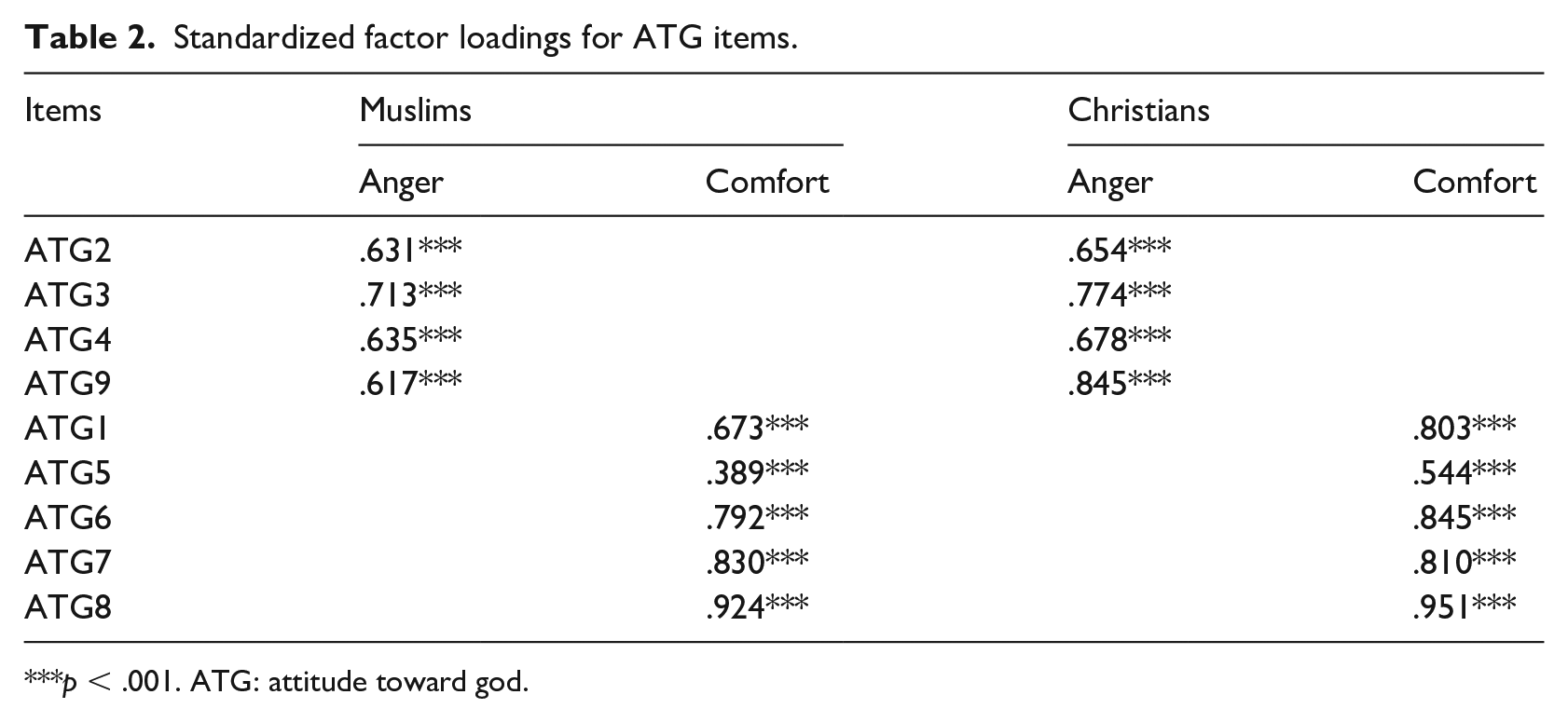
p < .001. ATG: attitude toward god.

Descriptive and correlational statistics
Table 3 shows the means, standard deviations, and correlations for all main variables for both Muslim and Christian participants. Consistent with the results of previous studies, both groups showed high levels for all dimensions of religiousness and comfort, with low levels of anger. The results of zero-order correlations were all in expected directions.
Means, standard deviation, and correlations for Muslim and Christian participants.

SD: standard deviation.
*Correlation is significant at the 0.05 level.
**Correlation is significant at the 0.01 level.
Regression analysis
Table 4 shows the results of the multiple regressions with comfort and anger set as independent variables, respectively. While controlling for neuroticism, the dimensions of religiousness that affected comfort and anger differed between Muslims and Christians. With regard to comfort, all dimensions of religiousness were significant predictors for Muslims. However, in terms of effect size, only believing and behaving had a major effect. The effect size of bonding and belonging was only one-third of the first two dimensions. In contrast, belonging was not a significant predictor for Christians, but the other three dimensions were significant positive predictors. In terms of effect size, the same held true with Muslims; believing and behaving had a major role, while bonding had a lower effect size. For anger, believing and behaving were significant negative predictors for Muslims, while only bonding was a significant negative predictor for Christians.
Multiple regression results for comfort and anger as independent variables.

Bold values indicate significance at p < .05.
The comparison of the BDRS dimension regression coefficient on the comfort variable between the Muslim and Christian groups showed that two dimensions, believing and bonding, were statistically significant (p < .05). Based on Table 4, the regression coefficient of the believing dimension in the Muslim group (β = .36) was greater than that in the Christian group (β = .26). On the contrary, for the bonding dimension, the regression coefficient for Christian groups (β = .16) showed greater results than for Muslim groups (β = –.09).
The comparison of the BDRS dimension regression coefficient on the anger variable between the Muslim and Christian groups showed believing and behaving dimensions were statistically significant (ρ < .05) for Muslims, while only the bonding dimension was significant for Christians.
Since the majority of data came from female respondents, we performed a regression analysis based on data from female respondents only. With regard to comfort, all dimensions of religiousness were significant predictors for female Muslims. In contrast, belonging was not a significant predictor for female Christians, but the other three dimensions were significant positive predictors. With regard to anger, believing and behaving were significant negative predictors for female Muslims, while there was no dimension that was a significant predictor for female Christians. We then conducted a similar analysis for male Christians and obtained the same result. All dimensions of religiousness were not significant predictors of anger. This difference might have been due to different characteristics of female and male Christians or because of the lower number of male respondents. The effect size produced by bonding was actually the same as the effect size of bonding based on regression analysis on the total number of subjects, that is, –.17; however, the significance shows different results. The effect size of bonding was small; thus, as the number of respondents decreased, the effect became insignificant. In this study, there were only 91 male Christians.
Discussion
Consistent with the results of previous research, neuroticism was a positive predictor of anger but a negative predictor of comfort. After controlling for the effects of neuroticism, believing and behaving were significant major positive predictors for comfort for both Muslims and Christians (β for bonding and belonging was relatively small). However, the effect size was greater for Muslims. In contrast, bonding was a significant positive predictor of comfort for Christians but a significant negative predictor for Muslims, even though the effect size was small compared with that of believing and behaving and much smaller for Muslims. Belonging was only a significant positive predictor for Muslims. This result sheds some light on the similarities and differences between Muslims and Christians in Indonesia in the role of religiousness in their relationship with God.
For both religious groups, believing and behaving are the highest predictors of a positive attitude toward God, which indicates that embracing the religious teachings and moral behaviors taught by either religion would contribute to a positive attitude. Both Islam and Christianity in Indonesia teach that God loves humans. For Muslims, the names referring to God’s attributes in the Qur’an include the Compassionate (Al-Rahman), the Merciful (Al-Rahim; literally, womb), the Generous (Al-Karim), The Forgiver (Al-Ghafur), and the Most Loving (Al-Wadud; Nasr, 2002; Saeed, 2008). The Christian Scripture describes God’s love in various ways, including through the incarnation of Christ, as love between believers, and through God’s care and protection (e.g. John 3:16, 1 John 4:7-8, Psalm 86:15). The more believers embrace these narratives, the more they have a positive image of God.
The same is true for moral behaviors. The more believers follow the required religious moral behaviors, the more they have a positive attitude toward God. There seems to be a link between a feeling of attachment or nearness to someone and the ease of following their requests (Lamy et al., 2009); therefore, the link between religious behavior and attachment to God is not surprising. Buchko and Witzig (2003) also confirmed this link between religious practices (such as praying) and the perception of God as being present, accepting, and nurturing.
The effects of believing and behaving on comfort toward God were found to be more pronounced than bonding, a dimension directly related to feelings. It seems that religious believing and behaving provide a more concrete footing for a positive attitude toward God, even more than bonding itself, for both Muslim and Christian students. Muslims may feel God’s mercy, forgiveness, and kindness, whereas Christians may experience God’s care and compassion through teachings and religious practices.
The effects of believing and behaving on a positive attitude toward God were higher among Muslims than among Christian students (higher β). Abu-Raiya et al. (2019, 2020), who conducted studies on Muslim communities in Palestine, Turkey, and Malaysia, argued that higher religiousness might be related to higher positive religious coping. Abu-Raiya et al. (2020) claimed that those who regard religious coping as being more central to their lives might be able to distinguish between different forms of religious coping and therefore use them in a more informed manner. If Abu-Raiya is correct, our current data might be indicative of higher religiousness among Muslims than among Christians in the Indonesian college student population.
However, the religiousness among both Muslim and Christian students in our data (means for all dimensions >5.0) was higher than that observed in secular Western countries (EU), Catholic religious countries (Costa Rica, Italy, Poland, Slovakia), Greece, and the United States (2.53 < means < 4.21; Saroglou et al., 2020). Thus, although we cannot rule out the possibility that Muslims in Indonesia are more religious than Christians, there might be other explanations for the differences in the effects of religious believing and behaving on positive attitude toward God. Christianity may allow for more complex nuances in the interpretation of religious narratives. For instance, the stories of the prophets Job and Jonah are typically taken by Christians to involve human complaints and anger toward God amid challenges and sufferings. The Judeo-Christian Job rails against God; however, in the Qur’an, Job is depicted as patient (sabr) and obedient (constantly turned to Allah; Q 38: 41-44). Furthermore, the Christian Scripture describes Jonah’s anger with the gracious God (Jonah 4:1-3), whereas Muslims usually understand Jonah to be angry at the unrepentant people who reject Allah (Q 21: 87-88). Christians may perceive negative attitudes toward God as an honest depiction of human experience, and no simple solutions to the problem of suffering and evil are presented in the Christian scripture. Such complex shades of meaning might influence the complicated dynamics for Christians between religious believing and behaving on the positive attitude toward God.
Bonding was the only religious dimension among Christians with a larger effect on positive attitude toward God compared to Muslim. Christianity teaches believers to have a personal relationship with God; bonding with God is a hallmark of Christianity. Saroglou et al. (2020) found that Christians in the United States tend to focus on bonding, and Beck and Haugen (2013) mentioned that Christians find comfort through bonding. On the contrary, Muslim participants unexpectedly showed that bonding had a small negative effect on comfort with God. According to Abu-Raiya et al. (2015), there are two possible explanations for religious participation or bonding that may not be in line with a positive attitude toward God. First, among Muslim participants, religious rituals and ceremonies are habitual practices, a part and parcel of daily life. The call to prayer five times a day and daily fasting during Ramadan are continuous quotidian reminders of faith, but their ubiquity may make them seem commonplace. In this context, habitual practices may not constitute a significant part of a dynamic and lively personal relationship with the supernatural being. Second, the association between religious participation and comfort may be moderated by other variables such as religious orientation. Furthermore, the researchers implied that religious participation may have a positive effect on feelings of comfort toward God among believers with intrinsic religious motivations as opposed to those who focus on extrinsic motivations (Abu-Raiya et al., 2015).
Our data showed that the dimension of religious belonging did not predict a positive attitude toward God among Muslims or Christians in Indonesia (for Christians, it was statistically insignificant, p > .05). Perhaps because belonging does not involve the relationship with God, but with fellow believers, the effect on attitude toward God was small or nonexistent.
Moreover, the restriction for communal prayer/worship enforced by the Indonesian government during the pandemic may also restrain the expression of religious belonging dimension. This resulted in the lower means of the belonging dimension.
The statistical insignificance of this for Christians may indicate that they held individualistic relationships with God, as Western Christians tend to, despite living in a collectivist society (Cohen et al., 2016). That is, a Christian participant’s level of comfort with God was likely dependent on their individual relationship with God rather than on their relationships with other believers. Furthermore, Christians’ minority status in Indonesia may have some bearing on their sense of belonging. This may also explain why the other three dimensions, which were more directly related to God, had significant positive effects. The higher the levels of believing, bonding, and behaving, the higher the level of comfort with God.
Religious believing and behaving again play an important role among Muslims in buffering anger toward God. The higher their level of believing, the more they viewed God as loving and caring, while the performance of good deeds was associated with increased feelings of being loved by God. This was true despite the belief that God would punish those who failed to obey the rules. Such an understanding may have helped Muslim participants develop positive perspectives when handling their problems with God. Indeed, Muslims consider behaving to be one of the primary ways of developing positive feelings toward God (Pieper et al., 2018), thus buffering the effects of anger.
For Christians, on the contrary, the only dimension that showed a significant effect on anger toward God was bonding. However, the effect was no longer significant when the analysis was separated for male and female students. This indicated a small effect that became significant only because of the large sample size. Therefore, Indonesian Christian college students did not seem to be able to process their anger through religiousness. Christian college students’ failure of bonding to buffer anger toward God was unexpected. Previous studies had contradictory findings. Hall and Edwards (2002) found that bonding could buffer the effects of conflicts that result in anger toward God. A positive relationship with God was also found to increase the belief in God’s presence and authority, thus helping individuals maintain positive images of God during difficult times (Exline, Hall, et al., 2017). Furthermore, Bock et al. (2018) found that individuals who reported good relationships with God tended to view suffering as a means of growth. In the context of COVID-19, such an attitude could help individuals maintain positive images of God while lessening any related anger.
However, a study by Saputra et al. (2015) might explain this contradictory result. They found Christian college students to be in the lower levels of James Fowler’s stages of faith. Fowler theorized that faith developed through stages similar to Piaget’s cognitive development and Kohlberg’s moral development. As people become more mature in their cognitive development, their faith development becomes more mature as well. Fowler proposed seven stages of faith development; according to Fowler’s theory, young adults should be in synthetic-conventional faith or individuative-reflective faith stage (Fowler & Dell, 2006). People in the synthetic-conventional stage of faith are characterized by a lack of critical thinking that hinders them if reality seems to contradict their belief system; they may not be mature enough to process paradoxical experiences that challenge them to process negative feelings toward God. Therefore, in our study, bonding was a significant predictor for positive attitude toward God (although with small effect) but did not buffer negative attitude toward God among Indonesian Christian students.
For Christians in our study, the believing dimension did not affect anger toward God. COVID-19 likely caught participants off-guard, thus influencing people’s abilities to make sense of the situation from a religious stance. A previous study found that religious people tend to assign religious attributions to events (Wong & Weiner, 1981). Despite participants’ belief that God loved and cared for them, the real conditions of the pandemic provided contradictory information, thus causing internal conflicts, cognitive dissonance, and possible struggles with God (Exline et al., 2014; Van Tongeren et al., 2019; Wood et al., 2010). Research conducted prior to the pandemic found that believing had negative effects on religious and spiritual struggles, including those with God (Aditya et al., 2019). As the pandemic may have increased cognitive dissonance, believing did not have a significant effect on anger.
Compared with Christian students, the effects of religiousness (regression coefficients) seem to be more substantially oriented toward comfort and more negative toward anger among Muslim students. Although they did not explicitly measure religiosity, Thomas and Barbato (2020) also observed that Muslims in the United Arab Emirates reported higher levels of positive religious coping than did Christians during the COVID-19 pandemic.
Implications, limitations, and suggestions for future research
This study found that Indonesian Muslim and Christian college students responded uniquely to the pandemic through the various dimensions of religiousness. College counselors should therefore tailor their approaches to help students increase comfort while reducing anger toward God given these differences. More specifically, counselors should focus on the dimensions of believing and behaving when working with Muslims, by helping clients examine their beliefs, study the teaching of their faith, and exercise their faith and its laws. When working with Christians, however, counselors should focus on bonding to increase positive attitudes toward God and, for mature enough students, to reduce anger. This could be done through the mindful following of rituals such as prayers, meditations, and reflections. Counselors should also keep in mind that believing and behaving are important for increasing positive attitudes.
Even though many ethnic groups were represented in this sample, they were limited to Muslim and Christian students living in the capital city. College students in rural areas and from different religious backgrounds may behave differently. The main differences between Muslim and Christian respondents were generally found in the bonding dimension. Future studies should implement more specific scales to capture elements related to bonding with God, such as attachment. It may also be useful for future studies to focus on other religions in Indonesia and/or similar religions in other countries.
Respondents in this study were mostly females. For future studies, more balanced respondents might be helpful for gender specific analysis.
Conclusion
This study explored the dimensions of religiousness that influenced feelings of comfort in and anger toward God among Muslim and Christian college students in Indonesia. For Muslims, believing and behaving were important for increasing comfort and decreasing anger, while belonging was significant for increasing comfort. However, bonding had a low significant negative influence on comfort. For Christians, bonding was effective for increasing comfort and reducing anger, while believing and behaving were only effective for increasing comfort. Neither comfort nor anger was found to be influenced by belonging in Christians.
The religious belonging dimension, which can be important for well-being in normal circumstances, seems to receive quite a hit during the pandemic in Indonesia through the restriction of communal prayer/worship, thus leaving the belonging dimension as non-predictors for comfort and anger toward God for Christians, and only a positive predictor for comfort in God among Muslims. There is also the possibility that Christian students, as the minority group, are more individualistic compared to their Muslim fellow students, especially in the urban settings.
Our research found that the religious believing and behaving dimensions were stronger predictors of comfort in God for both Muslims and Christians compared to the bonding dimension. It seems that believing and behaving provide a more concrete handle for a positive attitude toward God, compared to the fleeting affective dimension (bonding), especially during the pandemic, which even showed a negative regression coefficient (although very small) on comfort in God among Muslims.
Our data also showed that Christian students seem to have more difficulties dealing with anger toward God during the pandemic compared to Muslim fellow students. This could be related to the more complicated nuances of approaching Christian religious narratives on trusting God and viewing the world through the suffering of Christ, which requires a more mature faith understanding.
Footnotes
Declaration of conflicting interests
The author(s) declared no potential conflicts of interest with respect to the research, authorship, and/or publication of this article.
Funding
The author(s) disclosed receipt of the following financial support for the research, authorship, and/or publication of this article: This research was funded by the Ministry of Education and Culture of Indonesia (Grant Number 100.ADD/LL3/PG/2020).
