



Abstract
Recent studies have revealed how workers’ movements adapted republicanism into a language of anticapitalism in the nineteenth century. Much less attention has been paid, however, to the role feminists played in this process. This essay addresses this oversight by introducing the voices of the utopian socialists under July Monarchy France. These socialists insisted that there could be no social revolution without sexual revolution. Although they are often positioned outside of the republican tradition, this essay argues that the utopian socialists are better understood as rendering the legacy of classical and French republicanism compatible with nascent workers’ movements in the 1830s. By foregrounding the feminist Flora Tristan, this essay shows how utopian socialists weaponized republican tropes to address the social question, thereby expanding what a republican critique of capitalism could look like.
In the summer of 1843, Flora Tristan published L’Union ouvrière (The Workers’ Union). 1 Originally rejected by Parisian publishers, Tristan later released the book with the help of direct subscriptions from sympathetic workers: poets, artisans, painters, laundresses, masons, water carriers, and playwrights, as well as intellectuals like Victor Considerant (who contributed 10 francs) and George Sand (40 francs). The Workers’ Union quickly went through several editions. Each time, workers sponsored its reprint. Inside its pages, Tristan called for proletarians of both sexes to unite and create for themselves institutions for their social improvement. Inside, too, lay Tristan’s critique of industrial society. The Workers’ Union analogized the condition of wageworkers to those of women and denounced the situation of both as slavery. It claimed that both groups could emancipate themselves through unionization. With a union, the promise of 1789 could be fulfilled for pariahs all over—those men and women who, condemned by family and factory, found themselves trapped in unfree dependence. In short, The Workers’ Union stands as one of the first statements of socialist feminism in France and a prominent example of a republican critique of capitalism in the first half of the nineteenth century.
Political theorists have recently come to appreciate republicanism’s adaptation into a vocabulary of anticapitalism during the nineteenth century. 2 Ever since the work of J. G. A. Pocock and Quentin Skinner, it was presumed that liberalism eclipsed classical republicanism as the preeminent vocabulary of modern political freedom. 3 Republican values like mixed constitutionalism and civic virtue were judged unviable in an age of large commercial societies. But scholars have come to understand that republican thought persisted into the nineteenth century and beyond, inspiring popular labor movements like the Knights of Labor and canonical theorists like Karl Marx. 4 They have also traced a more complex, symbiotic relationship between republicanism and liberalism, recasting the relationship between the two as an evolving succession rather than a paradigm break. 5 Far from disappearing in the modern age, republicanism transformed in myriad, conflicting ways in response to the social question and the forms of social interdependence distinctive to capitalism.
Given political theory’s ongoing reappraisal of republicanism, it is striking that theorists have neglected the historical role of feminists like Tristan in adapting republican tropes for anticapitalist criticism. To be sure, contemporary critics have explored feminist uses of republican thought, even if the occasion for joining the two after the Cold War has been to critique liberalism, not capitalism. 6 Yet the neglect of feminist voices from republican critiques of capitalism is particularly conspicuous, because such early republican critiques were inseparable from the emergence of organized feminism. This was especially true in France. 7 Until 1848, leading socialist thinkers believed that the social question could not be resolved without women’s liberation. If there was going to be a social revolution, it would have to pass through a sexual revolution.
This essay revisits these early feminist-socialist voices from July Monarchy France to describe how they used republican tropes to articulate social revolution as sexual revolution. One reason for this operation is straightforwardly historical: despite efforts to enlarge the purview of political theory’s canon, our aperture of nineteenth-century social criticism remains defined by liberalism. Utopian socialism has never received dedicated treatment in the pages of this journal, and Tristan remains virtually unknown among historians of political thought. Yet as scholars plumb the past and present for critical perspectives on capitalism, they ought to do so in dialogue with the whole range of voices raised during and after the nineteenth century. Silvia Federici has observed that preserving the history of anticapitalist thought “is crucial if we are to find an alternative to capitalism,” because “this possibility will depend on our capacity to hear the voices of those who have walked similar paths.” 8 This is especially true of feminists forgotten.
Tristan in particular, however, also has contemporary value. An engaged intellectual rather than a philosopher, she did not theorize concepts in a systematic way. But her polemics point to at least two new ways of weaponizing republicanism as a political language—that is, as a collection of rhetorical tropes and images deployed in the figuration of injustice and the emplotment of its overcoming. First, she reveals its internationalist possibilities. Critics have objected, rightly, that republican liberty has been historically inseparable from nationalism. 9 Philip Pettit’s famous “eyeball test”—that to be free requires we be able to “look each other in the eye without fear or deference that a power of interference might inspire”—usually involves a bounded community of individuals capable of tracking one another’s interests as equals. 10 Tristan’s The Workers’ Union, however, is both a republican critique of capitalism and arguably the first text of labor internationalism in modern European political thought. 11 The Workers’ Union demands that workers of both sexes organize across boundaries of trade and nation. This is not, as for the American Knights of Labor, Pierre-Joseph Proudhon’s federalism or the traditional artisan compagnonnage, a matter of creating associations in various national contexts. Instead, it involves adapting the classical republican trope of fraternité to demand a single international body of both proletarian men and women.
Second, Tristan’s thought models a new way of turning republican critiques of dependency against the family. Contemporary critics have already used republican thought to reveal patterns of domination in institutions of everyday life like wage labor, the workplace, and the marriage contract. 12 Tristan shares these concerns, but she finds the family to be troubling for reasons that are distinct. The normative organization of the family internally dominates women, to be sure. But just as importantly, it structurally reproduces the domination of all working men and women by the bourgeoisie. That is because the sexual division of labor at its foundation prevents proletarian men and women from seeing their linked fates. Without grasping their linked fates, working men and women cannot unionize across sexual difference. They are therefore blocked from generating the shared power necessary to overcome their collective dependency on the bourgeoisie. By expanding the object of critique from the marriage contract to the family as a social institution, Tristan shows us how to attend, not only to domination of women by men within the marriage contract but also to the wider role of the patriarchal family in reproducing working-class disunity and disempowerment.
Introducing Tristan into our portrait of republican critiques of capitalism in the nineteenth century therefore alters that portrait: it reveals internationalist possibilities rooted in social solidarity across sexual difference. Episodes of cooperation between feminism and socialism have often appeared to be exceptions rather than a rule. For its part, republicanism has been cast as an “uneasy ally” to feminism and a substitute for socialism, especially after 1989. 13 Yet studying Tristan and her generation invites us to inhabit a moment in the history of the left when the trajectories of socialism, feminism, and republicanism were not yet pried apart. Tristan and her generation believed, as a matter of common sense, that socialism and feminism shared a joint pursuit of political freedom as collective independence. That common sense seems to me ripe with provocations for the present.
No Social Revolution Without Sexual Revolution: The Making of a Thesis
In 1830, a revolution brought down the Bourbon monarchy in France and replaced it with a new government led by Louis-Philippe, “citizen-king” of the French. Enduring until 1848, this “July Monarchy” oversaw a golden age of liberalism. These were the years of François Guizot’s ministry, the intellectual supremacy of the Académie des Sciences Morales et Politiques, and Alexis de Tocqueville’s breakthrough. They were also the beginning of France’s imperial conquest of Algiers and the Maghreb. Guizot captured the liberal spirit of the age when he enjoined France to “get rich” (“enrichissez-vous!”).
Although liberalism dominated political theory under Louis-Philippe’s rule, these were also the formative years for socialism and feminism in France. Between 1830 and 1848, France industrialized in earnest. An evolving geographic division of labor encouraged workers to migrate to cities like Paris and Lyon where they founded workers’ associations. 14 They created journals such as Le Globe, La Phalange, and La Démocratie pacifique, which were read by an increasingly literate male working class. They also organized mutual aid societies that protested wage suppression and demanded price controls. Lyonnais silk workers rose up in the “Canut revolts” of 1831 and 1834. 15 In 1833, a strike wave hit all of France, including at least 54 between September and December alone. 16 These large-scale patterns of migration and social dislocation were thought to be causally linked to urban squalor, sexual immorality, and poverty. 17 The social question, in short, had come to France.
If liberals saw in the 1830 July Revolution their defining triumph, many workers considered it une révolution escamotée, a stolen revolution. They had waged revolution for a Republic, not a liberal constitutional monarchy. Many of them veterans of secret republican societies, they responded by forming republican clubs whose names, like the Société de droits de l’homme and the Amis du peuple, were reprised from their 1790s counterparts. The rise of the social question was already turning republicans from “political” to “social” problems, and an influx of working-class members into their clubs only accelerated this reorientation of republican oppositional politics. 18
Yet as republican and workers’ movements converged in the early 1830s, it was not obvious that republicanism could answer the social question. Indeed, its modern variant seemed incompatible with the demands of workers’ movements. Jacobins had enjoined revolutionaries to “raise our souls to the height of republican virtues and examples from antiquity,” but they had also updated the republican tradition with a new emphasis on universalism, voluntarism, and individualism. 19 This modernized “French” republicanism contrasted sharply with the corporatist idiom that early nineteenth-century workers employed for political claims-making. Corporatism was the mode of social organization inherited from the ancien régime. It imagined society, not as a collection of equal individual citizens articulated together by common concerns but as a sequence of overlapping and concentric corporations woven together by relations of complementarity and subordination. Under corporatism, individuals acquired voice by dint of their membership in collective bodies like guilds, churches, estates, and families. Workers pressed demands, not as abstract individual citizens but as stonemasons, weavers, shoemakers—members of society.
After the Revolution, these corporatist claims clashed with abstract republican citizenship. The 1791 Loi Le Chapelier had been unequivocal: If, contrary to the principles of liberty and the Constitution, some citizens associated in the same professions, arts, and crafts hold deliberations or make agreements among themselves . . . such deliberations and agreements . . . are declared unconstitutional, in contempt of liberty and the Declaration of the Rights of Man, and noneffective.
20
Thus, as workers reoriented republican politics in July Monarchy France toward social problems, they also moved onto contradictory conceptual terrain. Unable to use the language of corporatism without sounding anachronistic, they also could not invoke republicanism uncritically. For republicanism to become a vocabulary of anticapitalism, even a language of class struggle, it would have to be adapted. That adaptation would be one of the achievements of French utopian socialism in the first half of the nineteenth century.
* * *
The term “utopian socialism” describes a generation of critics active under the July Monarchy. A heterogeneous group, they were recognizable by the way their social criticism combined Romanticism, faith in science and progress, monist mysticism, and a heterodox Christianity. 21 Like other socialist currents, they emerged from the crucible of the revolutionary republican tradition, which by 1830 had become the lingua franca of radical politics. Although not all utopian socialists were involved in avowedly antimonarchical politics, they shared with other republicans the belief that 1789’s promise had yet to be fulfilled. As Considerant put it in his 1843 Principes du socialisme, “Revolution, from 1789 to 1830, has shown only the negative and abstract side of the new democratic right.” It had abolished inherited privileges, only to also “[abandon] the whole social and economic arena” to “unbridled laissez faire” individualism. That was why socialism needed to finish “the democratic work hardly begun,” to make France democratic “not in theory and in law” but “in fact.” 22
To answer the social question, utopian socialists drew on republicanism’s rhetorical tropes to forge a distinctive vision of “social revolution.” Like their successors in the history of political thought, they did so as a way of finishing 1789. But unlike those “scientific” successors, they did not do so by positing male workers as the social revolution’s protagonist. Nor did they place responsibility for resolving the social question with the State (Jacobinism), a vanguard party (Leninism), or student movements (the New Left). Instead, for this first generation of socialists, the agent of social revolution had to be “Woman.” If there was going to be a social revolution, it would have to be a sexual revolution.
Utopian socialists repurposed republican tropes like fraternité and la femme messie to articulate this vision. Fraternity had originally formed a cornerstone of revolutionary republicanism alongside liberty and equality. The Constitution of 1791 stipulated that “National festivals shall be instituted . . . to maintain fraternity among the citizens, and to bind them to the Constitution, the Patrie, and the laws.” 23 However, even though revolutionaries proclaimed fraternity a mainspring of modern republicanism, in practice, liberty and equality overshadowed it. It received no equivalent treatment in the realm of political thought to Condorcet or Robespierre’s work on liberty and equality. 24 Unlike those two values, it did not appear in the 1789 Declaration of the Rights of Man and Citizen. And after Thermidor, Brumairians inserted “property” into its place in the republican trifecta. Rather than fraternity, they spoke of “the sacred rights of property, equality, and liberty.” 25
After the 1830 revolution, French socialists of all stripes retrieved fraternity as a fundamental value and redefined its valence. Jacobins had linked fraternity to nationalism and war, but socialists now linked it to economic cooperation and universal peace. Louis Blanc, for example, presented the “triumph of fraternity” as the goal of all social reform in his 1840 L’organization du travail. 26 Blanc was the July Monarchy’s leading socialist republican, and his pamphlet argued that the bourgeoisie “built its sovereignty upon free competition—the basis of tyranny,” whereas social reform would aim to “establish a solidarity of interests” and “salvation for all members of society without exception.” 27 Etienne Cabet, a utopian who coined the term communisme in France, wrote in his popular 1840 Voyage en Icarie that “Today, therefore, the doctrine of equality and fraternity, or of democracy, is the intellectual heritage of humanity; the fulfillment of this doctrine is the goal of all efforts, struggles, and combats on this earth.” 28 He was joined in his vision of universal fraternity by Pierre Leroux, a utopian who coined the term socialisme and who in his 1845 edition of De l’humanité argued that “the religious law of the caste, that is to say equality and fraternity, has become the religious law of humanity everywhere.” 29 In these texts, fraternity came to foreground the ills of a competitive market society: its egoism, its economic rendition of Hobbes’s bellum omnium contra omnes, its transformation of France’s cities into “un immense atelier de putréfaction.” 30
Socialists disagreed on the specific path to fraternity. Blanc, for example, plotted the path as one from “disorganization” to “concurrence,” whereas Charles Fourier and the Ecole sociétaire plotted it as an evolution from “civilization” to universal “harmony.” Beneath these differences in stadial theory, however, we can glean a common aspiration: “Men of inequality and conflict,” the editors of Le peuple argued, would “become men of harmony and fraternity.” 31 Social revolution would convey us from competition to cooperation. It indicated, not a regime change but a morally transformative event, repairing what had been frayed or damaged by industrialism. And in contrast to 1789’s political revolution, which descended to earth from the celestial realm of ideas, the social revolution would depart from existing social conditions. “To arrive at a social revolution,” Blanc explained, “it is necessary to take its starting point in the conditions of present society.” 32 However they imagined its particulars, socialists saw the social revolution as a way of peacefully evolving to an historical phase where liberty would be compatible with fraternity. Liberty, Jeremy Jennings writes, would be “not just the narrow conception of the absence of restraint but something tied to a different vision of society: the social Republic.” 33
If fraternité helped socialists define social revolution’s goal, la femme messie helped them identify its protagonist. This trope, too, was drawn from French republicanism. France had already developed a distinguished iconographic tradition of heroic women stretching back to Joan of Arc, but the Revolution republicanized the trope with Marianne and Liberty (figure 1). 34 Marianne and Liberty led the people at the same time that they represented them. They were, Eric Hobsbawm observes, the “concentrated force of the invincible people,” the people’s power incarnate. 35 Utopian socialists like Tristan were undoubtedly influenced by the most recent exemplar of this visual vocabulary: Eugène Delacroix’s 1830 Liberty Leading the People (figure 2). 36 In these allegorical illustrations, there is a direct causal connection drawn between women’s agency and the people’s emancipation.
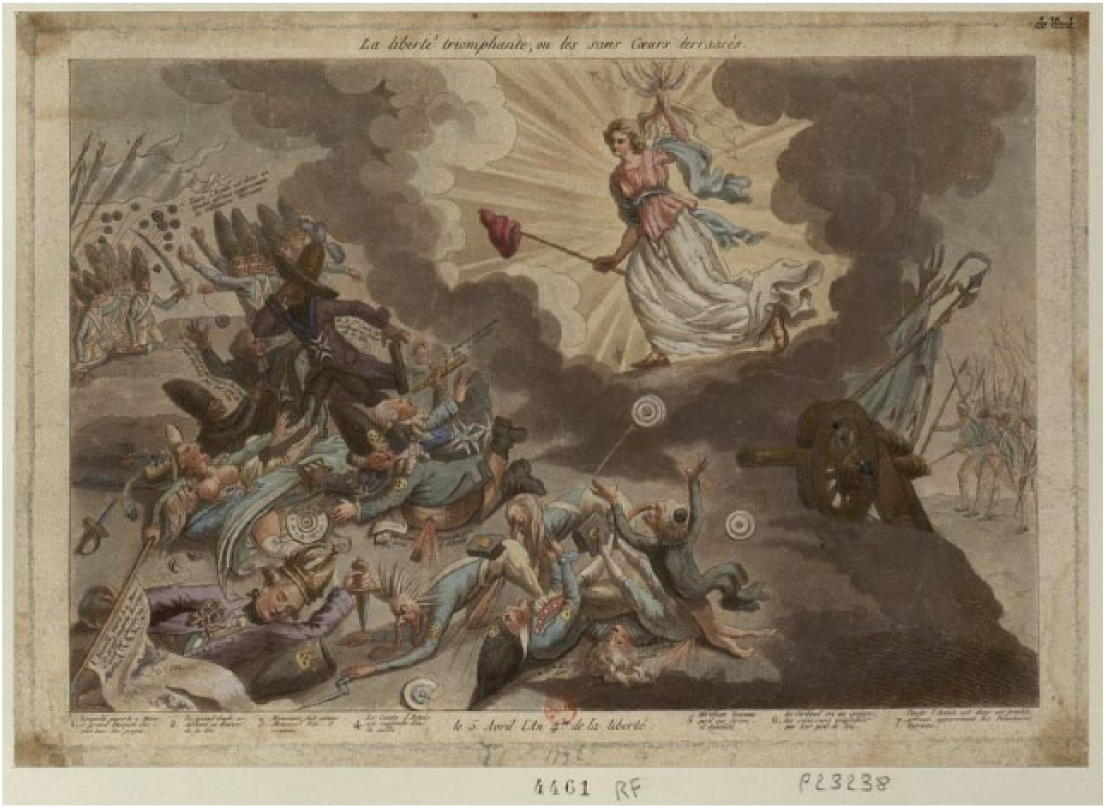
La Liberté Triomphante (1792). Bibliothèque Nationale de France, Paris.

Eugène Delacroix, Liberty Leading the People (1830). Louvre, Paris.
Utopian socialists used this republican motif to posit “Woman” as the agent of social revolution. Henri de Saint-Simon, a Restoration-era writer whose thought inspired subsequent socialists, invented a complex symbolic vocabulary to convey his prescriptions for the state to redistribute to laborers their portion of the social product. At its head was a divinity, l’androgyne. After all, who better to lead the path to universal fraternity than a deity that embodied the supersession of the most fundamental division, sexual difference? Other Saint-Simonians elaborated this motif in various ways. Simon Ganneau announced that he himself was “the androgyne, the messiah . . . for the age of association” and the new humanity, “Evadam.” 37 Prosper-Enfantin insisted that the coming social revolution would be heralded by the arrival of la femme messie, “Guide to Humanity.” From his all-male retreat at Menilmontant, Enfantin and his apostles awaited la femme by leaving her an empty seat at their meetings. For their part, Fourierists agreed that dyadic conceptions of sexual difference obscured how all men and women possessed qualities of both sexes, but simply in different degrees and proportions. Masculinity, with its rationalism and egoism, found its reciprocal and equal counterpart in women’s harmonious nature. That was why the regeneration of humanity depended on women’s liberation. Her virtues would mitigate the socially disintegrating effects of market competition. 38
Discerning what utopian socialists found so attractive in this republican iconographic tradition is not difficult. La femme messie combined in a single symbol a commitment to demotic power and an idealization of woman as industrial society’s antithesis. Where contemporary France was ruled by materialism, self-interest, and competition, woman brought harmony, cooperation, and virtue. That was why, if led by la femme messie, the people’s emancipation would also be a social revolution.
It can be easy to dismiss these invocations of “Woman” as merely symbolic. Undoubtedly, many utopian socialists uncritically recapitulated republicanism’s idealizations of archetypical women like Liberty and Marianne while ignoring real women and their political rights. As Naomi Andrews has shown, this contradiction was no accident. “Women in early socialism came to stand as the antithesis of all that socialists despised in their contemporary world,” and it was precisely because of that “process of exaltation” that “socialists also effectively ruled woman out of the public sphere they gained for themselves and other men in the spring of 1848.” A mythic apostle of heaven, she had no place in worldly politics. 39
Even so, as other feminists have been keen to point out, pious acclamations of symbolic “Woman” created—often unintentionally—opportunities for real women to organize. “The irony,” Margaret Talbot observes, “was that in sanctifying the woman-redeemer,” utopian socialism created forums for women like Tristan “to argue [their] points” against their male counterparts. 40 That was why it was no accident, as Claire Moses points out, that feminism as an autonomous movement emerged from within utopian socialism in France. 41 Symbols and tropes are always equivocal. Their political uses cannot be predetermined by their conceptual content or the context of their invention. The female messiah may have been a rhetorical figure for men to elevate mythic “Woman” at the expense of real women, but it also created spaces and opportunities for real women to repudiate their symbolization.
It helped that utopian socialist appeals to “Woman” could be much more than symbolic. Women’s work during the July Monarchy often revolved around skilled handicraft work. Many of the leading utopian socialist women were seamstresses as well as mothers and teachers. For these working women, the claim that “Woman” could repair the social fabric from the wear of economic individualism would not have been aspirational but descriptive. After all, their daily labor involved sewing and mending clothes, raising families, and morally educating children. This labor was not a metaphor for repair and creation; it was repair and creation. The “entanglement in the material conditions of her work as a seamstress,” Maria Tamboukou points out, “created conditions of possibility for real political ideas and practices to emerge and unfold.” 42 Hence if working women found a kernel of truth in the symbolic language of “Woman” as society’s mender, that was because the symbolism was concrete. Stitching back together the social fabric and real fabric, giving birth to a new society and a new family described the same activity, the same reparative agency, the same creative power.
No wonder that utopian idealizations of “Woman” as the social revolution’s protagonist resonated with a generation of feminist-socialist activists, including Tristan. She belonged to a diverse landscape of radical socialist women (“femmes prolétaires”) who struggled within its currents to radicalize its feminist possibilities. That landscape included women like Claire Bazard, the first woman member of the Saint-Simonian “Tribune”; Désirée Véret, a follower of Enfantin, Charles Fourier, and Robert Owen who would go on to help establish the First International; Suzanne Volquin, who with Véret and Marie-Reine Guindorf helped found La Femme libre, the first proletarian feminist magazine in France (figure 3); Jeanne Deroin, among the first activists to propose a federation of unions; and Clair Demar, a powerful internal critic of Saint-Simonism and defender of free love. These feminist women took seriously—more seriously than many of their male counterparts—Fourier’s proposition that “Social progress and changes of historical period are brought about as a result of the progress of women towards liberty,” because “the extension of the privileges of women is the basic principle of all social progress.” 43 In the words of the seamstresses at the Tribune, “It is by liberating women that you will liberate the worker.” 44 And to press this point, these feminists weaponized symbolic “Woman” for their own purposes and won “a new conception of their own worth and dignity.” 45

Headmast of La Femme Libre. Bibliothèque Nationale de France, Paris.
That is why, despite the troubling gap separating “Woman” and women in utopian socialism, we should not lose sight of the conceptual innovation. The idea of social revolution will enjoy a distinguished pedigree. Marx will distinguish it from a merely “political” revolution in The Eighteenth Brumaire of Louis-Bonaparte (1848). Where political revolutions like 1789 relied on the “borrowed language” of ancient republics, “the social revolution of the nineteenth century cannot create its poetry from the past but only from the future.” 46 Karl Kautsky will define the social revolution again in 1902 as “a complete transformation of wonted forms of association among men.” 47 It will name the seizure of political power by the most oppressed class, namely workers. But for utopian socialists, social revolution depended not only on the seizure of power by workers but also the emancipation of women from dependence and subordination. The transfiguration of society will be actualized by women’s agency. Their liberation will convey us to fraternity, for the bonds of humanity are forged in the crucible of cooperation and conjugality, not egoism and competition. This credo was articulated through deliberate repurposing of republican tropes. The result was a striking thesis in the history of political thought: no social revolution without sexual revolution.
Flora Tristan: From Corporatism to Internationalism
Tristan’s thought belonged to this generation. Born in 1803 to a French mother and Spanish father from Peru, she grew up outside of Paris in a household frequented by Simon Bolivar. Her young adult life would see her married to an abusive husband; repeated efforts to divorce him; a transformative trip to Peru to secure an inheritance (which failed); an attempt on her life by her husband; infamy for surviving his gunshot; an encounter with utopian socialism in the salons of the Hôtel de Desvres on Rue Monsigny; and finally by the mid-1830s an extensive, dialogic engagement with leading progressive intellectuals: Fourier (to whom she offered collaboration), Considerant (who published her work in La Phalange), Owen (whom she visited in London in 1839), and Sand (whom she was seen to rival). 48
Her writing reflected these encounters. Like her contemporaries, Tristan became enthralled with Romanticism. Her memoirs pay homage to exile, the triumph of feeling, the invisible bonds interconnecting all life forms, and a Promethean “Dieux.” Like them, too, she concluded there could be no social revolution without sexual revolution. Answering the social question meant answering, “how can and must one love and treat woman, for the sake of all men and women?” (W 75). And where male utopian socialists awaited la femme messie to lead the social revolution, Tristan sometimes spoke as if she actually were the “Guide to Humanity.” “I who have come to offer salvation to the working class,” she wrote with perfect self-evidence. 49
Even so, Tristan linked social and sexual revolution in ways that were distinct in her context. That is why, I want to now suggest, she can be valuable for contemporary critics wielding republicanism for anticapitalist criticism.
For one, she was able to bend utopian appeals to republican fraternity into a call for an international union of working men and women. 50 It was certainly never self-evident how Tristan could do this. After all, classical republicanism confined fraternity to the walls of a city-state or, after the eighteenth century, a nation. It insisted that a delimited community was required to create the space of common equality between citizens. Hence, Jean-Jacques Rousseau defended nationalism in On the Government of Poland. “In order to keep his people from dissolving among foreign peoples,” Rousseau argued that Moses had to give them “morals and practices incompatible with those of other nations . . . all the bonds of fraternity that he placed among the members of his republic were so many barriers which kept it separate from its neighbors and prevented it from blending with them.” 51 Hence also why republicans and their critics have argued that republics ought to be small, that they demand a heightened sense of prepolitical homogeneity, and that they depend on a “thick” social cohesion—that is, fraternity—in tension with a cosmopolitan politics. 52
Something of this classical attitude endured into the institutional prescriptions of Cabet, Owen, and Fourier. Even as each thinker reactivated fraternity to repudiate chauvinistic nationalism and individualism, they assumed that fraternity required delimited societies. They proposed small, self-governing intentional communities in pastoral landscapes. These communities would realize equality and fraternity in miniature and in sequestration from industrial society. Owen’s utopian community at New Lanark was the most successful example. New Lanark provided communal child education, variety in labor, communal farms, and an economy based on at-cost goods. But it was also isolationist. Owenists gambled that scaling down communities might retrieve some measure of harmony and independence. Fourier’s phalanstères were more elaborate, but they, too, were built as self-contained communes. Since humanity was constituted by dozens of affective orientations, phalanstères needed to organize the community according to a precise formula that harmonized these affects. Thus, phalanstères were restricted to several hundred people who enjoyed a complex division of labor, “attractive work,” gastronomical delights, and a “sexual minimum” to match their “social minimum.”
As much as these schemes impressed her, Tristan elected to move in the opposite direction. Rather than recalibrating the scale of fraternity down to the pastoral commune, she proposed the inverse: answering the social question required that we scale upward and outward. “The Workers’ Union,” she explained, “proceeding in the name of universal unity, must not make any distinction between nationalities or male and female workers belonging to whichever nation on earth” (W 125). Tristan advocated for a sequence of local unions that, rather than confederating with others, collectively formed a superior unified body that would “put the working class in a social position to demand its right to work, its right to education, and its right to be represented before the country” (W 47). Unity was key, because it manifested the fact that all workers shared a common interest and linked fate. Leadership would be distributed across various geographies and scales, but they would culminate in a central committee. That committee would manage subscriptions to run the various workers’ palaces, keep membership books, and fund a public defender in government much like Ireland had found in Daniel O’Connell.
In a society habituated to organizing according to local corporatist lines of trade and guild, this proposal was counterintuitive. Yet Tristan was moved to recast fraternité in an internationalist idiom, because her specific path to the social question gave her a capacious understanding of the subject of socialism. Most utopian socialists arrived at feminism through socialism. Their path to women’s equality passed through their outrage at the physical and psychological depletion wage-labor inflicted on working men. Tristan, however, arrived at socialism through the woman question. If these different paths brought Tristan and others before the same web of domination, the same “social totality,” it is nevertheless true that one’s departure point as a critic shapes one’s vantage point on that totality. The same set of relations under capitalism can always be apprehended several different ways, because our grasp of that totality is perspectival and because each apprehension has a different way of being adequate to it. 53 Accidents of biography and circumstance led Tristan to apprehend capitalism from the experiential basis of women’s dependence. The fortunate outcome was that by the time she arrived at the social question, she already understood that the subject of socialism had to include, at the minimum, women of all nationalities.
We can trace Tristan’s evolution from the woman question to the social question to her earliest essay, “Nécessité de faire un bon accueil aux femmes étrangères” (1835). The essay is exclusively concerned with the condition of traveling women. Despite the postrevolutionary “regeneration for the human race,” Tristan argued, traveling women were still treated poorly. Tristan urged her readers to consider how upon arriving in Paris, an aristocratic woman would struggle to enter society, meeting only “egotism and curiosity on the one hand and complete indifference on the other.” A bourgeois woman would find herself endlessly exploited, having no one to trust. A working-class woman—“the most numerous, the most interesting, on whom all griefs seem to be concentrated”—either “weeps and dies in obscurity,” “moans and wrings her hands in silence,” or “[loses] herself in that immense abyss where everything is reduced to the same form and takes on the same coloring,” poverty and prostitution. 54
She broached the idea of a union in this first essay, but it was only for elite women: “feeble as we are individually, it is only in union that we can find strength, power, and the possibility of doing good.” 55 Yet in subsequent writings, her feminism evolved to include a wider class of women. In her Mémoires et pérégrinations d’une paria (1838), for example, she began to use the term “pariah” for all women trapped in dependence. Tristan saw herself as an exemplary case. Fleeing an abusive husband in France and blocked from receiving her inheritance in Peru by her illegitimate status, Tristan believed herself “a pariah in the New World as I had been in the Old.” 56 But she also spoke of her cousin, Dona Carmen, a widow who inveighed against marriage as “the only hell I acknowledge,” her own “tyrannical husband,” and the condition of all married women “because they are all oppressed to some extent by their masters” (P 105–6). She spoke, too, of her cousin Dominga, a former nun who escaped the convent only to be trapped by its stigma: “You call me free? In what country can a frail creature oppressed by a wicked prejudice be called free? Here, Florita, in this room, in her pretty silk dress, Dominga is still the nun of Santa-Rosa! … If people see me in the street, they point me out and curse me” (P 240–41).
It is said that liberalism idealizes liberty as contractual consent, whereas republicanism construes it as independence. For a republican, to be free is as Dona Carmen and Dominga wished: to be “absolute mistress of yourself” rather than be “dominated” by family and “the wickedness of men.” In turn, dependence on an external will is a form of servitude. It means enjoying one’s schedule of rights (or not) at another’s discretion. That is why Rousseau believed political freedom must take the form of popular self-rule. For a people to be free, they cannot be subject to any will but their own in the form of the general will.
Tristan’s unbending scorn for the condition of pariahs like herself and her cousins was animated by this familiar republican protest against dependence. “In Europe women are men’s slaves just as they are here,” she bitterly complained to Dona Carmen (P 106). She meant that they all formed a dependent class. For all of the obvious differences between a Peruvian nun, a poor English woman, and a married French woman, they were all condemned by society to live by the will of others.
During the next decade, Tristan continued expanding her understanding of dominated classes to include not only women but also working men. In the 1842 edition of her Promenades dans Londres (1840), she included a “dedication to the working class,” which denounced poverty as servitude. Workers were effectively slaves, because they had no prospect of escaping their condition. They may have been free to contract away their labor, but ignorance of their rights and collective power kept them subordinated to the bourgeoisie. Even more than the Peregrinations, the Promenades dramatized this servitude. But this time, Tristan did not have in mind only women: “I clasp your hands in mine,” Tristan wrote, “all you men and women who up to this day have counted for nothing in the world.” 57 The woman question was evolving into the social question for Tristan.
The conceptual metamorphosis was completed by the time of The Workers’ Union in 1843. “Pariahs” were no longer just women, but all individuals trapped in unfree relations of dependence on the margins of society.
Up to now, woman has counted for nothing in human society. What has been the result of this? That the priest, the lawmaker, and the philosopher have treated her as a true pariah… what must make us hope that this sentence can be repealed is that the wisest of the wise have also for six thousand years pronounced a no less horrible verdict upon another race of humanity—the proletariat. (W 77)
It was therefore time, Tristan argued, for men to “emancipate the last slaves still remaining in French society; proclaim the rights of woman, in the same terms your fathers proclaimed yours” (W 88). Where Tristan once focused exclusively on women, she was now convinced that women and workers shared a common servitude. Hence the unprecedented claim of The Workers’ Union: rather than revive corporatism, men must join with women to create something historically new, a “universal union of working men and women” (W 88).
Much like subsequent feminists, such as Louise Michel and Alexandra Kollontai, Tristan was using her personal experiences to expand her understanding of the subject of socialism across lines of sex and nation. It was why she could propose an international union underwritten by an unusually expansive conception of the working class: “by working man or woman, we mean any individual who works with his or her hands in any fashion. Thus, servants, porters, messengers, laborers, and all the so-called odd-jobbers will be considered workers” (W 101).
Tristan’s internationalism became the centerpiece of The Workers’ Union. It was the most important value for children’s socialist education to convey: “By every means possible, the child would have to be led to understand that our globe is a large humanitarian body . . . All the parts of this great body are as closely connected to each other as the various parts of the human body.” Once the child grasped this metaphor of international fraternity, she would also grasp “the indivisibility of the big humanitarian body and the solidarity of nations and people” (W 118–19). Like Marx, then, Tristan renounced the belief that republican fraternity could only be realized locally. Instead, she insisted that questions of servitude and liberty, dependence and autonomy, were best worked through at the international scale. In so doing, her writings offer a feminist origin for subsequent forms of internationalism, Marxist or otherwise. They also point to a surprising genealogy for feminist-socialist thinking: rather than an outgrowth of internal disputes within “scientific” socialism, it had its roots in socialism’s decidedly unscientific “utopian” phase.
Flora Tristan: From the Conjugal Couple to the Family
Tristan’s internationalist idiom of republican fraternité is not her only contribution to contemporary social criticism. She also shows the importance of turning republicanism’s critical attention from domination within the conjugal couple to the wider role of the family in reproducing a class society. The difference here is important. There has been no shortage of republican analyses of domination within the former. Indeed, the dyadic marriage contract, along with that of the employer and employee, has served as the paradigmatic case for explaining the stakes in differentiating between freedom as nondomination and freedom as noninterference. A husband may not always interfere with his wife’s liberty, Pettit explains, but the absence of interference does not alter the situation as one of domination: she is subject to his dominion even when he does not exercise it. Indeed, that is what the liberal language of contract cannot capture: “the striking feature of a contract, even a free contract . . . is that it may give one party a power of domination over the other.” 58
Tristan’s work reminds us, however, that focusing on domination within the conjugal couple is not the same thing as focusing on the family. To focus on the conjugal couple is to focus on how women are subject to men’s dominion through the marriage contract. To focus on the family is to attend to how its patriarchal division of labor reproduces society in a specific shape, namely one where the working class is a class divided against itself by sexual difference. The family is never reducible to the individuals that “consent” to make it up, because its shape is not a matter of private wills but the laws of kinship which articulate private individuals into a structured social whole. Especially in France, the family has always been “the best unit to organize solidarity and build political consensus, the most universal and most abstractable mode of social representation.” 59 Tristan perceived this difference. What is at stake in The Workers’ Union goes beyond domination within the marriage contract. The text directly addresses the family’s role in grounding the wider condition of the working class as a dependent class.
Socialists of Tristan’s generation often attributed the working class’s enduring dependent status to low wages, a reflection of manual labor’s low social valuation. And indeed, unskilled labor in France was traditionally held in low regard because it lacked “intelligence,” did not require the application of reason, and therefore lacked the moral worth that characterized its higher kin, the “mechanical arts” of the gens de métier and “liberal arts” of intellectuals. In eighteenth-century lay economic thought, manual labor left nature in its brute, unspiritualized state. In contrast, art was a rational, form-giving act of legislation over nature. This conceptual opposition between work and art was rooted in the material culture of prerevolutionary France and justified the traditional hierarchy between unskilled labor, the mechanical arts, and the liberal arts. It also meant that work, by definition, could not be the foundation of an independent and free life. Only ownership of land (for physiocrats) or one’s corporate standing (for trade guilds) could do that. 60
Socialists of all types responded by revaluing the value of manual labor. Practically, this was done through demands for a social minimum, higher wages, and for variety and cleanliness in work. Ideologically, revaluation was accomplished through adopting what Kristin Ross has called a language of “labor as redemptive agency.” 61 In this language, manual labor was no longer the burden of sin or merely inert, mechanical activity. Instead, it was a Promethean fountain of creation. Saint-Simon was typical when he wrote, “Work is the source of all virtues; the most useful work should be the most highly esteemed; thus divine and human morality both call on the industrial class to enjoy the first place in society.” 62 The young Marx probably also imbibed this humanist language while in Paris. In his 1844 Paris notebooks, he famously describes unalienated labor as “life-activity, productive life,” which in “working-up” rather than mutely rearranging nature, verifies man’s freedom as a conscious species-being. 63
Tristan shared this language, too. She believed work to be “the only truly honorable thing” and praised Saint-Simon and Enfantin for proclaiming “the rehabilitation and sacredness of manual labor” (W 41, 60). But for Tristan, the deeper reason working men and women—that is, the entire working class—formed a permanent dependent class was not simply low wages. However true it was that “manual labor has always been and is still looked down upon,” the reason workers formed an enduring dependent class was political: they were barred from generating the power necessary to combat their condition. And the reason they could not generate power was because the emerging sexual division of labor within the proletarian family prevented men and women from understanding their common interests and acting on them (W 61). Proletarian families were, Tristan explained, the site at which the working class was inflicted with “division” (W 51).
If a bee or an ant, instead of working with the bees and ants to stock the common dwelling for winter, decided to separate and work alone, it too would die of cold and hunger all alone in a corner. Then why do you remain isolated from each other? Individually, you are weak and fall from the weight of all kinds of miseries. (W 39)
Tristan itemizes in The Worker’s Union many reasons for division, including continuing proletarian dependence on corporatism, which, rather than creating class power, “divides the working class into a multitude of small private groups” (W 51). The main culprit, however, was the organization of the proletarian family. Industrialization not only introduced free labor but also reorganized the home. Large tanneries, sugar refineries, and silk mills existed in France, but craft production prior to the nineteenth century still revolved around guilds (glasswork, masonry) or the putting-out system (lace, silverware). These modes of production accelerated manufacturing while leaving the household intact as the main site of production. 64 But with free labor and early manufacturing, production gradually relocated outside the home, spatially disaggregating it from the workplace. The result was the creation of separate but complementary spheres for production and reproduction, men and women.
Most socialists observed this transformation. But what Tristan emphasized in production’s separation from reproduction was not only economic exploitation but political disempowerment. In The Worker’s Union, she drew portraits of dysfunctional families to dramatize the ways working men and women struggled to see each other’s fate as linked. The creation of separate spheres created an appearance of two wholly separate species of humans. Women were reduced from man’s cooperative partner to “a nice doll and a slave destined for amusing and serving her master” (W 78). For the husband’s part, he found himself unable to connect with his wife and children. Rather than cogoverning the household, he despised domestic life and sought the company of others at taverns, “that place of perdition which wastes the worker’s time, money and health, and dulls his intellect” (W 85). Underlying her prudishness was Tristan’s observation that for working men, the household was not home. Unable to enjoy his family as the company of equals, the tavern became “the worker’s TEMPLE; it is the only place he can go” (W 94). The sexual division of labor thus provoked the breakdown of the family into antinomian spheres: Having received more instruction, being the head by law and also by the money he brings home, the husband thinks he is (and he is, in fact) very superior to his wife, who only brings home her small daily wage and is merely a very humble servant in her home. Consequently, the husband treats his wife with nothing less than great disdain. Humiliated by his every word or glance, the poor woman either openly or silently revolts, depending upon her personality. This creates violent, painful scenes that end up producing an atmosphere of consistent irritation between the master and the slave (one can indeed say slave, because the woman is, so to speak, her husband’s property). This state becomes so painful that, instead of staying home to talk with his wife, the husband hurries out; and as if he had no other place to go, he goes to the tavern . . . with other husbands who are just as unhappy as he . . . what becomes of the children? They see their father only in the evening or on Sunday. Always either upset or drunk, their father speaks to them only angrily and gives them only insults and blows. Hearing their mother continuously complain, they begin to feel hatred and scorn for her. They fear and obey her, but they do not love her. . . . (W 80–81)
Bourgeois families may experience their own pathologies, but what is unique to the emerging proletarian family is the way the division of labor snaps its affective bonds of commonality, its emotional economy. The family turns out to reproduce “division” between fathers, mothers, and children. Separate spheres blocked the identification of common interests, of linked fates.
Interpreted this way, it makes sense that The Worker’s Union is relatively less concerned with the themes that preoccupied other utopian socialists like wages and social minimums. Tristan cared about the proletarian family’s organization, because that was where the working class learned to divide itself along lines of sexual difference. It was therefore the existing shape of the family that blocked the path to the goal: “a general union among working men and women, regardless of trade” and “which would have as its goal the CONSOLIDATION OF THE WORKING CLASS” (W 39). This point is worth emphasizing. Tristan was unique among her peers for her forthright focus on the problems of political organizing. The goal of The Workers’ Union, and the reason Tristan wrote it, was to help workers to do the one thing that mattered: “to acquire a real power,” to “make itself heard,” to “demand from the bourgeois gentlemen its right to work and organize” (W 58). Above all else, Tristan’s utopianism was about acquiring power. “If I preach unity,” Tristan explained to her readers and listeners, “it is because I know the strength and power you will find” (W 56).
Its commitment to the creation of class power made Tristan’s union superior to the older mutual aid societies. The purpose of those old “private groups is simply to give aid” or “relieve individual suffering” (W 49). But because they do not create class power, no matter how much aid they give, “the physical and psychological condition of the working class will not have changed in fifty centuries: its fate will always be poverty, ignorance, and slavery, the only change being the types and names of slaves” (W 50). If wage slaves are to escape their status as a dependent class, they need leverage. And for that, working men and women must see their fortunes as linked. Without that, there can be no union, and both men and women will be less free. “Between master and slave,” Tristan insisted, “there can only be the weariness of the chain’s weight tying them together” (W 83).
In the end, Tristan’s concern with the familial division of labor was not reducible to the domination within the conjugal couple. It was about artificial divisions imposed between proletarian men and women, their subsequent disempowerment, and thus the enduring dependent status of working women and men everywhere. That is why Tristan’s book ought to be considered not only a text of utopian socialism but a republican critique of capitalism. Independence, what Machiavelli called “the free way of life”—that is what Tristan’s union sought. “It is up to you, and only you,” Tristan emphasized, “to act in the interest of your own cause” (W 37–38).
Conclusion
After Tristan published The Workers’ Union in 1843, she embarked on a “tour of France.” She would go to workplaces, explain her argument, and convince workers to support the union. Her account of the tour is contained in a posthumously published journal. In its pages, we see Tristan frustrated with male workers’ resistance. We see women suspicious of Tristan, a beautiful woman luring husbands away with utopian schemes. But we also see Tristan’s delight when workers supported the cause. In its pages, Tristan fashioned herself as la femme messie. She even acquired an apostle, Eléonore Blanc, whose soul Tristan occasionally insisted she possessed. But the tour only lasted one year. Tristan’s health deteriorated as she traveled, and in November 1844 in Bourdeaux, she passed away at forty-one.
Circumstances would soon bury Tristan’s ideas with her. Already seen as la femme messie, her early death completed her transformation into a martyr for the proletarian cause. But with 1848’s failure, Tristan’s political thought was laid to rest along with utopian socialism. In October, after the revolution’s failure was apparent, approximately eight thousand workers gathered in Bourdeaux. They unveiled a white column engraved with the epitaph: “To the Memory of Madame Flora Tristan, author of the Workers’ Union. The Grateful Workers. Liberty, Equality, Fraternity, Solidarity.” They eulogized her with a recitation of “Let Us Be United.” 65
Tristan’s life and work would be succeeded by generations of socialist criticism that would outstrip her economic analyses. She does not put forward a convincing analysis of capital’s logic. But if succeeding generations of socialist criticism advanced analytically, they also regressed politically. Especially after 1871, French socialism would become almost exclusively identified with the struggle of male workers. The history of the republican left during the Third Republic is a history of equivocation, naive scientism, and an intense recommitment to heterosexual familialism. 66 Not until the postwar period would the French left revisit feminism in any significant way. To this day, it is uniquely characterized by its stubborn defense of the normative family as the basis of healthy socialization.
Tristan and her generation are therefore of more than antiquarian interest. At a time when the trajectories of socialism, republicanism, and feminism in France were ill-defined, they succeeded in creating a language of social criticism that brought all three into an exhilarating unity. Committed to political ideas, not merely as theories to be expounded but as weapons to be wielded, these feminists appropriated republican tropes to articulate a horizon that we, almost two centuries later, are still fighting to protect: an international movement of working women and men. For all of their excesses and peculiarities, theirs was a genuine achievement of political theory. For that alone, we, too, should memorialize them. The stonemason Charles Poncy shows the way in his 1843 poem submitted for inclusion in The Workers’ Union (W 141): My brothers, it is time that hatreds be forgot; For all peoples to rally under a single flag! The salvation road is going to be laid out for us. The great freedom humanity dreams of Like a new radiant sun is rising On the horizon of the future. So that this sun of clarity inundates us; So that each day its divine fire inspires Our hearts, where the Eternal sowed the truth; We must complete the word God begins; Our sweat and immense love must Engender fraternity! The UNION must maintain your flame; Oh, people! harbor its banner in the eyes of all! Be united. The UNION will give you strength, And strength, freedom.
Footnotes
Acknowledgements
I would like to thank the following for their help: Nolan Bennett, Holger Droessler, Laura Ford, Emre Gercek, Jon Masin-Peters, Duff Morton, Emily Nacol, Vijay Phulwani, and Torrey Shanks. Thanks also to Bard’s History of Capitalism Group and to Lawrie Balfour and two anonymous reviewers.
Declaration of Conflicting Interests
The author declared no potential conflicts of interest with respect to the research, authorship, and/or publication of this article.
Funding
The author received no financial support for the research, authorship, and/or publication of this article.
