



Abstract
This study tests public service motivation (PSM) by accounting for organizational factors and socialization in shaping motives. Focusing on PSM and its four dimensions, we control for employment at-will as an organizational factor and agency type in influencing organizational socialization. Utilizing hierarchical linear modeling, we evaluate PSM in 10 municipalities at the individual level, while controlling for agency context as a predictor for a second level of analysis. The results underscore the effect of organizational factors, indicating that municipal employees in employment at-will environments have higher levels of self-sacrifice than their civil service counterparts. Although municipal employees in public safety agencies exhibit higher levels of self-sacrifice and commitment to the public interest than their peers in other agencies, their levels of attraction to policy making and compassion are significantly lower. The findings suggest the importance of a multi-dimensional approach to PSM when considering institutional factors and agency socialization in the workplace.
Introduction
Evaluating public service motivation (PSM) has expanded to include a number of factors since Perry’s initial development, including, socialization processes that occur outside of the organization, personal attributes, job characteristics, organizational incentives, and overall work environment (Bright, 2005; Camilleri, 2007; Perry, 1997; Vandenabeele, 2011). From the extant literature, the role organizations play in motivating employees is a prominent area of inquiry (Moynihan & Pandey, 2007). Also promising is how one’s chosen profession may influence individual perceptions of public service (Crewson, 1997; Taylor, 2007). According to Crewson (1997), professional comparisons allow for the testing of assumptions about individual motivation and their particular profession. Some professions by nature may require a service orientation (e.g., public safety) as opposed to others (e.g., engineers). Indeed, there is an established expectation of differing value preferences between and among professions (Edwards, Nalbandian, & Wedel, 1981). Individuals who work in public safety (e.g., police and firefighters) may be more inclined toward a special calling to service (see Guy, Newman, & Mastracci, 2008; Mastracci, Guy, & Newman, 2011).
Another point of inquiry is the impact on motivation that public management reforms have had on personnel, specifically, personnel reforms that have eliminated traditional civil service systems in favor of employment at-will (EAW; Bowman, Gertz, Gertz, & Williams, 2003; Bowman & West, 2006; Coggburn, 2001, 2006; Kellough & Nigro, 2002, 2006; Nigro & Kellough, 2008). In the U.S. states, EAW is the reduction or elimination of grievance and appeals processes established in traditional civil service arrangements. This move is viewed as a means for boosting employee motivation, and thus productivity, by way of an expedited dismissal process unhindered by what reformers contend is a recalcitrant traditional system unwilling or unable to mete out the disciplining of poor performing employees.
To test the significance of employee professional affiliation on PSM, we make a distinction between municipal employees working in public safety agencies and rank-in-file employees through a hierarchical linear analysis that controls for the individual’s department of employment. In addition, we consider the public management reform environment within a jurisdiction, namely, whether the personnel system is civil service or EAW. Below, a discussion of relevant theoretical developments in PSM and public management reform literature is carried out. The article then establishes a set of hypotheses for evaluation. To test the hypotheses, the present study employs hierarchical linear modeling (HLM). The “Data and Method” section of the article discusses the merits of HLM as well as data collection and measurement. Finally, the “Discussion and Conclusion” sections offer concluding remarks and avenues for further exploration.
Theoretical Framework
PSM Research
Eschewing an exhaustive analysis of PSM research, we focus on more recent developments in the field relevant to the present analysis. Accordingly, we rely on Perry and Wise’s (1990) seminal definition that focuses on the individual’s inclination toward motivational stimuli “grounded primarily or uniquely in public institutions and organizations” (p. 368). This stream of research suggests PSM is an integral factor in shaping many important organizational factors, including, productivity, improved management practices, accountability, and trust in government (Brewer, Selden, & Facer, 2000; Moynihan & Pandey, 2007). In terms of validity, the PSM construct has proven to be a resilient predictor of the existence of a public service ethos among public servants (Brewer et al., 2000; Coursey, Pandey, & Yang, 2012; Perry, 1996, 1997).
Yet, few studies have focused on the multi-dimensional aspects of PSM (DeHart-Davis, Marlowe, & Pandey, 2006; Moynihan & Pandey, 2007; Taylor, 2007; Vandenabeele, 2008). Exploring each dimension has the potential to provide a more robust understanding of PSM as both a unitary and multi-dimensional concept. For instance, Taylor’s 2007 study of Australian government employees found that organizational outcomes (i.e., organizational commitment, job satisfaction, and job motivation) varied by PSM dimension, with self-sacrifice in particular having a significant, positive relationship with the outcome variables. Thus, our survey included all four dimensions of Perry’s PSM construct: attraction to policy making, commitment to public interest, compassion, and self-sacrifice.
Consequently, the contribution of PSM research to motivation theory has proven fruitful to broader organizational behavior questions related to public administration (Moynihan & Pandey, 2007). Below, we focus our investigation on the role PSM plays in organizational social processes and recent public management reform efforts.
PSM and Organizations
Following the logic of Perry’s (2000) process theory and March and Olsen’s (1989) work on institutions, Moynihan and Pandey (2007) suggested organizations have a role in fostering experiences and policies that in turn shape PSM. A rational perspective to the study of the individual in the organization does not provide a complete explanation of motivation. Social processes within organizations also play a role in shaping an individual’s “normative beliefs and emotional understandings of the world” (Moynihan & Pandey, 2007, p. 41).
Our interest is in understanding the role of public management reforms toward shaping action in organizations (March & Olsen, 1989). Moynihan and Pandey (2007) found that organizational factors have both positive and negative consequences for the behavior of public servants and the value they place on public service. They found that organizational factors such as red-tape and length of organizational membership are negatively related to PSM, whereas hierarchical authority and reform efforts have a positive relationship. Expanding upon their logic, we argue that public management reforms—specifically EAW—influence employee perceptions. In so doing, we broaden the theoretical appreciation of the work environment and its impact on employee motivation, a framework that Perry and others contend is important to our understanding of organizations and individuals (Perry, 2000; Moynihan & Pandey, 2007).
In addition to organizational factors, we also consider sociohistorical influences on individuals before entry into the workplace. This approach is consistent with the theoretical premises that Perry (2000) and others (e.g., Moynihan & Pandey, 2007) have suggested broaden our understanding of PSM. Such an understanding considers both the exogenous factors (e.g., organizational aspects) and endogenous influences (e.g., professional association, education, parental socialization) that make up the sum total of the individual’s appreciation for self and the social process. Like any organization, public organizations are not only engaged in the production of goods and services but also constitute a social institution where “individuals interact and influence each other in the context of a structured environment” (Moynihan & Pandey, 2007, p. 42).
PSM and Public Management Reform
Proponents of public management reform have proposed numerous initiatives and reform efforts aimed at enhancing efficiency in the public sector, many of which pursue strategies and courses of action that are similar to the private sector. The goal of these reforms is often to dismantle traditional civil service systems viewed as lacking a performance-oriented approach (Coggburn, 2001; Hays & Sowa, 2006; Kearney & Hays, 1998; Kellough, 1999; Kellough & Selden, 2003). This shift has the potential to disrupt the relationship between the goals and values of public employees and the mission and values embraced by the organization (Kristof-Brown, Zimmerman, & Johnson, 2005).
The trend toward EAW systems in the public service has not gone unnoticed. Efforts at the federal, state, and local levels of government to curb employee rights highlight a number of developments (Bowman et al., 2003; Bowman & West, 2006; Coggburn, 2006; Hays & Sowa, 2006). At the federal level, legislation allowing exemption from Title 5, Office of Personnel Management (OPM, 2008) demonstration projects, and legislative approval of performance-based policies have all contributed to scaling back traditional merit-based procedures in favor of private sector management practices (Brook & Kiang, 2008). At the state level, far-reaching personnel changes include staffing and compensation decisions increasingly made by agency and division level managers; termination, transfer, and demotion decisions devolved to the agency level; EAW environments removing hierarchical-based rules and regulations for staffing and compensation decisions; and the erosion or elimination of the expectation of continued employment in the public sector (Battaglio, 2014). Indeed, Kettl (2015) argued that recent efforts to expedite removal of Senior Executive Service (SES) personnel in light of the 2014 Department of Veterans Affairs scandal—a data breach involving the falsification of wait-times at VA hospitals—have looked to EAW efforts at the state level for guidance.
The dismantling of traditional employee dismissal and due process procedures—the goal of EAW reforms—is often considered a primary component toward motivating employees in such a way as to empower and embolden them to achieve the reforms’ stated purposes of a productive and responsive public service (Coggburn, 2001, 2006; Kellough & Nigro, 2006). However, research suggests a less than sanguine opinion of the EAW environment among public servants and managers. Incorporating private sector concepts into the public sector has the potential to erode the public sector ethos and limit its attractiveness to potential employees (Bowman & West, 2006; Coggburn, 2001, 2006). Problems with morale may emerge if employees become less committed and less participatory as they perceive employment decisions made by management to be arbitrary and/or biased in an at-will environment (Battaglio, 2010; Bowman & West, 2006; Coggburn, 2001, 2006; Coyle-Shapiro & Kessler, 2003; Kellough & Nigro, 2002, 2006; Goodman & Mann, 2010; Radin & Werhane, 1996; Roehling & Wright, 2004).
Linking personnel reform research to self-determination theory affords an opportunity to evaluate how individuals exhibit different levels of motivation and respond to different types of stimuli (i.e., at-will employment) that often vary according to organizational context and task characteristics (Frey, 1997; Koehler & Rainey, 2008; Ryan & Deci, 2000). Accordingly, PSM may have both intrinsic and extrinsic qualities (Houston, 2011; Koehler & Rainey, 2008). Houston (2011) proposed that in an autonomous environment, “an individual with a public service identity is likely to act out of a ‘logic of appropriateness’ rather than a ‘logic of consequences’” (p. 763). If PSM-oriented individuals are more likely to act out of a sense of duty as opposed to punitive measures, then we would assume that EAW environments would be stifling to pro-public service behavior. Thus, we hypothesize as follows:
PSM and Organizational Socialization
Few evaluations have explored the differences exhibited by individuals working solely in the public sector in terms of PSM and the type of agency they work for (e.g., public safety agencies vs. social service agencies). The process of socialization within an organization imports significant “public institutional logic”—a key factor in establishing PSM at the individual level (Brewer, 2008, p. 149; Kjeldsen & Jacobsen, 2013). This socialization process within the organization plays an integral role in shaping the public ethos among public servants. This ethos is an essential part to maintaining an organization’s legitimacy among politicians and the larger public (Kjeldsen & Jacobsen, 2013). Similarly, March and Olsen (1995) contended that public sector organizations are a powerful force in instilling public values that foster PSM among public servants (March & Olsen, 1995; Moynihan & Pandey, 2007; Perry, 2000; Perry & Vandenabeele, 2008). Examining agency effect through a hierarchical linear model (discussed below) provides an opportunity to consider the impact profession may have on PSM. As previously established by Crewson (1997), professional comparisons allow for the testing of assumptions regarding persons and their particular profession. Some professions by nature may require a service orientation (e.g., social work) as opposed to others (e.g., engineers; see Guy et al., 2008; Mastracci et al., 2011). Indeed, there is an established expectation of differing value preferences between and among professions (Edwards et al., 1981). As such, it may be “useful to find out what combinations of PSM dimensions are most important for which people” (Taylor, 2007, p. 951). This is especially true in studies of public safety personnel (e.g., firefighters) where the self-sacrifice dimension has proven to be a more robust predictor of the commitment among this profession to be risk-averse when it comes to the welfare of citizens and their property (see, for example, Brewer, 2002; Lee & Olshfski, 2002).
Given the demands placed on persons in public safety professions, especially during crises, it is reasonable to assume that they may have stronger levels of PSM. This suggests that the individuals sampled in our survey may well be “nested” within two evolving but fundamentally different professional or agency groupings. Thus, we expect that some of the variance in the model of attitudes may be accounted for by the characteristics of the individuals in the sample; yet a substantial portion may also be attributable to the different nature of the evolution and characteristics of certain professions. Specifically, controlling for all the individual-level variables, we hypothesize as follows:
PSM and Individual Antecedents
In addition to the main hypotheses of our research, a number of respondent characteristics are included in the model. Specifically, we control for supervisory status, salary, education, membership in a professional association, and demographic indicators such as gender and race (Vandenabeele, 2011). According to predisposition opportunity (Knoke & Wright-Isak, 1982), the linking of organizational incentives and individual motivation is a key ingredient to overall success (Coursey et al., 2012). Individuals engaged in supervisory roles are an example of this linkage espoused by predisposition opportunity (Kristof-Brown et al., 2005). Although supervisory status has not been directly tested with respect to the four PSM dimensions, Coursey et al. (2012) found that managers’ PSM has a significant affect on perceptions and citizen involvement in the policy-making process.
Financial remuneration has also proven to be linked to PSM. This stream of research suggests that public employees value financial incentives, even those who are highly motivated by the public service ethic (Alonso & Lewis, 2001; Christensen & Wright, 2011; Newstrom, Reif, & Monczka, 1976; Rainey, 1982; Vandenabeele, 2008; Wittmer, 1991; Wright, 2007; Wright & Pandey, 2008). Among federal employees, pay was one of the top factors in their consideration of employment in the public sector (U.S. Merit Systems Protection Board, 2013). As an individual need, pay represents a key component toward job satisfaction and motivation (Christensen & Wright, 2011). Perry’s initial exploration of PSM and its antecedents found that higher levels of individual income were negatively related to PSM and commitment to public interest/civic duty. In their study of state health and human service public employees, Moynihan and Pandey (2007) found no significant relationship with individual income and PSM, and no significant relationship with income and attraction to policy making and commitment to public interest/civic duty.
Education—possibly due to its close relationship with individual cognitive development—is one of the most consistent positive antecedents of PSM (e.g., Bright, 2005; DeHart-Davis et al., 2006; Moynihan & Pandey, 2007; Perry, 1997). Perry (1997) asserted that education is an important antecedent to PSM, finding it strongly and significantly related to all four dimensions as well as the overall composite scale. Likewise, Moynihan and Pandey (2007) found level of education to be positively and significantly related to composite PSM scores, and the subscales for attraction to policy making and commitment to public interest/civic duty.
Professionalism or professional identification is an important antecedent to PSM (Andersen, 2007; DeHart-Davis et al., 2006; Moynihan & Pandey, 2007; Perry, 1997). Like Moynihan and Pandey (2007), this study adopts the approach assuming that membership to professional organizations would be a sufficient indicator of professional identification as it will reflect at least a minimum level of consciousness of professional values. Professionalism has a strong basis in the suppositions ascribed to process theory, namely, that followers’ perceptions, attitudes, and behaviors are a product of social learning and role modeling (Bandura, 1977, 1986). Professional identification is generally connected to a number of characteristics such as “clear-cut occupational field; specialized technical knowledge acquired from a formal educational program; ethical responsibility for the use of expertise” (Perry, 1997, p. 182). Perry (1997) found that professional identification had no significant relationship with his composite PSM scale. For the four dimensions, professional identification was negatively and significantly related to attraction to policy making, was positively and significantly related to commitment to the public interest and self-sacrifice, and had no significant relation with compassion. Moynihan and Pandey found professional identification to be significantly and positively associated with the composite PSM scale, attraction to policy making, and commitment to public interest/civic duty.
There is also evidence from previous research that individual or demographic variables, such as race and gender, are significantly correlated with PSM and/or job satisfaction (Perry, 1997; Steel & Warner, 1990; Yaeger, Rabin, & Vocino, 1982). While such differences have tended to be small, in some cases, minority respondents have had higher mean PSM scores (Naff & Crum, 1999). Not surprisingly, minorities and women tend to be engaged more in civic matters and avail themselves of public services (Taylor, 2010), and thus, more likely to exhibit a public service ethos. Most studies have demonstrated mixed or unexpected results with respect to gender (e.g., Bright, 2005, as opposed to Perry, 1997; Vandenabeele, 2011), suggesting the importance of continued evaluation of gender in ongoing PSM research. Some have suggested that PSM dimensions might be seen as feminine and masculine, with three of the dimensions (barring compassion) seen as sociologically masculine (see, for example, Bright, 2005; DeHart-Davis et al., 2006; Vandenabeele, 2011).
Research Context: Employment Practices in Mississippi Municipalities
In Mississippi, public employees are considered at-will employees, unless the jurisdiction implements a civil service system, or there is an employment contract (Goodman & French, 2011; Goodman & Mann, 2010). Civil service provides for a formalized set of procedures and regulations under which a defined set of employees work, often including hiring, promotion, discipline, and dismissal terms and procedures. State and local government employees who are protected by various civil service systems are insulated from political fallout; thus, once a person is hired and completes probation, he or she is a permanent employee and can only be removed for cause or as part of a general reduction in the workforce. Adoption of the civil service system by certain municipalities in this state is mandated by the Mississippi Code Annotated § 21-31-1 under Title 21 Municipalities, Chapter 31 Civil Service General Provisions. The mandate applies to those municipalities that have full-paid fire and police departments and also fall under eight additional provisions of this subsection. 1 In addition, § 21-31-3 states that the governing authorities of any municipality in which there is located a port of entry or in a county which has created a county port authority, may, in their discretion and by ordinance, extend those civil service general provisions mandated by Mississippi Code to all full-paid employees in all departments of the municipality (Mississippi Code of 1972. Annotated § 21-31-1; Mississippi Code of 1972. Annotated § 21-31-3; Mississippi Code of 1972 Annotated § 21-31-13). There are 297 cities and towns in Mississippi, 90% of those having populations less than 10,000. The municipalities selected for this study have populations greater than 10,000 and employment environments relative to our research hypotheses regarding at-will and civil service systems. The adoption of either/or both systems in these municipalities falls in line with the Mississippi Code.
Data and Method
The data for this study were obtained from a survey distributed to 1,159 employees who were chosen randomly from the employee rosters provided by 10 municipalities across the state of Mississippi (Starkville, Pascagoula, Greenville, Natchez, Hernando, Biloxi, Gulfport, McComb, Meridian, and Tupelo). The cities were selected based on their demographic locations, economic conditions, and population distribution (Table 1). Aggregate workforce demographics for these 10 cities included 23% female and 39% minority employees. Respondents represented all municipal departments, including public safety, administration, public works, parks and recreation, and others. The survey instrument was administered over a 7-month period in 2012. Each employee selected was given the opportunity to complete the survey anonymously during paid working hours. The survey team was on-site at different municipal locations to oversee administration of the survey instrument and answer any questions from the city’s employees. The mayors, managers, and senior management teams had given approval for the project and encouraged all municipal employees to participate. In all, 927 surveys were completed for a 79% response rate. The survey was designed to collect information concerning employee motivation, reward preference, and personal demographics.
Survey Results.
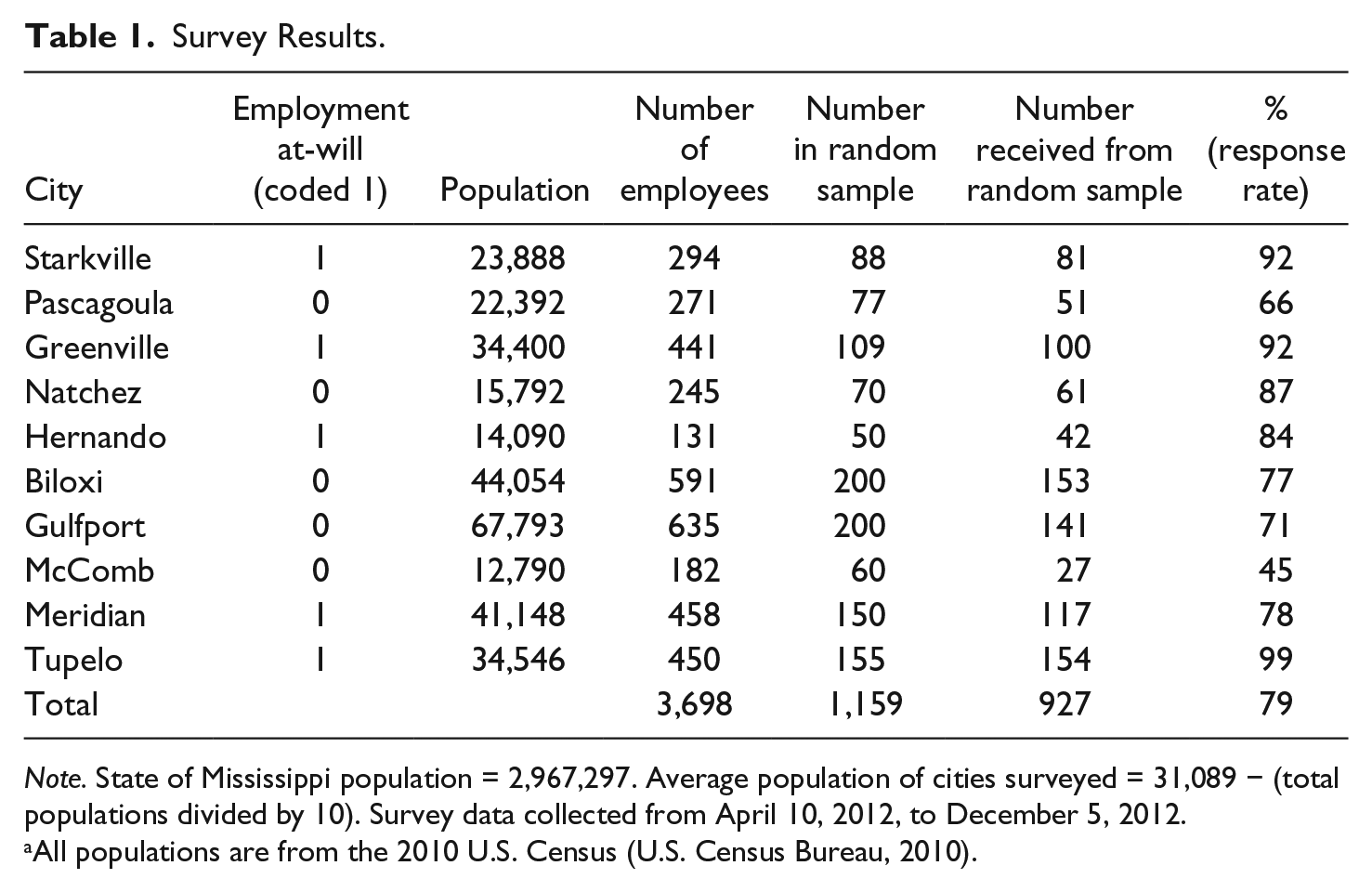
Note. State of Mississippi population = 2,967,297. Average population of cities surveyed = 31,089 − (total populations divided by 10). Survey data collected from April 10, 2012, to December 5, 2012.
All populations are from the 2010 U.S. Census (U.S. Census Bureau, 2010).
The majority of respondents in this study were male (73%) and the greatest percentage were between the ages of 35 and 44 (32%) (see Table 2). Minorities and females were also represented as almost 32% of those in the study were non-White, and approximately 27% were female. The survey results demonstrate minimal differentiation from the aggregate breakdown of demographics for the 10 cities cited above. Thus, the sample is generally representative of the municipalities profiled. While great care was taken in the design sampling to minimize error (Dillman, Smyth, & Christian, 2014) given the sample size and resource constraints, we are also cautious in our ability to generalize from the results. Nevertheless, the purpose of the analysis is not to develop a full-blown model of employee attitudes, but rather to assess the relationships between their public service and a number of theoretically justifiable variables (see Coggburn et al., 2010). Most individuals (50.3%) possessed a high school education, and the largest percentage (36%) had worked for their municipality 5 years or less. Slightly more than half (54%) of the group was comprised of fire and police personnel, and a majority of respondents (66%) were employed in non-management positions. Most employees in this study earned less than US$40,000 per year.
Descriptive Statistics.

Note. HS = high school; GED = General Educational Development.
Public Safety includes Fire and Police.
Measurement Validation
As our interest here is in perceptions of public service and not explicit measures of performance, self-reports are appropriate (Chan, 2001, 2009; Conway & Lance, 2010; Skinner, 1957). We maintain that employees are generally best suited to self-report their workplace environment because they are the ones who are aware of the subtle things they do in their jobs that lead to a feeling of value from public service (see Shalley, Gilson, & Blum, 2009). As a response variable, PSM is tied to perceptions of a public service ethos rather than an objective public service motive (see Judge, Bono, & Locke, 2000). Thus, our focus is on the perceived effects of organizational factors (i.e., as perceived by the incumbent) on PSM, making self-reports theoretically the most relevant measurement method (Conway & Lance, 2010; Judge et al., 2000). Conway and Lance (2010) also contended that construct validity of the measure employed is a means for preventing substantial method effects.
We employ a variation of Perry’s 24-item scale for measuring PSM. The survey recorded level of agreement to questions measuring the original four subscales—Attraction to Policy Making, Commitment to Public Interest, Self-Sacrifice, and Compassion—using a 5-point Likert-type scale ranging from 1 (strongly disagree) to 5 (strongly agree). While the 24-item PSM scale achieved a very good measure of internal consistency with a Cronbach’s alpha of .82 and the four subscales ranged from .65 to .76 (Table 3), reliability and validity estimates overall proved less promising. Thus, we also employed a confirmatory factor analysis (CFA) in two stages for the PSM scale. First, CFA was conducted for a second-order measurement model of PSM, in which the four dimensions of PSM were treated as first-order factors and the items of the dimensions were the observed indicators. In the second stage, CFA was conducted for the overall measurement model in which all the major latent constructs were correlated with each other. Model fit statistics recommended by Williams, Vandenberg, and Edwards (2009); Bollen (1989); Bollen and Long (1993); and Hair, Anderson, Tatham, and William (1998) were employed, including the comparative fit index (CFI), the root mean square error of approximation (RMSEA), the standardized root mean square residual (SRMR), the coefficient of determination (CD), and composite reliability (CR), and average variance extracted (AVE) scores. Generally speaking, a good fit is indicated by a CFI above 0.95, RMSEA less than 0.08, and a SRMR less than 0.10. CR above the 0.70 threshold and an AVE above 0.50 are recommended (Hair et al., 1998). Based on our initial results from the CFA for the 24-item PSM scale, several items were dropped from the scale due to serious cross-loading and weak factor loading (<0.2). Specifically, we dropped two items from the commitment to public interest (CPI) scale and five items each for the compassion (COM) and self-sacrifice (SS) scales resulting in a 12-item PSM scale. The fit of the second-order measurement model for the 12-item PSM scale was good ( 2 = 97.20, p < .001; CFI = 0.979, RMSEA = 0.034, and SRMR = 0.034; CD = 0.980). The standardized second-order factor loadings were 0.466 for attraction to policy making, 0.961 for commitment to the public interest, 0.805 for compassion, and 0.921 for self-sacrifice, all of which were significant at the p < .001 level. The resulting modified PSM model is similar to that derived by Kim (2009).
Standardized Factor Loadings for the Revised 12-Item PSM Scale (n = 908).
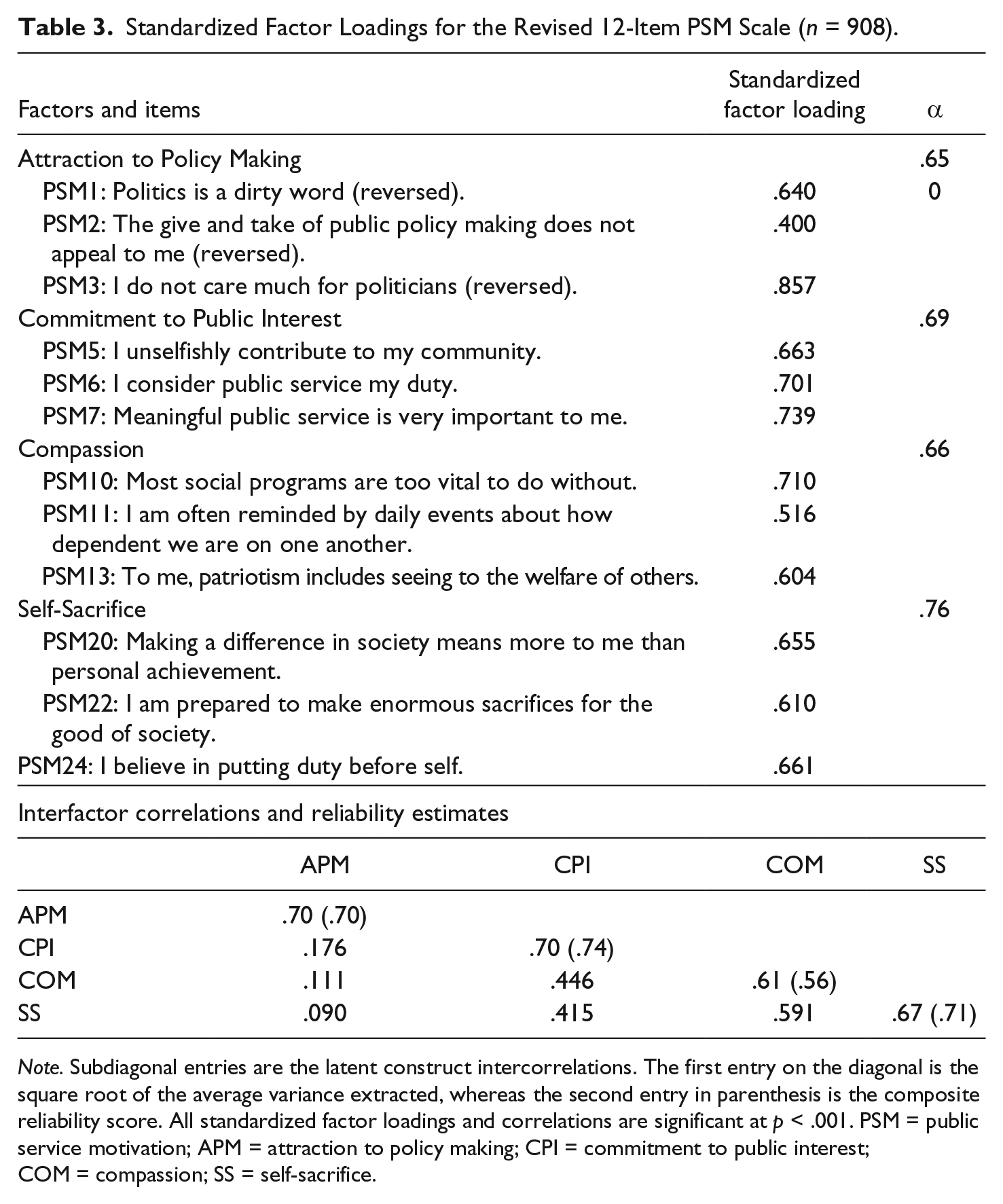
Note. Subdiagonal entries are the latent construct intercorrelations. The first entry on the diagonal is the square root of the average variance extracted, whereas the second entry in parenthesis is the composite reliability score. All standardized factor loadings and correlations are significant at p < .001. PSM = public service motivation; APM = attraction to policy making; CPI = commitment to public interest; COM = compassion; SS = self-sacrifice.
Results from the interfactor correlations and reliability estimates (Table 3) demonstrate that three of the PSM dimensions (excluding compassion) possess internal consistency achieving CR scores above the 0.70 threshold. While our calculation of AVE for each construct did not achieve the 0.50 threshold suggested by Hair et al. (1998), we still find evidence for discriminant validity in Table 1. A comparison of the square root of the AVE of each construct with their correlation estimates shows that the square root of the AVE for each dimension is higher than the corresponding interconstruct correlation estimate (Fornell & Larcker, 1981; Gould-Williams, Mostafa, & Bottomley, 2015).
The present study also gives us the opportunity to assess the impact of EAW on PSM in a reform environment. Several municipalities in the state of Mississippi—our loci of analysis—have elected to adopt EAW in lieu of traditional civil service systems (see Goodman & Mann, 2010). The state’s reform environment provides an opportunity to assess attitudes among municipal employees in both EAW and civil service personnel systems. Thus, we included a dummy variable that measures whether the jurisdiction’s personnel system incorporates EAW or is strictly civil service. 2
Data Analysis and Results
As the dependent variable is continuous, it is necessary to apply a generalized form of mixed linear modeling to the data to account for the multiple levels of data, which include both individual and agency. To establish agency differences, we must examine the results of the null models presented in Table 4. The null model explores the extent to which there is an agency (Level 2) effect on the (Level 1) intercept of PSM dimension scores. The fact that the intercept component for all four models is significant suggests that the intraclass correlation coefficient (ICC) is also significant, indicating that a multi-level model is appropriate and needed (Garson, 2013). Thus, a two-level model is estimated with a generalized linear mixed model (Luke, 2004). Given the significant agency effect verified by the null models, ordinary least squares will experience correlated error necessitating linear mixed modeling. Our analysis begins by formulating the individual (Level 1) model and a more complete model which incorporates an estimate for the differences among municipal agencies.
Final Estimation of Variance Components for the Two-Level Null Models (χ2 Statistic Reported).
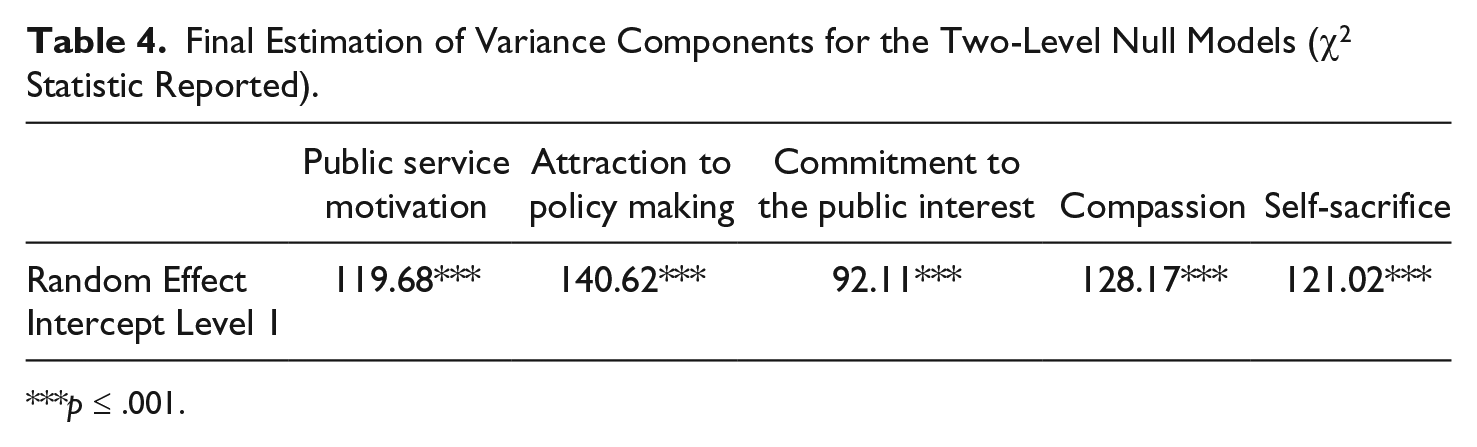
p ≤ .001.
We are now in a position to compose a model that incorporates the ability to test the chief hypotheses regarding the Level 2 units (between agency differences). In the presentation of the null models (Table 4) for variation among agencies, it was established that the possibility exists for strong differences in PSM dimension levels among agencies. Thus, we must allow for the possibility that there are statistically significant differences in associations with PSM dimensions across Level 2 units (agencies). Accordingly, we divided the 10 agencies identified in the survey (Administration, Community Development, Fire, HR/Personnel, Parks and Recreation, Planning and Development, Police, Public Works, Electric, Airport) into two categories: public safety agencies (coded 1) and other (coded 0). Now the difference in means of the outcome variable between agencies can be estimated as the difference in empathy with PSM dimensions between agencies that are either public safety agencies (fire, police) or other, controlling for the grand mean across all municipal employees (γ00). Furthermore, we maintain that scores on the PSM dimensions may also differ across Level 2 units in terms of EAW status (γ02) and organization size or full-time equivalent (FTE) (γ03).
To build an adequate model that explains PSM dimensions among municipal employees more completely, it is necessary to examine the within-agency variables as well (Level 1). By combining (Level 1 and Level 2) predictors, we can determine whether the Level 2 differences (public safety, EAW, and FTE) among agencies are maintained, as well as assess the Level 1 hypotheses. To achieve this, a fixed effects mixed model was estimated that incorporates estimates for both Level 1 and Level 2 explanatory variables:
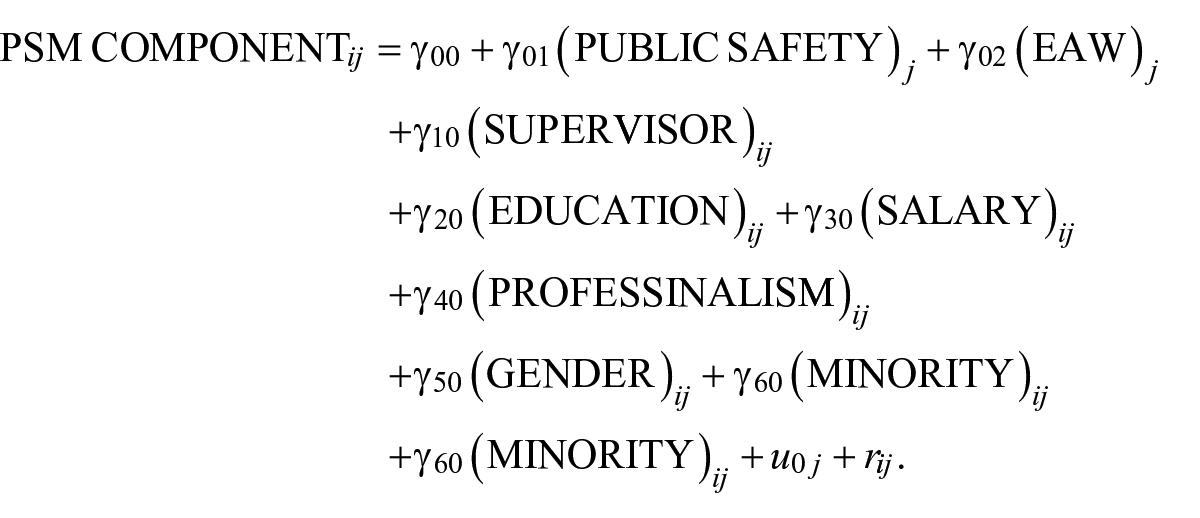
To estimate the model, we employ HLM 7 (Raudenbush, Bryk, Cheong, Congdon, & Du Toit, 2010). We utilize a unit-specific model along with a normal (continuous) distribution of the outcome variable (numeric index of the four PSM dimensions). Specifically, the Level 1 intercept term, expressed as β0j in output, is a function of a random intercept term at Level 2 (γ00) and a Level 1 residual error term (rij). The Level 1 intercept, in turn, is a function of the grand mean (γ00) across Level 2 units, which are agencies in the present study, plus a random error term (u0j), signifying the intercept is modeled as a random effect. As opposed to ordinary least squares where a single overall intercept is estimated, HLM 7 will create one Level 1 regression for each agency, and then will utilize the variance in these intercepts when estimating parameters and standard errors at Level 1 (Garson, 2013). The subscript i (Table 5) indicates that a Level 1 model is to be estimated for all individuals in the sample, but the j subscript denotes that a different Level 1 model is to be estimated for all j Level 2 units. The term µ0j is equal to the error term in the model. The deviance statistic measures the contribution of the Levels 1 and 2 predictors over a random intercept model. The significant chi-square statistic in Table 5 indicates that the full model presented is a significant improvement over a restricted model. The dependent variable is centered on its grand mean, while all regressors are uncentered.
Generalized Linear Mixed Models of PSM and Subscales.
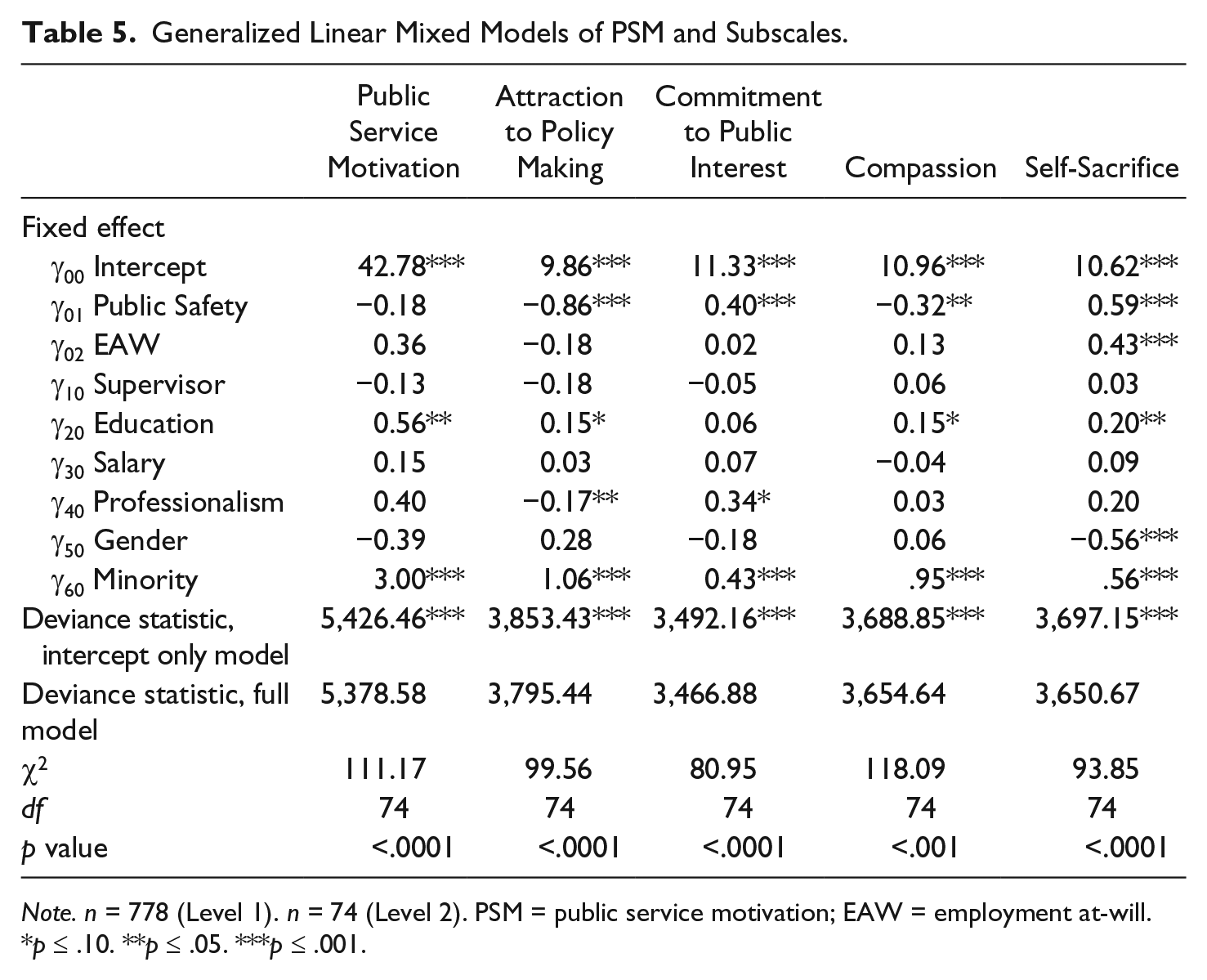
Note. n = 778 (Level 1). n = 74 (Level 2). PSM = public service motivation; EAW = employment at-will.
p ≤ .10. **p ≤ .05. ***p ≤ .001.
The findings for our assessment of public management reform and PSM—municipal employees in EAW environments—are significant, but not in the projected direction. Contrary to our hypotheses, EAW appears to be positively related to PSM (H1a), specifically, the self-sacrifice dimension (H1b). Whereas a stream of research has found that dismantling traditional employee dismissal and due process procedures has served to discourage employees in EAW environments (Kellough & Nigro, 2002, 2006), the findings here suggest that the effects of reform on motivation may be more nuanced than previously assumed. Our results suggest that the EAW environment may be a positive boost to public service motives, particularly values associated with self-sacrifice.
We hypothesized (H2a) that municipal employees in public safety agencies will demonstrate a stronger positive association with PSM than those municipal workers in other public agencies. Individuals in public safety agencies may also exhibit a greater willingness to self-sacrifice given the intensity of duties associated with jobs in these fields. Respondents are illustrated by the Level 2 variable (public safety agency/other) measuring whether a municipal employee is nested within an agency that is fire/police or one that is among the other agency choices. The Level 2 variable in Table 5 confirms our hypothesis for the self-sacrifice (H2b) dimension and reveals a positive association with commitment to public interest; however, there is an inverse relationship with the Attraction to Policy Making and Compassion subscales. That is, public employees in fire and police agencies are more likely to identify with values associated with commitment and self-sacrifice (e.g., serving others, making a difference, giving back, sacrifice for the greater good, risk personal loss, duty before self) and less likely to identify with tenets of attraction to policy making (e.g., positive perceptions of politics, public policy, and politicians) and compassion (welfare of others) compared with their peers in other municipal agencies. Perhaps, employment in public safety organizations satisfies some very specific public service motives that are common to their particular line of work (Houston, 2011). As Kim and Vandenabeele (2010) suggested, Self-Sacrifice may be a more robust dimension in comparison with the other subscales. Public safety personnel may have a higher expectation with regard to the sacrifice of their individual interests in their jobs, thus rendering greater commitment to the public service (Kim & Vandenabeele, 2010).
Respondent characteristics are also important in determining the importance placed on PSM dimensions. Informed and educated municipal respondents are generally positively associated with PSM (e.g., Bright, 2005; DeHart-Davis et al., 2006; Moynihan & Pandey, 2007; Perry, 1997). However, there is the potential for a more refined approach controlling for PSM dimensions to reveal a more nuanced association between education and PSM dimensions (DeHart-Davis et al., 2006). Nevertheless, our findings with regard to the PSM dimensions find no variation. Municipal respondents with higher levels of education have higher levels of PSM, attraction to policy making, compassion, and self-sacrifice. Remarkably, while municipal employees who are members of professional associations have higher levels of commitment to the public interest, they also exhibit less affinity to public policy making. Attraction to policy making has proven to be a problematic predictor for PSM. While Perry (1997) has found a negative relationship between the attraction to policy-making component of PSM and professionalism, recent research (e.g., Kim, 2009, 2011) suggests that this dimension may not accurately reflect rational motives. Some scholars consider attraction to policy making as a proxy for distaste of the political processes (e.g., Brewer et al., 2000), individual distrust of politicians (e.g., Coursey & Pandey, 2007), or alienation of professionals from politics (Perry, 1997). Still others suggest that the negative relationship between attraction to policy making and professionalism is evidence for the endurance of the politics-administration dichotomy (e.g., Coursey, Perry, Brudney, & Littlepage, 2008; DeHart-Davis et al., 2006). In light of the four dimensions, our findings in this regard tend to support the latter findings suggesting a more nuanced understanding of attraction to policy making. Perhaps, employee commitment to benefiting society only goes as far as the acquiring and sharing of knowledge through professional societies, leaving the ugly business of politics to “hired guns” working for these associations.
The results for gender and race are also important predictors in our analyses. As both groups tend to avail themselves of public services to a greater extent than White males, we would expect a positive correlation between the control variables for women and race and our PSM scale and four subscales. While the results for race are as expected, the findings with respect to gender are mixed. Female municipal respondents show less commitment to the public interest. The result for commitment to public interest is contrary to the prevailing wisdom that women tend to have a greater propensity for employment in “redistributive” occupations, a predilection for activist government, and more egalitarian predispositions than males (Howell & Day, 2000). Perhaps women working in municipalities in a state with a historical record of discrimination may be less committed to the broader public interest as opposed to the interests of women and others who have been traditionally disenfranchised. Such a specialized public interest may be important for understanding race, gender, and PSM and how they relate to the theory of representative bureaucracy. Indeed, DeHart-Davis et al. (2006) suggested that except for the compassion dimension, all three dimensions are sociologically masculine. The authors suggest that this is due to the dominance of masculine interaction patterns in the public sector and overall historical gender discrimination, which traditionally assigns a more precise caring and nurturing role to women (Bright, 2005; Vandenabeele, 2011). The findings here are generally in accordance with this explanation and similar studies (e.g., Camilleri, 2007; Vandenabeele, 2011).
Discussion and Conclusion
The research findings here are in contrast to the logic of the self-regulating framework of PSM as proposed through self-determination concepts (Houston, 2011; Perry & Vandenabeele, 2008). Respondents in EAW environments would appear to be motivated by the logic of sanctions as opposed to a commitment to the public service ethos. The findings mark a divergence in our understanding of PSM that suggests individuals may be acting out of self-preservation as opposed to self-determined actions in a manner perceived to be consistent with the values underlying the public service identity (Houston, 2011). Moreover, our results suggest that focus on PSM should be both unitary and multi-dimensional. In the case of public safety, the combined PSM construct fails to achieve significance, while the results for each of the four dimensions are significant and differ in direction. The observations suggest a masking effect brought on by the divergent results for public safety personnel and each dimension. Clearly, it is important to note the preliminary nature of the findings from the current analyses. We focus specifically on the perceived impact organizational factors have on PSM. As such, we have relied on self-reported measures as the most suitable means for assessing the perceptions of employees toward their workplace environment. We recognize the contentious nature of self-reported measures (i.e., common source bias) and encourage the use of triangulation in future research.
Up until now, the logic has been that at-will employment comes with a cost in terms of fear of reprisal for counter-productive behavior (Battaglio & Condrey, 2009; Bowman & West, 2006; Coggburn, 2006; Condrey & Battaglio, 2007; Goodman & Mann, 2010; Kellough & Nigro, 2002, 2006; Nigro & Kellough, 2000, 2008). In theory, gains that might accrue from reward and punishment systems (i.e., performance-based pay and EAW) should be offset by the loss in intrinsic motivation (Houston, 2011; Perry, Engbers, & Jun, 2009; Weibel, Rost, & Osterloh, 2010). Yet, we find that constrained, rule bound systems (as measured by the formal civil service system dummy variables) 3 seem to inhibit individual PSM, whereas such motives seem to flourish in at-will employment environments. The threat of termination for cause attributed to EAW systems would appear to be less deleterious to motivation than previously believed. In particular, the findings suggest that municipal employees working in EAW systems exhibit a greater willingness to self-sacrifice behavior. Clearly the loss of job security has not diminished the potential for creating a motivating influence on employees in the case of Mississippi municipalities. In terms of self-sacrifice, employees are motivated by the difference they make in society, placing duty before self, putting aside financial remuneration, serving citizens, giving back to society, willing to risk personal loss to help someone in need, and being prepared to make sacrifices for the betterment of society (Perry, 1996). As envisioned by proponents of EAW, elements such as those embodied in self-sacrifice should encourage a more responsive and motivated workforce as a result of the removal of job security.
Although the results here are limited to a few municipalities in a single jurisdiction (Mississippi), they do stand in contrast to recent work that has highlighted the shortcomings of personnel reform in the U.S. states (see Bowman et al., 2003; Bowman & West, 2006; Goodman & Mann, 2010; Kellough & Nigro, 2002, 2006), specifically, the inability of EAW to serve as a motivating force for productivity. The findings presented here—from a jurisdiction that is at the forefront of personnel reform in the United States—suggest that there is more to EAW as a motivational tool. Future research might benefit from a more robust analysis of EAW and PSM that utilizes the methodological tools employed with more objective measures of performance. Linking EAW to both increased motivational behavior among public servants as well as to productivity would represent a powerful divergent path to that of mainstream research on human resources and public management reform.
Our findings with respect to public safety personnel also support the importance of job-related tasks that are “challenging, enjoyable, or personally meaningful” (Houston, 2011, p. 762). According to Houston (2011), “behavior that is intrinsically motivated is undertaken because of the inherent satisfaction that is derived from a task” (p. 762). Indeed, several studies have shown that public employees often exhibit elevated levels of PSM when they are confronted with hardships or difficulties that seem to violate the organization’s standard operating procedures. This was the case in Brewer and Selden’s (1998) study of whistle-blowing in federal government where public employees are willing to make sacrifices out of concern for the public interest. Variety may be the spice of public service motives, where public safety agencies tap into a more robust and complex set of values, particularly those consistent with the Self-Sacrifice subscale.
Municipal employees working in public safety agencies were also less than enthusiastic toward the policy-making process. The differences may be attributable to the types of persons drawn to work in public safety agencies. Some professions by nature may require a special service orientation (Crewson, 1997; Edwards et al., 1981). This may be especially true of public safety employees who are often placed in emotionally demanding situations. Public safety employees may be tasked with handling stressful situations that include people employed as “domestic hotlines workers, EMTs, triage nurses, and agency/department spokespersons who are the initial faces of the organization and who deal with the public immediately following crises” (Mastracci et al., 2011). At the least, the findings here suggest the importance of evaluating differences in public service values while controlling for the job (Houston, 2011; Kim & Vandenabeele, 2010).
For researchers, our findings here raise more questions than answers about the PSM concept. Our results suggest the formative versus reflective nature of PSM is an important topic for inquiry. In terms of public safety personnel, it would seem that each dimension provides a unique contribution to an individual’s PSM (Wright, 2008). Future research should consider profession or agency differences when testing for uniqueness among the four dimensions. Our research highlights the unique nature of public safety professions. However, this uniqueness may not be solely to their department socialization process. While PSM drives people into demanding professions such as public safety, the institutional setting places these personnel in crises as first responders shaping PSM and subsequently behavioral outcomes. Perhaps both departmental socialization and sociohistorical institutions (education, family, and religion) shape an individual’s PSM over time. Qualitative research combined with longitudinal studies might be able to substantiate both institutional settings.
Footnotes
Declaration of Conflicting Interests
The author(s) declared no potential conflicts of interest with respect to the research, authorship, and/or publication of this article.
Funding
The author(s) received no financial support for the research, authorship, and/or publication of this article.