



Abstract
Very limited attention has been given by scholars to the relationship between servant leadership and employee behaviors in the public sector and not much is known about the mechanisms through which this relationship may take place. This study examines the relationship between servant leadership and proactive behaviors in the Egyptian public health sector and investigates the role of leader–member exchange (LMX) as a mediator. Using a sample of Egyptian public hospital nurses, the results of structural equation modeling (SEM) indicate that servant leadership was positively related to LMX which, in turn, had a significant positive association with proactive behavior. Thus, servant leaders encourage employees to engage in proactive behavior through enhancing the quality of their exchange relationship with their supervisors.
Introduction
Servant leadership has received considerable attention from scholars in the past few years. Servant leadership is generally viewed as a leadership style that “stresses personal integrity and focuses on promoting the interests of others” (Wu, Tse, Fu, Kwan, & Liu, 2013, p. 384). Servant leaders are service-oriented leaders who strive unselfishly to help and support others before themselves (Greenleaf, 1977). Such leaders bring out the best among their followers and assist them in achieving their potential. Besides followers, they also serve other stakeholders, including the community and society as a whole (Graham, 1991).
There is now enough evidence of the effectiveness of servant leadership in producing desirable employee behaviors in private sector organizations (e.g., Ling, Lin, & Wu, 2016; Wu et al., 2013). However, very limited attention has been given by scholars to the relationship between servant leadership and employee behaviors in the public sector and not much is known about the mechanisms through would this relationship may take place (Miao, Newman, Schwarz, & Xu, 2014; Newman, Schwarz, Cooper, & Sendjaya, 2017; Parris & Peachey, 2013; Shim, Park, & Eom, 2016). This study seeks to address these gaps by examining the relationship between servant leadership and proactive behaviors in the Egyptian public health sector and investigating the role of leader–member exchange (LMX) as a mediator.
This study makes three main contributions to the literature. First, it contributes to the proactivity literature. Proactive behavior is defined as “taking initiative in improving current circumstances; it involves challenging the status quo rather than passively adapting present conditions” (Crant, 2000, p. 436). Such behavior has been found to be linked to desirable employee and organizational outcomes (Parker, Williams, & Turner, 2006; Strauss, Griffin, & Rafferty, 2009; Thomas, Whitman, & Viswesvaran, 2010). Therefore, it has become a “necessity” in many organizations (Thomas et al., 2010, p. 275) and is viewed as “crucial to organizational success” (Strauss et al., 2009, p. 279). However, in spite of its importance, the antecedents of proactive behavior are “not well understood” (Parker et al., 2006). This study, therefore, contributes to the literature by examining the role of servant leadership in promoting proactive behaviors among public sector employees. By so doing, the study also responds to calls for more research on the role of leadership in enhancing such behaviors (Strauss et al., 2009; Den Hartog & Belschak, 2017) where, as recently stated by Den Hartog and Belschak (2017, p. 412), “empirical work on how leaders affect proactivity is still relatively limited.”
Second, very limited attention has been devoted by scholars to the psychological processes underlying the relationship between servant leadership and employee behaviors (Newman et al., 2017). Therefore, this study also contributes to the literature by examining the mediating role of LMX on the relationship between servant leadership and proactive behaviors. LMX refers to the quality of the relationship between leaders and their followers (Graen, Uhl-Bien, 1995). LMX theory specifically suggests that leaders use different styles in dealing with followers and develop a different type of exchange or relationship with each follower (Liden & Maslyn, 1998). This theory is the “most closely tied” leadership approach to social exchange theory (Liden, Wayne, Zhao, & Henderson, 2008, p. 163). Therefore, examining the role of LMX as a mediator will also help assess the prominence of social exchange theory, which has been widely used to explain the influence of leadership on positive employee behaviors (Miao et al., 2014; Newman et al., 2017).
Finally, this study extends prior research on the relationship between servant leadership and employee outcomes by examining the proposed relationships in the Egyptian public health sector. Most of the research on the link between servant leadership and different types of employee outcomes has been conducted in the Western world (e.g., De Clercq, Bouckenooghe, Raja, & Matsyborska, 2014; Hanse, Harlin, Jarebrant, Ulin, & Winkel, 2016; Liden et al., 2008) and Asia (e.g., Miao et al., 2014; Newman et al., 2017; Shim et al., 2016; Wu et al., 2013), and not much is known about this link in the Middle East. Therefore, this study helps contribute to the development of servant leadership theory as the international scope of research used to test theory is increased (Whetten, 1989).
The following section describes servant leadership and its relevance to the public sector. This is followed by a discussion of how LMX mediates the relationship between servant leadership and proactive behavior. Then, following a description of how the study data were collected and analyzed, the findings are presented. The final section provides a discussion of the findings and their theoretical and practical implications.
Servant Leadership in the Public Health Sector
Servant leaders are those who “strive to serve individuals under them, develop those being served, and benefit others in society” (Miao et al., 2014, p. 728). Such leaders give up their own self-interest for the sake of others and generally view themselves as servants rather than leaders (Barbuto & Wheeler, 2006; Ling et al., 2016; van Dierendonck, 2011). Overall, servant leaders are motivated by the need to serve rather than the need for power (Barbuto & Wheeler, 2006; van Dierendonck, 2011).
In spite of sharing several conceptual similarities with other leadership styles such as transformational, authentic, and ethical leadership, servant leadership is different. The main feature that distinguishes it from other styles is “its holistic nature” as it incorporates several dimensions that are never fully addressed in other leadership constructs (Sendjaya & Cooper, 2011, p. 417). In contrast to transformational leadership, in which the main focus is on motivating followers to help the organization achieve its objectives, the focus of servant leadership is on the followers and their aspirations and objectives (Barbuto & Wheeler, 2006; Sendjaya & Cooper, 2011; van Dierendonck, 2011). Thus, while transformational leaders consider followers “as a means to an end,” servant leaders “serve followers as an end in themselves” (Sendjaya & Cooper, 2011, p. 417). Moreover, contrary to other leadership styles, which also include moral components such as authentic and ethical leadership, servant leadership is distinctively concerned with the success of all organizational stakeholders including employees and the society as a whole (Neubert, Kacmar, Carlson, Chonko, & Roberts, 2008; Walumbwa, Hartnell, & Oke, 2010). Overall, compared to other leadership styles, servant leadership is “in a unique position” because it uniquely stipulates a “combined motivation to be(come) a leader with a need to serve” and explicitly emphasizes the importance of the personal growth of followers without essentially linking it to organizational outcomes (van Dierendonck, 2011, p. 1238).
Servant leadership could be conceptualized as consisting of seven dimensions or characteristics: emotional healing, creating value for the community, conceptual skills, empowering, helping subordinates to grow and succeed, putting subordinates first and behaving ethically (Liden et al., 2008). Emotional healing involves showing compassion and understanding of the personal concerns of others; creating value for the community refers to showing a genuine and conscious concern for helping the community; conceptual skills involves possessing the knowledge required to assist and effectively support others; empowering involves encouraging self-directed decision making; helping subordinates to grow and succeed refers to providing mentoring and support to others to enhance their career growth and development; putting subordinates first involves making clear to others, via words and actions, that satisfying their needs at work is of big importance; and behaving ethically involves being fair, honest and open with others (Barbuto & Wheeler, 2006; Liden et al., 2008; van Dierendonck, 2011).
Leaders in the public sector should put the interest of the public ahead of their own and serve people with full heart (Liu, Hu, & Cheng, 2015). Servant leadership is believed to be one of the main ways of promoting public service values and the improvement of public service delivery because of its emphasis on self-sacrifice and performance beyond the call of duty (Liu et al., 2015). Most of the major characteristics of servant leaders, such as the motivation and desire to serve others, are viewed as essential factors that affect the choice of public service jobs (Miao et al., 2014; Pedersen, 2014). As individuals with a strong desire to serve others are more likely to work in the public sector (Bright, 2005), servant leadership is believed to be more prevalent in public rather than private sector organizations (Miao et al., 2014). In spite of this, servant leadership and its relationship with employee outcomes have received “scant attention in the public sector literature” (Miao et al., 2014, p. 729). This study addresses this issue by examining the relationship between servant leadership, LMX, and proactive behaviors in the Egyptian public health sector.
Servant leadership is viewed as the “new path forward” for leadership in health care (Hanse et al., 2016, p. 232). Because of its focus on compassion, concern, and support for others, this leadership style aligns well with the duties of health care providers. It helps in serving and delivering high quality care to patients and contributes to building trustful relationships with them (Trastek, Hamilton, & Niles, 2014). Servant leadership is also of significant importance to health care personnel. It enhances workers’ personal and professional growth, and promotes caring behavior, personal involvement, teamwork, and shared decision making (O’Brien, 2011). In fact, research has shown that this leadership style is positively related to health care staff satisfaction as well as improved delivery of health care services (Garber, Madigan, Click, & Fitzpatrick, 2009; Jenkins & Stewart, 2010; O’Brien, 2011).
LMX as a Mediator of the Servant Leadership–Proactive Behaviors Relationship
LMX is mainly about the quality of the dyadic relationship between supervisors and their followers (Hanse et al., 2016). It specifically refers to the extent of emotional support and exchange of valued resources between both parties (Newman et al., 2017). In other words, LMX could be viewed as a measure of the degree to which both, supervisors and followers, are involved in a process of reciprocal social exchange. High-quality LMX is usually characterized by high levels of respect, communication and mutual trust (Hanse et al., 2016; Newman et al., 2017).
Relationship building with followers is regarded by some scholars as one of the key characteristics of servant leadership (Newman et al., 2017). Therefore, this study proposes that servant leadership could facilitate the development of high-quality LMX. Van Dierendonck (2011) argues that followers usually experience high quality LMX when their leaders work from a “motivation to serve” (p. 1244). Servant leadership mainly involves the creation of “serving relationships” between leaders and followers (Barbuto & Wheeler, 2006, p. 319) and focuses on the development of social, rather than economic, exchanges (Liden et al., 2008). Recent research has also shown that this leadership style helps in the building of trust and reciprocal obligation between leaders and followers (Shim et al., 2016). Thus, servant leaders are more likely to form and maintain strong interpersonal connections with their subordinates.
Servant leaders behave in a selfless and caring manner, and go out of their way to understand their subordinates and empathize with them (De Clercq et al., 2014). As mentioned before, such leaders usually support their followers, focus on their development and provide them with opportunities to acquire new knowledge and skills (Liden et al., 2008; Newman et al., 2017). Furthermore, because of their concern for the society, servant leaders are usually trusted and viewed by followers as “principled decision-makers” who care for everyone (Newman et al., 2017, p. 4). All this is more likely to lead to the development of strong interpersonal relationships between servant leaders and their followers and enhance LMX. Prior research findings provide support for these assumptions and suggest that servant leadership is positively related to LMX. For instance, Newman et al. (2017) reported that servant leadership had a significant positive relationship with LMX among employees working in a large state-owned enterprise in China. Hanse et al. (2016) also reported that servant leadership was significantly related to LMX in not-for-profit hospitals in Sweden. Accordingly, the following hypothesis is proposed:
As mentioned before, this study also proposes that LMX mediates the link between servant leadership and proactive behaviors. Proactive behaviors, also referred to as initiative (Crant, 2000), could simply be viewed as “anticipatory actions that employees take to create change” (Grant, Gino, & Hofmann, 2011, p. 530). Such behaviors are usually (a) in line with the organization’s mission, (b) long term in focus, (c) action oriented and goal directed, (d) obstinate in the face of hurdles and obstacles, and (e) self-initiated (Frese, Fay, Hilburger, Leng, & Tag, 1997). Proactive behaviors include solving problems without being asked to do so, proposing changes even when others disagree, and taking initiative to improve work circumstances (Den Hartog & Belschak, 2012).
Proactive behaviors are related to but not the same as organizational citizenship behaviors (OCBs; Frese et al., 1997). Both proactive behaviors and OCBs extend beyond work role requirements and contribute to organizational effectiveness. However, in contrast to OCBs, which are viewed as passive, proactive behaviors are viewed as active as they involve being rebellious, to some extent, toward existing regulations. Also, in contrast to OCBs which mainly contribute to short term positive outcomes, proactive behaviors provide long term positive outcomes for the organization (Frese & Fay, 2001; Frese et al., 1997).
High quality LMX relationships are likely to lead to proactive behaviors. As suggested by social exchange theory (Blau, 1964), positive treatment from leaders usually leads followers to reciprocate or pay back by going beyond the specifications of their job description and displaying behaviors that support the organization (Martin, Guillaume, Thomas, Lee, & Epitropaki, 2016; Newman et al., 2017). Furthermore, favorable exchanges between leaders and subordinates increase liking for leaders which, in turn, motivates subordinates to go beyond leaders’ expectations and exhibit behaviors that contribute to organizational effectiveness (Martin et al., 2016). Meta-analytic reviews and findings of recent studies provide support for these assumptions and highlight a positive relationship between LMX and employee activities that are not task-related but contribute positively to the organization such as proactive behaviors (Martin et al., 2016; Newman et al., 2017). Based on the above arguments, the following two hypotheses are proposed:
Sample and Procedures
The study data were collected from a sample of nurses in a large Egyptian public hospital using a paper and pen questionnaire. A convenience sample was employed because of the challenges associated with the collection of primary data in Egypt where respondents are usually uncooperative (Gould-Williams, Mostafa, & Bottomley, 2015). However, this means that the study results will not be as representative as results obtained using a random sample.
The nurses were contacted directly and were handed the questionnaires on a face-to-face basis during working hours. They were also promised that their responses would be anonymous and confidential. To reduce common method bias, the outcome variable, proactive behaviors, was rated by supervisors (Podsakoff, MacKenzie, Lee, & Podsakoff, 2003; Podsakoff, MacKenzie, & Podsakoff, 2012).
Three hundred fifty questionnaires were distributed and 202 were returned, giving a response rate of 58.3%. Most of the respondents (91%) were female and 53.4% were between 20 years and 30 years in age, 25% were between 31 years and 40 years and the rest were above 40 years old. Moreover, 37% of the nurses had served in the hospital for more than 15 years, 17% had served for between 10 years and 15 years, 13% had served for between 5 years and 10 years, and the rest had been serving in the hospital for less than 10 years.
Measures
The English version of the questionnaire was back-translated into Arabic and pretested by five nurses so as to ensure the equivalence of measures (Brislin, 1970). All questionnaire items were measured on a 7-point Likert-type scale with the end points strongly disagree (1) and strongly agree (7).
Servant leadership
Servant leadership was measured using 21 items from the scale developed by Liden et al. (2008). These items measured seven dimensions (three items per dimension), namely, emotional healing, creating value for the community, conceptual skills, empowering, helping subordinates to grow and succeed, putting subordinates first and behaving ethically. Sample items are “I would seek help from my supervisor if I had a personal problem” (emotional healing), “My supervisor is involved in community activities” (creating value for the community), “My supervisor is able to effectively think through complex problems” (conceptual skills), “My supervisor encourages me to handle important work decisions on my own” (empowering), “My supervisor provides me with work experiences that enable me to develop new skills” (helping subordinates to grow and succeed), “My supervisor puts my best interests ahead of his or her own” (putting subordinates first) and “My supervisor holds high ethical standards” (behaving ethically). Cronbach’s alpha for the seven dimensions ranged between .719 and .877.
LMX
A 7-item scale developed by Graen and Uhl-Bien (1995) was used to measure LMX. A sample item is “My working relationship with my supervisor is extremely effective.” Alpha reliability was .868 for this scale.
Proactive behavior
Proactive behavior was measured using four items developed by Frese et al. (1997). A sample item is “This employee takes initiative immediately even when others don’t.” Cronbach’s alpha for this scale was .802.
Controls
Initially, the effects of nurses’ age, gender, and organizational tenure on proactive behavior were controlled for. However, the results were highly consistent with and without including these controls. Therefore, in the interest of parsimony and consistent with the recommendations of Williams, Vandenberg, and Edwards (2009), the findings are reported control free.
Data Analysis
Structural equation modeling (SEM) with AMOS 23 was used to analyze the data. Following Anderson and Gerbing’s (1988) recommendations, the measurement model was first validated and then the structural model was estimated.
Measurement Model Validation
First, consistent with recent work on servant leadership (e.g., De Clercq et al., 2014) and other leadership styles such as transformational leadership (e.g., Bottomley, Mostafa, Gould-Williams, & Leon-Cazares, 2016), the items measuring each servant leadership dimension were averaged and the seven dimension scores were treated as indicators of an overall servant leadership construct in the analysis. This parceling approach helps maintain a manageable indicator-to-sample size ratio as well as reduce the large number of degrees of freedom that could create estimation problems, especially that the sample size in this study is relatively small (Bandalos, 2002). It also helps decrease Type 1 error and the likelihood of a priori model misspecification (Bagozzi & Heatherton, 1994; Hagtvet & Nasser, 2004).
Then, confirmatory factor analysis (CFA) was used to evaluate the discriminant validity of the constructs. The comparative fit index (CFI), the root mean square error of approximation (RMSEA), and the standardized root mean square residual (SRMR) were used to assess model fit. A CFI value of more than 0.90, an RMSEA value of less than 0.08, and an SRMR value of less than 0.10 suggest good fit (Byrne, 2010; Williams et al., 2009).
The fit of the hypothesized three-factor measurement model (servant leadership, LMX, and proactive behavior) was good, χ2 (df = 132) = 282.620, p < .01; CFI = 0.923, RMSEA = 0.075 and SRMR = 0.0540, and, as shown in Table 1, this model fitted the data significantly better than a two-factor model that combined servant leadership and LMX into one factor (Δχ2 = 97.626, Δdf = 2, p < .01), and a one-factor model that combined all the variables (Δχ2 = 513.350, Δdf = 3, p < .01). This suggests that discriminant validity was satisfied.
Measurement Models Comparison.
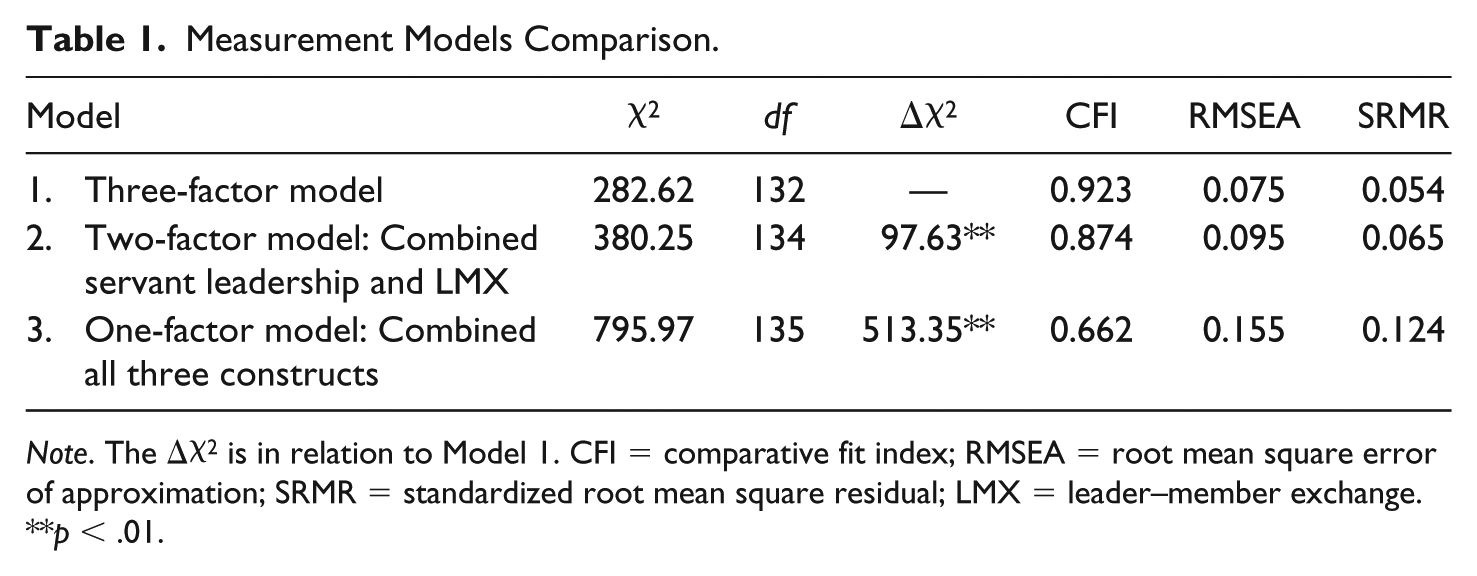
Note. The Δχ2 is in relation to Model 1. CFI = comparative fit index; RMSEA = root mean square error of approximation; SRMR = standardized root mean square residual; LMX = leader–member exchange.
p < .01.
Common Method Bias
As mentioned before, several steps were followed to help reduce common method bias problems in this study such as collecting data from multiple sources (servant leadership and LMX were rated by nurses whereas proactive behaviors were rated by their supervisors), reducing item ambiguity and assuring respondent anonymity (Podsakoff et al., 2003; Podsakoff et al., 2012). However, because servant leadership and LMX were measured from the same source, the possibility of common method bias influencing the relationships between variables remained. Therefore, the unmeasured latent method factor approach was used to test common method bias. This approach involved estimating a measurement model in which the indicators of servant leadership and LMX were allowed to load on both their theoretical constructs and a common factor. This model provided good fit to the data, χ2 (df = 62) = 139.18, p < .01; CFI = 0.946, RMSEA = 0.078, and SRMR = 0.067. However, the average variance extracted by the common factor was 0.39, which is lower than Fornell and Larcker’s (1981) 0.50 threshold that has been proposed as suggestive of the presence of common method bias. Hence, common method bias is unlikely to be a serious issue in the study.
Descriptive Statistics
Table 2 presents the correlations among variables together with the means, standard deviations, and the composite reliability estimates. As shown in the table, the three main constructs (servant leadership, LMX, and proactive behavior) were positively related. The correlation values are not more than 0.80, indicating that multicollinearity is unlikely (Kline, 2005). Also, none of the confidence intervals of the correlations includes 1.0, which confirms that the study constructs are conceptually distinct from each other (Anderson & Gerbing, 1988). Furthermore, the composite reliability estimates are more than 0.75, which indicates that the constructs had high internal consistency (Bagozzi & Yi, 2012).
Descriptive Statistics, Intercorrelations, and Reliability Estimates.
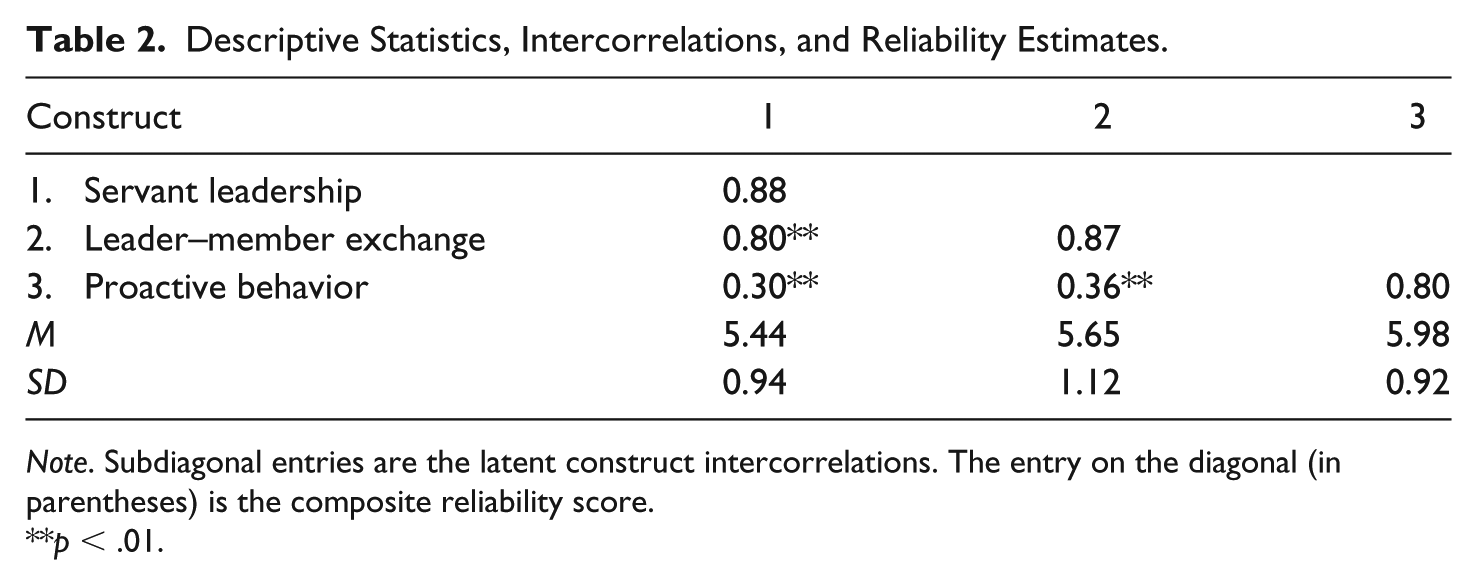
Note. Subdiagonal entries are the latent construct intercorrelations. The entry on the diagonal (in parentheses) is the composite reliability score.
p < .01.
Structural Model Estimation and Hypotheses Tests
Figure 1 provides the results of testing the structural model. The proposed model provided a good fit to the data, χ2 (df = 132) = 282.640, p < .01; CFI = 0.924, RMSEA = 0.074, and SRMR = 0.054. In this model, servant leadership explained almost 65% of the variance (R2) in LMX, which in turn explained 13% of the variance in proactive behavior.

Structural model results.
The fit of this fully mediated model in Figure 1 was compared with a partially mediated model in which a direct path was included from servant leadership to proactive behavior. The path included in the partial mediation model did not bring any significant improvement in model fit (Δχ2 = 0.02, Δdf = 1, p > .10). This provides initial support for Hypothesis 3 and suggests that LMX fully mediates the relationship between servant leadership and proactive behavior.
As shown in Figure 1, servant leadership was significantly and positively related to LMX (β = .804, p < .01). Thus, Hypothesis 1 was supported. In addition, LMX was positively related to proactive behavior (β = .361, p < .01), providing support for Hypothesis 2. The significance of the indirect path from servant leadership to proactive behavior was assessed using Preacher and Hayes (2004) bootstrapped approach. This involved computing 95% bias-corrected bootstrap confidence intervals using 1,000 replications. The coefficient associated with the indirect path of servant leadership via LMX to proactive behavior was significantly different from zero (β = .290, p < .01, bootstrap bias-corrected 95% CI = [0.126, 0.433]). This provides full support for Hypothesis 3.
Robustness Tests
To examine the effects of the individual servant leadership dimensions, seven different models were tested. In these models, the overall servant leadership variable in Figure 1 was replaced with the individual dimensions. As shown in Table 3, the fit of the seven models was good. The seven dimensions also had a significant positive relationship with LMX, which in turn had a significant positive relationship with proactive behavior. Furthermore, none of the seven dimensions of servant leadership had a significant relationship with proactive behavior.
The bootstrapping analyses also showed that the indirect paths from the seven servant leadership dimensions via LMX to proactive behavior were significant. Accordingly, it could be concluded that LMX fully mediates the relationship between the seven dimensions of servant leadership and proactive behavior.
Results of Individual Servant Leadership Dimensions Models.
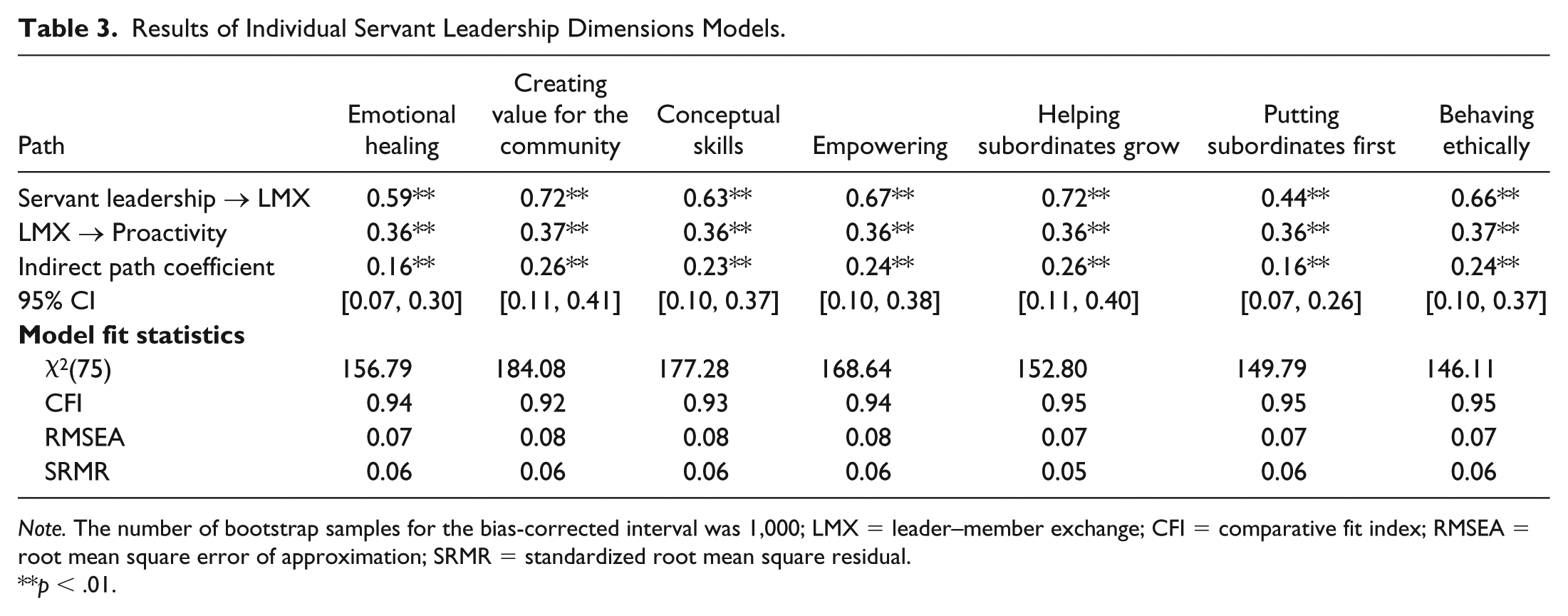
Note. The number of bootstrap samples for the bias-corrected interval was 1,000; LMX = leader–member exchange; CFI = comparative fit index; RMSEA = root mean square error of approximation; SRMR = standardized root mean square residual.
p < .01.
Discussion
Recently, there have been calls for research on the relationship between servant leadership and employee behaviors in the public sector as well as the mechanisms through would this relationship may take place. This study tried to address these calls by testing the relationship between servant leadership and proactive behavior in the Egyptian public health sector and investigating the role of LMX as a mediator.
The study presents a number of significant findings. First, consistent with recent research (e.g., Hanse et al., 2016; Newman et al., 2017), the study findings revealed that servant leadership is positively related to LMX. Servant leadership accounted for a large proportion (65%) of the variance in LMX. This suggests that “serving” followers, supporting them and treating them in a selfless and caring manner is an important means for the development of strong interpersonal relationship between supervisors and subordinates.
Second, in line with the rationale of social exchange theory, the findings also show that LMX has a positive relationship with proactive behavior. Thus, favorable exchanges between leaders and subordinates motivate subordinates to go beyond leaders’ expectations and exhibit behaviors that contribute positively to long-term organizational success. However, it is worth noting that LMX explained only 13% of the variance in proactive behavior. As mentioned before, the antecedents of proactive behavior are still not well understood (Parker et al., 2006). However, private sector research has shown that, besides leadership, other factors such as work motivation, personality, coworker trust, and job autonomy are also likely to facilitate such behavior (Ohly & Fritz, 2007; Parker et al., 2006). Future research may wish to consider the role of these factors in public sector organizations.
The findings also showed that the positive effect of servant leadership on proactive behavior occurs through favorable relationships and exchanges between supervisors and subordinates, where LMX fully mediated the relationship between servant leadership and proactive behavior. Furthermore, in line with the overall servant leadership hypothesis, the seven dimensions of servant leadership had significant positive relationships with LMX which, in turn, played a major role in linking these dimensions with proactive behavior. This highlights the importance of the mediation process and provides support for the assumption that servant leadership is more likely to enhance proactive behavior if employees experience high-quality relationships with their supervisors.
Practical Implications
The study has important managerial implications. The study findings revealed that servant leadership could help in the development of high-quality LMX relationships which, in turn, could enhance follower proactive behaviors. Thus, servant leadership behaviors could be used as a basis to recruit and select public sector supervisors. For example, the choice of supervisors could be based on certain qualities such as altruism, service orientation, and integrity. Supervisors in the public sector could also be trained on developing their servant leadership behaviors by incorporating elements, such as caring for subordinates, helping them enhance their career growth and satisfying their work needs, in leader development training programs (Miao et al., 2014). Furthermore, the main attributes of servant leadership could be considered during the design of public sector managers performance evaluations (Ling et al., 2016). This will encourage supervisors to include servant behaviors in their day-to-day work and will help them develop strong interpersonal relationships with their subordinates which, in turn, could encourage subordinates to engage in behaviors that extend beyond their work role requirements and contribute to long term effectiveness of public sector organizations.
Limitations
This study has a number of limitations. First, the cross-sectional design of the study does not allow causal interpretations. For example, it is possible that the quality of LMX influences employee perceptions of servant leadership, where subordinates with high-quality LMX may have a positive view of their servant leaders’ behaviors. However, it is worth noting that the relationships proposed in the study are based on theoretical predictions and existing empirical research. Longitudinal research could help address the issue of causality.
Second, as both the independent variable (i.e., servant leadership) and the mediator (i.e., LMX) were measured from the same source and at the same time, common method bias cannot be entirely ruled out. To totally avoid common method bias concerns, future studies could collect data on the independent and mediator variables at different points in time.
Third, the data for this study were collected from a convenience sample of Egyptian public hospital nurses and the sample size was relatively small. Therefore, the study findings are limited to the studied sample and cannot be generalized to the whole Egyptian context. Future work could assess whether the study findings could be generalized to other organizations and cultural contexts using larger samples. Finally, the study did not control for the possible influence of other leadership styles such as authentic, ethical, and transformational leadership. Future work may wish to include these leadership styles as controls to determine the additional variance that servant leadership could explain on different employee behaviors.
Despite these limitations, the study findings provide evidence of the importance of servant leadership in the public sector and offer an understanding of why this leadership style could lead public sector employees to engage in behaviors that contribute to long term organizational effectiveness.
Footnotes
Declaration of Conflicting Interests
The author(s) declared no potential conflicts of interest with respect to the research, authorship, and/or publication of this article.
Funding
The author(s) received no financial support for the research, authorship, and/or publication of this article.