




Abstract
This study examines downsizing reforms in U.S. city governments to understand the influence of managerial values and financial conditions on the implementation of downsizing strategies. Based on the analyses of national survey data, we found that downsizing tends to be implemented with a package of downsizing factor including structural and procedure changes. We further confirmed that managerial values, measured as their innovative attitudes and ethical concerns, affect downsizing factors of structural changes. Financial conditions, including budget surplus and fund deficits, are not related to downsizing strategies. Implications of the research findings are presented for future studies of public downsizing reforms.
Introduction
Since the late 1970s, public administration researchers and practitioners have promoted several reforms to improve the performance and accountability of public organizations. These reforms include, for example, cutback management, total quality management, reinventing government, national performance review (NPR), and new public management (NPM; Rainey, 2003). Based on different philosophies and theories, these reforms were developed to change the behavior of public employees, simplify the structure of government agencies, decentralize the decision-making processes, improve the measurement of public service outcome, and promote a new culture of public management (e.g., Rosenbloom, 1998).
Among these reforms, organizational downsizing has been consistently emphasized by policy makers and public managers. For example, downsizing, as a strategic fiscal option, was discussed in cutback management in the 1980s to address budgetary challenges (Levine, 1980). It was further highlighted in the reinventing government and the NPR movement in the United States during the 1990s (Gore, 1993; Osborne & Gaebler, 1992). Downsizing, as a strategy used by many countries to reduce the size of government and simplify the decision-making structure, has also been promoted in the movement of NPM at the international level (e.g., Peters & Pierre, 1998).
Despite its importance, the implementation of public sector downsizing has not been fully examined and understood. Early studies of cutback management tended to offer theoretical and conceptual explanations without empirical analyses and evidence (e.g., Jones, 1998). Some limited research that provided insight into downsizing experiences tend to focus on case studies of selected federal agencies and local governments (e.g., Levine, Rubin, & Wolohojian, 1981a, 1981b; Rubin, 1985).
Studies that focus on downsizing activities in public organizations have examined downsizing experiences among federal agencies (e.g., Halley, 2005), state governments (Liou & Korosec, 2009), and public safety agencies of local governments (e.g., Guajardo, 2014a), as well as ethical implications of downsizing (Feldheim, 2007), effective downsizing guidelines (Nutt & Hogan, 2008), and employee feelings of cutback and related organizational changes (Kiefer, Hartley, Conway, & Briner, 2015; Stein, 1997) and their experiences about downsizing decisions (Ashman, 2015). Despite different concerns and findings, these studies have recognized the need for more empirical studies to understand the overall downsizing experiences and their related factors to deepen our knowledge about public sector downsizing.
This study examines the implementation of downsizing reforms in city governments to enhance our understanding of public sector downsizing. Based on theoretical arguments from the corporate downsizing strategy, the study investigates the implementation of downsizing strategies in three areas: work redesign, system change, and work force reduction. Regarding influence of factors of downsizing, the study tests the influence of managerial values, financial conditions, and organizational factors on the downsizing strategies. The study first presents a critical review of theoretical issues to develop research questions followed by detailed explanations about research data, variables, measurements, and statistical techniques used. The findings of empirical analyses and their implications to public management reforms are discussed in the conclusion.
Research Background and Issues
Downsizing has become an important managerial strategy for both business and public organizations since the late 1970s. For business organizations, downsizing has been one of the major cost reduction strategies used by American companies in the global competition (Cameron, 1994a; McKinley, Sanchez, & Schick, 1995). For public organizations, downsizing has been emphasized by elected officials and public managers at all levels of government when they encountered problems of fiscal stresses in economic declines. Public managers are interested in downsizing to improve the performance of government agencies, with assumptions that downsizing, which works in firms, should also work in governments, especially in cost reduction and waste control (Rubin, 1999).
In the late 1970s, and then during the Reagan administration in the 1980s, public sector downsizing and related ideas were stressed by public administration researchers in their studies of cutback management and organizational decline. These studies focused on different topics, such as strategies and tactics for managing cutbacks (Behn, 1980b; Hardy, 1985; Levine, 1978, 1979, 1980; Rubin, 1985), concerns in managing retrenchment (Hardy, 1987, 1989; Levine et al., 1981a, 1981b, 1982; Rubin, 1980a, 1980b), and issues in terminating public policies and programs (Behn, 1978a, 1978b, 1980a). Many researchers conducted case studies to report lessons of downsizing experience among federal agencies, concluding that, while downsizing provides opportunities of growth, it also causes institutional structural chaos and psychosocial hardship to employees (Jones, 1998; Rubin, 1999).
Downsizing and related ideas were further emphasized in the reinventing government and the NPR movement of the Clinton administration in the 1990s. Influenced by Osborne and Gaebler’s (1992) work, Reinventing Government, the NPR intended to change federal agencies from bureaucratic into entrepreneurial organizations (Gore, 1993). Government downsizing is a major component of the NPR movement because the reduction of 272,900 federal workers was considered as the centerpiece of the reform and the key to the cost savings of US$40.4 billion (Jones, 1998; NPR, 1993). Many scholars have examined the experience of reinventing government among federal agencies (e.g., Thompson, 2000), state agencies (e.g., Brudney, Ted Hebert, & Wright, 1999), and local governments (e.g., Kearney, Feldman, & Scavo, 2000; Moon & deLeon, 2001). While offering insights about the reinventing experiences, these studies did not focus on the topic of downsizing and have provided inconsistent findings about implementations of these reinvention strategies.
To fully understand the experience of public sector downsizing, this study examines the implementation of downsizing strategies in U.S. city governments to understand public sector downsizing reforms and their related causing factors. We decided to study downsizing performance in city governments because of the increasing financial challenges in local governments. Since the late 1970s, local governments in the United States have continuously faced fiscal stress due to citizens’ revolts against higher property taxes (e.g., Proposition 13 in California, Proposition 2½ in Massachusetts, Amendment 10 in Florida), frequent cuts of federal and state aids, and negative consequences of economic and financial crises and challenges (e.g., market crashes of housing bubbles and credit crises in 2007-2009). It is important to understand local government responses to these financial crises and challenges of fiscal stress (e.g., Nelson & Balu, 2014). Downsizing reforms have been considered by local officials as a major reform strategy to increase the efficiency of their operations.
Regarding downsizing reforms in local governments, previous studies have focused on different topics in some cities or in specific agencies of selected cities. For example, in early studies of cutback management, public administration researchers have examined the politics of retrenchment among several local governments (e.g., Levine et al., 1981a) and the management of retrenchment in Cincinnati and Oakland (Levine et al., 1981b). A recent study of local government response to fiscal stress collected data from local school districts in California and Indiana to study their cost cutting and revenue-raising behaviors (Nelson & Balu, 2014). Other recent studies focused on examining downsizing effects in the police department of one city (e.g., New York Police Department [NYPD]) to understand their influence on female officer employment (Guajardo, 2014a) and minority integration (Guajardo, 2014b). These studies have provided insightful information about downsizing experiences in specific agencies of some cities. Our study is designed to support previous case studies by expanding the research scope to examine managerial and financial factors related to downsizing in a national survey of city governments in the United States. Findings of this study contribute to our overall understanding of public sector downsizing activities.
In addition, for the scale of downsizing reform, instead of defining downsizing narrowly as reduction in workforce, we examine a broader perspective of organizational downsizing reforms in improving agency performance. This broad perspective on downsizing consists of changes in three areas, namely, work force reduction, work redesign, and system changes (Cameron, 1994b; Cameron, Freeman, & Mishra, 1991). Workforce reduction strategies focus on head count and the elimination of employees, which include such items as attrition, layoffs, early retirement, and buyout packages. Work redesign strategies focus on jobs (levels and units) and the elimination of work, which consist of such activities as combining functions, merging units, redesigning jobs, and eliminating layers. Systemic change strategies focus on culture and the elimination of status quo, which include simplifying processes, targeting hidden costs, involving workers in planning and redesigning activities, and promoting bottom-up changes in organizations. Table 1 includes these types of downsizing strategies.
Types of Downsizing Strategies.
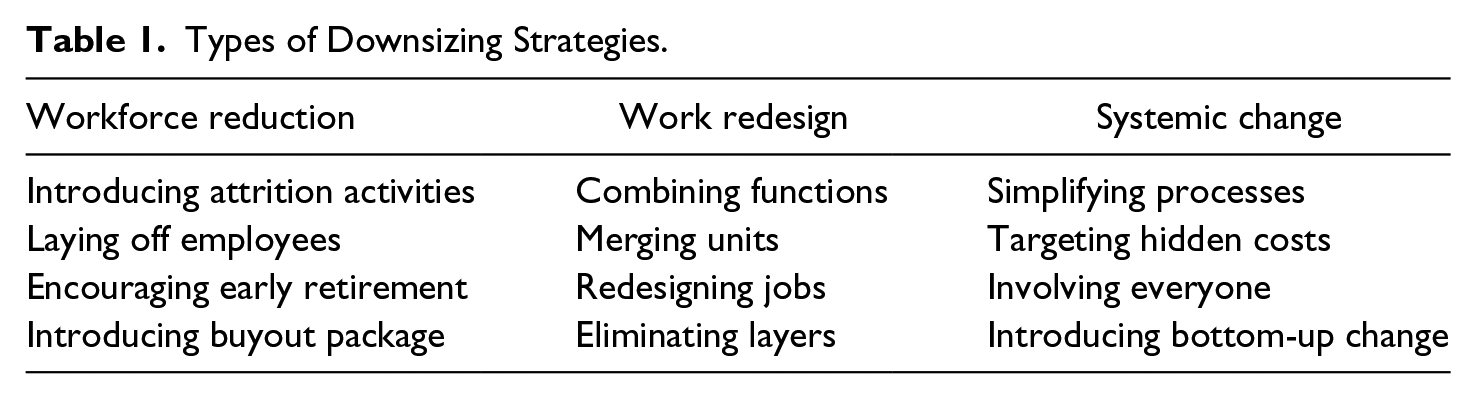
We selected the three areas of downsizing reforms based on the following considerations. First, the content of these downsizing strategies has covered major topics emphasized in public organizational management, such as employees, jobs, structures, behaviors, processes, and changes (e.g., Rainey, 2003). Next, the downsizing activities are closely related to the key components of government reforms, such as cutting red tape, empowering employees, and reexamining programs and procedures, emphasized in the reinventing of government (Gore, 1993; Rosenbloom, 1998). This alternative approach of downsizing is valuable for our comprehensive understanding of downsizing performance as it includes not only the narrow view of downsizing in terms of reduction in force (RIF) activities, but also the broad discussion of related organizational changes of behavior, structure, and culture that have been emphasized in previous studies of public organization reforms (e.g., Liou & Korosec, 2009). We believe that these downsizing strategies are effective managerial options available to public administrators in managing their organizations.
Research Questions and Factors
Downsizing Strategies
To examine the experience of public sector downsizing, we want to know the implementation of different downsizing strategies in city governments. Our first research question (RQ1) is “What are popular downsizing strategies implemented in U.S. city governments?” Previous studies of downsizing and reforms of public agencies have reported inconsistent findings on this question. For example, Hornestay (1999) explained that buyouts and early retirements were the preferred approaches (rather than disruptive layoffs) in the federal government, and that state and local governments experienced workforce reductions through privatization, deregulation, budget/service cuts, and program terminations. Liou and Korosec (2009) reported that major organizational reform strategies in state governments are implementing attrition activities, encouraging employee involvement, redesigning jobs or positions, and combining agency functions. It is important to know that both studies indicated that government agencies tend to include several strategies together in their implementation of reforms.
Moreover, we want to examine the factors that may affect the use of downsizing strategies. As explained, previous studies of public sector downsizing (Jones, 1998; Rubin, 1999) recognized the need for empirical evidence on influencing factors to fully understand the downsizing experience. Empirical studies on influencing factors are important to enhance our knowledge about downsizing reforms and to expand theories about public organizational reforms.
To test their influences, we reviewed major factors used in previous studies of reinventing government. These factors include environmental and organizational factors (Kellough & Selden, 2003); variables about managerial/political values, socioeconomic and institutional factors (Moon & deLeon, 2001); city manager, community, and local government characteristics (Kearney et al., 2000); and factors related to reform effort, agency type, agency characteristics, environmental influence, and agency director’s background and attitudes (Brudney et al., 1999).
Considering the importance of these internal and external factors, we then developed three research questions to test the effect of managerial values, financial conditions, and organizational factors on downsizing strategies. The influences of managerial values and financial conditions are especially important as they have been emphasized in the theoretical studies of corporate downsizing but have not been fully examined in the research of public sector downsizing, which begs the question if the corporate downsizing theories also apply to public organizations. Given the common assumption in promoting downsizing that downsizing strategies working in firms should also work in government (e.g., Rubin, 1999), this study of corporate downsizing strategies in public organizations and the test of their arguments will contribute to our overall understanding of public sector downsizing.
Managerial Values
A major argument in the corporate downsizing literature concerns the ideological approach of downsizing (e.g., McKinley, Mone, & Barker, 1998), which suggests that corporate downsizing decisions are related to a manager’s interest in the application of popular management philosophies and strategies. In other words, downsizing has been considered because of the interest in emphasizing employee self-reliance or the good idea of de-bureaucratization in business organizations. The ideological approach of downsizing is related to similar studies about the relationship between managerial values and reinventing government in the literature of public administration. For example, studies found a significant relationship between the implementation of reinvention ideas and manager’s values and attitudes (Kearney et al., 2000; Moon & deLeon, 2001). Our second research question (RQ2) examines the influence of managerial values on downsizing: “Do managerial values of the city government affect the performance of downsizing?” To answer this question, we developed two variables about managerial values, namely, innovative attitudes and ethical concerns, based on findings from studies of public management reforms.
The innovative attitudes refer to public managers’ attitudes in supporting an entrepreneurial culture and in adopting new approaches to improve the performance of public organizations. Public administration scholars have studied the influence of public managers’ values on reinvention activities in U.S. municipalities (Moon & deLeon, 2001), the relationship between management innovation and organizational performance (Walker, Damanpour, & Devece, 2011), and the need to stimulate entrepreneurial practices in public organizations (Y. Kim, 2010). Public managers who emphasize innovation in their operations are open and flexible in embracing new managerial ideas and practices, such as combining various downsizing strategies, to improve the organizational performance. This study thus hypothesizes that public managers favoring innovative approaches support downsizing reforms.
The second variable of managerial values is public managers’ ethical concerns, referred to their consideration about ethical issues and related effects on the management of city governments. Again, public administration scholars have recognized the importance of ethical issues and concerns to public organization management (e.g., Menzel & Benton, 1991; Zajac & Comfort, 1997). For public sector downsizing, researchers have studied the influence of downsizing experience on public employees (Stein, 1997) and examined the relationship between public sector downsizing activities and employee trust (Feldheim, 2007). Public managers who emphasize ethical practices will adhere to their professional ethical values and organizational standards (e.g., code of ethics) to manage their organizations. To address the financial challenge, public managers may adopt workforce reduction (RIF) strategies to maintain the well-being of their organizations. Prior to the application of RIF strategies, public managers may also promote work redesign and other systemic changes to improve the organizational performance. For this study, we want to understand the relationship between public managers’ concerns for ethical practices and their implementation of downsizing strategies, either workforce reduction, work redesign, or systemic change.
Financial Conditions
Besides the ideological approach of downsizing, studies of corporate downsizing also emphasized the economic approach of downsizing (e.g., Budros, 1997). This economic approach indicates that financial problems of the firms or changes in technologies promote downsizing activities (e.g., Budros, 1997). Managers decide to implement downsizing strategies because of the pressure of resolving financial problems or the interest in taking advantage of technological improvement. To test this financial aspect of downsizing, our third research question (RQ3) is about the influence of financial conditions on downsizing reforms: “Do financial conditions of a city government affect the performance of downsizing?” We believe that there is a relationship between the city’s financial conditions and the implementation of downsizing reforms because those cities with financial problems may need to implement downsizing strategies to solve resource-related issues or the cities with good financial condition may have the resources to implement downsizing strategies to further improve their operations. Previous studies of public management reforms reported significant relationships between reform implementation and economic factors, such as perceived economic health (Moon & deLeon, 2001) and unemployment rate (Kellough & Selden, 2003). To test the relationship between financial conditions and downsizing reforms, we also developed two variables representing the city government’s positive and negative financial conditions. The first variable is about the city governments’ budget surplus to see if the cities with good financial condition will implement new reform ideas. The second variable of financial conditions is the city government’s fund deficit used to assess if the cities with poor financial condition implement downsizing reforms to improve performance.
Organizational Factors
Besides managerial values and financial conditions, we included two organizational factors about the agency’s size and the employee’s tenure to examine their influence on downsizing reforms. Our fourth research question (RQ4) is “Are organizational factors of a city government related to the performance of downsizing?” For this question, we include two organizational factors, organizational size and employee tenure, based on the findings of previous studies. Organizational size has been considered one of the organizational characteristics in studying public organization management and performance (Graddy & Chen, 2006; Jung, 2013). Previous studies have found the impact of organizational size on organizational reforms among city governments (e.g., Kearney et al., 2000; Moon & deLeon, 2001). For downsizing reforms, large organizations may have more resources than small organizations to implement downsizing strategies requiring financial support. However, larger and older organizations may be more cautious than smaller organizations in the selection of simple downsizing strategies (Downs, 1967). Similar to the variable of organizational size, the tenure status variables have been used to study their effects on the performance of public organizations (Feiock & Stream, 1998; Juenke, 2005; S. K. Kim, 2005). From the literature of public organizational behavior, we have learned that public employees with long tenures in their organizations tend to be cautious in their support of organizational reforms (i.e., laws of increasing conservatism, Downs, 1967).
In sum, we reviewed related literatures about downsizing and public management reforms and developed four research questions for this study of downsizing reforms in U.S. city governments. These questions include the analysis of popular downsizing strategies implemented in city governments (RQ1) and the relationship between downsizing performance and managerial values (RQ2), financial conditions (RQ3), and organizational factors (RQ4).
Research Data and Method
Research Data
To understand downsizing reforms and related issues, we collected data through a national survey of city governments in the United States. A self-administrated questionnaire was sent to all chief administrative officers for cities with population over 50,000. The cities were identified through a mailing file from the National League of Cities and were further verified with the municipal yearbook of International City/County Management Association (ICMA). 1 Among 541 surveyed cities, 249 returned the survey with valid information, for a response rate of 46%.
For the data representation, we examined the population distribution, the form of government, and sample questions of responding cities. First, the population distribution of responding cities was compared with the population distribution of the cities in the ICMA’s Yearbook. Except for cities with population greater than 1 million, of which seven of eight responded to the survey (an 87.5% response rate), cities in other population categories exhibited similar response rates: 47.0% for cities with population ranging from 500,000 to 1 million, 48.7% for cities with population ranging from 250,000 to 499,999, 51.1% for cities with population ranging from 100,000 to 249,999, and 41.6% for cities with population ranging from 50,000 to 99,999. Second, we examined the form of government of the responding and nonresponding cities. Of the cities reporting such information, 179 had a council–manager form of government (52.7% of the 340 council–manager cities in the sample). The response rates for other categories of governmental forms were significantly lower (28.7%, 12.5%, and 20.0% for the mayor–council form, the commission form, and the township form, respectively), suggesting that this sample was more representative of the council–manager form of government.
To check the nonresponse bias, we conducted telephone surveys with more than 50 randomly selected city officials who did not respond to the survey (about 20% of nonrespondents). These officials were asked a few selected survey questions that included multiple survey items. Their answers were then compared with the respondents’ answers. No respondent bias was found by this process. To ensure the validity of the responses, we also conducted follow-up telephone interviews in which respondents were asked to verify their responses through specific examples in their organizations. All these interviewees were able to provide proper examples to substantiate their survey responses, suggesting that the survey responses are reliable.
Variables and Measurements
The survey questions for downsizing strategies are major variables that provide answers to the first research question. Downsizing strategies consist of 12 statement questions addressing reforms in such areas as employees, units, processes, structures, and systems. Specific variables are introducing attrition activities, combining agency functions, involving everyone in agency activities, laying off employees, merging units, simplifying rules and procedures, encouraging early retirement, redesigning jobs and positions, introducing bottom-up changes, introducing buyout packages, eliminating different layers, and targeting hidden costs. These reform items are related to downsizing strategies identified by Cameron (1994b) and were used by Liou and Korosec (2009) in their study of organizational reforms in state governments. We adopt the 12 downsizing strategies to fully understand the implementation of downsizing reforms in city governments. These strategies are comprehensive in scope, which include not only the RIF downsizing strategies, but also work redesign strategies and systemic change strategies—studying them provides a deeper understanding of downsizing in the public sector. Survey questions and measures are listed in the Appendix.
To measure the implementation of downsizing reforms, we asked the respondents to provide their assessments about the implementation of 12 downsizing strategies with a 5-level Likert-type scale, which includes 1 = no consideration, 2 = considered, no action yet, 3 = action planned, 4 = partially implemented, and 5 = fully implemented. The five levels of implementation measurement were developed by public administration researchers in their studies of implementation of government reforms (e.g., Brudney et al., 1999). 2
To examine factors influencing the implementation of downsizing reforms, we included questions about the city government’s managerial values, financial conditions, and organizational factors. The questions about the city’s managerial values are survey items examining the managers’ interest in adopting new approaches and their emphasis on ethical practices in their cities. The questions about the city’s financial conditions are survey items assessing the city’s budgetary surpluses and general fund deficits. These items are agreement questions and measured on a 5-level Likert-type scale, ranging from 1 (strongly disagree) to 5 (strongly agree). The questions regarding organizational factors focus on the managers’ years of service in the current position and the size of their cities, in terms of full-time employees (both are measured in real numbers). 3
Analysis Method and Findings
The first research question regarding the implementation of downsizing strategies was examined in two ways. First, we reported findings of descriptive analyses of means, standard deviations, and ranges to identify popular downsizing strategies and how they rank in popularity. In addition, we conducted factor analyses (principal component analyses) to see if these strategies could be grouped into factors to show the implementation of similar downsizing strategies.
The three research questions regarding the influence of managerial values, financial conditions, and organizational factors to downsizing performance were also analyzed through two stages. First, we reported findings of the means, standard deviations, and correlation coefficients of six variables representing managerial values, financial conditions, and organizational factors. Next, we adopted multivariate regression analyses to examine the effects of managerial values, financial conditions, and organizational factors (i.e., independent variables) on downsizing strategy factors reported from the factor analyses (i.e., dependent variables).
As revealed in Table 2, city governments have reported various levels of implementation about the 12 downsizing strategies. The downsizing strategy with the highest mean score is “simplifying rules and procedures” (3.42, with the SD score of 1.21). The strategy with the lowest score is “introducing buyout package” (1.68, with the SD score of 1.20). Four strategies with mean scores between 3 and 4, which indicate the situation of “actions planned” and “partially implemented,” are “simplifying rules and procedure,” “combining agency function,” “redesigning job and positions,” and “merging units.” Six strategies with mean scores between 2 and 3 (i.e., indicating the situation of “considered/no action yet” and “actions planned”) are involving everyone, attrition activities, targeting hidden costs, eliminating different layers, introducing bottom-up change, and encouraging early retirement. Two strategies with mean scores below 2 (i.e., indicating the situation of “no consideration” and “considered/no action yet”) are laying off employee and introducing buyout packages. The findings here provide answers to our first research question about popular downsizing strategies implemented in U.S. city governments.
Implementation Rankings of Downsizing Strategies.

Note. Levels of implementation are based on the Likert-type scale—1 = no consideration, 2 = considered, no action yet, 3 = actions planned, 4 = partially implemented, 5 = fully implemented.
The results of factor analyses (see Table 3) showed two general factors representing the combination of downsizing strategies (with Eigenvalue greater than 1.00). As the major factor (with a 3.953 Eigenvalue and 32.943% of variance value), Factor 1 “Structural Factor” consists of six mixed downsizing strategies dealing with structure and system changes, which include three items in work redesign and three items in system change. Factor 2 “Employee Factor” (with a 3.011 Eigenvalue and 25.093% of variance value) includes six downsizing strategies that are related to changes in the workforce reduction (four items) and in the system change (two items; that is, employee-focused changes). The findings here support arguments about the consideration of combining different downsizing strategies by U.S. city governments.
Factor Analysis of Downsizing Strategies.
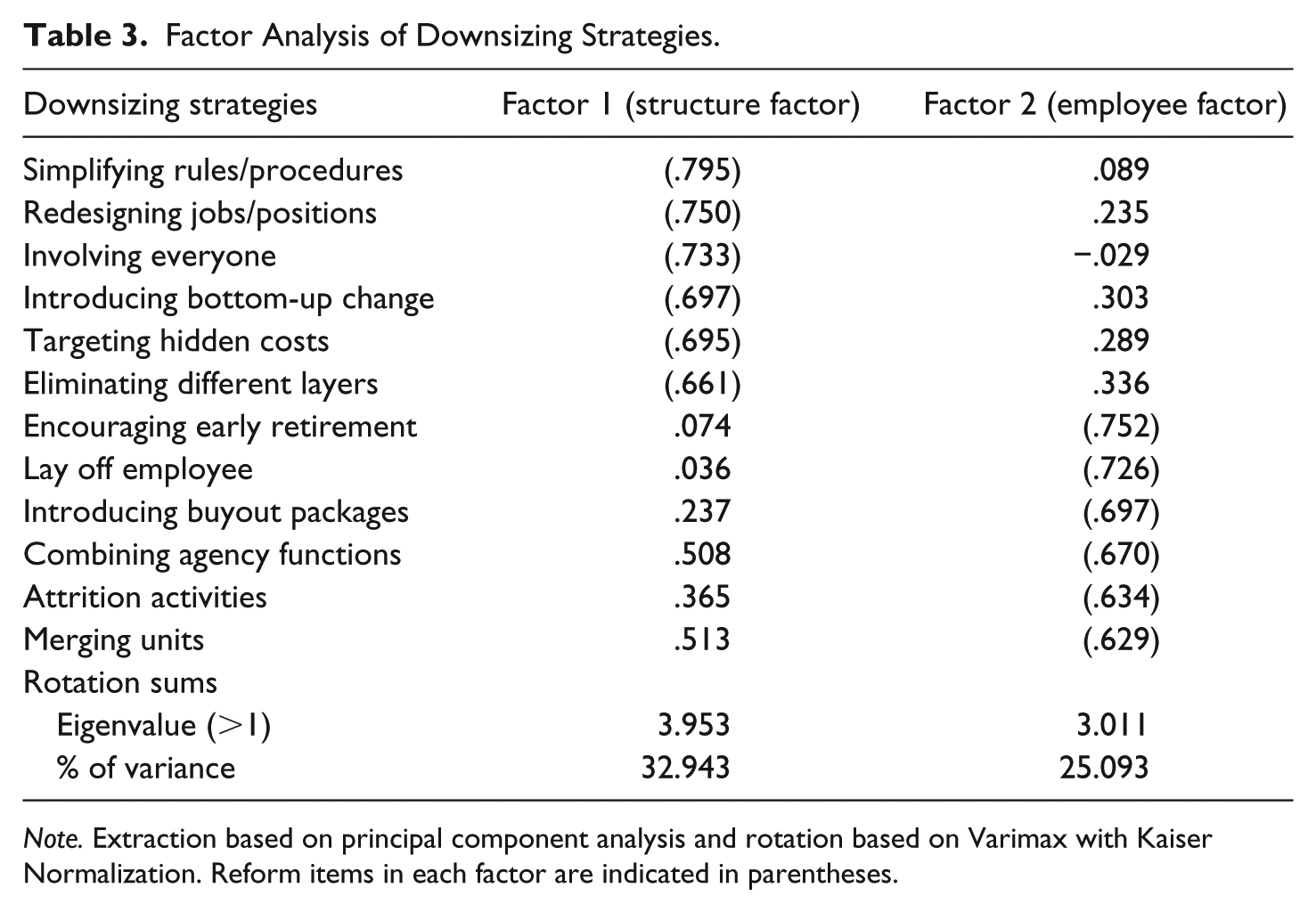
Note. Extraction based on principal component analysis and rotation based on Varimax with Kaiser Normalization. Reform items in each factor are indicated in parentheses.
Table 4 provided means, standard deviations, and correlation coefficients of six independent variables representing managerial values, financial conditions, and organizational factors. The correlation coefficients presented the interrelationships of the six independent variables and provided evidence to support the adoption of multivariate regression analyses as there are no multicollinearity problems between these variables.
Descriptive Statistics and Correlation Coefficients of Influencing Variables.

Note. Levels of agreement about the statement questions are based on the Likert-type scale 1 = strongly disagree, 2 = disagree, 3 = neutral, 4 = agree, 5 = strongly agree. Organizational size refers to real numbers in thousands. Correlation coefficients are Pearson correlation coefficients.
Indicating significance < .05.
The results of two multivariate regression analyses in Table 5 answer research questions RQ2, RQ3, and RQ4. The findings of regression analyses revealed that the regression model developed around the effect of managerial values, financial conditions, and organizational factors only supported the dependent variable of downsizing Factor 1 (mixed structure and system changes) because the F scores are statistically significant. The developed regression model is not statistically significant for the dependent variable of downsizing Factor 2 (mixed employee and system changes).
Multiple Regression Analyses of Influencing Factors on Downsizing Factors.

Indicating significance <.05.
On the effect of managerial values, the study found evidence to support the influence of new approaches and ethic priority to downsizing Factor 1, not Factor 2. In other words, city governments that emphasize new management approaches and are concerned about ethical practices tend to implement Factor 1 strategies (i.e., structure and system change). The findings here provided evidence to partially answer our research question RQ2.
For the relationship between downsizing strategies and city’s financial conditions, the findings are not statistically significant in both regression analyses models. The findings here do not support our research question RQ3 about the influence of budgeting surplus and fund deficits to downsizing strategies.
Similarly, regarding the relationship between downsizing strategies and organizational factors, the findings are not statistically significant in the two regression analyses models. The findings again do not support our research question RQ4 about the influence of organizational size and individual tenure to downsizing strategies.
Discussion and Implication
The results of empirical analyses provided evidence to our research questions and suggestions for public downsizing reform. On the question of popular downsizing strategies, the findings support previous research findings about the conservative and cautious approach in the implementation of reform strategies (Brudney et al., 1999; Moon & deLeon, 2001; Thompson, 2000). The top three strategies (i.e., simplifying rules/procedures, combining agency functions, and redesigning jobs and positions) do not involve major policy changes that incur financial costs and potential political and legal problems. The findings from factor analyses indicated that public managers prefer to adopt a whole package of related downsizing strategies (e.g., combination of structure and system changes) in the process of reforms. The findings again are similar to previous studies of public management reforms that were based on correlation analysis results (e.g., Brudney et al., 1999). Our suggestion here is that public managers need to consider downsizing strategies from a comprehensive organizational reform approach, not just strategies of reduction in workforce.
The two multiple regression analyses provided answers to our research questions about the influence of managerial values, financial conditions and organizational factors to downsizing reforms. Regarding the influence of managerial values, our study supports the positive effect of managers’ innovative approaches and ethical concerns on downsizing Factor 1 of structural changes, such as simplifying rules and procedures, redesigning jobs and positions, involving everyone in the process, introducing bottom-up change, targeting hidden costs, and eliminating different layers. The findings here support previous studies about the importance of managerial attitudes to government reforms (e.g., Brudney et al., 1999; Kearney et al., 2000). The findings about no statistically significant relationships between managerial values and downsizing Factor 2 (employment-based changes) are also important for our understanding of public sector downsizing, suggesting that more innovative public managers with ethical considerations less likely support downsizing strategies of encouraging early retirement, laying off employees, introducing buyout packages, combining agency functions, introducing attrition activities, and merging units.
The relationship between public managers’ ethical concerns and downsizing strategies needs to be carefully explained here. Our findings support the relationship between the ethical concern variable and structure-based downsizing strategies (Factor 1), but not the relationship between ethical concerns and employee-based downsizing strategies (Factor 2). The findings do not suggest that public managers are unethical if they implement workforce reduction (RIF) strategies. When facing financial challenges, public managers need to implement all types of downsizing strategies (including workforce reduction strategies) to protect the organization’s well-being and it would be unethical for them if they do not do so. To implement employee-based downsizing strategies (i.e., workforce reduction strategies), public managers need to be transparent in their operation and emphasize the managerial value of fairness to reduce employee’s resistance, stress, and distrust. The sophisticated relationship between ethical concern and downsizing strategies should be further examined in future studies.
On the relationship between financial conditions and downsizing performance, the results of regression analyses do not identify the influence of the city’s budget surplus and fund balance to downsizing factors, rejecting the original arguments that either cities with good budget conditions are likely to implement downsizing strategies or cities with poor budgeting conditions will have the need to implement downsizing strategies. Previous studies on the effects of financial condition on reinventing reforms have been mixed as some studies indicated significant relationship between fund balance and reform attitude, but not reform actions (e.g., Kearney et al., 2000). Our study thus confirmed no relationships between financial conditions and organizational reforms because our measures of downsizing reforms focused on the implementation (i.e., actions), not the attitude, of downsizing strategies.
Similarly, the findings of regression analyses do not support the effect of organizational factors on downsizing strategies. Both variables about the manager’s tenure and the city’s size do not have effects on downsizing factors. Regarding the influence of the tenure to downsizing reforms, the results showed negative relationships, which are similar to previous conclusions about the negative relationship between a manager’s tenure and reinvention reforms (Kearney et al., 2000). Nevertheless, the negative relationships in our study are not statistically significant. On the relationships between organizational size and downsizing reforms, previous studies supported the impact of organizational size on organizational reform (e.g., Kearney et al., 2000; Moon & deLeon, 2001). Again, the results of regression analyses in our study did not find evidence to support the relationship between organizational size and downsizing performance.
These findings and discussions about our study of downsizing reforms in U.S. city governments offer insights for public administration scholars and practitioners. For scholars, the findings about influencing factors to downsizing performance provide additional information about theoretical arguments between downsizing for managerial considerations and downsizing for economic concerns. In our study, managerial values of the city governments are more important than the city’s financial conditions and organizational factors in affecting the downsizing performance. In addition, the findings about the positive and significant relationships between managerial values and downsizing strategies of Factor 1 and the insignificant relationship for downsizing strategies in Factor 2 indicated that downsizing reforms are more complex than other government reforms and they should be carefully implemented to reduce negative effects on the organization and related employees. Clearly, not all downsizing strategies are the same in terms of their reasons for adoption, as demonstrated by our findings that different causes lead to adoptions of structure-based changes from employment-based changes. The relationship found between managerial values and the downsizing factor suggest that public managers should consider the inclusion of downsizing strategies in their overall reforms of organizational culture to emphasize the innovative attitude of trying new ideas and to promote ethical concerns in their operational practices.
For the practitioners, our research findings reveal unique approaches of public sector downsizing as city governments tend to be cautious in using combined strategies with significant fiscal burdens. Our findings about popular downsizing strategies and the combined approach are important for public managers. For example, researchers have emphasized the importance of studying the implementation and effect of government reforms on civil service systems and public personnel functions (Condrey, 2002; Holzer, Lee, & Newman, 2003; Kearney & Hays, 1998). Our study provided empirical evidence to support this position. As indicated previously, we emphasized that downsizing strategies are effective managerial options available to public administrators in managing their organizations. We found that the top four downsizing strategies with the mean scores above 3 (i.e., simplifying rules and procedures, combining agency functions, redesign jobs and positions, and merging units) are all changes in work design, which are directly related to the functions of public personnel managers.
Public personnel managers should play an important role in supporting the policy makers or the chief executives in designing and implementing downsizing-related reforms. Our findings on combining downsizing strategies and the importance of managerial values reveal the importance of taking a comprehensive and collaborative approach to assist managers with the process of downsizing and to moderate and manage the risks and unintended consequences of the process. This approach should consider the agency’s mission, leadership style, managerial goals and values, strategic plan, evaluation alternatives, communication tools, and union agreement provisions and civil service regulations (Bledsoe, et al., 2005; International Personnel Management Association, 2001).
For the argument about downsizing for economic concerns, there are theoretical implications about the finding of no relationship between financial conditions and downsizing reforms. Our study of downsizing performance indicated that there are differences between reform attitudes and reform actions because financial conditions are not related to the implementation of downsizing reforms. Future studies of government reforms may want to further test the differencing effect of financial condition on reform attitudes and actions. In addition, the financial condition measures used in this study, budgetary surplus and fund balance, assess fiscal outcomes not fiscal operations and changes, which could have different effect on downsizing. The relationship between financial conditions and downsizing strategies may be related to the nature and the timing of the survey studies. Futures studies of the influence of financial conditions may want to use measures to examine changes in the budgeting and fund balance (i.e., increases or decreases from previous years in a longitudinal approach), rather than the status of budgeting and fund balance (i.e., current amounts) because local governments may face more pressures to implement downsizing reforms because of changes in financial conditions.
Finally, regarding theories of downsizing, our findings provide suggestions for additional theoretical studies of public sector downsizing. As mentioned, previous studies of corporate downsizing provided arguments about the economic and the ideological approaches of downsizing. Although not designed for comparing downsizing arguments between business firms and public agencies, our study of downsizing reforms in city governments suggests that managerial values, not financial conditions, are related to downsizing performance in public agencies. Managerial values are related to the ideological approach of downsizing. This finding suggests about the unique environment of government agencies and how such environment may be different from business firms in dealing with financial challenges. Future studies about the influencing factors of public sector downsizing can consider the ideological approach (as supported in our study), the economic approach, or the combination of two approaches and test these approaches by comparing them among business firms, nonprofit organizations, and government agencies.
Our study of downsizing reforms in U.S. city governments was based on the analysis of national survey data. While providing important findings to clarify research questions, our study has several limitations. For the data, we developed our findings based on the subjective responses to research questions. While subjective responses have been widely used in the literature, studies of downsizing activities can also collect objective data to check real financial, structural, and personnel changes. In addition, the current study focused on examining the influence of internal managerial and financial factors to downsizing decisions and did not include external factors, such as geographic locations and objective economic and political factors.
Conclusion
Downsizing has been one of the major components emphasized in recent public management reforms. Downsizing strategies, either as direct responses to financial stresses or as a part of systematic managerial reforms, are likely to continue because large government agencies can be at a disadvantageous position when facing economic, fiscal, and political pressures. This study examines the implementation of downsizing strategies in U.S. city governments by adopting a broad definition of downsizing to include strategies, in addition to workforce reduction, in structure and system changes. The empirical analyses of data from a national survey have revealed the popular downsizing strategies emphasized by U.S. city governments. The findings call for an approach that combines downsizing strategies of structural and system changes and stresses managerial values in promoting the performance of downsizing strategies.
For future studies, public administration researchers may want to conduct more empirical studies to compare downsizing reforms at different levels of government and among different types of government agencies. The comparative study can also expand to include the longitudinal studies of downsizing reforms over the years and the cross-national comparisons of downsizing between public administration systems in different countries. Additional studies on the relationship between downsizing performance and managerial and financial influencing factors are especially valuable if the researchers can develop their studies by comparing the hypothesized relationships among government agencies, business firms, and nonprofit organizations. The findings of these comparative studies, either cross-sectional studies or longitudinal studies, can enhance our overall understanding of public sector downsizing and contribute to the literature of public management reforms.
Footnotes
Appendix
Declaration of Conflicting Interests
The author(s) declared no potential conflicts of interest with respect to the research, authorship, and/or publication of this article.
Funding
The author(s) received no financial support for the research, authorship, and/or publication of this article.