



Abstract
Women govern differently and offer a distinct voice in the governing process yet remain significantly underrepresented among city managers and chief administrative officers. Despite decades of work to improve gender parity, women hold just 13% of chief local government positions according to the International City/County Managers Association (ICMA). One reason for this may be that women have different experiences and are socialized differently than men, as suggested by differing motivations, identities, and attitudes. Using a mixed-methods approach, we explore differences in the experiences and socialization of women and men that may contribute to the gender disparity in representation among city managers. Our study yields several significant findings that suggest women are mentored differently, develop different political attitudes over time, and develop confidence differently than their male counterparts. Contrary to prior research, we did not find significant differences in public service motivations by gender or year of service.
Introduction
Although the International City/County Managers Association (ICMA) has been working to increase gender parity among chief administrative officers for decades, there is still a very large gap. According to the National Research Center (2013, as cited in ICMA, 2015), “34 percent of all assistant positions, 30 percent of department head positions, and 53 percent of all assistant to the [Chief Administrative Officer] positions are held by women,” but women hold only 13% of chief positions (ICMA [International City/County Management Association], 2015). Of these women in office, little is known about how their experiences might differ from men in the same occupation.
A number of studies have explored how women govern differently and have discovered that women offer a distinct voice in the governing process. However, a limited number of research studies have explored gender differences at the local level of government and more specifically, in leadership positions in local governments throughout the United States. Stewart (1980) suggests that the local level of government is the most accessible to women but remains the least studied of all three levels of government in a federalist form.
Some scholars have sought to address this void. For example, Fox and Schuhmann (1999, 2000) study gender differences in city management—an area of research they argue has been “entirely overlooked in the public administration and women and politics literature” (Fox & Schuhmann, 1999, p. 231). They find that women do govern differently and make decisions distinctly, exhibiting distinct motives for public service associated with encouraging citizen engagement and input into decision making, as well as facilitating communication (Fox & Schuhmann, 1999). Women city managers tend to be in leadership positions with a smaller budget, less personnel to oversee, and less pay (Alkadry et al., 2019.) More recently, Holman (2017) questions the consequences of the lack of women in local government, “particularly in terms of trust in government, political engagement, and democratic accountability” (p. 293). These findings have important implications for governing in a democratic, legitimate, and representative manner but do not answer questions about why there are so few women city managers.
Research suggests this is not an issue of not having enough qualified women to fill chief roles (Beaty & Davis, 2012; Gidengil & Vengroff, 2008). Studying Masters of Public Administration students from one program, Aguado and Frederickson (2012) find that far fewer women became city managers for several reasons. These include aspirations, being treated differently because of gender, and family circumstances. In particular, these authors highlight the challenges women face in work–life balance. Based on their experience as public servants and consultants, Voorhees and Earl (2017) anecdotally identify factors that prevent women from shattering the glass ceiling of city management, such as being mentored differently than men and reluctance from elected officials; however, they also highlight a psychological barrier women face: the confidence gap. Research exploring gender representation in politics often proposes readying the pipeline for women to achieve equal representation, but there is little research on women city managers’ development within the profession, which would contribute to a better understanding of the differences in men and women city managers.
Therefore, in this article, we examine how city managers differ along certain dimensions related to socialization by gender and time-in-position. Following Oberfield’s (2014) recent work on this topic, we conceptualize socialization as developing and modifying motivation, attitudes, and identities that city administrators rely on to carry out their work. To study these concepts, we use a cross-sectional national survey, followed by elite interviews, and explore differences between women’s and men’s public service motivation (PSM), attitudes as measured by political ideologies, and confidence as a proxy for identity. Although this study is limited by the use of cross-sectional data, our findings indicate that gender and tenure result in significant differences in chief administrators’ attitudes and identities. These findings have important implications for understanding women’s experience and indicate that women may be socialized into the occupation differently, which in turn affects their approach to governing and their careers.
Literature Review
Socialization in Public Administration
Socialization helps individual bureaucrats develop their beliefs about their role and appropriate actions (Berger & Luckmann, 1966; Klein & Heuser, 2008). Individuals are socialized by forces both within and external to organizations. Berger and Luckmann (1966) contend that secondary socialization, such as into a profession, occurs when people internalize and share knowledge, identities, and institutions with others. This can be a particularly useful construct to examine local government, where “social construction is practiced more effectively . . . by linking organizational units and people through open interaction, dialogue, and the sharing of socially distributed knowledge” (Jun, 2006, p. 12).
Within the workplace, leaders have the ability to set the tone for organizational norms and socialization processes. Denhardt (1968) argues that bureaucratic organizations socialize individuals so that they adopt and internalize the core values. Oberfield (2014) similarly argues that “bureaucratic socialization [is] the process by which public-sector entrants develop the knowledge, attitudes, and behaviors necessary to function” (p. 1). Organizational socialization is a multi-part process that includes developing the skills and behaviors, along with adopting similar norms according to Feldman (1981). He posits that this process is dependent on the extent to which individuals understand, master, and excel in their jobs, adjust to the culture, and form bonds of trust and understanding with others. The way that people are socialized into positions and understand their roles is particularly important for how well they adapt to their environment (Hsiung & Hsieh, 2003; Jaskyte, 2005), with job standardization being particularly useful for socialization (Hsiung & Hsieh, 2003). Jones (1986) finds that both institutional tactics and individual factors affect the outcome of socialization processes, noting in particular a person’s self-efficacy is strongly correlated with a person’s approach to their position. Furthermore, organizational commitment has been correlated with socialization practices (Jaskyte & Lee, 2009; Selden & Sowa, 2015), such as those that connect an employee’s characteristics and the organization’s needs (Jaskyte & Lee, 2009). Thus, both individual and institutional-level factors help to socialize people into their roles and may help to lengthen tenure in roles.
One strand of organizational literature focuses on occupational socialization, or the “changes that take place in a person as a function of the job” (Frese, 1982, p. 209). In private organizations, occupational socialization has been found to be correlated with individual work approaches (Frese et al., 1996). This line of research suggests that differences in how men and women are socialized before entering the workforce, such as during childhood, should disappear after being socialized into a profession, which Gomez-Mejia (1983) finds to be true among managers and professionals in a large U.S. corporation.
Oberfield (2014) claims, that in part, socialization can be understood as a product of motivations, identities, and attitudes developed over time. Studying new social service and police entrants into a large city government for 2 years, he finds that individual factors, as opposed to organizational efforts, are more likely to shape bureaucrats’ actions, although both have some effect. Although not focused on gender and consisting of a small sample, Oberfield’s findings suggest that studying the differences between men and women city managers’ experiences and the reasons for pursuing their work (motivation), approaches to the people they serve (attitude), and sense of one’s own professional self (identity) is valuable for what is a very understudied area of public administration (Moyson et al., 2017). This runs contrary to the occupational socialization literature, which suggests that over time, we might find that gender effects decrease as managers adjust to the norms of a profession (Frese, 1982; Frese et al., 1996; Gomez-Mejia, 1983).
In existing research examining gender in public service, scholars have argued and found that women tend to have a unique experience in pursuing leadership roles and in the bureaucracy. For example, researchers find that “a woman’s touch” is common in state administrations, where female managers have a distinct management style, as compared with their male counterparts (Jacobson et al., 2010). Women tend to perform emotional labor in organizations (Guy & Newman, 2004; Meier et al., 2006) and lead in a less-hierarchical, more-participative manner (Meier et al., 2006). Women also have distinct motivation to pursue public service career options (DeHart-Davis et al., 2006). A recent study found gender disparities in the career path of educators and argues that gendered career systems and gendered ambition may contribute to a bias in policy making and public management (Maranto et al., 2018). Research on elected officials has also illustrated gender differences in leadership styles, policy preferences, feminist identities, more liberal approaches, and impact on policy among others (K. Dolan & Ford, 1995; Ford, 2011).
The research on socialization and differences in men and women leaders yields an interesting question about prior research. Specifically, over time, will differences in motivations, attitudes, and identities of women city managers’ disappear as they are socialized into the profession? Prior socialization research in public administration has demonstrated that PSM, policy and political preferences, networks, and beliefs about oneself affect socialization (Moyson et al., 2017). Therefore, we focus the remainder of our literature review on the public administration and political science literature related to these concepts.
Motivation
Motives for accepting a position may help to determine the success of socialization processes and longevity in an organization (Baker & Jennings, 2000). One of the most studied theories of motivation is PSM (Perry, 1996, 2000; Perry et al., 2010; Perry & Wise, 1990). Perry (2000) expands on the theory of PSM by drawing on institutionalism, suggesting that in addition to the antecedents of PSM, such as education and childhood experiences, institutions and organizations work to shape an individual’s beliefs and values. He suggests that these factors help better explain motivations than rational choice theory alone. Vandenabeele (2011) furthers the study of PSM as a product of institutional factors, arguing that workplaces, politics, family history, personal characteristics, and education help to explain a person’s reasons for choosing public service. Together, these constructs suggest that socialization into an organization ultimately results in motivation to perform a job because of shared values, understandings, and knowledge (Choi & Chung, 2017; Denhardt, 1968; Feldman, 1981; Jun, 2006; Perry, 2000; Vandenabeele, 2011).
Several recent studies find that PSM declines after entering an organization (Choi & Chung, 2017; Kjeldsen & Jacobsen, 2012). In part, this may be because employees are surprised when entering new organizational forms, resulting in disappointment and turnover or overcoming “reality shock” through sense making (Louis, 1980). She argues that “insiders” help individuals interpret the environment and provide critical information that promotes sense making.
Public organizations are not the only agents of socialization, the education process or professional socialization can also enforce values and norms (Bright, 2005; Kjeldsen, 2012; Moynihan & Pandey, 2007; Perry, 1997; Stout, 2009). Kjeldsen (2012) finds that contrary to expectations, university students pursuing public service degrees begin with a high PSM level and have no significant increase in PSM scores over time, although students enrolled in non–public service degree programs do increase PSM over time. This suggests some people may be attracted to public service, rather than socialized into it by higher education. Furthermore, research has demonstrated that professional and organizational forces shape individuals’ values, and the city manager’s office sets the tone for the public sector it leads (Hamidullah et al., 2015). Brewer (2008) notes that “research has not, however, focused on the importance of socialization processes in imparting a high level of public service motivation” (p. 149).
A few studies explicitly examine the relationship between socialization and PSM. Two longitudinal studies examine changes in public and private sector employees. First, Kjeldsen and Jacobsen (2012) find that socialization may help explain why new public agency physiotherapists’ PSM declined significantly less than their counterparts working in similar private sector positions in the same time frame. Next, Choi and Chung (2017) find that the valuation of extrinsic rewards, specifically pay and job security, become more valued by public-sector employees over time, whereas inequity is less valued.
Other studies focus solely on public service employees and their motivations. For example, PSM and perceptions of red tape have an inverse relationship among state health and human services managers (Scott & Pandey, 2005). In a cross-sectional study of more than 3,000 public employees, Vandenabeele (2011) finds that socialization into an organization where public values are emphasized by others is positively correlated with PSM. Another examination compares at-will and civil service municipal employees, finding that type of agency duties, as well as organizational characteristics, education, and race may result in employees exhibiting some, but not all, of the four PSM dimensions (Battaglio & French, 2016). Bright (2005) finds that women civil servants tend to have higher PSM, although he calls for additional research, given the undersampling of men in his study. In part, this finding is supported by another study of public managers in state health and human services, which found that women had higher levels on two components of PSM: compassion and attraction to policymaking (Dehart-Davis et al., 2006). However, contrary to this, Vandenabeele (2011) finds that men had higher PSM scores than women.
The commonality among these studies is the suggestion that there is a dynamic, but not uniform, relationship between PSM and shared understandings and values, or socialization, along the four dimensions of PSM. One of the gaps in our knowledge, however, is how city managers’ PSM may change as they are socialized into their positions in local organizations where the ability to develop shared understandings is enhanced (Louis, 1980) and professional associations and educational opportunities further promote shared values.
Using PSM as a way to understand motivations, we hypothesize the following:
Attitude
An individual’s understanding of an organization’s constituents, or the people served and affected by the organization, affects approaches to governance and leadership. For example, Blau’s (1960) study of a public welfare agency suggested those workers who were socialized into the organization had better attitudes about the people they were serving. In other words, socialization affects how people do their jobs.
Gender roles, prescribed by society and accepted in many workplaces and organizations, complicate leadership norms and behaviors, however. Eagly and Johannessen-Schmidt (2001) argue that “conforming to their gender role can produce a failure to meet the requirements of their leader role, and conforming to their leader role can produce a failure to meet the requirements of their gender role” (p. 786). Leadership and management positions across the sectors are filled with masculine norms, meaning shattering the glass ceiling remains challenging to those with feminine, distinct voices. The term “glass ceiling” was coined in 1987 to describe women’s inability to climb the hierarchical structure of an organization successfully (King, 2000). Since the 1980s, women have been able to shatter the glass ceilings in a number of organizations across sectors; yet, they still face the dilemma of gendered decision making. King (2000) explains that the gendering of decision making is a “function of cultural roles, expectations, socialization and stereotypes” (p. 76).
While many public organizations are filled with such masculine identities, women who shatter the glass ceiling can manage their feminine management style or decide to embrace the “difference feminism” perspective. This perspective suggests that women’s management style, which incorporates feminine qualities, can enhance organizational effectiveness (Stivers, 2002). According to Sabharwal (2015), “women in leadership positions continue to face an uphill battle; they often are placed in precarious positions setting them up for failure and pushing them over the edge—a phenomenon recently termed as “glass cliff”” (p. 399). These barriers are persistence and prevalent in local government leadership.
In a 2015 article, three female city managers shared their experiences in facing institutional biases that have presented challenges to women becoming city managers and also discussed governing with a different “tone.” Women tend to lead in a more participatory, less-hierarchical approach and are commonly found in traditionally feminine organizations that focus on education, health and human services, and children and women’s rights (Smith, 2015). According to Smith (2015), the leadership categorization theory explains the persistence of glass walls, women in and leading feminine agencies, and the theory further supports the idea that traditionally socialized gender norms affect professional choices and may lead to selecting an occupation that aligns with basic gender norms.
In 1979, Burns studied men and women from various levels of city administration and discovered gender differences in political ambition, definitions of the managerial role, and support networks. In 1999, researchers discovered that female city managers were more likely to embrace a management style that relies on citizen input (Fox & Schuhmann, 1999). Further gender differences in city managers were found in Fox and Schuhmann’s (2000) work, which include female city managers identifying themselves as more liberal, emphasizing community relations as an important role of a city manager, and including citizen input in decision-making processes. When women govern at the local level, there is potential for policy outcomes to be different, as women are more liberal than males.
While city managers may not have political affiliations, their ideological leanings may affect their work. Bush et al. (2016) show that the ideology of the city manager has an effect on the level of expenditures at the local level. This finding is similar to J. Dolan’s (2002) research on federal expenditures and gender. Research shows that having women in local-level positions results in policies that are gendered (Kellogg et al., 2017). For example, women mayors increase female employment in the municipality (Ferreira & Gyourko, 2011). In studies examining women leading local governments globally, women-friendly policy outcomes were achieved (Bratton & Ray, 2002). Gender differences in the exercise of power within the local level of government have been found in cases where women are more willing to change the budget, admit fiscal problems, be more inclusive, and seek broader participation (Weikart et al., 2006). Most recently, Holman (2015) finds that female mayors approached budgetary policy differently, as they increased funding for social service programs.
These works support the difference feminism perspective, a theoretical approach that suggests feminine traits of management and leadership may be used effectively. Fox and Schuhmann (1999) write, “women are significantly more likely than men to display the ‘feminine voice’ traits,” which is important in being responsive to the underrepresented, enhancing representation and legitimacy; yet, “the serious problem in terms of representation and legitimacy arises in that women compose only 11 percent of chief administrators in city government” (, p. 240).
Using political ideologies as a way to understand administrators’ attitudes, we hypothesize,
Identity
Stereotypes and self-perceptions result in incongruent expectations and roles for women managers and very little research focuses on how women are socialized once in management positions (Terborg, 1977). One study found that women managers are more likely than male managers to emphasize their careers as compared with personal lives, suggesting that women managers have been socialized to value their professional life differently (Powell et al., 1984). Studying gender stereotypes, York (1988) did not find differences between male and female managers’ socialization but notes that it could be because women who move into administration display different characteristics than those who do not.
More recent research indicates that women city managers have lower “workplace authority profiles” than their male counterparts (Alkadry et al., 2019). According to these authors, this difference in authority profile personally effects women because it results in lower pay. Moreover, “even when women overcome position segregation, they still face the challenge of systematic exclusion from exercising comparable authority to their male counterparts” (Alkadry et al., 2019, p. 315). In a study among mayors in cities with populations of more than 30,000, women mayors were more likely than male mayors to perceive that women face “gender-based obstacles in the exercise of leadership” (Weikart et al., 2006, p. 119). These findings are not surprising given the characteristics that are traditionally valued in managerial positions.
Public administration values such as “professional expertise, management, leadership and public virtue that mark justification of administrative power,” conjure masculine images (Stivers, 2002, p. 3). At an institutional level, these gender images may affect the way people understand themselves as a professional, or their role in an organization. The institutions of the public sector as well as the traditionally valued skills and techniques used to run the bureaucracy tend to be masculine, which may present challenges to prospective leaders with feminine approaches. Carli and Eagly (2001) argue that females face a few challenges when being hired for leadership roles; they are presumed to be less competent and less credible to have influence, or when they are perceived to be as competent as men, they are viewed as violating social role norms.
This identity struggle between the social role versus professional role has profound effects on females considering leadership position and for women in decision making. While the “pipeline problem” is an issue that strengthens the glass ceiling for many women in many sectors, it is not necessarily an issue for women in city management. According to a recent report by the ICMA (2017), the majority of assistant city managers in the United States are female; yet, these women are not being mentored like their male peers and they are facing the “confidence gap.” Much like the glass ceiling and glass cliff, the confidence gap is an illusion that women lack confidence in applying for promotions, their negotiating skills, and readiness for leadership.
Confidence in both one’s own abilities, along with a position’s consistency with values, has an effect on women’s choice to stay in a chosen career (e.g., see Cech et al., 2011) or to seek leadership opportunities (Chan & Drasgow, 2001; Day et al., 2009). Interestingly, Ibarra (1999) finds that in experimenting with different identities, women relied on strategies that may suggest lower confidence levels. Professional identity is built by observation, experimentation, and evaluation over time which results in “attributes, beliefs, values, motives, and experiences in terms of which people define themselves in a professional role” (Ibarra, 1999, p. 765). Specifically, these study participants were “acutely aware of their limitations and avoided pretension or exaggerated displays of confidence” (Ibarra, 1999, p. 778). These findings are consistent with other studies on gender and confidence.
The confidence gap between genders has been well-documented from adolescence in studies about student learning (Pajares, 2002). Building self-confidence as part of one’s identity is an important part of public administration education (Denhardt, 2001), and socialization processes can help to build confidence (Smith & Hatmaker, 2014). This self-confidence, along with identifying with the role, is necessary to lead (Lord & Hall, 2005), but is also typically associated with more masculine traits (Eagly & Carli, 2007).
Given the relationship between the two concepts and their connection to gender in the literature, we used confidence as a proxy for identity and hypothesize,
Method
To examine ways that women and men serving in top local government management positions differ, we took a mixed-methods approach beginning with a survey. Our approach follows Gomez-Mejia’s (1983) method of studying occupational socialization, which also used a cross-sectional survey to examine gender differences among private corporation employees. In addition, we followed our survey with elite interviews.
We began in the fall of 2016 with a website search of all cities with a population of 5,000 or more identified by ICMA as using the council-manager form of government (ICMA, 2010). Our objective was to identify and survey all female city managers/administrators in these cities. Using the ICMA (2010) yearbook, we identified 2,499 such cities with city managers in the United States. We then went to the website of each of these cities to identify which currently had a female chief executive officer. The web search identified 353 (14.2%) cities with female managers, 2,062 (82.5%) cities with male managers, and 84 (3.3%) that were listed as either vacant or did not have a website.
To construct a sample of male city managers to compare with these 353 female managers, we used a random selection method to identify 353 male managers from the list of municipalities with male managers. Using the physical and email addresses obtained from our web search, we then conducted a survey of both sample groups. To improve the response rate, we provided all 706 identified managers with both a hard copy of the survey delivered via U.S. mail in addition to an option to complete an electronic version of the survey. Each manager received (a) an invitation letter to participate in our forthcoming survey via self-addressed and stamped return mail or using a web address provided, (b) hard copies of the survey with return postage, and (c) two reminders to return the survey. We received 284 usable surveys (a total return rate of 40%). We received 130 returns from female managers (a participation rate of 37%) and 154 returns from male managers (a 44% return rate). Using STATA, we analyzed the survey data.
The survey instrument captured information on respondents’ attitudes, perceptions, motivations, and values as well as a number of demographic characteristics. To capture a measure of motivation, we utilize the revision to Perry’s (1996) original 16-question Public Service Motivation measurement instrument as developed in 2013 by Kim and his colleagues (2013). This 2013 instrument uses 16 questions to capture four dimensions of PSM; four measure “attraction to public service” (APS), four measure “commitment to public values” (CPV), four measure “compassion” (COM), and four measure “self-sacrifice” (SS). Taken together, we are able to calculate an overall score for an individual’s PSM (see the appendix).
To capture each respondent’s political ideology, we asked each participant to describe their personal political ideology using a 5-point Likert-type scale from 1 = very liberal to 5 = very conservative for both “fiscal issues” and “social issues.” In addition, we asked respondents to answer a number of questions related to various aspects of confidence levels they experience. Using a 5-point Likert-type scale from disagree (1) to agree (5), respondents were asked how prepared they felt for their position when they began, how they rate their personal ability to fulfill the job responsibilities, how confident they are in their decision-making ability, and how confident they were when they interviewed for their current job. We then created an index measurement of these four aspects to capture the confidence score of the respondent (Cronbach’s α for these factors was .65).
We included a number of questions to capture the population’s personal demographic information on education, gender, family status, age, race, and number of years they have served as a city manager. In addition, managers were asked to rate their views concerning how adequately mentored they were before assuming their manager position. Finally, we asked managers if they had ever experienced certain bias or discriminatory behavior in their work or professional organizations, such as being excluded from professional activities or failing to acquire a position.
We followed up these surveys with 23 interviews with 12 women and 11 men city managers. In part, interviewees self-selected by agreeing to be interviewed and providing contact information within the survey. To select the interviewees, we divided potential interviewees by gender and randomly selected 57 of those, or about 40% of those who had agreed to be contacted, which was similar to the survey response rate. We were able to schedule and conduct 23 interviews. Of the total, 14 had held city manager positions for less than 10 years and nine had been in the profession for 11 years or more. Of the 14 less experienced managers, there were seven women and seven men. Of the more experienced managers, five were women and four were men. These differences in interviewees allowed us to focus our semi-structured interviews on better understanding the experiences of city managers as it related to our phenomenon of interest: gender and socialization.
Each interviewee was promised that their information would be kept confidential. Interviews lasted approximately 30 min in recognition of interviewees’ schedules. Interviews were recorded, transcribed, and deductively coded by one researcher based on both the literature and on discussions among the researchers that led to a common understanding of the themes and meaning of the qualitative data among all researchers. Using NVivo, themes of motivation, political ideologies, and confidence were coded for in the transcripts. In addition, each transcript was assigned attributes based on the interviewee’s gender and time in city management. These qualitative data were then analyzed along with our quantitative analyses to strengthen our understanding of the findings.
Findings
Tables 1 to 3 list the descriptive statistics obtained from survey participants. These statistics enabled us to identify several general differences and similarities between male and female city managers within our survey:
Demographic Statistics.
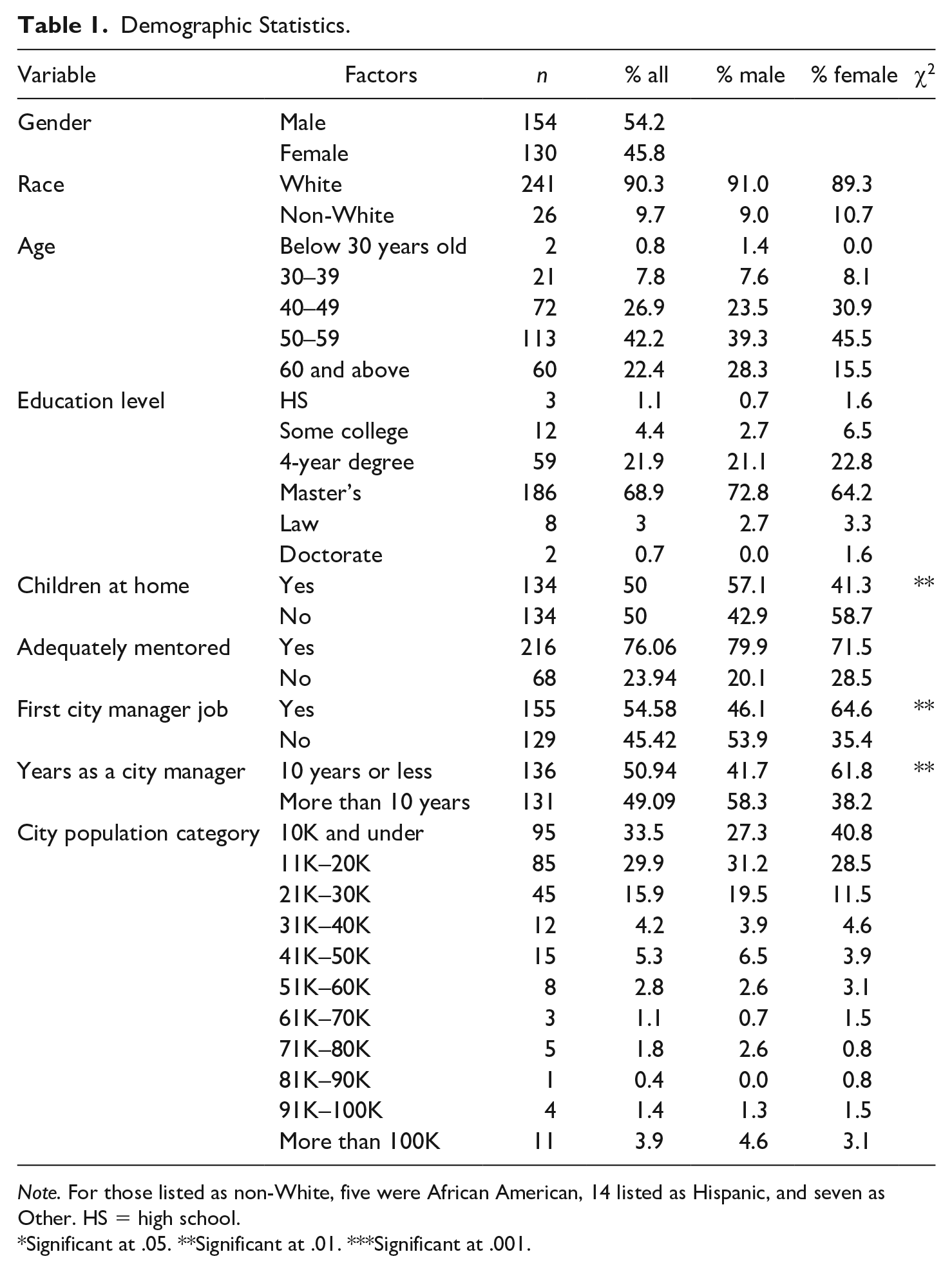
Note. For those listed as non-White, five were African American, 14 listed as Hispanic, and seven as Other. HS = high school.
Significant at .05. **Significant at .01. ***Significant at .001.
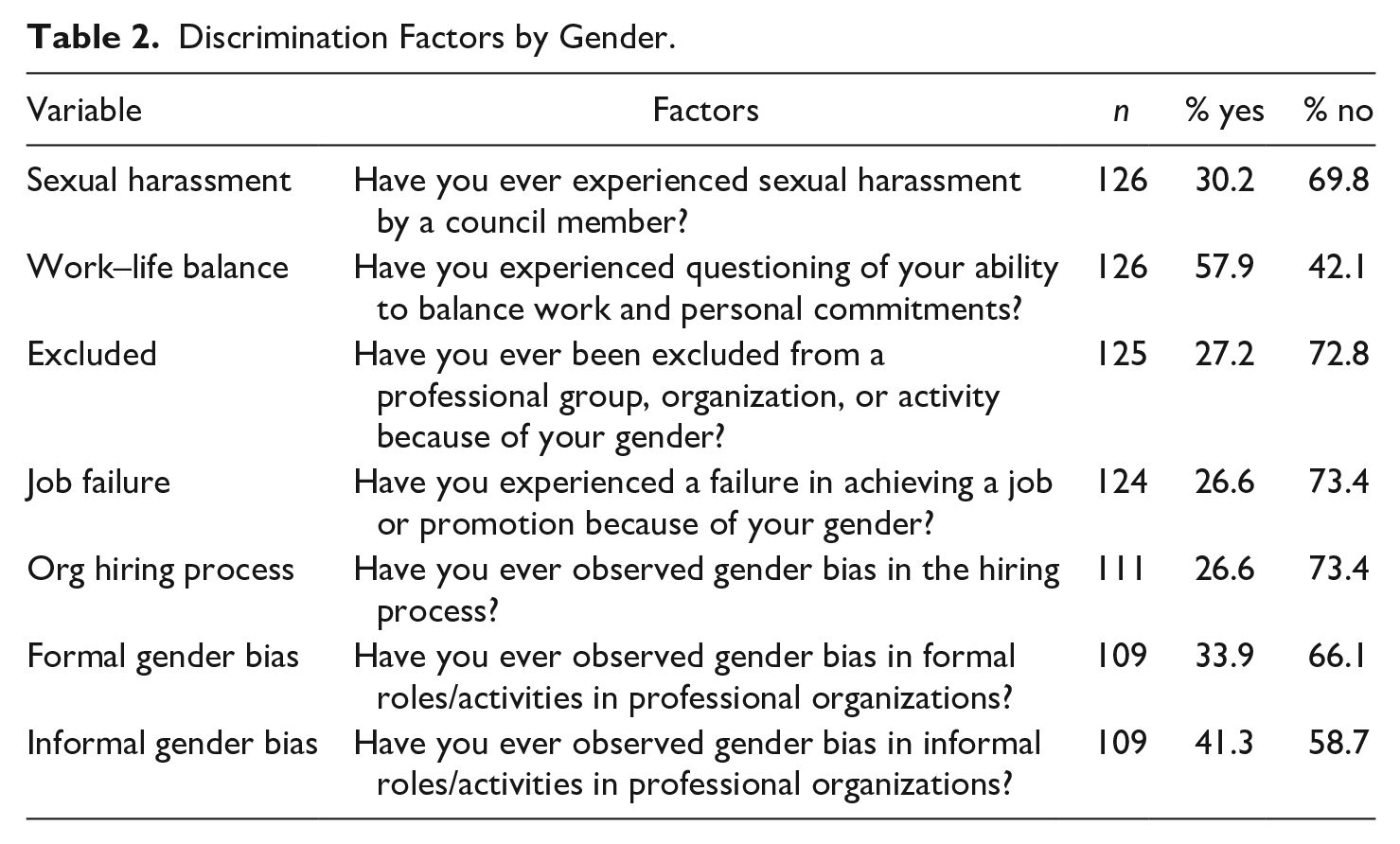
Discrimination Factors by Gender.
Individual Factors by Gender.

Note. PSM = public service motivation.
Significant at .05. **Significant at .01. ***Significant at .001.
These descriptive statistics indicate that, although fewer women had obtained a graduate degree and a higher percentage were in cities with a population of 10,000 or less, no significant differences between male and female managers are observed in minority status, age, education level, or the population of the city that they manage (Pearson χ2). In addition, on the whole, women and men show no significant difference in feeling adequately mentored. Women, however, have served as city managers for a significantly shorter time period than men (almost 62% of women have served for 5 years or less compared with only 25% of men with 5 or fewer years of service). This is not unexpected when we observe that women are more likely to be serving as a first-time city manager (65% of women vs. 46% of men), which may also help to explain their serving in smaller communities. We find that 41% of women serve in communities of 10,000 or less while only 27% of men serve in these smaller communities. Interestingly, only 41% of women reported having children living at home. This makes them significantly less likely than men, at 57%, to still have children living at home (see Table 1). This may mean either that women in this career choose not to have children or that they decide to delay having a family until they are established in a career.
We do find a number of gender differences when we examine respondents’ experiences in the workplace and in professional organizations (see Table 2). Women are statistically more likely to have experienced sexual harassment by a council member (30.2% of females), had their ability to balance their personal and work life questioned (57.9% of women), and to have experienced gender bias in formal (33.9%) and informal (41.3%) roles/activities in professional organizations. Females also significantly differ from males in failing to achieve a job or promotion because of their gender (26.6%) and being excluded from professional groups or activities (27.2%). Experiencing such different professional values in the workplace and in professional organizations may have lasting effects on the professional norms that these women assimilate.
From Table 3, we also find that females are more liberal than their male counterparts are (significantly so for social issues). Females also exhibit a lower level of confidence than males. Overall, both male and female show a high PSM score, which we would expect to find in the public sector (Choi & Chung, 2017; Kjeldsen & Jacobsen, 2012; Louis, 1980). 1
In our findings, we explore the four hypotheses that we have presented above and also the effects that experience and socialization may play in changing the motives, identities, and attitudes found in managers over time and if those changes appear to differ by gender. Because we hypothesize that gender and experience in the job interact with each other, we create an interaction variable for the two independent variables of “gender” and “total years as a manager.” We then regress respondent’s scores for PSM (motivation), social ideology (attitudes), and confidence (identities), controlling for a number of variables that capture the experiences of managers over their professional careers.
Table 4 looks at how these various independent variables affect an individual’s PSM score by performing a least squares regression on PSM.
Regression for Public Service Motivation.

Note. PSM = public service motivation.
p < .05. **p < .01. ***p < .001.
We observed in our descriptive statistics that, overall, female managers’ score slightly higher on the PSM scale than male managers (see Table 3); however, the difference did not reach a statistical level of significance. Looking at Table 4, we also find that male and female managers do not significantly differ in PSM scores. In addition, the professional experiences that we controlled for do not appear to factor into the PSM score one receives. The insignificance of our interactive variable indicates that this is true whether you are a man or a woman. The only control variable that significantly affects the PSM score in our regression is whether the respondent indicated that they were adequately mentored for the position of manager, with a higher PSM for those that felt that they were. Based upon these findings, we reject both Hypotheses 1 and 2.
Our interview data help to support this finding. When asked about what interested them in public service initially, men and women answered very similarly. Most indicated antecedents suggested in the literature, such as they had parents who were public servants, educational experiences that piqued their interest, or professional experiences. One woman did indicate “what really motivates me is knowing I have good staff under me and trying to protect them from the bad behavior or people that get elected to boards,” while another woman spoke of taking a local government position for lifestyle reasons.
From our descriptive statistics listed in Table 3, we discovered that females identify as more liberal than males for both fiscal and social issues, significantly so for ideology on social issues (p < .05).
To explore the effect that professional experiences have on this variable, we regressed social ideology scores on gender using the same control variables as before, including the interactive variable of gender and years as a manager (see Table 5). As expected, we find that gender significantly affects the social ideology score of respondents with females being higher. We also find that, when we include all male and female managers in our regression, none of the simple control variables are significant except for experiences bias in informal roles in professional organizations (p < .05). Interestingly, even though the variable measuring total years as a city manager does not significantly affect the social ideology score, we discover that when we interact gender and experience, we find a highly significant relationship (p < .01).
Regression for Social Ideology.
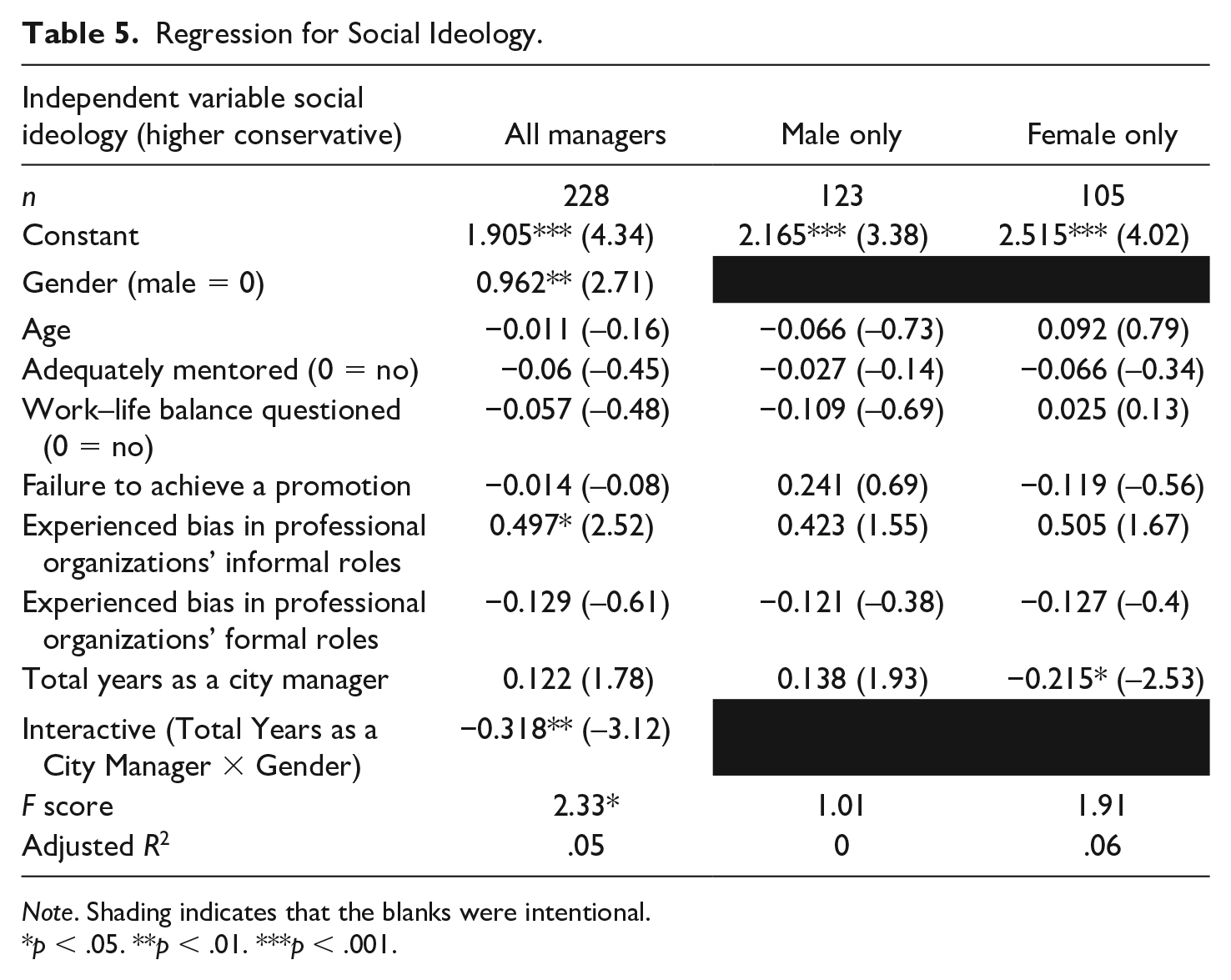
Note. Shading indicates that the blanks were intentional.
p < .05. **p < .01. ***p < .001.
Column 1 of Table 5 reveals that women with less than 1 year of experience as managers are more conservative than men with less than 1 year of experience—that is, the gap between women and men with less than a year of experience on social ideology is +0.644 units for women. However, women with the maximum amount of experience, over 20 years, are more liberal than men by 0.628 units. The interactive effects of gender conditional on year of service is illustrated in Graph 1. In effect, the marginal differences between women and men in social experience are positive and significant with little experience and become negative and significant as experience grows. The point at which differences move from positive to negative is between the 6 to 10 year category of experience and the 11 to 20 year category. It is absolutely true that experience has a liberalizing effect for women and not for men.
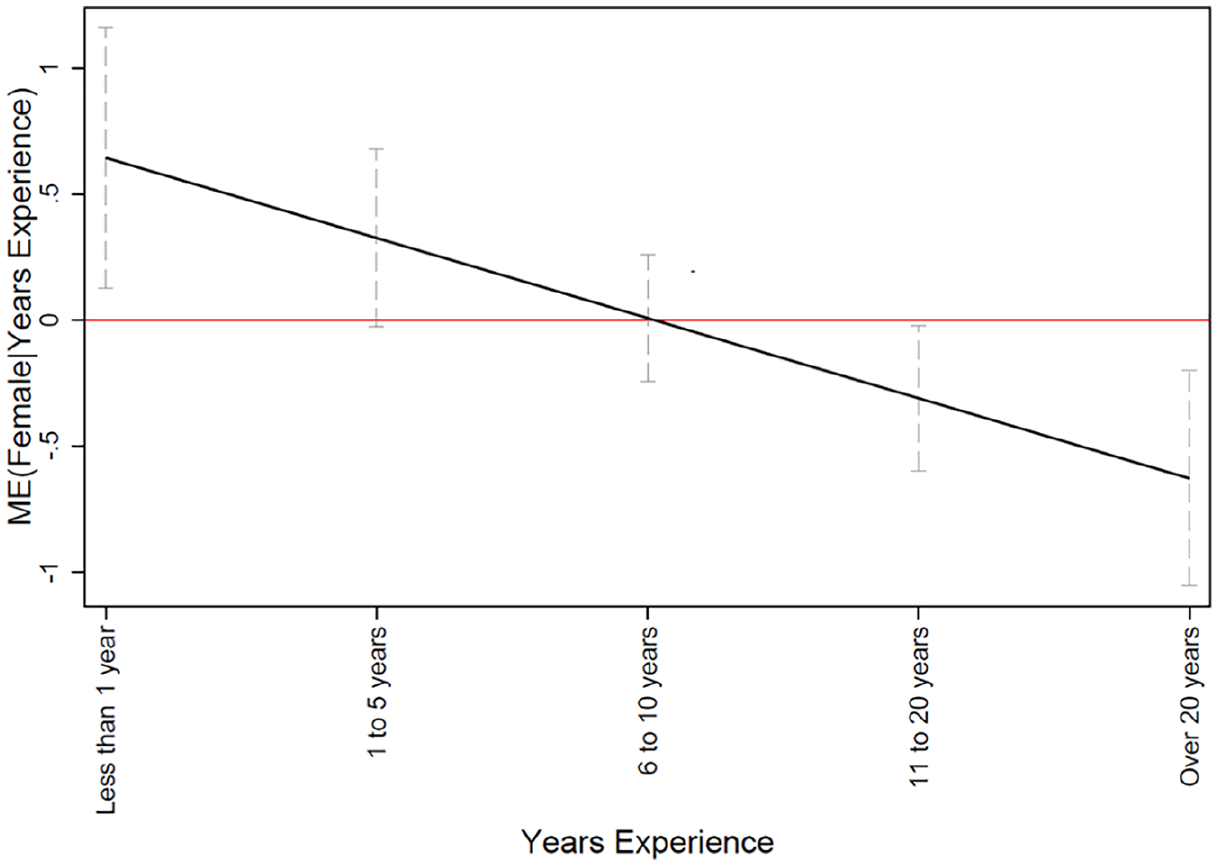
Social ideology—Interactive effects of gender conditional on years of service.
To explore this further, we ran regressions for men and women separately (see Table 5). While the models are not highly significant and the R2 values are relatively low, the results do indicate that for women, years of experience as a manager has the effect of liberalizing their social ideology. From previous research, we know that women city managers tend to be more liberal (Fox & Schuhmann, 2000) and inclusive (Fox & Schuhmann, 2000; Weikart et al., 2006). Our interview data suggest that in part, this may be because as women advance in their career, these city managers recognize the value of collaborations to help citizens, rather than simply fulfilling the city’s goal.
For example, one very experienced female city manager said, “We can’t do everything ourselves. We need partners to be able to make a difference.” Speaking about developers, another experienced woman indicated I know it’s all about making money but you need to get past that right now because this is also about your community. I need you to get involved in a different way. These are the reasons why you owe this to this community.
In comparison, women with less experience focused on using collaborations to reach their own current or future goals. For example, one woman said, “People are more willing to listen to a message from a nonprofit than us . . . [so] we use that [relationship] a lot [and] they do our messaging and outreach for us.” Another woman said, collaboration gives us a venue and opportunity to present the city to influential community members in a different light so they become the champions . . . it gives you a venue to change the perception or misperception about your organization and it shows that you are vested in the community and you want what’s best for the community.
The statements of women with less experience are more similar to men. For example, one man said, All of those different groups are people within the community, so whenever you have the opportunity to partner with them, you’re building a relationship that you might not have had prior to that and that can help you out in the future.
A more experienced man said, “a lot of people just don’t like the public sector. One of my missions is to have people have a better feeling of local government.” While a longitudinal study would be needed to examine this conclusion, these findings suggest that something in the experience of women leads them to become more liberal toward social issues. We fail to reject outright Hypothesis 3.
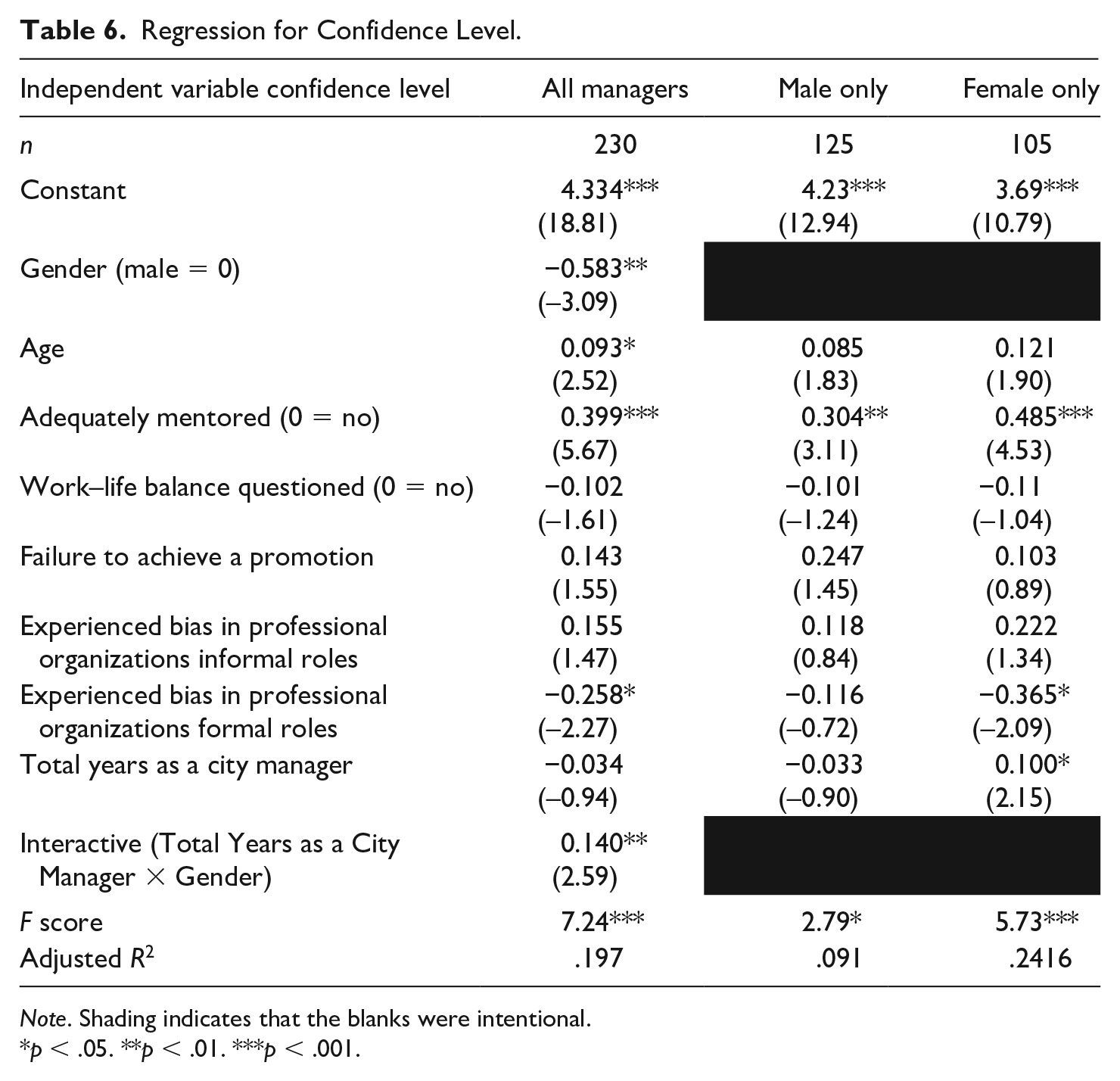
Looking back at Table 3, we find that, overall, female managers scored significantly lower than male managers in confidence levels (p < .01). To explore the effect that professional experiences have on this variable, we again regressed respondent’s confidence index scores on gender using the same control variables as before, including the interactive variable of gender and years as a manager (see Table 6). When we include all responses in our model, we find, as expected, that gender does play a significant role in the confidence level observed (p < .01), females are significantly lower than males. In addition to gender, we find that the belief that one was adequately mentored (p < .001) has a positive effect and having experienced bias in formal roles of professional organizations (p < .05) has a negative effect on respondent’s confidence levels.
Regression for Confidence Level.
Note. Shading indicates that the blanks were intentional.
p < .05. **p < .01. ***p < .001.
Again, interestingly, even though the variable measuring total years as a city manager does not significantly affect the confidence level score in our overall model, we discover that when we interact gender and experience, we again find a highly significant relationship (p < .01). Table 6 reveals that women with less than 1 year of experience have significantly less confidence than men. The interactive effects of gender conditional on year of service is illustrated in Graph 2.
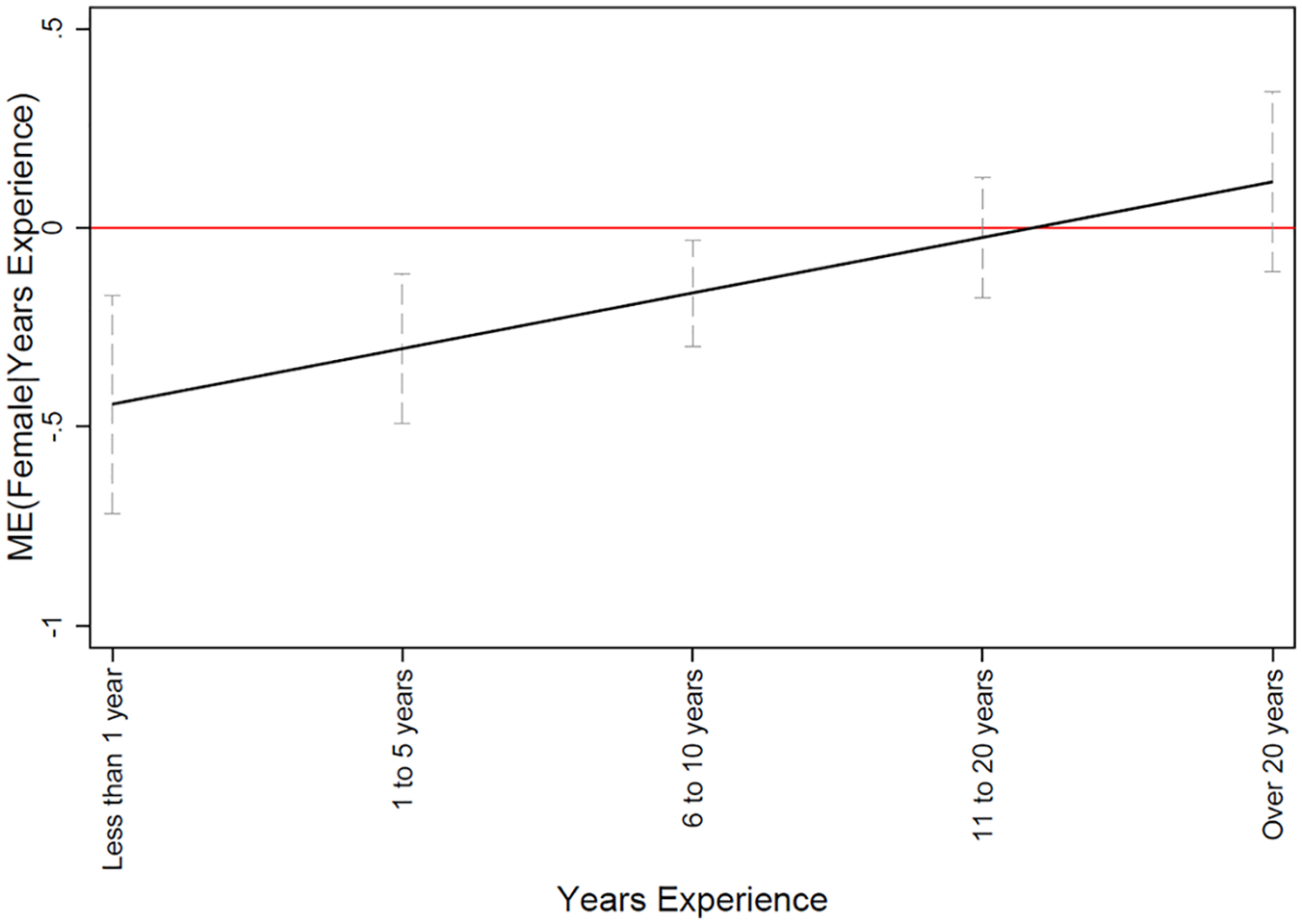
Confidence—Interactive effects of gender conditional on years of service.
The gap/difference between women and men with less than a year of experience is equal to −0.443 units on the confidence index. Women with more than 20 years of experience have slightly higher levels of confidence, which are not statistically significant. Women with 20 years of experience are 0.117 units higher on the confidence scale relative to men with 20 years of experience, other things being equal. The difference between women and men in confidence is negative for all levels of experience except for more than 20 years.
To explore this further, we again ran regression models separately for men and women (see Table 6). The regressions in Table 6 indicate that while adequate mentoring is significant in all three regression models, experience level is significant in female managers but not in male managers. In the women only model (R2 of 24.2%), however, we find several interesting changes. While the mentoring variable retains its significance (p < .001) as does the bias in formal roles variable (p < .05), we discover that the number of years as a city manager variable also becomes significant (p < .05). Years of experience appears to have a significant positive effect on the confidence level of women but not of men. Interviews suggest this may start in the hiring process. Most male interviewees, regardless of years in service, did not indicate that their gender was an advantage or disadvantage. Several women with less than 10 years of service, however, indicated they felt perceived as less fit for the job than a man or questioned about work–life balance during interviews. For example, one woman suggested that when compared with the other two male candidates, she had less leadership skills and experience. Another female manager said interviewers asked her, “As a woman, how are you going to work in this all male environment?” Others recalled council or citizens questioning how they would balance a family and work, although some did indicate they had been very honest about the importance of their family during the interview and felt supported in their family role. When speaking about her most recent interview process, one woman interviewee said, “I’ve been in this position so long I don’t feel bound up by being a woman,” instead approaching it by pointing to her successes in other communities and how they might translate to the hiring community.
This trend may continue early in a woman’s city management career and then change. For example, one woman with less than 10 years’ experience recounted how she had reached out to ask her peers a question and that “it was interesting how quickly the women city managers reached back to me, a lot of times the male city managers delegated correspondence to [another] office instead of answering me directly from one city manager to another.” Another indicated that although she had been city manager for the vast majority of a major building project, the city council recognized previous managers during the grand opening but failed to publicly acknowledge her leadership role during this event. A woman with more than 10 years’ experience said, I recognized early on that I couldn’t be the same type of city manager as a strong male person. I did not have the overbearing presence. I needed to figure out what my own strengths were and play to those.
Some indicated this might be because of age or organizational culture. Several females indicated they were very young. One said, “I was very young stepping into this position, and it definitely complicates it because I didn’t have the experience and know how to approach being a boss, a decision maker, and making those tough calls.” Another said, “I am fairly young and female . . . the first female city manager . . . so there is a little bit of ‘this is a man’s job.’”
Based upon these results, we fail to reject Hypothesis 4. Women appear to have lower confidence levels than men when they enter the profession but the margin shrinks as women gain experience. There are two possible explanations for this. One explanation is that although males’ confidence levels do not change with experience, females do gain confidence with experience. Although less experienced women managers have lower confidence levels than men, as women gain years of experience, the difference in confidence levels between men and women decreases. The observed change in women over time suggests that something in the experiences of women enables female chief officers to gain confidence. Alternatively, it may suggest that newer female city managers are entering their positions with less confidence than those women who entered the workforce multiple years ago. From a cross-sectional study, it is impossible to say which is true. A future longitudinal study will be necessary to draw further conclusions; however, either explanation suggests that some type of socialization issue is at work.
Discussion and Conclusion
Overall, our study highlighted areas of gender differences that exist in modern city management, which may be helpful in further understanding gender disparity at all levels of democratic government, the distinct impact women have in governing, and the barriers women face in governing. By examining gender differences among city managers, we can also further understand how women affect governance at the local level, which may lead to a greater understanding of governing at the state and federal levels.
We puzzled over why PSM is the same regardless of gender or experience, but these attributes did have a significant effect on ideological stance on social issues and on confidence levels. One possible explanation is that women and men socialize into the profession differently. Survey and interview data both indicate that the effect of adequate mentoring may be one of the most significant ways men and women are different. Moreover, inclusion in professional associations and networks may also have gendered effects. These activities may help women to build their identities and attitudes toward work.
Only about half the women we interviewed indicated another city manager or elected official mentored them. In contrast, almost all of the men indicated they had mentors. Of the remaining women, a type of regional board had mentored one, and a few others indicated they relied on an informal network of peers, who interacted on a frequent basis to answer questions and provide support. Two women, as opposed to no men, indicated that they had never had mentors. Thus, our research points to the importance of readying the pipeline for gender representation in government, as women traditionally do not advance into government leadership. By studying the underrepresentation of women in local government leadership as well as the challenges women in city management face, we may further understand the gender gap in government leadership at all levels.
The mentor process is important for a variety of reasons. The interview process appears to be one crucial place to build confidence. One of our less experienced female interviewees said she had city manager mentors that she called on quite a bit during this interview process because I hadn’t been through a city management interview process and that something that is a barrier to this profession. The interview process really bodes well for people that all they do is move from community to community. It’s very difficult for people who are coming in from other sectors because you don’t understand what that process looks like.
Mentoring may also help women feel more prepared. One less experienced woman said, Not having a mentor, or any guidance, and there had not been any strong leadership in the [locale] . . . so there was no administrative protocols and . . . no understanding or thought process of leadership. . . . I always wished that I had a good manager that I worked under . . . helped me establish my grounds . . . the kind of manager that I want to be . . . without having that guidance, level of professionalism, or somebody to take you under their wing, to even be able to explain . . . I really felt as though I lacked skills stepping into this position.
Another, more experienced female, indicated that of two male city managers she had worked for, one had not developed her confidence, but the second “was the person who made me be able to take the job after he left.”
Mentoring appears to be only part of the socialization process, however. Developing the appropriate norms, behaviors, and skills that are associated with being confident in one’s ability to do a job, appears linked to associations with other managers. Most men indicated that professional associations had been helpful. In our survey, very few men indicated they had ever felt excluded from these groups and no men in our follow-up interviews indicated this. In contrast, more than half of the female interviewees indicated they had felt excluded or different. Some attributed this exclusion directly to being a woman in a group of mainly males. Others related it to not having relationships with others. For example, one woman noted, You really have to make an effort to get engaged without some connections going into it. There’s this expectation that you just know . . . how to get involved . . . what groups you should go to . . . when the conferences are . . . .also, they have great list serves but there’s no real introduction of what’s acceptable, what’s not . . . There’s a lot of information on those that people could find not appropriate . . . you just get no guidance. That is the kind of thing where organizations just get comfortable and when new members come in its hard to get associated.
Part of the solution may be helping women form relationships across the state or region and making sure someone reaches out to new managers, whether that be at the woman’s appointment as a city manager or during conferences, and welcoming them as a colleague. A less experienced woman indicated she was initially uncomfortable at a conference because she knew no one, but someone tapped her on the shoulder, made a joke about a common characteristic that has become ongoing and “it kind of made us all connect and become friends.” Another more experienced woman indicated that although the men sometimes made her feel excluded, she had used humor to try and make them understand why she, and other women, might feel excluded by their choice of meeting venues. Although the men did not change their behavior, she did feel more accepted as time progressed. It could be that as confidence increases, so does the feeling of belonging to the profession and role.
Recognizing the importance of relationships, the Massachusetts Municipal Management Association is in the process of implementing and regularizing a mentorship program that may start to address this gap in the socialization of women. They have created a women’s mentoring group and asked all members to invite women who may be future city managers or department directors to attend the meetings. This could help individuals to learn the norms, behaviors, and skills needed for the position, and help to build networks that will help them feel adequately mentored and included. Future research should examine if this approach has any effect on the promotion of women into leadership positions in the state.
Beyond that, it may be important to try to help foster peer relationships between men and women for a number of reasons. Many of our interviewees, both male and female, indicated the importance of having what one referred to as a “board of advisors,” or other city managers that one can share issues with, ask questions of, and get support. One interviewee indicated she had regularly scheduled lunches with a group of other managers that sometimes used these meetings as informal educational opportunities, inviting speakers. Another woman indicated she was in a group that was in an ongoing text message every day and members helped each other with many different questions. No one indicated these groups were gender specific. Fostering such group interaction may help women to feel more satisfied in their careers and profession. Given that more experienced women also had a statistically different ideology than other groups, group interactions that include these women may also help other managers see problems and solutions from a different viewpoint. More research is needed to understand how and if these groups might actually lead to changes in managerial decisions or tend to be used to affirm one’s own beliefs, however.
Future research should also seek to study city managers over time and to look more specifically at motivations, attitudes, and identities. One limitation of our study is that it relies on a cross-sectional survey, rather than longitudinal data, and on proxies for concepts. Socialization is a process and as such, ideally would be studied over time. As our data were taken at a specific point-in-time, we cannot definitively say whether the difference we found are attributable to socialization experiences or to differences in respondents. Despite this, however, given that we found no significant differences in age among survey participants regardless of years of serving as city manager, we do not think our results are attributable to generational differences. Instead, our data seem to suggest that women city managers may have different professional experiences than men. These experiences do not lead to difference in motivations, as measured by PSM, but do result in different political ideologies, a facet of attitudes, and confidence, which is related to identity. These are important insights given that attempts to increase representation of women among city managers have not been wildly successful.
Footnotes
Appendix
Public Service Motivation Survey Questions.

| 1. I admire people who initiate or are involved in activities to aid my community.—(APS1) 2. It is important to contribute to activities that tackle social problems.—(APS2) 3. Meaningful public service is very important to me.—(APS3) 4. It is important for me to contribute to the common good.—(APS4) 5. It is fundamental that the interests of future generations are taken into account when developing public policies.—(CPV1) 6. I think equal opportunities for citizens are very important.—(CPV2) 7. It is important that citizens can rely on the continuous provision of services.—(CPV3) 8. To act ethically is essential for public servants.—(CPV4) 9. I feel sympathetic to the plight of the underprivileged.—(COM1) |
| 10. I empathize with other people who face difficulties.—(COM2) 11. I get very upset when I see other people being treated unfairly.—(COM3) 12. Considering the welfare of others is very important.—(COM4) 13. I am prepared to make sacrifices for the good of society.—(SS1) 14. I believe in putting civic duty before self.—(SS2) 15. I am willing to risk personal loss to help society.—(SS3) 16. I would agree to a good plan to make life better for the poor, even if it costs me money.—(SS4) |
Source. Kim et al. (2013).
Note. Responses were measured using a 5-point Likert-type scale from 1 = disagree to 5 = agree. The Cronbach’s alpha score for the PSM scale was .811. APS = attraction to public service; CPV = commitment to public values; COM = compassion; SS = self-sacrifice.
Declaration of Conflicting Interests
The author(s) declared no potential conflicts of interest with respect to the research, authorship, and/or publication of this article.
Funding
The authors disclosed receipt of the following financial support for the research, authorship, and/or publication of this article: The author received a small Appalachian State University grant to conduct the survey.
