



Abstract
Upon assuming office, executive, legislative, and judicial officials swear an oath as evidence of dedication, commitment, and duty to the Constitution. As such, they play a quintessential role in upholding democratic values. Yet contrasted to codes of ethics, oaths get little recognition in the study of public administration. What attention they do receive focuses primarily on the presidential oath of office. This article examines a little-researched topic: governmental oaths in American states. The inquiry is useful because oaths can help safeguard the integrity of civic institutions. As a distinguishing feature of public service, oath-taking nonetheless may be seen as a routine formality without consequence. The article discusses this rite of passage, explores its past and current functions, reviews the literature, and analyzes state oaths. The work concludes with observations on the prospects of these testimonials in troubled times, times that require the restoration of honor, dignity, and virtue in government.
Upon taking office, public officials affirm an oath as evidence of dedication to the Constitution. Oath-making is a formal ceremony and a personal pledge to honorable service required of every federal official as well as state officeholders under the supremacy clause in Article VI. The pronouncement is the predominant ethical claim accepted by public authorities, as implied by the inherently governmental nature of elective and appointive office. In general, it is a promise of a heavy moral weight to abide by certain principles, made orally and publicly along with certain symbolic gestures, whereby the oath-taker puts his/her integrity on the line and expresses a willingness to undergo a penalty if he/she breaks his/her word. (Metz, 2013, p. 23)
The official can be prosecuted, impeached, recalled, or otherwise expelled from office for violating his or her oath. A potential sanction, then, may not be only legal or political in character, but also moral. 1
The declaration is a deed that emphasizes that “public service requires a moral commitment of a special kind,” one that guides actions and confirms obligations (Rutgers, 2013, p. 430). The objective is to restrain the exercise of power by appealing to ethicality and the responsibility to perform the duties of office. The oath-taker, in a defining act of ethical maturity, establishes a binding covenant with the citizenry by committing to decide what the oath obliges them to do (Horowitz, 2009; Keskel, 2002). As such, officeholders play a quintessential role in helping to uphold democratic values.
Indeed, calls for ethics reforms in the last decade have included questions about how or whether oaths are honored, most notably at the federal level. Those concerns, inter alia, include several issues prior to the current administration as well as more recent incidents. Regarding the former events, Congressman Keith Ellison chose to be sworn in using the Quran rather the Bible in 2006, there was a perceived need to retake the presidential oath in 2009, and a 2013 controversy arose over the Central Intelligence Agency (CIA) director-designate’s use of the Constitution (instead of the Bible) when reciting the oath. 2
Concerning the latter events, there have been many allegations, including the following: (a) attempts to politicize military and civilian service, the judiciary, the census, and scientific research; (b) violations of the Constitution’s clauses on emoluments, faithful execution of law, and protection against foreign enemies; (c) corruption of elections; (d) obstructions of justice with respect to Federal Bureau of Investigation (FBI) and Congressional investigations; (e) abuses of the power of pardon in addition to the potential use of presidential self-pardon; (f) unprecedented classification and declassification of documents; (g) derelictions of duty in the disregard of responsible civic culture, informed discourse, and rule of law as the basis of decisions; (h) apprehensions over the obligation of cabinet members under the 25th Amendment; and (i) the apparent dishonoring of the oath of impartiality taken by U.S. Senators at the beginning of the recent impeachment trial. 3 (see Appendix).
These issues, while controversial in their own right, become much more divisive if citizens believe that public servants cannot be trusted to be true to their vows. The Constitution, in fact, was designed to ensure that “the people” could protect the office from an official who failed to fulfill the covenant. The current study, however, is not focused on any particular administration and its officeholders. Rather the events noted simply illustrate a renewed interest in the oath of office, albeit at the national level. Many of the same accusations have been made at the state level of officials failing to faithfully implement the law, politicizing the civil service, obstructing justice, abusing power, or neglecting duties. 4
This exploratory article contributes to the literature by examining a little-studied topic: oaths in state government. The inquiry is useful because the oath declarations, as a distinct feature of governmental service, can help preserve the dignity of civic institutions. Nonetheless, the ceremony is frequently seen as a routine formality without effect. The discussion below consists of background information and a literature review on the promise, problems, and prospects of these testimonials as well as a review of their content. The findings and conclusions should be of interest to scholars, governmental personnel, and students interested in public service ethics and the integrity of democracy.
Background
This section considers the following: (a) oaths as an element in governance, (b) their attributes and functions, and (c) criticisms of them. Embedded in a larger organizational infrastructure, these commitments can be seen as an anchor as well as a starting point for ethics in government (Bowman & West, 2020). Exhibit 1 shows, for comparative purposes, oaths taken by the president in addition to other elected and appointed officeholders. Typical features include an opening statement (I swear or affirm), material substance, and a closing that confirms the compact. The traditional protocol consists of hand raising, hand resting on the Bible, the presence of high officials, and a suitable institutional environment (Blok, 2013), elements that signify its solemn quality that transcends contractual or managerial approaches to sovereignty.
Governmental Oaths.
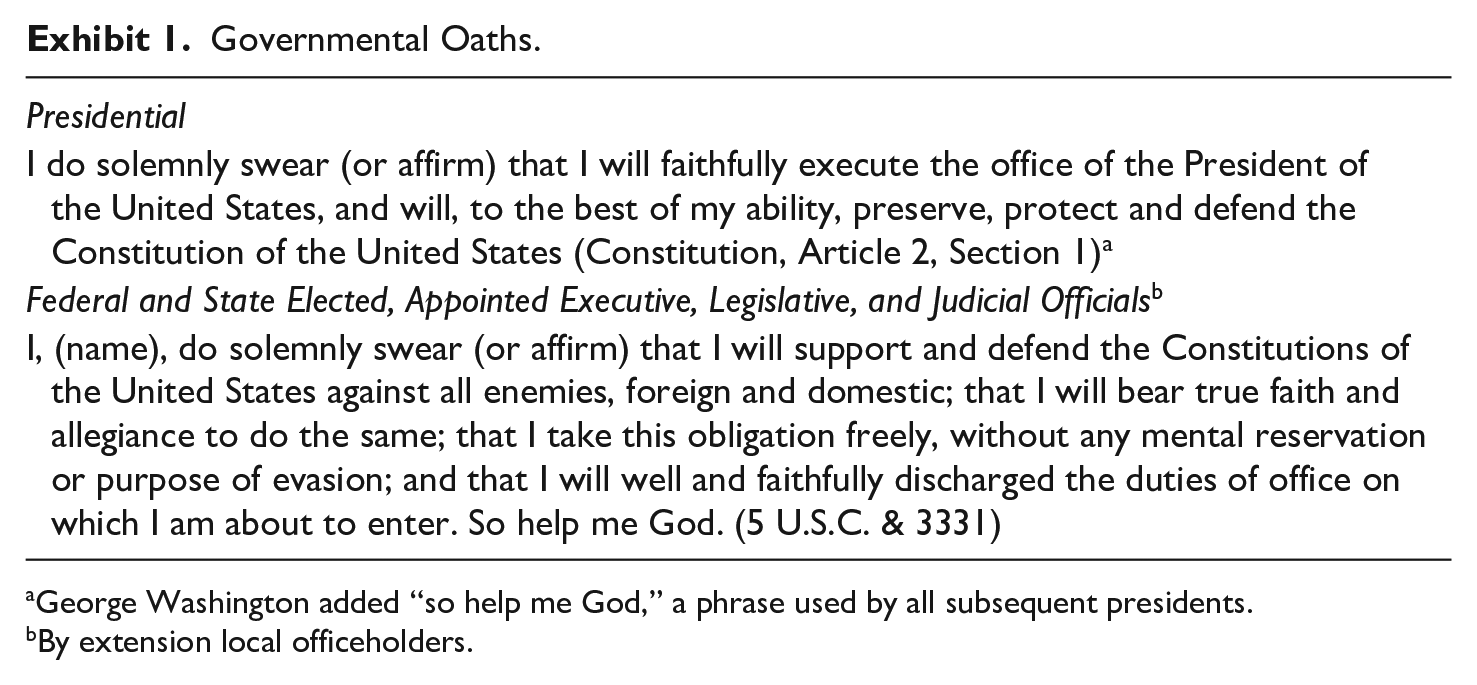
George Washington added “so help me God,” a phrase used by all subsequent presidents. bBy extension local officeholders.
The vow is intended to be a profound declaration that “binds the conscience” and appeals to a higher power (Rohr, 1989, Ch. 4). Obligating the individual to uphold the Constitution, not necessarily one’s superiors, 5 it distinguishes government service from that in other organizations. Public administrators, further, are “the only officials that pay attention to governmental activities all the time,” and therefore have a special duty to protect and serve the public interest (Goodsell, 2006, p. 630, original emphasis). Thus, the Constitution not only establishes the American system of government but also defines (according to the Preamble) the work of civil servants is “to establish Justice, insure domestic tranquility, provide for the common defense, promote the general welfare, and secure the blessings of liberty . . .”
The tradition of making oaths comes from ancient times and was common in Europe and prerevolutionary America (Rudd, 2009). The significance of formal promises to the Founders is unmistakable: The president’s oath is specified in the Constitution. Furthermore, the first act of the new Congress was to mandate federal and state officials of all three branches of government to support the Constitution. The wording of the assurance is not specified for these officeholders, as there is just a duty that an oath be taken (the phraseology subsequently would be formulated by national and state legislatures).
Given the prominence of such declarations, it follows, second, that they perform an individual affirmative function (prescribing allegiance to the Constitution) plus a collective affirmation (pledging to society a shared set of values) in a public ceremony. They serve to ensure that officials will speak the truth and keep promises, abstain from corruption, and sustain the Constitutional order (Steen & Rutgers, 2011; Vestal, 2016). This granting of public authority implies not only fidelity to the Constitution (a political oath), but also that the office was obtained fairly (an oath of purification) and that the individual will perform duties with integrity (a professional oath; Rutgers, 2013, p. 255). In so doing, the independence of the officeholder may be assured.
Third, oath-making has been common to virtually all peoples and cultures as the greatest form of commitment. Yet, contemporary commentators (e.g., Loonen & Rutgers, 2016; Menzel, 2016; Rohr, 1989) suggest that it has not retained its historical raison d’ etre as an inviolable guarantee. The ritual may be seen as perfunctory and paternalist and as cause of a false sense of security and complacency. Oath-taking, for instance, can be forgotten during new employee orientation because it may be seen as little more than a mere formality. Doubts should not imply, however, that the tradition be eliminated; rather the questions should be treated as diagnoses to make the pronouncements more effective and to impart moral meaning to official actions. Indeed, the high purpose of the investiture gives it a gravitas that creates expectations, rights, and obligations. As Harmon (1995) contended, “governing responsibly requires strengthening the social fabric so that, together, public servants and citizens might struggle honestly with the moral uncertainty that inevitably attends the government’s work” (p. 11).
In sum, an oath is one way to instill and reinforce core values, and it serves as a reminder of duties and responsibilities. The practice should be part of a larger effort to strengthen an institutional culture that offers ethical incentives, reduces vulnerabilities to corruption, and decreases risk of untoward conduct (Bowman & West, 2020; Molina, 2017). While less than everything, these statements are more than nothing, as they offer a standard against which behavior can be assessed. Arguments against them fail when asked for the philosophical grounds for rejection. Few observers suffer from the delusion that this rite of passage dramatically improves conduct. It can, however, function as an enabling device to strive for high ideals. Are oaths sometimes dismissed because they are ineffective, or are they ineffective because they are dismissed? Eblin (2010) answers that it is hard to determine, “but what doesn’t get said, doesn’t get heard.” Thus, for the reasons noted here, the time-honored use of these affirmations remains in nations around the world today.
Literature Review
Despite the increased attention to oaths in popular media, the topic is underrepresented in legal, philosophy, and public administration discourse. On the legal front, for instance, Wittes and Jurecic (2017) point out that the presidential oath does not “have a particularly extensive literature and no famous Supreme Court cases overtly turn on it or interpret it.” Furthermore, one ethicist writes that “almost nothing has been written about what an oath actually is. The Anglo-American philosophical literature has extensively explored promise making, but has ignored the whole question of oath-taking” (Sulmasy, 1999, p. 330). Regarding the study of public administration, Rutgers (2010, p. 436) charges that commitments of this kind are rarely considered in most introductions to public ethics and an encyclopedia of government ethics does not include an oaths of office entry (Roberts, 2001). Accordingly, a wide-ranging literature search covering the last 25 years was undertaken. The result identified work in medicine, education, economics, banking, law, law enforcement, the armed services, and public administration.
In the medical field, three surveys of medical school deans documented the aspirations, use, and relevance of oaths administered to graduates (Crawshaw & Link, 1996; Dossabhoy et al., 2018; Orr et al., 1997), while Sulmasy (1999) analyzed what these pledges are and their part in that profession. 6 Second, in the Journal of Higher Education and Policy, Sharrock (2010) argued that as universities increasingly rely on professional managers, they should develop one oath for administrators and one for researchers, whereas Leihy (2011) opined such vows are inappropriate for scholars due to the detrimental atmosphere that could accompany their enforcement.
In economics, Blok (2013) found that the performative character of oaths can contribute to ethical behavior, as their enactment empowers the oath-taker and enables formal and informal controls to monitor conduct. 7 Metz (2013; also see Schlesinger, 2008) examined the ethics of swearing and the implications of oath-breaking (to declare not to do something immoral—which is wrong in the first place—constitutes a false promise). Contending that oaths must be more than just another management tool, Rutgers (2013) maintained in the Review of Social Economy that they are a conscientious act of unconditional devotion. Next, focusing on banking, Boatright (2013) assessed a parliamentary bill proposing a Dutch banker’s oath, concluding that it was unlikely to be a reliable guide for bank officers. After passage, Loonen and Rutgers (2016) surveyed bank employees and their clients, finding that trust in (and knowledge of) the pledge was absent.
In the legal literature, fifth, Horowitz (2009) pinpointed the nature and majesty of the presidential oath as an extraordinary “constitutional moment” symbolizing regime perpetuity and stability. Vestal (2016) argued that the inclusion of religious restrictions is wrong as a matter of legal tradition and law (viz., the Constitution forbids a religious test as a requirement for office), thereby debunking governmental oaths as a barrier to service. Snyder (2001) described the salience of oaths over time and equates them to a self-restraint comparable to the prospect of impeachment or electoral defeat. Wittes and Jurecic (2017) questioned the current president’s sincerity in swearing the oath and doubted it would affect his behavior due to a lack of understanding of the office and its weight, as well as the constitution and rule of law (consult also Jurecic, 2016). Rudd (2009) described the wording and meaning of the oath taken by FBI Academy trainees and law enforcement officials.
Published material in the military profession includes Keskel’s (2002) work on oaths as a guide to (and a core of) moral leadership, and compares those used in the different branches of the armed services. Luke (2000) contended that military pledges may be counterproductive due to the superiority of natural law over Constitutional law and reinterpretations of the Constitution as a “living document.” These challenges, it was argued, leave officers without mooring as they attempt to interpret their responsibilities. 8
Finally, public administration contributions consist of scholarly research and practitioner essays. 9 Rutgers (2010), in evaluating the history and content of oaths as well as their role in the profession, saw them as a public service guardian—a function at risk as civic values get crowded out by New Public Management values (cf., Molina, 2015). Steen and Rutgers (2011; see also Stensota, 2010) maintained that an instrumental approach to noninstrumental values (like that in contemporary management strategies) come at the expense of the substantive meaning of public service motivation and the affirmation of office. If so, democratic norms would be at risk and vulnerability to unethical behavior more likely. Rohr (1989, p. 87) reasoned that the practice of public administration must be grounded in the objective of the oath: to uphold the Constitution. This provides the basis of a moral community, the foundation of “ethics for bureaucrats,” and professional autonomy.
In Public Administration Times, Abels (2018) held that professional associations and their members must combat the loss of citizen confidence and take positions to defend the integrity of civil service. Moore (2018) extended that plea by recommending robust civic education to disseminate knowledge, respect opposing viewpoints, and identification of a “common ground acceptable to the majority while protecting the rights of all.” Cassidy (2016) analyzed a dozen strategies on how to be loyal and keep a clear conscience in today’s public service (as well, see Shulman, 2018). Newland (2019; also see Schuchart, 2018), nonetheless, “decided that the responsibilities entailed in my oath were incompatible with the expectations of my job” at the Department of Justice and resigned. Last among these practitioner articles, Brescia (2018) argued that the nation has plenty of politicians, but needs statesmen who—as trustees of democracy—place country above partisan interests.
Complementing this interdisciplinary, largely periodical literature, there are several book-length treatments of the oath of office. Pauley (1999), in reviewing the lengthy history of oaths in human civilization, observed that academic attention to the presidential oath “has never been consistently great,” but maintained that covenant-making is an essential keystone of constitutional government. He stated, in fact, that the “modern tendency to minimize the importance of the president’s oath stands contrary to a long tradition in Western political thought and statecraft, in which oaths have been of tremendous significance at every turn” (p. 225). The Constitution was written, Pauley observed, to make a “more perfect union,” and perfection must come through that foundational law; the oath, then, serves as a symbol of presidential democracy continuity. While not directly germane to governmental oaths, Schlesinger (2008), a psychoanalytic clinician, focused on the psychology of promising: types of promises, promise keeping and breaking, moral development, along with cases of relevant patient and clinician behaviors.
More recently, Toobin (2012), in his book on the presidential oath of office and the Supreme Court, noted that White House attorneys realized there was “no single authoritative source” on the legal importance of the vow (p. 4). It was, therefore, decided to redo it after the 2009 initial ceremony to affirm that the precise words in Article II were recited by President Barack Obama. The author then used the incident, with little subsequent mention of the oath, as a springboard to discuss the personalities, politics, and court cases regarding the president-chief justice relationship. Finally, Brettschneider (2018) sought to instruct presidential aspirants that the Constitution focuses on democratic values and that they have an affirmative duty to promote them. The pledge “is meant to take a private citizen . . . and transform that person into a public officeholder, whose job is to protect the Constitution and the country it governs” (pp. xvii–xviii). The work then systematically considered respect (and disrespect) for oath of office in its analysis of presidential powers, the Bill of Rights, and limitations on the president.
A look at public service ethics textbooks and course syllabi updates Rutgers (2010) observation, mentioned earlier, that oaths do not receive much notice in those introductions. Thus, a widely used primer (Svara, 2015), a landmark text (Cooper, 2012), Koven’s (2015) volume as well as the second edition by Dutelle and Taylor (2017) do not include the subject. This is true, as well, for Dobel’s (2018) thoughtful Public Leadership Ethics. Other books, however, do address it. Menzel (2016) provided a succinct review of the function of oaths, criticisms of them, commentaries from experts and multiple examples from different jurisdictions, including the oath taken by the citizens of Athens more than 2000 years ago. Newell (2015) recognized that “the oath of office has a long and important history” (p. 13). Examining oaths and ethics codes, he challenged officials to do what the pledge requires them to do (to develop strategies, for instance, to confront torture). Bowman and West (2018) discussed oaths in connection with codes of conduct as core elements in organizational integrity programs and the whistleblower’s commitment to the oath made upon assuming office. Lewis and Gilman (2012) briefly included the formal and informal significance of oaths, who takes them, their wording, and the fact that public service employees in nongovernmental agencies do not repeat the vow, but “the promise is understood and it underlies the public’s grant of authority” (p. 49). Finally, regarding public service ethics courses (West, 2017), a review of 53 syllabi revealed only one that included readings or assignments on the oath of office.
In summary, extant materials in a variety fields are helpful, but there is only modest attention devoted to oaths of office in the public sector and much of that emphasizes the federal level. The present study seeks to contribute to the literature by analyzing the content of state government oaths. This is important because these declarations can help safeguard the dignity of public organizations, despite the fact that some commentators cast doubt on the significance of oaths in modern-day governance.
Method
As part of a larger project—and building on academic literature, legal documents, professional association reports, and consultation with state-level individuals—oath-related provisions in the 50 state constitutions were examined. The analysis was aided and checked against data from the National Conference of State Legislatures (NCSL), the National Association of Secretaries of State (NASS), the Council of State Governments (CSG), and legal scholars (e.g., Robb, 2016; Vestal, 2016).
The language of the oaths in some states has been modified over the years, whereas in other states, the wording has not been changed from the original text. Information reported here is based on the existing text of the oath taken by most state and local elected and appointed public servants as opposed to those oath provisions that are restricted to particular officials (e.g., election officers, National Guard soldiers, attorneys at law). Where discrepancies were found between the analysis of the oath provisions and earlier data (e.g., CSG, 2016; NCSL, 2004; Robb, 2016; Vestal, 2016), state constitutions were reexamined to confirm the accuracy of the data. Information about the traditions, rituals, and variations in the ways to execute the oath was gained through 10 telephone conversations and email exchanges with state stakeholders (e.g., staff in selected Secretary of State offices), news reports, and publicly available data and studies from professional associations (e.g., CSG, 2016; NASS, 2015; Robb, 2016; Vestal, 2016).
Results
In most states, the oath originated in the state’s first constitution in the late 1700s or early to mid-1800s with several subsequent revisions over time (NASS, 2015). 10 This section includes requirements addressed in either state constitutions or statutes (Who administers the oath of office? Who takes it? How many oaths are there?) and is followed by oath provisions and administration.
Requirements
First, there is considerable variety in who bestows the oath of office. In general, it is anyone authorized by the state constitution or statute. For the highest officials, it is frequently the chief justice of the state supreme court, the governor, the secretary of state, the presiding officer of the legislature, or other judges. Clerks of court, members of board of supervisors, state-commissioned notary publics, mayors, and county clerks are also frequently mentioned.
Second, all states require state elected and appointed officials to take an oath of office. The phrase “statewide officers” is often used to identify those who must recite the oath with either general or specific qualifications provided. Examples of a general qualification include those used in states like Indiana which refer to “all elected and appointed officers,” while a specific qualification like that in Mississippi or Oregon goes further to list those who must repeat the oath. Another broad phrase, “public officers,” is used in Nevada and elsewhere to refer to those enjoined to take the vow, and mandates the inclusion of all state and local elected and appointed officials. In Oregon, even county dog catchers are required to recite the affirmation.
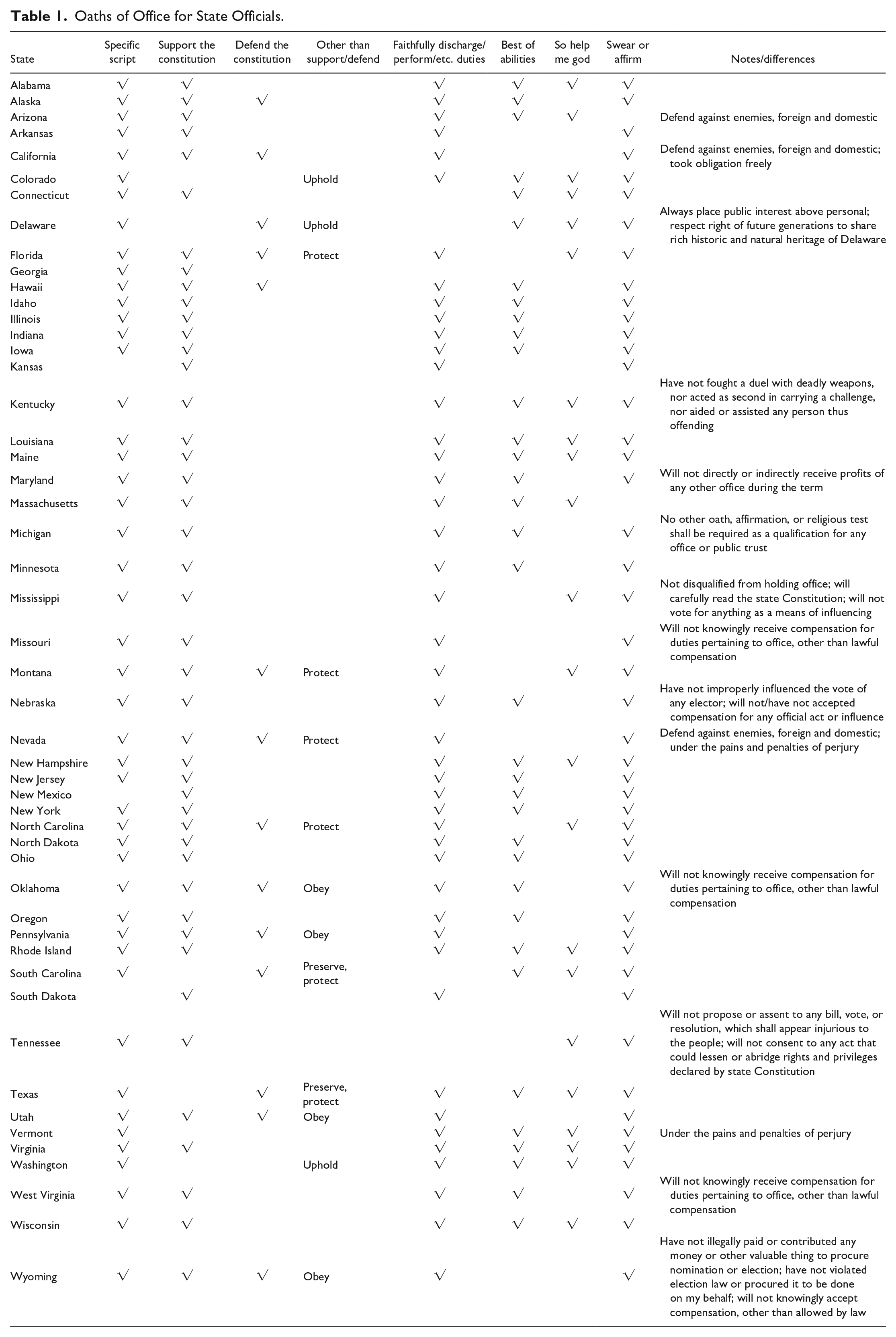
Third, some states have multiple oaths for different officers, while others have only one (e.g., Idaho). While several states have more than one oath, the common elements in most are listed in Table 1. Pennsylvania has 17 oaths tailored to separate offices ranging from state elected officials to municipal officers, each individually listed in the state constitution or in statutory provisions. North Carolina also has a variety of separate, specific statutory oaths (e.g., sheriff, county attorney, registrar of deeds) that may be required after those mandated by the Constitution. In Nebraska and Pennsylvania, refusal to take the vow results in forfeiture of office. In other states (e.g., South Carolina, Utah), it is unlawful to assume the office until the pledge has been made. In Utah, a person acting in their office without taking an oath is guilty of misconduct.
Oaths of Office for State Officials.
Variation can be seen in state traditions regarding where and in what way oath-taking occurs. In general, oaths can be recited anywhere, at any time, in a public or private setting. The ceremony for high officials is often held on the steps of the state capitol building or in the legislative chambers. Because testimonials are done at all three levels of government and in multiple locations, there are only a few officials (e.g., governor, secretary of state, and chief justice) who execute the oath in a consistent location.
It is customary in several states (e.g., Ohio, North Dakota) for the official to raise his or her right arm and place one hand on the Bible while reciting the oath. In other states (e.g., Oregon), there is no rule to use a specific object like the Bible, allowing individuals to affirm their office in the way that is most meaningful to them. Some states may affix the seal of office to the oath, if a seal is prescribed for, or adopted by, the person conducting the ceremony. Gestures and rituals, then, are part of oath practices (Blok, 2013; Rutgers, 2013). As noted, hand motions, the timing and place of the oath, attendance of others, and recording of the event are normally expected.
Oath Provisions
Table 1 provides details of provisions in the oath scripts prescribed in each state. With the exception of Kansas, New Mexico, and South Dakota, the declarations in the remaining states are specifically worded. All indicate duties under the U.S. and state constitutions, with words like “support” (44 states), “defend” (14), “protect” (4), “obey” (4), “uphold” (3), or “preserve/protect.” All but five states (Connecticut, Delaware, Georgia, South Carolina, and Tennessee) refer to faithfully discharging or performing one’s duty. Thirty-five of the oaths refer to performing their responsibilities “to the best of one’s ability.” The phrase “so help me God” is found in 22 states. In 47 states, the oath-taker has the option to “swear” or, if they prefer, “affirm” their testimony. The constitutions in eight U.S. states—Arkansas, Maryland, Mississippi, North Carolina, South Carolina, Pennsylvania, Tennessee, and Texas—disqualify a person who denies the existence of a Supreme Being (also referred to as “God” or “Almighty God”) from holding any public office. 11
Notwithstanding similarities, there are interesting differences in oath provisions in various states. California, Arizona, and Nevada covenants contain the promise to “defend against enemies, foreign and domestic.” Officials in Massachusetts swear that they will “obey the lawful orders of all superior officers”; in Iowa, they pledge to discharge duties of their office “impartially” and “as now or hereafter required by law.” In Nevada and Vermont, violating the vow has explicit consequences, “under the pains and penalties of perjury.” Clauses in Delaware include giving priority to public interest over personal interest and respecting the rights of future generations to enjoy the state’s “historic and natural heritage.” Tennessee mandates that the promise-maker will not consent to any act that could lessen or abridge constitutional rights and privileges.
A unique and surprising provision appears in the Kentucky oath where the pledge-taker promises that they have neither “fought a duel with deadly weapons,” nor been a “second in carrying a challenge,” nor “aided or assisted any person” in a duel. 12 Less surprising are sections found in Missouri, Nebraska, Oklahoma, Wyoming, and West Virginia where the individual avows not to knowingly receive payments for official duties, other than lawful compensation.
Some oaths call for an affirmation regarding election-related concerns and obligations. In Wyoming, the proclamation offers assurance that the person taking the oath has neither illegally paid or contributed money to procure nomination or election nor procured it to be done on their behalf. Mississippi prescribes that the individual promises to carefully read the state constitution, to not vote for anything as part of legislative logrolling, and to affirm that they are not disqualified from holding office. Nebraska requires that the oath-taker has not or will not improperly influence the vote of an elected official and has not/will not accept gifts intended to influence an official action.
Administration of the Oath
What happens to the oath once it is administered? In Connecticut, statewide officeholders are not directed to sign or record the oath with the Secretary of State, but they usually provide it to that official. However, in Colorado, Idaho, South Carolina, Montana, and elsewhere, high-level officers and judges file their oath with the secretary of state, while other local officers submit the document to the county or city clerk. North Dakota has a “ceremonial” verbal oath, as well as a print version to be archived. An unusual tradition occurs in North Carolina: an outdoor public commemoration where oaths are taken by 10 statewide elected officials who sign a hand-written paper placed into an ornate two-volume North Carolina Book of Oaths. Other states have unique celebrations after oath-taking inaugurations of high officials: in Utah, the Mormon Tabernacle Choir typically sings, and in Rhode Island, the National Guard fires a 19-gun salute to conclude the event.
What happens when the oath of office is administered incorrectly? The most visible case, noted earlier, occurred when Barack Obama had to redo it in the White House when the wording recited at the inauguration at the Capitol was stated incorrectly (Toobin, 2012, Prologue). The requirement that the oath be executed accurately has also been an issue at the state level. In Oregon, there was a court challenge because certain judges were not properly qualified to assume their positions. They had not taken the mandated oath word-for-word, comma-for-comma, thus rendering them ineligible to serve. Ultimately, the court dismissed the suit on procedural grounds, suggesting that the judges retake and correct their oaths if errors occurred (Mabon v. Wilson, 2005, 2006).
Finally, an instance when oath-taking was done in an unanticipated manner happened in Tennessee in 1979. Cited in the state’s response to survey on oaths, the incident occurred when . . . U.S. Attorney Hal Hardin told Governor-elect Alexander he had to take the oath of office three days early because of a scandal involving Gov. Ray Blanton who was planning to continue a “pay for pardon” scheme that had already allowed 52 criminals and many felons to be set free in exchange for bribes. The move was questioned legally and politically, but done in order to avoid any further action by Blanton whose scandal had already attracted national headlines. (NASS, 2015, p. 71)
To summarize the “Results” section, oaths are a common feature of national, state, and local governments. Among the states, there are similarities and differences in the content, process, and practices surrounding this initiation. While selected elements in the wording are shared across the states, variations are seen in administering or taking the oaths, the number of oaths required, and the traditions of the ritual. These declarations are expected to encourage ethical behavior and accountability as evident from their language, the promises of future action they contain, the special demands they put on the oath-maker, any penalties that may be associated with failing to live by one’s commitments, and the public display associated with ceremony. While this rite of passage cannot prevent unethical behavior or guarantee responsibility, it can prompt reflection on the officeholders’ solemn obligations and the restraining power of the affirmation openly expressed and recorded.
Conclusion
The normative foundation of modern public administration centers on the belief that government is an institution of high moral purpose and that the consent of the governed can be pursued in a disinterested manner. An oath, as code of honor, confers certain powers, privileges, duties, and immunities. In devotion to the public, civil servants take an oath, pledging to help achieve “government by, for, and of the people.” As such, it is a starting point of shared values, demonstrating an unwavering commitment to the Constitution. We owe it to ourselves, accordingly, to revisit the role of oaths of office in democracy. In a time when many citizens are concerned about the nation’s well-being, “the very system of government public administrators take an oath to uphold and defend” will be endangered if oaths are dismissed as an archaic ritual (Abels, 2018).
The research reported here contributes to the literature by documenting oath-taking provisions and traditions in U.S. states. However, a key question remains: In what ways, and to what extent, does the oath influence ethical behavior of officials? Proponents of oaths assume or contend that they do have an impact, but these covenants are not without their critics. As one Harvard Business School graduate who signed the MBA oath was quoted as saying, “There is no cost . . . You say the oath, and you’re done” (cited by Bazerman & Tenbrunsel, 2011, p. 100). 13 Absent compelling obedience, oaths are virtually toothless in their impact. Unlike laws that impose a cost through enforcement and penalties, the vows taken ordain that the official be bound by the oath—but how, by whom, and with what penalty for breaches of trust—may be ambiguous (“Oath Accountability Act,” see Alexander, 2011). With few arguable exceptions (e.g., prosecution for advocating the overthrow of government), oath-taking is bound by conscience, with no statutory mandate to fulfill the personal commitment.
This exploratory work should be viewed as preliminary and limited by its purpose to gather and report essential information on the little-studied subject of oaths at the state level. Building on this study, future practitioner-oriented research on oaths is needed to learn whether there are initiatives to train officials about the oath or to monitor performance in relation to the oath. Training about the oath could occur at the time of new employee orientation and then periodically as a refresher on a recurring basis as people progress in their career. Such training could be face-to-face, online, or in another format. Content could include such topics as the historical origins and evolution of oaths, their use in various professional settings, the purpose and rationale behind public service oaths, the strengths and weaknesses of these pledges, the meaning of various provisions in the oath, the principles or ideals reflected in the oaths, and/or the obligations associated with oath-taking. Training could occur as part of broader ethics or code of conduct review or as a separate free-standing module. Learning sessions of this type are most effective when prompting detailed, interactive discussion among participants (see, e.g., Bowman & West, 2018; Yakir & Glick, 1998). Regardless of the setting, timing, content, and format of the training, it is crucial that top management signals its support and commitment to the ideals in the oath.
Survey data could be used to explore official attitudes toward the oath of office, for example, Is it viewed as a procedural ritual or a noble code? Are contemporary oaths still relevant? Does the way the code is administered impact the way it is perceived? Does taking the oath change behavior in a significant way? What are some ways it might be enforced when it is perceived to have been violated? Should it be legally enforceable? Would potential censure by fellow public servants buttress self-regulation as a means of enforcement? What are the most important obligations in the oath?
Questions could examine (a) the habits, incentives, and protocols that best convert good intentions into more ethical behaviors, (b) structured programs that reinforce the oath by prompting thoughtful deliberation of workplace dilemmas, and (c) the use of peer accountability to emphasize mindfulness (see Kahneman, 2011, on System 2 thinking) regarding what their duties entail when facing an ethical conundrum or observing the limits of their authority.
Attitude surveys of this kind can be helpful to advance understanding of the reaction of public servants who take the oath and their beliefs about the oath in general (see, e.g., Yakir & Glick, 1998 for survey of attitudes toward the physician’s oath).
Scholars with more theoretical interests in oaths might explore the relationship between religious traditions and cultural context to oath-taking or how oaths have emerged and been used in different historical periods. Research could go deeper into explaining the reasons behind the way oaths are administered, the impacts they have on the oath-takers, and the variations that exist among jurisdictions in the United States and other countries in oath-related practices. Future studies of oaths could apply insights from the growing body of scholarship in the fields of behavioral economics/ethics and psychology that might strengthen the argument that oaths can influence ethical behavior (see Bowman & West, 2020). There are a multitude of individual, institutional, and cultural factors that might explain why some public servants may internalize oaths, whereas others see them as frivolous. Overall, then, investigations in the years ahead could analyze in detail the impact and effectiveness of oaths in safeguarding the integrity of public institutions.
This study has limitations. It did not examine the extent to which the use of oaths and how they were administered impacted the oath-takers’ understanding of the underlying values and principles embedded in its provisions and, in turn, the resulting behavior of the public official. Left to be explored is the importance that public officials place on oath-taking and its influence on their professional conduct. More in-depth content analysis methodologies—qualitative or quantitative—could be used based on different conceptual frameworks to identify content domains within relevant oath sections or among various oath types (see, e.g., Hsieh & Shannon, 2005; Kao & Parsi, 2004). Despite these limitations, our findings add to the field of public administration by providing empirical evidence of state laws, codes, practices, and rituals associated with oath-taking and supplying a foundation for future studies of the link between oaths and promotion of ethics and integrity in public service.
Although there have been attempts to make oath-breaking a legal violation (e.g., “Oath Accountability Act,” see Alexander, 2011), such efforts to date have been unsuccessful. The costs of not living up to the pledges in the oath are mainly self-imposed by the violator’s rectitude. Oaths are most effective in improving or sustaining ethical behavior when internalized and taken seriously by the oath-taker. This is most likely to occur when reinforced by codes of ethics, value statements, policy guidelines, and an organizational culture that promotes ethical action. In combination with these efforts to fortify ethics, oaths can help to serve the greater good, promote ethical actions, and minimize wrongdoing, especially when the public is vigilant in holding officials accountable for their behavior.
Footnotes
Appendix
Acknowledgements
The authors thank Ms. Yi Fang, Ms. Geraldine Hayes, and Ms. Jendayi London for their assistance in data collection for this study.
Declaration of Conflicting Interests
The author(s) declared no potential conflicts of interest with respect to the research, authorship, and/or publication of this article.
Funding
The author(s) received no financial support for the research, authorship, and/or publication of this article.
