




Abstract
The present study examines the antecedents of street-level bureaucrats’ work engagement. In particular, this study investigates whether a work-unit manager’s servant-leader orientation may, directly or indirectly, contribute to increasing subordinates’ work engagement by shaping employees’ resources (i.e., job autonomy, goal specificity, public service motivation [PSM], and organizational trust). Data collected from 416 street-level bureaucrats in Korean local government agencies and the analyzed results show that work-unit managers’ servant-leader orientation indirectly influence employees’ work engagement by developing employees’ positive perceptions and attitudes.
Introduction
Work engagement is a “positive, fulfilling work-related state of mind” (Schaufeli et al., 2002, p. 74) that allows workers to achieve optimal task performance. Work engagement may be particularly important for street-level bureaucrats because those with a higher level of work engagement are more likely to be dedicated to accomplishing the organization’s mission with enthusiasm, fully immersed in providing better services to their clients, and better able to maintain motivation and energy in their work by maintaining their psychological well-being. Thus, work engagement can be a form of psychological capital that enables public-sector employees to provide better services and sustain a high level of work motivation.
However, maintaining these employees’ high level of work engagement, so that they participate fully in providing the social services intended by policymakers, can be a daunting challenge. Employees of public service organizations often suffer from a high level of burnout due to various factors, such as insufficient organizational and job resources, and a high level of emotional and physical job demands (Golembiewski et al., 1998). The situation has exacerbated as public sector reforms require public-sector employees to be engaged in emotional labor to enhance clients’ satisfaction and effective service delivery (Hsieh et al., 2012). Alongside work overload and emotional labor, street-level bureaucrats may be frustrated by bureaucratic procedures that limit discretion in the social services delivery process, which ultimately damages employee motivation (Shim et al., 2017). Furthermore, as governments and nonprofit organizations struggle with limited and declining financial and organizational resources, sustaining employees’ work engagement might become more difficult.
Although it stands to reason that difficult working conditions (lack of job resources or a high level of job demands) should decrease work engagement levels of public-sector employees, empirical evidence show this is not the case always. Previous studies have found that government employees demonstrate higher levels of pro-social behavior, compassion, and the tendency toward self-sacrifice than most workers (Hsieh et al., 2012). Besides, despite their highly demanding work environment, individuals who provide valuable public services may find it rewarding and meaningful to help those in need, thus finding intrinsic motivation to perform their work with diligence (Shim et al., 2017). This tendency raises the following research question: Under what conditions can government employees who provide direct services to the public best maintain their level of work engagement?
Based on the theoretical implication of the job demands-resources (JD-R) model, the current study investigates the relationship between street-level bureaucrats’ various resources (job autonomy, goal specificity, public service motivation [PSM], and organizational trust) and HCwork engagement. It also investigates the role of servant leadership in maintaining or increasing the work engagement of street-level bureaucrats. Arguably, the employees who work under a manager with a strong servant-leader orientation may be inspired by the leader’s self-sacrificing and pro-social behavior and may perceive such conduct as that of providing support and resources for their work. Accordingly, these employees may find their work more meaningful and be more enthusiastic about providing services to disadvantaged clients. Although several studies have examined the relationship between servant leadership and work engagement in private and nonprofit sector organizations (Carter & Baghurst, 2014; Coetzer et al., 2017; De Clercq et al., 2014; Parris & Peachy, 2012), to our knowledge, few have examined the relationship between work-unit managers’ servant-leader orientation and work engagement in government organizations. Based on this notion, this study attempts to understand how unit-level managers’ servant-leader orientation can help street-level bureaucrats be more engaged in their works by examining its indirect influences on work engagement through employees’ job (job autonomy, goal specificity), organizational (organizational trust), and personal (PSM) resources.
This study is organized as follows: the first section reviews the literature and develops hypotheses regarding the joint influences of the manager’s servant-leader orientation and other resources on work engagement. Next, the data collection procedures and measures are explained. This is followed by a presentation of the study results are presented and, finally, a discussion of the theoretical and practical implications of the findings.
Literature Review and Hypotheses
Work Engagement: Definition and Theoretical Foundation
Kahn (1990) first introduced the term “work engagement,” defining it as “the simultaneous employment and expression of a person’s ‘preferred self’ in task behaviors that promote connections to work and to others, personal presence (physical, cognitive, and emotional) and active, full performances” (p. 700). Recent management studies have paid increasing attention to work engagement since contemporary organizations have started expecting employees to bring their “complete selves” to work to meet the new challenges faced by the organization (Kahn, 1992). Work engagement has been highlighted as a critical psychological foundation of employees’ occupational well-being that helps them maintain a healthy work-life balance and remain free from exhaustion and burnout. Bakker and Demerouti (2008) assert that there are three components of work engagement: vigor which refers to individuals’ psychological resilience and willingness to make quality effort even in challenging or difficult situations; dedication which refers to one’s involvement, enthusiasm, and identification with one’s job; and absorption which refers to full concentration or engrossment in one’s work. Kahn (1990) suggests that employees are more likely to be engaged in their jobs when three psychological needs are met: (a) meaningfulness, (b) psychological safety, and (c) availability. They are more likely to find meaning in their work when they perform autonomous and fulfilling tasks in which they can observe the consequences of their job-related decisions and performance. Interpersonal relationships and the social environment may influence psychological safety. Availability denotes employees’ sense that they have the physical and psychological resources needed to accomplish their tasks.
The Job Demands-Resources (hereafter JD-R) model with dual processes offers a theoretical framework for understanding the underlying psychological dynamics of individuals’ work engagement in an organization (Bakker et al., 2014). The model suggests that job resources contribute to employees’ goal achievement and personal growth while job demands contribute to individuals’ work-related stress (burnout). Various person-related (e.g., PSM), job-related (e.g., job control, information), and organization-related (e.g., voice climate, supervisory support, and appreciation) resources have been reported as antecedents of public-sector employees’ work engagement (Bakker et al., 2007; Borst et al., 2019; Lee et al., 2017).
Unlike the aforementioned determinants, there is no apparent relationship between job demands and how they impair or improve engagement at work. This is because job demands may not always have adverse psychological effects. Where hindrance demands (e.g., emotional labor or red tapes) may thwart the need for personal goal attainment, challenge demands (e.g., work overloads) may serve as momentum in pursuit of personal growth or organizational goals (LePine et al., 2005). However, the interpretation of a specific demand as a challenge or a hindrance under the given circumstances is often ambiguous (Bakker & Sanz-Vergel, 2013), which may suggest that the psychological impact of job demands may be much more complex than that of job resources in an organization. A few studies have found moderate effect of job demands on the relationship between job resources and work engagement (Bakker et al., 2007; Borst et al., 2019), but they vary depending on occupation, the intensity of the stressor, or given work contexts (Bakker & Sanz-Vergel, 2013). For these reasons, in an attempt to examine whether servant leadership can be perceived as an employee resource and, consequently, increase employees’ work engagement, this study focuses only on the role of job resources in facilitating employees’ work engagement and does not consider the potential influence of job demands on work engagement.
Employees’ Resources and Work Engagement
The study adopted four types of employee resources that might enhance street-level bureaucrats’ work engagement. Two job-related resources—job autonomy and goal specificity—were included because they can enhance employees’ intrinsic need for competence. PSM was selected because it can be a personal resource that helps street-level bureaucrats sustain their work engagement (Bakker, 2015). Finally, organizational trust was included to represent organization-related resources on which employees depend to sustain work engagement.
Job autonomy is the degree to which one’s job involves independent judgment and discretion (Hackman & Oldham, 1975). According to the self-determination theory, providing autonomy is a cornerstone for employees to feel an intrinsic motivation to work because employees experience ownership of their decisions (Gagné & Deci, 2005). Such theoretical speculation is also in line with Karasek’s (1979) job demand-control (JD-C) model. Karasek posits that providing employees with job control or autonomy would be critical to their learning and will facilitate mastery of their emotion when working under pressure. Petrou et al. (2012) suggest that high autonomy and high demands, which they define as “active job,” can enhance employees’ work engagement as they can be used, via self-leadership strategies, to seek development opportunities. Salanova et al. (2005) also identified autonomy as a job resource, after finding it has a positive relationship with employees’ work engagement, after analyzing employees in restaurants and hotels.
Goal specificity contributes to enhancing employees’ motivation and performance (Locke & Latham, 2002). It may be viewed as a cornerstone for providing meaningful feedback to employees. A clear understanding of organizational goals often guides employees regarding where to place their energy and commitment. Since organizational goals provide concrete information regarding workers’ levels of accomplishment by comparing their goals with their actual performance, employees who have clearer organizational goals are more likely to have higher work engagement. Jung (2013) posits that public employees activate self-determination when they can identify their organization’s mission and integrate the value of the mission into a personal one. On the other hand, when they are not given clear goals, government employees may feel demotivated, less satisfied, and less productive.
PSM refers to “an individual’s orientation to delivering services to people with a purpose to do good for others and society” (Perry & Hondeghem, 2008, p. vii). PSM has been conceptualized as an individual’s predisposition to seeking to make a difference in their society by working in the public sector (Davis et al., 2020; Pandey et al., 2008; Perry & Wise, 1990) or broader components of a personality trait that can guide workers to perform their public sector jobs with a sense of calling, to assist the underprivileged, and provide better public services to their communities (Christensen et al., 2017). The possibility that PSM may contribute to sustaining street-level bureaucrats’ work engagement derives from Bakker’s (2015) assertion that PSM can be a personal resource helping government employees manage their performance. Bakker suggested that PSM might encourage employees to be more personally committed to their work and not be as strongly swayed by a negative work environment. Borst et al. (2019) also examined the relationship between PSM and work engagement by using a large sample of Dutch public-sector employees and found a consistent positive relationship between PSM and work engagement.
Organizational trust is conceptualized as a generalized belief or evaluation of trustworthiness that employees perceive about their organization and fellow workers (Schoorman et al., 2007). Organizational trust is a type of social capital that employees cultivate in their organization. Trusting one’s counterpart or organization is a risk-taking behavior that depends on one’s evaluation of the counterpart’s competence, benevolence, and integrity (Mayer et al., 1995). Employees who trust their organization and colleagues develop a sense of solidarity as they build long-term relationships in their organization. A sense of belonging is another aspect of an employee’s intrinsic need satisfaction (Baumeister & Leary, 1995). Therefore, employees with a high level of organizational trust should be more engaged in their work (Joseph & Winston, 2005).
In sum, the current study hypothesizes that the extent to which street-level bureaucrats’ have person-, job-, and organization-related resources will, in turn, be reflected in their level of positive work engagement. Based on this notion, the following hypothesis is proposed:
Managers’ Servant-Leader Orientation and Work Engagement
Servant leadership is “an understanding and practice of leadership that places the good of those led over the self-interest of the leader, emphasizing leader behaviors that focus on follower development and de-emphasizing glorification of the leader” (Hale & Fields, 2007, p. 397). Servanthood, or leaders’ altruistic helping behaviors, has been recognized as a core component of servant leadership and characterized by empathy, stewardship, trust, and integrity (Spears, 1995). One characteristic that differentiates servant leadership from other forms of leadership is that servant leaders’ prioritize fulfilling their subordinates’ needs. According to Graham (1991), the fundamental difference between servant leadership and transformational leadership is that servant leaders emphasize employees’ growth and success in their organizational life, whereas transformational leaders pursue the accomplishment of organizational goals. Greenleaf (1998) argues that one’s needs and satisfaction should not be sacrificed for organizational goals but, rather, these needs for growth should be the drive that increases organizational performance and productivity. Thus, a manager with servant-leader orientation may fulfill their employees’ needs, enable their intrinsic satisfaction, and instill altruistic values and a culture of public service into them (Greenleaf, 1998).
De Clercq et al. (2014) suggest that servant leaders can enhance employees’ work engagement because by making the purpose of their work explicit and providing employees a psychologically safe environment. Servant leaders also satisfy employees’ needs for autonomy by empowering them to make important decisions and respecting their opinions. Also, servant leaders can boost subordinates’ competence by helping subordinates with their career development (Chiniara & Bentein, 2016). Finally, servant leaders’ altruistic behaviors facilitate trusting relationships between leaders and subordinates, which enhance a sense of belonging among employees. Using a sample of employees in a Ukrainian IT company, De Clercq et al. (2014) found that servant leadership has a significant positive relationship with subordinates’ work engagement.
We did not find any study that examined the relationship between work engagement and managers’ servant leadership. This study attempts to show that unit-level managers’ servant-leader orientation can be effective in enhancing government employees’ work engagement. In sum, based on the notion that intrinsic need satisfaction is a crucial motivational mechanism that enhances work engagement and that manager’s servant-leader orientation can thereby contribute to intrinsic need satisfaction, the second hypothesis was developed:
Indirect Influences of Manager’s Servant-Leader Orientation on Work Engagement
Prior studies on leadership have suggested several mediating paths through which leadership influences work engagement by changing subordinates’ attitudes/perceptions and expanding their self-awareness. For example, a transformational leader can enhance his or her subordinates’ self-efficacy and motivate them intrinsically and, consequently, leadership indirectly increases the level of subordinates’ work engagement (Salanova et al., 2011). We argue that the work-unit manager’s servant-leader orientation may have a similar indirect effect on employees’ work engagement by developing employees’ perceived resources. The reason for hypothesizing an indirect effect of managers’ servant-leader orientation is that key characteristics of unit-level managers with the servant-leader orientation inherently focus on facilitating subordinates’ motivation and internalization of work value. For instance, a manager with a strong servant-leader orientation may guide his or her subordinates with clear goals while giving them job autonomy and emotional support emotionally (e.g., organizational trust) (Shim et al., 2016) as well as help them find meaning in their work as public servants (e.g., PSM) (Shim & Park, 2019). Organizational members may perceive their manager’s support (job autonomy, organizational trust, and goal specificity in this study) as valuable resources for motivating themselves and overcoming task-related challenges. As a result, individuals are likely to be enthusiastically engaged in their job when they get such support from their manager. The indirect effects of servant-leader orientation on work engagement occur only if a manager contributes to the motivational process that subordinates would go through. Thus, the current study hypothesizes that work-unit manager’s servant-leader orientation can indirectly influence employees’ work engagement.
First, since bestowing empowerment is one of the most critical attributes of servant leaders (Russell, 2001), we argue that managers with strong servant-leader orientation would have indirect influence on employees’ work engagement by enhancing their sense of job autonomy. These managers are more likely to share their authority with their subordinates because they aim to inculcate servant attitudes by delegating decisions about how to reach goals. Employees who work for work-unit managers with servant-leader orientations would possibly work with more considerable discretion and use the opportunity to voice their opinions, which liberates their creativity (Wilkes, 1998). Chiniara and Bentein (2016) confirm the positive relationship between servant leadership and job autonomy using a sample of employees in Canadian private sector companies.
Second, managers with strong servant-leader orientation may indirectly influence work engagement by establishing organizational trust. Greenleaf (1998) and Joseph and Winston (2005) point out that building trust is the central output of managers with strong servant leadership. Such managers might fully accept subordinates and show a high level of interest in their career development. This will, in turn, be perceived as benevolence by the subordinates (Shim et al., 2016). Furthermore, since managers with strong servant-leader orientation would hold honesty as one of their core values and set an example accordingly for their subordinates, the subordinates are more likely to trust their managers’ integrity. McGee-Cooper (1998) also suggests that servant leadership practices can establish a culture of trust by enhancing interdependence and increasing employees’ perception of organizational credibility. Moreover, employees under managers with strong servant-leader orientation might perceive the trustworthiness of their organization as they interpret organizational policies through the behavior of their managers.
Third, this study posits that the unit-level manager’s servant-leader orientation would have an indirect influence on work engagement by forming subordinates’ PSM. Unit-level managers with strong servant-leader orientation can be role models for public employees to build PSM (Liu et al., 2015). Subordinates may learn and assimilate the value of self-sacrifice and compassion by observing their managers’ behavioral patterns (e.g., putting others’ interest first, valuing subordinates’ growth and development). Moreover, employees under such managers are more likely to learn the importance of public values by emulating their service-orientated behaviors and commitment to the public. Prior empirical studies also found a positive relationship between servant leadership and PSM (Liu et al., 2015; Shim & Park, 2019).
Fourth, the current study examines whether the manager’s servant-leader orientation has an indirect influence on work engagement by clarifying the organization’s goals. There have been somewhat conflicting evidence regarding this matter. For example, Greenleaf (1998) used the term “foresight and conceptualizing” to describe a servant-leader’s efforts to clarify organizational goals and claimed that servant leaders should actively communicate these goals to employees and stakeholders. Roberts (2015) posits that servant leaders rarely have a martyr complex but integrate grace and accountability and cultivate a culture of performance excellence, balancing between autonomy and clear boundaries. However, Stone et al. (2004) assert that servant leaders who put more emphasis on employee development might not be primarily interested in emphasizing organizational goals. In line with the argument by Stone et al. (2004), Hu and Liden (2011) examined the joint influence of goal specificity and servant leadership on team potency and team effectiveness with a sample of bank employees. They did not find any significant correlation between servant leadership and goal specificity. The current study will analyze the indirect impact of managers’ servant-leader orientation on work engagement through goal specificity to ascertain if a manager’s servant-leader orientation might take similar or different routes to influencing work engagement as compared to transformational leadership.
In summary, the current study hypothesizes that the essential characteristics of unit-level manager’s servant-leader orientation facilitate subordinates’ motivation and positive perceptions about their job, which ultimately enhances their work engagement:
Methods
Data and Sample
This study used data collected from street-level bureaucrats working for the Seoul Metropolitan Government, Korea. Seoul is composed of 25 districts, Gu, similar to the five boroughs of New York City. For this research, three Gus were selected based on the geographical regions and distribution of populations. In each of these Gus, questionnaires were administered to employees in 23 departments that provide public services directly to citizens (e.g., social services for women, children, seniors, and people with disabilities; parks and recreation; sanitation and public works; and cultural services).
The list of survey recipients was obtained from the selected Gus websites. The authors visited the Gu offices and explained the purpose of the survey. After obtaining consent and authorization from the offices, the authors distributed the questionnaires to the 624 street-level bureaucrats in the selected offices. The participation in the survey was voluntary. Each participant was given an envelope along with the questionnaire and was encouraged to seal their responses after completing the questionnaire to ensure the confidentiality of their responses.
Among the 624 bureaucrats, and 445 (67.0%) participated in the survey. In all, 29 unreliable responses out of those 445 were excluded, and 416 usable surveys (62.6%) were used for the data analysis. The study targeted local government employees who had direct contact with citizens or clients, and therefore, the demographic composition of respondents differed from that of overall Korean local government employees. Although only 34.9% of all Korean local government employees are female, 52.9% of the respondents in this study were female. However, this proportion is considered appropriate because 46.7% of low-level local government employees (between grades 7 and 9), who provide public services directly to clients, are reported to be female. Also, 87.3% of the respondents were not in managerial positions. The respondents had an average tenure of 14 years in local government, slightly less than the overall average of 16 years among all Korean local government employees 78.2% had a bachelor’s degree. 1
Measures
Ninety-three survey items were developed to measure employees’ work engagement, servant leadership, PSM, and other work experience. Most of these items were adopted from previous studies. Based on confirmatory factor analysis (CFA), several items were dropped from the analysis due to low factor loading scores. The model fits of CFA (χ2 = 928.58, df = 472, p < .01], root mean square error of approximation [RMSEA] = 0.04, mean square error of comparative fit index [CFI] = 0.94, and Tucker–Lewis index [TLI] = 0.93) were adequate 2 , and the tests of average variance extracted (AVE) and composite reliability (CR) supported the construct validity of the adopted items, in that all the AVEs of latent variables exceeded 0.5 and the CRs were found to be higher than 0.7. AVE and CR scores appear in Table 1.
Correlation Coefficients of Latent Variables (n = 416).
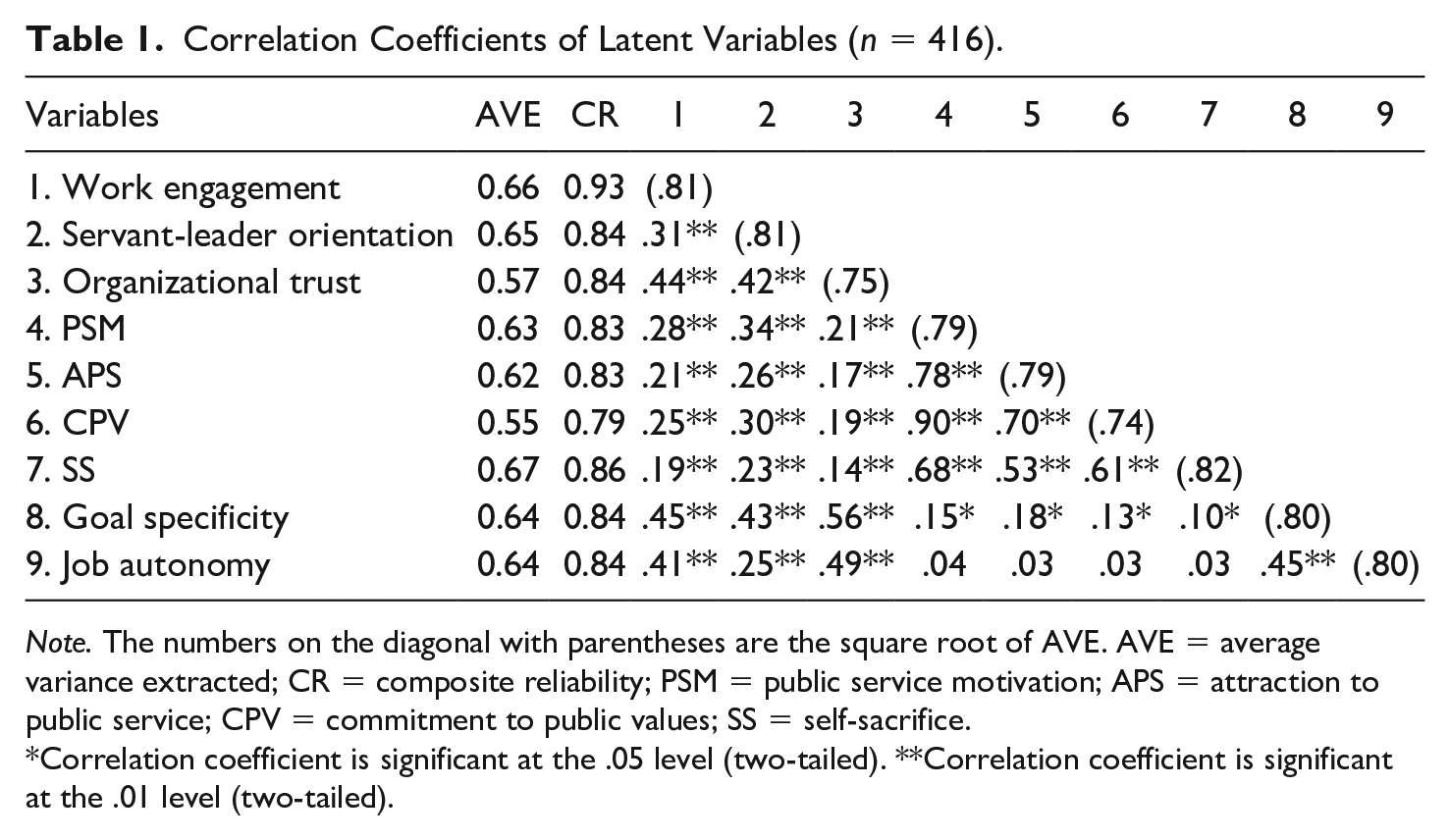
Note. The numbers on the diagonal with parentheses are the square root of AVE. AVE = average variance extracted; CR = composite reliability; PSM = public service motivation; APS = attraction to public service; CPV = commitment to public values; SS = self-sacrifice.
Correlation coefficient is significant at the .05 level (two-tailed). **Correlation coefficient is significant at the .01 level (two-tailed).
Work engagement
Work engagement was measured with nine items developed by Schaufeli et al. (2006), but two items were dropped due to low factor loading scores. A 7-point Likert-type scale was used.
Managers’ servant-leader orientation
A shortened version of the servant leadership instrument developed by (Liden et al., 2015) was used to measure servant leadership. Liden et al. (2015) developed a global measure of servant leadership items that capture each dimension of servant leadership using seven items. Based on the three empirical studies, Linden et al. found that SLB-7 has a high correlation with SLB-35 and predictive validity. The items were adopted in other recent studies (DeConinck et al., 2018). The current study adopted six items; however, two of these items were dropped due to low factor loading scores. The respondents were asked to evaluate their departmental leaders’ servant-leader orientation.
Organizational trust
Organizational trust was measured with four items based on Nyhan and Marlowe’s (1997) organizational trust inventory.
PSM
We adopted PSM items developed by Kim et al. (2013). A 7-point Likert-type scale was used. However, among the four PSM components (attraction to public service, commitment to public values, self-sacrifice, and compassion), compassion was not included in the data analysis because it yielded low, second-order factor loading scores. Three items from the remaining three components were also dropped due to low factor loading scores. As a result, nine items were used for the data analysis in this study.
Job autonomy and goal specificity
Job autonomy was measured with three items from Sims et al.’s (1976) Job Characteristic Inventory. Goal specificity items were derived from Davis and Stazyk (2014).
Social desirability
The self-report method is often susceptible to the respondents’ tendency to respond in a culturally appropriate and acceptable manner to obtain others’ approval, a phenomenon known as social desirability bias (Crowne & Marlowe, 1960). Social desirability bias, producing spurious correlations between the study variables, is a classic example of the common method variance described by Campbell and Fiske (1959). Social-desirability scales are often administered as an aid to establish the discriminant validity of the primary instrument being employed. By including the scales, researchers can better explore the relationship between two variables of interest while statistically controlling for socially desirable responses using partial correlations.
The current study measured social desirability tendencies with a 13-item short version of the Marlowe-Crowne Scale proposed by Reynolds (1982). Respondents were requested to select either “yes” or “no.” A high proportion of “yes” responses to these questions would indicate the respondent’s tendency to provide socially desirable answers concerning others’ reactions, leading to an inaccurate representation of actual responses. The detailed logic of using the social desirability instrument is discussed in the following section.
Procedure and Common Method Bias
Since the current study collected the data using a single survey, the common method bias (hereafter CMB) may be a concern. Due to the respondents’ concerns about confidentiality raised during the pilot study, the researchers decided that a single survey approach rather than a multiple-phase study would be more appropriate. The study followed the recommendations suggested by several scholars to control for the potential CMB. First, we used survey instruments validated in previous studies. All variables were measured using multiple items, and the reliability and validity of each, including AVE and CR, were found to be robust across studies were robust. Harman’s one-factor test of the data also suggested that common method variance might not be a serious concern since one factor accounted for less than 30% of the variance. Second, the order of questions was carefully designed. For instance, the items for each variable were grouped into separate sections in the survey and were introduced so that respondents could perceive these items as distinct constructs. The protocol and procedure we adopted were in line with the guidelines suggested by George and Pandey (2017), and Podsakoff et al. (2003). Third, since respondents’ tendency to provide socially desirable answers could be an important source of CMB, particularly in Asian culture, the current study controlled for social desirability. Following Podsakoff et al.’s (2003) recommendations, this study controlled for the social desirability effect by regressing each item on the social desirability variable in the standard error of the mean (SEM). Although the results of hypotheses testing were consistent even after controlling for social desirability (Figure 1), it was appropriate to control for this effect in addition to the steps that we adopted to reduce the CMB, such as considering the Asian culture, which is still largely Confucius-based, hierarchical, and collectivistic. In such a cultural context, respondents may feel pressured to respond in a socially desirable way (i.e., in favor of their leaders regardless of their actual opinions) when being asked to evaluate their leaders. However, it should also be noted that controlling for social desirability effects did not eliminate the CMB, and it might not be an ideal approach, as Jakobsen and Jensen (2015) point out.
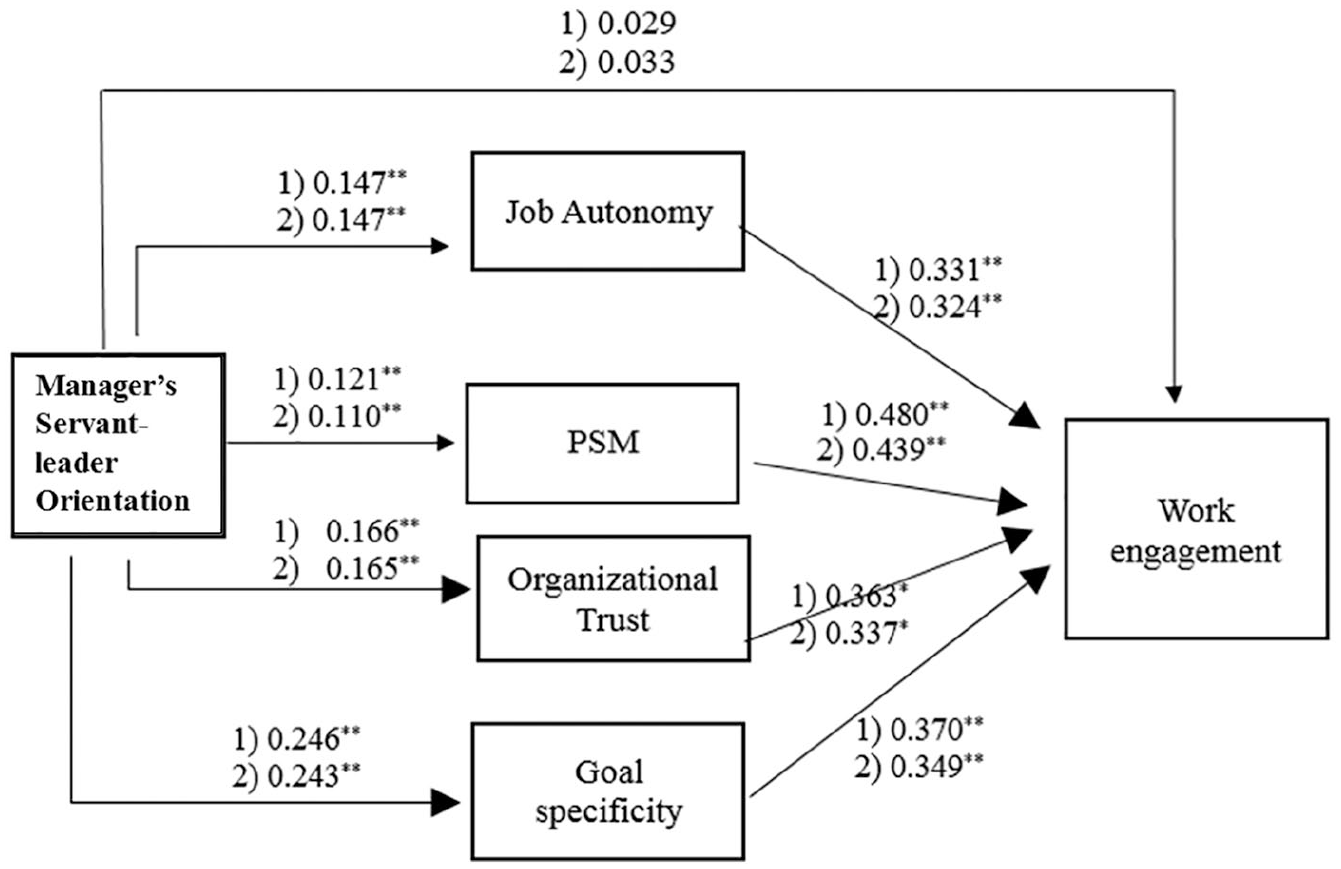
Summary of standardized coefficients of structural equation models.
Results
Data were collected from 23 work units (departments) in 3 self-governing districts (Gus), and the current study examined whether variability in responses originated from work unit-level (i.e., department level) or organizational-level differences. The examination of the intraclass correlation coefficient (ICC) value was 0.06, which indicates that 94% of the variability was from the individual-level difference. Maas and Hox (2005) recommend that the number of the unit for the multi-level analysis should exceed 30 to avoid the possibilities of a Type I error. We also conducted an ANOVA analysis to examine whether any significant difference in the value of variables among the three self-governing districts existed. However, no statistically significant difference was found. Based on this notion, the current study focuses on the individual- and not group or organizational-level analysis.
Table 1 presents correlation coefficients among the major variables at the individual level. The correlation results were in line with expectations. First, work engagement was positively associated with manager’s servant-leader orientation (r = .31, p < .01), organizational trust (r = .44, p < .01), PSM (r = .28, p < .01), job autonomy (r = .41, p < .01), and goal specificity (r = .45, p < .01). The relationships between manager’s servant-leader orientation and other employee resources were also consistent with expectations. First, manager’s servant-leader orientation was positively associated with both measures of job resources (goal specificity: r = .43, p < .01; job autonomy: r = .25, p < .01), as well as with organizational resources (organizational trust: r = .42, p < .01) and personal resources (PSM: r = .34, p < .01). Sub-dimensions of PSM were also found to have significant positive relationships with manager’s servant-leader orientation (attraction to public service: r = .26, p < .01; commitment to public values: r = .30, p < .01; and self-sacrifice: r = .23, p < .01). Relationships among mediators were all positive. In particular, the relationships between organizational trust with goal specificity (r = .56, p < .01) and job autonomy (r = .49, p < .01) and between goal specificity and job autonomy (r = .45, p < .01) are worth noting.
H1 states that employee resources (i.e., job autonomy, goal specificity, PSM, and organizational trust) should be positively associated with work engagement. In all the SEM results, H1 was generally supported in that the path coefficients were statistically significant for job autonomy (β = 0.33, p < .01 without controlling common method variance [CMV]; β = 0.32, p < .01 with controlling CMV), PSM (β = 0.48, p < .01 without controlling CMV; β = 0.44, p < .01 with controlling CMV), and goal specificity (β = 0.37, p < .01 without controlling CMV; β = 0.35 p < .01 with controlling CMV). The results also supported the expected positive relationship between organizational trust and work engagement, as the path coefficients were significant at the 95% confidence level (β = 0.36, p < .05 without controlling CMV; β = 0.34, p < .05 with controlling CMV).
H2 states that the manager’s servant-leader orientation would have a positive relationship with work engagement. However, the SEM results reveal that a manager’s servant-leader orientation does not have a significant relationship with work engagement, as the coefficients for the models both with and without controlling CMV were not statistically significant (γ = 0. 03, p = n.s. both with and without controlling CMV). In other words, the results suggest that the manager’s servant-leader orientation might not have a direct influence on enhancing employees’ work engagement when employee resources are held constant.
H3 states that the manager’s servant-leader orientation would have indirect effects on work engagement by enhancing employee resources (i.e., PSM, job autonomy, specificity, and organizational trust). Table 2 summarizes the indirect effects of the manager’s servant-leader orientation on work engagement; total and specific indirect effects are reported. First, the manager’s servant-leader orientation was found to have an indirect effect on work engagement through employee resources, as the total indirect effect was significant (f = 0.26, z = 5.60). More specifically, manager’s servant-leader orientation had indirect effects through job autonomy (f = 0.05, z = 2.45), goal specificity (f = 0.09, z = 2.55 without CMV), PSM (f = 0.06, z = 2.49), and organizational trust (f = 0.06, z = 1.74).
Mediation Analysis: The Indirect Effects of Servant Leadership on Work Engagement Through PSM, Job Autonomy, Goal Specificity, and Organizational Trust.
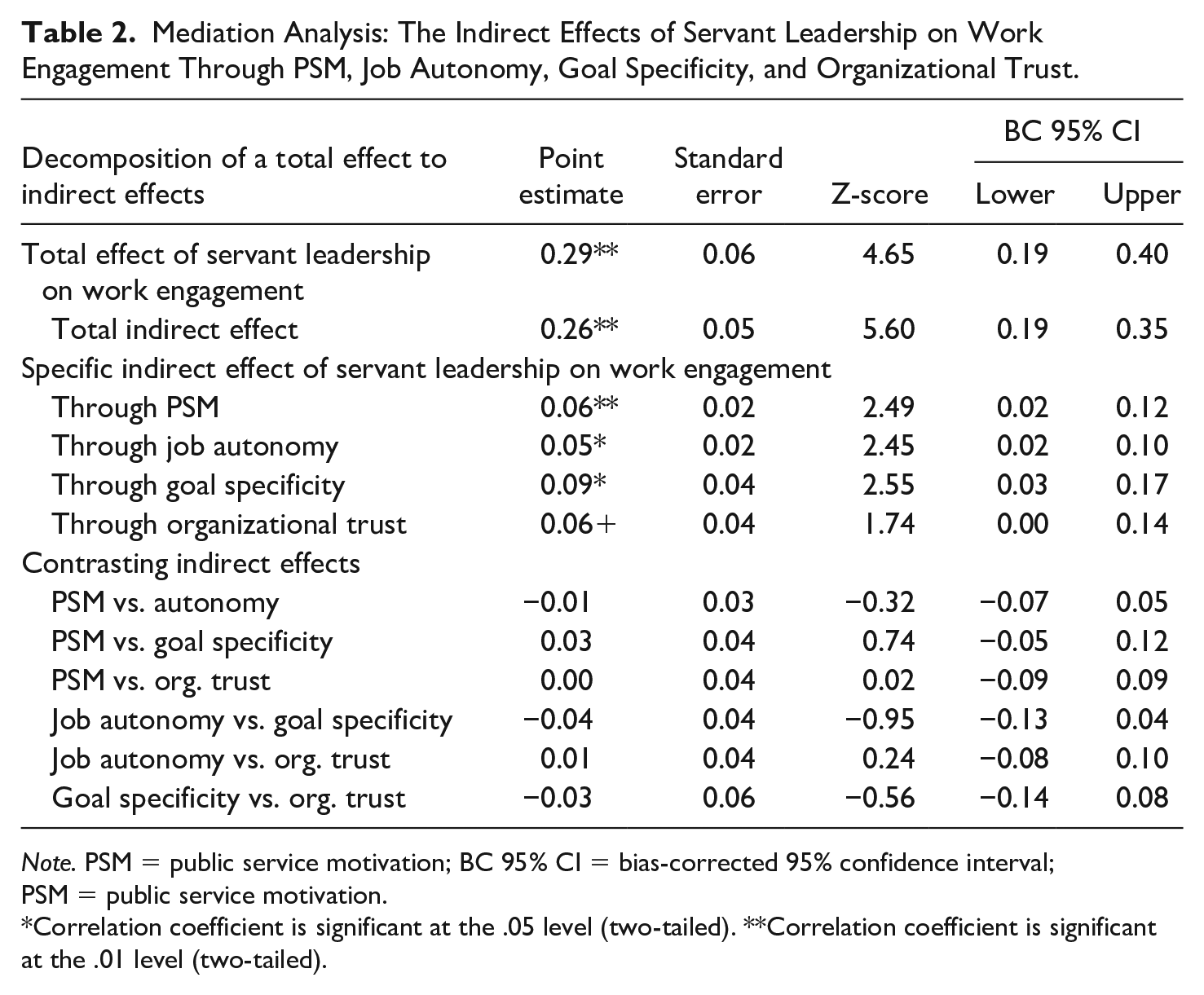
Note. PSM = public service motivation; BC 95% CI = bias-corrected 95% confidence interval; PSM = public service motivation.
Correlation coefficient is significant at the .05 level (two-tailed). **Correlation coefficient is significant at the .01 level (two-tailed).
To check the potentially differentiated mediating effects of employee resources, a pair of indirect effects were contrasted. For example, “PSM vs. job autonomy” compares the statistical difference of the mediating effect of PSM with that of job autonomy. No significant difference was found in a series of comparisons between indirect effects. This finding implies that servant leadership contributes to enhancing work engagement by mobilizing various employee resources such as personal resources (i.e., PSM), job resources (i.e., job autonomy and goal specificity), and interpersonal resources (i.e., organizational trust). (see Table 2).
Discussion and Conclusion
This study had several limitations. First, even though the current study attempted to reduce the CMB, as mentioned above, it could not be eliminated completely. In particular, controlling for social desirability does not control other sources of CMB, such as halo effects of the respondents’ transient mood, consistency motif, and implicit theories in responding to the survey questions. Future studies should consider different types of research designs, such as survey-based experiments, to confirm the relationship found in this study. Second, the current study focused only on the dynamics of various job resources without considering the potential influences of job demands on work engagement. In other words, the present study assumes that person-, job-, and organization-related resources would overcome a certain level of job demand to produce engagement. However, the conservation of resource theory posits that the level of resources examined may not contribute to employees’ psychological well-being (work engagement) when a high level of demand offsets resource availability. For example, employees might not appreciate their managers’ servant-leader orientation if they still struggle with a lack of discretion due to bureaucratic organizational procedures. In the same vein, street-level bureaucrats who feel that they have been assigned to insignificant jobs with ambiguous organizational goals might not recognize any value in their manager’s efforts. Accordingly, future studies should investigate the potential interaction effects of job resources and job demands, and differential influences of various job demands on work engagement. Third, because the study is based on cross-sectional data, the interpretations of the relationships are limited to confirming the causal mediating effect. For example, the relationship between organizational trust and manager’s servant-leader orientation would be reciprocal. In other words, the development of organizational trust can be a foundational condition that enables managers with a strong servant-leader orientation to exert their influence, while the current study was conducted based on the assumption that organizational trust would be an output of managers’ efforts. Unfortunately, this study cannot address this potential reciprocal relationship. Future studies should consider longitudinal or experimental designs to understand the relationships more clearly. Fourth, as our study is based on individual-level data analysis, it is limited to examining the workgroup-level dynamics. For example, it would be worthwhile to examine whether managers with strong servant-leader orientation could enhance the engagement of whole work units as well as individuals. Future studies should investigate the effectiveness of servant leadership through group-level analysis. Finally, because the data were collected in Korea, further investigations in other countries would be needed to confirm the cross-cultural generalizability of the results.
Despite the limitations mentioned above, this study offers several theoretical and practical contributions. First, it further illustrates the effectiveness of a manager’s servant-leader orientation in the context of street-level bureaucracy. The results of the study suggest that managers with a servant-leader orientation might be in a good position to boost their subordinate’s pro-social orientation (i.e., PSM), which contributes to sustaining street-level bureaucrats’ work engagement. At the same time, the study found that managers with strong servant-leader orientation can mobilize employees’ work engagement by facilitating employees’ positive interpretation of their work environment (i.e., job autonomy and organizational trust), and providing clear organizational goals. This is worth noting because a servant leadership orientation can enhance job and organization-related resources as well as personal resources. Thus, public managers with servant-leader orientation might be armored with various tools to shape their subordinates’ perception of work and psychological well-being. The indirect influence of manager’s servant-leader orientation on work engagement through goal specification is also worth noting. Prior servant leadership studies found that servant leaders might be poor at motivating subordinates to achieve organizational objectives because they might place undue priority on satisfying subordinates’ needs and establishing an egalitarian culture (De Clercq et al., 2014). However, the results of the current study revealed that the manager’s servant-leader orientation can help employees attain clearer goal perception as Roberts (2015) asserts.
Finally, because finding meaning in one’s work and having discretion over it are critical to sustaining employees’ work engagement, managers may need to provide street-level bureaucrats with an expanded job scope so that they can more readily feel meaningful. However, because increasing street-level bureaucrats’ discretion at the maximum level might encroach on fair and equal access to services and increase their opportunities to abuse their powers, public managers should be careful not to cater to the interests of street-level bureaucrats that run contrary to the public’s. They should also find ways to provide street-level bureaucrats with a sense of empowerment without losing control of the fair public service delivery process.
Footnotes
Declaration of Conflicting Interests
The author(s) declared no potential conflicts of interest with respect to the research, authorship, and/or publication of this article.
Funding
The author(s) disclosed receipt of the following financial support for the research, authorship and/or publication of this article: This study was supported by a Korea University Grant(K1911321). This work was also supported by the Ministry of Education of the Republic of Korea and the National Research Foundation of Korea (NRF-2016S1A3A2924956).
