



Abstract
For decades, scholars and practitioners have paid serious attention to how to facilitate extra-role behaviors of employees. While many studies have been conducted, it is not yet clear what factors facilitate or suppress those behaviors within organizations and how those factors interact with each other. The current research focuses on two extra-role behaviors of employees: innovative behavior and organizational citizenship behavior (OCB). Both behaviors have been discussed as determinants of individual and organizational performance. Filling the gap of the existing studies, the current research comprehensively considers organizational characteristics, task characteristics, and motivational factors in explaining those behaviors. Integrating two data sets, the 2015 and 2016 Perception of Public Officials Surveys administered by the Korea Institute of Public Administration (KIPA), we conducted a hierarchical linear model (HLM) analysis to examine the effects of determinants in the Korean context. Based on the multi-level analysis, this research demonstrates the positive influence of autonomy and PSM on both behaviors. Among organizational-level variables, cooperative culture increases the innovative behavior, whereas the lack of organizational support decreases it. We provide several managerial implications based on the findings.
Keywords
Introduction
While citizens’ trust in government has been decreasing in many countries, the expectations and demands for government have not decreased (Grimmelikhuijsen, 2012; Kim, 2010; Lee & Schachter, 2019; Miller & Listhaug, 1998; Van De Walle et al., 2008). Rather, citizens want more services and higher quality policies from government and expect that government should actively tackle various social problems (Carvalho & Brito, 2012; Hetherington & Husser, 2012). In this regard, many governments, including the United States and the United Kingdom, seek to increase the capacity of public employees (Hameduddin & Fernandez, 2019). While one can define the capacity of public employees from several perspectives, the current research focuses on the capacity for voluntary and proactive behaviors by organizational members to achieve organizational purpose. As proxy measures of those behaviors, it employs innovative behavior and organizational citizenship behavior (OCB), both of which can be considered as a type of extra-role behaviors of employees.
For higher performance of government, public employees need to be more active in identifying critical social issues, creating initiatives to solve them, and taking risks as policy entrepreneurs (Bhatti et al., 2015; Teske & Schneider, 1994). For example, in dealing with the recent COVID-19 pandemic problem, the Korean government showed its entrepreneurship by rapidly adopting innovative diagnostic methods such as drive-through and walk-through tests. However, proactive actions sometimes fail. In tackling the same issue, the Korean government alleviated the “social distance” policy after the national election in April. The decision was made against the warnings of experts from the Korea Centers for Disease Control and Prevention (KCDC) and the Korean Society of Infectious Diseases (KSID), which resulted in the second outbreak of COVID-19. In addition, some public employees have been slow to confront environmental changes due to their passivity and blame avoidance (Hansson, 2015; Hood, 2010). Scholars in the field of public administration have also been slow to address this issue (Hinterleitner, 2017; for exceptions, Howlett, 2014; Weaver, 1986).
Seeking to fill the gap, this research asks the following research questions: What organizational and individual factors lead to innovative behavior and OCB of public employees? How does the lack of organizational support interact with individual factors in affecting those behaviors? This research examines which factors facilitate or suppress those behaviors, and it mainly relies on the perceived organizational support (POS) theory and the job demand-resource (JD-R) model in identifying core antecedents. Accordingly, organizational, task, and motivational characteristics are considered as the determinants. In detail, the research considers cooperative culture, capacity of change management, and lack of organizational support as organizational characteristics, while the task and motivational characteristics include autonomy, role conflict, and public service motivation (PSM). In addition, this research also explores whether a lack of organizational support moderates the effect of autonomy, role conflict, and PSM on innovative behavior and OCB.
To address the research questions, we integrated two data sets: the 2015 and 2016 Perception of Public Officials Surveys administered by the Korea Institute of Public Administration (KIPA). Using the 2015 data, this research measured organizational characteristics by aggregating the responses into the organizational level. However, individual-level factors and dependent variables came from the 2016 survey data. Employing the multi-level approach, the current research contributes to the literature by considering both individual and organizational factors. Methodologically, although not perfect, the integration of the data sets partly avoids the common method bias. Another contribution is to examine the determinants of innovative behavior and OCB in the East-Asian context. While there are many relevant studies, most of them were conducted in western countries. This research wants to provide empirical evidence for determinants of innovative behavior and OCB in the Korean context, effects of which might differ from those in western countries.
The following section reviews the concept of innovative behavior and OCB as well as the existing studies on the subjects. Identifying the research gap, we highlight the contribution of the current research. The next section suggests the research framework and provides theoretical discussion supporting the core hypotheses. Following the explanation of the research method, the analysis results are reported. Then, the conclusion section summarizes the research findings and provides practical implications.
Literature Review on Innovative Behavior and OCB
Existing Studies on Innovative Behavior
Innovation refers to the production or adoption of new and useful ideas and implementation of those ideas (Hansen & Pihl-Thingvad, 2019; Rogers, 2003). Innovation of products and technologies has been a key source for performance improvement and competitiveness of private sector firms (Christensen, 1997; Fagerberg et al., 2005; Porter, 1985), and many studies suggest that innovation is also critical for public sector performance (Altshuler & Behn, 1997; Borins, 2014; Damanpour et al., 2009; Light, 1998). Researchers and practitioners agree that, to solve “unruly and wicked” problems, public organizations need to build more capacity for innovation (Crosby et al., 2017; Hansen & Pihl-Thingvad, 2019: 918; Kinder, 2012; Moore & Hartley, 2008; Torfing & Ansell, 2017).
Because innovation is initiated with the problem recognition and generation of ideas (Kanter, 1988; Scott & Bruce, 1994), it is important to study what factors facilitate or suppress individual innovative behaviors. Janssen (2003) defined innovative work behavior as “the intentional generation, promotion, and realization of new ideas within a work role, work group, or organization” (p. 348). Similarly, Aryee et al. (2012) defined innovative behavior as “the production or adoption of useful ideas and idea implementation” (p. 8). Scholars have nominated various factors that may affect innovative behavior. Scott and Bruce (1994) and Bysted and Jespersen (2014) emphasized the importance of building an organizational climate to enhance innovation, while other scholars have argued that the engaged individuals with vigor and dedication are the key to generate innovation (Al-Hawari et al., 2019; Aryee et al., 2012). Fernandez and Moldogaziev (2013) stressed various empowerment practices as sources for innovation and Wynen et al. (2014) argued that, by focusing on job characteristics, autonomy and room for experimentation are antecedents for innovation. Scholars, such as Bysted and Hansen (2015) and Miao et al. (2018), underscored the role of leadership for facilitating innovative behaviors among employees. Based on the existing studies, the current research classifies the determinants of innovative behavior into three categories, including organizational (managerial) characteristics, job characteristics, and motivational factors.
Existing Studies on OCB
Since Organ and colleagues (Bateman & Organ, 1983; Smith et al., 1983) developed and introduced the concept of OCB, numerous studies have been conducted in the field of OCB (Podsakoff et al., 2018). In the very early days of OCB research, Organ (1988) defined the concept as follows: “individual behavior that is discretionary, not directly or explicitly recognized by the formal reward system, and that in the aggregate promotes the effective functioning of the organization” (p. 4). Organ also suggested the specified dimensions of OCB, which include altruism, courtesy, conscientiousness, civic virtue, and sportsmanship. Recently, peacekeeping and cheerleading were also included in the dimensions (Organ, 1990; Podsakoff et al., 2009). The aforementioned definition and constructs of OCB make one expect that OCB is positively associated with organizational effectiveness. Indeed, previous studies have shown that OCB has a positive impact on job performance and employee behaviors, whereas it negatively affects various forms of withdrawal behaviors such as turnover intention, absenteeism, and turnover (Podsakoff et al., 2009).
A variety of factors have been considered as the antecedents of OCB. They include personality traits (e.g., conscientiousness, agreeableness, emotional stability, extraversion, openness), leadership characteristics (e.g., transformational leadership, transactional leadership, servant leadership, leader-member demographic similarity, LMX), and other contextual factors (e.g., justice, structure, coworker support) (Chiaburu et al., 2011; Ilies et al., 2007; Kacmar et al., 2011; Organ, 1988; Organ & Ryan, 1995; Pandey et al., 2008; Taylor, 2013). Most of these OCB studies have focused on the individual-level antecedents of individual-level OCB. In recent years, researchers have begun to examine the effects of organizational-level variables as well as to identify the moderating effects of those variables (Dekas, 2010; Kalshoven et al., 2013; Podsakoff et al., 2018; Wherry, 2012). Besides individual-level factors, the current research considers organizational-level factors, including cooperative culture (Ng & Van Dyne, 2005), change management capacity (Choi, 2007), and lack of organizational support.
Contribution of Current Research
Assuming that innovative behavior and OCB can cope with expectations of citizens and environmental changes, researchers and practitioners have shown considerable interest in identifying the antecedents. Those behaviors can be considered extra-role behaviors, which are positively related to work outcomes such as satisfaction, performance, network management, and problem solving (Alessandri et al., 2018; DeGroot & Brownlee, 2006; Dunlop & Lee, 2004; Kim & Gong, 2009; MacKenzie et al., 2011; Moeller et al., 2018; Nielsen et al., 2012; Podsakoff et al., 2014; Zhang et al., 2008). From the social exchange perspective, employees engage in extra-role behaviors by responding to organizational support for providing abundant resources (Blau, 1964). Employees who perceive that they have received enough resources from the organization perform well in their organizations (Saks, 2006). Some task characteristics and motivational factors were also found to be critical elements affecting those extra-role behaviors (Giebels et al., 2016; Grant, 2007, 2008; Pandey et al., 2008; Todd & Kent, 2006). In addition, both innovative behavior and OCB can also be considered as types of behavioral engagement in that Macey and Schneider (2008) argued that behavioral engagement include “innovative behavior, demonstrations of initiative, proactively seeking opportunities to contribute, and going beyond what is, within specific frames of reference, typically expected or required” (p. 15). That is, behaviorally engaged employees are dedicated to focusing on their work activities, being open to new experiences, and helping their colleagues (Bakker & Albrecht, 2018).
Although many studies have been conducted on innovative behavior and OCB, one can identify several gaps in the research. First, few studies employed a multi-level approach to explore the interactions between organizational factors and individual factors in explaining those behaviors. For example, Biggs et al. (2014) have emphasized the need for research that deals with both individual and environmental factors by arguing that few studies have examined how strategic alignment at the organizational level affects employee engagement. Similarly, Chen and Kao (2011) argued the necessity to conduct the multi-level analysis to explain OCB. Studies dealing with some organizational factors, such as job resources and leadership, are increasing (e.g., Alfes et al., 2013; Breevaart et al., 2014; Holman & Axtell, 2016), but more studies are required to obtain practical knowledge to facilitate and maintain those extra-role behaviors. To fill such gap, the current research takes a multi-level approach by considering both organizational-level and individual-level factors.
Second, for a systematic understanding of extra-role behaviors, research is needed on the public and nonprofit sectors in addition to the private sector (Bakker & Albrecht, 2018). While studies have been conducted on innovative behavior and OCB in the public sector, the private sector research deals with a wider range of subjects and research topics (e.g., Al-Hawari et al., 2019; Aryee et al., 2012; Yuan & Woodman, 2010). In addition, the most critical resources and influential determinants for those extra-role behaviors might be different across the sectors. While acknowledging the importance of investigating such differences, the public management field was relatively slow to respond to the call for research on innovative behavior and OCB (Hansen & Pihl-Thingvad, 2019). In addition, many empirical studies for the subject were conducted in western countries and one can find little research dealing with the Asian context. Examining survey data collected from government officials working in the South Korea, the current research contributes to filling the gaps.
Research Framework and Hypotheses
Research Framework
Figure 1 illustrates the framework of this research. The current research is mainly based on the JD-R model and the POS theory. Seeking to encompass various relevant factors, the framework includes organizational characteristics, job characteristics, and motivational factors. Organizational factors at Level 2 reflect the level of support for innovative behavior and OCB from several aspects at the organizational level, the effects of which can be explained by the POS theory. Furthermore, the JD-R model is also applicable in that those supports from organization can be perceived as job resources. Individual-level factors mainly reflect job characteristics and motivational aspects. Among those factors, the effects of job characteristics are well explained by the JD-R model.

Research framework.
Altogether, in explaining the individual-level dependent variables, innovative behavior, and OCB, the framework hypothesizes that both organizational- and individual-level factors have influences. Organizational-level factors include cooperative culture, capacity for change management, and lack of organizational support. The first two factors are expected to have a positive influence on innovative behavior and OCB, whereas the last factor, lack of organizational support, is expected to have a negative effect. Individual-level factors include autonomy, role conflict, PSM, and demographic factors. We assume that autonomy and PSM are positively associated with the dependent variables, while role conflict has a negative association with them. In addition, the research examines interaction effects between lack of organizational support and the three individual-level factors noted above. The section below explains the relationships between core independent variables and the dependent variables. We suggest hypotheses based on the discussion.
Theoretical Discussion and Hypotheses
Organizational factors
The influence of three organizational factors can be explained by both the POS theory and the JD-R model. POS means employees’ “beliefs concerning the extent to which the organization values their contributions and cares about their well-being” (Eisenberger et al., 1986, p. 500). Various organizational characteristics will give positive or negative signals to employees’ perception, which will constitute the level of organizational support (Kurtessis et al., 2017; Rhoades & Eisenberger, 2002; Riggle et al., 2009). In addition, based on the JD-R model, the perceived level of organizational support actually works as an emotional and physical resource for organizational members, which eventually affects important organizational outcomes (Bakker & Demerouti, 2007). In sum, both the POS theory and the JD-R model explain the effects of organizational factors considered by the current research.
Cooperative culture facilitates work environments that permit employees to work together and rely on each other in initiating innovations. Cooperation becomes more important when organizations seek innovations which require a complex process and participation of various organizational members. OCB will more easily emerge when the overall organizational culture is cooperative. The members of cohesive groups tend to be more sensitive to social, affective, and cognitive cues that are displayed by other members, from which they infer how their colleagues should feel, think, and act in the group (Van Mierlo & Bakker, 2018). Engaging in extra-role behaviors will be natural when employees are willing to collaborate.
Change management capacity refers to the degree of readiness and commitment to change. When an organization actively supports change, organizational members recognize it as POS for creativity, by which employees perceive that the organization values and rewards creative behaviors (Zhou & George, 2001). When management focuses on change and innovation, extra-role behaviors will be further recognized and more innovations and creative activities will emerge. Accordingly, both innovative behaviors and OCB will be positively influenced by change management capacity.
In contrast, the lack of organizational support will decrease such voluntary behaviors. Many existing studies have found that sufficient organizational support leads to positive outcomes (Bishop et al., 2000; Coyle-Shapiro et al., 2016; Eisenberger et al., 1990; Jong & Ford, 2016), but not many studies have dealt with how insufficient support negatively affects outcomes. The lack of resources leads to perceptional constraints by decreasing psychological room (Bum, 2015). Compared to people who have enough resources, people who are lack of resources are more sensitive to opportunity costs and perceive a higher level of psychological threats, which leads to conservative decision-makings (Shah et al., 2015). The deficiency of resources also generates the “tunnel vision” effect which narrows one’s view (Williams, 1982). Accordingly, the lack of support is not just the absence of sufficient support. Rather, it has negative impact on employees and decreases extra-role behaviors. In case of Korea, to solve the economic hardship resulted from the COVID-19 pandemic situation, the Korean government decided to provide a stimulus check ranging $400 to $1,000 to citizens. One problem was that it substantially increased the workloads of street-level bureaucrats, but additional organizational support was not provided. Consequently, many public employees suffered from emotional labor and burnout syndrome (Hankyung, 2020, May 16). Furthermore, they were under political pressure to donate their own stimulus check (ChosunBiz, 2020, April 30). All these circumstances made street-level bureaucrats more passive and risk-avoided in managing their works. In sum, when there is a lack of support, employees will experience difficulties in conducting their current tasks, which delays developing innovative ideas and helping others in the workplace (Cohen & Abedallah, 2015; Van Emmerik et al., 2003). Instead, the lack of support will lead to negative outcomes such as work stress, burnout, and job distress (Caesens et al., 2014; Demerouti et al., 2001). While existing studies mainly focused on positive factors increasing innovative behavior and OCB, the current research also deals with the lack of organizational support as a factor that may negatively affect them.
Consequently, out of many organizational characteristics, the three factors discussed above reflect the substantial portion of organizational influences that affect innovative behavior and OCB. Based on the above discussion, the following hypotheses were established:
Job characteristics and motivational factors
In addition to organizational characteristics, other factors may affect the level of innovative behavior and OCB. Representatively, characteristics of one’s task and the level of motivation are core elements in explaining innovative behavior and OCB (Chen & Kao, 2011; Giebels et al., 2016; Pandey et al., 2008; Todd & Kent, 2006). Accordingly, the current research deals with two job characteristics, autonomy and role conflict, and one motivational factor, PSM.
Autonomy is critical to enhance both innovative behavior and OCB. If public employees do not have enough autonomy, then they will have less room to design and implement innovative ideas. Under less autonomy, employees will feel higher constraints and be less likely to engage in voluntary helping behaviors. In short, a low level of autonomy will decrease employees’ capacity for innovative behavior and OCB. The JD-R model gives a good explanation for the relationship. The model suggests that job strain and well-being are the results coming from the balance between job resources and job demands (Demerouti et al., 2001). According to the model, autonomy is one of the representative examples of job resources that lead to positive outcomes including enhanced motivation, extra-role performance, innovativeness, higher work engagement, and higher performance (Bakker & Demerouti, 2017). In a study of 826 nurses in Italy, Trinchero et al. (2013) confirmed that discretionary power was an important driver of engagement and Shantz et al. (2013) also found a positive relationship between autonomy and employee engagement with a sample of 283 employees in the United Kingdom.
The effect of another independent variable, role conflict, is also well explained by the JD-R model, but in the opposite way (Bakker & Demerouti, 2017). Job demands are defined as “those physical, social, or organizational aspects of the job that require sustained physical or mental effort and are therefore associated with certain physiological and psychological costs” (Demerouti et al., 2001, p. 501). Role conflict works as a job demand in that it requires employees to clarify their roles, which is often accompanied by much stress. Role conflict as the hindrance demand will lead to employee depression, psychological strain, and burnout (Crawford et al., 2010), which all leave little room for extra-role behaviors. However, one can think of the opposite perspective that innovative behavior may lead to role conflict. If employees are engaged in innovative behavior, which accompanies new ideas and suggestions, their roles might become in conflict with other employees’ roles because innovations often cross the boundaries of roles. Despite the possibility, the current research considers the role conflict as the antecedent of innovative behavior by relying on the JD-R model. Future research using a longitudinal design is needed to test the competitive arguments.
Existing studies have also demonstrated the above arguments. Working as a job resource, autonomy is closely related to positive outcomes (Bakker et al., 2005), while role conflicts are associated with negative attitudes and behaviors (Crawford et al., 2010; Kahn, 1990). As previous studies demonstrated that these factors work as critical determinants of extra-role behaviors, they need to be controlled to properly capture the effects of other independent variables. More importantly, not many studies have demonstrated the effects of those factors on innovative behavior yet (for exceptions, see Bysted & Hansen, 2015; Bysted & Jespersen, 2014), which increases the necessity to examine the relationship. In addition, one needs to confirm whether those factors have similar influences in the Korean context. Accordingly, we set the following hypotheses:
PSM is expected to increase both innovative behavior and OCB. Defined as “a mix of motives that drives an individual to engage in an act that benefits society” (Taylor, 2007, p. 934), PSM drives public employees to strive to serve the public interests. In explaining the positive effect of PSM in the public sector, person-organizational fit (P-O fit) theory is frequently used. The P-O fit refers to the extent of compatibility between an individual and the work environment (Kristof-Brown et al., 2005), and the expectation is that employees well matched to organizational characteristics will show better attitudes and behaviors than others. When one applies the theory to PSM, he or she can assume that people who are attracted to fulfilling the public interests are likely to work in public organizations that serve the purpose. As their needs are fulfilled in the public sector, public employees who have a high level of PSM will show higher levels of satisfaction and commitment as well as be more dedicated to their mission and vision, making them willing to engage in extra-role behaviors (Kim, 2006; Pandey et al., 2008). Helping other employees and keeping organizational rules are representative examples. Besides, these employees will think of innovative ideas and actively suggest them to achieve public interests (Miao et al., 2018; Perry & Wise, 1990). While Miao et al. (2018) demonstrated the indirect effect of PSM on innovative behavior via psychological empowerment, to our knowledge, no research has demonstrated the direct effect of PSM on innovative behavior yet. Based on the discussion, we set the following hypothesis:
In addition, this research examines the moderating effect of lack of organizational support on the relationship between individual-level variables and extra-role behaviors. The main reason to choose this factor is to explore how organizational constraints affect the extra-role behaviors. While existing studies provide several factors facilitating extra-role behaviors (e.g., Afsar & Badir, 2016; Coyle-Shapiro et al., 2016), not many studies have identified factors suppressing the effects of those behaviors. Focusing on insufficient workforce, unreasonable task deadline, and the lack of work–family balance, the current research examines whether the lack of organizational support moderates the influences of individual-level factors.
The JD-R model provides the explanation for the moderating effects. As mentioned earlier, the JD-R model argues that the balance between job resources and job demands affects job strain and well-being (Demerouti et al., 2001), where not only the excessive demands but also insufficient resources may lead to negative consequences. Accordingly, when there is a lack of organizational support, this will suppress the full realization of positive effects of individual-level factors.
For example, under the lack of organizational support, the effect of autonomy might not be fully realized. Even when one has job autonomy, if available resources are not enough to initiate any innovative project, then no innovation might happen or the outcome of the innovation will be limited. As a result, the influence of autonomy enhancing innovative behavior and OCB will be reduced when the organizational support is limited. Under the lack of organizational support, the negative impact of the role conflict might be getting worse. The deficiency of support will exacerbate employees’ capacity to resolve conflict in the workplace, which will further decrease the room for innovative ideas and extra-role behaviors. That is, the lack of organizational support and role conflict will make the negative synergy in reducing extra-role behaviors. Finally, the effect of PSM will be decreased under the condition of lack of organizational support. Like the autonomy, the positive influence of PSM may not be fully realized when an organization does not provide enough support. The efforts to achieve public interests will experience frustration when the organization does not provide enough support. Reflecting the discussion above, we set the following hypotheses:
Method
Data and Analytic Method
To address the research questions, this research integrates two data sets: the 2015 and 2016 Perception of Public Officials Surveys conducted by The KIPA. As a representative survey on public employees in Korea, the survey is conducted for both central and local public employees. In the 2015 survey, 43 central administrative agencies and 17 local governments participated, while the 2016 survey was distributed to 42 central administrative agencies and 17 local governments. Using multi-level quota sampling, the KIPA collected 2,000 public officials in 2015 and 2,070 public officials in 2016. We constructed a hierarchical data structure by aggregating 2015 survey responses into the organizational level. Then, using the aggregated measures of the 2015 data, the research matched the 2015 organizational-level data with 2016 individual-level data by the organizational affiliation. With the integration of the data sets, we partly avoided the common method bias because the respondents of the 2015 survey were different from those of the 2016 survey. That is, at least the organizational-level factors came from a different data source.
Regarding the aggregating responses, one can find several existing studies using the aggregated measures of individual survey responses as team- or organizational-level factors (e.g., Bertelli et al., 2013; Chan, 2005; Ehrhart et al., 2006; Raver et al., 2012). Like those studies, this research used the referent-shift consensus model as recommended by Podsakoff et al. (2014). Prior to aggregating 2015 survey data, we first tested the within-group agreement (rWG) level of the data (James et al., 1984, 1993) and the interrater agreement (intraclass correlation [ICC1]) level. This research used the tool designed by Biemann et al. (2012) in computing the estimates. The average rWG values for cooperative culture, change management capacity, and lack of organizational support were .83, .87, and .76, respectively, all of which met the critical value of .70 proposed by James et al. (1984). To test the consistency in member scoring, James (1982) recommends the use of ICC(1). A low ICC close to 0 means that values from the same group are not similar. The ICC(1) coefficient was .03 for cooperative culture, .04 for change management capacity, and .05 for lack of organizational support. Based on Bliese’s (2000) study, the appropriate criterion for the ICC(1) coefficient is between .05 and .30, so the ICC(1) values of cooperative culture and change management capacity did not meet the criteria. However, when group sizes are large (i.e., more than 25), even a very small ICC(1) (i.e., .01) is not a big problem (Bliese, 1998: 363). As the average group size of this study was 34, it was feasible to conduct a group-level analysis through the aggregation of individual-level data.
Accordingly, we aggregated data into the organizational level and conducted the hierarchical linear model (HLM) analysis. The HLM analysis is appropriate for examining the effects of both higher level factors (organizational-level factors) and lower level factors (individual-level factors) on lower-level factors (individual-level outcomes). This characteristic makes the HLM a suitable analytic method for the current analysis. In addition, the research also examines the moderating effect of lack of organizational support on the relationship between individual-level factors and two types of behaviors, innovative behavior and OCB.
Measurements
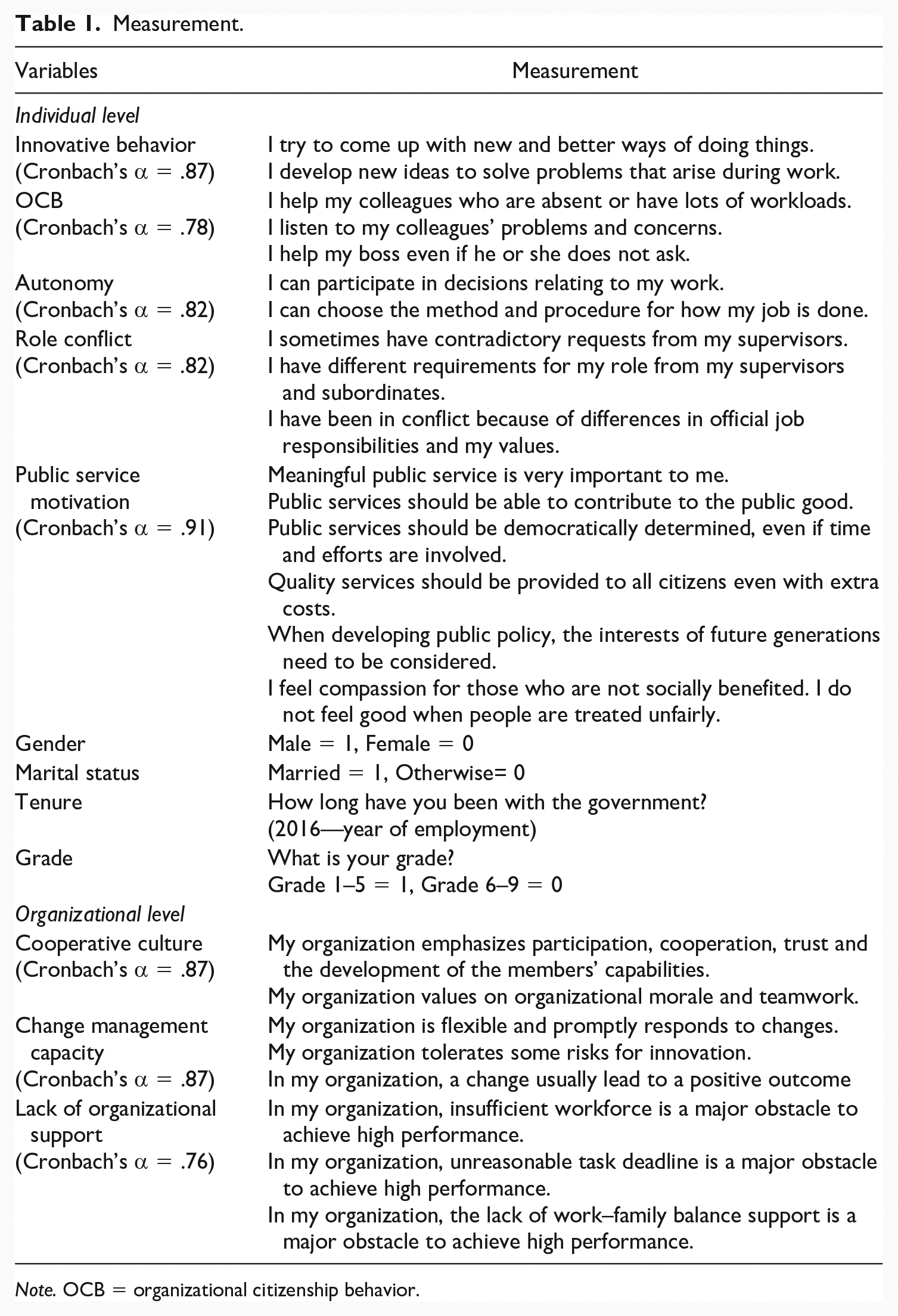
The questionnaire items used in the study are shown in Table 1. The dependent variables are innovative behavior and OCB. Innovative behavior was conceptualized as two behavioral phases for employees to undertake: idea generation and idea realization. The scale is based on the work of Janssen (2001) and Scott and Bruce (1994). The OCB survey items reflect those used in Stumpf et al. (2013).
Measurement.
Note. OCB = organizational citizenship behavior.
The cooperative culture scale comes from Quinn’s (1988) competing values model. The questionnaires were developed based on the support orientation concept: mutual trust and interpersonal harmony (Van Muijen, 1999). The change management capacity questions are related to the “Perceived Organization Support for Innovation” introduced in Scott and Bruce’s (1994) study. The questions of lack of organizational support reflect major obstacles to high performance at the organizational level. As noted before, the three organizational-level factors have been conceptualized and measured as a referent-shift construct (Chan, 1998). The current research aggregated individual responses into organizational level in two reasons. First, in Korea, one can observe a large variation of budget scale and capacity across central agencies and local governments and the effect of top leadership is much more substantial than mid-level leadership. Second, because team-level data are not available, the current research was not able to examine team-level effects.
Out of three aspects of autonomy including method autonomy, scheduling autonomy, and criteria autonomy (Breaugh, 1985), the current measurements focus on method and criteria autonomy. In addition, role conflict questions were selected from Kahn et al. (1964), Rizzo et al. (1970), and King and King (1990). Sources for the PSM questions included Perry (1996), and Kim et al. (2013). Finally, we controlled several demographic variables that have been shown to influence innovative behavior and task performance (Pieterse et al., 2010; Scott & Bruce, 1994). All measurements with multiple items showed the acceptable Cronbach’s alpha values over .70, and only one factor was retained by the factor analysis for each variable.
Although the measurements of organizational-level factors came from the different source, 2015 survey data, the individual-level factors and the dependent variables came from the same data source, 2016 survey data. To test the seriousness of the common method bias, the current research conducted Harman’s single-factor test. Although the test does not eliminate the bias, it helps us evaluate the seriousness of it. The test result demonstrated that the bias was not serious. The biggest factor explained only 19% of the total variance, less than the common threshold (50%). Accordingly, we proceeded to the HLM analysis.
Analysis Results
Descriptive Statistics
Table 2 shows summary statistics and zero-order correlations. Besides demographic factors, role conflict had the lowest mean value, 2.99, which was close to the mid-point, 3. Both innovative behavior and OCB had mean values, 3.23 and 3.58, respectively, higher than the mid-point. For correlations, the dependent variables, innovative behavior and OCB, were positively correlated as expected, 0.39. Autonomy and PSM were positively correlated with both dependent variables, while role conflict was negatively correlated with them. Regarding organizational-level factors, cooperative culture and change management capacity had a statistically significant and positive correlation.
Descriptive Statistics and Bivariate Correlations.

Note. OCB = organizational citizenship behavior.
*p <.05. **p < .01.
HLM Analysis
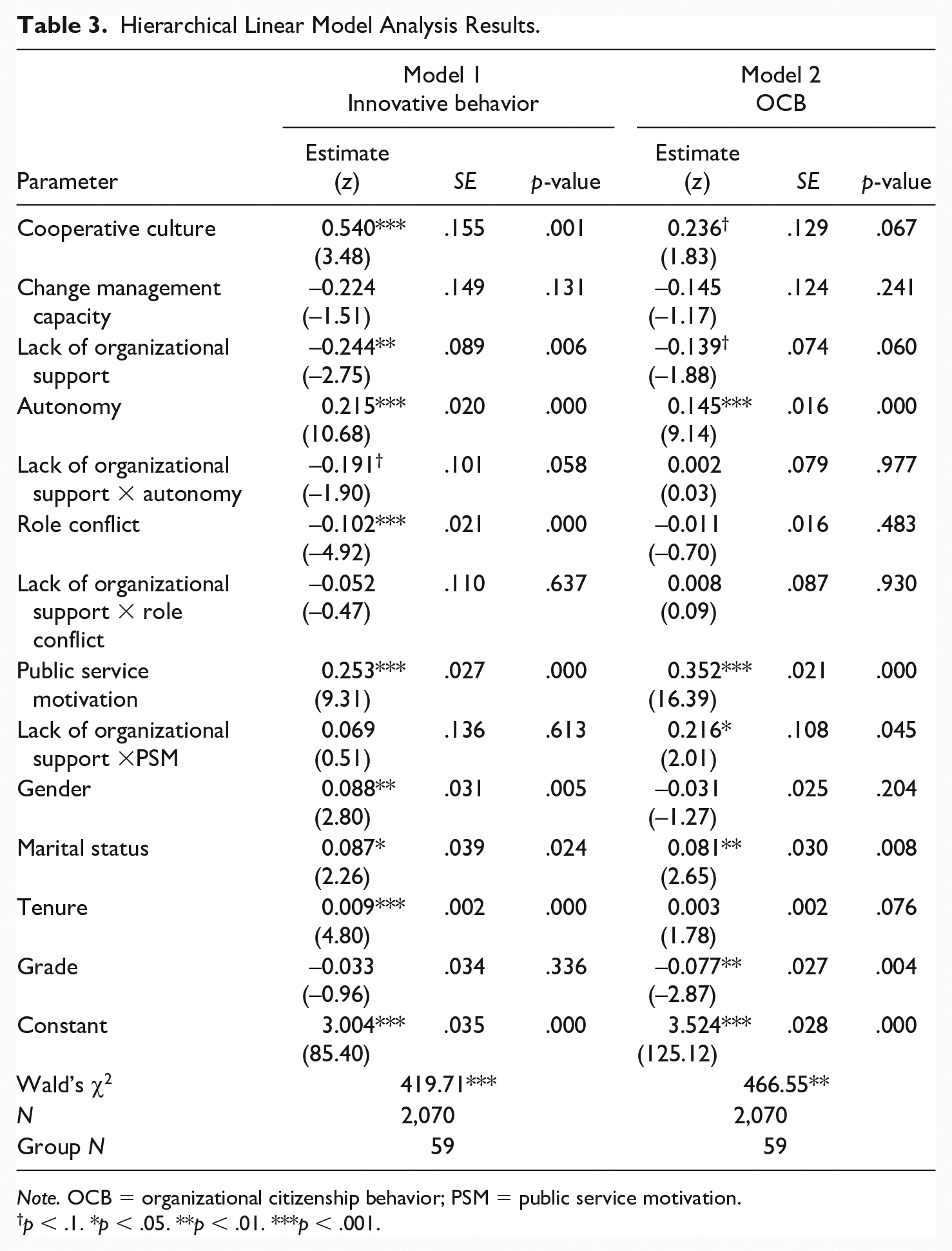
Table 3 presents the HLM analysis results. The number of observations was 2,070 at the individual level, and the number of groups was 59 at the organizational level. The number of individuals per group ranged from 20 to 70. Regarding innovative behavior, two organizational-level factors had statistically significant effects. Lack of organizational support decreased the innovative behavior, while cooperative culture enhanced the behavior. Among the individual-level factors, autonomy and PSM were positively associated with the innovative behavior, whereas role conflict reduced such behavior. Several demographic factors were statistically significant. Males, married employees, and employees with longer tenure were more likely to engage in innovative behavior.
Hierarchical Linear Model Analysis Results.
Note. OCB = organizational citizenship behavior; PSM = public service motivation.
p < .1. *p < .05. **p < .01. ***p < .001.
Hypotheses for the cross-level effects between individual factors and lack of organizational support were rejected at the .05 significance level. While all the moderating effects were not significant at the .05 significance level, the relationship between autonomy and lack of organizational support was significant at the .1 level. With caution, we interpret the relationship in consideration of its contextual importance. The moderating effect shows when there was a lack of organizational support, the effect of autonomy on innovative behavior was decreased. This influence can be plotted as shown in Figure 2. As the autonomy increases, the innovative behavior tends to increase. The slope is steeper when the lack of organizational support is at the low level (−.4), but the positive effect of autonomy on innovative behavior is decreased when the lack of organizational support is at the high level (.6). In other words, when organizational support is deficient, the effect of autonomy which increases innovative behavior is reduced. However, the effect is further boosted when one does not perceive such deficiency. Despite the interpretation, the current result is based on the .1 significance level and future studies need to reaffirm the relationship using a stricter standard.

Cross-level effect between autonomy and lack of organizational support.
Regarding OCB, the result of organizational-level factors was not statistically significant at the .05 significance level. However, lack of organizational support and cooperative culture were significant at the .1 level. When organizational support was deficient, employees were less likely to engage in OCB. On the contrary, under cooperative organizational culture, employees were more likely to show OCB. However, further validation is required to assure the relationships.
Among the individual-level factors, the importance of autonomy and PSM were demonstrated. When individual employees enjoyed a high level of autonomy and had a high level of PSM, they were more actively engaged in OCB. The coefficient of PSM was the largest among the variables included in the model, which implies that PSM is the major determinant of OCB. Role conflict did not have a significant effect on OCB. The reason might be that OCB is basically extra-role behaviors that do not require specific job descriptions, which is not much affected by the level of in-role conflict. Married employees were more likely to show OCB, whereas high-level officers showed less OCB when other conditions were equal.
For the cross-level effects between individual-level factors and lack of organizational support, only the interaction between PSM and lack of organizational support was significant, but in the opposite direction. When there was a lack of organizational support, the effect of PSM on OCB was further increased. In other words, the impact of PSM is larger when one cannot obtain enough support from the organization. The reason might be that employees seek to overcome the organizational constraints when they have a high level of PSM, but further research is required to confirm this conjecture. Figure 3 shows the relationship more clearly. One can find that the overall level of OCB is higher when there is organizational support (low level of lack of organizational support). As the PSM increases, the OCB also tends to increase. Especially, the slope is flatter when the lack of organizational support is at the low level (−.4, high level of organizational support), while the slope is steeper when the lack of organizational support is at the high level (.6, low level of organizational support). That is, under the deficiency of organizational support, the positive effect of PSM on OCB was further increased. In contrast, the effect was reduced when organizational support existed.
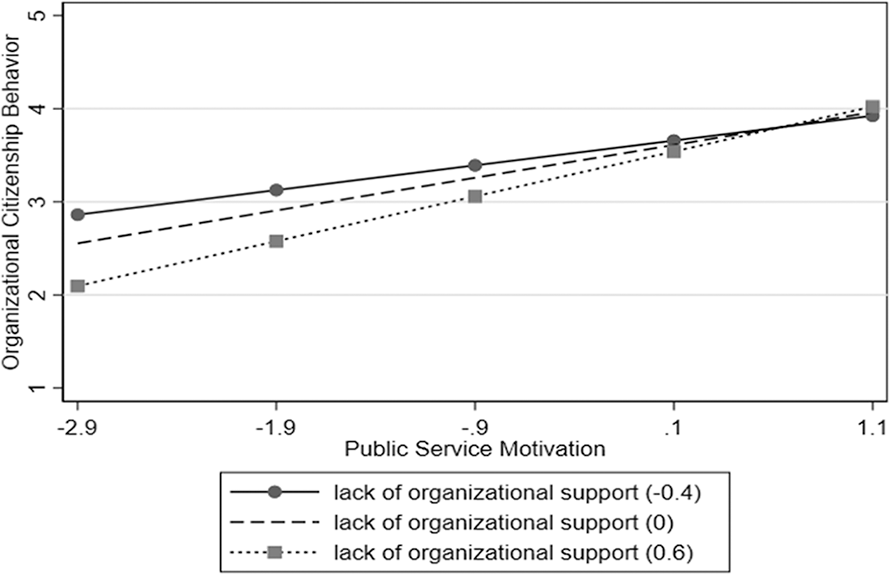
Cross-level effect between PSM and lack of organizational support.
Conclusion
This study examined organizational-level and individual-level factors that affect two types of extra-role behaviors, innovative behavior and OCB. The empirical analysis based on the 2015 and 2016 Perception of Public Officials Surveys revealed some significant effects of organizational factors. Establishing a cooperative culture among employees and supporting organizational members were critical to facilitate those behaviors. 1 Regarding individual-level factors, autonomy had a positive impact on both innovative behavior and OCB, whereas the lack of organizational support weakened the positive impact of autonomy on innovative behavior. PSM was positively associated with innovative behaviors and OCB, where the effect of PSM was further increased with the lack of organizational support. In other words, PSM buffered a negative effect of insufficient organizational support. Employees with role conflict were less likely to show innovative behavior. Unexpectedly, some hypotheses were rejected. For example, change management capacity did not show a significant effect on innovative behavior or OCB. It might have indirect effects by working through other factors rather than directly affecting those behaviors. The exploration of plausible mediating factors might be desired in the future research. Role conflict did not have a significant effect on OCB. As noted before, by being closely related with work roles, role conflict may largely influence in-role behaviors rather than extra-role behaviors. Despite the conjectures, future studies need to demonstrate those unexpected findings.
Focusing on extra-role behaviors, this research sought to provide some practical implications on how to enhance innovative behavior and OCB. The environmental changes will be greater in the near future, which will make the command and control mechanism less useful. Sometimes, the rapid changes of environment may increase the pressure on employees to conduct rule-bending behaviors (Sekerka & Zolin, 2007). Although bending rules might be a risky choice to individual employees and organizations, such behavior can be done based on knowledge and experience with the expectation of better policy results (Borry, 2017; Collins, 2012; DeHart-Davis, 2007; Sekerka & Zolin, 2007; Spreitzer & Sonenshein, 2004). Likewise, extra-role behaviors based on a voluntary mechanism will be more critical and contribute to solving the issue of risk-avoidance of public employees. The current analysis demonstrates that both individual and organizational factors are critical to facilitate innovative behavior and OCB. At the organizational level, nurturing a cooperative culture and providing support for employees are necessary. At the individual level, the management of job characteristics needs to be considered. Providing more autonomy while reducing role conflict will be helpful for employees to be more engaged in extra-role behaviors. Finally, from the motivational perspective, efforts to enhance PSM will pay off with the increased level of those behaviors as several studies have demonstrated that PSM can be nurtured within organizations (e.g., Giauque et al., 2013; Ritz et al., 2016).
In general, most governments will make efforts to facilitate those extra-role behaviors. Especially in the case of the South Korean government, to encourage “proactive governance” that seeks to enhance innovative capacity of public employees, the government established the consulting system and the proactive governance support committee, which help public officials who have difficulties in making decisions during proactive governance (Enforcement Rule of the Audit Vindication System Operation, including Proactive Governance Immunity, 2019). The government also provides some incentives such as accelerated promotion and performance pay to public officials who demonstrate proactive governance (Operating Regulation of et al., 2019). To some extent, these initiatives can be positively evaluated in that they help improve institutional support and extrinsically motivate employees for innovative behavior and OCB. However, one can also find some limitations of the government policy. The implication of the current analysis is that the lack of organizational support, such as manpower, time, and a work–family balance support system, decreases extra-role behaviors, but those supports are not covered by the current policy. Rather, they are dealt with in a separate manner. Furthermore, the current incentive system for proactive governance is ex post facto, rather than proactive. Under the current policy, proactively provided resources might not be enough for public employees who seek to engage in extra-role behaviors. Restructuring the incentive system by integrating separate policies and providing proactive incentives will be necessary to further facilitate those behaviors. The implication might be applicable to other countries under similar circumstances, but one needs a caution in that the current research largely reflects the Korean contexts.
The current research has several limitations. First, the current research is not free from the common method bias although it partly avoids the bias by using multiple data sources. While organizational-level factors come from the 2015 survey with different respondents, the relationships among individual-level factors might be inflated by the bias. However, Harman’s single-factor test demonstrates that the bias is not very serious. When conducting the test, the biggest factor explained 19% of the variance, which is much less than the threshold (50%). Thus, although the bias does exist, it is not sufficient to invalidate the analysis results. However, to establish more robust causal relationships, future research may want to integrate multiple data sources at the individual level. Regarding the data integration, the current research merged the data into the organizational level rather than the team level. However, some group characteristics might be better reflected at the team level. As the secondhand data were used and the team affiliation was not available, the current research was not able to examine the case. Considering the limitation, future research may want to compare the effects of group-level factors at different levels.
Another area for future research is to examine the effects of innovative behavior and OCB on individual and organizational performance. Performance has been a major concern of management. While one can think of innovative behavior and OCB as performance itself, it is necessary to confirm whether those extra-role behaviors lead to actual performance. Although one can find such evidence in the private sector (Aryee et al., 2012; Gong et al., 2009), little evidence has been provided in the public sector. In pursuing the discussed research method and topic, the time factor needs to be considered. Although the current research sets a 1-year time lag for organizational-level factors, it does not assure the time precedence for individual-level factors. By constructing a longitudinal data set, future research may want to examine the long-term effects of antecedents as well as clarify the dynamics among antecedents, extra-role behaviors, and relevant outcomes. Then, for example, one can deal with the complicated relationships such as the relationship between role conflict and innovative behavior, and provide an answer for which factor is more likely to work as an antecedent. In addition, the current research used the shortened version of measurements for the main variables. Although the research sought to justify the use from theoretical and methodological perspectives, future studies may want to test the core relationships based on the full version of measurements.
It will be also worthwhile to extend the scope of the research by linking innovative behavior and OCB to entrepreneurial or rule-bending activities. Such effort will broaden the managerial view to facilitate innovations in the public sector. In addition, while the current research deals with innovative behavior and OCB as extra-role behaviors, future environments may change the status into in-role behaviors by explicitly requiring innovativeness in conducting one’s role. How the different status affects actual innovation and performance will be worthwhile to examine. Exploring plausible causal relationships among innovative behavior, OCB, and other extra-role behaviors will be another topic for future research.
Future organizations should respond to rapid changes and high uncertainties such as the current COVID-19 pandemic situation. Under those circumstances, employees tamed by the command-and-control mechanism might have difficulties in designing organizational innovations, whereas the engaged workforce will play more critical roles (Miller, 2010, November 28). As organizations become bigger and more hierarchical, autonomous discretion is infringed and working processes are slowed down, thereby making employees more passive. To reverse this inclination and successfully conduct innovations, public organizations need to develop extra-role behaviors such as innovative behavior and OCB. The Korean government and other governments may want to cultivate such engaged employees by securing autonomy, nurturing PSM, establishing the cooperative culture, and strengthening organizational support.
Footnotes
Declaration of Conflicting Interests
The author(s) declared no potential conflicts of interest with respect to the research, authorship, and/or publication of this article.
Funding
The author(s) disclosed receipt of the following financial support for the research, authorship, and/or publication of this article: This work was supported by the Ministry of Education of the Republic of Korea and the National Research Foundation of Korea (NRF-2017S1A3A2067636).
