



Abstract
Although there has been much recent attention to empowerment in public sector research, most of this research focuses on structural empowerment, rather than psychological empowerment, and thus focuses on management practices, rather than on employees’ motivational states. This article examines the processes through which transformational leadership and transactional leadership affect employees’ feelings of psychological empowerment, focusing specifically on the role of goal specificity as a mediating variable. Using data collected from state government employees, the structural equation modeling (SEM) analyses found support for hypotheses that goal specificity mediates the relationships between both transformational and transactional leadership and psychological empowerment. These results contribute to the discussion of transformational and transactional leadership approaches with regard to goal setting in the public sector and provide practical implications that public managers’ leadership behaviors can help employees develop positive attitudes toward goal specificity, which can then lead to feelings of psychological empowerment.
Keywords
Over the past four decades, empowerment has been the subject of much scholarly research in both the public and private sectors (Fernandez & Moldogaziev, 2013; Seibert et al., 2011), with researchers examining the impact of empowerment at the individual, team, and organizational level (Maynard et al., 2012; Seibert et al., 2011). A key reason for both practitioner and scholarly interest in empowerment is the assumption that empowerment is associated with higher levels of motivation and productivity on the part of employees (Amundsen & Martinsen, 2014). The term “empowerment,” however, has been used in several different ways to refer to somewhat different concepts. In particular, one conceptualization of empowerment, usually referred to as structural empowerment, focuses on such organizational-level practices as the delegation of power and granting of decision-making authority to employees at lower levels of the organization hierarchy (Menon, 2001), whereas a second conceptualization of empowerment examines leadership empowering behaviors, that is, leadership behaviors that encourage employees to take on challenges and develop their own leadership (Amundsen & Martinsen, 2014; Dewettinck & Van Ameijde, 2011). A third conceptualization of empowerment, usually referred to as psychological empowerment, focuses on psychological enabling and motivation of employees, and it stresses on four cognitions—competence, impact, meaning, and self-determination (choice; Spreitzer, 1995; Thomas & Velthouse, 1990). Thus, although interest in empowerment stems from the assumption that empowerment is associated with higher levels of motivation and productivity on the part of employees, only psychological empowerment focuses specifically on employees.
Although most research in the public sector has focused on structural empowerment (e.g., Fernandez & Moldogaziev, 2011, 2013; Pitts, 2005)—where empowerment practices are seen as central features of New Public Management and government reform initiatives (García-Juan et al., 2019, 2020)—Seibert et al. (2011), in their meta-analysis examining both antecedents and consequences of psychological empowerment, found that most current research views organizational and management practices such as structural empowerment as “antecedents of psychological empowerment, rather than as empowerment itself” (p. 982). With respect to the consequences of psychological empowerment, Seibert et al. (2011) found statistically significant relationships between psychological empowerment and such important outcome variables as task performance, organizational citizenship behavior, and organizational commitment. Taken together, this meta-analysis suggests that psychological empowerment may be a mediator variable in the relationship between structural empowerment and key outcome variables. In addition, psychological empowerment has been found to be associated with increased employee engagement (Macsinga et al., 2015) and organizational performance (García-Juan et al., 2020). As Menon (2001) notes, however, “the expected benefits of empowerment will be realised only if the employees actually experience empowerment (i.e., they are in the psychological state of empowerment)” (p. 158, emphasis added). Given that findings from these studies indicate that psychological empowerment is an important proximal antecedent variable to a range of outcome variables and that Seibert et al.’s (2011) meta-analysis presents a range of potential antecedents to psychological empowerment, it would be beneficial to increase attention to psychological empowerment in public sector research and identify key antecedents of psychological empowerment in the public sector. Moreover, given that one characteristic of the public sector that is often discussed is the relatively high levels of procedural constraints, which may lower employees’ perceptions of their ability to achieve their goals (Wright, 2004) and make some aspects of psychological empowerment more difficult to achieve, it is important to look beyond structural empowerment to identify other key antecedents of psychological empowerment in the public sector context.
One antecedent of empowerment that has received much attention is leadership. Indeed, in their meta-analysis, Seibert et al. (2011) found that among four contextual antecedents—high-performance managerial practices (which includes structural empowerment), sociopolitical support, leadership, and work design characteristics—leadership has received the most attention. While their meta-analysis included a broad array of conceptualizations of leadership, the motivational foundation of transformational leadership suggests a potential linkage with psychological empowerment and Seibert et al.’s meta-analysis showed a strong positive relationship between transformational leadership and psychological empowerment. Interestingly, although no studies of transactional leadership were included in Seibert et al.’s (2011) meta-analysis, several studies have shown a link between transactional leadership and psychological empowerment (e.g., Khanmohammadi & Mohseni, 2010; Zhu et al., 2012). Thus, although transformational and transactional leadership behaviors are often juxtaposed as contrasting behaviors, studies have shown that they both lead to psychological empowerment, which raises the question of whether the leadership–psychological empowerment relationship is mediated by other variables, that is, whether both types of leadership behaviors may lead to specific understandings about one’s work or one’s work conditions that in turn lead employees to sense psychological empowerment.
As noted above, when employees believe that their organizational context diminishes their ability to achieve their goals, they are less likely to feel psychologically empowered (Wright, 2004). Goal setting theory presumes that because employees have limited amounts of time and energy to focus on their formal tasks, specific goals can help increase task performance by mobilizing effort, directing attention, and encouraging persistence. As an element of goal setting theory, goal specificity (sometimes referred to as goal clarity) refers to the degree to which a goal is precise in a quantitative or qualitative way (Locke & Latham, 1990, 2002) and, indeed, research has generally shown that specific and challenging goals improve employee performance (Locke & Latham, 1990, 2002). Although some leadership scholars in public administration have examined the role of goal specificity in the relationship between leadership styles and such performance outcomes as in-role and extra role performance (Caillier, 2016), this relationship has not received much attention, even though goal setting has been investigated as an antecedent of psychological empowerment in the public sector (e.g., Taylor, 2013).
Given these research findings, it seems reasonable to examine the interrelationships among leadership, goal specificity, and psychological empowerment in the public sector and, in particular, to examine whether goal specificity plays a role as a mediator variable in the leadership–psychological empowerment relationship. Thus, this study aims to examine the role of goal specificity in the relationship between both transformational and transactional leadership and psychological empowerment to develop a more complete understanding of how goal specificity is associated with these leadership styles and then influences psychological empowerment in the context of public organizations (see Figure 1). By investigating the mediating role of goal specificity in the leadership–psychological empowerment relationship, this study contributes to the public administration literature in several ways. First, it examines the impact of both transformational and transactional leadership on goal specificity and psychological, rather than structural, empowerment, and so may uncover important understandings of how leaders can use different behaviors to motivate employees. Second, by examining the role of goal specificity as mediator in the leadership–psychological empowerment relationship, this study can increase our understanding of how two seemingly different approaches to leadership both translate into employee psychological empowerment, which can ultimately lead to positive work outcomes. The next section examines the key literatures that provide a foundation for the model presented in Figure 1.
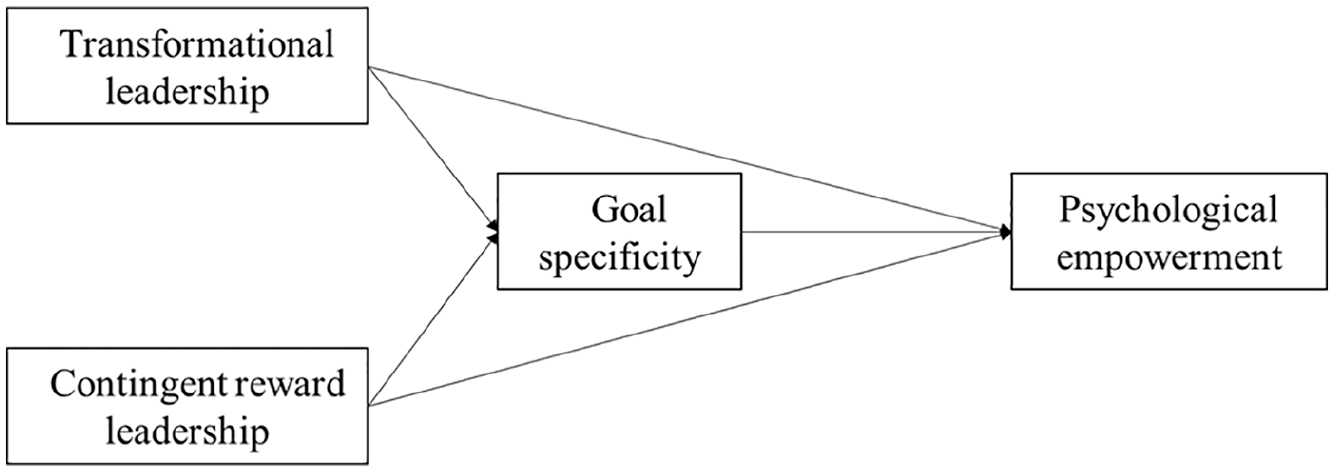
Proposed research model.
Literature Review
Transformational and Transactional Leadership and Psychological Empowerment
Although there is a vast array of leadership theories and approaches to study leadership, Bass and Avolio (1990)’s conceptualization of transformational and transactional leadership is currently considered to be one of the most widely used approaches (Jensen et al., 2019). This approach conceptualizes transformational leadership as a set of interrelated behaviors, including idealized influence (i.e., being a source of inspiration for followers by serving as a role model), inspirational motivation (i.e., providing a compelling vision and sense of purpose about what is to be accomplished), intellectual stimulation (i.e., stimulating followers to see new perspectives and find new ways to solve problems), and individual consideration (i.e., focusing on the individual needs of followers). By engaging in these behaviors, transformational leaders focus on employees’ higher-level needs (Jensen et al., 2019), encouraging them to exert extraordinary efforts and achieve extraordinary goals on behalf of the organization (Bass, 1985).
Alternatively, transactional leadership focuses on exchange behaviors that involve positive rewards (either pecuniary or nonpecuniary) for above average effort/performance and/or sanctions for below average effort/performance. Transactional leadership comprises two dimensions: contingent reward (i.e., clarifying what followers need to do to be rewarded and providing rewards for good performance) and management by exception (i.e., monitoring performance and taking corrective action when problems arise, including sanctioning employees for poor performance; Bass, 1999).
Although the original conceptualization of psychological empowerment as a set of four cognitions was developed by Thomas and Velthouse (1990), Spreitzer (1995) is generally credited with developing the first instrument to measure the four dimensions. In operationalizing psychological empowerment, she defined psychological empowerment as “increased intrinsic task motivation manifested in a set of four cognitions reflecting an individual’s orientation to his or her work role: competence, impact, meaning, and self-determination” (p. 1443). Spreitzer (1995) defined competence in terms of feelings of self-efficacy, that is, a belief that one is capable of successfully performing a task; impact as the degree to which an individual believes his or her work makes a difference in achieving the task or that he or she can influence organizational outcomes; meaning as the weight an individual places on a task based on his or her personal standards; and self-determination (choice) as a belief that one has autonomy in making decisions about one’s work.
As noted above, Seibert et al.’s (2011) meta-analysis found a positive association between transformational leadership and psychological empowerment. Interestingly, Dust et al. (2014) found an overall positive association between transformational leadership and psychological empowerment, but found that the relationship was stronger in organizations characterized as having more organic, rather than mechanistic, structures. In addition, several public administration scholars have focused on the critical role of transformational leadership in motivating employees. For example, Paarlberg and Lavigna (2010) emphasized the importance of transformational leaders’ roles in creating work structures that lead to employee empowerment. Likewise, in discussing the psychological mechanisms through which transformational leadership can stimulate employees’ intrinsic motivation and public service motivation, Jensen and Bro (2017) suggested that transformational leadership can help satisfy individuals’ basic psychological needs for autonomy, competence, and relatedness, which are closely related to the construct of psychological empowerment.
While research has generally found that transformational leadership positively influences both performance and attitudinal variables, research on transactional leadership is more mixed. In general, leadership scholars have found contingent reward leadership to be effective in some circumstances (Avolio, 1999; Bass & Avolio, 1994; Jacobsen & Andersen, 2017; Lowe et al., 1996), whereas management by exception has not been consistently found to be either effective or ineffective (Bass & Avolio, 1994). In addition, some public administration scholars have raised concerns regarding the applicability of transactional leadership to the public context, arguing that transactional leadership inhibits public sector employees’ motivation and performance (Moynihan, 2010), and some have found that pecuniary rewards can have negative effects in public organizations (Jensen et al., 2019). Interestingly, Jacobsen and Andersen (2017) found that use of nonpecuniary contingent rewards can be effective for increasing employees’ self-efficacy (closely related to feelings of competence) because they provide positive feedback on performance, but that the use of sanctions had no effect on self-efficacy in their study. Other studies have specifically examined the relationship between transactional leadership and empowerment (e.g., Khanmohammadi & Mohseni, 2010) and found a positive relationship. For example, Zhu et al. (2012) found that contingent reward behavior can positively influence followers’ feelings of empowerment through a better understanding of the value of their job, suggesting that followers may consider contingent reward leadership behaviors as a positive exchange relationship that leads them to feel that their work is meaningful and has an impact. Given these findings, this study examines only the influence of the contingent reward dimension of transactional leadership, and focuses specifically on nonpecuniary contingent rewards.
Although research has generally shown that transformational leaders put greater emphasis on motivation (e.g., Wright et al., 2012) than transactional leaders do, based on the theoretical arguments and empirical evidence, we expect that both transformational and transactional leader behaviors motivate employees and generate feelings of psychological empowerment.
Transformational and Transactional Leadership and Goal Specificity
Goal setting theory has been studied extensively in the psychology and business disciplines (Locke & Latham, 1990, 2002). As one aspect of goal setting theory, goal specificity (goal clarity), has received much attention from public management scholars who have examined organizational goal setting and goal ambiguity in the public sector (e.g., Chun & Rainey, 2005; Davis & Stazyk, 2015; Jung, 2014a, 2014b; Jung & Lee, 2013; Rainey & Jung, 2015; Stazyk et al., 2011; Stazyk & Goerdel, 2011; Wright, 2004). In particular, these scholars have considered organizational goal specificity to be a significant factor influencing employee and organizational performance, arguing that clear goals help employees define and set performance expectations, and help them see the connections between their actions and their organizations’ broader mission (Pandey & Wright, 2006; Stazyk et al., 2011; Stazyk & Goerdel, 2011; Wright, 2004).
Public administration scholars have demonstrated that transformational leadership increases goal specificity/clarity (e.g., Caillier, 2016; Moynihan, Pandey, & Wright, 2012; Moynihan, Wright, & Pandey, 2012; Wright et al. 2012). For example, Caillier (2016) explained the relationship between transformational leadership and goal clarity based on role theory (Kahn et al., 1964). Describing goal clarity as “the polar opposite of role ambiguity” (Caillier, 2016, p. 886), Caillier argued that transformational leadership practices (e.g., articulating a clear vision, encouraging, and mentoring) are important for improving goal clarity and reducing role ambiguity. In addition, Paarlberg and Lavigna (2010) noted the importance of transformational leaders’ roles in setting clear and important public service goals. Likewise, Moynihan, Pandey, and Wright (2012, p. 143) argued that transformational leaders “set the table” for implementing reforms through goal clarity and building a developmental culture.
While most studies examining the leadership–goal specificity relationship have only explored the impact of transformational leadership, some leadership scholars suggest that transactional leadership is also important for employee attitudes. Indeed, according to Bass’ (1985) conceptualization of transactional leadership, contingent reward leadership focuses on in-role performance, clarifying followers’ goals and expectations, and establishing the rewards for meeting these expectations. Thus, transactional leaders are expected to provide direction regarding the specific goals to be achieved.
Although most public management research on leadership and goal specificity has examined either transformational leadership or public managers’ style, more generally, Jacobsen and Andersen (2017) argue that, as a dimension of transactional leadership, contingent rewards can function as a mechanism that clarifies for employees the organizational or work unit goals as well as their contributions to these goals and that transactional leadership might be effective if this leadership strategy provides “an extra necessary signal” (p. 254). Interestingly, Jacobsen and Andersen (2017) note that one expected benefit of contingent rewards—that employees may exert more effort when they expect extrinsic rewards—is not applicable in the public sector because public employees tend to be intrinsically motivated. They also note that because performance of public services is often difficult to measure and so employee efforts and organizational performance are not necessarily connected, the key premise of transactional strategies is generally not appropriate in public organization settings. Nevertheless, as noted above, their findings show that use of nonpecuniary contingent rewards is effective for increasing employees’ self-efficacy because it provides positive feedback on performance.
Given the theoretical arguments and empirical evidence cited above, this study posits that both transformational and transactional leadership will positively influence employees’ perceptions of goal specificity. While the empirical evidence directly focusing on the relationship between transactional leadership and goal specificity is limited, the strong theoretical basis for this relationship suggests the importance of extending the body of evidence.
The Impact of Goal Specificity on Psychological Empowerment
Moynihan et al. (2014) note that “clear organizational goals cascade to the job level by focusing attention and resources on what individual employees need to do to achieve organizational goals” (p. 95). Given that public sector organizations often face ambiguous goals (Chun & Rainey, 2005), it is important to consider whether goal specificity can be enhanced in these organizations, and whether it has an impact on employees’ motivation.
In general, goal setting and goal specificity have received much attention within research on such motivation-related variables as self-efficacy, intrinsic motivation, beliefs about control over one’s work environment, and job autonomy (e.g., Bronkhorst et al., 2015; Wright, 2004, 2007), most of which arguably overlap with the definition and nature of psychological empowerment. Indeed, a review of the goal setting literature indicates that a positive evaluation of goal specificity is vital for feelings of employee motivation. Employees who have a specific job goal tend to exhibit high levels of self-efficacy (Wright, 2004, 2007). Moreover, numerous studies have found that specific goals can inspire individuals to exert higher levels of effort, even when they find the goal to be challenging (Latham et al., 2008; Locke & Latham, 2002).
Focusing specifically on public sector organizations, Bronkhorst et al. (2015), Taylor (2013), Van der Hoek et al. (2018), and Wright (2004, 2007) have emphasized the mechanisms and processes by which goal setting leads to positive employee attitudes and behaviors such as psychological empowerment. In addition, in a sample of Australian federal agencies, Taylor (2013) found that employees who perceive their work goals as more specific report stronger feelings of empowerment. When goals are specific, leaders can give employees more autonomy and when employees understand fully what they are expected to accomplish on their job, the work may be more meaningful to them. Thus, goal specificity appears to be linked to feelings of psychological empowerment, and we expect goal specificity to be an important antecedent of feelings of psychological empowerment:
The Mediating Role of Goal Specificity in the Leadership–Empowerment Relationship
The literature presented above presents empirical evidence that both transformational and transactional leadership influence goal specificity and that goal specificity may influence psychological empowerment, suggesting that goal specificity may be a mediator variable in the relationship between leadership and psychological empowerment. To explain this relationship from a theoretical perspective, we draw on organizational support theory (Eisenberger et al., 1990; Rhoades & Eisenberger, 2002), which argues that employees form “a general perception concerning the extent to which the organization values their contributions and cares about their well-being” (Eisenberger et al., 1990, p. 51). When transformational leaders articulate an appealing vision and focus on achieving attractive goals (Schmitt et al., 2016), employees are more likely to perceive favorable working conditions, based on the support and guidance they receive from the leader to help them achieve their goals, which in turn will make it more likely that employees will exert more effort and experience their tasks as meaningful (Aryee et al., 2012), a dimension of empowerment. Furthermore, because transformational leaders motivate followers through articulating a vision and a mission and connecting the followers’ efforts and goals to the work unit’s values (Shamir et al., 1993), employees may see the impact of their work in organizational outcomes, also a dimension of empowerment. Alternatively, contingent reward leaders pay attention to identifying followers’ needs, desires, and their capabilities so that they can provide motivationally relevant rewards (Zohar, 2002). When transactional leaders provide specific goals, employees are more likely to experience self-efficacy (competence) and meaning, two dimensions of empowerment. Given the theoretical and empirical justification, we hypothesize as follows:
Method
Sample
Data for this study were obtained from full-time professional employees working in a large state government in the United States via a self-administered web-based survey. The survey assured participants that participation was voluntary, and that all data would remain confidential. An email letter including a link for the survey was sent to state government employees through their union’s listserv (approximately 50,000 union employees), and 824 employees responded to the survey. Although the exact response rate cannot be determined (because this listserv is not updated on a daily basis), the email list administrator (a union employee) indicated that this response rate was above average for membership surveys of this type. Moreover, this individual noted that a large number of the email accounts (which must be private, rather than work, accounts) are not checked frequently or are not accurate (at least 50%). Thus, the actual response rate is likely substantially higher than the ratio of respondents to union members. 1
Survey respondents represent a variety of job areas (e.g., auditing/accounting, counseling and social work, general administration, health care delivery, information and computing technology, research and policy analysis). A majority of participants (86%) were White/Caucasian; respondents were balanced fairly equally between male (43%) and female (57%). More than 80% had at least a bachelor’s degree, and 45% had supervisory status. The mean age was 51 years, and the average tenure was 18 years.
Measures
All survey measures used a 5-point Likert-type scale ranging from 1 = strongly disagree to 5 = strongly agree, except for the measure of transformational and transactional leadership, which ranged from 1 = not at all to 5 = frequently, if not always used. Items used to measure the major variables are included in Appendix A.
Goal specificity (α = .77) examines the extent to which employees’ job requirements are specific and well understood. The measure was based on Wright’s (2004) adaptation of Locke and Latham’s (1990) Goal Setting Questionnaire, it has been used in previous studies (e.g., Bronkhorst et al., 2015; Taylor, 2013), and focuses on employees’ jobs, in general, rather than on any task-specific goal (Wright, 2004).
Psychological empowerment (α = .85) was assessed using Spreitzer’s (1995) 12-item scale, which measures individuals’ perceptions (cognitive states) of empowerment based on the dimensions of meaning, competence, self-determination, and impact. These dimensions capture a cognitive state achieved when employees perceive that they are empowered (Maynard et al., 2012). Prior research has shown that measures of each of the four dimensions have adequate alpha estimates and load onto a single second-order factor (Seibert et al., 2011; Spreitzer, 1995). In this study, coefficient alphas for the individual scales were .92, .82, .85, and .75, respectively. In line with Spreitzer’s (1995) conceptualization of psychological empowerment, Seibert et al.’s (2011) meta-analysis indicates that “the unitary or global psychological empowerment construct was at least as strongly related to outcomes as any of the subdimensions” (p. 995). Following these studies, this study combined the four scales into one higher-order factor.
Transformational and transactional leadership
To measure transformational and transactional leadership, the Multifactor Leadership Questionnaire (MLQ-5X short version; Bass & Avolio, 1990) was used. 2 Transformational leadership (α = .95) was measured using four subscales—idealized influence, inspirational motivation, intellectual stimulation, and individualized consideration. In this study, coefficient alphas for the individual scales were .87, .86, .89, and .77, respectively. This study combined the four scales into one higher-order factor. Contingent reward leadership (α = .82), a dimension of transactional leadership, was measured with three items. Employees were asked to evaluate how frequently their direct supervisor engages in transformational and contingent reward leadership behaviors. 3
Finally, this study controls for employees’ demographic characteristics that may influence employee psychological empowerment. For example, greater tenure may affect individuals’ feelings of empowerment (Seibert et al., 2011). Thus, respondents’ gender, education level, years of agency employment, and job area (e.g., auditing/accounting, budgeting and finance, and criminal justice and investigation) are included as control variables.
Data Analyses
To test the expected factor structure of the main study variables, confirmatory factor analysis (CFA) was first conducted. Then, to test the hypotheses that (a) leadership is related to psychological empowerment, (b) leadership is related to goal specificity, (c) goal specificity is related to psychological empowerment, and (d) goal specificity mediates the relationship between leadership and empowerment, this study employed structural equation modeling (SEM). Furthermore, the significance of indirect effects was tested using a bootstrap approach to calculate 95% bias-corrected bootstrap confidence intervals (CIs) of standardized indirect effects.
Results
Measurement Model Analysis
Table 1 provides descriptive statistics, correlations, and scale reliabilities for the major variables of this study. Measures for each of the key variables and standardized factor loadings are presented in Appendix A. As seen in Appendix A, the CFA results indicate that factor loadings of all indicators significantly loaded on their intended latent factor (i.e., standardized loadings ranged from .512 to .912, p < .001) (see Note 3).
Means, Standard Deviations, and Correlations.
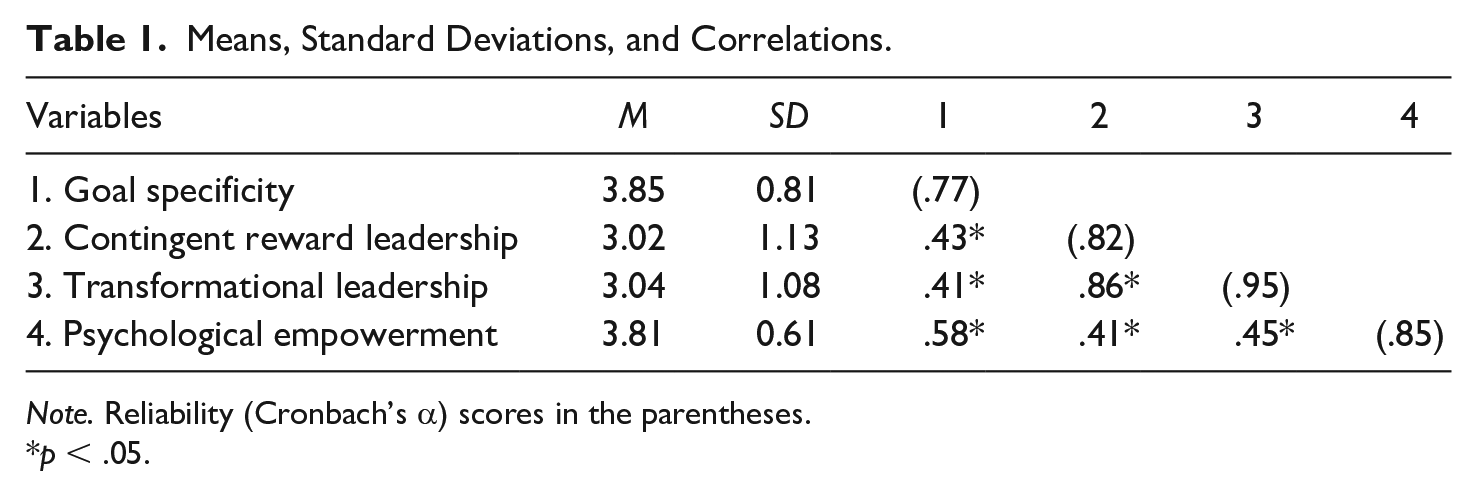
Note. Reliability (Cronbach’s α) scores in the parentheses.
p < .05.
Next, we conducted CFAs to compare our hypothesized four-factor model (transformational leadership, contingent reward leadership, goal specificity, and psychological empowerment) to a series of plausible alternative nested models. As presented in Table 2, results indicated that the hypothesized model (Model D) was acceptable to continue with hypothesis testing, χ2(382) = 792.479, p < .05, root mean square error of approximation (RMSEA) = .043, normed-fit index (NFI) = .939, Tucker–Lewis index (TLI) = .963, and comparative fit index (CFI) = .967.
Results of Confirmatory Factor Analysis.
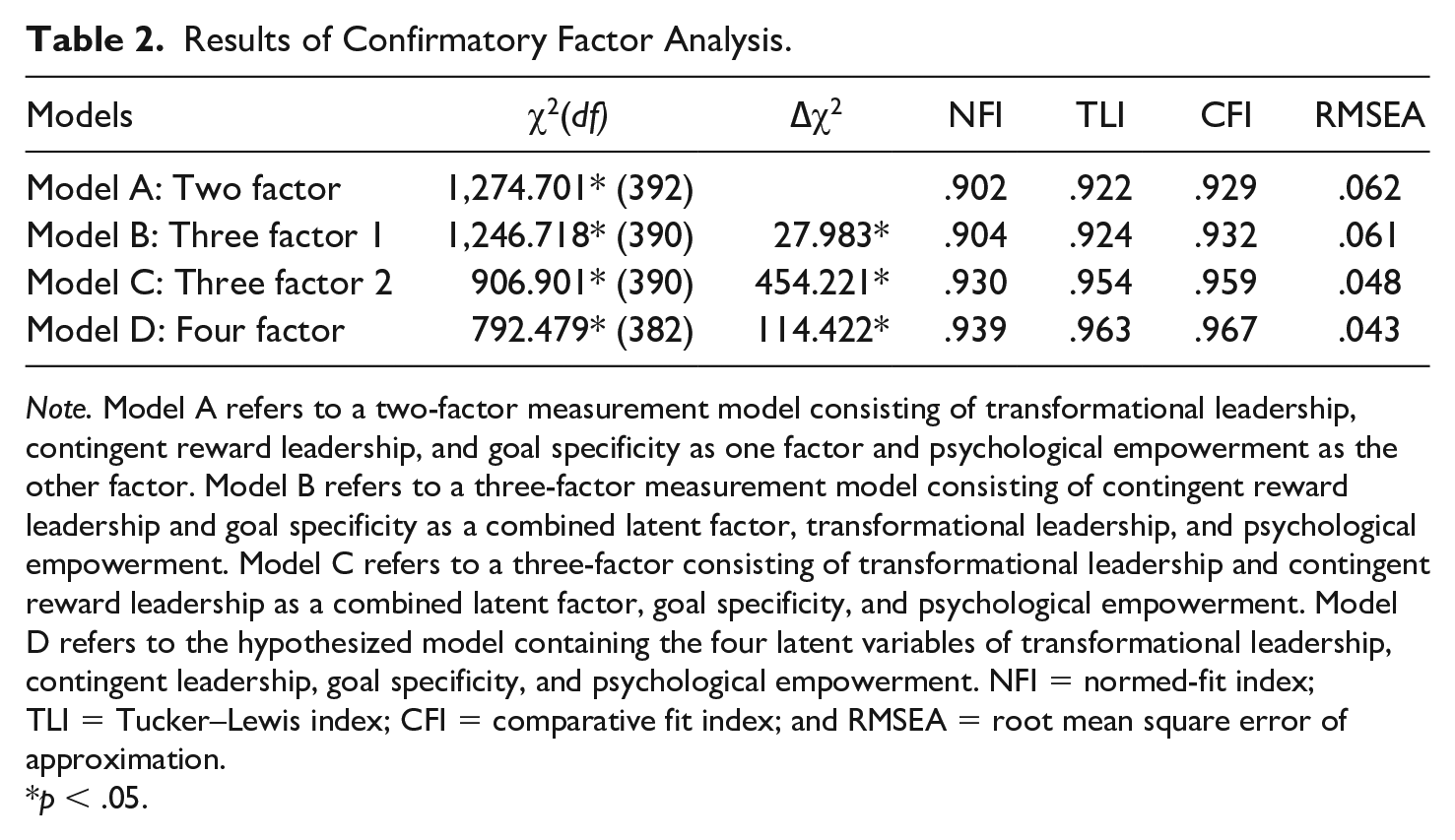
Note. Model A refers to a two-factor measurement model consisting of transformational leadership, contingent reward leadership, and goal specificity as one factor and psychological empowerment as the other factor. Model B refers to a three-factor measurement model consisting of contingent reward leadership and goal specificity as a combined latent factor, transformational leadership, and psychological empowerment. Model C refers to a three-factor consisting of transformational leadership and contingent reward leadership as a combined latent factor, goal specificity, and psychological empowerment. Model D refers to the hypothesized model containing the four latent variables of transformational leadership, contingent leadership, goal specificity, and psychological empowerment. NFI = normed-fit index; TLI = Tucker–Lewis index; CFI = comparative fit index; and RMSEA = root mean square error of approximation.
p < .05.
Because all data on goal specificity, transformational and contingent reward leadership, and psychological empowerment were self-reported using a single questionnaire, it is possible that the rather strong links among predictor variables and employee attitude variables are partly a consequence of common method variance (CMV). Following Podsakoff et al. (2003) recommendations, two tests—the unmeasured latent methods factor technique (i.e., single-common-method-factor-approach) and Harman’s single factor test—were conducted to determine if CMV is a problem with this data set. 4
Hypothesis Testing
To test the hypotheses, results of the SEM analyses were examined. As seen in Table 3, the SEM indicated that transformational leadership was positively associated with psychological empowerment (β = .357, p < .05), which supports H1a. Results also showed that goal specificity was positively related to psychological empowerment (β = .474, p < .05), providing support for H3. H2a was supported, as results showed a significant positive relationship between transformational leadership and goal specificity (β = .510, p < .05). Table 4 shows the SEM result with respect to the relationship between contingent reward leadership and psychological empowerment. H1b, which states that contingent reward leadership is positively associated with psychological empowerment, was supported (β = .323, p < .05). Furthermore, H2b was supported as results showed a significant positive relationship between contingent reward leadership and goal specificity (β = .563, p < .05).
Standardized Direct, Indirect, Total Effects for Transformational Leadership.
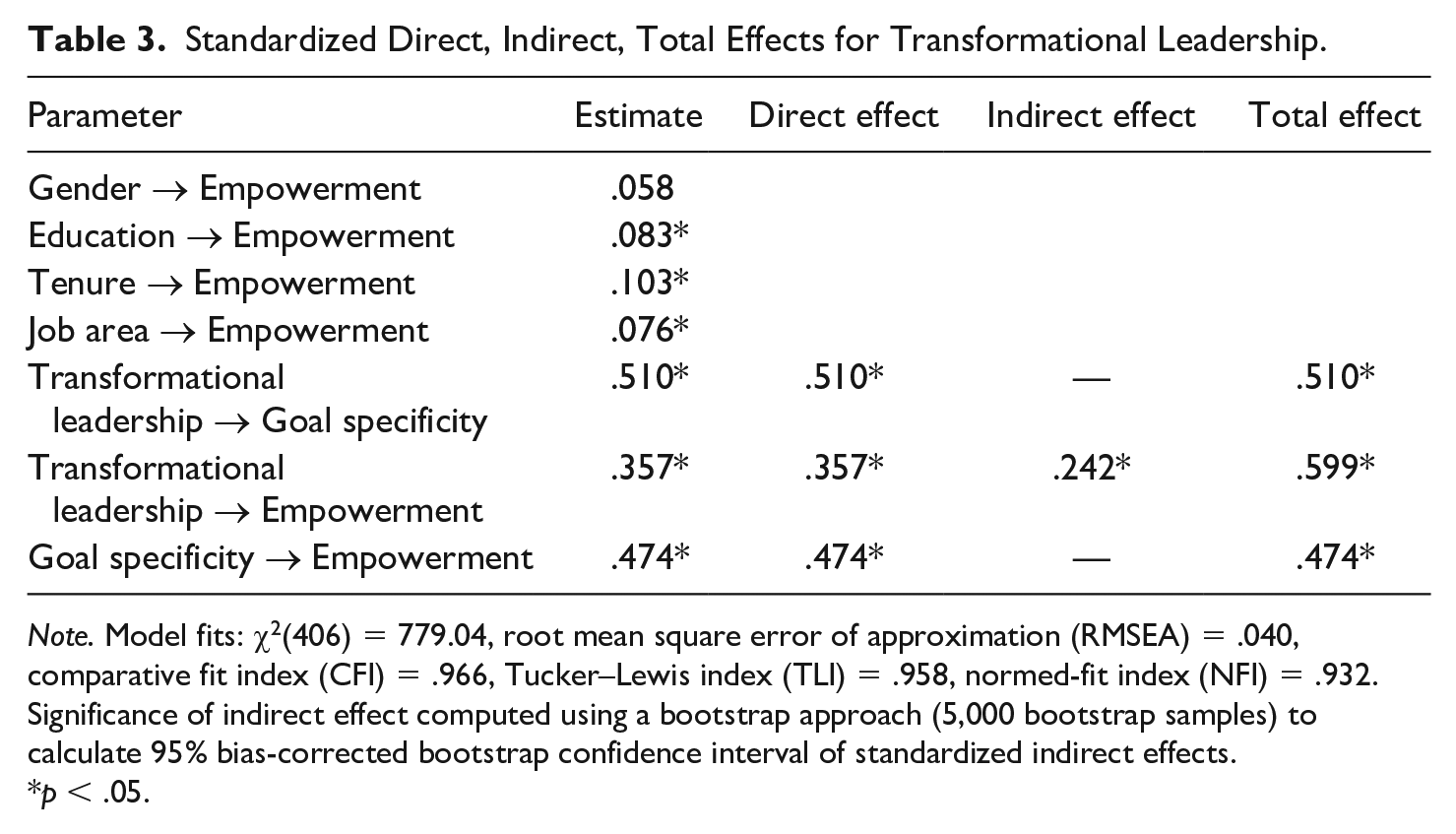
Note. Model fits: χ2(406) = 779.04, root mean square error of approximation (RMSEA) = .040, comparative fit index (CFI) = .966, Tucker–Lewis index (TLI) = .958, normed-fit index (NFI) = .932. Significance of indirect effect computed using a bootstrap approach (5,000 bootstrap samples) to calculate 95% bias-corrected bootstrap confidence interval of standardized indirect effects.
p < .05.
Standardized Direct, Indirect, Total Effects for Contingent Reward Leadership.
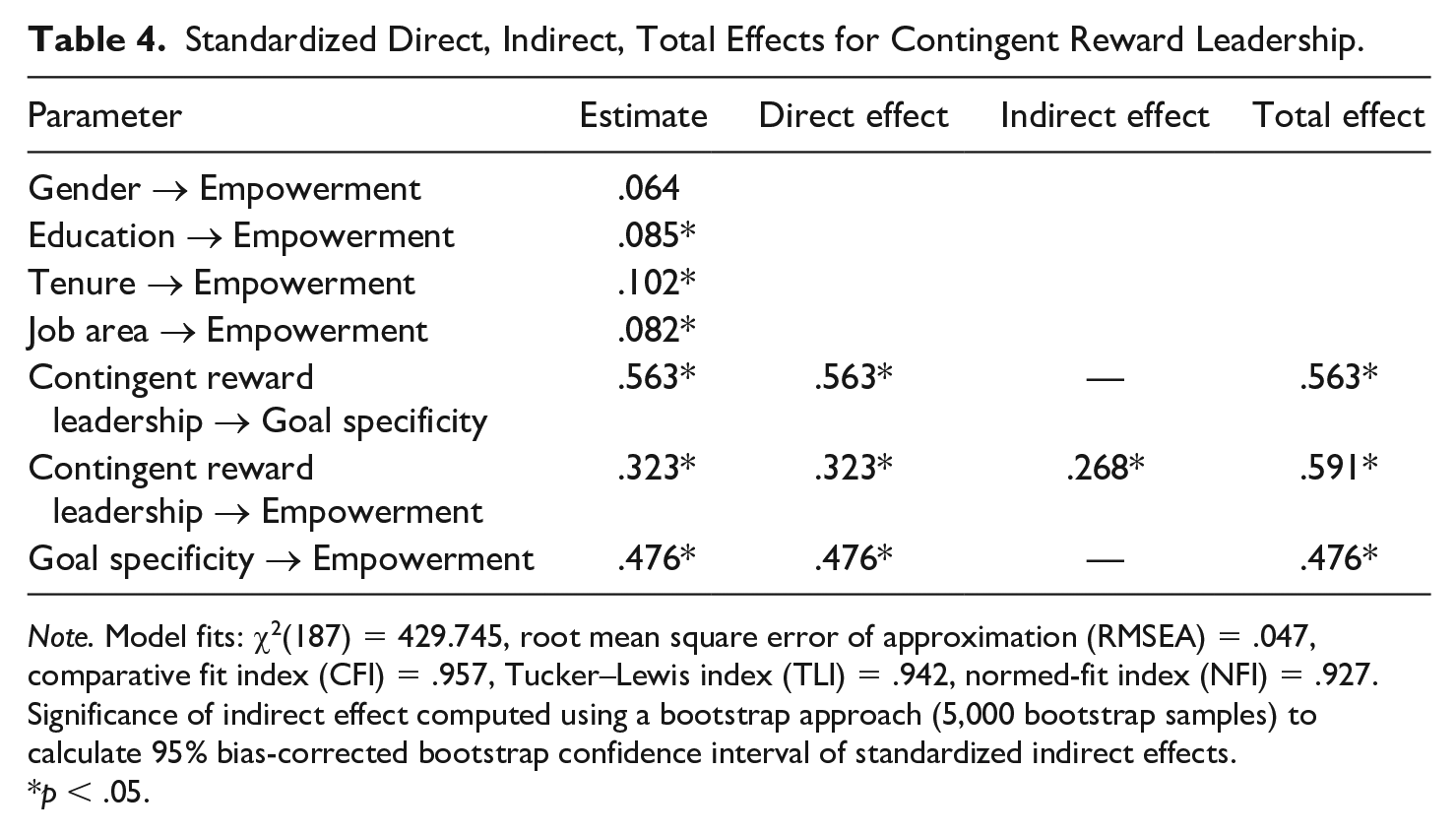
Note. Model fits: χ2(187) = 429.745, root mean square error of approximation (RMSEA) = .047, comparative fit index (CFI) = .957, Tucker–Lewis index (TLI) = .942, normed-fit index (NFI) = .927. Significance of indirect effect computed using a bootstrap approach (5,000 bootstrap samples) to calculate 95% bias-corrected bootstrap confidence interval of standardized indirect effects.
p < .05.
To test the mediation hypotheses, bootstrap procedures in AMOS (using 5,000 bootstrap samples) were used to calculate 95% bias-corrected bootstrap CIs of standardized indirect effects. As shown in Table 3, results demonstrated that goal specificity mediates the relationship between transformational leadership and psychological empowerment (indirect effect = .242, standard error = .038, 95% CI = [.179, .328]), thereby supporting H4a. The direct effect of transformational leadership on empowerment (absent of goal specificity) was reduced while remaining significant when goal specificity was added to the model. This indicates that the relationship between transformational leadership and empowerment was partially mediated by goal specificity. Table 4 shows that the relationship between contingent reward leadership and psychological empowerment was mediated by the goal specificity (indirect effect = .268, SE = .045, 95% CI = [.194, .369]). Thus, H4b was supported. The direct effect of contingent reward leadership on empowerment (absent of goal specificity) was reduced while remaining significant when goal specificity was added to the model. This also indicates that the relationship between contingent reward leadership and empowerment was partially mediated by goal specificity.
Discussion
Results of this study show that a more refined model of transformational and transactional leadership better predicts goal specificity and psychological empowerment, indicating the importance of examining both types of leadership in goal setting research focusing on public sector organizations. Most importantly, for both scholars and practitioners, the model reinforces the value of both transformational and contingent reward leadership styles. This study has several theoretical implications regarding transformational and transactional leadership, goal specificity, and psychological empowerment.
Theoretical Implications
The first contribution of this research is the finding that highlights that goal specificity mediates the relationship between leadership and psychological empowerment. Prior research has noted that public organizations are susceptible to goal ambiguity and so emphasized the importance of clear goals (e.g., Chun & Rainey, 2005; Jung, 2014a, 2014b; Rainey & Jung, 2015). Although some public administration scholars have attempted to identify factors that influence goal ambiguity and job-level goal specificity in the public sector (e.g., Davis & Stazyk, 2015), none have examined goal specificity as a mediator in the relationship between leadership behaviors and psychological empowerment. While there is a vast literature, mostly outside the field of public administration, that has examined the relationship between transformational leadership and psychological empowerment, and a more limited literature linking transactional leadership to psychological empowerment, this study shows the importance of goal specificity as a linking mechanism between both transformational and transactional leadership and psychological empowerment. Moreover, this study examined these relationships using a sample of state government employees, and thus confirms the relevance of prior theories from the fields of psychology and business regarding the leadership–psychological empowerment and goal specificity–psychological empowerment relationships.
The second contribution of this research is the examination of transactional leadership in addition to transformational leadership in the study of goal specificity and empowerment. As noted above, most of the public administration literature that examines the relationship between leadership and goal specificity has focused on transformational leadership only. Our finding adds to the public administration literature that examines the positive effect of transactional leadership, specifically contingent reward leadership, on motivation (Jacobsen & Andersen, 2017) by examining goal specificity as a mediator between contingent rewards transactional leadership and empowerment. Although previous studies (e.g., Bass, 1985) note that transformational leadership seems to be more effective than transactional leadership in promoting follower motivation, this study suggests that contingent reward transactional leadership may be more effective than transformational leadership in facilitating goal specificity (as indicated in the β coefficients in Tables 3 and 4). Interestingly, although scholars have frequently contrasted the positive effects of transformational with the less beneficial effects of transactional leadership, the present study suggests that contingent reward transactional leadership may have a stronger impact on goal specificity than transformational leadership does and that the role of transactional leadership in promoting goal specificity should not be overlooked.
Related to this, our findings suggest the importance of investigating the interaction effect of transformational and transactional leadership with regard to goal specificity. While some previous studies have examined the interacting effect of the two leadership behaviors (e.g., Vecchio et al., 2008), most of these studies have been conducted outside the public sector or not considered goal setting variables. It would be valuable to examine the interaction effect of transformational and transactional leadership on goal specificity and attitudinal outcomes in the public sector using a moderated mediation model where the interaction between transformational and transactional leadership is hypothesized to predict goal specificity, which in turn influences psychological empowerment.
Practical Implications
Results of this study also suggest some important implications for public sector managers. In particular, managers need to consider whether employees understand organizational and job-related goals (goal specificity). If employees do not understand these goals, managers may need to work more closely with these employees and, in some cases, revise job goals to ensure that this situation does not lead to lower levels of empowerment. By clarifying goals and clearly identifying tasks, roles, and rewards, leaders may help employees develop stronger feelings of psychological empowerment.
Goal setting theory suggests a variety of leadership behaviors that can be used to enhance employee motivation and performance (Locke & Latham, 1990, 2002). Findings from this study suggest that public managers should consider how developing both their transformational and transactional leadership behaviors might enhance their abilities to develop their employees’ psychologically empowerment when implementing motivation programs that involve goal setting. More importantly, the findings of this study show that transactional leadership, as well as transformational leadership, is effective in increasing goal specificity, thus suggesting that transactional leadership should sometimes be encouraged.
Findings from this study also potentially support the utility of training and development efforts designed to enhance the effect of goal setting in the workplace. For example, managerial-level training programs can help managers enhance their ability to work with employees to develop appropriate work goals. Similarly, employee-level training programs can help employees develop a stronger understanding of the meaningfulness of their goals, which might inspire them to work harder toward goal attainment. Such programs might also increase employees’ feelings of empowerment, which, in turn, would foster and develop their performance behaviors over time.
Limitations and Areas for Future Research
In considering the contributions and implications of this study, some limitations must be acknowledged. First, the age distribution of the sample may be a bit skewed toward an older population (i.e., mean age of respondents was 51 years) and so may not necessarily reflect views of younger generations. Future research might consider whether generational differences exist with respect to goal setting and psychological empowerment. For example, future research might separate generation groups (e.g., twenties–thirties vs. forties–fifties) to investigate the effect of generation on the leadership–goal specificity attitudes relationship.
Second, this study used a cross-sectional survey, which requires us to be cautious in drawing any conclusions regarding causality (Maxwell & Cole, 2007). For example, it may be that employees who feel empowered in their work—that is, believe their work is meaningful and impactful—may perceive higher levels of goal specificity. Thus, the relationships that emerged in this study should be understood as correlational in nature. To address this concern, future studies should attempt to collect data at multiple time periods (e.g., outcome variables could be examined at a later date) or perhaps data could be collected before and after managers have participated in training related to goal setting.
Third, this study uses only self-report measures. As noted above (and described in Note 4), two tests were conducted following Podsakoff et al.’s (2003) recommendations to test CMV. While the results of the unmeasured latent methods factor technique indicated that the methods factor did not influence a substantial amount of variance in the model and the Harman test indicated that the data analysis could proceed without concern for CMV, it has been often argued that Harman’s single factor test is not sufficient to address this potential problem (Jakobsen & Jensen, 2015; Podsakoff et al., 2003). Thus, there is some possibility that the magnitude of the relationship in the hypothesized model may be inflated. However, a recent study by George and Pandey (2017) has demonstrated that the argument that correlations between variables measured by the same source are always inflated is not supported by empirical evidence. In addition, George and Pandey (2017) noted that because some individual-level variables are perceptual by their nature (e.g., outcomes such as organizational commitment), it may be most appropriate to use self-reported measures. Similarly, Podsakoff et al. (2012) argue that relying on measures from same sources may be appropriate “when both the predictor and criterion variables are capturing an individual’s perceptions, beliefs, judgments, or feelings” (p. 549). Our variables—leadership behaviors, goal specificity, and psychological empowerment—examine employee’s perceptions and attitudes, and thus may be best captured by individual self-report. In spite of the notion that a survey (even a single source survey) may still be an appropriate approach for this study (George & Pandey, 2017; Podsakoff et al., 2012), we acknowledge that the potential CMV issue could not be completely ruled out for this study. To reduce the concern, future studies might attempt to use the practices recommended by Podsakoff et al. (2012), such as procedural remedies, and use more rigorous research designs by obtaining data from different sources (e.g., supervisors and employees) or at multiple time periods using a panel data design (Jakobsen & Jensen, 2015).
Fourth, this study measured transformational and transactional leadership using the MLQ (Bass & Avolio, 1990). Although many organization scholars have used this instrument in their research on leadership, Jensen et al. (2019) identify several theoretical and methodological shortcomings of existing conceptualizations and measures of transformational and transactional leadership, arguing that they have unclear theoretical bases, confound leadership and its effects, and are not necessarily suitable for public organizations. It would certainly be worthwhile for future research to use the revised conceptualizations and measures of transformational and transactional leadership suggested by Jensen et al. (2019), which offer more parsimonious conceptual and operational constructs and have been shown not to confound cause and effect, to test the impact of leadership on public sector employee work outcomes. In conducting a similar study using Jensen et al.’s (2019) conceptualizations and measures, we could determine the validity of this study’s findings.
Finally, although this study did not examine the four empowerment dimensions (self-determination, meaning, importance, and competence) separately, some literature has treated empowerment as a multidimensional construct and found that some work design characteristics are more likely to influence certain dimensions of psychological empowerment than others (e.g., Gagné et al., 1997; Liden et al., 2004). Although, as noted above, Seibert et al.’s (2011) meta-analysis supports Spreitzer’s conceptualization of psychological empowerment as a single second-order construct, future research might examine whether goal specificity has differential impacts on the four individual dimensions of empowerment.
Conclusion
Evidence for the relationships between both transformational and transactional leadership and employees’ perceptions of goal attributes and feelings of psychological empowerment is scarce. The purpose of the present study was to shed more light on these relationships by examining goal specificity as a mediator variable and psychological empowerment as a consequence variable. Using a sample of state government employees, this study tested a theoretical model that drew on several established theoretical frameworks—leadership theory, goal setting theory, and psychological empowerment—and found that goal specificity mediated the relationship between both transformational leadership and transactional leadership (contingent reward dimension) and employee feelings of psychological empowerment. This indicates that when employees’ supervisors exhibit transformational or contingent reward leadership behaviors, employees tend to have a greater sense of the meaning of their work goals and, ultimately, experience a greater sense of psychological empowerment. Given that the proposed hypotheses were generally supported by the analysis, this research contributes to our knowledge about leadership, goal setting, and empowerment by providing a more nuanced understanding of the motivational effects of leadership on goal setting. This research also highlights the importance of transformational and transactional leadership in facilitating goal specificity and creating empowerment experiences in public sector organizations.
Footnotes
Appendix
Exploratory Factor Analysis of Goal Specificity and Contingent Reward Leadership.
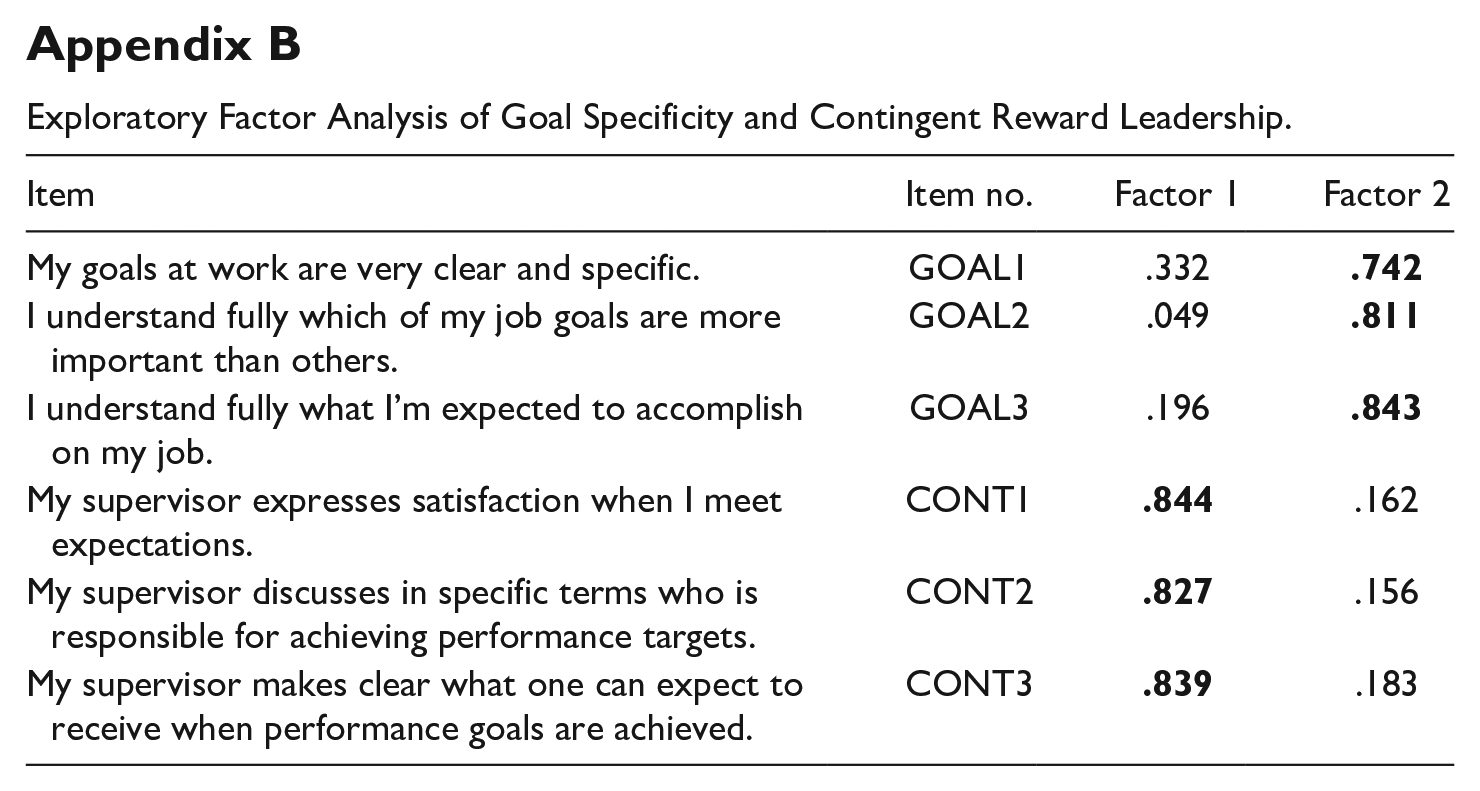
| Item | Item no. | Factor 1 | Factor 2 |
|---|---|---|---|
| My goals at work are very clear and specific. | GOAL1 | .332 |
|
| I understand fully which of my job goals are more important than others. | GOAL2 | .049 |
|
| I understand fully what I’m expected to accomplish on my job. | GOAL3 | .196 |
|
| My supervisor expresses satisfaction when I meet expectations. | CONT1 |
|
.162 |
| My supervisor discusses in specific terms who is responsible for achieving performance targets. | CONT2 |
|
.156 |
| My supervisor makes clear what one can expect to receive when performance goals are achieved. | CONT3 |
|
.183 |
Declaration of Conflicting Interests
The author(s) declared no potential conflicts of interest with respect to the research, authorship, and/or publication of this article.
Funding
The author(s) received no financial support for the research, authorship, and/or publication of this article.
