




Abstract
The rising nationwide concerns about violence targeting Asians have highlighted the scant research on Asian American police officers. This article aims to (re)introduce this important dialogue and calls for a commitment from other race and social equity scholars to extend the discourse on racial diversity in policing. Using data on race and ethnicity compiled by the Law Enforcement Management and Administrative Statistics survey, this article compares data from the largest 100 cities ranked by their respective Asian population percentage with the percentage of Asian police officers from those same cities to examine Asian diversity in policing. Analysis reveals that all the cities with the exception of five were underrepresented by Asian police officers, and that more work needs to be done by these police departments if they hope to reflect the diversity of the communities they serve.
Violence against Asian Americans is not new. The Chinese Exclusion Act of 1882—initially designed to suspend Chinese immigration for 10 years (although not repealed until 1943) and impede the naturalization of Chinese migrant workers due to economic, social, and cultural tensions—generated hundreds of riots and purges that left thousands of Chinese laborers and their families dead, wounded, or displaced (Pfaelzer, 2007). In addition, the passage of Executive Order 9066 (1942) at the onset of World War II authorized the arrest of nearly 122,000 men, women, and children of Japanese ancestry—an estimated 62% of whom were native-born U.S. citizens—and their subsequent internment at 10 isolated prison camps due to racist and prejudicial war hysteria (Anderson, 2020). Furthermore, after the Vietnam War, refugees from Southeast Asia faced routine hate, and in 1982, Vincent Chin, a Chinese American, was murdered by two Detroit autoworkers who thought Chin was Japanese, during a period of economic decline that was partially blamed on the rise of the Japanese auto industry (Mineo, 2021).
More recently, the Atlanta-area killing spree on March 16, 2021, that killed eight people—six of them Asian women—coupled with countless attacks against Asian Americans as a result of the COVID-19 pandemic (e.g., “kung flu” and “China virus” rhetoric) represents the latest and a rising nationwide concern about violence targeting Asian Americans. In fact, according to a recent Pew Research Center survey, 32% of Asian adults feared someone might threaten or physically attack them, and 81% said violence against them is increasing, far surpassing any other race or ethnic group who said the same (Ruiz et al., 2021). Accordingly, the Center for the Study of Hate & Extremism (2021) found a 149% increase in anti-Asian hate crimes in 2020 alone, although the overall hate crimes regardless of the targeted identity dropped 7% in that same period. These statistics are problematic because research has also shown that Asians distrust law enforcement and may be afraid to report hate crimes (Thorbecke, 2021).
The latest violence in Georgia has renewed the #StopAsianHate and #StopAAPIHate hashtags that have taken over social media. However, the spokesman for the Atlanta-area shooting investigation—Captain Jay Baker from the Cherokee County Sheriff’s Office—stated in a press conference that the killings were “not racially motivated” and that the White suspect (Robert Long) “was pretty much fed up [and having] a really bad day” in response to the shooter’s motives (Kornfield & Knowles, 2021), prompting further outrage across the globe due to the dismissive tone against the Asian American community. The racial and cultural insensitivities were unmistakable, resulting in Baker’s subsequent removal from the domestic terrorism, murder, and hate-crime investigation (Kornfield & Knowles, 2021).
But should we be surprised? According to the Bureau of Justice Statistics (2020), the Cherokee County Sheriff’s Office employs 276 full-time sworn law enforcement officers (i.e., deputies) and they have zero Asian American deputies. If the Cherokee County Sheriff’s Office had any Asian American deputies, would the outcome be any different? That is more difficult to answer, but in light of the changing landscape of the general population—for example, Asians are the most diverse and fastest growing racial group in the country (Colby & Ortman, 2015; Gibson & Jung, 2002)—every law enforcement agency must do better to reflect the diversity of the communities they serve. However, there is scant research on Asian American police officers, with public administration being no exception. This study aims to fill this gap.
Using data on race and ethnicity compiled by the Law Enforcement Management and Administrative Statistics (LEMAS) survey, this study compares data from the largest 100 cities ranked by their respective Asian population percentage with the percentage of Asian police officers from those same cities. The main interest here is to examine Asian diversity in policing while creating a new baseline for Asian American scholarship in U.S. policing. In addition, this article extends the discourse on racial diversity in policing, employing symbolic representation to advocate for more racial minority police officers. To the best of author’s knowledge, this is only the second study that exclusively examines Asian American police officers.
The article is structured as follows. First, this article proceeds with a discussion on policing reforms and the current racial composition of local police departments. Next, this article provides a theoretical overview on why racial diversity in policing matters, followed by the research settings and results from the comparative analysis. Finally, the article concludes with a discussion on the barriers for recruiting more Asian police officers, as well as best practices and avenues for future research. The findings of this study have practical implications for all law enforcement agencies and may contribute to the increase of Asians in the police force. Drawing attention to their gross underrepresentation is a necessary step to achieving racial parity.
Police Reforms and Racial Diversity in Policing
The #BlackLivesMatter movement is responsible for the much-needed attention to policing reforms, underscored by the recent police killings of George Floyd (in Minneapolis, Minnesota, on May 25, 2020) and Breonna Taylor (in Louisville, Kentucky, on March 13, 2020), both African American victims. Accordingly, President Obama issued Executive Order 13684 (2014)—Establishment of the President’s Task Force on 21st Century Policing—arguably the most comprehensive criminal justice reform initiative since President’s Commission on Law Enforcement and Administration of Justice (1967) to strengthen community policing and promote effective crime reduction while building public trust. Many of the concerns in the Commission’s (President’s Commission on Law Enforcement and Administration of Justice, 1967) report still remain to this day, in particular the signature recommendation from the President’s Task Force on 21st Century Policing (2015, p. 16) which “strive[s] to create a [police] force that contains a broad range of diversity including race, gender, language, life experience, and cultural background to help improve [a police department’s] understanding and effectiveness in dealing with all communities.” Just to be clear, efforts for increasing racial diversity in policing have historically targeted African American officers, with attention recently given to Hispanic officers (Schroedel et al., 1994; Wang et al., 2019). Therefore, while there were calls for improving racial diversity in policing, these reform initiatives were never meant to include or increase Asian diversity. Regardless, this narrative is important because race and cultural insensitivities beyond the Black and Brown communities likely permeate in organizations that are predominantly White.
According to the Bureau of Justice Statistics, 71.5% of all local police officers are White (Hyland & Davis, 2019). However, the country’s general population is currently estimated at only 60.1% White (U.S. Census Bureau, 2019). For comparisons at the intergovernmental level, sheriffs’ offices and state law enforcement agencies are even worse, where 75.8% of all deputies and 83.9% of all patrol officers, respectively, are White (Brooks, 2019b; Bureau of Justice Statistics, 2020). Only federal law enforcement agencies appear to have achieved proportional representation with 62.1% of all federal officers (or agents) being White (Brooks, 2019a). These statistics—regardless of the intergovernmental level—are important because law enforcement is arguably the most visible public service institution in the country, and municipal police officers are often the public face of local government.
However, research on Asian police officers is scant. While there is basis for this omission—most of the literature on racial diversity in policing has concentrated on Black police officers (e.g., Rhodes & Tyler, 2021; Riccucci et al., 2018; Skolnick, 2008; White et al., 2010; Wilson et al., 2013)—very few scholarly articles and research reports were found in a literature review of racial minority police officers that focused primarily on Asian American police officers or as a minimum captured Asian officers as a separate demographic without combination to other race and ethnic groups (e.g., Baumgartner et al., 2021; Castaneda & Ridgeway, 2010; Maciag, 2015; Matthies et al., 2012; Schroedel et al., 1994; U.S. Department of Justice, 2016).
For example, Schroedel and colleagues (1994) were the first to systematically examine the employment of Asian American police officers, establishing their pervasive underrepresentation in local policing. At that time, the employment of Asian American men and women as sworn police officers [had] been largely ignored [despite] the U.S. Commission on Civil Rights [issuing] a series of reports [between 1976 and 1980] with titles that conveyed its intent: Asian Americans and Pacific Peoples: A Case of Mistaken Identity; The Forgotten Minority: Asian Americans in New York City; and Civil Rights Issues of Asian and Pacific Americans: Myths and Realities. (Schroedel et al., 1994, p. 174)
Their study of 70 police departments in Los Angeles County and Orange County—one of the largest concentration of Asians in the country—revealed the magnitude to which they were underrepresented. In other words, “a fraction of their presence in the population” (Schroedel et al., 1994, p. 176). Unfortunately, their ground-breaking study did not result in many subsequent studies that focused exclusively on Asian police officers.
In addition, the Bureau of Justice Statistics—the primary agency responsible for compiling statistics on law enforcement personnel regardless of the intergovernmental level—does not even report independent statistics on Asian American police officers, choosing instead to combine Asians, Native Hawaiians, other Pacific Islanders, American Indians, Alaska Natives, or persons of two or more races under an umbrella category of “Other” when describing race or ethnicity of sworn law enforcement personnel (Brooks, 2019a, 2019b; Hyland & Davis, 2019). While there may be basis for this approach (e.g., small sampling), discounting Asian American police officers in the literature and failing to report on their own race or ethnic category in the law enforcement census undercut a recurring anti-Asian sentiment in the United States.
Furthermore, as the most diverse racial group in the country, representing at least 24 national origins from East and Southeast Asia and the Indian subcontinent (Lee et al., 2018), and fastest growing—for example, Asians were 2.8% of the U.S. population in 1990, 3.6% in 2000, 5.9% in 2019, and are projected to increase to 8.2% in 2050 and again to 11.7% in 2060, respectively (Colby & Ortman, 2015; Gibson & Jung, 2002; U.S. Census Bureau, 2001, 2018, 2019)—more scholarship is needed on this rising demographic. For example, Chinese Americans (23%) are the largest Asian group in the United States, followed by Asian Indians (20%), Filipinos (18%), Vietnamese (9%), Koreans (8%), and Japanese (6%) (Budiman & Ruiz, 2021). The other Asian groups account for the remaining 15% (Budiman & Ruiz, 2021; Lee et al., 2018). However, each has its own migration histories, languages, and cultures (Budiman & Ruiz, 2021; Kiang et al., 2017), further complicating the cross-cultural differences between police and the Asian communities they serve. Finally, unlike other race or ethnic groups in the country, most Asians are foreign born (roughly two-thirds) and are forecasted to become the largest immigrant population in the United States, surpassing Hispanics by 2055 (Pew Research Center, 2015).
These projections are important because Asian communities—especially among Asian immigrant communities—do not always recognize differences among American police officers with those from their native countries (Daye, 1997; Voice of America, 2012). For example, in Fairfax County, Virginia, home to a growing Korean and Vietnamese population, some Asian residents believe it is common to bribe a police officer for small infractions, a crime that can get you arrested in the United States (Voice of America, 2012). Similarly, they also believe it is common to argue with police officers, an inappropriate and potentially threatening act in the United States with unintended consequences (Voice of America, 2012). While this is just one example of the experiences shared by one police department (i.e., Fairfax County Police Department), there are likely similar perceptions from other Asian communities around the country. Therefore, more scholarship is needed on this rising demographic. Considering these cross-cultural differences, the past couple of years have witnessed a rising nationwide concern about violence targeting Asians amid the COVID-19 pandemic and its impact on the nation.
Hate Crimes and Reporting
According to the Federal Bureau of Investigation (2020), more than half (57.6%) the victims of single-bias hate crime incidents were targeted due to their race, ethnicity, or ancestry. Although the official hate crime statistics for 2020 have not been released as of this writing, hates crimes in the United States reached its highest level in more than a decade in 2019, with anti-Asian hate bias increasing 29.4% from the previous year (Federal Bureau of Investigation, 2019, 2020). In comparison with other race and ethnic groups, anti-Asian hate bias had the second highest increase next to anti-Arab hate bias, which increased 36.8% from the previous year (Federal Bureau of Investigation, 2019, 2020). However, the overall percentages of hate bias regardless of the directional change from the previous year remained with anti-Black bias (48.5%) and anti-Hispanic bias (14.1%) (Federal Bureau of Investigation, 2020). Despite the overall figures, the increase in the reporting of anti-Asian hate crimes—more than 2,800 incidents between March and December 2020 (Stop AAPI Hate, 2021)—is of great concern.
However, the actual anti-Asian hate crime numbers are probably higher. Research has shown that Asians may be afraid to report hate crimes, or any crime for that matter, due to an overall lack of trust in government or law enforcement (Fifield, 2016; Leatherby & Oppel, 2020; Thorbecke, 2021; Wu, 2014). To illustrate, in many Asian communities—especially among foreign-born or first-generation Americans—many Asians immigrated to the United States to escape corrupt and oppressive governments (Daye, 1997; Fifield, 2016; Kawai, 2005; Thorbecke, 2021; Voice of America, 2012; Wu, 2014). As a result, government and law enforcement officials are seen as unsupportive and “often portrayed as corrupt, cold, brutal, disrespectful, and politically dangerous” (Daye, 1997, p. 35). Although many second- and third-generation Americans have come to learn that this image is false, this negative image still permeates across many Asian communities (Daye, 1997). Hence, many Asians will not trust police officers until they get to know them and respect them (Daye, 1997). Instead, they are likely to address issues on their own (Voice of America, 2012). In addition, “when [Asians] don’t have a clear representation of [Asian police officers] who have been hired to serve and protect [them], there’s a fear of reporting” (Contreras & Chen, 2021). Furthermore, language barriers—especially among immigrant communities of color and the elderly—are another reason hate crimes, or crimes in general, go unreported (Thorbecke, 2021; Wu, 2014). To explain, according to data collected by the U.S. Census Bureau, more than one-third of all Asians have limited English language proficiency (LEP), although nativity holds a strong relationship with language limitations. To illustrate, 47% of foreign-born Asians have insufficient English skills versus 9% of U.S.-born Asians. In addition, 70% of Asian Americans speak a language other than English at home. (Lee et al., 2018, as cited in Yu, 2020, p. 161)
Consequently, Asians with language barriers often need to enlist their family members or neighbors to serve as translators to report crimes, discouraging many Asians from even trying (Contreras & Chen, 2021). Furthermore, many Asians have been taught to “turn the other cheek” and not engage or report when attacked with anti-Asian rhetoric (Thorbecke, 2021). While the recent passage of the COVID-19 Hate Crimes Act may well mitigate some of these concerns—specifically by ensuring that resources for reporting are available online in multiple languages—like most anti-discrimination legislation, its impact takes time.
On the other hand, when Asians do report, many are treated with apathy, as reported by news outlets and the countless stories that have been circulated on social media in response to the #StopAsianHate and #StopAAPIHate movement (e.g., Stop AAPI Hate, 2021; Thorbecke, 2021). In addition, according to a recent Pew Research Center survey, “Asians are not accepted as people of color [because] they are [often] seen as the model minority [a stereotype that ‘refers to the idea that Asian Americans are relatively problem free, hardworking and perseverant’ (Kiang et al., 2017)], but are seen as foreign because they are not White” (Ruiz et al., 2021). Similarly, “four years of Trump has normalized racism and bullying. His continual example of blaming Asians for the coronavirus is allowing people to openly discriminate against Asians” (Ruiz et al., 2021). Hence, due to the conservative leaning of most law enforcement institutions (Skolnick, 2008), these beliefs are likely espoused by police officers as well. Furthermore, a recent Gallup poll found that Asians lacked assurance that police encounters would go well if they were to interact (Saad, 2020). Specifically, less than a quarter (24%) of Asian respondents felt very confident that the police would treat them with courtesy and respect (Saad, 2020). This was markedly lower than the 40% of Hispanics and the 56% of Whites who said the same but higher than the 18% of Blacks who also replied the same (Saad, 2020). The lack of police officers who look and speak similar to them likely exacerbate the situation. Altogether, these are the very reasons why racial diversity in policing is so important to the Asian community. The scholarship on representative bureaucracy—specifically symbolic representation—supports this narrative.
Symbolic Representation
Symbolic representation is the latest wave of theory building in representative bureaucracy scholarship and suggests that the benefits of passive representation—for example, an increase of trust between minority officers and communities of color due to similar demographics, values, and beliefs—can influence how communities judge the performance, conduct, and legitimacy of public service institutions (Bishu & Kennedy, 2020; Gade & Wilkins, 2013; Meier & Nicholson-Crotty, 2006; Nowacki et al., 2021; Riccucci et al., 2014, 2018; Schuck, 2018; Sowa & Selden, 2003; Theobald & Haider-Markel, 2009; Van Ryzin et al., 2017), such as law enforcement. More specifically, “symbolic representation argues that the presence of minority representatives, in and of itself, can change the behavior of the clients [e.g., Asian communities] and their perceptions about the legitimacy of government” institutions and personnel because the parties impart a narrow set of shared realities (Gade & Wilkins, 2013, p. 270).
For example, Riccucci et al. (2018) found in their experimental study of civilian complaints on police misconduct that perceived trust, performance, and fairness improved among African American respondents when the department comprised mostly African American police officers. In addition, studies on gender representation found that female rape victims were more likely to report sexual assault to a police department where female police officers were well accounted for because women as opposed to men were more likely to empathize with the female victims (Meier & Nicholson-Crotty, 2006; Schuck, 2018). Similarly, in an experimental study on gender representation in a domestic violence unit—a squad that investigates crimes where most of the alleged victims are women—Riccucci et al. (2014) found that police departments with a higher proportion of female police officers positively influenced the perceived trustworthiness and fairness of that department. Thus, these studies suggest that the symbolic representation of the police does causally influence how citizens from marginalized groups evaluate and assess a law enforcement agency.
Accordingly, there is no reason why symbolic representation could not extend to local police departments that have a higher percentage of Asian American police officers to improve trust and the reporting of hate crimes from the Asian community. To be clear, increasing Asian American police officers will not necessarily eliminate the perceived fear that the Asian community has in reporting hate crimes, or any crimes for that matter. However, a diverse police force is likely to be more empathetic about concerns from the Asian community, especially because Asian police officers likely share similar cultural values and background experiences—to include a linguistic component—with members of the communities they protect and serve (Contreras & Chen, 2021; Sklansky, 2006; Voice of America, 2012). Similarly, the symbolic benefits of a shared racial identity—regardless of a shared linguistic component because all Asian police officers do not necessarily speak a language other than English—may change a citizen’s behavior due to mutual understanding, and Asians may be more likely to trust officers who share their racial background and report crimes against them and their Asian community. Again, this is important because cultural insensitivities and language barriers appear to discourage many Asians from reporting crime (Contreras & Chen, 2021; Thorbecke, 2021; Wu, 2014).
In addition, a more diverse police department can improve the overall culture in policing by providing more opportunities for exchange and communication between non-Asian and Asian American police officers, initiating much-needed cultural and systematic changes in a predominantly White occupation (Sklansky, 2006; Skolnick, 2008; U.S. Department of Justice, 2016; Wu, 2014), a necessity likely ignored due to the model minority stereotype. However, as mentioned previously, calls for improving racial diversity in policing were never meant to include or increase Asian diversity, discounting Asian police officers in representative bureaucracy scholarship. Furthermore, Asian police officers can help identify racial stereotypes or bias in investigations that involve an Asian suspect or victim, in part because they likely experienced racism firsthand adjusting to the police culture themselves (Contreras & Chen, 2021; Gustafson, 2008; Matthies et al., 2012). Although the Asian experience is likely different from the Black or Brown experience, again, partially due to the model minority stereotype and heightened linguistic- and immigrant-based challenges, there are also similarities among Black and Brown officers such as the overall underrepresentation of all minorities in policing, a general mistrust of the police by various communities of color, and a lack of familial recruitment challenges (Gibbs et al., 2018; Hyland & Davis, 2019; Maciag, 2015; Schroedel et al., 1994; Scrivner, 2009; U.S. Department of Justice, 2016; Wang et al., 2019). The latter will be discussed in more detail in the next section. Therefore, a baseline of Asian American police officers must be established to truly account for their disproportionate representation.
As mentioned previously, White officers are overrepresented in nearly every police department in the country (Hyland & Shelley, 2019; U.S. Census Bureau, 2019). Although many have narrowed the gap for improving racial diversity in policing, the reality is that most police departments have not kept pace with the changing demographics of their cities (Leatherby & Oppel, 2020; Maciag, 2015; Sklansky, 2006; U.S. Census Bureau, 2019; U.S. Department of Justice, 2016). In addition, racial diversity varies widely by the size of population these departments serve. For example, police departments in cities or counties with at least 1 million residents are the most diverse with only 50.5% of all police officers being White (Hyland & Davis, 2019). However, racial diversity decreases as the population lessens, with a significant number of police departments (86.5%) working in cities and counties with less than 25,000 residents (Hyland & Davis, 2019) (see Table 1 for the percentage of White police officers by population served).
Percentage of White Police Officers by Population Served.

Source. Adapted from Hyland and Davis (2019).
Furthermore, departments that employ a small number of police officers (e.g., <50) or have lower turnover rates have been affected the most from the demographic shift in their municipalities (Hyland & Davis, 2019; Maciag, 2015). These account for 88% of all police departments or 10,792 police departments (Hyland & Davis, 2019). However, according to the Bureau of Justice Statistics (2020), Asian (and Hispanic) police officers grew the most in their latest census of law enforcement personnel. Still, assertions such as these can be misleading because they do not account for the Asian population in their respective cities.
Research Settings
This study presents data from the largest 100 cities (with at least 200,000 residents) ranked by the Asian population percentage and compares data on race and ethnicity collected from the 2016 LEMAS survey to examine Asian diversity in policing. Performed periodically since 1987, the LEMAS survey “collects data from over 3,000 general purpose law enforcement agencies, including all those that employ 100 or more full-time sworn officers and a nationally representative sample of smaller agencies” (Bureau of Justice Statistics, 2020). Although they cover a myriad of personnel and organizational topics, this study focused primarily on demographic characteristics, specifically race and ethnicity of full-time police officers (Bureau of Justice Statistics, 2020). The aim here is to determine whether Asian American police officers reflect their Asian communities (see Supplemental Appendix for comparative data).
Findings
Figure 1 displays the percentage of the Asian population, in comparison with the percentage of Asian police officers from those same cities. Not surprisingly, all the cities with the exception of five jurisdictions (e.g., Norfolk [VA], Colorado Springs [CO], Mesa [AZ], Miami [FL], and Hialeah [FL]) were underrepresented by Asian police officers, ranging from differences of −0.2% (e.g., Richmond [VA]) to −49.8% (e.g., Fremont [CA]). Despite their gross underrepresentation, 18 cities did have police departments whose Asian police officers did exceed 5.9% of their police force, the overall national representation of Asians in the United States (U.S. Census Bureau, 2019).
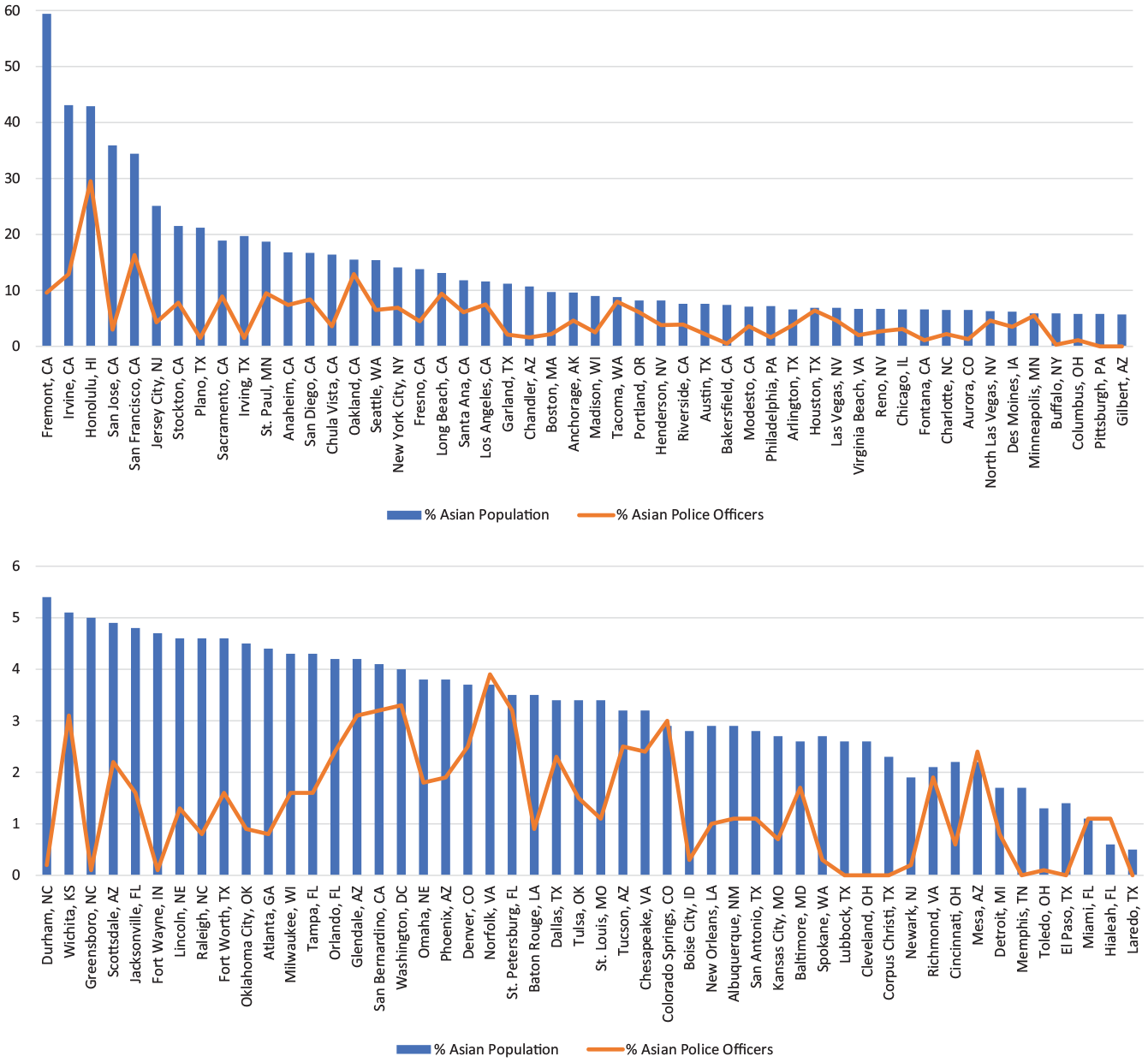
Top 100 largest cities by Asian population.
These include: Portland (OR) [6.1%], Santa Ana (CA) [6.1%], Houston (TX) [6.4%], Seattle (WA) [6.5%], New York City (NY) [6.9%], Anaheim (CA) [7.4%], Los Angeles (CA) [7.5%], Stockton (CA) [7.8%], Tacoma (WA) [8%], San Diego (CA) [8.4%], Sacramento (CA) [8.9%], Long Beach (CA) [9.4%], St. Paul (MN) [9.5%], Fremont (CA) [9.6%], Irvine (CA) [12.9%], Oakland (CA) [12.9%], San Francisco (CA) [16.3%], and Honolulu (HI) [29.5%], which had the highest representation of Asian American police officers.
On the other hand, 14 cities had police departments with less than 1% of Asian American police officers. These include: Bakersfield (CA), Buffalo (NY), Durham (NC), Greensboro (NC), Fort Wayne (IN), Raleigh (NC), Oklahoma City (OK), Atlanta (GA), Baton Rouge (LA), Boise City (ID), Kansas City (MO), Spokane (WA), Newark (NJ), Cincinnati (OH), Detroit (MI), and Toledo (OH). In addition, eight cities had zero Asian officers. These include: Pittsburgh (PA), Gilbert (AZ), Lubbock (TX), Cleveland (OH), Corpus Christi (TX), Memphis (TN), El Paso (TX), and Laredo (TX). Acknowledging those successful, as well as those less successful police departments, responds to the call by the President’s Task Force on 21st Century Policing (2015).
Barriers to Recruiting More Asian Police Officers
Although overall gains in racial diversity were driven by a rising number of Asian (and Hispanic) police officers (Bureau of Justice Statistics, 2020), this article clearly demonstrates that more work needs to be done on this front. However, many police departments are struggling to recruit more Asian police officers to adequately serve the communities they serve. There are two primary explanations for this. First, policing is not seen as a safe or prestigious career choice among Asians in general (National Public Radio, 2016; Voice of America, 2012). Instead, Asian parents encourage their children toward higher paid white-collar occupations such as those in the science, technology, engineering, and mathematics (STEM) and health care fields (Min & Jang, 2015; National Public Radio, 2016; Schroedel et al., 1994). In fact, according to the Bureau of Labor Statistics (2020, p. 4), “55% of employed Asians work in management, professional, and related occupations—the highest paying major occupational category—compared with 41% of employed Whites, 32% of employed Blacks, and 23% of employed Hispanics.” Furthermore, “65% of Asians in the labor force [have] a bachelor’s degree and higher, compared with 41% of Whites, 32% of Blacks, and 22% of Hispanics” (Bureau of Labor Statistics, 2020, p. 3), further diminishing Asian recruitment in policing, as most police departments only require a high school diploma or its equivalent (Bureau of Justice Statistics, 2020), also reducing the prestige of the occupation.
Second, Asian Americans—in particular Asian immigrants—do not have a pathway into policing as many police officers typically have a familial connection, who is an active or retired police officer (Gibbs et al., 2018; Scrivner, 2009). This can be explained by the series of measures that banned Asian immigration until the passage of the Immigration and Naturalization Act of 1965, when large numbers of medical and technical immigrants arrived at that time (Kiang et al., 2017; Min & Jang, 2015). As a result, younger Asians have a greater tendency to choose professional fields helped by their own parents because they have a strong STEM background (Min & Jang, 2015). However, this familial connection is critical for promoting the law enforcement profession and guiding the recruitment process (Gibbs et al., 2018; Scrivner, 2009). Although this impacts other racial minorities as well, the lack of a personal connection is exacerbated among Asian immigrants who already distrust police and likely have language limitations. In addition, virtually all law enforcement organizations in the United States have a citizenship requirement that disproportionately impacts un-naturalized Asian (and Hispanic) immigrants, resulting in the exclusion of qualified Asian applicants from the recruitment pool (Fifield, 2016; Maciag, 2015; Matthies et al., 2012; U.S. Department of Justice, 2016). As mentioned previously, most Asians are foreign born (roughly two-thirds) (Pew Research Center, 2015) and less than half (45%) are naturalized citizens (Budiman, 2020).
Despite these barriers, efforts to recruit more Asian police officers must continue. Research has demonstrated that targeted recruitment strategies aimed at racial minorities have been successful for increasing the number of racial minority officers at local police departments (Jordan et al., 2009; Matthies et al., 2012; Schroedel et al., 1994; Scrivner, 2009; U.S. Department of Justice, 2016). However, recruitment approaches must be adapted between race and ethnic groups. To illustrate, Castaneda and Ridgeway (2010) found that Asian recruits were drawn to the excitement of the work, whereas Black recruits responded to the prestige of the profession. Accordingly, proactive and targeted community outreach programs such as community fairs, church gatherings, “meet and greet” with community leaders and Asian-owned businesses, and recruiting events at local high schools should focus on this one particular aspect of the profession while educating the community about policing’s varied roles. Furthermore, police departments should build robust partnerships with local educational institutions, including K–12 schools, community colleges, and universities, and provide internships to young men and women from underrepresented Asian communities, creating “a robust pipeline of potential applicants while also helping to address historically-negative perceptions or experiences diverse communities have had with law enforcement” (U.S. Department of Justice, 2016, p. 28).
One police department that was recognized by the President’s Task Force on 21st Century Policing (2015) for successfully targeting the Asian American community was the Sacramento Police Department (CA). They have one of the largest representations of Asian police officers in the country (8.9%), although their Asian community is almost one fifth (18.9%) of the population they serve (Bureau of Justice Statistics, 2020; U.S. Census Bureau, 2019). However, their efforts include hosting a free hiring workshop that informs recruits and their families about the application process; a “Run with the Recruiter” program that allows potential applicants to ask questions in an informal manner and also measures their physical fitness; and a patrol ride-along program that introduces recruits to the unique challenges and demands of the occupation in an interactive, engaging manner (U.S. Department of Justice, 2016).
Finally, a police department’s reputation and aggressive operational practices matter when recruiting people of color in today’s climate (Maciag, 2015; Matthies et al., 2012; U.S. Department of Justice, 2016). For example, Law enforcement agencies can affect recruitment indirectly by adhering to well- established tenets of policing: keeping cities safe while holding officers to high standards of professionalism and integrity. [This] can reduce crime while having a positive, proactive influence on community attitudes. When a law enforcement agency is seen as fair and trustworthy—in other words, legitimate—even people who run afoul of the law have [a] higher regard for the police . . . particularly among groups with historically low affinity for law enforcement. (Matthies et al., 2012, p. 2)
For future research, policing scholars should consider partnering with professional law enforcement associations such as the National Association of Asian American Law Enforcement Commanders (2018) that utilize their positions to encourage the recruitment, enrichment, and advancement of qualified Asian Americans in the field of law enforcement, or the National Asian Peace Officers’ Association (2021) that serves as the voice for more than 3,000 Asian American and Pacific Islander law enforcement officers and special agents in 22 local chapters across the country, to identify additional best practices for improving Asian diversity. Moreover, scholars should consider contacting one of the five police departments from this article that have successfully created a racially and culturally diverse police force, also to identify further best practices for increasing Asian diversity. This research stream is important to rectify the underrepresentation of Asian officers within the rank-and-file of local police. Finally, future studies should continue to reexamine the employment figures of Asian officers for evaluative purposes and analyze data on Asian hate crimes to theoretically examine whether the symbolic benefits of diversifying a police department actually reduce hate crimes against Asian Americans.
Conclusion
Let us conclude by returning to the question in the title of this article: Do we need more Asian American police officers in response to the #StopAsianHate movement? The answer is a resounding yes. Given the growing expansion of the Asian population, to include their ensuing growth in the U.S. workforce, it becomes vital that we continue to look at Asians on improving racial diversity in policing to (re)establish the trust and legitimacy of law enforcement organizations and the Asian communities they are sworn to protect and serve. With the rise in anti-Asian hate crimes, police departments can no longer risk cultural insensitivities due to ignorance or lack of Asian representation. Furthermore, the reasons why scholars omitted Asian police officers no longer stand today. As the fastest growing racial group in the country, Asian American police officers must be accounted for as an independent race or ethnic group in the law enforcement census. Finally, racial diversity in policing is an area of public administration that in some form touches every citizens’ lives (if often indirectly). Ensuring we have high-quality scholarship on this important area is not something that can be solely delegated to other disciplines. The author calls for a commitment from other race and social equity scholars in public administration to examine this important research stream to harness the cultural understanding that Asians bring to the profession and to consider how to increase the representation of well-qualified and diverse Asian Americans at all levels of law enforcement. In addition, public administration scholars should rethink how we categorize Asians given the ethnic diversity within the community. For example, the literature has identified sources of heterogeneity among several Asian ethnicities, including those from East Asia, Southeast Asia, and South Asia, resulting in dissimilar outcomes (Kiang et al., 2017; Lee et al., 2018; Yu, 2020). Finally, public administration should consider further avenues to make policing more welcoming to Asian Americans, despite the barriers to their recruitment. This narrative is important because representative bureaucracy is a pillar of social equity in public administration and diversifying police organizations should be a priority for all communities.
Supplemental Material
sj-docx-1-ppm-10.1177_00910260221074971 – Supplemental material for Racial Diversity in Policing: Do We Need More Asian American Police Officers in Response to the #StopAsianHate Movement?
Supplemental material, sj-docx-1-ppm-10.1177_00910260221074971 for Racial Diversity in Policing: Do We Need More Asian American Police Officers in Response to the #StopAsianHate Movement? by Helen H. Yu in Public Personnel Management
Footnotes
Declaration of Conflicting Interests
The author(s) declared no potential conflicts of interest with respect to the research, authorship, and/or publication of this article.
Funding
The author(s) received no financial support for the research, authorship, and/or publication of this article.

Supplemental Material
Supplemental material for this article is available online.
Author Biography
References
Supplementary Material
Please find the following supplemental material available below.
For Open Access articles published under a Creative Commons License, all supplemental material carries the same license as the article it is associated with.
For non-Open Access articles published, all supplemental material carries a non-exclusive license, and permission requests for re-use of supplemental material or any part of supplemental material shall be sent directly to the copyright owner as specified in the copyright notice associated with the article.
