




Abstract
This article provides an assessment of the employment of women in STEM occupations in the U.S. federal government. Women are underrepresented in STEM fields in the U.S. federal service, but their levels of employment vary markedly between departments and agencies. Women also quit federal STEM jobs in disproportionately large numbers, compared with men, and compared with women in other professions, and they resign at varying rates depending on the department or agency. We examine the impact of the presence of women in STEM supervisory positions on these patterns using a two-staged instrumental variable model. Our findings suggest that larger proportions of women in supervisory positions in STEM fields may help to produce higher levels of employment of women, but the presence of women as STEM supervisors has no observable impact on the rate at which women quit STEM jobs.
The struggle to promote equal employment opportunity in the United States can be traced back for decades (see, e.g., Gregory, 2014; Iversen & Rosenbluth, 2010; Kellough, 1989, 2006; Krislov, 1967; Reed, 1991), but despite considerable effort over an extended period of time, women and minorities remain underrepresented in many organizations and occupational fields. One of the most significant examples of this problem is the extensive and persistent underrepresentation of women in professional fields associated with science, technology, engineering, and mathematics, that is, the STEM fields. According to a 2017 report by the U.S. Department of Commerce, women held approximately half of all jobs in the U.S. economy, but filled only 24% of all STEM jobs (Noonan, 2017; see also, Blackburn, 2017). 1 The fact that women, who comprise one-half of the national population in the United States, do not share STEM positions equally is troubling given the long history of efforts to promote equality of opportunity. Moreover, this problem is not confined to the private sector. The U.S. Office of Personnel Management reported in 2018 that women hold less than 27% of all STEM positions within the U.S. civil service (U.S. Office of Personnel Management, 2018).
This article focuses on the public sector and provides an examination of the employment of women in U.S. federal government STEM jobs from 2005 to 2018 in all Cabinet-level Departments and two executive agencies with exceptionally large numbers of STEM employees—the Environmental Protection Agency (EPA) and the National Aeronautics and Space Administration (NASA). Beyond the underrepresentation of women in federal STEM jobs observed generally, one of the most noteworthy features of the problem in government is the significant variation across federal departments and agencies in the proportion of STEM jobs held by women. The purpose of this study is to better understand that variation. Why is the proportion of STEM jobs held by women in federal departments and agencies much higher (or lower) in some organizations than in others? To gain insight into this question, the potential impact of covariates reflecting a range of department/agency characteristics is analyzed. In particular, however, the analysis is focused on examining the impact of the presence of female supervisors in STEM positions on the employment of women in nonsupervisory STEM jobs.
Related to the problem of employment representation is the fact that women are overrepresented among those who resign from STEM jobs, and importantly, the proportion of STEM employees who quit who are women varies markedly from one federal department/agency to another. In some organizations, this proportion is large; in others, it is smaller. Clearly, this issue further exacerbates the difficulty associated with the employment of women in STEM occupations. This study seeks to identify department/agency characteristics that may help explain variation among federal organizations in the quit behavior of women in STEM, but again, the variable of main interest is the representation of women in STEM supervisory positions. The question in this case is whether a proportionately greater presence of women in STEM supervisory positions will have an impact on quit rates of women in STEM employment.
Women In STEM: Examining The Scope of the Problem
There is a broad, multidisciplinary, and well-developed literature on the problem of the underrepresentation of women in STEM fields. 2 Within that literature, there is a consensus among scholars that the challenges for women in STEM jobs have multiple and interconnected origins. A primary issue, of course, is initial entry into educational programs in STEM. For a variety of reasons, having to do with patterns of socialization that direct women to other areas and sexual biases that create environments unreceptive to them in STEM fields, women do not enter STEM degree programs at rates equal to those of men. One study examining this issue noted that socialization processes were directing young women away from math and science as early as the middle school grades (Burke, 2007). Teacher expectations and attitudes often reinforce these views, and science textbooks that seldom represent the accomplishments of women have added further to the problem (Fort & Varney, 1989). As women enter college, scientific fields are frequently seen as male preserves, and many young women, because of prior socialization practices, choose not to pursue math and science majors (Shapiro & Sax, 2011).
The fact that there are few women on college and university faculties in STEM fields to serve as positive role models contributes to this problem. In addition, some male students and professors are hostile to women in STEM majors, and that behavior also discourages women from entering those fields (Burke, 2007). In an examination of the representation of women in undergraduate STEM majors, Blickenstaff (2005) argues that the low representation of women on STEM faculties in colleges and universities sends a message that those disciplines are not suited for women and that they should therefore avoid them. The presence of female faculty members who could serve as role models for women in STEM fields could, in contrast, help undergraduate women gain confidence and a belief that they too can be successful as students in those fields and eventually in STEM careers (Shapiro & Sax, 2011). In addition, women in faculty positions may also work to counter discriminatory practices such as when male faculty members, who consider science and engineering fields to be male domains, deny female students opportunities in the classroom, subject them to more rigorous grading practices than their male peers, and generally create unwelcoming environments for women (Seymour & Hewitt, 1997).
A 2010 report by the American Association of University Women (AAUW) on the general lack of women in STEM fields echoes these points. The authors of the study found that socialization processes and biases operate to significantly deter women from studying science and math-related subjects (Hill et al., 2010). The authors note that “Achievements and interest [of women] in math and science are shaped by the environment around them” (Hill et al., 2010, p. 27). Moreover, the situation is not improving as time passes. Since the year 2000, according to Miller and Wai (2015), the number of women in STEM fields at the bachelor’s degree level has declined, further underscoring the significance of this issue. Those women who do remain in undergraduate STEM programs are usually highly committed to moving on to graduate programs (Miller & Wai, 2015), but once they do, the difficulties encountered earlier as undergraduate students continue (Hill et al., 2010; Lott et al., 2009). The combination of these pernicious forces means that women face substantial obstacles in higher degree programs within STEM professions.
Furthermore, difficulties do not end for women who earn degrees and are eventually able to enter into work in STEM occupations. Evidence shows that they continue to face numerous obstacles including isolation and exclusion, the downplaying of their abilities, sexual harassment, and a lack of female role models and mentors (Burke, 2007; Van Veelen et al., 2019). Not surprisingly, these circumstances result in women leaving STEM jobs (i.e., quitting their positions) at rates significantly higher than the rates for men. As has been observed, this pattern of disproportionate attrition of women from the STEM workforce, in turn makes the problem of the lack of women in these occupational fields much worse than it would be otherwise (Xu, 2008).
An important study by Glass et al. (2013) compared retention rates of women in STEM fields to the retention rates of women with high skill levels in other non-STEM professional occupations such as those of accountants, attorneys, health technologists, managers and administrators, and other fields. The results indicated that women in STEM occupations were significantly more likely to leave their jobs than were women in professions outside of STEM. Because the authors were comparing the retention rates for women across broad categories of occupations, rather than comparing them to men, the fact that women often face disproportionate family responsibilities compared with men could not account for the difference. They found also that specific workplace characteristics, including hours of work, flexible scheduling, the availability of telecommuting, earnings, and parental leave policies, affect retention in similar ways for women in STEM and other professional employment, thus these kinds of factors failed to explain the differential pattern of retention of women between STEM and non-STEM occupations. The authors argue that women’s “token status in STEM fields” and the “attitudes and expectations of coworkers and supervisors” who are overwhelmingly male and who adhere to “traditional” views of STEM occupations as male preserves create dissatisfaction for women. The inequitable distribution of job rewards (such as opportunities for training) favoring men in STEM occupations also produced lower job commitment for women (Glass et al., 2013).
Another more recent study by Van Veelen et al. (2019) found that the fact that women are outnumbered and negatively stereotyped in STEM jobs produces a “gender identity threat” that in turn generates less work engagement and lower career confidence for women. The authors claim the gender identity threat occurs because women in STEM jobs see themselves being treated negatively and devalued by virtue of the fact that they are women (Van Veelen et al., 2019). As work engagement for women declines, commitment to their organizations and their careers also declines.
In addition to these issues, Noonan (2017) in the study sponsored by the U.S. Department of Commerce cited earlier, found that while women held only about one quarter (24%) of all STEM jobs in the United States, they are not equally present in all STEM fields. Women are most highly represented in the physical and life sciences, holding 43% of those positions, but they occupy only 14% of the positions in engineering, the field represented by the “E” in STEM (Noonan, 2017).
These difficulties and barriers are more heavily experienced by women of color, especially those from Black, Latina, and Indigenous/Native American backgrounds or other intersectional identities. Ong et al. (2011) synthesize the disparate existing research on the “double bind” that women of color must navigate through STEM education and STEM careers. Findings include the fact that despite outperforming underrepresented men of color in undergraduate STEM coursework, underrepresented women of color tend to receive fewer bachelor’s degrees in STEM. Ong et al. find that this is not due to a lack of interest in STEM fields among underrepresented women of color, who declare a similar level of interest in STEM degrees to other groups, but instead it is due to disproportionate attrition rates.
Ong et al. find that African American women in STEM fields at predominately White colleges and universities report a sense of segregation and social isolation. Underrepresented women of color often cite climates in academic departments and laboratories that are unsupportive or explicitly racist and sexist as major barriers. Some African American women report that working in laboratories in which they are at times the only women, usually the only African Americans, and almost always the only African American women, leads to feelings of stereotype threat and suspicion of hostility. Ong et al. find that underrepresented women of color often feel the need to engage in additional invisible labor to gain acceptance from their male peers. While the U.S. Office of Personnel Management’s (OPM) FedScope, the data source used in the present investigation, does not make data publicly available that are intersectional along the lines of race and gender, understanding how the climate of the public sector STEM workforce affects individuals along those intersections, particularly women of color, is vitally important. The need for data to facilitate such research is imperative.
In addition to documenting the underrepresentation of women in STEM fields and identifying causes for that underrepresentation, the existing literature also proposes a variety of strategies for improvement. These proposals include efforts to increase interest in STEM fields among girls in elementary and middle schools (Valla & Williams, 2012); programs to combat stereotypes that portray STEM fields as areas best suited for men (Di Bella & Crisp, 2016; Ryan, 2014; Saucerman & Vasquez, 2014); and the implementation of family-friendly policies within the workplace (Feeney et al., 2014). Numerous scholars also point to the importance of having positive female role models available for women in undergraduate and graduate programs in STEM and in work settings within organizations (Bottia et al., 2015; Conklin, 2015; Feeney & Bernal, 2010; Quimby & DeSantis, 2006). The presence of successful women in STEM disciplines effectively demonstrates to other women who may be entering these fields that they also can do well, that they belong, and that they have much to contribute. Successful women in STEM fields, especially those in supervisory positions can provide inspiration for other women to be successful.
In the federal government workforce specifically, the durability of the problem of the underrepresentation of women in STEM is stunning. In the organizations examined in this article, the employment of women in STEM jobs was essentially unchanged from 2005 when they held 25.33% of all STEM positions, to 2018 when women held 25.63% of all STEM jobs. One might have expected growth in the employment of women in these positions during this 14-year period, but the change was negligible. Equally important, however, is the fact that the employment of women in STEM jobs varies significantly, as noted earlier, from one federal organization to another. While women are underrepresented in federal STEM jobs in general for the reasons discussed in the existing literature, the extent of underrepresentation is different in different federal departments and agencies. The representation of women in STEM jobs in each federal department and agency in the data set, expressed as a proportion of each organization’s overall STEM employment (including supervisory and nonsupervisory positions) and averaged across the years analyzed (2005–2018), is provided in Table 1. As can be seen, women’s representation in STEM fields varies markedly in the organizations in the sample—from a low average of 16.7% of STEM positions in the Department of the Air Force to a high of 42.9% of those positions in the Department of Health and Human Services. While the underrepresentation of women in STEM employment may be the product of numerous factors including entrenched socialization processes and biases within educational systems discussed earlier, the fact that the presence of women varies so much across federal departments and agencies is striking and raises the question of what characteristics of those departments and agencies can account for that variation.
Women and Men in Federal STEM Occupations by Agency (Average From 2005 to 2018).
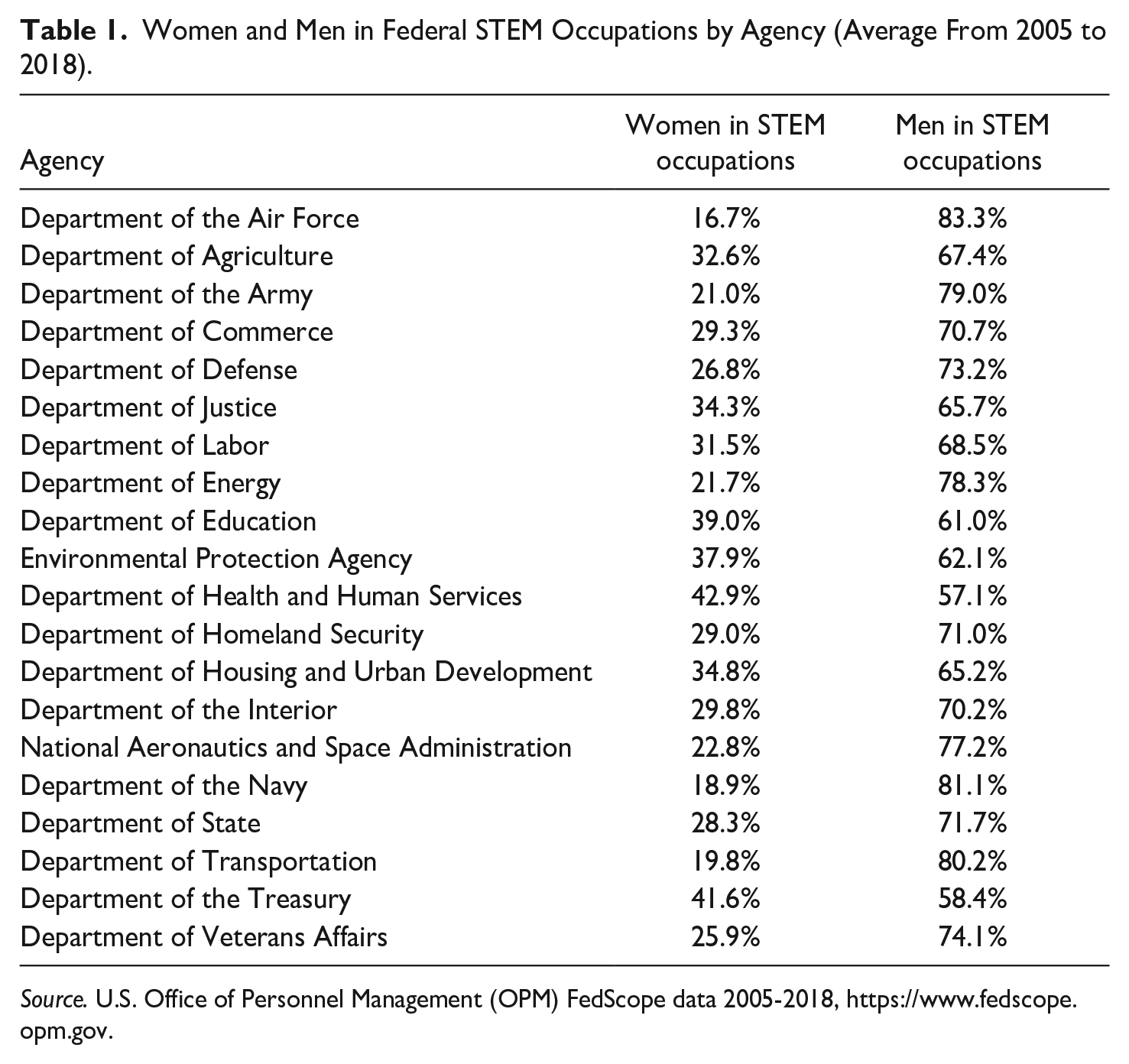
Source. U.S. Office of Personnel Management (OPM) FedScope data 2005-2018, https://www.fedscope.opm.gov.
Table 2 provides evidence showing that women are generally over-represented among those who quit federal STEM jobs, but the quit rate for women varies widely depending on the agency or department considered. The Environmental Protection Agency (EPA) provides an interesting case. Women comprise 37.9% of STEM employees on average in the EPA across the time period analyzed, but they account for 52.8% of the employees who quit those jobs. STEM employment and quit rates for women at the Department of Justice are exactly equal and are nearly equal at the Department of Health and Human Services. Remarkably, however, numbers at the Department of the Treasury are almost the inverse of those at the EPA. In the Treasury Department, women make up 41.6% of STEM employees and only 27.3% of those who quit.
Women’s Representation Among Those Who Quit STEM Occupations and Women’s Representation in STEM Occupations by Agency (Average From 2005 to 2018).

Source. U.S. Office of Personnel Management (OPM) FedScope data 2005-2018, https://www.fedscope.opm.gov.
What characteristics of the departments and agencies under analysis can help explain variation observed in the share of STEM positions held by women and the proportion of those who quit STEM jobs who are women? These are the fundamental questions motivating the present research. As noted, the impact the presence of women in STEM supervisory positions is of particular interest, but other factors possibly associated with the employment and retention of women in STEM in federal government organizations are also examined.
Data and Methods
Data analyzed come from the OPM FedScope data source (https://www.fedscope.opm.gov). As stated earlier, data on civilian employment levels and quit rates for women in STEM occupations in all 15 of the cabinet-level executive departments and two independent agencies with substantial STEM employment (the Environmental Protection Agency and the National Aeronautics and Space Administration) are examined. Civilian employment data for other key scientific agencies such as the Centers for Disease Control and Prevention (CDC), National Institutes of Health (NIH), National Oceanic and Atmospheric Administration (NOAA), and the National Laboratories are represented in their respective parent departments such as the Department of Health and Human Services, the Department of Commerce, and the Department of Energy. For the Department of Defense, the Air Force, Army, and Navy are examined separately from the remainder of the Department to consider whether there may be differences across these branches of the military. As a result, the sample includes 20 distinct federal organizations. The data cover the period from 2005, the first year for which data are available, to 2018. 3
The Dependent Variables
The dependent variables examined are the two measures of the presence of women in federal STEM positions discussed above. Specifically, these variables are (a) the proportion of nonsupervisory STEM jobs in federal departments and agencies held by women, and (b) the proportion of employees who quit STEM positions who are women. 4 These two variables are measures of the extent of the two primary problems associated with the employment of women in STEM: (a) the problem of getting women into STEM positions so that the STEM workforce is representative of both men and women, and (b) the difficulty that is often encountered in retaining women in STEM positions.
The Principal Independent Variable
The analysis is built on models specifying covariates for the specified dependent variables. The independent variable of primary interest, as indicated earlier, is the proportion of STEM supervisors in each department and agency who are women. The objective is to determine if higher levels of female representation among STEM supervisors leads to higher representation of women in nonsupervisory STEM jobs and if the presence of women in supervisory positions in STEM is associated with lower quit rates for women in STEM.
Examination of this independent variable (the proportion of STEM supervisors who are women) is motivated by and grounded in theory found within two bodies of research literature. The first is the literature examining the theory of representative bureaucracy. According to this theory, employees within a government bureaucracy often act in ways that further the interests of individuals who share their demographic backgrounds. In short, the theory suggests that the passive representation of specific groups (i.e., their employment within the bureaucracy) will lead to the active representation of the interests of those groups in bureaucratic decision-making processes. Empirical work has produced significant support for this theoretical proposition. For example, Meier and Stewart (1992) and Meier (1993a) found that the presence of minority teachers was associated with improved performance of minority students. In addition, Selden et al. (1998) demonstrated that the employment of minority bureaucrats within the Farmers Home Administration was positively related to the success of minority applicants for FMHA loans. Furthermore, Keiser et al. (2002) found that the presence of female math teachers was associated with better performance of female math students. Several other studies have found similar results and have further specified the underlying theoretical linkages (Hindera, 1993; Lim, 2006; Meier, 1993b; Meier and Nicholson-Crotty, 2006; Saltzstein, 1979; Wilkins & Keiser, 2006). Based on this work, one may hypothesize that women in supervisory positions in STEM fields in federal departments and agencies will work to promote the interests of women who apply for work in STEM fields and will act to help ensure the success of women once they are hired. Federal supervisors typically make hiring decisions or have substantial influence over who is selected to fill job vacancies, and they may work to enforce rules of workplace behavior prohibiting various forms of harassment and discrimination. If those supervisors are women, they may act in ways to protect the interests of women. Indeed, the very presence of women in supervisory positions may deter inappropriate or harassing behavior. Consequently, prospects for the employment of women in nonsupervisory STEM positions could be improved as the representation of women among STEM supervisors increases.
Interest in the impact of the presence of female supervisors in STEM is also motivated by concepts developed within the literatures on organizational behavior and career development theory that suggest the importance of role models as guides to individual career development (see, e.g., Dalton, 1989; Gibson, 2004; Ibarra, 1999; Morgenroth et al., 2015; Speizer, 1981). A number of studies have examined the importance of role models for individual career choice and success for both men and women, and the availability of female role models has been found to be especially important for women in nontraditional careers (such as those in STEM) because they help boost feelings of self-efficacy and confidence (Bandura, 2000; Gibson, 2004; Gilbert, 1985; Quimby & DeSantis, 2006). Previous research shows that when women lack gender-congruent role models in STEM positions, it can lower their sense of belonging in those fields (Cheryan et al., 2013; Hermann et al., 2016). A shortage of female role models for women in STEM, indicated by comparatively low levels of employment of women in STEM supervisory positions, can communicate a message to women that they are not supported and are not welcomed, but in contrast, the presence of women in supervisory positions in STEM may be encouraging to women in those fields.
It is anticipated that women will feel more comfortable applying for and accepting jobs in workplaces that have more women in supervisory positions (see, Bottia et al., 2015; Conklin, 2015; Feeney & Bernal, 2010). Consequently, the expectation is that departments and agencies with larger proportions of STEM supervisors who are women will employ larger shares of women in nonsupervisory STEM jobs. That is, the proportion of STEM supervisors who are women and the proportion of nonsupervisory STEM jobs filled by women will be positively associated. In addition, it is anticipated that women will be less likely to quit STEM jobs when they are in organizations where larger shares of STEM supervisors are women. In other words, the proportion of STEM supervisors who are women and the female share of STEM employees who quit should be negatively associated. From the theoretical foundations reviewed here (i.e., the theory of representative bureaucracy and career development/role-model theory), the two core hypotheses for this study are specified as follows:
Control Variables
The models specified include a number of control variables that are also expected to be associated with the employment and retention of women in STEM jobs in the federal service. For example, one variable investigated is the size of the overall STEM workforce in each organization. This variable is included in the employment representation model, not because of a belief that women will be attracted to organizations with larger or smaller STEM divisions, but because the dependent variable in that model is the proportion of women in nonsupervisory STEM jobs, and departments and agencies with larger numbers of their employees found in nonsupervisory STEM occupations (compared with those with smaller numbers of STEM workers) will need to employ more women to achieve a given proportion of women in nonsupervisory STEM positions. Given the limited supply of women trained in STEM fields, it is expected that as the size of the STEM segment of an organization’s workforce increases, the proportion of employees in those occupations who are women will decline. That is, a negative association between the size of the STEM workforce (measured in thousands of employees) in a department or agency and the employment representation of women in nonsupervisory STEM positions measured as the proportion of those jobs held by women is predicted.
A negative association between the size of the STEM segment of an organization’s workforce and quit behavior by women in STEM jobs is also anticipated. Once women are employed in STEM occupations in federal departments and agencies, they will be likely to find greater opportunities for transfers and advancement in organizations that have larger STEM workforces than in those with smaller numbers of STEM employees. In those circumstances, women may be able to move more readily to other units within their organizations or find other alternatives to quitting to escape inhospitable situations.
Because the literature on women in STEM employment finds that a major obstacle to increased representation is unwelcoming or even hostile work environments (e.g., see Burke, 2007 and Van Veelen et al., 2019), support for diversity within federal departments and agencies should provide a positive influence on the employment of women in STEM jobs and could help to decrease the extent to which women quit those jobs once they have them. Support for diversity is measured by observing the score achieved for each department and agency in each year examined on items used to construct an index of support for diversity in the Partnership for Public Service (2019) estimate of “Best Places to Work in the Federal Government.” The measure is based on data from the U.S. Office of Personnel Management, Federal Employee Viewpoint Survey (FEVS). It is derived from employee responses to three survey items designed to assess their perception of support for diversity and inclusion in their organizations. Responses to each item are coded on a 5-point scale with higher values indicating higher levels of agreement. The specific survey items utilized are as follows:
Policies and programs promote diversity in the workplace (e.g., recruiting minorities and women, training in awareness of diversity issues, and mentoring).
My supervisor is committed to a workforce representative of all segments of society.
Supervisors work well with employees of different backgrounds.
Responses on these items are combined into an index using a using a weighted formula that produces scores that fall on a 100-point scale (Partnership for Public Service, 2019). It is expected that higher scores on the support for diversity index will be reflective of more positive work environments for women and will therefore be associated with higher levels of female employment in nonsupervisory STEM occupations in federal departments and agencies and lower propensities for women to quit STEM jobs.
The fact that women are not equally represented in all STEM fields suggests that the distribution of specific STEM occupations within departments and agencies may also help to explain variation across those departments and agencies in the employment of women in STEM and variation in the rates at which they quit STEM jobs (Noonan, 2017). As noted, of the broad occupational categories represented in the acronym STEM, women are least well represented in engineering jobs, a field that has historically been seen largely as a male domain. Given this fact, the proportion of STEM jobs in each department and agency that are in the field of engineering is controlled in each model. The expectation is that, as engineering jobs increase as a proportion of all STEM jobs, fewer women will be employed, and women will quit more frequently.
In the model of quit rates for women in STEM, the proportion of female STEM employees who are young is also included as a control variable because prior research demonstrates that younger workers (regardless of field) quit more often than older workers (Bradbury et al., 2013; Government Performance Project, 2007; Kellough & Osuna, 1995; Lewis, 1991; Lewis & Park, 1989; Llorens & Stazyk, 2011; Meyer et al., 1979). In the analysis, “young” is defined as 29 years old or younger. As the proportion of women in STEM who are young increases in the organizations studied, quit behavior by women in STEM is expected to increase. Table 3 provides descriptive statistics for all of the variables in the models.
Variables in the Models a .
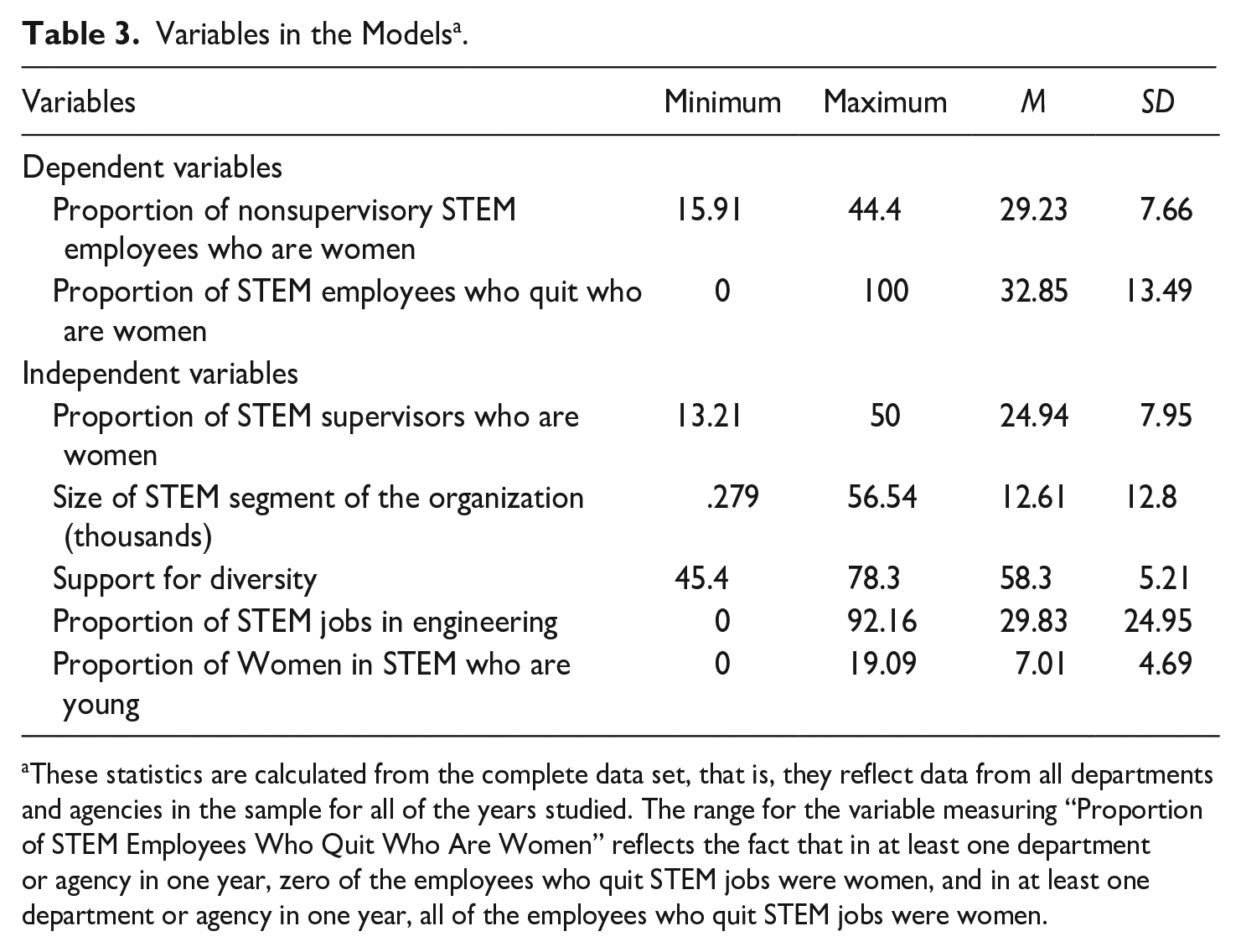
These statistics are calculated from the complete data set, that is, they reflect data from all departments and agencies in the sample for all of the years studied. The range for the variable measuring “Proportion of STEM Employees Who Quit Who Are Women” reflects the fact that in at least one department or agency in one year, zero of the employees who quit STEM jobs were women, and in at least one department or agency in one year, all of the employees who quit STEM jobs were women.
In the next section, the hypotheses specified above are tested through the estimation of multiple regression models for employment levels and quit rates for women in STEM. 5 Findings from these models are discussed and their implications are noted.
Findings
The models utilized produce a number of results that assist us in understanding variation in the employment of women in STEM fields and their quit behavior in U.S. federal government departments and agencies. First, a simple ordinary least squares (OLS) model examining variation in the employment of women in STEM is discussed. Following that, to address inherent weaknesses in this initial OLS model, results from an instrumental variable model examining the employment of women in STEM are included and discussed. Finally, an OLS model examining departmental and agency variation in quit rates for women in STEM is examined and discussed.
OLS Results for the Employment of Women in STEM
Findings from a simple OLS model examining the employment of women in subordinate STEM positions are provided in Table 4. Overall, the model accounts for a striking 87% of the observed variation across federal departments and agencies in the employment of women in nonsupervisory STEM positions. The unstandardized coefficient on the variable measuring the proportion of STEM supervisors who are women is large (.511) and is significant at the .001 level. This finding suggests that for every one percentage point increase in the employment of women as STEM supervisors, women in nonsupervisory STEM jobs increases by slightly more than one-half of a percentage point. Tentative support for hypothesis H1 which posited that “Federal departments and agencies that have larger proportions of STEM supervisors who are women will have larger proportions of nonsupervisory STEM positions held by women” is, therefore, provided.
OLS Regression Model for the Employment of Women in STEM.
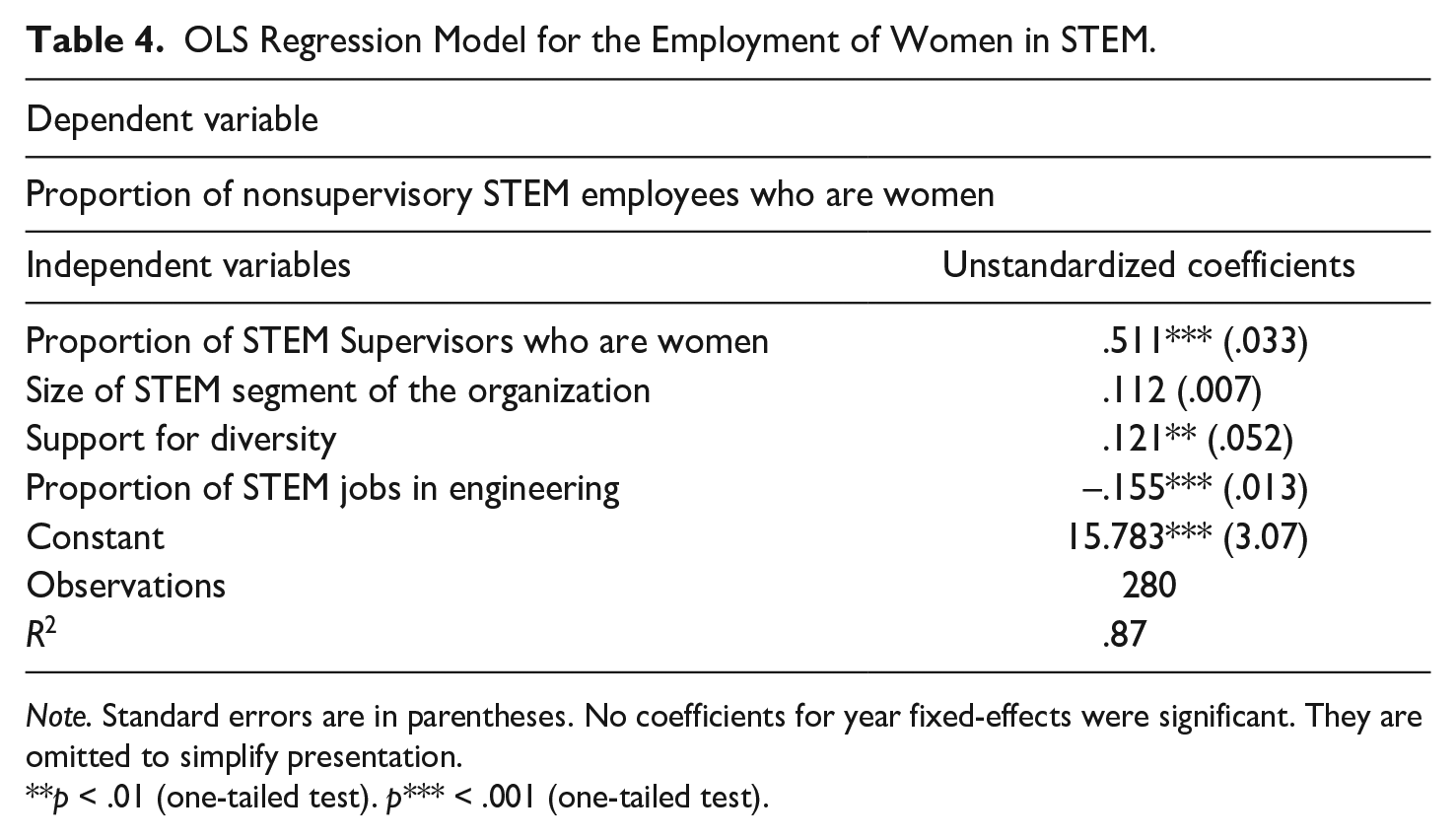
Note. Standard errors are in parentheses. No coefficients for year fixed-effects were significant. They are omitted to simplify presentation.
p < .01 (one-tailed test). p*** < .001 (one-tailed test).
Other variables in the model also provide interesting results. For example, the variable measuring the size of the STEM segment within federal departments and agencies is positive rather than negative as expected. This variable was predicted to exhibit a negative association with the employment of women in STEM under the assumption that the limited supply of women trained in STEM fields would make it more difficult for organizations with larger segments of their workforces in STEM occupations to achieve a given proportion of women in STEM jobs. Based on the analysis, that assumption appears to be incorrect. The finding suggests that as the size of the STEM segment of the workforce increases, the proportion of STEM employees who are women also increases. The mechanism that is at work to produce this result is unclear.
The variable measuring support for diversity within the organizations studied produces a large positive coefficient, as expected. The coefficient is .121 and is significant at the .01 level. Departments and agencies in which there is a higher level of support for diversity, as seen by their employees, have higher levels of female employment in nonsupervisory STEM jobs. In addition, the finding with respect to the presence of jobs in the field of engineering is also significant and in the direction expected. As the proportion of STEM jobs in engineering increases, the proportion of STEM jobs held by women declines. The coefficient on this variable is −.155, and it is significant at the .001 level.
Instrumental Variable Results for the Employment of Women in STEM
Despite these results, simple OLS regression may leave the direction of causality of the variable of primary interest (the proportion of STEM supervisors who are women) unclear. In the OLS model, the coefficient on the variable measuring the proportion of STEM supervisors who are women (.511) is statistically significant, as noted above. It may well be that when an organization has proportionately more STEM supervisors who are women, the presence of those female supervisors will lead to higher levels of employment of women in nonsupervisory STEM jobs as hypothesized. But it may also be the case that proportionately more women in nonsupervisory STEM jobs in a department or agency will lead to more women being selected as STEM supervisors. In that instance, the dependent variable is causing the independent variable. If this is the situation that is present, then the independent variable (the proportion of STEM supervisors who are women) is an endogenous regressor that is correlated with the underlying error in the model. Because the error represents omitted variables that are partial causes of the dependent variable, to the extent that the dependent variable is a cause of an independent variable, that independent variable will also be correlated with the error term (and thus will be endogenous).
To help resolve this dilemma and attempt to disentangle the direction of causality, a two-stage least squares modeling process with an instrumental variable is developed to provide a supplemental employment representation model. This is a standard approach for dealing with issues associated with endogenous independent variables (Wooldridge, 2003). In the first stage of this model, the instrumental variable is used to predict the endogenous independent variable “Xe” (the proportion of STEM supervisors who are women), and the predicted values of that independent variable from this equation are used in a second stage in the original model to predict the dependent variable “Y” (proportion of nonsupervisory STEM positions held by women).
For this strategy to work, two conditions must be met. First, the instrument must be strongly associated with the endogenous independent variable “Xe” and uncorrelated with the error term in the original model. That is, it must be a good predictor of the endogenous independent variable (the proportion of STEM supervisors who are women). When that is the case, the values predicted for the endogenous independent variable will not be caused by the dependent variable. The second condition is that the instrument itself must not be a direct cause of the dependent variable (Wooldridge, 2003). In the present case, there must be no theoretical reason to expect the instrumental variable to be a direct cause of the proportion of nonsupervisory STEM positions held by women. This is known as the “exclusionary restriction” for the use of instrumental variables.
To find an instrumental variable that is correlated with the endogenous independent variable “Xe” but not correlated with the error term, the nature of the error in the original model should be considered. That model controls for support for diversity and inclusiveness within the organizations studied and a number of other covariates specified earlier. Variables included within the error from that model, that is, the model used to predict the employment of women in nonsupervisory STEM jobs will therefore include factors such as
the attitudes of male STEM workers toward women in STEM;
the availability of female STEM applicants, and;
the number of vacancies in STEM in a department or agency.
In principle, any of these variables could be measured and included in the original model, but data are not available to make that possible. Because the instrumental variable selected should be uncorrelated with these variables, the “proportion of non-STEM supervisors in a department or agency who are women” is selected as the instrument. This variable is strongly and positively associated with the original endogenous independent variable (the proportion of STEM supervisors who are women). It is a robust predictor of that endogenous variable, but it will not be associated with kinds of factors found within the error term noted above. There is no reason to expect that the female share of supervisory positions outside of STEM will be associated with the attitudes of male STEM workers toward women in STEM, the availability of female STEM applicants, the number of vacancies in STEM, or similar variables within the error term. For similar reasons, the instrument selected (the proportion of non-STEM supervisors who are women) is not likely a direct cause of the dependent variable (the proportion of nonsupervisory STEM employees who are women). Because STEM employment is highly specialized and requires training in particular scientific or science-related fields, there is no reason to expect that a higher level of representation of women among non-STEM supervisors will directly cause the employment of women in nonsupervisory STEM jobs to increase or decrease. Consequently, the instrument (the proportion of non-STEM supervisors who are women) is used to predict the original endogenous independent variable in the first stage of the model and then the predicted values for that variable are used in the original equation in the second stage. 6 This procedure allows the estimation of the impact of “the proportion of STEM supervisors who are women” on the representation of women in nonsupervisory STEM jobs, while minimizing concern for reverse causality. It provides a useful complement to the original OLS model. This estimation strategy is not used in the model predicting the proportion of women who quit STEM jobs, however, since that model does not suffer from the same endogeneity problem as the first model.
Table 5 provides results from the two-stage instrumental variable (IV) model for the employment representation of women in nonsupervisory STEM occupations in the departments and agencies analyzed. This model produces a high R-squared value of .87, exactly as was the case for the simple OLS model for employment representation discussed above. The instrumental variable model accounts for 87% of the variance in the employment of women in nonsupervisory STEM jobs among the departments and agencies studied from 2005 to 2018. In this model, the expectation regarding the effect of the presence of female supervisors is strongly supported. The unstandardized coefficient on the variable estimating the “proportion of STEM supervisors who are women” is positive, large (.531), and significant. This result is very similar to that from the simple OLS model which produced a positive unstandardized coefficient of .511 on the variable providing a direct measure of the proportion of STEM supervisors who are women. This finding provides additional evidence that higher levels of the presence of women in supervisory positions in STEM fields across federal departments and agencies during the years examined will lead to higher levels in the employment of women in nonsupervisory STEM positions. In other words, the instrumented estimate of the employment of women in STEM supervisory positions has a significant positive impact on the general employment of women in nonsupervisory STEM occupations as suggested in hypothesis H1. This estimated effect offers further support for the proposition that women in supervisory positions in STEM may promote the interests of female STEM applicants and employees, as the theory of representative bureaucracy would lead us to expect. This finding also provides support for the argument that female STEM supervisors may act as positive role models for women, thus making STEM careers more attractive for women, as the literatures on career development and role-model theory suggest. These results reinforce those of the simple OLS model and underscore the importance of having women in supervisory positions in STEM segments of federal departmental and agency workforces when the goal is to increase the employment of women in nonsupervisory STEM positions.
Instrumental Variable Regression Model for the Employment of Women in STEM.
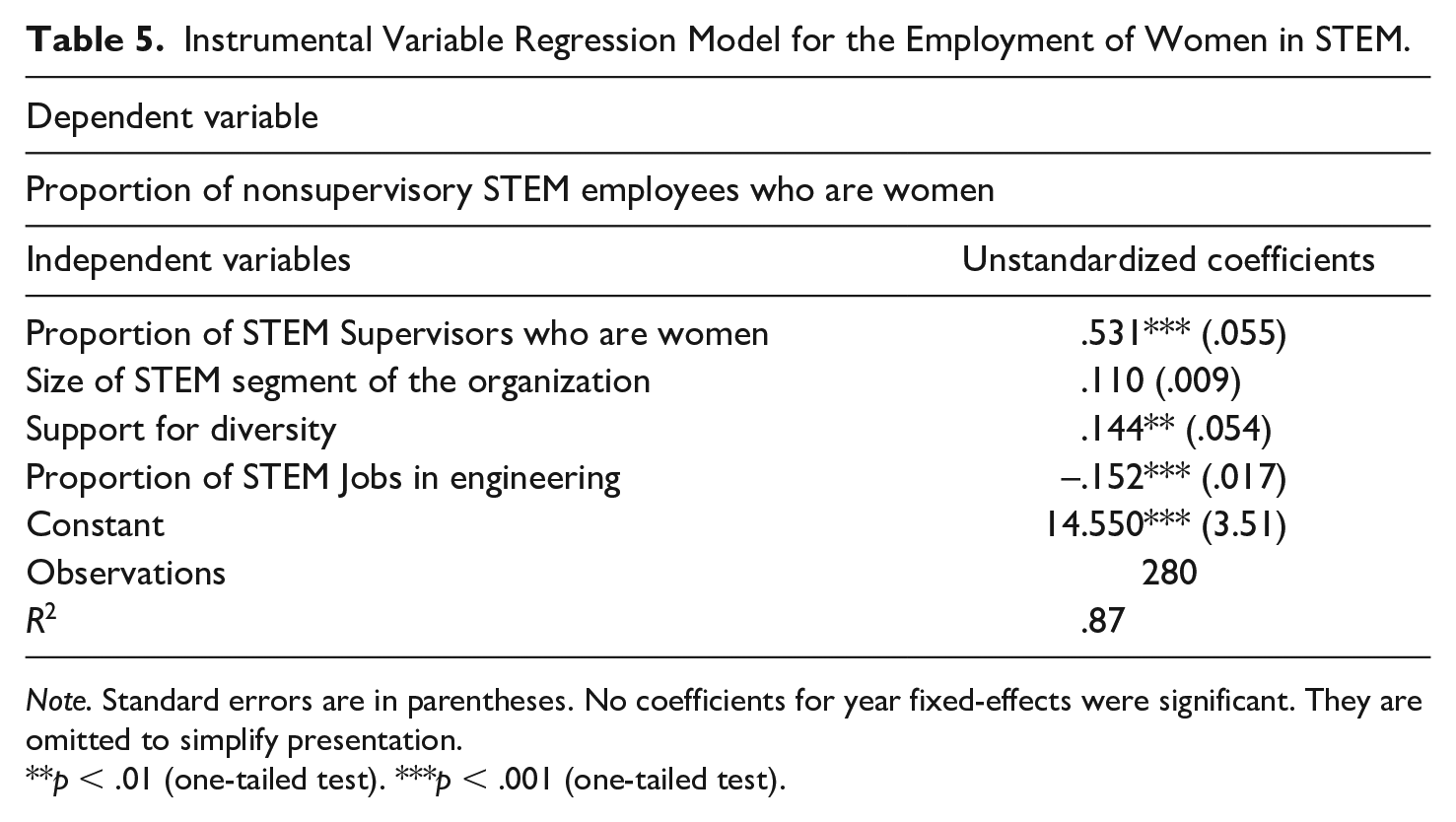
Note. Standard errors are in parentheses. No coefficients for year fixed-effects were significant. They are omitted to simplify presentation.
p < .01 (one-tailed test). ***p < .001 (one-tailed test).
The proposed covariates serving as control variables in the IV model also produce findings similar to those of the simple OLS model. Table 5 shows that the variable measuring the size of the STEM segment of the workforce does not have the effect anticipated. The coefficient on this variable is positive rather than negative.
Strong support is found, however, for the expectation regarding support for diversity within federal departments and agencies. As predicted, the coefficient on this variable is positive and significant, meaning that as support for diversity increases, the employment of women in nonsupervisory STEM positions also increases. This finding highlights further the importance of efforts to create environments within departments and agencies supportive of diversity. The unstandardized coefficient on this variable is .144 meaning that for every 1-point increase on the 100-point support for diversity scale, the employment of women in nonsupervisory STEM increases by 0.144 percentage points. While this impact may seem small, a shift from 0 to 100 on the support for diversity scale (reflecting movement from no support to strong support for diversity) will produce a 14-percentage point increase in the employment of women in STEM occupations.
Finally, the expectation regarding the proportion of STEM jobs in engineering is also supported. As expected, as the share of STEM jobs in engineering increases across the organizations studied, the proportion of nonsupervisory STEM jobs held by women decreases. The coefficient is −.152 suggesting that for every 1% increase in engineering jobs as a share of all STEM jobs, the employment of women declines by 0.152 percentage points. This effect is almost precisely the same as that estimated in the simple OLS model.
OLS Results for Quit Rates for Women in STEM
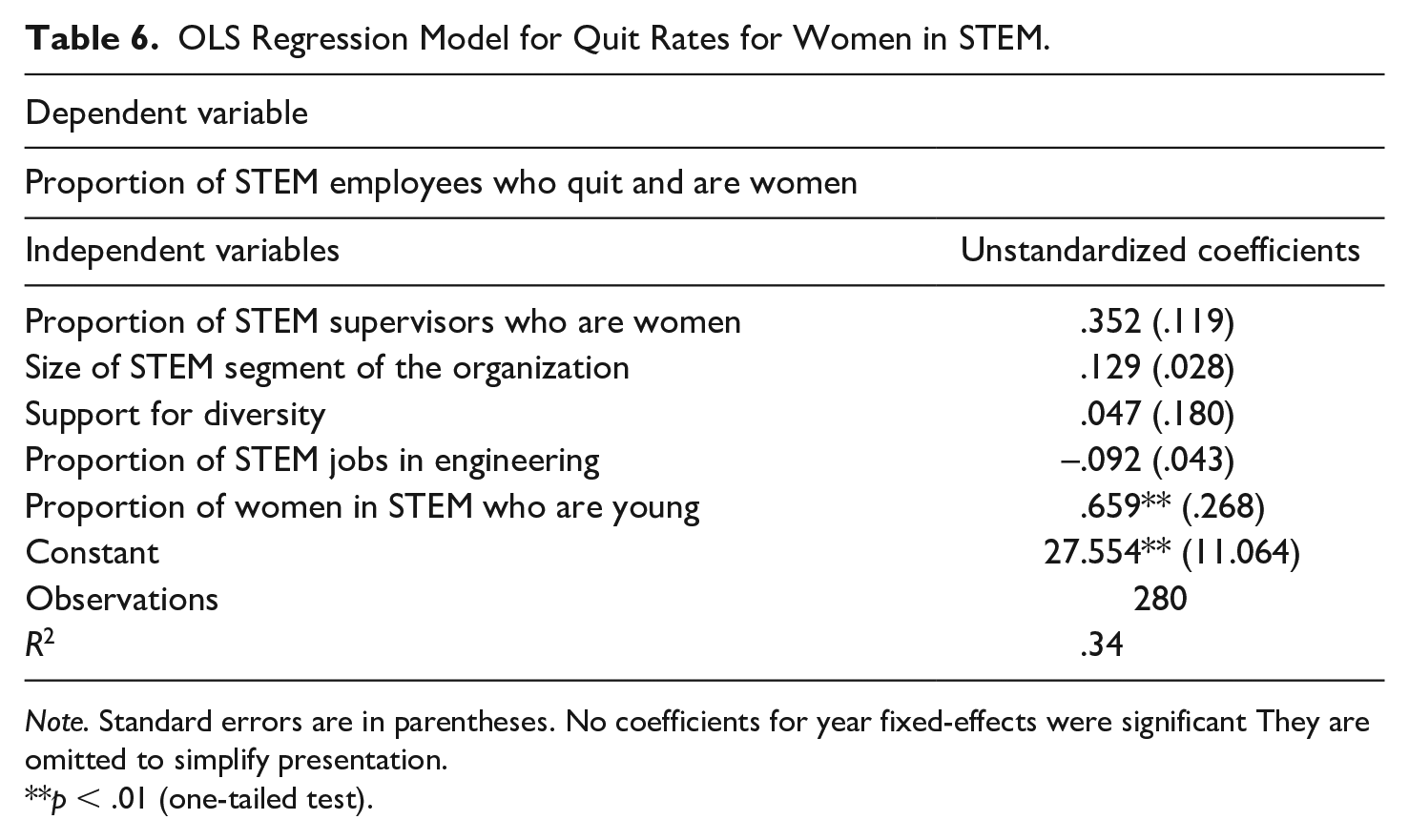
Table 6 provides findings for the model of the presence of women among those who quit STEM jobs. In this case, the model explains only 34% of the variance in quit rates for women in STEM in the federal departments and agencies studied. Surprisingly, there is no support for the proposition that the presence of women in supervisory positions in STEM will be negatively associated with the quit behavior of women in federal STEM jobs. The coefficient on the variable of primary interest is large, but it is positive rather than negative. This finding is in the opposite direction of what was predicted. The expectation was that departments and agencies with larger shares of STEM supervisors who are women would exhibit lower quit rates for women in STEM. This expectation was built on the assumption that women in supervisory positions in STEM would help to protect the interests of subordinate women in STEM, would provide positive role models, and would lead to lower quit rates for women in those positions. That effect does not appear to be present. Higher levels of the employment of women in supervisory positions is not associated with lower levels of the share of those who quit STEM who are women. Hypothesis 2 is not supported.
OLS Regression Model for Quit Rates for Women in STEM.
Note. Standard errors are in parentheses. No coefficients for year fixed-effects were significant They are omitted to simplify presentation.
p < .01 (one-tailed test).
Turning to the proposed covariates, there is no evidence that a larger STEM segment of the workforce in the departments and agencies examined will produce a lower the quit rate for women in STEM. Indeed, this coefficient is also positive rather than negative as hypothesized. This finding suggests that larger STEM components within federal departments and agencies do not lead to lower quit rates. Apparently, a larger STEM workforce within a department or agency does not necessarily enable women to move to other units within their organizations or find other alternatives to quitting to escape unwelcoming environments.
Similar results are found for the measure of support for diversity within federal departments and agencies. The coefficient for this variable is positive, but the prediction was that the association would be negative, that is, it was expected that as support for diversity increased, quit rates for women in STEM would decline. Apparently, support for diversity may help to promote the hiring of women in STEM, but it is not sufficient to reduce the rate at which women quit STEM jobs.
A similar finding is obtained for the variable measuring the proportion of STEM jobs in engineering. The expectation was that as engineering jobs increased as a share of all STEM jobs in departments and agencies, women as a proportion of those who quit would increase. That is not the finding. The coefficient is negative rather than positive. The fact that this and other variables in the model do not exhibit expected impacts warrants further investigation in future work designed to uncover the underlying processes at work regarding these factors.
There is, however, strong evidence that as the proportion of women in STEM who are young (29 years old or younger) increases, quit rates for women in STEM also increase. The unstandardized coefficient here is .659, and it is significant at the .01 level. This result is consistent with expectations and reflects the fact that younger workers generally quit at rates higher than those of older workers because they typically have fewer family or other obligations and may, as a consequence, be relatively free to shift career objectives. This finding is similar to those in other studies that have examined employee quit behavior in a number of contexts (see Bradbury et al., 2013; Government Performance Project, 2007; Kellough & Osuna, 1995; Lewis, 1991; Lewis & Park, 1989; Llorens & Stazyk, 2011; Meyer et al., 1979).
Conclusion
Striking variation between federal departments and agencies in the employment of women in federal STEM positions and in rates at which women quit STEM jobs is documented and examined in this study. Theoretically derived hypotheses are generated regarding the impact the employment of women as STEM supervisors may have on the employment of women in subordinate STEM positions and quit rates for women in STEM. Data were analyzed to test these hypotheses. Only one of these hypotheses is supported by the data. Analytical results indicate that the proportion of nonsupervisory STEM jobs in a department or agency held by women is strongly and positively associated with the proportion of STEM supervisors who are women, as hypothesized. The evidence suggests that the presence of women in supervisory jobs in STEM is at least a partial cause of employment for women in subordinate STEM positions. As a consequence, this finding provides support for theories derived from the literatures on representative bureaucracy and the importance of role models. The results of this model also indicate that the employment of women in nonsupervisory STEM positions is positively associated with support for diversity within a department or agency and negatively associated with the proportion of STEM jobs in engineering.
In contrast to findings in the employment share models, the model predicting quit rates for women in STEM does not provide evidence in support of the hypothesis that the presence of female STEM supervisors will reduce the rates at which women resign from STEM jobs. The dynamics underlying this finding are unknown, and efforts to identify an explanation should be undertaken in additional research. The most that can be said based on the present study is that for many women, the pressures that drive them to leave their jobs in STEM apparently overwhelm inclinations to stay fostered by the presence of women is supervisory roles who may serve as role models and may strive to make the work environment more hospitable. In a study of women in institutions of higher education, Etzkowitz et al. (1994) found that even though women in science in academia achieved a numerical “critical mass” in some departments, fragmentation along the lines of tenure, achievement, subfield, and generation made it difficult for young women (both students and junior faculty) to find supportive role models. Something similar may be occurring in the case of women in federal STEM employment who are contemplating quitting their jobs.
Several of the control variables in the quit rate model also fail to operate as expected. For example, the presence of larger STEM units in a department or agency workforce do not decrease quit behavior by women. A similar finding is seen regarding support for diversity, and results suggest that increasing proportions of STEM jobs in engineering does not increase quit behavior of women as had been expected. However, the variable measuring the extent to which women in STEM jobs are young (i.e., 29 years old or less) is a very strong predictor of quit rates for women. There is a substantial positive relationship between the presence of younger women in STEM occupations in the departments and agencies studied and the rate at which women quit those jobs.
This study is the first to systematically examine departmental and agency variation in the employment of women in STEM jobs in the U.S. federal service. No earlier work has examined the specific questions addressed here. It may be beneficial for future research on this issue to develop case studies of specific federal departments and agencies that are outliers in the models presented in this work. That is, from both the employment and the quit rate models presented here, one could select for close examination organizations with large positive residuals and those with large negative residuals. This would permit, for example, case analysis of organizations that employ more and fewer women in STEM than the model predicts and organizations where the quit rates for women are lower and higher than predicted. These organizations could provide interesting contexts for developing a fuller understanding of the dynamics associated with the employment of women in federal STEM positions. In this new work, women in STEM in outlier departments and agencies could be interviewed. In-depth research of this nature could provide important information to supplement the empirical findings of this study.
The present research is, nevertheless, meaningful to theory related to public sector employment diversity because it provides an uncommon exploration of intra-governmental, intra-gender dynamics. Most of the work on representative bureaucracy investigates dynamics between employees within government and populations outside of government. In addition, much of the recruitment and retention literature investigates attempts to diversify agencies but regards preexisting internal demographics as variables of secondary interest. This article puts organizational dynamics among women employed in public organizations at the forefront. Future research along these lines should result in a better understanding of the nuanced ways that individuals within underrepresented demographic groups relate to one another, establish community, and establish methods of mutual support in public sector employment.
In addition, future work in this area must consider the issue of intersectionality. The inability to fully address intersectionality is a limitation of the present paper and of the available data. OPM should disaggregate federal employment data more thoroughly by race, ethnicity, sex, and other characteristics so that intersectional dynamics can be examined across professional fields. All individuals have multiple intersecting identities including sex, sexual orientation, race, ethnicity, and social class background (Gayles & Smith, 2019). All of these factors can help to shape employment experiences for individuals. As was discussed earlier in this research, the experiences of minority women in federal STEM employment are likely to be quite different from that of nonminority women.
In sum, the underemployment of women in STEM jobs is an important issue that has been recognized as such for a very long time, but progress in dealing with the problem has been excruciatingly slow. This paper finds empirical support for the proposition that increases in the employment of women in STEM supervisory positions can lead to employment gains for women in nonsupervisory STEM positions. From a practical perspective, public managers seeking to increase the STEM employment of women in their agencies should strongly consider investing in developing and promoting women into supervisory roles. This is not a new or novel recommendation. It has been said before, but it is important that pressure be continually applied to remove the barriers that prevent women from fully participating in STEM fields as students in colleges and universities and ultimately in the workforce.
Footnotes
Declaration of Conflicting Interests
The author(s) declared no potential conflicts of interest with respect to the research, authorship, and/or publication of this article.
Funding
The author(s) received no financial support for the research, authorship, and/or publication of this article.
