



Abstract
Extant research has demonstrated that public service motivation (PSM) might have a dark side on public employees. However, empirical research on this assumption remains unclear. Based on Job Demands-Resources Model, this study explores the psychological mechanism of PSM on burnout and examines the relationship from both positive and negative aspects by classifying work stress into challenge stress and hindrance stress. A study with 255 street-level public employees shows that PSM has significant negative effects on burnout. Specifically, perceived hindrance stress mediates a negative relationship between PSM and burnout, and perceived challenge stress mediates a positive relationship between PSM and burnout. This study not only contributes to the development of theories on the doubled-edged nature and psychological mechanism of PSM in relation to burnout but also provides management enlightenment for improving employees’ well-being and mitigating burnout.
Introduction
Public service motivation (PSM) has aroused widespread interest from scholars and practitioners over the past three decades (Perry & Vandenabeele, 2015; Ritz et al., 2016; Vandenabeele et al., 2014). Scholars are calling for increasing PSM of public employees through various ways like management practices, reward systems, and training (Andersen et al., 2012; Giauque et al., 2013a; Pande & Jain, 2014; Ritz et al., 2016). However, employees in the public sector may sometimes experience low job satisfaction and poor well-being. Especially during the COVID-19 pandemic, public employees face more and harder work in a more restrictive and less connected bureaucratic environment and may experience decreased well-being (Berry et al., 2022; van der Meer et al., 2022). Based on an investigation in China, Liu et al. (2015) proposed that public employment could be the most stressful occupation. It appears that public employees with high PSM are more willing to serve the public, feel compassion for disadvantaged groups, sacrifice their own time and energy, and attempt to improve policy implementation through their efforts, which is likely to lead to stress and burnout (Schott & Ritz, 2018).
Scholars have extensively studied the relationship between PSM and burnout (Giauque et al., 2013b; Kim, 2015, 2018; Rayner et al., 2018; van Loon et al., 2015; Potipiroon, 2023). Burnout is defined as a psychological state in response to stress in the work context and consists of three key dimensions: emotional exhaustion, depersonalization, and reduced accomplishment (Maslach & Jackson, 1981; Maslach et al., 2001). It is manifested in negative individual outcomes such as depression, anxiety, sleep disturbances, and work-to-family conflict (Carlson et al., 2012; Koutsimani et al., 2019; Qin et al., 2022) as well as organizational outcomes such as increased absenteeism, turnover intention, decreased job performance, and organizational commitment (Jourdain & Chênevert, 2015; Lemonaki et al., 2021; Li et al., 2021; Scanlan & Still, 2019). PSM is expected to increase the tolerance of public employees toward bureaucratic characteristics (Scott & Pandey, 2005), increase the fit between the work environment and personal aspirations (Bright, 2007), and may be considered a crucial job resource that can surmount burnout (Kim, 2018). Yet, empirical studies have mostly focused on the direct relationship between PSM and burnout and have produced mixed findings, including positive (e.g., Giauque et al., 2013b), negative (e.g., Kim, 2018), and non-significant (e.g., Rayner et al., 2018) direct relationships. Disclosing the “black box” between PSM and burnout may help explain the mixed picture of empirical findings and offer a deeper understanding of how PSM works.
To contribute to the empirical studies of the relationship between PSM and burnout and address the issue of confusing results, this study analyses the psychological mechanism between PSM and burnout by integrating the positive and negative effects of PSM on burnout. Specifically, this study capitalizes on the Job Demands-Resources Model (Bakker & Demerouti, 2007; Xanthopoulou et al., 2007) to examine the mediating effect of two kinds of work stress on the relationship between PSM and burnout among street-level public employees in the Chinese context. Previous studies usually take work stress as a single scale, which is unable to draw a clear picture of the actual effect of PSM (Giauque et al., 2013b; Gould-Williams et al., 2015). To fill this gap, this study distinguishes work stress into challenge and hindrance stress (Cavanaugh et al., 2000) and explores the mediating role of two types of work stress. Challenge stress is often perceived as demands that can promote personal achievement and growth and future gains. Hindrance stress is perceived as demands that can hinder personal growth, learning, and work achievement.
This study contributes to the extant literature in three ways. First, this study provides a nuanced view of the nature of PSM and offers an application of the JD-R model in public organizations. PSM is not only a personal job resource but also has a dark side, becoming the source of job demands. Then, this study discloses the “black box” between PSM and burnout. This study proposes that PSM can relate to burnout both positively (through perceived challenge stress) and negatively (through perceived hindrance stress). Examining multiple theories of human behavior is necessary to understand the underlying mechanisms (Colquitt & Zapata-Phelan, 2007). In doing so, the findings of this research reconcile discrepancies in empirical results and answer the call for overcoming the optimism perspective of PSM (Ritz et al., 2016). Furthermore, by differentiating two types of work stress (challenge stress and hindrance stress), this study responds to the debate on the validity of this classification and provides empirical evidence in the public domain.
Literature Review and Theoretical Hypothesis
PSM and Burnout
PSM refers to “a particular form of altruism or prosocial motivation that is animated by specific dispositions and values arising from public institutions and missions” (Perry et al., 2010, p. 682). Studies on the outcomes of PSM have mainly focused on the bright side. It has been shown that PSM is positively related to positive work attitudes and behaviors, such as job satisfaction (Homberg et al., 2015; Liu et al., 2008), organizational commitment (Crewson, 1997; Liu & Zhang, 2019; Sun, 2021; Wright et al., 2013), organizational citizenship behavior (Chen et al., 2023; Liu & Perry, 2016), and change-supportive behavior (Ahmad et al., 2021; Hassan et al., 2021). And it can also mitigate negative outcomes, like decreasing turnover intention (Bright, 2021; Gan et al., 2020).
Public organizations have placed greater emphasis on customer orientation and faced increasing demands for quicker response times (Diefenbach, 2009), raising concerns about burnout among public employees. Scholars are increasingly taking public employees’ burnout as an important topic. Burnout refers to “a psychological syndrome that occurs in response to chronic work-related stressors” (Maslach et al., 2001, p. 399). Previous studies have widely examined the antecedents of burnout to improve employees’ well-being and benefit organizations. And the Job Demands-Resource model (the JD-R model) is the main conceptual framework to understand how various antecedents lead to burnout (Bakker et al., 2004; Demerouti et al., 2001; Martinussen et al., 2007). The JD-R model classifies job characteristics into two broad categories: job demands (i.e., red tape, goal ambiguity) and job resources (i.e., social support, task significance, autonomy; Bakker & Demerouti, 2007; Demerouti et al., 2001). According to the JD-R model, job demands and resources play vital roles in developing burnout (Bakker et al., 2014). Burnout occurs when public employees face extreme job demands and a lack of job resources (Bakker & Demerouti, 2007; Demerouti et al., 2001). Consistent with prior studies (Bakker, 2015; Giauque et al., 2013b), this study uses the JD-R model to explain how PSM influences burnout.
First, PSM can be regarded as a personal job resource that public employees can employ to deal with tremendous work demands (Giauque et al., 2013b). PSM is positively associated with person-organization fit (Bright, 2007; Kim, 2012), referring to the congruence between employees’ values and the organization’s culture (Cable & DeRue, 2002). When employees believe that their values align with their organization, they are more inclined to cultivate developmental relationships with other individuals, such as supervisors, mentors, and co-workers, which leads to a greater sense of social support in terms of networking, mentorship, and supportive work relationships (Afsar & Badir, 2016). PSM can also be viewed as a form of autonomy orientation (Liu et al., 2015; Shim et al., 2017). Public employees with a high level of PSM, who experience autonomous motivational states, will have a high ability to manage stress appropriately. For example, autonomously oriented individuals will perceive adequate resources for coping with stressful events, effectively assimilate and integrate emotions with previous experiences, emotions, and beliefs, and utilize emotions to provide needed information (Liu et al., 2015; Weinstein & Ryan, 2011). Furthermore, according to Motivation-Hygiene Theory (Herzberg et al., 1959), PSM, which aims to benefit others and contribute to the whole society, belongs to motivators and can relieve work stress (Gould-Williams et al., 2015; Knoop, 1994).
Then, from the perspective of job demands, PSM can affect how public employees perceive and understand job demands (Potipiroon & Faerman, 2020). Numerous bureaucratic characteristics constitute public organizations’ job demands. For example, red tape, described as burdensome rules, regulations, and procedures that can restrict and hinder employees from achieving their goals (Bozeman, 2000), can lead to lots of negative employee outcomes (Blom et al., 2021; George et al., 2021) and is considered as main characteristics of job demands in public organizations (Giauque et al., 2013b). Goal ambiguity requires extra cognitive effort from employees to achieve set goals and is also categorized as job demands (Andrews & Mostafa, 2019). PSM is positively associated with public employees’ congruence with organizations and can enhance their tolerance toward bureaucratic characteristics (Scott & Pandey, 2005). Previous research demonstrates that employees working on their passion can integrate multiple goals and feel less time stress (Jachimowicz & Whillans, 2018). That is, high-PSM public employees who have passions for public service might feel multiple goals integrated, perceive less time pressure, and thus avoid poor health, like burnout. Aiming to benefit others and achieve organizational goals, PSM drives public employees to take job demands as in-role difficulties rather than unacceptable restrictions (Potipiroon & Faerman, 2020; Scott & Pandey, 2005). In other words, PSM can help public employees “eliminate” job demands in public organizations.
To summarize, on the one hand, public employees with high PSM will perceive a high person-organization fit and have a great sense of social support, possess a high ability to manage stress appropriately, and thus have sufficient personal job resources; on the contrary, PSM can enhance tolerance for bureaucratic characteristics, foster a perception of integrated multiple goals and reduced time pressure, which results in fewer job demands. Therefore, employees with high PSM are less prone to experience burnout due to fewer job demands and adequate job resources. This leads to:
The Mediating Role of Work Stress
As work stress within the public sector has become an increasing concern, a handful of studies have paid attention to the relationship between PSM and work stress, resulting in mixed effects (Giauque et al., 2013b; Gould-Williams et al., 2015; Jia et al., 2022; Quratulain & Khan, 2015). For instance, Gould-Williams et al. (2015) propose that PSM can be considered a personal job resource that can help public employees surmount stress perception, similar to motivators in the Motivation-Hygiene theory. Consistent with this idea, Jia et al. (2022) have drawn a negative relationship between PSM and work stress. On the contrary, in their empirical results, Giauque et al. (2013b) found a positive relationship between PSM and stress perception, explaining that PSM can enhance the organizational commitment of public employees and make it easier for them to experience stress subsequently due to the inability to achieve organizational goal. However, these studies failed to analyze different types of work stress and mostly took work stress as an aggregate concept, which might be the main reason for mixed results.
Work stress is normally aroused by various stressors. Cavanaugh et al. (2000) have distinguished two kinds of work stressors: challenge and hindrance. It is important to differentiate between reactions to challenge and hindrance stressors. This study made distinct predictions for the relationship between perceived challenge and hindrance stress and PSM. Challenge stress refers to challenging job demands that can offer potential gain and contribute to personal achievement and growth (Cavanaugh et al., 2000), including heavy workload, time urgency, high responsibility, and so on. Hindrance stress refers to undesirable or unnecessary constraints that may thwart or hinder personal growth and work achievement (Cavanaugh et al., 2000), including red tape, politics, role conflict, and so on. The meta-analysis conducted by LePine et al. (2005) demonstrated differential relationships between motivation (i.e., the direction, level, and persistence of effort toward work) and two types of stress, in which hindrance stress had a negative association with motivation and challenge stress had a positive relationship with motivation. As a type of motivation, public service motivation should demonstrate similar relationships (Deng et al., 2019, 2021). PSM can drive public employees to view job demands as opportunities to benefit others and the whole society, and to frame job demands as challenges rather than obstacles to achieving goals, implying higher perceived challenge stress and lower perceived hindrance stress (Liu et al., 2015). Thus, we propose the following hypotheses:
Perceived stress is one of the most important antecedents of burnout (Alarcon, 2011; Maslach & Jackson, 1981; Maslach et al., 2001). Previous studies demonstrated that challenge and hindrance stress had an inverse relationship with personal or organizational outcomes (LePine et al., 2005). However, regarding the relationship between two kinds of stress and burnout, studies claimed consistent positive findings for both challenge and hindrance stress (e.g., LePine et al., 2004; Meng et al., 2023; Wu et al., 2020). From the perspective of the JD-R model, whether challenge or hindrance stress belongs to job demands, so they both require increased energy or efforts to cope with, which may lead to burnout subsequently (Crawford et al., 2010). A recent meta-analysis synthesizing many studies also demonstrates consistent positive effects for both hindrance stress (0.38, average correlation) and challenge stress (0.24, average correlation) on burnout (Mazzola & Disselhorst, 2019). Therefore, we propose the following hypotheses:
Previous research has pointed out that perceived challenge stress and hindrance stress may serve as mediators in the relationship between personal or situational factors and employees’ attitudes and behaviors (Culbertson et al., 2009; Lin et al., 2020; Mawritz et al., 2014). This study posits that PSM is positively associated with challenge stress and negatively associated with hindrance stress (Hypotheses 2a and 2b) and that challenge stress and hindrance stress are positively associated with burnout (Hypotheses 3a and 3b). Thus, this study hypothesizes that perceived challenge and hindrance stress mediate the relationship between PSM and burnout. Specifically, PSM will increase employees’ perception of challenge stress by promoting them to view job demands as opportunities, which will require more energy or effort and lead to burnout. Simultaneously, PSM will decrease employees’ perception of hindrance stress by reducing their sense of threat or constraint, resulting in fewer job demands and a low risk of burnout. This leads to:
The proposed model is presented in Figure 1.
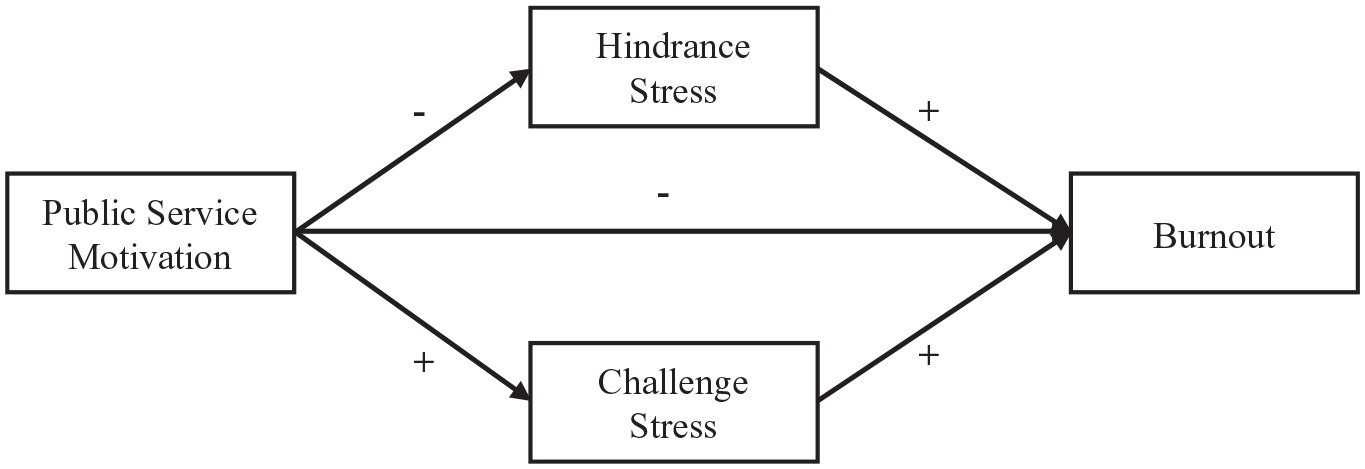
Theoretical Model.
Method
Sample
This study collected data from public employees who were part-time students in a Master of Public Administration (MPA) program in a metropolitan city in eastern China. These public employees worked in various departments, including tax collection, health, personnel, social security, and so on. The survey was conducted during class breaks. At the beginning of the survey, the participant was informed that the investigation was voluntary, anonymous, and confidential. This study distributed 300 questionnaires and received 255 completed qualified questionnaires after excluding cases with missing data, resulting in a response rate of 85.00%. Of 255 respondents, 53.73% were female, and 14.12% held a master’s degree and above. The average age was 29.04 years (SD = 3.26), and the average organizational tenure was 4.66 years (SD = 2.57).
Measures
All variables were measured by seven-point Likert-type scales, ranging from 1 to 7, indicating “strongly disagree” to “strongly agree.” Furthermore, following the recommendations of Brislin (1970), original English items were translated into Chinese and back into English.
Public Service Motivation
This variable was assessed by 18 items developed by Perry (1996) and revised by Liu and Perry (2016) in the Chinese Context. A representative item is “sharing my views on public policies with others is attractive to me.” The Cronbach’s α for 18-item PSM is 0.95.
Burnout
Maslach Burnout Inventory developed by Maslach and Jackson (1981) was used. As emotional exhaustion is viewed as the best indicator and core dimension of burnout (Johnson & Spector, 2007), this study only employs the emotional exhaustion subscale. A sample item is “I feel used up at the end of the workday.” The Cronbach’s α for burnout is 0.90.
Work Stress
The work stress scale developed by Rodell and Judge (2009) was used, in which four themes were used to capture perceived challenge stress, and four themes were used to capture hindrance stress. A sample item for challenge stress is “My job has required me to work very hard.” A sample item for hindrance stress is “I have had to go through a lot of red tape to get my job done.” The Cronbach’s α for the challenge and hindrance stress were 0.73 and 0.78, respectively, both greater than the acceptable threshold of 0.7 (Taber, 2018). Other studies focusing on challenge and hindrance stress have also reported similar Cronbach’s α (Flinchbaugh et al., 2015; Yang & Li, 2021).
This study controlled several demographic variables commonly used in previous studies on work-related stress and burnout (e.g., Bao & Zhong, 2019; van Loon et al., 2015). These variables include age, gender (female = 0, male = 1), education (college and below = 1, bachelor = 2, master and above = 3), and organizational tenure (in the year). Meta-analyses have demonstrated significant correlations between these variables and employees’ burnout, which further justifies their inclusion as control variables in this study (Brewer & Shapard, 2004; Lim et al., 2010; Purvanova & Muros, 2010).
Analytic Procedures
Before testing the hypotheses, this study conducted a preliminary analysis. This study employed confirmatory factor analysis to evaluate the structural validity of the constructs. To test common method bias, Harman’s single-factor test was used. Then, all variables’ mean, standard deviations, and correlations were analyzed to provide preliminary support for subsequent regression analysis. Next, this study adopted regression analysis to test the hypotheses, including both direct and indirect effects. And this study also used PROCESS macro to analyze 95% confidence intervals (CIs) to test the mediation effect more rigorously.
Results
Preliminary Analysis
First, confirmatory factor analyses were conducted to evaluate the structural validity of the main variables. As Table 1 shows, hypothesized four-factor model fits the data well (χ2/df = 3.01, comparative fit index = 0.94, Tucker–Lewis index = 0.92, root mean square error of approximation = 0.08, standardized root mean square residuals = 0.05). Compared with the other three competing models, the four-factor model performed better in every fitting indicator, demonstrating that measures of the main variables have good structural validity.
Confirmatory Factor Analysis (CFA) Results.
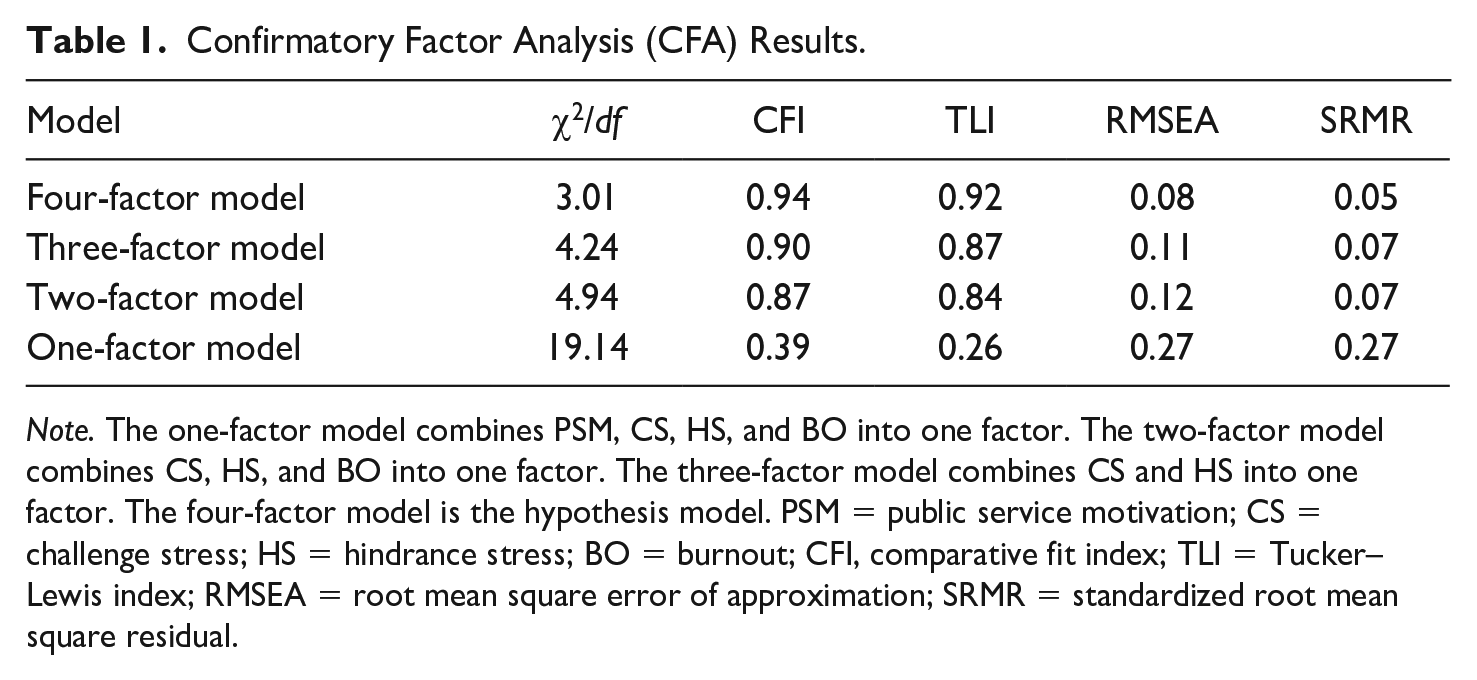
Note. The one-factor model combines PSM, CS, HS, and BO into one factor. The two-factor model combines CS, HS, and BO into one factor. The three-factor model combines CS and HS into one factor. The four-factor model is the hypothesis model. PSM = public service motivation; CS = challenge stress; HS = hindrance stress; BO = burnout; CFI, comparative fit index; TLI = Tucker–Lewis index; RMSEA = root mean square error of approximation; SRMR = standardized root mean square residual.
As the data were collected from one source at one time, common method bias (CMB) may affect the results. This study conducted Harman’s single-factor test to examine the unrotated factor solutions. It drew six factors, and the first factor accounted for 22.37% of the total variance, which did not explain the majority of the variance, implying that CMB was not a significant concern.
Descriptive Statistics and Correlation Analysis
Table 2 reported means, standard deviations, and correlations for all variables. Based on correlation analysis, PSM was negatively related to burnout, which provided preliminary support for Hypothesis 1. As expected, PSM was positively associated with challenge stress, and challenge stress was positively associated with burnout. Table 2 also demonstrated that the correlation between PSM and hindrance stress was significantly negative, and the correlation between hindrance stress and burnout was significantly positive. Thus, correlations between main variables provide preliminary support for the research hypotheses.
Means, Standard Deviations, and Correlations.
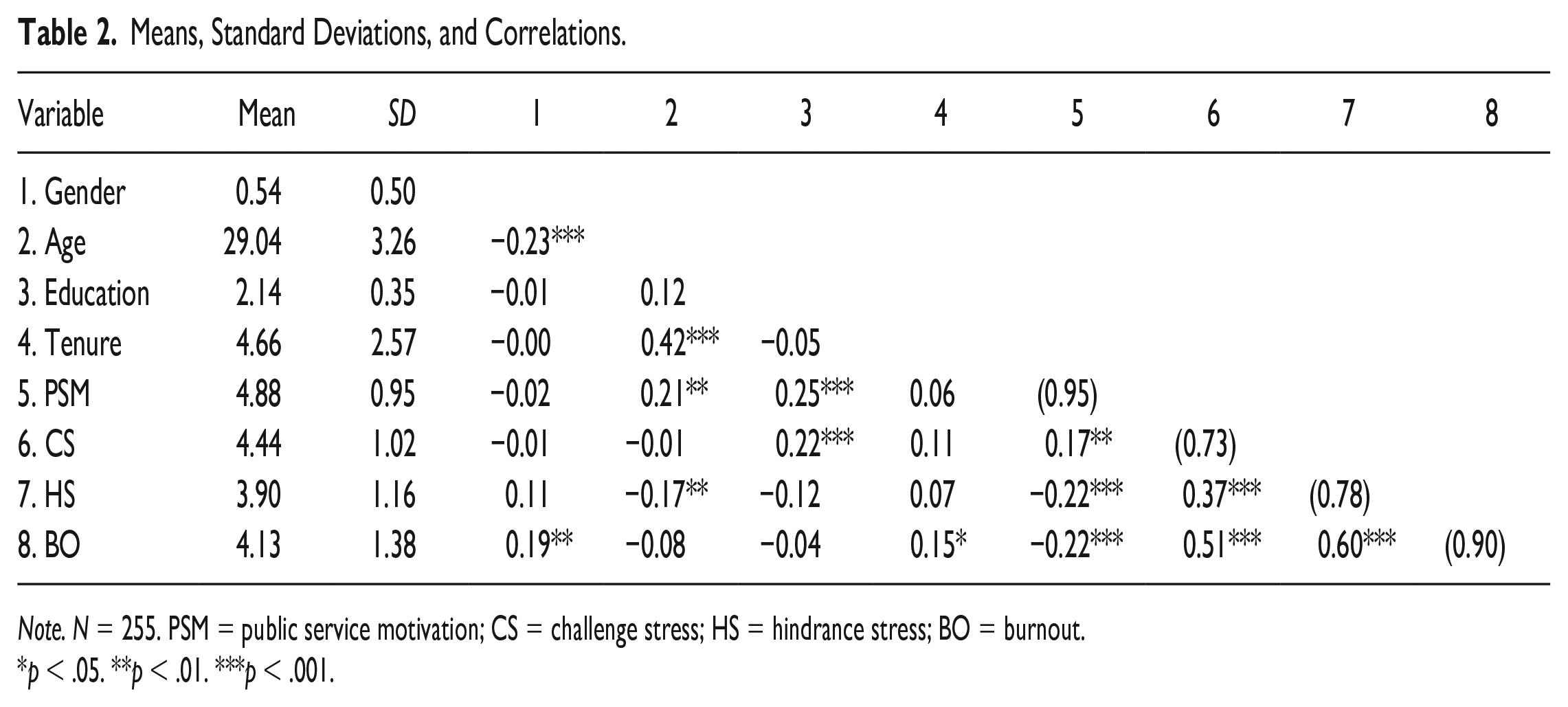
Note. N = 255. PSM = public service motivation; CS = challenge stress; HS = hindrance stress; BO = burnout.
p < .05. **p < .01. ***p < .001.
Hypothesis Testing
First, this research conducted regression analyses in SPSS to test hypotheses. Hypothesis 1 predicted that PSM would be negatively related to burnout. As shown in Table 3, after controlling for the demographic variables, PSM had a significantly negative effect on burnout (β = −0.23, p < .001, model 3). Therefore, Hypothesis 1 was supported (i.e., path c).
Results of Regression Analysis.
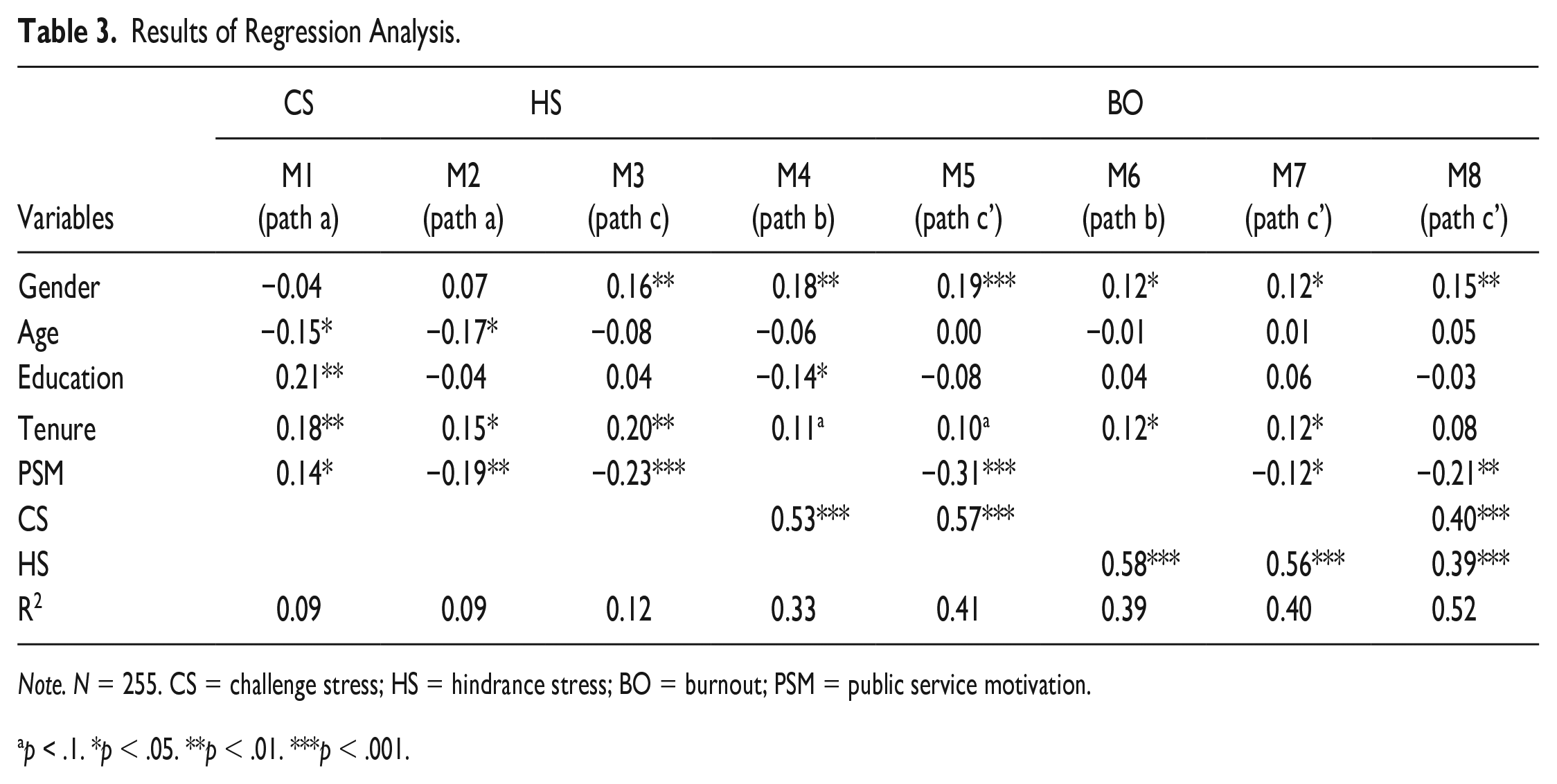
Note. N = 255. CS = challenge stress; HS = hindrance stress; BO = burnout; PSM = public service motivation.
p < .1.
p < .05. **p < .01. ***p < .001.
To examine the mediation effects, this study followed procedures recommended by Baron and Kenny (1986). For the mediation effect of challenge stress, PSM was positively related to challenge stress (β = .14, p < .05, model 1), indicating that Hypotheses 2a was supported (i.e., the path a). Furthermore, Challenge stress was positively related to burnout (β = .53, p < .001, model 4), implying that Hypotheses 3a was supported (i.e., the path b). Next, this study added challenge stress into the model (Model 5) and found that it had a significant positive relationship with burnout (β = .57, p < .001, model 5). In addition, PSM was still negatively related to burnout after including challenge stress (β = −.31, p < .001, Model 5). Thus, challenge stress partially mediated the relationship between PSM and burnout. Hypothesis 4a was supported (i.e., the path c’).
For the mediation effect of hindrance stress, model 2 explored the significantly negative effect of PSM on hindrance stress (β = −.19, p < .01, Model 2), implying that Hypotheses 2b was supported (i.e., the path a). Hindrance stress was positively related to burnout (β = .58, p < .001, Model 6), implying that Hypotheses 3b was supported (i.e., the path b). Then this study added hindrance stress into a new model based on Model 3. The results showed a significantly positive effect of hindrance stress on burnout (β = .56, p < .001, Model 7) and a significantly negative effect of PSM on burnout (β = −.12, p < .05, Model 7). Thus, hindrance stress partially mediated the relationship between PSM and burnout, and Hypothesis 4b was supported (i.e., the path c’).
The above analysis indicates that challenge and hindrance stress exert distinct mediation effects. Drawing on Zhao et al.’s (2010) decision tree for identifying types of mediation, this study classifies challenge stress as a competitive mediator and hindrance stress as a complementary mediator.
To rigorously test the mediation hypotheses, this study used the PROCESS macro developed by Hayes and Preacher (2014) to explore the confidence interval of the indirect effect between PSM and burnout through challenge stress and hindrance stress, respectively. The results are summarized in Table 4. The confidence interval for the indirect effect of PSM on burnout through challenge stress did not include zero, with the 95% CI ranging from 0.03 to 0.18, suggesting that the indirect effect of PSM on burnout via challenge stress was significant. Likewise, the confidence interval for the indirect effect of PSM on burnout through hindrance stress did not include zero, with the 95% CI ranging from −0.23 to −0.05, suggesting that the indirect effect of PSM on burnout via hindrance stress was significant. Therefore, the significant results of the indirect effects supported Hypotheses 4a and 4b.
Results of Mediation Effects Analysis.
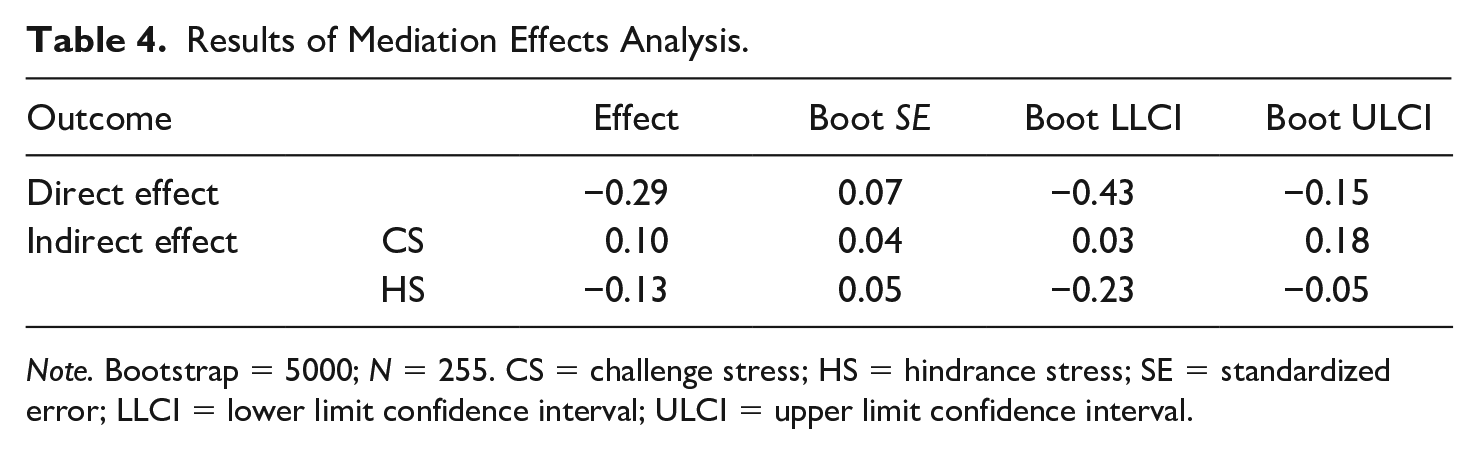
Note. Bootstrap = 5000; N = 255. CS = challenge stress; HS = hindrance stress; SE = standardized error; LLCI = lower limit confidence interval; ULCI = upper limit confidence interval.
The full results are presented in Figure 2.
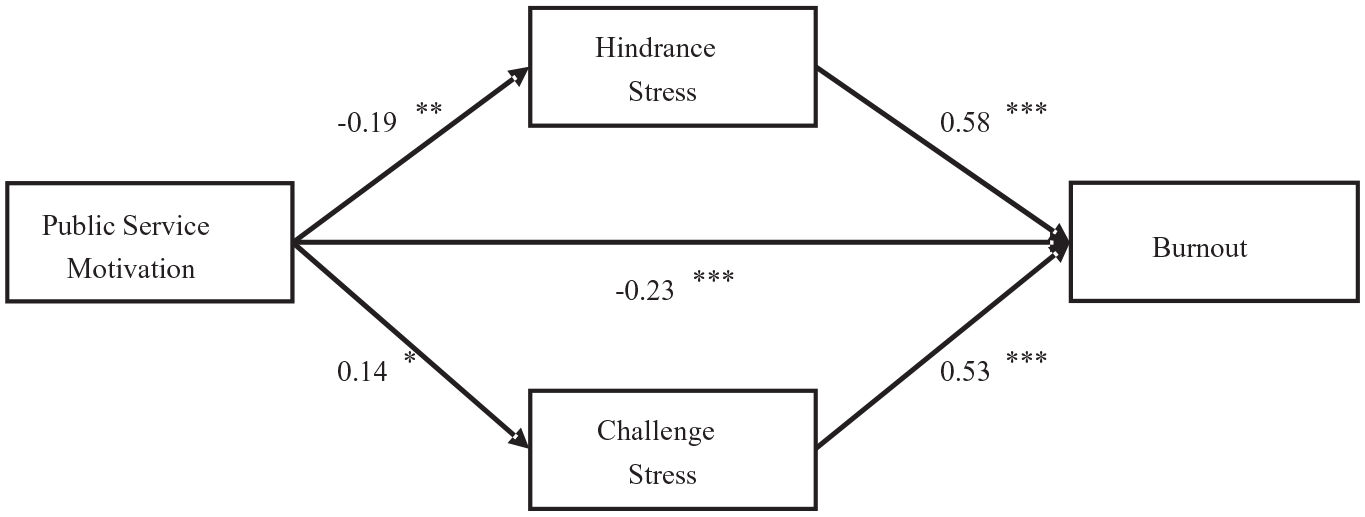
Results of Theoretical Model
Discussion
Theoretical Implications
First of all, the findings of this study provide a more nuanced understanding of the nature of PSM and offer support for applying the JD-R model in public organizations. It is an oversimplistic view to take PSM as a personal job resource. As an individual characteristic in public organizations (Davis et al., 2020), PSM can not only be considered a personal job resource but also be the source of job demand (like high responsibility), which is in line with the reminder that PSM might have a dark side (e.g., Giauque et al., 2013b; Liu et al., 2015; Potipiroon, 2023). This finding is also consistent with the research on deeply meaningful work and calling. For instance, employees who experience deeply meaningful work may exhibit high work devotion and tend to overwork and erratic work, increasing the risk of time- and trust-based conflict (Oelberger, 2019). Sharma et al. (2022) have demonstrated that calling has a dark side and is positively associated with work–family conflict, family–work conflict, and burnout.
Second, this study discloses the psychological mechanism between PSM and burnout. While previous studies have investigated the link between PSM and burnout (Kim, 2015; Rayner et al., 2018; van Loon et al., 2015), in the face of contradictory results, they fail to analyze the underlying mechanism. To the best of the knowledge, it is the first research to investigate the relationship between PSM and burnout from both positive (via perceived challenge stress) and negative (via perceived hindrance stress) paths. The study findings shed new light on how burnout develops in public organizations and contribute to the nomological network of burnout. Challenge stress and hindrance stress play different mediating roles, with challenge stress acting as a competitive mediator that strengthens the negative relationship between PSM and burnout, and hindrance stress acting as a complementary mediator that weakens the negative relationship between PSM and burnout. These results imply that some omitted mediators could be studied in future research (Zhao et al., 2010). Interestingly, when both types of stress are included, the relationship between PSM and burnout remains negative, and the coefficient is similar to the direct effect when neither is included, indicating similar and opposite mediating effects for challenge stress and hindrance stress. Previous research has pointed out that the relationship between PSM and its outcomes could be influenced by moderators (e.g., van Loon et al., 2015). For instance, Davis et al. (2020) have proposed that PSM would lead to higher negative emotions when employees perceive heightened workplace conflict. Thus, future research should pay closer attention to the exploration of boundary conditions.
Finally, instead of using an overarching work stress concept, this study contributes to stress literature by linking PSM and two kinds of stress: challenge stress and hindrance stress. Although previous research in PA has mentioned the relationship between PSM and two types of stress (Shim et al., 2017), this study is the first to empirically examine the mediating effect of perceived hindrance stress and perceived challenge stress on the relationship between PSM and burnout. The results show that PSM is positively related to perceived challenge stress and negatively related to perceived hindrance stress, while both types of stress are positively related to burnout. The findings provide empirical support for the challenge-hindrance stress model but do not support the idea of taking challenge stress as good stress (Travis et al., 2020). Some studies concern no significant differences between challenge and hindrance stress (Crane & Searle, 2016; Webster et al., 2011). In line with the meta-analysis of Podsakoff et al. (2007) and Mazzola and Disselhorst (2019), the findings of this study partially supported the validity of differentiating two types of work stress. That is, challenge and hindrance stress present different relationships with some variables, like job satisfaction, while they show the same relationships with some variables, especially physical and psychological strain. Future research should continue to investigate the empirical analysis of challenge and hindrance stress and build an overall theory. These findings also respond to the call for the validity of the differentiation of challenge and hindrance stress in different job domains (Demerouti & Bakker, 2011). It is worth mentioning that some studies suggest the opposite causality in which challenge stressors and hindrance stressors are antecedents of PSM (Deng et al., 2019, 2021). Further research is required to investigate this subject.
Practical Implications
The findings of this study also provide some valuable managerial insights for public organizations. First, considering the aggregate negative effect between PSM and burnout, it is necessary to invest more efforts in the selection and cultivation of high-PSM public employees. The public sector should consider PSM in all stages of the HRM process and ensure coordination among different stages (Piatak et al., 2021). For example, in the process of recruitment and selection, public organizations could screen candidates with high PSM through surveys or focus on their volunteering behavior (Paarlberg et al., 2008; Piatak & Holt, 2020). The public sector could also optimize job design to foster PSM, such as designing appropriate work autonomy and providing opportunities for employees to engage with customers (Homberg et al., 2015; Mostafa et al., 2015).
Second, the research findings demonstrate that hindrance stress mediates the negative relationship between PSM and burnout. Specifically, hindrance stress is found to be negatively related to PSM and, in turn, has a detrimental influence on employees’ well-being. Located in the Job Demands-Resources model, more resources should be offered to mitigate the negative effects of hindrance stress. For instance, public organizations could foster a supportive work environment, cultivate a specific leadership style, or reform the government system (Bao & Zhong, 2019; Ozer et al., 2014).
The present study also found that challenge stress mediates the relationship between PSM and burnout. Specifically, PSM is positively associated with challenge stress, while challenge stress is positively linked to burnout. However, due to the positive relationship between challenge stress and burnout, it would be inappropriate to simply suggest increasing challenge stress (Bao & Zhong, 2021). Because challenge stress can also benefit organizations and individuals (Mazzola & Disselhorst, 2019; LePine et al., 2005), it is reasonable to adopt management practices to alleviate strain associated with challenge demands, such as training in prioritizing tasks, advocate strain-reducing activities (Crawford et al., 2010; LePine et al., 2005).
Meanwhile, this study was conducted in the Chinese context, where public employees experienced severe burnout under the “dynamic zero-COVID” policy. Empirical studies have pointed out that public employees are faced with increasing emotional demands during the COVID-19 pandemic, such as fear and anxiety about health, and are more likely to experience stress and burnout (Barboza-Wilkes et al., 2022). Therefore, it is necessary and imperative to focus on burnout and work stress of public employees. Moreover, previous studies have demonstrated that cultural differences might influence PSM’s prevalence, antecedents, and consequences (Houston, 2011; Rayner et al., 2018). This study provides a contextualized understanding of PSM and responds to the call for more research in non-Western settings (Hassan & Ahmad, 2021).
Limitation and Future Research
This study inevitably has several limitations which need to be considered in future research. First, the study employed a cross-sectional design, which prevented from establishing the exact causal relationships among the study variables. Future research should adopt rigorous research designs to increase confidence in the causal statements, like experimental or longitudinal designs. In addition, all variables used in this study were self-reported, as they belong to individual characteristics or psychological perceptions. Although the result of Harman’s single-factor test provides some confidence, this study cannot rule out the risk of common method bias. Objective data could be used to measure well-being variables in future research. Second, this study used a convenience sample of full-time public employees who were also part-time MPA students from a metropolitan city in eastern China. Thus, caution is needed when generalizing the research results. For example, the average age of the sample is 29.04 years old, which is relatively young compared with the overall population of public employees. Previous studies have suggested age could influence burnout and its relationship with other variables (Brewer & Shapard, 2004; Huang et al., 2022). Meanwhile, organizational type also plays an important role in the relationship between PSM and other variables (van Loon et al., 2015). Future research could test the proposed relationships among different age groups as well as be conducted in different areas or professions to validate study results further. Third, this study only focuses on the direct and mediating effect between PSM and burnout while ignoring moderate variables constraining these relationships. Heeding the results of van Loon et al. (2015), organizational type and social impact potential may influence the relationship between PSM and burnout. Otherwise, perceived person-organization fit may also mix the effect of PSM on employees’ well-being (Christensen & Wright, 2011). Therefore, to obtain a more comprehensive understanding of PSM and its outcomes, future research should adopt a more rigorous research design incorporating various moderating variables to analyze the conditional boundaries influencing the relationship between PSM and burnout.
Conclusion
Based on the Job Demands-Resources model, this study aims to disclose the “black box” between PSM and burnout by examining the mediating effect of challenge stress and hindrance stress. Specifically, this study finds that: (a) PSM has a negative relationship with burnout; (b) PSM has a negative relationship with burnout through the mediating role of perceived hindrance stress; (c) PSM has a positive relationship with burnout through the mediating role of perceived challenge stress. The findings of this study respond to the focus on the dark side of PSM, as well as enhance understanding of the psychological mechanisms of PSM in relation to burnout. Considering the salient situation of tremendous work stress in public organizations, the well-being of public employees has been a critical issue. The results of this study also provide managerial implications and shed light on measures to mitigate burnout.
Footnotes
Declaration of Conflicting Interests
The author(s) declared no potential conflicts of interest with respect to the research, authorship, and/or publication of this article.
Funding
The author(s) disclosed receipt of the following financial support for the research, authorship, and/or publication of this article: This work was supported by National Social Science Fund of China (Project 20AZD020).
