



Abstract
Objective
The primary care office is an ideal setting to identify and address adverse childhood experiences, which is a strong predictor of chronic health outcomes and morbidity. This study sought to understand the experiences of primary care from the perspective of patients who experienced trauma.
Method
Purposive sampling was used to select eligible and interested participants who identify a high adverse childhood experience score at a residency-based community health center, which offers integrated behavioral health services in primary care. Semistructured in-depth interviews conducted by doctoral-level behavioral health clinicians were audio-recorded, transcribed, and analyzed thematically.
Results
Subjects (n = 6) described aspects of medical setting, including removal of clothing or physical touch, that trigger their past trauma, which often resulted in maladaptive stress responses. Subjects also reported sensing when their complexity resulted in negative interpersonal dynamics between team members, and they described fearing abandonment from their team during these heightened stress states. The behavioral health clinician on the health care team served as an advocate, enhanced trust, and allowed for increased continuity and access to care.
Conclusions
Given the role of adverse childhood experiences in health outcomes and the results of this study, incorporating a trauma-informed approach is essential to treating patients with adverse childhood experiences. We propose that integrating mental health professionals into primary care settings better serves patients with trauma histories.
Keywords
Introduction
Adverse childhood experiences (ACEs) have hazardous, quantifiable, and substantial impacts on health outcomes. An ACE score is a sum of “yes” responses to experiences of different types of abuse, neglect, and other hardships of childhood. 1 Patients with high ACE scores often exhibit identifiable behaviors that health care teams can address by incorporating appropriate resources into patient care. 1
Stress is an essential part of human development, which manifests in both positive and negative ways. 2 “Positive” stress builds individual resilience (e.g. a child’s failure on a test can spur motivation for improvement and personal growth). “Tolerable” stressors, such as the loss of a loved one or a natural disaster, represent the potential to cause significant harm but are adequately buffered by existing support systems. 3 Severe or persistent stressors with inadequate buffering or support can produce a state known as “toxic stress.” Long-term toxic stress can disrupt neural development and cause permanent neurological injury and organ systems damage. 4
ACEs, including physical, emotional, or sexual abuse or family instability during childhood, are known to result in this state of toxic stress. Exposure to ACEs and toxic stress result in a quantifiable risk to health outcomes.5,6 The higher the ACE score, the higher the risk for heart disease,7,8 obesity,9,10 addiction,10,11 sexually transmitted disease (STDs), 7 and smoking.7,10 The proposed correlation mechanism between toxic stress and these health outcomes is explained by inappropriate hyperactivation of the sympathetic nervous system during development. 4 The resulting physiologic state leads to difficulty with stress regulation and coping with otherwise harmless interactions. In other words, when development occurs in environments of toxic stress, fight-or-flight responses become easily activated and innocuous triggers such as a medical visit can be perceived as dangerous. Trauma-informed health care systems reduce the likelihood of triggering patients with high ACE scores.1,12 This study aims to explore patients’ perspectives of what constitutes trauma-informed primary care.
Methods
This study took place at a residency-affiliated community health center with fully integrated behavioral health services in primary care. A qualitative research approach was used to conduct semi-structured interviews (see Figure 1 for interview guide) with a purposive sample of patients recommended by integrated behavioral health clinicians (IBHCs) or primary care providers (PCPs) as people that would be interested in sharing information about their experience. The two interviewers (authors AV and EC) are doctoral-level behavioral health clinicians who were previously unknown to the patients and not involved in their care. They obtained informed consent, emphasizing the optional and voluntary nature of participation. All six patients referred to the study agreed to participate. Interviews were audio-recorded and transcribed verbatim. Researchers had sole access to these transcripts, which were stored electronically and password-protected. No compensation was provided. Institutional Review Board (IRB) approval was obtained.
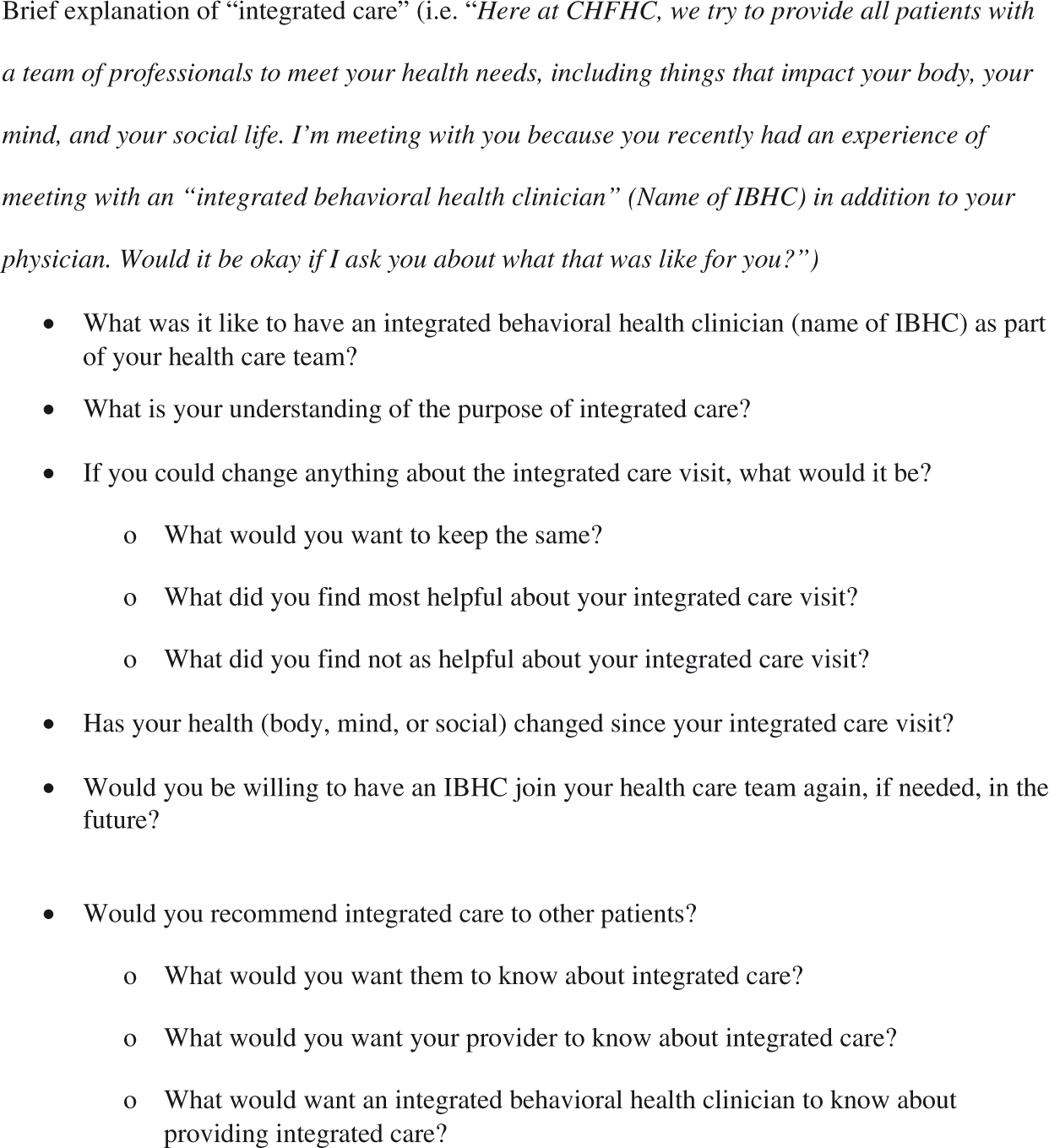
Interview guide.
Participants ranged in age from 36 to 61 years, 50% were female, and a variety of insurance statuses were represented, including Medicare, Medicaid, private insurance, or none. All participants carried diagnoses of depression, anxiety, substance use, and/or Post-Traumatic Stress Disorder (PTSD); all were comorbid with other diagnoses, like type 2 diabetes, arthritis, chronic heart failure, or Chronic Obstructive Pulmonary disease (COPD).
Qualitative data analysis entailed an iterative process. 13 Participants’ experiences with integrated behavioral health in primary care were elicited through in-depth interviews, using “open, direct, verbal questions that elicit stories.” 14 Three authors (EC, EH, and AV) first independently coded the data using Strauss & Corbin’s open coding method. 15 Open coding involves giving text excerpts descriptive labels. These labels were combined into categories, forming a number of themes. To ensure data fidelity, triangulation was employed, in which the preliminary themes were examined by the entire research team, who further refined them. The data were then reexamined, looking for confirming and disconfirming evidence for the identified themes.
Results
Medical settings trigger trauma
Medical encounters can trigger a maladaptive stress response in patients with ACEs.16,17 Some activities within the medical setting (e.g. removal of clothing, physical touch, vulnerable physical positions, lack of privacy, and invasive procedures) are often taken for granted by medical professionals. One interviewee described this phenomenon: I’m a trauma survivor. You want to talk insane, talk to somebody who’s been abused … rape and sexual abuse, physical abuse, and you’re putting them through all kinds of invasive tests because they need it. Yet you know, as a doctor, doing that is probably going to set off more of their symptoms, but if you don’t do it, you’re not going to know if they’re really okay or not … (My doctor) definitely did exactly what she needed to do, but at some point in that whole situation, I really couldn’t handle any more … I started falling apart, in part because of medically what was going on, and mentally what was going on. I was like “this is too much” and went back to using and then left and tried to find a different provider and then did that for a little while and then left (that office). The shame and the fear that comes up because of the trauma-related issues and the mental health issues; it can stop people from coming in to see their doctor. I’ve not showed up, or I’ve cancelled appointments because I didn’t want to tell a doctor what I had to tell her. Sometimes … no matter what you do, it seems you’re being manipulative or you’re not being honest or you’ve got a secondary agenda … sometimes professionals, especially ones that don’t know you well, have a perspective of what you’re doing. I’m like, “… they’re going to think I’m messing with them, that I’m playing the doctors against each other.” It’s very easy to happen with (misunderstandings) … I mean, world wars are caused by miscommunication, so in treatment, it can get real messy very fast. I was known as the kid that freaked out and lost his temper and slammed doors and yelled at people. When people saw that they had an appointment with me, they were probably like “oh no, [he] is coming.” Not all doctors handle having a patient that has medical and mental issues going on. Sometimes you’re not believed. Tell the doctor something is going on in my body, they don’t believe you. They think it’s your mental health issue and they refer you back to your provider over there. Sometimes the person just needs to say out loud exactly how crazy they f***ing feel in their head. They need to say what it’s really like, without the fear of just being stuck some place or being abandoned or rejected. I’ve been rejected before. It’s really hard.
Integrated team approach to address trauma
Participants noted integrated care allowed trust with providers and led to accessing appropriate care.
2
The IBHC skillset allowed for recognition of trauma, support, and continuity of care. When there is high turn-over, unavailability, or cross coverage of providers, the integrated care team approach is particularly warranted. The “safe” team member allows for patients to feel “known.” Not having to repeat yourself. That’s a huge thing because like I said, I’ve been here for so long and the one thing that was so hard was repeating that story over and over again to everyone that’s new. People could come walking in here with medical issues. You don’t know they’ve (been traumatized). And they’re sitting in your office and they’re crying their eyes out because you’re giving them a script for a medication that they don’t have any money for it because they’re now in a homeless shelter and their family is separated all over the place. So the (IBHC) is like the person that’s coming in and saying, “We’re here to help you. Do you need some services?”
Discussion
A trauma-informed health system requires a paradigm shift. The traditional medical model and dyadic doctor–patient relationships work well when there are symptoms, tests are run, an answer is discovered, diagnoses are made, pills are prescribed, and the patient is cured. However, when the traditional medical model is applied to complex situations in which symptoms overlap and are confounded with social determinants of health, potential exists for re-traumatizing patients and frustrating care teams. Trauma-informed health care requires moving beyond traditional, medical, and curative models and embracing team-based, multi-disciplinary, supportive approaches (see Figure 2). It is imperative that primary care clinicians recognize the impact of ACEs and understand the need for trauma-informed care. Although the sample size is small, and results may not be generalizable to all adult survivors of ACEs, this pilot qualitative study sets the stage for larger investigation into tenets of trauma-informed care. Providing adequate, trauma-informed care necessitates that the individual patient, context, support system, coping skills, and resources all be considered to benefit patients and providers.

Tenets of a trauma informed approach.
Footnotes
Acknowledgments
This paper was presented at Forum for Behavioral Science in Family Medicine, Chicago, IL, 10–13 October 2018.
Declaration of conflicting interests
The author(s) declared no potential conflicts of interest with respect to the research, authorship, and/or publication of this article.
Funding
The author(s) received no financial support for the research, authorship, and/or publication of this article.