



Abstract
Institutionalized racism embeds our systems of healthcare delivery and medical education. This produces racial healthcare disparities which have been shown to severely impact both physical and behavioral health outcomes. Efforts to address institutionalized racism often focus on individualized efforts directed towards the healthcare workforce. However, more effective system level approaches are emerging. The behavioral health sciences can play a role in dismantling institutionalized racism by providing the evidence needed to understand effects on individuals and develop targeted system level approaches.
Introduction
In 2017, in response to a resolution from its Congress of Delegates, the American Academy of Family Physicians (AAFP) established its Center for Diversity and Health Equity (CDHE) which positioned the AAFP to take a leadership role in advancing issues of diversity and health equity across the specialty of family medicine. 1 Creating the CDHE allowed the AAFP to both centralize and operationalize several key priorities which included; diversifying the workforce, advocating for health in all policies and providing physicians with education and practice tools to advance equity at the point of care and in communities. In the period since its inception, its scope of work has become increasing more progressive, focusing on issues of social justice (i.e., implicit bias, birth equity, institutional racism, race-based medicine, etc.) and their applicability to patient care and population health. This shift likely reflects the changing demographics and concerns of the overall membership as demonstrated in their most recent policies and positions.2,3
With the murders of Ahmaud Arbery, Breonnna Taylor and George Floyd and the accompanying calls for racial justice in the United States and across the globe, organizations were called to acknowledge and reconcile ways in which many of the systems and structures considered foundational to our society have been rooted in and shaped by racialized oppression, segregation and discrimination. Likewise, the leadership of the AAFP went through its own process of self-reflection and assessment of its progress towards becoming an antiracist and multicultural institution, however, it did so a year prior in 2019 in accordance with the recommendations outlined in its policy.4,5 During that process, most described the AAFP as follows: (1) an “affirming institution” with a growing understanding of racism as a barrier to diversity, (2) having a consciousness regarding who holds power and privilege, (3) intentional, accountable and committed to dismantling racism and (4) committed to eliminating dominant culture advantage.
In the period since, many other medical societies, academic medical centers, etc. have also begun their journey towards becoming antiracist and multicultural, however, not without opposition.6-9 For example, in June 2021 during its annual meeting, the American Medical Association faced backlash from a vocal minority group of members over its racial equity plan. Addressing this opposition may necessitate more explicit explanations of the empirical evidence demonstrating a clear relationship between racism and health to understand why it has become an emergent focus of organized medicine. To support that effort, this article aims to outline the association between racism and health, describe how racism becomes institutionalized within healthcare and outline specific calls to action, to include those for behavioral health faculty.
Racism and Health
The AAFP recognizes that racism, as defined by Dr. Camara Jones, is a system that categorizes people based on race, color, ethnicity and culture in an effort to differentially allocate societal goods and resources. 10 This is done so in a way that unfairly disadvantages some, while without merit, rewards others. This system allows for the codification of patterns, procedures, practices and policies within organizations that consistently penalizes and exploits people because of their race, color, culture or ethnic origin. Once embedded as part of the culture, systemic racism also begins to affect the attitudes, beliefs and behaviors of one individual towards another (personally mediated) as well as affects how individuals perceive themselves (internalized). Whereas personally mediated racism most commonly occurs in the form of prejudices and discrimination, internalized racism can perpetuate negative messages about one’s own self-worth and abilities.
The health impacts of racism are well documented thanks to the availability of several validated measurement tools.11,12 A 2006 study published in the International Journal of Epidemiology conducted a systematic review to examine the relationship between self-reported experiences of racism and health. 13 The findings determined that racism was positively associated with poor mental health outcomes, such as depression, anxiety and stress, as well as poor physical health outcomes, such as hypertension, premature birth and diabetes. In addition, racism was positively associated with poor health behaviors such as misuse of tobacco, alcohol and other substances. This study also determined that racism was shown to decrease an individual’s self-esteem and quality of or satisfaction with life and work. In addition, there are currently studies underway to assess the validity of these types of tools in the clinical setting which show promise for identifying racial trauma as a social determinant of health, similar to that of adverse childhood experiences. 14 Subsequently, racism is also a clear and present threat to public health. 15 Most, if not all, health disparities, can be directly linked to racialized systems of healthcare delivery, education, housing, policing, etc. As such, this has resulted in numerous declarations by state and local governments, federal agencies and organizations, such as the AAFP, calling for meaningful action to include data collection and analysis, financial accountability and community reinvestment. 16
Institutionalized Racism
To establish and maintain racism as a system requires a number of core policies and infrastructure, which are highlighted here. First, the Thirteenth Amendment, whereby slavery was abolished except for people convicted of a crime. It allowed for the creation of “Black Codes” designed to criminalize legal activity for African-Americans (i.e., loitering, breaking curfew, being unemployed, etc.). 17 This created a new system of convict labor and leasing that allowed former slave owners to again have access to free labor from African-Americans. The Supreme Court in the 1896 case of Plessy v. Ferguson declared separate but “equal” facilities were constitutional up until it was overturned by the 1954 case of Brown vs. Board of Education Topeka. 18 The Homeowners Loan Corporation was created to assist “certain” homeowners and stabilize banks but also created detailed neighborhood maps that took into account the racial composition of a neighborhood or likelihood of racial infiltration. 19 They color coded these neighborhoods in red and labeled them “undesirable,” resulting in a lack of investment in neighborhoods with people of color and enormous investment in white neighborhoods. The Social Security Act (SSA) or New Deal programs would not have passed the Southern voting block unless they were designed in a way that preserved established racial norms at the time. This meant excluding certain occupations from receiving benefits, such as farm and domestic workers in which Black Americans were overwhelming represented. 20
There are several landmark examples highlighting how racism became institutionalized in healthcare. First, The Flexner Report, commissioned by the American Medical Association and written by a non-physician, called for higher admission and graduation standards in medical education which led to increased rigor of the scientific curriculum. Many institutions were unable to adhere to these new guidelines and consequently, a number were forced to merge or close entirely. This resulted in the closure of five of the seven medical schools educating Black doctors, leaving only two, Meharry and Howard. 21 Although African Americans have continued to graduate from every medical school in the United States in the decades since, the legacy of the Flexner Report is the disproportionate number of Blacks Americans entering medical school, especially Black males. 22 The Hospital Survey and Construction Act, also known as the Hill–Burton Act, passed in 1946 was consistent with the separate-but-equal provision and stated that discrimination based on race was acceptable if there was “equitable provision on the basis of need for facilities and services of like quality for each such group.” 23 This resulted in “Colored” wards and hospitals which were consistently understaffed and underfunded. In the present day, organized efforts to undermine the Affordable Care Act to include the protections for pre-existing conditions and or eligibility waivers may be considered a modern example of institutionalized racism. 24
In addition to policy, racism may also become institutionalized within healthcare through education, training and practice (Figure 1). For example, research on medical education has shown that there are elements of the standard and hidden curriculum that introduce and contribute to racial biases, stereotypes and misbeliefs.25,26 Those are then reinforced by established health care system practices, procedures and processes which when combined result in differential diagnostics and treatment recommendations by race. This process is exemplified in the practice of race-based medicine, whereby race is consider as though it were biological as opposed to socially constructed and then utilized as a marker in the diagnosis and treatment of disease.
27
Overwhelmingly, efforts to disrupt this pattern have primarily focused on the healthcare workforce by targeting them with trainings and education on topics like cultural competency and implicit bias. However, while the AAFP, per its policy, and others recommend educating physicians about implicit bias and strategies to address it, that alone will not reduce healthcare disparities.
28
Conceptual framework depicting institutionalize racism in medical education and the health care system.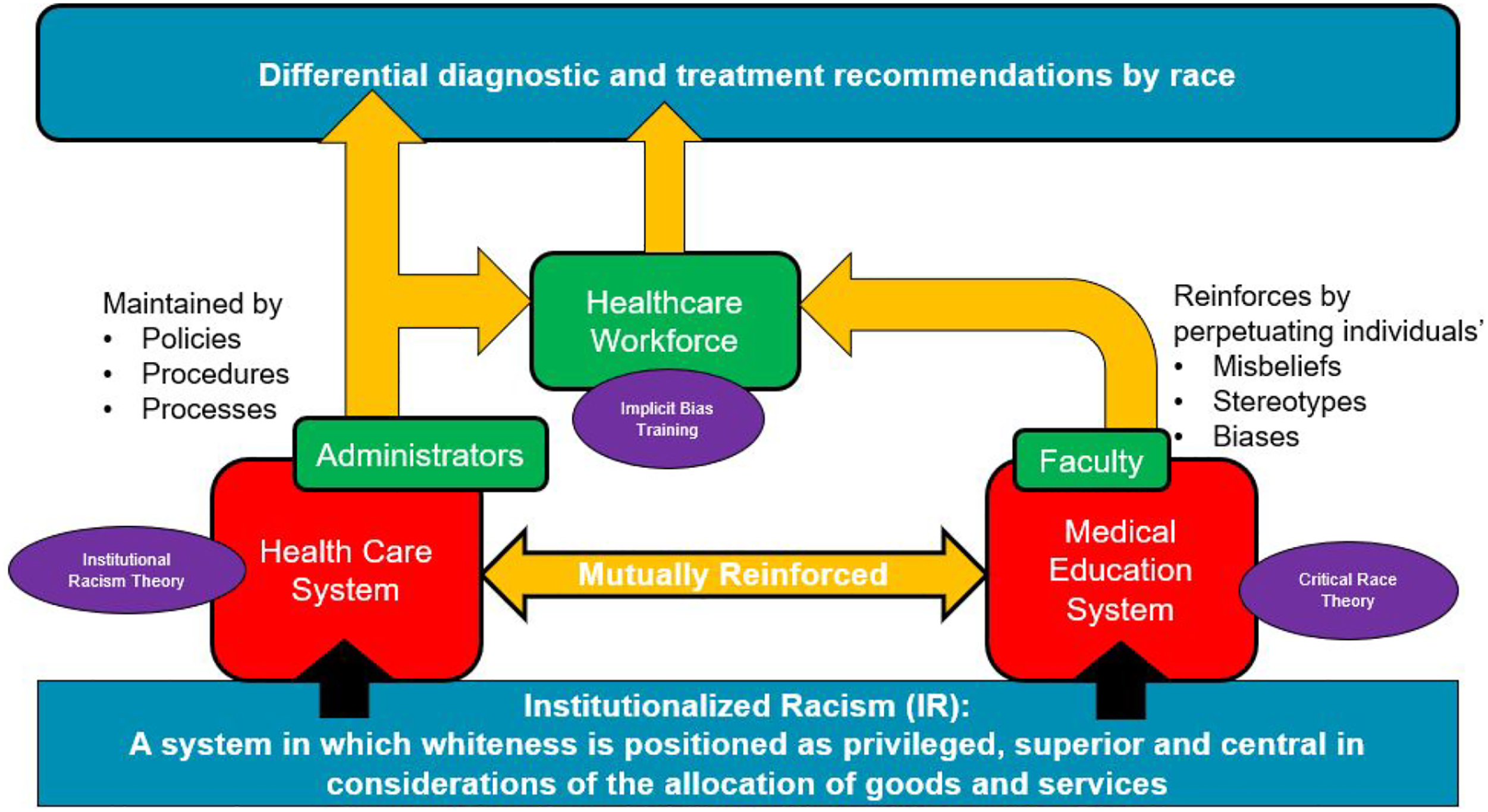
Disrupting Institutionalized Racism in Healthcare
Disrupting institutionalized racism in healthcare settings requires examining and challenging historical and contemporary approaches to race to include minoritization, marginalization, colonization and other racial phenomena. This also includes examining racial hierarchies which centralize proximity to whiteness as the standard, particularly in medical and healthcare research. One well established and most recently controversial framework for dismantling institutionalized racism is Critical Race Theory (CRT). 29 With origins grounded in legal study dating back to the 1980s, CRT has also emerged outside of race relations to include discourses such as gender, sexuality, class as well as disciplines, such as education, pharmacy and most recently medical education and healthcare delivery.30,31 However, as stated, CRT is not without controversy, resulting in a number of preemptive legislative bans across the country to prohibit its application to K-12 education. However, in some places like Washington state, CRT is embraced as a necessary component of medical education as a condition of graduating with the aim of equipping students with the knowledge, attitudes, and skills to understand and counteract racism and implicit bias in health care.
In addition, the American Medical Association (AMA) recently established a set of guidelines organizations can utilize in the development of policies and processes that address issues of institutionalized racism in healthcare delivery.
32
These include: • Establishing clear definitions for terms such as discrimination, systemic racism, explicit and implicit bias and microaggressions in the healthcare environment • Establishing workplace policies that are prominently displayed and easily accessible by patients and employees • Communicate management’s commitment to providing safe and healthy environments that aim to prevent and address incidences • Establishes training requirements for all members of the healthcare system. • Prioritize safety in both reporting and corrective actions
Call to Action
Dismantling institutionalized racism across healthcare requires collaborative multisector approaches that embed equity across medical research, education and practice. Those in the behavioral health sciences should be considered integral to this transformative process in the following ways. First, by contributing to and driving research that examines the way in which institutionalized racism influences both implicit and explicit expressions of racism that can be either personally mediated or internalized, especially in clinical interactions. While much of the current research is largely conceptual and or subjective, based on the self-reported experiences of patients and or students, studies are emerging using robust empirical design models that may one day result in evidence-based interventions at both the individual and institutional level to reduce healthcare disparities. Behavioral health scientists are also important to the design and delivery of education that positions racism, not race, as a sociopolitical determinant of health as opposed to race, a biological proxy. While evolving, the standard medical education curriculum is often remissat providing this type of didactic learning and if it does, faculty who intentionally seek to incorporate these topics often face challenges and or barriers. Behavioral health scientists can be vital to filling these gaps in a program’s design.
Conclusion
The twin pandemics of COVID-19 and police violence sparked a movement that demands individuals and organizations no longer approach issues of health disparities, social inequality and institutionalized racism as mere subjects of scholarly discourse but as calls to action. It’s imperative to patients, their families and communities that we build a better more inclusive and equitable health care system and country that protects the most vulnerable. Doing so requires coordinated grassroots efforts that seek to cultivate a next generation workforce that reflects the diversity of these communities and approaches clinical care with an equity lens. The behavioral sciences are vital to this effort as they bring a perspective and approach that is ancillary to healthcare delivery and academic medicine. Behavioral health faculty in academic medicine should seek ways in which they can contribute to the growing body of evidence examining the relationship between institutionalized racism and health outcomes. This should include studies that validate the use of assessment tools in clinical settings and provide effective interventions. Lastly, behavioral health faculty should identify ways in which they can be instrumental in the design and delivery of curriculum that meets the current challenge of medical education to address the health impacts of institutional racism.
Footnotes
Declaration of Conflicting Interests
The author(s) declared no potential conflicts of interest with respect to the research, authorship, and/or publication of this article.
Funding
The author(s) received no financial support for the research, authorship, and/or publication of this article.
