




Abstract
Background/Introduction
U.S. teacher shortages have more than tripled since the 2012-2013 school year, to over 110 000 teachers needed in 2016. 1 At the conclusion of the 2011-12 school year, 13.8% of public-school teachers left their position. 2 Approximately 50% of the public-school teachers cited the inability to manage their roles as the primary factor for leaving. 2
Open positions are largely filled with novice teachers, or those with less than 5 years teaching experience. 3 Such teachers enter the profession with limited resources and support in addition to lacking experience. 4 They face the challenge of meeting high-performance standards and performing instructional or managerial tasks at the level of their veteran peers while learning their new roles. 5 An exploration of the experiences of first year teachers identified 10 themes. 6 All themes align with occupational stress, or the accumulation of work-related stressors over time. 7 Occupational stressors can lead to burnout or total emotional exhaustion. 8 Forty percent (40%) of teachers experience burnout at some point in their career. 8 Forty one percent (41%) of teachers left their roles within the first 5 years of employment. 9 Ingersoll called this cycle of attrition the “revolving door effect”. 10 This study sought to explore the effectiveness of Balint groups in addressing the factors that lead to burnout and attrition among school teachers.
Prior to this study, the researcher sought to determine if these findings were true to her sample population, which consisted of 100 teachers recruited through a program training those new to the profession. In turn, they commit to teaching two years in a low-income community.
The researcher conducted an initial needs assessment of the 100 teachers in the cohort using a Google Form. The needs assessment was designed as a quantitative study that utilized a series of Likert-scaled questions to collect information about members. All of the measurements were existing questionnaires that were compiled together to create the needs assessment. The instruments measured the sources of pressure in the work of educators using the Stress in the Teaching Profession survey, 11 teacher burnout using Maslach Burnout Inventory, 12 teacher self-efficacy using Tschannen-Moran and Hoy's Teacher efficacy short-from, 13 the resilience of teachers using the brief resilience scale, 14 perfectionism within participants us the Frost Multidimensional Perfectionism Scale, 15 and any coping strategies that members are currently using to manage stress using the brief cope survey. 16 The needs assessment revealed sources of stress similar to those indicated in the analysis of previous research on teacher attrition:
• long work hours completing administrative tasks
• poor working conditions
• job role ambiguity
• burnout
• individual personality characteristics, including a tendency towards perfectionism
• challenges to self-efficacy
The results of the needs assignment aligned to the experience of general practitioners. Through analysis of literature on burnout and retention in medicine, there was evidence to support the use of Balint groups in the medical field to combat similar challenges with self-efficacy, burnout, and retention.
Psychoanalysts Michael and Enid Balint developed Balint groups to enhance the general practitioner’s understanding and management of the doctor-patient relationship. The goal of Balint is to enhance participant’s ability to recognize and promote intrapsychic and interpersonal skills needed for robust doctor-patient relationships. 17 Balint groups are currently used in a wide variety of medical settings, including residency/fellowship programs across specialties, faculty groups, and among other mental health practitioners.17-21 However, no published studies exist about the use of Balint groups among school-teachers.
Balint groups have between 4 and 10 members. The group meets according to a regular schedule, typically for 60-90 mins. The Balint group is led by 1 or 2 people who have experience and/or certification in the method. During a group, a member presents a case from memory. Cases typically center around a patient who has elicited a difficult, memorable, or otherwise salient response from the presenting group member. The other group members attempt to understand the case from the patient and doctor’s perspective but avoid offering specific solutions or diagnoses. The case presenter meanwhile listens but does not participate in the discussion. This allows the presenter to reflect upon the discussion. Previous research indicates that participation in a Balint group can correlate with improved self-concept and relationships with patients.22-25
Method
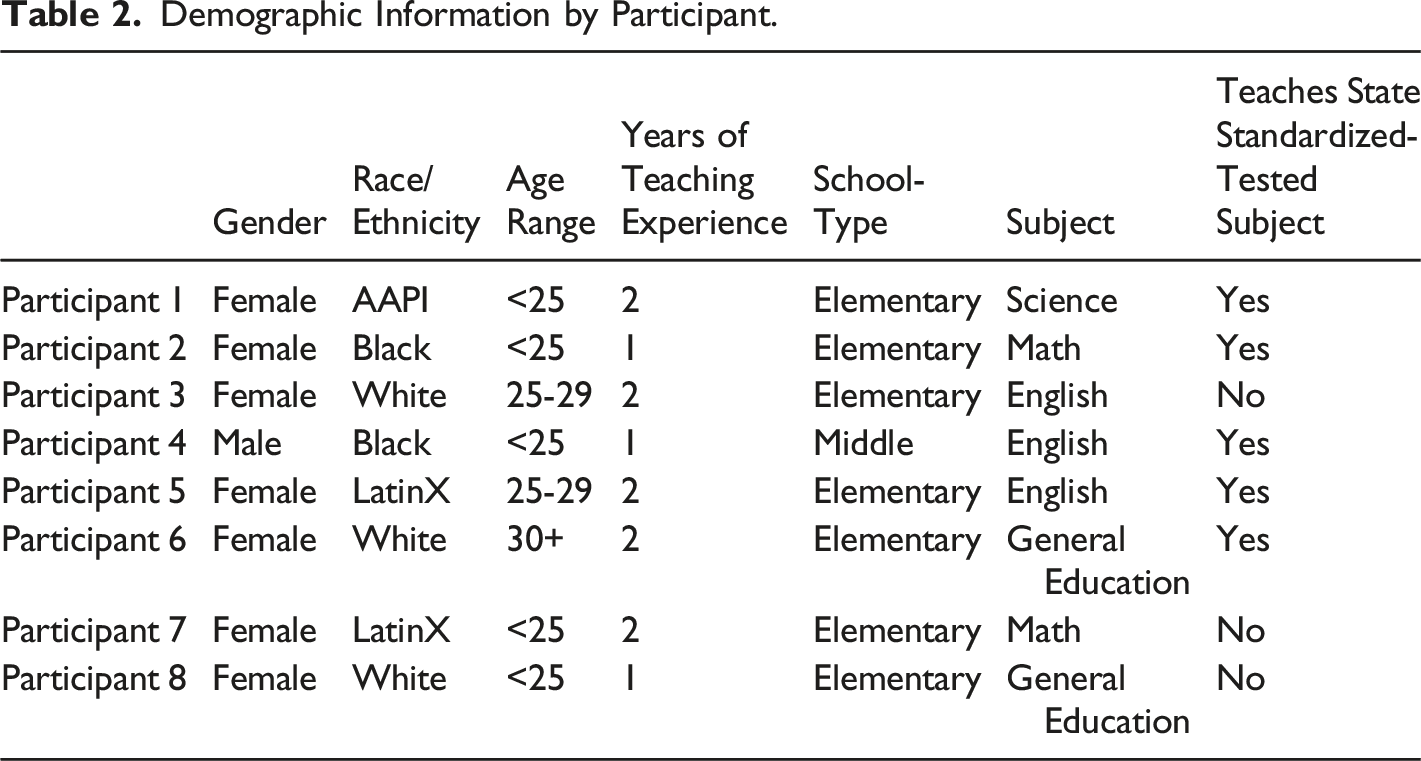
The purpose of this study was to examine the influence of participation in a 6-month Balint group experience on a novice teacher’s self-efficacy, experience with burnout, and intentions to persist in the classroom. The study centered on a teacher preparation program located in the Houston metropolitan area. The program itself recruits individuals to commit to teaching in low-income communities for 2 years. The questions guiding the study were: • How did participants perceive their experience engaging in a 6-month Balint group? • How did the study implementation adhere to or differ from the proposed implementation procedures? • How did participation in the experience change novice teacher self-efficacy along 3 domains: (a) efficacy in classroom management, (b) efficacy in instructional strategies, and (c) efficacy in student engagement? • How did participation in the experience change participants’ level of burnout across 3 domains: (a) emotional exhaustion; (b) depersonalization; (c) low personal accomplishment? • What was the difference in teacher self-expressed intent to persist in the classroom before and after participating in the Balint group intervention?
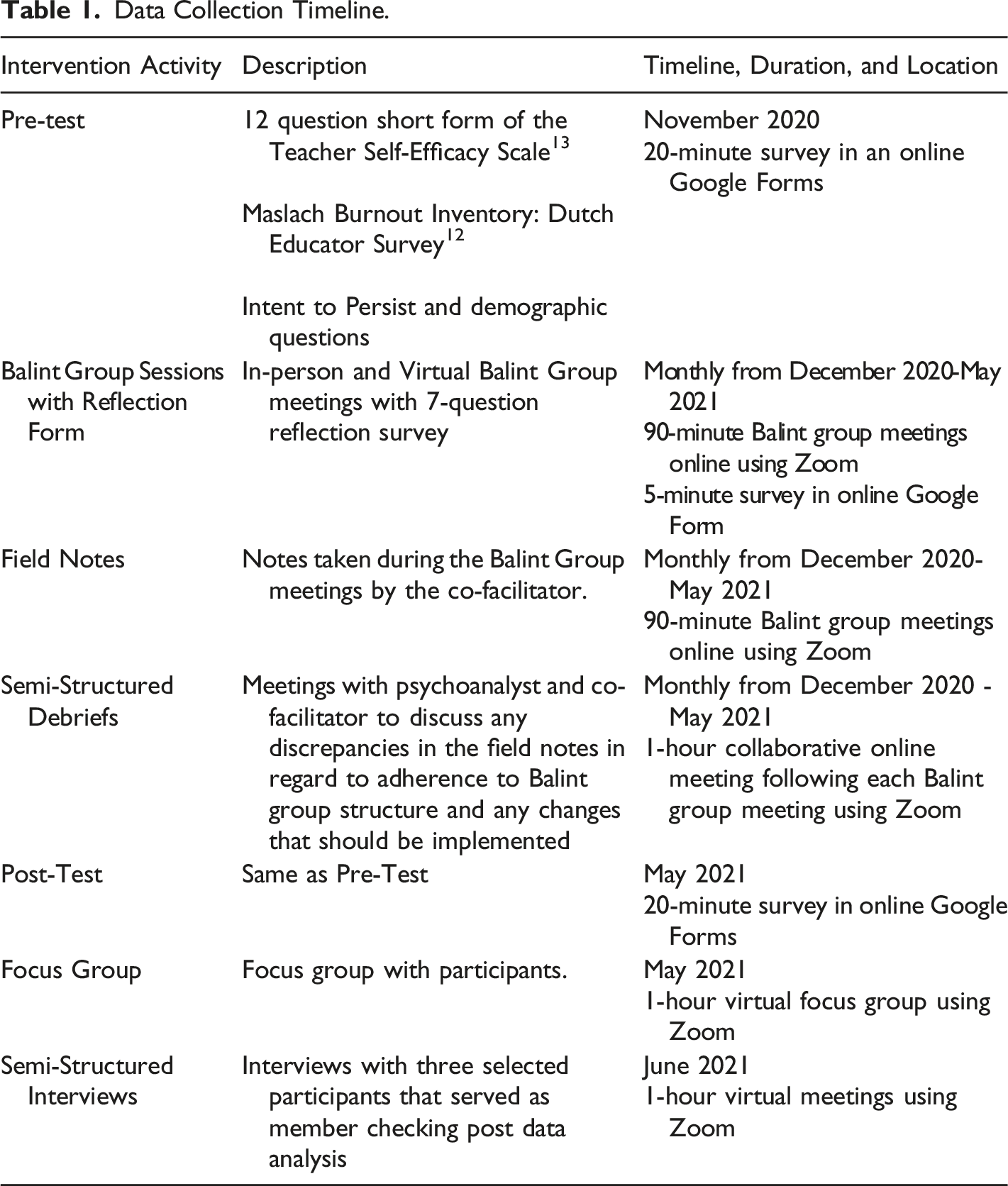
A converged mixed-methods approach was used. Each question was explored with a corresponding qualitative and a quantitative dataset. Qualitative data included (a) a semi-structured focus group; (b) field notes shared from the co-facilitator and Balint group leader; (c) semi-structured debriefs with the Balint group leaders; (d) open-ended questions on the pre and post-test reflection forms, and (e) semi-structured interviews with 3 participants that served as a form of member checking. Quantitative data included pre and post-test that included the 12 question short form of the Teacher Self-Efficacy Scale 13 to access self-efficacy, the Maslach Burnout Inventory: Dutch Educator Survey 12 to access burnout, and closed-ended questions regarding the participant's intent to persist that were developed by the researchers. They included:
• Do you intend to complete your two-year commitment?
• Do you see yourself teaching beyond your 2-year commitment?
• Do you see yourself teaching for 5 or more years?
• Currently, what are your long-term plans?
• <Open Ended> Looking at the answers above, what factors contributed to your decisions around persisting in the classroom?
Additionally, participants completed monthly reflection forms that were collected at the conclusion of each meeting. All forms used 5-point Likert scale questions. A descriptive approach was used due to small sample size. T-tests were used to analyze the significance of change in outcome constructs.
Data Collection Timeline.
Demographic Information by Participant.
The group was scheduled to meet once a month, online, for 90 mins on a Sunday from December 2020-May 2021 (6 meetings), but due to Winter Storm Uri in February 2021, the group met 5 times. Two cases were presented each month. Practical elements of meeting online were addressed: joining in a confidential space, multitasking, and making sure video was turned on.
Results
An initial needs assessment of the 100 teachers in the cohort revealed sources of stress similar to those experienced in medicine, where Balint groups had previously been conducted: • Long work hours completing administrative tasks • Poor working conditions • Job role ambiguity • Burnout • Individual personality characteristics, including a tendency towards perfectionism • Challenges to self-efficacy
Participant perception
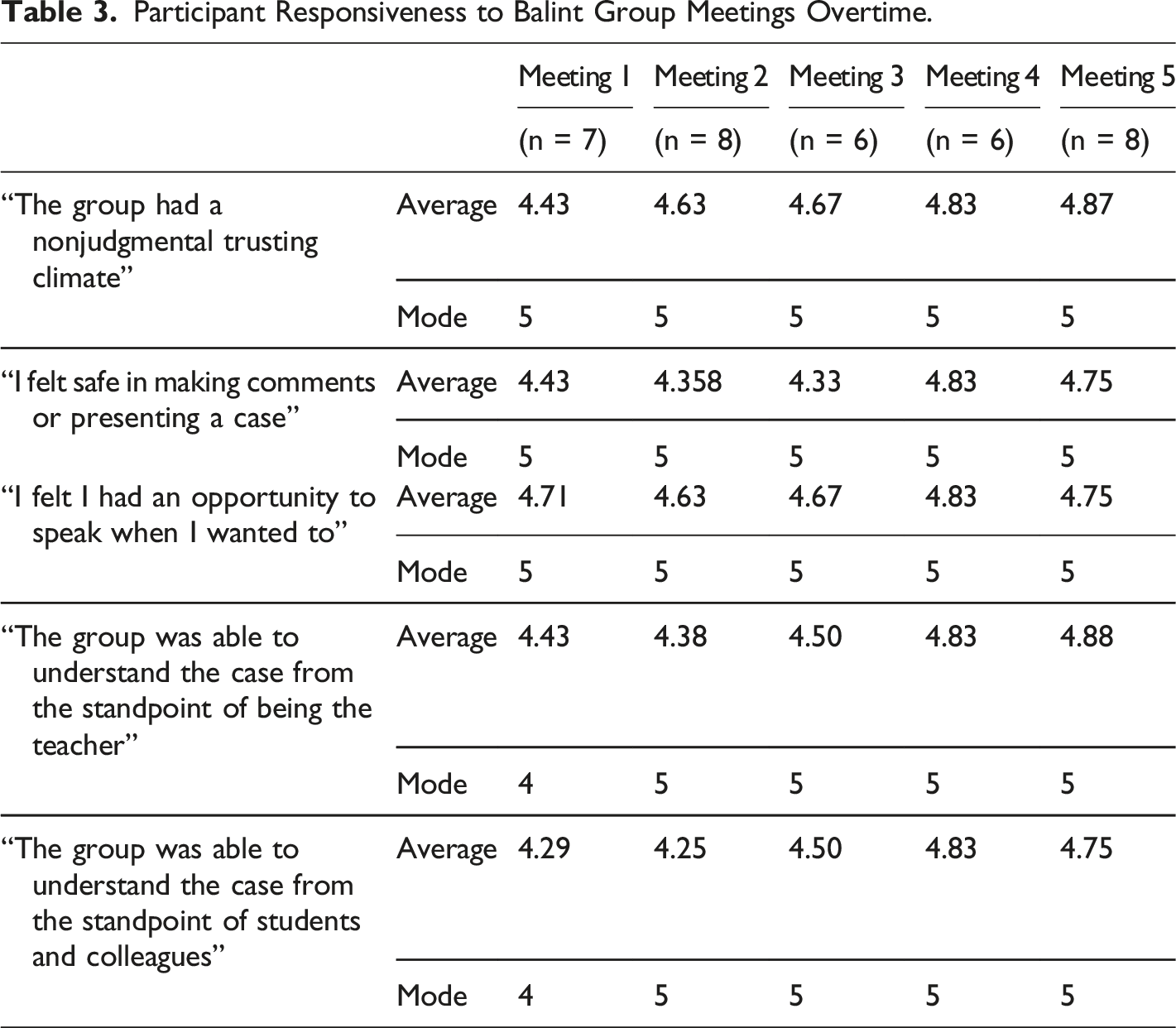
Participant Responsiveness to Balint Group Meetings Overtime.
Adherence
The field notes and semi-structured debriefs with the Balint group leaders revealed that the structure of the Balint Group meetings was consistent. The reflection forms revealed that over time, teachers’ abilities to provide suggestions or identify areas where they could take action to influence change increased. The focus group data aligned with these findings. Participants revealed that they initially believed the Balint Group meetings would be about receiving suggestions for action they could take in the classroom that would improve their students’ performances; however, they realized it was about understanding the perspectives of others.
Change in self-efficacy
The quantitative data from the pre- and post-test indicated that the participants’ self-efficacy decreased overtime in 2 of the domains: class management and student engagement. However, their perceptions of their efficacy in instructional strategies increased. During the focus group, participants believed their relationships with students and their understanding of their locus of control also improved because of the intervention.
Change in burnout
Based on the analysis of data from the pre- and post-test, participants’ experiences with burnout increased across all 3 domains during the 6-month experience. During the semi-structured focus group, teachers felt more stressed throughout the school year and identified several factors that contributed to their feelings of burnout. These factors included administrative pressures, systematic pressures, social perceptions of education, a desire for recognition, need for additional support, limited time restraints, and lack of work-life balance.
Change in intent to persist
Focus Group Codebook.

Discussion
In this pilot study, Balint groups were employed among a novel population, public school teachers. The results indicate that this sample experiences stressors similar to professionals in the medical field, historically the target audience for Balint groups, and that Balint offers an opportunity to address social and emotional needs they face.
Specifically, one of the recurring themes of case presentations related to the concept of self-efficacy, with regards to both locus of control and perceptions around building relationships with students in a manner that promotes learning. Interestingly, experiences with burnout increased over the 6 month experience. It is not possible to attribute this trend to the Balint group itself, as the meetings occurred infrequently compared to the day to day work of being a teacher, but the goal of the group is to improve self-awareness and develop insights into the relationship the individual has with others. The post-test scores indicate an improvement in understanding in locus of control and perceptions in efficacy in instructional strategies; it is possible that teachers were able to better appreciate the nuances in their ability to relate to particular students, and in turn, tailor pedagogical styles to better meet their needs. Nevertheless, it appears that the Balint group itself did not help to have teachers feel more comfortable in their role as it pertains to the larger educational system.
Another key component of the Balint process is being part of a group. These teachers transitioned from a traditional in-person classroom environment, to a fully virtual 1 abruptly as the pandemic associated lock-downs began. The isolation of being at home and away from a group of colleagues and students prevented a previously essential part of teaching: direct human connection. This Balint group, even itself conducted virtually, provided an opportunity for teachers to validate the emotions that come from the work and its intersections with the changing world around them, and this was reflected in themes that came up of feeling part of a community.
One teacher noted that Balint group participation changed the perception this individual had about the desire to commit to the teaching profession. It is difficult to extrapolate information beyond the individual, but it does speak to the force a collective effort such as Balint can have in individuals to reaffirm their goals, and in a profession with attrition as high as it is, this is an important point to highlight.
This is a pilot study, and by its nature, it had many limitations. The group itself was small and self-selected. It was not possible to randomize and run a control group. As such, it is better suited to consider additional research questions than to form conclusions. Further research would benefit from a controlled group where teachers undergo more curriculum driven psychosocial support practices. Additionally, while fidelity to the Balint method was strong, the group itself met relatively infrequently due to external circumstances, and as such, further experiments benefit from more frequent, regular meetings.
Footnotes
Declaration of conflicting interests
The author(s) declared no potential conflicts of interest with respect to the research, authorship, and/or publication of this article.
Funding
The author(s) disclosed receipt of the following financial support for the research, authorship, and/or publication of this article: Funding for the pilot study was partially supported by Sarat Munjuluri’s American Psychiatry Association’s Minority Fellowship.