



Abstract
Objective
This cross-sectional study aims to examine the prevalence of postpartum depression (PPD) and sleep problems, their relationship, and the characteristics associated with depression/insomnia in Qassim, Saudi Arabia.
Methods
An online survey was administered to a convenience sample of 395 mothers who had given birth within the preceding year. The survey comprised demographic characteristics, pregnancy and childbirth characteristics, depression (via the Edinburgh Postnatal Depression Scale; EPDS), and sleep quality (via the Pittsburgh Sleep Quality Index; PSQI).
Results
Nearly two-thirds of respondents (62.3%) had PPD, while 92.2% experienced poor sleep quality. Both scales demonstrated a statistically significant positive correlation. Participants with previous PPD, peripartum depression, a personal or family history of other depression, those bottle-feeding their infants, or who had a change in sleep pattern scored significantly higher on the EPDS and had poorer PSQI scores. Respondents with a history of mental illness, pregnancy or delivery complications, those who lacked support, or gave birth to unhealthy newborns also had significantly higher EPDS scores.
Conclusions
PPD and poor sleep quality were highly prevalent among mothers living in the Qassim region of Saudi Arabia. Not surprisingly, PPD was strongly correlated with poor sleep quality. Postpartum counseling for mothers during the first year after delivery is necessary to decrease the risk of developing depressive symptoms and poor sleep quality. Screening for sleep-related difficulties and depression in prenatal and postnatal programs may help prevent the development of depressive disorder among postpartum women in this region of Saudi Arabia (or other areas of the Middle East).
Keywords
Introduction
Depression—a common psychiatric disorder—affects over 264 million people worldwide. 1 It significantly impacts one's emotions, cognition, and ability to function on a daily basis. 2 Numerous types of depression—major depression, persistent depressive disorders, psychotic depression, seasonal affective disorders, and postpartum depression (PPD)—can develop in different situations. 2
Several women experience PPD 3 —with symptoms including anxiety, a sense of guilt or worthlessness, mood swings, sadness, a lack of interest in their baby, and difficulty in thinking or making decisions. 4 Suicidal thoughts and a fear of harming one’s baby have also been reported as symptoms of PPD 5 and, if left untreated, can negatively impact both the mothers’ health and quality of life and the infants’ well-being.6-8 Consequently, early detection and treatment of maternal PPD are critical for providing a safe and healthy environment for child development. 9 However, PPD should not be confused with “baby blues,” which include mild depressive symptoms like anxiety, tearfulness, sadness, a sense of emotional liability, and irritability. 10 Approximately 70% of new mothers experience “baby blues” that typically peak within 10 days postpartum, fade spontaneously within 2 weeks thereafter, and exhibit no significant impact on performance. Researchers worldwide have investigated PPD’s prevalence and risk factors—reportedly, the prevalence of depression and anxiety is 38.4% in China, 11 while that of PPD is 38.8% in Iran. 12 A recent review reported that the cumulative prevalence of PPD among mothers in the Middle East was 27%. 13 Furthermore, as per Saudi Arabian studies, 38.5% and 20.9% of women in Riyadh and Jeddah exhibit PPD, respectively.14,15
Studies have classified the possible risk factors as mental, biological, obstetric, and environmental. 16 Prior findings have suggested that conditions or disorders such as premenstrual syndrome or premenstrual dysphoric disorder are significant risk factors for both PPD 17 and depression during pregnancy. 18 Additionally, studies have revealed that the environmental factors associated with PPD include low socioeconomic status, 16 complicated pregnancies, 19 unemployment, domestic violence, sexual abuse, and sleep status.16,20 A study found that women who had previously experienced traumatic experiences had greater post-traumatic stress disorder symptoms post-childbirth than those who had not, which was associated with higher depression ratings. 21 In contrast, employment, receiving social support (particularly postpartum), PPD education,20,22 healthy eating habits, high seafood intake, and multivitamin supplements are protective factors for mothers against PPD. 23 In particular, sleep disturbances—including short sleep durations, insomnia, and sleep deprivation—are common during the postpartum period 24 because of the late-night feeding of infants and repeated nocturnal awakenings. 25 A lack of sleep may have variable consequences—such as exhaustion, nervousness, lower ability to concentrate, and a poorer quality of life 26 —and also lead to stressful life events, poor partner relationships, and insufficient physical and emotional care for the child.25,27 Several studies have found an association between poor sleep quality and PPD,28-30 whereas some samples were conclusive for high-risk mothers 28 either at 3 months 29 or 2-12 months postpartum. 30
This study aimed to assess PPD’s prevalence and examine its relationship to sleep quality among mothers within 1 year postpartum in Qassim, Saudi Arabia.
Methods
This study adopted a descriptive cross-sectional design. It was conducted in the Qassim region (located between the middle and northern regions of Saudi Arabia), comprising 12 governorates and a population of 1,215,858. As per the Saudi General Authority’s 2017 statistics, Qassim comprises 521,965 women aged 15-54 years. Using Raosoft software, the required sample size was determined as 384, which was estimated at a 95% confidence level with an estimated 50% response distribution and a ±5% margin of error.
An online survey was administered, using social media from January to July 2022, to mothers who had recently delivered (within 1 year postpartum) through data collectors in different regions of Qassim. This study was approved by the Qassim Regional Research Ethics Committee (approval number 1443-5825-3). The online survey contained a statement explaining the right to withdraw and the nature of the survey’s voluntary participation. The respondents could only proceed with the survey after giving their consent, acknowledging their understanding of the study’s aim and the nature of their participation.
The survey comprised 4 components: (1) demographic data, (2) desired assessment variables, (3) the Edinburgh Postnatal Depression Scale (EPDS), and (4) the Pittsburgh Sleep Quality Index (PSQI). In terms of the desired variables, we include previous diagnoses of PPD and mental disorders, a family history of depression, and a history of infertility, miscarriage, or stillbirth. In addition, we also consider factors such as a previous diagnosis of depression during the recent pregnancy/delivery or after giving birth, the duration of trying to conceive, the method of conceiving, whether the pregnancy was planned or unplanned, pregnancy-related complications, delivery-related complications, the mother’s postpartum month at the time of taking the survey, social support during the postpartum period, changes in sleep patterns, and use of substances during pregnancy or after delivery. Newborn-related factors, including health conditions, sex, and feeding methods, were also tested.
The EPDS is used for screening postnatal depression. It is a self-reported scale comprising 10 items, with 4 responses, each scored from 0-4. The EPDS’ results are scored as “unlikely depression” (<8), “possible depression” (9-11), “a high possibility of depression” (12-13), and “probable depression” (≥14). This study used the Arabic version of the EPDS, for which permission was obtained from the Royal College of Psychiatrists. 31
For measuring sleeping habits during the preceding month, the PSQI contains 19 self-reported questions and 5 questions rated by the bed-partner or roommate. These 19 questions are sub-grouped into 7 components: subjective sleep quality, sleep latency, sleep duration, habitual sleep efficiency, sleep disturbance, use of sleeping medication, and daytime dysfunction. Each component is scored from 0-3 (from “no difficulty” to “severe difficulty”), resulting in a total score ranging from 0-21. 32 A validated Arabic version was obtained and used with permission from the Mapi Research Trust. 33
Statistical analysis
Descriptive statistics were used to describe the respondents, including their overall numbers and percentages (categorical variables), along with means and standard deviations (continuous variables). Differences in the EPDS and PSQI scores, as based on the mothers’ sociodemographic and maternal characteristics, were assessed using the Mann–Whitney Z-test and Kruskal–Wallis H-test. Statistical collinearity was measured using the Shapiro–Wilk and Kolmogorov–Smirnov tests. As both the EPDS and PSQI scores followed a non-normal distribution, non-parametric tests were performed. A two-tailed analysis (P < .05) was used as the cutoff for statistical significance. All data analyses were performed using the Statistical Package for Social Sciences version 26 (SPSS, Armonk, NY, USA).
Results
Among the study’s 395 respondents, 46.3% were mothers aged between 31-40 years, 97.5% constituted Saudi nationals, 96.7% were married, 67.1% had a bachelor’s degree, 60% had no occupation, and 58.2% had monthly earnings ≤5000 SAR. Only 12.9% of respondents had a history of PPD; however, 17.4% were diagnosed with depression either before/during pregnancy or after delivery. Of these, 14.9% had a family history of depression—47.5% of which was detected among their siblings.
Regarding the respondents’ maternal characteristics, 8.1% suffered from infertility, 64.8% had been trying to conceive for less than a year, 76.7% had planned their current pregnancy, and 89.1% had conceived naturally. While 25.6% reported complications during pregnancy, 15.4% reported complications during or after their recent childbirth. The most common complication was intra/postpartum hemorrhage (16.4%).
The most commonly known mental illnesses previously diagnosed among respondents were depression (6.3%) and anxiety (5.8%), while a history of insomnia was reported by 3.8% of respondents.
Multiple response answers indicated that the most common maternal complications were placental problems (24.4%), followed by antepartum hemorrhage (16.3%)—whereas the least common was that of a preterm delivery (3.5%).
Characteristics of pregnancy and childbirth (n = 395).

Descriptive statistics for the Edinburgh Postnatal Depression Scale (EPDS) and the Pittsburgh Sleep Quality Index (PSQI) (n = 395).

Figure 1 shows a positive and highly significant correlation between the EPDS and PSQI scores (r = .403; P < .001). Correlation between the Edinburgh Postnatal Depression Scale (EPDS) and the Pittsburgh Sleep Quality Index (PSQI) scores.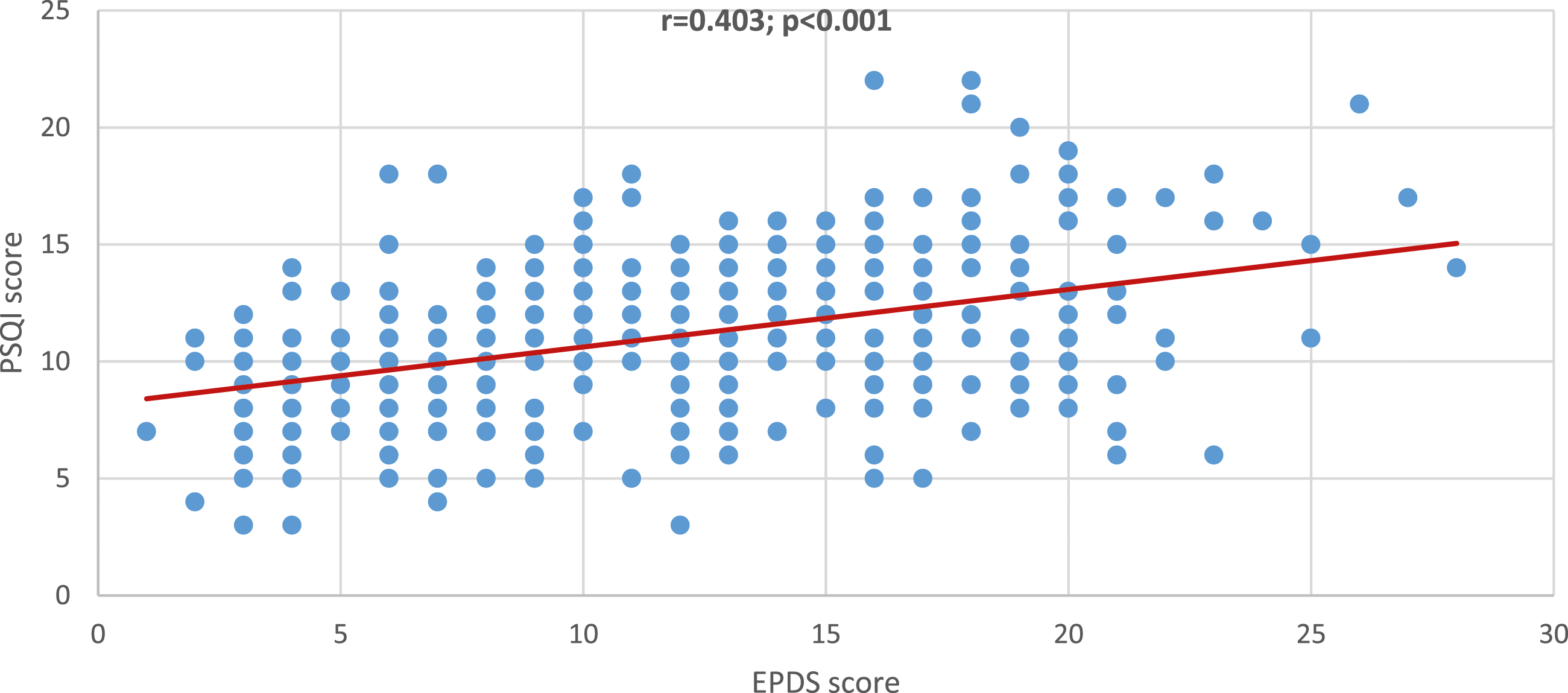
Differences in scores between the Edinburgh Postnatal Depression Scale (EPDS) and the Pittsburgh Sleep Quality Index (PSQI) with respect to mothers’ sociodemographic characteristics postpartum (n = 395).

**Significant at P < .05 level.
aP-value was calculated using the Mann–Whitney Z-test.
bUnknown cases were excluded from the analysis.
cOther feeding methods were excluded from the analysis.
dP-value was calculated using the Kruskal–Wallis H-test.
eP-value was calculated using the Mann–Whitney Z-test.
Discussion
This study investigated the predictors of PPD and their association with poor sleep quality among mothers in Qassim, Saudi Arabia. Its findings reveal that the prevalence of depression over a 1-year postpartum was 62.3% (EPDS≥10). The overall mean EPDS score was 11.1 (SD = 3.42). This prevalence was higher than previous evidence indicated in the literature, which ranges between 13%-40%.5,11-15,18-20,22,29,30 In contrast with other studies conducted in various regions of Saudi Arabia—which ranged from 18-50%—the prevalence of PPD reported in this study was relatively high.14,15,34-36 Surprisingly, it was also higher than that reported in a previous study conducted in the same region (13.7%). 35 While earlier reports on lower prevalence rates of PPD could have resulted from conducting a single-city sample collection at a primary healthcare center, it may also be related to 58.3% of its sample representing the 18-30 age group. In contrast, this study comprised a sample of 59% of respondents who were ≥30 years old. This can also be an indicator of more pregnancies, as 71.6% of this study respondents’ newborns’ birth order ranged from second to fifth or more. 35 The previous study also excluded mothers receiving psychological treatment, those whose babies were diagnosed with medical issues, and instances of intrauterine fetal deaths. Another critical factor is that the previous study only classified people with scores indicating “probable depression” as having PPD, whereas this study enrolled respondents with scores of “possible,” “highly possible,” and “probable for depression” as having PDD. Other factors that contributed to the lower rate of PDD in previous studies could have been a result of restricting the interview period to 4-24 weeks postpartum,14,15,34-36 whereas this study was conducted over a longer period and across different areas.
Furthermore, we identified several risk factors for PPD, including a diagnosis of depression before pregnancy, during pregnancy, and postpartum; previous diagnosis of PPD; a family history of depression; complications during pregnancy; complications during or after childbirth; infertility; changes in sleep patterns postpartum; previous diagnoses of mental illness; an unhealthy newborn; and bottle-feeding method. A history of depression during a previous pregnancy was also reported as a risk factor for PPD.3,15,18 A prospective cohort study of first-time mothers aged 18-35 years found an indirect link between unplanned pregnancies and PPD. 37 Another study reported a link between unintended pregnancies and depression during the perinatal period. 38 Moreover, our findings suggest that PPD is more likely to occur in women who have experienced infertility. In contrast, a retrospective cohort study found no link between PPD and infertility but discovered that infertility treatment increased the risk of developing stress and anxiety. 39 Furthermore, our research discovered that EPDS scores were higher among mothers who conceived through assisted reproductive technology than among those who conceived naturally. Similarly, Cozzolino et al 40 found that a strong link exists between PPD and homologous in vitro fertilization pregnancies at the time of discharge and that spontaneous pregnancies exhibit a higher risk of developing PPD 1 year after delivery. Interestingly, we discovered that bottle feeding was positively associated with higher EPDS scores. A study that examined the ability of the EPDS to predict later breastfeeding problems found that mothers with higher EPDS scores were more likely to formula feed at 3 months. Thus, the odds of bottle feeding increased with an EPDS result, even at low scores. 41 Regarding the PSQI score, we found that bottle feeding was linked to a higher score. This is consistent with previously reported results that breastfeeding had no effect on sleep duration and quality after controlling for the frequency of nighttime feeding, which is associated with shorter sleep durations and poorer sleep quality. 42 Conversely, a cross-sectional study investigating the factors influencing how mothers feed their infants compared perceived sleep quality and fatigue levels concluded that the type of infant feeding did not affect mothers' PSQI scores. 43 A study conducted in China 11 identified a number of risk factors for PPD, including smoking before pregnancy, fatigue, difficulties in breastfeeding, separation of mothers from babies, and associated postpartum anxiety. According to Kim et al, 22 employment status—especially full-time employment and holding a professional or technical job—could be protective factors for mothers against PPD. However, further investigations are required. A systematic review and meta-analysis of 15 studies conducted in the Middle East 13 found that the most common risk factors for PPD were poor economic status, pregnancy-associated complications, poor education, unplanned pregnancies, inadequate social support from family members, and feeding by formula. However, our results found no link between sociodemographic factors, such as income, education, and PPD, which is consistent with a previous study conducted in Saudi Arabia. 15 The high prevalence of PPD in the Middle East, including Saudi Arabia, indicates the need for depression screening after delivery so that the identified risk factors could serve as a guide for healthcare providers. In contrast, Oztora et al. found that a low monthly income was a risk factor. 44
Similarly, we found that receiving consistent support from others after delivery was associated with a decrease in the prevalence of PPD and primarily served as a protective factor. This aligns with Liu et al.’s 11 findings that receiving support from family, colleagues, and friends was a protective factor against PPD symptoms. Moreover, according to Kim et al, 22 mothers of all ages were equally vulnerable to PPD when they received minimal or no postpartum support. This finding could be explained by the fact that caregivers—particularly primary caregivers—act as a source of support for new mothers, improving their self-esteem and allowing them to adjust to parenthood more easily. 45 However, a study in Jeddah, western Saudi Arabia, found no association between non-supportive husbands or family members and PPD. 15 Furthermore, our results suggest that a higher EPDS score is significantly associated with an unhealthy condition in newborns (Z = 2.583; P = .010). Recent research has suggested that congenital abnormalities significantly contribute to PPD, 12 which is 4-18 times more common among mothers who give birth to infants weighing less than 1500 g than among other mothers. 46
Like PPD, poor sleep quality had a 92.2% prevalence rate (PSQI≥6). The overall mean PSQI was 11.1 (SD = 3.42). Consistent with this prevalence, Ko et al 25 reported a high prevalence of poor sleep quality among Taiwanese mothers, with a prevalence rate of 87.5%. However, studies conducted in Iran 29 and Nepal 30 documented a lower prevalence of poor sleep quality at 53.1% and 28.2%, respectively. Conversely, Sivertsen et al 24 documented that 60% of women had insomnia, with a similar 41% trajectory during the first 2 years postpartum, suggesting that insomnia and short sleep duration were usually seen in women before and after pregnancy. Therefore, strategies for helping women with sleep disorders are necessary.
Moreover, our results suggest that the PSQI score was positively and significantly correlated with the EPDS score, indicating that the increased prevalence of PPD was associated with an increase in sleep problems. This finding was consistent with the results reported by Lewis et al 28 Based on linear regression estimates, we predicted that worsening or minimal improvement in sleep problems is associated with higher depressive symptoms at 7 months postpartum. We recommend that women should receive education regarding the potential worsening of sleep problems and methods for preventing sleep-related issues. Consistent with this, Iranpour et al 29 noted that mothers with poor sleep quality had a 3.34-fold higher risk of depression than mothers with good sleep quality. The strong positive correlation between sleep problems and PPD indicates the need for early detection and support for mothers at risk of depression and poor sleep quality.
Conversely, we found that risk factors for poor sleep quality were previous diagnoses of depression before pregnancy, during pregnancy, or postpartum; previous diagnosis of PPD; change in sleep patterns after delivery; and bottle feeding. A Nepalese study 30 found that having an occupation, a male infant, mental illness during pregnancy, and complications after delivery were risk factors for poor sleep quality. Additionally, a Taiwanese study 25 reported that the frequency of nocturnal awakening, co-sleeper disturbance, postpartum physical symptoms, perceived stress, marital satisfaction, and baby sleep status were significant predictors of increased poor sleep quality. Postpartum counseling among mothers is necessary to decrease the risk of developing depressive symptoms and poor sleep quality. Thus, implementing screening for sleep-related difficulties and depression in prenatal and postnatal programs could prevent the development of a full-fledged depressive disorder.
Limitations
This study established a relationship between PPD and poor sleep quality. However, its results could not establish a cause-and-effect relationship because it employed a descriptive cross-sectional methodology and used online distribution for its convenience sampling. Additionally, as it was conducted in a single region, future research should be conducted over a larger geographical area for generalizability.
Conclusions
PPD and poor sleep quality were highly prevalent among mothers living in the Qassim region, suggesting a positive link between PPD and poor sleep quality. Furthermore, previous diagnosis of depression before pregnancy, during pregnancy, or postpartum; previous diagnosis of PPD; changes in sleep patterns postpartum; and use of the bottle-feeding method were identified as risk factors for an increased risk of PPD and poor sleep quality. These findings suggest the importance of screening for PPD to prevent or reduce its severity, especially if risk factors are present. As pregnancy and delivery-related complications are associated with depression, future studies should consider the psychological and physical trauma related to PPD, develop interventions for preventing or reducing the severity of PPD, and/or examine its effects on sleep quality.
Footnotes
Acknowledgements
We wish to express our appreciation to the medical students who helped with data collection, including Raghad Ibrahim Albarrak, Sadeem Sulaiman Alsenidi, Betool Rashed Alqefaria, and Hind Hussain Almazyad. We are also extremely grateful to all the participants who contributed to this study.
Author Contributions
Conceptualisation, S.A.J. and R.A.A.; Methodology, S.A.J., AMA, and A.S.A.; Drafted the questionnaire, S.A.J., R.A.A., E.A.A, A.M.A., and A.S.A,.; Analysing and interpreting the data, S.A.J.; Writing—original draft preparation, R.A.A, A.M.A, A.S.A, and E.A.A.; Wrote the manuscript, S.A.J., R.A.A, and E.A.A.
Declaration of Conflicting Interests
The author(s) declared no potential conflicts of interest with respect to the research, authorship, and/or publication of this article.
Funding
The author(s) received no financial support for the research, authorship, and/or publication of this article.
