



Abstract
The goal of this study was to explore the influences of proximal and distal life events on mental status in later life. Additionally, life events were categorized into positive and negative experiences. Data from 208 older adults over 80 years of age from the Georgia Centenarian Study were included in this study. Results from a series of blockwise regression analyses indicated that the number of distal negative life events that older adults had experienced was a predictor of older adults’ better mental status. Oldest-old adults’ age, education, social supports, and social provision were also associated with their cognition. Cumulative negative life events may protect people in cognitive function as implicated by our results.
Some older adults experience cognitive decline as they age (e.g., Bäckman, Small, Wahlin, & Larsson, 2000; Poon et al., 2012; Prince et al., 2013). Although studies on cognition have reported relatively low dementia prevalence rates of 11.9% for octogenarians (Prince et al., 2013) to 52.3% for centenarians (Poon et al., 2012), it has been reported that cognitive functioning plays an important role in older adults’ well-being. The literature showed that older adults’ interpersonal relationship, leisure activities, work capability (Mitchell, Kemp, Benito-León, & Reuber, 2010), as well as health-related quality of life (Pan et al., 2015) were predicted by cognitive functioning. Several centenarian studies have also found the association of cognition even with longevity (Gondo et al., 2006; Kliegel & Sliwinski, 2004; Langa et al., 2008; Poon et al., 2000). For example, Langa et al. (2008) divided older adult participants into three groups based on participants’ cognitive functioning levels and compared their mortality risk. They reported that moderately or severely impaired persons’ mortality risk over 2 years was more than three times higher than for older adults with normal cognition.
Acknowledging the significant role of cognition in the older adults’ well-being as described earlier, various disciplines related to gerontology such as biology, psychology, sociology, and geriatrics have made efforts to find the predictors of older adults’ cognitive function. With a life span perspective emphasizing the effects of both individuals’ characteristics and experiences on developmental outcomes (Graham, Christian, & Kiecolt-Glaser, 2006), the current study focuses on older adults’ life events, social support they receive from others, and personality traits.
Although studies show that life events and stress are related to mental health and subjective well-being (Dalgard & Tambs, 1995; Kinderman, Schwannauer, Pontin, & Tai, 2013), much less is known about the impact that stressful events have on cognitive functioning. Most studies reported negative influences of negative or stressful life events on cognition. A study by Klein and Boals (2001) observed the association between life stress and working memory capacity. They reported that participants who had experienced more life event stress performed more poorly on working memory tasks, and this poor performance became worse over time. Vondras, Powless, Olson, Wheeler, and Snudden (2005) also noted that everyday hassles and irritations, as well as accumulated challenging life events, were related to poor episodic memory. However, a few contradictory results were also reported. For example, Grimby and Berg (1995) found from older adults living independently that the frequency of negative life experiences was not associated with cognition among older adults except for extremely stressful events such as bereavement after losing a spouse or child. Korten, Penninx, Pot, Deeg, and Comijs (2014) also reported from the longitudinal data of older adults that accumulated negative life events was not associated with cognition, and that negative life events influenced cognition only when the participants experienced depression.
The types and timing of life events may explain some of the differences in the life event effects. Regarding the effects of life event types on cognition, some evidence was presented in previous studies (e.g., Aggarwal et al., 2014; Comijs, van den Kommer, Minnaar, Penninx, & Deeg, 2011). For example, Comijs et al. (2011) reported that not only stressful events such as death of a child or grandchild predicted cognitive decline but also some other stressors such as illness of a partner or relative and interpersonal conflicts were associated with better cognitive functioning. In the current study, we divide life events into two groups—positive and negative. Positivity of life events depends on individuals’ perception. Two people in the same place at the same time can interpret the same event, situation, and issue differently according to their perceptions (e.g., Lee, Martin, & Poon, 2016). Therefore, some studies considered older adults’ perceptions of the life events (e.g., Berntsen, Rubin, & Siegler, 2011). However, the literature on the effects of life events on cognition is disproportionately focusing on negative events, which limits us from hypothesizing the effect of positive events. The timing of life events may also account for the discrepancies in the effects of life events. To our knowledge, no studies have specified proximal and distal life events to compare their effects. It is possible that distal events can continue to influence the cognitive functioning of older adults. It is also plausible that recent (“proximal”) events are more influential than distal events because they have occurred more recently. In contrast, distal life events may fade as individuals begin to disregard the events. In the present study, we assessed the timing effect of positive and negative life events on cognitive functioning. Therefore, the current study investigates the influence of the positivity and the proximity of life events on older adults’ cognition.
Social support frequently measured by social resources and social provision plays an important role in cognition for aging adults. When assessing social ties and cognitive aging, researchers have noted that individuals with strong emotional support systems are more likely to have better cognitive functioning than those who do not (Seeman, Lusiqnolo, Albert, & Berkman, 2001). Poor social connections, low participation in social activities, and disengagement from social interaction predicted cognitive decline (Zunzunegui, Alvarado, Del Ser, & Otero, 2003). Social resources have been reported as a predictor of improved cognition (Kang, Boss, & Clowtis, 2016; Kim et al., 2015). Along with Fillenbaum (1988), we conceptualized social resources as the “extent and perceived adequacy of social contact with friends and family” and “the presence of a confidant” or the overall “availability of help from friends in a time of need” (p. 8). Social resources have the ability to influence cognition, with more diverse social networks and higher levels of social engagement positively influencing older adults’ cognitive function (Barnes, De Leon, Wilson, Bienias, & Evans, 2004). Therefore, the more accessible social resources, the less cognitive decline (Holtzman et al., 2004). In the current study, we hypothesized that social resources would influence cognitive functioning.
Martin and Martin (2002) suggested that personality is an important individual resource for developmental outcomes in later life, and empirical studies on older adults’ cognition supported this. The current study summarizes previous findings focusing on extraversion and neuroticism. Regarding extraversion, extraverted individuals showed higher crystallized and fluid intelligence (Ackerman & Heggestad, 1997) and performed better in cognitive speed tasks (Pearman, 2009). They also experienced less decline with time (Luchetti, Terracciano, Stephan, & Suttin, 2015) and a lower risk of cognitive impairment in older adults (Crowe, Andel, Pederson, Fratiglioni, & Gatz, 2006). Neuroticism is also relevant to older adults’ cognition (Booth, Schinka, Brown, Mortimer, & Borenstein, 2006; Boyle, Buchman, Barnes, & Bennett, 2010). Pivotal work by Ackerman and Heggestad (1997) reported from their meta-analysis of 562 studies that neuroticism was negatively correlated with fluid and crystallized abilities. More recent work by Luchetti et al. (2015) found that individuals who score higher in neuroticism performed poorly on cognitive measures and demonstrated greater memory decline. Waggel et al. (2015) looked specifically at older adults with highly neurotic personalities and found that neuroticism was associated with late-life cognitive decline. Considered together, we hypothesized that higher levels of extraversion and neuroticism would result in better and poorer cognition, respectively.
Several demographic characteristics are also related to cognitive functioning. We included age, gender, ethnicity, and education as covariates in our study. Research has reported that age (Bäckman et al., 2000; Gondo et al., 2006), gender (Aartsen, Martin, & Zimprich, 2003), and ethnicity (Haan & Weldon, 1996) have varying effects on cognitive functioning.
Research on the relationship of life events and cognitive functioning has not explored differential effects depending on when the events happened. The goal of this study was to explore the influences of personality, social supports, and proximal and distal life events on cognitive functioning in later life. The influence of the positivity of events was further tested. We hypothesized higher levels of neuroticism and extraversion would predict worse and better cognition, respectively. More social supports were expected to predict better cognition. We expected that more social supports and fewer distal or proximal life events would predict better cognitive functioning. We further investigated whether the proximity of life events shows different influences depending on the positivity of the events.
Method
Participants
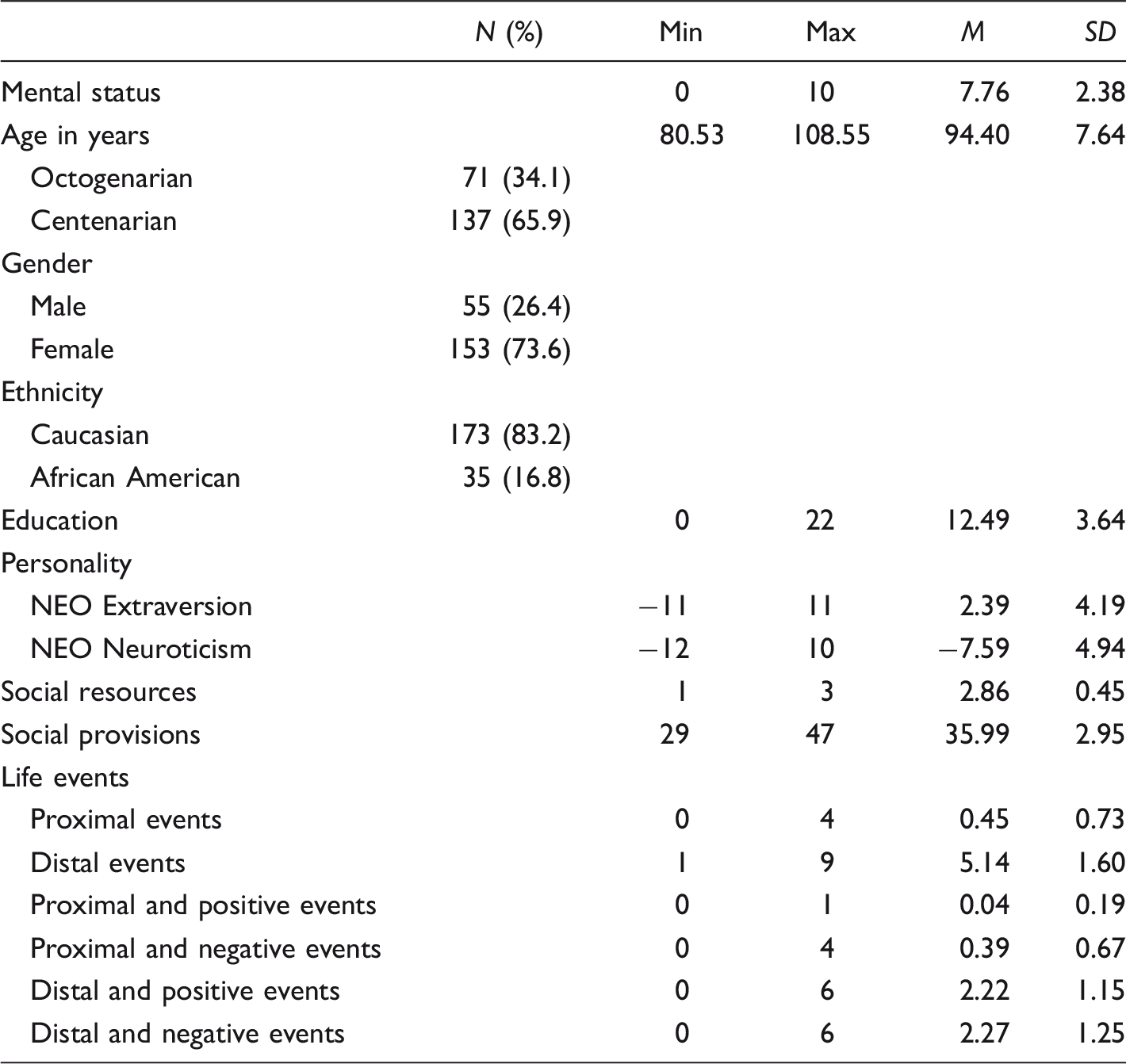
Demographic Characteristics.
Note. N = 208.
Measures
Mental status
The Short Portable Mental Status Questionnaire (SPMSQ; Pfeiffer, 1975) was used to measure mental status. The SPMSQ is a 10-item test for examining the intellectual impairment of older adults. It contains four distinct concepts of intellectual functioning: orientation, memory function related to the capacity for self-care, remote memory, and capacity to perform several mental operations. The items included questions such as “What is the date today,” “What day of the week is it,” “What is the name of this place,” “What is your telephone number,” and “How old are you?” High scores indicated good mental status. Cronbach’s alpha for this measurement was .76.
Positive or negative, distal or proximal life events
The Psychiatric Epidemiology Research Interview Life Events Scale (Dohrenwend, Krasnoff, Askenasy, & Dohrenwend, 1978) was utilized to count the number of positive and negative life events. From the list of 102 life events, we selected a total of 23 events and asked whether the events had happened to them (1 = yes and 0 = no) at any time of their lives. We counted the number of the life events each person had experienced throughout their life. This inventory includes birth of children, death (of each family member and friends), divorce (of own and parents’), employment (employment, change, and retirement), financial problems, residential change, health change, relationship worsening, and being burglarized. A single question “Was the event positive or negative?” was used to measure the impact of each event perceived by the oldest-old adults (−1 = negative; 0 = neutral; 1 = positive). To measure the proximity of each life event, if the participants experienced the event more than 20 years before the interview, it was coded as a distal event, and proximal events were coded if they had happened within the last 2 years.
Personality
The NEO Five-Factor Inventory (Costa & McCrae, 1989) was used to measure two dimensions of personality among older adults—extraversion and neuroticism. Older adults responded to two sets of 12-item questions for extraversion and neuroticism. Items for neuroticism included: “I often feel inferior to others” and “When I am under a great deal of stress, sometimes I feel like I am going to pieces.” Items for extraversion included: “I like to have a lot of people around me” and “I laugh easily.” Cronbach alpha for extraversion was .90 and for neuroticism was .93.
Social resources
One item of the Older Americans Resources and Services assessment (Fillenbaum, 1988) was used to measure how many social resources the participants had. Older adult participants were asked how many people they knew well enough to visit (0 = none; 1 = one or two; 2 = three or four; 3 = five or more).
Social supports
The Social Provisions Scale (Cutrona, Russell, & Rose, 1987) comprised of 12 items was used to measure the level of social supports. Items of the scale include: “There are people I can depend on to help me if I really need it,” “there are people who enjoy social activities I do,” “I feel personally responsible for the well-being of another person,” and “there are people who admire my talents and abilities” (1 = strongly disagree through 4 = strongly agree). Cronbach alpha was .75. The summary score from all the answers was used, and high scores indicated more social supports.
Covariates
Demographic information included age (0 = octogenarian, 1 = centenarian), gender (0 = male, 1 = female), race (0 = Caucasian, 1 = African American), and education (in years).
Data Analysis
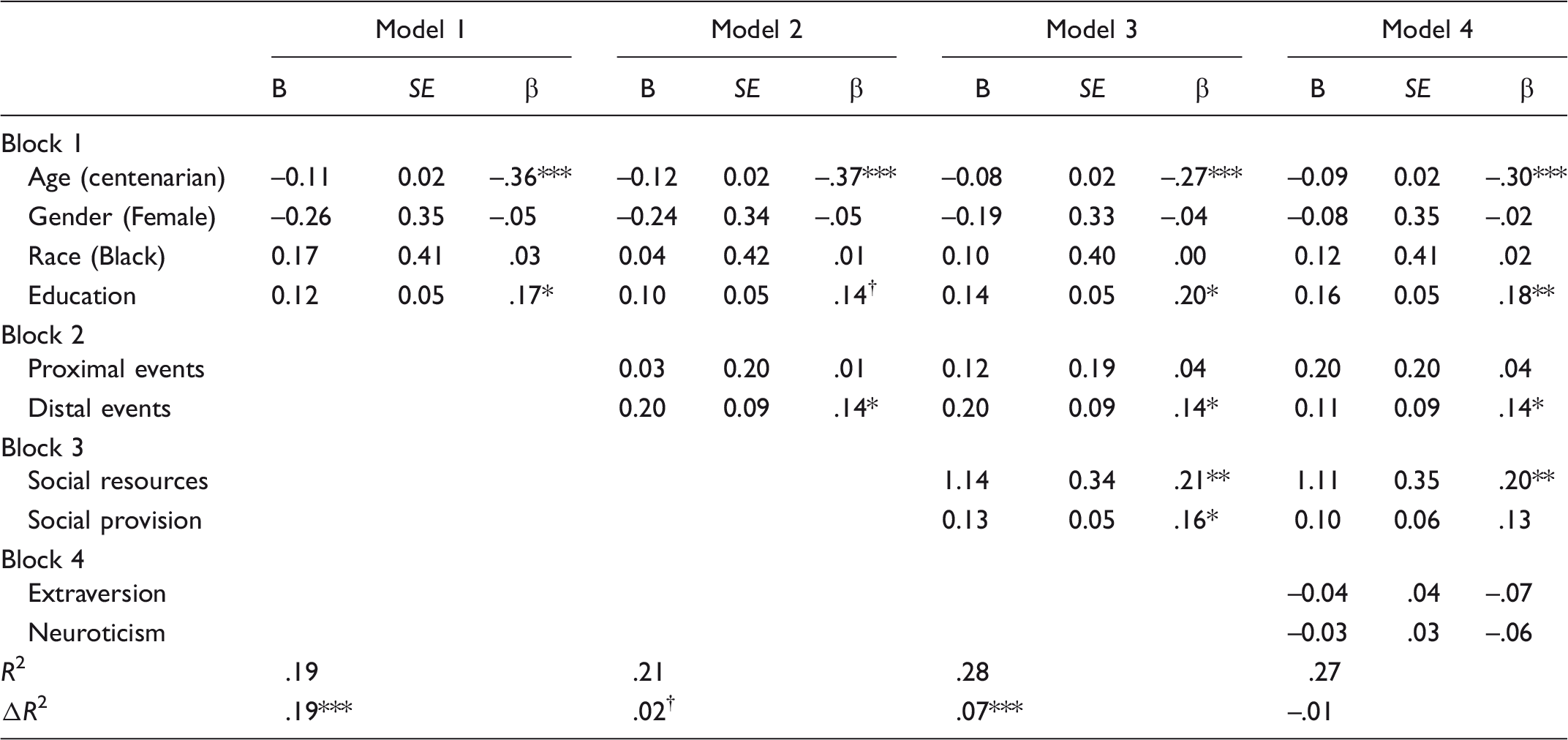
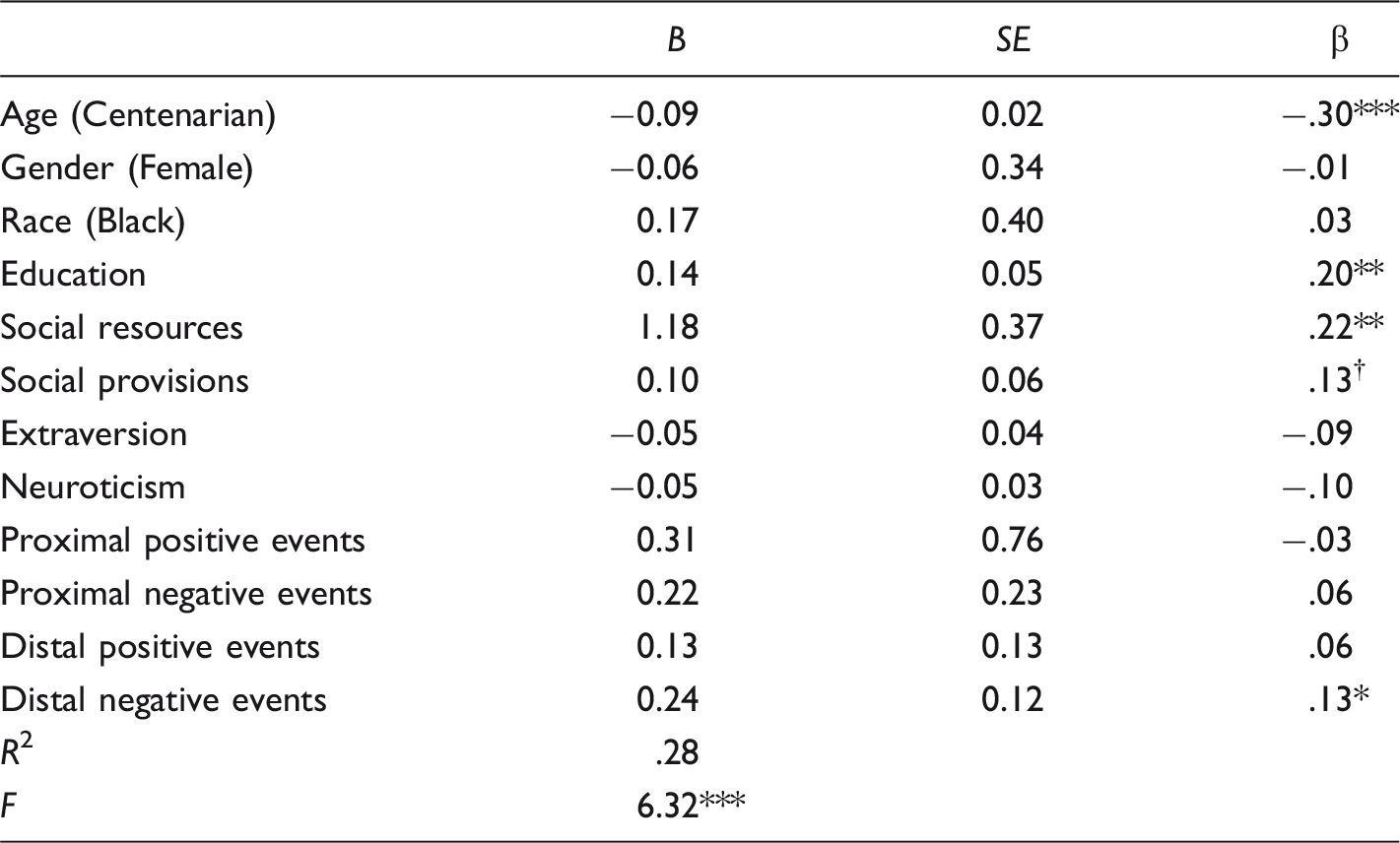
Descriptive statistics were computed using IBM SPSS 22.0. Utilizing Mplus 7.0, Pearson correlations followed by two sets of blockwise multiple regression analyses were computed: the first analyses with five models was to test the effects of demographic variables, personality, social supports, and life events on mental status in later life. Demographic variables were entered as the first block in Model 1. We then added distal and proximal life events to the second block in Model 2, social resources and provisions to the third block in Model 3, and extraversion and neuroticism to the fourth block in Model 4. In this way, Model 4, the final model, showed the total variance explained by all the study variables. In the next regression analysis, four types of life events were entered into the model; life events were categorized based on the time distance between the life events and the interview year and whether the participants interpreted the events as positive or negative. All the statistical estimates and p values were adjusted for missing data using multiple imputation methods with five imputations.
Results
Table 1 presents descriptive characteristics. Participants’ mean score of mental status was above 7.76 for the 10 items of SPMSQ. Personality scores of the participants showed that oldest-old adults were more likely to be extraverted and less neurotic. The mean score of social resources showed that they knew close to five people well enough to visit. The mean social provisions score of 35.99 was also high compared with the possible maximum score of 48. The mean number of proximal and distal events was .45 and 5.14, respectively. Considering the positivity of events, the mean number of distal and negative events were the most frequent events (M = 2.27, SD = 1.25), and proximal and positive events (M = 0.04, SD = .19) were the least likely to occur.
Bivariate Correlations Among Study Variables.

Note. N = 208.
p < .05. **p < .01. ***p < .001.
Multiple Regression Analyses on Mental Status.
Note. N = 208.
p < .10. *p < .05. **p < .01. ***p < .001.
Multiple Regression Analysis on Mental Status.
Note. N = 208.
p < .10. *p < .05. **p < .01. ***p < .001.
Discussion
This study examined the influence of distal and proximal life events on mental status in later life. The results isolated two major findings related to the relationship between life events and mental status. First, regarding the proximity of events, distal events were more influential than proximal ones on the mental status of the oldest-old, although the memory of distal life events might be more inclined to fade as time goes by. Developmental outcomes shown in later life are the result of accumulated influences throughout one’s life (Elder, 1974). Therefore, life events that occur in earlier life can be more influential than ones in later life. For example, if a child experiences the loss of a parent due to an accident, the family might experience financial problems. This could then result in the loss of opportunities related to education for this child, which may finally lead to lower socioeconomic status and poor overall health behaviors and outcomes. The death of a parent in middle or older age may not affect the individual in the same way as it does a child (e.g., Kendler, Nele, Kessler, Heath, & Eaves, 1992). Just as early life experiences influence many health outcomes, mental status in late life also can be influenced by early life experiences. Martin and Martin (2002) suggested in their developmental adaptation model that the influences of early life events continue to be important in later life and that distal events influence developmental outcomes through proximal experiences. Martin and Martin added that other proximal factors such as individual and social or economic resources play a significant role in yielding developmental outcomes. Coping strategies, a major part of the Martin and Martin’s model, have also been suggested to influence developmental outcomes by buffering the effects of recent events. If coping strategies matter, the timing of life events may be critical because older adults are more likely to use effective coping strategies than younger people. For example, Whitty (2003) compared three age groups and reported that younger groups (17–23 years old) used less effective coping strategies when compared with middle-aged and older adults.
Second, we found that only negative distal events were associated with mental status of oldest-old adults. This result also relates to previous findings (Baumeister, Bratslavsky, Finkenauer, & Vohs, 2001; Taylor, 1991), suggesting that negative events are more psychologically influential than positive ones. Baumeister et al. (2001) speculated that negative events are stronger than positive events. They explained that this occurs because through the act of coping with negative events, individuals can glean new insight regarding how to deal with difficult situations. This better prepares them for future negative events that may occur. Another plausible explanation relating to the saliency of negative events is the long-lasting nature of negative events. Previous studies have shown that negative events are not only more powerful but also have a more lasting effect than positive events (Draper et al., 2008; Ege, Messias, Thapa, & Krain, 2015; Maschi, Viola, Morgen, & Koskinen, 2015).
In the present study, the direction of negative distal events’ effect on oldest adults’ cognition was positive, and effectively predicted better mental status in the oldest-old. This result is inconsistent with findings from several other studies which suggested that negative life events are associated with poor cognition (e.g., Klein & Boals, 2001) or are not associated (e.g., Grimby & Berg, 1995; Rosnick, Small, McEvoy, Borenstein, & Mortimer, 2007; Vondras et al., 2005).
Although some studies (e.g., Comijs et al., 2011; Saczynski, Rebok, & Holtzman, 2002) support our finding that stressful or negative life events predict better cognition, the effect of distal events on mental status in later life has not been explained well. We suggest that practice-and-improvement of cognitive function can account for this. Negative life events may challenge older adults to use cognitive functions to cope with the events, which finally contributes to improvement in cognition. The findings of Frankenhuis and de Weerth (2013) support this explanation. They reported that children with stressful experiences demonstrated advanced cognitive functioning in detection, learning, and memory, especially if the tasks involved safety-related stimuli. In other words, individuals experiencing negative life events were more likely to cope with difficulties effectively, which may result in the development of cognition during the problem-solving process.
Some may raise questions about the results arguing that recalling life events involves cognitive processes. In fact, the literature on autobiographical memory has indicated that older adults’ cognitive decline and autobiographical memory are closely related to each other (Leyhe, Müller, Milian, Eschweiler, & Saur, 2009). However, we limited our life events list to major events that are most likely remembered by older adults who are not cognitively impaired (e.g., marriage, children, retirement, institutionalization).
Regarding the positivity of life events, it could be argued that life events cannot be defined easily as positive or negative. Depending on the context, certain life events can be either positive and negative or ambiguous. For example, an adult child may have an adverse relationship with a parent. This individual could have positive feelings associated with the death of a parent rather than negative emotions. Another example of the complexity of life events is the termination of the relationship with a spouse. If the relationship was unhappy, perhaps that person would not perceive divorce as negative. Further, perhaps some negative life events can be interpreted as positive after a certain period has lapsed. A severe financial problem can be regarded as a good opportunity to learn about financial planning, savings, and earnings. In future research, it would be worthwhile for researchers who are studying life events to consider this issue.
Social resources and social supports were significantly associated with better cognition of older adults, which supports previous research (Barnes et al., 2004; Seeman et al., 2001; Zunzunegui et al., 2003). Although this study is a cross-sectional study, our findings suggest that social ties and support available for older adults may prevent cognitive declines or impairment in later life. Barnes et al.’s (2004) explanation of the effect of social resources shares the basic direction of the effect of negative life events suggested in the current study. They suggested that the cognitive challenge people gain from social relationships and activities may work to prevent cognitive decline. Their additional explanation that fewer social resources may be an early sign of cognitive decline is also relevant to the findings of the present study.
Although previous studies indicated that there was an association between extraversion or neuroticism and cognitive functioning (Booth et al., 2006; Boyle et al., 2010, Pearman, 2009, Soubelet & Salthouse, 2011; Waggel et al., 2015), the results of the current study did not support earlier findings. There are three possible explanations. First, our results represent the effect of personality on cognition for oldest-old adults. Even if personality plays an important role in the changes of cognition during a certain period, its impact may become less significant compared with other factors such as education, social support, and distal life events as shown in the current study. Second, although the majority of studies suggest that personality is stable over time, some provide evidence that particular traits can change in oldest-old age (e.g., Berg & Johansson, 2014). Therefore, the changing characteristic of personality may have diluted the influence of personality on cognition. Finally, a survival bias from the effect of personality on longevity could partly explain the current finding. Martin et al. (2006) reported that centenarians showed higher extraversion and lower neuroticism. Thus, the associations between personality, longevity, and cognition should be further studied to confirm the effect of personality on oldest-old adults’ cognition.
Several associations between covariates and cognition were found. Higher education level was associated with better cognition. Considering the fact that education is also a distal experience, the strong effect of distal events on cognition is supported by this finding. The nonsignificant association of gender and cognition does not support previous findings (Aartsen et al., 2003) that women showed higher levels of memory functioning.
Limitations
This study has several limitations. First, we employed the retrospective response method measuring the number and timing of life events. With this approach, there might have been considerable recall-bias. Although participants whose cognition was severely impaired were excluded from the study, whether certain life events had truly happened or had been forgotten cannot easily be verified. Cross-checking the responses by older adults’ close family members may increase the validity of the reported events. Furthermore, as Seidlitz and Diener (1993) noted that happy people tended to interpret events more positively than unhappy people, the concept of positive and negative events can have different interpretations. It is also possible that participants’ interpretations of life events change: negative events at the time of occurrence may be reinterpreted as neutral or even positive at later times.
Second, because events were only rated dichotomously (e.g., positive or negative), we do not have sufficient information about the strength of negativity or positivity. Therefore, we could not identify the effects of extremely negative life events such as the experience of trauma. Comijs et al. (2011) suggested that only extreme life events influenced cognition. Likewise, we were not able to differentiate the influence of very positive life events.
Third, this sample cannot be considered representative because the sample included only centenarians and octogenarians residing in Georgia. Furthermore, the findings of the study only represent very old age groups.
Finally, the timing criteria of distal and proximal events and the life event items are somewhat arbitrary. Proximal and distal events were defined as having occurred up to 2 years ago and 20 or more years, respectively. Our definition of proximal events concurs with the stress and coping literature that typically defines recent events as those occurring in the last 1 to 2 years (e.g., Foster, 2011). We chose a 20-year time span for distal events because we wanted the distal events to have occurred before centenarians became octogenarians and before octogenarians became sexagenarians. Life events that had happened between these two periods were therefore not included. Because of our life-span perspective on life events, some events were more likely to have occurred earlier in life (e.g., birth of children and employment), whereas others were more likely to have occurred late in life (e.g., health changes, institutionalization).
Recommendations for Future Work
One of the primary challenges in work on life events is participants’ memory bias. A good way of addressing this issue is to collect longitudinal data. Micro longitudinal studies such as the daily diary method would be beneficial to obtain detailed information about the influences of daily events.
We future recommend future studies to investigate the influence of historical events. Da Rosa, Martin, Gondo, Hirose, Ishioka, and Poon (2014) reported oldest-old adults in Japan mentioned historical events such as the Great Depression and world wars as some of the most important life events they had experienced. The results of international research on the effect of life events including historical events would not only help us understand individual development but also indicate prevalence differences in cognitive impairment shown in different countries (e.g., Prince et al., 2013).
Future research should more closely investigate the nature of negative distal events, perhaps with comprehensive qualitative studies. In addition, neuropsychological assessments may help explain negative events, particularly if they were traumatic experiences.
Life events should also be studied qualitatively. If distal negative life events are associated with better cognition, why and how is this so? Qualitative studies can consider the individual, family, and social context as well as the role of coping with stress (e.g., Liu, Guo, & Bern-Klug, 2013).
Conclusion
Our study found that distal negative life events and social supports are strong predictors of mental status among oldest-old adults. We did not, however, find effect of older adults’ personality traits on cognition. Contrary to common belief that stress is harmful for cognition, the current study showed that distal negative life events could promote better cognition. We hope the positive effect of distal stress on mental status reported in the current study stimulates future work related to the positivity and proximity of life events.
Footnotes
Acknowledgments
Additional investigators of the Georgia Centenarian Study include S. M. Jazwinski, R. C. Green, M. MacDonald, M. Gearing, W. R. Markesbery (deceased), J. L. Woodard, J. S. Tenover, I. C. Siegler, W. L. Rodgers, C. Rott, A. Davey, and J. Arnold. Authors acknowledge the valuable recruitment and data acquisition effort from M. Burgess, K. Grier, E. Jackson, E. McCarthy, K. Shaw, L. Strong and S. Reynolds, data acquisition team management; S. Anderson, E. Cassidy, M. Janke, and J. Savla, data management; M. Poon for project fiscal management.
Declaration of Conflicting Interests
The authors declared no potential conflicts of interest with respect to the research, authorship, and/or publication of this article.
Funding
The authors disclosed receipt of the following financial support for the research, authorship, and/or publication of this article: The Georgia Centenarian Study (Leonard W. Poon, PI) is funded by 1P01-AG17553 from the National Institute on Aging, a collaboration among The University of Georgia, Tulane University Health Sciences Center, Boston University, University of Kentucky, Emory University, Duke University, Wayne State University, Iowa State University, Temple University and University of Michigan.