



Abstract
Burgeoning evidence has shown that neighborhood environments are related to depressive symptoms in the older population. Older adults living in residential care homes may be more vulnerable to environmental characteristics. The current study sought to understand how institutionalized older adults relate to environmental factors and residential satisfaction in terms of depressive symptoms. Data were collected from a cross-sectional national survey of 1,429 Chinese elders living in residential care homes. The findings reveal that 46.1% of the older Chinese residents living in residential care homes suffered from mild to severe depression. In addition, the current study finds that both environmental factors (e.g., geographic position, air quality, and transportation) and residential satisfaction are negatively associated with depressive symptoms. The findings support that residential satisfaction partially mediate the relationship between exterior environmental characteristics and depressive symptoms.
Keywords
Introduction
As one of the fastest aging societies among the Asia Pacific regions, China has a large proportion of aging population due to a longer life expectancy and a dramatic decline in fertility rates. Although many older adults choose to age at home, as the commonest form of accommodation (Perez, Fernandez, Rivera, & Abuin, 2001), living in residential care homes (RCHs) is still upheld by the elders who are in need of professional care (Mello, Engstrom, & Alves, 2014).
It is important to pay attention to the physical and mental well-being of older adults living in RCHs. Previous studies mainly focused on residents’ quality of life (Hoe, Hancock, Livingston, & Orrell, 2006; Lee, Yu, & Kwong, 2009), the physical and functional health of elders (Merrell, Philpin, Warring, Hobby, & Gregory, 2012), and residential service quality from the provider’s point of view (Chou, Boldy, & Lee, 2002). Little is known about the relationship of residential environment with mental health in aged care settings (Prieto-Flores, Fernandez-Mayoralas, Forjaz, Rojo-Perez, & Martinez-Martin, 2011). Empirical evidence is found to support the influence of environmental characteristics in health and behavior among the institutionalized older adults (Baltes, 1982; Carp & Carp, 1984; Moos & Lemke, 1996) and the positive association of residential satisfaction with psychological well-being (Sirgy & Cornwell, 2002) in other countries. However, late-life depression among institutionalized elders and the extent to which depression may be affected by the environment or neighborhood where they live have received limited research. This study aims to examine the prevalence of depression among institutionalized elders in China and understand how older adults relate to environmental characteristics and residential satisfaction in terms of depressive symptoms through a cross-sectional survey of Chinese elders living in RCHs recruited in a national survey.
Residential Satisfaction and Residential Care Settings
The relationship between person and the residential environment is a significant topic, leading to a number of studies that have sought to explain how well people adapt to their living environments (Phillips, Cheng, Yeh, & Siu, 2010). Home environments are considered one of the most salient environments in human’s life course, especially for elders those with physical and functional disabilities (Rioux & Werner, 2011). There is a growing literature that support elders’ aging in place, without having to change residence, as the prevalent form of accommodation. The residential setting, as in the home, may be central to the residents’ experience and to their well-being (Cheng, Rosenberg, Wang, Yang, & Li, 2011). Different from community-dwelling elders, older adults living in RCHs are away from their homes where they have more ties and binding memories of family members. Hence, it is significant to understand the influence of environment and neighborhood characteristics on residential satisfaction of the older adults after their relocation from homes to RCHs.
Empirical studies have unraveled a body of factors that contribute to the extent of residential satisfaction, consisted of dwelling conditions (interior environment and exterior environment), relationships with neighbors, the local physical environment (safety, presence of and access to services, traffic, geographical position), and health features (air quality and pollution) in their conceptual frameworks (Bonaiuto, 2004; Francescato, 2002; Phillips, Siu, Yeh, & Cheng, 2005). Specially, residential satisfaction of elders in RCHs may be subject to the service quality (Chou et al., 2002), caring facilities (Chou, Boldy, & Lee, 2003), interactions with peer residents (Adriaanse, 2007; Phillips et al., 2005), and the local environment factors (Bonaiuto, 2004).
Within the past 10 years, there has been a burgeoning number of studies focusing on the importance of person-environment (P-E) fit and residential satisfaction in Chinese societies (Cheng et al., 2011; Ouyang, Chong, Ng, & Liu, 2015; Phillips et al., 2010; Phillips et al., 2005; Zhan, Liu, Guan, & Bai, 2006). Most of the research focuses on people living in the community, and the studies conducted in RCHs are limited. RCHs in China have experienced a two-stage development. Before the 1980s, RCHs for the older people in China were mainly managed by the government and only provided services for the vulnerable elders (e.g., elders without children, the disabled, and the impoverished). The services were limited to basic physical care with little consideration for social or emotional care needs (Zhan et al., 2006). Afterward, social welfare institutions witnessed a structural reform through absorbing more types of funding. RCHs for the elders in China started to provide a variety of higher standards of services to meet the social, emotional, and spiritual needs of older residents (Zhan et al., 2006). Like nursing homes and hostels in English-speaking countries, RCHs in China generally provide services which can be categorized into six domains—room, home, social interaction, meals service, staff care, and resident involvement (Chou et al., 2002). Additionally, the site selection of RCHs is not restricted to traditional areas that are distant from the center. Many new RCHs are built in good locations in urban and rural areas to satisfy residents’ needs in terms of transportation convenience, air quality, and so on.
Depressive Symptoms of the Elders in RCHs
Depression in old age encompasses a broad set of chronic and recurrent symptoms characterized by sadness and low mood, which is a significant risk factor contributing to functional impairment and poor health-related quality of life (Blazer, 2002; Segal, Williams, & Teasdale, 2012). Depressive symptoms of older adults are generally recognized more common in nursing homes than in communities (Brown, Lapane, & Luisi, 2002). In China, empirical research has showed that the prevalence rate of depression among institutionalized elders varies from 50% in Shanghai city (Yao, 2010), 31.1% in Shenzhen city (Yi & Yan, 2006), and 38.5% in Guangzhou city (Shi, Wang, Liang, Gao, & Chen, 2007). Most of the previous studies conducted in China demonstrated that the prevalence of depressive symptoms was higher among the institutionalized elders than the community-dwelling elders (Yi & Yan, 2006).
A wide range of risk factors for depression in older adults has been associated with physical or cognitive functional impairment, chronic medical conditions, sleep disturbance, bereavement and major losses, and social isolation (Cahoon, 2012; Madhusoodanan, Ibrahim, & Malik, 2010). Among the above factors, repeated studies have demonstrated a relationship between functional disabilities and depressive symptoms in the older adults (Dunne, Wrosch, & Miller, 2011; Yang, 2006). Additionally, gender, educational attainment, length of dwelling in RCHs, perceived health status, and life satisfaction have been identified to affect depression of older residents in China (Shi et al., 2007; Yao, 2010; Yi & Yan, 2006). Despite the increased awareness of depression among elders in RCHs, only a handful of researchers have addressed the role of environment characteristics and residential satisfaction on depressive symptoms. In terms of environment characteristics, family environment (Agid et al., 1999), social network and neighbor environment (La Gory & Fitpatrick, 1992), and urban built environment (Galea, Ahern, Rudenstine, Wallace, & Vlahov, 2005) have all been detected to be associated with depression. As to the effect of residential satisfaction, most studies tended to merge it into the effect of life satisfaction, which was demonstrated to result in depressive symptoms in Chinese societies (Zheng et al., 2010). To the best of our knowledge, the understanding of the influence of exterior environment factors (e.g., location, air quality, transportation) on residential satisfaction and depression is sparse. Thus, there is a great need to contribute an additional study to this growing field by exploring environmental parameters and depression among the older adults in residential care settings.
Theoretical Framework
Past research has demonstrated significant effects of environmental characteristics and residential satisfaction on mental health and psychological well-being in later life. Local residential environment is believed to have profound consequences for social and psychological domains (La Gory & Fitpatrict, 1992). Several studies in the United States and Asia have found strong positive relationships between residential satisfaction and psychological well-being (Phillips & Yeh, 1999; Siu & Phillips, 2002). Environmental characteristics are thought to trigger the perceptions or appraisals of people’s residential environment and ultimately affect psychology well-being (Kahana, Lovegreen, Kahana, & Kahana, 2003; Phillips et al., 2010; Phillips et al., 2005).
There are good theoretical reasons to believe that residential satisfaction mediates the effects of environmental characteristics on depressive symptoms. Initially, the P-E congruence model takes into account a wide range of factors in the dwelling context that might be utilized to meet the needs of residents to maintain equilibrium (Hooyman & Kiyak, 1996; Kahana, 1982). Subsequent developments of this model have revealed the predicting effect of environmental characteristics and individual needs or preferences on older person’s well-being (Chong, 2001; Kahana, 1982; Kahana et al., 2003). Regarding the elders in RCHs, they are usually not in a position to change the environment or to leave the place; therefore, the congruence between environmental characteristics and residents’ appraisals is more inclined to foster satisfaction and morale (Kahana, 1982). Moreover, researchers adopting conceptual frameworks based on the congruence model have identified the influences of P-E transactions on residential satisfaction and psychological well-being (Cvitkovich, 1999) by specifying the exterior environment and the interior environment (Perez et al., 2001; Phillips et al., 2005).
In addition to implications of the P-E congruence model, few empirical evidence have been found to uncover the mediating mechanism of residential satisfaction on environmental characteristics and psychological well-being among older persons. In gerontological research, residential satisfaction is regarded as a relevant variable because it is shown to be a significant predictor of residential mobility and psychological well-being of the elders (Reschovsky, 1990). It is supposed that high satisfaction with residential environment will mediate the effect of environmental characteristics, which usually stem from exterior environmental factors, and generate positive effect on psychological well-being. In a study conducted among Hong Kong Chinese older adults, Phillips et al. (2005) found that residential satisfaction fully mediated the effect of environmental factors on psychological well-being. They also proclaimed that environmental characteristics and their relation with well-being of elders depended on the extent to which individual’s expectations of residential satisfaction are met (Phillips et al., 2005).
The Present Research
Empirical research on environment, residential satisfaction, and depression among institutionalized elders has been scarce, especially in Chinese context. The present study seeks to build on existing literature and identify the most appropriate pathways to understand how institutionalized older adults relate to the environment characteristics and residential satisfaction in terms of their depressive symptoms through a national survey. The aim of the study is threefold. First, the research attempts to examine the environmental and residential correlates of depressive symptoms from the current sample consisting of 1,429 respondents living in RCHs. Second, the study examines the relationships between exterior environmental factors (e.g., geographic position, air quality, and transportation convenience), residential satisfaction, and depressive symptoms of Chinese elders living in RCHs. Third, this study aims to address the research gap by illuminating the meditating role of residential satisfaction contributing to environment–mental well-being relationships in Chinese RCH settings.
Method
Sample
Data for analysis were taken from a cross-sectional survey conducted by China Research Center on Aging (CRCA). The sample was obtained through a stratified multistage sampling method across mainland China. This method is considered advantageous to increase the representativeness of the sample to the target population (Babbie, 2013). First, the primary sampling units were all the 31 provinces in mainland China. According to the geographical location of each province, the 31 provinces were classified into four regions: the east (10 provinces or municipalities), the west (12 provinces, municipalities or autonomous regions), central (6 provinces), and the northeast (3 provinces). Then, the probability proportional to size sampling method was adopted to capture 10 province-level units, based on the distribution of population aged 60 and over from the fifth National Census (National Bureau of Statistics of China, 2000). The selected 10 sample provinces encompassed three provinces each in the east (Jiangsu, Shandong, and Guangdong), the west (Shanxi, Sichuan, and Yunnan), the central (Anhui, Shanxi, and Hubei), and one in northeast (Heilongjiang). Second, a simple random sampling method was used to select one urban city and one rural county within each sampled province. Consequently, 10 cities and 10 counties were obtained. In the third stage, 10 RCHs were randomly selected within each city or county, as a result, a total of 200 RCHs was collected. In the last stage, nine older residents from each urban RCH and eight from each rural RCH were randomly selected, respectively. Consequently, a sample of 1,700 residents was obtained (Ouyang et al., 2015).
Structured questionnaire designed by CRCA research team was successfully administered to 1,636 respondents by trained interviewers from March 2010 to May 2010. The survey had a response rate of 96.2%. The main variables and demographic variables had a modest amount of missing values approximate to 1%. The missing data on the demographic variables were handled through listwise deletion. The missing values for environmental characteristics, residential satisfaction, and depressive symptoms were imputed using the expectation–maximization algorithm (Ouyang et al., 2015). Finally, the sample for analysis was composed of 1,429 participants.
Data Collection
Social workers and volunteers recruited from the Committee on Aging in each selected unit constituted the interviewers’ team. Prior to participation, the interviewers were given a handbook specifically designed for the survey and trained by CRCA staffs. Researchers from CRCA who were equipped with rich fieldwork experience with elders worked as supervisors in the preliminary interview process. Respondents received an information sheet detailing relevant information about the study. All respondents signed the consent form. Interviewers completed the questionnaire for all respondents by reading out all questions. Upon the completion of the questionnaire, all participants were presented incentives as a sign of gratitude. To ensure accurate responses, 10% of the questionnaires completed by each interviewer were systematically checked by the supervisors in CRCA.
Variables and Measures
Depressive symptoms
The dependent variable of the study is depressive symptoms, measured by the 15-item short form of Geriatric Depression Scale (GDS-15). This measure was translated into Chinese and validated by Mui (1996). Each item was coded as 0 = no and 1 = yes. The total score ranged from 0 to 15, with a higher score signifying a higher level of depressive symptoms. GDS-15 has been widely used in China and shown to have good reliability among older adults in China (Boey, 2000; Mui, 1996). The Cronbach’s α was .85.
Residential satisfaction
Residential satisfaction usually refers to individuals’ appraisal of the conditions of their residential environment, in relation to needs, expectations, and achievements in their homes or sphere of location (Amérigo & Aragonés, 1997). In the present study, residential satisfaction was measured by a 12-item scale designed by CRCA. Questions of the scale were adopted to access different aspects of residential satisfaction: dining, accommodation, activity space, hygiene, barrier-free facilities, gym and rehabilitation, comfort of the room, bathing, going to the toilet, attitudes of nursing staff, professional skills of nursing staff, and scheduled activities. Each item had three options: 1 = not satisfied, 2 = neutral, and 3 = satisfied. The total score ranged from12 to 36. The higher the score, the more residential satisfaction were detected through the scale. The Cronbach’s α was .90.
Environmental characteristics
In this study, environmental characteristics referred to the perceptual exterior factors of the RCHs in which the respondents lived. Previous studies have showed that both subjective and objective measures of neighborhood conditions correlated well with residential satisfaction (Carp & Christensen, 1986). The older residents were asked about their subjective perceptions toward the exterior environmental conditions, namely, health features and physical amenities: “how do you evaluate your surrounding environment, including the geographic position, air quality, and etc.?” and “how do you evaluate the transportation system around your RCH?” The two items were rated on a 3-point scale (1 = bad, 2 = neither bad nor good, and 3 = good). The total score ranged from 2 to 6, with a higher score indicating better exterior environmental conditions that the RCH possessed. The reliability of the scale was basically satisfactory with a Cronbach’s α of .71.
Functional disability
Functional disability was selected as a control variable in this study. It was assessed using the measures of activities of daily living (ADL), instrumental ADL (IADL), and mobility developed by the CRCA. Respondents were asked to report their dependence in the following six ADL impairment categories in the previous 3 days: eating, dressing, bathing, using the toilet, moving about indoors, and getting into and out of bed. IADL impairment was measured by the sum of each respondent’s ability to complete seven tasks during the previous 7 days, namely cooking, doing the laundry, shopping, making phone calls, sweeping, taking buses, and managing money. Mobility was measured by three items, carrying objects weighing 10 kg, walking 1.5 to 2.0 km and climbing stairs. Each item was coded as 1 = not difficult at all, 2 = a little bit difficult, and 3 = unable to do the task. The overall score of functional disability was the unweighted sum of these 16 items, ranged from 16 to 48. The higher score indicated higher functional disability. The Cronbach’s α was .88.
Sociodemographic factors
Sociodemographic characteristics of the older adults living in RCHs at baseline were entered in the process of data analysis as control variables. Participants were asked to report their age (in years), gender, educational attainment (illiterate, primary, secondary, and college), marital status (never married, married, divorced, and widowed), length of dwelling in RCHs (less than 6 months, 6 months to 12 months, and more than 12 months), and monthly income (below US$82, US$82–246, and above US$246). In the subsequent analyses, most of the demographic variables were dummy coded except that age was analyzed as a continuous variable.
Data Analysis
Analysis was performed using IBM Statistical Package for the Social Sciences (SPSS) version 21 and AMOS 21.0. Descriptive statistics for key variables are reported. Following this, hierarchical regression analysis was adopted to explore the relationship between independent variables (environmental factors and residential satisfaction), dependent variables (depressive symptoms), and control variables (functional disability and sociodemographic factors). To assess the mediation effect, path analysis was employed using AMOS.
Results
Sample Characteristics
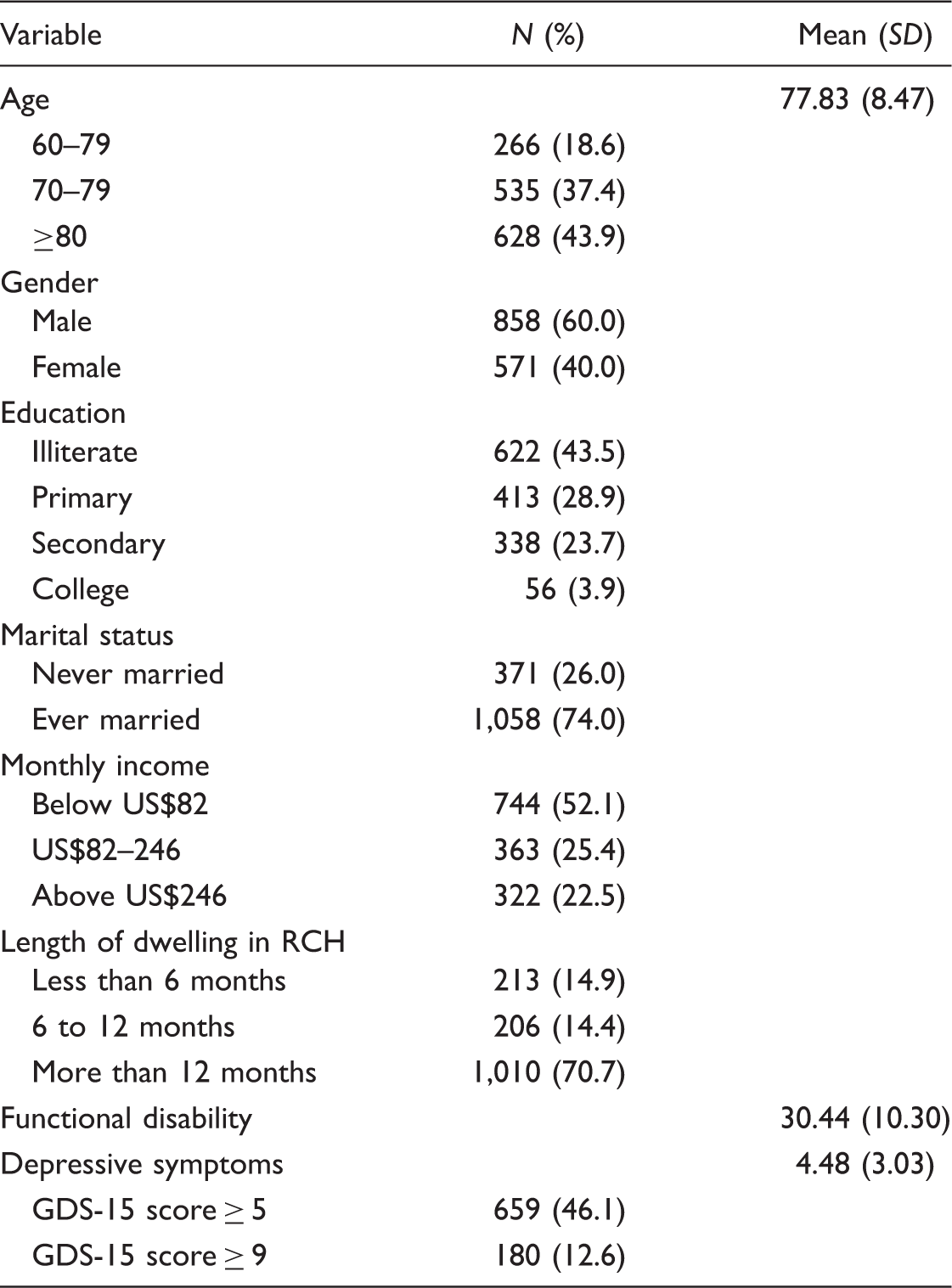
Sample Characteristics of the Elders Living in RCHs (N = 1,429).
Note. GDS = Geriatric Depression Scale.
Hierarchical Regression Analysis
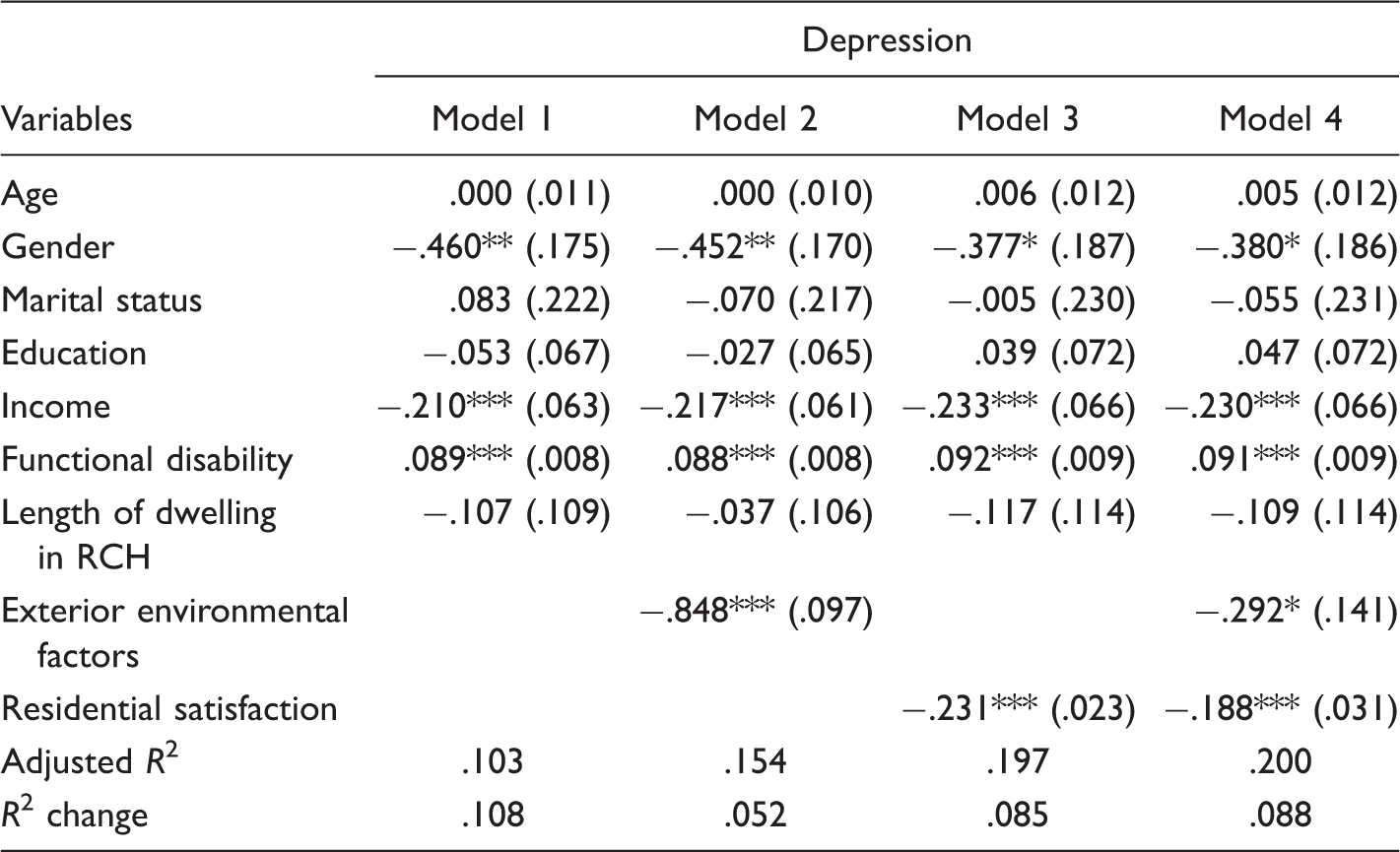
Regression of Depression on Exterior Environmental Factors, Residential Satisfaction, and Sociodemographic Factors.
Note. Unstandardized coefficients with standard errors are shown in parentheses, N = 1,429. RCH: residential care home. Gender (female = 2 and male = 1), marital status (ever married = 2 and never married = 1).
*p < .05. **p < .01. ***p < .001 (two-tailed test).
Residential Satisfaction as a Mediator Between Environmental Characteristics and Depressive Symptoms
In this study, Baron and Kenny’s (1986) method was adopted to detect the hypothesized mediating effect of residential satisfaction on the relationship between environmental characteristics and depressive symptoms among the older Chinese living in RCHs. It appears that a mediational effect occurs when a predictor conceptually triggers the mediator and in turn causes the ultimate outcome (Mackinnon, 2000). In the present study, it was hypothesized that the perception of environmental characteristics (i.e., exterior environmental factors) could trigger the expectations and subjective appraisals toward residential satisfaction, which was contributive to mental health, as indicated by depressive symptoms.
The mediation test was conducted in SPSS AMOS 21. The influences of the demographic variables (gender, age, education, marital status, and income) were entered as covariates during the analysis. The results showed that age was positively related with residential satisfaction (β = .065, p < .01) and men were more likely to report higher scores of depression (β = −.053, p < .05). Other demographic variables were not found to have significant associations with the major variables. Moreover, an earlier article has reported that functional disability was found to be positively related to depression in this sample (Ouyang et al., 2015); therefore, the effect of functional disability was also controlled in the mediation test. The analysis indicated that functional disability was positively related to depression (β = .326, p < .001). To capture the mediation mechanism between main variables, we regressed depressive symptoms on environmental characteristics in the first step. The result showed that environmental characteristics were negatively related to depressive symptoms (β = −.231, p < .001). In the second step, environmental characteristics were found to be positively related to residential satisfaction (β = .61, p < .001). In the third step, residential satisfaction was negatively related to depressive symptoms (β = −.18, p < .001). The direct effect of environmental characteristics on depressive symptoms revealed significant (β = −.121, p < .001), which means that residential satisfaction served as a partial mediator in the relationship between environmental characteristics and depressive symptoms. Furthermore, Sobel test was conducted to test the significance of indirect effect of environmental characteristics on depressive symptoms through residential satisfaction (β = −.109). The result showed that the indirect effect was significant (Z = 5.8, p < .001). The results of the mediation analysis are presented in Figure 1.
Mediation model of exterior environmental characteristics, residential satisfaction, and depressive symptoms (N = 1,429). Note. All the coefficients were significant standardized values (p < .001). The coefficient in the parentheses represents the total effect.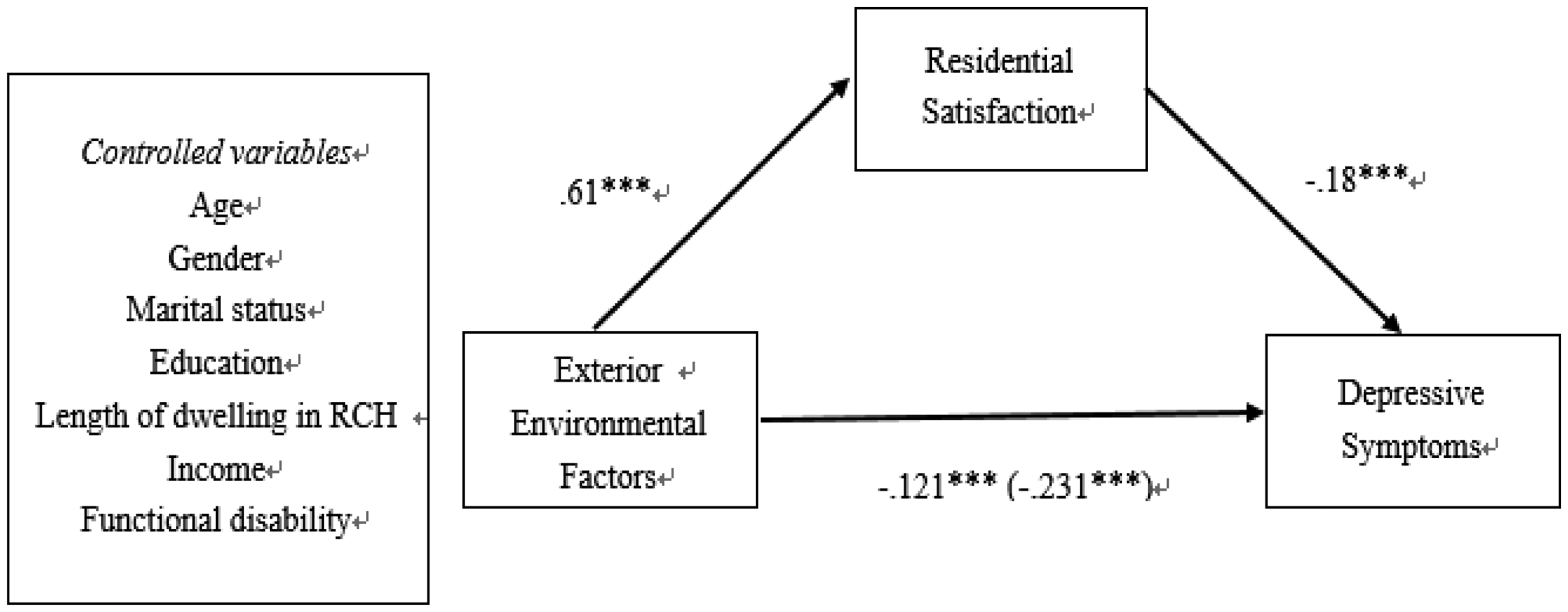
Discussion
This article examines the influences of residential satisfaction and exterior environmental factors on older people’s depressive symptoms using data of a national survey of 1,429 older Chinese living in RCHs. In terms of the depressive symptoms, the sample reflects a salient depression prevalence adopting the cutoff score of ≥ 5 and ≥ 9, respectively (Mui, 1996). Statistics suggests that 46.1% of the sample suffered from clinically significant symptoms of depression and 12.6% of the older adults experienced moderate to severe depression. The findings confirm that the older Chinese residents living in RCHs experienced a high rate of depressive symptoms, which is severer than the rate among the hospitalized and institutionalized older adults in the United States, varying from 30% to 40% (Kerber, Dyck, Culp, & Buckwalter, 2005). Moreover, the depression rate of the older residents in this sample is higher than that of the community-dwelling older adults. According to the statistics of the baseline survey under China Health and Retirement Longitudinal Study conducted in 2011–2012, almost 40% of community-dwelling Chinese older adults have significant depressive symptoms (National Development Research Academy of Peking University, 2013). Therefore, more attention should be paid to the mental health of the institutionalized older adults in RCHs and more treatment should be implemented to alleviate their depressive symptoms.
The empirical data of the present study unravel the effects of environmental characteristics and residential satisfaction on depressive symptoms among the older residents. The current study found that both environmental characteristics (e.g., geographic position, air quality, and transportation) and residential satisfaction were negatively associated with depressive symptoms. Higher appraisals of environmental characteristics of the RCHs from the participants, which is operationalized as exterior environmental factors in the current research, have been found to contribute to lower depressive symptoms. This finding is consistent with previous research that highlight the importance of physical amenities including good air quality (Kahana et al., 2003; Talbot & Kaplan, 1991) and transportation convenience (Cvitkovich & Wister, 2001) to sustain psychological well-being among older adults. Given the existing evidence that institutionalization has great impacts on the social world of older adults after leaving their familiar home and the neighborhood, the older residents tend to put more emphasis on the environmental features of the place where they reside (Grenade & Boldy, 2008; Prieto-Flores et al., 2011). As to the institutionalized older adults, there is expectation of good air to breathe, and of convenient transportation to minimize social isolation and improve access to medical services (Schaie & Pietrucha, 2000). Additionally, superior geographic position (e.g., located in the center, close to green areas) may also help maintain connections with the community and increase participation in social and leisure activities. Therefore, it could be inferred that the environmental characteristics play a significant role in affecting older resident’s psychological well-being.
Another important finding is the relationship between residential satisfaction and depressive symptoms. The current research shows that the overall score of residential satisfaction is negatively associated with depressive symptoms. This finding also lends credence to the previous evidence. In the past studies, residential satisfaction has been identified as a global representation of individual’s response of their social and physical environment and has been related to more cognitive evaluations and life satisfaction (Bonaiuto, Aiello, Perugini, Bonnes, Ercolani, 1999; Chou et al., 2002). Additionally, the positive association of residential satisfaction with health and subjective well-being among older adults has been verified in Chinese context (Phillips et al., 2005). Similar to the multidimensional construct of Residential Satisfaction Questionnaire proposed by Chou et al. (2002), the 12-item scale of residential satisfaction in the present study also examines the degree of satisfaction toward approximately six dimensions, namely room conditions, facilities, meals service, staff, resident involvement, and accommodation. Embracing a higher degree of satisfaction toward the above dimensions is deemed beneficial for older adults’ mental status, which, in turn contribute to alleviating depression.
Most importantly, the results of mediation analysis confirm the mediation mechanism between environmental characteristics, residential satisfaction, and depressive symptoms of institutionalized older adults. The findings support that residential satisfaction partially mediates the relationship between exterior environmental factors and depressive symptoms. Statistics in Figure 1 identifies the impact of exterior environmental factors, if it is to have any effect on the mental health of the older adults, tends to operate through an evaluation or appraisal process, that is, it operates through the older adult’s residential satisfaction. The present finding demonstrates the partial mediating path of the environment–mental health association via residential satisfaction among institutionalized older adults and articulates the important role that residential satisfaction plays in predicting depressive symptoms. It is in line with the prior research works that have confirmed the mediating mechanism through which residential satisfaction intervenes between environment and well-being (Kahana et al., 2003; Phillips et al., 2010; Phillips et al., 2005). The results from this study attempt to verify that a high degree of satisfaction occurs when the exterior surrounding environment meets an older person’s needs or expectations, which may further contribute to psychological well-being. It sheds light on the theoretical implications of P-E congruence model which postulates individuals are active to utilize the environment factors to meet their needs and to maintain a balancing relationship with well-being (Hooyman & Kiyak, 1996; Kahana, 1982). In other words, depressive symptoms in the current research are, to a large extent, the result of subjective appraisal of the exterior environment and dwelling. Hence, gerontological studies may also benefit from this argument in that residential satisfaction (a proximal outcome) may serve as a focal relevant outcome variable leading to psychological well-being (a distal outcome) in the conceptual framework of P-E fit.
The present study has several limitations. First, although path analysis was applied to test causal models, the present study followed a cross-sectional design. The causality direction between environmental characteristics, residential satisfaction, and depressive symptoms cannot be determined. The older adults who have suffered from depression prior to moving to RCHs might generate lower levels of residential satisfaction by ignoring the environment factors. Longitudinal studies are recommended to further assess the direction of the paths connecting these variables. Second, the data collected in the present study were primarily based on self-report measures or perceptual appraisal. We did not have access to the objective or physical indicators of the environment and residential conditions from staff or family members. Thus, there is a need to further develop indices of environment characteristics and residential conditions based on objective assessments. Third, this study only adopted a two-item scale as the measurement of environmental characteristics because of the nature of questionnaire design. Inadequate data on the environment domain might have some impacts on the interpretation of results. Future studies are suggested to construct a measurement tool with a full spectrum of environmental characteristics (e.g., social environment, safety, etc.). Fourth, the score of residential satisfaction in this study should be interpreted with caution. Self-rated residential satisfaction may be open to criticism as being relatively nondiscriminating because the older adults tend to give very high and illusive satisfaction scores (Chong, 2003).
Implications
Given the cross-sectional nature of analysis in this study, we might be immature to articulate implications of the findings for gerontological practice. Nevertheless, we think that policies and programs that aim to meet the needs and expectations of environmental characteristics, to improve the level of residential satisfaction would do many goods including preventing depression among institutionalized older adults in China. Residential satisfaction is an important outcome pertaining to policies. In our study, residential satisfaction of the institutionalized older adults acts as a significant indicator of depressive symptoms, revealing that the older adults have active involvement to adapt to residential life. The shrinking of living environment appears to be one of the major reasons that more attention are paid to the dwelling experience. Therefore, one way to enhance the older persons’ well-being could be by improving the level of residential satisfaction. As mentioned in previous sessions, the services provided by RCHs in China have witnessed a dramatic reform since decades of years ago. RCHs should not be limited to basic physical care, but begin to take more consideration for social or emotional care needs. Given the dominating belief of filial piety, most of the frail older adults move to RCHs because their family members could not provide around-the-clock care at home. Naturally, institutionalized older adults expect to have sufficient care and good psychological well-being as they can receive from their family caregivers. Therefore, the operation and management of RCHs should adhere to the notion of “residents-oriented” to meet the envisaged demands of living and caregiving by improving facilities, creating a warm residential atmosphere, organizing proper leisure activities, and bringing more interactions with the community.
Another implication goes to how to balance the needs of older residents and the residential environment. Institutionalized elders typically find themselves in unfamiliar environmental settings that they did not actively select. These settings have physical and social features that are incongruent with residents’ needs and preferences (Kahana, Kahana, & Chirayath, 1999). In accordance with the findings of this study, a high level of residential satisfaction could also be achieved by lowering expectations of the environment or making expectations more realistic, rather than considering their living environment negatively. Alternatively, older persons are encouraged to build up self-esteem and feelings of self-worth when they are confronted with unsatisfied living environment or care service (Phillips et al., 2005). Consequently, institutionalized older persons might have reduced depressive symptoms through positive appraisals and evaluations. This is one practical implication of the present study to the fields of gerontological social work. Staff of RCHs and older persons’ family members may help the older adults develop coping strategies in the face of unmet needs of the surroundings.
Conclusion
In conclusion, this article addresses the paths by which environmental characteristics affect depression among institutionalized older adults in China. The findings of the study highlight the mediation effects of residential satisfaction on the relationship between exterior environmental factors and depressive symptoms, which support the argument of P-E congruence model in understanding the P-E transactions among Chinese institutionalized older people. Despite the limitations, the current research makes some contributions. To the best of our knowledge, this is one of the very few empirical studies that examine the environment variables and residential satisfaction of institutionalized older adults in China. The use of stratified multistage sampling method allows the major findings to be partially generalized to residents living in RCHs. The study also elucidates the mediation mechanism between the residential environment and well-being of institutionalized older adults and adds empirical evidence to the P-E congruence model. In a word, the findings may produce important insights for understanding the mental health of Chinese elders in residential settings.
Footnotes
Declaration of Conflicting Interests
The authors declared no potential conflicts of interest with respect to the research, authorship, and/or publication of this article.
Funding
The authors disclosed receipt of the following financial support for the research, authorship, and/or publication of this article: This work was supported by the Ministry of Civil Affairs of China.